
Submitted:
28 June 2026
Posted:
30 June 2026
You are already at the latest version
Abstract
Ecotoxicological and occupational health hazards triggered by pesticide usage are strictly linked to the technical wear of application equipment. This study applies the industrial FMECA (Failure Mode, Effects, and Criticality Analysis) methodology to a pool of 294 knapsack sprayers operated in vegetable farming across three key zones of Côte d'Ivoire (Abidjan, Bouaké, Korhogo), alongside an assessment of growers' cognitive risk boundaries. Technical audits expose that 85% of sprayers are defective, reaching 88% in Abidjan. Pumping lever jams (211 cases), cracked tanks (105 cases), and unsealable caps (111 cases) emerge as primary structural anomalies. The FMECA approach ranks unnoticeable nozzle orifice expansion (Criticality = 40) and leaking tank caps (Very High Criticality = 48) as priority operational hazards inducing involuntary overdosing and direct dermal operator exposure. Simultaneously, a deep cognitive dissonance was documented: 96% of Abidjan market gardeners implement no water resource protection measures, undermining chemical toxicity for short-term financial trade-offs. Urgent equipment calibration and participatory safety protocols are highly critical.
Keywords:
FMECA
; cognitive dissonance
; Côte d’Ivoire
1. Introduction
In sub-Saharan Africa, the protection of intensive vegetable crops relies heavily on the use of synthetic chemical pesticides, applied via manual knapsack sprayers [1]. While scientific research has extensively focused on active ingredient toxicity and chemical residues on food commodities, the intrinsic physical failures of the application machinery itself remain under-documented [2,3]. Yet, the structural integrity of these tools governs spray spectrum uniformity, directly determining the intensity of both dermal operator exposure and ecotoxicological drift into soil and water bodies [4,5].
By deploying Failure Mode, Effects, and Criticality Analysis (FMECA) a core tool from industrial reliability engineering this article aims to analyze and rank mechanical failures within an active sprayer pool in Côte d’Ivoire, confronting these technological breaking points with market gardeners' empirical cognitive representations of chemical risks [6,7].
2. Materials and Methods
The technical diagnosis focused on a sub-sample of 294 manual knapsack sprayers, distributed across the District of Abidjan (n = 145), the Bouaké region (n = 83), and the Korhogo region (n = 66). Direct mechanical field inspections were carried out to catalog all hydraulic and structural anomalies. The FMECA framework was applied to calculate the Global Criticality Index (C) for each defect as a matrix product: C = O x G x D. Occurrence (O) represents empirical failure frequency; Gravity (G) scores the impact on agronomic dosage precision and human contamination (on a 1–5 scale); and Detectability (D) rates the difficulty of identifying the anomaly before operation (on a 1– 4 scale). Concurrently, individual surveys and focus groups were deployed to measure chemical risk perception thresholds among the applicators.
3. Results
3.1. Identification of Sprayer Physical and Mechanical Anomalies
The mechanical audit reveals a massive structural degradation of chemical application tools currently in use, as detailed in Table 1. Out of 294 rigorously inspected units, 85% (250 sprayers) present at least one major functional defect, with this rate peaking at 88% in the Abidjan area. In total, nine main failure modes alter structural and hydraulic performance. Pumping lever jams stand out as the most recurring defect (211 cases), followed by the loss of the filling filter inside the tank (129 cases) and torn carrying straps (119 cases). Integrity failures, such as unsealable tank caps (111 cases) and tank shell cracks (105 cases), constitute permanent points for chemical mix leakage.
3.2. FMECA Ranking of Priority Risks
The quantitative scoring of criticality indices indicates that the most ecotoxicologically dangerous defects are not the most visually apparent before application, as synthesized in Table 2. Nozzle orifice expansion shows a high criticality score (C = 40) consistently across all three study locations; this subtle defect alters the spray stream profile, causing chronic involuntary pesticide overdoses. The most severe criticality metrics ("Very High", C = 48) are observed in Bouaké and Korhogo for unclosable tank caps and broken carrying straps, two technical failures that trigger direct spilling of concentrated chemical spray solution onto operators' skin and clothing.
3.3. Spatial Mapping of Chemical Mix Preparation Areas
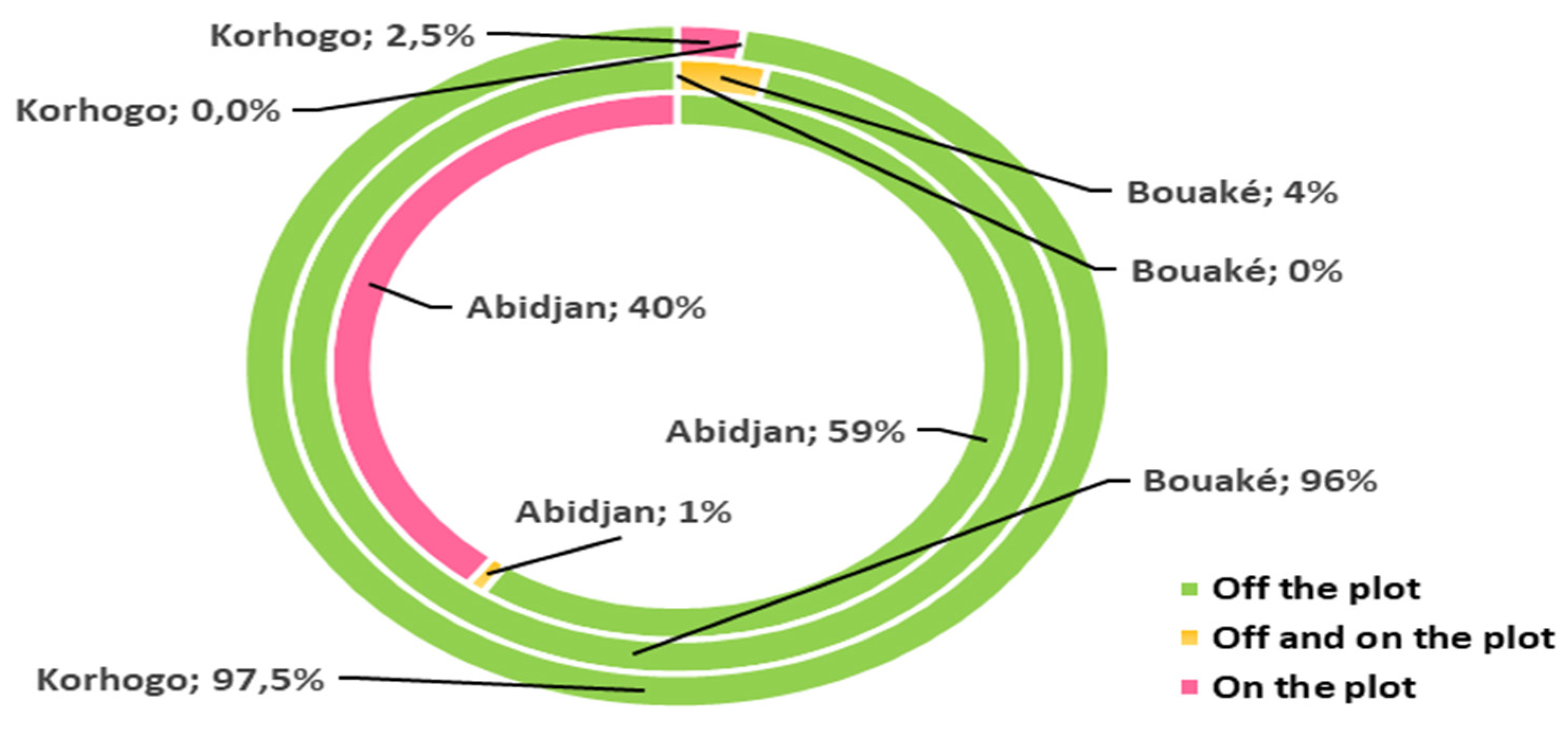
Spatial analysis of operational crop management highlights sharp behavioral contrasts regarding the mitigation of acute environmental risks during pesticide mixing. In the District of Abidjan, 59% of market gardeners prepare their chemical bouillies outside the field boundaries (in residential areas or near household water sources), compared to 40% who mix them inside production boundaries. Conversely, in the interior basins (Bouaké and Korhogo), pesticide mixing takes place almost exclusively in-situ on the field plots, accounting for 96% and 97.5% of growers respectively, thereby confining accidental spill risks to agricultural zones. The chart below displays the ex-situ vs in-situ distribution for chemical preparation, illustrating localized management habits.
Figure 1.
Mapping of Phytosanitary Mix Preparation Sites Across the Three Vegetable Production Hubs.
Figure 1.
Mapping of Phytosanitary Mix Preparation Sites Across the Three Vegetable Production Hubs.
3.4. Water Resource Protection Behaviors
Empirical tracking of protection strategies aimed at safeguarding groundwater tables and open irrigation canals points to a near-total absence of eco-responsibility among growers facing diffuse pollution hazards, as illustrated in Figure 2. The situation is critical in the District of Abidjan, where 96% of lettuce smallholders deploy no mitigation or containment steps around neighboring water bodies during sprayer cleaning or chemical treatments. The Korhogo zone shows an intermediate threat profile with 69% unsafe behaviors, while Bouaké displays the highest resource protection rate, though still in the minority (39% safe management). The histogram below emphasizes the behavioral failure relating to water resource preservation, heavily pronounced in metropolitan Abidjan.
3.5. Water Resource Protection Behaviors
Psychological assessment reveals a flagrant contradiction between objective threat levels (85% defective spraying equipment, absence of water resource isolation) and subjective operator safety viewsas illustrated in Figure 3. In Abidjan, despite highly intensive pesticide applications, 89% of smallholders evaluate treatment risks as "low" (50%) to "medium" (39%), with only 10% identifying a high risk. Conversely, market gardeners in Korhogo and Bouaké express greater cognitive clarity, associating chemical applications with mostly moderate-to-high risk levels. The Chi-square test confirms the highly significant dependence of this mental perception upon the geographic environment (2 = 50.12; p < 0.05). The graph below outlines the psychological anchoring bias among Abidjan growers who trivialize chemical threats compared to interior basin smallholders.
4. Discussion
The evaluation of the sprayer fleet exposes a major blind spot within occupational safety frameworks in West African agriculture: the systemic deterioration of the technical application tool (85% failure rate), matching the global crop itinerary non-compliance patterns outlined by [2,3]. The FMECA methodology demonstrates that nozzle orifice widening (C = 40) represents a highly treacherous agronomic risk because it is visually unnoticeable before field use. This widening alters flow rates and droplet size profiles, generating large involuntary chemical overdoses that override application dose calculations from manufacturing firms. Furthermore, leaking caps and cracked shells (C = 48) turn spraying routines into severe dermal exposure events for the operator, who does not wear any personal protective equipment (PPE).
On the psychological level, the systematic risk minimization recorded in Abidjan (89% low-to-medium perception) validates the classic risk perception theories established by [8]. In routine agricultural setups, repeating a hazardous task (chemical spraying) without experiencing immediate acute injuries erodes the cognitive awareness of chronic, long-term toxicity, triggering a social normalization of danger.
This safety underestimation creates a profound cognitive dissonance: market gardeners directly contaminate their own irrigation supplies (96% absence of protection in Abidjan) while possessing theoretical knowledge that pesticides are toxic substances. As detailed by [9], operational trade-offs in informal peri-urban spaces are driven by immediate financial survival. Facing severe land and cash precarity, smallholders sacrifice sprayer maintenance or environmental containment to protect immediate profit margins, matching the risk models described [10] in informal African food chains.
5. Conclusions
The implementation of the FMECA framework across Ivorian vegetable systems proves that mechanical degradation of knapsack sprayers (85% failure rate) is a key amplifier of environmental pollution and occupational poisoning. This physical breakdown is exacerbated by cognitive biases, leading urban smallholders to a routine normalization of chemical hazards and direct water source contamination. Breaking this technical vulnerability cycle requires participatory engineering approaches centered on compulsory nozzle calibration, distribution of low-cost tank repair kits, and community-led training focused on overcoming immediate economic constraints.
Author Contributions
For research articles with several authors, a short paragraph specifying their individual contributions must be provided. The following statements should be used “Conceptualization, Dingui Patrice ASSOI and Patrice Desire Yapi Assoi YAPI; methodology, Dingui Patrice ASSOI and Patrice Desire Yapi Assoi YAPI; software, Dingui Patrice ASSOI; validation, Patrice Desire Yapi Assoi YAPI and Bosson Jean-Aimé ASSANVO; formal analysis, X.X.; investigation, X.X.; resources, Dingui Patrice ASSOI; data curation, X.X.; writing—original draft preparation, Dingui Patrice ASSOI; writing—review and editing, Patrice Desire Yapi Assoi YAPI and Bosson Jean-Aimé ASSANVO; visualization, Patrice Desire Yapi Assoi YAPI and Bosson Jean-Aimé ASSANVO; supervision, Patrice Desire Yapi Assoi YAPI; project administration, Patrice Desire Yapi Assoi YAPI; funding acquisition, Dingui Patrice ASSOI. All authors have read and agreed to the published version of the manuscript”.
Funding
This research received no external funding.
Informed Consent Statement
This study did not involve experiments on humans or animals.
Data Availability Statement
The datasets generated and/or analyzed during the current study are not publicly available and are not deposited in any public repository due to institutional restrictions. Therefore, they are not available for public access.
Conflicts of Interest
The authors declare no conflicts of interest.
References
- Williamson, S.; Ball, A.; Pretty, J. Trends in pesticide use and drivers for safer practices in African horticulture. Int. J. Agric. Sustain. 2008, 6(4), 336–349. [Google Scholar]
- Akpo, L. E.; Soro, D.; Kone, M. Évaluation des pratiques culturales et risques de résidus de pesticides dans les cultures maraîchères en Côte d’Ivoire. Rev. Ivoirienne Des. Sci. Et. Technol. 2016, 27, 45–58. [Google Scholar]
- Kouadio, K. J.; Soro, Y.; Agbo, O. Analyse des résidus de pesticides dans les légumes de grande consommation et dérive des DAR en Côte d’Ivoire. Afr. Agron. 2023, 15(2), 114–126. [Google Scholar]
- Doumbia, M.; Kwadjo, K. E. Évaluation des pratiques phytosanitaires et des risques résiduels dans les périmètres maraîchers urbains en Côte d’Ivoire. J. Appl. Biosci. 2009, 24(2), 995–1002. [Google Scholar]
- Soro, G.; Sika, A. Pratiques phytosanitaires et niveau de connaissance des risques écotoxicologiques à long terme chez les petits exploitants ivoiriens. J. Ivoir. Des. Sci. De l'Environnement 2020, 5(2), 76–88. [Google Scholar]
- Mawussi, G.; Sanda, K.; Merlina, G. Évaluation quantitative des résidus de xénobiotiques et profil socio-éducatif des maraîchers ouest-africains. Rev. Int. Des. Sci. Environnementales 2014, 8(1), 12–23. [Google Scholar]
- Silué, N.; Soro, D.; Kone, M. Évaluation empirique et représentations sociales des risques phytosanitaires par les producteurs du Nord de la Côte d’Ivoire. Afr. Sci. 2022, 20(3), 32–45. [Google Scholar]
- Slovic, P. Perception of risk. Science 1987, 236(4799), 280–285. [Google Scholar] [CrossRef] [PubMed]
- Samb, A. (2023). Itinéraires techniques maraîchers, gouvernance des ressources hydriques et sécurité sanitaire en Côte d’Ivoire. Doctoral Dissertation, Université Nangui Abrogoua, Abidjan, Côte d'Ivoire, 145 p. p. 145 p.
- Grace, D.; Roesel, K.; Lore, T. (2015). Food safety and informal markets in developing countries: Governance, incentives, and expert perspectives. International Livestock Research Institute, Routledge, London.
Figure 2.
Proportion of Market Gardeners Implementing Water Body Protection Metrics During Field Spraying.
Figure 2.
Proportion of Market Gardeners Implementing Water Body Protection Metrics During Field Spraying.
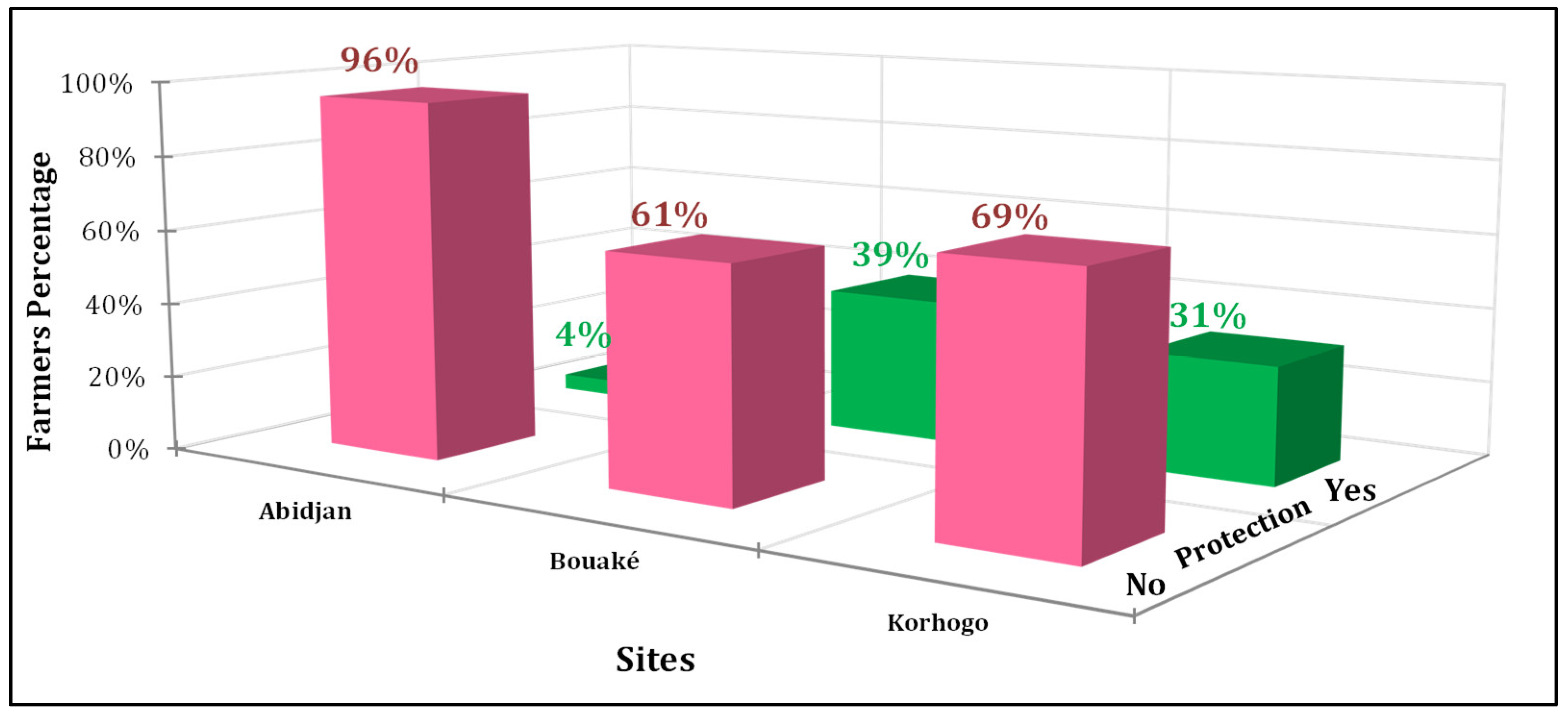
Figure 3.
Spatial Variance of Market Gardeners' Perceived Risk Intensity Regarding Insecticide and Fungicide Treatments.
Figure 3.
Spatial Variance of Market Gardeners' Perceived Risk Intensity Regarding Insecticide and Fungicide Treatments.
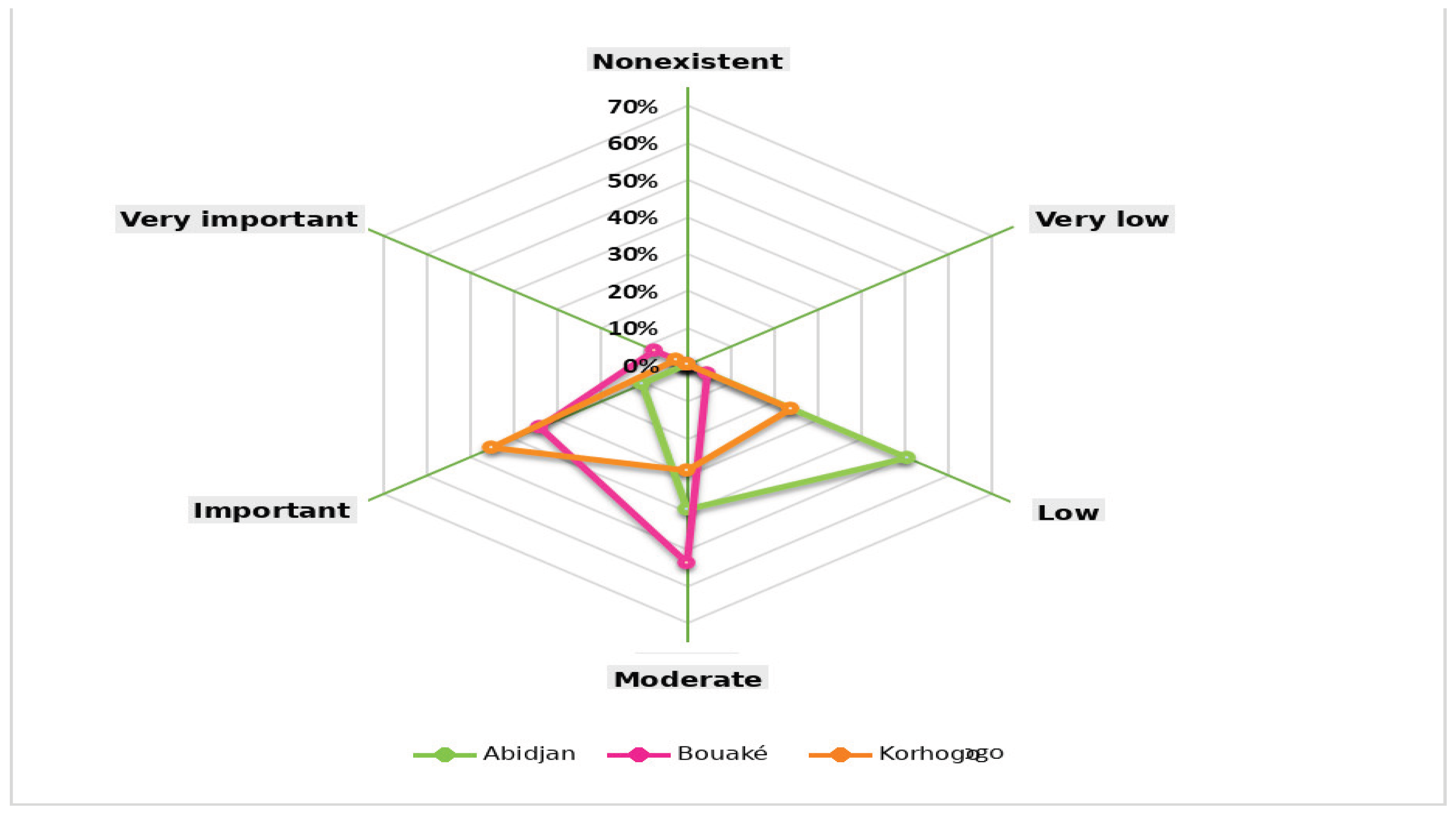

Table 1.
Descriptive Status and Typology of Inspected Field Sprayer Mechanical Failures.
| Mechanical Parameters and Structural Defects | Abidjan | Bouaké | Korhogo | Overall Total |
|---|---|---|---|---|
| Total number of inspected sprayers | 145 | 83 | 66 | 294 |
| Functional equipment (without defects) | 17 | 12 | 15 | 44 (15%) |
| Defective equipment (with defects) | 128 | 71 | 51 | 250 (85%) |
| Jammed pumping lever | 100 | 64 | 47 | 211 |
| Tank internal filter dropped | 51 | 54 | 24 | 129 |
| Broken carrying straps | 55 | 38 | 26 | 119 |
| Tank cap closure impossible | 47 | 29 | 35 | 111 |
| Cracked chemical spray tank | 45 | 22 | 38 | 105 |
Table 2.
FMECA Evaluation Matrix and Failure Criticality Index (C) Ranking by Basin.
| Specific Mechanical Failure Mode | Score G | Score D | C Abijan | C Bouaké | C Korhogo | Criticality Class / Risk Level |
|---|---|---|---|---|---|---|
| Widened nozzle orifice | 5 | 4 | 40 | 40 | 40 | High (Involuntary Overdosing) |
| Tank cap closure impossible | 4 | 4 | 32 | 48 | 48 | Very High (Dermal Exposure) |
| Cracked spray tank | 4 | 4 | 32 | 32 | 32 | Moderate |
| Broken carrying straps | 4 | 4 | 32 | 48 | 32 | Moderate to Very High |
| Jammed pumping lever | 1 | 2 | 6 | 6 | 4 | Very Low |
Note: G = Gravity (1 to 5); D = Detectability (1 to 4); C = Occurrence (derived) x G x D.
Disclaimer/Publisher’s Note: The statements, opinions and data contained in all publications are solely those of the individual author(s) and contributor(s) and not of MDPI and/or the editor(s). MDPI and/or the editor(s) disclaim responsibility for any injury to people or property resulting from any ideas, methods, instructions or products referred to in the content. |
© 2026 by the authors. Licensee MDPI, Basel, Switzerland. This article is an open access article distributed under the terms and conditions of the Creative Commons Attribution (CC BY) license (http://creativecommons.org/licenses/by/4.0/).
Copyright: This open access article is published under a Creative Commons CC BY 4.0 license, which permit the free download, distribution, and reuse, provided that the author and preprint are cited in any reuse.


