
Submitted:
27 June 2026
Posted:
30 June 2026
You are already at the latest version
Abstract
Economic development is a multidimensional process influenced by factors such as economic performance, human capital, urbanization, labor market conditions, and the distribution of economic outcomes. This study develops multidimensional rankings of economic prosperity and distributional outcomes for all 77 Thai provinces using the Technique for Order Preference by Similarity to the Ideal Solution (TOPSIS). Using 2024 provincial economic statistics from the National Economic and Social Development Council (NESDC) and Thailand’s Labor Force Survey (LFS), the analysis evaluates provincial development across multiple dimensions. The results reveal an exceptionally high degree of urban primacy, with Bangkok substantially outperforming all other provinces. Beyond the capital city itself, high levels of prosperity are concentrated in the neighboring provinces of the Bangkok Metropolitan Region and the Eastern Seaboard industrial corridor, while Phuket represents an alternative tourism-led pathway to prosperity. Favorable distributional outcomes also tend to be concentrated within this metropolitan-industrial corridor, whereas less favorable outcomes are more common in the North and Northeast. Robustness tests indicate that prosperity rankings are highly persistent over time, whereas distributional outcomes exhibit somewhat lower temporal stability. Overall, the study demonstrates the value of multidimensional ranking approaches for understanding urban–regional disparities in Thailand.
Keywords:
urban–regional disparities
; economic prosperity
; distributional outcomes
; economic vulnerability
; provincial development
; TOPSIS
; provincial ranking
; Thailand
1. Introduction
Thailand exhibits substantial spatial disparities in economic development, with Bangkok and its surrounding metropolitan region forming the country’s dominant economic core while many peripheral provinces continue to lag behind. Despite the importance of these differences, comprehensive measures of provincial development remain limited. This study develops multidimensional rankings of economic prosperity and distributional outcomes for all 77 provinces of Thailand using the Technique for Order Preference by Similarity to the Ideal Solution (TOPSIS). In this study, distributional outcomes refer to the degree of income inequality and economic vulnerability within provinces, capturing how broadly the benefits of economic development are shared across the population. While related, prosperity and distributional outcomes represent distinct dimensions of development. By combining multiple indicators into two complementary rankings, the study provides a systematic assessment of spatial disparities in development patterns across Thailand.
A large body of literature in urban and regional economics emphasizes the tendency for economic activity to concentrate geographically. Agglomeration economies, labor market pooling, knowledge spillovers, and market access create advantages for cities and regions that are able to attract firms, workers, and investment [7,13]. As a result, economic prosperity is often unevenly distributed across space, generating distinct patterns of regional specialization and development. Economic concentration may also be associated with greater inequality, as the benefits of growth may not always be shared equally across individuals and households. Examining economic prosperity and distributional outcomes separately, therefore, provides a more comprehensive understanding of spatial development patterns.
In recent decades, composite indicators and ranking systems have become increasingly important tools for evaluating regional performance and visualizing spatial disparities. Examples include China’s China Integrated City Index (CICI), Vietnam’s Provincial Competitiveness Index (PCI), Indonesia’s Provincial Competitiveness Analysis, and the Milken Institute’s Best-Performing Cities Index in the United States [8,17,25,26]. By combining information from multiple indicators into a single framework, these systems provide accessible tools for benchmarking regional performance and identifying spatial patterns that may be difficult to observe using individual indicators alone.
Thailand possesses a substantial amount of provincial-level socioeconomic information. The National Economic and Social Development Council (NESDC) regularly publishes Gross Provincial Product (GPP) and related economic statistics, while various government agencies produce provincial indicators aligned with national development plans and the Sustainable Development Goals (SDGs). Among existing initiatives, the Provincial SDG Index developed by SDG Move [22] provides one of the most comprehensive assessments of provincial development in Thailand.
While these initiatives provide valuable information on sustainable development, they are designed to assess a broad range of development objectives spanning social, economic, environmental, and institutional dimensions. In contrast, this study focuses specifically on economic development and distinguishes between two complementary dimensions: economic prosperity and distributional outcomes.
To this end, this study constructs provincial rankings of economic prosperity and distributional outcomes for all 77 provinces of Thailand using TOPSIS, a widely used Multi-Criteria Decision Making (MCDM) method. The economic prosperity ranking is based on indicators capturing economic performance, income levels, human capital, urbanization, and labor market conditions, while the distributional outcomes ranking incorporates measures of income inequality and economic vulnerability. The resulting rankings are used to examine whether provinces that perform strongly in terms of economic prosperity also achieve favorable distributional outcomes.
The results reveal an exceptionally high degree of urban primacy, with Bangkok substantially outperforming all other provinces. Beyond Bangkok, prosperity is concentrated within a metropolitan-industrial corridor encompassing the Bangkok Metropolitan Region and the Eastern Seaboard. In contrast, unfavorable distributional outcomes are more broadly concentrated in the North and Northeast, whereas many provinces within Bangkok’s metropolitan-industrial core record comparatively favorable outcomes. While the spatial distributions of prosperity and distributional outcomes are not identical, many provinces within Thailand’s metropolitan-industrial core perform well on both dimensions, suggesting that economic prosperity and favorable distributional outcomes often coexist within the country’s most urbanized and industrialized regions.
2. Literature Review
Composite ranking systems have become widely used tools for evaluating the relative performance of cities, provinces, and regions. By aggregating information from multiple indicators into a single measure, these frameworks facilitate comparisons across geographic units and provide policymakers, businesses, and researchers with accessible benchmarks of regional development. A common feature of modern ranking systems is their recognition that development is multidimensional and cannot be adequately represented by a single indicator such as income or economic output.
Numerous countries have developed sub-national ranking systems reflecting different development objectives. China’s China Integrated City Index (CICI) evaluates 297 cities using indicators spanning economic, social, and environmental dimensions [8]. Vietnam’s Provincial Competitiveness Index (PCI) ranks all 63 provinces according to governance quality and the business environment [17]. Indonesia’s Provincial Competitiveness Analysis assesses provinces using indicators related to macroeconomic stability, institutions, business conditions, and infrastructure [26]. In India, Moirangthem and Nag [19] construct a Regional Competitiveness Index for states and union territories and show that regional competitiveness is positively associated with economic growth. Similarly, the Milken Institute’s Best-Performing Cities Index evaluates metropolitan areas in the United States using indicators related to labor market performance, technological dynamism, and economic opportunity [25].
Despite differences in methodology and purpose, these ranking systems share several common characteristics. First, they adopt a multidimensional perspective on development by incorporating information from multiple criteria. Second, they summarize complex information into composite indicators that facilitate comparison across geographic units. Third, they are intended not only to rank regions but also to identify strengths and weaknesses that can inform policy decisions and investment strategies.
Beyond their role as benchmarking tools, composite indicators have increasingly been used to examine spatial disparities in urban and regional development. Urban and regional economics emphasize that economic activity tends to concentrate geographically due to agglomeration economies, market access, and scale effects [7,13]. As a result, substantial differences often emerge between metropolitan cores and peripheral regions. Composite indicators and ranking systems provide a practical means of summarizing these multidimensional differences and visualizing spatial patterns of development. They have therefore become increasingly common in studies of urban competitiveness, regional development, and territorial inequality.
Thailand has also begun to develop provincial ranking systems. Among existing initiatives, the Provincial SDG Index developed by SDG Move [22] provides one of the most comprehensive assessments of provincial development in Thailand. The index evaluates all 77 provinces across the 17 Sustainable Development Goals (SDGs), encompassing the five dimensions of People, Prosperity, Planet, Peace, and Partnership. In addition to an overall composite score, the Provincial SDG Index reports separate scores for each of the 17 SDGs, allowing users to assess provincial performance across a broad range of social, economic, environmental, and institutional dimensions.
The Provincial SDG Index represents an important contribution to development monitoring in Thailand. However, its broad scope means that economic outcomes constitute only one component of a much wider multidimensional framework. Provinces may therefore achieve similar overall SDG scores despite differing substantially in their levels of economic prosperity or in the distribution of development gains. We complement the Provincial SDG Index by focusing specifically on economic development outcomes. In particular, the economic prosperity ranking captures differences in economic performance and development fundamentals, while the distributional outcomes ranking evaluates the extent to which the benefits of development are broadly shared within provinces. By examining these dimensions separately, the analysis provides additional insight into spatial variations in development outcomes across Thailand.
3. Materials and Methods
3.1. Indicator Selection and Data Sources
This study constructs two separate provincial rankings: an economic prosperity ranking and a distributional outcomes ranking. The prosperity ranking is based on five indicators: GPP per capita, educational attainment, urban population share, employment density, and average monthly income. The distributional outcomes ranking is based on two indicators: the provincial Gini coefficient and a measure of economic vulnerability defined as the share of income earners with incomes below the national median income. Together, these indicators capture both the distribution of income within provinces and the relative economic position of lower-income earners. The conceptual rationale for selecting these indicators is discussed in Section 3.2. Table 1 summarizes the indicators, definitions, and data sources used in the analysis.
The analysis covers all 77 provinces of Thailand for the year 2024. Data are drawn from two principal sources: the Labor Force Survey (LFS) conducted by the National Statistical Office (NSO) and provincial economic statistics published by the National Economic and Social Development Council (NESDC). Variables derived from the LFS are calculated by the authors using individual-level microdata and the sampling weights provided by the NSO. The LFS is designed to produce representative labor market statistics at the provincial level, making it a suitable source for constructing provincial socioeconomic indicators. Because the survey is conducted quarterly, provincial estimates are first calculated separately for each quarter and then averaged across the four quarters of 2024 to reduce sampling variability and improve the stability of provincial estimates.
3.2. Conceptual Framework
The economic prosperity ranking is designed to capture multiple dimensions of provincial economic development. GPP per capita and average monthly income reflect economic performance and living standards, capturing differences in productivity, income-generating capacity, and the extent to which economic activity translates into material well-being. Educational attainment represents human capital, which has long been recognized as a key determinant of productivity and long-run economic growth [3,4,18]. Urban population share reflects the degree of urbanization and economic concentration, while employment density captures agglomeration economies arising from labor market pooling, specialization, and knowledge spillovers [7]. These urban indicators are consistent with the New Economic Geography literature, which emphasizes how spatial concentration generates self-reinforcing advantages through scale economies, knowledge spillovers, and market access [14]. Taken together, these indicators provide a multidimensional assessment of provincial economic prosperity that reflects both economic performance and the structural characteristics associated with long-run development.
The distributional outcomes ranking focuses on how economic gains are distributed within provinces. In this study, distributional outcomes are defined as the degree of income inequality and economic vulnerability experienced by provincial income earners. It consists of two indicators: the provincial Gini coefficient and the share of income earners with incomes below the national median income. The inclusion of both indicators recognizes that distributional outcomes have both a relative and an absolute dimension. The Gini coefficient measures the degree of income inequality within a province, capturing how evenly income is distributed among income earners. In contrast, the economic vulnerability indicator measures the extent to which provincial income earners fall below a fixed national income benchmark. While conceptually related to poverty, economic vulnerability is measured using the national median income rather than Thailand’s official poverty line. Recent assessments have noted methodological limitations in the construction of the official poverty line, suggesting that it may not fully capture the extent of economic hardship experienced by households [10]. Using the national median income provides a broader benchmark for identifying individuals who may be economically vulnerable relative to prevailing national living standards. A province may exhibit relatively low inequality but still contain a large share of income earners with incomes below the national median, indicating limited participation in national economic prosperity.
By combining these indicators, the ranking captures both the internal distribution of income and the relative economic position of lower-income earners. This approach is consistent with broader development perspectives that emphasize not only aggregate economic performance but also the extent to which economic gains are shared across the population [23]. The resulting ranking should therefore be interpreted as a measure of provincial distributional outcomes rather than a pure measure of income inequality.
3.3. Ranking Methodology
3.3.1. Fundamental Concept of TOPSIS
The fundamental concept of TOPSIS is that the best solution is the one with the shortest distance to the positive ideal solution and the farthest distance from the negative ideal solution [11,15,29]. Accordingly, TOPSIS can be considered as a geometry-based method.
TOPSIS has been applied to many domains including outsource selection [12,24], manufacturing [1,21], financial performance evaluation [9], service quality assessment [16], educational selection [20], technology selection [13], material selection [6], product selection [2], strategy evaluation [28], critical mission planning [27], and many more [5].
TOPSIS assumes that each attribute has a utility with a monotonic nature. In other words, each attribute takes either monotonically increasing or monotonically decreasing utility. TOPSIS divides the criteria into two groups, namely benefit/profit/positive and cost/loss/negative criteria. By definition, the positive ideal solution is composed of all best attribute values attainable, whereas the negative ideal solution is composed of all worst attribute values attainable. All criteria employed in this study satisfy this condition: the five prosperity indicators are treated as benefit criteria, for which higher values indicate higher economic prosperity, while the Gini coefficient and economic vulnerability measure are treated as cost criteria, for which lower values indicate more favorable distributional outcomes.
3.3.2. Steps in TOPSIS
TOPSIS consists of 6 steps as follows.
(1) Construction of a normalized decision matrix. Since each criterion evaluation may result in different units of measurement, the normalization of the evaluated performances is recommended in order to transform them into dimensionless quantities, which allows the comparison across all evaluated performances. An element of the normalized decision matrix is defined as
(2) Construction of a weighted normalized decision matrix. The preference in the criteria is taken into account in this step via the weights associated with each criterion. Equal weights were assigned to all criteria within each ranking, consistent with standard practice in exploratory composite indicator construction. The weighted normalized decision matrix is obtained as
where
(3) Determination of positive ideal solution V⁺ and negative ideal solution V⁻. Both solutions are defined as:
where and
(4) Calculation of separation measure. Since each alternative is represented by a point in the n-dimensional space, the separation between two alternatives can be measured as the distance between them in space. The Euclidean distance is used for this purpose. Accordingly, the separation between an alternative and the positive ideal solution is
The separation between an alternative and the negative ideal solution is
(5) Calculation of the relative closeness to the positive ideal solution. The relative closeness of the alternative with respect to , is defined as
(6) Ranking of the preference order. The alternatives are preferred in accordance with the descending order of , i.e., the alternatives with higher ’s are preferred to the ones with lower ’s.
4. Results
This section presents the provincial rankings generated using the TOPSIS methodology. The analysis examines urban–regional disparities across Thailand through two complementary dimensions of development: economic prosperity and distributional outcomes. The prosperity ranking reflects differences in economic performance, human capital, urbanization, labor market conditions, and average income, whereas the distributional outcomes ranking captures variation in income inequality and economic vulnerability across provinces.
4.1. Economic Prosperity Ranking
Figure 1 presents the spatial distribution of provincial economic prosperity scores, while Table 2 summarizes prosperity levels across Thailand’s major regions. Complete provincial scores and rankings are reported in Figure A1 in the Appendix. The prosperity score refers to the relative closeness () defined in Equation (7), where higher values indicate greater economic prosperity. The results reveal a highly uneven geography of development characterized by extreme urban primacy, a concentrated metropolitan-industrial core, substantial regional heterogeneity in the South, and persistent underperformance across much of the Northeast.
The most striking finding is the exceptional position of Bangkok. With a prosperity score of 0.990, Bangkok ranks first by a substantial margin, nearly doubling the score of the second-ranked province, Nonthaburi (0.498) (Figure A1). This gap is considerably larger than the differences observed among other leading provinces and highlights the dominant role of Bangkok within Thailand’s urban system. Bangkok combines the country’s highest levels of economic output, income, human capital, urbanization, and employment concentration, reflecting its position as Thailand’s principal economic, administrative, and service center. The results, therefore, suggest not only a core-periphery pattern of development, but also an unusually high degree of urban primacy.
Beyond Bangkok, prosperity is concentrated within a broader metropolitan-industrial corridor encompassing the Bangkok Metropolitan Region and the Eastern Seaboard. Provinces surrounding Bangkok, together with major industrial provinces such as Chon Buri and Rayong, consistently occupy the upper end of the prosperity ranking. This concentration is reflected in regional averages. As shown in Table 2, the Bangkok Metropolitan Region records the highest mean prosperity score (0.447), substantially exceeding all other regions, while the Eastern region ranks second with an average score of 0.192. These provinces benefit from dense transportation networks, large labor markets, industrial agglomeration, and proximity to major domestic and international markets. The observed pattern is consistent with theories of agglomeration economies and New Economic Geography, which emphasize the tendency for economic activity, investment, and skilled labor to concentrate spatially in locations that already possess significant economic advantages [14].
The results also reveal that prosperity is not exclusively confined to Bangkok and its surrounding industrial corridor. Phuket ranks among the country’s most prosperous provinces (Figure A1) despite its geographic distance from the national economic core. Unlike the manufacturing-oriented provinces of the Eastern Seaboard, Phuket’s prosperity is primarily driven by tourism and internationally oriented service activities. This finding suggests that integration into global tourism networks can provide an alternative pathway to regional prosperity outside Thailand’s traditional metropolitan-industrial growth pole.
An important feature of the results is the substantial heterogeneity observed within Southern Thailand. The South exhibits the widest dispersion of prosperity scores among all major regions outside the Bangkok Metropolitan Region, with scores ranging from 0.038 to 0.316. This variation reflects the coexistence of highly prosperous tourism-oriented provinces alongside lower-performing provinces, particularly in the southern border area. The regional diversity observed in the South contrasts sharply with the more uniform patterns observed elsewhere and suggests that regional location alone cannot fully explain provincial development outcomes.
In contrast, the Northeast displays a remarkably compressed distribution of prosperity scores. The region records the lowest average prosperity score in the country (0.077) and the narrowest range of scores (0.095), indicating that most northeastern provinces occupy broadly similar positions near the lower end of the national distribution. Rather than being driven by a small number of particularly disadvantaged provinces, the results point to a broader pattern of region-wide underperformance. Lower levels of urbanization, weaker agglomeration economies, and more limited integration into national and international production networks appear to characterize much of the region.
Overall, the spatial distribution of prosperity reveals a development landscape that is simultaneously concentrated and heterogeneous. Economic prosperity remains strongly clustered around Bangkok and the Eastern Seaboard, reflecting the importance of urbanization and agglomeration economies. At the same time, the success of provinces such as Phuket demonstrates that alternative development pathways exist outside the country’s primary economic core. The findings therefore suggest that Thailand’s geography of prosperity is best understood not as a simple core-periphery divide, but as a system characterized by extreme urban primacy, a powerful metropolitan-industrial corridor, and substantial variation across peripheral regions.
4.2. Distributional Outcomes Ranking
Figure 2 presents the spatial distribution of provincial distributional outcomes scores, while Table 3 summarizes regional patterns, and Figure A2 provides the complete provincial rankings. The distributional outcomes score is measured by the relative closeness coefficient () defined in Equation (7), with higher values indicating less favorable distributional outcomes. Specifically, provinces receive higher scores when they exhibit greater income inequality and a larger share of income earners with incomes below the national median. The results reveal a pronounced regional divide in distributional outcomes, with distributional disadvantage concentrated in the North and Northeast and comparatively favorable outcomes concentrated within Bangkok’s metropolitan-industrial corridor.
Table 3 shows a clear regional gradient. The Northeast records the highest average distributional outcomes score (0.767), followed by the North (0.712), indicating that these regions experience the least favorable distributional outcomes nationally. In contrast, the Bangkok Metropolitan Region records by far the lowest average score (0.218), while the Eastern region also performs relatively well (0.359). These patterns suggest that distributional disadvantage is concentrated primarily in inland northern Thailand rather than within the country’s principal urban and industrial centers.
The spatial distribution shown in Figure 2 reinforces this finding. Many provinces in the Northeast occupy the upper end of the ranking, including Surin, Amnat Charoen, Yasothon, Nong Bua Lam Phu, Buri Ram, Sakon Nakhon, and Si Sa Ket. These provinces exhibit a combination of relatively high income inequality and elevated economic vulnerability, indicating that a substantial share of income earners remain disconnected from national levels of prosperity. The North displays a similar, although somewhat less pronounced, pattern. Many northern provinces also record relatively high scores, suggesting that economic vulnerability remains an important challenge despite differences in local economic structures and development trajectories.
A particularly noteworthy finding is the favorable performance of Bangkok and the surrounding metropolitan-industrial corridor. Nonthaburi records the lowest score nationally (0.082), followed by Pathum Thani (0.118), Samut Prakan (0.140), Chachoengsao (0.148), Chon Buri (0.184), Rayong (0.189), and Bangkok (0.192). These provinces are also among the most prosperous in Thailand, indicating that high levels of economic development are not necessarily associated with less favorable distributional outcomes. Instead, Thailand’s leading urban and industrial provinces appear to combine strong economic performance with comparatively favorable distributional outcomes.
As with the prosperity ranking, substantial regional heterogeneity is evident in Southern Thailand. The South exhibits the widest dispersion of distributional outcomes scores among all regions, with values ranging from 0.226 to 0.870. Provinces such as Pattani and Narathiwat rank among the most disadvantaged provinces nationally, while others record considerably more favorable outcomes. This variation suggests that Southern Thailand cannot be characterized by a single development profile and instead encompasses multiple development trajectories.
Comparing Figure 1 and Figure 2 highlights an important distinction between prosperity and distributional outcomes. Prosperity is concentrated within a relatively small metropolitan-industrial core centered on Bangkok and the Eastern Seaboard, whereas distributional disadvantage is more broadly concentrated in the North and Northeast. Provinces within Bangkok’s economic core generally perform well on both dimensions, while many provinces in northern Thailand combine lower prosperity with less favorable distributional outcomes. These findings suggest that prosperity and distributional outcomes represent related but distinct dimensions of regional development and should not be assumed to move together across space.
4.3. Robustness Check: Temporal Stability of Rankings
The rankings presented in the previous sections are based on data from 2024. To assess whether the observed patterns reflect persistent features of Thailand’s urban–regional development rather than year-specific fluctuations, the TOPSIS rankings were reconstructed using data from 2022 and 2023. The complete provincial scores and rankings for all three years are reported in the Supplementary Materials (Table S1), while rank correlations and quartile stability measures are presented in Appendix A (Table A1 and Table A2).
The economic prosperity ranking exhibits exceptional temporal stability. Spearman rank correlations exceed 0.98 for all pairwise comparisons between 2022, 2023, and 2024, indicating that provincial rankings remain largely unchanged over time. In addition, 71 of 77 provinces (92.2%) remain within the same quartile throughout the three-year period. Stability is particularly evident among the highest-ranked provinces. Bangkok, Nonthaburi, Samut Prakan, and Rayong occupy the top four positions in all three years, while most provinces in the top and bottom deciles retain similar positions. These findings suggest that the prosperity ranking captures enduring structural differences in economic performance, human capital, urbanization, and agglomeration economies rather than short-term fluctuations in economic conditions.
The broader spatial pattern identified in Section 4.1 is similarly persistent. Bangkok, the Bangkok Metropolitan Region, and the Eastern Seaboard consistently dominate the prosperity ranking, whereas many provinces in the North, Northeast, and border regions remain concentrated near the bottom. This stability indicates that the prosperity ranking reflects a durable geography of economic development rather than a temporary outcome associated with a particular year.
The distributional outcomes ranking exhibits lower temporal stability than the prosperity ranking, although substantial persistence remains. Spearman rank correlations range from 0.738 to 0.911, and 36 of 77 provinces (46.8%) remain within the same quartile across all three years. This lower stability is not unexpected, as income distribution and economic vulnerability are generally more responsive to changes in labor market conditions, migration, sectoral composition, and local economic shocks than the structural factors underlying economic prosperity.
Despite this greater mobility, the underlying spatial pattern remains remarkably consistent. Provinces within Bangkok’s metropolitan region and the surrounding industrial corridor consistently record some of the most favorable distributional outcomes, while many northeastern provinces remain concentrated near the upper end of the ranking. Although provinces in the middle of the distribution experience noticeable rank changes, the broader regional pattern identified in Section 4.1 and Section 4.2 changes relatively little over time. This suggests that the spatial distribution of distributional disadvantage is persistent even though the precise ordering of provinces is more sensitive to short-term economic conditions.
Overall, the temporal stability analysis provides additional confidence in the robustness of the rankings. The prosperity ranking exhibits exceptional stability and appears to capture long-run structural differences across provinces. The distributional outcomes ranking is more dynamic but nevertheless reveals a persistent spatial pattern in which Bangkok’s metropolitan-industrial core consistently records more favorable distributional outcomes than many provinces in the North and Northeast. Together, these findings suggest that the principal results reported in this study reflect durable features of Thailand’s urban–regional system rather than temporary fluctuations in provincial socioeconomic conditions.
5. Implications for Policy and Spatial Decision-Making
The findings of this study demonstrate the value of multidimensional approaches for understanding urban–regional disparities. While provinces within Thailand’s metropolitan-industrial core generally perform well on both prosperity and distributional outcomes, the rankings reveal important differences in the spatial extent of these dimensions. In particular, unfavorable distributional outcomes are more broadly concentrated across northern Thailand than low prosperity, providing additional insight into the geography of regional disadvantage.
From a policy perspective, the results highlight the continued importance of spatial concentration in shaping development outcomes. Provinces within Bangkok’s metropolitan-industrial corridor generally combine high levels of economic prosperity with comparatively favorable distributional outcomes, while many provinces in the North and Northeast combine lower prosperity with less favorable distributional outcomes. This pattern suggests that regional disadvantage in Thailand often extends across multiple dimensions of development rather than being confined to economic performance alone. The findings, therefore, highlight the importance of expanding economic opportunities in provinces that remain outside Thailand’s principal growth centers while ensuring that the benefits of development are broadly shared across local populations.
The analysis also highlights the value of provincial-level benchmarking. While broad spatial patterns are evident, considerable variation exists across provinces, particularly in Southern Thailand, where provinces display markedly different levels of prosperity and distributional outcomes. The rankings developed in this study provide a systematic framework for identifying provinces that lag behind national development patterns and for tracking spatial disparities over time. As such, they may serve as a useful complement to existing socioeconomic indicators used in policy analysis, development planning, and resource allocation.
Beyond their policy relevance, the rankings may also support a range of spatial decision-making activities. Firms considering provincial expansion often rely on readily available indicators such as GPP per capita or average income published by the National Economic and Social Development Council (NESDC). While informative, such measures capture only a single dimension of local economic conditions and may therefore provide an incomplete assessment of provincial market potential. By incorporating information on income levels, human capital, urbanization, and labor market density, the prosperity ranking provides a broader assessment of provincial economic environments. The ranking may therefore serve as a useful reference for businesses, investors, planners, and other stakeholders evaluating provincial opportunities and development conditions.
More broadly, the study demonstrates the usefulness of TOPSIS as a flexible framework for spatial evaluation and decision support. Although the rankings presented here are based on a specific set of indicators and equal weights, the methodology can readily accommodate alternative criteria and weighting schemes. Government agencies may adapt the framework to evaluate provinces according to particular policy objectives, while businesses and other organizations may incorporate criteria that reflect their own operational requirements or strategic priorities. In this sense, the contribution of the study extends beyond the rankings themselves and illustrates how multidimensional evaluation methods can support evidence-based urban and regional decision-making.
6. Conclusions
This study develops provincial rankings of economic prosperity and distributional outcomes for all 77 provinces of Thailand using the Technique for Order Preference by Similarity to the Ideal Solution (TOPSIS). Drawing on data from the National Economic and Social Development Council (NESDC) and Thailand’s Labor Force Survey (LFS), the analysis provides a multidimensional assessment of urban–regional disparities and offers new evidence on the spatial structure of development in Thailand.
Several important findings emerge. First, Thailand exhibits an exceptionally high degree of urban primacy. Bangkok occupies a unique position within the national urban system, recording a prosperity score substantially higher than all other provinces. Beyond Bangkok, prosperity is concentrated within a metropolitan-industrial corridor encompassing the Bangkok Metropolitan Region and the Eastern Seaboard, highlighting the continued importance of agglomeration economies, infrastructure, and market access in shaping regional development.
Second, the results reveal a strong spatial concentration of both prosperity and favorable distributional outcomes. Provinces within Bangkok’s metropolitan-industrial corridor generally combine high levels of economic prosperity with comparatively favorable distributional outcomes, while many provinces in the North and Northeast combine lower prosperity with less favorable distributional outcomes. At the same time, the geography of distributional outcomes is broader than the geography of prosperity, with distributional disadvantage extending across a larger share of northern Thailand. These findings suggest that prosperity and distributional outcomes are closely related across Thailand’s provinces, although the spatial extent of distributional disadvantage is broader than that of low prosperity.
Third, substantial regional heterogeneity exists within Thailand’s peripheral regions. Southern Thailand exhibits the greatest variation in both prosperity and distributional outcomes, reflecting diverse development trajectories ranging from tourism-oriented growth centers to provinces facing persistent socioeconomic challenges. In contrast, many provinces in the Northeast are concentrated toward the less favorable end of both rankings, suggesting that regional disadvantage is widespread rather than confined to a small number of provinces.
The temporal stability analysis indicates that these patterns are not unique to 2024. Prosperity rankings exhibit exceptional stability between 2022 and 2024, while distributional outcomes rankings show greater mobility but maintain a broadly consistent regional structure. This suggests that the principal spatial patterns identified in the study reflect durable features of Thailand’s urban–regional system rather than short-term fluctuations in economic conditions.
Overall, the study demonstrates the value of multidimensional ranking approaches for understanding urban–regional disparities. The rankings provide a systematic framework for benchmarking provincial development, identifying spatial patterns that may be obscured by individual indicators, and tracking regional disparities over time. The rankings may also complement provincial SDG monitoring efforts by helping identify provinces that lag behind in economic prosperity and the distribution of development gains. More broadly, the study illustrates how TOPSIS can be applied as a flexible tool for multidimensional spatial evaluation. These findings highlight the importance of considering both economic prosperity and distributional outcomes when evaluating urban–regional development and designing evidence-based development strategies.
Supplementary Materials
The following supporting information can be downloaded at the website of this paper posted on Preprints.org, Table S1: Provincial TOPSIS scores and ranks for economic prosperity and distributional outcomes, 2022–2024. Table S2: Provincial criteria variables for economic prosperity and distributional outcomes rankings, 2022–2024.
Author Contributions
Conceptualization, N.H.; methodology, N.H.; software, N.H.; validation, P.S. and N.H.; formal analysis, P.S. and N.H.; investigation, P.S. and N.H.; resources, P.S.; data curation, P.S.; writing—original draft preparation, P.S. and N.H.; writing—review and editing, P.S. and N.H.; visualization, P.S.; supervision, N.H.; project administration, P.S.; funding acquisition, P.S. All authors have read and agreed to the published version of the manuscript.
Funding
This research received no external funding.
Data Availability Statement
The yearly provincial criteria variables used in the TOPSIS rankings are available in the Supplementary Materials accompanying this article. The individual-level microdata from the Labor Force Survey (LFS) are not publicly available due to data access restrictions imposed by the National Statistical Office (NSO) of Thailand. Researchers requiring access to the LFS microdata may submit a formal request directly to the NSO at https://www.nso.go.th.
Acknowledgments
The authors gratefully acknowledge the National Statistical Office (NSO) of Thailand for providing access to the Labor Force Survey (LFS) microdata used in this study. During the preparation of this manuscript, the authors used ChatGPT GPT-4o, GPT-4.5, and GPT-5.5 (OpenAI) for the purposes of polishing and improving the clarity of the written text, and Claude Sonnet 4.6 (Anthropic) for the purposes of document formatting, figure and table construction, and manuscript editing. The authors have reviewed and edited the output and take full responsibility for the content of this publication. The authors would like to thank the Faculty of Economics, Chiang Mai University, and Chiang Mai University for their support.
Conflicts of Interest
The authors declare no conflicts of interest.
Abbreviations
The following abbreviations are used in this manuscript:
| CICI | China Integrated City Index |
| GPP | Gross Provincial Product |
| LFS | Labor Force Survey |
| MCDM | Multi-Criteria Decision Making |
| NESDC | National Economic and Social Development Council |
| NSO | National Statistical Office |
| PCI | Provincial Competitiveness Index |
| SDG | Sustainable Development Goal |
| TOPSIS | Technique for Order Preference by Similarity to the Ideal Solution |
Appendix A
Figure A1.
TOPSIS-based ranking of Thai provinces by economic prosperity, 2024.
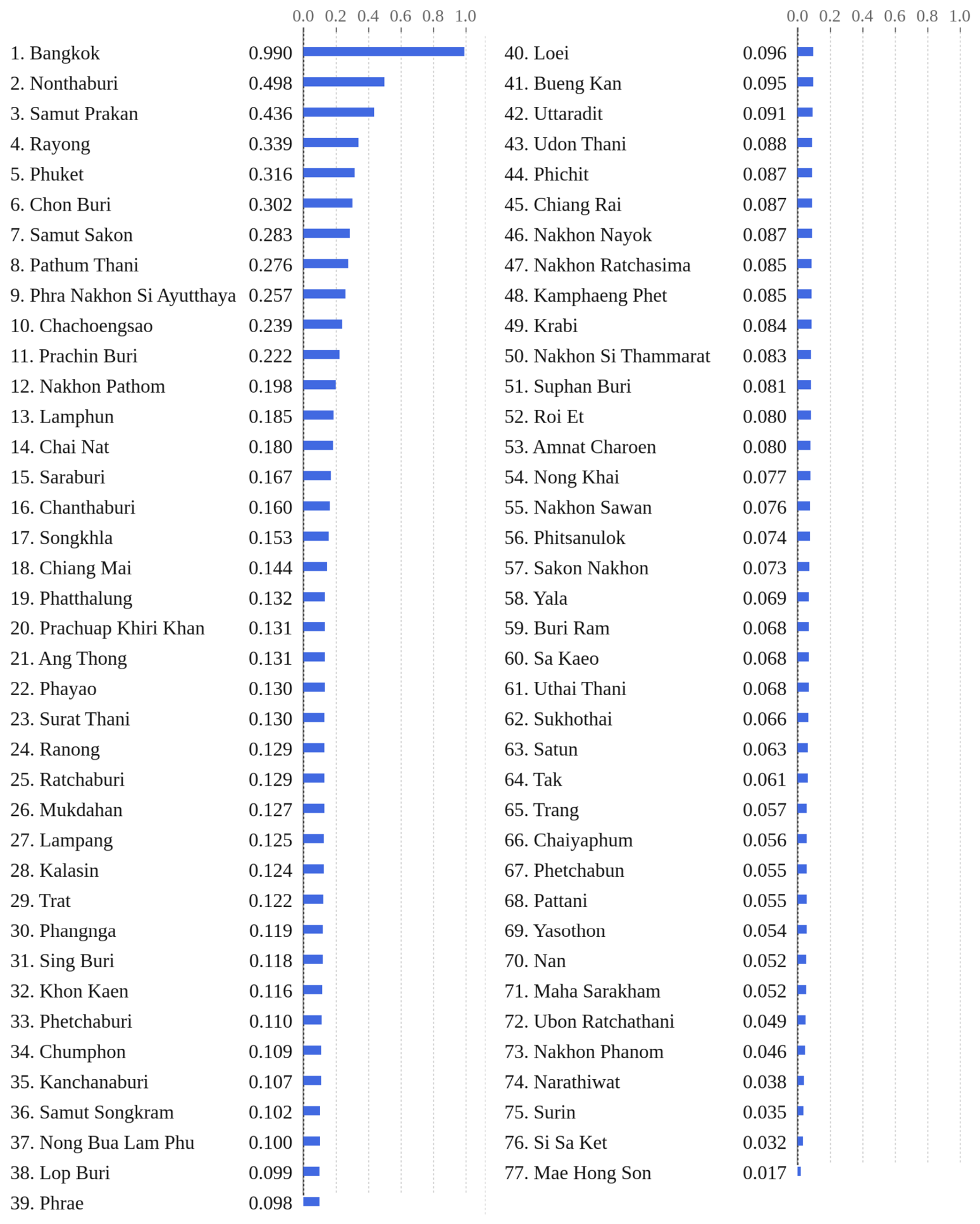
Figure A2.
TOPSIS-based ranking of Thai provinces by distributional outcomes, 2024.
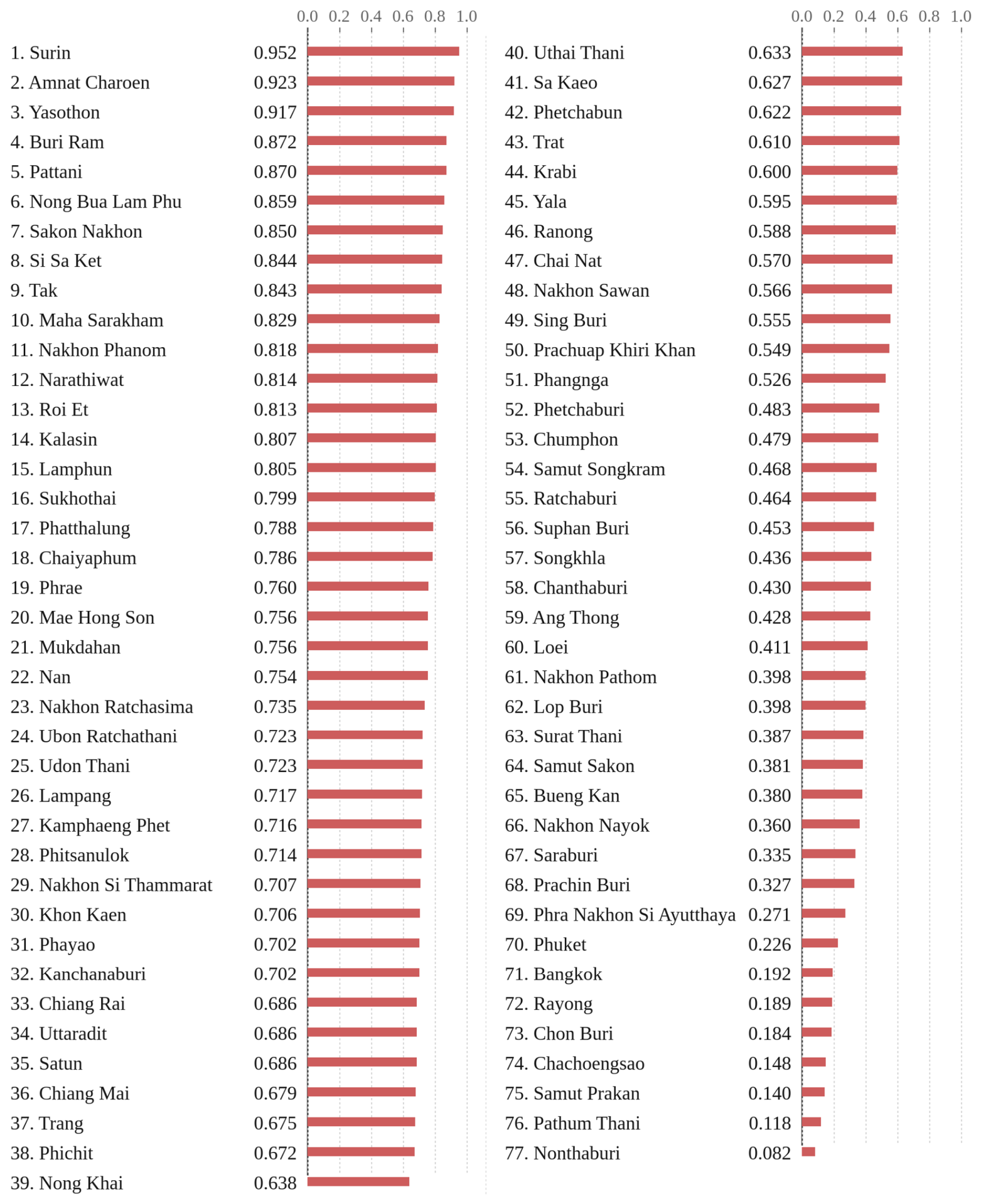

Table A1.
Spearman Rank Correlations Across Years.
| Dimension | 2022 vs. 2023 | 2022 vs. 2024 | 2023 vs. 2024 |
| Economic prosperity | 0.995 | 0.986 | 0.983 |
| Distributional outcomes | 0.911 | 0.799 | 0.738 |
| Note: Spearman rank correlation coefficients computed across all 77 Thai provinces. All correlations are statistically significant at the 1% level (p < 0.001). | |||
Table A2.
Quartile Stability Across Years.
| Dimension | Provinces in same quartile (all 3 years) | Share (%) |
| Economic prosperity | 71 of 77 | 92.2 |
| Distributional outcomes | 36 of 77 | 46.8 |
|
Note: A province is classified as stable if it falls in the same quartile in all three years (2022, 2023, and 2024). Quartiles are equal-sized groups (Q1–Q4) assigned separately by dimension and year. | ||
References
- Agrawal, V.; Kohli, V.; Gupta, S. Computer aided robot selection: the ‘multiple attribute decision making’ approach. Int. J. Prod. Res. 1991, 29, 1629–1644. [CrossRef]
- Akgül, E.; Bahtiyari, M.İ.; Kizilkaya Aydoğan, E.; Benli, H. Use of TOPSIS method for designing different textile products in coloration via natural source madder. J. Nat. Fibers 2022, 19, 8993–9008. [CrossRef]
- Barro, R.J.; Lee, J.-W. International comparisons of educational attainment. J. Monet. Econ. 1993, 32, 363–394. [CrossRef]
- Barro, R.J.; Lee, J.-W. A new data set of educational attainment in the world, 1950–2010. J. Dev. Econ. 2013, 104, 184–198. [CrossRef]
- Chakraborty, S. TOPSIS and Modified TOPSIS: A comparative analysis. Decis. Anal. J. 2022, 2, 100021. [CrossRef]
- Chede, S.J.; Adavadkar, B.R.; Patil, A.S.; Chhatriwala, H.K.; Keswani, M.P. Material selection for design of powered hand truck using TOPSIS. Int. J. Ind. Syst. Eng. 2021, 39, 236–246. [CrossRef]
- Ciccone, A.; Hall, R.E. Productivity and the density of economic activity. Am. Econ. Rev. 1996, 86, 54–70.
- Cloud River Urban Research Institute; Department of Development Planning, National Development and Reform Commission. China Integrated City Index (CICI); China Statistics Press: Beijing, China, 2020.
- Feng, C.-M.; Wang, R.-T. Considering the financial ratios on the performance evaluation of highway bus industry. Transp. Rev. 2001, 21, 449–467. [CrossRef]
- Gordon, D.; Najera, H.; Prakobsri, I. Measuring Poverty in Thailand: An Assessment of the Monetary and Multidimensional Poverty Measures; UNICEF Thailand: Bangkok, Thailand, 2024.
- Hwang, C.L.; Yoon, K. Multiple Attribute Decision Making: Methods and Applications; Springer: Berlin/Heidelberg, Germany, 1981.
- Kahraman, C.; Engin, O.; Kabak, Ö.; Kaya, İ. Information systems outsourcing decisions using a group decision-making approach. Eng. Appl. Artif. Intell. 2009, 22, 832–841. [CrossRef]
- Khan, M.S.; Shah, S.I.A.; Javed, A.; Qadri, N.M.; Hussain, N. Drone selection using multi-criteria decision-making methods. In Proceedings of the 2021 International Bhurban Conference on Applied Sciences and Technologies (IBCAST), Islamabad, Pakistan, 12–16 January 2021; IEEE: Piscataway, NJ, USA, 2021; pp. 256–270.
- Krugman, P. Increasing returns and economic geography. J. Polit. Econ. 1991, 99, 483–499. [CrossRef]
- Lai, Y.-J.; Liu, T.-Y.; Hwang, C.-L. TOPSIS for MODM. Eur. J. Oper. Res. 1994, 76, 486–500. [CrossRef]
- Laroche, M.; Mukherjee, A.; Nath, P. An empirical assessment of comparative approaches to service quality measurement. J. Serv. Mark. 2005, 19, 174–184. [CrossRef]
- Malesky, E.; Pham, N.T.; Phan, T.N. The Vietnam Provincial Competitiveness Index and Provincial Green Index Report: Provincial Governance and Business Climate Assessment; Vietnam Chamber of Commerce and Industry: Hanoi, Vietnam, 2023.
- Mankiw, N.G.; Romer, D.; Weil, D.N. A contribution to the empirics of economic growth. Q. J. Econ. 1992, 107, 407–437.
- Moirangthem, N.S.; Nag, B. Developing a competitiveness index at sub-national level for India: An economic growth measure. Int. J. Emerg. Mark. 2023, 18, 4481–4503. [CrossRef]
- Nanayakkara, C.; Wilkinson, S.; Vithanage, C. Deciding discipline, course and university through TOPSIS. Stud. High. Educ. 2021, 46, 2497–2512.
- Parkan, C.; Wu, M.-L. Decision-making and performance measurement models with applications to robot selection. Comput. Ind. Eng. 1999, 36, 503–523. [CrossRef]
- SDG Move, Centre for SDG Research and Support, Thammasat University. Thailand Provincial SDG Index: Ranks and Scores. Available online: https://www.sdgmove.com/en/2025/09/06/thailand-provincial-sdg-index-ranks-and-scores-2/ (accessed on 19 June 2026).
- Sen, A. Development as Freedom; Alfred A. Knopf: New York, NY, USA, 1999.
- Shyur, H.-J.; Shih, H.-S. A hybrid MCDM model for strategic vendor selection. Math. Comput. Model. 2006, 44, 749–761. [CrossRef]
- Switek, M.; Smith, B.; Turok, R. Best-Performing Cities 2026: Resilience in a Cooling Economy; Milken Institute: Santa Monica, CA, USA, 2026.
- Tan, K.G.; Amri, M.; Low, L.; Tan, K.Y. Competitiveness Analysis and Development Strategies for 33 Indonesian Provinces. Int. J. Public Sect. Manag. 2012, 25, 378–393. [CrossRef]
- Tavana, M.; Hatami-Marbini, A. A group AHP-TOPSIS framework for human spaceflight mission planning at NASA. Expert Syst. Appl. 2011, 38, 13588–13603. [CrossRef]
- Ture, H.; Dogan, S.; Kocak, D. Assessing euro strategy using multi-criteria decision making methods: VIKOR and TOPSIS. Soc. Indic. Res. 2020, 142, 645–665. [CrossRef]
- Yoon, K. Systems Selection by Multiple Attribute Decision Making; Ph.D. Dissertation, Kansas State University, Manhattan, KS, USA, 1980.
Figure 1.
Spatial distribution of economic prosperity scores across Thai provinces, 2024.
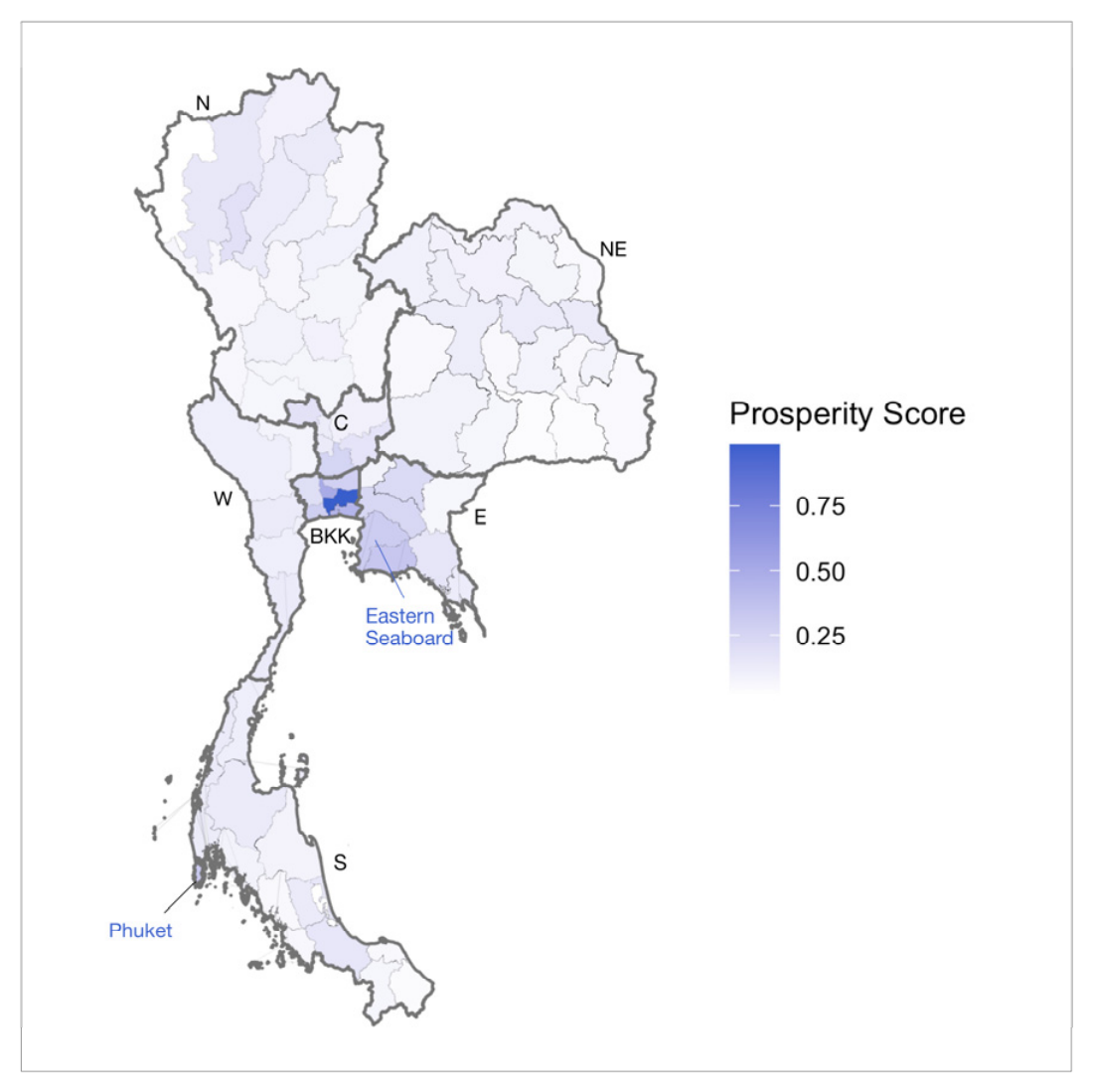
Figure 2.
Spatial distribution of distributional outcomes scores across Thai provinces, 2024.
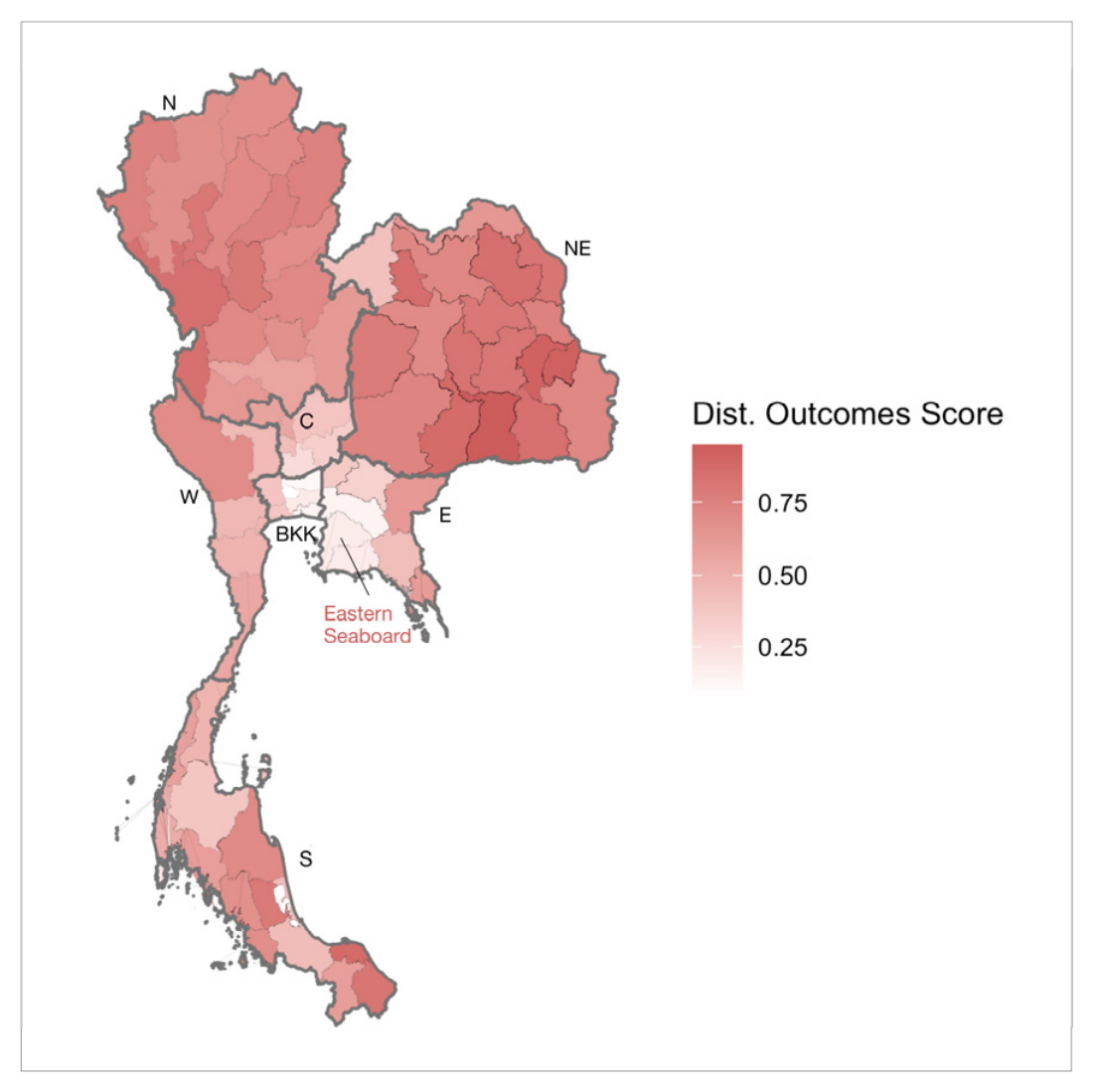
Table 1.
Criteria used in provincial rankings.
| Indicator | Description | Source |
| Economic Prosperity Ranking | ||
| GPP per capita | Real gross provincial product per capita (Baht) | NESDC |
| Educational attainment | Share of working-age population with secondary or tertiary education (%) | LFS |
| Urban population share | Share of working-age population residing in municipal areas (%) | LFS |
| Employment density | Number of working-age employed persons per square kilometer | LFS and NESDC |
| Average monthly income | Average real monthly income (Baht) | LFS |
| Distributional Outcomes Ranking | ||
| Gini coefficient | Provincial income Gini coefficient | LFS |
| Economic vulnerability | Share of working-age income earners with incomes below the national median income (%) | LFS |
Table 2.
Prosperity scores by region, 2024.
| Region | Mean | Min | Max | Range |
| Bangkok Metro Region | 0.447 | 0.198 | 0.990 | 0.793 |
| East | 0.192 | 0.068 | 0.339 | 0.271 |
| Central | 0.159 | 0.099 | 0.257 | 0.158 |
| South | 0.110 | 0.038 | 0.316 | 0.278 |
| West | 0.110 | 0.081 | 0.131 | 0.050 |
| North | 0.088 | 0.017 | 0.186 | 0.169 |
| Northeast | 0.077 | 0.032 | 0.127 | 0.095 |
Note: Regions ordered by mean prosperity score (descending).
Table 3.
Distributional outcomes scores by region, 2024.
| Region | Mean | Min | Max | Range |
| Northeast | 0.767 | 0.380 | 0.952 | 0.572 |
| North | 0.712 | 0.566 | 0.843 | 0.277 |
| South | 0.598 | 0.226 | 0.870 | 0.644 |
| West | 0.520 | 0.453 | 0.702 | 0.249 |
| Central | 0.426 | 0.271 | 0.570 | 0.299 |
| East | 0.359 | 0.148 | 0.627 | 0.479 |
| Bangkok Metro Region | 0.218 | 0.082 | 0.398 | 0.316 |
Note: Regions ordered by mean distributional outcomes score (descending).
Disclaimer/Publisher’s Note: The statements, opinions and data contained in all publications are solely those of the individual author(s) and contributor(s) and not of MDPI and/or the editor(s). MDPI and/or the editor(s) disclaim responsibility for any injury to people or property resulting from any ideas, methods, instructions or products referred to in the content. |
© 2026 by the authors. Licensee MDPI, Basel, Switzerland. This article is an open access article distributed under the terms and conditions of the Creative Commons Attribution (CC BY) license (http://creativecommons.org/licenses/by/4.0/).
Copyright: This open access article is published under a Creative Commons CC BY 4.0 license, which permit the free download, distribution, and reuse, provided that the author and preprint are cited in any reuse.