

Submitted:
26 June 2026
Posted:
29 June 2026
You are already at the latest version
Abstract
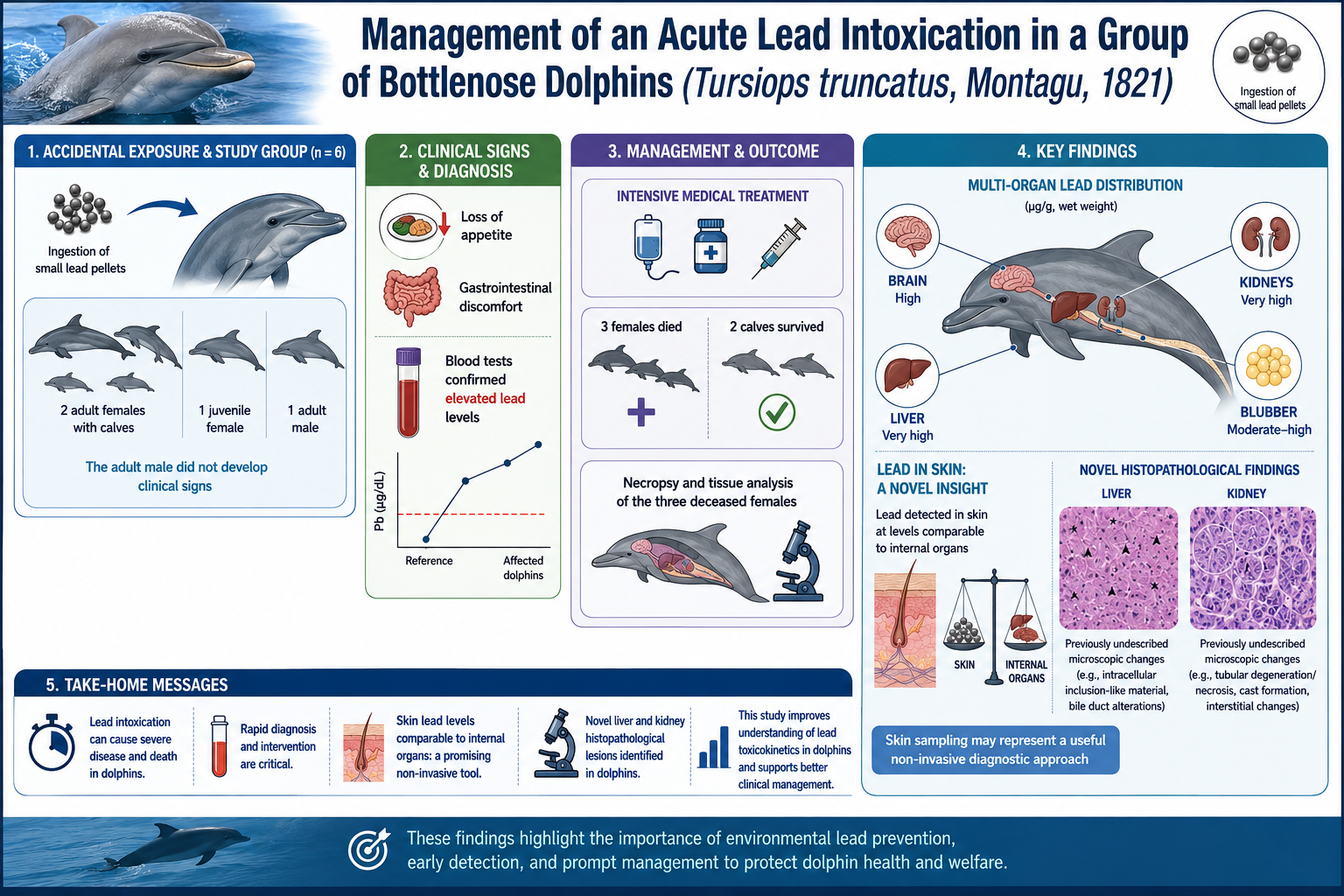
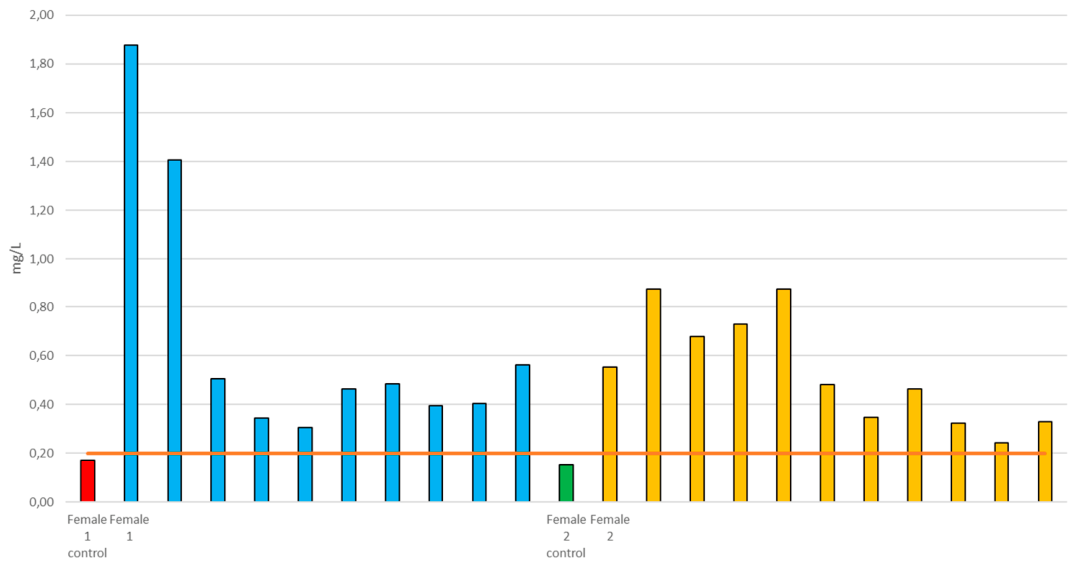
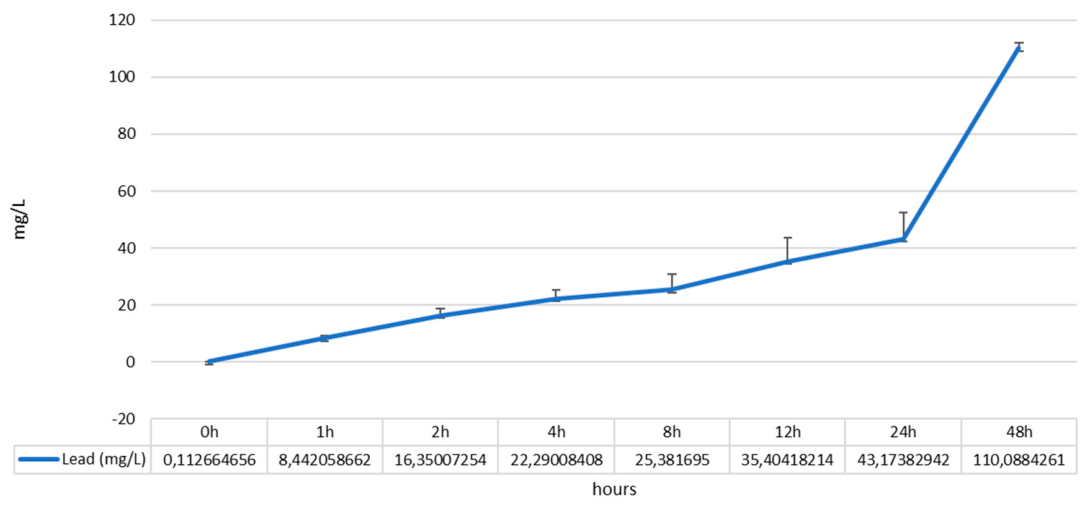
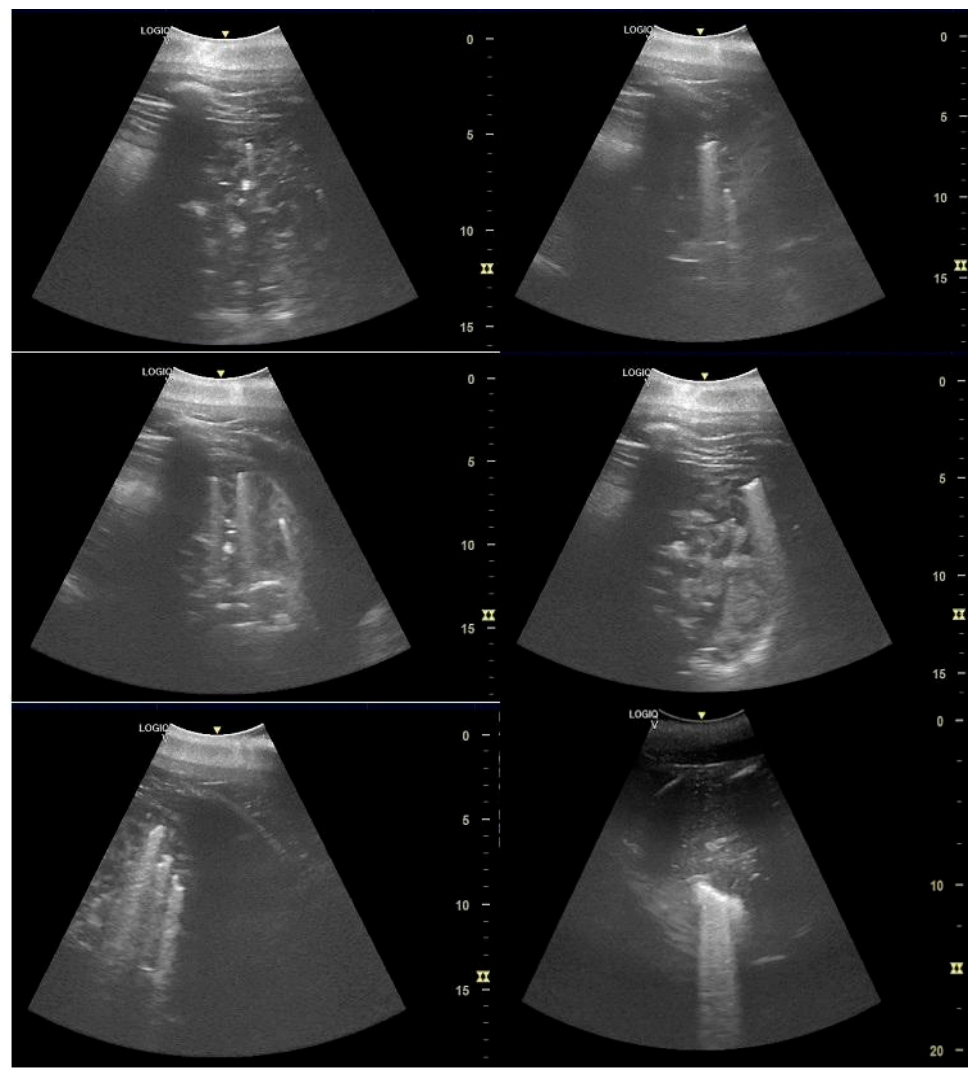
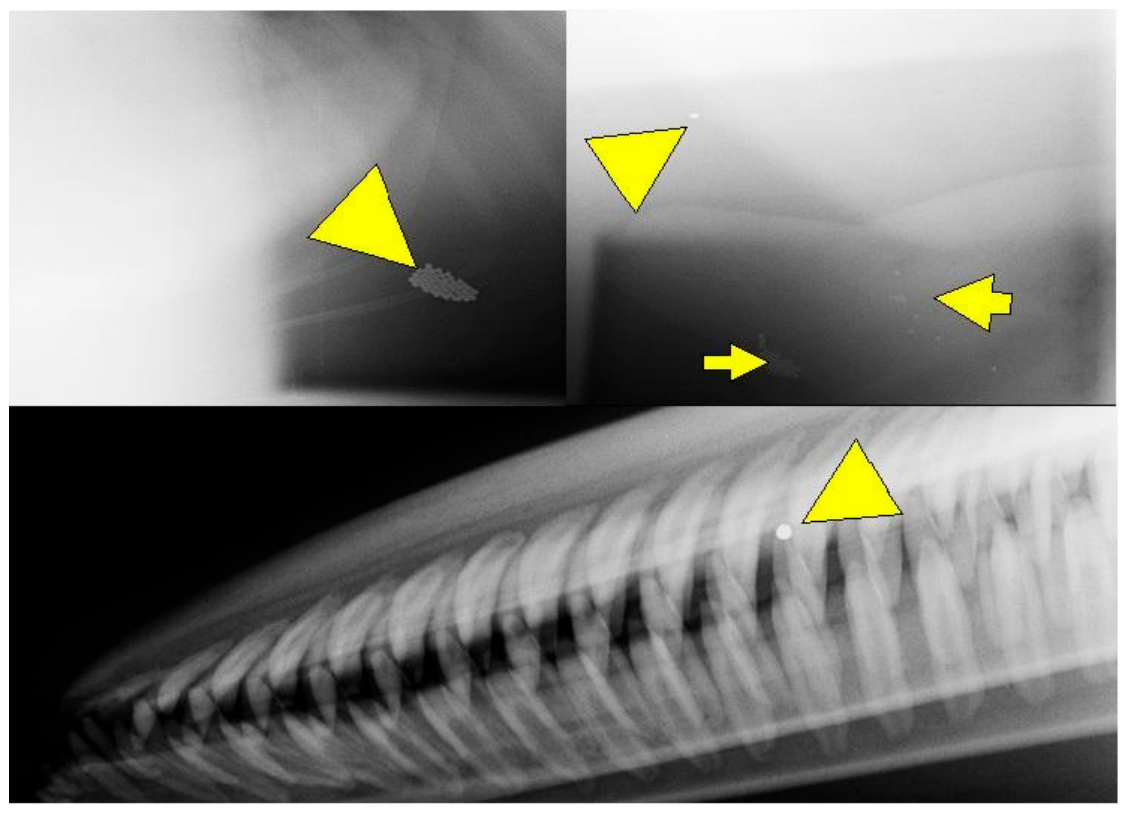
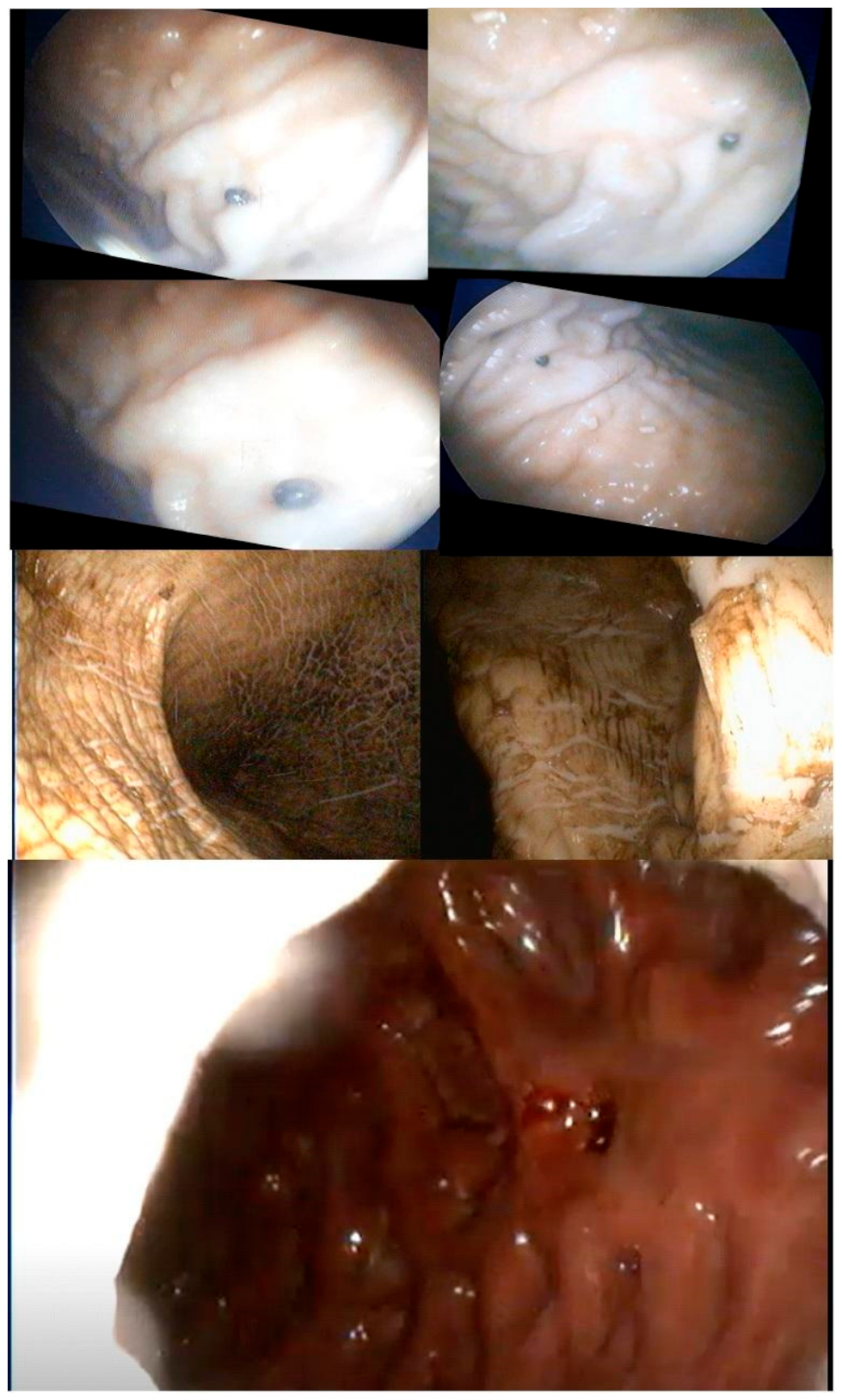
Acute lead intoxication is rarely reported in bottlenose dolphins (Tursiops truncatus) in human care, and information on tissue distribution during acute exposure is limited. This study describes the clinical presentation, management, and tissue distribution of lead (Pb) following accidental ingestion of Pb pellets in a group of six dolphins (two lactating adult females, their male calves, one juvenile female, and one adult male). The adult male did not develop clinical signs nor evidence of pellet ingestion and was therefore not included among the clinically affected cases. Clinical evaluation, hematology, serum biochemistry, heavy metal analysis, diagnostic imaging, and endoscopy were performed. Elevated blood Pb levels were detected in all clinically affected animals. Pellets were identified in the stomach of the three females and one of the calves. The calf without detectable pellets had the highest blood Pb concentration, suggesting lactational transfer. Despite intensive supportive and chelation therapy, the three adult females died, and complete necropsies were conducted. Pb concentrations were measured in liver, kidney, brain (three cerebral regions), blubber, muscle, and skin. Post-mortem analyses demonstrated high Pb concentrations in liver (1.14 mg/kg), kidney (0.814 mg/kg), and brain (0.554 mg/kg), as well as detectable levels in blubber (1.166 mg/kg). Skin Pb concentrations (1.254 mg/kg) were comparable to those of liver and kidney. Histopathology revealed intranuclear inclusion bodies in renal and hepatic cells. These findings characterize systemic Pb distribution in acute intoxication and identify skin as a potential diagnostic matrix in dolphins.
Keywords:
1. Introduction
2. Materials and Methods
2.1. Animals Involved and Onset of the Toxicosis
2.1.1. Dolphins
2.1.2. Signs and Symptoms
2.2. Clinical Diagnosis
2.3. Additional Diagnostics and Assays
2.3.1. Urine
2.3.2. Milk
2.3.3. Skin
2.3.4. Digestion Assay
2.3.4. Necropsy and Histopathology
2.3.5. Toxicological Analysis
2.4. Medical Treatments
3. Results
- lead-induced intranuclear inclusion bodies in approximately 20% of the injured hepatocytes and renal proximal convoluted lining cells;
- iron accumulation in hepatocytes;
- degenerative changes in Purkinje cells, associated with small hemorrhages, edema, gliosis, swelling/proliferation of capillary endothelium, interspersed perivascular cuffing, and cerebral neuronal degeneration;
- total depletion of red marrow with severe myelophthisis.
4. Discussion
5. Conclusions
Author Contributions
Funding
Institutional Review Board Statement
Data Availability Statement
Acknowledgments
Conflicts of Interest
Abbreviations
| BD | Bottlenose Dolphin |
| PEs | Physical Exams |
| GI | Gastrointestinal |
| CNS | Central Nervous System |
| NRBC | Nucleated Red Blood Cells |
| PLT | Platelet |
| WBC | White Blood Cell |
| PO | Per Os - Oral administration |
| BID | Bis In Die - Twice a day |
| IM | Intramuscular |
| SID | Semel In Die - Once a day |
| Pb | Lead |
| CaNa2EDTA | Calcium EDTA |
| DMSA | Dimercaptosuccinic Acid |
| Buscopan | Hyoscine Butylbromide |
| MRL | Maximum Residual Limit |
References
- Wells, R.S.; Natoli, A.; Braulik, G. Tursiops truncatus (errata version published in 2019). IUCN Red. List Threat. Species 2019, 2019–2011. [Google Scholar]
- Dziobak, M.K.; Fahlman, A.; Wells, R.S.; Takeshita, R.; Smith, C.; Gray, A.; Weinstein, J.; Hart, L.B. First evidence of microplastic inhalation among free-ranging small cetaceans. PLoS ONE 2024, 19, e0309377. [Google Scholar] [CrossRef] [PubMed]
- Ocampos, A.I.; Guinn, M.A.; Elliott, J.; Wittmaack, C.; Sinclair, C.; Abdulla, H.; Orbach, D.N. Pharmaceuticals in the blubber of live free-swimming common bottlenose dolphins (Tursiops truncatus). Iscience 2024, 27. [Google Scholar] [CrossRef] [PubMed]
- Mancia, A. On the revolution of cetacean evolution. Mar. Genom. 2018, 41, 1–5. [Google Scholar] [CrossRef]
- Grigg, E.; Markowitz, H. Habitat use by bottlenose dolphins (Tursiops truncatus) at Turneffe Atoll, Belize. Aquat. Mamm. 1997, 23, 163–170. [Google Scholar]
- Shlosberg, A.; Bellaiche, M.; Regev, S.; Gal, R.; Brizzi, M.; Hanji, V.; Zaidel, L.; Nyska, A. Lead toxicosis in a captive bottlenose dolphin (Tursiops truncatus) consequent to ingestion of air gun pellets. J. Wildl. Dis. 1997, 33, 135–139. [Google Scholar] [CrossRef] [PubMed]
- Stetter, M.; Mangold, B.; Miller, M.; Weber, M.; Capobianco, J. Successful treatment of lead toxicosis in a bottlenose dolphin (Tursiops truncatus). In Proceedings of the Proceedings of the International Association for Aquatic Animal Medicine, 1999; pp. 146–147. [Google Scholar]
- Martel, A.K.; Doss, G.A.; Mans, C. Suspected peripheral neuropathy secondary to lead intoxication in three psittacine birds. J. Exot. Pet. Med. 2020, 32, 13–17. [Google Scholar] [CrossRef]
- Chiverton, L.; Cromie, R.; Kock, R. European mammal exposure to lead from ammunition and fishing weight sources. Heliyon 2022, 8. [Google Scholar] [CrossRef] [PubMed]
- Cowan, V.; Blakley, B. Acute lead poisoning in western Canadian cattle—A 16-year retrospective study of diagnostic case records. Can. Vet. J. 2016, 57, 421. [Google Scholar] [PubMed]
- Bautista, A.C.; Puschner, B.; Poppenga, R.H. Lead exposure from backyard chicken eggs: a public health risk? J. Med. Toxicol. 2014, 10, 311–315. [Google Scholar] [CrossRef] [PubMed]
- Legagneux, P.; Suffice, P.; Messier, J.-S.; Lelievre, F.; Tremblay, J.A.; Maisonneuve, C.; Saint-Louis, R.; Bêty, J. High risk of lead contamination for scavengers in an area with high moose hunting success. PLoS ONE 2014, 9, e111546. [Google Scholar] [CrossRef] [PubMed]
- Zook, B.; Sauer, R.; Garner, F. Lead poisoning in captive wild animals. J. Wildl. Dis. 1972, 8, 264–272. [Google Scholar] [CrossRef] [PubMed]
- Blakley, B.R. Lead Poisoning in Animals. Available online: https://www.msdvetmanual.com/toxicology/lead-poisoning/lead-poisoning-in-animals. (accessed on 6 October 2024).
- California Department of Food and Agriculture. Lead toxicity and its effects on animals and animal products. Available online: https://www.cdfa.ca.gov/ahfss/Animal_Health/pdfs/leadtoxicity.pdf (accessed on 15 march 2026).
- Pain, D.J.; Fisher, I.; Thomas, V.G. A global update of lead poisoning in terrestrial birds from ammunition sources. Ingestion Lead. From Spent Ammunit. Implic. Wildl. Hum. 2009, 99–118. [Google Scholar]
- Kelly, T.R.; Grantham, J.; George, D.; Welch, A.; Brandt, J.; Burnett, L.J.; Sorenson, K.J.; Johnson, M.; Poppenga, R.; Moen, D. Spatiotemporal patterns and risk factors for lead exposure in endangered California condors during 15 years of reintroduction. Conserv. Biol. 2014, 28, 1721–1730. [Google Scholar] [CrossRef] [PubMed]
- Zabka, T.S.; Haulena, M.; Puschner, B.; Gulland, F.M.; Conrad, P.A.; Lowenstine, L. Acute lead toxicosis in a harbor seal (Phoca vitulina richardsi) consequent to ingestion of a lead fishing sinker. J. Wildl. Dis. 2006, 42, 651–657. [Google Scholar] [CrossRef] [PubMed]
- Sweeney, J.C.; Reddy, M.L.; Lipscomb, T.P.; Bjorneby, J.M.; Ridgway, S.H. Handbook of cetacean cytology. In USA: Dolphin Quest Inc; 1999. [Google Scholar]
- Corrons, J.-L.V.; Albarède, S.; Flandrin, G.; Heller, S.; Horvath, K.; Houwen, B.; Nordin, G.; Sarkani, E.; Skitek, M.; Van Blerk, M. Guidelines for blood smear preparation and staining procedure for setting up an external quality assessment scheme for blood smear interpretation. Part I: Control material. Clin. Chem. Lab. Med. 2004, 42. [Google Scholar] [CrossRef]
- Geraci, J.R.; Lounsbury, V.J. Marine mammals ashore: a field guide for strandings; National Aquarium in Baltimore, 2005. [Google Scholar]
- Bryan, C.E.; Ragland, J.M. Dolphins in human care sampling protocol and sample entry assistant (SEA) for tissue archival and Analyte analysis. Natl. Inst. Stand. Technol. Interag. Intern. Rep. 2020, 8281, 1–27. [Google Scholar] [CrossRef]
- Pugliares, K.R.; Bogomolni, A.; Touhey, K.M.; Herzig, S.M.; Harry, C.T.; Moore, M.J. Marine mammal necropsy: an introductory guide for stranding responders and field biologists; Woods Hole Oceanographic Institution: Woods Hole, MA, 2007. [Google Scholar]
- Zaccaroni, A.; Corteggio, A.; Altamura, G.; Silvi, M.; Di Vaia, R.; Formigaro, C.; Borzacchiello, G. Elements levels in dogs from “triangle of death” and different areas of Campania region (Italy). Chemosphere 2014, 108, 62–69. [Google Scholar] [CrossRef] [PubMed]
- European Commission. Regulation of 25 April 2023 on maximum levels for certain contaminants in food and repealing Regulation (EC). Off. J. 5/05/2023 2023, L 119/103 No 1881/2006, 915/2023/EU. [Google Scholar]
- Codex Alimentarius. Code of practice for the prevention and reduction of lead contamination in foods. CAC/RCP 2004, 56–2004. [Google Scholar]
- Stacy, N.I.; Nollens, H.H. Hematology of marine mammals. Schalm's Vet. Hematol. 2022, 1104–1113. [Google Scholar] [CrossRef]
- Osweiler, G. Metals and minerals. Toxicology 1996, 179–211. [Google Scholar]
- Goyer, R.A. Toxic and essential metal interactions. Annu. Rev. Nutr. 1997, 17, 37–50. [Google Scholar] [CrossRef] [PubMed]
- Friend, M.; Franson, J.C.; Ciganovich, E.A. Field manual of wildlife diseases: general field procedures and diseases of birds; Geological Survey (USGS), 1999. [Google Scholar]
- Bryan, C.E.; Christopher, S.J.; Balmer, B.C.; Wells, R.S. Establishing baseline levels of trace elements in blood and skin of bottlenose dolphins in Sarasota Bay, Florida: implications for non-invasive monitoring. Sci. Total Environ. 2007, 388, 325–342. [Google Scholar] [CrossRef] [PubMed]
- Puls, R. Mineral levels in animal health: diagnostic data; 1994. [Google Scholar]
- Meador, J.; Ernest, D.; Hohn, A.; Tilbury, K.; Gorzelany, J.; Worthy, G.; Stein, J. Comparison of elements in bottlenose dolphins stranded on the beaches of Texas and Florida in the Gulf of Mexico over a one-year period. Arch. Environ. Contam. Toxicol. 1999, 36, 87–98. [Google Scholar] [CrossRef] [PubMed]
- Stein, J.E.; Tilbury, K.L. Ecotoxicological investigations of bottlenose dolphin (Tursiops truncatus) strandings: accumulation of persistent organic chemicals and metals. In Toxicology of marine mammals; CRC Press, 2002; pp. 470–500. [Google Scholar]
- Sheffler, R.; Rebolloso, S.; Scott, I.; Buchweitz, J.P.; Puschner, B. Milk and Whole Blood Surveillance Following Lethal and Sublethal Lead Intoxication in a Michigan Dairy Herd. Toxics 2025, 13, 445. [Google Scholar] [CrossRef] [PubMed]
- Gulson, B.L.; Mizon, K.J.; Korsch, M.J.; Palmer, J.M.; Donnelly, J.B. Mobilization of lead from human bone tissue during pregnancy and lactation—a summary of long-term research. Sci. Total Environ. 2003, 303, 79–104. [Google Scholar] [PubMed]
- (ATSDR), A.f.T.S.a.D.R. Toxicological profile for Lead; U.S. Department of Health and Human Services, Public Health Service: Atlanta, GA, 2020. [Google Scholar]
- Stockham, S.L.; Scott, M.A. Fundamentals of veterinary clinical pathology; John Wiley & Sons, 2024. [Google Scholar]
- Canfield, R.L.; Gendle, M.H.; Cory-Slechta, D.A. Impaired neuropsychological functioning in lead-exposed children. Dev. Neuropsychol. 2004, 26, 513–540. [Google Scholar] [CrossRef] [PubMed]
- Cory-Slechta, D.A. Developmental Exposure to Lead: Overview and Integration of Neurobehavioral Consequences and Mediation. Environ. Factors Neurodev. Neurodegener. Disord. 2015, 139–165. [Google Scholar]
- Virgolini, M.; Rossi-George, A.; Lisek, R.; Weston, D.; Thiruchelvam, M.; Cory-Slechta, D. CNS effects of developmental Pb exposure are enhanced by combined maternal and offspring stress. Neurotoxicology 2008, 29, 812–827. [Google Scholar] [CrossRef] [PubMed]
- Heath, L.; Soole, K.L.; McLaughlin, M.L.; McEwan, G.T.A.; Edwards, J. Toxicity of environmental lead and the influence of intestinal absorption in children. Rev. Environ. Health 2003, 18, 20. [Google Scholar] [CrossRef]
- Ziegler, E.E.; Edwards, B.B.; Jensen, R.L.; Mahaffey, K.R.; Fomon, S.J. Absorption and retention of lead by infants. Pediatr. Res. 1978, 12, 29–34. [Google Scholar] [CrossRef] [PubMed]
- National Institute of Environmental Health Sciences. Lead. Available online: https://www.niehs.nih.gov/health/topics/agents/lead (accessed on 15 march 2026).
- Borrell, A.; Cantos, G.; Pastor, T.; Aguilar, A. Organochlorine compounds in common dolphins (Delphinus delphis) from the Atlantic and Mediterranean waters of Spain. Environ. Pollut. 2001, 114, 265–274. [Google Scholar] [CrossRef] [PubMed]
- Rabinowitz, M.B.; Wetherill, G.W.; Kopple, J.D. Kinetic analysis of lead metabolism in healthy humans. J. Clin. Investig. 1976, 58, 260–270. [Google Scholar] [CrossRef] [PubMed]

| INDIVIDUAL | AGE (y) | ORIGIN | RELATIONSHIP | CLINICAL HISTORY |
|---|---|---|---|---|
| Female 1 | 24 | Wild-born | Mother of Male 1 | Urethral prolapse |
| Female 2 | 22 | Wild-born | Mother of Female 3 and Male 1 | Respiratory mycosis |
| Female 3 | 6 | Captive-born | Daughter of Female 2 | Lower rank in the pod’s hierarchy. Rake marks from recent interaction with another dolphin. Ovarian cyst on the left ovary. |
| Male 1 | 3 | Captive-born | Son of Female 2 and brother of Female 3 | Nursing calf |
| Male 2 | 2 | Captive-born | Son of Female 1 | Nursing calf |
| Name | Dosage | Comment |
| Calcium EDTA (CaNa2 EDTA) | 4500 mg PO BID | Given in cycles of one week on, one week off. |
| Dimercapto succinic acid (DMSA) | 600 mg PO BID | Initially given in cycles of one week on, one week off. Later decided to maintain it daily. |
| Garlic | 1 clove PO SID | |
| Vitamin C | 300 - 500 mg/Kg PO SID | |
| Active charcoal | 1 - 5 g/Kg PP SID-BID | |
| Omeprazol | 40 mg PO SID | |
| Vitamin B complex | 2 - 5 tablets PO BID | Bécozyme Forte. Manufacturer: Dragenopharm Apotheker Püschl GmbH, Göllstrasse 1, D-84529 Tittmoning (Germany) |
| Vitamin B1 | 300 mg PO SID | |
| Vitamin K | 3 mg PO BID | |
| Folic acid | 50 mg PO SID | |
| Stanozolol | 4 mg PO SID | |
| Yunnan Baiyao | 2 capsules PO SID | |
| Sucralfate | 2 g PO SID | |
| Metoclopramide | 0.1 mg/Kg IM BID | |
| Maropitant | 20 mg IM SID | |
| Paraffin oil | 100 ml PO SID-BID | |
| Tramadol | 0.66 mg/Kg PO BID | |
| Hyoscine butylbromide (Buscopan) | 10 mg PO BID | |
| Silimarin | 240 mg PO BID | |
| Pancreatic enzymes | 8 g PO Each feeding | |
| Dexamethasone | 0.06 mg/Kg IM BID | |
| Prednisolone | 0.5 - 1 mg/Kg PO SID | |
| Furosemide | 3 mg/Kg IM SID / 40 mg PO SID |
| HEAVY METALS | Female 1 | Female 2 | Female 3 | Male 1 | Male 2 |
|---|---|---|---|---|---|
| ARSENIC ug/l | 53,4 | 54,2 | 25,1 | 11,3 | 19.6 |
| THALLIUM ug/l | <1 | <1 | <1 | <1 | <1 |
| CHROME ug/l | <5 | <5 | <5 | <5 | <5 |
| CADMIUM ug/l | <1 | <1 | <1 | <1 | <1 |
| NICKEL ug/l | <1 | <1 | <1 | <1 | <1 |
| LEAD ug/l | 1096,9 | 666,8 | 876,3 | 785 | 1726.7 |
| Valid N | Mean | Minimum | Maximum | Std.Dev. | |
|---|---|---|---|---|---|
| Female 1 | 10 | 0,042433 | 0,014880 | 0,090520 | 0,030528 |
| Female 2 | 13 | 0,046260 | 0,015050 | 0,172190 | 0,048342 |
| Female 3 | 6 | 0,131697 | 0,021020 | 0,529560 | 0,197773 |
| [Pb] mg/kg | Female 1 | Female 2 | Female 3 | Male 1 | Male 2 |
| BLUBBER | 2,881 | 0,213 | 0,405 | - | - |
| BRAIN | 0,569 | 0,031 | 1,063 | - | - |
| KIDNEY | 0,291 | 0,991 | 1,159 | - | - |
| LIVER | 1,072 | 1,006 | 1,340 | - | - |
| MUSCLE | 0,551 | 0,213 | 0,904 | - | - |
| SKIN Ante-mortem | 1,131 | 0,598 | 1,124 | - | 2,163 |
| SKIN Post-mortem | 46,58 | 0,781 | 1,328 | - | - |
Disclaimer/Publisher’s Note: The statements, opinions and data contained in all publications are solely those of the individual author(s) and contributor(s) and not of MDPI and/or the editor(s). MDPI and/or the editor(s) disclaim responsibility for any injury to people or property resulting from any ideas, methods, instructions or products referred to in the content. |
© 2026 by the authors. Licensee MDPI, Basel, Switzerland. This article is an open access article distributed under the terms and conditions of the Creative Commons Attribution (CC BY) license (http://creativecommons.org/licenses/by/4.0/).


