

Submitted:
26 June 2026
Posted:
29 June 2026
You are already at the latest version
Abstract
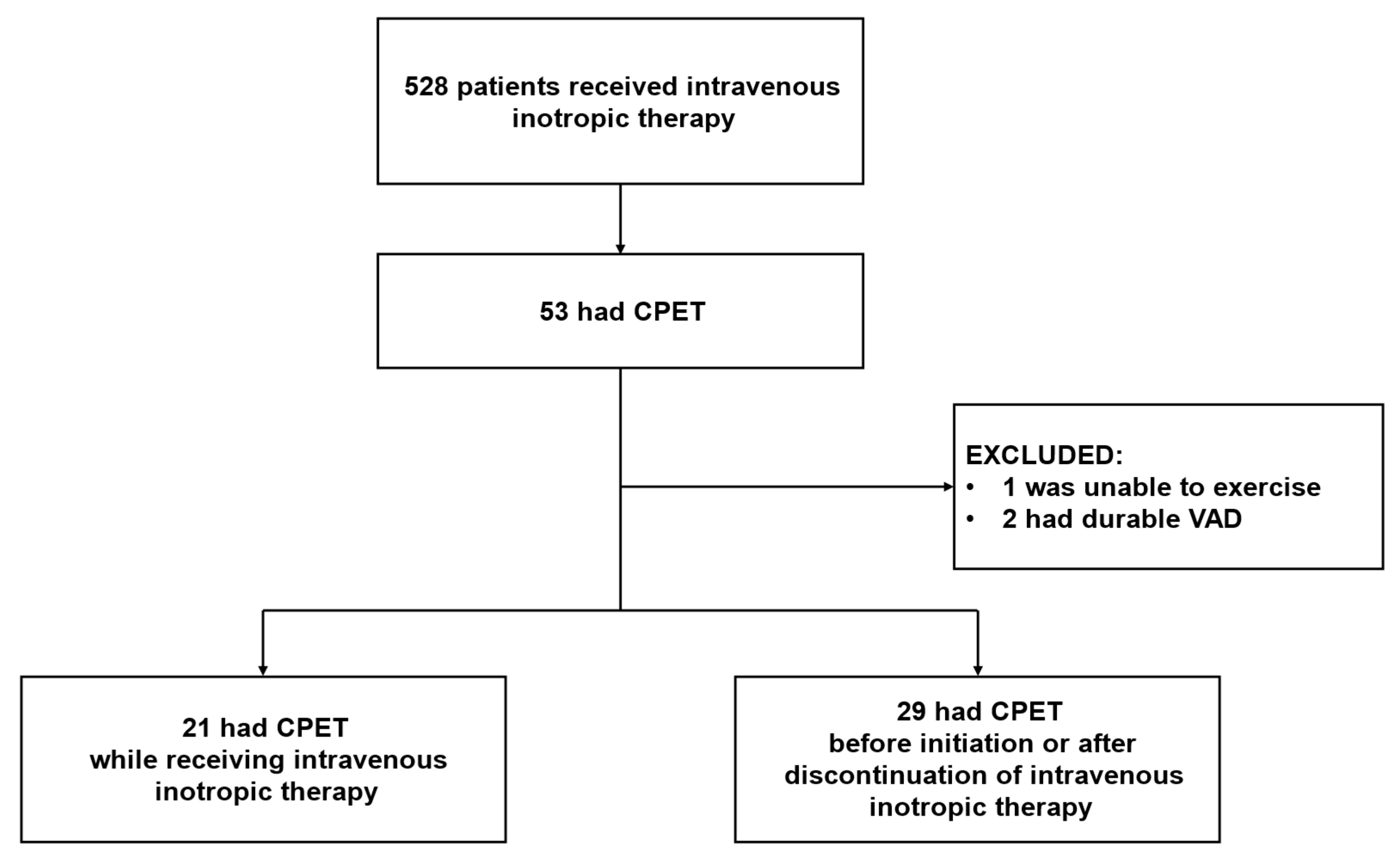
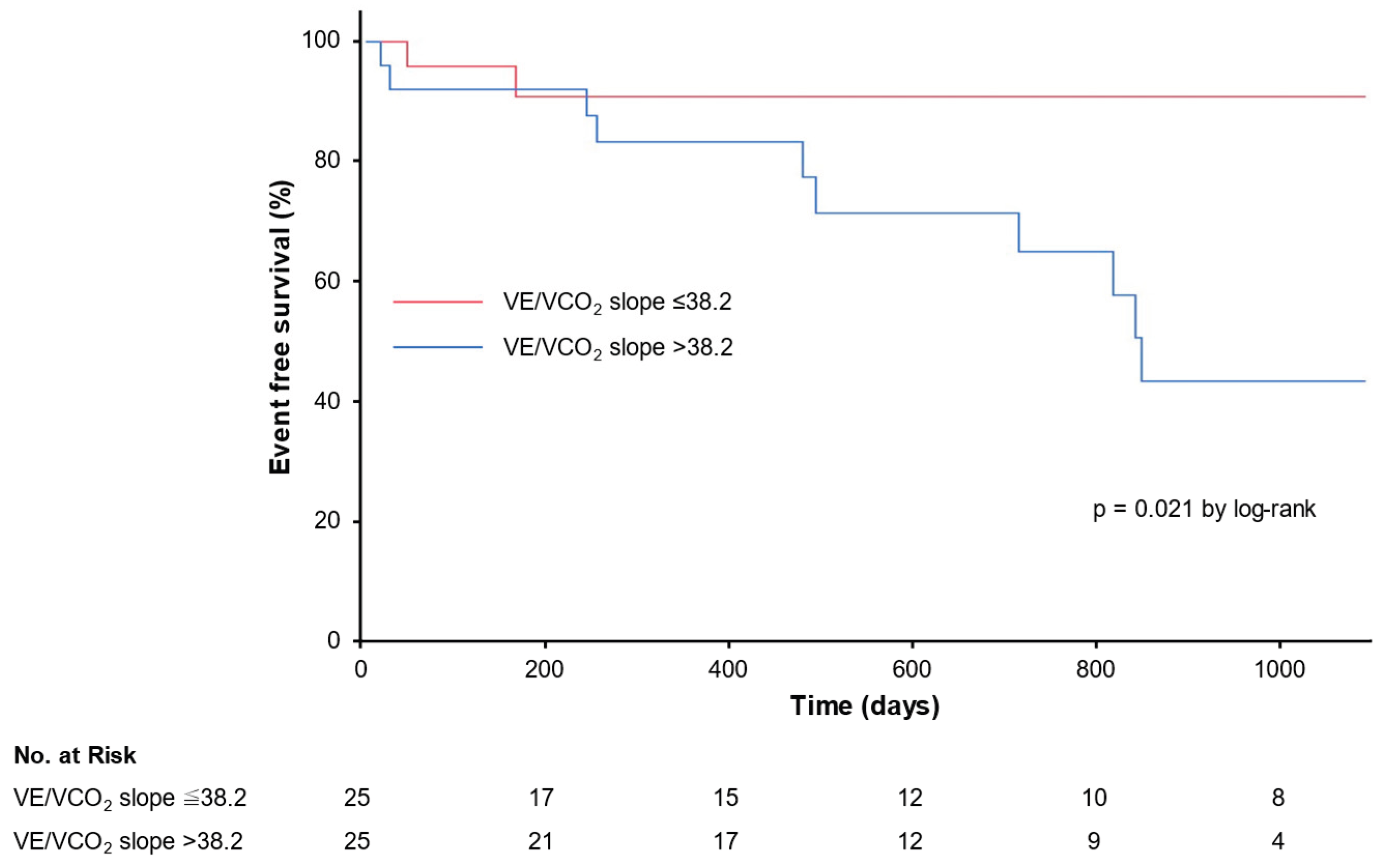
Background: Cardiopulmonary exercise testing (CPET) is widely used for prognostic assessment and risk stratification in patients with heart failure (HF). However, its feasibility and clinical utility in patients with advanced HF requiring intravenous inotropic support remain unclear. Methods: This observational study included hospitalized patients with HF who received intravenous inotropic therapy and underwent CPET during index hospitalization. The primary outcome was a composite of HF rehospitalization or cardiovascular death. Results: A total of 528 patients hospitalized for HF required intravenous inotropic therapy; 50 patients were included. CPET was safely completed in all patients without exercise-related adverse events. The median peak VO2 was 12.5 mL/kg/min, and the median VE/VCO2 slope was 38.3. During a median follow-up of 762 days, 12 primary events occurred. In univariable analysis, the VE/VCO2 slope, O2 pulse, and maximal workload were significantly associated with the primary outcome, whereas peak VO2 was not. A VE/VCO2 slope >38.2 was associated with a significantly higher 3-year event rate compared with a slope ≤38.2 (40% vs. 8%, p = 0.021). Conclusions: CPET is feasible and safe in selected patients with advanced HF requiring inotropic support, and the VE/VCO2 slope provides important prognostic information even in this high-risk population.
Keywords:
1. Introduction
2. Materials and Methods
2.1. Study Design
2.2. Exercise Testing
2.3. Outcomes
2.4. Statistical Analyses
3. Results
3.1. Follow-Up and Patient Characteristics
3.2. Cardiopulmonary Exercise Test Parameters
3.3. Clinical Outcomes
4. Discussion
4.1. Feasibility of CPET
4.2. CPET Parameters with or Without Inotropic Therapy
4.3. Clinical Impact of CPET
4.4. Limitations
5. Conclusions
Author Contributions
Funding
Institutional Review Board Statement
Informed Consent Statement
Data Availability Statement
Acknowledgments
Conflicts of Interest
References
- Alba, A. C.; Adamson, M. W.; MacIsaac, J.; Lalonde, S. D.; Chan, W. S.; Delgado, D. H.; Ross, H. J. The Added Value of Exercise Variables in Heart Failure Prognosis. J. Card. Fail From NLM. 2016, 22(7), 492–497. [Google Scholar] [CrossRef] [PubMed]
- Corrà, U.; Piepoli, M. F.; Adamopoulos, S.; Agostoni, P.; Coats, A. J.; Conraads, V.; Lambrinou, E.; Pieske, B.; Piotrowicz, E.; Schmid, J. P.; et al. Cardiopulmonary exercise testing in systolic heart failure in 2014: the evolving prognostic role: a position paper from the committee on exercise physiology and training of the heart failure association of the ESC. Eur. J. Heart Fail From NLM. 2014, 16(9), 929–941. [Google Scholar] [CrossRef] [PubMed]
- McDonagh, T. A.; Metra, M.; Adamo, M.; Gardner, R. S.; Baumbach, A.; Böhm, M.; Burri, H.; Butler, J.; Čelutkienė, J.; Chioncel, O. 2021 ESC Guidelines for the diagnosis and treatment of acute and chronic heart failure From NLM. Eur. Heart J. 2021, 42(36), 3599–3726. [Google Scholar] [CrossRef] [PubMed]
- Heidenreich, P. A.; Bozkurt, B.; Aguilar, D.; Allen, L. A.; Byun, J. J.; Colvin, M. M.; Deswal, A.; Drazner, M. H.; Dunlay, S. M.; Evers, L. R.; et al. 2022 AHA/ACC/HFSA Guideline for the Management of Heart Failure: A Report of the American College of Cardiology/American Heart Association Joint Committee on Clinical Practice Guidelines. Circulation From NLM. 2022, 145(18), e895–e1032. [Google Scholar] [CrossRef] [PubMed]
- Mancini, D. M.; Eisen, H.; Kussmaul, W.; Mull, R.; Edmunds, L. H., Jr.; Wilson, J. R. Value of peak exercise oxygen consumption for optimal timing of cardiac transplantation in ambulatory patients with heart failure. Circulation From NLM. 1991, 83(3), 778–786. [Google Scholar] [CrossRef] [PubMed]
- Mehra, M. R.; Canter, C. E.; Hannan, M. M.; Semigran, M. J.; Uber, P. A.; Baran, D. A.; Danziger-Isakov, L.; Kirklin, J. K.; Kirk, R.; Kushwaha, S. S.; et al. The 2016 International Society for Heart Lung Transplantation listing criteria for heart transplantation: A 10-year update. J. Heart Lung Transpl. From NLM. 2016, 35(1), 1–23. [Google Scholar] [CrossRef] [PubMed]
- Lietz, K.; Miller, L. W. Improved survival of patients with end-stage heart failure listed for heart transplantation: analysis of organ procurement and transplantation network/U.S. United Network of Organ Sharing data, 1990 to 2005. J. Am. Coll. Cardiol. From NLM. 2007, 50(13), 1282–1290. [Google Scholar] [CrossRef] [PubMed]
- Chua, T. P.; Ponikowski, P.; Harrington, D.; Anker, S. D.; Webb-Peploe, K.; Clark, A. L.; Poole-Wilson, P. A.; Coats, A. J. Clinical correlates and prognostic significance of the ventilatory response to exercise in chronic heart failure. J. Am. Coll. Cardiol. From NLM. 1997, 29(7), 1585–1590. [Google Scholar] [CrossRef] [PubMed]
- Corrà, U.; Agostoni, P. G.; Anker, S. D.; Coats, A. J. S.; Crespo Leiro, M. G.; de Boer, R. A.; Harjola, V. P.; Hill, L.; Lainscak, M.; Lund, L. H.; et al. Role of cardiopulmonary exercise testing in clinical stratification in heart failure. A position paper from the Committee on Exercise Physiology and Training of the Heart Failure Association of the European Society of Cardiology. Eur. J. Heart Fail From NLM. 2018, 20(1), 3–15. [Google Scholar] [CrossRef] [PubMed]
- Landsteiner, I.; Ikoma, T.; Lewis, G. D. Cardiopulmonary Exercise Testing in Advanced Heart Failure Management. Heart Fail Clin.;From NLM 2025, 21(1), 35–49. [Google Scholar] [CrossRef] [PubMed]
- Lala, A.; Shah, K. B.; Lanfear, D. E.; Thibodeau, J. T.; Palardy, M.; Ambardekar, A. V.; McNamara, D. M.; Taddei-Peters, W. C.; Baldwin, J. T.; Jeffries, N.; et al. Predictive Value of Cardiopulmonary Exercise Testing Parameters in Ambulatory Advanced Heart Failure. JACC Heart Fail From NLM. 2021, 9(3), 226–236. [Google Scholar] [CrossRef] [PubMed]
- Balady, G. J.; Arena, R.; Sietsema, K.; Myers, J.; Coke, L.; Fletcher, G. F.; Forman, D.; Franklin, B.; Guazzi, M.; Gulati, M. Clinician's Guide to cardiopulmonary exercise testing in adults: a scientific statement from the American Heart Association From NLM. Circulation 2010, 122(2), 191–225. [Google Scholar] [CrossRef] [PubMed]
- Kitai, T.; Shimogai, T.; Tang, W. H. W.; Iwata, K.; Xanthopoulos, A.; Otsuka, S.; Nakada, F.; Yokoyama, R.; Kamiya, K.; Saito, H.; et al. Short physical performance battery vs. 6-minute walking test in hospitalized elderly patients with heart failure. Eur. Heart J. Open 2021, 1(1), oeab006. [Google Scholar] [CrossRef]
- Kataoka, T.; Keteyian, S. J.; Marks, C. R.; Fedel, F. J.; Levine, A. B.; Levine, T. B. Exercise training in a patient with congestive heart failure on continuous dobutamine. Med. Sci. Sports Exerc From NLM. 1994, 26(6), 678–681. [Google Scholar] [CrossRef] [PubMed]
- Arena, R.; Humphrey, R.; Peberdy, M. A. Safety and efficacy of exercise training in a patient awaiting heart transplantation while on positive intravenous inotropic support. J. Cardiopulm. Rehabil. 2000, 20(4), 259–261. [Google Scholar] [CrossRef]
- Forestieri, P.; Guizilini, S.; Peres, M.; Bublitz, C.; Bolzan, D. W.; Rocco, I. S.; Santos, V. B.; Moreira, R. S.; Breda, J. R.; de Almeida, D. R. A Cycle Ergometer Exercise Program Improves Exercise Capacity and Inspiratory Muscle Function in Hospitalized Patients Awaiting Heart Transplantation: a Pilot Study From NLM. Braz. J. Cardiovasc Surg. 2016, 31(5), 389–395. [Google Scholar] [CrossRef] [PubMed]
- Maskin, C. S.; Forman, R.; Sonnenblick, E. H.; Frishman, W. H.; LeJemtel, T. H. Failure of dobutamine to increase exercise capacity despite hemodynamic improvement in severe chronic heart failure. Am. J. Cardiol. From NLM. 1983, 51(1), 177–182. [Google Scholar] [CrossRef] [PubMed]
- Wilson, J. R.; Martin, J. L.; Ferraro, N. Impaired skeletal muscle nutritive flow during exercise in patients with congestive heart failure: role of cardiac pump dysfunction as determined by the effect of dobutamine. Am. J. Cardiol. From NLM. 1984, 53(9), 1308–1315. [Google Scholar] [CrossRef] [PubMed]
- Mushtaq, S.; Andreini, D.; Farina, S.; Salvioni, E.; Pontone, G.; Sciomer, S.; Volpato, V.; Agostoni, P. Levosimendan improves exercise performance in patients with advanced chronic heart failure. ESC Heart Fail From NLM. 2015, 2(3), 133–141. [Google Scholar] [CrossRef] [PubMed]
- Arena, R.; Myers, J.; Abella, J.; Peberdy, M. A.; Bensimhon, D.; Chase, P.; Guazzi, M. Development of a ventilatory classification system in patients with heart failure From NLM. Circulation 2007, 115(18), 2410–2417. [Google Scholar] [CrossRef] [PubMed]
- Arena, R.; Myers, J.; Aslam, S. S.; Varughese, E. B.; Peberdy, M. A. Peak VO2 and VE/VCO2 slope in patients with heart failure: a prognostic comparison. Am. Heart J. From NLM. 2004, 147(2), 354–360. [Google Scholar] [CrossRef] [PubMed]
- Francis, D. P.; Shamim, W.; Davies, L. C.; Piepoli, M. F.; Ponikowski, P.; Anker, S. D.; Coats, A. J. Cardiopulmonary exercise testing for prognosis in chronic heart failure: continuous and independent prognostic value from VE/VCO(2)slope and peak VO(2). Eur. Heart J. From NLM. 2000, 21(2), 154–161. [Google Scholar] [CrossRef] [PubMed]
- Robbins, M.; Francis, G.; Pashkow, F. J.; Snader, C. E.; Hoercher, K.; Young, J. B.; Lauer, M. S. Ventilatory and heart rate responses to exercise: better predictors of heart failure mortality than peak oxygen consumption From NLM. Circulation 1999, 100(24), 2411–2417. [Google Scholar] [CrossRef] [PubMed]
- Bard, R. L.; Gillespie, B. W.; Clarke, N. S.; Egan, T. G.; Nicklas, J. M. Determining the best ventilatory efficiency measure to predict mortality in patients with heart failure. J. Heart Lung Transpl. From NLM.. 2006, 25(5), 589–595. [Google Scholar] [CrossRef] [PubMed]

| Total (n = 50) |
Inotrope (n = 21) |
Non-inotrope (n = 29) |
P value | |
|---|---|---|---|---|
| Age, years | 58 (49-67) | 58 (49-66) | 57 (49-72) | 0.753 |
| Male, n (%) | 36 (72) | 16 (76) | 20 (69) | 0.574 |
| Body mass index, kg/m2 | 20.5 (19.2-23.8) | 21.5 (19.1-25.7) | 20.4 (19.2-22.5) | 0.467 |
| Systolic blood pressure, mmHg | 95 (83-107) | 88 (81-98) | 105 (84-113) | 0.006* |
| Heart rate, beats per minutes | 75 (68-84) | 75 (63-80) | 71 (64-83) | 0.187 |
| Diabetes mellitus, n (%) | 21 (42) | 11 (52) | 10 (35) | 0.206 |
| Ischemic etiology, n (%) | 14 (28) | 4 (19) | 10 (35) | 0.230 |
| Dilated cardiomyopathy, n (%) | 17 (34) | 13 (62) | 4 (14) | <0.001* |
| Atrial fibrillation, n (%) | 12 (24) | 5 (24) | 7 (24) | 0.979 |
| Left ventricular ejection fraction, % | 32 (22-43) | 31 (21-40) | 32 (26-47) | 0.279 |
| Hemoglobin, g/dL | 12.7 (10.8-14.3) | 13.2 (11.7-15.1) | 11.7 (10.4-13.3) | 0.043* |
| Serum albumin, g/dL | 3.5 (3.1-3.8) | 3.5 (3.1-4.0) | 3.5 (3.2-3.8) | 0.882 |
| Serum sodium, mEq/L | 139 (137-140) | 139 (138-141) | 139 (137-140) | 0.197 |
| Serum potassium, mEq/L | 4.3 (4.0-4.8) | 4.3 (4.1-4.7) | 4.2 (4.0-4.9) | 0.867 |
| eGFR, mL/minute/1.73m2 | 54.8 (44.1-68.6) | 48.6 (44.7-65.4) | 57.0 (41.3-73.6) | 0.569 |
| Uric acid, mg/dL | 4.5 (3.7-6.3) | 3.9 (3.5-5.4) | 4.6 (3.8-6.5) | 0.109 |
| Total bilirubin, mg/dL | 0.6 (0.4-0.8) | 0.6 (0.4-0.8) | 0.6 (0.4-0.8) | 0.819 |
| Plasma BNP, pg/mL | 188 (120-339) | 229 (134-364) | 167 (91-320) | 0.238 |
| Treatment | ||||
| Dobutamine, μg/kg/min | 0 (0-2.0) | 2.0 (1.8-3.0) | 0 (0-0) | <0.001* |
| Beta-blockers, n (%) | 49 (98) | 21 (100) | 28 (97) | 0.390 |
| ACEI/ARB/ARNI, n (%) | 50 (100) | 21 (100) | 29 (100) | NA |
| MRA, n (%) | 46 (92) | 20 (95) | 26 (90) | 0.473 |
| SGLT2 inhibitors, n (%) | 38 (76) | 18 (86) | 20 (69) | 0.171 |
| Loop diuretics, n (%) | 24 (48) | 11 (52) | 13 (45) | 0.598 |
| Dose of loop diuretics, mg/day | 0 (0-10) | 10 (0-20) | 0 (0-10) | 0.472 |
| Total (n = 50) |
Inotrope (n = 21) |
Non-inotrope (n = 29) |
P value | |
|---|---|---|---|---|
| Peak VO2, mL/kg/min | 12.5 (10.6-15.4) | 13.1 (11.1-15.7) | 12.2 (10.4-15.5) | 0.549 |
| VE/VCO2 slope | 38.3 (34.1-46.8) | 43.0 (35.2-47.9) | 38.1 (33.2-44.3) | 0.157 |
| AT, mL/kg/min | 8.5 (7.5-9.4) | 8.4 (7.7-9.2) | 8.5 (7.2-9.4) | 0.714 |
| Peak RER | 1.19 (1.11-1.25) | 1.23 (1.15-1.31) | 1.14 (1.09-1.23) | 0.018* |
| Peak O2 pulse, mL | 6.5 (5.7-8.5) | 6.7 (5.4-8.9) | 6.5 (5.9-8.2) | 0.829 |
| HRR | 13 (5-21) | 13 (8-24) | 13 (3-20) | 0.271 |
| Peak systolic blood pressure, mmHg | 117 (102-128) | 114 (102-123) | 117 (107-131) | 0.267 |
| Peak heart rate, beats per minutes | 116 (102-132) | 120 (103-133) | 110 (97-132) | 0.461 |
| Maximal workload, W | 61 (45-82) | 68 (46-88) | 57 (43-80) | 0.275 |
| Borg score at peak exercise | 14 (13-17) | 14 (13-17) | 14 (13-16) | 0.520 |
| Variables | Outcome (-) (n = 38) | Outcome (+) (n = 12) | Hazzard Ratio (95% CI) | p value |
|---|---|---|---|---|
| Inotrope group, n | 16 (42) | 5 (42) | 1.21 (0.38, 3.84) | 0.742 |
| Age, years | 56 (49-66) | 65 (44-70) | 1.02 (0.98, 1.06) | 0.424 |
| Body mass index, kg/m2 | 20.6 (19.4-26.1) | 19.9 (17.5-23.1) | 0.87 (0.72, 1.01) | 0.078 |
| Ischemic etiology, n | 12 (32) | 2 (17) | 0.43 (0.09, 1.95) | 0.271 |
| LVEF, % | 32 (22-45) | 34 (21-42) | 1.01 (0.97, 1.04) | 0.671 |
| Hemoglobin, g/dL | 57.0 (44.7-71.6) | 12.3 (11.4-14.3) | 1.01 (0.80, 1.25) | 0.912 |
| eGFR, mL/minute/1.73m2 | 12.7 (10.7-14.3) | 48.5 (33.9-67.8) | 0.99 (0.97, 1.02) | 0.551 |
| ln BNP | 5.15 (4.56-5.74) | 5.62 (5.01-6.12) | 1.42 (0.66, 2.89) | 0.367 |
| Peak VO2, mL/kg/min | 13.4 (11.1-15.9) | 11.3 (9.7-12.4) | 0.83 (0.65, 1.01) | 0.066 |
| VE/VCO2 slope | 37.5 (33.3-46.0) | 45.5 (38.7-48.8) | 1.09 (1.01, 1.20) | 0.027* |
| AT, mL/kg/min | 8.6 (7.8-9.4) | 7.7 (6.5-8.8) | 0.68 (0.36, 1.22) | 0.197 |
| Peak RER | 1.19 (1.11-1.25) | 1.20 (1.09-1.27) | 2.28 (0.02, 166.69) | 0.718 |
| Peak O2 pulse, mL | 6.8 (5.7-8.8) | 6.0 (4.2-6.5) | 0.60 (0.39, 0.88) | 0.007* |
| HRR | 14 (7-23) | 9 (3-17) | 0.96 (0.89, 1.03) | 0.271 |
| Peak SBP, mmHg | 117 (102-132) | 115 (102-121) | 0.97 (0.94, 1.00) | 0.115 |
| Peak HR, beats per minutes | 119 (103-132) | 109 (92-123) | 0.98 (0.95, 1.01) | 0.178 |
| Maximal workload, W | 65 (48-86) | 46 (38-65) | 0.97 (0.93, 1.00) | 0.022* |
| Borg score at peak exercise | 14 (13-17) | 14 (12-15) | 0.90 (0.66, 1.20) | 0.492 |
| Variables | Outcome (-) (n = 43) | Outcome (+) (n = 7) | Hazzard Ratio (95% CI) | p value |
|---|---|---|---|---|
| Inotrope group, n | 18 (42) | 3 (43) | 1.29 (0.29, 5.82) | 0.737 |
| Age, years | 56 (48-66) | 70 (65-75) | 1.10 (1.03, 1.19) | 0.004* |
| Body mass index, kg/m2 | 21.0 (19.3-25.8) | 20.4 (18.8-20.6) | 0.84 (0.62, 1.03) | 0.104 |
| Ischemic etiology, n | 11 (26) | 3 (43) | 1.68 (0.38, 7.52) | 0.498 |
| LVEF, % | 32 (21-42) | 35 (27-47) | 1.02 (0.98, 1.06) | 0.311 |
| Hemoglobin, g/dL | 12.7 (10.8-14.7) | 11.5 (10.4-13.0) | 0.77 (0.51, 1.07) | 0.133 |
| eGFR, mL/minute/1.73m2 | 56.9 (45.1-68.2) | 36.3 (33.1-73.2) | 0.99 (0.96, 1.02) | 0.492 |
| ln BNP | 5.28 (4.69-5.75) | 5.09 (4.96-6.18) | 1.08 (0.40, 2.90) | 0.875 |
| Peak VO2, mL/kg/min | 13.3 (10.5-15.8) | 11.8 (11.3-12.4) | 0.87 (0.64, 1.11) | 0.282 |
| VE/VCO2 slope | 38.2 (33.8-46.6) | 42.6 (35.3-49.1) | 1.03 (0.94, 1.15) | 0.545 |
| AT, mL/kg/min | 8.5 (7.7-9.4) | 7.1 (6.4-8.9) | 0.74 (0.44, 1.21) | 0.238 |
| Peak RER | 1.19 (1.10-1.25) | 1.20 (1.11-1.27) | 2.68 (0.01, 982.59) | 0.748 |
| Peak O2 pulse, mL/beat | 6.7 (5.6-8.7) | 5.9 (5.7-6.4) | 0.70 (0.42, 1.08) | 0.110 |
| HRR | 13 (6-21) | 13 (3-25) | 0.99 (0.91, 1.06) | 0.851 |
| Peak SBP, mmHg | 116 (102-130) | 117 (79-121) | 0.97 (0.93, 1.01) | 0.183 |
| Peak HR, beats per minutes | 117 (102-132) | 103 (82-128) | 0.97 (0.93, 1.01) | 0.205 |
| Maximal workload, W | 66 (46-85) | 45 (38-48) | 0.95 (0.90, 0.99) | 0.022* |
| Borg score at peak exercise | 15 (13-17) | 14 (13-14) | 1.00 (0.69, 1.40) | 0.993 |
Disclaimer/Publisher’s Note: The statements, opinions and data contained in all publications are solely those of the individual author(s) and contributor(s) and not of MDPI and/or the editor(s). MDPI and/or the editor(s) disclaim responsibility for any injury to people or property resulting from any ideas, methods, instructions or products referred to in the content. |
© 2026 by the authors. Licensee MDPI, Basel, Switzerland. This article is an open access article distributed under the terms and conditions of the Creative Commons Attribution (CC BY) license (http://creativecommons.org/licenses/by/4.0/).


