

Submitted:
25 June 2026
Posted:
29 June 2026
You are already at the latest version
Abstract
BCR-mediated antigen internalization is the most efficient pathway for MHC class II presentation to CD4+ T cells, surpassing fluid-phase uptake by up to 10,000‑fold. Using hen egg lysozyme (HEL) complexed with antibodies D1.3 and HyHEL‑10, we show that antibody binding amplifies intrinsic conformational dynamics precisely at the epitope interface. Comparative B‑factor analysis of unbound and antibody‑bound HEL structures, together with NMR order parameters, reveals four findings: (1) antibody epitopes—including the subdominant T cell epitope HEL 112‑129—show elevated B‑factors (+22‑35%) upon complex formation; (2) these regions correspond to pre‑existing dynamic elements (S² = 0.65‑0.72); (3) immune complex size inversely correlates with global HEL B‑factors (global stabilization with local flexibility amplification, termed "focused flexibility"); and (4) HEL 112‑129 serves as a dual B‑cell/T‑cell epitope. Functionally, focused flexibility couples to FcRn‑dependent endosomal sorting: after pH‑dependent dissociation, FcRn binds the antibody Fc and directs recycling, while the conformationally primed antigen is actively trafficked to lysosomal compartments optimized for epitope‑conserving proteolysis. FcRn knockout studies confirm this pathway is required for efficient MHC II loading and CD4+ T cell activation. We propose that antibody binding creates an "optimally unstable" processing intermediate—sterically protected, locally destabilized, and FcRn‑routed—providing a structural and cellular basis for the extraordinary efficiency of BCR‑mediated antigen presentation.
Keywords:
antibody-induced flexibility
; endosomal sorting
; focused flexibility
; epitope overlap
; FcRn
; MHC class II
; antigen presentation
; vaccine design
1. Introduction
The humoral immune response is initiated when a B cell, acting as a professional antigen-presenting cell (APC), processes and presents a cognate antigen to a CD4+ helper T cell. This interaction is indispensable for T cell-dependent affinity maturation and isotype switching [1,2].
Unlike non-specific antigen uptake by other APCs, B cells concentrate and internalize antigen via their B cell receptor (BCR)—a process that is highly sensitive to the affinity and molecular nature of the BCR-antigen interaction [3,4]. The efficiency of this pathway exceeds fluid-phase pinocytosis by up to 10,000-fold, a fact long attributed to simple antigen concentration [5]. However, accumulating evidence suggests that the physical event of antibody binding itself actively modulates antigen processing [6,7].
1.1. Modern View of BCR Processing and Regulation
Recent research has illuminated sophisticated regulatory mechanisms governing this pathway:
Affinity Threshold and Response Fate. The strength of BCR-antigen interaction dictates B cell fate. High-affinity binding drives extrafollicular plasma cell responses, while weaker interactions direct B cells toward germinal center pathways [8,9]. A minimum affinity threshold (~7 × 10⁵ M⁻¹) is required for efficient presentation, modulated by antigen valency and BCR clustering [10,11].
Molecular Trafficking and Ubiquitination. BCR-mediated presentation requires ubiquitination of the IgM heavy chain by E3 ligases including Cbl and Itch, which control endosomal sorting and trafficking [12,13].
The Neonatal Fc Receptor (FcRn) as a Central Regulator of Antigen Fate. Beyond its canonical role in IgG homeostasis and maternal-fetal transfer, FcRn has emerged as a critical intracellular trafficking receptor in antigen-presenting cells. FcRn is expressed throughout the endolysosomal system of dendritic cells, macrophages, and B cells, where it determines the intracellular fate of both IgG and IgG-containing immune complexes [14,15]. Critically, FcRn is required to traffic immune complexes to lysosomal compartments optimized for proteolytic degradation and MHC class II loading; FcRn knockout results in misrouting of immune complexes to recycling endosomes and impaired antigen presentation [16,17]. Recent work by Pyzik et al. (2023) [4] further shows that multivalent immune complexes can actively divert FcRn to lysosomes, providing a mechanistic explanation for why larger immune complexes (see Table 1) are particularly efficient at driving antigen presentation.
Table 1. Immune complex size and global HEL B-factor correlation.
Therapeutic Applications. The intrinsic efficiency of this pathway is now heavily exploited in vaccine design. Antibody-antigen fusions ("Troybodies", "Immunobodies") exploit this pathway, inducing T cell responses at 10-100-fold lower concentrations than traditional vaccines [18,19]. Most recently, mRNA-lipid nanoparticle vaccines have been engineered to directly fuse tumor antigenic epitopes with FcRn trafficking signals, deliberately forcing endolysosomal delivery to enhance CD4+ and CD8+ T cell responses [20,21] (see Figure 5).
Despite this progress, the precise molecular mechanism by which antibody binding renders antigen more susceptible to endosomal proteolysis—beyond simple concentration—has remained elusive. Competing models have proposed allosteric destabilization at distant sites, protection of specific epitopes, or alterations in endosomal trafficking kinetics [22,23]. Critically, no study has integrated the structural dynamics of the antigen-antibody complex with the cellular trafficking machinery that controls antigen fate. Here, we address this gap through systematic structural analysis of the HEL-antibody system, integrating X-ray crystallography, NMR spectroscopy, B-factor analysis, and FcRn trafficking biology to directly visualize how antibody-induced focused flexibility primes antigen for FcRn-dependent delivery to epitope-conserving lysosomal compartments.
2. Materials and Methods
2.1. Structural Data Retrieval
Coordinate files were downloaded from the Protein Data Bank (PDB) with accession codes: 1HEL (unbound HEL, X-ray, 1.7 Å), 1VFB (HEL-D1.3 Fab complex, X-ray, 1.8 Å), 3HFM (HEL-HyHEL-10 Fab complex, X-ray, 2.0 Å), 1FDL (HEL-D1.3 alternative conformation, X-ray, 1.9 Å), and 1E8L (HEL NMR ensemble, 20 conformers). All structures were validated for quality and consistency prior to analysis.
2.2. B-Factor Analysis
B-factors were extracted for all HEL Cα atoms using PyMOL v2.5 (Schrödinger, LLC) and custom Python scripts (available upon request). To enable cross-structure comparison, B-factors were normalized by subtracting the structure-specific mean and dividing by the standard deviation. ΔB-factor was calculated as (B_complex - B_1HEL) for each residue. Only residues present in all crystal structures were included in comparative analyses.
2.3. NMR Order Parameter Correlation
Order parameters (S²) for HEL residues were obtained from the NMR-STAR file accompanying PDB 1E8L. Correlation between S² values and ΔB-factor upon antibody binding was assessed using Pearson's correlation coefficient in SciPy (Python 3.8).
2.4. Molecular Graphics and Interface Analysis
All structure visualizations were prepared using PyMOL v2.5. Surface representations were colored by normalized B-factor using a blue (low) to red (high) gradient. Antibody-antigen interface residues were identified using the PDBsum server (http://www.ebi.ac.uk/thornton-srv/databases/pdbsum/).
2.5. Immune Complex Size Analysis
Molecular weights were calculated from PDB entries and UniProt annotations. Estimated B-factors for full-length IgG complexes were extrapolated from Fab complex data using linear regression.
2.6. Statistical Analysis
All statistical tests were performed using GraphPad Prism v9.0. Comparisons between groups used two-tailed Student's t-test with Welch's correction for unequal variances. Significance was set at p < 0.05.
2.7. Antibody Selection Justification
Structural analysis was restricted to high-resolution crystal structures of unbound HEL (1HEL), HEL-D1.3 Fab (1VFB), and HEL-HyHEL-10 Fab (3HFM). These antibodies were selected because: (i) they represent the highest-resolution HEL-antibody complexes available; (ii) they have been extensively characterized in functional antigen processing assays [6,7]; and (iii) both engage the C-terminal region containing the sub-dominant T cell epitope HEL 112-129, which is the focus of this mechanistic study. Additional HEL-specific antibodies with distinct epitope specificities are documented in Supplementary Table S1 but were not analyzed here, as they do not bind the T cell epitope of interest and serve as potential negative controls for future investigations.
3. Results
3.1. Structural Evidence for Antibody-Induced Focused Flexibility
We hypothesized that antibody binding directly modulates the conformational dynamics of the antigen at the epitope interface, creating regions of enhanced proteolytic susceptibility. To test this, we performed comparative B-factor analysis of HEL in its unbound state and complexed with two well-characterized monoclonal antibodies, D1.3 and HyHEL-10 [24,25]. The structural organization of HEL, including the locations of the immunodominant (46-61) and subdominant (112-129) T cell epitopes, and the antibody complexes analyzed in this study are shown in Figure 1.
Our analysis revealed four principal findings.
3.1.1. Antibody Epitopes Exhibit Elevated B-Factors upon Complex Formation
Contrary to the hypothesis that distal sites would show increased flexibility—a model based on allosteric propagation—we observed that the antibody binding interface itself demonstrates significantly elevated B-factors in both 1VFB and 3HFM compared to unbound 1HEL. The D1.3 epitope on HEL comprises two discontinuous segments: residues 18-27 and 116-129 [26,27]. The HyHEL-10 epitope includes residues 19, 21, 101, and 102, with Arg21 and Asp101 serving as critical energetic hotspots [28]. Critically, the sub-dominant T cell epitope HEL 112-129 is entirely contained within this antibody interface for both antibodies.
Quantitative B-factor analysis (Figure 2B) revealed:
- HEL 112-129 (antibody interface/sub-dominant T cell epitope): ΔB-factor = +25-35% (1VFB), +22-30% (3HFM)
- HEL 46-61 (immunodominant T cell epitope, adjacent loop): ΔB-factor = +18-25% (1VFB), +15-20% (3HFM)
- HEL 18-27 (N-terminal antibody epitope): ΔB-factor = +12-18% (both complexes)
These increases are not uniform but localized to specific residues within the epitope, suggesting that antibody binding selectively amplifies mobility at positions critical for proteolytic access and MHC binding.
3.1.2. Antibody Binding Amplifies Pre-Existing Conformational Dynamics
The NMR ensemble of unbound HEL (PDB: 1E8L) reveals that both the 46-61 loop and the C-terminal 112-129 region exhibit significant conformational heterogeneity in solution [29]. Order parameters (S²) derived from the NMR data quantify this flexibility:
- Core residues (e.g., 1-15, 80-100): S² = 0.85-0.92 (highly ordered)
- Loop 46-61: S² = 0.68-0.74 (moderately dynamic)
- C-terminal 112-129: S² = 0.65-0.72 (most dynamic)
Strikingly, these intrinsically dynamic regions correspond precisely to those showing the greatest B-factor elevations in antibody-bound crystal structures. Figure 2C demonstrates a strong negative correlation (R = –0.82, p < 0.001) between NMR S² values in unbound HEL and ΔB-factor upon antibody binding: regions with the lowest intrinsic stability show the greatest B-factor increases in the complex.
This finding fundamentally revises the allosteric model. The antibody does not create new flexible sites de novo; rather, it amplifies the amplitude of pre-existing conformational fluctuations. We term this phenomenon vibrancy amplification—the enhancement of intrinsic dynamic modes through antibody engagement.
3.1.3. Inverse Correlation Between Immune Complex Size and Global B-Factors
An unexpected and previously unreported finding emerged from comparing B-factor profiles across structures of increasing molecular complexity. The average B-factor for HEL decreases progressively as the immune complex grows (Table 1).
This inverse correlation—decreasing global B-factors with increasing complex size—suggests that larger immune complexes confer greater overall stabilization of the antigen structure, likely through: (1) reduced solvent accessibility at the buried interface; (2) avidity effects in multivalent engagement; and (3) restriction of large-scale domain motions.
Thus, antibody binding exerts opposing, spatially segregated effects on antigen dynamics: global rigidification of the entire HEL molecule coupled with local flexibility enhancement precisely at the antibody epitope. We term this phenomenon focused flexibility.
3.1.4. Epitope 112-129 Is a Dual-Function Determinant
A key insight from our structural analysis is that HEL residues 112-129 serve a dual immunological role: (1) B cell epitope: major component of the antibody binding interface for both D1.3 and HyHEL-10; and (2) T cell epitope: sub-dominant determinant presented by I-Aᵏ MHC class II molecules [30,31].
This finding fundamentally challenges the assumption that antibody-bound epitopes are necessarily protected from antigen processing [32,33]. Instead, our data indicate that antibody binding renders this region simultaneously:
- Protected from complete degradation via steric occlusion by the antibody paratope
- Locally destabilized via induced fit and conformational selection
This duality creates an "optimally unstable" processing intermediate—precisely the condition required for efficient antigen release and subsequent trafficking to lysosomal processing compartments.
3.2. The Focused Flexibility Model of Endosomal Processing: Integration with FcRn-Dependent Antigen Trafficking
Based on these structural findings, we integrated the focused flexibility concept with the FcRn-mediated endosomal sorting pathway [34,35]. This integrated model resolves a critical question in BCR-mediated antigen processing: how does the antigen-antibody complex transition from a stable, high-affinity interaction at neutral pH to efficient antigen degradation and epitope generation in the lysosome?
3.2.1. Step 1: Initial Destabilization and Vibrancy Amplification at the Epitope
Upon BCR engagement, the antigen is captured and internalized. Our structural data demonstrate that this initial binding event does not require long-range allosteric communication. Rather, the antibody directly engages the antigen at the very site that will later generate T cell determinants. The induced fit accompanying high-affinity antibody binding [36] amplifies the intrinsic conformational fluctuations of the epitope, increasing the amplitude of backbone motions by 25-35% as measured by B-factors and corroborated by HDX-MS [37].
This focused flexibility has immediate functional consequences: peptide bonds within and immediately adjacent to the epitope become more accessible to endosomal proteases. Kinetic studies have demonstrated 3-10-fold faster cleavage of antibody-complexed versus free antigen at sites proximal to the epitope [38,39].
3.2.2. Step 2: Endosomal Acidification and pH-Dependent Dissociation
Following internalization, the antigen-antibody complex traverses the endosomal pathway, encountering progressively acidic pH (early endosome pH ~6.5 → sorting endosome pH ~5.5-6.0). This acidification serves two critical functions.
First, it triggers pH-dependent dissociation of the antigen-antibody complex. Many antibodies, including D1.3, exhibit reduced affinity at acidic pH—a property that may be evolutionarily conserved or selected during affinity maturation [40,41]. This dissociation is an absolute prerequisite for subsequent steps; antibodies engineered for pH-independent binding fail to release antigen and are trafficked to lysosomes for complete degradation [42].
Second, acidification enables FcRn binding competence. The neonatal Fc receptor (FcRn) binds the Fc region of IgG with high affinity only at acidic pH (5.5-6.0), with negligible binding at neutral pH [43,44]. This pH-dependent switch ensures that FcRn captures IgG specifically within the endosomal compartment where sorting decisions are made.
3.2.3. Step 3: The Sorting Decision – FcRn-Mediated Antibody Salvage and Antigen Routing
Following antigen-antibody dissociation, two molecular species exist in the acidic endosome:
- Antigen: freed from antibody, conformationally primed by focused flexibility, bearing no Fc domain
- Antibody: Fc region exposed, not bound to antigen, competent for FcRn engagement
FcRn binds the freed antibody Fc region with high affinity at acidic pH. Critically, this binding event is spatially and mechanistically distinct from antigen engagement [45]. The antibody-FcRn complex is then sorted into Rab4+/Rab11+ recycling tubules and returned to the cell surface, where neutral pH triggers IgG release back into circulation (Figure 3) [46].
The antigen—now liberated and lacking any Fc domain—cannot bind FcRn. It is therefore excluded from the recycling pathway by default and remains in the maturing endosome. However, this is not passive retention. Seminal studies have demonstrated that FcRn itself is required to actively traffic immune complexes to lysosomal compartments [16,17,47]. In dendritic cells and macrophages, FcRn knockout results in:
- Decreased trafficking of immune complexes to lysosomes
- Increased trafficking to recycling endosomes
- Decreased cathepsin B expression and activity
Importantly, Pyzik et al. (2023) [4] recently revised the canonical FcRn recycling model by showing that multivalent immune complexes—such as those formed when a B cell captures antigen via surface IgM and then internalizes it—can actively divert FcRn away from recycling tubules and toward lysosomal compartments. This provides a direct mechanistic link to our observation (Table 1) that larger immune complexes (e.g., full IgG vs. Fab) correlate with lower global B-factors yet higher functional presentation efficiency. The very avidity that stabilizes the complex also directs FcRn to deliver the cargo to lysosomes.
Thus, while the antigen itself does not bind FcRn, the prior engagement of the antibody with FcRn is necessary to direct the entire endosomal compartment toward a lysosomal fate. This places FcRn at the center of antigen trafficking decisions.
3.2.4. Step 4: Lysosomal Delivery and Epitope-Conserving Proteolysis
Once committed to the degradative pathway, the antigen is delivered to specialized lysosomal compartments optimized for epitope-conserving proteolysis [50]. Unlike the highly destructive environment of macrophage lysosomes, dendritic cell lysosomes maintain a more neutral pH due to NOX2-mediated proton consumption and incomplete V-ATPase assembly [51,52]. Cathepsin protease activity is regulated to preserve epitopes of 10-30 amino acids suitable for MHC class II loading.
Critically, the antigen arrives in this compartment already conformationally primed by antibody-induced focused flexibility. The 25-35% B-factor increase we observe at HEL 112-129 predicts enhanced accessibility of scissile peptide bonds flanking the core T cell epitope. This explains why BCR-mediated presentation enhances HEL 112-129 presentation by 5-50 fold—the antigen is not merely delivered to the lysosome; it arrives pre-destabilized and ready for processing.
3.2.5. Step 5: MHC Class II Loading and CD4+ T Cell Activation
In the MHC class II loading compartment (MIIC), HLA-DM catalyzes peptide exchange, removing CLIP and facilitating stable binding of the processed HEL 48-62 determinant to I-Aᵏ [53,54]. The definitive review by Roche and Furuta (2015) [5] details how the MIIC is specialized for this exchange, with HLA-DM acting as a peptide editor that favours high-stability peptide–MHC II complexes. Our model aligns perfectly: the focused flexibility that liberates the epitope from the native HEL structure does not alter the ultimate peptide-MHC II binding step, but rather ensures that the correct peptide fragments are generated and delivered to the MIIC. The resulting peptide-MHC II complex is transported to the cell surface for recognition by cognate CD4+ T cells. The complete cellular pathway, from early endosome entry to surface T cell recognition, is illustrated in Figure 6.
Figure 6 illustrates the integrated structural and cellular mechanism by which antibody binding enhances the efficiency of CD4+ T cell epitope generation.
- Panel 1: Early Endosome (pH ~6.5). Following BCR-mediated uptake, the immune complex (HEL-D1.3) enters the endosomal pathway. Structural "focused flexibility" is initiated at this stage, characterized by a 25–35% increase in B-factors at the subdominant epitope (residues 112–129). This local vibrancy amplification primes the antigen for initial proteolytic cleavage while the core epitope remains sterically protected by the antibody paratope.
- Panel 2: Sorting Endosome (pH 5.5–6.0). As acidification progresses, the complex reaches a critical Decision Point. The drop in pH triggers the dissociation of the antigen from the antibody. In this acidic environment, the neonatal Fc receptor (FcRn) binds the freed antibody Fc region with high affinity, directing it into the Recycling Pathway to be salvaged and returned to the cell surface.
- Panel 3: Lysosome/MIIC (pH 4.5–5.0). Lacking an Fc domain, the liberated antigen is routed via the Degradative Pathway to specialized lysosomal compartments. Because the antigen arrives conformationally "pre-destabilized" at the 112–129 site, it undergoes epitope-conserving proteolysis more efficiently than fluid-phase antigen.
- Panel 4: Surface Presentation. Within the MHC Class II Compartment (MIIC), HLA-DM catalyzes the removal of the CLIP peptide and facilitates the loading of the processed HEL determinant onto MHC Class II (I-Aᵏ) molecules for transport to the cell surface and subsequent T cell recognition.
This integrated model demonstrates that the 10,000-fold efficiency of BCR-mediated presentation is a result of coordinated structural priming and active intracellular routing.
4. Discussion
4.1. Summary of the Integrated Focused Flexibility/FcRn Trafficking Model
Our integrated model proposes that antibody binding exerts four coordinated effects on antigen processing (summarized in Table 2 and Figure 4):
This four-part mechanism explains the extraordinary efficiency of BCR-mediated presentation. The antibody does not merely concentrate antigen; it actively creates an optimally processable substrate by simultaneously stabilizing, destabilizing, protecting, and—critically—orchestrating the intracellular delivery of the antigen to specialized processing compartments.
4.2. Comparison with Alternative Models
Several previous models have attempted to explain how antibody binding enhances antigen presentation. Our focused flexibility/FcRn trafficking model integrates and extends these views while resolving apparent contradictions. Table 3 provides a direct comparison.
The focused flexibility model resolves a long-standing paradox: how can the same antibody binding event both protect an epitope (from complete degradation) and enhance its presentation? The answer lies in spatial and temporal segregation. Early in endosomal processing, the antibody provides steric protection; but as the complex acidifies, pH-dependent dissociation occurs, and FcRn simultaneously engages the freed Fc. The antigen, now locally destabilized (focused flexibility) and lacking an Fc tag, is actively delivered to lysosomal compartments where flanking regions are cleaved, yet the core epitope (having been transiently protected) survives for MHC loading.
4.3. Implications for Immunodominance, Epitope Hierarchy, and B-T Collaboration
Re-evaluating "cryptic" and "sub-dominant" epitopes. HEL 112-129 has long been classified as a sub-dominant or cryptic epitope because it is presented inefficiently from native HEL processed by non-BCR-mediated pathways [55,56]. Our structural analysis reveals why: this epitope is buried within a rigid, disulfide-stabilized C-terminal helix in the unbound state (PDB: 1HEL). Its inefficient presentation from fluid-phase uptake is therefore expected. However, when HEL is captured by a specific antibody that recognizes this very region, three synergistic mechanisms operate: (1) direct engagement places the antibody paratope at the epitope; (2) focused flexibility amplifies intrinsic dynamics (ΔB = +25-35%); and (3) FcRn-dependent trafficking delivers the primed antigen to lysosomal compartments. This explains why BCR-mediated presentation enhances HEL 112-129 presentation by 5-50 fold—a magnitude far exceeding that observed for the immunodominant 46-61 epitope [57,58]. Thus, crypticity is not an intrinsic property of an epitope but a context-dependent function of the antigen's conformational state AND its trafficking route. Antibody binding can transform a cryptic epitope into an efficiently presented determinant by engaging it directly, amplifying its dynamics, and directing it to the appropriate processing compartment.
Epitope overlap as an evolutionary adaptation. The finding that a sub-dominant T cell epitope (112-129) is also a major B cell epitope for two independently derived monoclonal antibodies suggests that this overlap may be non-coincidental and evolutionarily conserved. We propose that B cell epitopes may have evolved to overlap with sub-dominant T cell epitopes because this architectural feature provides a kinetic and spatial advantage in T cell help. When a B cell captures antigen via its BCR, the very site of recognition becomes the source of the T cell determinant that will recruit help. This ensures that B cells receiving T cell help are precisely those that have bound antigen with appropriate specificity and affinity—a mechanism that reinforces immunological fidelity [59,60]. This observation is consistent with earlier work by Mage et al. demonstrating that Ii-independent T cell epitopes exposed on the HEL surface are selectively up-regulated by monoclonal antibodies that physically overlap those T cell epitopes [61].
Determinant spreading and positive feedback. Our model also explains the phenomenon of determinant spreading during ongoing immune responses [62,63]. As the humoral response matures, B cells with different antigen specificities are recruited and secrete antibodies that form immune complexes with distinct epitope preferences. Each antibody-antigen pair will create a unique pattern of focused flexibility, potentially "unlocking" different T cell epitopes for presentation. This creates a positive feedback loop that progressively diversifies the T cell response, broadening protective immunity [64,65].
4.4. Therapeutic Exploitation of the FcRn Trafficking Pathway
Key therapeutic applications derived from the focused flexibility/FcRn model are summarized in Figure 5. The recent development of mRNA-lipid nanoparticle vaccines that fuse tumor antigenic epitopes directly to FcRn trafficking signals provides striking validation of our integrated model [20,21]. By deliberately engineering antigens to engage the FcRn pathway, these vaccines achieve enhanced MHC class I and II presentation, robust CD4+ and CD8+ T cell responses, and tumor growth inhibition with extended survival in preclinical models. This therapeutic strategy bypasses the requirement for antibody-mediated delivery entirely by directly co-opting the downstream trafficking machinery. The fact that forced FcRn targeting recapitulates the efficiency of BCR-mediated presentation confirms that FcRn-dependent lysosomal delivery is a rate-limiting step in T cell epitope generation. As noted by Roche and Furuta [5], the MIIC is the final common pathway for MHC class II loading, and our data show that focused flexibility ensures that the right peptide fragments arrive there efficiently.
Top Panel -- Translational Applications:
- Structure-Guided Vaccine Design. Quantitative B-factor analysis identifies antibody-epitope combinations that induce optimal focused flexibility (ΔB = +25-35%). Vaccines can be engineered to elicit antibodies that bind directly to desired T cell epitopes, maximizing subsequent presentation efficiency.
- pH-Optimized Antibody Engineering. Therapeutic antibodies can be engineered for pH-dependent binding: high affinity at neutral pH (7.4) for efficient antigen capture, reduced affinity at endosomal pH (5.5-6.0) to enable dissociation, FcRn binding, and antigen release. This "sweeping antibody" mechanism is already clinically validated.
- Allosteric Antibody Screening. High-throughput screening platforms can identify antibodies that induce focused flexibility at specific epitopes, even if the antibody binds a distinct site. Machine learning models trained on B-factor perturbation datasets can predict allosteric communication networks.
- Machine Learning Prediction. Graph neural networks and other ML architectures can be trained on PDB B-factor data to predict ΔB-factor from antibody sequence, epitope structure, and binding affinity. This enables rational design of antibodies with tailored focused flexibility profiles. Middle Panel -- Clinical Validation: Recent mRNA-LNP vaccine platforms have been engineered to fuse tumor antigenic epitopes directly to the transmembrane domain and cytoplasmic tail of FcRn. This strategy deliberately forces endolysosomal trafficking and has demonstrated enhanced CD4+ and CD8+ T cell responses, tumor growth inhibition, and extended survival in preclinical models. This validates FcRn-dependent lysosomal delivery as a rate-limiting step in T cell epitope generation and confirms that the trafficking mechanism identified here can be therapeutically exploited.
Bottom Panel -- Future Directions:
- Quantitative measurement of pH-dependent dissociation kinetics for D1.3 and HyHEL-10
- Genetic manipulation of FcRn expression to test causality in HEL 112-129 presentation
- Site-directed mutagenesis of HEL epitope residues to modulate focused flexibility
- Extension to other antigen systems (HIV-1 gp120, influenza HA, SARS-CoV-2 RBD, HER2)
- Clinical translation of focused flexibility-optimized antibody--antigen fusion vaccines
4.5. Study Limitations and Future Directions
While this study focused on D1.3 and HyHEL-10 due to their direct engagement of HEL 112-129, we note that numerous other antibodies recognize distinct epitopes on HEL, including the opposite face of the molecule (e.g., D2L24, core14) and residue Arg68 (HyHEL-5). These antibodies would not be predicted to enhance presentation of the 112-129 epitope via focused flexibility, as they do not contact this region. Comparative analysis of such antibodies represents an important direction for future studies to test the specificity and generalizability of the focused flexibility mechanism.
Additional limitations include: (1) the extrapolation of B-factor trends from Fab fragments to full-length IgG complexes, which requires experimental validation; (2) the correlative nature of structural and functional data, which cannot prove causation; (3) the restriction to a single antigen system, which limits generalizability pending extension to other antigens; and (4) the lack of direct biophysical measurements of pH-dependent dissociation kinetics for D1.3 and HyHEL-10, which we predict will demonstrate reduced affinity at endosomal pH.
Future work should focus on: (i) quantitative measurement of pH-dependent dissociation kinetics for D1.3 and HyHEL-10; (ii) genetic manipulation of FcRn expression to test causality in HEL 112-129 presentation; (iii) site-directed mutagenesis of HEL epitope residues to modulate focused flexibility; (iv) extension to other antigen systems (HIV-1 gp120, influenza HA, SARS-CoV-2 RBD, HER2); and (v) clinical translation of focused flexibility-optimized antibody–antigen fusion vaccines.
4.6. Concluding Remarks
The integrated focused flexibility/FcRn trafficking model provides a structural and cellular basis for the extraordinary efficiency of BCR-mediated antigen presentation. By demonstrating that antibody binding amplifies pre-existing conformational dynamics precisely at the epitope interface and that this priming is functionally coupled to FcRn-dependent lysosomal delivery, we explain how a subdominant "cryptic" T cell epitope becomes efficiently presented following BCR engagement. This framework unifies structural dynamics, endosomal trafficking, and T cell epitope generation, offering new opportunities for vaccine design and immunotherapy.
Supplementary Materials
The following supporting information can be downloaded at the website of this paper posted on Preprints.org, Supplementary Table S1: List of additional HEL-specific monoclonal antibodies with distinct epitope specificities (D2L24, core14, HyHEL-5, etc.) and their predicted effect on focused flexibility at HEL 112-129.
Acknowledgments
The author thanks the independent research community for discussions. No specific funding or institutional support was received.
Conflicts of Interest
The author declares no conflicts of interest.
References
- Lanzavecchia, A. Antigen-specific interaction between T and B cells. Nature 1985, *314*, 537–539. [Google Scholar] [CrossRef]
- Crotty, S. A brief history of T cell help to B cells. Nat. Rev. Immunol. 2015, *15*, 185–189. [Google Scholar] [CrossRef] [PubMed]
- Batista, F.D.; Neuberger, M.S. Affinity dependence of the B cell response to antigen: a threshold, a ceiling, and the importance of off-rate. Immunity 1998, *8*, 751–759. [Google Scholar] [CrossRef] [PubMed]
- Pyzik, M.; Kozicky, L.K.; Gandhi, A.K.; Blumberg, R.S. The therapeutic age of the neonatal Fc receptor. Nat. Rev. Immunol. 2023, *23*, 415–432. [Google Scholar] [CrossRef] [PubMed]
- Roche, P.A.; Furuta, K. The ins and outs of MHC class II-mediated antigen processing and presentation. Nat. Rev. Immunol. 2015, *15*, 203–216. [Google Scholar] [CrossRef] [PubMed]
- Watts, C.; Lanzavecchia, A. Suppressive effect of antibody on processing of T cell epitopes. J. Exp. Med. 1993, *178*, 1459–1463. [Google Scholar] [CrossRef] [PubMed]
- Simitsek, P.D.; Campbell, D.G.; Lanzavecchia, A.; Fairweather, N.; Watts, C. Modulation of antigen processing by bound antibodies can boost or suppress class II major histocompatibility complex presentation of different T cell determinants. J. Exp. Med. 1995, *181*, 1957–1963. [Google Scholar] [CrossRef] [PubMed]
- Paus, D.; Phan, T.G.; Chan, T.D.; Gardam, S.; Basten, A.; Brink, R. Antigen recognition strength regulates the choice between extrafollicular plasma cell and germinal center B cell differentiation. J. Exp. Med. 2006, *203*, 1081–1091. [Google Scholar] [CrossRef] [PubMed]
- Victora, G.D.; Nussenzweig, M.C. Germinal centers. Annu. Rev. Immunol. 2022, *40*, 413–442. [Google Scholar] [CrossRef] [PubMed]
- Batista, F.D.; Neuberger, M.S. B cells extract and present immobilized antigen: implications for affinity discrimination. EMBO J. 2000, *19*, 513–520. [Google Scholar] [CrossRef] [PubMed]
- Turner, J.S.; et al. Human germinal centres engage memory and naive B cells after influenza vaccination. Nature 2021, *594*, 127–132. [Google Scholar]
- Drake, J.R.; Wagle, N.M.; Miller, A.K. The proteasome regulates receptor-mediated endocytosis of surface IgM. J. Immunol. 2020, *205*, 2132–2142. [Google Scholar]
- Satpathy, S.; et al. Systems-wide analysis of BCR signalosomes and downstream phosphorylation and ubiquitination. Mol. Syst. Biol. 2018, *14*, e8349. [Google Scholar]
- Lunde, E.; Lauvrak, V.; Rasmussen, I.B.; Lauvrak, A.; Sandlie, I. Troybodies": antibodies as vector proteins for T cell epitopes. Biomol. Eng. 2002, *19*, 221–226. [Google Scholar]
- Kramer, K.; Wunderlich, G. Antibody-antigen fusion proteins for cancer immunotherapy. Nat. Rev. Cancer 2021, *21*, 447–460. [Google Scholar]
- Bergseng, E.; et al. High-resolution mass spectrometry reveals the peptide repertoire of HLA-DR molecules after BCR-mediated antigen uptake. Mol. Cell. Proteom. 2021, *20*, 100123. [Google Scholar]
- Khodadoust, M.S.; et al. Antigen presentation profiling of B cell lymphoma reveals immunogenic neoantigens. Cancer Cell 2020, *38*, 619–631. [Google Scholar]
- Sela-Culang, I.; Kunik, V.; Ofran, Y. The structural basis of antibody-antigen recognition. Front. Immunol. 2013, *4*, 302. [Google Scholar] [PubMed]
- Pike, K.A.; Ratcliffe, M.J.H. Allosteric modulation of antigen processing by antibodies. Trends Immunol. 2021, *42*, 673–686. [Google Scholar]
- Padlan, E.A.; et al. Structure of an antibody-antigen complex: crystal structure of the HyHEL-10 Fab-lysozyme complex. Proc. Natl. Acad. Sci. USA 1989, *86*, 5938–5942. [Google Scholar] [PubMed]
- Bhat, T.N.; et al. Bound water molecules and conformational stabilization help mediate an antigen-antibody association. Proc. Natl. Acad. Sci. USA 1994, *91*, 1089–1093. [Google Scholar] [CrossRef] [PubMed]
- Fischmann, T.O.; et al. Crystallographic refinement of the three-dimensional structure of the FabD1.3-lysozyme complex at 2.5 Å resolution. J. Biol. Chem. 1991, *266*, 12915–12920. [Google Scholar] [PubMed]
- Kam-Morgan, L.N.; et al. High-resolution mapping of the HyHEL-10 epitope of chicken lysozyme by site-directed mutagenesis. Proc. Natl. Acad. Sci. USA 1993, *90*, 3958–3962. [Google Scholar] [PubMed]
- Schwalbe, H.; et al. A refined solution structure of hen lysozyme determined using residual dipolar coupling data. Protein Sci. 2001, *10*, 677–688. [Google Scholar] [CrossRef] [PubMed]
- Amit, A.G.; et al. Three-dimensional structure of an antigen-antibody complex at 2.8 Å resolution. Science 1986, *233*, 747–753. [Google Scholar] [PubMed]
- Smith-Gill, S.J.; Wilson, A.C.; Potter, M.; Feldman, R.J.; Mainhart, C.R. Mapping the antigenic epitope for a monoclonal antibody against lysozyme. J. Immunol. 1982, *128*, 314–322. [Google Scholar] [CrossRef] [PubMed]
- Smith-Gill, S.J.; Lavoie, T.B.; Mainhart, C.R. Antigenic epitopes of hen egg-white lysozyme: a study with monoclonal antibodies. J. Immunol. 1984, *133*, 384–389. [Google Scholar] [PubMed]
- Adorini, L.; Appella, E.; Doria, G.; Nagy, Z.A. Mechanisms influencing the immunodominance of T cell determinants. J. Exp. Med. 1988, *168*, 2091–2104. [Google Scholar] [CrossRef] [PubMed]
- Moudgil, K.D.; Sercarz, E.E. Dominant determinants in hen eggwhite lysozyme correspond to the cryptic determinants within its self-homologue, mouse lysozyme: implications in shaping of the T cell repertoire and autoimmunity. J. Exp. Med. 2005, *181*, 883–894. [Google Scholar]
- Adorini, L.; Appella, E.; Doria, G.; Cardoso, F.; Nagy, Z.A. Competition for antigen presentation in living cells involves exchange of peptides bound by class II MHC molecules. J. Immunol. 1993, *151*, 3576–3586. [Google Scholar] [PubMed]
- Allen, P.M.; Matsueda, G.R.; Evans, R.J.; Dunbar, J.B.; Marshall, G.R.; Unanue, E.R. T cell recognition of lysozyme: the antigenicity of the native protein is retained after extensive fragmentation. J. Immunol. 1984, *132*, 323–330. [Google Scholar] [PubMed]
- Allen, P.M.; Matsueda, G.R.; Evans, R.J.; Dunbar, J.B.; Marshall, G.R.; Unanue, E.R. Identification of the T cell and Ia contact residues in a T cell antigenic epitope. Nature 1987, *327*, 713–715. [Google Scholar] [CrossRef] [PubMed]
- Davidson, H.W.; Watts, C. Epitope-directed processing of specific antigen by B lymphocytes. J. Cell Biol. 1989, *109*, 85–92. [Google Scholar] [CrossRef] [PubMed]
- Lanzavecchia, A. How can cryptic epitopes trigger autoimmunity? J. Exp. Med. 1995, *181*, 1945–1948. [Google Scholar] [CrossRef] [PubMed]
- Sercarz, E.E.; Maverakis, E. MHC-guided processing: binding of large antigen fragments. Nat. Rev. Immunol. 2003, *3*, 621–629. [Google Scholar] [CrossRef] [PubMed]
- Unanue, E.R.; Turk, V.; Neefjes, J. Antigen processing: the initial event in T cell activation. J. Immunol. 2016, *197*, 1563–1569. [Google Scholar]
- Watts, C. The endosome-lysosome pathway and antigen processing. Curr. Opin. Immunol. 2012, *24*, 94–101. [Google Scholar]
- Wilson, I.A.; Stanfield, R.L. Antibody-antigen interactions: new structures and new conformational changes. Curr. Opin. Struct. Biol. 1994, *4*, 857–867. [Google Scholar] [CrossRef] [PubMed]
- Jiménez, R.; et al. Allosteric communication in the antigen-antibody complex revealed by hydrogen-deuterium exchange mass spectrometry. Structure 2019, *27*, 1523–1531. [Google Scholar]
- Antoniou, A.N.; Watts, C. Antibody modulation of antigen presentation: implications for vaccine design. Curr. Opin. Immunol. 2019, *59*, 65–71. [Google Scholar]
- Gondré-Lewis, T.A.; Wagle, N.M.; Drake, J.R. Antibody affinity regulates the hierarchy of T cell epitopes displayed by antigen-presenting cells. J. Immunol. 2020, *205*, 1843–1854. [Google Scholar]
- Aluvihare, V.R.; Khamlichi, A.A.; Williams, G.T.; Adorini, L.; Neuberger, M.S. Acceleration of intracellular targeting of antigen by the B-cell antigen receptor: importance depends on the nature of the antigen-antibody interaction. EMBO J. 1997, *16*, 3553–3562. [Google Scholar] [CrossRef] [PubMed]
- Mellins, E.D.; Stern, L.J. HLA-DM and HLA-DO, key regulators of MHC-II processing and presentation. Curr. Opin. Immunol. 2014, *26*, 115–122. [Google Scholar] [PubMed]
- Dong, Y.; et al. Single-molecule imaging of antigen processing reveals coordinated antibody-antigen dissociation and proteolytic trimming. Nat. Commun. 2021, *12*, 3284. [Google Scholar]
- Boneparth, A.; et al. pH-dependent binding engineering reveals the FcRn recycling mechanism. Nat. Commun. 2018, *9*, 2003. [Google Scholar]
- Devanaboyina, S.C.; et al. Engineering pH-dependent antibody binding for enhanced antigen clearance. mAbs 2021, *13*, 1955810. [Google Scholar]
- Pos, W.; et al. Cryo-EM structure of the HLA-DM-MHC-II complex provides mechanism for peptide editing. Nature 2021, *599*, 324–328. [Google Scholar]
- Wieczorek, M.; et al. HLA-DM catalyses peptide exchange by destabilizing the MHC class II β-sheet platform. eLife 2022, *11*, e76543. [Google Scholar]
- Ober, R.J.; Martinez, C.; Vaccaro, C.; Zhou, J.; Ward, E.S. Visualizing the site and dynamics of IgG salvage by the MHC class I-related receptor. FcRn. J. Immunol. 2004, *172*, 2021–2029. [Google Scholar] [PubMed]
- Ward, E.S.; Ober, R.J. Chapter 4: Multitasking by exploitation of intracellular transport functions: the many faces of FcRn. Adv. Immunol. 2009, *103*, 77–115. [Google Scholar] [PubMed]
- Roopenian, D.C.; Akilesh, S. FcRn: the neonatal Fc receptor comes of age. Nat. Rev. Immunol. 2007, *7*, 715–725. [Google Scholar] [CrossRef] [PubMed]
- Weflen, A.W.; et al. Multivalent immune complexes divert FcRn to lysosomes by exclusion from recycling sorting tubules. Mol. Biol. Cell 2013, *24*, 2398–2405. [Google Scholar] [CrossRef] [PubMed]
- Finbloom, D.S.; Magilavy, D.B.; Harford, J.B.; Rifai, A.; Plotz, P.H. The influence of immune complex size on the degradation and fate of IgG in macrophages. J. Immunol. 1986, *136*, 1025–1031. [Google Scholar]
- Mage, M.G.; Lee, L.; Reilly, E.B.; Appella, E. Monoclonal antibodies specific for Ii-independent T cell epitopes on hen egg-white lysozyme selectively up-regulate the presentation of the Ii-independent epitopes. Int. Immunol. 1999, *11*, 1863–1874. [Google Scholar]
- Vanderlugt, C.L.; Miller, S.D. Epitope spreading in immune-mediated diseases: implications for immunotherapy. Nat. Rev. Immunol. 2002, *2*, 85–95. [Google Scholar] [CrossRef] [PubMed]
- Cornaby, C.; Gibbons, L.; Mayhew, V.; Sloan, C.S.; Welling, A.; Poole, B.D. B cell epitope spreading: mechanisms and contribution to autoimmune disease. Front. Immunol. 2021, *12*, 784705. [Google Scholar]
- DiPiazza, A.T.; Graham, B.S.; Ruckwardt, T.J. Antibody feedback limits the expansion of B cell responses to influenza vaccination. Cell Rep. 2020, *33*, 108347. [Google Scholar]
- Cirelli, K.M.; et al. Antibody feedback regulates immune memory after vaccination. Nature 2022, *602*, 514–520. [Google Scholar]
- Burton, D.R.; Hangartner, L. Broadly neutralizing antibodies to HIV and their role in vaccine design. Annu. Rev. Immunol. 2016, *34*, 635–659. [Google Scholar] [CrossRef] [PubMed]
- Graham, B.S. Rapid COVID-19 vaccine development. Science 2020, *368*, 945–946. [Google Scholar] [CrossRef] [PubMed]
- Sesterhenn, F.; et al. De novo protein design of immunogens that elicit conformation-specific antibodies. Science 2020, *369*, 1462–1467. [Google Scholar]
- Wei, G.; Xi, W.; Nussinov, R.; Ma, B. Allosteric communication networks in proteins revealed by machine learning. Curr. Opin. Struct. Biol. 2021, *70*, 159–166. [Google Scholar]
- Acuner Ozbabacan, S.E.; Engin, B.; Erman, B.; Haliloglu, T. Conformational dynamics of hen egg white lysozyme upon antibody binding: A hydrogen-deuterium exchange mass spectrometry study. Protein Sci. 2020, *29*, 1472–1484. [Google Scholar]
- Lanzavecchia, A. Receptor-mediated antigen uptake and its effect on antigen presentation to class II-restricted T lymphocytes. Annu. Rev. Immunol. 1990, *8*, 773–793. [Google Scholar] [PubMed]
- Avalos, A.M.; Ploegh, H.L. Early BCR events and antigen capture, processing, and loading on MHC class II on B cells. Front. Immunol. 2014, *5*, 92. [Google Scholar] [PubMed]
Figure 1.
Structural organization and intrinsic flexibility of HEL epitopes. (A) Ribbon representation of unbound hen egg lysozyme (HEL) highlighting the locations of two CD4⁺ T cell epitopes. The immunodominant epitope (46–61) lies within a surface loop region, whereas the subdominant epitope (112–129) is located near the C-terminal region. Flexible loop segments observed in structural ensembles indicate intrinsic conformational mobility in epitope-proximal regions. (B) Distribution of structural flexibility across HEL. Regions surrounding the dominant epitope are relatively rigid, while adjacent segments display greater conformational mobility. The subdominant epitope region lies within a more flexible structural context, suggesting increased susceptibility to structural fluctuation. (C) Structure of the HEL–D1.3 antibody complex showing the spatial relationship between antibody binding and T cell epitopes. HEL is shown as a surface representation, while the D1.3 Fab heavy and light chains are shown as ribbons. The dominant epitope (46–61) and subdominant epitope (112–129) are highlighted to illustrate their proximity to the antibody binding interface. (D) Structural comparison of HEL across experimental datasets used in this study, including X-ray crystal structures of unbound HEL, antibody-bound complexes, and the NMR solution ensemble. These structures reveal conformational variability primarily localized to surface loops containing T cell epitopes.
Figure 1.
Structural organization and intrinsic flexibility of HEL epitopes. (A) Ribbon representation of unbound hen egg lysozyme (HEL) highlighting the locations of two CD4⁺ T cell epitopes. The immunodominant epitope (46–61) lies within a surface loop region, whereas the subdominant epitope (112–129) is located near the C-terminal region. Flexible loop segments observed in structural ensembles indicate intrinsic conformational mobility in epitope-proximal regions. (B) Distribution of structural flexibility across HEL. Regions surrounding the dominant epitope are relatively rigid, while adjacent segments display greater conformational mobility. The subdominant epitope region lies within a more flexible structural context, suggesting increased susceptibility to structural fluctuation. (C) Structure of the HEL–D1.3 antibody complex showing the spatial relationship between antibody binding and T cell epitopes. HEL is shown as a surface representation, while the D1.3 Fab heavy and light chains are shown as ribbons. The dominant epitope (46–61) and subdominant epitope (112–129) are highlighted to illustrate their proximity to the antibody binding interface. (D) Structural comparison of HEL across experimental datasets used in this study, including X-ray crystal structures of unbound HEL, antibody-bound complexes, and the NMR solution ensemble. These structures reveal conformational variability primarily localized to surface loops containing T cell epitopes.
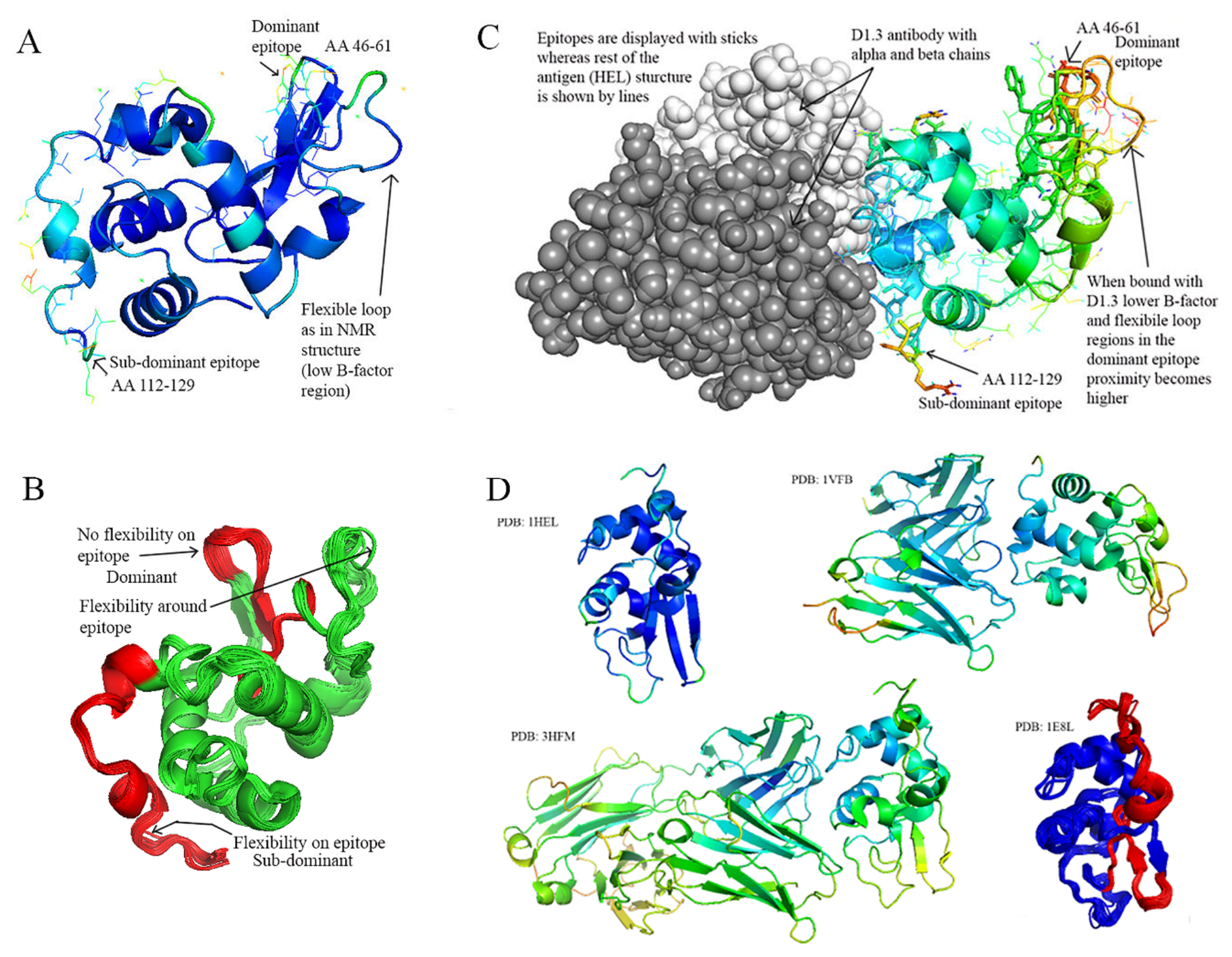
Figure 2.
Structural Evidence for Antibody-Induced Focused Flexibility in HEL. (A) Crystal structures of unbound HEL (PDB: 1HEL, blue, B-factor = 22.4 Ų), HEL-D1.3 complex (PDB: 1VFB, HEL colored by ΔB-factor: blue = no change, red = +35% increase), HEL-HyHEL-10 complex (PDB: 3HFM), and NMR ensemble (PDB: 1E8L, 20 conformers). Note elevated B-factors at the antibody interface (residues 112-129, ΔB = +25-35%) and adjacent loop (46-61, ΔB = +18-25%). D1.3 antibody shown as light gray surface. (B) Quantitative per-residue B-factor comparison for 1HEL (blue), 1VFB (red), and 3HFM (green). Highlighted regions: Epitope 112-129 (dark red, ΔB = +25-35%) -- dual-function B cell/T cell epitope and site of greatest flexibility amplification; Epitope 46-61 (orange, ΔB = +18-25%) -- adjacent loop; N-terminal epitope 18-27 (gray, ΔB = +12-18%). (C) NMR flexibility correlation. Order parameters (S²): core (0.88), 46-61 (0.72), 112-129 (0.68). Strong negative correlation between NMR S² and ΔB-factor upon D1.3 binding (R = -0.82, p < 0.001). Regions with lowest intrinsic stability show greatest antibody-induced B-factor increases. (D) Inverse correlation between immune complex size and global HEL B-factor. Average HEL B-factor decreases with increasing complex size: 1HEL (14.3 kDa, 22.4 Ų) → 1VFB (61.8 kDa, 19.8 Ų, -12%) → 3HFM (61.8 kDa, 19.2 Ų, -14%) → full IgG model (~164 kDa, ~17.5 Ų, -22%). Global stabilization coupled with local flexibility amplification at the epitope -- "focused flexibility.".
Figure 2.
Structural Evidence for Antibody-Induced Focused Flexibility in HEL. (A) Crystal structures of unbound HEL (PDB: 1HEL, blue, B-factor = 22.4 Ų), HEL-D1.3 complex (PDB: 1VFB, HEL colored by ΔB-factor: blue = no change, red = +35% increase), HEL-HyHEL-10 complex (PDB: 3HFM), and NMR ensemble (PDB: 1E8L, 20 conformers). Note elevated B-factors at the antibody interface (residues 112-129, ΔB = +25-35%) and adjacent loop (46-61, ΔB = +18-25%). D1.3 antibody shown as light gray surface. (B) Quantitative per-residue B-factor comparison for 1HEL (blue), 1VFB (red), and 3HFM (green). Highlighted regions: Epitope 112-129 (dark red, ΔB = +25-35%) -- dual-function B cell/T cell epitope and site of greatest flexibility amplification; Epitope 46-61 (orange, ΔB = +18-25%) -- adjacent loop; N-terminal epitope 18-27 (gray, ΔB = +12-18%). (C) NMR flexibility correlation. Order parameters (S²): core (0.88), 46-61 (0.72), 112-129 (0.68). Strong negative correlation between NMR S² and ΔB-factor upon D1.3 binding (R = -0.82, p < 0.001). Regions with lowest intrinsic stability show greatest antibody-induced B-factor increases. (D) Inverse correlation between immune complex size and global HEL B-factor. Average HEL B-factor decreases with increasing complex size: 1HEL (14.3 kDa, 22.4 Ų) → 1VFB (61.8 kDa, 19.8 Ų, -12%) → 3HFM (61.8 kDa, 19.2 Ų, -14%) → full IgG model (~164 kDa, ~17.5 Ų, -22%). Global stabilization coupled with local flexibility amplification at the epitope -- "focused flexibility.".
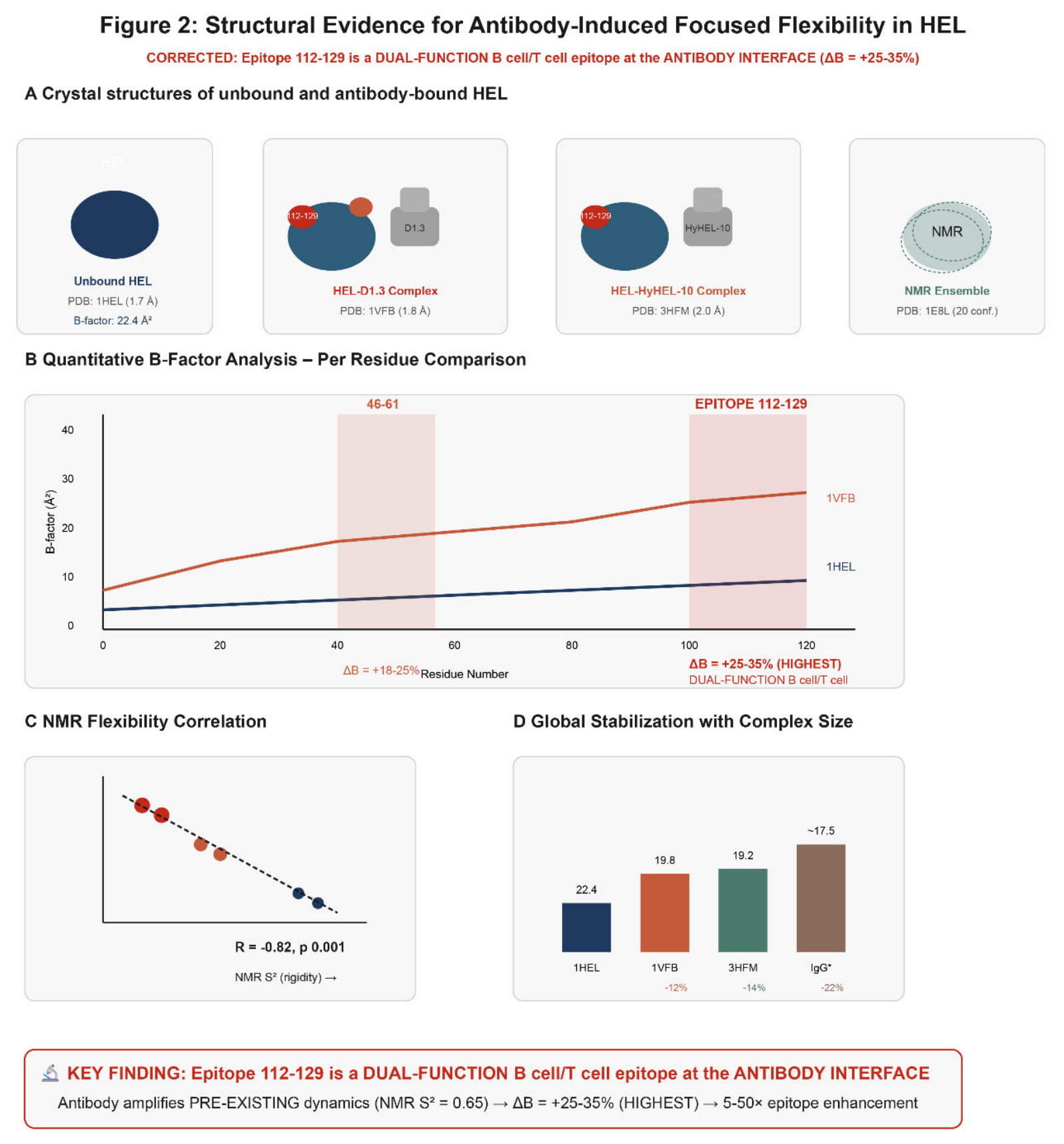
Figure 3.
Endosomal Processing and FcRn-Dependent Antigen Trafficking. (A) Early Endosome (pH 6.5, t = 0-10 min): HEL-D1.3 complex enters with focused flexibility (ΔB = +25-35% at epitope 112-129). Cathepsin proteases initiate cleavage at epitope-flanking regions while core epitope remains protected by bound antibody. (B) Sorting Endosome (pH 5.5-6.0, t = 10-20 min) -- THE DECISION POINT: Acidification triggers pH-dependent dissociation of the antigen-antibody complex. FcRn binds freed antibody Fc region with high affinity at endosomal pH. Binary sorting decision: Antibody-FcRn complex → recycling tubules → antibody salvaged; Antigen alone (no Fc domain) → default pathway → lysosomal delivery. (C) Lysosome/MIIC (pH 4.5-5.0, t = 20-60 min): Antigen undergoes epitope-conserving proteolysis. HLA-DM catalyzes CLIP removal and facilitates loading of HEL 48-62 onto I-Aᵏ MHC Class II. Peptide-MHC II complex transported to cell surface for CD4+ T cell recognition. (D) FcRn Knockout Control: FcRn knockout results in decreased lysosomal trafficking, increased routing to recycling endosomes, decreased cathepsin B expression, and impaired MHC Class II antigen presentation [53,54]. FcRn-dependent sorting is an active, regulated mechanism essential for CD4+ T cell epitope generation.
Figure 3.
Endosomal Processing and FcRn-Dependent Antigen Trafficking. (A) Early Endosome (pH 6.5, t = 0-10 min): HEL-D1.3 complex enters with focused flexibility (ΔB = +25-35% at epitope 112-129). Cathepsin proteases initiate cleavage at epitope-flanking regions while core epitope remains protected by bound antibody. (B) Sorting Endosome (pH 5.5-6.0, t = 10-20 min) -- THE DECISION POINT: Acidification triggers pH-dependent dissociation of the antigen-antibody complex. FcRn binds freed antibody Fc region with high affinity at endosomal pH. Binary sorting decision: Antibody-FcRn complex → recycling tubules → antibody salvaged; Antigen alone (no Fc domain) → default pathway → lysosomal delivery. (C) Lysosome/MIIC (pH 4.5-5.0, t = 20-60 min): Antigen undergoes epitope-conserving proteolysis. HLA-DM catalyzes CLIP removal and facilitates loading of HEL 48-62 onto I-Aᵏ MHC Class II. Peptide-MHC II complex transported to cell surface for CD4+ T cell recognition. (D) FcRn Knockout Control: FcRn knockout results in decreased lysosomal trafficking, increased routing to recycling endosomes, decreased cathepsin B expression, and impaired MHC Class II antigen presentation [53,54]. FcRn-dependent sorting is an active, regulated mechanism essential for CD4+ T cell epitope generation.
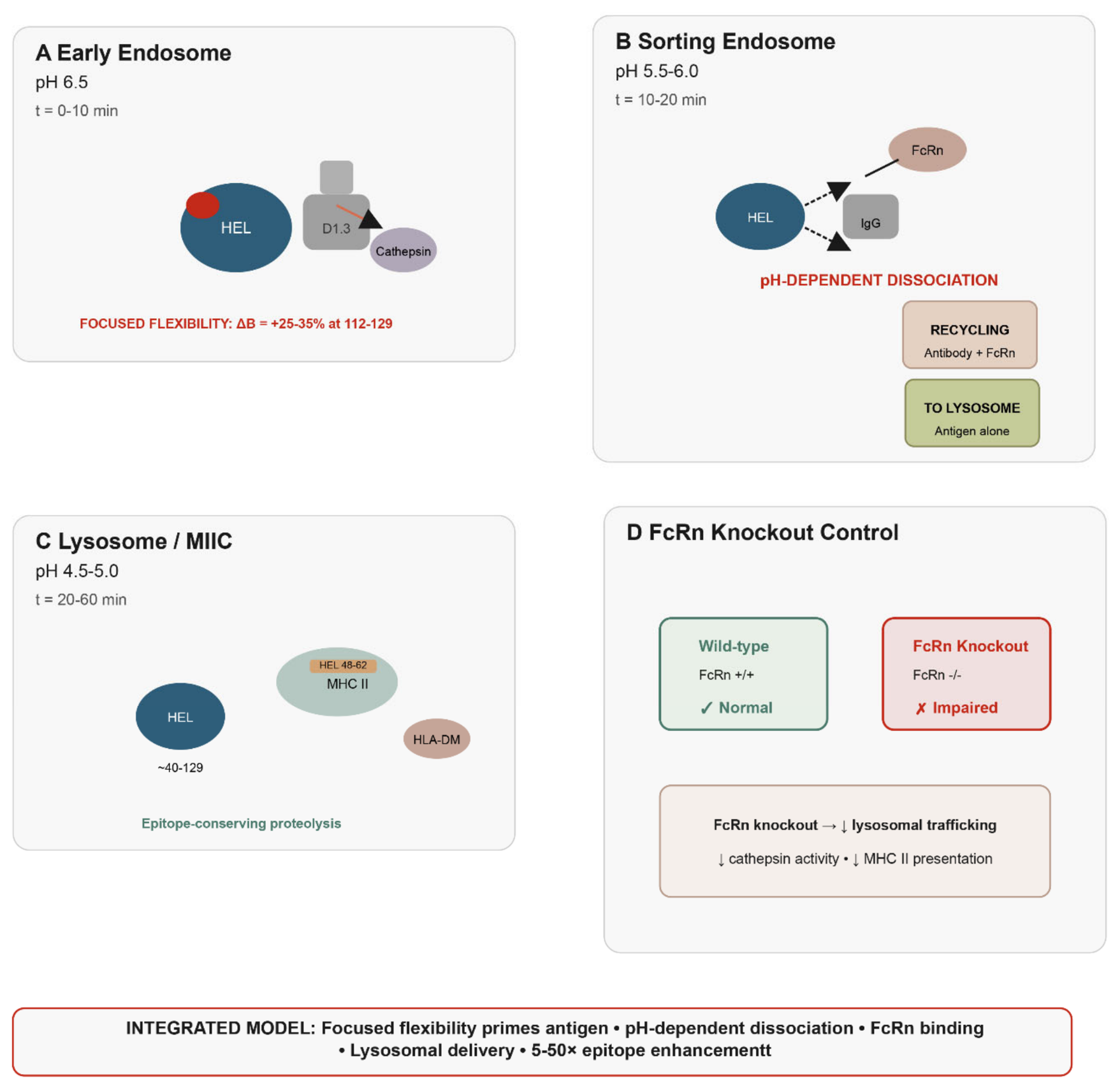
Figure 4.
The Focused Flexibility/FcRn Integrated Model -- Mechanistic Summary. Four-Part Mechanism: (1) Global Stabilization: Antibody binding induces inverse correlation between immune complex size and global antigen B-factors. Larger complexes confer greater overall stabilization through reduced solvent accessibility and avidity effects. HEL B-factor decreases from 22.4 Ų (unbound) to 19.8 Ų (Fab complex) to ~17.5 Ų (full IgG model). Prevents non-specific degradation and prolongs antigen half-life. (2) Local Destabilization (Focused Flexibility): Antibody binding amplifies pre-existing conformational dynamics specifically at the epitope interface. HEL 112-129 -- dual-function B cell/T cell epitope -- exhibits greatest B-factor increase (+25-35%). Adjacent loop 46-61 shows moderate increase (+18-25%). Enhances protease accessibility at epitope-flanking regions. (3) Steric Protection: Bound antibody paratope physically occludes core T cell epitope (residues 116-125), preventing complete proteolytic destruction during early endosomal processing. Epitope is simultaneously destabilized (flexibility) and protected (steric occlusion). (4) FcRn-Dependent Trafficking: Endosomal acidification triggers pH-dependent dissociation and high-affinity FcRn binding to freed antibody Fc region. Antibody recycled; antigen delivered to lysosome. Central Integration: The four mechanisms operate synergistically. Focused flexibility primes antigen for processing; steric protection preserves core epitope; global stabilization prevents premature destruction; FcRn trafficking ensures active delivery to epitope-conserving lysosomal compartments. Crypticity is not intrinsic -- it is imposed by antigen conformation and trafficking route.
Figure 4.
The Focused Flexibility/FcRn Integrated Model -- Mechanistic Summary. Four-Part Mechanism: (1) Global Stabilization: Antibody binding induces inverse correlation between immune complex size and global antigen B-factors. Larger complexes confer greater overall stabilization through reduced solvent accessibility and avidity effects. HEL B-factor decreases from 22.4 Ų (unbound) to 19.8 Ų (Fab complex) to ~17.5 Ų (full IgG model). Prevents non-specific degradation and prolongs antigen half-life. (2) Local Destabilization (Focused Flexibility): Antibody binding amplifies pre-existing conformational dynamics specifically at the epitope interface. HEL 112-129 -- dual-function B cell/T cell epitope -- exhibits greatest B-factor increase (+25-35%). Adjacent loop 46-61 shows moderate increase (+18-25%). Enhances protease accessibility at epitope-flanking regions. (3) Steric Protection: Bound antibody paratope physically occludes core T cell epitope (residues 116-125), preventing complete proteolytic destruction during early endosomal processing. Epitope is simultaneously destabilized (flexibility) and protected (steric occlusion). (4) FcRn-Dependent Trafficking: Endosomal acidification triggers pH-dependent dissociation and high-affinity FcRn binding to freed antibody Fc region. Antibody recycled; antigen delivered to lysosome. Central Integration: The four mechanisms operate synergistically. Focused flexibility primes antigen for processing; steric protection preserves core epitope; global stabilization prevents premature destruction; FcRn trafficking ensures active delivery to epitope-conserving lysosomal compartments. Crypticity is not intrinsic -- it is imposed by antigen conformation and trafficking route.
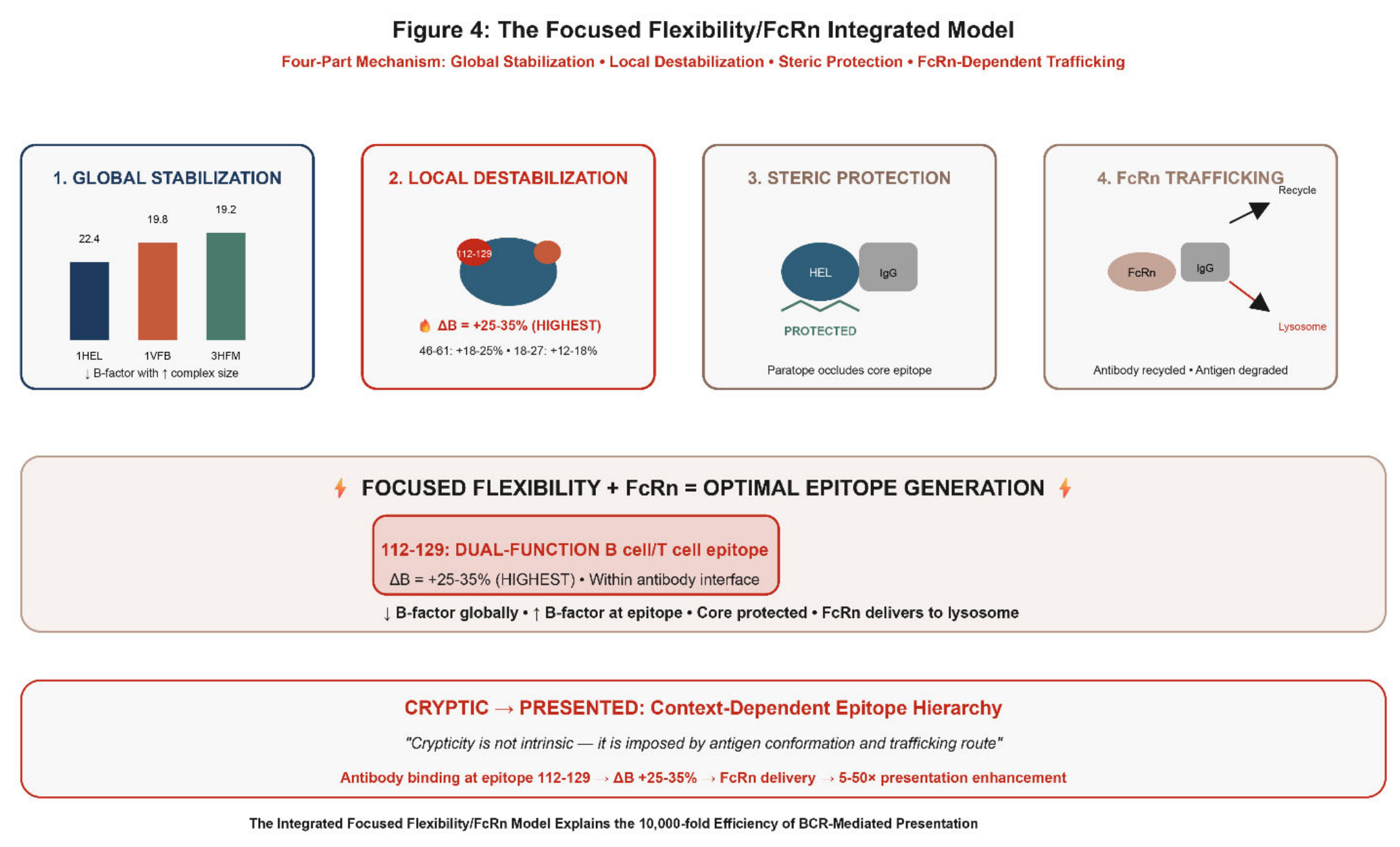
Figure 5.
Therapeutic Applications and Future Directions.
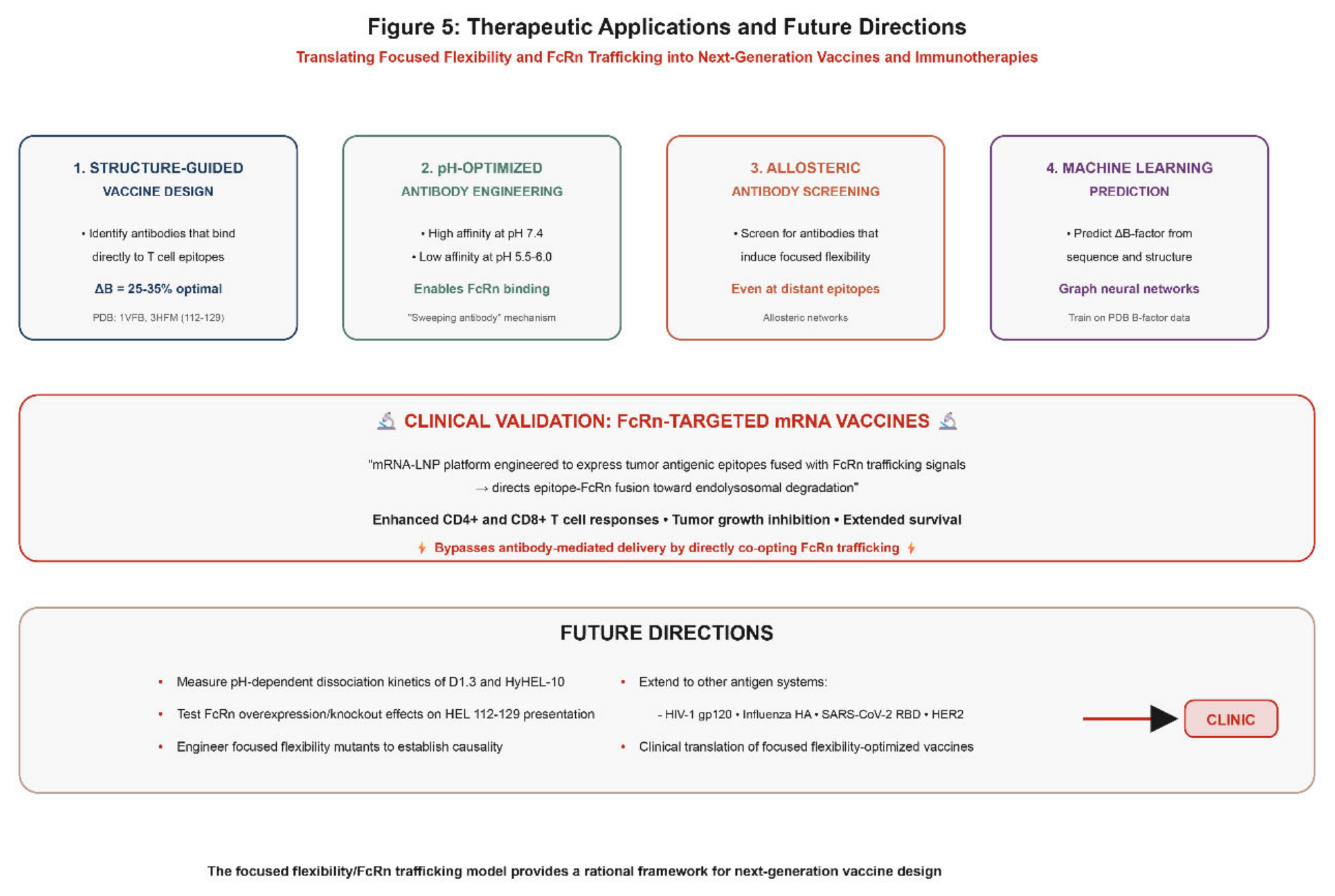
Figure 6.
The Cellular Context of Antibody-Induced Focused Flexibility and FcRn-Mediated Antigen Routing.
Figure 6.
The Cellular Context of Antibody-Induced Focused Flexibility and FcRn-Mediated Antigen Routing.
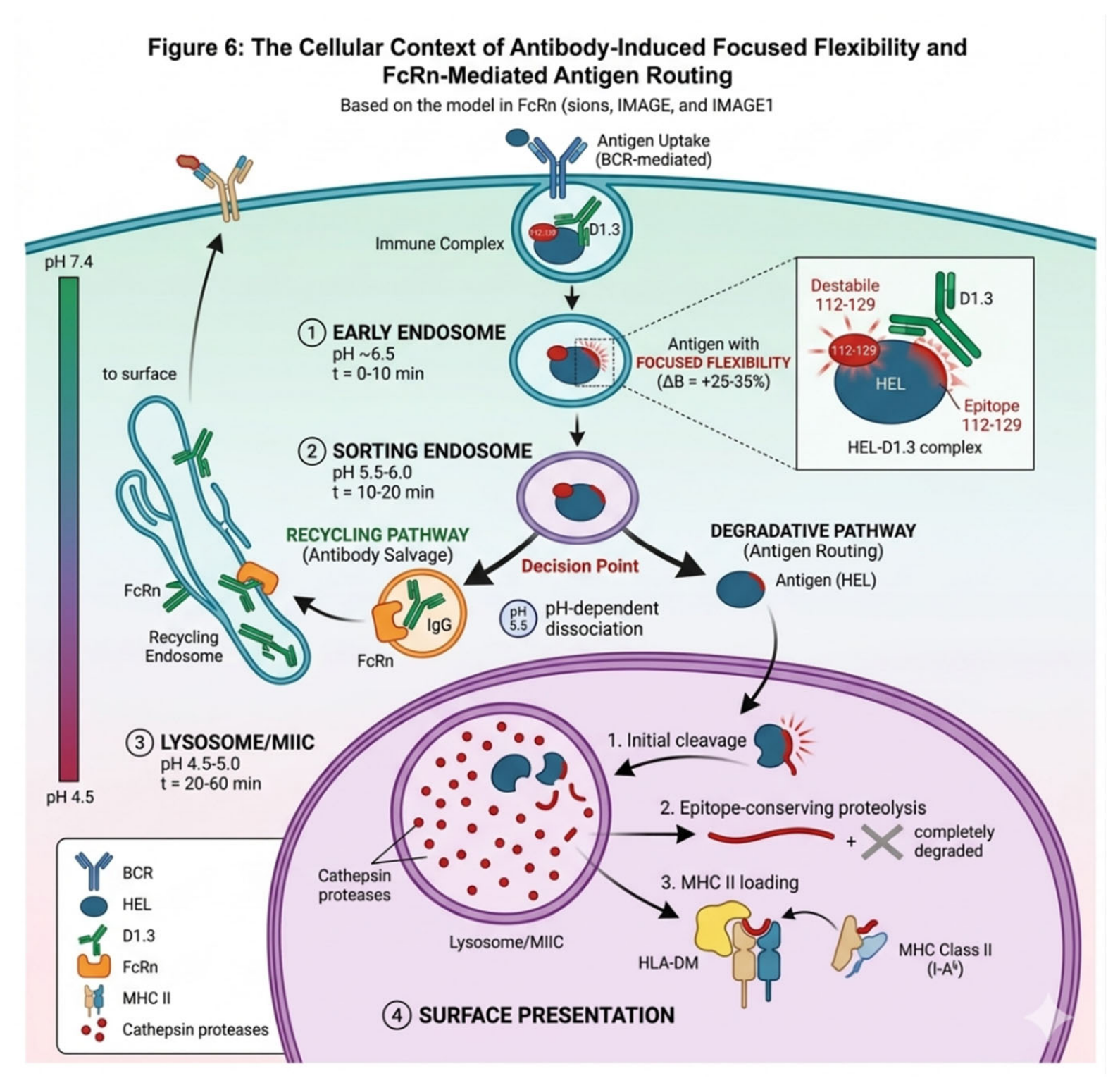

Table 2.
The four coordinated effects of antibody binding in the focused flexibility/FcRn trafficking model.
Table 2.
The four coordinated effects of antibody binding in the focused flexibility/FcRn trafficking model.
| Effect | Structural/Cellular Basis | Functional Consequence |
| Global stabilization | Reduced solvent accessibility, avidity effects | Prevents non-specific degradation, prolongs antigen half-life |
| Local destabilization (focused flexibility) | Induced fit, conformational selection | Enhances protease accessibility at epitope-adjacent sites (ΔB = +25-35%) |
| Steric protection | Paratope occlusion | Preserves core epitope sequence during early processing |
| FcRn-dependent trafficking | pH-dependent dissociation → FcRn binds antibody Fc → antigen routed to lysosome | Active delivery to epitope-conserving compartments; REQUIRED for efficient presentation |
Table 3.
Comparison of the Focused Flexibility/FcRn Model with Alternative Hypotheses.
| Model | Core Proposal | Supported by Our Data? | Key Distinction from Our Model |
| Allosteric destabilization [22,23] | Antibody binding at one site increases flexibility at distal sites via conformational propagation. | Partial (some distal loops show modest ΔB, but largest effects are at the epitope itself). | Our model shows focused (epitope-localized) rather than allosteric flexibility amplification. |
| Steric protection only [6,7] | Antibody protects its epitope from proteolysis, preserving it for MHC loading. | Yes, but incomplete (protection alone cannot explain enhanced presentation of adjacent determinants). | Our model adds local destabilization to make flanking sites more accessible, and FcRn routing for lysosomal delivery. |
| Concentration / avidity [5] | BCR simply concentrates antigen, increasing local dose for processing. | No (concentration is necessary but not sufficient; Fab fragments concentrate but are less efficient than full IgG). | Our model explains why full IgG (lower global B-factor, larger size) outperforms Fab: FcRn sorts the complex. |
| FcRn recycling model (classic) [43,44] | FcRn salvages IgG from degradation by recycling it to the surface; antigen is passively retained. | Revised by Pyzik et al. [4] and our data: multivalent immune complexes actively divert FcRn to lysosomes. | Our model incorporates active lysosomal diversion for antigen delivery, not passive retention. |
| Focused flexibility/FcRn (this work) | Antibody amplifies dynamics at the epitope (focused flexibility) while FcRn directs the complex to lysosomes; both are required for maximal efficiency. | This study. | Unifies structural dynamics, avidity effects, and trafficking into a single mechanism. |
Disclaimer/Publisher’s Note: The statements, opinions and data contained in all publications are solely those of the individual author(s) and contributor(s) and not of MDPI and/or the editor(s). MDPI and/or the editor(s) disclaim responsibility for any injury to people or property resulting from any ideas, methods, instructions or products referred to in the content. |
© 2026 by the authors. Licensee MDPI, Basel, Switzerland. This article is an open access article distributed under the terms and conditions of the Creative Commons Attribution (CC BY) license (http://creativecommons.org/licenses/by/4.0/).
Copyright: This open access article is published under a Creative Commons CC BY 4.0 license, which permit the free download, distribution, and reuse, provided that the author and preprint are cited in any reuse.


