

Submitted:
22 June 2026
Posted:
26 June 2026
You are already at the latest version
Abstract
Trunk rotator training is important for performance, stability, and injury prevention, but the intensity of anti-rotation exercises is difficult to quantify precisely. Break-tests may provide a practical method to assess maximal anti-rotation strength and its dependence on body posture. This study determined the intra- and inter-session reliability of a break-test for quantifying maximal anti-rotation trunk strength during a cable woodchop exercise, and examined differences and relationships across common postural configurations. Twenty-two physically active men completed two testing sessions separated by one week. Maximal isometric break force was assessed in seated, kneeling, half-kneeling, staggered-stance, and parallel-stance positions. Force was progressively applied by an evaluator within a standardized time window until posture was lost. Reliability was evaluated using intraclass correlation coefficients (ICC) and typical error (TE), while between-position differences and relationships were analyzed using repeated-measures ANOVA and Pearson’s correlations. The break-test demonstrated excellent intra-session reliability (ICC = 0.90–0.97; TE = 0.4–1.0 kg) and robust inter-session reliability (ICC = 0.78–0.90; TE = 0.8–1.4 kg). Maximal anti-rotation strength was posture-dependent (p < 0.001): half-kneeling produced the highest forces, whereas seated and staggered-stance positions constrained performance. Correlations between positions were moderate to high (r = 0.59–0.84), suggesting shared and position-specific strength characteristics. These findings support the break-test as a reliable and practical method for quantifying maximal anti-rotation trunk strength, helping standardize assessment and guide position-specific load prescription.
Keywords:
core stability
; consistency
; field test
; break force
; postural control
; load prescription
Introduction
Training the trunk rotator musculature (particularly the obliques) is commonly included in exercise programs targeting movement efficiency and athletic performance, (Kibler et al., 2006; Saeterbakken et al., 2011) and it has also been highlighted in injury-prevention strategies. (Willson et al., 2005; Zazulak et al., 2007) Adequate conditioning—encompassing strength, endurance, and neuromuscular control of the oblique musculature—is therefore important to optimize force transfer between the lower and upper limbs during dynamic actions such as throwing, striking, or rapid directional changes (Kibler et al., 2006), to enhance lumbopelvic and spinal stability (Granata & Orishimo, 2001), and to sustain coordinated control under repetitive or asymmetrical loading demands. (McGill, 2004; McGill et al., 2003)
In this context, anti-rotation trunk exercises (e.g., the woodchop, lift, and Pallof press) have gained increasing relevance within trunk conditioning and rehabilitation programs because they are pushing or pulling tasks in which forces applied through the upper limbs against elastic bands or cable–pulley systems generate a torsional moment about the trunk, thereby challenging the ability to stabilize the lumbopelvic region and maintain alignment while resisting rotation. (Juan-Recio et al., 2025; S. M. McGill & Karpowicz, 2009; Mullane et al., 2021) These exercises represent an effective alternative to conventional floor-based trunk exercises (e.g., bridges, bird-dog) as they provide a more specific neuromuscular stimulus for sport performance and daily activities, particularly because they are commonly performed in more functional positions such as standing, semi-squat, and seated postures. (Juan-Recio et al., 2025; Mullane et al., 2021)
Anti-rotation trunk exercises are commonly performed using resistance-band systems or cable-pulley machines, which generate torsional moments on the trunk during upper-limb pushing or pulling actions, thereby challenging trunk stability. Elastic bands are inexpensive, portable, and widely accessible, making them suitable for field-based or home training; however, the resistance they provide is nonlinear and highly sensitive to changes in band elongation, body position, and material properties, which complicates the accurate quantification and reproducibility of external load. (Fernandez-Gamez et al., 2024; Shoepe et al., 2010) Cable–pulley machines, although mechanically more consistent, typically rely on relatively large weight-stack increments (e.g., 2.5–5 kg), limiting the ability to precisely individualize training loads. Moreover, maximal strength approaches based on stepwise loading up to a one-repetition maximum, while used in some trunk-rotation testing paradigms, (Zemková, 2022) can be logistically demanding and are often time-consuming and unnecessarily fatiguing in applied settings, (Garcia-Ramos & Jaric, 2018; Niewiadomski et al., 2008) and are not always practical for anti-rotation tasks. As a result, previous studies have relied on pilot testing and coarse load individualization based on body-mass ranges (Juan-Recio et al., 2025) or on fixed absolute loads applied uniformly across participants, (Franco-López et al., 2024) without objectively quantifying the relative intensity imposed on each individual, thereby limiting comparability across individuals and settings.
Break-tests—defined as assessments in which a progressive external load is applied until the individual loses postural alignment—may offer a practical and reproducible alternative for quantifying intensity in anti-rotation exercises. (Peek, 2013) Break-based assessments have been successfully applied in other strength-testing contexts, particularly using hand-held dynamometry, demonstrating acceptable reliability for assessing maximal force production. (Bohannon, 1986; Burns et al., 2005; Mosler et al., 2017; Phillips et al., 2000; Stratford & Balsor, 1994; Thorborg et al., 2010, 2011) However, their application to multi-joint, posture-dependent trunk exercises remain largely unexplored. Importantly, because anti-rotation exercises are performed in a wide range of postures—ranging from seated and kneeling to upright and asymmetrical stances—the position adopted may substantially influence the magnitude of the load that can be resisted, as well as the neuromuscular strategies involved. Understanding how break-load magnitude varies across commonly used positions is therefore essential for standardizing assessment procedures and for aligning training prescriptions with specific performance demands.
Accordingly, the primary aim of this study was to determine the intra- and inter-session reliability of break-tests to quantify maximal anti-rotation trunk strength during a cable woodchop exercise. Secondary aims were to examine between-position differences in maximal anti-rotation trunk strength across several commonly used postures and to analyze the relationships between force values obtained in these positions. Collectively, these analyses were intended to clarify the extent to which maximal anti-rotation trunk strength is posture-dependent and to inform the selection of assessment and training positions in applied trunk-conditioning contexts.
Methods
Participants
A total of 22 healthy and physically active men (age: 30.5±11.0 years; height: 173.7±7.3 cm; body mass: 77.0±6.7 kg) voluntarily participated in the study. All participants reported engaging in at least two weekly sessions of moderate-to-vigorous physical activity, accumulating 120–300 min per week. Exclusion criteria included: (i) presence of any musculoskeletal disorder or medical condition contraindicating physical activity; (ii) reported recent injury affecting the trunk or upper/lower limbs and (iii) participation in a trunk stability program within the six months prior to the study. Before participation, all volunteers were fully informed about the aims, procedures, and potential risks of the investigation and provided written informed consent in accordance with the Declaration of Helsinki revised in 2024 and approved by the University Office for Research Ethics.
Procedures
Participants completed two evaluation sessions, each lasting approximately 45 min and separated by approximately one week. At the beginning of the first session, anthropometric measurements were recorded, including body mass, height, biacromial width, mainly to standardized posture in woodchop exercise variations. Participants were also asked to report their clinical history and the type and frequency of physical activity they regularly performed. Participants then performed a 5-minute warm-up that included full-body joint mobility exercises (from shoulders to ankles), followed by trunk musculature activation through a 20-second dynamic set of the woodchop exercise at moderate intensity.
Following the warm-up, participants performed the break-tests, which assessed their ability to resist external forces while maintaining specific postures by a bar with both hands (Figure 1A). During each test, the evaluator applied a progressive lateral force to the participant using a handle attached perpendicularly to the bar. This setup allowed the participant to sustain the posture long enough to generate maximal isometric force without causing an abrupt failure. The evaluator applied a steadily increasing force until the participant could no longer maintain the required posture. A Tindeq Progressor 300 load cell (Tindeq, Trondheim, Norway) was connected to the handle to record the force applied (in kilograms). Force data were transmitted in real time to the accompanying mobile application (Tindeq Progressor), for storage and later analysis. During each break-test, the evaluator applied the external force in a gradual and controlled manner, aiming to reach maximal resistance within an expected time window of approximately 7-12 s, depending on individual characteristics and testing position. To verify that, force application increased smoothly throughout the trial, the force–time signal was visually inspected in real time using the graphs provided by the Tindeq application. Trials were considered valid only when the force–time curve showed a continuous and progressive increase in force, without abrupt fluctuations, irregular load changes, or premature plateaus (Figure 1B). Trials that failed to display a uniform force progression (Figure 1C) or did not reach peak force within the expected time window were discarded, ensuring a consistent and standardized execution of the test across participants and positions.
Break, or loss of posture, was determined using a fixed reference system placed at approximately 4 cm from the bar used during the exercise. This distance defined the allowable displacement before the bar contacted the reference, at which point the break-test was terminated. The evaluator closely monitored each trial to identify the exact moment when the bar touched the reference, and the corresponding force value was recorded as the participant’s maximum break force for that exercise position.
The break-tests were conducted across the following positions derived from cable woodchop variations, in the order described below.
Seated: Participants were positioned in a seated posture on a plyometric box, with the feet placed flat on the floor at biacromial-width apart (Figure 2A).
Kneeling: Participants knelt on a padded mat with both knees aligned at biacromial-width distance (Figure 2B).
Half-kneeling: Participants adopted a half-kneeling stance, placing the right leg forward with the knee flexed at 90°, the left knee resting on a mat, and the left foot placed behind them. The distance between the right toe and the left knee was standardized to one-third of the participant’s height, ensuring proper alignment and comfort. Foot width was set to match biacromial-width distance (Figure 2C).
Staggered-stance: In this variation, participants stood with the right foot forward and the left foot back, both feet flat on the floor. The distance between the toes of the front foot and the heel of the rear foot was again standardized to one-third of the participant’s height, with foot placement matching biacromial-width distance, as in the half-kneeling position (Figure 2D).
Parallel-stance: Participants stood upright with both feet parallel and positioned at biacromial -width apart (Figure 2E).
Statistical Analysis
Descriptive statistics (mean and standard deviation) were calculated for anti-rotation trunk strength in each woodchop exercise variation. The normality of the data was assessed using the Kolmogorov–Smirnov test with Lilliefors correction (p> 0.05). Data consistency was evaluated through the typical error (standard deviation of the difference between sessions divided by √2) and the intraclass correlation coefficient (ICC3,k), along with its 95% confidence intervals. A reliability spreadsheet developed by Hopkins (Hopkins, 2015) was used to examine test–retest reliability. ICC values were classified as follows: excellent (0.90–1.00), good (0.70–0.89), moderate (0.50–0.69), and poor (< 0.50). (Koo & Li, 2016) Based on previous reliability research for similar procedures, (Barbado et al., 2018) a typical error ≤ 20% was considered acceptable for posturographic analysis. Differences in anti-rotation trunk strength between cable woodchop positions were analyzed using a repeated-measures analysis of variance (ANOVA). Additionally, relationships between positions were examined using Pearson’s product–moment correlation coefficient (r), with correlation magnitudes interpreted as trivial (< 0.10), small (0.10–0.29), moderate (0.30–0.49), large (0.50–0.69), very large (0.70–0.89), and nearly perfect (≥ 0.90). (Hopkins et al., 2009)
Results
Intra-session reliability
Maximal break forces showed excellent intra-session reliability across all testing positions when comparing the two trials of session 2 (table 1). Intraclass correlation coefficients (ICC, 95% CI) ranged from 0.90 to 0.97, with the highest reliability observed in the seated (ICC= 0.97, 95% CI: 0.92–0.99) and kneeling positions (ICC= 0.96, 95% CI: 0.90–0.98), while half-kneeling, staggered-stance, and parallel-stance positions showed similar values (ICC= 0.94, 95% CI: 0.85–0.98). Typical error values ranged from approximately 0.4 to 1.0 kg, and their 95% confidence intervals were relatively narrow, indicating limited measurement noise relative to the absolute break forces. The 95% confidence intervals for the mean change between trial 1 and trial 2 always included zero across positions, suggesting the absence of systematic bias within the session.

Table 1.
Intra-session reliability of break tests (session 2, trial 1 vs. trial 2).
| Position |
Trial 1 (mean ± SD, kg) |
Trial 2 (mean ± SD, kg) |
Mean change (kg, 95% CI) |
Typical error (kg, 95% CI) |
ICC (95% CI) |
| Seated | 6.83±1.50 | 6.85±1.55 | 0.03 (-0.22 to +0.28) |
0.40 (0.31 to 0.57) |
0.97 (0.92 to 0.99) |
| Kneeling | 8.50±2.06 | 8.34±2.16 | -0.16 (-0.54 to +0.22) |
0.60 (0.46 to 0.86) |
0.96 (0.90 to 0.98) |
| Half-Kneeling | 11.60±2.83 | 11.92±3.09 | 0.32 (-0.31 to +0.95) |
1.00 (0.77 to 1.44) |
0.94 (0.85 to 0.98) |
| Staggered-Stance | 7.30±1.98 | 7.40±2.21 | 0.10 (-0.35 to +0.54) |
0.70 (0.54 to 1.01) |
0.94 (0.86 to 0.98) |
| Parallel-Stance | 8.08±2.00 | 7.95±1.54 | -0.13 (-0.50 to +0.24) |
0.59 (0.45 to 0.84) |
0.94 (0.87 to 0.98) |
SD: standard deviation; ICC: intraclass correlation coefficient; CI: confident intervals.
Inter-Session Reliability
When comparing session 1 and session 2, inter-session reliability was generally good except in the half-kneeling position, where it was excellent (table 2). The ICC values (95% CI) ranged from 0.78 (0.48–0.91) in the staggered-stance position to 0.90 (0.76–0.96) in the half-kneeling position, with seated, kneeling, and parallel-stance positions showing ICCs between 0.83 and 0.87. Typical error values were higher than in the intra-session analysis (≈ 0.8–1.4 kg), and the 95% confidence intervals for the mean differences were generally narrow and always included zero across positions, suggesting the absence of systematic bias between sessions.
Table 2.
Inter-session reliability of break tests (session 1 vs. session 2).
| Position |
Session 1 (mean ± SD, kg) |
Session 2 (mean ± SD, kg) |
Mean change (kg, 95% CI) |
Typical error (kg, 95% CI) |
ICC (3,1) (95% CI) |
| Seated | 7.13±1.70 | 6.84±1.50 | -0.29 (-0.83 to +0.25) |
0.86 (0.66 to 1.23) |
0.83 (0.59–0.93) |
| Kneeling | 8.32±1.87 | 8.42±2.06 | 0.10 (-0.50 to +0.70) |
0.95 (0.73 to 1.36) |
0.87 (0.67–0.98) |
| Half-Kneeling | 11.89±3.50 | 11.76±2.88 | -0.12 (-0.99 to +0.75) |
1.39 (1.07 to 1.98) |
0.90 (0.76–0.96) |
| Staggered-Stance | 7.02±1.91 | 7.35±2.03 | 0.33 (-0.41 to +1.07) |
1.18 (0.91 to 1.69) |
0.78 (0.48–0.91) |
| Parallel-Stance | 7.89±1.60 | 8.02±1.73 | 0.13 (-0.38 to +0.64) |
0.81 (0.62 to 1.16) |
0.87 (0.67–0.94) |
SD: standard deviation; ICC: intraclass correlation coefficient; CI: confident intervals.
Between-Position Differences
A one-way repeated-measures ANOVA of the session 2 break force values revealed a significant main effect of position (F(4,84)= 54.93, p< 0.001, partial η2 = 0.72), indicating that the anti-rotation trunk strength differed substantially between postures (Figure 3). On average, the half-kneeling position produced the highest break forces, followed by the kneeling and parallel-stance positions, whereas the seated and staggered-stance positions elicited the lowest values. Pairwise comparisons with Bonferroni adjustment showed that half-kneeling elicited higher break forces than all other positions (p< 0.001; dz= 1.62–2.27). In addition, kneeling produced greater break forces than staggered-stance (p= 0.037; dz= 0.70) and seated (p< 0.001; dz= 1.38); similarly, parallel-stance resulted in higher values than seated (p= 0.002; dz= 0.96).
Correlation Analysis
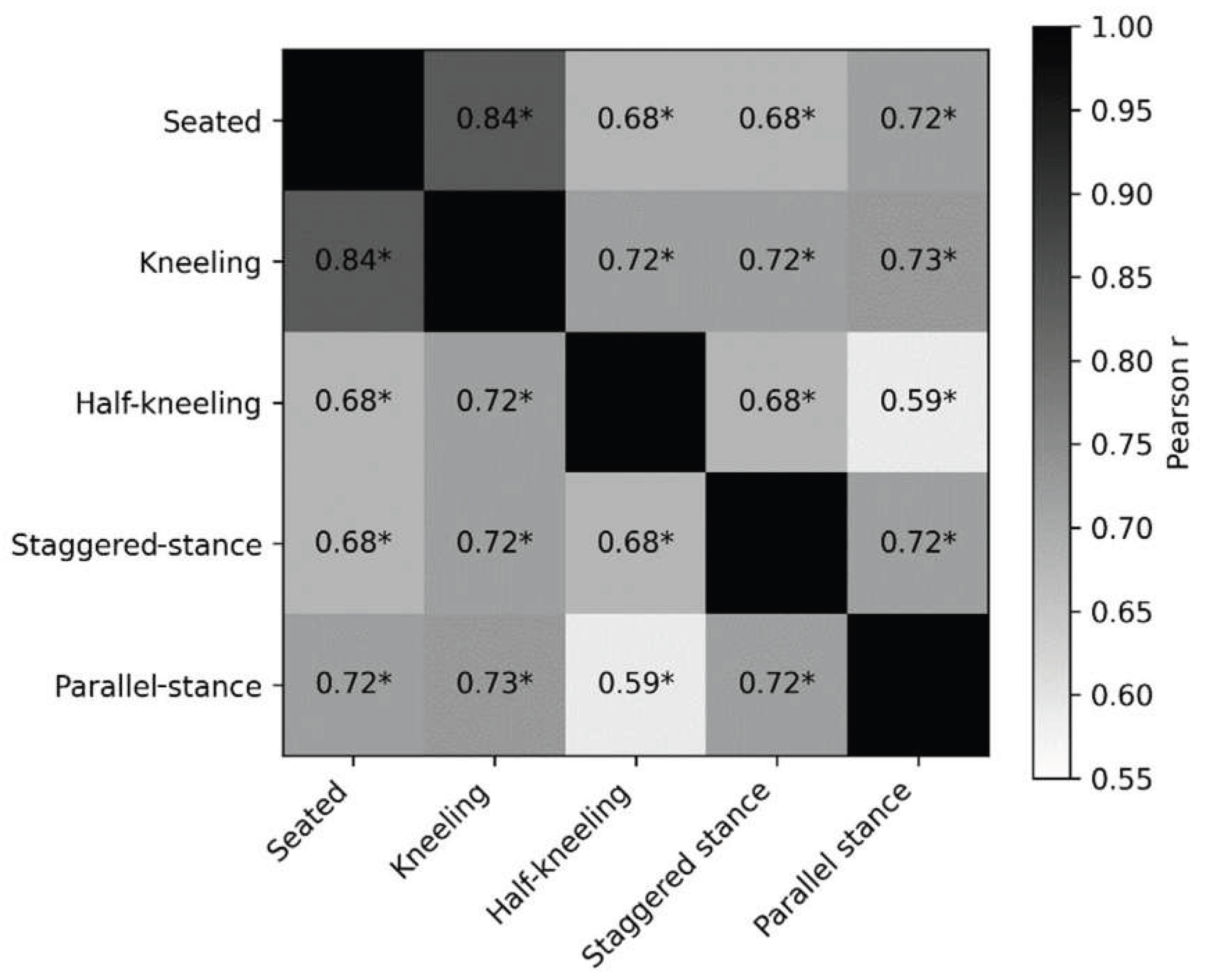
Pearson correlation analysis (Figure 4) revealed significant positive associations between break forces obtained across all testing positions using session 2 mean values (all p< 0.05). Correlation coefficients ranged from moderate to high (r= 0.59–0.84), indicating that participants who exhibited higher break forces in one position tended to show higher values in the remaining positions. The highest correlation was observed between the seated and kneeling positions (r= 0.84), followed by the correlations between the kneeling position and the half-kneeling, staggered-stance, and parallel-stance positions (r= 0.72–0.73), and the correlation between the staggered-stance and parallel-stance positions (r= 0.72). The weakest correlations involved the half-kneeling position with the seated, staggered-stance, and parallel-stance positions (r= 0.59–0.68).
Discussion
The primary aim of the present study was to evaluate the reliability of a break-test to quantify maximal anti-rotation trunk strength during the cable woodchop exercise across different positions, as well as to examine between-position differences and relationships. Overall, the findings indicate that the proposed protocol provides consistent measurements both within and between sessions, and that the maximal anti-rotation trunk strength is strongly posture-dependent. Specifically, higher break forces were observed in positions with lower postural demands, allowing effective force transmission through the kinetic chain without the mechanical constraints imposed by balance maintenance. Collectively, these results highlight the importance of strictly standardizing body position when assessing performance and prescribing training intensity in anti-rotation trunk exercises.
The present results demonstrate excellent intra-session reliability across all tested positions (ICC> 0.94), indicating that the break-test provides highly consistent measurements when repeated within the same testing session. Comparable levels of within-session reliability have been reported in previous break-test studies using hand-held dynamometry, with ICC values typically exceeding 0.95 across multiple muscle groups. (Bohannon, 1986; Stratford & Balsor, 1994) However, those investigations were conducted under highly controlled conditions, primarily involving single-joint actions and externally stabilized postures. In contrast, the present findings extend this evidence to a multi-joint anti-rotation task performed in upright and asymmetrical positions, demonstrating that excellent within-session consistency can be maintained despite increased biomechanical complexity when posture and execution are carefully standardized.
Inter-session reliability in the present study was generally good to excellent across positions (0.78 <ICC< 0.90), indicating acceptable reproducibility over a one-week interval. These findings are also consistent with previous break-test studies using hand-held dynamometry, which have reported moderate-to-excellent inter-session reliability depending on the muscle group, population, and testing conditions. (Bohannon, 1986; Burns & Spanier, 2005; Larson et al., 2010; Newman et al., 2012) From an applied perspective, the observed inter-session reliability supports the use of the break-test not only for discriminating between individuals’ performance levels, but also to individualize training loads based on each participant’s anti-rotation trunk strength, for example by prescribing exercise intensities as a given percentage of the break force obtained in a standardized position. Moreover, the relatively low inter-session typical error—equivalent, in the worst case, to approximately 10–15% of the grand mean—indicates that practically meaningful strength gains are likely to exceed measurement error. This suggests that the break-test is sufficiently sensitive to detect moderate changes in anti-rotation trunk strength over time, (Weakley et al., 2024) supporting its application for both load prescription and the monitoring of training-induced adaptations. Absolute reliability was also high, with typical error ranging from 0.8 to 1.3 kg across positions and the upper limit of the 95% confidence interval remaining below 2 kg. This degree of precision compares favorably with standard cable-pulley machines, which typically allow load increments of 2.5 to 5 kg. In the context of the maximal break forces observed here, a 2.5 kg increment may correspond to an increase of approximately 25% to 33% of maximal isometric capacity in some postures, assuming a constant lever arm. Thus, beyond providing reliable assessment, the portable load-cell break-test offers a finer and more practical means of monitoring and prescribing anti-rotation trunk exercise intensity than conventional equipment.
The between-position differences observed in break force were statistically supported by the repeated-measures ANOVA, confirming a significant main effect of position and indicating that anti-rotation trunk strength during the break tests is highly posture-dependent. Post-hoc analyses revealed that the half-kneeling position elicited the highest break forces, whereas the seated and staggered-stance positions produced the lowest values. From a mechanical perspective, these differences can be explained by posture-specific changes in the base-of-support geometry, the center-of-mass height, and the ability to transmit ground reaction forces through the kinetic chain. Trunk stability has been defined as the capacity to control torax motion over the pelvis to optimize force production and transfer to distal segments, emphasizing the importance of effectively anchoring the trunk to the lower extremities. (Kibler et al., 2006) In the half-kneeling position, the three-point contact (foot, knee, foot) creates a rigid triangular base that likely enhances global stability, allowing a greater proportion of muscular effort to be directed toward anti-rotation trunk torque rather than managing postural sway (Cholewicki & VanVliet Iv, 2002). In contrast, the seated condition, despite providing pelvic stability, likely uncouples the kinetic chain, preventing the lower extremities from generating a reactive counter-moment against the floor. This forces the trunk musculature to rely solely on intrinsic stiffness and pelvic anchoring, thereby limiting maximal force capacity. Similarly, the staggered-stance posture imposes a conflict of neuromuscular resources: the narrow, asymmetric base of support increases the demand for active balancing mechanisms, which mechanically constrains the maximal voluntary contraction available for anti-rotation tasks due to the need to prioritize upright posture preservation. This interpretation is consistent with postural control evidence showing that reduced base-of-support symmetry increases center-of-pressure excursions and instability. (Albertsen et al., 2017) From an applied perspective, these findings highlight the importance of standardizing body position when assessing anti-rotation trunk strength and suggest that different postures may be purposefully selected to target distinct training objectives, such as maximizing force production in more stable positions or increasing postural-control demands in less stable configurations when prescribing anti-rotation trunk exercises.
The raincloud plots suggest greater inter-individual variability in positions with lower external constraints, possibly reflecting a wider range of motor strategies available to resist the applied force, consistent with contemporary motor-control perspectives emphasizing the role of task constraints in shaping movement solutions. (Whiting & Bernshteĭn, 1984) More constrained postures, in contrast, appear to promote more uniform performance across participants.
The Pearson correlation analysis revealed large-to-very large positive associations between break forces obtained across all testing positions (r≈ 0.59–0.84), indicating that individuals with greater anti-rotation trunk strength in one posture tended to exhibit higher values in others. However, the absence of uniformly high correlations suggests that, although a shared underlying capacity contributes to performance across positions, maximal break force remains partly position-specific and influenced by posture-dependent mechanical demands. This observation aligns with previous evidence indicating that trunk strength and stability are highly task- and posture-dependent, and that performance does not necessarily translate across different mechanical and postural contexts. (S. McGill, 2010)
Several limitations of the present study should be acknowledged. First, the sample consisted of healthy, physically active individuals, which may limit the generalizability of the findings to clinical populations or highly specialized athletes. Second, although the break-test demonstrated good-to-excellent reliability, force application was performed manually by the evaluator, which may introduce some degree of operator-dependent variability despite the use of standardized procedures and real-time visual feedback. Third, although a standardized temporal window was used to control force application, small inter-individual variations in force application time were allowed to accommodate differences in postural control and strength, which may have influenced maximal break force values. Finally, this study focused on maximal isometric break force in different cable woodchop positions; therefore, the transferability of these findings to dynamic or sport-specific rotation actions should be interpreted with caution.
Practical applications
From a practical standpoint, the present findings support the use of a standardized break-test to assess maximal anti-rotation trunk strength in training settings. Because maximal break force is posture-dependent, testing and training positions should be selected according to the specific mechanical demands and training objectives of the athlete. More stable positions, particularly half-kneeling, may be useful for establishing baseline strength and prescribing load, whereas less stable positions, such as staggered-stance or seated variations, may be preferable when greater postural-control demands or task specificity are desired. These results therefore support the use of multiple positions to assess and train posture-specific anti-rotation strength capacities. Finally, the demonstrated inter-session reliability suggests that the break-test is suitable for monitoring training-induced changes over time, provided that posture and execution are carefully standardized.
Author Contributions
Conceptualization, Javier De Los Ríos-Calonge, Casto Juan-Recio, Aaron Miralles Iborra, David Barbado and Francisco J. Vera-Garcia; Methodology, Javier De Los Ríos-Calonge, Casto Juan-Recio, Aaron Miralles Iborra and Amaya Prat-Luri; Software, Aaron Miralles Iborra; Formal analysis, Javier De Los Ríos-Calonge, Casto Juan-Recio and Amaya Prat-Luri; Investigation, Javier De Los Ríos-Calonge, Casto Juan-Recio, Aaron Miralles Iborra, David Barbado and Francisco J. Vera-Garcia; Data curation, Javier De Los Ríos-Calonge, Casto Juan-Recio, Aaron Miralles Iborra and Amaya Prat-Luri; Writing – original draft, Casto Juan-Recio and Francisco J. Vera-Garcia; Writing – review & editing, Javier De Los Ríos-Calonge, Aaron Miralles Iborra, Amaya Prat-Luri and David Barbado; Supervision, David Barbado and Francisco J. Vera-Garcia; Project administration, David Barbado and Francisco J. Vera-Garcia; Funding acquisition, David Barbado and Francisco J. Vera-Garcia. All authors have read and agreed to the published version of the manuscript.
Funding
This research was funded by Ministerio de Ciencia, Innovación y Universidades (MICIU/AEI/10.13039/501100011033) grant number PID2022-140323OB-100 and by FEDER, EU. The funding sources had no role in the design of the study; in the collection, analysis, or interpretation of data; in the writing of the manuscript; or in the decision to submit the article for publication.
Institutional Review Board Statement
The study was conducted in accordance with the Declaration of Helsinki, and approved by the Committee of Ethics and Integrity in Research (CEII) of Miguel Hernandez University of Elche (protocol code DCD.FBM.01.23, date of approval 07. November 2023).
Informed Consent Statement
Informed consent was obtained from all subjects involved in the study.
Data Availability Statement
The raw data supporting the conclusions of this article will be made available by the authors on request.
Acknowledgments
We would like to thank all the study participants for their support.
Conflicts of Interest
The authors declare no conflicts of interest. Specifically, the authors have no professional relationships with companies or manufacturers that could benefit from the results of the present study.
References
- Kibler, W.B.; Press, J.; Sciascia, A. The role of core stability in athletic function. Sports Med. 2006, 36, 189–198. [Google Scholar] [CrossRef] [PubMed]
- Saeterbakken, A.H.; Van den Tillaar, R.; Seiler, S. Effect of core stability training on throwing velocity in female handball players. J. Strength Cond. Res. 2011, 25, 712–718. [Google Scholar] [CrossRef] [PubMed]
- Zazulak, B.T.; Hewett, T.E.; Reeves, N.P.; Goldberg, B.; Cholewicki, J. Deficits in neuromuscular control of the trunk predict knee injury risk: A prospective biomechanical-epidemiologic study. Am. J. Sports Med. 2007, 35, 1123–1130. [Google Scholar] [CrossRef] [PubMed]
- Willson, J.D.; Dougherty, C.P.; Ireland, M.L.; Davis, I.M.C. Core stability and its relationship to lower extremity function and injury. J. Am. Acad. Orthop. Surg. 2005, 13, 316–325. [Google Scholar] [CrossRef] [PubMed]
- Granata, K.P.; Orishimo, K.F. Response of trunk muscle coactivation to changes in spinal stability. J. Biomech. 2001, 34, 1117–1123. [Google Scholar] [CrossRef] [PubMed]
- McGill, S.M. Linking latest knowledge of injury mechanisms and spine function to the prevention of low back disorders. J. Electromyogr. Kinesiol. 2004, 14, 43–47. [Google Scholar] [CrossRef] [PubMed]
- McGill, S.M.; Grenier, S.; Kavcic, N.; Cholewicki, J. Coordination of muscle activity to assure stability of the lumbar spine. J. Electromyogr. Kinesiol. 2003, 13, 353–359. [Google Scholar] [CrossRef] [PubMed]
- Juan-Recio, C.; Prat-Luri, A.; Rondón-Espinosa, H.; Barbado, D.; Vera-Garcia, F.J. Effect of body position and support surface on the postural control challenge during the Pallof press exercise: A smartphone accelerometer-based study. Medicina 2025, 61, 312. [Google Scholar] [CrossRef] [PubMed]
- McGill, S.M.; Karpowicz, A. Exercises for spine stabilization: Motion/motor patterns, stability progressions, and clinical technique. Arch. Phys. Med. Rehabil. 2009, 90, 118–126. [Google Scholar] [CrossRef] [PubMed]
- Mullane, M.; Turner, A.N.; Bishop, C. The Pallof press. Strength Cond. J. 2021, 43, 121–128. [Google Scholar] [CrossRef]
- Shoepe, T.C.; Ramirez, D.A.; Almstedt, H.C. Elastic band prediction equations for combined free-weight and elastic band bench presses and squats. J. Strength Cond. Res. 2010, 24, 195–200. [Google Scholar] [CrossRef] [PubMed]
- Fernandez-Gamez, B.; Pulido-Muñoz, Á.; Olvera-Rojas, M.; et al. Examining elastic band properties for exercise prescription: AGUEDA equations. Physiother. Res. Int. 2024, 30, e70010. [Google Scholar] [CrossRef] [PubMed]
- Zemková, E. Strength and power-related measures in assessing core muscle performance in sport and rehabilitation. Front. Physiol. 2022, 13, 861582. [Google Scholar] [CrossRef] [PubMed]
- Garcia-Ramos, A.; Jaric, S. Two-point method: A quick and fatigue-free procedure for assessment of muscle mechanical capacities and the 1 repetition maximum. Strength Cond. J. 2018, 40, 54–66. [Google Scholar] [CrossRef]
- Niewiadomski, W.; Gąsiorowska, A.; Cybulski, G.; Laskowska, D.; Langfort, J. Determination and prediction of one repetition maximum (1RM): Safety considerations. J. Hum. Kinet. 2008, 19, 109–120. [Google Scholar] [CrossRef]
- Franco-López, F.; Durkalec-Michalski, K.; Díaz-Morón, J.; Higueras-Liébana, E.; Hernández-Belmonte, A.; Courel-Ibáñez, J. Using resistance-band tests to evaluate trunk muscle strength in chronic low back pain: A test–retest reliability study. Sensors 2024, 24, 4131. [Google Scholar] [CrossRef] [PubMed]
- Peek, K. Muscle strength in adults with spinal cord injury: A systematic review of manual muscle testing, isokinetic and hand-held dynamometry clinimetrics. JBI Database Syst. Rev. Implement. Rep. 2014, 12, 349–429. [Google Scholar] [CrossRef]
- Burns, S.P.; Breuninger, A.; Kaplan, C.; Marin, H. Hand-held dynamometry in persons with tetraplegia: Comparison of make- versus break-testing techniques. Am. J. Phys. Med. Rehabil. 2005, 84, 22–29. [Google Scholar] [CrossRef] [PubMed]
- Phillips, B.A.; Lo, S.K.; Mastaglia, F.L. Muscle force measured using “break” testing with a hand-held myometer in normal subjects aged 20 to 69 years. Arch. Phys. Med. Rehabil. 2000, 81, 653–661. [Google Scholar] [CrossRef] [PubMed]
- Stratford, P.W.; Balsor, B.E. A comparison of make and break tests using a hand-held dynamometer and the Kin-Com. Orthop. Sports Phys. Ther. 1994, 19, 28–32. [Google Scholar] [CrossRef] [PubMed]
- Bohannon, R.W. Test-retest reliability of hand-held dynamometry during a single session of strength assessment. Phys. Ther. 1986, 66, 206–209. [Google Scholar] [CrossRef] [PubMed]
- Thorborg, K.; Petersen, J.; Magnusson, S.P.; Hölmich, P. Clinical assessment of hip strength using a hand-held dynamometer is reliable. Scand. J. Med. Sci. Sports 2010, 20, 493–501. [Google Scholar] [CrossRef] [PubMed]
- Thorborg, K.; Couppé, C.; Petersen, J.; Magnusson, S.P.; Hölmich, P. Eccentric hip adduction and abduction strength in elite soccer players and matched controls: A cross-sectional study. Br. J. Sports Med. 2011, 45, 10–13. [Google Scholar] [CrossRef] [PubMed]
- Mosler, A.B.; Crossley, K.M.; Thorborg, K.; et al. Hip strength and range of motion: Normal values from a professional football league. J. Sci. Med. Sport 2017, 20, 339–343. [Google Scholar] [CrossRef] [PubMed]
- Hopkins, W.G. Spreadsheets for analysis of validity and reliability. Sportscience 2015, 19, 36–44. [Google Scholar]
- Koo, T.K.; Li, M.Y. A guideline of selecting and reporting intraclass correlation coefficients for reliability research. J. Chiropr. Med. 2016, 15, 155–163. [Google Scholar] [CrossRef] [PubMed]
- Barbado, D.; Irles-Vidal, B.; Prat-Luri, A.; García-Vaquero, M.P.; Vera-Garcia, F.J. Training intensity quantification of core stability exercises based on a smartphone accelerometer. PLoS ONE 2018, 13, e0208262. [Google Scholar] [CrossRef] [PubMed]
- Hopkins, W.G.; Marshall, S.W.; Batterham, A.M.; Hanin, J. Progressive statistics for studies in sports medicine and exercise science. Med. Sci. Sports Exerc. 2009, 41, 3–12. [Google Scholar] [CrossRef] [PubMed]
- Burns, S.P.; Spanier, D.E. Break-technique handheld dynamometry: Relation between angular velocity and strength measurements. Arch. Phys. Med. Rehabil. 2005, 86, 1420–1426. [Google Scholar] [CrossRef] [PubMed]
- Newman, B.L.; Pollock, C.L.; Hunt, M.A. Reliability of measurement of maximal isometric lateral trunk-flexion strength in athletes using handheld dynamometry. J. Sport Rehabil. 2012, 21, 1–6. [Google Scholar] [CrossRef] [PubMed]
- Larson, C.A.; Tezak, W.D.; Malley, M.S.; Thornton, W. Assessment of postural muscle strength in sitting: Reliability of measures obtained with hand-held dynamometry in individuals with spinal cord injury. J. Neurol. Phys. Ther. 2010, 34, 24–31. [Google Scholar] [CrossRef] [PubMed]
- Weakley, J.; Black, G.; McLaren, S.; et al. Testing and profiling athletes: Recommendations for test selection, implementation, and maximizing information. Strength Cond. J. 2024, 46, 159–179. [Google Scholar] [CrossRef]
- Cholewicki, J.; VanVliet, J.J. Relative contribution of trunk muscles to the stability of the lumbar spine during isometric exertions. Clin. Biomech. 2002, 17, 99–105. [Google Scholar] [CrossRef] [PubMed]
- Albertsen, I.M.; Ghédira, M.; Gracies, J.M.; Hutin, É. Postural stability in young healthy subjects—Impact of reduced base of support, visual deprivation, dual tasking. J. Electromyogr. Kinesiol. 2017, 33, 27–33. [Google Scholar] [CrossRef] [PubMed]
- Whiting, H.T.A. (Ed.) Human Motor Actions: Bernstein Reassessed; North-Holland: Amsterdam, The Netherlands, 1984. [Google Scholar]
- McGill, S. Core training: Evidence translating to better performance and injury prevention. Strength Cond. J. 2010, 32, 33–46. [Google Scholar] [CrossRef]
Figure 1.
A) Experimental setup for the break-test performed in the seated woodchop position; B) Representative force–time signal showing progressive and controlled force development during a valid trial. (C) Example of an invalid trial, characterized by an irregular force development followed by an abrupt peak at the end.
Figure 1.
A) Experimental setup for the break-test performed in the seated woodchop position; B) Representative force–time signal showing progressive and controlled force development during a valid trial. (C) Example of an invalid trial, characterized by an irregular force development followed by an abrupt peak at the end.
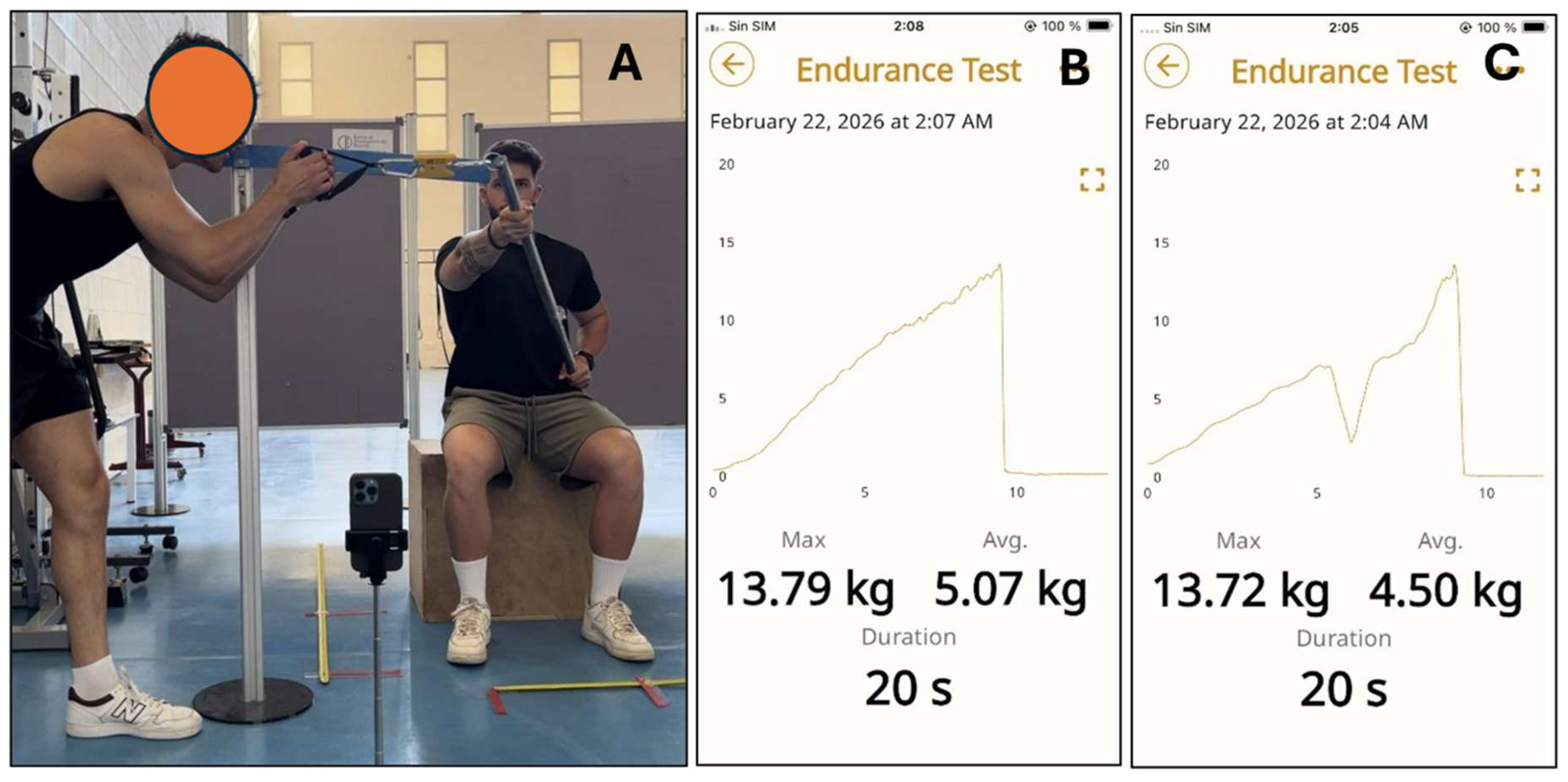
Figure 2.
Cable woodchop positions: A) Seated; B) Kneeling; C) Half-kneeling; D) Staggered-stance; E) Parallel-stance.
Figure 2.
Cable woodchop positions: A) Seated; B) Kneeling; C) Half-kneeling; D) Staggered-stance; E) Parallel-stance.
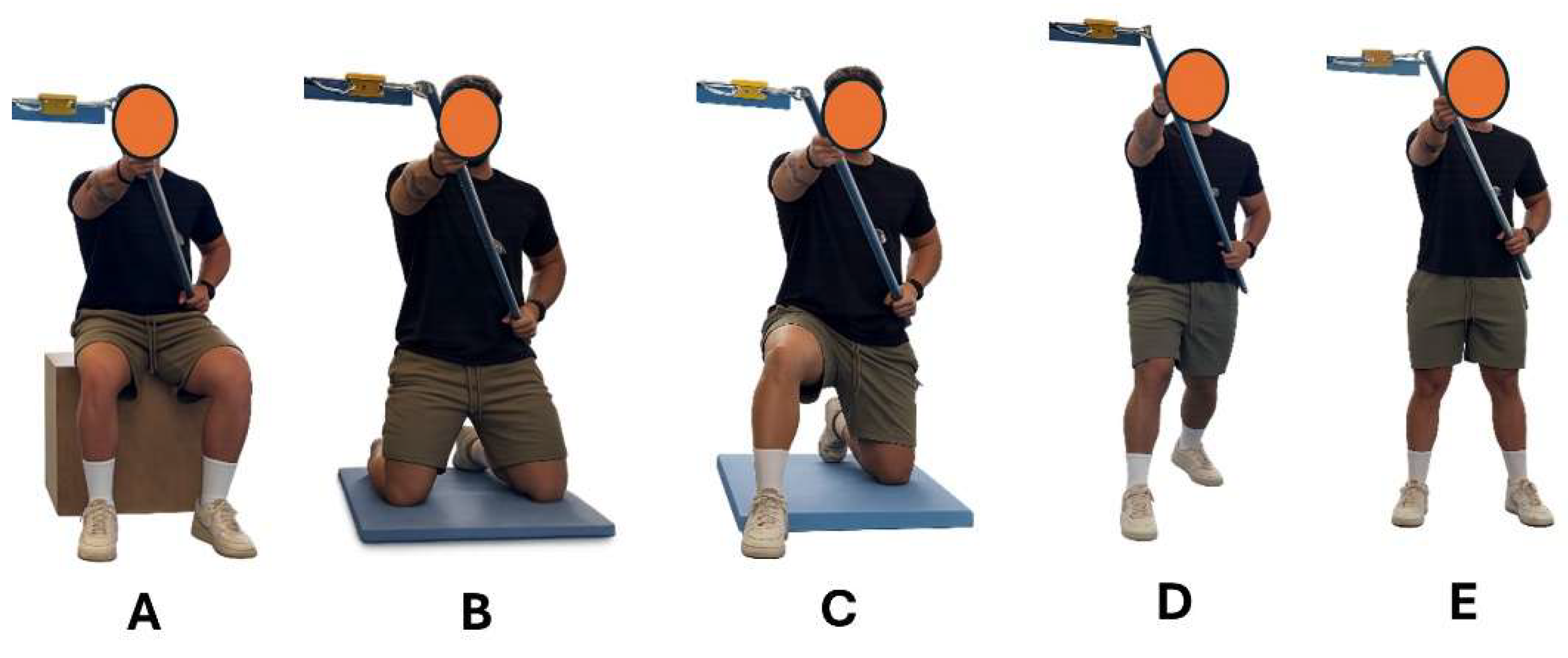
Figure 3.
Rain cloud plots of maximal break force (kg) across positions during session 2. * Significant differences respect to half-kneeling position, p < 0.001; † Significant differences respect to kneeling position, (p< 0.05); ‡ Significant difference respect to parallel-stance position, (p< 0.05).
Figure 3.
Rain cloud plots of maximal break force (kg) across positions during session 2. * Significant differences respect to half-kneeling position, p < 0.001; † Significant differences respect to kneeling position, (p< 0.05); ‡ Significant difference respect to parallel-stance position, (p< 0.05).
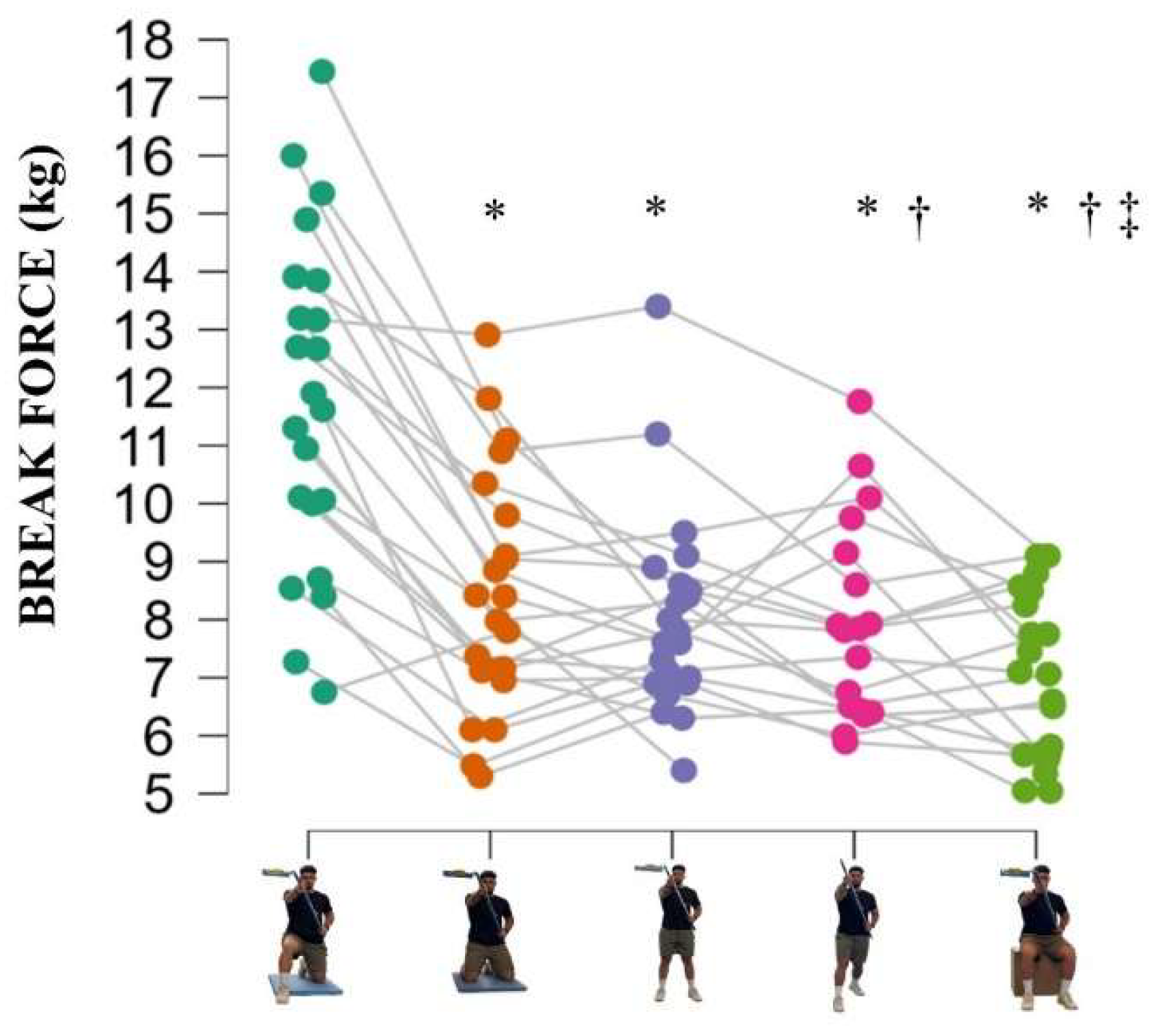
Figure 4.
Pearson correlation coefficients between break forces obtained in each cable woodchop position. All correlations were significant (p< 0.05).
Figure 4.
Pearson correlation coefficients between break forces obtained in each cable woodchop position. All correlations were significant (p< 0.05).
Disclaimer/Publisher’s Note: The statements, opinions and data contained in all publications are solely those of the individual author(s) and contributor(s) and not of MDPI and/or the editor(s). MDPI and/or the editor(s) disclaim responsibility for any injury to people or property resulting from any ideas, methods, instructions or products referred to in the content. |
© 2026 by the authors. Licensee MDPI, Basel, Switzerland. This article is an open access article distributed under the terms and conditions of the Creative Commons Attribution (CC BY) license (http://creativecommons.org/licenses/by/4.0/).
Copyright: This open access article is published under a Creative Commons CC BY 4.0 license, which permit the free download, distribution, and reuse, provided that the author and preprint are cited in any reuse.