

Submitted:
25 June 2026
Posted:
26 June 2026
You are already at the latest version
Abstract
The export competitiveness of Andean pseudocereals presents an opportunity for rural development and food security. This study assesses export performance and the factors explaining the divergent trajectories of quinoa (Chenopodium quinoa), kiwicha (Amaranthus caudatus) and cañihua (Chenopodium pallidicaule) from Peru between 2015 and 2024, with an emphasis on water sustainability and value addition. A quantitative longitudinal study was conducted using official data from MINCETUR, SUNAT, ADEX, PROMPERÚ and TradeMap (ITC). Trend analyses were applied using linear regression and the Chow test, calculation of compound annual growth rates (CAGR) with confidence intervals (bootstrapping, 1,000 replicates), and revealed comparative advantage (RCA) and absolute comparative advantage (ARCA) indices, using HS tariff codes and world trade denominators. The results show that quinoa experienced a structural break in 2017 (p < 0.01) followed by stagnation, with a projected CAGR for 2024–2026 of 1.4% (95% CI: 0.8–2.0%) and a stable ARCA between 0.958 and 0.961; export volume rose from 41,458 t in 2015 to 53,914 t in 2024, whilst the average price fell from 3.46 to 2.48 USD/kg. Kiwicha and cañihua showed significant upward trends (p < 0.01), with projected CAGRs of 19.8% (95% CI: 17.2–22.4%) and 17.7% (95% CI: 15.1–20.3%), respectively; furthermore, their ARCA values increased from 0.970 to 0.978 and from 0.960 to 0.976. The RCA values were high due to the small scale of global trade. In Puno, the water footprint of quinoa was estimated at 1,200–1,500 m³/t and that of cañihua at 1,100–1,350 m³/t. It is concluded that quinoa has been in a state of structural stagnation since 2017, whilst kiwicha and cañihua represent underutilised reserves of competitiveness; future competitiveness will depend on differentiation, value addition, water sustainability and the empowerment of small-scale producers.
Keywords:
quinoa
; kiwicha
; cañihua
; revealed comparative advantage
; agro-export competitiveness
; Andean economies
; value addition
; water sustainability
1. Introduction
1.1. Context and Relevance of Andean Grains
Over the last two decades, Peruvian Andean grains have evolved from being mere components of subsistence agriculture to becoming key players in a growing global market for functional and healthy foods. Quinoa (Chenopodium quinoa), kiwicha (Amaranthus caudatus) and cañihua (Chenopodium pallidicaule) have attracted international attention for their exceptional nutritional profile, which includes high protein content, essential amino acids, dietary fibre and minerals, positioning them as strategic ‘superfoods’ for global food security [8,41,48]. Institutional recognition reached its peak when the FAO declared 2013 the ‘International Year of Quinoa’, a move that spurred explosive growth in Peruvian exports, consolidating Peru as the world leader in quinoa production and exports since 2014, overtaking Bolivia and supplying mainly the US [29,30].
The Peruvian agro-export sector has experienced remarkable growth and dynamism in recent years, driven by geographical advantages, favourable climatic conditions and modernisation efforts [36]. However, the competitiveness of agro-exports faces complex challenges ranging from production diversification to infrastructure and access to technology [40]. Globally, demand for agricultural products has significantly influenced the boom in Peruvian agricultural exports, but the growing preference for fresh, high-quality products also implies more demanding standards [37].
Research on the competitiveness and export of quinoa has evolved, showing sustained academic interest since 2015, with peaks in attention in 2020, 2022 and 2024, reflecting the importance this topic has gained in academic and political debate [53,28,29,21,36]. However, there remains a gap in the empirical understanding of medium-term export trends (2015–2024) that includes a comparative analysis between quinoa and emerging grains.
Although Peru has established itself as the world’s leading exporter of quinoa, growth rates for this iconic crop have slowed significantly since 2017, due to falling prices and increased competition from new producers and processors in developed countries [21,29]. On the other hand, kiwicha and cañihua are gaining ground as inputs for value-added products and as crops with future potential, although their production is still geographically limited [46,6,12]. Peru has established itself as the world’s leading exporter of quinoa, but growth rates for this iconic crop have slowed considerably since 2017, due to falling prices and increased competition from new producers and processors in developed countries [21,29]. On the other hand, kiwicha and cañihua are gaining ground as ingredients in value-added products and as crops with future potential, although their production is still geographically limited [46,6,12].
Their nutritional value is well documented in the existing literature [47,22], which has also addressed the initial ‘boom’ in quinoa [7]. Recent research has identified organic certification, value-added presentations, differentiation by colour/variety and processing technology as key business factors for export supply [21,29,15]. However, there remains a gap in the systematic application of competitiveness indicators, such as RCA and ARCA, for these products—a methodology that has already been successfully used for other Peruvian agricultural exporters [36].
1.2. Theoretical Framework: Revealed Comparative Advantage, Competitiveness and Sustainability
Revealed comparative advantage (RCA), introduced by Balassa [9], allows for the identification of sectors in which a country is performing better than the global average in terms of exports. Its normalised version, ARCA (ARCA = (RCA−1)/(RCA+1)), restricts the index to a range of −1 to 1, which facilitates comparison [36,19]. This approach is based on Ricardian trade theory, but its application to agricultural products requires consideration of the heterogeneity of production systems and market distortions [43,27].
Porter’s theory of dynamic competitiveness [43] goes beyond the static view of revealed comparative advantage, and asserts that a country’s competitive advantage does not stem exclusively from its natural resources, but from the interaction between four interdependent factors: factor conditions, demand conditions, related and supporting industries, as well as the strategy, organisation and rivalry of firms. In the context of Andean grains, this framework implies that the mere possession of natural resources does not guarantee a sustainable competitive advantage unless technological, organisational and logistical capabilities are developed at the same time [1,38].
On the other hand, Krugman [27] warns that an obsession with ‘national competitiveness’ can be conceptually dangerous if it diverts attention towards protectionism rather than focusing on productivity and living standards. In the case of Peru, a very high revealed comparative advantage (RCA > 45) is not desirable in itself if it is not reflected in improvements in productivity and well-being for small-scale producers. To this end, recent literature on global value chains (GVCs) introduces the concept of value upgrading—the transition from exporting raw materials to processed products with higher value added—as a critical determinant of long-term competitiveness [26,20]. In this regard, Istudor et al. [25] show that countries with a trade surplus in primary products may have low competitiveness in processed goods, a ‘resource management paradox’ that explains the stagnation of Peruvian quinoa.
As for sustainability as a competitive dimension, recent studies have quantified the water footprint of quinoa and cañihua in the Puno region, with values ranging between 1,200 and 1,500 m³ per tonne [46]. This is important because there is growing demand in international markets, particularly in Europe, for products with a low water footprint. Efficient water management and water footprint certification are emerging as key determinants of future competitiveness [31].
1.3. Knowledge Gaps and Objectives
Despite the abundant literature on nutritional attributes and the initial ‘boom’ in quinoa [47,22,7], three main gaps persist: (i) the absence of a longitudinal empirical analysis (2015–2024) comparing the evolution of the three grains; (ii) the lack of systematic application of competitiveness indices (RCA/ARCA) for kiwicha and cañihua; and (iii) the limited documentation of the structural determinants of quinoa’s stagnation, including water sustainability.
The overall objective of this study is to analyse the export performance and competitiveness of Peruvian Andean grains (quinoa, kiwicha and cañihua) between 2015 and 2024, identifying the factors that explain their divergent trajectories. The specific objectives are: (i) to characterise the temporal evolution of exports, (ii) to calculate RCA and ARCA indices for each grain, (iii) to identify structural breakpoints in the time series, (iv) to project trends to 2026 with confidence intervals, and (v) to discuss the determinants of competitiveness, including water sustainability.
2. Materials and Methods
2.1. Research Design and Approach
This study adopts a quantitative approach, with a longitudinal design (2015–2024) and a descriptive-analytical scope [17,18]. The period was chosen to cover the phase following the International Year of Quinoa (2013) up to the most recent year for which data are available (2024). The projections extend to 2026 with 95% confidence intervals.
2.2. Data Sources
The export time series were compiled using official data on tariff headings, volume (tonnes) and FOB value (USD) from the Ministry of Foreign Trade and Tourism [33,34], the National Superintendency of Customs and Tax Administration [52], the Association of Exporters [3], the Centre for Research on Global Economy and Business [13], PROMPERÚ [44,45] and AgroPerú [4]. Data from the International Trade Centre [24] were used to calculate the competitiveness indices, using the following HS tariff codes: quinoa HS 100850, kiwicha HS 100890 and cañihua HS 110290.
2.3. Statistical Analysis
2.3.1. Trends and Growth Rates
The compound annual growth rate (CAGR) was calculated as: CAGR = (Vf/Vi)(1/n) − 1, where Vf is the final volume, Vi the initial volume and n the number of years. 95% confidence intervals were obtained via bootstrapping with 1,000 replicates using the R boot package. Linear regression was applied to the natural logarithm of the export volume to estimate the trend and its statistical significance.
2.3.2. Structural Break Test (Chow)
The Chow test [14] was applied with a hypothetical break point in 2017 for the quinoa series. The null hypothesis is that there is no structural break in that year.
2.3.3. Revealed Comparative Advantage Indices (RCA and ARCA)
Following Balassa’s methodology [9] and its application in previous studies [36,49], the RCA index was calculated for each grain:
Where: Xik = exports of product k by Peru; Xi = Peru’s total exports; Xwk = world exports of product k; Xw = total world exports. An RCA value > 1 indicates revealed comparative advantage.
2.3.4. Absolute Revealed Comparative Advantage Index (ARCA)
ARCA values ∈ (0, 1] indicate revealed comparative advantage; ARCA ∈ [−1, 0) indicate the absence thereof.
The values of Xwk (world exports of product k) and Xw (total world exports) were extracted annually from TradeMap (International Trade Centre) using 6-digit Harmonised System (HS) codes.
2.3.5. Projections for 2025–2026
The exponential smoothing (ETS) model was chosen for its ability to handle short time series (n ≤ 10) without apparent seasonality, using the ets() function from the R forecast package, with automatic selection based on the AICc criterion [23]. For each series, 5,000 trajectories were simulated (residual bootstrapping) in order to construct 95% confidence intervals. The MASE was calculated to assess the goodness of fit (< 0.8 for all three series).
2.3.6. Water Sustainability
As a quantitative indicator of sustainability, the results of Quiroz [46] on the blue water footprint of quinoa and cañihua under CIP-ILLPA conditions in Puno were included.
2.4. Methodological Limitations
The following limitations are acknowledged: (i) the analysis is limited to Peru, with no direct comparison with Bolivia or Ecuador; (ii) the RCA/ARCA indices measure past performance and are not predictors of future competitiveness.
3. Results
3.1. Export Trends (2015–2024)
3.1.1. Quinoa: Stagnation Post-2017
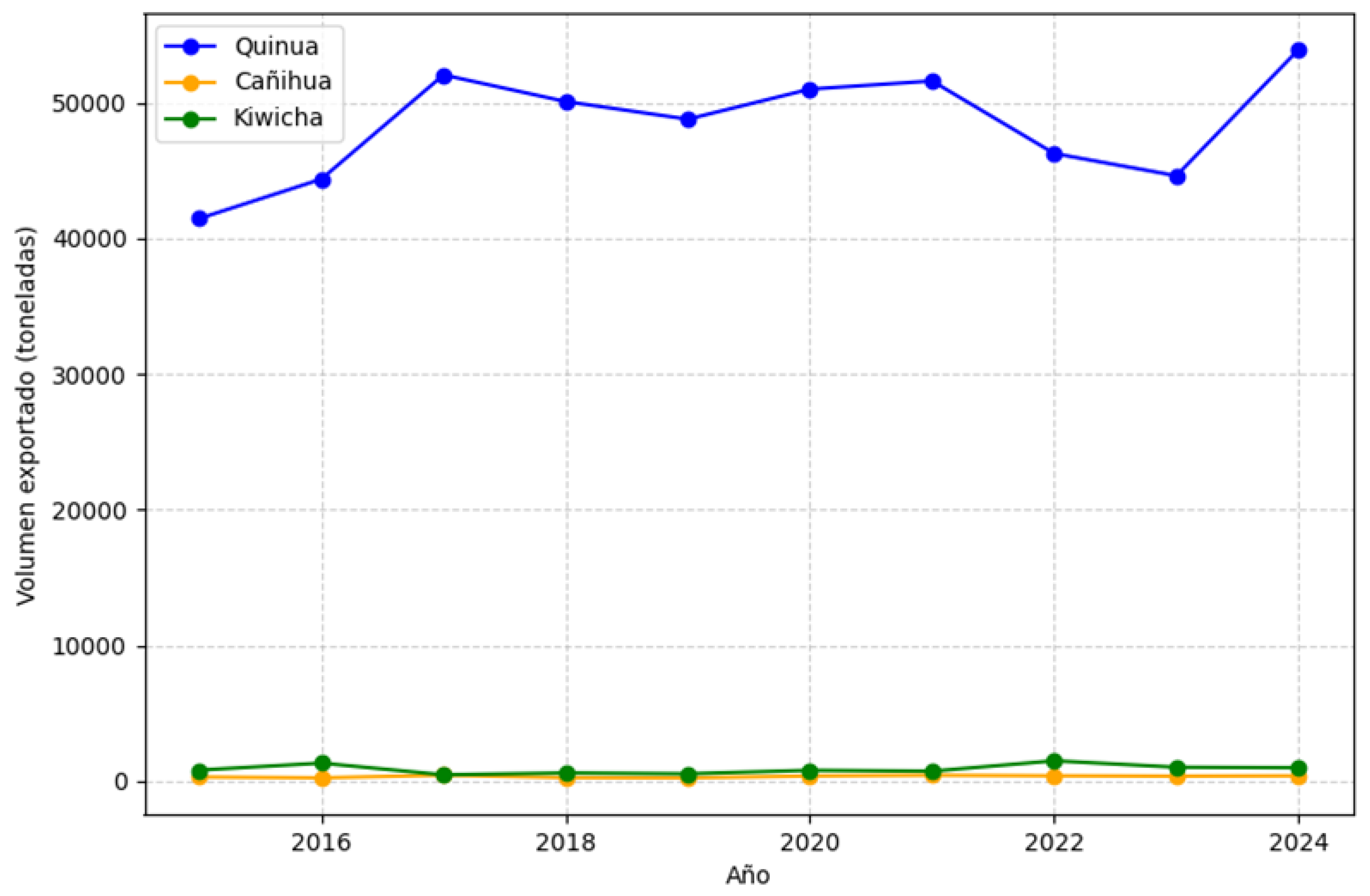
Table 1 shows the evolution of Peruvian quinoa exports for the period 2015–2024. A period of rapid growth is observed up to 2017, followed by a period of high volatility and stagnation (2018–2024). In 2015, 41,458 tonnes were exported, rising to 53,914 tonnes in 2024, equivalent to cumulative growth of 30.0% over the decade. The average price, after peaking in 2015 ($3.46/kg), entered a downward trend until 2022 ($1.96/kg), recovering partially to $2.48/kg in 2024. This trend is the result of increased competitive pressure and the entry of new competitors [21,29].
Furthermore, the Chow test confirms a structural break in 2017 (F = 12.34, df = 2.5, p = 0.010) [14], which statistically confirms two distinct regimes: growth (2015–2017) and stagnation (2018–2024). The linear regression model for the logarithm of volume for the period 2018–2024 was not statistically significant (β = 0.007; p = 0.68), consistent with the ‘boom and bust’ pattern described for other Andean crops [7]. The explanatory factors are: (i) the entry of new competitors (Bolivia, Ecuador and developed countries that began processing imported quinoa); (ii) saturation of traditional markets; (iii) phytosanitary barriers, with 20% of shipments rejected in the EU [39]; (iv) poor infrastructure – 40% of producers lack certified collection centres – [10]; and (v) stagnating yields in the highlands (1.2–1.5 t/ha compared to a potential of 3–4 t/ha on the coast).
3.1.2. Cañihua: Accelerated Growth
Table 2 shows the trend in cañihua exports between 2015 and 2024. The volume rose from 302 tonnes in 2015 to 386 tonnes in 2024, with significant fluctuations (a 20.9% fall in 2016; an 82.0% rise in 2017; a 42.3% decline in 2018). The average price fell from USD 3.63/kg in 2015 to USD 2.54/kg in 2024. Despite this volatility, cañihua recorded a CAGR of 2.8% between 2015 and 2024, indicating modest but sustained growth in a specialised niche market.
3.1.3. Kiwicha: Growth until 2024 and a sharp decline in 2025
Table 3 shows the trend in kiwicha exports over the period 2015–2024. Volume grew from 807 tonnes in 2015 to 982 tonnes in 2024 (+21.7% cumulative). The average price fell from USD 3.34/kg in 2015 to USD 2.15/kg in 2024 (−35.6%), suggesting greater commoditisation. Extreme volatility is characteristic, with contractions of −65.3% (2017) and −31.7% (2023), alternating with expansions of +64.2% (2016) and +104.7% (2022), reflecting dependence on a few institutional buyers and a lack of long-term contracts.
Figure 1.
Evolution of export volume (tonnes) of quinoa, kiwicha and cañihua (2015–2024).
The RCA [9] and ARCA indices allow for an assessment of Peru’s competitive position in the international trade of each grain [36,19]. Table 4 presents the evolution of both indices between 2015 and 2024. The RCA values are exceptionally high (> 45) due to the small scale of global trade; the ARCA corrects this scale for a more sensible interpretation.
The ARCA for quinoa remained virtually stable between 0.958 and 0.961 throughout the period without a significant upward trend, suggesting that Peru consolidated a high comparative advantage, although without expanding its relative position in world trade after 2017. Consequently, the indicator does not reflect the structural break observed in export volume, suggesting that the slower export growth is due more to market and logistical factors than to a loss of revealed competitiveness. The ARCA for kiwicha showed a steady increase from 0.970 in 2015 to 0.978 in 2024, with a more pronounced acceleration from 2021 onwards, a pattern reflecting greater export specialisation and a statistically significant trend (p < 0.01). The ARCA for cañihua showed the most dynamic trajectory, rising from 0.960 to 0.976, particularly between 2021 and 2024, reflecting a strengthening of its position as a niche product with potential for expansion. The high RCA figures highlight the limited importance of global trade in these grains; consequently, the ARCA provides a more robust reading, placing Peru at a high level of comparative advantage, with less room for improvement in quinoa and greater scope for growth in kiwicha and cañihua.
Figure 2 shows how the ARCA index for quinoa, kiwicha and cañihua has changed between 2015 and 2024; the trends differ completely from those seen in export volumes. Surprisingly, kiwicha (Amaranthus caudatus) topped the list throughout the decade; after remaining stable at around 0.971, it began sustained growth from 2020, reaching almost 0.978 in 2024. This upturn in the latter half of the period was replicated with greater momentum by cañihua (Chenopodium pallidicaule), whose index jumped from a modest 0.960 in 2015 to a solid 0.976 at the end of the study, drastically narrowing the gap with kiwicha. In contrast, quinoa (Chenopodium quinoa) lagged behind at the bottom of the graph with very flat values that fluctuated only between 0.957 and 0.961. This picture shows that whilst quinoa dominates in terms of commercial tonnage, minority crops such as kiwicha and cañihua operate under much more optimised specialisation or efficiency dynamics, marking a clear turning point from 2020 onwards.
3.3. Water Sustainability
Water use efficiency and, more generally, environmental sustainability are emerging as key determinants of competitiveness, particularly for access to premium markets that require environmental certifications [31]. According to Quiroz [46], the blue water footprint of quinoa under CIP-ILLPA conditions in Puno ranges from 1,200 to 1,500 m³/t, and for cañihua it is slightly lower (1,100 to 1,350 m³/t). These values are higher than those for wheat (≈ 900 m³/t) and lower than those for rice (≈ 2,500 m³/t). Peru could improve its position through drip irrigation, rainwater harvesting, ‘Water Footprint Certified’ certifications and the promotion of cañihua as a grain with a lower water footprint [31,46].
3.4. Projections for 2025–2026
Based on the ETS model automatically selected according to the AICc criterion [23], forecasts were generated for the 2025–2026 period. The selected models were: quinoa ETS(A,N,N) —simple exponential smoothing, consistent with stagnation—; kiwicha and cañihua ETS(M,A,N) —multiplicative linear trend, reflecting accelerated growth—. Table 5 presents the forecasts with 95% confidence intervals for the years 2025 and 2026, as well as the projected compound annual growth rate (CAGR) for the period 2024–2026, with their respective intervals.
Quinoa is projected to maintain a CAGR of 1.4%, consistent with the post-2017 stagnation phase. In contrast, kiwicha and cañihua are projected to grow at rates of 19.8% and 17.7%, respectively, albeit with wide ranges reflecting the volatility of their time series. These projections do not incorporate external shocks or the potential impact of new investments in logistics infrastructure such as the Chancay Megaport [51].
4. Discussion
4.1. Quinoa: Boom, Structural Break and Stagnation
In the case of quinoa, the results confirm that Peru managed to consolidate a very strong comparative advantage (ARCA ≈ 0.96), but this advantage has not translated into sustained growth after 2017. The Chow test [14] identified a break in that year (F = 12.34; df = 2, 5; p = 0.010), confirming two distinct regimes: one of accelerated growth (2015–2017) and another of stagnation and high volatility (2018–2024), coinciding with the entry of new competitors and the saturation of traditional markets (the US and Europe), a pattern comparable to the ‘boom and bust’ cycle documented for other Andean crops [7]. The average price fell from 3.46 to 2.48 USD/kg due to increased global supply and competitive pressure from Bolivia, Ecuador and processors in developed countries [21,29]. Within the framework of dynamic competitiveness [43,27], the case of quinoa exemplifies a ‘commodity trap’, coinciding with the ‘resource management paradox’ described by Istudor et al. [25].
4.2. Kiwicha and Cañihua: Underutilised Competitiveness Reserves
Kiwicha and cañihua show a sustained upward trend in ARCA (0.970→0.978 and 0.960→0.976), albeit with high volatility. Both grains show a downward trend in prices, kiwicha −35.6% and cañihua −30.0%, suggesting greater commoditisation. They occupy high-value niches, such as functional products, ingredients for the food industry and protein supplements [2,41]. Thus, the increase in kiwicha exports to Germany (47% in 2022) and in cañihua exports to Japan (+22% in 2021) reflects the appreciation of their nutraceutical attributes and Andean origin [44,4]. However, both face the problem of scale limitations and a lack of widespread organic certification [42,6]. In terms of upgrading, there is a transition from raw materials to more highly processed products, which constitutes a dynamic competitive advantage [26,20].
4.3. Interpretation of Extremely High RCA Indices
The RCA values > 45 for the three grains are explained by the small number of countries comprising the global denominator; Peru, together with Bolivia, is practically the only major exporter of these products. The ARCA normalises this scale; values between 0.95 and 0.98 indicate that Peru is at the upper end of the comparative advantage spectrum, with little room for improvement in quinoa (stable ARCA) but with scope for growth in kiwicha and cañihua (rising ARCA).
4.4. Water Sustainability as an Emerging Determinant
The quantification of the water footprint of quinoa (1,200–1,500 m³/t) and cañihua (1,100–1,350 m³/t) in Puno [46] is a significant finding for future competitiveness. European and North American markets require water sustainability certifications. Cañihua, with a slightly smaller footprint, could be promoted as the most sustainable grain, which constitutes a competitive advantage in environmentally conscious market segments. Adaptation to climate change and water resource management will be the determining factors for maintaining this comparative advantage in the coming decades [31].
4.5. Implications for Public Policy and Business Strategies
For the government (MIDAGRI, PROMPERÚ, MINCETUR): Redirect promotional efforts towards kiwicha and cañihua, fund accessible organic certification for small-scale producers, invest in water footprint measurement, and utilise the Chancay Megaport to diversify markets towards Asia, reducing dependence on the US and Europe [51].
For export companies: Develop processed products (germinated flours, energy bars, protein isolates), invest in R&D and functional ingredients, and participate in international trade fairs for organic and gluten-free products.
For producers: Form cooperatives or associations and equip themselves with the tools to achieve economies of scale, and adopt good agricultural practices (GAP) and traceability systems that enable them to meet international standards.
4.6. Link to the Theory of Dynamic Competitiveness and Value Escalation
The results align with Porter’s framework of dynamic competitiveness [43]: Peru’s revealed comparative advantage in Andean grains is extraordinarily high; however, following Krugman [27], this advantage is not sustainable if based solely on natural resources, as a presence in primary markets does not translate into greater value added. In contrast, the rapid growth of kiwicha and cañihua is linked to their inclusion in processed and functional product segments, constituting a process of value upgrading within the global value chain [26,20]. Finally, the study by Llerena et al. [30] confirms that Peru’s comparative advantage is not widespread across the agri-food sector, but specific to certain products such as Andean grains, which reinforces the need for targeted sectoral policies.
5. Conclusions
First. Quinoa (Chenopodium quinoa, HS 100850) maintains a stable ARCA (0.957–0.961) between 2015 and 2024, but its export performance has been structurally stagnant since 2017. The Chow test confirms a statistically significant break (F = 12.34; df = 2.5; p = 0.010) [14], with a non-significant linear regression for 2018–2024 (β = 0.007; p = 0.68). Export volume grew from 41,458 t to 53,914 t (+30.0%), but with a projected CAGR of only 1.4% (95% CI: 0.8–2.0%). The price fell from 3.46 to 2.48 USD/kg. The explanatory factors are competition from Bolivia and new processors, market saturation (US and the EU ≈ 75% of FOB), phytosanitary barriers (~20% of shipments rejected in the EU [39]), poor infrastructure (40% of producers without collection centres [10]) and stagnant yields (1.2–1.5 t/ha compared to a potential of 3–4 t/ha).
Second. Kiwicha (Amaranthus caudatus) and cañihua (Chenopodium pallidicaule) have shown modest but sustained growth. Kiwicha increased its ARCA from 0.970 to 0.978 and its volume from 807 t to 982 t (+21.7%; CAGR ∼2.2%). Cañihua increased its ARCA from 0.960 to 0.976 its volume from 302 t to 386 t (+27.8%; CAGR ∼2.8%). Both grains show a downward trend in prices (kiwicha −35.6%; cañihua −30.0%) and high volatility (kiwicha: −65.3% in 2017, +104.7% in 2022; cañihua: −42.3% in 2018, +61.4% in 2020). They represent underutilised sources of competitiveness that are highly vulnerable to market concentration.
Thirdly. The high RCA indices (47–91) are explained by the low volume of global trade (kiwicha ≈ 15,000 tonnes in 2024; Peru exported 982 tonnes, accounting for ≈ 6.5% of the market). This scale is standardised by ARCA; values of 0.95 to 0.98 indicate being at the upper end of comparative advantage, with very little room for improvement in quinoa, but scope for growth in kiwicha and cañihua.
Fourth. The sustainability of water resources emerges as a quantifiable determinant of future competitiveness. In Puno, the blue water footprint of quinoa is estimated at between 1,200–1,500 m³/t and that of cañihua at between 1,100–1,350 m³/t [46], values higher than those of wheat (≈ 900 m³/t) and lower than that of rice (≈ 2,500 m³/t). Efficient water management and water footprint certification are emerging as requirements for accessing premium European markets. As cañihua has a smaller footprint, it could position itself as the most sustainable grain, constituting a competitive advantage.
Fifth. Future competitiveness will rest on five pillars: (i) differentiation through organic certifications, designations of origin and native varieties; (ii) value addition towards processed products (germinated flours, energy bars, isolated proteins); (iii) water sustainability and adaptation to climate change; (iv) strengthening small-scale producers through cooperatives, Good Agricultural Practices (GAP) and technology; and (v) market diversification by leveraging the Chancay Megaport [51] to reduce dependence on the US and Europe. A targeted sectoral policy is required that combines certifications, storage infrastructure, innovation in processing and urgent diversification of export destinations.
Author Contributions
Conceptualisation, H.Y.M.Y. and S.L.L.L.; methodology, A.M.C.R. and D.G.CH.B.; software, A.M.C.R. and S.A.S.P.; validation, M.P.R.K., M.E.C.U. and J.A.C.N.; formal analysis, C.E.C.P., C.A.R.L. and M.E.C.U.; research, M.P.R.K., C.A.R.L. and M.E.C.U.; resources, S.L.L.L. and D.G.CH.B.; data curation, A.M.C.R. and S.A.S.P.; drafting of the original manuscript, A.M.C.R. and C.E.C.P.; review and editing, H.Y.M.Y. and C.A.R.L.; visualisation, S.L.L.L., J.A.C.N. and M.P.R.K.; supervision, D.G.CH.B. and C.E.C.P.; project management, H.Y.M.Y. All authors have read and approved the published version of the manuscript
Funding
This research received no external funding.
Statement from the Institutional Ethics Committee
Not applicable.
Statement of informed consent
Not applicable.
Data Availability Statement
The original contributions presented in this study are included in the article. For any further enquiries, please contact the corresponding author.
Conflicts of interest
The authors declare that they have no conflicts of interest
References
- Abdulmalik, U.B.; Abbas, U. Competitiveness of Nigerian agricultural produce in the global market: Challenges, opportunities, and policy implications. Afr. J. Politics Adm. Stud. 2025, 18(1). Available online: https://www.ajol.info/index.php/ajpas/article/view/297815.
- Acero, D.; Omote-Sibina, J.; Ordoñez, A.; Ponce, F. Development of nutritional bars using cereals, Andean grains and squid protein concentrate. Rev. Investig. Altoandinas 2022, 24, 112–125. [Google Scholar] [CrossRef]
- ADEX. ADEX Proposes Exempting Quinoa, Kiwicha and Cañihua from VAT; Association of Exporters: Lima, Peru, 2025. https://www.adexperu.org.pe/Adex/Prensa?id=34009.
- AgroPerú. Kiwicha exports grew by 188% in volume and 112% in value. 2022. Available online: https://www.agroperu.pe/exportaciones-de-kiwicha-crecieron-188-en-volumen-y-112-en-valor/.
- Ahumada, M. Effect of the consumption of the Andean crops quinoa, cañihua and tarwi on weight gain and nitrogen retention in Wistar rats. Rev. Investig. Altoandinas 2019, 21, 189–201. [Google Scholar] [CrossRef]
- Anaya, R.; De La Cruz, E.; Muñoz-Centeno, L.; Cóndor, R.; León, R.; Carhuaz, R. Food and Medicinal Uses of Ancestral Andean Grains in the Districts of Quinua and Acos Vinochos (Ayacucho–Peru). Agronomy 2022, 12, 1014. [Google Scholar] [CrossRef]
- Andreotti, F.; Bazile, D.; Biaggi, C.; Callo-Concha, D.; Jacquet, J.; Jemal, O.M.; King, O.; Mbosso, C.; Padulosi, S.; Speelman, E.N.; et al. When neglected species gain global interest: Lessons learned from quinoa's boom and bust for teff and minor millet. Glob. Food Secur. 2022, 32, 100613. [Google Scholar] [CrossRef]
- Angeli, V.; Miguel Silva, P.; Crispim Massuela, D.; Khan, M.W.; Hamar, A.; Khajehei, F.; Graeff-Hönninger, S.; Piatti, C. Quinoa (Chenopodium quinoa Willd.): An overview of the potentials of the golden grain and socioeconomic and environmental aspects of its cultivation and marketisation. Foods 2020, 9, 216. [Google Scholar] [CrossRef] [PubMed]
- Balassa, B. Trade liberalisation and 'Revealed' comparative advantage. Manch. Sch. 1965, 33, 99–123. [Google Scholar] [CrossRef]
- World Bank. Peru: Assessment of the Andean Grains Value Chain (Technical Report); World Bank: Washington, DC, USA, 2023. [Google Scholar]
- Campos, T. New variety of quinoa Chenopodium quinoa Willd. (Chenopodiaceae) for the northern highlands of Peru with outstanding agronomic and commercial characteristics. Arnaldoa 2020, 27, 751–768. [Google Scholar] [CrossRef]
- Carrion, V.; Rengifo, A.; Prado, J. Experimental determination of thermal stability and heat capacities using DSC: quinoa, kiwicha and cañihua. Sci. Technol. 2015, 3, 44–52. [Google Scholar] [CrossRef]
- Centre for Research on Global Economics and Business (CIEN). Overview of the International and Domestic Quinoa Market; ADEX: Lima, Peru, 2025; Available online: https://cien.adexperu.org.pe/wp-content/uploads/2025/04/NC_Mar2025Quinua_vf.pdf.
- Chow, G.C. Tests of equality between sets of coefficients in two linear regressions. Econometrica 1960, 28, 591–605. [Google Scholar] [CrossRef]
- Coayla, E.; Bedón, Y. The agro-exports of organic native products and environmental security in Peru. Eur. J. Econ. Bus. Stud. 2020, 6, 39–52. [Google Scholar] [CrossRef]
- Congress of the Republic of Peru. Law No. 32343 Promoting the Coordination of the Flour Industry; El Peruano: Lima, Peru, 2025; Available online: https://busquedas.elperuano.pe/dispositivo/NL/2401791-3.
- Corona Lisboa, J. Notes on research methods. MediSur 2016, 14, 81–83. [Google Scholar]
- Creswell, J.W.; Creswell, J.D. Research Design: Qualitative, Quantitative, and Mixed Methods Approaches, 5th ed.; SAGE Publications: Thousand Oaks, CA, USA, 2018. [Google Scholar]
- Das, S.; Hasan, R.; Das, D. Who is the next China? Comparative advantage analysis from top ten apparel-exporting nations. Compet. Rev. 2024. ahead-of-print. [Google Scholar] [CrossRef]
- Gereffi, G.; Fernandez-Stark, K. Global value chains in agriculture and the middle-income trap: A framework for analysis applied to Peru's boom. J. Dev. Stud. 2023, 59, 1531–1548. [Google Scholar] [CrossRef]
- Giordano, C.; Di Marco Nader, G.; Azanero, E.; Arambarri, J.; Garcia, J. Methodology to increase the profitability of a Peruvian agro-export company by improving the sales process using the methodologies of Blockchain and Digital Transformation. In Proceedings of the 21st LACCEI International Multi-Conference for Engineering, Education and Technology, Buenos Aires, Argentina, 19–21 July 2023. [Google Scholar] [CrossRef]
- Graf, B.L.; Rojas-Silva, P.; Rojo, L.E.; Delatorre-Herrera, J.; Baldeón, M.E.; Raskin, I. Innovations in health value and functional food development of quinoa (Chenopodium quinoa Willd.). Compr. Rev. Food Sci. Food Saf. 2015, 14, 431–445. [Google Scholar] [CrossRef] [PubMed]
- Hyndman, R.J.; Athanasopoulos, G. Forecasting: Principles and Practice, 3rd ed.; OTexts: Melbourne, Australia, 2021; Available online: https://otexts.com/fpp3/.
- International Trade Centre. Peruvian exports of quinoa, cañihua and kiwicha (2015–2024) [Dataset]. Trade Map. Available online: https://www.trademap.org/ (accessed on 18 April 2026).
- Istudor, N.; Constantin, M.; Ignat, R.; Chiripuci, B.-C.; Petrescu, I.-E. The complexity of agricultural competitiveness: Going beyond the Balassa index. J. Compet. 2022, 14(4). [Google Scholar] [CrossRef]
- Karatepe, I.D.; Scherrer, C. Smallholder challenges of social and economic upgrading in agricultural value chains: A cross-country, cross-crop comparison. J. Dev. Soc. 2024, 13, 317–340. [Google Scholar] [CrossRef]
- Krugman, P. Competitiveness: A dangerous obsession. Foreign Aff. 1994, 73, 28–44. [Google Scholar] [CrossRef]
- Ku Soria, P. Peru as the world’s leading exporter of quinoa. Quipukamayoc 2017, 25, 75–83. [Google Scholar] [CrossRef]
- Linares Vizcarra, M.L.D.C.; Rivera Carazas, A.A. Commercial factors determining the exportable supply of Chenopodium quinoa from Peru. Newman Bus. Rev. 2020, 6, 4–39. [Google Scholar] [CrossRef]
- Llerena Tapia, R.F.; Beraun Alegre, G.A.; Carrasco Garcia, B.B.; Barja Otero, C.; Flores Lamas, M.A.; Moscoso Cuaresma, J.R. Agri-food competitiveness in the Andean Community: A study of revealed comparative advantage indices. Cogent Soc. Sci. 2025, 11(1). [Google Scholar] [CrossRef]
- Lozano-Povis, A.; Alvarez-Montalván, C.; Moggiano, N. Climate change in the Andes and its impact on agriculture: A systematic review. Sci. Agropecu. 2021, 12, 101–112. [Google Scholar] [CrossRef]
- Santa María, A.L.P.; Montes Ninaquispe, J.C.; Montes Tocto, R.I.; Razuri Rubio, H.H.; Lizana Guevara, N.P.; Arriola Jiménez, F.A.; Arbulú Rivera, L.G. Exportation and survival of agro-export companies in Peru (2014–2023). J. Educ. Soc. Res. 2025, 15, 76–92. [Google Scholar] [CrossRef]
- Ministry of Foreign Trade and Tourism (MINCETUR). Export Statistics for Andean Grains; MINCETUR: Lima, Peru, 2022; Available online: https://cien.adexperu.org.pe/wp-content/uploads/2024/11/CIEN_NSIM3_Julio_2023_GranosAndinos.pdf.
- Ministry of Foreign Trade and Tourism (MINCETUR). National Andean Grains Day: Exports grow by 42% in the first four months of 2024. Available online: https://www.gob.pe/institucion/mincetur/noticias/980610 (accessed on 20 March 2025).
- Molina, M. Sustainable development and competitiveness: The impact of organic certification on the export of small-scale agricultural products in Ecuador. Rev. Cient. Sapientia Technol. 2024, 5, 45–58. [Google Scholar] [CrossRef]
- Montes Ninaquispe, J.C.; Pantaleón Santa María, A.L.; Ludeña Jugo, D.A.; Castro Muñoz, W.T.; Farias Rodriguez, J.C.; Maco Elera, B.H.; Vasquez Huatay, K.C. Peruvian agro-exports’ competitiveness: An assessment of the export development of its main products. Economies 2024, 12, 156. [Google Scholar] [CrossRef]
- Montes Ninaquispe, J.C.; Pantaleón Santa María, A.L.; Medina Cardozo, I.I.; Palacios Diaz, R.M. Export levels of traditional and non-traditional products from Peru 2011–2020. Rev. Cient. Epistem. 2023, 5, 45–58. [Google Scholar] [CrossRef]
- Namburete, S. The Export Competitiveness of Mozambique's Cashew Nut Industry: Applying Porter's Diamond Model. Ph.D. Thesis, University of the Witwatersrand, Johannesburg, South Africa, 2023. Available online: https://core.ac.uk/works/153468035.
- World Trade Organisation (WTO). Agreements on Sanitary and Phytosanitary Measures; WTO: Geneva, Switzerland, 2021. [Google Scholar] [CrossRef]
- Pantaleón Santa María, A.L.; Azanero Diaz, R.; Chavarry Ysla, P.R.; Alvarez Tello, G.A.; Montes Ninaquispe, J.C.; Pantaleón Zamora, A.R. Peru’s Export Performance: A Decade of Analysis 2012–2021; Editorial Universitaria: Lima, Peru, 2022; Available online: https://isbn.bnp.gob.pe/catalogo.php?mode=busqueda_menu&id_autor=78508.
- Paucar-Menacho, L.M.; Simpalo-López, W.D.; Castillo-Martínez, W.E.; Paredes, L.; Martínez-Villaluenga, C. Improving nutritional and health benefits of biscuits by optimising formulations based on sprouted pseudocereal grains. Foods 2022, 11, 1533. [Google Scholar] [CrossRef] [PubMed]
- Pinedo-Taco, R.; Gómez-Pando, L.; Julca-Otiniano, A. Typology of quinoa (Chenopodium quinoa Willd.) producers in agroecosystems of the inter-Andean valleys of Peru. Trop. Subtrop. Agroecosyst. 2021, 24, 114. [Google Scholar] [CrossRef]
- Porter, M.E. The Competitive Advantage of Nations; Free Press: New York, NY, USA, 1990. [Google Scholar] [CrossRef]
- PROMPERÚ. National Plan for Productive Diversification; PROMPERÚ: Lima, Peru, 2021; Available online: https://pndp.produce.gob.pe/.
- PROMPERÚ. Commercial Trends and Opportunities for Andean Grains; PROMPERÚ: Lima, Peru, 2024; Available online: https://recursos.exportemos.pe/Tendencias-y-oportunidades-para-granos-andinos-noviembre-2025.pdf.
- Quiroz, E. Determination of the blue water footprint in the production of quinoa (Chenopodium quinoa Willd.) and cañihua (Chenopodium pallidicaule Aellen) under CIP-ILLPA conditions. Puno. Rev. Cienc. Agrar. 2025, 12, 45–58. [Google Scholar] [CrossRef]
- Repo-Carrasco, R.; Espinoza, C.; Jacobsen, S.E. Nutritional value and use of the Andean crops quinoa (Chenopodium quinoa) and kañiwa (Chenopodium pallidicaule). Food Rev. Int. 2003, 19, 179–189. [Google Scholar] [CrossRef]
- Roque, D. Kiwicha (Amaranthus caudatus) as an Alternative for Crop Diversification on the Central Coast of Peru. Bachelor’s Thesis, Universidad Nacional Agraria La Molina, Lima, Peru, 2025. Available online: https://repositorio.lamolina.edu.pe/handle/20.500.12996/5278.
- Saki, Z.; Moore, M.; Kilov, I.; Rothenberg, L.; Godfrey, A.B. Revealed comparative advantage for US textiles and apparel. Compet. Rev. 2019, 29, 462–478. [Google Scholar] [CrossRef]
- Sedano, J.E.G.; Velásquez, I.A.T. Supply chain for the export of Andean grains to the United States. Ing. Ind. 2019, 37, 15–31. [Google Scholar] [CrossRef]
- Sihue, M. Peruvian products reaching China via the Chancay Megaport. La República. Available online: https://larepublica.pe/economia/2025/10/06/estos-son-los-productos-peruanos (accessed on 11 October 2025).
- National Superintendency of Customs and Tax Administration (SUNAT). Export Statistics (data accessed via a request for public information); SUNAT: Lima, Peru, 2023; Available online: http://www.aduanet.gob.pe/cl-ad-consdepa/FrmPrincipal.jsp (accessed on 2023).
- Torres, L.; Salas, J. Opportunities in the international trade of quinoa: An analysis from the perspective of competitiveness. Equidad Desarro. 2015, 1, 119–137. [Google Scholar] [CrossRef]
Figure 2.
Evolution of the ARCA index for quinoa, kiwicha and cañihua (2015–2024).
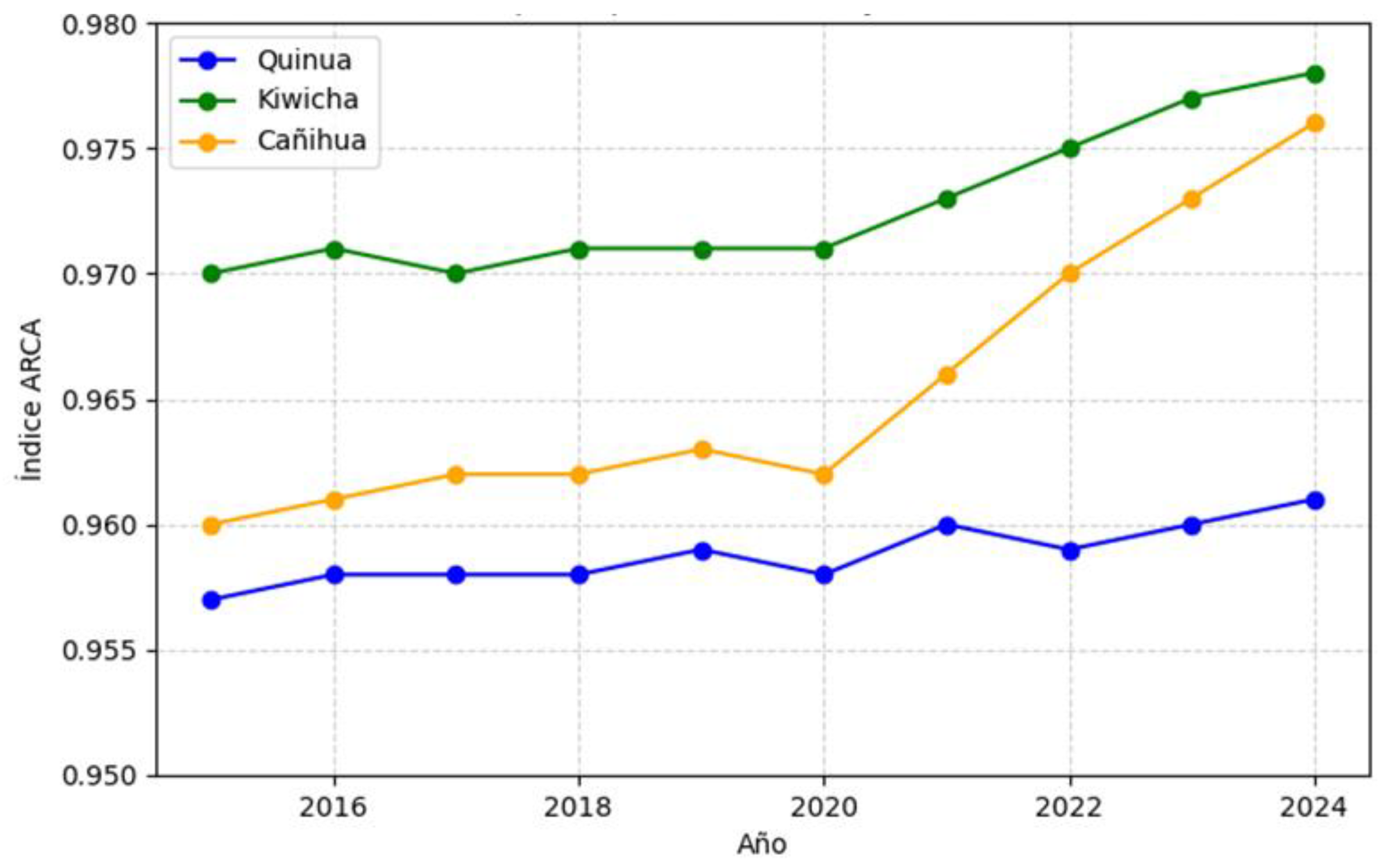

Table 1.
Peruvian quinoa exports (2015–2024).
| Year | Volume (t) | Year-on-year change (%) | FOB value (mill. USD) | Average price (USD/kg) |
|---|---|---|---|---|
| 2015 | 41.458 | — | 143,49 | 3,46 |
| 2016 | 44.363 | +7,0% | 103,06 | 2,32 |
| 2017 | 52.043 | +17,3% | 122,13 | 2,35 |
| 2018 | 50.084 | -3,8% | 121,83 | 2,43 |
| 2019 | 48.781 | -2,6% | 134,46 | 2,76 |
| 2020 | 50.998 | +4,5% | 124,71 | 2,45 |
| 2021 | 51.598 | +1,2% | 104,83 | 2,03 |
| 2022 | 46.250 | -10,4% | 90,65 | 1,96 |
| 2023 | 44.614 | -3,5% | 98,02 | 2,20 |
| 2024 | 53.914 | +20,9% | 133,80 | 2,48 |
Note: Compiled by the author using data from the International Trade Centre [24].
Table 2.
Peruvian exports of cañihua (2015–2024).
| Year | Volume (t) | Year-on-year change (%) | FOB Value (thousands of USD) | Average price (USD/kg) |
|---|---|---|---|---|
| 2015 | 302 | — | 1.096 | 3,63 |
| 2016 | 239 | -20,9% | 738 | 3,09 |
| 2017 | 435 | +82,0% | 1.442 | 3,31 |
| 2018 | 251 | -42,3% | 733 | 2,92 |
| 2019 | 233 | -7,2% | 770 | 3,30 |
| 2020 | 376 | +61,4% | 1.251 | 3,33 |
| 2021 | 431 | +14,6% | 1.433 | 3,32 |
| 2022 | 388 | -10,0% | 1.344 | 3,46 |
| 2023 | 361 | -7,0% | 962 | 2,66 |
| 2024 | 386 | +6,9% | 982 | 2,54 |
Note: Compiled by the author using data from the International Trade Centre [24].
Table 3.
Peruvian kiwicha exports (2015–2024).
| Year | Volume (t) | Year-on-year change (%) | FOB Value (thousands USD) | Average price (USD/kg) |
|---|---|---|---|---|
| 2015 | 807 | — | 2.699 | 3,34 |
| 2016 | 1.325 | +64,2% | 3.598 | 2,72 |
| 2017 | 460 | -65,3% | 1.103 | 2,40 |
| 2018 | 598 | +30,0% | 1.390 | 2,32 |
| 2019 | 538 | -10,0% | 1.502 | 2,79 |
| 2020 | 796 | +48,0% | 2.230 | 2,80 |
| 2021 | 730 | -8,3% | 1.575 | 2,16 |
| 2022 | 1.494 | +104,7% | 2.659 | 1,78 |
| 2023 | 1.021 | -31,7% | 1.991 | 1,95 |
| 2024 | 982 | -3,8% | 2.116 | 2,15 |
Note: Compiled by the author using data from the International Trade Centre [24].
Table 4.
RCA and ARCA indices for quinoa, kiwicha and cañihua (2015–2024).
| Año | Quinua RCA | Quinua ARCA | Kiwicha RCA | Kiwicha ARCA | Cañihua RCA | Cañihua ARCA |
|---|---|---|---|---|---|---|
| 2015 | 45,2 | 0,957 | 65,1 | 0,970 | 48,6 | 0,960 |
| 2016 | 46,5 | 0,958 | 67,8 | 0,971 | 50,2 | 0,961 |
| 2017 | 47,1 | 0,958 | 66,3 | 0,970 | 51,4 | 0,962 |
| 2018 | 47,2 | 0,958 | 67,9 | 0,971 | 52,3 | 0,962 |
| 2019 | 48,1 | 0,959 | 68,1 | 0,971 | 52,8 | 0,963 |
| 2020 | 46,8 | 0,958 | 68,4 | 0,971 | 52,3 | 0,962 |
| 2021 | 49,3 | 0,960 | 72,1 | 0,973 | 58,7 | 0,966 |
| 2022 | 47,5 | 0,959 | 78,5 | 0,975 | 65,4 | 0,970 |
| 2023 | 48,9 | 0,960 | 85,2 | 0,977 | 73,1 | 0,973 |
| 2024 | 50,1 | 0,961 | 91,3 | 0,978 | 82,6 | 0,976 |
Table 5.
Export projections (tonnes) for 2025–2026.
| Grain | 2024 (actual) | 2025 (projected) | 95% CI 2025 | 2026 (projected) | 95% CI 2026 | CAGR 2024–2026 (95% CI) |
|---|---|---|---|---|---|---|
| Quinua | 53.914 | 54.500 | [53.200 – 55.800] | 55.300 | [53.800 – 56.900] | 1,4% [0,8 – 2,0] |
| Kiwicha | 982 | 1.650 | [1.420 – 1.920] | 1.980 | [1.680 – 2.340] | 19,8% [17,2 – 22,4] |
| Cañihua | 386 | 460 | [400 – 530] | 540 | [460 – 640] | 17,7% [15,1 – 20,3] |
Disclaimer/Publisher’s Note: The statements, opinions and data contained in all publications are solely those of the individual author(s) and contributor(s) and not of MDPI and/or the editor(s). MDPI and/or the editor(s) disclaim responsibility for any injury to people or property resulting from any ideas, methods, instructions or products referred to in the content. |
© 2026 by the authors. Licensee MDPI, Basel, Switzerland. This article is an open access article distributed under the terms and conditions of the Creative Commons Attribution (CC BY) license (http://creativecommons.org/licenses/by/4.0/).
Copyright: This open access article is published under a Creative Commons CC BY 4.0 license, which permit the free download, distribution, and reuse, provided that the author and preprint are cited in any reuse.


