
Submitted:
25 June 2026
Posted:
25 June 2026
You are already at the latest version
Abstract
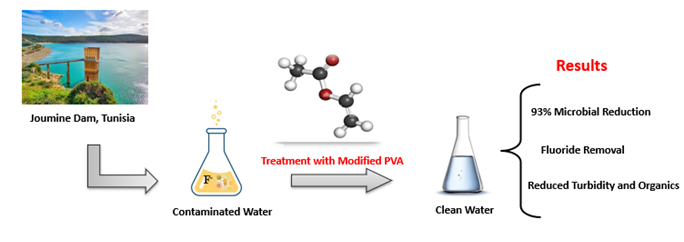
Aquatic ecosystems are increasingly affected by anthropogenic pollution, highlighting the need for efficient and sustainable water treatment technologies. Polyvinyl alcohol-co-vinyl acetate (PVA), a water-soluble polymer widely used in industrial applications, has received limited attention for surface water remediation. In this study, a chemically modified PVA was evaluated for the treatment of surface water collected from the Joumine Dam (Tunisia). Physico-chemical and microbiological characterization of water samples from six locations revealed the highest contamination levels at the dam inlet, reflecting a substantial pollution load entering the reservoir. Inlet water was therefore selected to assess treatment performance. Application of the modified PVA led to a 93% reduction in microbial load, accompanied by significant decreases in fluoride concentration, turbidity, and organic matter content. The treatment efficiency is attributed to the combined adsorptive and antimicrobial properties of the modified polymer. These results demonstrate the potential of modified PVA as a simple and effective material for improving surface water quality, with promising implications for drinking water treatment and decentralized water purification systems.
Keywords:
surface water quality
; water remediation
; polymer-based treatment
; microbial removal
; modified polyvinyl alcohol (PVA)
Copyright: This open access article is published under a Creative Commons CC BY 4.0 license, which permit the free download, distribution, and reuse, provided that the author and preprint are cited in any reuse.


