

Submitted:
24 June 2026
Posted:
25 June 2026
You are already at the latest version
Abstract
This work demonstrates that the RAPDtT model—a descriptive architecture with structural and ontological scope, composed of Reception (R), Storage/Buffer (A), Processing (P), Dispatch (D), and transport vectors (t, T)—constitutes a minimal and sufficient operational homomorphism, under the defined assumptions, to formalize the internal structure of the classical black box. Based on the protocolized record of states (inputs/outputs), the operational equivalence Φ(Input) ~== -t-> R - t-> A- t-> P- t-> D - t-> (input), is proposed, understood as a structural explicitness of the system’s transfer function rather than a strict functional identity in the mathematical sense. This correspondence enables formalization of the internal architecture under conditions of defined boundaries, traceability, and operational closure, facilitating homeostatic control mechanisms through negative feedback. Methodologically, the minimality of the architecture is examined using the principle of parsimony (Ockham’s Razor), demonstrating that the removal of any component invalidates the representation under the established structural requirements. The integration of Mario Bunge’s systemic ontology and W. Ross Ashby’s formal definition of dynamic systems allows the conclusion that RAPDtT functions as a provisional standard architecture for the analysis, design, and auditing of physical–informational processes in transformative systems with bounded flow.
Keywords:
RAPDtT
; black box
; white box
; structural architecture
; first-order cybernetics
; logistics
; traceability
1. Introduction
The notion of a black box, initially developed in electrical engineering and later formalized in cybernetics, has enabled the understanding of complex systems based solely on the observation of their inputs and outputs, without the need to access their internal structure. Wiener [1] describes the black box as a device that transforms an input signal through an unknown operation Φ to generate an observable response. Ashby [2] deepens this idea by noting that multiple internal mechanisms can produce equivalent external behaviors, which is why the rigorous observation of the protocol—the chronological sequence of inputs and outputs—constitutes the only legitimate means to infer regularities. Mindell [3], from a historical perspective, shows that the black box emerged as a technical solution at Bell Laboratories, where the abstraction of devices in terms of signals made it possible to separate communication, control, and physical mechanism, giving rise to the language that underpins first-order cybernetics as proposed by Wiener and his colleagues [1].
Within this context, the RAPDtT model is introduced. Initially developed to describe logistic flow, it was later consolidated as an ontological operations architecture capable of representing any physical or informational flow through six universal operations: Reception (R), Storage/Buffer (A), Processing (P), Dispatch (D), internal transport (t), and External Transport (T). Its minimal sequence T-t-R-t-A-t-P-t-D-t-T constitutes a linear causal structure, enabling the establishment of traceability, operational closure, flow continuity, and control through negative feedback, thus fulfilling the principles of first-order cybernetics.
Under this understanding, and drawing on the concepts proposed by Bunge [4], a canonical definition of RAPDtT is advanced as a conclusion, using his methodology, which holds that defining a system with scientific and philosophical rigor requires more than mere description; it must be decomposed into its ontological triad consisting of Composition (C), Environment (E), and Structure (S) [4, pp. 30–34].
This work demonstrates that RAPDtT is not merely a descriptive model but a functional structure that makes it possible to open the black box and make explicit its internal architecture under the transfer function Φ, rendering it analogous to the internal apparatus of a white box. An equivalence is established between the abstract operation of the black box’s internal apparatus and the sequential composition of RAPDtT, showing that:
Φ(Input) ~== -t->R - t-> A-> t-> P- t-> D - t-> ~== (Output)
With T at the endpoints, representing the couplings of external flows that connect the transfer function Φ of the black box to its environment at both input and output.
This work maintains that RAPDtT is not merely a descriptive model, but a functional structure that allows the black box to be opened and its internal architecture to be made explicit under the transfer function Φ.
2. Background and Related Work
2.1. The Black Box
A black box is a system whose internal functioning is unknown, inaccessible, or has not been analyzed [1,3]; only its inputs and outputs are of interest. In this approach, attention is focused on the internal operation Φ, understood as the transformation the system applies to a potential input (present and past) in order to produce an observable response [2,3], formalized by the mathematical expression
Output = Φ(input)
Since the internal apparatus of a black box cannot be observed, all information is obtained through a protocol, which is the chronological record of input and output states. Mathematically, this implies that when the system is treated as a black box, Φ is an unknown.
Ashby notes that the same external behavior (what the box does) can be produced by an infinite number of different internal mechanisms.
For Wiener [1], a black box is a device (such as an electrical network with input and output terminals) that performs a specific operation on an input signal to produce a response. The key point for Wiener is that the observer has no information about the internal structure or the components performing the transformation.
The structure of a system treated as a black box is presented below. (See Figure 1)
Ashby [2] indicates that highly complex systems can be controlled and understood without the need to “open” them, provided that one is able to systematically decode the relationship between their inputs and outputs through a rigorous protocol. Ashby argues that every complex system should be studied as a “black box,” using a protocol that chronologically records its inputs and outputs in order to identify regularities and construct a model of its behavior, even if not of its internal structure, since different internal configurations can produce the same outcomes (Homomorphism). “Memory” is not a physically verifiable property, but rather an effect of the system’s incomplete observability.
Consequently, understanding and managing real systems involves decoding the transition logic between states using black boxes and their observable responses, without the need to know their internal workings.
2.2. The White Box
Wiener [1, p. xli] indicates that there exists the antonym of the black box, defined as a system with a known structure, designed according to a specific plan to ensure a predetermined relationship between input and output. Unlike the black box, in the white box the interconnections of its components and the laws governing its internal functioning are fully known, enabling observability, describability, and control through the information available for auditing. Wiener proposes that "white boxes" (structures with known configuration representing terms of a mathematical expansion) can be used to model or emulate a black box.
2.3. The RAPDtT Model
The RAPDtT model is an operational reference model originally developed as a method for handling logistics flows, proposed by González Silva and Vásquez Bernal for the operational management of logistical processes. It is defined as a logical and consecutive sequence of six basic operations that describe the movement of materials and information: Reception (R), Storage/Buffer (A), Processing (P), Dispatch (D), Internal Transport (t), and External Transport (T). Its origin lies in the observation of logistical processes, where González Silva recognized the repetitive and orderly sequence of activities that determined the operational considerations of the processes studied.
Subsequently, and thanks to prior developments, it has been elevated to a model capable of providing descriptive, sequential, and recursive characteristics of physical and informational flows, independent of the context in which they occur [5,6].
The ontological body of RAPDtT is defined as a universal and recursive operational architecture that describes the logical sequence of any logistical flow, which must occur in a specific order to maintain traceability. This structure is based on six basic operations: Reception (R), Storage/Buffer (A), Processing (P), Dispatch/Direction (D), Internal Transport (t), and External Transport (T) [5]. Without these basic operations, no formal interconnection between processes would exist, nor could the physical and informational flow be maintained [7].
Its essence rests on the following pillars:
Operational Homomorphism: Functions as an operational "seed" capable of representing, using the same language, anything from a micro-task (such as a machine) to a macro-system (such as an entire value network) [6]. The RAPDtT structure maintains the same form and functional laws regardless of scale, making the model a valid representation of reality.
Flow Determinism: Generates a logical sequence of activities that provides observability and describability of information flows, as particularly studied by González Silva and Vásquez in the field of manufacturing [8].
Operational Closure: Standardizes the physical handling of materials and their parallel information flows, enabling tracking and operational control at any organizational scale [7].
Systemic Homeostasis: Aligned with First-Order Cybernetics, its structure allows the establishment of control and negative feedback mechanisms to maintain system balance in the face of disturbances [6].
2.4. Bunge’s Ontological Triad and Complementary Concepts for the Framework
Bunge [4] proposes that every system fulfills the triad Composition (C), Environment (E), and Structure (S). The composition (C) consists of the real entities or components with properties that are part of the system. The Environment (E) is defined as everything that is not part of the system but interacts with it. For Bunge, the environment is the set of things that act upon the system or upon which the system acts. Finally, the Structure (S) is the set of relationships and links (mechanisms) that hold the components together.
Bunge complements this triad with essential concepts: Systemism [4, p. 70], viewing every system as a nested hierarchy of subsystems; Emergentist Materialism [4, p. 176], asserting that function arises from the specific connectivity of components rather than mystical properties; and Observer Independence [4, p. 208], which maintains that systems and their structures exist regardless of external observation—a principle fundamental to referential architectures.
Additionally, a historical approach supports the claim that the RAPDtT model can explain legacy technical and logistical systems—such as Bowersox’s pipeline, machine flow descriptions, or office workflows—even those predating the model’s formalization. This reconstructive capability provides empirical evidence for its ontological definitions, demonstrating that its structure is homomorphic with the actual operation of diverse systems. This reaffirms its validity as a general architecture for transformable systems where flow is constrained by boundaries and observable traceability.
To bridge these ontological structures with operational control, we must consider the evolution of the "black box." Mindell [3] explains that this concept emerged in electrical engineering to describe sealed devices analyzed solely by their inputs and outputs. The work of Harold Stephen Black on negative feedback in 1927 [3] transformed passive systems into active machines by separating the message from the physical medium. Initially a specific solution for stability, feedback was later generalized during World War II by Nyquist and Bode [2], giving rise to the signal language that underpins cybernetics. Thus, the black box is not merely a theoretical abstraction, but the result of a technical evolution at Bell Laboratories that enabled the representation of the world through a common language of signals [3, p. 434].
Validation in Regulated Sectors
The RAPDtT model emerges from both conceptual formulation and an empirically documented trajectory. Its comparison with the classical logistics pipeline [8] and its use as a macro-micro analytical framework corroborate the stability of the RAPD sequence articulated by the transport vectors t/T.Its applicability in small enterprises (González Silva & Vásquez Bernal, 2022) demonstrates its capacity to represent operational environments with low formalization while maintaining flow traceability. This is further reinforced by its application in highly regulated sectors, such as green logistics for bioethanol in Colombia [9]. In that context, RAPDtT was used to structure critical points in supply and production according to environmental regulations and HACCP principles. Collectively, these precedents provide sufficient historical and empirical support to assert that RAPDtT functions as a referential and recursive architecture of flows, ready to be articulated with the black box approach and the function Φ as a self-evident structural identity.
2.5. Occam’s Razor
The principle of parsimony, or Occam’s Razor, proposed by the philosopher William of Ockham [11], is situated as a foundational postulate within the configuration of robust structures. This principle states that “entities should not be multiplied beyond necessity” [12], establishing a mandate of intellectual economy that prioritizes simplicity and efficiency in delineating technical truth. Under these considerations, the minimality of an architecture ceases to be an aesthetic choice and becomes its ontological essence; a structure is truly powerful not when it has nothing more to add, but when there is nothing that can be removed without compromising its existence. This pursuit of the irreducible is what guarantees the validity of a model in the face of environmental complexity.
3. Results
3.1. RAPDtT and Its Formalization as a Coherent Ontological Body
The sequence depicted in Figure 2 does not include system boundaries, an element required to formalize the processing apparatus that converts input into output. Under this condition, it is necessary to review the symmetry and operational closure of the model and, by applying rigorous evaluation, to verify its status as a system descriptor, while still satisfying the criteria established by first-order cybernetics. The following section is proposed to fulfill these objectives:
Justification of Symmetry and Operational Closure in the RAPDtT Model
The structure of the model exhibits functional symmetry, beginning and ending with the external transport vector (T) as the interface with the environment, while the internal transport (t) acts as the “connecting glue” between states. This architectural choice responds to two fundamental principles of systems engineering dynamics:
Transport as a Structural Coupling Vector: In systems theory [2,1] and logistics process management [13], transport is understood as the mechanism that connects subsystems, moving materials, information, or energy from one point to another. Therefore, it is recognized that flow cannot originate spontaneously within Reception (R) nor terminate within Dispatch (D). By placing a “t” before Reception and after Dispatch, the model ensures the existence of a transmission medium connecting the system boundary with the environment. Without these terminal “t” vectors, the system would become an isolated island, unable to synchronize with external transport (T).
State Continuity (Uninterrupted Flow): From systems theory, state continuity is based on the existence of uninterrupted flows of matter, energy, or information, which maintain structural coherence and functional stability. Bertalanffy [14] considered this principle from the outset to ensure that the system preserves its homeostasis, in accordance with first-order cybernetics, through continuous exchanges with the environment.
These considerations provide the criteria for continuous transmission within the model, conditions that inherently require support to propose RAPDtT as a system descriptor. Therefore, it is necessary to recognize the model as an Homomorphism tailored to this task.
RAPDtT and Systemic Homomorphism with Bunge’s Triad (<C, E, S>)
As part of the previous proposal, RAPDtT is reviewed, decomposing its structure in terms of Bunge’s three pillars: C, E, and S:
Composition (C): defines the entities or components of the system. In RAPDtT, the enabling functions are R, A, P, and D. Bunge requires that these components be real (entities with properties), and in this context, these functions are defined as “ontologically invariant functional stages of the flow.”
Environment (E): defines what is not part of the system but interacts with it. Here, the external vectors T are located. For Bunge, the environment comprises all things that act upon the system’s components or upon which the components act.
Structure (S): for Bunge, structure is the set of relationships and links (mechanisms) that hold the components together. In RAPDtT, this is represented by the internal vectors t and the invariant, non-commutative sequence T · t · R · t · A · t · P · t · D · t · T.
In this way, RAPDtT satisfies Bunge’s triad, fulfilling the structural requirements that allow it to propose the systemic Homomorphism. This validates its necessary ontological condition, enabling an approach to the description of the black box system.
3.2. From the Black Box to the White Box with RAPDtT
In this work, Φ represents exclusively the internal transformation apparatus of the black box. Let:
Φ(Input)=output
The RAPDtT model proposes (RAPD) as the functional stages in a unique sequential order, coupled by the internal transport vector t, or expressed in chronological sequence as -t-> R - t-> A- t-> P- t-> D - t->. External transport (T) functions as the coupling mechanism with the environment (system boundary). Under this consideration, this sequence is proposed as the operational homomorphic equivalent of Φ. For notational clarity, it is proposed:
Φ(Input) ~== [-t-> R - t-> A- t-> P- t-> D - t->] (input)
This correspondence should be understood, for the purposes of this work, as structural-operational rather than a strict functional identity in the mathematical sense.
It is worth noting that the chronological sequence “-t -> R- t-> A—t-> P – t-> D- t->” indicates that what reaches Dispatch (D) has already passed through Processing (P), and so on, thereby enforcing the logical and mandatory sequence rule that provides a standard to the model.
In this correspondence, the presence of t at both the beginning and the end ensures operational closure. This implies that:
At the beginning: the system assumes responsibility for the material/information from the moment it crosses the boundary.
At the end: the system does not release the flow until it has been fully projected outside its boundary.
This symmetry, t … t, also enables traceability, as it ensures that each state transition is supported by a movement vector, eliminating “blind spots” where information could be lost between the white box and the environment—a crucial point that serves as the key mechanism transforming a black box into a white box.
3.3. Formal Proof: RAPD as the Structure of Φ
For a descriptor of Φ to be real and formal, it must map the entity’s lifecycle without “blind spots.” It is proposed that RAPD achieves this through the following logical correspondence:
The function Φ cannot operate on what it does not recognize. The Reception (R) state formalizes the domain of the function. R identifies the flow.
In the sequence Reception (R) → Storage (A), the (A) state serves as the descriptor of the temporal variable in Φ. It represents the value of the variable during the waiting interval in which the transformation has not yet occurred, but the object is already “part” of the system. In this state, it is acknowledged that no transformation in Φ is instantaneous and that flows are not perfectly constant.
The Processing (P) state corresponds to the execution of the transformation law that changes the entity’s properties. The transfer function is the identity that converts input into output to generate a new state, which constitutes the raison d’être of the “black box.”
Finally, the Dispatch (D) state represents operational closure. (D) marks the moment when the result of Φ exits the system boundary. Without (D), the system loses operational closure and structural traceability, as results would accumulate indefinitely without being delivered to the output vector.
Under these considerations, sequence (3) is validated as an operational equivalence, which implies, according to (2), that:
-t-> R - t-> A- t-> P- t-> D - t-> (input) ~== output
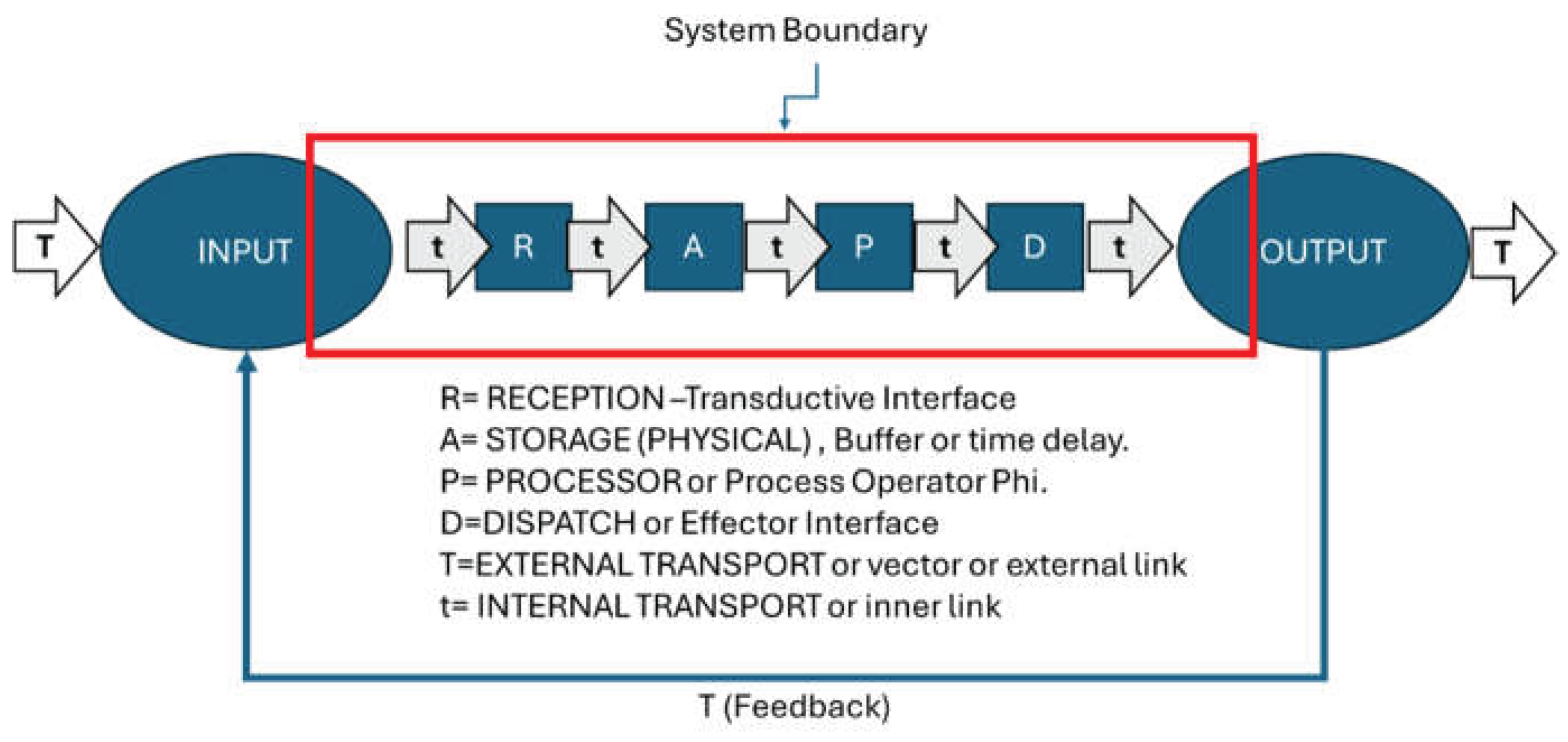
Under these considerations, the activities that define the input-output boundaries are the head and tail of the sequence, initiated and terminated by “t,” which are responsible for receiving from or delivering to the environment. Acting as coupling mechanisms, they handle what the external transport brings into the system or takes from it. Reception (R) is the activity that validates the inflow. Under these parameters, the system boundaries and system structure can be represented as shown in Figure 3. (See Figure 3).
Figure 3 illustrates the definitive transition from the opacity of the black box to the operational transparency of the RAPDtT model, which, under this configuration, aligns RAPD with the transfer function Φ and establishes the equivalence of the operational Homomorphism in terms of a white box.
Under the proposed considerations, RAPD is a real descriptor of Φ because it encompasses the four structural dimensions required, under the defined assumptions, for any flow: Identity, Time, Change, and Boundary—non-negotiable foundations according to Bunge [4]. If any dimension is missing, the transformation description remains incomplete (resulting in a Gray or Black Box). Adding extra dimensions introduces technical redundancy, violating minimality.
This reinforces the equivalence consideration, acknowledging that the RAPDtT structure also satisfies the formal conditions of a dynamic system defined by Ashby [2]: a set of invariant functional stages, a transition rule, and external coupling, as logical propositions of necessary dependency for a system to formally exist as a "White Box," i.e., with explicit and distinguishable internal structure.
Under this formal correspondence, the coupling interface is proposed as {t, T}, the set of invariant functional stages as {R, A, P, D}, and the transition criterion as {t}, reaffirming equivalence in white box terms.
The resulting system satisfies the external considerations of the black box while simultaneously allowing recognition of a standard internal operational form that exhibits recursivity, in accordance with Bunge’s systemic principles. Each activity of RAPDtT can also be treated as a black box and opened using the same logic, providing a new demonstration of the model’s recursive, fractal property—originally enabling the intuitive scaling from a micro-task to a logistic chain and extrapolating to an entire value network.
Equivalence (3) establishes that the transfer function Φ is not an abstraction but a composite architecture. By recognizing that the RAPD core, linked by internal transport (t) and coupled to the environment via external transport (T), sufficiently describes the internal functioning under the defined structural requirements, the RAPDtT model consolidates as the key to opening the black box, formally transforming it into an auditable, recursive, and universal operational equivalence of the White Box.
3.4. RAPDtT and the Minimality Criterion
Having established the proposed operational equivalence between Black Box and White Box systems through the RAPDtT equivalence, there remains a canonical need to determine whether RAPDtT satisfies the minimality principle as a descriptor of Φ in a non-redundant and sufficient manner. To address this, the considerations of the principle of parsimony, or Ockham’s Razor, are applied.
Proof of Minimality (Ockham’s Razor)
To apply the considerations of Ockham’s Razor, also recognized as the principle of parsimony or the principle of economy, each component must be evaluated under the criterion of ontological necessity.
If an ontological function or state can be removed without causing the system to collapse, then it is superfluous. If its absence disrupts the flow logic, it is a necessary entity. This requires examining the RAPDtT architecture function by function to determine whether the architecture T · t · R · t · A · t · P · t · D · t · T constitutes the formal minimum of the sufficient set of ontological invariant functional stages —under specified conditions—for describing the Black Box. Such an assessment not only confirms operational Homomorphism but also establishes RAPDtT as a minimally sufficient entity for describing a flow object, and, in the case of interest, the function Φ.
Interface Vectors (T and t)
Ockham’s principle demands simplicity, which implies avoiding the multiplication of redundant elements. Therefore, it is necessary to examine each vector individually in terms of its necessity within the sequence:
T (External Transport): Represents the Environment (E). If T is removed, the system becomes isolated. There is no exchange of energy or matter. Without T, the system is no longer an open system but an inert object. This indicates that T is a necessary interface vector.
t (Internal Transport): Represents the Structure (S) and the transit time. If t is removed, the set of ontological invariant functional stages (R, A, P, D) and their connections to T collapse onto one another. The flow element cannot exist in two sets of ontological invariant functional stages without a transition vector. Without t, the flow would effectively be teleported. Therefore, t is an irreducible coupling vector.
On the functional stages (R, A, P, D):
Review of Each State under the Principle of Parsimony
To evaluate each state according to the principle of parsimony, the negation is applied sequentially to each element (if not state, then…), analyzing one by one to determine whether its absence could be compensated by another:
If R is removed → Loss of Identity: The system, no longer recognizes input; traceability of origin collapses. This is the point of no return where the flow enters the legal domain of the system. Under this consideration, R is an irreducible ontological state.
If A is removed → Collapse due to Asynchrony: The system requires infinite synchronization; under any environmental variation (noise), the flow is interrupted due to the lack of a buffer. The concept of latency is essential to achieve homeostasis. Even if average latency = 0, it must exist. Its removal is not permissible under non-ideal flow and non-zero external perturbations.
If P is removed → System Uselessness: The system becomes a simple conduit: what enters leaves unchanged; the system ceases to create value and becomes a movement cost. Without P, the system loses its raison d’être.
If D is removed → Blockage due to Saturation: The flow enters but never exits; the system blocks internally, unable to deliver results to the environment. Destination traceability is lost, as the object remains “trapped” indefinitely within the system boundary. D is therefore an irreducible closure state.
Under these considerations, RAPDtT is parsimonious because it is strictly sufficient. It represents the exact point at which the model contains the fewest elements possible without losing the capacity to describe reality. Adding or omitting functional stages would create redundancy or disconnection. The combination of functional stages R, A, P, D and vectors T and t constitute the necessary and sufficient set that renders RAPDtT minimal—not merely as a simple structure, but as an irreducible one: the removal of any single element destroys the architecture’s ability to describe reality in an auditable and recursive manner.
This also endows RAPDtT with the ability to describe the system according to systemic principles, organizing flows according to Emergentist Materialism [4] (flows are organized into physical functional stages whose interactions produce emergent system properties). The function Φ emerges as a property of the RAPD architecture, representing how components are connected within the black box. Furthermore, the model satisfies observer independence, since RAPDtT as a coherent “white box” ontology aligns with Bunge’s scientific realism, which asserts that systems exist and have real structures regardless of observation.
3.5. Foundational Axioms
Systemic Existence: An open transforming system exists when it organizes flows that cross a boundary defined by external vectors .
Neutrality and Emergence: The architecture is independent of the nature of the flow (material, informational, energetic, decisional, or symbolic). The system function emerges from the organization of the flow, not from the entity of the object.
Constructive Recursivity: The architecture is recursive; each enabling function (R, A, P, D) can itself be structured as a RAPDtT system, preserving the non-commutative sequence at any level of granularity.
The Ontological Triad <C, E, S>
Composition (C): Enabling Functions
The system is constituted by four functions representing ontological functional stages with structurally distinguishable roles under observational discretization of the flow:
Reception (R): Formalizes entry into the system domain.
Storage (A): Preserves the value and integrity of the flow during latency.
Processing (P): Executes the transformation of the properties or value of the flow.
Dispatch (D): Formalizes the output and transcendence of the flow toward the environment.
Environment (E): External Vectors (T)
Coupling with the supersystem occurs exclusively through external transport vectors (T), which act as boundary transfer interfaces (input/output).
Structure (S): Internal Vectors (t) and Sequence
The system function is an emergent property arising from the articulation of the composition via internal transport vectors (t), which ensures the continuity of flow between functions. The structure is defined by the non-commutative sequence:
Structural Constraint:
Omitting or altering the order of any component (R, A, P, D, t, T) invalidates the representation under the structural requirements defined in this work.
Epistemological Note: This first-order architecture assumes ontological independence of the system with respect to the observer, without denying epistemological mediation in its description. By identifying the internal structure of the function , the model provides an explicit architecture that allows reinterpretation of the black box as a formalizable operational structure when the defined conditions are met, through a white-box formalization compatible with second-order cybernetics without prescribing internal control mechanisms.
4. Conclusions
The analysis demonstrates that the RAPDtT model proposes an explicit formalization of the underlying operational structure of systems that, within the cybernetic tradition of Norbert Wiener and W. Ross Ashby, could be treated as black boxes. The operational correspondence between the transfer function Φ and the sequence t−R−t−A−t−P−t−D−t establishes that a system’s transformation can be represented through a standard operational structure when conditions of defined boundaries, traceable flow, and controllability are met. Under these assumptions, the black box ceases to be an opaque mechanism and can be formalized as a white-box architecture whose internal operation is documentable, replicable, and auditable.
The validity of RAPDtT is not based on abstract mathematical identity but on its empirical development, coherence with first-order cybernetics, and its ability to explain, via operational homomorphism, the internal dynamics of real logistical and technical systems. This integration of empiricism and formalization allows the model to function simultaneously as a descriptor, explanatory framework, and reconstructive tool.
Historical analysis further confirms its capacity for retroactive explanation: it can be applied to interpret technologies and processes predating its formulation and make explicit the structure of their transformations. Consistent with Mario Bunge’s systemic realism, this structural stability suggests ontological robustness, demonstrating that the architecture preserves coherence across scale and context.
The model’s applicability presupposes: (i) the availability of an observational protocol (recording inputs and outputs), (ii) the existence of a traceable flow of matter, energy, or information, and (iii) conditions for implementing negative feedback. In non-observable systems or those lacking controllable coupling, the model may require extensions or be limited to partially formalizable components.
Regarding exclusivity, RAPDtT is not asserted to be the only possible homomorphism for formalizing the black box; rather, it constitutes, under the defined structural requirements, a minimal sufficient operational core. The current absence of an alternative architecture of lower cardinality that preserves identity, time, change, and boundary provisionally supports its parsimony, without precluding the possibility of formal counterexamples.
Overall, RAPDtT can be characterized as an open and recursive operational architecture for transforming systems with bounded flow. Its potential to describe, analyze, and reconstruct complex systems positions it as an integrative tool in systems engineering and control theory, while maintaining validity conditioned on the structural assumptions established herein.
In summary, the RAPDtT model is postulated not as an exhaustive resolution, but as a proposed approach to the operational syntax of complex systems. Under this premise, the structure serves as a framework that allows for the explicitness of the object's identity and its governed transformation, without compromising traceability. This perspective invites future research to explore RAPDtT as a scenario of structural transparency, where systemic management is consolidated as a logical derivation of its own ontological configuration.
References
- Wiener, Cybernetics: or, control and communication in the animal and the machine, segunda edición. Original 1948 ed., Cambridge: The MIT Press., 2019.
- W. R. Ashby, An Introduction to Cybernetics, Londres: Chapman&Hall, 1957.
- D. A. Mindell, «Opening Black's Box: Rethinking Feedback's Myth of Origin.,» Technology and Culture., vol. 41, nº 3, pp. pp. 405-434, 2000.
- M. Bunge, Tratado de Filosofía Volumen 4 ONTOLOGÍA II: UN MUNDO DE SISTEMAS, Primera ed., vol. 4, Barcelona: Editorial Gedisa S. A., 2012, p. 402.
- J. C. González Silva y O. A. Vásquez Bernal, «Evolución de método a modelo del tratamiento del flujo logístico RAPDtT.,» Publicaciones e Investigación, vol. 18, nº 3, pp. 1-6, 2024.
- J. C. González Silva, «El modelo referencial logístico RAPDtT y la Cibernética de Primer Orden,» Publicaciones e Investigación, pp. 1-15, 2025.
- J. C. Gonzalez Silva y O. A. Vásquez Bernal, «Método referencial de operaciones básicas para el manejo del flujo logístico en pequeñas empresas latinoamericanas. El RAPDtT, Documentos De Trabajo ECBTI, pp. 1-15, 2022.
- J. Gonzalez Silva y O. Vasquez Bernal, «Capitulo 2: INNOVACIÓN FRUGAL EN SUPPLY CHAIN MANAGEMENT: AMPLIANDO LAS FRONTERAS OPERATIVAS DE LA LOGÍSTICA EN MANUFACTURA,» de Teoría y praxis del emprendimiento, Toluca, Editorial de la Universidad Autónoma del Estado de México, 2025, p. 305.
- L. E. Camacho Albadan y J. A. Valderrama Higuera, Compilación de Normas Medioambientales que Regulan la Logística Verde en las Empresas Productoras de Bioetanol Colombianas, 2023.
- E. Vargas Abarzúa, «El "realismo científico" a la luz de Xavier Zubiri,» Ideas y Valores, vol. 67, nº 167, pp. 177-198, 2018.
- A. Vanegas Carvajal, «Guillermo de Ockham,» Revista Científica Guillermo de Ockham, Vols. %1 de %27, , nº 1, pp. 165-179, 2009.
- J. J. McFadden, «Afilada como una navaja: el papel de la navaja de Occam en la ciencia,» Anales de la Academia de Ciencias de Nueva York, vol. 1530, nº 1, pp. 8-17, 12 2023.
- D. J. Bowersox y D. J. &. C. B. Closs, Administración y logística en la cadena de suministros, (Segunda ed. ed., Mexico D.F: McGRAW-HILL/INTERAMERICANA EDITORES, S.A., 2007.
- L. von Bertalanffy, Teoría General de sistemas, Mexico D.F.: Fondo de Cultura Económica, 1989.
Figure 1.
A black box within a system recognizes the inputs, outputs, the inflow and outflow vectors, the system boundaries, and, under the box’s own conditions, the transfer function that relates the input and output through its internal processing, which is represented by the function Φ.
Figure 1.
A black box within a system recognizes the inputs, outputs, the inflow and outflow vectors, the system boundaries, and, under the box’s own conditions, the transfer function that relates the input and output through its internal processing, which is represented by the function Φ.
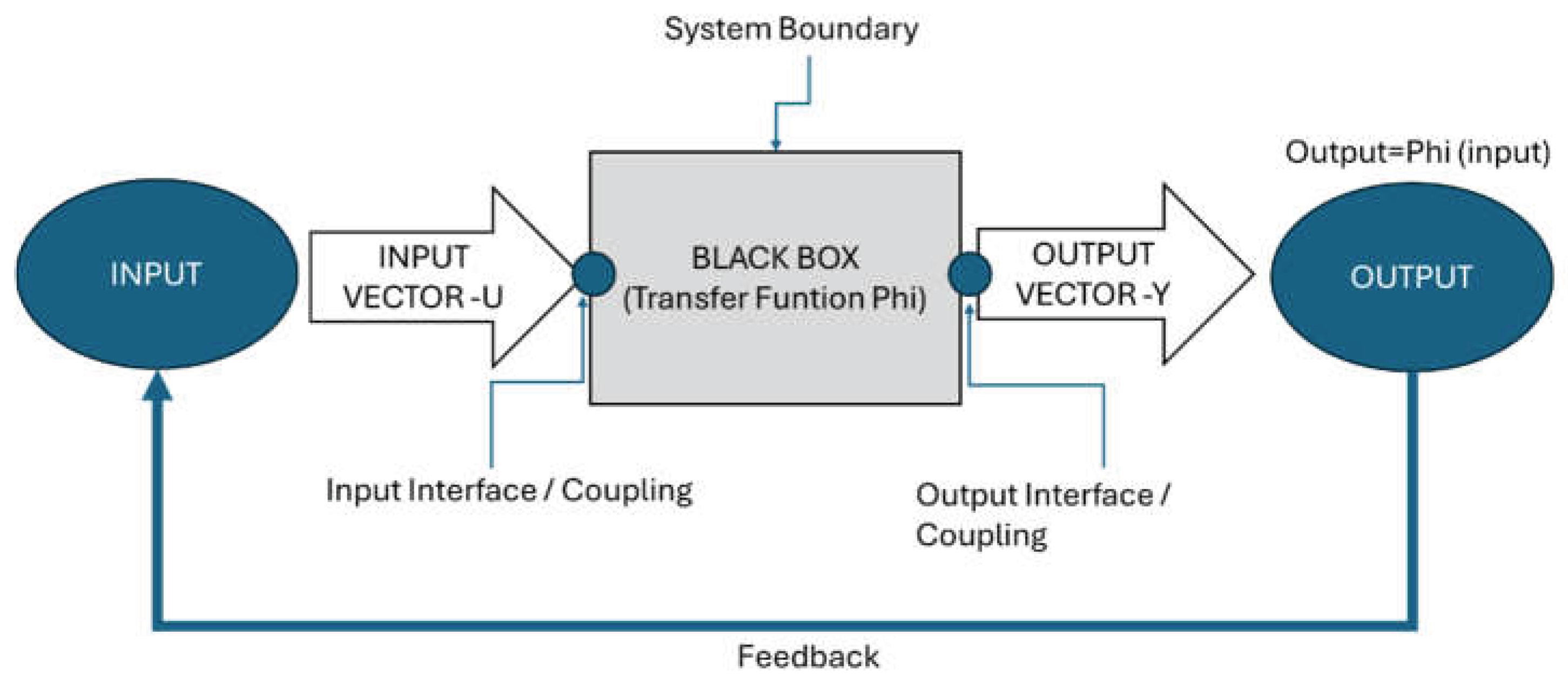
Figure 2.
Simplified diagram based on González Silva’s RAPDtT model and the negative feedback embedded in its operations [5], including the input and output elements.
Figure 2.
Simplified diagram based on González Silva’s RAPDtT model and the negative feedback embedded in its operations [5], including the input and output elements.
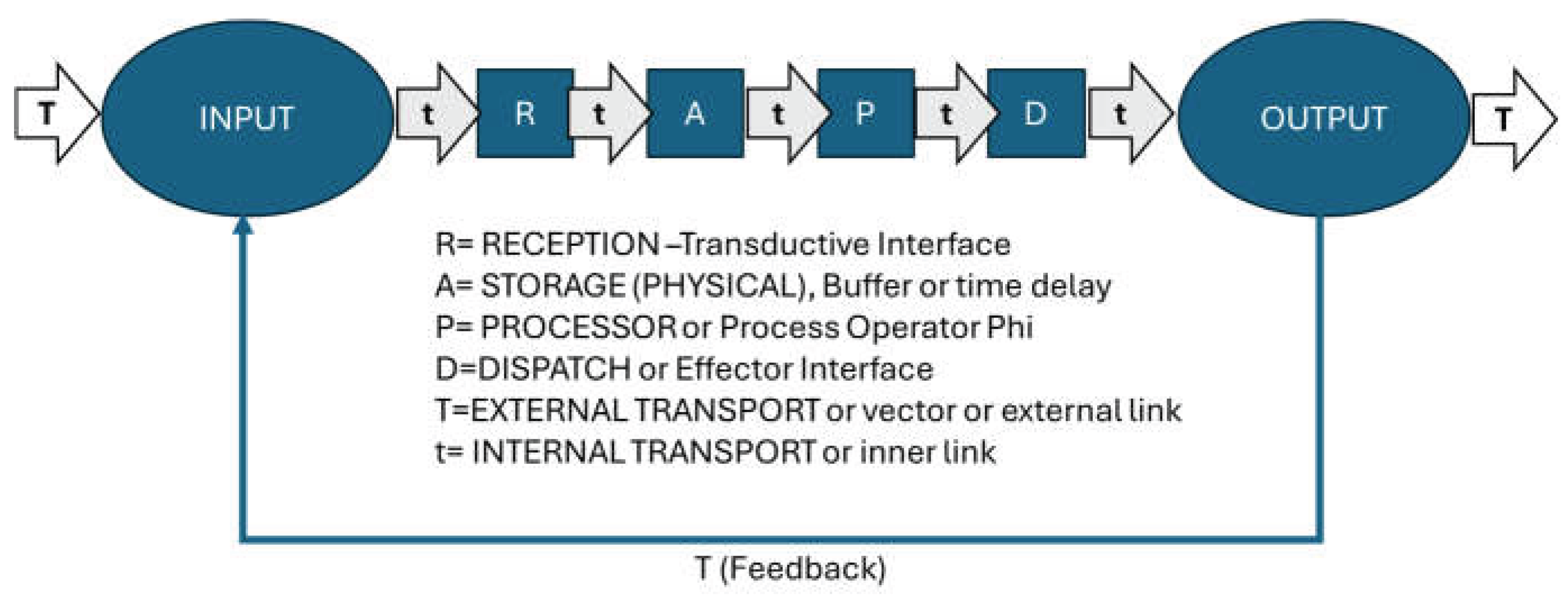
Figure 3.
Figure 2 receives the boundary delimitation of the black box. The RAPD operations, connected through internal transport as a coupling mechanism, represent Φ as an operational Homomorphism of the operations within the system.
Figure 3.
Figure 2 receives the boundary delimitation of the black box. The RAPD operations, connected through internal transport as a coupling mechanism, represent Φ as an operational Homomorphism of the operations within the system.
Disclaimer/Publisher’s Note: The statements, opinions and data contained in all publications are solely those of the individual author(s) and contributor(s) and not of MDPI and/or the editor(s). MDPI and/or the editor(s) disclaim responsibility for any injury to people or property resulting from any ideas, methods, instructions or products referred to in the content. |
© 2026 by the authors. Licensee MDPI, Basel, Switzerland. This article is an open access article distributed under the terms and conditions of the Creative Commons Attribution (CC BY) license (http://creativecommons.org/licenses/by/4.0/).
Copyright: This open access article is published under a Creative Commons CC BY 4.0 license, which permit the free download, distribution, and reuse, provided that the author and preprint are cited in any reuse.


