

Submitted:
24 June 2026
Posted:
25 June 2026
You are already at the latest version
Abstract
The target (1E,4E)-1,5-bis(2,4-dichlorophenyl)penta-1,4-dien-3-one oxime 4 was prepared in good yield, as a key aza-precursor for the Nazarov cyclization, through a two-steps sequence. Initially, the starting divinyl ketone 1a was obtained from a Claisen-Schmidt condensation reaction between 2,4-dichlorobenzaldehyde 3 and acetone in the presence of aqueous 20% NaOH. Subsequently, treatment of 1a with hydroxylamine hydrochloride under thermal conditions afforded the expected oxime in excellent yield whose structure was confirmed by analytic and spectroscopic techniques.
Keywords:
divinyl ketones
; Claisen-Schmidt condensation
; Nazarov cyclization
; electrocyclic reaction
; 2-cyclopenten-1-ones
; oximes
1. Introduction
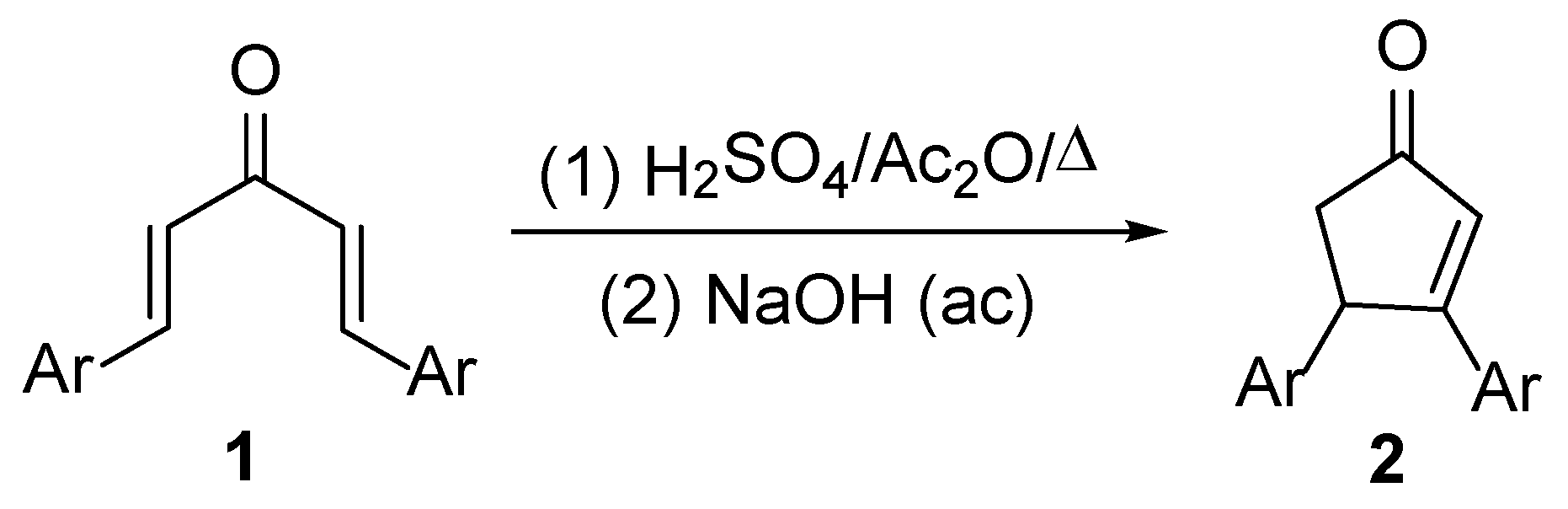
The Nazarov cyclization (NC), is a classical reaction reported firstly by Ivan Nikolaevich Nazarov in the 1940s [1]. This is a thermally-permitted 4π [2 + 2] electrocyclic type reaction that converts divinyl ketones 1 into 2-cyclopenten-1-ones (CPs) 2 by means of a conrotatory ring closure, catalyzed by acids, as shown in Scheme 1 [2].
This reaction has a stereospecific character, for which, disrotatory closure is not allowed within this pathway. Since its discovery, various modifications of the NC have been developed, using different acid catalysts and exploring precursors structurally different than those originally proposed divinyl ketones 1 [3,4]. These variations have demonstrated the versatility of the NC, consolidating it as an efficient strategy for the synthesis of functionalized CPs, compounds of notable interest in pharmaceutical chemistry due to their presence in different synthetic and naturally occurring molecules with recognized biological activity [5].
Thus, the 2-cyclopenten-1-one ring is a fundamental building block in organic synthesis due to its structural and chemical versatility. Its biological relevance is evidenced by its presence in various synthetic and naturally occurring compounds with recognized pharmaceutical activity, such as litseaverticillol A, (-)-nigrosporiones C and D, (-)-kjellmanianone, untenone A and pentenomicine, as shown in Scheme 3 [6]. Particularly, nigrosporiones C and D have been shown to possess potent antifungal properties and were isolated from an endophytic fungus from the insect Oxya chinensis Thunberg [7].
Figure 1.
Several naturally occurring compounds of biological interest containing the 2-cyclopenten-1-one ring in their structures.
Figure 1.
Several naturally occurring compounds of biological interest containing the 2-cyclopenten-1-one ring in their structures.
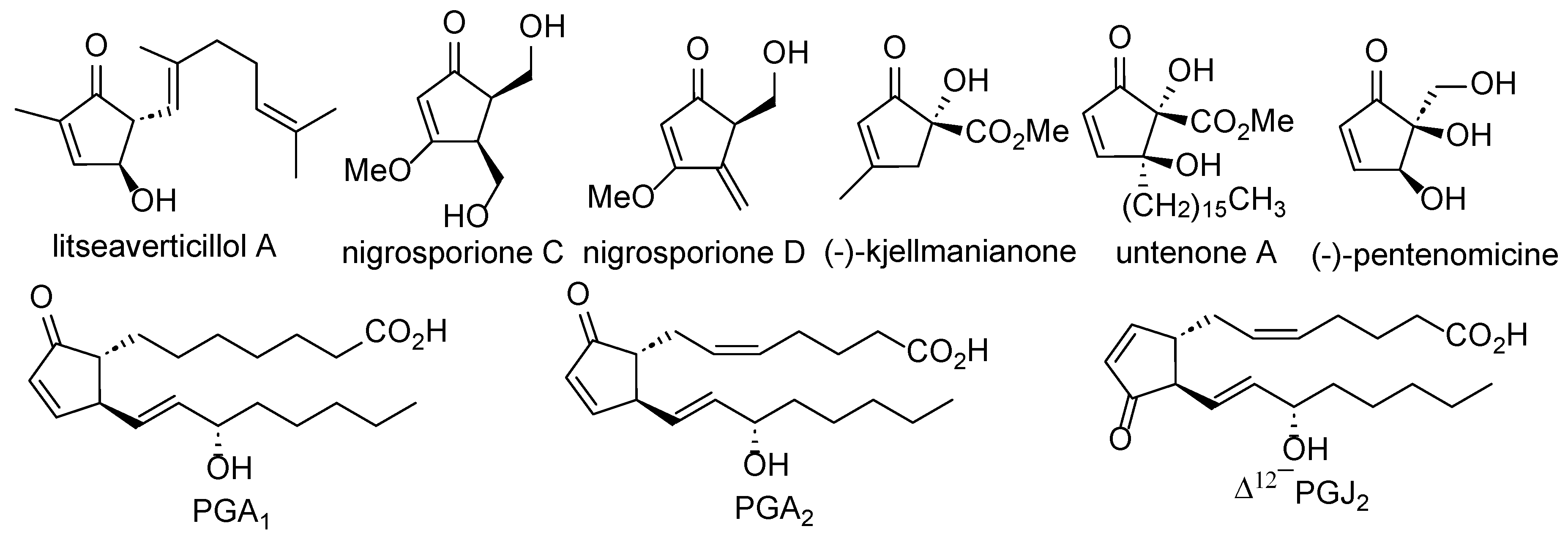
Likewise, 2-cyclopenten-1-one ring is also present in prostaglandins, among them, the cyclopentenone prostaglandins (cyPG’s) like PGA1, PGA2 and Δ12PGJ2 series (Scheme 3). These structures are potent bioactive molecules and have a wide range of pharmaco-biological functions [8,9].
On the other hand, the α,β-unsaturated diaryl ketones (chalcones) have shown a wide spectrum of biological activities [10,11], but also have been used a key building blocks for constructing diverse more elaborated acyclic and cyclic organic compounds of practical interest [12,13]. Based on our vast expertise in the synthetic and practical utility of chalcone derivatives [14,15,16], the new divinyl ketone oxime 4, corresponding to an interesting aza-analog of divinyl ketones 1, was envisaged as a key precursor to further evaluate its suitability for conversion into the aza-2-cyclopenten-1-one derivative 5 through Nazarov cyclization conditions.
2. Results and Discussion
The target compound (1E,4E)-1,5-bis(2,4-dichlorophenyl)penta-1,4-dien-3-one oxime (4) was synthesized in a two-steps reaction sequence (Scheme 2).
Initially, the precursor (1E,4E)-1,5-bis(2,4-dichlorophenyl)penta-1,4-dien-3-one (1a) was obtained in excellent yield from a 2.2:1 ratio of 2,4-dichlorobenzaldehyde 3 and acetone via a Claisen-Schmidt condensation reaction [17], as shown in Scheme 2. Reaction proceeded in methanol at room temperature and catalyzed by aqueous 20% NaOH. After simple work-up procedure and recrystallization in aqueous ethanol, the divinyl ketone precursor (1a) was obtained in 92% yield. Analytical and spectroscopic techniques confirmed its formation. Particularly, the C=O absorption band at 1653 cm-1 in the IR spectrum (Supplementary Figure S1), five different signals (integrating for ten protons, including two doublets for the two equivalent protons of the α,β-unsaturated system with Jtrans = 16.0 Hz) in the 1H NMR (Supplementary Figure S2), nine different carbon signals (including the C=O group at 188.4 ppm) in the 13C NMR, agree with the symmetry and structure proposed for precursor 1a (Supplementary Figure S3). Additionally, and based on the presence of four chlorine atoms, a complex profile of five even molecular ion peaks in the range of m/z 378–370 agrees the isotopic chlorine rule [18,19] (Supplementary Figure S4), confirming the obtained structure for 1a.
The following step consisted in the condensation of precursor 1a with hydroxylamine hydrochloride to afford the target product 4. Thus, precursor 1a was treated with NH2OH∙HCl (2.0 equiv.) in the presence of AcOH at 70 oC. Upon consumption of the starting materials by four days of heating (monitored by TLC), and after a work-up procedure and purification by column chromatography using DCM as the eluent, the target product 4 was obtained in 87% yield. The structure of 4 was verified by IR, NMR, MS, and microanalysis data.
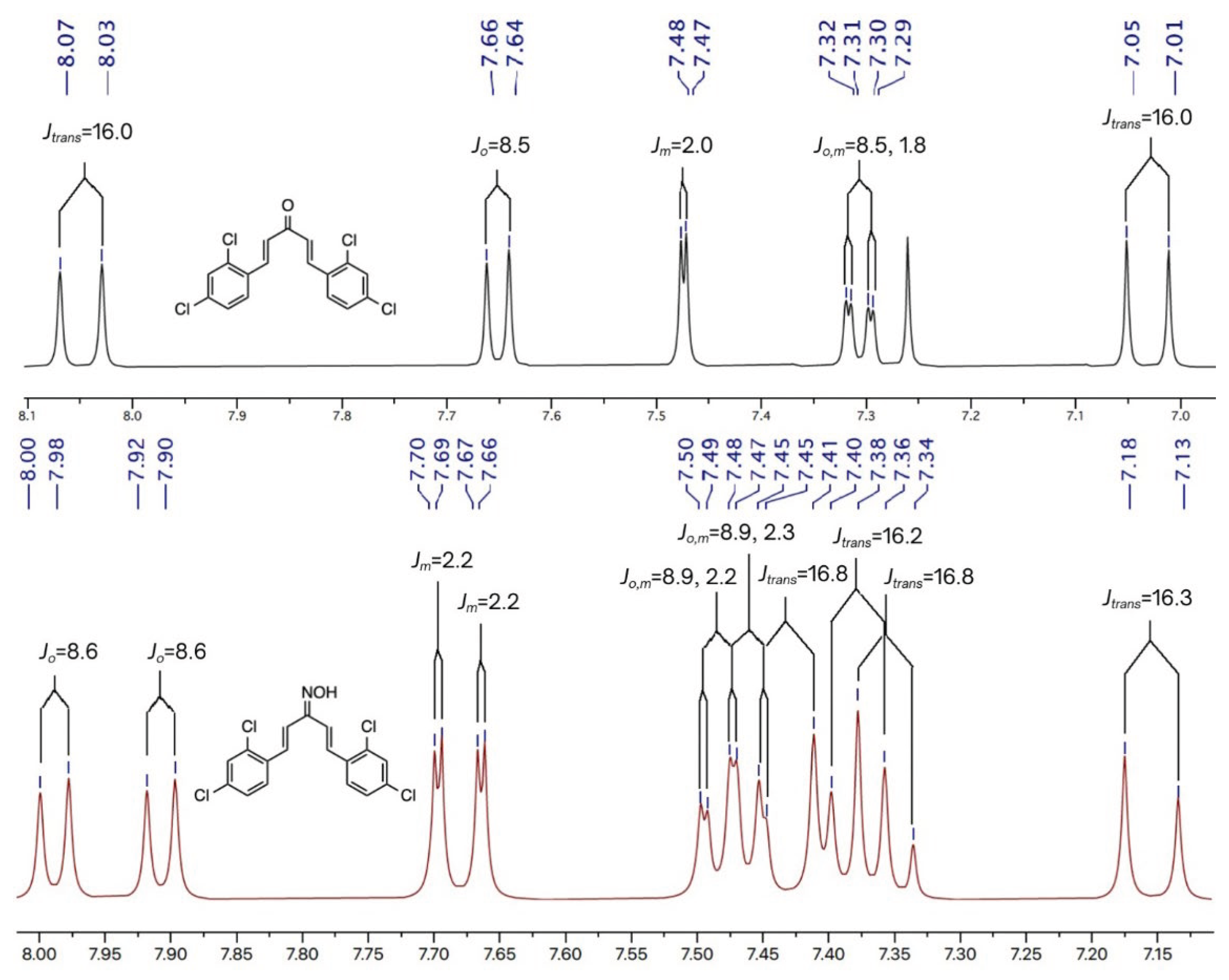
Infrared spectrum showed a weak and broad stretching band at 3271 cm-1, a medium stretching band at 1732 cm-1 and a strong stretching band at 964 cm-1 (Supplementary Figure S5). This finding corresponds the characteristic bands of the =NO-H, C=N- and N-O functionalities, respectively, of the oxime group [20]. The 1H NMR spectrum showed a complex profile in the aromatic region in the range of 7–8 ppm (integrating for 10H), suggesting a complete asymmetry of the structure contrary to that observed in the 1H NMR spectrum of its precursor 1a. The existence of a thin singlet at 12.00 ppm (integrating for 1H) assigned to =NO-H proton indicates formation of the expected oxime functionality. Four doublets at ~7.43 (d, J = ~16.8 Hz, 1H), ~7.38 (d, J = ~16.2 Hz, 1H), ~7.35 (d, J = ~16.8 Hz, 1H) and 7.15 (d, J = 16.3 Hz, 1H) ppm, corresponding to the α,β-vinylic protons of the aliphatic C=C bonds, confirm the loss of symmetry of 1a after the formation of the oxime functionality in 4, passing from two to four α,β-vinylic protons with trans configuration, among other confirming protonic signals (Supplementary Figure S6), Figure 2.
The presence of the C=N signal at 152.4 ppm of the oxime functionality added to sixteen sp2-carbon atom signals in the range of 120.9–134.3 ppm are the most relevant features in the 13C NMR spectrum of 4 (Supplementary Figure S7). Additionally, a complex profile of five odd molecular ion peaks with m/z 393/391/389/387/385 (accomplishing the Cl- and N-rules) [21,22], and four base peaks with m/z 356/354/352/350 (M – Cl) in the mass spectrum (Supplementary Figure S8), also agrees with the proposed structure for oxime 4.
3. Materials and Methods
3.1. General Information
All reagents and solvents are commercially available (Merck, Kenilworth, NJ, USA) and were used without further purification. The progress of the reaction was monitored by TLC with 0.2 μm precoated plates of silica gel 60GF254 (Merck, Kenilworth, NJ, USA). Melting points were determined on a Stuart SMP3 melting point apparatus (Cole-Parmer, Staffordshire, UK) and are uncorrected. IR spectra were recorded on a Shimadzu IRAffinity−1 (Shimadzu, Kyoto, Japan) with ATR probe. 1H and 13C NMR spectra were recorded on a Bruker Avance II spectrophotometer (Bruker, Bruker BioSpin GmbH, Rheinstetten, Germany) operating at 400 MHz and 100 MHz, respectively, and using CDCl3 and DMSO-d6 as solvents and TMS as internal standard. Chemical shifts (δ) are given in ppm and coupling constants (J) are given in Hz. The following abbreviations are used for multiplicities: s = singlet, d = doublet, t = triplet, and m = multiplet. Mass spectra were run on a SHIMADZU GCMS-QP2010 spectrometer (Shimadzu, Kyoto, Japan) operating at 70 eV (equipped with a direct inlet probe) operating at 70 eV. Microanalyses were performed on an Agilent CHNS elemental analyzer (Thermo Fischer Scientific Inc., Madison, WI, USA) and the values are within ± 0.4% of the theoretical values.
3.2. Synthesis of (1E,4E)-1,5-bis(2,4-dichlorophenyl)penta-1,4-dien-3-one (1a)
A mixture of 2,4-dichlorobenzaldehyde 3 (2.65 g, 2.2 equiv.), acetone (0.5 mL, 1.0 equiv.), aqueous 20% NaOH (0.2 mL) and methanol (4 mL) was subjected to stirring at room temperature for 2 h. The solid formed was filtered and washed with cold methanol. Recrystallization from 96% ethanol afforded 3 (2.36g, 92% yield, yellow solid, m.p. 165‒166 oC; 166‒167 oC [23]). FTIR (ATR): ν = 1653 (C=O), 1584, 1470 cm-1. 1H NMR (400 MHz, CDCl3) δ: 8.05 (d, Jtrans = 16.0, 2H), 7.65 (d, Jortho = 8.5 Hz, 2H), 7.47 (d, Jmeta = 2.0 Hz, 2H), 7.31 (dd, Jortho = 8.5 Hz, Jmeta = 1.8 Hz, 2H), 7.03 (d, Jtrans = 16.0, 2H) ppm. 13C NMR (100 MHz, CDCl3) δ: 188.4 (C=O), 138.5, 136.8 (Cq), 136.2 (Cq), 131.7 (Cq), 130.3, 128.6, 127.9, 127.8 ppm. MS (EI, 70 eV) m/z (%): 378/376/374/372/370 (0.2/1/5/11/9) [M+], 341/339/337/335 (4/30/95/100) [M ‒ Cl].
3.3. Synthesis of (1E,4E)-1,5-bis(2,4-dichlorophenyl)penta-1,4-dien-3-one oxime (4)
A mixture of (1E,4E)-1,5-bis(2,4-dichlorophenyl)penta-1,4-dien-3-one 1a (0.2 g, 1.0 equiv.), hydroxylamine hydrochloride (0.75 g, 2.0 equiv.), and AcOH (5 mL) was subjected to heating at 70 °C for 4 days. The resulting crude was neutralized with solid NaHCO3 until pH = 9, filtering under vacuum the solid formed and washing with cold acetic acid. The solid was subsequently purified by column chromatography using DCM as the eluent to afford the target product 4 (0.18g, 87% yield, beige solid, m.p. 162‒163 oC). FTIR (ATR): ν = 3271 (O-H), 3152, 1732 (C=N), 1467, 978, 964 cm-1. 1H NMR (400 MHz, DMSO-d6) δ: 12.00 (s, 1H, OH), 7.99 (d, J = 8.6 Hz, 1H), 7.91 (d, J = 8.6 Hz, 1H), 7.70 (d, J = 2.2 Hz, 1H), 7.66 (d, J = 2.2 Hz, 1H), 7.51 – 7.44 (m, 2H), 7.43 – 7.32 (m, 3H), 7.15 (d, J = 16.3 Hz, 1H). 13C NMR (100 MHz, DMSO-d6) δ: 152.4 (C=N), 134.4 (Cq), 134.1 (Cq), 133.8 (Cq), 133.7 (Cq), 133.5 (Cq), 133.4 (Cq), 130.5, 129.7, 129.6, 129.1, 128.9, 128.4, 128.3, 127.1 (x 2C), 120.9 ppm. Anal. calcd. for C17H11Cl4NO (387,08): C, 52.75; H, 2.86; N, 3.62. Found: C, 52.86; H, 3.01; N, 3.49. MS (EI, 70 eV) m/z (%): 393/391/389/387/385 (0.6/6/28/59/43) [M+], 356/354/352/350 (8/61/100/99) [M ‒ Cl].
Supplementary Materials
The following supporting information can be downloaded at the website of this paper posted on Preprints.org. Figure S1: FT-IR spectrum of divinyl ketone precursor 1a; Figure S2: 1H NMR spectrum of divinyl ketone precursor 1a; Figure S3: 13C NMR spectrum and DEPT-135 experiment of divinyl ketone precursor 1a; Figure S4: MS spectrum of divinyl ketone precursor 1a; Figure S5: FT-IR spectrum of oxime product 4; Figure S6: 1H NMR spectrum of oxime product 4; Figure S7: 13C NMR spectrum and DEPT-135 experiment of oxime product 4; Figure S8: MS spectrum of oxime product 4.
Author Contributions
Conceptualization, R.A.; Methodology, R.A., J.-P.M. and A.-F.S.; Formal Analysis, R.A., J.-P.M. and A.-F.S.; Investigation, J.-P.M. and A.-F.S.; Writing – Original Draft Preparation, R.A., J.-P.M. and A.-F.S.; Writing – Review & Editing, R.A. All authors have read and agreed the final version of the manuscript.
Funding
The Manpower, some reagents and some technical costs were funded by Universidad del Valle (project CI. 71403) and CIBiOFi.
Data Availability Statement
The data presented in this study are available on request from the corresponding author.
Conflicts of Interest
The authors declare no conflicts of interest.
References
- Vinogradov, M.G.; Turova, O.V.; Zlotin, S.G. Nazarov reaction: current trends and recent advances in the synthesis of natural compounds and their analogs. Org. Biomol. Chem. 2017, 15, 8245–8269. [Google Scholar] [CrossRef] [PubMed]
- Zhang, L.; Wang, S. Efficient synthesis of cyclopentenones from enynyl acetates via tandem Au(I)-catalyzed 3,3-rearrangement and the Nazarov reaction. J. Am. Chem. Soc. 2006, 128, 1442–1443. [Google Scholar] [CrossRef] [PubMed]
- Pellissier, H. Recent developments in the Nazarov process. Tetrahedron 2005, 61, 6479–6517. [Google Scholar] [CrossRef]
- Frontier, A.J.; Collison, C. The Nazarov cyclization in organic synthesis. Recent advances. Tetrahedron 2005, 61, 7577–7606. [Google Scholar] [CrossRef]
- Gowala, T.N.; Chaudhari, P.; Pabba, J.; Sawant, K.; Pal, S.; Ghorai, S.K. Synthesis of 2,3,4-trisubstituted 2-cyclopentenones via sequential functionalization of 2-cyclopentenone. J. Org. Chem. 2021, 86, 10812–10818. [Google Scholar] [CrossRef] [PubMed]
- Yu, S.; Hong, C.; Liu, Z.; Zhang, Y. Synthesis of cyclopentenones through rhodium-catalyzed C–H annulation of acrylic acids with formaldehyde and malonates. Org. Lett. 2021, 23, 5054–5059. [Google Scholar] [CrossRef] [PubMed]
- Meng, F.-T.; Chen, J.-L.; Qin, X.-Y.; Zhang, T.-S.; Tu, S.-J.; Jiang, B.; Hao, W.-J. Gold self-relay catalysis for accessing functionalized cyclopentenones bearing an all-carbon quaternary stereocenter. Org. Chem. Front. 2022, 9, 140–146. [Google Scholar] [CrossRef]
- Wu, Z.; Xie, Z.; Wu, M.; Li, X.; Li, W.; Ding, W.; She, Z.; Li, C. New antimicrobial cyclopentenones from Nigrospora sphaerica ZMT05, a fungus derived from Oxya chinensis Thunber. J. Agric. Food Chem. 2018, 66, 5368–5372. [Google Scholar] [CrossRef] [PubMed]
- Mullally, J.E.; Moos, P.J.; Edes, K.; Fitzpatrick, F.A. Cyclopentenone prostaglandins of the J series inhibit the ubiquitin isopeptidase activity of the proteasome pathway. J. Biol. Chem. 2001, 276, 30366–30373. [Google Scholar] [CrossRef] [PubMed]
- Salehi, B.; Quispe, C.; Chamkhi, I.; El Omari, N.; Balahbib, A.; Sharifi-Rad, J.; Bouyahya, A.; Akram, M.; Iqbal, M.; Docea, A.O.; Caruntu, C.; Leyva-Gómez, G.; Dey, A.; Martorell, M.; Calina, D.; López, V.; Les, F. Pharmacological properties of chalcones: A review of preclinical including molecular mechanisms and clinical evidence. Front. Pharmacol. 2021, 18, 592654. [Google Scholar] [CrossRef] [PubMed]
- Tidke, A.D.; Adole, V.A.; Deshmukh, D.V.; Shinde, R.A.; Kapadnis, K.H. Exploring quinoline-linked chalcones as broad-spectrum antimicrobial agents: Synthesis, antibacterial, antifungal, molecular docking, pharmacokinetics, and DFT investigation. Bioorg. Chem. 2026, 169, 109389. [Google Scholar] [CrossRef] [PubMed]
- Mukhtar, S.S.; Mohamed, N.M.M.; Hassan, A.S.; Hafez, T.S. A review of chalcones: Synthesis, reactions, and biological importance. Egypt. J. Chem. 2022, 65, 379–395. [Google Scholar] [CrossRef]
- Shenvi, S.; Kumar, K.; Hatti, K.S.; Rijesh, K.; Diwakar, L.; Reddy, G.C. Synthesis, anticancer and antioxidant activities of 2,4,5-trimethoxy chalcones and analogues from asaronaldehyde: Structure activity relationship. Eur. J. Med. Chem. 2013, 62, 435–442. [Google Scholar] [CrossRef] [PubMed]
- Abonia, R.; Insuasty, D.; Castillo, J.; Insuasty, B.; Quiroga, J.; Nogueras, M.; Cobo, J. Synthesis of novel quinoline-2-one based chalcones of potential anti-tumor activity. Eur. J. Med. Chem. 2012, 57, 29–40. [Google Scholar] [CrossRef] [PubMed]
- Abonia, R.; Cuervo, P.; Insuasty, B.; Quiroga, J.; Nogueras, M.; Cobo, J.; Meier, H.; Lotero, E. An Amberlyst-15® mediated synthesis of new functionalized dioxoloquinolinone derivatives. Open Org. Chem. J. 2008, 2, 26–34. [Google Scholar] [CrossRef]
- Abonia, R.; Cuervo, P.; Insuasty, B.; Quiroga, J.; Nogueras, M.; Cobo, J. A simple two-step sequence for the synthesis of novel 4-aryl-4,5-dihydro-6H-[1,3]dioxolo [4,5-h]pyrrolo [1,2-a][1]benzazepin-6-ones from 6-amino-3,4-methylenedioxyacetophenone. Eur. J. Org. Chem. 2008, 4684–4689. [Google Scholar] [CrossRef]
- Yadav, G.D.; Wagh, D.P. Claisen-Schmidt condensation using green catalytic processes: A critical review. ChemistrySelect 2020, 5, 9059–9085. [Google Scholar] [CrossRef]
- Silverstein, R.M.; Webster, F.X.; Kiemle, D.J. spectrometric identification of organic compounds, 7th Edition ISBN: 0-471-39362-2; John Wiley and sons, Inc., 2005; Volume Chapter 1, pp. Pages 35–37. [Google Scholar]
- Gross, R.A., Jr. A mass spectral chlorine rule for use in structure determinations in sophomore organic chemistry. J. Chem. Educ. 2004, 81, 1161. [Google Scholar] [CrossRef]
- Norman, J.J. Oximes: II. The infrared spectra of some complex oximes. Can. J. Chem. 1962, 40, 2023–2029. [Google Scholar] [CrossRef]
- Silverstein, R.M.; Webster, F.X.; Kiemle, D.J. spectrometric identification of organic compounds, 7th Edition ISBN: 0-471-39362-2; John Wiley and sons, Inc., 2005; Volume Chapter 1, pp. Pages 31–33. [Google Scholar]
- Tsikas, D. Proposal and application of nitrogen rules in interpreting gas chromatography negative-ion chemical ionization mass spectrometry spectra. Anal. Biochem. 2025, 705, 115922. [Google Scholar] [CrossRef] [PubMed]
- Aher, R.; Wanare, G.; Kawathekar, N.; Kumar, R.; Kaushik, N.; Sahal, D.; Chauhan, V. Dibenzylideneacetone analogues as novel plasmodium falciparum inhibitors. Bioorg. Med. Chem. Lett. 2011, 21, 3034–3036. [Google Scholar] [CrossRef] [PubMed]
Scheme 1.
Original synthetic route of 2-cyclopenten-1-ones 2 via NC.
Scheme 2.
Synthetic sequence to obtain the target (1E,4E)-1,5-bis(2,4-dichlorophenyl)penta-1,4-dien-3-one oxime (4).
Scheme 2.
Synthetic sequence to obtain the target (1E,4E)-1,5-bis(2,4-dichlorophenyl)penta-1,4-dien-3-one oxime (4).
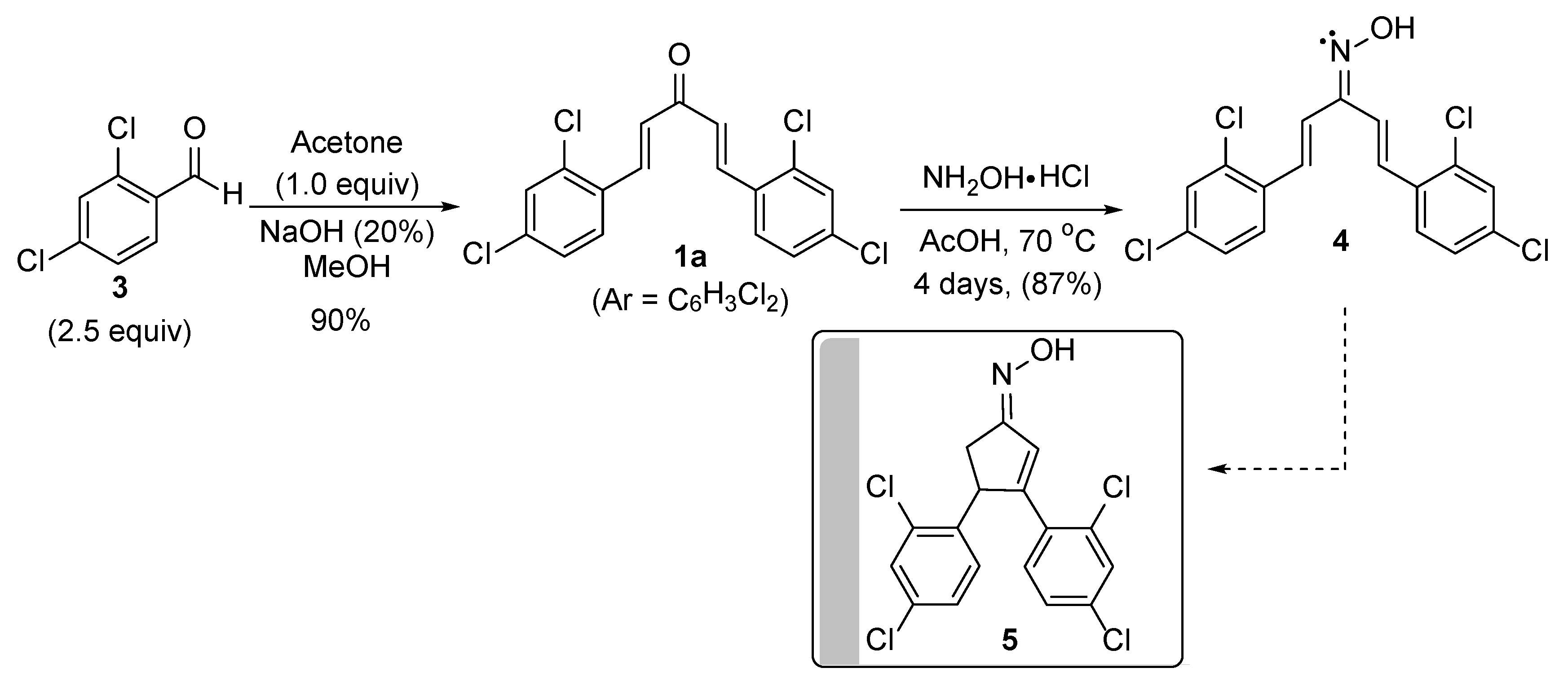
Figure 2.
1H NMR aromatic regions of ketone precursor 1a (up) and its corresponding oxime 4 (down) showing the loss of symmetry during the synthetic process.
Figure 2.
1H NMR aromatic regions of ketone precursor 1a (up) and its corresponding oxime 4 (down) showing the loss of symmetry during the synthetic process.
Disclaimer/Publisher’s Note: The statements, opinions and data contained in all publications are solely those of the individual author(s) and contributor(s) and not of MDPI and/or the editor(s). MDPI and/or the editor(s) disclaim responsibility for any injury to people or property resulting from any ideas, methods, instructions or products referred to in the content. |
© 2026 by the authors. Licensee MDPI, Basel, Switzerland. This article is an open access article distributed under the terms and conditions of the Creative Commons Attribution (CC BY) license (http://creativecommons.org/licenses/by/4.0/).
Copyright: This open access article is published under a Creative Commons CC BY 4.0 license, which permit the free download, distribution, and reuse, provided that the author and preprint are cited in any reuse.


