

Submitted:
24 June 2026
Posted:
25 June 2026
You are already at the latest version
Abstract
Monosodium glutamate (E621) is a common flavor enhancer in highly processed food. Although it makes food more enjoyable, chronic intake may lead to excitotoxicity in brain areas. The current study investigates histological and biochemical neurodegenerative alterations in the rat hippocampus following E621 administration and evaluates the potential neuroprotective properties of vitamin C (ascorbic acid) against E621-induced adverse effects. Forty adult male albino rats were divided into four groups: control (G1), vitamin C (G2), E621-treated (G3), and E621+vitamin C (G4). All rats received daily oral gavage for 30 days. Hippocampal samples were processed and stained with hematoxylin and eosin (H&E), immunostained for GFAP, synaptophysin (a synaptic protein), and caspase-3, and biochemically analyzed for oxidative markers: Malondialdehyde (MDA) and superoxide dismutase (SOD). G3 exhibited significant neurodegenerative changes, characterized by pyknotic granular cells, cytoplasmic vacuolation, with significantly elevated GFAP, synaptophysin, and caspase-3 immunoreactivity in the dentate gyrus (DG). These structural deficits correlated with elevated MDA levels and reduced SOD levels in G3. In contrast, simultaneous administration of vitamin C with E621 resulted in substantial preservation of neuronal morphology, reduction of caspase 3 immunoreactivity, and a restoration of synaptic vesicle density in G4. E621 induces hippocampal injury by increasing ROS levels and dysregulating GFAP, synaptophysin, and caspase-3. At the same time, vitamin C preserves neuronal integrity and synaptic homeostasis, suggesting its potential role as a protective dietary supplement against brain injury induced by the E621 flavor enhancer.
Keywords:
dentate gyrus
; monosodium glutamate
; neurotoxicity
; vitamin C
; oxidative stress
; antioxidant
1. Introduction
Highly processed foods with various additives intended to improve palatability and shelf life are increasingly prevalent in our diets. Among these, monosodium glutamate (MSG), identified by the European Food Code (E621), is one of the most widely consumed flavor enhancers globally [1].
Worldwide, E621 is an everyday ingredient in the diets of people across various socioeconomic groups, largely because it is present in affordable, popular products such as instant noodles, flavored snacks, and bouillon cubes, as well as soups, chips, frozen dinners, and seasoning blends [2]. E621 is a water-soluble, white, odorless, crystalline powder [3]. It is the sodium salt of the nonessential amino acid glutamic acid, with 78% glutamic acid, 22% sodium, and water [4]. E621 initially appeared in 1908, when Japanese chemist Kikunae Ikeda recognized glutamate as the key component to seaweed’s unique flavor and neutralized it with Na in order to improve its solubility property, which led to the production of E621 [5]. E621’s unique flavor is triggered by the activation of particular taste receptors on the lingual taste buds named umami receptors, which are in charge of relaying taste impulses to the brain’s taste nuclei, permitting this type of taste to be perceived [6]. E621 increases food palatability by enhancing the umami taste [7]. However, there is no recommended daily intake, and it is regarded as a safe food additive for human consumption. In 1987, the Joint FAO/WHO Expert Committee on Food Additives evaluated the safety of glutamate and its salt and assigned it an “acceptable daily intake (ADI) not specified” rating [5]. However, in 2017, the European Food Safety Authority (EFSA) reevaluated the safety of MSG and established an “acceptable daily intake” of 30 mg/kg BW [8].
The brain contains the highest concentration of glutamate, followed by plasma and extracellular fluid [9]. Glutamate is an excitatory neurotransmitter for the central nervous system [10]. New neurotoxicological research demonstrates that persistent consumption of E621 at excessive amounts for prolonged periods causes serious brain disturbances secondary to excitotoxicity. Excess dietary glutamate elevates extracellular glutamate levels in various brain regions, thereby overstimulating ionotropic receptors, including N-methyl-D-aspartate (NMDA) receptors. This overstimulation triggers a massive, abnormal influx of calcium ions into neurons, leading to subsequent neural degeneration [11]. Many reports indicate that E621 acts as an excitotoxin by generating free radicals that promote cell damage and activate pathways, including inflammatory responses and cell death, leading to a variety of detrimental health impacts [12].
Ascorbic acid (AA) or vitamin C is a water-soluble antioxidant found in a wide range of plants, including broccoli, citrus fruits, blackcurrants, and strawberries. Numerous studies have shown that AA exhibits antioxidant and anti-inflammatory impacts. AA has been shown to improve a variety of medical disorders, including diabetes, allergies, cardiovascular diseases, neurodegenerative diseases, and infectious diseases [13]. Vitamin C has attracted interest as an efficient antioxidant that combats free radicals and preserves mitochondrial membranes. Vitamin C has the ability to cross through the blood-brain barrier (BBB) and neutralize both extracellular and intracellular free radicals because it has a high concentration of electrons that can bind to free radicals and hinder their detrimental impact [14]. Recently, vitamin C supplementation has been shown to exert neuroprotective effects in rats through multiple mechanisms, including antioxidant defense, modulation of neurotransmitters, and modulation of metabolic transport. This may prevent apoptotic pathways, as indicated by Bcl-2, and lessen the neuroinflammatory response, as indicated by Anti-glial fibrillary acidic protein (GFAP) [15].
The hippocampus is a component of the limbic lobe, situated in the medial portion of the temporal lobe, and is involved in various brain functions, including memory, mood, cognitive processes, and spatial orientation. The hippocampal formation is structured into three distinct parts: the hippocampus proprius, the dentate gyrus (DG), and the subicular cortex [16]. The hippocampus proprius is split histologically into four sections (CA1–CA4) based on the density, size, and branching of pyramidal cell axons and dendrites [17]. The DG is a short-folded band of grey matter that extends from the gyrus fasciolaris to the superior surface of the parahippocampal gyrus. The DG contains archtitectorial fascia dentata (FD), which is divided into three layers from superficial to deep: molecular, granular, and polymorphic cell layers [18]. The granule cell layer (GL) contains both granule cells and immature neurons in the subgranular zone (SGZ), one of the stem cell-rich regions of the adult human brain [19]. The hippocampus is highly vulnerable to calcium-mediated brain injury because it has high concentrations of glutamate receptors, particularly in the CA and DG sections. Damage to these sections has been associated with impairment of memory and spatial learning [20]. As the “calcium cascade” develops, it accelerates the formation of reactive oxygen species (ROS) and depletes the brain tissues’ endogenous antioxidant defense mechanisms, including glutathione and superoxide dismutase (SOD). Although the hazards of E621 have been confirmed in numerous studies, its intake continues to rise dramatically due to increased consumption of packaged foods and the widespread use of fast and ready-to-eat products. As these substances become extensively used, concerns regarding their safety have grown, and research into these compounds is increasing [21]. Thus, studies on commonly consumed protective natural antioxidants, such as vitamin C, are highly required.
The present work was designed to investigate the neuroprotective potential of vitamin C against E621-induced neurotoxicity in rat hippocampal neuronal tissues by evaluating histopathological and biochemical alterations.
2. Materials and Methods
2.1. Experimental Animals and Chemicals
Forty adult male Wistar albino rats (175–210g) were utilized. Animals were housed in the animal facility under standard conditions (12-h light/dark cycle) with free access to a standard pellet diet and water. Vitamin C tablets (500 mg) were purchased from Nature’s Bounty (Bohemia, NY, USA), and E621 was purchased from Badia Spices (Doral, FL, USA).
2.2. Experimental Design and Ethical Approval
The rats were randomly divided into four equal groups (n=10) and treated via intraperitoneal (IP) injection for 30 consecutive days. The control group (G1) was injected with 1 mL of distilled water (DW), and the vitamin C group (G2) was injected with vitamin C (500 mg/kg/day) dissolved in 1 mL of DW. E621 group (E621 = G3) was injected with E621 (4 mg/kg) dissolved in 1 mL of DW [22], and the combined group (G4) received the aforementioned doses of vitamin C and E621 in 1 mL of DW. All procedures of the current study were approved by the Institutional Animal Care and Use Committee (IACUC) of Deraya University (Number DCSR-02026-100), in accordance with the ARRIVE Essential 10 and the National Institutes of Health (NIH Publication) guidelines for the Care and Use of Laboratory Animals.
2.3. Biochemical Analysis
The lipid peroxidation marker, malondialdehyde (MDA), was measured in brain tissues using the thiobarbituric acid procedure for colorimetric detection using 1,1,3,3-tetramethoxypropane as a reference standard [23], and the results were represented as nmol/g tissue. Also, SOD levels were measured using a commercial kit (Biodiagnostics, Cairo, Egypt; Cat. No. SD 25 21) according to the manufacturer’s instructions, and the results were expressed as U/g protein.
2.4. Histological and Immunohistochemical Procedures
Following the treatment period, brain specimens from each rat were fixed in 10% neutral buffered formalin. Paraffin sections (4 µm) were prepared and stained with:
Hematoxylin and Eosin (H&E) to assess the general morphology of the hippocampus, GFAP immunohistochemistry (IHC) to evaluate astrocyte activation (neuroinflammation), anti-synaptophysin IHC to determine synaptic density and integrity, and anti-caspase-3 IHC to detect caspase-mediated apoptosis
Paraffin-embedded brain sections were mounted on positively charged slides, deparaffinized, rehydrated, and heated in citrate buffer for antigen retrieval. Endogenous peroxidase activity and nonspecific binding were blocked using 3% hydrogen peroxide. Sections were incubated overnight at 4 °C with primary antibodies against GFAP (MS-280-B0; Lab Vision Corporation; 1:100), synaptophysin (A6344; Abclonal Technology; 1:100), and caspase-3 (PA1-29157; Thermo Fisher Scientific; 1:100). Then, all sections were washed with PBS, incubated with the appropriate secondary antibody, visualized with DAB, and counterstained with Mayer’s hematoxylin. The appropriate positive controls were used, and negative controls were processed by omitting the primary antibody.
2.5. Morphometric Analysis
Quantitative morphometric analysis was performed on ten non-overlapping fields per section at ×400 magnification using a light microscope (Olympus CX41). H&E–stained sections were used to calculate the percentage of degenerated neurons relative to the total neuronal count in the DG. Immunohistochemical sections were analyzed for the mean area percentage (%) of GFAP, synaptophysin, and caspase-3 immunoreactivity using ImageJ (version 22).
2.6. Statistical Analysis
The percentage of degenerated neurons, the mean area percentage (%) of GFAP, synaptophysin, and caspase-3 immunoreactivity, and the levels of MDA and SOD were analyzed using GraphPad Prism 9. Statistical differences between groups were assessed using a one-way ANOVA, followed by the Tukey-Kramer post hoc test for multiple comparisons. A p-value < 0.05 was considered statistically significant.
2.7. AI-Assisted Language Improvement
The authors used ChatGPT (OpenAI, USA; version 5.5, 2025) as an AI-assisted writing tool to improve the manuscript’s English, grammar, spelling, punctuation, clarity, and language refinement. The authors carefully reviewed the content and take full responsibility for the manuscript’s final content and integrity, including the accuracy of the data, interpretations, and conclusions.
3. Results
3.1. Histopathological Findings of H&E-Stained Sections of the Hippocampus
A sample of H&E-stained sections of the normal hippocampus proper and the DG was presented in Figure 1. The hippocampus exhibited normal histological architecture, comprising four regions of the Cornu Ammonis (CA1–CA4) and the DG (a dark V-shaped structure that encloses CA4).
Figure 2 shows a higher-magnification view of the DG in G1 and G2, comprising the molecular layer (ML), granular cell layer (GL), and polymorphic layer (PL). The GL showed densely packed small granular cells with vesicular nuclei and minimal interstitial tissues. In contrast, Figure 2 revealed significant histopathological changes in G3, indicating neurotoxic effects of E621. Figure 2 exhibited numerous dark, shrunken granular cells with pyknotic nuclei, pericellular halos, cytoplasmic vacuolation, and regions of cellular loss in the DG. Also, the PL had extensive neuronal degeneration, with disordered, widely spaced, shrinking cells, pyknotic nuclei, and perineuronal halos, along with congested capillaries, while few neurons appeared intact. In contrast, Figure 2 revealed that co-administration of vitamin C with E621 significantly reduced the histopathological alterations induced by E621 in G4, indicating its neuroprotective effects. Most granular cells maintain their typical vesicular nuclei and basophilic cytoplasm, giving them a normal appearance, whereas a few granular cells in the DG of G4 show degeneration and pericellular halos.
3.2. Immunohistochemical Staining of GFAP in the DG
Figure 3 revealed GFAP immunostaining in the DG region of all studied groups. Sections from DG of G1 and G2 revealed thin processes in the GL and PL, along with mild astrocytic positivity. In contrast, G3 sections displayed numerous hypertrophic astrocytes with thick, ramified processes and high GFAP expression, indicating obvious astrocytic activity. Also, G4 sections exhibited small astrocytes with short, thin processes, resulting in a significant reduction in GFAP immunoreactivity after co-administration of vitamin C with E621.
3.3. Immunohistochemical Staining of Synaptophysin in the DG
Figure 4 revealed synaptophysin immunostaining in the DG region of all studied groups. Synaptophysin immunostaining was minimal in the GL of G1 and G2; however, it was significantly elevated in the GL of G3, with robust cytoplasmic expression, indicating that E621 has neurotoxic effects. In contrast, synaptophysin was significantly reduced in the GL of G4 compared with G3, suggesting that coadministration of vitamin C with E621protects against the neurotoxic effects of E621.
3.4. Immunohistochemical Staining of Activated Caspase-3 in the DG
Figure 5 showed caspase-3 activation in the DG region across all studied groups. Activated caspase-3 immunostaining was minimal in the GL of G1 and G2; however, it was significantly elevated with cytoplasmic expression in the GL of G3, indicating the neurotoxic effects of E621 in G3 compared with G1 and G2. In contrast, activated caspase-3 was significantly reduced in the GL of G4 compared with G3, indicating that vitamin C administration protects against E621-induced neurotoxicity.
3.5. Morphometric Analysis
Table 1 presents the morphometric analysis of the percentage of degenerated neurons and the immunoreactivity of GFAP, synaptophysin, and activated caspase-3 in the DG region of the hippocampus across all studied groups. Histopathological scoring in G3 showed a significant increase in the percentage of degenerated neurons compared to G1 and G2, whereas G4 showed a significant decrease compared to G3, indicating the neuroprotective role of vitamin C administration in G4. At the same time, the surface area for GFAP, synaptophysin, and activated caspase-3 immunoreactivity showed a significant increase in G3 compared with G1 and G2, and a significant decrease in G4 compared with G3, indicating a neuroprotective role for vitamin C against the neurotoxic effects of E621 in G3.
3.6. Impact of E621 on Levels of MDA and SOD of Brain Tissue
MDA concentrations in the brain tissues of G3 (E621-treated group) were substantially greater than in G1 (control group), while SOD concentrations were significantly reduced in G3 compared to G1. However, MDA and SOD levels were considerably improved in G4 (vitamin C + E621-treated group) compared to G3 (Table 1).

Table 2.
shows the mean ± standard error of mean (M ± SEM) of MDA and SOD levels in all studied groups.
Table 2.
shows the mean ± standard error of mean (M ± SEM) of MDA and SOD levels in all studied groups.
| Groups (n=8) | M ± SEM of MDA levels | p- value | M ± SEM of SOD levels | p- value |
|---|---|---|---|---|
| G1 | 25±1.00 | 67.6±1.778 | ||
| G2 | 21.8±1.53 | 0.1181# | 61.2±2.154 | 0.0511# |
| G3 | 52.8±1.428 | <0.0001# <0.0001* |
27.8±1.068 | <0.0001# <0.0001* |
| G4 | 28.2±0.5831 | 0.0245# 0.0045* <0.0001& |
43.2±1.281 | <0.0001# <0.0001* <0.0001& |
The mean ± standard Error of Means (M ± SEM), # versus G1, *versus G2, &versus G3, p <0.05 is significant.
3.7. Summary of the Neuroprotective Potential of Vitamin C Against E621-Induced Hippocampal Injury.
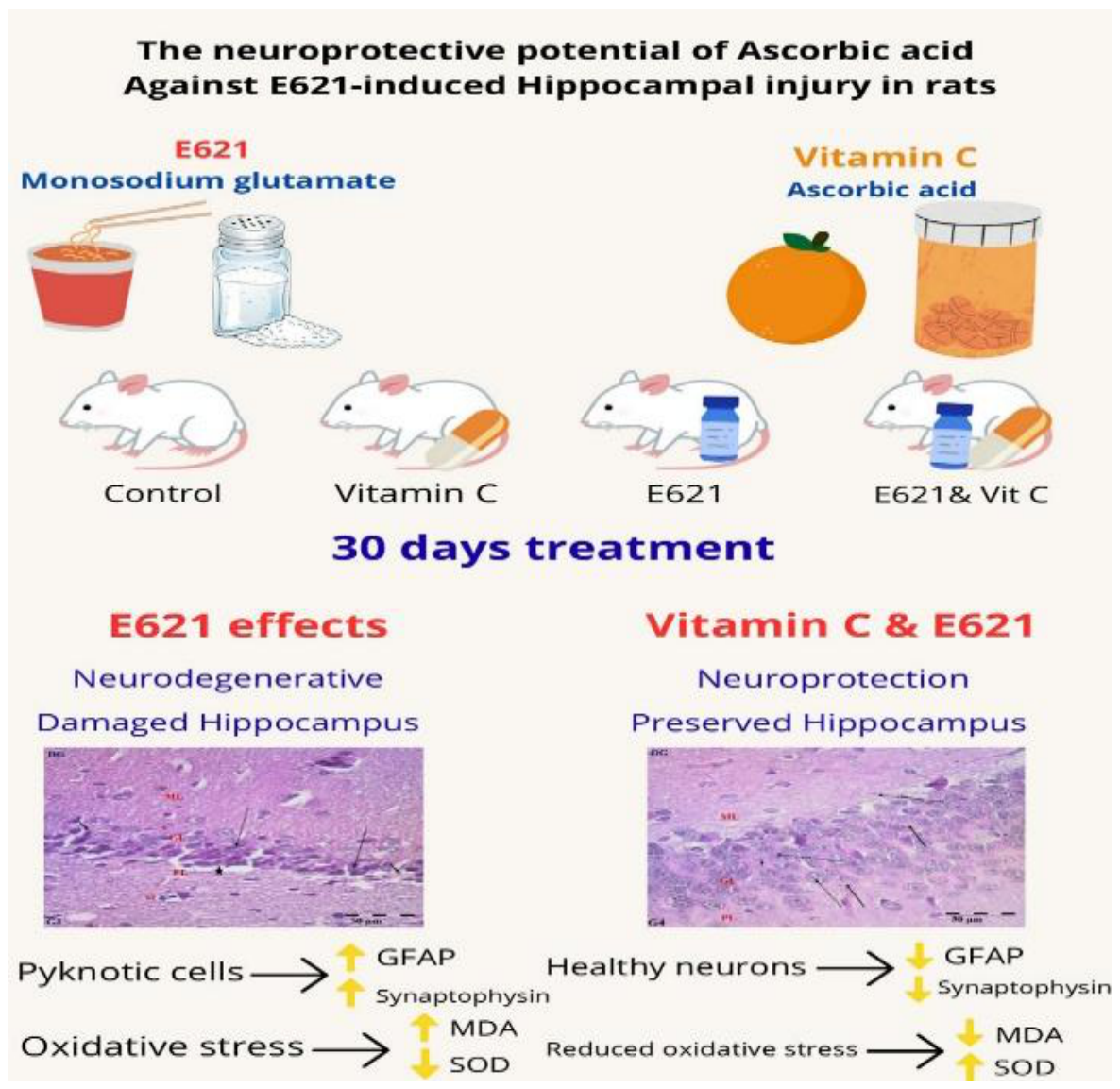
4. Discussion
The hippocampus is particularly vulnerable to excitotoxic injury due to its dense glutamatergic circuitry and high metabolic demand, rendering it highly sensitive to E621 consumption [24]. The current study demonstrates that E621 administration induces pronounced histological and biochemical alterations in the hippocampal tissues, while vitamin C co-treatment markedly attenuates these deleterious effects. At the same time, E621 administration was associated with increased levels of the lipid peroxidation product MDA and decreased SOD activity in brain tissues; in contrast, Co-administration of vitamin C resulted in a significant decrease in MDA and an increase in SOD activity.
According to [25], oxidative stress is triggered by an imbalance of antioxidants and oxidants. Excessive production of free radicals, including ROS and nitrogen-derived species, may adversely affect functionally essential molecules, such as genetic material (DNA), lipids, and proteins. Damage to these molecules causes diseases secondary to increased free radical levels in various organs, including the brain, leading to the oxidation of proteins, lipids, and nucleic acids [26]. The brain’s high energy requirements generate free radicals through mitochondrial metabolism, which can damage fatty acids and trigger lipid peroxidation.
Vitamin C primarily maintains the structural integrity of neural membranes by minimizing lipid peroxidation, as evidenced by lower MDA levels [14]. These neuroprotective findings of ascorbic acid against neurological damage in rats were also noticed by [27]. Some studies explain the neuroprotective effect of vitamin C by scavenging oxygen-free radicals; additionally, ascorbic acid has been shown to exert an antiapoptotic effect by increasing catalase activity and reducing lipid levels. Because it can cross the blood-brain barrier and support amino acid synthesis, vitamin C may have a neuroprotective effect [14].
Histological preservation of the DG regions in G1 and G2 confirms maintenance of normal hippocampal cytoarchitecture. In contrast, animals of G3 exhibited characteristic neurodegenerative changes, including neuronal shrinkage, pyknotic nuclei, pericellular halos, cytoplasmic vacuolation, and neuronal loss. These features are consistent with glutamate-mediated excitotoxicity and oxidative stress, which have been repeatedly implicated in E621-induced hippocampal injury [24]. The marked vulnerability of DG granular neurons observed in the present study aligns with their high expression of glutamate receptors and susceptibility to calcium overload and mitochondrial dysfunction. Reactive astrogliosis was evident in the E621 group, as demonstrated by increased GFAP immunoreactivity. Astrocyte hypertrophy is a hallmark of neuroinflammation secondary to neuronal injury. While astrocytic activation initially serves a protective function, sustained gliosis may exacerbate synaptic dysfunction and neuronal loss [28,29]. The reduction in GFAP expression in G4 following vitamin C co-treatment indicates attenuation of the inflammatory response, likely through antioxidant-mediated suppression of oxidative stress.
Also, the synaptic integrity was markedly affected by E621 exposure. Synaptophysin immunoreactivity was weak in G1 and G2, significantly elevated in G3, and modestly expressed in G4 following vitamin C co-treatment. Under physiological conditions, low basal synaptophysin expression reflects stable synaptic turnover. The pronounced upregulation observed in G3 likely represents pathological synaptic dysregulation rather than enhanced synaptic function. Recent evidence indicates that excitotoxic and oxidative insults induce abnormal accumulation of presynaptic proteins as a compensatory or maladaptive response to neuronal injury, synaptic loss, or altered vesicle cycling [30]. Excessive glutamate signaling has been shown to disrupt synaptic homeostasis, leading to aberrant presynaptic remodeling and impaired neurotransmission [30]. The reduction of synaptophysin expression to a modest level following vitamin C co-treatment suggests partial restoration of synaptic balance and attenuation of excitotoxic synaptic stress in G3. Similarly, [31] demonstrated increased synaptophysin immunostaining in the cerebellum of E621-Treated mice compared with control animals. They reported that elevated synaptophysin expression may result from a compensatory increase in presynaptic terminal density during the initial stage of degeneration induced by the excitotoxic effect of E621 ingestion, as clearly demonstrated by our findings. On the other hand, [32] reported that an intraperitoneal injection of E621 did not alter synaptophysin levels. The discrepancy in the impact of elevated glutamate on synaptophysin sensitivity between different experiments may be explained by variations in duration, dose, and route of E621 administration.
Recently, investigating the apoptotic signaling implicated it strongly in E621-induced neurotoxicity, and the marked upregulation of activated caspase-3 in neurons corresponds with the observed nuclear pyknosis and neuronal shrinkage, confirming the activation of programmed cell death pathways. Similar findings have been reported in E621 neurotoxicity models, in which excessive excitatory signaling secondary to glutamate excess triggers mitochondrial dysfunction and caspase-dependent apoptosis [33,34]. Based on a recent investigation, glutamate-induced neuronal cell death is mediated by two distinct pathways: necrotic and apoptotic, with excitotoxic and oxidative damage [32]. The significant reduction in caspase-3 immunoreactivity in G4 highlights vitamin C’s anti-apoptotic role.
Collectively, the findings of the current work indicate that E621 induces hippocampal neurotoxicity through a combination of oxidative stress, astrocytic activation, synaptic dysregulation, and apoptosis. Also, vitamin C exerts a protective effect by mitigating oxidative stress, modulating apoptotic pathways, and stabilizing synaptic protein expression, highlighting its potential therapeutic value against glutamate-mediated neurotoxicity.
The current findings demonstrate that E621 induces severe hippocampal injury via a multi-faceted toxic cascade. Similarly, [11] observed that neuronal pyknosis is a direct consequence of calcium-induced protease activation, which dismantles the neuronal cytoskeleton. Also, [2] reported that GFAP upregulation indicates that E621 triggers a pro-inflammatory state in the brain glial network, thereby exacerbating tissue damage.
Vitamin C also exerts its neuroprotective effects in the rat brain through a multifaceted approach involving antioxidant defense, metabolic transport, and neurotransmitter regulation. Primarily, Vitamin C acts as a potent antioxidant, scavenging ROS and reducing lipid peroxidation, as evidenced by decreased MDA levels, thereby preserving neuronal membrane integrity [35].
Although ascorbic acid is hydrophilic, it crosses the blood-brain barrier (BBB) primarily in its oxidized form, dehydroascorbic acid (DHA), utilizing glucose transporters such as GLUT1; once within the brain parenchyma, it is recycled back into its active antioxidant form, ascorbic acid, to maintain high local concentrations [36]. Beyond its role in oxidative protection, vitamin C functions as a neuromodulator by regulating the release and uptake of glutamate and dopamine. Inhibiting excessive glutamate signaling prevents excitotoxicity, a common pathway for neuronal death in trauma and disease [37]. Furthermore, vitamin C supplementation has been linked to enhanced synaptic plasticity, specifically by facilitating Long-Term Potentiation (LTP) in the hippocampus, which supports the preservation of cognitive function and memory [38].
5. Conclusions and Limitations of the Study
Exposure to E621 causes severe hippocampal neurotoxicity, characterized by increased lipid peroxidation, decreased antioxidant activity, apoptosis, astrocytic activation, neuronal damage, and synaptic dysregulation. These effects are substantially mitigated by vitamin C co-treatment, suggesting that dietary antioxidants may be a practical means to combat food additive-associated neurotoxicity. In light of our findings, a translational toxicology approach linking experimental findings to dietary exposure patterns, including the combined effects of commonly consumed food additives, is needed, and further work is required to investigate the clinical significance of antioxidant supplementation for neuroprotection. Further molecular research is needed to determine how vitamin C ameliorates E621-induced neurotoxicity under different experimental conditions.
Author Contributions
“Conceptualization, Enas N and Samah M; methodology, Ayman M, Rasha A, Hanan S, and Asmaa J; software, Khaled E, Marwa M and Amany R.; validation, Tarek H., Hanan S, Reham A, and Hagir H.; formal analysis, Reham A, Marwa M, and Amany R.; investigation, Khaled E., Reem A, Hagir H; resources, Asmaa J, Ashwag A., and Abdullah M.; data curation, Enas H, Tarek H., and Khaled E.; writing—original draft preparation, Enas N Enas H, and Samah M.; writing—review and editing, Ayman M and Samah M; visualization, Reem A, Hagir H.; supervision, Abdullah M., Ashwag A., and Rasha A,; project administration, Enas N, Enas H, and Samah M; funding acquisition. All authors have read and agreed to the published version of the manuscript.”.
Funding
“This research received no external funding.”.
Institutional Review Board Statement
The current study was approved by the Institutional Animal Care and Use Committee (IACUC) of Deraya University (Number DCSR-02026-100), in accordance with the ARRIVE Essential 10 and the National Institutes of Health (NIH Publication) guidelines for the Care and Use of Laboratory Animals.
Informed Consent Statement
“Not applicable.”.
Data Availability Statement
The data that support the findings of this study are available from the corresponding author upon reasonable request.
Acknowledgments
The researchers would like to thank the Deanship of Graduate Studies and Scientific Research at Qassim University (www.qu.edu.sa) for financial support (QU-APC-2026).
Conflicts of Interest
No potential conflict of interest was reported by the authors.
References
- Hasenböhler, A.; Javaux, G.; Payen de la Garanderie, M.; Szabo de Edelenyi, F.; Agaësse, C.; De Sa, A.; Deschasaux-Tanguy, M.; Fezeu, L.; Srour, B.; Touvier, M. Food additive monosodium glutamate and risk of cardiovascular diseases: NutriNet-Santé cohort. Eur. J. Public Health 2024, 34, ckae144.234. [Google Scholar] [CrossRef]
- Benbow, T.; Ekbatan, M.R.; Wu, G.H.Y.; Teja, F.; Exposto, F.G.; Svensson, P.; Cairns, B.E. Systemic administration of monosodium glutamate induces sexually dimorphic headache- and nausea-like behaviours in rats. Pain 2022, 163, 1838–1853. [Google Scholar] [CrossRef] [PubMed]
- Ali, H.M.; Hammad, S.F.; El-Malla, S.F. Green spectrophotometric methods for the determination of monosodium glutamate in different matrices. Microchem. J. 2021, 169, 106622. [Google Scholar] [CrossRef]
- Nguyen Thuy, L.; Salanță, L.C.; Tofană, M.; Socaci, S.A.; Fărcaş, A.C.; Pop, C.R. A mini review about monosodium glutamate. Bull. UASVM Food Sci. Technol. 2020, 77, 1–12. [Google Scholar] [CrossRef]
- Yoshida, R.; Ninomiya, Y. Umami and MSG. In Umami: Taste for health; Springer, 2023; pp. 7–42. [Google Scholar]
- Abd-Elkareem, M.; Soliman, M.; Abd El-Rahman, M.A.; Abou Khalil, N.S. The protective effect of Nigella sativa seeds against monosodium glutamate-induced hepatic dysfunction in rats. Toxicol. Rep. 2022, 9, 147–153. [Google Scholar] [CrossRef] [PubMed]
- Islam, M.S.; Al Ferdous, K.; Amin, M.N.; Kamruzzaman, M.; Islam, M.A. Impact of monosodium glutamate on the liver of chick embryo: Histology, biochemical properties, and AVBD9 gene expression. Int. J. Agric. Biosci. 2024, 13, 76–84. [Google Scholar] [CrossRef]
- Niaz, K.; Zaplatic, E.; Spoor, J. Extensive use of monosodium glutamate: A threat to public health? EXCLI J. 2018, 17, 273–278. [Google Scholar] [CrossRef] [PubMed]
- Hajihasani, M.M.; Soheili, V.; Zirak, M.R.; Sahebkar, A.; Shakeri, A. Natural products as safeguards against monosodium glutamate-induced toxicity. Iran. J. Basic Med. Sci. 2020, 23, 416. [Google Scholar] [CrossRef] [PubMed]
- Howes, O.; McCutcheon, R.; Stone, J. Glutamate and dopamine in schizophrenia: An update for the 21st century. J. Psychopharmacol. 2015, 29, 97–115. [Google Scholar] [CrossRef] [PubMed]
- Razali, R.; Zulkarnain, Z.; Asrizal, C.W. Effects of monosodium glutamate (MSG) on neuron damages in hippocampus in Sprague-Dawley rats. Indian J. Forensic Med. Toxicol. 2021, 15, 3960–3964. [Google Scholar] [CrossRef]
- Kesherwani, R.; Bhoumik, S.; Kumar, R.; Rizvi, S.I. Monosodium glutamate even at low dose may affect oxidative stress, inflammation and neurodegeneration in rats. Indian J. Clin. Biochem. 2024, 39, 101–109. [Google Scholar] [PubMed]
- Mudgal, R.; Sharma, S.; Singh, S.; Ravichandiran, V. The neuroprotective effect of ascorbic acid against imidacloprid-induced neurotoxicity and the role of HO-1 in mice. Front. Neurol. 2023, 14, 1130575. [Google Scholar] [CrossRef] [PubMed]
- Mohamed, A.S.; Ahmed, M.A.; Mohamed, D.A. Comparative study between the neuroprotective effect of curcumin and vitamin C against neurotoxicity induced by acetamiprid on the cerebellum of male adult albino rats: A histological study. SVU-Int. J. Med. Sci. 2024, 7, 81–91. [Google Scholar] [CrossRef]
- Suleiman, S.; Adebisi, S.; Musa, S.; Ekpo, U.; Lazarus, S.; Oderinde, G. Neuroprotective effect of Adansonia digitata fruit pulp extract against aluminum chloride-induced memory deficits and hippocampal damage in rats. J. Neurobehav. Sci. 2026, 13, 1–7. [Google Scholar]
- Roesler, R.; Parent, M.B.; LaLumiere, R.T.; McIntyre, C.K. Amygdala-hippocampal interactions in synaptic plasticity and memory formation. Neurobiol. Learn. Mem. 2021, 184, 107490. [Google Scholar] [CrossRef] [PubMed]
- Abdel-Aziz, H.; Ahmed, S.M.; Mohammed, M.Z.; et al. Efficacy of cerebrolysin on dentate gyrus of hippocampus after experimentally induced acute ischemic stroke in adult albino rats (histological, immunohistochemical, and biochemical study). Egypt. J. Histol. 2019, 42, 229–244. [Google Scholar] [CrossRef]
- Schröder, H.; Moser, N.; Huggenberger, S. The mouse hippocampus. In Neuroanatomy of the mouse: An introduction; Springer, 2020; pp. 267–288. [Google Scholar]
- Abbott, L.C.; Nigussie, F.J. Adult neurogenesis in the mammalian dentate gyrus. Anat. Histol. Embryol. 2020, 49, 3–16. [Google Scholar] [PubMed]
- Erkartal, H.Ş.; Toy, S.; Secgin, S.; Secgin, Y. Histopathological and biochemical evaluation of the effects of monosodium glutamate on cognitive memory and brain functions in rats. 2025. [Google Scholar] [CrossRef]
- Zanfirescu, A.; et al. A review of the alleged health hazards of monosodium glutamate. Compr. Rev. Food Sci. Food Saf. 2019, 18, 1111–1134. [Google Scholar] [CrossRef] [PubMed]
- Ebaid and Tag, 2012 (Note: This full reference source text was missing from your initial pool. Please verify your document to insert its details).
- Buege, J.A.; Aust, S.D. Microsomal lipid peroxidation. Methods Enzymol. 1978, 30, 302–310. [Google Scholar] [CrossRef] [PubMed]
- Amer, M.M.; Abozaid, S.M.M.; El-Meguid, E.A.A.; Seleem, H.S.; Abdel-Hamed, M.R. The protective effect of melatonin against monosodium glutamate-induced hippocampal injury: Focus on regulating the Nrf2/heme oxygenase-1 and nuclear factor-kappa B/tumor necrosis factor-α/caspase-3 and brain-derived neurotrophic factor signaling pathways in a rat model. J. Anat. Soc. India 2025, 74, 110–123. [Google Scholar] [CrossRef] [PubMed]
- Ibrahim, A.; Muhammad, S.A. Antioxidant-rich nutraceuticals as a therapeutic strategy for sickle cell disease. J. Am. Nutr. Assoc. 2023, 42, 588–597. [Google Scholar] [CrossRef] [PubMed]
- Buccellato, F.R.; D’Anca, M.; Fenoglio, C.; Scarpini, E.; Galimberti, D. Role of oxidative damage in Alzheimer’s disease and neurodegeneration: From pathogenic mechanisms to biomarker discovery. Antioxidants 2021, 10, 1353. [Google Scholar] [CrossRef] [PubMed]
- Afifi, O.K.; Embaby, A.S. Histological study on the protective role of ascorbic acid on cadmium-induced cerebral cortical neurotoxicity in adult male albino rats. J. Microsc. Ultrastruct. 2016, 4, 36–45. [Google Scholar] [PubMed]
- Sofroniew, M.V. Astrocyte reactivity: Subtypes, states, and functions in CNS innate immunity. Trends Immunol. 2020, 41, 758–770. [Google Scholar] [CrossRef] [PubMed]
- Verkhratsky et, a.l. (Note: This aligns with your reference authored by Vishnumukkala, T., Che Mohd Nassir, C. M. N., Hein, Z. M., et al. (2025) focusing on glial cells and astrocytes). Glial cells as emerging therapeutic targets in neurodegenerative diseases: Mechanistic insights and translational perspectives. Cells 2025, 14, 1497. [Google Scholar] [CrossRef] [PubMed]
- Wu, W.L.; Gong, X.X.; Qin, Z.H.; et al. Molecular mechanisms of excitotoxicity and their relevance to the pathogenesis of neurodegenerative diseases—An update. Acta Pharmacol. Sin. 2025, 46, 3129–3142. [Google Scholar] [CrossRef] [PubMed]
- Ibrahim, M.N.; Mostafa, E.M.; Toama, F.N. Histological Effects of Monosodium Glutamate on Brain of Infant Albino Swiss Mice Mus Musculus. J. Med. Chem. Sci. 2021, 4, 564–570. [Google Scholar] [CrossRef]
- Saleh, S.M.E.; Ameen, O.; Gadallah, M.S.; Saleh, A.S.A.E.; Abdel-Razek, H.A.D. Effect of L-ascorbic acid and alpha-tocopherol on the monosodium glutamate-induced neurobehavioral changes in rats. Bull. Egypt. Soc. Physiol. Sci. 2021, 41, 410–427. [Google Scholar] [CrossRef]
- Zhang, Y.; Bhavnani, B.R. Glutamate-induced apoptosis in primary cortical neurons is inhibited by equine estrogens via down-regulation of caspase-3 and prevention of mitochondrial cytochrome c release. BMC Neurosci. 2005, 6, 13. [Google Scholar] [CrossRef] [PubMed]
- Albrakati, A. Monosodium glutamate induces cortical oxidative, apoptotic, and inflammatory challenges in rats: The potential neuroprotective role of apigenin. Environ. Sci. Pollut. Res. 2022, 30, 24143–24153. [Google Scholar] [CrossRef]
- Sil, S.; Ghosh, T.; Gupta, P.; Ghosh, R.; Kabir, S.N.; Roy, A. Dual role of vitamin C on the neuroinflammation mediated neurodegeneration and memory impairments in colchicine-induced rat model of Alzheimer disease. J. Mol. Neurosci. 2016, 60, 421–435. [Google Scholar] [CrossRef] [PubMed]
- Harrison, F.E.; May, J.M. Vitamin C function in the brain: Vital role of the ascorbate transporter SVCT2. Free Radic. Biol. Med. 2009, 46, 719–730. [Google Scholar] [CrossRef] [PubMed]
- Rebec & Pierce, 1994 (Note: This full reference text was missing from your source pool. Please ensure to grab the complete journal volume and page details from your main draft).
- Nam, S.M.; Seo, M.; Seo, J.S.; Rhim, H.; Nahm, S.S.; Cho, I.H.; Chang, B.J.; Kim, H.J.; Choi, S.H.; Nah, S.Y. Ascorbic acid mitigates D-galactose-induced brain aging by increasing hippocampal neurogenesis and improving memory function. Nutrients 2019, 11, 176. [Google Scholar] [CrossRef] [PubMed]
Figure 1.
shows a lower magnification from a sagittal section in the hippocampus proper and dentate gyrus (DG) of a control rat. The normal histological architecture of the hippocampus proper comprises four regions of cornu ammonis (CA1–CA4), and the DG, which appears as a dark V-shaped structure enclosing the CA4 area in G1. The DG has a molecular layer (ML), a granular cell layer (GL), and a polymorphic layer (PL). (H&E ×40).
Figure 1.
shows a lower magnification from a sagittal section in the hippocampus proper and dentate gyrus (DG) of a control rat. The normal histological architecture of the hippocampus proper comprises four regions of cornu ammonis (CA1–CA4), and the DG, which appears as a dark V-shaped structure enclosing the CA4 area in G1. The DG has a molecular layer (ML), a granular cell layer (GL), and a polymorphic layer (PL). (H&E ×40).
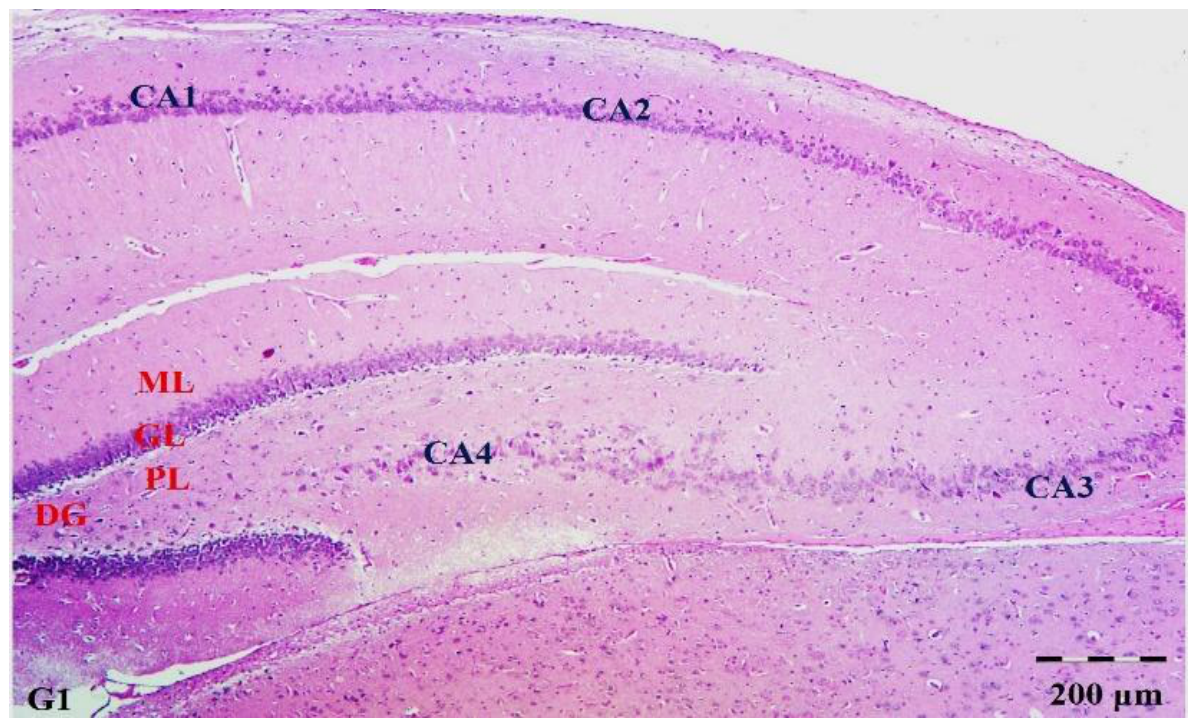
Figure 2.
shows a higher-magnification view of the DG from rats in all studied groups. The DG of G1 and G2 consists of the ML, the GL, and the PL. The GL shows densely packed small granular cells with vesicular nuclei (arrow). Also, sparse neuroglial cells (NG) are scattered within the neuropil, with small, darkly stained nuclei and minimal interstitial tissue in G1and G2. In contrast, the GL of DG in G3 shows significant histopathological changes, where numerous dark, shrunken granular cells with pyknotic nuclei (dotted arrows), pericellular halos (arrow heads), cytoplasmic vacuolation, and regions of cellular loss (star). As well, the PL in G3 shows extensive neuronal degeneration, with disordered, widely spaced, shrinking cells, pyknotic nuclei, and perineuronal halos, along with congested capillaries (cc), while some neurons appear intact. Also, co-administration of vitamin C with E621 significantly reduced the histopathological alterations induced by E621 in G4. Some granular cells maintain their usual shape, with vesicular nuclei and basophilic cytoplasm, giving them an almost normal appearance, whereas other granular cells in the DG show degeneration and pericellular halos (dotted arrows). (H&E ×400).
Figure 2.
shows a higher-magnification view of the DG from rats in all studied groups. The DG of G1 and G2 consists of the ML, the GL, and the PL. The GL shows densely packed small granular cells with vesicular nuclei (arrow). Also, sparse neuroglial cells (NG) are scattered within the neuropil, with small, darkly stained nuclei and minimal interstitial tissue in G1and G2. In contrast, the GL of DG in G3 shows significant histopathological changes, where numerous dark, shrunken granular cells with pyknotic nuclei (dotted arrows), pericellular halos (arrow heads), cytoplasmic vacuolation, and regions of cellular loss (star). As well, the PL in G3 shows extensive neuronal degeneration, with disordered, widely spaced, shrinking cells, pyknotic nuclei, and perineuronal halos, along with congested capillaries (cc), while some neurons appear intact. Also, co-administration of vitamin C with E621 significantly reduced the histopathological alterations induced by E621 in G4. Some granular cells maintain their usual shape, with vesicular nuclei and basophilic cytoplasm, giving them an almost normal appearance, whereas other granular cells in the DG show degeneration and pericellular halos (dotted arrows). (H&E ×400).
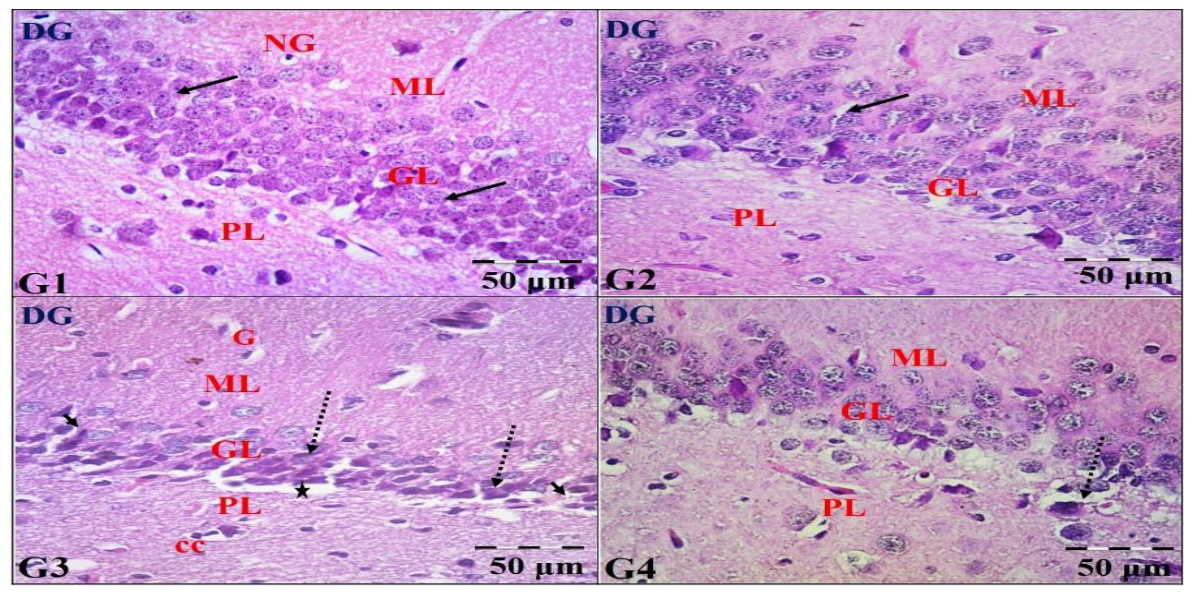
Figure 3.
shows photomicrographs from DG sections stained with GFAP in all studied groups. A few small astrocytes with thin processes (arrows) and mild astrocytic positivity are dispersed among the cells of ML, GL, and PL in the DG of G1and G2 sections. In contrast, numerous large astrocytes with thick, multiple, ramified processes (arrows) appear among the cell bodies of the ML, GL, and PL in G3. Also, small astrocytes with few short, thin processes (arrows) are present in the ML, GL, and PL of G4. (GFAP immunostaining ×400).
Figure 3.
shows photomicrographs from DG sections stained with GFAP in all studied groups. A few small astrocytes with thin processes (arrows) and mild astrocytic positivity are dispersed among the cells of ML, GL, and PL in the DG of G1and G2 sections. In contrast, numerous large astrocytes with thick, multiple, ramified processes (arrows) appear among the cell bodies of the ML, GL, and PL in G3. Also, small astrocytes with few short, thin processes (arrows) are present in the ML, GL, and PL of G4. (GFAP immunostaining ×400).
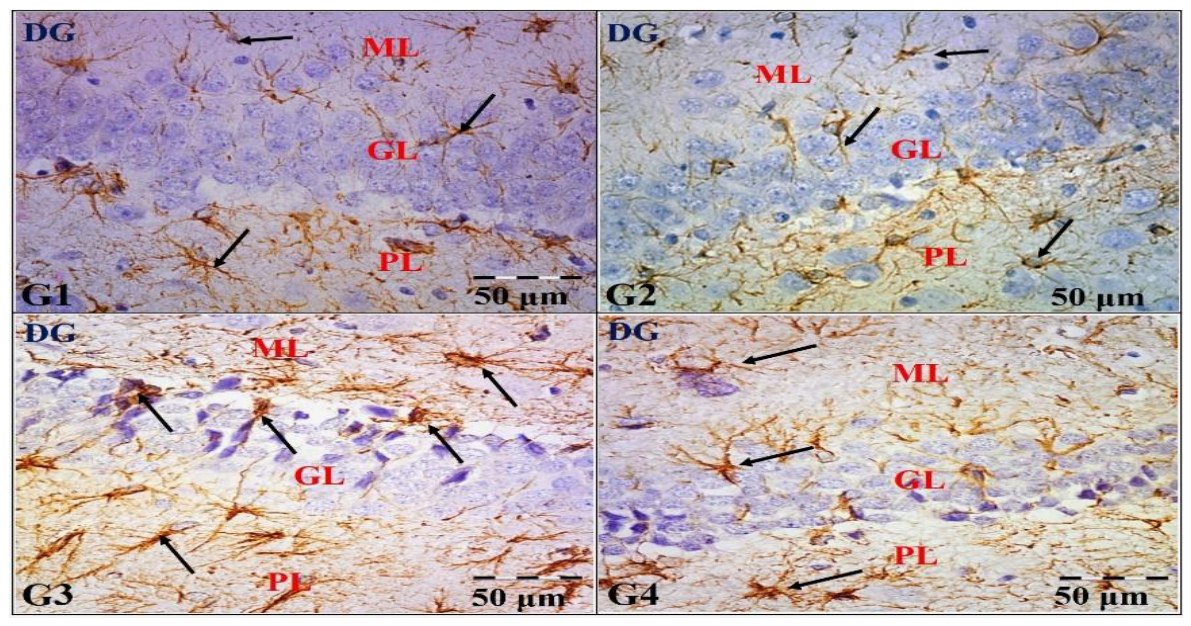
Figure 4.
shows representative photomicrographs of synaptophysin-immunostained sections in the DG of all studied groups. Synaptophysin appears minimal in the GL (arrow) of G1 and G2; however, it is significantly elevated, with robust, prominent cytoplasmic expression (arrows) in the GL of G3. In contrast, synaptophysin is significantly reduced in the GL (arrows) of G4 compared with G3. (synaptophysin immunostaining ×400).
Figure 4.
shows representative photomicrographs of synaptophysin-immunostained sections in the DG of all studied groups. Synaptophysin appears minimal in the GL (arrow) of G1 and G2; however, it is significantly elevated, with robust, prominent cytoplasmic expression (arrows) in the GL of G3. In contrast, synaptophysin is significantly reduced in the GL (arrows) of G4 compared with G3. (synaptophysin immunostaining ×400).
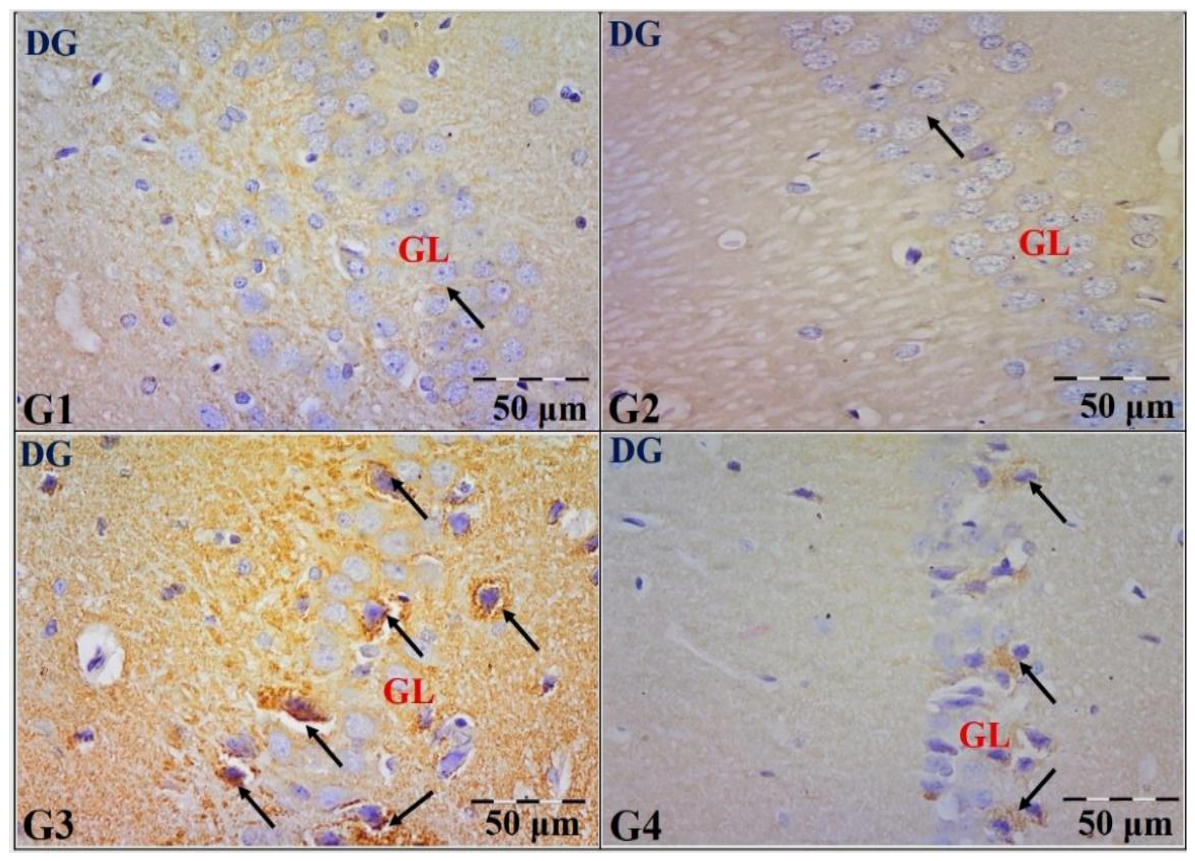
Figure 5.
shows representative photomicrographs of activated caspase-3 immunostained sections in the DG region of all studied groups. The activated caspase-3 appears faint in the cytoplasm (arrows) of the GL in G1 and G2; however, it is significantly elevated with strong cytoplasmic (arrows) and nuclear (dotted arrows) expression in the GL of G3. In contrast, activated caspase-3 is significantly reduced with moderate cytoplasmic expression (arrows) in the GL of G4. (activated caspase-3 immunostaining ×400).
Figure 5.
shows representative photomicrographs of activated caspase-3 immunostained sections in the DG region of all studied groups. The activated caspase-3 appears faint in the cytoplasm (arrows) of the GL in G1 and G2; however, it is significantly elevated with strong cytoplasmic (arrows) and nuclear (dotted arrows) expression in the GL of G3. In contrast, activated caspase-3 is significantly reduced with moderate cytoplasmic expression (arrows) in the GL of G4. (activated caspase-3 immunostaining ×400).
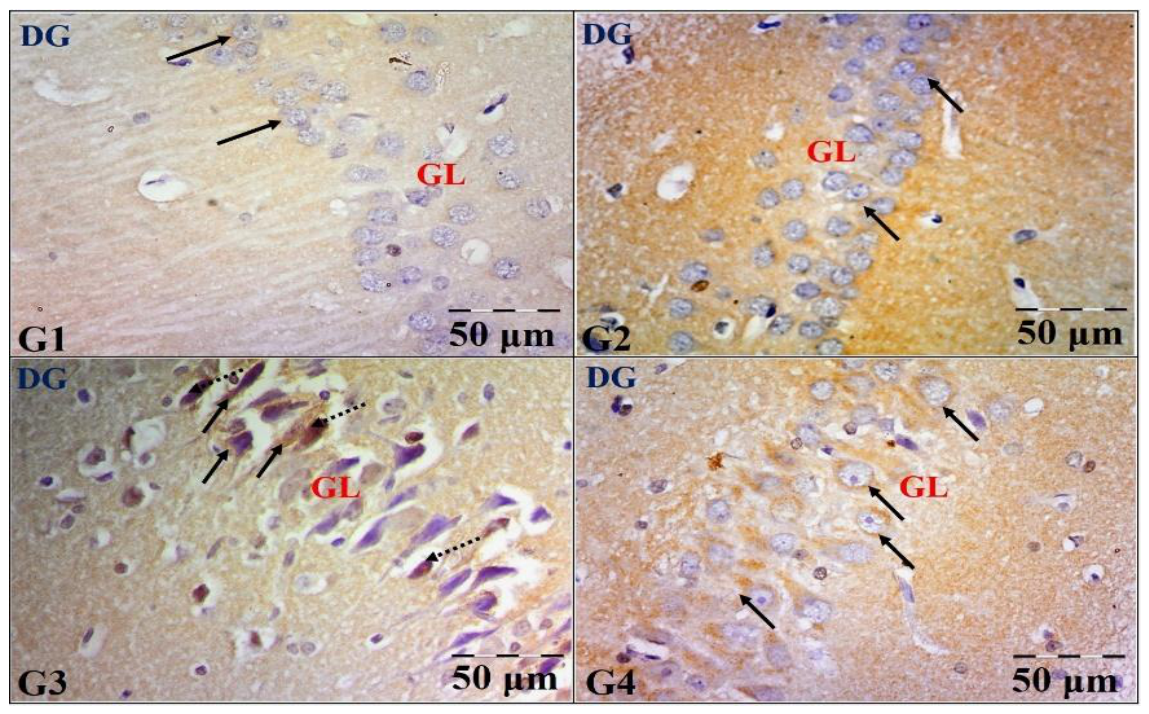
Table 1.
shows the mean ± standard error of mean (M ± SEM) of the percentage of degenerated neurons and the immunoreactivity of GFAP, synaptophysin, and activated caspase-3 in the DG region of the hippocampus across all studied groups.
Table 1.
shows the mean ± standard error of mean (M ± SEM) of the percentage of degenerated neurons and the immunoreactivity of GFAP, synaptophysin, and activated caspase-3 in the DG region of the hippocampus across all studied groups.
| Groups (n=8) | M ± SD of degenerated neurons % | p- value | M ± SD of GFAP IR | p- value | M ± SD of synaptophysin IR |
p- value | M ± SD of activated caspase-3 IR | p- value |
|---|---|---|---|---|---|---|---|---|
| G1 | 3.80 ± 0.58 | 17.09 ± 0.65 | 2.27 ± 0.31 | 11.13 ± 0.72 | ||||
| G2 | 4.79 ± 0.37 | 0.847# | 20.67 ± 0.39 | 0.06# | 2.84 ± 0.25 | 0.463# | 10.69 ± 0.56 | 0.963# |
| G3 | 29.00 ± 1.01 |
0.001# 0.004& |
36.44 ± 1.50 | 0.001# 0.003& |
14.35 ± 0.21 | 0.001# 0.008& |
20.25 ± 0.66 |
0.001# 0.002& |
| G4 | 6.75 ± 1.24 |
0.053# 0.001* |
26.02 ± 0.77 | 0.061# 0.001* |
8.31 ± 0.32 | 0.055# 0.001* |
15.37 ± 0.67 | 0.064# 0.001* |
The mean ± standard error of means (M ± SEM), immunoreactivity (IR), # versus G1, *versus G2, &versus G3, p <0.05 is significant.
Disclaimer/Publisher’s Note: The statements, opinions and data contained in all publications are solely those of the individual author(s) and contributor(s) and not of MDPI and/or the editor(s). MDPI and/or the editor(s) disclaim responsibility for any injury to people or property resulting from any ideas, methods, instructions or products referred to in the content. |
© 2026 by the authors. Licensee MDPI, Basel, Switzerland. This article is an open access article distributed under the terms and conditions of the Creative Commons Attribution (CC BY) license (http://creativecommons.org/licenses/by/4.0/).
Copyright: This open access article is published under a Creative Commons CC BY 4.0 license, which permit the free download, distribution, and reuse, provided that the author and preprint are cited in any reuse.


