
Submitted:
23 June 2026
Posted:
25 June 2026
You are already at the latest version
Abstract
Conventional low-level vision models often suffer from limited generalization and a lack of explicit semantic understanding, particularly when confronting complex or hybrid real-world degradations. The recent emergence of Vision-Language Models (VLMs) has fundamentally transformed this landscape by injecting visual-linguistic priors into pixel-level reconstruction. This paper presents the first comprehensive survey of VLM applications in low-level vision, proposing a unified taxonomy that organizes existing literature into two complementary paradigms. The first, Direct VLM Adaptation focuses on modifying VLM architectures, including visual encoders and language branches, and employing prompt learning strategies to bridge the inherent gap between high-level semantics and the fine-grained precision required for pixel-level tasks. The second, VLM as Auxiliary, leverages pre-trained VLMs as external modules to assist restoration networks, serving distinct roles as Semantic Providers, Degradation Interpreters, Quality Evaluators, and Intelligent Controllers. Beyond natural images, we systematically review applications in specialized domains such as medical imaging and remote sensing, analyzing domain-specific challenges like data scarcity and distribution shifts. Through curated quantitative summaries and qualitative analyses, we identify critical open challenges, including semantic-pixel misalignment and computational efficiency. Finally, we outline promising future directions, emphasizing the transition toward unified, physics-informed, and generative foundation models for universal image restoration. A curated repository is available at: https://github.com/ChunmingHe/awesome-multimodal-large-language-models-in-low-level-vision.
Keywords:
vision-language models
; low-level vision
; image restoration
; prompt learning
; multimodal learning
1. Introduction
Low-level vision encompasses fundamental image processing tasks that restore or enhance visual data degraded by real-world factors, including super-resolution [1,2], deblurring [3,4], dehazing [5,6], inpainting [7], fusion [8,9], and low-light enhancement [10,11]. They serve as critical preprocessing for downstream applications such as autonomous driving, medical diagnosis [12], remote sensing [13], and multimedia content creation [14]. Driven by deep learning, the field has progressed from early CNNs [15,16] to Transformers with global receptive fields [17] and, more recently, diffusion models with powerful generative priors [10], improving restoration fidelity and robustness.
Despite this progress, most methods remain task-specific and data-driven, with objectives dominated by pixel-wise reconstruction error and little explicit understanding of scene structure, object relations, or contextual intent. As a result, they generalize poorly to complex or hybrid degradations beyond the training distribution, yielding inconsistent perceptual quality on in-the-wild data [18,19]. This semantic gap, i.e., insufficient global understanding within pixel-oriented paradigms, has become a central bottleneck in pushing low-level vision toward higher-level visual reasoning.
Vision-Language Models (VLMs), such as CLIP [20], BLIP [21], and LLaVA [22], offer a transformative remedy. Trained on large-scale image–text data, they acquire rich visual–semantic knowledge and strong zero-shot generalization [20,23], motivating their use in low-level vision [24,25,26] (see Figure 1). They address the limitations along three axes: semantic priors that enforce consistency in restored outputs [27,28], broad visual–linguistic knowledge that improves generalization to out-of-distribution degradations [29,30], and reasoning that enables adaptive handling of multiple co-existing degradations [31,32] (for generative MLLMs).
However, deploying VLMs here is non-trivial due to an objective mismatch: VLMs target high-level semantic understanding and image–text alignment, whereas low-level tasks demand pixel-level accuracy and spatial fidelity [33]. Their visual encoders operate at fixed low resolutions (typically ), and, being trained on clean RGB images, they degrade under severe noise, blur, or haze [34,35]. Domain gaps are even larger for specialized modalities such as hyperspectral remote sensing [36,37,38] or medical CT/MRI [39,40,41]. These challenges have spurred research on VLM adaptation, prompt design, and restoration-oriented architectures.
From this review, we identify two complementary paradigms for integrating VLMs into low-level vision. Direct VLM Adaptation modifies VLM architectures and training to process and restore degraded images end-to-end [42,43,44,45,46,47], through visual-encoder adaptation, language-branch modification, and prompt learning. VLM as Auxiliary keeps the VLM largely frozen and uses it as an external module in four roles: semantic provider [48,49,50], degradation interpreter [51,52,53], quality evaluator [54,55,56], and intelligent controller [18,19]. The two are not mutually exclusive and can be combined.
Despite this rapid progress, a dedicated systematic survey is still lacking. Existing VLM surveys focus on high-level tasks [57,58,59,60] and overlook the distinct challenges of low-level applications; this work fills the gap with the first comprehensive survey of VLMs across low-level vision tasks. Two contemporaneous surveys warrant explicit positioning. Jiang et al. [61] review all-in-one restoration by architecture and learning paradigm, without centering the language–vision axis; Liu et al. [62] organize language-driven restoration by three coupling levels, restricted to restoration and quality assessment. In contrast, our taxonomy is integration-centered, splitting the literature by how VLM components enter the system (Direct VLM Adaptation versus VLM as Auxiliary with its provider, interpreter, evaluator, and controller roles) and spans image fusion, medical imaging, remote sensing, video and 3D processing, and zero-shot adaptation.
Figure 2.
Overview and taxonomy of vision–language model paradigms for low-level vision. The taxonomy organizes methods by their integration roles; contrastive and autoregressive generative mechanisms can occur across its categories.
Figure 2.
Overview and taxonomy of vision–language model paradigms for low-level vision. The taxonomy organizes methods by their integration roles; contrastive and autoregressive generative mechanisms can occur across its categories.
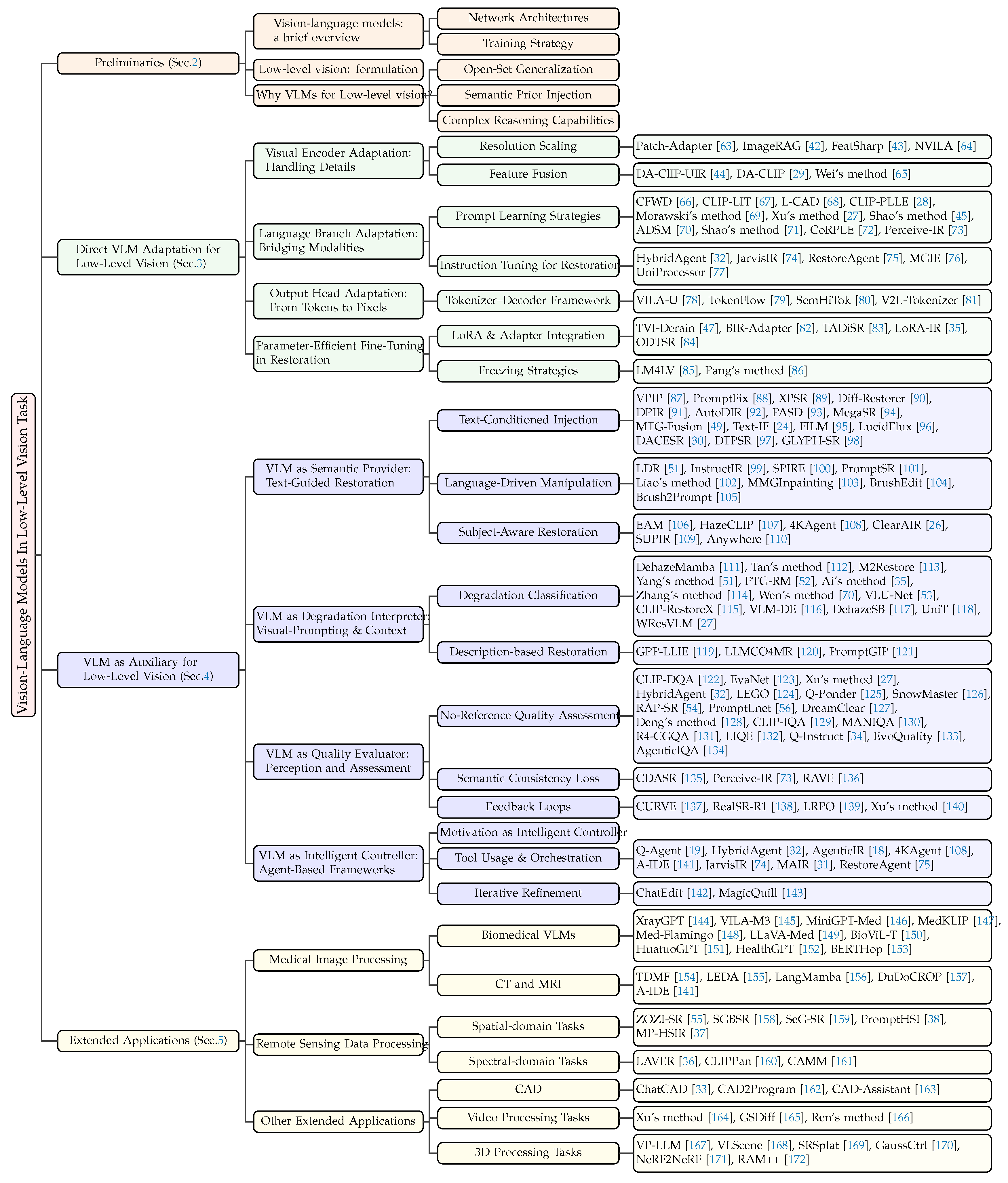
Studying VLMs in low-level vision is not purely application-oriented; it also informs VLM design. The demand for pixel fidelity and fine-grained spatial consistency exposes architectural and training limitations (resolution, degradation sensitivity, and semantic–pixel misalignment), while solutions such as multi-scale visual encoding, degradation-aware feature extraction, and continuous prompt optimization point toward more versatile VLMs that support semantic understanding and fine-grained reconstruction. This survey thus advances low-level vision with VLMs while informing the broader development of general-purpose vision–language systems.
Our main contributions are summarized as follows. (1) We propose a unified taxonomy that organizes VLM-based low-level vision methods into two paradigms, Direct VLM Adaptation and VLM as Auxiliary, the latter further divided into Provider, Interpreter, Evaluator, and Controller roles, offering a clear framework for categorizing existing and future work. (2) We systematically analyze architectural adaptations and prompt learning strategies that connect VLMs’ high-level semantics with the pixel-level accuracy required in low-level tasks. (3) We extend the discussion beyond natural images to specialized domains such as medical imaging and remote sensing, highlighting domain-specific challenges and adaptations. (4) We compile experimental results on representative benchmarks, summarize open challenges, and outline future directions, with particular emphasis on emerging generative VLMs for image restoration. To facilitate ongoing research, we maintain an up-to-date repository at repository.
The remainder of this survey is organized as: Section 2 introduces the preliminaries. Section 3 and Section 4 detail the two core paradigms: Direct VLM Adaptation and VLM as Auxiliary. Section 5 explores extended applications in specialized domains, followed by experiments in Section 6. Finally, Section 7 and Section 8 discuss future directions and conclude the work.
Note. Our systematic search covers databases like DBLP and Google Scholar, emphasizing reputable venues such as IEEE T-PAMI, IJCV, and CVPR. We prioritize studies with public code and high citations as indicators of impact and practicality. Each selected work is carefully examined to assess its unique contribution and influence in the community. This allows our survey to provide a comprehensive overview of the most representative and influential research, and to highlight promising directions for future inquiry.
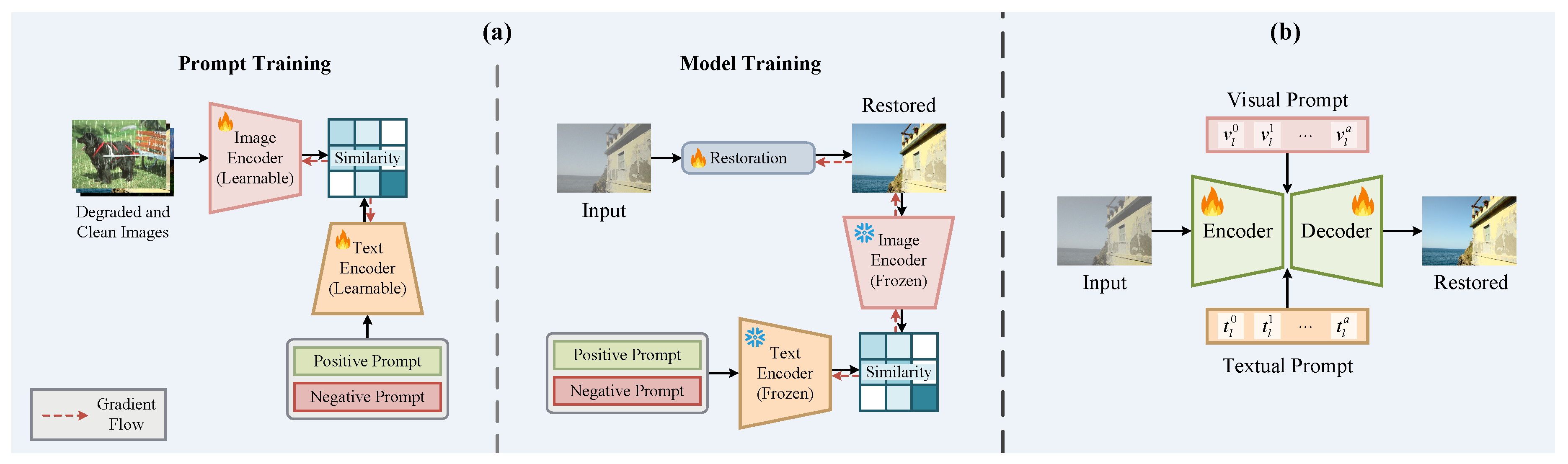
Figure 3.
Main application methods of prompt learning. (a) learnable context vectors are adopted as prompts. This approach typically involves two stages: first, the prompt is optimized; second, the learned prompt is used for self-supervised training [27,45,66,69,70,71,72,73]; (b) prompts are simultaneously set in both visual and linguistic modalities [37,173].
Figure 3.
Main application methods of prompt learning. (a) learnable context vectors are adopted as prompts. This approach typically involves two stages: first, the prompt is optimized; second, the learned prompt is used for self-supervised training [27,45,66,69,70,71,72,73]; (b) prompts are simultaneously set in both visual and linguistic modalities [37,173].
2. Preliminaries
2.1. Vision-Language Models: A Brief Overview
VLMs are multimodal systems that model images and text in a shared embedding space, enabling image–text matching and cross-modal retrieval. A typical VLM comprises image and text encoders that map visual and textual inputs into aligned embeddings and, with large-scale contrastive pre-training, exhibit transferability and zero-shot generalization.
We use VLM as an umbrella term and distinguish two operating mechanisms relevant to this survey. Contrastive (dual-encoder) VLMs, represented by CLIP, map images and text into aligned embedding spaces for similarity estimation, retrieval, classification, and feature conditioning. Autoregressive generative VLMs, particularly multimodal large language models (MLLMs) such as LLaVA, connect visual representations to a language model and generate text for description, instruction following, reasoning, and tool use. Models such as BLIP and BLIP-2 support both contrastive representation learning and text generation; we describe them according to the capability used by each reviewed method. This mechanism axis is orthogonal to our integration-centered taxonomy.
2.1.1. Network Architectures
Given a dataset of paired samples , an image encoder and a text encoder map each image and its caption to embeddings and .
Visual branch. Two families of encoders are widely used: CNN-based and Transformer-based. CNN backbones such as VGG [174], ResNet [175], and EfficientNet [176] are often adopted with minor changes for vision–language pre-training [20]. Vision Transformers (ViT) [177] instead tokenize an image into patches and process them via stacked Transformer blocks, capturing long-range dependencies in a global token space. Later works [20,178,179] introduce refinements such as pre-encoder normalization to improve stability and representation quality under large-scale VLM pre-training.
Language branch. Transformers and their variants [180,181,182] dominate text encoding. The standard Transformer consists of multi-head self-attention and multilayer perceptron (MLP) blocks in both encoder and decoder. Most VLMs, e.g., CLIP [20], use Transformers similar to GPT-2 [182], sometimes initialized from GPT-like checkpoints, while others train the text encoder from scratch.
2.1.2. Training Strategy
Contrastive VLMs and generative MLLMs are trained differently. Contrastive VLMs such as CLIP are pre-trained on large image-text corpora with a contrastive objective that pulls matched image-text pairs together and pushes mismatched pairs apart in a shared embedding space, yielding transferable representations without generating text. Generative MLLMs instead follow three stages:
Pre-training. Pre-training aims to align heterogeneous modalities and acquire broad world knowledge using large-scale image–text pairs. A common paradigm involves autoregressively predicting textual descriptions from input images via standard cross-entropy loss. For optimization, many frameworks freeze pre-trained components (e.g., the visual encoder and LLM) and train only a lightweight bridging module to preserve inherent knowledge [149,183]. Conversely, other approaches [184,185,186] opt to unfreeze specific components, such as the visual encoder, to enable stronger cross-modal adaptation at the cost of increased trainable parameters.
Instruction-tuning. This stage enhances zero-shot generalization by optimizing the model to generate a response conditioned on an instruction and multimodal input . Formally, given a triplet , the MLLM is trained to minimize the standard autoregressive loss [187,188]:
where represents model parameters and denotes preceding tokens. This process enables the model to generalize to unseen tasks by following natural language instructions.
Preference Alignment. This stage aligns generative MLLMs with human preferences (e.g., reducing hallucination). Reinforcement Learning from Human Feedback (RLHF) [189] utilizes a learned reward model to guide optimization [190], whereas Direct Preference Optimization (DPO) [191] simplifies the pipeline by directly learning from preference data without an explicit reward model. Recently, Group Relative Policy Optimization (GRPO) [192] has emerged to further enhance efficiency; it eliminates the critic (value function) by optimizing based on relative rewards within a sampled group of outputs, thereby significantly reducing memory overhead.
2.2. Low-Level Vision: Formulation
Low-level vision tasks focus on restoring or enhancing degraded visual signals, prioritizing pixel-level reconstruction and structural fidelity over semantic understanding. The primary objective is to recover the clean image from a degraded observation y. Representative tasks include image denoising [193], deblurring [4], deraining [194], dehazing [6], and super-resolution [1]. Mathematically, these tasks share a unified forward degradation model:
where and y denote the clean high-quality (HQ) and observed low-quality (LQ) images, respectively. represents the degradation operator, encompassing factors such as kernel blur, downsampling, atmospheric scattering, or illumination attenuation, while n denotes random perturbations like sensor noise. Reconstructing from y constitutes an inherently ill-posed inverse problem characterized by non-uniqueness and high sensitivity to noise. In real-world scenarios, is often unknown or difficult to model accurately, further exacerbating the challenge by limiting available constraints.
3. Direct VLM Adaptation for Low-Level Vision
3.1. Visual Encoder Adaptation: Handling Details
Recent work adapts VLM visual branches via patching (to bypass fixed-resolution limits) and controller modules (for degradation awareness).
Resolution Scaling. Input resolutions in low-level vision often exceed standard VLM limits (e.g., 224×224). Resolution-scaling strategies use patching or tiling to process high-resolution images without modifying the backbone, partitioning the image into encoder-sized patches and then recomposing features or retrieving across patches to preserve context and detail. Zhang et al. [63] address structural inconsistencies in 4K inpainting by injecting CLIP-retrieved reference features into attention layers for consistency. ImageRAG [42] handles ultra-high-resolution remote sensing by formulating a “long-context selection” problem. FeatSharp [43] and NVILA [64] encode partitioned tiles and stitch them into a unified feature map, capturing both global context and local structure.

Table 1.
Instruction tuning for restoration in language branch.
| Dataset | Year | Related Method | Short Description | Type |
|---|---|---|---|---|
| Paired training samples [75] | 2024 | RestoreAgent [75] | A 23K-pair instruction dataset labeled with the optimal restoration pipeline |
Real |
| CleanBench [74] | 2025 | JarvisIR [74] | 150K synthetic pairs and 80K real degraded images accompanied by self-constructed instruction–response pairs |
Real and Syn |
| SlowAgent [32] | 2025 | HybridAgent [32] | A total of 70K pairs composed of degraded images, predicted degradation types, and tool-calling instructions. |
Syn |
| FeedbackAgent [32] | 2025 | HybridAgent [32] | 66K pairs used to determine whether an image is clean and whether further restoration is required. |
Syn |
| Low-level vision VQA dataset [77] | 2024 | UniProcessor [77] | Covering 30 degradation types and over 70K image patches, with diverse QA instructions generated via templates |
Syn |
| InstructIR Prompt Set [99] | 2024 | InstructIR [99] | An instruction set with 10K+ distinct prompts covering 7 restoration/ enhancement tasks |
Syn |
| PromptFix Dataset [88] | 2024 | PromptFix [88] | A 1,013,320-sample instruction-following dataset spanning 7 restoration/ editing tasks (e.g., dehazing, low-light, deblurring) |
Real and Syn |
| PixTalk Dataset [195] | 2025 | PixTalk [195] | A 106K RAW↔sRGB paired dataset with language prompts for photorealistic image processing and editing |
Real |
| Tri-IR [196] | 2025 | InstructRestore [196] | A 536,945-triplet dataset consisting of a high-quality image, a target-region description, and a region mask for region instruction restoration |
Real and Syn |
| Pico-Banana-400K [197] | 2025 | Pico-Banana-400K [197] | A 400K instruction-based image editing dataset built on real photos, paired with edited results for instruction-following enhancement |
Real and Syn |
Figure 4.
Illustration of combining frozen VLM semantic features with low-level features via trainable controlnet-like structures.
Figure 4.
Illustration of combining frozen VLM semantic features with low-level features via trainable controlnet-like structures.
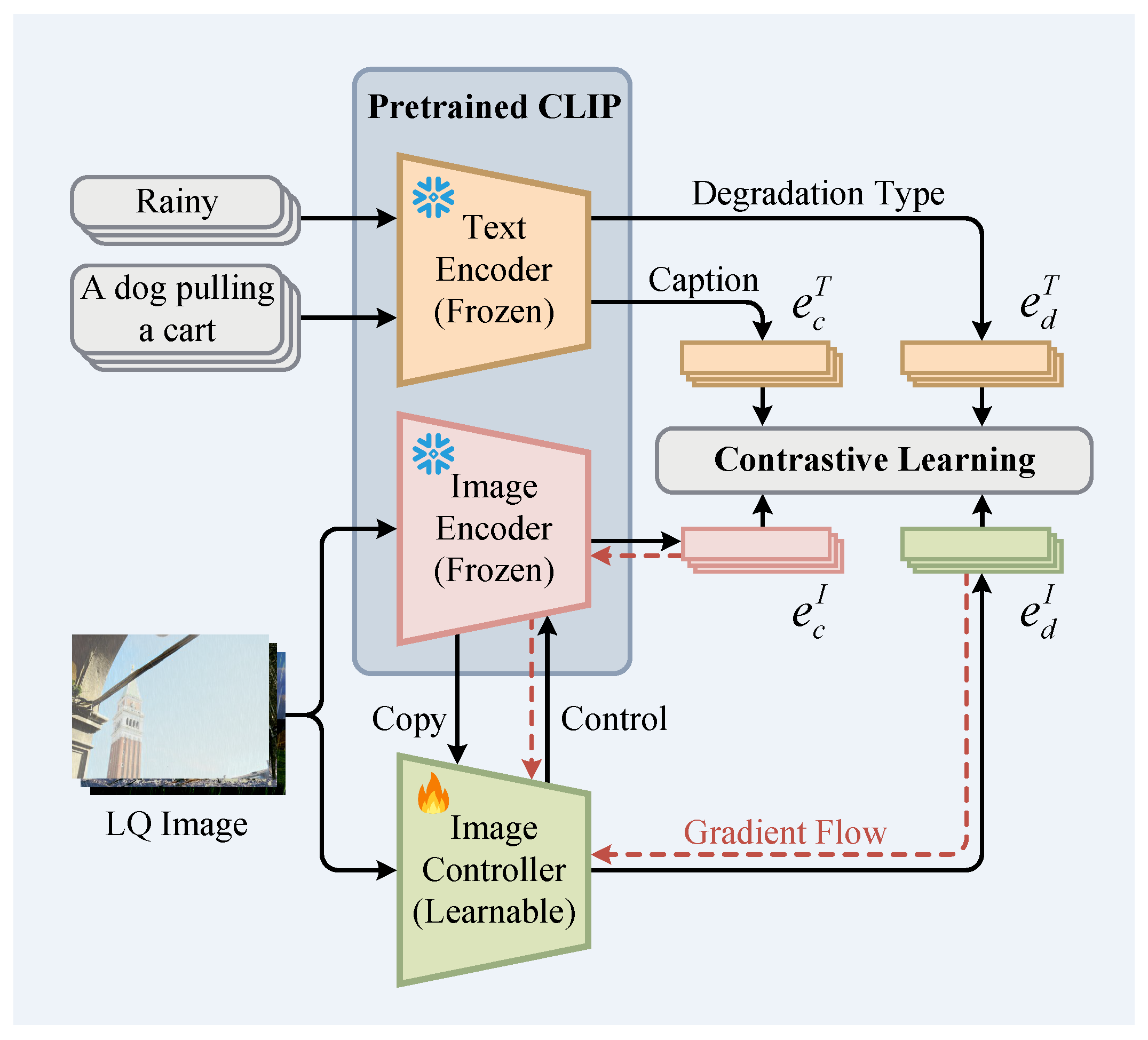
Feature Fusion. VLMs pre-trained on clean images lack robustness to degradation, so their visual features often misalign with textual descriptions in restoration tasks. Recent works inject degradation awareness into the visual branch. Several approaches [29,44] add a parallel image controller (Figure 4) that encodes degradation embeddings from low-quality inputs and fuses them with semantic priors. The primary encoder stays frozen while the controller is fine-tuned, connected by zero-initialized layers for adaptation [198] and optimized with a joint contrastive loss :
where denotes the controller parameters, correspond to content/degradation embeddings, and are embeddings from the clean caption and degradation label.
3.2. Language Branch Adaptation: Bridging Modalities
Standard VLM language branches, built for high-level semantic matching, lack fine-grained degradation information and sensitivity to quality variations. Two adaptation strategies address this: soft prompt tuning, which injects learnable embeddings to steer the semantic space, and instruction tuning, which fine-tunes the model on restoration-specific tasks.
Prompt Learning Strategies. Soft prompt tuning injects continuous, learnable context vectors into the language branch, optimized by gradient descent to capture degradation-specific priors without modifying the core architecture (Figure 3). A common paradigm is two-stage: first learn quality-distinguishing prompts, then use them to guide restoration [27,69]. Given a degraded image x encoded as and prompt vectors t for different image characteristics, the matching probability for the i-th prompt is a softmax-normalized cosine similarity:
The prompts are trained with the cross-entropy loss. During restoration, contrastive learning aligns the restored output with the “clear” prompt embedding. Some methods [37,173] prompt both visual and textual modalities to maintain alignment. Yang et al. [173] address the feature shift from uni-modal prompting by modeling the layer-wise shift .
Instruction Tuning for Restoration. Instruction tuning finetunes VLMs on restoration-centric image–text–image triplets, enabling the language encoder to perceive diverse degradation patterns and understand specific restoration goals; representative datasets are summarized in Table 1. Existing approaches fall into three categories: (1) Agent Instruction Tuning, where the VLM acts as a controller to output restoration task signals [32,74] (Section 4.4); (2) Conditional Generation, where the language model produces soft embeddings to guide a diffusion-based restoration model [76]; and (3) Degradation Prediction, where the VLM predicts degradation labels for a downstream reconstruction network [77] (Section 4.2).
Table 2.
Representative text generation methods.
| Generation approach | Method | Explanation | Utilized VLMs |
|---|---|---|---|
| Direct Generation | RAP-SR [54] | Automatically generates image descriptions using Florence-2. | Florence-2 [199] |
| RamIR [200] | Generates degradation () and clean () embeddings via BLIP. | BLIP [21] | |
| CyclicPrompt [102] | Encodes BLIP descriptions into , combining learnable and visual . | BLIP [21] | |
| LDR [51] | Describes weather types and occluded regions via language instructions. | LISA [201] | |
| Diff-Dehazer [202] | Derives positive prompts by removing “haze” from BLIP-2 descriptions. | BLIP-2 [203] | |
| DA-CLIP [29] | Uses triplets of HQ images, descriptive texts, and degradation labels. | BLIP [21] | |
| Progressive generation | PBI [48] | CogVLM describes masked objects; Mistral-7B rewrites them as addition instructions. | CogVLM [204], Mistral-7B [205] |
| MTGFusion [49] | Encodes six types of GPT-4 text prompts via BLIP into vectors. | GPT-4 [206], BLIP [21] | |
| Chen’s Method [50] | Fuses coarse-grained (BLIP-2) and fine-grained (MiniGPT-4) descriptions via templates. | BLIP-2 [203], MiniGPT-4 [207] | |
| Multi level generation | XPSR [89] | Generates high-level semantic and low-level detail descriptions via LLaVA. | LLaVA [22] |
| PASD [93] | Encodes object/location words (ResNet/YOLO) and scene contents (BLIP). | BLIP [21] | |
| MTGFusion [49] | Generates separate source, shared, and unique descriptions. | GPT-4 [206], BLIP [21] | |
| FILM [95] | Combines scene (BLIP-2), object (GRIT), and mask (SAM) prompts for ChatGPT generation. | BLIP-2 [203], ChatGPT [208] | |
| Region level generation | DreamPaint [209] | Generates descriptive text based on Kosmos-2 object detection boxes. | LLaVA-1.6-Vicuna-7B [187] |
| Anywhere [110] | Generates text descriptions for foreground regions extracted by RMBG-1.4. | Gemini-Pro-Vision [210] |
3.3. Output Head Adaptation: From Tokens to Pixels
Tokenizer–Decoder Framework. Extending VLMs to visual generation requires bridging continuous pixels and discrete token-based LLMs via a codebook tokenizer–decoder. Yu et al. [46] address the limited capacity of traditional VQ-VAE [211] codebooks by reducing embedding dimensions. VILA-U [78] enhances capacity via residual vector quantization, jointly predicting indices from multiple residual stages. To reconcile high-level semantics with fine pixels, TokenFlow [79] shares indexing between semantic and pixel-level codebooks, while SemHiTok [80] uses a hierarchical coarse-semantic codebook with fine-grained pixel sub-codebooks.
Direct Pixel Regression Heads. Beyond discrete tokenization, an alternative line attaches lightweight regression heads that map VLM features directly to continuous pixel values, avoiding the quantization loss of codebook-based decoders. LM4LV [85] keeps the language model frozen and learns only linear adapter layers that regress pixel-level outputs, showing that a frozen LLM can support low-level reconstruction without discrete token prediction. Such heads trade the flexibility of token sequences for higher fidelity on detail-sensitive tasks and remain underexplored relative to tokenizer–decoder designs.
3.4. Parameter-Efficient Fine-Tuning (PEFT) in Restoration
Since direct VLM use is degradation-insensitive and full fine-tuning is costly, PEFT freezes most parameters and tunes lightweight modules to balance generalization and adaptation.
LoRA and Adapter Integration. Adapters [212] and LoRA [213] enable efficient fine-tuning via low-rank matrices or bottleneck layers. Inserting adapters into Transformer layers steers representations toward restoration [47]:
where s is a scaling factor weighting the adapter output. Adapter-based methods also extend pretrained diffusion priors: BIR-Adapter [82] augments diffusion self-attention with a parameter-efficient restoring-attention mechanism for blind restoration without auxiliary extractors; TADiSR [83] adapts diffusion cross-attention layers; and LoRA-IR [35] maps CLIP features to degradation types via fine-tuned experts.
Freezing Strategies. Strategic freezing preserves pre-trained knowledge while allowing adaptation. LM4LV [85] freezes the LLM and tunes only linear adapters for pixel-level details, and Pang et al. [86] show that frozen LLM Transformer blocks can serve as effective visual encoders when paired with trainable linear projection layers.
4. VLM as Auxiliary for Low-Level Vision
As auxiliary modules, VLMs enhance restoration networks with minimal tuning in four roles mapping onto Equation (2): Semantic Providers shape the prior on ; Degradation Interpreters estimate and n; Quality Evaluators supply a no-reference fidelity surrogate; and Intelligent Controllers select the inversion sequence, dividing labor over prior, forward model, objective, and solver. These roles describe what a model does, not how it is implemented: contrastive VLMs supply embeddings, similarities, or probabilities, whereas generative MLLMs produce descriptions, judgments, reasoning, or tool decisions. Both span the provider, interpreter, and evaluator roles; the controller, generative by nature, is MLLM-based as a rule, with contrastive models entering only as scoring sub-components it reads.
4.1. VLM as Semantic Provider
VLM-based semantic generation falls into four categories, summarized in Table 2. First, direct generation constructs explicit image-text pairs to train restoration models, using VLMs such as BLIP [29,44], LLaVA [214], and mPLUG-Owl2 [54] to describe content, scene characteristics, and degradation types; text-only LLMs can further synthesize comprehensive descriptions from image-derived prompts, as in FILM [95]. Second, progressive generation [48,49,50] chains multiple VLMs into a coherent semantic pathway for higher-quality descriptions. Third, multi-level generation [89,92,93,215,216,217] produces prompts capturing both high-level semantics (scene categories, spatial layout) and fine-grained details. Finally, region-level generation [107,110,209] segments images to generate localized descriptions, capturing local features and spatial relationships.
Text-Conditioned Injection. Most works extract semantic or degradation-related embeddings from CLIP, while others use multimodal models for prompts. Diff-Restorer [90] disentangles semantic and degradation features from CLIP, whereas XPSR [89] uses a multimodal model for hierarchical prompts. Injection typically employs cross-attention: VPIP [87] integrates task-specific prompt maps at the U-Net bottom; PromptFix [88] injects user instructions and auxiliary prompts into cross-attention layers (Figure 5); and XPSR [89] uses a Semantic Attention module. To prevent degradation contamination, Diff-Restorer [90] decomposes CLIP embeddings into content and degradation components, and DPIR [91] combines textual prompts with global-local visual prompts as control for diffusion-transformer restoration.
Language-Driven Manipulation. VLMs enable restoration strength and style adjustment via natural-language or numerical prompts. For dynamic routing, LDR [51] uses a degradation map to guide a Mixture-of-Experts for kernel selection, while InstructIR [99] uses an Instruction Condition Block for soft gating. For strength control, SPIRE [100] embeds explicit degradation parameters (e.g., sigma values) into prompts for continuous modulation, and PromptSR [101] allows discrete intensity selection (e.g., heavy/light). Liao et al. [102] extract weather-independent priors to update degradation prompts.
Subject-Aware Restoration. VLMs provide semantic priors that resolve the ill-posed nature of restoration, enabling subject-aware control. EAM [106] detects focal regions (e.g., humans) and generates descriptions, preventing background over-enhancement. HazeCLIP [107] segments sky/non-sky regions via SAM [218] for dehazing prompts. 4KAgent [108] invokes a face-repair pipeline for facial regions while preserving backgrounds (Figure 6). Beyond focal-region enhancement, ClearAIR [26] addresses the all-in-one setting with an MLLM-based quality-assessment module for global degradation evaluation and a semantic guidance unit for region-level analysis.
4.2. VLM as Degradation Interpreter
VLMs function as degradation interpreters through two mechanisms: contrastive VLMs classify or score degradation attributes, while generative MLLMs describe degradation type, severity, and spatial location or produce structured signals.
Degradation Classification. Framing VLMs as degradation classifiers yields high-level descriptors that modulate restoration. A common paradigm extracts semantic features from degraded images [35,53,113,114] and maps them to a probability distribution over degradation categories. To preserve degradation details in CLIP, Ai et al. [35] process both a downsampled image and sliding-window patches and optimized via cross-entropy. Zhang et al. [114] use Q-Align [219] to obtain token probability distributions for haze-level estimation. Alternatively, some methods map VLM-extracted tokens into visual embedding spaces [51,70,111,112]: Wen et al. [70] map degradation type and attribute prompts directly to high-dimensional vectors; Yang et al. [51] use CoT prompts to generate descriptions projected into a degradation prior ; Tan et al. [112] compute layer-wise HQ–LQ CLIP differences for pixel-level and degradation-type priors; and PTG-RM [52] extracts implicit priors to learn a pixel-wise restoration intensity map.
Description-based Restoration. VLMs also evaluate attributes such as brightness and semantic correlations. In Figure 7, GPP-LLIE [119] uses the probability difference between positive and negative tokens to derive continuous scores for contrast, visibility, and sharpness: . LLMCO4MR [120] aligns ancient manuscripts using VLM confidence scores; VLU-Net [53] integrates VLM-derived degradation descriptions into a deep unfolding framework where vision-language gradient guidance drives all-in-one restoration; and PromptGIP [121] reformulates processing as QA-style visual prompts for dynamic task switching.
4.3. VLM as Quality Evaluator
VLMs increasingly serve as quality evaluators: contrastive VLMs score quality by comparing images against antonym prompts in a shared space, whereas generative MLLMs are prompted to produce attribute-level quality judgments.
No-Reference Quality Assessment. VLMs evaluate restoration quality when references are unavailable. CLIP-DQA [122] computes cosine similarity between the generated image and antonymous reference prompts (e.g., “good”/“bad”) in CLIP space. Beyond natural images, EvaNet [123] extends VLM-guided assessment to image fusion via an LLM-informed perceptual assessment. Others [27,32,124,125,126] prompt VLMs to estimate quality-level probabilities and convert them to scores; e.g., Xu et al. [27] classify visibility into five levels and Ma et al. [124] use GPT-4o to score underwater attributes. Aesthetic assessment is also explored [54,56,127]: Wang et al. [54] use mPLUG-Owl2 for aesthetic scoring, and Yin et al. [56] train a reward model from BLIP and human preference data. Li et al. [131] propose R4-CGQA, a CG-specific quality dataset with a two-stream retrieval framework that supplies visually similar CG images.
Semantic Consistency Loss. While VGG-based perceptual loss [220] captures local textures, VLMs encode high-level semantics and aesthetic preferences. CLIP-IQA [129] shows zero-shot assessment, inspiring perceptual distances: CDASR [135] minimizes super-resolution distance in CLIP space, Perceive-IR [73] (Figure 8) uses a CLIP-aware loss with fixed quality prompts (“excellent”/“poor”), and RAVE [136] introduces a CLIP-feature identity loss. These semantic losses are typically combined with pixel-level and VGG losses.
Feedback Loops. VLM-derived quality scores increasingly serve as rewards in reinforcement learning (RL) loops. CURVE [137] computes rewards via CLIP embedding distances; RealSR-R1 [138] uses GRPO [192] with degradation, comprehension, and generation rewards; and LRPO [139] integrates human-preference, perceptual-quality (CLIP-IQA), and fidelity rewards. Xu et al. [140] use a VLM-trained IQA model as the reward with a difficulty-adaptive strategy.
4.4. VLM as Intelligent Controller
Recent studies position MLLMs as central controllers in agent frameworks for multi-degradation restoration. Because planning, tool selection, and reflection are generative by nature, the controller itself is an MLLM, and any contrastive model enters only as a quality-scoring sub-component.
Motivation. Natural images often suffer from concurrent degradations. “All-in-One” models [35,221] address diverse types but trade generalization for accuracy, whereas combining specialized models requires precise orchestration, since improper sequencing can introduce artifacts [75]. MLLMs act as intelligent controllers to select and order these models.
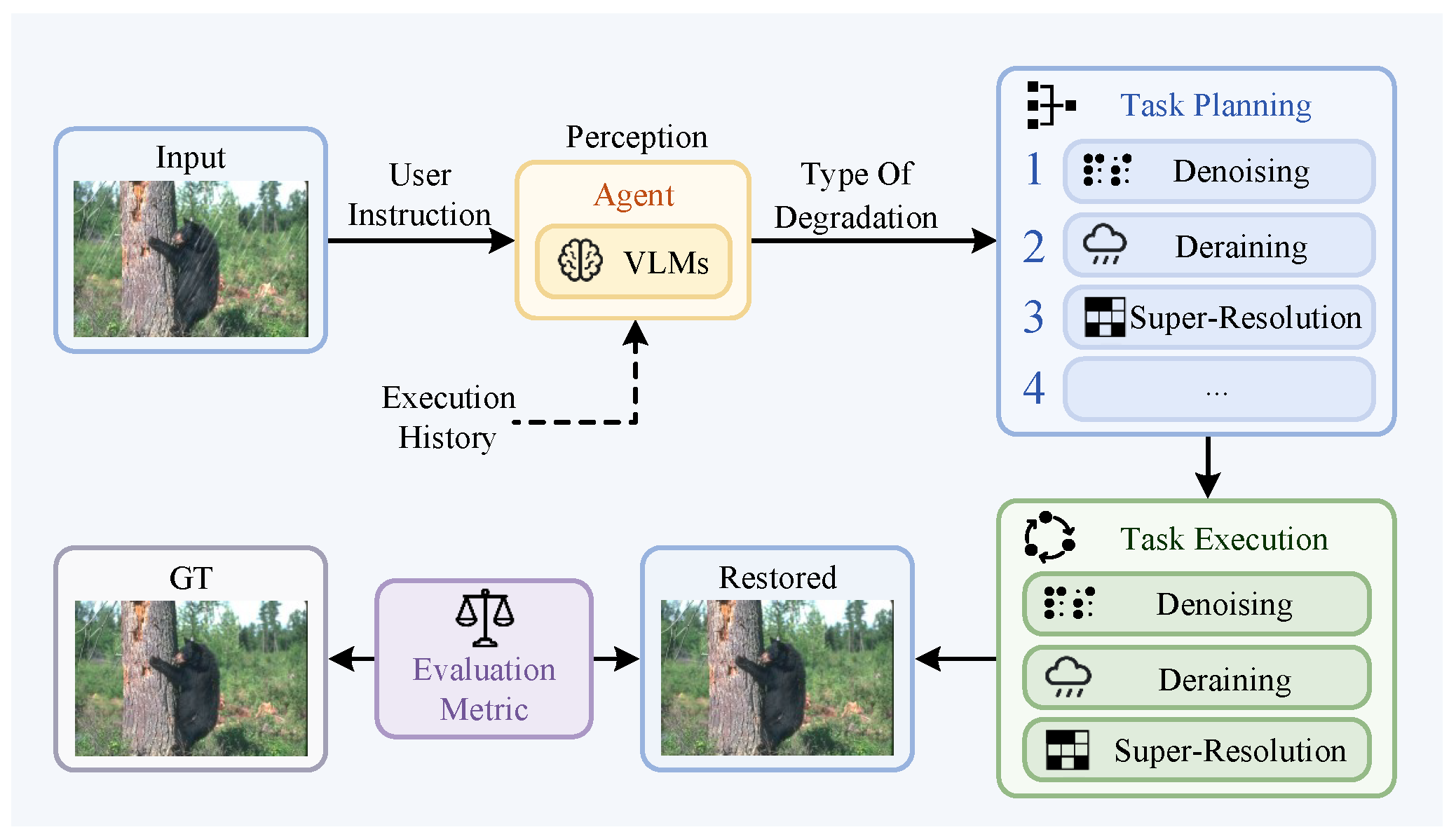
Tool Usage and Orchestration. Agent-based methods [74,75,108,141] structure restoration into degradation perception, sequence optimization, model selection, and execution (Figure 9). Given degradation types and a model library , the objective is an optimal sequence maximizing quality :
Rollback mechanisms mitigate error propagation. Improvements include standardized metrics [75], hierarchical multi-agent designs [31] distinguishing compression, imaging, and scene degradations, and CoT reasoning with greedy search for efficiency [19]. Beyond orchestration, controller reliability can be improved by training: JarvisIR [74] uses supervised fine-tuning on CleanBench followed by human-feedback alignment, which we treat as a canonical mitigation for the text-hallucination failure mode in Section 6.
Figure 9.
A typical pipeline for agent-based image restoration, where dashed lines indicate optional steps [18,32,75].
Iterative Refinement. VLMs refine decisions through multi-turn human interaction. ChatEdit [142] tracks user requests via a dialogue module while an editing module applies modifications to original images to avoid error accumulation; MagicQuill [143] uses a brush-based paradigm that, after each stroke, infers user intent for real-time multi-turn editing.
5. Extended Applications
5.1. Medical Image Processing
Biomedical VLMs. Medical image acquisition relies on complex, physically constrained processes [224], making quality sensitive to hardware and clinical conditions such as radiation-dose limits, and demanding restoration that preserves clinically relevant semantics. While general-domain VLMs are limited by semantic discrepancies in biomedical data, domain-specific pretraining [40,41,225] and large-scale datasets such as PMC-15M [225] have made biomedical vision–language learning feasible (Table 3).
Li et al. [149] proposed LLaVA-Med, pioneering biomedical instruction tuning via curriculum learning. Alkhaldi et al. [146] introduced MiniGPT-Med, a unified interface for report generation and disease detection. VILA-M3 [145] enhances reasoning with feedback from expert models such as VISTA3D [226]. Lin et al. [152] proposed HealthGPT, the first unified VLM for both understanding and generation across modalities, and Chen et al. [151] presented HuatuoGPT-Vision for Chinese medical tasks, supported by PubMedVision.
CT and MRI. MRI encodes hydrogen-proton concentration for soft-tissue visualization, whereas CT encodes tissue density. Chen et al. [156] proposed LangMamba for low-dose CT (LDCT) denoising (Figure 10): a Language-guided AutoEncoder with a frozen medical VLM maps normal-dose CT into an anatomy-enriched semantic space, coupled with a semantic-enhanced denoiser and a dual-space alignment loss. For metal artifact reduction, DuDoCROP [157] uses LLaVA-1.5 [22] for structured descriptions and CLIP for embedding alignment. SCAN-PhysFed [227] uses MiniGPT-Med [146] to extract anatomical information from radiology reports for federated LDCT reconstruction. For fusion, Dong et al. [154] use BLIP-2 embeddings to guide a Restormer-based [17] process. Kim et al. [228] use language embeddings for controllable brain-MRI synthesis across modalities such as FLAIR and T1.
5.2. Remote Sensing Data Processing
Heterogeneous satellite sensors yield increasingly large-scale, diverse data well-suited to the perceptual and reasoning capabilities of VLMs. We organize VLM-based methods into (i) spatial-domain tasks, improving spatial fidelity (e.g., super-resolution, restoration), and (ii) spectral-domain tasks, recovering and enhancing spectral information.
Spatial-domain tasks. VLMs mainly provide semantic evaluation and guidance for spatial restoration and super-resolution. Wolters et al. [55] couple ESRGAN [229] with CLIP-based similarity as a perceptual alternative to PSNR. In Figure 11, Wu et al. [158] integrate CLIP features and learn a degradation vector through wavelet patch contrastive learning, mapped by an MLP to modulation parameters. Chen et al. [159] apply LoRA to adapt CLIP for module-wise semantic guidance maps. PromptHSI [38] converts text prompts into a task descriptor for frequency-domain modulation, whereas MP-HSIR [37] replaces CLIP visual features with learnable visual tokens fused with text prompts.
Spectral-domain tasks. Spectral-domain restoration reconstructs rich hyperspectral signatures from limited spectral bands, a severely ill-posed mapping where VLM priors help disambiguate the few observed channels. Chen et al. [36] proposed LAVER, which modifies CLIP by adding interpolated positional encodings, enabling resolution-flexible semantic guidance for RGB-to-HSI reconstruction.
5.3. Spatiotemporal and Geometric Modality Processing
This section reviews emerging modalities where VLM-based low-level processing remains underexplored.
CAD. CAD drawings are often corrupted by software-version incompatibilities. Tang et al. [33] proposed ChatCAD, the first zero-shot VLM-based CAD restoration system, which simulates the industrial drawing-review workflow via a multi-agent framework that checks engineering-logic consistency and revises drawings when inconsistencies arise.
Table 4.
Common dataset for low-level vision tasks. “Size” reports the official train/validation/test split when available; otherwise, it reports the dataset size or the train/test split specified in the corresponding source.
Table 4.
Common dataset for low-level vision tasks. “Size” reports the official train/validation/test split when available; otherwise, it reports the dataset size or the train/test split specified in the corresponding source.
| Tasks | Datasets | Size | Source | Type | Description |
|---|---|---|---|---|---|
| SR | DIV2K [230] | 800/100/100 | NTIRE 2017 | Syn | A high-resolution image benchmark containing diverse natural scenes with synthetically generated degradations. |
| RealSR [231] | 595 | ICCV 2019 | Real | A real-capture dataset obtained by varying the camera focal length under controlled settings. | |
| DRealSR [232] | 2,507 | ECCV 2020 | Real | A real-world dataset acquired with focal-length adjustments across indoor and outdoor environments. | |
| LLIE | LOLv1 [233] | 485/15 | BMVC 2018 | Real | A real-world paired low-/normal-light dataset collected under diverse illumination conditions. |
| LIME [234] | 10 | TIP 2016 | Real | A real-world low-light image set without paired ground truth, used for no-reference low-light enhancement evaluation. | |
| LOLv2 [235] | 1,589/200 | TIP 2021 | Real&Syn | A combined dataset including real pairs with multi-stage imaging and synthetic pairs using luminance transformations. | |
| Dehaze | RESIDE [236] | 13,000/990 | TIP 2019 | Real&Syn | A dehazing benchmark with synthetic and real subsets, covering diverse indoor/outdoor conditions. |
| NH-Haze [237] | 55 | CVPRW 2020 | Real | A real-captured outdoor dataset using controlled haze machines, providing paired hazy/clear images. | |
| Haze-4K [238] | 4,000 | MM 2021 | Syn | A synthetic benchmark including paired images with their transmission maps and atmospheric light annotations. | |
| Inpainting | CelebA [239] | 200,000 | ICCV 2015 | Real | A large-scale face benchmark with over 10,000 identities, used in semantic inpainting and human-centric restoration. |
| CelebA-HQ [240] | 30,000 | ArXiv 2017 | Real | A high-quality subset of CelebA produced through super-resolution, suitable for high-fidelity face restoration tasks. | |
| MSCOCO [241] | 328,124 | ECCV 2014 | Real | A general-purpose benchmark offering diverse scenes across 91 object categories with segmentation annotations. | |
| Derain | Rain100H [242] | 1,800/100 | CVPR 2017 | Syn | A synthetic benchmark simulating heavy rain streaks with multiple directional patterns for supervised deraining. |
| RainDrop [243] | 861/239 | CVPR 2018 | Real | A real-world dataset by capturing paired images through dual glass surfaces, modeling adherent raindrop. | |
| GT-RAIN [244] | 26,124/2,100 | ECCV 2022 | Real | A real paired deraining dataset with ground-truth clean/rainy pairs captured under controlled non-rain variations. | |
| Deblur | GoPro [245] | 2,103/1,111 | CVPR 2017 | Syn | A motion-blur benchmark with high-frame-rate video capture, approximating camera shake via temporal integration. |
| RealBlur [246] | 3,758/980 | ECCV 2020 | Real | A motion blur dataset acquired using paired short-/long-exposure imaging in both RAW and JPEG formats. | |
| HIDE [247] | 8,422 | ICCV 2019 | Syn | A human-centered dynamic-scene dataset with both near-field and far-field motion. | |
| CT denoising | 2016 NIH-AAPM-Mayo [248] | 5,936 | Med. Phys. 2017 | Real | A dataset with full-dose CT scans from 10 patients, widely used in dose-reduction and denoising studies. |
| Mayo-2016 [249] | 4,800/1,136 | Med. Phys. 2021 | Real | A dataset comprising abdominal CT images with normal-dose and simulated quarter-dose ones from 10 subjects. | |
| Mayo-2020 [249] | 2,400/580 | Med. Phys. 2021 | Real | A dataset with abdominal CT images from 100 patients reconstructed at of the routine radiation dose. |
Video processing tasks. VLM-based video restoration is still nascent. Xu et al. [164] bring language prompts and VLMs to video face restoration with ControlNet [198] for prompt-free generalization, and build the first video-face degradation dataset on CelebV-HQ [250]. GSDiff [165] uses InstructBLIP [251] to describe the first frame’s degradation, supporting generic and medical video reconstruction. Since CLIP-based pulling toward a “haze-free” prompt can induce adversarial behavior (imperceptible changes causing large score swings), Ren et al. [166] (Figure 12) propose a CLIP-regularized dehazing framework that measures the mean discrepancy between hazy and clean videos to guide training.
Table 5.
Results of VLM-guided SR Methods. RealSR uses a same-resolution SR, while DRealSR adopts SR.
Table 5.
Results of VLM-guided SR Methods. RealSR uses a same-resolution SR, while DRealSR adopts SR.
| Methods | RealSR [231] | DRealSR [232] | Params | ||||||
|---|---|---|---|---|---|---|---|---|---|
| PSNR↑ | SSIM↑ | LPIPS↓ | MUSIQ↑ | PSNR↑ | SSIM↑ | LPIPS↓ | MUSIQ↑ | [M] | |
| LR Image | 27.80 | 0.7928 | 0.3356 | 34.40 | 28.02 | 0.8374 | 0.4410 | 20.54 | N/A |
| CoSeR [252] | 21.24 | 0.6109 | 0.2438 | 70.29 | 19.95 | 0.5350 | 0.2702 | 70.18 | 720+1936 |
| XPSR [89] | 24.19 | 0.6870 | 0.3517 | 70.23 | 26.62 | 0.7220 | 0.3864 | 67.84 | 868+1066 |
| PASD [93] | 25.93 | 0.7105 | 0.2806 | 65.60 | 29.09 | 0.7937 | 0.2893 | 34.63 | 361+1314 |
| MegaSR [94] | 23.49 | 0.6903 | 0.3072 | 70.03 | 25.74 | 0.7367 | 0.3258 | 64.14 | — |
| PURE [215] | 22.83 | 0.6079 | 0.3821 | 72.37 | 24.73 | 0.6459 | 0.3452 | 73.28 | 7000 |
Table 6.
Results of VLM-guided Denoising Methods, where denotes the noise level. Values are reported in PSNR / SSIM.
Table 6.
Results of VLM-guided Denoising Methods, where denotes the noise level. Values are reported in PSNR / SSIM.
| Methods | CBSD68 [253] | Urban100 [254] | Params | ||||
|---|---|---|---|---|---|---|---|
| [M] | |||||||
| Noised Image | 24.84/0.592 | 20.54/0.418 | 15.00/0.219 | 24.95/0.629 | 20.69/0.480 | 15.18/0.292 | N/A |
| InstructIR-3D [99] | 34.15/0.933 | 31.52/0.890 | 28.30/0.804 | 34.12/0.945 | 31.80/0.917 | 28.63/0.861 | 16+17 |
| TextPromptIR [255] | 34.17/0.936 | 31.52/0.893 | 28.26/0.805 | 34.76/0.951 | 32.54/0.929 | 29.47/0.882 | 124+110 |
| CLIPDenoising [256] | 33.97/0.930 | 31.02/0.878 | 26.69/0.731 | 33.15/0.930 | 30.72/0.893 | 26.27/0.769 | 11+9 |
| VLU-Net [53] | 34.13/0.935 | 31.48/0.892 | 28.23/0.804 | 34.92/0.952 | 32.71/0.930 | 29.61/0.883 | 35+88 |
| DFPIR [257] | 34.32/0.934 | 31.71/0.897 | 28.49/0.814 | 34.79/0.952 | 32.57/0.930 | 29.53/0.883 | 31+63 |
Table 7.
Results of VLM-Guided Multi-Weather Image Restoration Methods.
| Methods | Snow100K-L [258] | Outdoor-Rain [259] | RainDrop [243] | Params | |||
|---|---|---|---|---|---|---|---|
| PSNR↑ | SSIM↑ | PSNR↑ | SSIM↑ | PSNR↑ | SSIM↑ | [M] | |
| Degraded Image | 18.67 | 0.6468 | 12.89 | 0.5293 | 23.81 | 0.8363 | N/A |
| MPerceiver [260] | 31.11 | 0.9180 | 31.25 | 0.9246 | 33.62 | 0.9300 | — |
| ADSM [70] | 30.81 | 0.9058 | 31.28 | 0.9227 | 30.71 | 0.9188 | — |
| VLCIR [45] | 32.28 | 0.9296 | 32.62 | 0.9447 | 33.39 | 0.9489 | — |
| CyclicPrompt [102] | 32.16 | 0.9265 | 32.81 | 0.9371 | 32.57 | 0.9454 | 30+486 |
| M2Restore [113] | 31.20 | 0.9110 | 32.01 | 0.9550 | 31.73 | 0.9430 | — |
Table 8.
Results of VLM-Guided Low-Light Image Enhancement Methods.
| Methods | LOLv1 [233] | LOLv2-Real [235] | LIME [234] | Params | ||||
|---|---|---|---|---|---|---|---|---|
| PSNR↑ | SSIM↑ | LPIPS↓ | PSNR↑ | SSIM↑ | LPIPS↓ | NIQE↓ | [M] | |
| Low-Light Image | 7.77 | 0.191 | 0.417 | 9.72 | 0.196 | 0.394 | 4.351 | N/A |
| NeRCo [261] | 22.95 | 0.785 | 0.311 | 25.17 | 0.785 | 0.338 | 3.803 | 46+102 |
| CFWD [66] | 29.19 | 0.872 | 0.197 | 29.86 | 0.891 | 0.193 | 3.568 | 22+151 |
| CLIP-LLA [262] | 22.66 | 0.882 | 0.140 | 20.23 | 0.844 | 0.164 | — | 2+151 |
| HVI-CIDNet+ [263] | 28.85 | 0.894 | 0.058 | 24.31 | 0.873 | 0.107 | 3.760 | 69+246 |
| GPP-LLIE [119] | 27.51 | 0.872 | 0.081 | 29.23 | — | 0.055 | 4.24 | 76+55 |
Table 9.
Results of VLM-Guided Image Deraining Methods.
| Methods | Rain100H [242] | Rain100L [242] | Test100 [264] | Params | Time | |||
|---|---|---|---|---|---|---|---|---|
| PSNR↑ | SSIM↑ | PSNR↑ | SSIM↑ | PSNR↑ | SSIM↑ | [M] | [s] | |
| Rainy Image | 12.13 | 0.344 | 25.52 | 0.814 | 21.11 | 0.640 | N/A | N/A |
| DA-CLIP [29] | 27.07 | 0.817 | 34.50 | 0.948 | 27.95 | 0.857 | 49+125 | 10.898 |
| TVI-Derain [47] | 30.51 | 0.893 | 37.72 | 0.973 | 31.17 | 0.912 | 20+278 | — |
| TexDepth-Derain [265] | 33.97 | 0.949 | 41.97 | 0.991 | — | — | 26+1469 | — |
| PTG-RM-cRestormer [52] | 31.77 | 0.913 | 39.27 | 0.985 | 32.30 | 0.934 | 27+86 | 0.142 |
| AWRaCLe [266] | 27.20 | 0.840 | 35.70 | 0.966 | 27.58 | 0.860 | 35+151 | 0.221 |
Table 10.
Results of VLM-guided Image Editing Methods.
| Methods | MagicBrush [267] | AnyEdit [268] | Params | Time | ||||
|---|---|---|---|---|---|---|---|---|
| L1↓ | DINO↑ | CVS↑ | L1↓ | DINO↑ | CVS↑ | [B] | [s] | |
| ML-MGIE [76] | 0.083 | 84.54 | 90.70 | 0.211 | 60.31 | 78.85 | 0.86+7.43 | 5.11 |
| InstructPix2Pix [269] | 0.101 | 71.46 | 85.22 | 0.167 | 65.93 | 77.90 | 0.86+0.12 | 7.76 |
| ICEdit [270] | 0.088 | 84.37 | 90.17 | 0.163 | 66.66 | 80.90 | 12.00+4.82 | 9.95 |
| UltraEdit-SD3 [271] | 0.042 | 87.90 | 89.70 | 0.152 | 70.50 | 80.43 | 2.00+5.52 | 3.09 |
| AnySD [268] | 0.066 | 88.10 | 87.60 | 0.148 | 72.45 | 81.68 | 0.86+0.12 | 3.16 |
| EditMGT [272] | 0.109 | 76.96 | 86.22 | 0.147 | 68.80 | 82.74 | 1.01+3.70 | 12.75 |
3D processing tasks. VLMs are emerging as priors for 3D geometry and appearance recovery. DepthLM [273] uses vision-language features for metric depth prediction to reduce geometric ambiguity. For 3D completion, VP-LLM [167] formulates volume completion as token prediction, whereas VLScene [168] distills vision–language guidance into camera-based semantic completion for robustness against occlusion (Figure 13). SRSplat [169] addresses super-resolution Gaussian splatting from sparse inputs using VLM-assisted priors, and SpatialStack [274] proposes a hierarchical fusion of vision, geometry, and language, in contrast with the late-stage fusion. For text-driven 3D editing, where naive per-view conditioning disrupts geometric consistency, Instruct-NeRF2NeRF [171] applies instruction-following 2D diffusion edits as view-wise supervision while enforcing cross-view coherence, and GaussCtrl [170] uses ControlNet-style conditioned diffusion to stabilize multi-view-consistent editing of Gaussian splats.
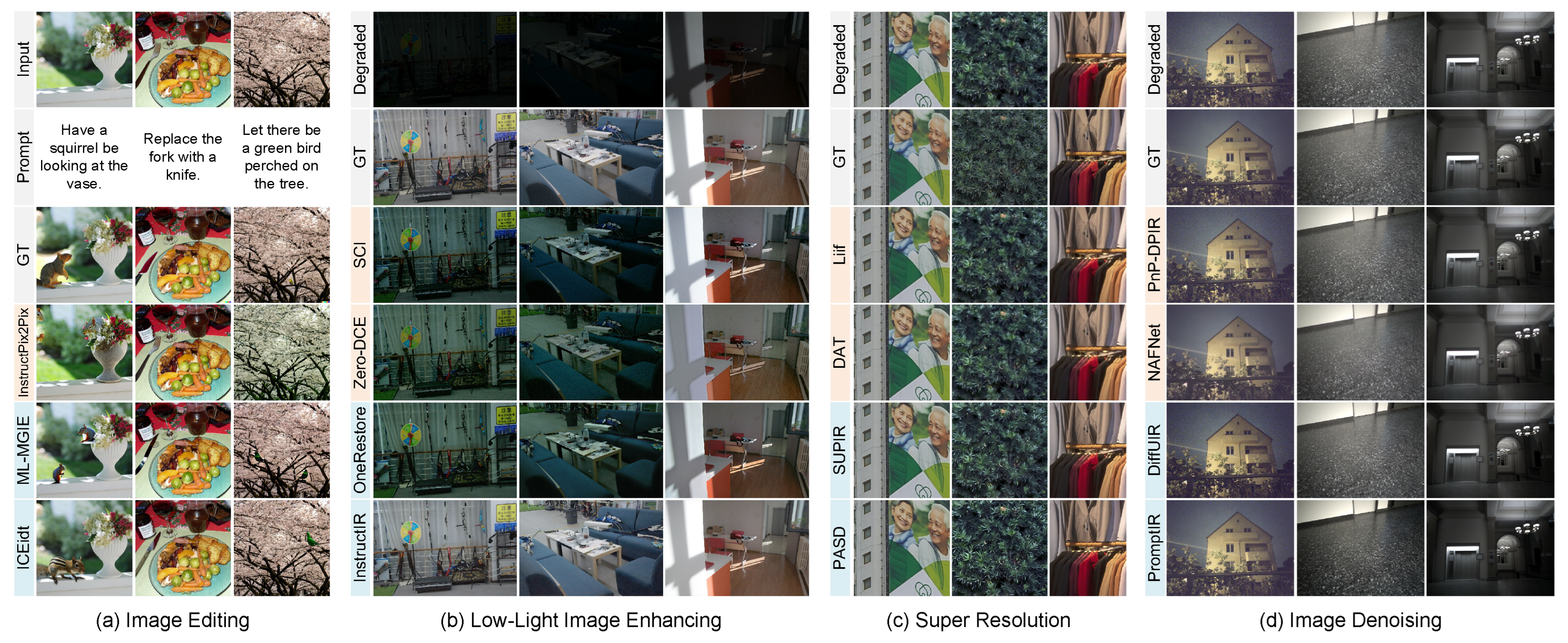
Figure 14.
Image-level qualitative comparisons across four representative low-level vision tasks. Orange rows denote conventional task-specific models, while blue rows denote VLM-guided methods.
Figure 14.
Image-level qualitative comparisons across four representative low-level vision tasks. Orange rows denote conventional task-specific models, while blue rows denote VLM-guided methods.
6. Experiments
Protocol and caveats. The reported numbers are curated summaries from the original papers or public results, not a unified re-implementation: the methods differ in training data, parameters, degradation settings, and inference protocols. Hence, we use them for trend-level comparison rather than absolute ranking, and mark unreported values with “—”.
6.1. Datasets
Pre-training datasets. Among open corpora, LAION-5B [275] is the largest (∼5.85B image–text pairs, of which 2.32B are English and 2.26B span over 100 languages); Conceptual Captions (CC3M/CC12M) [276] provide 3M and ∼12M English pairs, SBU Captions [277] 1M Flickr pairs, and MS COCO Captions [278]∼120K images with 600K human-written descriptions. Proprietary corpora are typically larger: ALIGN [23] (∼1.8B pairs), Florence [279] (FLD-900M), Flamingo [280] (M3W, 185M), and PaLI [281] (WebLI, ∼10B images across 109 languages).
Low-level vision datasets. Table 4 summarizes task-specific datasets for important tasks. VLM-based approaches emphasize adaptation on real-world data, typically fine-tuning pre-trained models to address degradation.
6.2. Evaluation metrics
Distortion-based metrics. PSNR quantifies pixel-wise disparity via mean squared error, and SSIM assesses similarity across contrast, brightness, and structure.
Inception-based metrics. LPIPS [282] uses a pretrained AlexNet to emulate human perception, while FID [283] measures the fidelity and diversity of generated images via the Fréchet distance to reference images.
No-reference quality assessment. MUSIQ [284] handles resolution via multi-scale design, MANIQA [130] uses multi-dimensional attention for local-global cues, and CLIP-IQA [129] leverages CLIP to align with human perception.
Downstream application-based evaluations. Beyond visual quality, evaluation increasingly measures the utility of enhanced images for high-level tasks, e.g., mean Average Precision (mAP) for detection and accuracy for classification.
Instruction-based editing metrics. For image editing, following MGIE [76], L1 measures pixel-level distance to the target, while DINO and CVS measure visual similarity to the target via DINO and CLIP features.
Figure 15.
Framework-level analysis of VLM-guided restoration. (a) Text-driven controllability: given the same input, different prompt sequences yield distinct restoration outputs, a capability unique to VLM-guided frameworks. (b) Mixed rain-and-haze and (c) mixed low-light-and-haze degradations: three frameworks (OneRestore, AutoDIR, InstructIR) respond to four different prompts on the same input, demonstrating fine-grained text-conditioned control under compound degradations.
Figure 15.
Framework-level analysis of VLM-guided restoration. (a) Text-driven controllability: given the same input, different prompt sequences yield distinct restoration outputs, a capability unique to VLM-guided frameworks. (b) Mixed rain-and-haze and (c) mixed low-light-and-haze degradations: three frameworks (OneRestore, AutoDIR, InstructIR) respond to four different prompts on the same input, demonstrating fine-grained text-conditioned control under compound degradations.
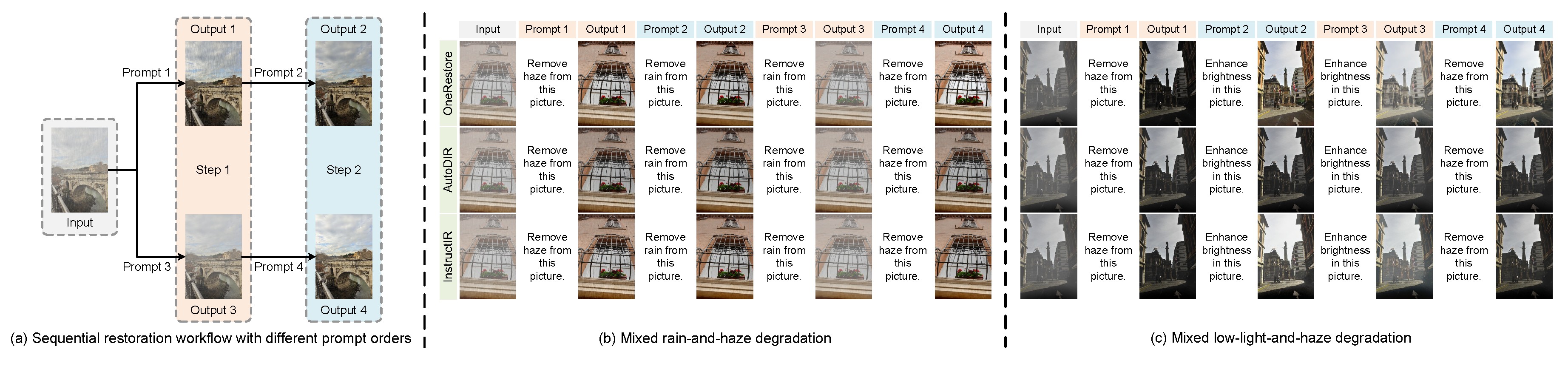
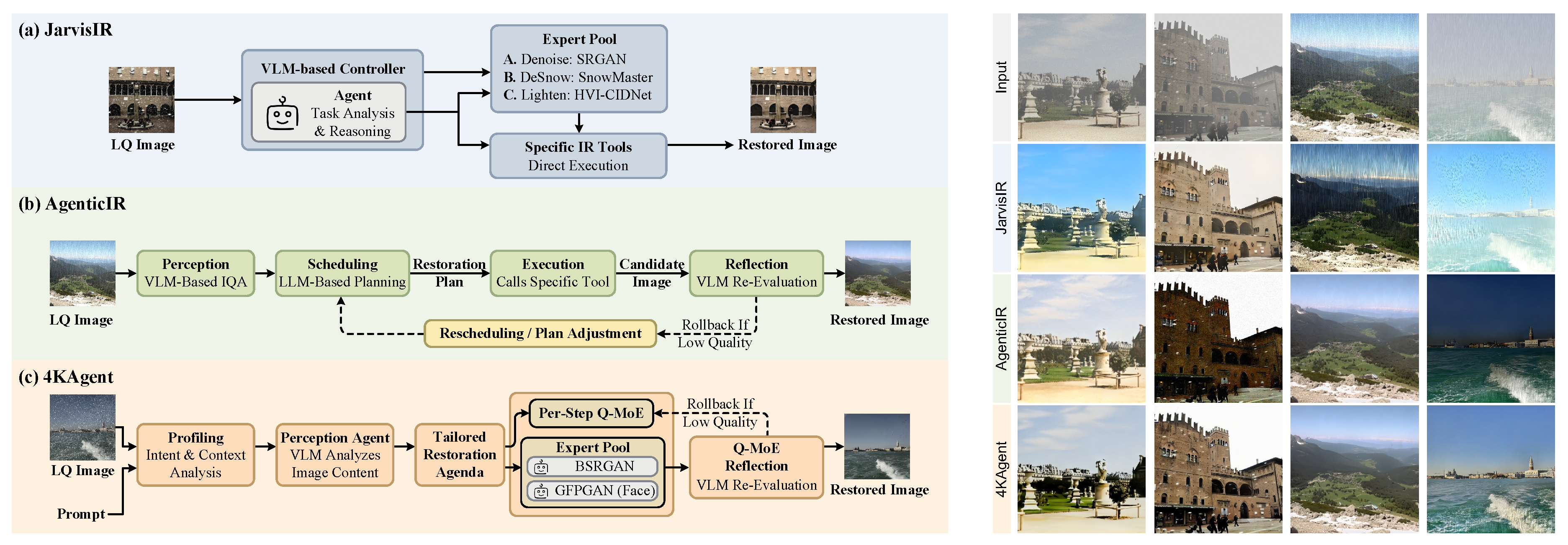
Figure 16.
Paradigm-level visualization of agentic restoration workflows. (Left) Architectures of three representative VLM-driven agents: JarvisIR, AgenticIR, and 4KAgent. (Right) Corresponding qualitative results on the same low-quality inputs.
Figure 16.
Paradigm-level visualization of agentic restoration workflows. (Left) Architectures of three representative VLM-driven agents: JarvisIR, AgenticIR, and 4KAgent. (Right) Corresponding qualitative results on the same low-quality inputs.
6.3. Experimental Results
Params are reported as backbone+auxiliary (in millions, M; billions, B in Table 10).
Results on super-resolution. On RealSR [231] and DRealSR [232] (Table 5), PASD [93] attains the highest PSNR via pixel-level cross-attention, while PURE [215] leads on MUSIQ [284] by combining structural and semantic cues. Qualitatively (Figure 14(c)), VLM-guided methods (SUPIR, PASD) recover finer textures than conventional ones (Liif).
Results on denoising. On CBSD68 [253] and Urban100 [254] (Table 6), DFPIR [257] achieves the best overall results on CBSD68, while VLU-Net [53] leads on the structure-rich Urban100. TextPromptIR [255] also remains competitive across noise levels. Figure 14(d) shows VLM-guided methods (DiffUIR, PromptIR) preserve more structural detail under heavy noise than conventional baselines (DPIR).
Results on multi-weather image restoration. On Snow100K-L [258], Outdoor-Rain [259], and RainDrop [243] (Table 7), VLCIR [45] performs well for snow removal, while CyclicPrompt [102] shows strong deraining by leveraging a rain-free prior for second-stage refinement.
Results on low-light enhancement. On LOLv1 [233], LIME [234], and LOLv2-Real [235] (Table 8), CFWD [66] achieves the best PSNR and NIQE through multimodal guidance within a diffusion-based framework. In Figure 14(b), VLM-guided methods (OneRestore, InstructIR) recover brightness and color fidelity in dark regions.
Results on deraining. On Rain100H [242], Rain100L [242], and Test100 [264] (Table 9), TexDepth-Derain [265] reports the highest PSNR/SSIM on Rain100H and Rain100L, while PTG-RM-cRestormer [52] achieves the best Test100 performance by leveraging CLIP-derived spatial priors. Inference time (Table 9, last column) varies by over an order of magnitude: prior-injection methods like PTG-RM stay near 0.1–0.2 s, whereas DA-CLIP, querying a CLIP model per image, exceeds 10 s, showing that VLM coupling dominates runtime more than the backbone.
Results on image editing. On MagicBrush [267] and AnyEdit [268] (Table 10), UltraEdit-SD3 [271] shows good edit fidelity on MagicBrush, AnySD [268] strong semantic alignment on AnyEdit, and ML-MGIE [76] stable performance across both. Figure 14(a) shows VLM-guided editors (InstructPix2Pix, ML-MGIE) follow free-form instructions such as “Have a squirrel be looking at the vase”. For editing (Table 10, last column), methods run at a few seconds per image, with diffusion-transformer designs (e.g., EditMGT) the slowest, reflecting multi-step sampling rather than the VLM call.
Framework-level analysis: text-driven controllability under mixed degradations. Beyond image-level metrics, VLM-guided frameworks offer text-driven controllability. In Figure 15(a), the same input under different prompt sequences (“Prompt 1→2” vs. “Prompt 3→4”) yields distinct restoration trajectories, which is inaccessible to task-specific models. Figure 15(b,c) compares OneRestore, AutoDIR, and InstructIR under mixed rain-and-haze and low-light-and-haze degradations, showing that these frameworks adapt to each prompt’s intent rather than merely handling compound degradations.
Paradigm-level analysis: agentic restoration workflows. At the paradigm level, recent works orchestrate multiple restoration tools via agents (Figure 16): JarvisIR uses a controller–expert design dispatching inputs to specific IR tools; AgenticIR runs a closed loop of Perception → Scheduling → Execution → Reflection with rollback on insufficient quality; and 4KAgent adds a profiling stage and a per-step Q-MoE module. Progressively more sophisticated agentic designs yield better detail recovery and fewer artifacts.
Failure case analysis. Current VLM-guided methods still exhibit characteristic failure modes (Figure 17, Table 11). (a) Text hallucination: the VLM perceives objects but not textual content, over-associating with semantic priors and distorting characters on signs. (b) Noise introduction: the agent commits to a plan from the initial degradation assessment and leaves residual noise introduced by intermediate tools uncorrected. (c) Limited generative recovery: under severe compound degradations, insufficient generative capacity yields blurry or incomplete reconstructions. (d) Zero-shot failure: unseen degradation types are not generalized. These failure modes motivate the directions in Section 7.
7. Future Directions
While VLMs have advanced low-level vision, current methods remain dominated by the VLM as Auxiliary paradigm, with end-to-end Direct VLM Adaptation still nascent. We outline research vectors to bridge the granularity gap between semantic reasoning and pixel-level reconstruction.
7.1. Advancing VLM Architectures for Low-Level Vision
Bridging the semantic-pixel granularity gap. A core bottleneck is the dimensionality mismatch between VLM latent spaces and the pixel-space requirements of restoration [79,80,288]. Beyond simple cross-attention, learnable hierarchical tokenization with unified codebooks could jointly encode coarse semantics (e.g., “foggy cityscape”) and fine high-frequency details (e.g., edge textures), letting VLMs reason about degradation globally while modulating local pixels via texture-aware decoders, a promising step toward a unified “All-in-One” restoration foundation model.
From guided restoration to direct generation. Most methods use VLMs to guide a separate diffusion or CNN backbone. A transformative direction empowers VLMs as direct generative engines for degradation removal, akin to DALL-E 2 [289] or GPT-4o [290], by extending discrete autoregressive prediction to continuous pixels via regression heads or integrated latent-diffusion decoders. Since naively adding high-level generative tasks can compromise detail-sensitive restoration [291], new objectives must synthesize restorations without hallucinating structural artifacts, reducing the error propagation of cascaded systems.
The perception-distortion tradeoff. Blau and Michaeli [292] show that distortion and perceptual realism cannot be jointly optimized beyond a point, which explains why the LR input leads on PSNR/SSIM in Table 5 while generative methods lead on LPIPS/MUSIQ. VLMs sharpen this tension: the semantic priors that enable realistic reconstructions also drive the hallucinations of Section 6. The goal is thus not to win both ends but to make the operating point controllable and to report both metric families explicitly.
7.2. Expanding VLM Capabilities and Applications
Restoration for downstream machine perception. Most research optimizes human perceptual quality (e.g., LPIPS, FID), yet in autonomous driving and surveillance the consumer is a machine. In machine-centric restoration, VLMs act as differentiable proxies for downstream tasks [8,293]; aligning restoration with the perception model’s semantic feature space [11] prioritizes features critical for recognition (e.g., edge distinctness) over human aesthetics.
Physically-informed multimodal prompting. Beyond descriptive prompts (e.g., “remove rain”), future systems should encode explicit physical constraints, prompting VLMs with physical parameters (scattering coefficients, ISO noise levels, sensor response) or non-visual modalities such as LiDAR depth, thermal, or audio [294] within an embodied framework [295,296], improving fidelity in ill-posed problems like underwater imaging or dehazing.
Quality-conditioned manifold learning. A complementary direction treats perceptual quality and degradation level as controllable axes of the latent manifold. Quality-conditioned approaches [286,287] steer generation toward a target quality, suggesting a restoration model conditioned on a continuous quality coordinate that traverses from degraded to clean states. Formalizing such a manifold, parameterized by VLM-derived quality estimates, could unify assessment and restoration and address the limited-generative-recovery failure of Section 6.
7.3. Optimizing VLM Performance and Deployment
Degradation-aware parameter-efficient tuning. While LoRA and Adapters have been widely adopted, they are often generic and agnostic to the spatial inductive biases required for image restoration [35,297]. Future research should investigate degradation-aware efficient tuning, where trainable modules are specifically designed to interact with the high-frequency components of the VLM’s visual encoder. Furthermore, exploring neural architecture search [298] to automatically identify optimal insertion points for adapters within massive VLMs could maximize restoration performance while minimizing computational overhead.
Data-efficient learning from unpaired priors. The dependence on massive paired datasets [20,23] is a barrier to scalability. A promising avenue is leveraging the pre-trained priors of VLMs to facilitate unsupervised or weakly-supervised learning [11]. By exploiting the rich semantic consistency inherent in CLIP or LLaVA, future models could learn to restore images by maximizing the semantic alignment between the output and a distinct “clean” text prompt. Techniques such as intelligent contrastive negative sampling [14] or distillation from larger models [299] can effectively distill restoration capabilities from the VLM’s zero-shot knowledge without requiring pixel-perfect ground truth pairs.
7.4. Addressing Inherent Challenges and New Paradigms
Self-evolving and test-time adaptation. Training on paired synthetic data often leads to poor generalization on real-world degradations due to domain gaps [300]. VLMs offer a unique opportunity for Test-Time Adaptation as a new paradigm [301]. Future work should explore optimization objectives that leverage the pre-trained semantic consistency of VLMs as a supervision signal during inference. By dynamically minimizing the semantic discrepancy between the degraded input and the restored output in the VLM’s feature space, models can adapt to specific noise distributions or degradation combinations on the fly, significantly enhancing robustness in open-world scenarios. A closely related route is self-evolution, in which the model generates its own training signal without human labels. EvoQuality [133] demonstrates this for no-reference quality assessment via pairwise voting and relative-reward updates; extending such label-free self-improvement from quality assessment to quality restoration remains open, since the supervisory signal for pixel reconstruction is harder to bootstrap than a ranking objective.
Trustworthiness and explainable restoration. As VLMs are deployed in safety-critical domains like medical imaging (CT/MRI) and forensic analysis, black-box restoration is insufficient [11]. Future frameworks must address the risk of hallucination by providing explainable degradation reasoning [302], where the model articulates its diagnosis of image quality issues and justifies its restoration strategy via CoT prompting. Additionally, developing human-in-the-loop interactive agents [24,303] that allow users to spatially refine restoration results through natural language feedback, correcting artifacts or adjusting enhancement strength in real-time, will be essential for establishing trust in clinical and professional workflows [27] under real-world conditions.
Convergence with Vision-Language-Action models. As Vision-Language-Action (VLA) models extend VLMs with action outputs for embodied agents, low-level vision becomes a robustness prerequisite rather than a downstream consumer: corrupted or degraded visual inputs propagate directly into action errors. Recent work restores corrupted observations before action prediction to harden VLA policies [304], and broader analyses identify input robustness and perception reliability as open challenges guiding VLA development [305]. A promising direction is to co-design restoration and action heads, so the restoration objective is shaped by downstream control performance and the VLA’s action confidence signals which regions warrant restoration, tightening the loop between low-level vision and embodied decision-making.
8. Conclusions
This survey organizes VLM-based low-level vision into two paradigms: Direct VLM Adaptation, which refactors visual encoders and prompts to handle degradations end-to-end, and VLM as Auxiliary, where VLMs act as Semantic Providers, Degradation Interpreters, Quality Evaluators, or Intelligent Controllers. While VLMs bring strong zero-shot generalization and semantic consistency, particularly in domains such as medical imaging and remote sensing, aligning high-level linguistic representations with the fine-grained fidelity required for reconstruction remains the central bottleneck. As the field moves from cascaded guidance toward unified foundation models, balancing computational efficiency, physical grounding, and explainability will be key. We hope this survey and its taxonomy inspire future work on robust, open-world restoration; to support ongoing research, we maintain a continuously updated repository of VLM-based low-level vision resources.
Funding
This work was supported in part by the Foundation Fighting Blindness (BR-CL-0621-0812-DUKE) and Research to Prevent Blindness (Unrestricted Grant to Duke University).
Conflicts of Interest
The authors declare no conflicts of interest.
References
- Yang, W.; Zhou, F.; Zhu, R.; Fukui, K.; Wang, G.; Xue, J.H. Deep learning for image super-resolution. Neurocomputing 2020, 398, 291–292. [Google Scholar] [CrossRef]
- Saharia, C.; Ho, J. Image super-resolution via iterative refinement. IEEE Trans. Pattern Anal. Mach. Intell. 2022, 713–726. [Google Scholar]
- Biyouki, S.A.; Hwangbo, H. A comprehensive survey on deep neural image deblurring. arXiv 2023, arXiv:2310.04719. [Google Scholar]
- He, C.; Zhang, R.; Chen, Z.; Yang, B.; Fang, C.; Lin, Y.; Xiao, F.; Farsiu, S. UnfoldLDM: Deep Unfolding-based Blind Image Restoration with Latent Diffusion Priors. arXiv 2025, arXiv:2511.18152. [Google Scholar]
- Liu, Y.; Zhao, G.; Gong, B.; Li, Y.; Raj, R.; Goel, N.; Kesav, S.; Gottimukkala, S.; Wang, Z.; Ren, W.; et al. Improved techniques for learning to dehaze and beyond: A collective study. arXiv 2018, arXiv:1807.00202. [Google Scholar]
- Fang, C.; He, C.; Xiao, F.; Zhang, Y.; Tang, L.; Zhang, Y.; Li, K.; Li, X. Real-world Image Dehazing with Coherence-based Label Generator and Cooperative Unfolding Network. NeurIPS 2024. [Google Scholar]
- Xia, B.; Zhang, Y.; Wang, S.; Wang, Y.; Wu, X.; Tian, Y.; Yang, W.; Van Gool, L. DiffIR: Efficient diffusion model for image restoration. In Proceedings of the ICCV, 2023; pp. 13095–13105. [Google Scholar]
- He, C.; Li, K.; Xu, G.; Zhang, Y.; Hu, R.; Guo, Z.; Li, X. Degradation-resistant unfolding network for heterogeneous image fusion. In Proceedings of the ICCV, 2023; pp. 12611–12621. [Google Scholar]
- Xu, G.; He, C.; Wang, H.; Zhu, H.; Ding, W. DM-Fusion: Deep Model-Driven Network for Heterogeneous Image Fusion. IEEE Trans. Neural Netw. Learn. Syst. 2023. [Google Scholar]
- He, C.; Fang, C.; Zhang, Y.; Ye, T.; Li, K.; Tang, L.; Guo, Z.; Li, X.; Farsiu, S. Reti-Diff: Illumination degradation image restoration with Retinex-based latent diffusion model. ICLR, 2025. [Google Scholar]
- He, C.; Zhang, R.; Xiao, F.; Fang, C.; Tang, L.; Zhang, Y.; Farsiu, S. UnfoldIR: Rethinking Deep Unfolding Network in Illumination Degradation Image Restoration. CVPR, 2026. [Google Scholar]
- Kaur, A.; et al. A complete review on image denoising techniques for medical images. NPL 2023, 55, 7807–7850. [Google Scholar] [CrossRef]
- Han, L.; Zhao, Y.; Lv, H.; Zhang, Y.; Liu, H.; Bi, G. Remote sensing image denoising based on deep and shallow feature fusion and attention mechanism. Remote Sens. 2022, 14, 1243. [Google Scholar] [CrossRef]
- He, C.; Li, K.; Zhang, Y.; Zhang, Y.; Guo, Z.; Li, X. Strategic Preys Make Acute Predators: Enhancing Camouflaged Object Detectors by Generating Camouflaged Objects. ICLR, 2024. [Google Scholar]
- Dong, C.; Loy, C.C.; He, K.; Tang, X. Image super-resolution using deep convolutional networks. IEEE Trans. Pattern Anal. Mach. Intell. 2015, 38, 295–307. [Google Scholar] [CrossRef]
- Zhang, K.; Zuo, W.; Chen, Y.; Meng, D.; Zhang, L. Beyond a Gaussian denoiser: Residual learning of deep CNN for image denoising. IEEE Trans. Image Process. 2017, 26, 3142–3155. [Google Scholar] [CrossRef] [PubMed]
- Zamir, S.W.; Arora, A.; Khan, S.; Hayat, M.; Khan, F.S.; Yang, M.H. Restormer: Efficient transformer for high-resolution image restoration. In Proceedings of the CVPR, 2022; pp. 5728–5739. [Google Scholar]
- Zhu, K.; Gu, J.; You, Z.; Qiao, Y.; Dong, C. An Intelligent Agentic System for Complex Image Restoration Problems. arXiv 2024, arXiv:2410.17809. [Google Scholar]
- Zhou, Y.; Cao, J.; Zhang, Z.; Wen, F.; Jiang, Y.; Jia, J.; Liu, X.; Min, X.; Zhai, G. Q-Agent: Quality-Driven Chain-of-Thought Image Restoration Agent through Robust Multimodal Large Language Model. arXiv 2025, arXiv:2504.07148. [Google Scholar]
- Radford, A.; Kim, J.W.; Hallacy, C.; Ramesh, A.; Goh, G.; Agarwal, S.; Sastry, G.; Askell, A.; et al. Learning transferable visual models from natural language supervision. In Proceedings of the ICML, 2021; pp. 8748–8763. [Google Scholar]
- Li, J.; Li, D.; Xiong, C.; Hoi, S. BLIP: Bootstrapping language-image pre-training for unified vision-language understanding and generation. In Proceedings of the ICML, 2022; pp. 12888–12900. [Google Scholar]
- Liu, H.; Li, C.; Li, Y.; Lee, Y.J. Improved baselines with visual instruction tuning. In Proceedings of the CVPR, 2024; pp. 26296–26306. [Google Scholar]
- Jia, C.; Yang, Y.; Xia, Y.; Chen, Y.T.; Parekh, Z.; Pham, H.; Le, Q.; Sung, Y.H.; Li, Z.; Duerig, T. Scaling up visual and vision-language representation learning with noisy text supervision. In Proceedings of the ICML. PMLR, 2021; pp. 4904–4916. [Google Scholar]
- Yi, X.; Xu, H.; Zhang, H.; Tang, L.; Ma, J. Text-IF: Leveraging semantic text guidance for degradation-aware and interactive image fusion. In Proceedings of the CVPR, 2024; pp. 27026–27035. [Google Scholar]
- Yu, Y.; Du, D.; Zhang, L.; Luo, T. Unbiased multi-modality guidance for image inpainting. In Proceedings of the ECCV, 2022; pp. 668–684. [Google Scholar]
- Zhang, X.; Zhang, H.; Wang, G.; Zhang, Q.; Zhang, L. ClearAIR: A Human-Visual-Perception-Inspired All-in-One Image Restoration. In Proceedings of the AAAI, 2026. [Google Scholar]
- Xu, J.; Wu, M.; Hu, X.; Fu, C.W.; Dou, Q.; Heng, P.A. Towards Real-World Adverse Weather Image Restoration: Enhancing Clearness and Semantics with Vision-Language Models. In Proceedings of the ECCV, 2024; pp. 147–164. [Google Scholar]
- Morawski, I.; He, K.; Dangi, S.; Hsu, W.H. Leveraging Content and Context Cues for Low-Light Image Enhancement. IEEE Trans. Multimedia 2025. [Google Scholar]
- Luo, Z.; Gustafsson, F.K.; Zhao, Z.; Sjölund, J.; Schön, T.B. Controlling vision-language models for multi-task image restoration. arXiv 2023, arXiv:2310.01018. [Google Scholar]
- Lei, X.; Zhang, W.; Luo, B.; Liang, H.; Cao, W.; Lin, Q. DACESR: Degradation-Aware Conditional Embedding for Real-World Image Super-Resolution. arXiv 2026, arXiv:2602.23890. [Google Scholar]
- Jiang, X.; Li, G.; Chen, B.; Zhang, J. Multi-Agent Image Restoration. arXiv 2025, arXiv:2503.09403. [Google Scholar]
- Li, B.; Li, X.; Lu, Y.; Chen, Z. Hybrid agents for image restoration. arXiv 2025, arXiv:2503.10120. [Google Scholar]
- Tang, J.; Xiao, H.; Li, X.; Wang, W.; Gong, Z. ChatCAD: An MLLM-Guided Framework for Zero-shot CAD Drawing Restoration. In Proceedings of the ICASSP, 2025; pp. 1–5. [Google Scholar]
- Wu, H.; Zhang, Z.; Zhang, E.; Chen, C.; Liao, L.; Wang, A.; Xu, K.; Li, C.; Hou, J.; Zhai, G.; et al. Q-Instruct: Improving low-level visual abilities for multi-modality foundation models. In Proceedings of the CVPR, 2024; pp. 25490–25500. [Google Scholar]
- Ai, Y.; Huang, H.; He, R. LoRA-IR: Taming Low-Rank Experts for Efficient All-in-One Image Restoration. arXiv 2024, arXiv:2410.15385. [Google Scholar]
- Chen, B.; Chen, K.; Liu, L.; Shi, Z.; Zou, Z. Leveraging language-aligned visual knowledge for remote sensing image spectral super-resolution. In Proceedings of the WHISPERS, 2024; pp. 1–5. [Google Scholar]
- Wu, Z.; Chen, Y.; Yokoya, N.; He, W. MP-HSIR: A Multi-Prompt Framework for Universal Hyperspectral Image Restoration. arXiv 2025, arXiv:2503.09131. [Google Scholar]
- Lee, C.M.; Cheng, C.H.; Lin, Y.F.; Cheng, Y.C.; Liao, W.T.; Hsu, C.C.; Yang, F.E.; Wang, Y.C.F. PromptHSI: Universal hyperspectral image restoration framework for composite degradation. arXiv 2024, arXiv:2411.15922. [Google Scholar]
- Eslami, S.; de Melo, G.; Meinel, C. Does CLIP benefit visual question answering in the medical domain as much as it does in the general domain? arXiv 2021, arXiv:2112.13906. [Google Scholar]
- Eslami, S.; Meinel, C.; De Melo, G. PubmedCLIP: How much does CLIP benefit visual question answering in the medical domain? In Proceedings of the EACL, 2023; pp. 1181–1193. [Google Scholar]
- Boecking, B.; Usuyama, N.; Bannur, S.; Castro, D.C.; Schwaighofer, A.; Hyland, S.; Wetscherek, M.; Naumann, T.; Nori, A.; Alvarez-Valle, J.; et al. Making the most of text semantics to improve biomedical vision–language processing. In Proceedings of the ECCV, 2022; pp. 1–21. [Google Scholar]
- Zhang, Z.; Shen, H.; Zhao, T.; Guan, Z.; Chen, B.; Wang, Y.; Jia, X.; Cai, Y.; Shang, Y.; Yin, J. ImageRAG: Enhancing Ultra High Resolution Remote Sensing Imagery Analysis with ImageRAG. arXiv 2024, arXiv:2411.07688. [Google Scholar]
- Ranzinger, M.; Heinrich, G.; Molchanov, P.; Kautz, J.; Catanzaro, B.; Tao, A. FeatSharp: Your Vision Model Features, Sharper. arXiv 2025, arXiv:2502.16025. [Google Scholar]
- Luo, Z.; Gustafsson, F.K.; Zhao, Z.; Sjölund, J.; Schön, T.B. Photo-realistic image restoration in the wild with controlled vision-language models. In Proceedings of the CVPR, 2024; pp. 6641–6651. [Google Scholar]
- Shao, M.; Liu, W.; Li, Q.; Meng, L. Controlling vision-language model for enhancing image restoration. IVC 2025, 105538. [Google Scholar] [CrossRef]
- Yu, L.; Lezama, J.; Gundavarapu, N.B.; Versari, L.; Sohn, K.; Minnen, D.; Cheng, Y.; Birodkar, V.; Gupta, A.; Gu, X.; et al. Language Model Beats Diffusion–Tokenizer is Key to Visual Generation. arXiv 2023, arXiv:2310.05737. [Google Scholar]
- Yang, Q.; Li, P.; Jin, J.; Jin, G.; Song, T.; Fan, S.; Hou, H. Textual-visual interaction for enhanced single image deraining using adapter-tuned VLMs. Vis. Comput. 2026, 42, 193. [Google Scholar] [CrossRef]
- Wasserman, N.; Rotstein, N.; Ganz, R.; Kimmel, R. Paint by inpaint: Learning to add image objects by removing them first. arXiv 2024, arXiv:2404.18212. [Google Scholar]
- Wang, Z.; Zhao, L.; Zhang, J.; Song, R.; Song, H.; Meng, J.; Wang, S. Multi-Text Guidance Is Important: Multi-Modality Image Fusion via Large Generative Vision-Language Model. Int. J. Comput. Vis. 2025, 1–23. [Google Scholar] [CrossRef]
- Chen, X.; Bai, C.; Wu, Z.; Wu, X.; Zou, Q.; Xia, Y.; Wang, S. Coarse-to-fine text injecting for realistic image super-resolution. Neurocomputing 2025, 129591. [Google Scholar] [CrossRef]
- Yang, H.; Pan, L.; Yang, Y.; Liang, W. Language-driven all-in-one adverse weather removal. In Proceedings of the CVPR, 2024; pp. 24902–24912. [Google Scholar]
- Xu, X.; Kong, S.; Hu, T.; Liu, Z.; Bao, H. Boosting image restoration via priors from pre-trained models. In Proceedings of the CVPR, 2024; pp. 2900–2909. [Google Scholar]
- Zeng, H.; Wang, X.; Chen, Y.; Su, J.; Liu, J. Vision-Language Gradient Descent-driven All-in-One Deep Unfolding Networks. In Proceedings of the CVPR, 2025; pp. 7524–7533. [Google Scholar]
- Wang, J.; Fan, Q.; Chen, J.; Gu, H.; Huang, F.; Ren, W. RAP-SR: RestorAtion Prior Enhancement in Diffusion Models for Realistic Image Super-Resolution. In Proceedings of the AAAI; 2025; Vol. 39, pp. 7727–7735. [Google Scholar] [CrossRef]
- Wolters, P.; Bastani, F.; Kembhavi, A. Zooming out on zooming in: Advancing super-resolution for remote sensing. arXiv 2023, arXiv:2311.18082. [Google Scholar]
- Yin, J.; He, Y.; Zhang, M.; Zeng, P.; Wang, T.; Lu, S. PromptLnet: Region-adaptive aesthetic enhancement via prompt guidance in low-light enhancement net. arXiv 2025, arXiv:2503.08276. [Google Scholar]
- Yin, S.; Fu, C.; Zhao, S.; Li, K.; Sun, X. A survey on multimodal large language models. NSR 2024, 11, nwae403. [Google Scholar] [CrossRef] [PubMed]
- Zhang, J.; Huang, J.; Jin, S.; Lu, S. Vision-language models for vision tasks: A survey. IEEE Trans. Pattern Anal. Mach. Intell. 2024. [Google Scholar]
- Ghosh, A.; Acharya, A.; Saha, S.; Jain, V.; Chadha, A. Exploring the frontier of vision-language models: A survey of current methodologies and future directions. arXiv 2024, arXiv:2404.07214. [Google Scholar]
- Danish, S.; Sadeghi-Niaraki, A.; Khan, S.U.; Dang, L.M.; Tightiz, L.; Moon, H. A comprehensive survey of vision-language models: Pretrained models, fine-tuning, prompt engineering, adapters, and benchmark datasets. Inf. Fusion 2025, 103623. [Google Scholar]
- Jiang, J.; Zuo, Z.; Wu, G.; Jiang, K.; Liu, X. A survey on all-in-one image restoration: Taxonomy, evaluation and future trends. IEEE Trans. Pattern Anal. Mach. Intell. 2025. [Google Scholar]
- Liu, M.; Shu, H.; Cui, Y.; Zhou, X.; Cao, H.; Ren, W.; Shi, B.; Knoll, A.C. Language-Driven Image Restoration and Semantic-Aware Quality Assessment: A Survey. 2026. [Google Scholar] [CrossRef] [PubMed]
- Zhang, J.; Cheng, S.; Sun, Q.; Liu, J.; Luyang, W.; Feng, C.; Fang, C.; et al. Ultra High-Resolution Image Inpainting with Patch-Based Content Consistency Adapter. In Proceedings of the ICCV; 2025; pp. 16991–17000. [Google Scholar] [CrossRef]
- Liu, Z.; Zhu, L.; Shi, B.; Zhang, Z.; Lou, Y.; Yang, S.; Xi, H.; Cao, S.; Gu, Y.; Li, D.; et al. NVILA: Efficient frontier visual language models. In Proceedings of the CVPR, 2025; pp. 4122–4134. [Google Scholar]
- Wei, Y.; Zhang, Y.; Li, K.; Wang, F.; Tang, S.; Zhang, Z. Leveraging vision-language prompts for real-world image restoration and enhancement. Comput. Vis. Image Underst. 2025, 250, 104222. [Google Scholar]
- Xue, M.; He, J.; Wang, W.; Zhou, M. Low-light image enhancement via CLIP-Fourier guided wavelet diffusion. arXiv 2024, arXiv:2401.03788. [Google Scholar]
- Liang, Z.; Li, C.; Zhou, S.; Feng, R.; Loy, C.C. Iterative Prompt Learning for Unsupervised Backlit Image Enhancement. In Proceedings of the ICCV, 2023; pp. 8060–8069. [Google Scholar]
- Chang, Z.; Weng, S.; Zhang, P.; Li, Y.; Li, S.; Shi, B. L-CAD: Language-based Colorization with Any-level Descriptions using Diffusion Priors. In Proceedings of the NeurIPS; 2023; Vol. 36, pp. 77174–77186. [Google Scholar] [CrossRef]
- Morawski, I.; He, K.; Dangi, S.; Hsu, W.H. Unsupervised Image Prior via Prompt Learning and CLIP Semantic Guidance for Low-Light Image Enhancement. In Proceedings of the CVPR, 2024; pp. 5971–5981. [Google Scholar]
- Wen, Y.; Gao, T.; Li, Z.; Zhang, J.; Zhang, K.; Chen, T. All-in-one Weather-degraded Image Restoration via Adaptive Degradation-aware Self-prompting Model. IEEE Trans. Multimedia 2025. [Google Scholar]
- Shao, M.; Liu, Y.; Cheng, Y.; Wan, Y.; Wang, C. Adaptive Fuzzy Degradation Perception Based on CLIP Prior for All-in-one Image Restoration. IEEE Trans. Fuzzy Syst. 2024. [Google Scholar]
- Li, X.; Liu, J.; Chen, Z.; Zou, Y.; Ma, L.; Fan, X.; Liu, R. Contourlet residual for prompt learning enhanced infrared image super-resolution. In Proceedings of the ECCV; Springer, 2024; pp. 270–288. [Google Scholar]
- Zhang, X.; Ma, J.; Wang, G.; Zhang, Q.; Zhang, H.; Zhang, L. Perceive-IR: Learning to perceive degradation better for all-in-one image restoration. IEEE Trans. Image Process. 2025. [Google Scholar]
- Lin, Y.; Lin, Z.; Chen, H.; Pan, P.; Li, C.; Chen, S.; Wen, K.; Jin, Y.; Li, W.; Ding, X. JarvisIR: Elevating autonomous driving perception with intelligent image restoration. In Proceedings of the CVPR, 2025; pp. 22369–22380. [Google Scholar]
- Chen, H.; Li, W.; Gu, J.; Ren, J.; Chen, S.; Ye, T.; Pei, R.; Zhou, K.; et al. RestoreAgent: Autonomous image restoration agent via multimodal large language models. arXiv 2024, arXiv:2407.18035. [Google Scholar]
- Fu, T.J.; Hu, W.; Du, X.; Wang, W.Y.; Yang, Y.; Gan, Z. Guiding instruction-based image editing via multimodal large language models. arXiv 2023, arXiv:2309.17102. [Google Scholar]
- Duan, H.; Min, X.; Wu, S.; Shen, W.; Zhai, G. UniProcessor: a text-induced unified low-level image processor. In Proceedings of the ECCV. Springer, 2024; pp. 180–199. [Google Scholar]
- Wu, Y.; Zhang, Z.; Chen, J.; Tang, H.; Li, D.; Fang, Y.; Zhu, L.; Xie, E.; et al. VILA-U: a unified foundation model integrating visual understanding and generation. arXiv 2024, arXiv:2409.04429. [Google Scholar]
- Qu, L.; Zhang, H.; Liu, Y.; Wang, X.; Jiang, Y.; Gao, Y.; Ye, H.; Du, D.K.; et al. Tokenflow: Unified image tokenizer for multimodal understanding and generation. In Proceedings of the CVPR, 2025; pp. 2545–2555. [Google Scholar]
- Chen, Z.; Wang, C.; Chen, X.; Xu, H.; Huang, R.; Zhou, J.; Han, J.; Xu, H.; Liang, X. SemHiTok: A unified image tokenizer via semantic-guided hierarchical codebook for multimodal understanding and generation. arXiv 2025, arXiv:2503.06764. [Google Scholar]
- Zhu, L.; Wei, F.; Lu, Y. Beyond Text: Frozen Large Language Models in Visual Signal Comprehension. In Proceedings of the CVPR, 2024; pp. 27047–27057. [Google Scholar]
- Eteke, C.; Griessel, A.; Kellerer, W.; Steinbach, E. BIR-Adapter: A Low-Complexity Diffusion Model Adapter for Blind Image Restoration. arXiv 2025, arXiv:2509.06904. [Google Scholar]
- Hu, Q.; Fan, L.; Luo, Y.; Yu, Y.; Guo, X.; Fan, Q. Text-Aware Real-World Image Super-Resolution via Diffusion Model with Joint Segmentation Decoders. arXiv 2025, arXiv:2506.04641. [Google Scholar]
- Fang, Y.; Chen, Y.; Yin, S.; Hu, Q.; Yao, J.; Zhang, Y.; Zhang, X.; Wang, Y. One-Step Diffusion Transformer for Controllable Real-World Image Super-Resolution. In Proceedings of the CVPR, 2026. [Google Scholar]
- Zheng, B.; Gu, J.; Li, S. LM4LV: A frozen large language model for low-level vision tasks. arXiv 2024, arXiv:2405.15734. [Google Scholar]
- Pang, Z.; Xie, Z.; Man, Y.; Wang, Y.X. Frozen transformers in language models are effective visual encoder layers. arXiv 2023, arXiv:2310.12973. [Google Scholar]
- Chen, X.; Liu, Y.; Pu, Y.; Zhang, W.; Zhou, J.; Qiao, Y.; Dong, C. Learning a low-level vision generalist via visual task prompt. In Proceedings of the ACM MM, 2024; pp. 2671–2680. [Google Scholar]
- Zeng, Z.; Hua, H.; Fu, J.; Luo, J.; et al. PromptFix: You Prompt and We Fix the Photo. NeurIPS 2024, 37, 40000–40031. [Google Scholar] [CrossRef]
- Qu, Y.; Yuan, K.; Zhao, K.; Xie, Q.; Hao, J.; Sun, M.; Zhou, C. XPSR: Cross-modal priors for diffusion-based image super-resolution. In Proceedings of the ECCV. Springer, 2024; pp. 285–303. [Google Scholar]
- Zhang, Y.; Zhang, H.; Chai, X.; Cheng, Z.; Xie, R.; Song, L.; Zhang, W. Diff-Restorer: Unleashing visual prompts for diffusion-based universal image restoration. arXiv 2024, arXiv:2407.03636. [Google Scholar]
- Kong, D.; Li, F.; Wang, Z.; Xu, J.; Pei, R.; Li, W.; Ren, W. Dual Prompting Image Restoration with Diffusion Transformers. In Proceedings of the CVPR, 2025. [Google Scholar]
- Jiang, Y.; Zhang, Z.; Xue, T.; Gu, J. AutoDIR: Automatic all-in-one image restoration with latent diffusion. In Proceedings of the ECCV, 2024; pp. 340–359. [Google Scholar]
- Yang, T.; Wu, R.; Ren, P.; Xie, X.; Zhang, L. Pixel-aware stable diffusion for realistic image super-resolution and personalized stylization. In Proceedings of the ECCV, 2024; pp. 74–91. [Google Scholar]
- Li, X.; Wu, J.; Huang, X.; Chen, C.; Guan, W.; Hua, X.S.; Nie, L. MegaSR: Mining Customized Semantics and Expressive Guidance for Image Super-Resolution. arXiv 2025, arXiv:2503.08096. [Google Scholar]
- Zhao, Z.; Deng, L.; Bai, H.; Cui, Y.; Zhang, Z.; Zhang, Y.; Qin, H.; Chen, D.; Zhang, J.; Wang, P.; et al. Image fusion via vision-language model. arXiv 2024, arXiv:2402.02235. [Google Scholar]
- Fei, S.; Ye, T.; Wang, L.; Zhu, L. LucidFlux: Caption-Free Universal Image Restoration via a Large-Scale Diffusion Transformer. In Proceedings of the ICLR, 2026. [Google Scholar]
- Jiang, L.; Liu, X.; Tong, X.; Li, Z.; Liu, J.; Tang, J.; Wu, G. Disentangled Textual Priors for Diffusion-based Image Super-Resolution. In Proceedings of the CVPR, 2026. [Google Scholar]
- Sung, M.; Ham, S.; Kim, K.; Yoon, Y.; Yun, S.; Kim, I.M.; Kang, J.M. GLYPH-SR: Can We Achieve Both High-Quality Image Super-Resolution and High-Fidelity Text Recovery via VLM-guided Latent Diffusion Model? arXiv 2025, arXiv:2510.26339. [Google Scholar]
- Conde, M.V.; Geigle, G.; Timofte, R. InstructIR: High-quality image restoration following human instructions. In Proceedings of the ECCV, 2024; pp. 1–21. [Google Scholar]
- Qi, C.; Tu, Z.; Ye, K.; Delbracio, M.; Milanfar, P.; Chen, Q.; Talebi, H. SPIRE: Semantic prompt-driven image restoration. In Proceedings of the ECCV, 2024; pp. 446–464. [Google Scholar]
- Chen, Z.; Zhang, Y.; Gu, J.; Yuan, X.; Kong, L.; Chen, G.; Yang, X. Image super-resolution with text prompt diffusion. arXiv 2023, arXiv:2311.14282. [Google Scholar]
- Liao, R.; Li, F.; Wei, Y.; Shi, Z.; Zhang, L.; Bai, H.; Wang, M. Prompt to Restore, Restore to Prompt: Cyclic Prompting for Universal Adverse Weather Removal. arXiv 2025, arXiv:2503.09013. [Google Scholar]
- Zhang, C.; Yang, W.; Li, X.; Han, H. MMGInpainting: Multi-modality guided image inpainting based on diffusion models. IEEE Trans. Multimedia 2024. [Google Scholar]
- Li, Y.; Bian, Y.; Ju, X.; Zhang, Z.; Shan, Y.; Zou, Y.; Xu, Q. BrushEdit: All-in-one image inpainting and editing. arXiv 2024, arXiv:2412.10316. [Google Scholar]
- Chiu, M.T.; Zhou, Y.; Zhang, L.; Lin, Z.; Barnes, C.; Amirghodsi, S.; Shechtman, E.; Shi, H. Brush2Prompt: Contextual Prompt Generator for Object Inpainting. In Proceedings of the CVPR, 2024; pp. 12636–12645. [Google Scholar]
- Xie, H.; Du, K.; Yan, Q.; Lu, S.; Han, J.; Chen, H.; Hu, H.; Hu, J. EAM: Enhancing Anything with Diffusion Transformers for Blind Super-Resolution. arXiv 2025, arXiv:2505.05209. [Google Scholar]
- Wang, R.; Li, W.; Liu, X.; Li, C.; Zhang, Z.; Min, X.; Zhai, G. HazeCLIP: Towards language guided real-world image dehazing. In Proceedings of the ICASSP. IEEE, 2025; pp. 1–5. [Google Scholar]
- Zuo, Y.; Zheng, Q.; Wu, M.; Jiang, X.; Li, R.; Wang, J.; Zhang, Y.; Mai, G.; Wang, L.V.; Zou, J.; et al. 4KAgent: Agentic Any Image to 4K Super-Resolution. arXiv 2025, arXiv:2507.07105. [Google Scholar]
- Yu, F.; Gu, J.; Li, Z.; Hu, J.; Kong, X.; Wang, X.; He, J.; et al. Scaling up to excellence: Practicing model scaling for photo-realistic image restoration in the wild. In Proceedings of the CVPR, 2024; pp. 25669–25680. [Google Scholar]
- Xie, T.; Ma, R.; Wang, Q.; Ye, X.; Liu, F.; Tai, Y.; Zhang, Z.; Wang, L.; Yi, Z. Anywhere: A Multi-Agent Framework for User-Guided, Reliable, and Diverse Foreground-Conditioned Image Generation. In Proceedings of the AAAI; 2025; Vol. 39, pp. 7410–7418. [Google Scholar] [CrossRef]
- Zhang, R.; Yang, Z.; Pan, L. DehazeMamba: Large multi-modal model guided single image dehazing via mamba. Vis. Intell. 2025, 3, 11. [Google Scholar]
- Tan, Z.; Wu, Y.; Liu, Q.; Chu, Q.; Lu, L.; Ye, J.; Yu, N. Exploring the application of large-scale pre-trained models on adverse weather removal. IEEE Trans. Image Process. 2024. [Google Scholar]
- Wang, Y.; Li, Y.; Zheng, Z.; Zhang, X.P.; Wei, M. M2Restore: Mixture-of-Experts-based Mamba-CNN Fusion Framework for All-in-One Image Restoration. arXiv 2025, arXiv:2506.07814. [Google Scholar]
- Zhang, R.; Yang, H.; Yang, Y.; Fu, Y.; Pan, L. LMHaze: Intensity-aware Image Dehazing with a Large-scale Multi-intensity Real Haze Dataset. In Proceedings of the MM Asia, 2024; pp. 1–1. [Google Scholar]
- Huang, X.; Zhang, Q.; Hu, J.F.; Zheng, W.S. CLIP-RestoreX: Restore Image Structure and Perception in Exposure Correction. In Proceedings of the AAAI; 2025; Vol. 39, pp. 3760–3768. [Google Scholar] [CrossRef]
- Cai, J.; Yang, K.; Ding, J.; Fu, L.; Ouyang, L.; Li, J.; Shen, J.; Meng, Z. Degradation-Aware Image Enhancement via Vision-Language Classification. arXiv 2025, arXiv:2506.05450. [Google Scholar]
- Lan, Y.; Cui, Z.; Luo, X.; Liu, C.; Wang, N.; Zhang, M.; Su, Y.; Liu, D. When Schrödinger Bridge Meets Real-World Image Dehazing with Unpaired Training. In Proceedings of the ICCV, 2025; pp. 8756–8765. [Google Scholar]
- Kim, J.H.; Cho, P.H.; Kim, C.; Min, J.; Lee, J.; Park, J.; Choi, Y.; Kim, S. UniT: Unified Diffusion Transformer for High-fidelity Text-Aware Image Restoration. In Proceedings of the ICLR, 2026. [Google Scholar]
- Zhou, H.; Dong, W.; Liu, X.; Zhang, Y.; Zhai, G.; Chen, J. Low-light image enhancement via generative perceptual priors. In Proceedings of the AAAI; 2025; Vol. 39, pp. 10752–10760. [Google Scholar] [CrossRef]
- Zhang, Y.; Li, H.; Zhang, S.; Wang, R.; He, B.; Dou, H.; Yan, J.; Zhang, Y.; Wu, F. LLMCO4MR: LLMs-Aided Neural Combinatorial Optimization for Ancient Manuscript Restoration from Fragments with Case Studies on Dunhuang. In Proceedings of the ECCV. Springer; 2024; pp. 253–269. [Google Scholar]
- Liu, Y.; Chen, X.; Ma, X.; Wang, X.; Zhou, J.; Qiao, Y.; Dong, C. Unifying Image Processing as Visual Prompting Question Answering. In Proceedings of the ICML, 2024; pp. 30873–30891. [Google Scholar]
- Zeng, Y.; Fu, J.; Amirpour, H.; Wang, H.; Yue, G.; Liu, H.; Chen, Y.; Zhou, W. CLIP-DQA: Blindly Evaluating Dehazed Images from Global and Local Perspectives Using CLIP. arXiv 2025, arXiv:2502.01707. [Google Scholar]
- Cheng, C.; Xu, T.; Wu, X.J.; Zhou, T.; Li, H.; Tang, Z.; Kittler, J. EvaNet: Towards More Efficient and Consistent Infrared and Visible Image Fusion Assessment. IEEE Trans. Pattern Anal. Mach. Intell. 2026. [Google Scholar]
- Ma, Y.; Xia, F.; Lin, L.; Guan, X. LEGO: LLM-enhanced genetic optimization for underwater robot image restoration. Pattern Recognit. 2025, 111782. [Google Scholar]
- Cai, Z.; Zhang, J.; Yuan, X.; Jiang, P.T.; Chen, W.; Tang, B.; Yao, L.; Wang, Q.; Chen, J.; Li, B. Q-Ponder: A Unified Training Pipeline for Reasoning-based Visual Quality Assessment. arXiv 2025, arXiv:2506.05384. [Google Scholar]
- Lai, J.; Chen, S.; Lin, Y.; Ye, T.; Liu, Y.; et al. SnowMaster: Comprehensive Real-world Image Desnowing via MLLM with Multi-Model Feedback Optimization. In Proceedings of the CVPR, 2025; pp. 4302–4312. [Google Scholar]
- Ai, Y.; Zhou, X.; Huang, H.; Han, X.; Chen, Z.; You, Q.; Yang, H. DreamClear: High-Capacity Real-World Image Restoration with Privacy-Safe Dataset Curation. NeurIPS 2024, 37, 55443–55469. [Google Scholar] [CrossRef]
- Deng, J.; Wu, X.; Yang, Y.; Zhu, C.; Wang, S.; Wu, Z. Acquire and then Adapt: Squeezing out Text-to-Image Model for Image Restoration. arXiv 2025, arXiv:2504.15159. [Google Scholar]
- Wang, J.; Chan, K.C.; Loy, C.C. Exploring CLIP for assessing the look and feel of images. In Proceedings of the AAAI; 2023; Vol. 37, pp. 2555–2563. [Google Scholar] [CrossRef]
- Yang, S.; Wu, T.; Shi, S.; Lao, S.; Gong, Y.; Cao, M.; Wang, J.; Yang, Y. MANIQA: Multi-dimension attention network for no-reference image quality assessment. In Proceedings of the CVPR, 2022; pp. 1191–1200. [Google Scholar]
- Li, Z.; Jin, J.; Cai, S.; Lin, W. R4-CGQA: Retrieval-based Vision Language Models for Computer Graphics Image Quality Assessment. arXiv 2026, arXiv:2603.10578. [Google Scholar]
- Zhang, W.; Zhai, G.; Wei, Y.; Yang, X.; Ma, K. Blind Image Quality Assessment via Vision-Language Correspondence: A Multitask Learning Perspective. In Proceedings of the CVPR, 2023; pp. 14071–14081. [Google Scholar]
- Wen, W.; Zhi, T.; Fan, K.; Li, Y.; Peng, X.; Zhang, Y.; Liao, Y.; Li, J.; Zhang, L. Self-Evolving Vision-Language Models for Image Quality Assessment via Voting and Ranking. In Proceedings of the ICLR, 2026. [Google Scholar]
- Zhu, H.; Tian, Y.; Ding, K.; Chen, B.; Chen, B.; Wang, S.; Lin, W. AgenticIQA: An Agentic Framework for Adaptive and Interpretable Image Quality Assessment. arXiv 2025, arXiv:2509.26006. [Google Scholar]
- Lu, Z.; Xia, Q.; Wang, W.; Wang, F. CLIP-aware domain-adaptive super-resolution. arXiv 2025, arXiv:2505.12391. [Google Scholar]
- Gaintseva, T.; Benning, M.; Slabaugh, G. RAVE: Residual vector embedding for CLIP-guided backlit image enhancement. In Proceedings of the ECCV, 2024; pp. 412–428. [Google Scholar]
- Ogino, Y.; Toizumi, T.; Ito, A. CURVE: Clip-Utilized Reinforcement Learning for Visual Image Enhancement via Simple Image Processing. In Proceedings of the ICIP. IEEE, 2025; pp. 427–432. [Google Scholar]
- Qiao, J.; Cai, M.; Li, W.; Liu, Y.; Huang, X.; He, G.; Xie, J.; Hu, J.; Chen, X.; Lin, S. RealSR-R1: Reinforcement Learning for Real-World Image Super-Resolution with Vision-Language Chain-of-Thought. arXiv 2025, arXiv:2506.16796. [Google Scholar]
- Wu, B.; Liu, Y.; Zhang, C.; Zhao, Y.; Wang, W. LRPO: Enhancing Blind Face Restoration through Online Reinforcement Learning. arXiv 2025, arXiv:2509.23339. [Google Scholar]
- Xu, X.; Chu, R.; Wang, J.; Zhou, K.; Shu, W.; Yang, H.; Lim, S.N.; Chen, H.; Lin, L. Enhancing Diffusion-based Restoration Models via Difficulty-Adaptive Reinforcement Learning with IQA Reward. arXiv 2025, arXiv:2511.01645. [Google Scholar]
- Cho, U.; Kim, N. A-IDE: Agent-Integrated Denoising Experts. arXiv 2025, arXiv:2503.16780. [Google Scholar]
- Cui, X.; Li, Z.; Li, P.; Hu, Y.; Shi, H.; Cao, C.; He, Z. ChatEdit: Towards multi-turn interactive facial image editing via dialogue. In Proceedings of the EMNLP, 2023; pp. 14567–14583. [Google Scholar]
- Liu, Z.; Yu, Y.; Ouyang, H.; Wang, Q.; Cheng, K.L.; Wang, W.; Liu, Z.; Chen, Q.; Shen, Y. MagicQuill: An intelligent interactive image editing system. In Proceedings of the CVPR, 2025; pp. 13072–13082. [Google Scholar]
- Thawkar, O.; Shaker, A.; Mullappilly, S.S.; Cholakkal, H.; Anwer, R.M.; Khan, S.; Laaksonen, J.; Khan, F.S. XrayGPT: Chest radiographs summarization using medical vision-language models. arXiv 2023, arXiv:2306.07971. [Google Scholar]
- Nath, V.; Li, W.; Yang, D.; Myronenko, A.; Zheng, M.; Lu, Y.; Liu, Z.; Yin, H.; Tang, Y.; Guo, P.; et al. VILA-M3: Enhancing vision-language models with medical expert knowledge. arXiv 2024, arXiv:2411.12915. [Google Scholar]
- Alkhaldi, A.; Alnajim, R.; Alabdullatef, L.; Alyahya, R.; Chen, J.; Zhu, D.; Alsinan, A.; Elhoseiny, M. MiniGPT-Med: Large language model as a general interface for radiology diagnosis. arXiv 2024, arXiv:2407.04106. [Google Scholar]
- Wu, C.; Zhang, X.; Zhang, Y.; Wang, Y.; Xie, W. MedKLIP: Medical knowledge enhanced language-image pre-training for X-Ray diagnosis. In Proceedings of the ICCV, 2023; pp. 21372–21383. [Google Scholar]
- Moor, M.; Huang, Q.; Wu, S.; Yasunaga, M.; Dalmia, Y.; Leskovec, J.; Zakka, C.; Reis, E.P.; Rajpurkar, P. Med-Flamingo: a multimodal medical few-shot learner. In Proceedings of the ML4H, 2023; pp. 353–367. [Google Scholar]
- Li, C.; Wong, C.; Zhang, S.; Usuyama, N.; Liu, H.; Yang, J.; Naumann, T.; Poon, H.; Gao, J. LLaVA-Med: Training a large language-and-vision assistant for biomedicine in one day. NeurIPS 2023, 36, 28541–28564. [Google Scholar]
- Bannur, S.; Hyland, S.; Liu, Q.; Perez-Garcia, F.; Ilse, M.; Castro, D.C.; Boecking, B.; Sharma, H.; Bouzid, K.; Thieme, A.; et al. Learning to exploit temporal structure for biomedical vision-language processing. In Proceedings of the CVPR, 2023; pp. 15016–15027. [Google Scholar]
- Chen, J.; Gui, C.; Ouyang, R.; Gao, A.; Chen, S.; Chen, G.H.; Wang, X.; Zhang, R.; Cai, Z.; Ji, K.; et al. HuatuoGPT-Vision, towards injecting medical visual knowledge into multimodal LLMs at scale. arXiv 2024, arXiv:2406.19280. [Google Scholar]
- Lin, T.; Zhang, W.; Li, S.; Yuan, Y.; Yu, B.; Li, H.; He, W.; Jiang, H.; Li, M.; Song, X.; et al. HealthGPT: A Medical Large Vision-Language Model for Unifying Comprehension and Generation via Heterogeneous Knowledge Adaptation. arXiv 2025, arXiv:2502.09838. [Google Scholar]
- Monajatipoor, M.; Rouhsedaghat, M.; Li, L.H.; Jay Kuo, C.C.; Chien, A.; Chang, K.W. BERTHop: An effective vision-and-language model for chest X-Ray disease diagnosis. In Proceedings of the MICCAI, 2022; pp. 725–734. [Google Scholar]
- Dong, A.; Xu, J.; Wang, L.; Lv, G.; Zhao, G.; Cheng, J. TDMF: Text-Guided Denoising and Interactive Medical Image Fusion. In Proceedings of the ICASSP. IEEE, 2025; pp. 1–5. [Google Scholar]
- Chen, Z.; Chen, T.; Wang, C.; Gao, Q.; Niu, C.; Wang, G.; Shan, H. Low-Dose CT denoising with language-engaged dual-space alignment. In Proceedings of the BIBM, 2024; pp. 3088–3091. [Google Scholar]
- Chen, Z.; Chen, T.; Wang, C.; Gao, Q.; Xie, H.; Niu, C.; Wang, G.; Shan, H. LangMamba: A Language-driven Mamba Framework for Low-Dose CT Denoising with Vision-language Models. IEEE Trans. Radiat. Plasma Med. Sci. 2025. [Google Scholar]
- Zhang, X.; Cai, A.; Wang, S.; Wang, L.; Zheng, Z.; Li, L.; Yan, B. Dual-Domain CLIP-Assisted Residual Optimization Perception Model for Metal Artifact Reduction. arXiv 2024, arXiv:2408.14342. [Google Scholar]
- Wu, B.; Hao, S.; Wang, W. Semantic-aware Guidance for Blind Super-resolution of Remote Sensing Images. IEEE Geosci. Remote Sens. Lett., 2025. [Google Scholar]
- Chen, B.; Chen, K.; Yang, M.; Zou, Z.; Shi, Z. SeG-SR: Integrating Semantic Knowledge into Remote Sensing Image Super-Resolution via Vision-Language Model. arXiv 2025, arXiv:2505.23010. [Google Scholar]
- Jian, L.; Liu, J.; Wu, S.; Chen, L. CLIPPan: Adapting CLIP as A Supervisor for Unsupervised Pansharpening. arXiv 2025, arXiv:2511.10896. [Google Scholar]
- Zhang, M.; Li, L.; Gao, F.; Zhang, Q.; Guo, J. Multimodal Prior Learning with Double Constraint Alignment for Snapshot Spectral Compressive Imaging. In Proceedings of the IJCAI; 2025; pp. 2359–2367. [Google Scholar] [CrossRef]
- Wang, X.; Zheng, J.; Hu, Y.; Zhu, H.; Yu, Q.; Zhou, Z. From 2D CAD Drawings to 3D Parametric Models: A Vision-Language Approach. arXiv 2024, arXiv:2412.11892. [Google Scholar]
- Mallis, D.; Karadeniz, A.S.; Cavada, S.; Rukhovich, D.; Foteinopoulou, N.; Cherenkova, K.; Kacem, A.; Aouada, D. CAD-Assistant: Tool-Augmented VLLMs as Generic CAD Task Solvers. arXiv 2025, arXiv:2412.13810. [Google Scholar]
- Xu, Y.; Song, Z.; Lu, J. Universal Video Face Restoration Method Based on Vision-Language Model. In Proceedings of the ACML, 2025. [Google Scholar]
- Liu, J.; Zhang, J.; Yang, S.; Xiang, J.; Wang, X.; Zhao, J.; Yang, Z.; Zhao, J. Towards General-Purpose Video Reconstruction through Synergy of Grid-Splicing Diffusion and Large Language Models. IEEE Trans. Circuits Syst. Video Technol. 2025. [Google Scholar]
- Ren, J.; Chen, H.; Ye, T.; Wu, H.; Zhu, L. Triplane-smoothed video dehazing with CLIP-enhanced generalization. Int. J. Comput. Vis. 2025, 133, 475–488. [Google Scholar]
- Liu, J.; Liu, Y.; Zhang, Y.; Meng, Z.; Tai, Y.W.; Tang, C.K. VP-LLM: Text-Driven 3D Volume Completion with Large Language Models through Patchification. arXiv 2024, arXiv:2406.05543. [Google Scholar]
- Wang, M.; Pi, H.; Li, R.; Qin, Y.; Tang, Z.; Li, K. VLScene: Vision-Language Guidance Distillation for Camera-Based 3D Semantic Scene Completion. arXiv 2025, arXiv:2503.06219. [Google Scholar]
- Hu, X.; Shi, C.; Yang, C.; Chen, M.; Ding, J.; Wei, T.; Wei, C.; Yu, Z.; Tan, M. SRSplat: Feed-Forward Super-Resolution Gaussian Splatting from Sparse Multi-View Images. arXiv 2025, arXiv:2511.12040. [Google Scholar]
- Wu, J.; Bian, J.W.; Li, X.; Wang, G.; Reid, I.; Torr, P.; Prisacariu, V.A. GaussCtrl: Multi-View Consistent Text-Driven 3D Gaussian Splatting Editing. arXiv 2024, arXiv:2403.08733. [Google Scholar]
- Haque, A.; Tancik, M.; Efros, A.A.; Holynski, A.; Kanazawa, A. Instruct-NeRF2NeRF: Editing 3D Scenes with Instructions. arXiv 2023, arXiv:2303.12789. [Google Scholar]
- Zhang, Z.; Qin, C.; Guo, C.; Zhang, Y.; Xue, C.; Cheng, M.M.; Li, C. RAM++: Robust Representation Learning via Adaptive Mask for All-in-One Image Restoration. arXiv 2025, arXiv:2509.12039. [Google Scholar]
- Yang, Y.; Zhang, C.; Yang, Z.; Gao, Y.; Qin, Y.; Li, K.; Sun, X.; Yang, J.; Gu, Y. RESTORE: Towards Feature Shift for Vision-Language Prompt Learning. arXiv 2024, arXiv:2403.06136. [Google Scholar]
- Simonyan, K.; Zisserman, A. Very deep convolutional networks for large-scale image recognition. arXiv 2014, arXiv:1409.1556. [Google Scholar]
- He, K.; Zhang, X.; Ren, S.; Sun, J. Deep residual learning for image recognition. In Proceedings of the CVPR, 2016; pp. 770–778. [Google Scholar]
- Tan, M.; Le, Q. EfficientNet: Rethinking model scaling for convolutional neural networks. In Proceedings of the ICML, 2019; pp. 6105–6114. [Google Scholar]
- Dosovitskiy, A. An image is worth 16x16 words: Transformers for image recognition at scale. arXiv 2020, arXiv:2010.11929. [Google Scholar]
- Yao, L.; Huang, R.; Hou, L.; Lu, G.; Niu, M.; Xu, H.; Liang, X.; Li, Z.; Jiang, X.; Xu, C. FILIP: Fine-grained interactive language-image pre-training. arXiv 2021, arXiv:2111.07783. [Google Scholar]
- Mu, N.; Kirillov, A.; Wagner, D.; Xie, S. SLIP: Self-supervision meets language-image pre-training. In Proceedings of the ECCV, 2022; pp. 529–544. [Google Scholar]
- Vaswani, A.; Shazeer, N.; Parmar, N.; Uszkoreit, J.; Jones, L.; Gomez, A.N.; Kaiser, Ł.; Polosukhin, I. Attention is all you need. NeurIPS 2017, 30. [Google Scholar]
- Devlin, J.; Chang, M.W.; Lee, K.; Toutanova, K. BERT: Pre-training of deep bidirectional transformers for language understanding. In Proceedings of the NAACL-HLT, 2019; pp. 4171–4186. [Google Scholar]
- Radford, A.; Wu, J.; Child, R.; Luan, D.; Amodei, D.; Sutskever, I.; et al. Language models are unsupervised multitask learners. OpenAI Blog 2019, 1, 9. [Google Scholar]
- Pi, R.; Gao, J.; Diao, S.; Pan, R.; Dong, H.; Zhang, J.; Yao, L.; Han, J.; Xu, H.; Kong, L.; et al. DetGPT: Detect what you need via reasoning. arXiv 2023, arXiv:2305.14167. [Google Scholar]
- Bai, J.; Bai, S.; Yang, S.; Wang, S.; Tan, S.; Wang, P.; Lin, J.; Zhou, C.; Zhou, J. Qwen-VL: A frontier large vision-language model with versatile abilities. arXiv 2023, arXiv:2308.129661, 3. [Google Scholar]
- Ye, Q.; Xu, H.; Xu, G.; Ye, J.; Yan, M.; Zhou, Y.; Wang, J.; Hu, A.; Shi, P.; Shi, Y.; et al. mPLUG-Owl: Modularization empowers large language models with multimodality. arXiv 2023, arXiv:2304.14178. [Google Scholar]
- Wang, W.; Chen, Z.; Chen, X.; Wu, J.; Zhu, X.; Zeng, G.; Luo, P.; Lu, T.; et al. VisionLLM: Large language model is also an open-ended decoder for vision-centric tasks. NeurIPS 2023, 36, 61501–61513. [Google Scholar] [CrossRef]
- Liu, H.; Li, C.; Wu, Q.; Lee, Y.J. Visual instruction tuning. NeurIPS 2023, 36, 34892–34916. [Google Scholar] [CrossRef]
- Zhang, X.; Wu, C.; Zhao, Z.; Lin, W.; Zhang, Y.; Wang, Y.; Xie, W. PMC-VQA: Visual instruction tuning for medical visual question answering. arXiv 2023, arXiv:2305.10415. [Google Scholar]
- Ziegler, D.M.; Stiennon, N.; Wu, J.; Brown, T.B.; Radford, A.; Amodei, D.; Christiano, P.; Irving, G. Fine-tuning language models from human preferences. arXiv 2019, arXiv:1909.08593. [Google Scholar]
- Sun, Z.; Shen, S.; Cao, S.; Liu, H.; Li, C.; Shen, Y.; Gan, C.; Gui, L.; Wang, Y.X.; Yang, Y.; et al. Aligning large multimodal models with factually augmented RLHF. In Proceedings of the ACL, 2024; pp. 13088–13110. [Google Scholar]
- Rafailov, R.; Sharma, A.; Mitchell, E.; Manning, C.D.; Ermon, S.; Finn, C. Direct preference optimization: Your language model is secretly a reward model. NeurIPS 2023, 36, 53728–53741. [Google Scholar] [CrossRef]
- Shao, Z.; Wang, P.; Zhu, Q.; Xu, R.; Song, J.; Bi, X.; Zhang, H.; Zhang, M.; et al. DeepSeekMath: Pushing the limits of mathematical reasoning in open language models. arXiv 2024, arXiv:2402.03300. [Google Scholar]
- Fan, L.; Zhang, F.; Fan, H.; Zhang, C. Brief review of image denoising techniques. Vis. Comput. Ind. Biomed. Art. 2019, 7. [Google Scholar] [PubMed]
- Yang, W.; Tan, R.T.; Wang, S.; Fang, Y.; Liu, J. Single image deraining: From model-based to data-driven and beyond. IEEE Trans. Pattern Anal. Mach. Intell. 2020, 43, 4059–4077. [Google Scholar]
- Conde, M.V.; Lu, Z.; Timofte, R. PixTalk: Controlling Photorealistic Image Processing and Editing with Language. In Proceedings of the ICCV; 2025; pp. 19269–19279. [Google Scholar] [CrossRef]
- Liu, S.; Ma, J.; Sun, L.; Kong, X.; Zhang, L. InstructRestore: Region-Customized Image Restoration with Human Instructions. arXiv 2025, arXiv:2503.24357. [Google Scholar]
- Qian, Y.; Bocek-Rivele, E.; Song, L.; Tong, J.; Yang, Y.; Lu, J.; Hu, W.; Gan, Z. Pico-Banana-400K: A Large-Scale Dataset for Text-Guided Image Editing. arXiv 2025, arXiv:2510.19808. [Google Scholar]
- Zhang, L.; Rao, A.; Agrawala, M. Adding conditional control to text-to-image diffusion models. In Proceedings of the ICCV, 2023; pp. 3836–3847. [Google Scholar]
- Xiao, B.; Wu, H.; Xu, W.; Dai, X.; Hu, H.; Lu, Y.; Zeng, M.; Liu, C.; Yuan, L. Florence-2: Advancing a unified representation for a variety of vision tasks. In Proceedings of the CVPR, 2024; pp. 4818–4829. [Google Scholar]
- Tang, A.; Wu, Y.; Zhang, Y. RamIR: Reasoning and action prompting with Mamba for all-in-one image restoration. Appl. Intell. 2025, 55, 258. [Google Scholar] [CrossRef]
- Lai, X.; Tian, Z.; Chen, Y.; Li, Y.; Yuan, Y.; Liu, S.; Jia, J. LISA: Reasoning segmentation via large language model. In Proceedings of the CVPR, 2024; pp. 9579–9589. [Google Scholar]
- Lan, Y.; Cui, Z.; Liu, C.; Peng, J.; Wang, N.; Luo, X.; Liu, D. Exploiting Diffusion Prior for Real-World Image Dehazing with Unpaired Training. In Proceedings of the AAAI; 2025; Vol. 39, pp. 4455–4463. [Google Scholar] [CrossRef]
- Li, J.; Li, D.; Savarese, S.; Hoi, S. BLIP-2: Bootstrapping language-image pre-training with frozen image encoders and large language models. In Proceedings of the ICML, 2023; pp. 19730–19742. [Google Scholar]
- Wang, W.; Lv, Q.; Yu, W.; Hong, W.; Qi, J.; Wang, Y.; Ji, J.; Yang, Z.; Zhao, L.; XiXuan, S.; et al. CogVLM: Visual expert for pretrained language models. NeurIPS 2024, 37, 121475–121499. [Google Scholar] [CrossRef]
- Jiang, A.Q.; Sablayrolles, A.; Mensch, A.; Bamford, C.; Chaplot, D.S.; de las Casas, D.; Bressand, F.; Lengyel, G.; Lample, G.; Saulnier, L.; et al. Mistral 7B. arXiv 2023, arXiv:2310.06825. [Google Scholar]
- Achiam, J.; Adler, S.; Agarwal, S.; Ahmad, L.; Akkaya, I.; Aleman, F.L.; Almeida, D.; Altenschmidt, J.; Altman, S.; Anadkat, S.; et al. GPT-4 technical report. arXiv 2023, arXiv:2303.08774. [Google Scholar]
- Zhu, D.; Chen, J.; Shen, X.; Li, X.; Elhoseiny, M. MiniGPT-4: Enhancing vision-language understanding with advanced large language models. arXiv 2023, arXiv:2304.10592. [Google Scholar]
- Brown, T.; Mann, B.; Ryder, N.; Subbiah, M.; Kaplan, J.D.; Dhariwal, P.; Neelakantan, A.; Shyam, P.; Sastry, G.; Askell, A.; et al. Language models are few-shot learners. NeurIPS 2020, 33, 1877–1901. [Google Scholar]
- Fanelli, N.; Vessio, G.; Castellano, G. I Dream My Painting: Connecting MLLMs and Diffusion Models via Prompt Generation for Text-Guided Multi-Mask Inpainting. In Proceedings of the WACV; 2025; pp. 6073–6082. [Google Scholar] [CrossRef]
- Team, G.; Anil, R.; Borgeaud, S.; Alayrac, J.B.; Yu, J.; Soricut, R.; Schalkwyk, J.; Dai, A.M.; Hauth, A.; Millican, K.; et al. Gemini: a family of highly capable multimodal models. arXiv 2023, arXiv:2312.11805. [Google Scholar]
- Van Den Oord, A.; Vinyals, O.; et al. Neural discrete representation learning. NeurIPS 2017, 30. [Google Scholar]
- Houlsby, N.; Giurgiu, A.; Jastrzebski, S.; Morrone, B.; De Laroussilhe, Q.; Gesmundo, A.; Attariyan, M.; Gelly, S. Parameter-efficient transfer learning for NLP. In Proceedings of the ICML, 2019; pp. 2790–2799. [Google Scholar]
- Hu, E.J.; Shen, Y.; Wallis, P.; Allen-Zhu, Z.; Li, Y.; Wang, S.; Wang, L.; Chen, W.; et al. LoRA: Low-rank adaptation of large language models. ICLR, 2022. [Google Scholar]
- Fan, G.; Zhou, S.; Hua, Z.; Li, J.; Zhou, J. LLaVA-based semantic feature modulation diffusion model for underwater image enhancement. Inform. Fus. 2025, 103566. [Google Scholar]
- Wei, H.; Liu, S.; Yuan, C.; Zhang, L. Perceive, Understand and Restore: Real-World Image Super-Resolution with Autoregressive Multimodal Generative Models. arXiv 2025, arXiv:2503.11073. [Google Scholar]
- Wang, C.; An, W.; Jiang, K.; Liu, X.; Jiang, J. LLV-FSR: Exploiting Large Language-Vision Prior for Face Super-resolution. arXiv 2024, arXiv:2411.09293. [Google Scholar]
- Sun, H.; Li, W.; Liu, J.; Zhou, K.; Chen, Y.; Guo, Y.; Li, Y.; Pei, R.; Peng, L.; Yang, Y. Beyond Pixels: Text Enhances Generalization in Real-World Image Restoration. arXiv 2024, arXiv:2412.00878. [Google Scholar]
- Kirillov, A.; Mintun, E.; Ravi, N.; Mao, H.; Rolland, C.; Gustafson, L.; Xiao, T.; Whitehead, S.; Berg, A.C.; Lo, W.Y.; et al. Segment anything. In Proceedings of the ICCV, 2023; pp. 4015–4026. [Google Scholar]
- Wu, H.; Zhang, Z.; Zhang, W.; Chen, C.; Liao, L.; Li, C.; Gao, Y.; Wang, A.; Zhang, E.; Sun, W.; et al. Q-Align: Teaching LMMs for visual scoring via discrete text-defined levels. arXiv 2023, arXiv:2312.17090. [Google Scholar]
- Johnson, J.; Alahi, A.; et al. Perceptual losses for real-time style transfer and super-resolution. In Proceedings of the ECCV, 2016; pp. 694–711. [Google Scholar]
- He, X.; Li, L.; Wang, Y.; Zheng, H.; Cao, K.; Yan, K.; Li, R.; Xie, C.; Zhang, J.; Zhou, M. Training-Free Large Model Priors for Multiple-in-One Image Restoration. arXiv 2024, arXiv:2407.13181. [Google Scholar]
- Wang, Z.; Wu, Z.; Agarwal, D.; Sun, J. MedCLIP: Contrastive learning from unpaired medical images and text. In Proceedings of the EMNLP; 2022; Vol. 2022, p. 3876. [Google Scholar] [CrossRef]
- Sun, Q.; Fang, Y.; Wu, L.; Wang, X.; Cao, Y. Eva-CLIP: Improved training techniques for CLIP at scale. arXiv 2023, arXiv:2303.15389. [Google Scholar]
- Kumari, S.; Singh, P. Data efficient deep learning for medical image analysis: A survey. arXiv 2023, arXiv:2310.06557. [Google Scholar]
- Zhang, S.; Xu, Y.; Usuyama, N.; Bagga, J.; Tinn, R.; Preston, S.; Rao, R.; Wei, M.; Valluri, N.; Wong, C.; et al. Large-scale domain-specific pretraining for biomedical vision-language processing. arXiv 2023, arXiv:2303.00915. [Google Scholar]
- He, Y.; Guo, P.; Tang, Y.; Myronenko, A.; Nath, V.; Xu, Z.; Yang, D.; Zhao, C.; Simon, B.; Belue, M.; et al. Vista3D: Versatile imaging segmentation and annotation model for 3D computed tomography. arXiv 2024, arXiv:2406.05285. [Google Scholar]
- Yang, Z.; Chen, Y.; Wang, Z.; Shan, H.; Chen, Y.; Zhang, Y. Patient-level anatomy meets scanning-level physics: Personalized federated Low-Dose CT denoising empowered by large language model. arXiv 2025, arXiv:2503.00908. [Google Scholar]
- Kim, K.; Na, Y.; Ye, S.J.; Lee, J.; Ahn, S.S.; Park, J.E.; Kim, H. Controllable text-to-image synthesis for multi-modality MR images. In Proceedings of the WACV, 2024; pp. 7936–7945. [Google Scholar]
- Wang, X.; Yu, K.; Wu, S.; Gu, J.; Liu, Y.; Dong, C.; Qiao, Y.; Change Loy, C. ESRGAN: Enhanced super-resolution generative adversarial networks. In Proceedings of the ECCVW, 2018; pp. 0–0. [Google Scholar]
- Agustsson, E.; Timofte, R. NTIRE 2017 Challenge on Single Image Super-Resolution: Dataset and Study. In Proceedings of the CVPRW, July 2017. [Google Scholar]
- Cai, J.; Zeng, H.; Yong, H.; Cao, Z.; Zhang, L. Toward real-world single image super-resolution: A new benchmark and a new model. In Proceedings of the ICCV, 2019; pp. 3086–3095. [Google Scholar]
- Wei, P.; Xie, Z.; Lu, H.; Zhan, Z.; Ye, Q.; Zuo, W.; Lin, L. Component divide-and-conquer for real-world image super-resolution. In Proceedings of the ECCV, 2020; pp. 101–117. [Google Scholar]
- Wei, C.; Wang, W.; Yang, W.; Liu, J. Deep Retinex decomposition for low-light enhancement. arXiv 2018, arXiv:1808.04560. [Google Scholar]
- Guo, X.; Li, Y.; Ling, H. LIME: Low-light image enhancement via illumination map estimation. IEEE Trans. Image Process. 2016, 26, 982–993. [Google Scholar] [CrossRef]
- Yang, W.; Wang, W.; Huang, H.; Wang, S.; Liu, J. Sparse gradient regularized deep Retinex network for robust low-light image enhancement. IEEE Trans. Image Process. 2021, 30, 2072–2086. [Google Scholar] [CrossRef] [PubMed]
- Li, B.; Ren, W.; Fu, D. Benchmarking single-image dehazing and beyond. IEEE Trans. Image Process. 2018, 492–505. [Google Scholar] [CrossRef]
- Ancuti, C.; Ancuti, C. An image dehazing benchmark with non-homogeneous hazy images. In Proceedings of the CVPRW, 2020; pp. 444–445. [Google Scholar]
- Liu, Y.; Zhu, L. From synthetic to real: Image dehazing collaborating with real data. In Proceedings of the ACM MM, 2021; pp. 50–58. [Google Scholar]
- Liu, Z.; Luo, P.; Wang, X.; Tang, X. Deep learning face attributes in the wild. In Proceedings of the ICCV, 2015; pp. 3730–3738. [Google Scholar]
- Karras, T.; Aila, T.; Laine, S.; Lehtinen, J. Progressive growing of GANs for improved quality, stability, and variation. arXiv 2017, arXiv:1710.10196. [Google Scholar]
- Lin, T.Y.; Maire, M.; Belongie, S.; Hays, J.; Perona, P.; Ramanan, D.; Dollár, P.; Zitnick, C.L. Microsoft coco: Common objects in context. In Proceedings of the ECCV, 2014; pp. 740–755. [Google Scholar]
- Yang, W.; Tan, R.T.; Feng, J.; Liu, J.; Guo, Z.; Yan, S. Deep joint rain detection and removal from a single image. In Proceedings of the CVPR, 2017; pp. 1357–1366. [Google Scholar]
- Qian, R.; Tan, R.T.; Yang, W.; Su, J.; Liu, J. Attentive generative adversarial network for raindrop removal from a single image. In Proceedings of the CVPR, 2018; pp. 2482–2491. [Google Scholar]
- Ba, Y.; Zhang, H.; Yang, E.; Suzuki, A.; Pfahnl, A.; Chandrappa, C.C.; de Melo, C.M.; You, S.; Soatto, S.; Wong, A.; et al. Not Just Streaks: Towards Ground Truth for Single Image Deraining. In Proceedings of the ECCV, 2022; pp. 723–740. [Google Scholar]
- Nah, S.; Hyun Kim, T.; Mu Lee, K. Deep multi-scale convolutional neural network for dynamic scene deblurring. In Proceedings of the CVPR, 2017; pp. 3883–3891. [Google Scholar]
- Rim, J.; Lee, H.; Won, J.; Cho, S. Real-world blur dataset for learning and benchmarking deblurring algorithms. In Proceedings of the ECCV, 2020; pp. 184–201. [Google Scholar]
- Shen, Z.; Wang, W.; Lu, X.; Shen, J.; Ling, H.; Xu, T.; Shao, L. Human-aware motion deblurring. In Proceedings of the ICCV, 2019; pp. 5572–5581. [Google Scholar]
- McCollough, C.H.; Bartley, A.C.; Carter, R.E.; Chen, B.; Drees, T.A.; Edwards, P.; Holmes, D.R., III; Huang, A.E.; Khan, F.; Leng, S.; et al. Low-Dose CT for the detection and classification of metastatic liver lesions: results of the 2016 low dose CT grand challenge. Med. Phys. 2017, 44, e339–e352. [Google Scholar] [CrossRef] [PubMed]
- Moen, T.R.; Chen, B.; Holmes, D.R., III; Duan, X.; Yu, Z.; Yu, L.; Leng, S.; Fletcher, J.G.; McCollough, C.H. Low-Dose CT image and projection dataset. Med. Phys. 2021, 48, 902–911. [Google Scholar] [PubMed]
- Zhu, H.; Wu, W.; Zhu, W.; Jiang, L.; Tang, S.; Zhang, L.; Liu, Z.; Loy, C.C. CelebV-HQ: A large-scale video facial attributes dataset. In Proceedings of the ECCV, 2022; pp. 650–667. [Google Scholar]
- Dai, W.; Li, J.; Li, D.; Tiong, A.; Zhao, J.; Wang, W.; Li, B.; Fung, P.N.; Hoi, S. InstructBLIP: Towards general-purpose vision-language models with instruction tuning. NeurIPS 2023, 36, 49250–49267. [Google Scholar] [CrossRef]
- Sun, H.; Li, W.; Liu, J.; Chen, H.; Pei, R.; Zou, X.; Yan, Y.; Yang, Y. CoSeR: Bridging image and language for cognitive super-resolution. In Proceedings of the CVPR, 2024; pp. 25868–25878. [Google Scholar]
- Martin, D.; Fowlkes, C.; Tal, D.; Malik, J. A database of human segmented natural images and its application to evaluating segmentation algorithms and measuring ecological statistics. In Proceedings of the ICCV; IEEE, 2001; Vol. 2, pp. 416–423. [Google Scholar]
- Huang, J.B.; Singh, A.; Ahuja, N. Single image super-resolution from transformed self-exemplars. In Proceedings of the CVPR, 2015; pp. 5197–5206. [Google Scholar]
- Yan, Q.; Jiang, A.; Chen, K.; Peng, L.; Yi, Q.; Zhang, C. Textual prompt guided image restoration. arXiv 2023, arXiv:2312.06162. [Google Scholar]
- Cheng, J.; Liang, D.; Tan, S. Transfer CLIP for generalizable image denoising. In Proceedings of the CVPR, 2024; pp. 25974–25984. [Google Scholar]
- Tian, X.; Liao, X.; Liu, X.; Li, M.; Ren, C. Degradation-Aware Feature Perturbation for All-in-One Image Restoration. In Proceedings of the CVPR, 2025; pp. 28165–28175. [Google Scholar]
- Liu, Y.F.; Jaw, D.W.; Huang, S.C.; Hwang, J.N. DesnowNet: Context-aware deep network for snow removal. IEEE Trans. Image Process. 2018, 27, 3064–3073. [Google Scholar] [CrossRef]
- Li, R.; Cheong, L.F.; Tan, R.T. Heavy rain image restoration: Integrating physics model and conditional adversarial learning. In Proceedings of the CVPR, 2019; pp. 1633–1642. [Google Scholar]
- Ai, Y.; Huang, H.; Zhou, X.; Wang, J.; He, R. Multimodal prompt perceiver: Empower adaptiveness generalizability and fidelity for all-in-one image restoration. In Proceedings of the CVPR, 2024; pp. 25432–25444. [Google Scholar]
- Yang, S.; Ding, M.; Wu, Y.; Li, Z.; Zhang, J. Implicit neural representation for cooperative low-light image enhancement. In Proceedings of the ICCV, 2023; pp. 12918–12927. [Google Scholar]
- Song, S. Noise-Resilient Low-Light Image Enhancement with CLIP Guidance and Pixel-Reordering Subsampling. Electronics 2025, 14, 4839. [Google Scholar] [CrossRef]
- Yan, Q.; Shi, K.; Feng, Y.; Hu, T.; Wu, P.; Pang, G.; Zhang, Y. HVI-CIDNet+: Beyond Extreme Darkness for Low-Light Image Enhancement. arXiv 2025, arXiv:2507.06814. [Google Scholar]
- Zhang, H.; Sindagi, V.; Patel, V.M. Image de-raining using a conditional generative adversarial network. IEEE Trans. Circuits Syst. Video Technol. 2019, 30, 3943–3956. [Google Scholar] [CrossRef]
- Wei, X.; Ye, X.; Mei, X.; Wang, J.; Ma, H. A single image deraining algorithm guided by text generation based on depth information conditions. Appl. Soft Comput. 2025, 113506. [Google Scholar]
- Rajagopalan, S.; Patel, V.M. AWRaCLe: All-weather image restoration using visual in-context learning. In Proceedings of the AAAI; 2025; Vol. 39, pp. 6675–6683. [Google Scholar] [CrossRef]
- Zhang, K.; Mo, L.; Chen, W.; Sun, H.; Su, Y. MagicBrush: A Manually Annotated Dataset for Instruction-Guided Image Editing. arXiv 2024, arXiv:2306.10012. [Google Scholar]
- Yu, Q.; Chow, W.; Yue, Z.; Pan, K.; Wu, Y.; Wan, X.; Li, J.; Tang, S.; Zhang, H.; Zhuang, Y. AnyEdit: Mastering Unified High-Quality Image Editing for Any Idea. arXiv 2025, arXiv:2411.15738. [Google Scholar]
- Brooks, T.; Holynski, A.; Efros, A.A. InstructPix2Pix: Learning to follow image editing instructions. In Proceedings of the CVPR, 2023; pp. 18392–18402. [Google Scholar]
- Zhang, Z.; Xie, J.; Lu, Y.; Yang, Z.; Yang, Y. In-Context Edit: Enabling Instructional Image Editing with In-Context Generation in Large Scale Diffusion Transformer. arXiv 2025, arXiv:2504.20690. [Google Scholar]
- Zhao, H.; Ma, X.; Chen, L.; Si, S.; Wu, R.; An, K.; Yu, P.; Zhang, M.; Li, Q.; Chang, B. UltraEdit: Instruction-based Fine-Grained Image Editing at Scale. arXiv 2024, arXiv:2407.05282. [Google Scholar]
- Chow, W.; Li, L.; Kong, L.; Li, Z.; Xu, Q.; Song, H.; Ye, T.; Wang, X.; Bai, J.; Xu, S.; et al. EditMGT: Unleashing Potentials of Masked Generative Transformers in Image Editing. arXiv 2026, arXiv:2512.11715. [Google Scholar]
- Cai, Z.; Yeh, C.F.; Xu, H.; Liu, Z.; Meyer, G.; Lei, X.; Zhao, C.; Li, S.W.; Chandra, V.; Shi, Y. DepthLM: Metric Depth From Vision Language Models. arXiv 2025, arXiv:2509.25413. [Google Scholar]
- Zhang, J.; Zhou, S.; Liu, B.; Kadambi, A.; Fan, Z. SpatialStack: Layered Geometry-Language Fusion for 3D VLM Spatial Reasoning. arXiv 2026, arXiv:2603.27437. [Google Scholar]
- Schuhmann, C.; Beaumont, R.; Vencu, R.; Gordon, C.; Wightman, R.; Cherti, M.; Coombes, T.; Katta, A.; Mullis, C.; Wortsman, M.; et al. LAION-5B: An open large-scale dataset for training next generation image-text models. NeurIPS 2022, 35, 25278–25294. [Google Scholar] [CrossRef]
- Sharma, P.; Ding, N.; Goodman, S.; Soricut, R. Conceptual captions: A cleaned, hypernymed, image alt-text dataset for automatic image captioning. In Proceedings of the ACL, 2018; pp. 2556–2565. [Google Scholar]
- Ordonez, V.; Kulkarni, G.; Berg, T. Im2Text: Describing images using 1 million captioned photographs. NeurIPS 2011, 24. [Google Scholar]
- Chen, X.; Fang, H.; Lin, T.Y.; Vedantam, R.; Gupta, S.; Dollár, P.; Zitnick, C.L. Microsoft COCO captions: Data collection and evaluation server. arXiv 2015, arXiv:1504.00325. [Google Scholar]
- Yuan, L.; Chen, D.; Chen, Y.L.; Codella, N.; Dai, X.; Gao, J.; Hu, H.; Huang, X.; Li, B.; Li, C.; et al. Florence: A new foundation model for computer vision. arXiv 2021, arXiv:2111.11432. [Google Scholar]
- Alayrac, J.B.; Donahue, J.; Luc, P.; Miech, A.; Barr, I.; Hasson, Y.; Lenc, K.; Mensch, A.; Millican, K.; Reynolds, M.; et al. Flamingo: a visual language model for few-shot learning. NeurIPS 2022, 35, 23716–23736. [Google Scholar] [CrossRef]
- Chen, X.; Wang, X.; Changpinyo, S.; Piergiovanni, A.; Padlewski, P.; Salz, D.; Goodman, S.; Grycner, A.; Mustafa, B.; Beyer, L.; et al. PaLI: A jointly-scaled multilingual language-image model. arXiv 2022, arXiv:2209.06794. [Google Scholar]
- Zhang, R.; Isola, P.; Efros, A.A.; Shechtman, E.; Wang, O. The unreasonable effectiveness of deep features as a perceptual metric. In Proceedings of the CVPR, 2018; pp. 586–595. [Google Scholar]
- Heusel, M.; Ramsauer, H.; Unterthiner, T.; Nessler, B.; Hochreiter, S. GANs trained by a two time-scale update rule converge to a local Nash equilibrium. NeurIPS 2017, 30. [Google Scholar]
- Ke, J.; Wang, Q.; Wang, Y.; Milanfar, P.; Yang, F. MUSIQ: Multi-scale image quality transformer. In Proceedings of the ICCV, 2021; pp. 5148–5157. [Google Scholar]
- Yang, C.; Dong, R.; Lam, K.M. Vision-Language Model Guided Image Restoration. arXiv 2025, arXiv:2512.17292. [Google Scholar]
- Xiao, F.; Feng, J.; Hu, P.; Zhang, D.; Xu, L.; Qin, G.; Li, L.; He, C.; Farsiu, S. Qualiteacher: Quality-conditioned pseudo-labeling for real-world image restoration. arXiv 2026, arXiv:2603.08030. [Google Scholar]
- Xiao, F.; Hu, P.; Xu, L.; Guo, X.; Qin, G.; Shen, Y.; Fang, C.; Zhang, R.; He, C.; Farsiu, S. Beyond Ground-Truth: Leveraging Image Quality Priors for Real-World Image Restoration. CVPR, 2026. [Google Scholar]
- Gu, A.; Dao, T. Mamba: Linear-time sequence modeling with selective state spaces. arXiv 2023, arXiv:2312.00752. [Google Scholar]
- Ramesh, A.; Dhariwal, P.; Nichol, A.; Chu, C.; Chen, M. Hierarchical text-conditional image generation with CLIP latents. arXiv 2022, arXiv:2204.061251, 3. [Google Scholar]
- Hurst, A.; Lerer, A.; Goucher, A.P.; Perelman, A.; Ramesh, A.; Clark, A.; Ostrow, A.; Welihinda, A.; Hayes, A.; Radford, A.; et al. GPT-4o system card. arXiv 2024, arXiv:2410.21276. [Google Scholar]
- Pu, Y.; Zhuo, L.; Zhu, K.; Xie, L.; Zhang, W.; Chen, X.; Gao, P.; Qiao, Y.; Dong, C.; Liu, Y. Lumina-OmniLV: A unified multimodal framework for general low-level vision. arXiv 2025, arXiv:2504.04903. [Google Scholar]
- Blau, Y.; Michaeli, T. The perception-distortion tradeoff. In Proceedings of the CVPR, 2018; pp. 6228–6237. [Google Scholar]
- He, C.; Zhang, R.; Zhang, D.; Xiao, F.; Fan, D.P.; Farsiu, S. Nested Unfolding Network for Real-World Concealed Object Segmentation. arXiv 2025, arXiv:2511.18164. [Google Scholar]
- Zhu, H.; Luo, M.D.; Wang, R.; Zheng, A.H.; He, R. Deep audio-visual learning: A survey. Int. J. Autom. Comput. 2021, 18, 351–376. [Google Scholar] [CrossRef]
- Duan, J.; Yu, S.; Tan, H.L.; Zhu, H.; Tan, C. A survey of Embodied AI: From simulators to research tasks. IEEE Trans. Emerg. Top. Comput. Intell. 2022, 6, 230–244. [Google Scholar] [CrossRef]
- Wang, T.; Mao, X.; Zhu, C.; Xu, R.; Lyu, R.; et al. EmbodiedScan: A holistic multi-modal 3D perception suite towards Embodied AI. In Proceedings of the CVPR, 2024; pp. 19757–19767. [Google Scholar]
- Zhang, C.; Gong, D.; He, J.; Zhu, Y.; Sun, J.; Zhang, Y. UIR-LoRA: Achieving Universal Image Restoration through Multiple Low-Rank Adaptation. arXiv 2024, arXiv:2409.20197. [Google Scholar]
- Ren, P.; Xiao, Y.; Chang, X.; Huang, P.Y.; Li, Z.; Chen, X.; Wang, X. A comprehensive survey of neural architecture search: Challenges and solutions. CSUR 2021, 54, 1–34. [Google Scholar] [CrossRef]
- Wang, P.; Luo, X.; Xie, Y.; Qu, Y. Data-free Distillation with Degradation-prompt Diffusion for Multi-weather Image Restoration. arXiv 2024, arXiv:2409.03455. [Google Scholar]
- He, C.; Shen, Y.; Fang, C.; Xiao, F.; Tang, L. Diffusion Models in Low-Level Vision: A Survey. IEEE Trans. Pattern Anal. Mach. Intell. 2024. [Google Scholar]
- Chen, D.; Wang, D.; Darrell, T.; Ebrahimi, S. Contrastive test-time adaptation. In Proceedings of the CVPR, 2022; pp. 295–305. [Google Scholar]
- Tang, J.; Chen, J.; Wei, W.; Xu, X.; Liu, R.; Wu, X.; Xie, Q.; Wu, J.; Zhang, L.; Chen, Q. Robust-R1: Degradation-Aware Reasoning for Robust Visual Understanding. arXiv 2025, arXiv:2512.17532. [Google Scholar]
- Wei, Y.; Zhang, Z.; Ren, J.; Xu, X.; Hong, R.; Yang, Y.; Yan, S.; Wang, M. Clarity ChatGPT: An interactive and adaptive processing system for image restoration and enhancement. arXiv 2023, arXiv:2311.11695. [Google Scholar]
- Orjuela, D.Y.G.; Scappatura, L.; Di Gennaro, V.; Izzo, R.A.; Bardaro, G.; Matteucci, M. Improving Robustness of Vision-Language-Action Models by Restoring Corrupted Visual Inputs. arXiv 2026, arXiv:2602.01158. [Google Scholar]
- Poria, S.; Majumder, N.; Hung, C.Y.; Bagherzadeh, A.A.; Li, C.; Kwok, K.; Wang, Z.; Tan, C.; Wu, J.; Hsu, D. 10 open challenges steering the future of vision-language-action models. In Proceedings of the AAAI, 2026; pp. 39771–39779. [Google Scholar]
Figure 1.
A timeline illustration depicting the evolution of VLM-guided low-level vision models, where Vision–Language Models are primarily used either as auxiliary modules to assist restoration pipelines or are adapted to directly process degraded content.
Figure 1.
A timeline illustration depicting the evolution of VLM-guided low-level vision models, where Vision–Language Models are primarily used either as auxiliary modules to assist restoration pipelines or are adapted to directly process degraded content.
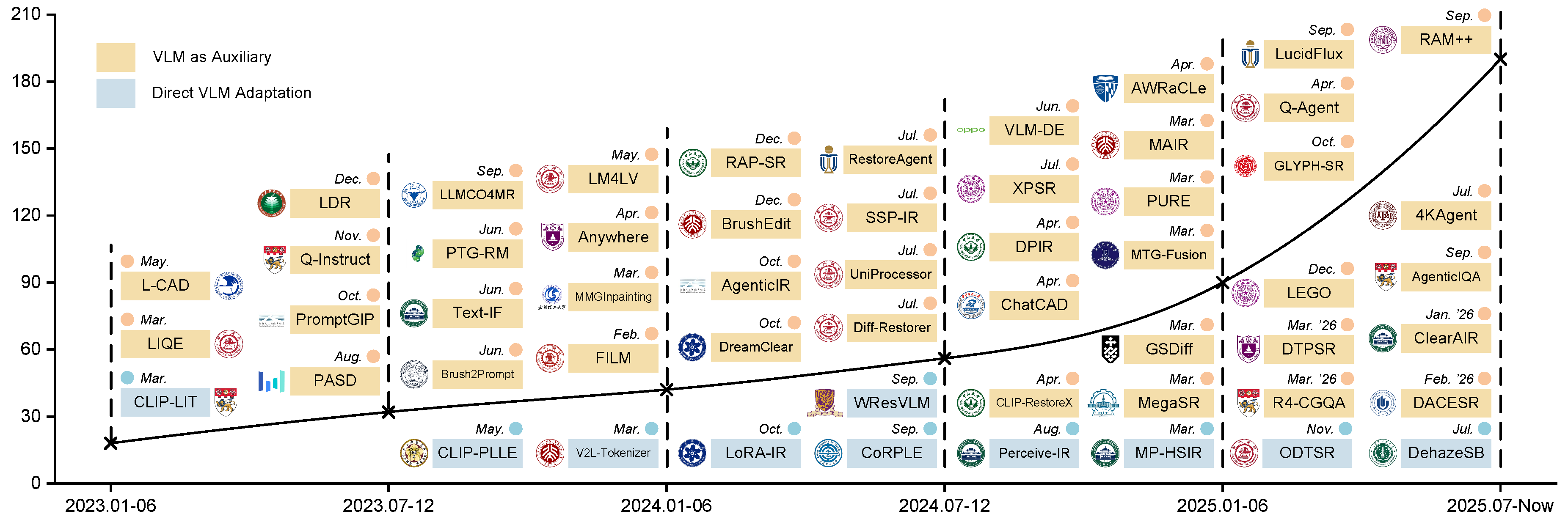
Figure 5.
Framework of PromptFix [88], redrawn and reorganized for clarity and visual consistency.
Figure 5.
Framework of PromptFix [88], redrawn and reorganized for clarity and visual consistency.
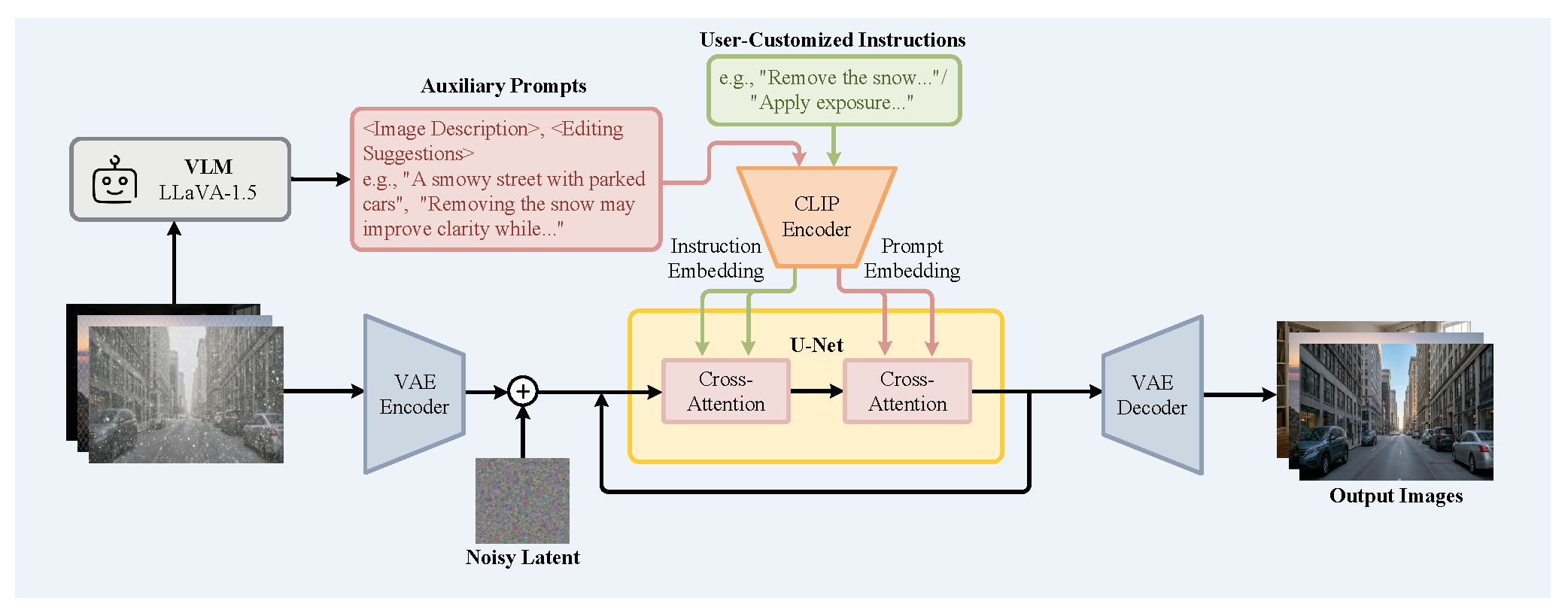
Figure 6.
Framework of 4KAgent [108], redrawn and reorganized for clarity and visual consistency.
Figure 6.
Framework of 4KAgent [108], redrawn and reorganized for clarity and visual consistency.
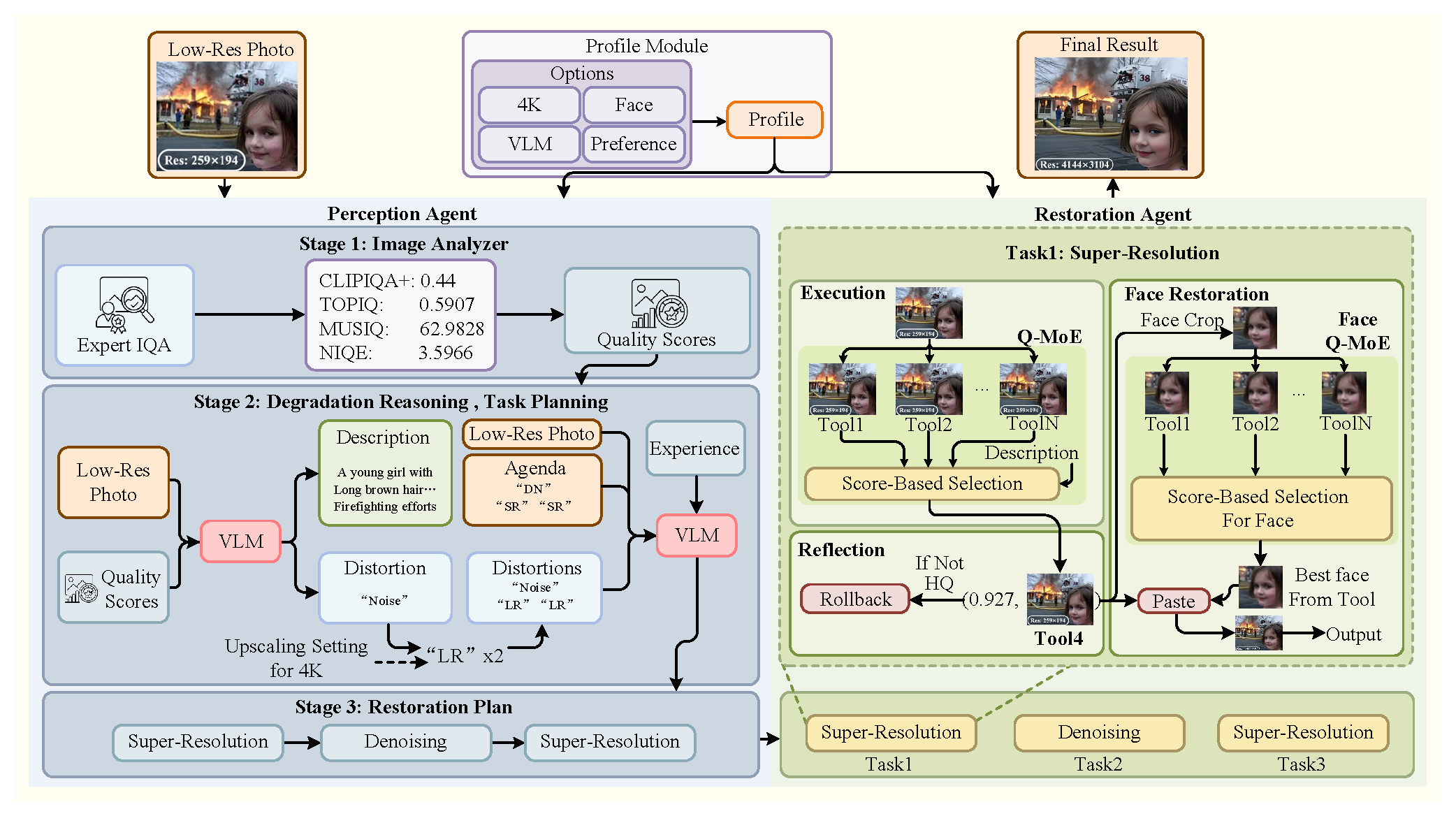
Figure 7.
Framework of GPP-LLIE [119], redrawn and reorganized for clarity and visual consistency.
Figure 7.
Framework of GPP-LLIE [119], redrawn and reorganized for clarity and visual consistency.
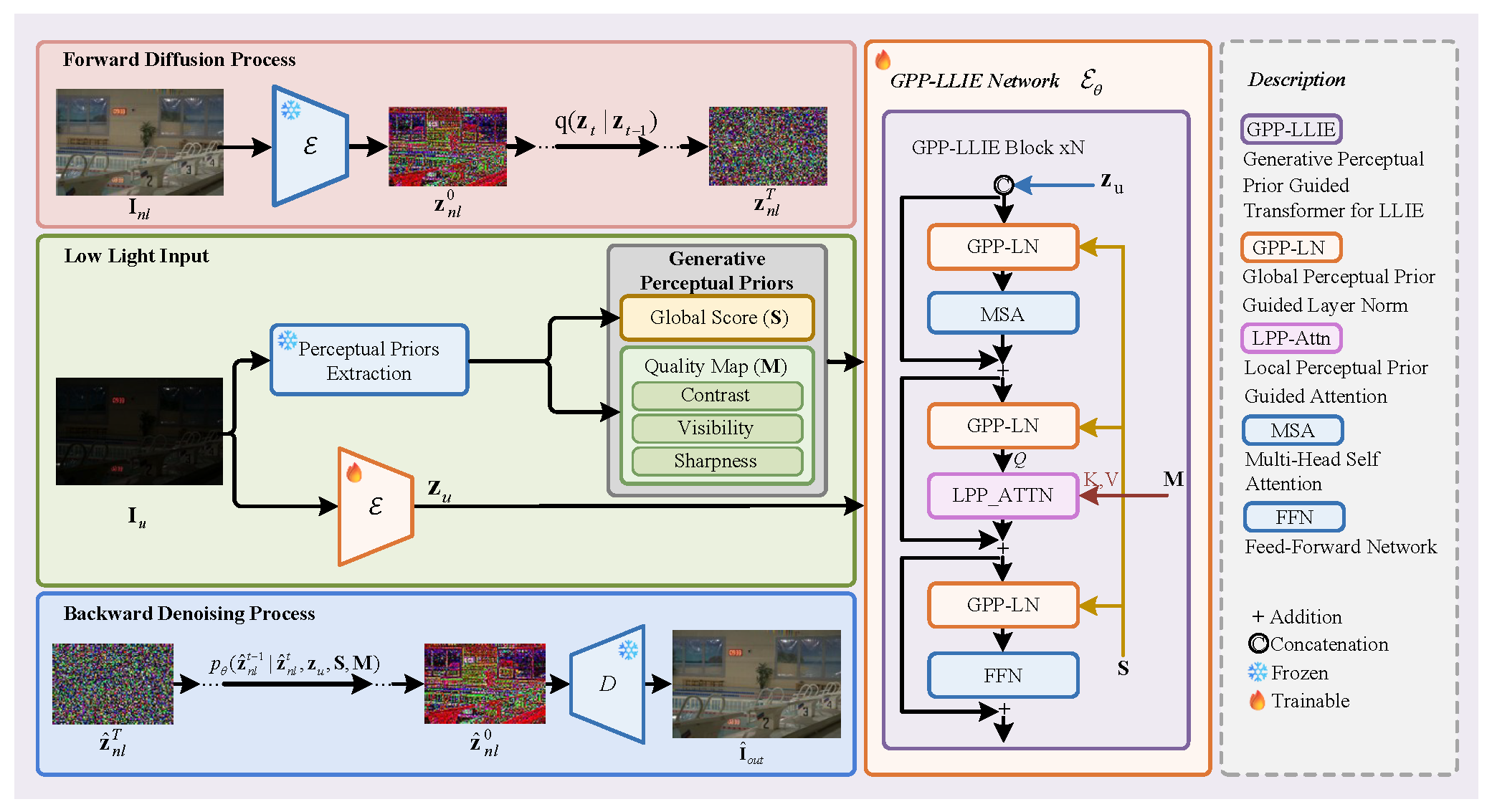
Figure 8.
The mechanism of Perceive-IR [73], redrawn and reorganized for clarity and visual consistency.
Figure 8.
The mechanism of Perceive-IR [73], redrawn and reorganized for clarity and visual consistency.
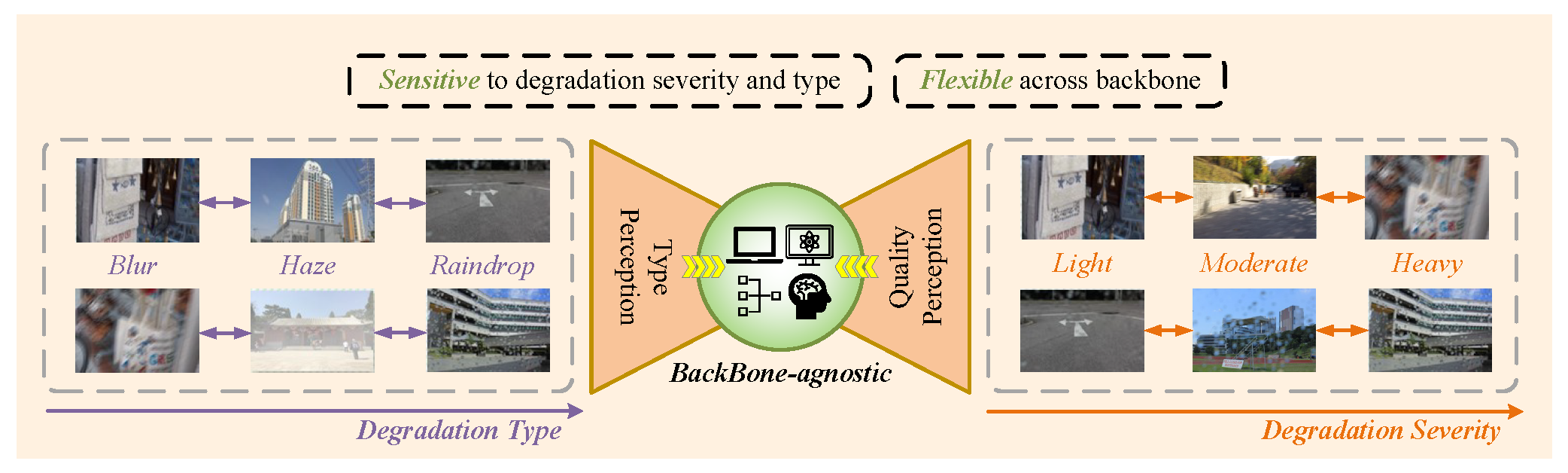
Figure 10.
Framework of LangMamba [156], redrawn and reorganized for clarity and visual consistency.
Figure 10.
Framework of LangMamba [156], redrawn and reorganized for clarity and visual consistency.
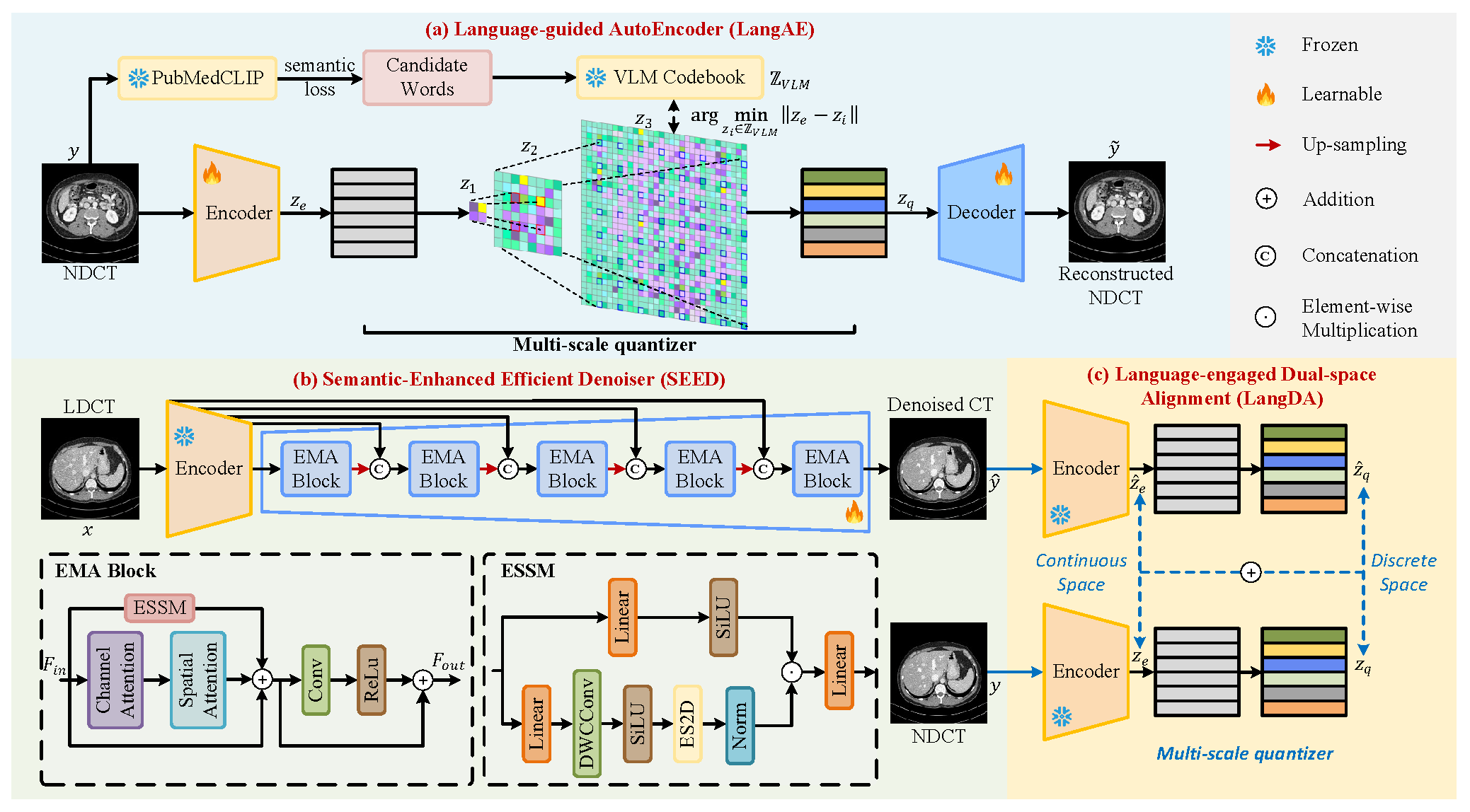
Figure 11.
Framework of Wu’s method [158], redrawn and reorganized for clarity and visual consistency.
Figure 11.
Framework of Wu’s method [158], redrawn and reorganized for clarity and visual consistency.
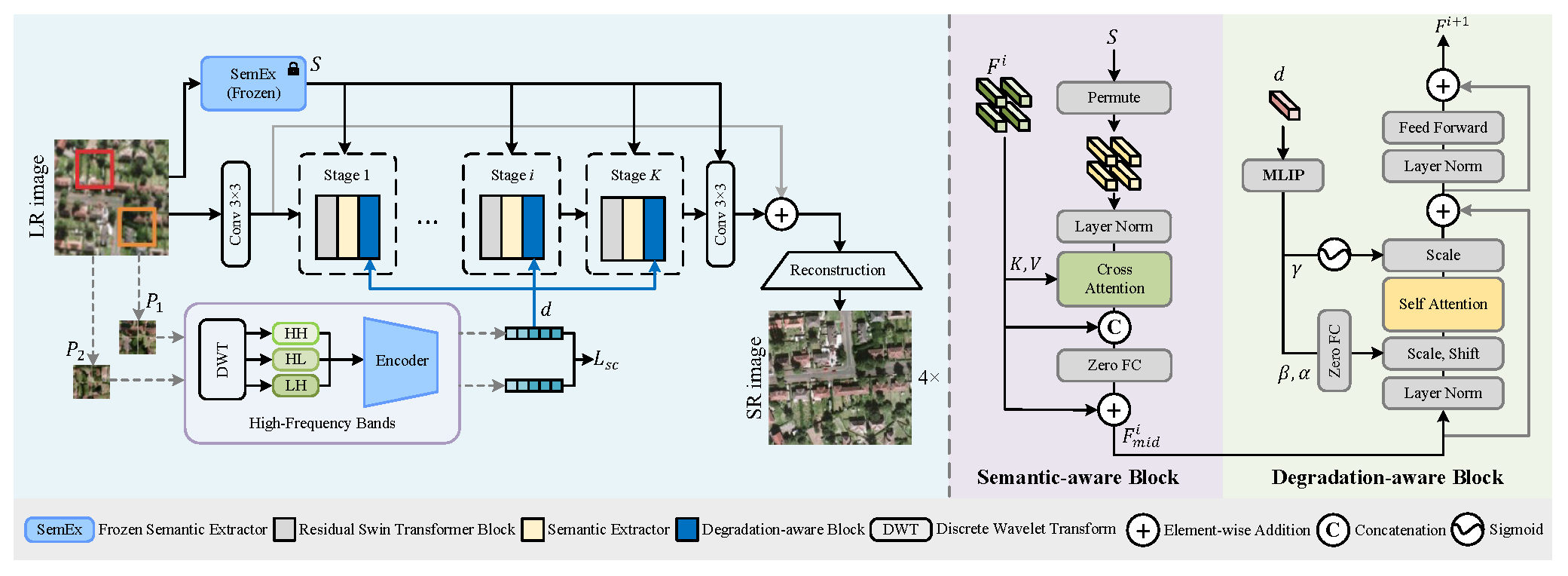
Figure 12.
Framework of Ren et al.’s method [166], redrawn and reorganized for clarity and visual consistency. Video frames are represented by three complementary planes , , , and three queries extract ambient light, transmission, and residual to recover haze-free images from enhanced features.
Figure 12.
Framework of Ren et al.’s method [166], redrawn and reorganized for clarity and visual consistency. Video frames are represented by three complementary planes , , , and three queries extract ambient light, transmission, and residual to recover haze-free images from enhanced features.
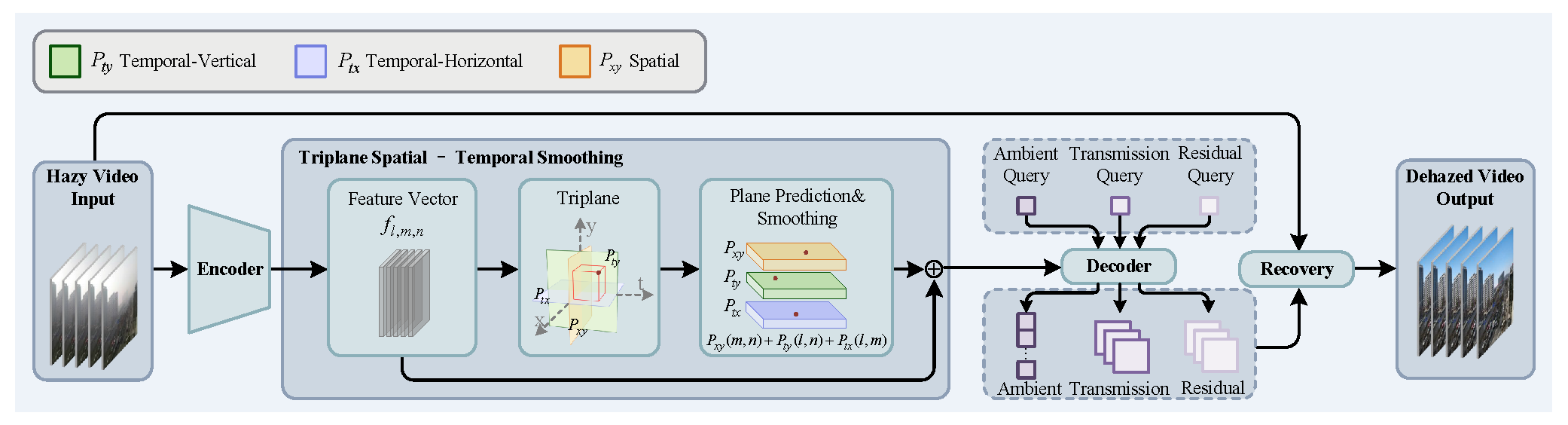
Figure 13.
Framework of VLScene [168], redrawn and reorganized for clarity and visual consistency.
Figure 13.
Framework of VLScene [168], redrawn and reorganized for clarity and visual consistency.
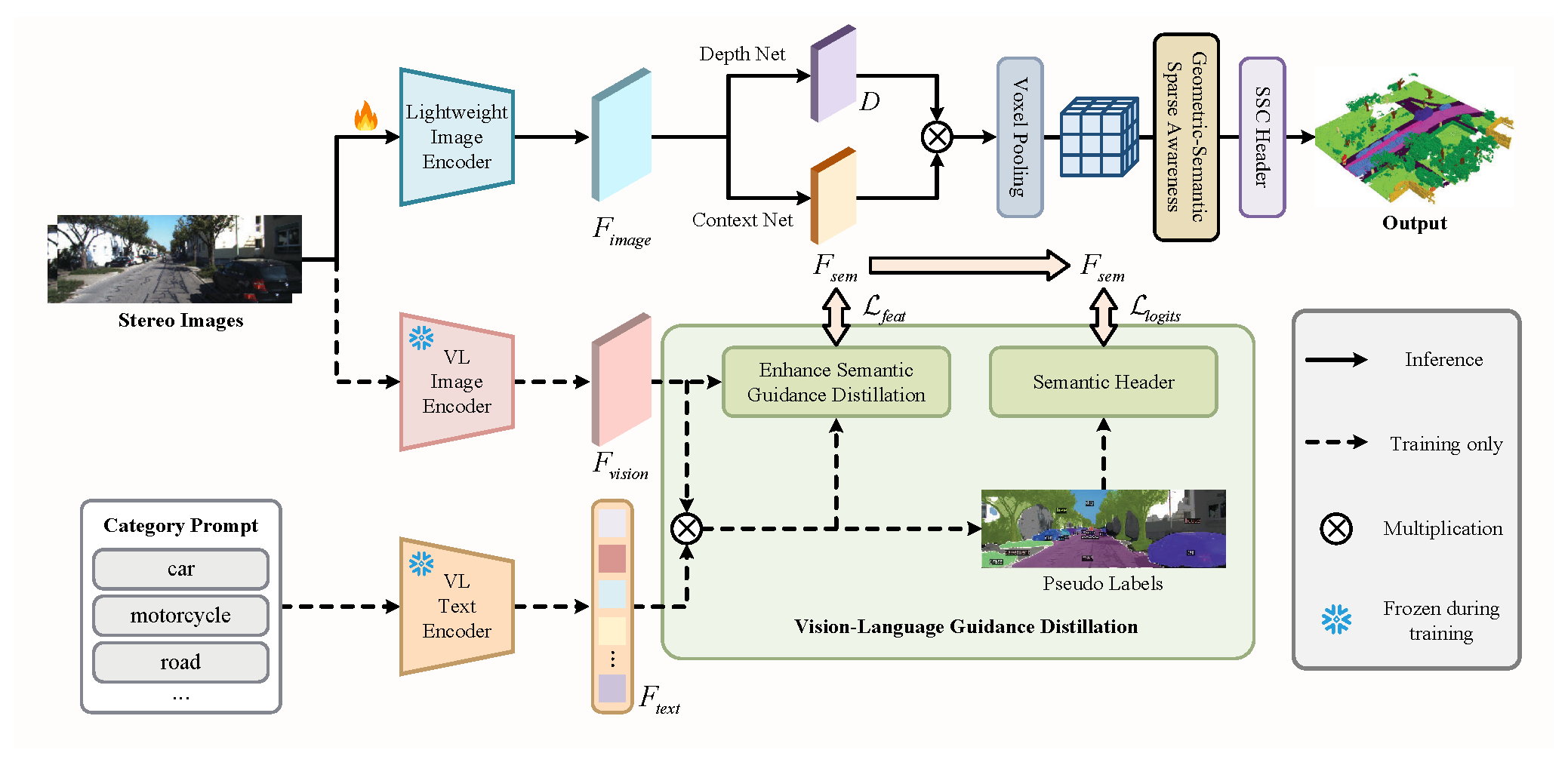
Figure 17.
Representative failure cases of VLM-guided restoration: (a) text hallucination, (b) noise introduction, (c) limited generative recovery, and (d) zero-shot failure.
Figure 17.
Representative failure cases of VLM-guided restoration: (a) text hallucination, (b) noise introduction, (c) limited generative recovery, and (d) zero-shot failure.
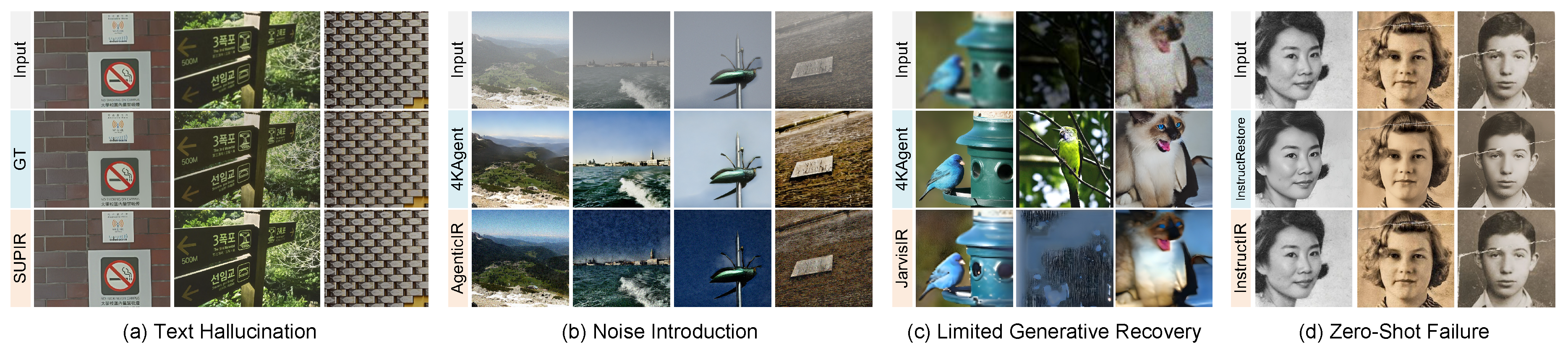
Table 3.
Comparative Overview of Medical Vision-Language Models. “Open” means “Open-source”.
| Model | Year | Technical points | Function | Paper | Open |
|---|---|---|---|---|---|
| LLaVA-Med | 2023 | Self-supervised instruction tuning; Two-stage curriculum learning. | Medical VQA, Image captioning | [149] | Y |
| Med-Flamingo | 2023 | Few-shot learning; OpenFlamingo pre-training. | Rationale generation, Case solving | [148] | Y |
| BioViL-T | 2023 | CNN-Transformer hybrid; Temporal image-report pairing. | Disease progression modeling | [150] | Y |
| XrayGPT | 2023 | Frozen MedCLIP [222] and LLM; Alignment layer tuning. | Radiograph summarization & QA | [144] | Y |
| MedKLIP | 2023 | Entity-level alignment; Structured triplet supervision. | Zero-shot diagnosis, Grounding | [147] | Y |
| VILA-M3 | 2024 | Expert-guided tuning; Integration of expert models. | Medical VQA, Classification | [145] | Y |
| MiniGPT-Med | 2024 | Frozen EVA [223] projection to LLaMA2; Task token guidance. | Radiology diagnosis, Report generation | [146] | Y |
| HuatuoGPT | 2024 | VLM-assisted data reformatting; Large-scale alignment. | Cross-modality reasoning | [151] | Y |
| HealthGPT | 2025 | Heterogeneous LoRA; Task-aware feature selection. | Modality conversion, Super-resolution | [152] | Y |
Table 11.
Failure modes of VLM-guided low-level vision and representative works that partially mitigate them. None of these works fully resolves the corresponding failure; remaining gaps motivate Section 7.
Table 11.
Failure modes of VLM-guided low-level vision and representative works that partially mitigate them. None of these works fully resolves the corresponding failure; remaining gaps motivate Section 7.
| Failure mode | Likely cause | Partial mitigation |
|---|---|---|
| Text hallucination | Over-association with semantic priors; weak text grounding | JarvisIR [74] human-feedback alignment stage |
| Noise introduction | Low-quality-caption noise leaking into the prior | VLMIR [285] caption-alignment cosine-similarity loss |
| Limited generative recovery | Insufficient quality-conditioned generative capacity | Quality-conditioned supervision: QualiTeacher [286], IQPIR [287] |
| Zero-shot failure | Poor transfer to unseen degradations | EvoQuality [133] (voting + GRPO); DA-CLIP [29] |
Disclaimer/Publisher’s Note: The statements, opinions and data contained in all publications are solely those of the individual author(s) and contributor(s) and not of MDPI and/or the editor(s). MDPI and/or the editor(s) disclaim responsibility for any injury to people or property resulting from any ideas, methods, instructions or products referred to in the content. |
© 2026 by the authors. Licensee MDPI, Basel, Switzerland. This article is an open access article distributed under the terms and conditions of the Creative Commons Attribution (CC BY) license (http://creativecommons.org/licenses/by/4.0/).
Copyright: This open access article is published under a Creative Commons CC BY 4.0 license, which permit the free download, distribution, and reuse, provided that the author and preprint are cited in any reuse.


