

Submitted:
24 June 2026
Posted:
25 June 2026
You are already at the latest version
Abstract
For the drilling engineer, an instrumented drillstring is a resource-constrained, communication-starved, safety-critical edge node: it must estimate its own state, schedule its own work, and survive faults while the surface is too far and the telemetry too narrow to intervene in time. The Apollo Guidance Computer (AGC) met a structurally similar predicament in 1969 under documented and severe constraints, and we argue that its systems-engineering playbook, not its algorithms, is an underused reference architecture for drilling automation. We make four mappings precise and bound each. Apollo’s priority-scheduled, fault-tolerant executive, the design that turned the first 1202 program alarm into a survivable event, is the right structure for protecting a safety-critical drilling-automation task under overload; a reproducible model shows that priority with deliberate work-shedding holds a safety-critical deadline that a priority-blind scheduler misses. Apollo flew a numerically stable square root (Potter–Battin) Kalman filter in fixed point; on an ill-conditioned survey problem we show that this factored form stays positive semidefinite where the conventional and even the Joseph-stabilized covariance updates fail, and we reframe the standard wellbore position-uncertainty model as the propagation half of that estimator. Apollo’s fixed-point, snapshot-telemetry edge discipline matches a downhole tool that has less surface bandwidth than a 1969 spacecraft. Finally, Apollo’s verb-noun interface, in which the machine proposes and the human commits, is a precedent for the driller’s supervisory console. We delimit the analogy at the point where the subsurface denies an absolute position fix and state the breaking points as a research agenda.
Keywords:
drilling automation
; Apollo guidance computer
; wellbore surveying
; square-root Kalman filter
; real-time fault tolerance
; edge computing
; measurement while drilling
; managed pressure drilling
1. Introduction: Two Descents
A lunar module on its powered descent and a bottomhole assembly boring toward a reservoir share an awkward predicament. Both are machines sent into a hostile place too far away for a human to fly directly, connected to the outside world by a link too thin to carry the raw picture of what they sense, and trusted to keep themselves safe in the seconds before anyone on the surface could intervene. The lunar module answered that predicament with the Apollo Guidance Computer (AGC): roughly 2000 words of erasable memory, a fixed program woven into 36864 words of core rope, a 1 clock, no floating-point unit, and a telemetry budget of about 1600 bits/ [1,2]. With that, it estimated its own state, scheduled its own work, controlled its own descent, and survived a real-time overload during the first landing without losing the mission [3,4]. The instrumented drillstring answers the same predicament today with downhole tools that are, by every measure except one, far more capable, and yet are still defeated by the same constraint that shaped the AGC: the wire to the surface is too narrow for raw sensing or continuous surface control.
This paper argues that the engineering response Apollo’s designers worked out under those constraints is a coherent and underused reference architecture for drilling automation. We are precise about what that claim is and is not. The instrumented drillstring is not literally a spacecraft; it is a resource-constrained, communication-starved, safety-critical edge node. It shares the one AGC constraint that still bites a modern downhole tool, the starvation of the uplink, and it is instructive by contrast on the others, where a present-day downhole processor far outstrips the 1969 machine. The transfer we make is of the AGC’s systems-engineering playbook, not its algorithms: the priority-scheduled, fault-tolerant executive that degraded gracefully under overload, and the fixed-point, telemetry-frugal discipline of computing where the data is. Those two patterns, we will show, map onto the parts of the drilling problem that the existing literature has left least examined.
What this paper is not. Three neighbors invite confusion and we dispatch them at the outset. First, Apollo carried an actual drill, the Apollo Lunar Surface Drill, a mechanical auger for emplacing heat-flow probes [5]; our subject is Apollo’s computer, not its drill. Second, guidance-and-navigation algorithms have already been carried commercially from aerospace into directional drilling, most visibly the trajectory-optimization methods marketed as space-age survey guidance [6]; we transfer the AGC’s computing and fault-tolerance discipline, not its trajectory mathematics. Third, the planetary science community builds autonomous drills that run space-to-space, with their own onboard fault recovery [7,8]; we run the other way, from a terrestrial-flight-heritage computer to terrestrial wells. None of these occupies the cell we claim.
What is already established, and what is new. Cross-domain transfer into drilling is itself a recognized move, and we build on it rather than pretend to originate it. Aviation and spaceflight have been invoked as models for drilling-automation maturity and human-machine authority [9,10,11], and a drilling-specific levels-of-autonomy taxonomy now exists [12]. Inertial navigation and Kalman filtering were carried into wellbore surveying decades ago [13,14,15]. We concede these bridges by name: the autonomy framing and the estimation method are not ours to claim. What we have not found in the English or Chinese literature is the transfer of the AGC’s fault-tolerant real-time executive and its fixed-point, low-bandwidth edge discipline to the drillstring, or the assembly of all four bridges into a single sourced reference frame with an honest account of where it fails. That gap is the contribution.
Why the Apollo computer specifically. A reasonable objection is that modern spacecraft carry far more sophisticated fault-protection systems, so why mine a machine from 1969? Because the AGC is the legible existence proof. Its complete flight source is public and reads with line numbers [2,16]; its design rationale is documented by the people who built it [1,3,17]; and its constraint severity sits closer to the downhole regime than a modern, proprietary, resource-rich spacecraft stack does. We mine the documented origin, not because later fault-protection is irrelevant, but because the origin is where the principles are visible.
Contributions. Beyond the constraint-regime framing and the research agenda, the paper develops three bridge mappings in depth and treats a fourth, human-supervised autonomy, briefly as a historical precedent. Concretely:
- 1.
- We frame the instrumented drillstring as a resource- and communication-constrained edge node and quantify, with sourced figures, the one constraint axis it shares with the AGC and the axes on which the two diverge (Section 3).
- 2.
- We map the AGC’s priority-scheduled, fault-tolerant executive onto safety-critical pressure-integrity and kick-detection tasks in the drilling automation stack, and show with a reproducible illustration that priority-with-shedding protects the critical task where a priority-blind scheduler does not (Section 4).
- 3.
- We trace the recursive-estimation lineage to Apollo’s square-root (Potter–Battin) measurement update, reframe the industry-standard wellbore-uncertainty model as the propagation half of that estimator, and provide a reproducible benchmark showing the factored update keeps the covariance positive semidefinite where the textbook covariance update fails (Section 5).
- 4.
- We make explicit the edge-computing discipline, fixed-point arithmetic and pre-agreed, snapshot telemetry, and quantify the downlink-to-data ratio that forces onboard autonomy in both regimes (Section 6).
- 5.
- We delimit the analogy: the subsurface denies the absolute position fix that bounded Apollo’s drift, and the downhole threat model demands hard preemption the AGC lacked. We state each breaking point as an open problem (Section 8).
The organizing claim is a synthesis, not a new technique. We attach a regenerated number or a source line to every load-bearing assertion, and we keep the breaking points in view throughout, because the discipline that makes the analogy useful is the same discipline that keeps it honest.
2. The Apollo Guidance Computer as an Existence Proof
The case for treating the AGC as a reference architecture rests on a simple observation: it already did, under documented and severe constraints, the things a drilling-automation system is asked to do. Both the constraints and the achievement deserve to be concrete, because the gap between them is the part worth borrowing.
The constraints. The Block II AGC carried about 2048 words of erasable (read/write) memory and 36864 words of fixed core-rope memory holding the program [1]. Its data word was 15 bits, 14 of magnitude plus a sign in one’s-complement, carried in a 16-bit parity-checked memory word; there was no floating-point unit and no hardware multiply-rich datapath in the modern sense. The processor ran near 1 and executed a basic instruction in roughly 12 , on the order of to operations per second. Arithmetic was fixed-point and scaled by hand, and the spacecraft telemetry downlist that carried the computer’s state to the ground ran at roughly 1600 bits/ [2]. Memory here is counted in words, not bytes; the discipline the machine demanded came from that scarcity.
The interpreter: capability bought with code density. A machine this small could not have expressed Apollo’s vector and matrix navigation mathematics in raw basic instructions and still fit in core rope. The designers solved this with an interpreted virtual machine, the Interpreter, whose pseudo-instructions (double-precision vector loads, dot and cross products, matrix-vector multiplies) traded execution speed for a large gain in code density [1,2]. The AGC thus ran sophisticated numerical code on a tiny machine by accepting a slower but far more compact representation, a trade that any engineer who has tried to fit a real algorithm into a downhole tool will recognize.
The achievement. With that footprint the AGC flew a complete guidance, navigation, and control solution. It maintained an onboard state estimate using a square-root formulation of recursive estimation [18,19]; it ran the powered-descent guidance law that brought the lunar module from orbital speed to a controlled touchdown [20]; it scheduled dozens of asynchronous jobs through a priority-driven executive that, during the first landing, alarmed, restarted, and re-created protected work fast enough to keep the descent going while annunciating the now famous program alarms [3,4]; and it presented all of this to the crew through a deliberately minimal display-and-keyboard interface. The software-engineering discipline that made this dependable, including priority displays and restart protection, was itself a deliberate invention [17,21].
A primary source, not a legend. What makes the AGC usable as a reference rather than an anecdote is that it is fully open. The flight programs for the lunar and command modules survive as transcribed assembly source [2], are executable in a faithful simulator [16], and are specified at the equation level in the Guidance System Operations Plan [22]. Every claim we make about the AGC in the sections that follow is therefore checkable against a named file and line, and we cite it that way. The remainder of the paper takes four mechanisms from this machine and asks, for each, what survives the move into the borehole and what does not.
4. Bridge I: The Priority-Scheduled Executive and the Downhole 1202
We lead with the executive because it is the bridge the drilling literature has left least examined, and because the event that made it famous is exactly the failure mode a downhole controller must survive.
What actually happened at the first landing. During the powered descent of Apollo 11, at roughly 102:38 ground elapsed time, the guidance computer annunciated the first 1202 program alarm; subsequent alarms included more 1202s and one 1201. The cause was not a software bug and not crew workload in the way the legend sometimes has it: the rendezvous radar had been left in a mode that made its coupling-data unit counters increment spuriously, stealing on the order of a tenth of the processor’s duty cycle and exhausting the executive’s fixed pool of job slots [3,4]. The machine did not freeze. Resource exhaustion raised an alarm and entered a state-preserving software restart; the restart machinery cleared the saturated work queues and re-created the essential phase-table-protected jobs fast enough that the guidance loop never missed a step. The human decision, the celebrated call to continue, was a separate judgment laid on top of a computer that had already protected itself.
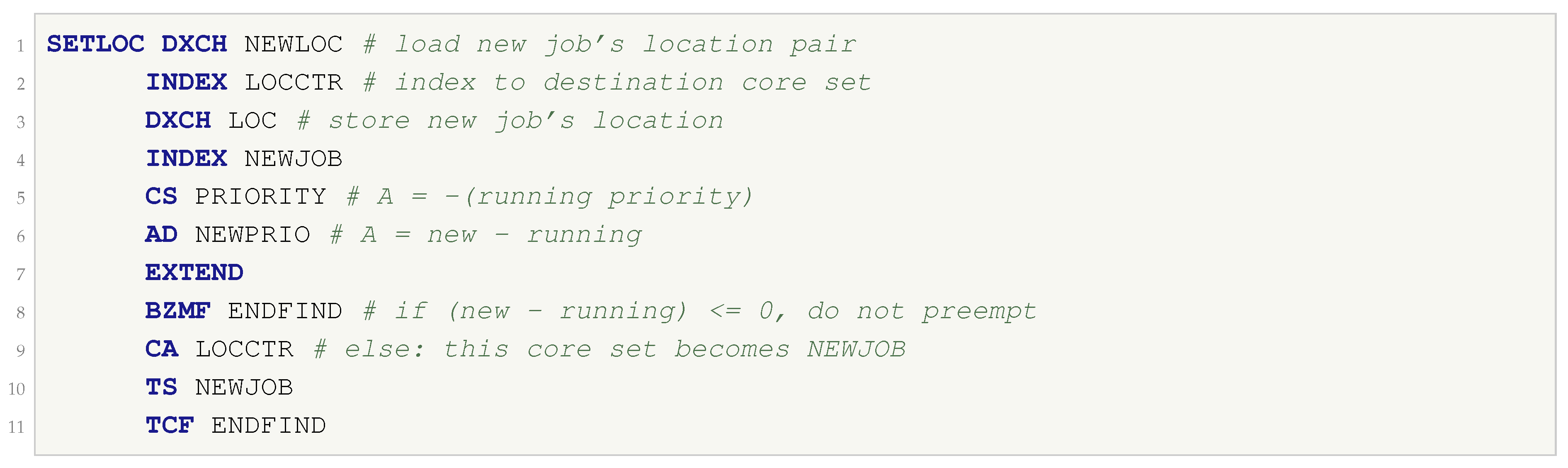
The mechanism, with line numbers. The behavior is not folklore; it is in the source. The executive manages a fixed set of eight job-context slots (“core sets”)1 and five vector-accumulator work areas (“VAC areas”) in the LM landing program; these are statically allocated, with no dynamic memory [2]. A job needing only a context slot enters through one path; a job needing floating-point-style workspace enters through another that first reserves a VAC area. When a slot or area is unavailable the executive raises the alarm and enters restart rather than letting the running work collapse: 1201 (no VAC areas) at Luminary099/EXECUTIVE.agc:147 and 1202 (no core sets) at :208, both transferring to the state-preserving restart at BAILOUT1 (Luminary099/ALARM_AND_ABORT.agc:189). Preemption is decided by a single subtraction of the running job’s priority from the candidate’s (SETLOC, Luminary099/EXECUTIVE.agc:189--199); the highest-priority resident job is elected by a deterministic linear scan at ENDOFJOB. Recovery is checkpointed: restart groups and phase tables let an interrupted job re-enter from a known point, and the tables are verified by exclusive-or before they are trusted (Luminary099/FRESH_START_AND_RESTART.agc:290--304, Luminary099/RESTARTS_ROUTINE.agc:35--67). The design choice that matters is that overload was treated as a planned-for operating condition with a defined response, not as an exception that halts.
The transferable pattern. Stripped of its 1969 specifics, the pattern is three rules: schedule by priority, define what work may be abandoned when the budget is exceeded, and recover from a checkpoint rather than restart from zero. The theory that later formalized why this works, fixed-priority schedulability and priority-inheritance protocols, postdates the AGC [29,30], as does the dependability vocabulary that names what it achieves [31,32]. A drilling-automation stack faces the same arithmetic. Safety-critical pressure-integrity monitoring, kick and influx detection, and automated well-control logic, often using both surface and downhole signals, must keep their deadlines while lower-value logging and telemetry formatting compete for the same processor [33,34,35,36,37]. The AGC’s answer is the right reflex: protect the safety-critical task, shed the logging, recover clean.
An illustration. Figure 1 makes the contrast concrete with a deliberately small, reproducible model (full parameters in Appendix B.1). This is not a cycle-accurate AGC restart simulation; it transfers the design reflex into a drilling-automation task: serve protected work first, and discard explicitly expendable work when the budget is exceeded. A priority-blind first-come scheduler and a priority-with-shedding executive process an identical job set on an identical fixed per-cycle compute budget. A transient “sensor storm,” the structural analogue of the radar interrupt flood, drives demand to 1.77 times the budget. The priority-blind scheduler misses the safety-critical deadline on 13 of 120 cycles, every miss inside the storm; the priority executive misses none, by deliberately discarding 1723 compute-units of low-priority backlog. The shed work is the price, and paying it is the point: the backlog is dropped, the well is not.
Where this maps best, and where it breaks. The cleanest safety-critical analogue is not survey steering but well control. The engineering post-mortems of the Macondo blowout describe a control-and-monitoring chain that needed exactly the AGC’s reflex, detect the abnormal condition, preserve the protective function, and avoid a hard stop that loses the well [38,39]. The analogy has a firm limit, and stating it is what keeps the bridge honest. Apollo’s preemption was soft: a context switch happened at the next voluntary job end, up to a two-second guidance cycle later. Downhole kick detection cannot wait two seconds; it needs hard, hardware-level preemption, a watchdog timer, and dynamic reallocation of compute to the emergency, none of which the 1969 design had and none of which it needed for its threat model. The lesson is therefore not that the AGC executive is a drop-in controller. It is that the AGC executive is the right structure, and the downhole threat model dictates the additions.
5. Bridge II: Recursive Estimation, from Star Fixes to Wellbore Surveys
This bridge is our credibility anchor, and we open it with a concession. Recursive estimation in wellbore surveying is not new and is not ours. Inertial navigation and Kalman filtering were carried downhole decades ago and are now standard practice [13,14,15,40], all descendants of the recursive estimator Kalman formalized [41]. We claim no new estimator. What we claim is a more specific and, we think, more useful observation about which estimator Apollo flew and why it still matters.
Apollo flew a square-root filter, and that is the point. The AGC did not store or update the error covariance . Its source comments name the object it maintains the “error transition matrix” W (Luminary099/MEASUREMENT_INCORPORATION.agc:32,39,214), and in the Apollo and Battin formulation W is the square-root factor of the covariance: [18,19,42]. Each measurement is incorporated one scalar at a time by James Potter’s square-root update, which downdates the factor W directly and never forms, stores, or inverts [43,44,45]. On a 15-bit fixed-point machine this was not an elegance; it was a necessity. The conventional covariance update can, under ill-conditioning, return a matrix with a negative eigenvalue, a “covariance” that is not one, after which the filter is free to diverge. A factored representation cannot do this: is positive semidefinite for any W, by construction. That Apollo ran a numerically stable square-root filter in fixed point in 1969 is a directly relevant piece of engineering, and it is precisely the property a downhole estimator needs.
A benchmark, not an anecdote. Figure 2 makes the necessity concrete on a wellbore-survey-like problem, run in 32-bit float as a stand-in for the AGC’s far coarser fixed-point precision (full setup in Appendix B.2). We process a sequence of stiff, near-redundant station fixes against an ill-conditioned prior (condition number ) and track the smallest eigenvalue of . For a representative realization the conventional update drives the smallest eigenvalue to , and even the Joseph-stabilized form, normally the more robust covariance update, reaches ; both have lost positive-definiteness, while Potter’s square-root update holds at . The single-run ordering of the two unfactored forms is not robust, but the separation is: across forty seeds the conventional and Joseph updates lose positive-definiteness in 29 and 32 of 40 runs, the square-root update in none. Joseph fails because, in limited precision, rounding while forming its covariance products defeats the positive-definiteness it guarantees only in exact arithmetic; the factored form cannot fail this way, since is positive semidefinite by construction. Sparse, one-station-at-a-time, ill-conditioned survey estimation is exactly that regime, which is why the modern recommendation, square-root or UD-factored filtering [45], is the same one Apollo adopted by necessity. This is the bridge’s contribution: not a new filter, but a sourced argument for an old and underused one, with a reproducible demonstration.
Reframing the industry’s uncertainty model. Wellbore position uncertainty is governed in practice by the systematic error-source model maintained by the Industry Steering Committee for Wellbore Survey Accuracy (ISCWSA, now the SPE Wellbore Positioning Technical Section), which propagates an ellipsoid of uncertainty along the borehole from weighted, systematic error terms [46,47,48,49,50,51]. Read through the estimator lens, this model plays the role of the propagation (predict) step: it grows the covariance as the well advances. It is best understood as an analogy and not an identity, since the standard model composes error sources rather than running a state-transition matrix on a live estimate. The analogy is useful precisely because it exposes what is usually left out, the routine measurement update. Apollo’s discipline was to close that loop on every sighting. The transferable lesson is to treat each station fix, gyrocompassing reference, or external tie not as a check on a propagated budget but as a measurement to be incorporated by a numerically sound, factored update.
What the update buys, and the limit it cannot cross. Figure 3 shows the value of incorporation and, in the same picture, its boundary. A three-state estimator marched in measured depth drifts to a lateral uncertainty of at 3000 under pure dead reckoning. Periodic attitude fixes, the gyrocompassing analogue of an Apollo star sighting, bound it to ; adding an absolute position fix, the analogue of Apollo’s ground tracking, reaches . That last regime is the one the subsurface most nearly denies: it supplies an absolute attitude reference (gravity and north-seeking gyrocompassing give an Earth-referenced heading with no surface tie), but an absolute position reference is rare and only locally available, for instance by magnetic ranging to a known offset well. There is no GPS underground, and the gap between the bounded and the unbounded curves is the visual statement of the analogy’s hard limit, not a defect in it. Two honest caveats complete the picture. First, the downhole measurement model is more nonlinear than Apollo’s, especially near vertical, so a practical implementation needs an extended or unscented form, not the linear update verbatim, and the attitude fix itself, recovered from accelerometer (gravity) and magnetometer (field) vector observations, is the borehole counterpart of Apollo’s star and landmark sightings, solved by the same vector-observation attitude determination [52] once the magnetic readings are corrected for drillstring and geomagnetic interference [53,54]. Second, the contrast with Apollo is sometimes overdrawn: Apollo’s optical navigation was itself sparse and manual, batches of sextant marks rather than a continuous stream, which makes the two regimes more alike, not less. The estimator is the same shape in both; only the availability of an absolute fix differs, and that difference is the frontier.
6. Bridge III: Computing at the Edge
The third bridge is the AGC’s edge-computing discipline: do real numerical work in fixed point, trade speed for code density when memory is the binding constraint, and send only pre-agreed, pre-compressed state up a narrow link because the link cannot carry anything more. Each of these has a direct downhole counterpart, and each comes with a limit we state plainly.
Navigation arithmetic without a floating-point unit. The AGC had no FPU and scaled its fixed-point arithmetic by hand, yet it computed a full navigation and guidance solution. The natural objection from a modern vantage is that fixed point is too blunt for real navigation. Figure 4 answers it (setup in Appendix B.4). We compute the trigonometry that strapdown dead reckoning needs with CORDIC, the shift-and-add rotation algorithm that uses no hardware multiplier, in B-bit fixed point, and sweep B. At 12 fractional bits the per-stand dead-reckoning error is already , and it saturates below by 16 bits; the AGC’s 15-bit data word sits squarely in that saturated, sub-millimetre regime. The arithmetic a directional survey needs fits, with margin, in the AGC’s bit budget. For the at-bit and near-bit processing the industry now pursues, the precision of the datapath is therefore a design choice rather than a barrier, the same conclusion the embedded machine-learning community has reached in showing that low-bit fixed-point arithmetic suffices for serious computation on microcontrollers [55,56,57].
Capability through code density. When memory rather than speed is the wall, the AGC’s answer was the Interpreter, a compact pseudo-instruction layer for vector and matrix mathematics that traded execution time for a large reduction in program size [1,2]. The same trade recurs whenever an algorithm must fit in a tool qualified for 150–200 °C, where the choice of silicon is itself constrained by temperature [26,27,28]. The lesson is not the Interpreter’s specific encoding but its premise: at the edge, the scarce resource dictates the representation, and accepting a slower but smaller form is often the only practical way to run the real algorithm.
Telemetry frugality forces onboard decisions. Section 3 established the binding constraint: the uplink is too narrow to ship the raw picture, with a downlink-to-data ratio near for the AGC and for a mud-pulse measurement-while-drilling tool [23]. The AGC’s response is worth copying in detail. It did not stream memory; it sent “downlists,” pre-agreed tables naming exactly which words to telemeter and in what order, and it captured fast-changing quantities in atomic snapshots so a value could not change mid-transmission (the snapshot sublists in Luminary099/DOWNLINK_LISTS.agc:48--54 and the packing loop in Luminary099/DOWN_TELEMETRY_PROGRAM.agc:252--320). A modern measurement-while-drilling tool already lives by the same rule, transmitting a fixed, pre-agreed selection of computed quantities rather than raw sensor streams, because the channel allows nothing else. The deeper consequence is one Apollo makes plain: when the link is this narrow, the decision must be made where the data is. Onboard, or downhole, autonomy is not a preference; it is forced by the communication budget.
The limit. The honest scope of this bridge is the discipline, not the hardware. A modern downhole microcontroller dwarfs the AGC in clock and memory, so the binding constraint downhole today is power, temperature, and communication, not the 1969 problem of fitting code into a few thousand words. We are not recommending a 2000-word computer for the bit. We are observing that the AGC’s frugal patterns, fixed-point feasibility, code-density-aware representation, pre-agreed snapshot telemetry, and onboard decision-making forced by the link, are the right patterns for a node that remains communication-starved even as its compute grows. The edge-computing literature frames this general shift toward decision-making at the data source [58,59]; the AGC is an early, unusually legible safety-critical instance.
7. Bridge IV: Human-Supervised Autonomy
The fourth bridge is the softest, and we keep it short on purpose. Apollo’s display-and-keyboard interface worked by a verb-noun contract in which the computer proposed and the crew committed: the machine flew, flashed a request for confirmation, and acted only when the crew pressed proceed, and the crew could take manual authority, as in the landing-point redesignation of program P66, whenever judgment demanded it. Mindell’s history reads the entire Apollo program as a sustained negotiation over exactly this line between human and machine authority [4]. That negotiation is alive in drilling, where automation must leave the driller a clear, low-ambiguity way to monitor and to override.
We claim only a historical precedent here, not a method. The drilling community has already built its own apparatus for this question: a recent levels-of-autonomy taxonomy adapts the aerospace framing to drilling’s multi-agent, sparse-data conditions [12], and the argument that humans remain essential under uncertainty has been made for drilling with explicit reference to spaceflight [11]. We cite that work and stay off its ground. The transferable point is narrow and old: a supervisory interface for a high-consequence, communication-limited process should make the machine’s proposal and the human’s authority both explicit, the way the verb-noun contract did. The DSKY is a precedent for the pattern, not a template for the console.
8. Where the Analogy Breaks, and Why That Is the Research Agenda
A perspective is only as honest as its account of its own limits, and in this case the limits are the most useful part, because each one names a concrete problem a reader could work on. We state six, in rough order of how hard they make the downhole problem relative to Apollo’s.
1. There is no absolute position fix underground. This is the deepest disanalogy. Apollo bounded its inertial drift with external fixes, star sightings for attitude and ground tracking for position. The subsurface offers an attitude reference (gravity, the geomagnetic field, gyrocompassing) but no routine absolute position reference; the versus gap in Figure 3 is exactly the value of the fix the borehole withholds. Bounding position growth without it is an open estimation problem closer to simultaneous localization and mapping without reliable loop closure than to spacecraft navigation. Candidate fixes worth formalizing as measurement updates include seismic-while-drilling and look-ahead ties [60,61], relative ties to offset wells by magnetic ranging [62], and geological map-matching against a prior model [63]. Each is a way to manufacture the fix the surface cannot send.
2. The threat model demands hard real-time guarantees the AGC lacked. Bridge I transfers the executive’s structure, but the AGC’s preemption was soft and it had no watchdog. A safety-critical pressure-integrity or kick-detection task in the drilling automation stack needs bounded, hardware-level preemption, worst-case execution-time guarantees, and a watchdog, the apparatus that real-time scheduling theory formalized after Apollo [29,30]. Porting the priority, restart, and planned-shedding pattern into a downhole real-time operating system with provable response bounds, rather than the AGC’s cooperative two-second cycle, is a systems problem with a clear specification.
3. Sparse, stiff measurement sequences need adaptive, factored filters. The long gaps between survey stations let uncertainty grow far more than between Apollo’s marks, and the resulting covariances are stiff. A constant, hand-tuned process-noise model is inadequate. The agenda here is adaptive process-noise estimation carried on a factored (square-root or UD) filter so that the numerical robustness demonstrated in Figure 2 is preserved while the filter learns the drift it must reject [45].
4. The process model, not the estimator, is the hard part. Apollo propagated a known, benign dynamical model; the borehole advances through an unknown and sometimes adversarial medium, where bit-rock interaction, stick-slip, and formation changes corrupt the very model a filter assumes [64,65,66]. This is where downhole state estimation is genuinely harder than spaceflight, not easier, and it is the place the spacecraft analogy is weakest. Physics-constrained, data-driven process models that admit their own uncertainty are the research direction, and the honest framing is that the AGC offers little help here precisely because its world was knowable.
5. Verification has to survive the oven. Apollo’s dependability came as much from process as from architecture: priority displays, restart protection, and a verification discipline that the field credits with founding software engineering [17,21]. Reproducing that assurance for firmware that must run correctly at 150–200 °C under shock, where re-flashing a tool five kilometers down is not an option, is a verification-and-qualification problem that the dependable-computing vocabulary frames [31,32] but does not solve for this environment.
6. Apollo is the legible start, not the destination. We mined a 1969 computer because it is open and documented, but the mature generalization of its ideas lives in modern spacecraft fault protection. A natural continuation is to carry that newer, more capable fault-protection practice into drilling, using the AGC as the readable on-ramp rather than the final word. The contribution of this paper is to draw an initial, legible version of the map; extending it to contemporary aerospace autonomy is future work we would welcome others to take up.
Taken together these six are not caveats that weaken the thesis; they are the thesis’s payload. The synthesis earns its place not by asserting that the drillstring is a spacecraft, which it is not, but by handing two communities a shared, sourced list of the exact points where a well-understood reference architecture stops fitting an important problem.
9. Related Work and Positioning
Cross-domain transfer into drilling automation is not new, and we do not claim the move as such. Three strands precede us. The first is organizational and operational. Thorogood [9] reads aviation’s automation history (mode confusion, out-of-the-loop performance, operator complacency) as a warning for drilling; de Wardt [10] surveys aviation, spaceflight, and motor racing as maturity analogues for drilling-systems automation and real-time operating centers; and Macpherson et al. [11] invoke the lunar landing itself to argue that humans remain essential under uncertainty, importing an aerospace levels-of-automation taxonomy. Thorogood et al. [67] earlier set out the genre’s premise, drawing parallels with other industries to fix terminology. The second strand is algorithmic. Wellbore surveying inherited recursive estimation and strapdown inertial navigation from missiles and aircraft: Kelsey’s gimballed downhole inertial system with zero-velocity updates [13], MEMS gyro continuous surveying via Kalman filtering [14], near-bit state-space attitude estimation [15], and gyro-while-drilling with real-time quality control [40], all resting on the systematic error-budget framework of the wellbore-positioning literature [47,48,51]. The third is the drilling-systems automation architecture and interoperability program: roadmaps, open-system approaches, and process-automation interfaces that aim to make rig components cooperate rather than remain isolated tools [68,69,70]. We concede all three strands by name. The format (“aerospace lessons for drilling”), the estimation bridge, and the automation-roadmap problem are established; we build on them rather than rediscover them.
A parallel genre tells Apollo’s engineering lessons to a general technical audience. Hamilton and Hackler distill systems-language discipline from the flight software [17]; Eyles recounts the lunar-module guidance computer from inside the code [3]; Mindell reconstructs the human-machine bargain of the program [4]; and Leveson draws spacecraft-accident lessons about the role of software [21]. These accounts are pitched mostly at software engineering in the abstract. Our contribution is to carry them into a specific terrestrial safety-critical domain and to do so at mechanism level, mapping the executive’s priority scheduling and bounded restart [29,30] and the dependability vocabulary of fault tolerance [31,32] onto the instrumented drillstring rather than gesturing at heritage.
Three look-alikes warrant a sharp line. Superior QC’s HiFi Guidance, profiled as space-age directional drilling [6], is a commercial example of guidance, navigation, and control crossing into the oilfield, but it transfers GN&C algorithms (trajectory and delta-v optimization), not the systems-engineering method; we transfer the AGC playbook, not its algorithms. Planetary autonomous drills, exemplified by DAME’s onboard fault detection and recovery under light-speed delay [7], run space-to-space at the robotic-drill level and do not center a flight computer’s executive; the broader planetary-drilling corpus is, in the review cited here, predominantly mechanical [8]. We also separate Apollo’s computer from Apollo’s drill [5], a distinct piece of hardware. And we do not propose a levels-of-autonomy taxonomy: that ground is held by de Wardt et al. [12], whom we cite and stay clear of. The empty cell we fill sits between these: the AGC’s fault-tolerant executive (priority-scheduled work, state-preserving restart, and explicit treatment of expendable work) and its fixed-point, tiny-telemetry edge discipline, unified under one heritage frame and bounded by a quantified limit of analogy. Taken separately, these sub-literatures do not make that synthesis explicit.
Adjacent transfers into drilling have been cultural or organizational rather than computational. Post-Macondo safety work imports non-technical skills, high-reliability principles, and INPO-style self-regulation [38,39,71]; the digital-twin literature surveys the same industry without tracing its concepts to spaceflight [72]. These move people and process; we move machine architecture, which is the differentiator. In venue terms this is a perspective: it supplies a sourced reference frame relating four drilling sub-literatures to one documented exemplar, and a shared open-problem list (the points where the frame stops holding) that no single sub-literature offers on its own.
10. Conclusions
The instrumented drillstring and the Apollo Guidance Computer are not the same machine, and we have been careful not to say they are. They are two answers to one predicament: a capable device, sent somewhere a person cannot follow, on a link too thin to think through, trusted to keep itself safe before help could arrive. Apollo worked out a coherent response to that predicament under constraints that are documented to the line, and three parts of that response transfer cleanly to drilling automation. The priority-scheduled, fault-tolerant executive is the right structure for protecting a safety-critical drilling-automation task under overload. The square-root filter is the numerically sound way to fuse the sparse, stiff measurements a survey provides, and it is the form Apollo was forced into and the form the borehole rewards. The edge discipline, fixed-point feasibility and pre-agreed, snapshot telemetry, is the right posture for a node that stays communication-starved even as its compute grows.
We have tried to hold a single line throughout: claim a synthesis, never a new technique, and put a regenerated number or a source line behind every load-bearing claim. The analogy is the organizing spine; the numbers and the line references are the argument. The same discipline that makes the transfer useful is what marks its limits, and those limits, the absent underground fix, the need for hard real-time guarantees, the unknown process model, are offered as a research agenda rather than hidden as concessions.
The three reproducible illustrations and the square-root benchmark (which we call SQRT-SURVEY) are deterministic and self-contained, and the Apollo routines we lean on are reproduced as annotated ports in Appendix A. The invitation is to two communities that rarely read each other: to drilling engineers, that a fifty-year-old flight computer is a more rigorous reference for downhole autonomy than its age suggests; and to the guidance and edge-systems communities, that the borehole is a worthy and unforgiving place to send their methods next. From space to the subsurface is a short trip for an idea, provided one is honest about where the ground stops sending a fix.
Acknowledgments
We thank the Virtual AGC project and the maintainers of the public Apollo 11 guidance-computer source for making this primary material legible and executable.
Appendix A. From AGC Assembly to Python: Annotated Ports of the Highlight Routines
To keep the mechanism-level claims of Sections 4 and 5 checkable, we reproduce two of the AGC routines we lean on as faithful, runnable Python ports. Each is shown next to the original assembly. The complete, tested modules are in code/ports/.
Appendix A.1. The Preemption Decision (EXECUTIVE.agc)
The entire decision of whether a newly scheduled job should preempt the running one is a single subtraction. SETLOC negates the running job’s priority, adds the candidate’s, and branches on the sign (Luminary099/EXECUTIVE.agc:189-199).
| Listing 1. AGC: arm a preemption iff the new job outranks the running one. |
 |
| Listing 2. Python: the same decision, and the fixed-slot scheduler around it. |
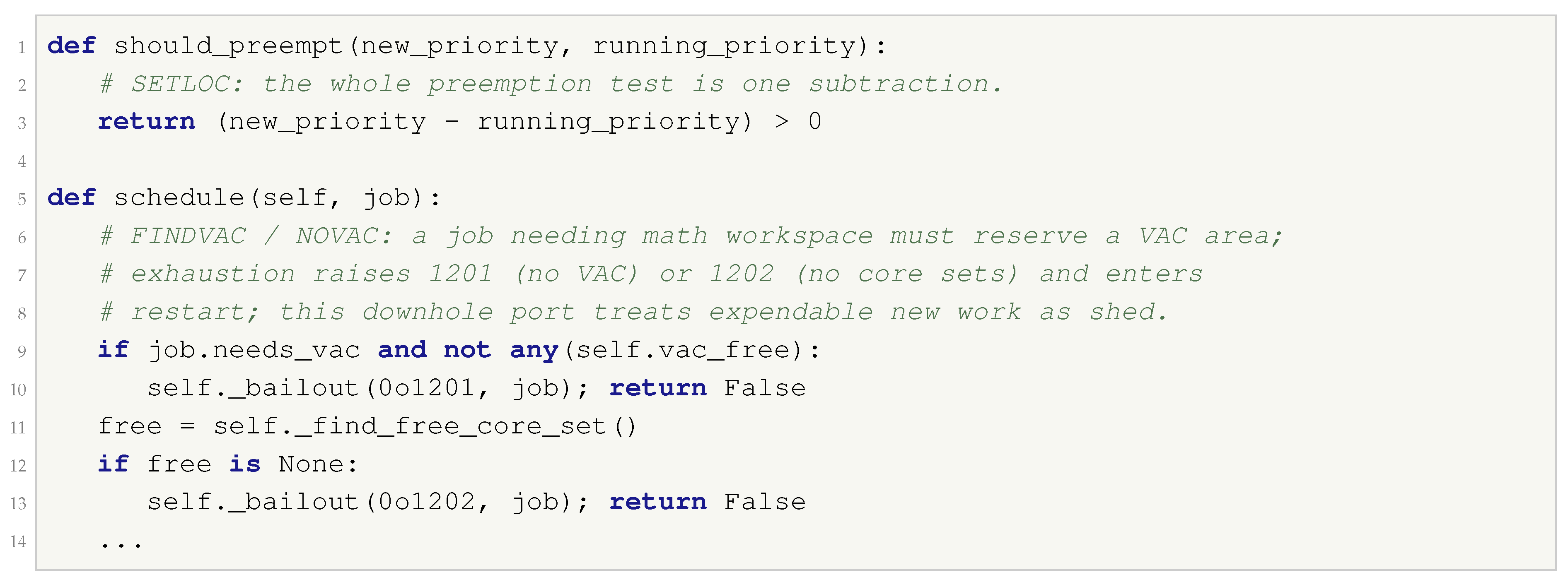 |
The port preserves what matters for the transferred pattern: priorities decide, overload has a defined non-crashing response, and expendable low-value work is abandoned while the resident safety-critical job keeps running. It is the executable form of the behavior in Figure 1.
Appendix A.2. The Square-Root Measurement Update (MEASUREMENT_INCORPORATION.agc)
The routine updates the “error transition matrix” W, the square-root factor of the covariance (), one scalar measurement at a time. It projects the measurement into factor space (, the AGC’s Z = W.B), forms the innovation variance, and downdates the factor. It never forms or inverts , which is why the reconstructed covariance is positive-semidefinite by construction.
| Listing 3. Python: Apollo’s Potter square-root measurement update of the factor W. |
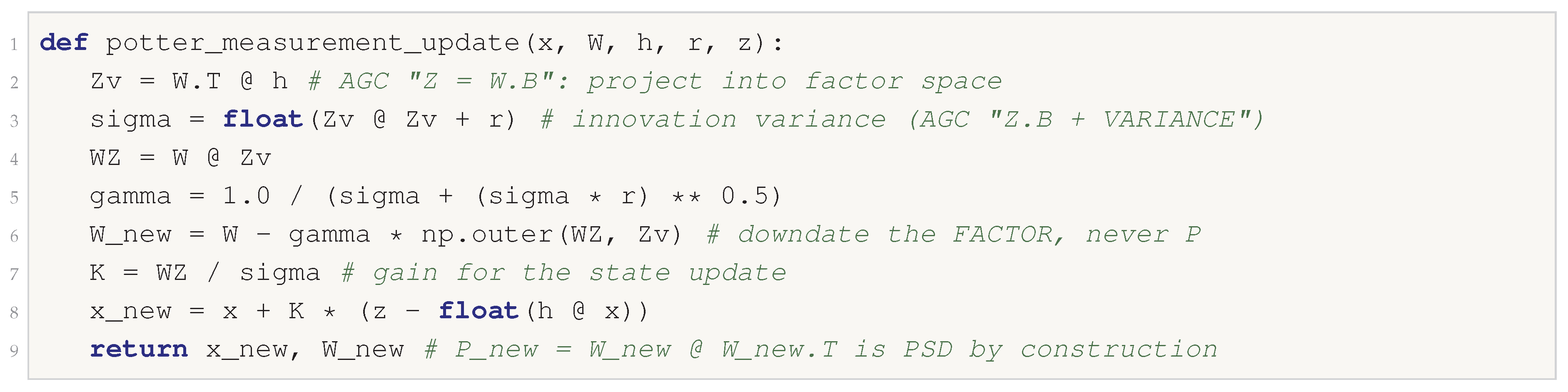 |
This port agrees with a textbook covariance filter to machine precision on well-conditioned problems, and keeps the reconstructed covariance nonnegative where that filter fails (Figure 2). It is the routine that earlier informal analysis mislabeled a “rank-1 covariance downdate”; it is in fact a factored, square-root update, and the distinction is the whole point of Section 5.
Appendix B. Reproducible Experiment Details
This appendix gives the setup behind the four figures in the main text: three reproducible illustrations (graceful degradation, drift bounding, and fixed-point arithmetic) and one numerical benchmark (the SQRT-SURVEY comparison). The illustrations are deliberately small, self-contained, and deterministic: each isolates one transferable principle and, where relevant, the point at which it stops transferring, and absolute numbers should be read as illustrative rather than as field specifications. The benchmark (Appendix B.2) is a genuine comparison with a baseline and a metric: it shows that Apollo’s factored covariance update is numerically robust where the conventional and Joseph forms are not. All code, with fixed random seeds, is under code/; every script regenerates its figure exactly.
Common setup. Python 3 with numpy, scipy, and matplotlib. Seeds are fixed (the constant 1969) so figures are bit-reproducible, and each script under code/ runs standalone.
Appendix B.1. Graceful Degradation Under Compute Overload
A downhole controller executes on a fixed compute budget per control cycle. Each cycle a set of jobs arrives: one safety-critical pressure-integrity monitor with a hard per-cycle deadline, an important job (survey and steering), and a background job (logging and telemetry). During a “sensor storm” window, a burst of spurious low-priority jobs floods the intake, pushing total demand above the budget. This is the structural analogue of the rendezvous-radar interrupt flood that triggered the Apollo 11 1202 alarm, translated into an explicit drilling-automation load-shedding policy rather than a cycle-accurate AGC restart model. Two schedulers process the identical jobs: a best-effort FIFO that serves jobs in (priority-blind) arrival order, and a priority executive that serves by priority and sheds the lowest-priority backlog first. Figure 1 shows the result: FIFO misses the critical deadline repeatedly during the storm, while the priority executive never does, at the cost of intentionally shedding low-priority work.

Table A1.
Graceful-degradation parameters.
| Parameter | Value |
|---|---|
| Control cycles | 120 (≈2 s cadence each) |
| Compute budget per cycle | 100 units |
| Storm window | cycles 45–80 |
| Critical / important / background base cost | 22 / 28 / 30 units |
| Storm flood | 3–6 extra background jobs/cycle, ∼14 units each |
| Peak demand | ≈1.8× budget |
Appendix B.2. The SQRT-SURVEY Benchmark: Square-Root Versus Conventional Update
This is the paper’s one quantitative benchmark. We process a sequence of stiff, near-redundant scalar station fixes against an ill-conditioned prior covariance (condition number , measurement-noise variance ), deliberately in 32-bit floating point to stand in for the AGC’s far coarser fixed-point precision. Three measurement updates run on the identical sequence: the conventional , the Joseph-stabilized form, and Apollo’s Potter square-root update of the factor W (with , faithfully ported in Appendix A). The metric is the smallest eigenvalue of , computed in double precision so the diagnostic is not itself the error source. As Figure 2 shows, the conventional update reaches a smallest eigenvalue of and the Joseph form , both losing positive-definiteness, while the square-root form holds at and never goes indefinite. Across forty seeds the conventional and Joseph updates lose positive-definiteness in 29 and 32 of 40 runs respectively, the square-root update in none; the single-run ordering of the two unfactored forms is incidental, their joint failure under limited precision is not. This is the numerical reason Apollo factored the covariance, and the reason a sparse, ill-conditioned downhole survey estimator should as well.
Appendix B.3. Bounding Drift by Measurement Incorporation
We march a three-state estimator in measured depth s along a directional well. The state is with y the lateral position error, the attitude (azimuth) error, and b a gyro bias. Over a depth step the propagation is
so position error is the double integral of gyro bias and its variance grows cubically with depth, the classic strapdown behaviour. Measurements are incorporated with a standard linear update , , . Three regimes are compared: inertial dead-reckoning (no updates), periodic attitude fixes (, the gyrocompassing analogue of an Apollo star sighting), and occasional absolute position fixes (, the analogue of Apollo ground tracking, which the subsurface largely denies). Results, from a 400-run Monte Carlo, appear in Figure 3; the predicted matches the realised RMS error to within a few percent, a basic filter-consistency check.
Table A2.
Drift-estimation parameters (representative, not vendor-specific).
| Parameter | Value |
| Survey step | 30 m (one stand) |
| Measured depth | 3000 m (100 steps) |
| Initial gyro bias | 0.5 deg/km |
| Attitude random walk | 0.02 deg/ |
| Attitude-fix interval / noise | 150 m / 0.1 deg |
| Position-fix interval / noise | ≈1000 m / 1 m |
| Final lateral (3 regimes) | 39.8 / 1.16 / 0.68 m |
Appendix B.4. Fixed-Point Arithmetic at the Bit
We compute sin and cos with CORDIC, the shift-and-add rotation algorithm that needs no hardware multiplier, in B-bit fixed point (every intermediate value is quantised to B fractional bits after each iteration). We then use it for strapdown-style dead-reckoning of a borehole tangent over one stand and compare to a double-precision reference, sweeping B. Figure 4 shows that roughly 14 to 15 fractional bits, near the AGC’s 15-bit data word, already deliver sub-centimetre arithmetic. The bit budget near the bit is therefore a design choice, not a barrier.
References
- Hall, E.C. Journey to the Moon: The History of the Apollo Guidance Computer; Library of Flight; American Institute of Aeronautics and Astronautics: Reston, VA, 1996. [Google Scholar] [CrossRef]
- Garry, C.; Burkey, R.S. Apollo-11: Original Apollo 11 Guidance Computer (AGC) Source Code (Comanche055 / Luminary099). GitHub Repos. 2016. Public domain; transcribed from MIT Museum hardcopy. [Google Scholar]
- Eyles, D. Tales from the Lunar Module Guidance Computer. In Proceedings of the 27th Annual Guidance and Control Conference (American Astronautical Society), Breckenridge, CO, 2004. AAS Paper 04-064. [Google Scholar]
- Mindell, D.A. Digital Apollo: Human and Machine in Spaceflight; MIT Press: Cambridge, MA, 2008. [Google Scholar]
- Crouch, D.S. Apollo Lunar Surface Drill (ALSD) Final Report. Technical Report NASA-CR-92412; Martin Marietta Corporation for NASA, 1968. [Google Scholar]
- Gutierrez, D. Space-Age Directional Drilling Improves Efficiency, Economics. J. Pet. Technol. (JPT) 2022. Superior QC HiFi Guidance. [Google Scholar]
- Glass, B.; Cannon, H.; Branson, M.; Hanagud, S.; Paulsen, G. DAME: Planetary-Prototype Drilling Automation. Astrobiology 2008, 8, 653–664. [Google Scholar] [CrossRef] [PubMed]
- Zacny, K.; Bar-Cohen, Y.; Brennan, M.; Briggs, G.; Cooper, G.; et al. Drilling Systems for Extraterrestrial Subsurface Exploration. Astrobiology 2008, 8, 665–706. [Google Scholar] [CrossRef] [PubMed]
- Thorogood, J.L. Automation in Drilling: Future Evolution and Lessons from Aviation. SPE Drill. Complet. 2013, 28, 194–202, IADC/SPE-151257. [Google Scholar] [CrossRef]
- de Wardt, J.P. Industry Analogies for Successful Implementation of Drilling-Systems Automation and Real-Time Operating Centers. SPE Drill. Complet. 2014, 29, 22–27, SPE/IADC-163412. [Google Scholar] [CrossRef]
- Macpherson, J.D.; de Wardt, J.P.; Florence, F.; Chapman, C.D.; Zamora, M.; Laing, M.L.; Iversen, F.P. Drilling-Systems Automation: Current State, Initiatives, and Potential Impact. SPE Drill. Complet. 2013, 28, 296–308. [Google Scholar] [CrossRef]
- de Wardt, J.P.; Cayeux, E.; Mihai, R.; Macpherson, J.; Annaiyappa, P.; Pirovolou, D. Taxonomy Describing Levels of Autonomous Drilling Systems: Incorporating Complexity, Uncertainty, Sparse Data, With Human Interaction. SPE J. 2026, 1–14, Journal version of IADC/SPE-217754. [Google Scholar] [CrossRef]
- Kelsey, J.B. A Wellbore Inertial Navigation System. In Proceedings of the IADC/SPE Drilling Conference. Society of Petroleum Engineers; Sandia National Laboratories, 1983. IADC/SPE-11359. [Google Scholar] [CrossRef]
- ElGizawy, M.; Noureldin, A.; El-Sheimy, N. Continuous Wellbore Surveying While Drilling Utilizing MEMS Gyroscopes Based on Kalman Filtering. In Proceedings of the SPE Annual Technical Conference and Exhibition; Society of Petroleum Engineers, 2010. [Google Scholar] [CrossRef]
- Xue, Q.; Leung, H.; Wang, R.; Liu, B.; Wu, Y. Continuous Real-Time Measurement of Drilling Trajectory With New State-Space Models of Kalman Filter. IEEE Trans. Instrum. Meas. 2016, 65, 144–154. [Google Scholar] [CrossRef]
- Burkey, R.S. Virtual AGC: yaAGC Simulator and Digitized AGC Source. Online project and source repository. (accessed on 2026-06-17).
- Hamilton, M.H.; Hackler, W.R. Universal Systems Language: Lessons Learned from Apollo. Computer 2008, 41, 34–43. [Google Scholar] [CrossRef]
- Battin, R.H. An Introduction to the Mathematics and Methods of Astrodynamics, revised ed.; AIAA Education Series; American Institute of Aeronautics and Astronautics: Reston, VA, 1999. [Google Scholar] [CrossRef]
- Schmidt, S.F. The Kalman Filter: Its Recognition and Development for Aerospace Applications. J. Guid. Control 1981, 4, 4–7. [Google Scholar] [CrossRef] [PubMed]
- Klumpp, A.R. Apollo Lunar Descent Guidance. Automatica 1974, 10, 133–146. [Google Scholar] [CrossRef]
- Leveson, N.G. Role of Software in Spacecraft Accidents. J. Spacecr. Rocket. 2004, 41, 564–575. [Google Scholar] [CrossRef]
- MIT Instrumentation Laboratory. Guidance System Operations Plan for Manned LM Earth Orbital and Lunar Missions Using Program LUMINARY 1E. Technical Report R-567, MIT Instrumentation Laboratory (for NASA Manned Spacecraft Center), 1972. Guidance System Operations Plan; the cited NTRS scan is Section 7 (Erasable Memory Programs), NASA-CR-115564.
- Su, Y.; Sheng, L.; Li, L.; Bian, H.; Shi, R.; Zhuang, X.; Chin, W. Strategies in High-Data-Rate MWD Mud Pulse Telemetry. J. Sustain. Energy Eng. 2014, 2, 269–319. [Google Scholar] [CrossRef]
- Allen, S.; McCartney, C.; Hernandez, M.; Reeves, M.; Baksh, A.; MacFarlane, D. Step-Change Improvements with Wired-Pipe Telemetry. In Proceedings of the SPE/IADC Drilling Conference and Exhibition; Society of Petroleum Engineers, 2009. [Google Scholar] [CrossRef]
- Edwards, S.T.; Coley, C.J.; Whitley, N.A.; Keck, R.G.; Ramnath, V.; Foster, T.; Coghill, K.; Honey, M. A Summary of Wired Drill Pipe Field Trials and Deployments in BP. In Proceedings of the SPE/IADC Drilling Conference. Society of Petroleum Engineers, 2013. [Google Scholar] [CrossRef]
- Watson, J.; Castro, G. A Review of High-Temperature Electronics Technology and Applications. J. Mater. Sci. Mater. Electron. 2015, 26, 9226–9235. [Google Scholar] [CrossRef]
- Lv, Y.G.; Chu, W.X.; Wang, Q.W. Thermal Management Systems for Electronics Using in Deep Downhole Environment: A Review. Int. Commun. Heat Mass Transf. 2022, 139, 106450. [Google Scholar] [CrossRef]
- Beckwith, R. Downhole Electronic Components: Achieving Performance Reliability. J. Pet. Technol. 2013, 65, 42–57. [Google Scholar] [CrossRef]
- Liu, C.L.; Layland, J.W. Scheduling Algorithms for Multiprogramming in a Hard-Real-Time Environment. J. ACM 1973, 20, 46–61. [Google Scholar] [CrossRef]
- Sha, L.; Rajkumar, R.; Lehoczky, J.P. Priority Inheritance Protocols: An Approach to Real-Time Synchronization. IEEE Trans. Comput. 1990, 39, 1175–1185. [Google Scholar] [CrossRef]
- Avižienis, A.; Laprie, J.C.; Randell, B.; Landwehr, C. Basic Concepts and Taxonomy of Dependable and Secure Computing. IEEE Trans. Dependable Secur. Comput. 2004, 1, 11–33. [Google Scholar] [CrossRef]
- Randell, B. System Structure for Software Fault Tolerance. IEEE Trans. Softw. Eng. 1975, SE-1, 220–232. [Google Scholar] [CrossRef]
- Godhavn, J.M. Control Requirements for Automatic Managed Pressure Drilling System. SPE Drill. Complet. 2010, 25, 336–345. [Google Scholar] [CrossRef]
- Kinik, K.; Gumus, F.; Osayande, N. Automated Dynamic Well Control With Managed-Pressure Drilling: A Case Study and Simulation Analysis. SPE Drill. Complet. 2015, 30, 110–118. [Google Scholar] [CrossRef]
- Yin, Q.; Yang, J.; Tyagi, M.; Zhou, X.; Hou, X.; Wang, N.; Tong, G.; Cao, B. Machine Learning for Deepwater Drilling: Gas-Kick-Alarm Classification Using Pilot-Scale Rig Data with Combined Surface-Riser-Downhole Monitoring. SPE J. 2021, 1–27. [Google Scholar] [CrossRef]
- Atchison, B.W. Automated Well Control: From Automated Detection to Automated Shut-In. In Proceedings of the SPE/IADC Middle East Drilling Technology Conference and Exhibition; Society of Petroleum Engineers, 2021. [Google Scholar] [CrossRef]
- Atchison, B.W.; Wuest, C. The Integration of Managed Pressure Drilling (MPD) and Automated Well Control Technology. In Proceedings of the IADC/SPE Managed Pressure Drilling & Underbalanced Operations Conference & Exhibition; Society of Petroleum Engineers, 2021. [Google Scholar] [CrossRef]
- National Academy of Engineering and National Research Council. Macondo Well Deepwater Horizon Blowout: Lessons for Improving Offshore Drilling Safety; The National Academies Press: Washington, DC, 2012. [Google Scholar] [CrossRef] [PubMed]
- National Commission on the BP Deepwater Horizon Oil Spill and Offshore Drilling. Deep Water: The Gulf Oil Disaster and the Future of Offshore Drilling. Report to the President; Technical report; National Commission on the BP Deepwater Horizon Oil Spill and Offshore Drilling: Washington, D.C., 2011. [Google Scholar]
- Weston, J.; Ledroz, A.; Ekseth, R. New Gyro While Drilling Technology Delivers Accurate Azimuth and Real-Time Quality Control for All Well Trajectories. SPE Drill. Complet. 2014, 29, 295–303. [Google Scholar] [CrossRef]
- Kalman, R.E. A New Approach to Linear Filtering and Prediction Problems. Trans. ASME–Journal Basic Eng. 1960, 82, 35–45. [Google Scholar] [CrossRef]
- McGee, L.A.; Schmidt, S.F. Discovery of the Kalman Filter as a Practical Tool for Aerospace and Industry; Technical Report NASA TM-86847; NASA Ames Research Center, 1985. [Google Scholar]
- Potter, J.E.; Stern, R.G. Statistical Filtering of Space Navigation Measurements. In Proceedings of the Proceedings of the AIAA Guidance and Control Conference; AIAA, 1963. AIAA Paper 63-333. [Google Scholar] [CrossRef]
- Kaminski, P.G.; Bryson, A.E.; Schmidt, S.F. Discrete Square Root Filtering: A Survey of Current Techniques. IEEE Trans. Autom. Control 1971, 16, 727–736. [Google Scholar] [CrossRef]
- Bierman, G.J. Factorization Methods for Discrete Sequential Estimation; Academic Press: New York, 1977. [Google Scholar]
- Wolff, C.J.M.; de Wardt, J.P. Borehole Position Uncertainty: Analysis of Measuring Methods and Derivation of a Systematic Error Model. J. Pet. Technol. 1981, 33, 2338–2350. [Google Scholar] [CrossRef]
- Williamson, H.S. Accuracy Prediction for Directional Measurement While Drilling. SPE Drill. Complet. 2000, 15, 221–233. [Google Scholar] [CrossRef]
- Torkildsen, T.; Håvardstein, S.T.; Weston, J.; Ekseth, R. Prediction of Wellbore Position Accuracy When Surveyed With Gyroscopic Tools. SPE Drill. Complet. 2008, 23, 5–12. [Google Scholar] [CrossRef]
- Ekseth, R.; Torkildsen, T.; Brooks, A.; Weston, J.; Nyrnes, E.; Wilson, H.; Kovalenko, K. High-Integrity Wellbore Surveying. SPE Drill. Complet. 2010, 25, 438–447. [Google Scholar] [CrossRef]
- Brooks, A.G.; Wilson, H. An Improved Method for Computing Wellbore Position Uncertainty and Its Application to Collision and Target Intersection Probability Analysis. In Proceedings of the European Petroleum Conference. Society of Petroleum Engineers, 1996. [Google Scholar] [CrossRef]
- Jamieson, A. (Ed.) Introduction to Wellbore Positioning, v9, 10 ed.; University of the Highlands and Islands: Inverness, UK; Industry Steering Committee for Wellbore Survey Accuracy (ISCWSA), 2017. [Google Scholar]
- Shuster, M.D.; Oh, S.D. Three-Axis Attitude Determination from Vector Observations. J. Guid. Control 1981, 4, 70–77. [Google Scholar] [CrossRef] [PubMed]
- Russell, A.W.; Roesler, R.F. Reduction of Nonmagnetic Drill Collar Length Through Magnetic Azimuth Correction Technique. In Proceedings of the SPE/IADC Drilling Conference. Society of Petroleum Engineers, 1985. [Google Scholar] [CrossRef]
- Brooks, A.G.; Gurden, P.A.; Noy, K.A. Practical Application of a Multiple-Survey Magnetic Correction Algorithm. In Proceedings of the SPE Annual Technical Conference and Exhibition; Society of Petroleum Engineers, 1998. [Google Scholar] [CrossRef]
- Gupta, S.; Agrawal, A.; Gopalakrishnan, K.; Narayanan, P. Deep Learning with Limited Numerical Precision. In Proceedings of the Proceedings of the 32nd International Conference on Machine Learning (ICML); PMLR, 2015; Vol. 37, pp. 1737–1746. [Google Scholar]
- David, R.; Duke, J.; Jain, A.; Janapa Reddi, V.; Jeffries, N.; Li, J.; Kreeger, N.; Nappier, I.; Natraj, M.; Regev, S.; et al. TensorFlow Lite Micro: Embedded Machine Learning for TinyML Systems. In Proceedings of the Proceedings of Machine Learning and Systems (MLSys); 2021; Vol. 3, pp. 800–811. [Google Scholar]
- Banbury, C.R.; Janapa Reddi, V.; Lam, M.; Fu, W.; Fazel, A.; Holleman, J.; Huang, X.; Hurtado, R.; Kanter, D.; Lokhmotov, A.; et al. Benchmarking TinyML Systems: Challenges and Direction. arXiv 2020, arXiv:2003.04821. [Google Scholar]
- Shi, W.; Cao, J.; Zhang, Q.; Li, Y.; Xu, L. Edge Computing: Vision and Challenges. IEEE Internet Things J. 2016, 3, 637–646. [Google Scholar] [CrossRef]
- Satyanarayanan, M. The Emergence of Edge Computing. Computer 2017, 50, 30–39. [Google Scholar] [CrossRef]
- Eidsvik, J.; Hokstad, K. Positioning Drill-Bit and Look-Ahead Events Using Seismic Traveltime Data. Geophysics 2006, 71, F79–F90. [Google Scholar] [CrossRef]
- Nejadi, S.; Kazemi, N.; Curkan, J.A.; Auriol, J.; Durkin, P.R.; Hubbard, S.M.; Innanen, K.A.; Shor, R.J.; Gates, I.D. Look Ahead of the Bit While Drilling: Potential Impacts and Challenges of Acoustic Seismic While Drilling in the McMurray Formation. SPE J. 2020, 25, 2194–2205. [Google Scholar] [CrossRef]
- Diao, B.; Gao, D.; Zhang, S.; Liu, Z. An Algorithm to Improve Magnetic Ranging Accuracy for Cluster Horizontal Wells with Narrow Spacings. J. Pet. Explor. Prod. Technol. 2024, 14, 583–592. [Google Scholar] [CrossRef]
- Wu, M.; Miao, Y.; Panchal, N.; Kowal, D.R.; Vannucci, M.; Vila, J.; Liang, F. Stochastic Clustering and Pattern Matching for Real-Time Geosteering. Geophysics 2019, 84, ID13–ID24. [Google Scholar] [CrossRef]
- Kyllingstad, Å.; Halsey, G.W. A Study of Slip/Stick Motion of the Bit. SPE Drill. Eng. 1988, 3, 369–373. [Google Scholar] [CrossRef]
- Bourgoyne, A.T.; Young, F.S. A Multiple Regression Approach to Optimal Drilling and Abnormal Pressure Detection. Soc. Pet. Eng. J. 1974, 14, 371–384. [Google Scholar] [CrossRef]
- Bourgoyne, A.T.; Millheim, K.K.; Chenevert, M.E.; Young, F.S. Applied Drilling Engineering; SPE Textbook Series; Society of Petroleum Engineers: Richardson, TX, 1986; Vol. 2. [Google Scholar]
- Thorogood, J.; Aldred, W.; Florence, F.; Iversen, F. Drilling Automation: Technologies, Terminology, and Parallels With Other Industries. SPE Drill. Complet. 2010, 25, 419–425. [Google Scholar] [CrossRef]
- de Wardt, J.P.; Macpherson, J.D.; Zamora, M.; Dow, B.; Hbaieb, S.; Macmillan, R.A.; Laing, M.L.; DiFiore, A.M.; Inabinett, C.E.; Anderson, M.W. Drilling Systems Automation Roadmap: The Means to Accelerate Adoption. In Proceedings of the SPE/IADC Drilling Conference and Exhibition; Society of Petroleum Engineers, 2015. [Google Scholar] [CrossRef]
- Brackel, H.U.; Macpherson, J.; Mieting, R.; Wassermann, I. An Open Approach to Drilling Systems Automation. In Proceedings of the SPE Asia Pacific Oil and Gas Conference and Exhibition; Society of Petroleum Engineers, 2018. [Google Scholar] [CrossRef]
- van Kuilenburg, R.; Isbell, M.; Behounek, M.; Macpherson, J.; Schaefer, S.; Fox, T.; Pirovolou, D. Interoperability for Drilling Process Automation. In Proceedings of the IADC/SPE International Drilling Conference and Exhibition; Society of Petroleum Engineers, 2024. [Google Scholar] [CrossRef]
- Flin, R.; O’Connor, P.; Crichton, M. Safety at the Sharp End: A Guide to Non-Technical Skills; Ashgate: Aldershot, UK, 2008. [Google Scholar]
- Wanasinghe, T.R.; Wroblewski, L.; Petersen, B.K.; Gosine, R.G.; James, L.A.; De Silva, O.; Mann, G.K.I.; Warrian, P.J. Digital Twin for the Oil and Gas Industry: Overview, Research Trends, Opportunities, and Challenges. IEEE Access 2020, 8, 104175–104197. [Google Scholar] [CrossRef]
| 1 | Eight, not the commonly cited seven: the erasable block statically reserves eight twelve-word core sets (96 words in ERASABLE_ASSIGNMENTS.agc), and the executive’s allocator scans all eight before raising 1202. The widely repeated “seven” follows the NO.CORES loop seed of 7, which counts down through zero for eight passes. |
Figure 1.
The downhole 1202. (a) A transient sensor storm drives compute demand above the budget. (b) A priority-blind FIFO scheduler starves the safety-critical loop during the storm; the transferred priority-plus-shedding executive holds it at zero deadline misses. Setup in Appendix B.1.
Figure 1.
The downhole 1202. (a) A transient sensor storm drives compute demand above the budget. (b) A priority-blind FIFO scheduler starves the safety-critical loop during the storm; the transferred priority-plus-shedding executive holds it at zero deadline misses. Setup in Appendix B.1.
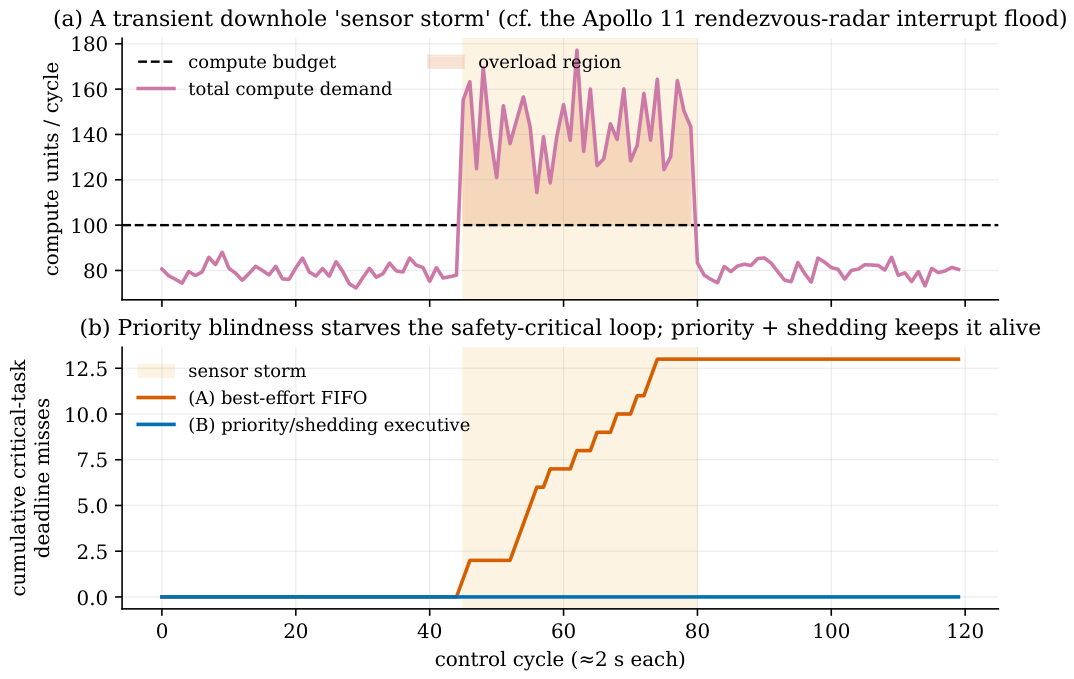
Figure 2.
The SQRT-SURVEY benchmark: numerical stability under ill-conditioning in 32-bit arithmetic. The conventional and even the Joseph-stabilized covariance updates drive the smallest eigenvalue of negative (a covariance that is no longer one); Apollo’s Potter square-root update of the reconstructed covariance stays nonnegative by construction. Setup in Appendix B.2.
Figure 2.
The SQRT-SURVEY benchmark: numerical stability under ill-conditioning in 32-bit arithmetic. The conventional and even the Joseph-stabilized covariance updates drive the smallest eigenvalue of negative (a covariance that is no longer one); Apollo’s Potter square-root update of the reconstructed covariance stays nonnegative by construction. Setup in Appendix B.2.
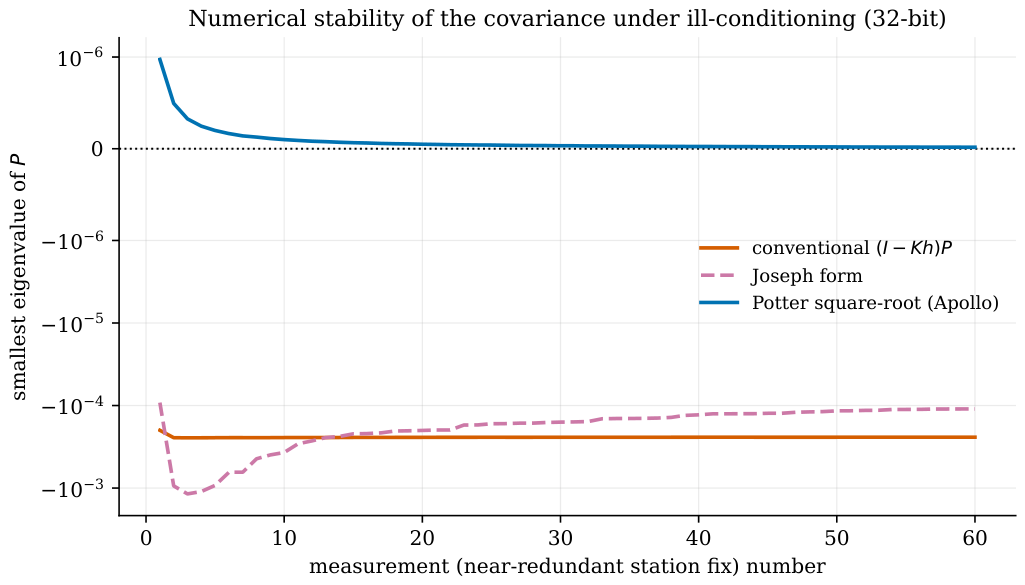
Figure 3.
Bounding drift. (a) Inertial dead-reckoning drifts to tens of metres; measurement incorporation bounds it. (b) The corrective sawtooth of recursive estimation; only an absolute position fix flattens the growth, and that fix is what the subsurface withholds. Setup in Appendix B.3.
Figure 3.
Bounding drift. (a) Inertial dead-reckoning drifts to tens of metres; measurement incorporation bounds it. (b) The corrective sawtooth of recursive estimation; only an absolute position fix flattens the growth, and that fix is what the subsurface withholds. Setup in Appendix B.3.
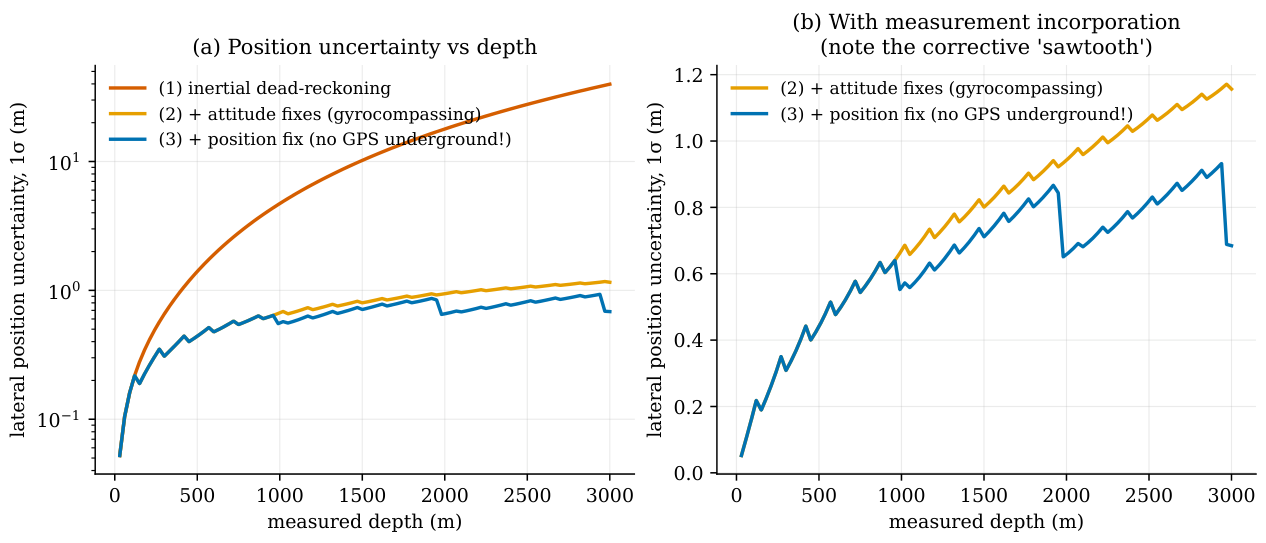
Figure 4.
Navigation math without a floating-point unit. (a) CORDIC trigonometric accuracy and (b) one-stand dead-reckoning accuracy improve sharply with word length and saturate near the AGC’s 15-bit data-word precision. Setup in Appendix B.4.
Figure 4.
Navigation math without a floating-point unit. (a) CORDIC trigonometric accuracy and (b) one-stand dead-reckoning accuracy improve sharply with word length and saturate near the AGC’s 15-bit data-word precision. Setup in Appendix B.4.
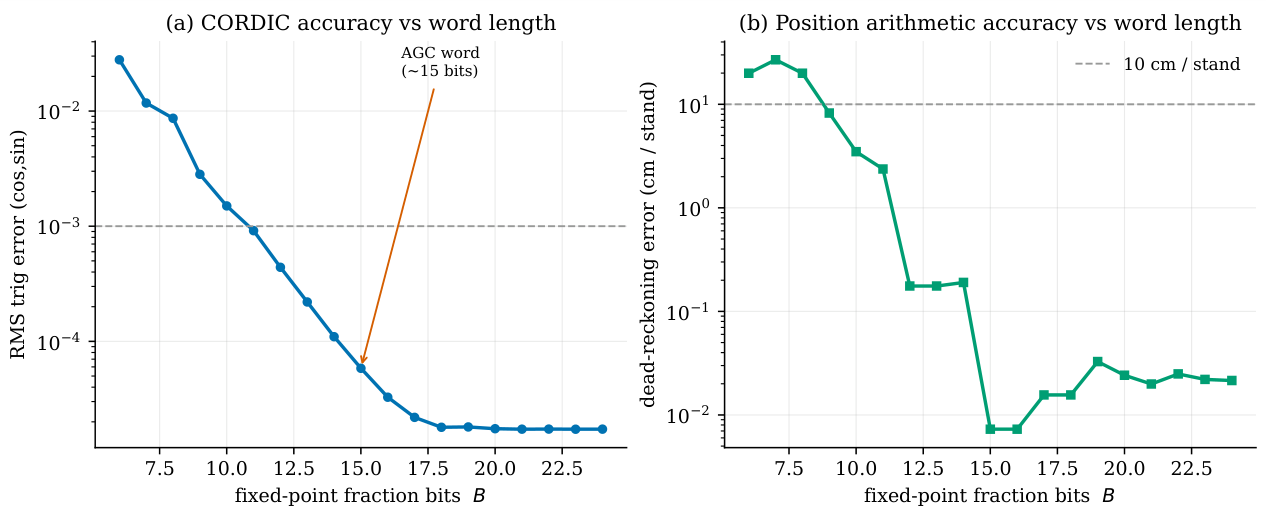
Table 1.
Where the instrumented drillstring and the AGC overlap and diverge. Figures are order-of-magnitude; modern downhole compute is far ahead, while surface telemetry is, if anything, worse than Apollo’s.
Table 1.
Where the instrumented drillstring and the AGC overlap and diverge. Figures are order-of-magnitude; modern downhole compute is far ahead, while surface telemetry is, if anything, worse than Apollo’s.
| Axis | Apollo AGC (1969) | Modern downhole tool | Verdict |
|---|---|---|---|
| Clock / throughput | ∼1 , ∼85k ops/s | tens to hundreds of | diverge (tool ahead) |
| Read/write memory | ∼2k words | megabyte-class | diverge (tool ahead) |
| Numeric hardware | 15-bit fixed point, no FPU | fixed point / limited FPU at temperature | converge |
| Surface telemetry | downlist ∼1600 bps (low-rate PCM) | mud pulse ∼1–20 bps (typ. 10) | overlap (tool worse) |
| Environment | vacuum, radiation | 150–200 °C, shock, vibration | diverge (tool harsher) |
| Human intervention | light-time and workload limited | survey-interval and link limited | overlap |
Disclaimer/Publisher’s Note: The statements, opinions and data contained in all publications are solely those of the individual author(s) and contributor(s) and not of MDPI and/or the editor(s). MDPI and/or the editor(s) disclaim responsibility for any injury to people or property resulting from any ideas, methods, instructions or products referred to in the content. |
© 2026 by the authors. Licensee MDPI, Basel, Switzerland. This article is an open access article distributed under the terms and conditions of the Creative Commons Attribution (CC BY) license (http://creativecommons.org/licenses/by/4.0/).
Copyright: This open access article is published under a Creative Commons CC BY 4.0 license, which permit the free download, distribution, and reuse, provided that the author and preprint are cited in any reuse.


