
Submitted:
24 June 2026
Posted:
25 June 2026
You are already at the latest version
Abstract
Schuurs-Hoeijmakers syndrome, caused by pathogenic variants in PACS1, is a rare neurodevelopmental disorder characterized by intellectual disability, distinctive craniofacial dysmorphism, and multisystem involvement. A 6-year-old male presented with global developmental delay, nocturnal seizures, hypotonia, and progressive craniofacial dysmorphism, including frontal hypertrichosis, synophrys, cup-shaped ears, and digital pads. Whole-exome sequencing revealed a de novo pathogenic variant in PACS1 c.607C>T (p.Arg203Trp), absent in both parents, becoming the first molecularly confirmed case of SHMS in southwestern Colombia. Interestingly, the patient fulfilled the clinical criteria for KS, but no pathogenic variants were identified in KMT2D or KDM6A, supporting the consideration of SHMS as a Kabuki-like syndrome. Brain MRI was unremarkable; however, additional findings such as stereotypic movements, photophobia, and feeding difficulties contributed to an expanded phenotypic spectrum. This case expands the genotypic and phenotypic spectrum of SHMS and reinforces its role as a phenotypic mimic of chromatinopathies like KS. We recommend that PACS1 be included in the genetic evaluation of patients with Kabuki-like features, especially when standard testing yields inconclusive results. This report also underscores the diagnostic value of exome sequencing in complex neurodevelopmental disorders.
Keywords:
Schuurs-Hoeijmakers syndrome
; neurodevelopmental disorder
; seizures
; hypotonia
; intellectual disability
Introduction
The PACS1 gene (Phosphofurin Acidic Cluster Sorting Protein 1, MIM: 607492, NM_018026.3) is located on chromosome 11q13, spanning a total of 24 exons and approximately 175,000 base pairs. It encodes the PACS1 protein, a key regulator of membrane trafficking at the trans-Golgi network (1), which is involved in protein transport and the migration of cranial neural crest cells. The expression of this gene is significantly elevated during embryonic development but is downregulated in the postnatal period.
PACS1 is known to cause Schuurs-Hoeijmakers syndrome (SHMS), an autosomal dominant disorder that clinically manifests with a variable degree of intellectual disability, speech delay, motor difficulties, behavioral problems, and seizures in approximately 60% of patients. Distinctive craniofacial features include arched eyebrows, hypertelorism, downward-slanting palpebral fissures, a bulbous nose, and low-set ears, which may mimic certain chromatinopathies such as Kabuki syndrome (KS). Additional neurological manifestations, such as cerebellar anomalies, ventriculomegaly, and hydrocephalus, are frequently observed.
The disorder was described for the first time on 2012 by Schuurs-Hoeijmakers et al. (2), who reported two unrelated individuals presenting with intellectual deficits and similar facial dysmorphic features, both harboring a de novo c.607C>T (p.Arg203Trp) variant in the PACS1 gene. This variant has been identified in the majority of individuals with SHMS. Additionally, there are two other missense variants that cause disease: c.608G>A (p.Arg203Gln), wich affect the same residue (Arg203) as the recurrent variant c.607C>T (p.Arg203Trp) and produce a similar classic phenotype in both, and the variant c.1574G>A (p.Arg525Lys), this variant is currently controversial, and there is little data available of this variant and SHMS. A multi-exon deletion involving exons 12 to 24 has also been described in four members of a three-generation pedigree, which has been described as a mild phenotype with only language impairment, given that haploinsufficiency is not the common disease-producing mechanism in SHMS (3). To date, 73 patients have been molecularly documented in the literature (4). Due to the lack of pathognomonic phenotypic features and the broad spectrum of overlapping conditions, diagnosis may be delayed, underscoring the importance of genetic testing in cases with similar clinical presentations.
Case Presentation
A 6-year-old male was referred for clinical genetics consultation. The patient, who was the product of the third pregnancy of a mother (3 pregnancies, 2 vaginal deliveries and 1 cesarean section), was born prematurely at 34 weeks of gestation due to fetus in breech position. Since birth, the patient has demonstrated a neurological sucking disorder, which impaired feeding and hindered optimal developmental progression during the neonatal period.
At four months of age, a significant delay in the attainment of psychomotor and cognitive milestones was observed. By seven months, distinct dysmorphic facial features such as slight bilateral eversion of the outer canthi and downward-slanting labial commissures had become evident, which progressively became more pronounced as the patient continued to develop.
At two years of age, the patient presented nocturnal ictal episodes during sleep, that were suggestive of a frontal lobe epilepsy. Language development was markedly impaired, with almost no linguistic progress. The patient also displayed mild hypotonia, evidenced by frequent stumbling and toe-walking.
Repetitive organizing behavior was observed, with a specific obsessive focus on precisely grouping shoes and a persistent need for order. Additional behavioral traits included photophobia, stereotypic hand movements, and constant finger intertwining. The patient was generally sociable but exhibited episodes of exaggerated laughter, deemed unusual behaviorally.
From a gastrointestinal perspective, the patient suffered from persistent constipation and difficulty swallowing solid foods due to his neurological condition, although no signs of gastroesophageal reflux were reported.
The patient's phenotype became more pronounced by de age of 6, including frontal hirsutism, a widow’s peak, thick arched eyebrows with mild synophrys, epicanthal folds, and telecanthus; the auricular morphology includes anteverted ears with overfolded helices, a cup-shaped right ear, and absent right antihelix. A comprehensive semiological description is detailed in Figure 1. To evaluate the brain structure, a simple brain MRI was performed, which was normal. Given the presence of a malformative syndrome and global neurodevelopmental delay, an array comparative genomic hybridization (cGH-microarray) was conducted, nochromosomal rearrangements were found(arr(1-22)x2,(X,Y)x1).
This case highlights the presence of multiple features consistent with SHMS, including distinctive craniofacial dysmorphisms, neurodevelopmental delays, epilepsy, hypotonia, and behavioral peculiarities with a variable degree of severity as reported previously.
Due to a high clinical suspicion of a monogenic disorder, whole-exome sequencing (WES) was performed.
Genomic DNA was extracted from peripheral blood sample using the Maxwell RSC Blood DNA Kit (Promega Corporation, USA). Library preparation was performed with the HubExome Plus Panel-GeneSGKIT (ThermoFisher Scientific, USA), enrichment and capture kit following the manufacturer’s protocol. Libraries were quantified using the Qubit dsDNA HS assay kit (ThermoFisher Scientific, USA), and a Qubit 2.0 fluorometer (ThermoFisher Scientific, USA), and subsequently diluted according to protocol requirements.
Sequencing by synthesis and bridge amplification was carried out on the Illumina NextSeq 500/550 platform (Illumina, USA). This kit allows for comprehensive exome and mitochondrial genome capture. The exome analysis included the detection of single nucleotide variants (SNVs), small insertions and deletions (InDels), large indels, ALU insertions, and copy number variations (CNVs).
Identifying a pathogenic variant in PACS1 c.607C>T (p.Arg203Trp) which has been widely associated with the development of SHMS. According to the American College of Medical Genetics and Genomics (ACMG) Guidelines for the Interpretation and standardized classification on variants, this variant was classified as pathogenic (PS3_verystrong: there are well-established functional studies, in vitro or in vivo, demonstrating a harmful effect of the variant on the function of the gene or gene product, PP5_supporting: variants reported as pathogenic by a reputable source (e.g., clinical databases or peer reviewed scientific literature), PM2_moderate: when the variant is absent (or present at an extremely low frequency) in reference population databases (e.g., gnomAD, ExAC), suggesting that it is not a common variant in the general population and is therefore more likely to be pathogenic, PP2_supporting: missense variants in genes with a low rate of benign missense variant and in which missense variants are a common mechanism of disease PP3_supporting: existence of multiple lines of computational evidence (in silico predictors) supporting a deleterious effect of the variant on the gene or its product) in the PACS1 gene, the finding was subsequently confirmed by Sanger sequencing (6).
Family segregation analysis revealed the absence of this variant in both parents, confirming it as an apparently de novo variant. The identified genetic variant correlates with the patient's phenotype and highlights the critical role of comprehensive genetic testing in neurodevelopmental disorders characterized by overlapping, heterogeneous, and variably severe clinical features.
Discussion
SHMS, or PACS1 Neurodevelopmental Disorder (PACS1-NDD), is an infrequent syndromic cause of intellectual disability first described in 2012 (2). To date, 73 patients have been molecularly documented in the literature (5)(7). Notably, the majority of patients present the same de novo variant c.607C>T(p.Arg203Trp) in the PACS1 gene. However, additional pathogenic variants have been identified, further expanding the phenotypic spectrum, such as a missense variant of the PACS1 gene: c.608G>A (p.Arg203Gln) affecting the same domain as the recurrent variant c.607C>T, producing a similar phenotype, and a deletion of exons 12 to 24 of the PACS1 gen with a mild phenotype, mainly language compromise, since loss of function is not the common disease-producing mechanism, contributing more to a possible genotype-phenotype relationship (7)(9).
The largest cohorts of patients with SHMS have been described by Tin-Yan Seto et al (2020) and Tenorio-Castaño et al (2021), with nearly all cases harboring the same variant c.607C>T(p.Arg203Trp). This consistent finding of the variant (p.Arg203Trp) in the PACS1 gene, and its pathogenic mechanism of gain-of-function or dominant-negative effect, makes it an excellent therapeutic target (8). In this context, antisense oligonucleotides present a promising therapeutic option, as they can be designed to bind specifically to the mutated messenger RNA, preventing its translation or promoting its degradation, binding specifically to the mutated transcript without affecting the normal allele, improving neuronal morphology and function, having implications in cognitive development (10).
Considering the various molecular interactions of the PACS1 protein with gene products from other genes, such as PACS2 and WDR37 (7), overlapping phenotypes with other syndromes have been identified. These include Epileptic Encephalopathy and Developmental Delay 66 (OMIM #618067), associated with pathogenic variants in the PACS2 gene, and Neurooculocardiogenitourinary Syndrome (OMIM #618586), linked to pathogenic variants in the WDR37 gene (2). Both syndromes share clinical and dysmorphic characteristics. Among which they stand out mainly in the neurodevelopmental domain, with shared facial dysmorphias (broad nose, palpebral ptosis, and depressed nasal bridge), which are frequent in all three syndromes, cognitive delay, hypotonia, behavioral disorders such as attention-deficit/hyperactivity disorder (ADHD), autism, and to a lesser extent epilepsy and brain malformations. Mutations in PACS1 and PACS2 alter intracellular trafficking adaptor proteins, which may explain their similar neurodevelopmental effects, and WDR37 encodes a WD repeat protein involved in signaling and developmental processes, but its dysfunction may converge in pathways like PACS1 and PACS2 (11).
In clinical practice, the phenotypic resemblance of SHMS to other syndromic causes of neurodevelopmental disorders, such as chromatinopathies, is particularly striking, especially with KS and Cornelia de Lange syndrome (CdLS) (12).
In this case report, we aim to expand the phenotype of SHMS, highlighting it as one of the main differential diagnoses forKS, Reinforcing the idea that chromatinopathies are classic mimickers of various conditions, with SHMS serving as a clear example.
Establishing a clinical diagnosis based solely on the cardinal features described represents a significant diagnostic challenge, especially when clinical presentations are as suggestive as in KS, as observed in this case (Figure 1).
According to the latest international diagnostic consensus on Kabuki syndrome (KS), published in 2019 (13), a definitive clinical diagnosis of KS is proposed in a patient of any sex and age who presents with infantile hypotonia, neurodevelopmental delay and/or intellectual disability, along with one or both of the following major criteria: a pathogenic variant in the KMT2D or KDM6A gene, and typical dysmorphic features defined as long palpebral fissures, eversion of the lateral third of the lower eyelid, and at least two of the following: arched and broad eyebrows, short columella with a depressed nasal tip, large, prominent, cupped or low-set ears, and persistent fingertip pads.
The patient fully meets the minimum criteria for a definitive clinical diagnosis, with the sole exception of lacking a pathogenic or likely pathogenic variant in the KMT2D or KDM6A genes. However, as with many malformative conditions, including some chromatinopathies such as CdLS (14), the diagnosis should be clinical when the phenotype is highly suggestive, even in the absence of molecular confirmation. In fact, as in the case of CdLS, some genes that are not direct causative genes of the condition but are associated with nearly indistinguishable phenotypes are referred to as Cornelia de Lange-like syndromes (14). This is the case with the ANKRD11 gene, associated with KBG syndrome, which can be an exceptional phenotypic mimic of CdLS (15).
For this reason, based on the KS diagnostic criteria, the significant similarities between SHMS and KS observed in patients reported in the literature, and as represented in Table 1, which outlines the cardinal physical features of both KS and SHMS and compares them with the current case, it is proposed that the PACS1 gene, associated with SHMS phenotype, be considered a Kabuki syndrome mimic or Kabuki-like syndrome.
Conclusions
As far as we know, we report the first case of SHMS in a patient from southwestern Colombia, who harbors the de novo c.607C>T (p.Arg203Trp) variant and exhibits a phenotype overlapping with Kabuki syndrome. Based on the literature and this case report presented, we propose that SHMS should be considered a Kabuki-like syndrome. This case underscores the importance of ongoing research into SHMS and its clinical implications to improve the understanding of genotype-phenotype correlations and optimize patient management.
Author Contributions
Conceptualization, H.P., J.T-C., and P.L.; methodology, H.P., J.T-C., and P.L.; validation, H.P., J.T-C., and P.L.; formal analysis, H.P., J.T-C., and P.L.; investigation, H.P., S.B-N., L.E.P., L.V.C-D-C., J.T-C., and P.L.; resources, H.P.; writing—original S.B-N., L.E.P., L.V.C-D-C.; writing—review and editing, H.P.; visualization, H.P., S.B-N., L.E.P., L.V.C-D-C; supervision, H.P.; project administration, H.P. All authors have read and agreed to the published version of the manuscript.
Funding
This research received no external funding.
Institutional Review Board Statement
The study was conducted in accordance with the Declaration of Helsinki and approved by the Ethics Committee of Hospital Universitario Fundación Valle del Lili (protocol code 2025.034, approved on 17 Ago 2025).
Informed Consent Statement
Written informed consent has been obtained from the patient to publish this paper.
Data Availability Statement
Not applicable.
Conflicts of Interest
The authors declare no conflicts of interest.
References
- Youker, R.T.; Shinde, U.; Day, R.; Thomas, G. At the crossroads of homoeostasis and disease: Roles of the PACS proteins in membrane traffic and apoptosis. Biochem J. 2009, 421, 1–15. [Google Scholar] [CrossRef] [PubMed]
- Schuurs-Hoeijmakers, J.H.M.; Oh, E.C.; Vissers, L.E.L.M.; Swinkels, M.E.M.; Gilissen, C.; Willemsen, M.A.; et al. Recurrent de novo mutations in PACS1 cause defective cranial-neural-crest migration and define a recognizable intellectual-disability syndrome. Am. J. Hum. Genet. 2012, 91, 1122–7. [Google Scholar] [PubMed]
- Miyake, N.; Ozasa, S.; Mabe, H.; Kimura, S.; Shiina, M.; Imagawa, E.; et al. A novel missense mutation affecting the same amino acid as the recurrent PACS1 mutation in Schuurs-Hoeijmakers syndrome. Clin. Genet. 2018, 93, 929–30. [Google Scholar] [PubMed]
- Pagano, S.; Lopergolo, D.; De Falco, A.; Meossi, C.; Satolli, S.; Pasquariello, R.; et al. Expanding the clinical spectrum associated with the recurrent Arg203Trp variant in PACS1, An Italian cohort study. Genes 2025, 16, 227. [Google Scholar] [PubMed]
- Bruno, L.P.; Doddato, G.; Baldassarri, M.; Lo Rizzo, C.; Resciniti, S.; Bruttini, M.; et al. Expanding the clinical spectrum associated with the PACS1 p.Arg203Trp mutational hot-spot: Two additional Italian patients. Am. J. Med. Genet A 2023, 191, 284–8. [Google Scholar] [PubMed]
- Richards, S.; Aziz, N.; Bale, S.; Bick, D.; Das, S.; Gastier-Foster, J.; et al. Standards and guidelines for the interpretation of sequence variants: A joint consensus recommendation of the American College of Medical Genetics and Genomics and the Association for Molecular Pathology. Genet Med.;PubMed 2015, 17, 405–24. [Google Scholar] [CrossRef]
- Arnedo, M.; Ascaso, Á.; Latorre-Pellicer, A.; Lucia-Campos, C.; Gil-Salvador, M.; Ayerza-Casas, A.; et al. Molecular basis of the Schuurs–Hoeijmakers syndrome: What we know about the gene and the PACS-1 protein and novel therapeutic approaches. Int. J. Mol. Sci. 2022, 23, 1–17. [Google Scholar] [CrossRef]
- Seto, M.T.Y.; Bertoli-Avella, A.M.; Cheung, K.W.; Chan, K.Y.K.; Yeung, K.S.; Fung, J.L.F.; et al. Prenatal and postnatal diagnosis of Schuurs-Hoeijmakers syndrome: Case series and review of the literature. Am. J. Med. Genet A 2021, 185, 384–9. [Google Scholar] [PubMed]
- Liu, Y.; Ding, H.; Yan, T.; Liu, L.; Yu, L.; Huang, Y.; et al. A novel multi-exon deletion of PACS1 in a three-generation pedigree: Supplements to PACS1 neurodevelopmental disorder spectrum. Front Genet. 2021, 12, 1–8. [Google Scholar]
- Thomas, G.; Villar-Pazos, S.; Thomas, L.; Yang, Y.; Chen, K.; Lyles, J.; et al. RNA-targeted therapy corrects neuronal deficits in PACS1 syndrome mice. Res Sq [Preprint]. 2023. Available online: https://www.researchsquare.com.
- Tenorio-Castaño, J.; Morte, B.; Nevado, J.; Martinez-Glez, V.; Santos-Simarro, F.; García-Miñaúr, S.; et al. Schuurs–Hoeijmakers syndrome (PACS1 neurodevelopmental disorder): Seven novel patients and a review. Genes 2021, 12, 738. [Google Scholar] [CrossRef] [PubMed]
- Schuurs-Hoeijmakers, J.H.M.; Landsverk, M.L.; Foulds, N.; Kukolich, M.K.; Gavrilova, R.H.; Greville-Heygate, S.; et al. Clinical delineation of the PACS1-related syndrome: Report on 19 patients. Am. J. Med. Genet A 2016, 170, 670–5. [Google Scholar] [PubMed]
- Adam, M.P.; Banka, S.; Bjornsson, H.T.; Bodamer, O.; Chudley, A.E.; Harris, J.; et al. Kabuki syndrome: International consensus diagnostic criteria. In J Med Genet.; PubMed, 2019; Volume 56, pp. 89–95. [Google Scholar] [PubMed]
- Kaur, M.; Blair, J.; Devkota, B.; Fortunato, S.; Clark, D.; Lawrence, A.; et al. Genomic analyses in Cornelia de Lange syndrome and related diagnoses: Novel candidate genes, genotype–phenotype correlations and common mechanisms. Am. J. Med. Genet A 2023, 191, 2113–31. [Google Scholar] [CrossRef] [PubMed]
- Piché, J.; Van Vliet, P.P.; Pucéat, M.; Andelfinger, G. The expanding phenotypes of cohesinopathies: One ring to rule them all! Cell Cycle 2019, 18, 2828–48. [Google Scholar] [CrossRef] [PubMed]
Figure 1.
Clinical features of a patient with PACS1 syndrome at different ages. (A) The patient at 2 years of age exhibits characteristic facial dysmorphism, including slight bilateral eversion of the outer canthi (a feature typical of KS) and downward-slanting labial commissures. (B) By 6 years of age, facial features become more pronounced, including frontal hirsutism, a widow’s peak, thick arched eyebrows with mild synophrys, downward-slanting palpebral fissures, epicanthal folds, and telecanthus. The auricular morphology includes anteverted ears with overfolded helices, a cup-shaped right ear, and absent right antihelix. Additional findings include a slightly bulbous nasal tip, a long and smooth philtrum, a thin upper lip, and spaced lower incisors. (C) Digital pads are prominent on all fingers. (D) The right auricular helix shows overfolding, and two occipitoparietal hair whorls are present. (E) At 6 years, the bilateral outer canthal eversion (less pronounced than at 2 years) is highlighted. These findings align with the reported phenotypic spectrum of PACS1-related disorders.
Figure 1.
Clinical features of a patient with PACS1 syndrome at different ages. (A) The patient at 2 years of age exhibits characteristic facial dysmorphism, including slight bilateral eversion of the outer canthi (a feature typical of KS) and downward-slanting labial commissures. (B) By 6 years of age, facial features become more pronounced, including frontal hirsutism, a widow’s peak, thick arched eyebrows with mild synophrys, downward-slanting palpebral fissures, epicanthal folds, and telecanthus. The auricular morphology includes anteverted ears with overfolded helices, a cup-shaped right ear, and absent right antihelix. Additional findings include a slightly bulbous nasal tip, a long and smooth philtrum, a thin upper lip, and spaced lower incisors. (C) Digital pads are prominent on all fingers. (D) The right auricular helix shows overfolding, and two occipitoparietal hair whorls are present. (E) At 6 years, the bilateral outer canthal eversion (less pronounced than at 2 years) is highlighted. These findings align with the reported phenotypic spectrum of PACS1-related disorders.
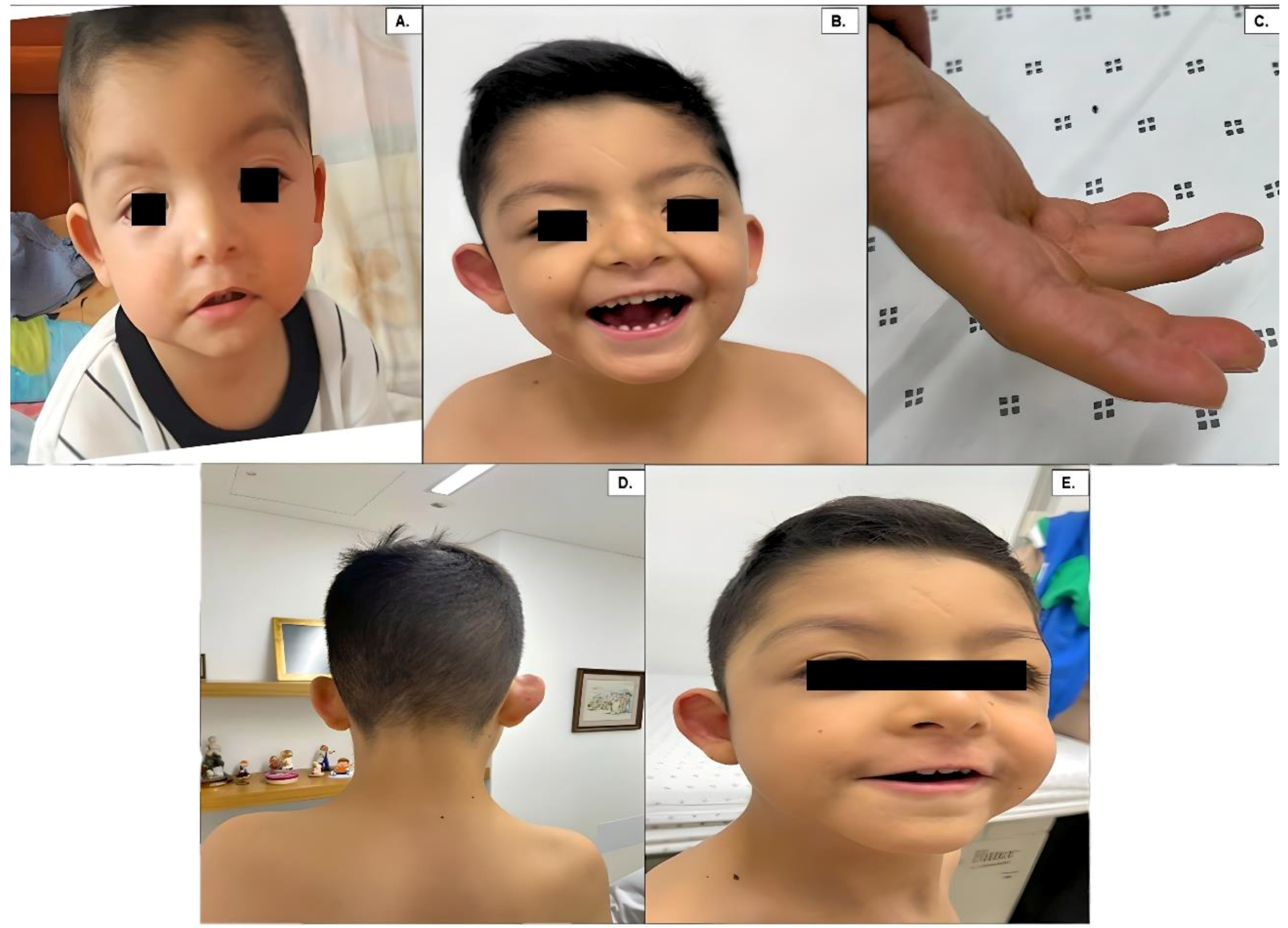

Table 1.
Cardinal features of Kabuki Syndrome (KS) and Schuurs-Hoeijmakers Syndrome (SHMS).
| Kabuki Syndrome | Schuurs-Hoeijmakers Syndrome | This case | |
|---|---|---|---|
| Neurodevelopment | |||
| Mild-to-moderate intellectual disability (HP:0001256) | X° | ||
| Mild-to-severe intellectual disability (HP:0010864) | X° | X | |
| Developmental delay (HP:0001263) | X° | X° | X |
| Hypotonia (HP:0001290) | X** | X** | X |
| Seizures (HP:0001250) (early or infantile onset; well-controlled by medication) | X | X | |
| Postnatal growth retardation (HP:0001507) |
X* | ||
| Facial dysmorphisms (HP:0001999) | |||
| Long palpebral fissures with eversion of the lateral third of the lower eyelid (HP:0007655) | X*** | X | |
| Ocular Hypertelorism (HP:0000316) | X*** | ||
| Hirsutism (HP:0001007) | X** | X | |
| Downslanting palpebral fissures (HP:0000494) | X** | X | |
| Highly arched and broad eyebrows with the lateral third displaying sparseness or notching (HP:0002553) | X*** | X** | X |
| Short columella with depressed nasal tip (HP:0002000)(HP:0000437) | X** | ||
| Bulbous nasal tip (HP:0000414) | X** | X | |
| Large, prominent, and/or cupped ears (HP:0000378) | X*** | X | |
| Low-set and simple ears (HP:0000369) | X* | ||
| Smooth philtrum (HP:0000319) | X*** | X | |
| Wide mouth with downturned corners (HP:0002714) | X** | X | |
| Thin upper vermilion (HP:0000219) | X*** | X | |
| Wide-spaced teeth (HP:0000687) | X | X** | X |
| Skeletal abnormalities (HP:0000924) | |||
| Hemivertebrae, butterfly vertebrae, narrow intervertebral disc space, and/or scoliosis | X** | ||
| Brachydactyly V (HP:0001156) | X** | ||
| Clinodactyly of fifth digits (HP:0004209) | X* | ||
| Behavioral features (HP:0000708) | |||
| Autism spectrum disorder, temper tantrums, aggression,laughing episodes overall friendly disposition | X*** | X | |
| Dermatoglyphic abnormalities (HP:0007477) | |||
| Persistence of fetal fingertip pads (HP:0001212) | X*** | X | |
| Heart defects (HP:0001627) | X** | X** | |
| Feeding problems (HP:0011968) | X** | X* | X |
| Ocular anomalies (Coloboma of the iris, retina, &/or optic nerve) | X* | ||
| ° (Obligate), *** (Very frecuent), ** (Frecuent), *(Occasional) | |||
| Description of the most frequent clinical features associated with SHMS and KS and the patient's case. It is possible to observe the features that can be shared in both syndromes, as well as the features that are specific to each one, observing overlapping of both syndromes and even pointing out features that are observed only in KS. | |||
Disclaimer/Publisher’s Note: The statements, opinions and data contained in all publications are solely those of the individual author(s) and contributor(s) and not of MDPI and/or the editor(s). MDPI and/or the editor(s) disclaim responsibility for any injury to people or property resulting from any ideas, methods, instructions or products referred to in the content. |
© 2026 by the authors. Licensee MDPI, Basel, Switzerland. This article is an open access article distributed under the terms and conditions of the Creative Commons Attribution (CC BY) license.
Copyright: This open access article is published under a Creative Commons CC BY 4.0 license, which permit the free download, distribution, and reuse, provided that the author and preprint are cited in any reuse.


