

Submitted:
23 June 2026
Posted:
24 June 2026
You are already at the latest version
Abstract
Exercise training is frequently examined in relation to cognitive and brain health in aging populations. Yet many exercise-cognition studies remain difficult to interpret mechanistically because cognitive outcomes are often assessed without sufficient alignment with exercise dose, biological endpoints, and participant vulnerability. This mechanism-informed narrative review argues that future research in cognitive aging should move beyond outcome-based interpretation alone and more explicitly connect the exercise stimulus with cerebrovascular endpoints, supportive biological markers, baseline vulnerability, and cognitive or translational outcomes. The review treats cerebrovascular endpoints, including cerebral blood flow, cerebrovascular reactivity, endothelial function, vascular compliance, and neurovascular coupling, as primary mechanistic anchors because they are closely related to vascular cognitive vulnerability and are more proximal to biological adaptation than cognitive test scores alone. Immune-inflammatory markers, blood-brain barrier-related indicators, myokines, neurotrophic factors, and exercise-induced circulating factors are considered supportive endpoints because they may clarify broader biological responsiveness when selected according to a clear hypothesis. The review also considers how exercise modality, delivered dose, adherence, baseline fitness, vascular risk, cognitive status, sex, comorbidity, and recovery capacity may shape responder heterogeneity. Based on this synthesis, the review proposes a five-layer mechanism-informed endpoint framework to support future study design and interpretation. Rather than serving as a clinical prescription model or formal reporting guideline, the framework is intended to help align exercise exposure, participant characteristics, biological mechanisms, and cognitive outcomes in studies of cognitive aging.
Keywords:
vascular cognitive vulnerability
; biological responsiveness
; neurovascular coupling
; exercise dose
; mechanistic endpoints
; responder heterogeneity
1. Introduction
Cognitive aging is commonly assessed through changes in memory, executive function, attention, processing speed, and global cognitive performance. These outcomes are clinically meaningful, but they sit relatively far downstream from the biological processes that exercise interventions are assumed to modify. Age-related cognitive vulnerability is shaped by interacting vascular, metabolic, inflammatory, and neurobiological factors, including cerebrovascular regulation, endothelial function, neurovascular coupling, cardiometabolic burden, and systemic inflammatory status [1,2,3]. This is where many exercise-cognition studies become difficult to interpret mechanistically. A change in cognitive test performance may reflect neural, vascular, or systemic adaptation. Yet the same change can also be shaped by baseline risk, outcome selection, learning effects, medication use, comorbidities, adherence, or insufficient exposure to the intended exercise stimulus [4]. Conversely, the absence of measurable cognitive improvement should not be read too quickly as evidence that exercise produced no biological adaptation. Vascular, inflammatory, fitness-related, or brain structural changes may occur before cognitive changes become detectable, may affect only selected cognitive domains, or may require longer follow-up before they become functionally meaningful.
Exercise training has been widely investigated as a strategy to support cognitive and brain health in middle-aged and older adults. Previous syntheses suggest that exercise interventions may improve selected cognitive domains, particularly executive function and memory, although the observed effects vary across populations, modalities, intervention duration, adherence, and cognitive outcome measures [5]. Human experimental evidence also supports the biological plausibility of exercise-related brain adaptation, including findings that aerobic exercise training can influence hippocampal volume and memory in older adults [6]. Broader reviews of physical activity, cognition, and brain outcomes further suggest that exercise may influence brain health through several interacting pathways rather than through a single cognitive or neural mechanism [7]. Aerobic exercise has received particular attention because of its links with cardiorespiratory fitness, vascular regulation, and cerebrovascular responsiveness, whereas resistance, multimodal, and mind-body exercise are increasingly studied but are less consistently integrated with mechanistic endpoints [5,8,9,10]. This heterogeneity may be telling us something more specific than simply that the evidence is inconsistent. It may also indicate that exercise-cognition effects depend on whether a specific intervention delivers an adequate biological stimulus for a specific participant profile, and whether the study captures the intermediate mechanisms most likely to connect exercise exposure with cognitive outcomes.
Existing reviews have already mapped several important parts of this field, including exercise effects on cognitive outcomes, cerebrovascular function, vascular aging, blood-brain barrier-related mechanisms, and muscle-brain signaling [5,8,11,12,13,14]. Together, these bodies of evidence explain why exercise is biologically plausible as a brain health intervention in aging. However, they often leave the reader with separate pieces of the mechanism rather than a clear way to interpret how those pieces fit together in an exercise trial. Reviews focused on cognitive outcomes may not fully address whether the prescribed exercise stimulus was sufficient to elicit cerebrovascular or inflammatory adaptation. Reviews focused on cerebrovascular function may not fully incorporate intervention reporting, baseline vulnerability, or supportive immune-inflammatory and muscle-derived markers. Reviews of blood-brain barrier-related mechanisms or myokines may highlight promising pathways, but much of this evidence is translational, preclinical, or disease-specific and should not be directly generalized to central neuroimmune modulation in aging humans. The central issue, therefore, is not simply whether another review of exercise and cognitive aging is needed. Rather, the field needs a clearer way to interpret exercise-cognition studies by aligning exercise dose, biological endpoints, participant vulnerability, and cognitive outcomes.
Against this background, the present review proposes a mechanism-informed endpoint framework for exercise studies in cognitive aging. The review gives priority to cerebrovascular endpoints, including cerebral blood flow, cerebrovascular reactivity, endothelial function, vascular compliance, and neurovascular coupling, because these measures are closely linked to vascular cognitive vulnerability and are directly relevant to exercise, cerebrovascular health, and cognitive aging. Immune-inflammatory markers, blood-brain barrier-related mechanisms, myokines, and neurotrophic factors are considered supportive biological endpoints that may help clarify exercise-related responsiveness, while recognizing that direct human evidence remains limited. The review also considers how exercise modality, frequency, intensity, duration, progression, adherence, baseline vascular risk, cognitive status, fitness, sex, and comorbidity may shape responder heterogeneity. To support this interpretation, intervention description, exercise reporting principles, and exercise-dose concepts are incorporated as part of the framework rather than treated as technical details [15,16,17]. Responder heterogeneity is also considered cautiously because apparent individual differences in training response may reflect both true biological variability and measurement or statistical factors, and because sex-related biological and methodological considerations may influence exercise-brain research in aging populations [18,19]. This approach moves the discussion beyond whether exercise changes cognitive scores alone and toward research designs that ask for whom, under what exercise conditions, and through which biological pathways exercise may support cognitive resilience in aging and at-risk adults. Figure 1 summarizes this logic by placing participant vulnerability, exercise stimulus, cerebrovascular anchors, supportive biological endpoints, and cognitive or translational outcomes within the same interpretive pathway rather than treating them as separate domains.
2. Narrative Search Strategy and Conceptual Synthesis Approach
This article takes the form of a mechanism-informed narrative review rather than a systematic review, scoping review, or meta-analysis. The central question was therefore not how large the pooled effect of exercise on cognition might be, but how evidence from exercise training, cerebrovascular function, biological markers, and participant vulnerability can be brought together to improve the interpretation of exercise-cognition studies in aging. This positioning follows the broader distinction among review types [20,21]. Narrative and conceptual reviews are useful when the task is to interpret heterogeneous evidence and develop an integrative argument, whereas systematic reviews and meta-analyses are designed for explicit eligibility-based evidence identification, appraisal, and effect estimation. Accordingly, the review focused on literature related to exercise training, cognitive aging, cerebrovascular regulation, immune-inflammatory and muscle-derived signaling, exercise-dose characteristics, intervention reporting, and responder heterogeneity.
A structured narrative search was conducted using PubMed, Web of Science, Scopus, and Google Scholar. Rather than relying on a single fixed search string, the search was organized around several concept clusters. These clusters covered exercise exposure terms, including exercise training, physical activity, aerobic exercise, resistance training, multimodal exercise, and mind-body exercise; population and cognition terms, including cognitive aging, subjective cognitive decline, mild cognitive impairment, and vascular cognitive impairment; mechanistic endpoint terms, including cerebral blood flow, cerebrovascular reactivity, endothelial function, neurovascular coupling, blood-brain barrier, inflammation, cytokines, myokines, and brain-derived neurotrophic factor; and interpretation-related terms, including exercise dose, adherence, intervention reporting, and individual response. In selecting sources for synthesis, emphasis was placed on human intervention studies, systematic reviews, meta-analyses, mechanistic reviews, methodological papers, reporting frameworks, and selected translational studies directly relevant to endpoint interpretation. Because cognitive outcomes in non-pharmacological interventions are heterogeneous, studies were considered particularly informative when they helped clarify the relationship between cognitive endpoints and biological or intervention-level measures [4].
Conceptual relevance, rather than exhaustive inclusion, guided the synthesis. Evidence was organized around five interpretive layers: participant vulnerability, exercise stimulus, primary cerebrovascular endpoints, supportive immune-inflammatory and muscle-derived endpoints, and cognitive or translational outcomes. This choice reflects the purpose of the review: to integrate evidence across heterogeneous domains and develop an interpretive framework, rather than to provide a complete inventory of all eligible studies [21]. Intervention description and reporting principles were treated as part of the interpretive framework because incomplete reporting of exercise content, progression, supervision, and adherence limits replication and weakens mechanistic interpretation [15,16]. Exercise-dose concepts were interpreted with reference to established exercise prescription principles, including frequency, intensity, time, type, and progression [17]. Responder heterogeneity was considered cautiously because apparent individual differences in training response may reflect both true biological variability and measurement or statistical factors [18]. Sources were prioritized when they directly informed the interpretation of exercise exposure, cerebrovascular or supportive biological endpoints, participant vulnerability, cognitive outcomes, or the proposed endpoint-alignment framework. In this sense, the search strategy supported a mechanism-informed synthesis of conceptually relevant evidence, rather than pooled effect estimation or formal certainty grading. The narrative search was last updated in June 2026. Because the purpose of this review was conceptual synthesis rather than pooled effect estimation or formal evidence grading, no formal risk-of-bias assessment or certainty-of-evidence rating was performed.
3. Why Outcome-Based Exercise-Cognition Studies Are Difficult to Interpret
Cognitive outcomes remain necessary in exercise studies of aging because they indicate whether an intervention is associated with changes that matter for brain health and daily function. However, cognitive test performance is a distal endpoint, and its mechanistic meaning is often uncertain. Studies also vary in the cognitive domains they emphasize, including memory, executive function, processing speed, attention, and global cognition, and these domains may not respond to exercise in the same way or over the same time course [4,5]. Earlier and more recent meta-analytic work suggests that exercise training may be associated with cognitive benefits in older adults, but the magnitude and pattern of effects depend on cognitive domain, participant characteristics, training modality, intervention duration, and analytic choices [22,23,24]. This domain-specific variability is not a minor methodological inconvenience. It affects whether a cognitive change can reasonably be interpreted as evidence of vascular, neural, metabolic, or systemic adaptation.
Cognitive outcomes are also exposed to influences that may have little to do with the exercise mechanism being tested. Baseline cognitive status, education, test familiarity, sleep, mood, medication use, comorbidities, and the timing of outcome assessment may all affect performance. Repeated cognitive testing adds a further complication because practice effects can occur when participants become familiar with task demands, response formats, or testing procedures [25]. These issues do not invalidate cognitive outcomes, but they do make mechanistic interpretation more fragile, particularly when trials use global screening tools, short follow-up periods, multiple cognitive endpoints, or limited mechanistic measures. A positive cognitive change does not by itself identify the biological pathway through which exercise acted. Conversely, a null cognitive result does not necessarily indicate that the intervention failed to induce vascular, metabolic, inflammatory, fitness-related, or brain structural adaptation.
The intervention itself adds another layer of uncertainty. Exercise is not a uniform exposure; it is a complex stimulus defined by modality, frequency, intensity, duration, progression, supervision, adherence, and participant tolerance. Two studies may both be labeled as aerobic exercise or multimodal training, yet differ substantially in actual dose, progression, monitoring, and participant engagement. Incomplete reporting of intervention content can therefore limit replication and make it difficult to determine whether mixed cognitive findings reflect true differences in biological response or differences in the delivered exercise stimulus [15,16]. Established exercise prescription principles highlight the importance of specifying frequency, intensity, time, type, and progression, yet these details are not always fully integrated into the interpretation of cognitive outcomes [17]. In mechanism-informed research, exercise dose is more than a reporting detail; it is the biological stimulus that determines whether cerebrovascular, inflammatory, neuromuscular, or metabolic responses are likely to occur.
Biological adaptation and cognitive change may also unfold on different time scales. Exercise may first affect cardiorespiratory fitness, blood pressure regulation, endothelial function, cerebrovascular responsiveness, systemic inflammatory status, or brain structural and functional plasticity before cognitive changes become detectable. Mechanistic and translational reviews of exercise-related brain plasticity suggest that exercise can influence brain health through multiple interacting pathways, but these pathways may not be captured by a single cognitive test or short-term cognitive endpoint [7,26,27]. In some populations, intermediate biological adaptations may be more sensitive to the intervention than global cognitive scores, especially when baseline cognition is relatively preserved or when follow-up is short. Human exercise studies that include cerebrovascular measures suggest that biological and cognitive outcomes may provide complementary information rather than interchangeable indicators of benefit [8,9,10]. This distinction matters because cognitive outcomes alone cannot determine whether an intervention was biologically inactive, insufficiently dosed, poorly matched to the participant profile, or simply not assessed with endpoints sensitive to the expected mechanism.
Responder heterogeneity makes this interpretation even less straightforward. Older adults differ in baseline vascular risk, cognitive status, fitness, sex, comorbidities, medication use, inflammatory status, adherence, and recovery capacity. These factors may influence both the ability to tolerate a given exercise dose and the likelihood of showing measurable biological or cognitive response. At the same time, apparent responder and non-responder classifications must be interpreted cautiously because individual differences may reflect biological variability, measurement error, regression to the mean, or statistical decisions used to define response [18,28]. These considerations do not diminish the value of cognitive outcomes. Rather, they suggest that cognitive outcomes are most informative when interpreted alongside well-described exercise exposure, intermediate biological endpoints, and baseline participant vulnerability. This is the rationale for turning to cerebrovascular endpoints as primary anchors in exercise-cognition research.
4. Cerebrovascular Endpoints as Primary Mechanistic Anchors
These limitations make cerebrovascular endpoints especially important for exercise-cognition research. Cognitive aging is closely related to vascular cognitive vulnerability, including altered cerebral perfusion, endothelial dysfunction, impaired autoregulation, arterial stiffness, and disrupted neurovascular coupling [1,2,3]. These processes are more proximal to brain vascular health than cognitive test scores alone and may therefore offer a more mechanism-relevant indication of exercise-related adaptation. Cerebral blood flow is regulated through interacting mechanisms involving perfusion pressure, arterial carbon dioxide, oxygen delivery, metabolic demand, autonomic regulation, and vascular structure [29]. In aging adults, cardiovascular and vascular changes can alter cerebral blood flow regulation and may contribute to cognitive vulnerability, while aerobic fitness and cardiovascular function may influence the preservation of cerebral perfusion [30,31]. In this context, cerebrovascular endpoints are not merely secondary biomarkers. They can serve as primary mechanistic anchors because they help determine whether an exercise intervention has engaged vascular pathways relevant to cognitive resilience [8].
Exercise training is likely to engage cerebrovascular function through more than one physiological route. Aerobic exercise, in particular, repeatedly increases cardiorespiratory and hemodynamic demand, exposing the vascular system to stimuli such as shear stress, autonomic adjustment, blood pressure regulation, and metabolic challenge. These stimuli may contribute to vascular adaptation when the intervention is sufficiently intense, progressive, and sustained. Reviews of exercise, cerebrovascular function, and cognition support the biological plausibility of exercise-related cerebrovascular adaptation in aging, although the magnitude and consistency of effects differ across populations, intervention designs, and measurement approaches [8]. Human intervention and training-status studies further suggest that aerobic exercise may influence selected aspects of cerebrovascular regulation and cognition in older adults, but these findings should be interpreted in relation to baseline risk, training adherence, and endpoint selection [9,10,32]. Exercise training has also been associated with changes in resting cerebral blood flow in older adults with and without cognitive impairment, and meta-analytic evidence suggests that physical exercise may improve cerebral blood velocity in older people [33,34]. However, these findings should not be read as evidence of a simple linear pathway from exercise to cerebrovascular improvement to cognitive benefit. They instead suggest that cerebrovascular endpoints can help clarify whether a given exercise stimulus is biologically active in a pathway relevant to cognitive aging.
Not all cerebrovascular endpoints answer the same mechanistic question, and their selection should depend on the pathway being tested. Cerebral blood flow provides information about perfusion, whereas cerebrovascular reactivity reflects the capacity of cerebral vessels to respond to vasoactive stimuli. Neurovascular coupling refers to the coordination between neural activity and local vascular response, and endothelial function reflects vascular health that may influence both peripheral and cerebral regulation [8,29,35,36,37]. Arterial stiffness and vascular compliance may also be relevant because large-vessel aging can affect pulsatile flow transmission and downstream microvascular stress, and arterial stiffness has been associated with cognitive outcomes in adult and older populations [30,38]. These endpoints do not measure the same vascular process and should not be interpreted as interchangeable. For example, a change in resting cerebral blood flow does not necessarily indicate improved cerebrovascular reactivity, and improved peripheral endothelial function does not automatically demonstrate improved brain vascular regulation.
The interpretation of cerebrovascular measures also depends strongly on how they are assessed. Cerebrovascular reactivity can be measured using approaches such as carbon dioxide challenge with MRI or other modalities, but findings may depend on the stimulus, imaging sequence, gas-delivery method, analytic approach, and physiological context [35,36]. Neurovascular coupling measures require similar caution because the observed signal reflects interactions among neural activity, vascular responsiveness, metabolic demand, and methodological assumptions [37]. Similarly, BOLD fMRI responses in aging may be affected by vascular as well as neural factors, which complicates interpretation when vascular function differs across age or risk groups [39]. Transcranial Doppler, near-infrared spectroscopy, MRI-based perfusion methods, peripheral vascular measures, and cardiometabolic indicators may each provide useful information, but they do not represent the same biological construct. This caution matters for the proposed framework: cerebrovascular endpoints strengthen mechanistic interpretation only when their physiological meaning and measurement limits are explicitly recognized.
Cerebrovascular endpoints therefore provide a necessary but not sufficient mechanistic layer for exercise-cognition research. They are necessary because they connect exercise exposure to biological processes directly relevant to vascular cognitive vulnerability. They are not sufficient because cognitive resilience is also shaped by systemic inflammation, blood-brain barrier-related mechanisms, muscle-derived signaling, baseline risk, adherence, and recovery capacity. For this reason, study designs are more informative when they align exercise dose and modality with selected cerebrovascular outcomes while also considering supportive biological markers and participant vulnerability. This approach keeps cerebrovascular function at the center of mechanistic interpretation without reducing cognitive aging to a single vascular pathway.
5. Immune-Inflammatory and Muscle-Derived Signals as Supportive Mechanistic Endpoints
Cerebrovascular endpoints provide the primary mechanistic anchors for this review, but they are unlikely to explain exercise-related cognitive resilience on their own. Cognitive aging is also shaped by systemic inflammation, blood-brain barrier-related mechanisms, metabolic regulation, skeletal muscle adaptation, and neurotrophic signaling. These processes may influence how an older adult responds to exercise and whether vascular adaptation is accompanied by cognitive or functional change. For this reason, immune-inflammatory and muscle-derived signals are best interpreted as supportive mechanistic endpoints. They may help clarify whether an exercise stimulus is accompanied by broader biological responsiveness, but they should not be treated as direct evidence of central neuroimmune modification in aging humans [12,13,14,40].
Systemic inflammatory markers and blood-brain barrier-related mechanisms are relevant because vascular cognitive vulnerability is not solely a hemodynamic problem. Low-grade inflammation, endothelial dysfunction, and altered barrier regulation may interact with cerebrovascular health and cognitive decline. Studies of older adults suggest that physical activity and exercise are associated with inflammatory profiles, and systematic reviews indicate that exercise interventions may influence peripheral inflammatory and neurotrophic biomarkers, although responses vary by marker, modality, population, and intervention duration [40,41,42]. This variability matters because the same biomarker change may carry different meanings across intervention designs and participant profiles. A decrease in a peripheral inflammatory marker may indicate systemic biological responsiveness, but it does not by itself demonstrate that central inflammatory processes or neuroimmune signaling were modified.
Blood-brain barrier-related mechanisms are most relevant when the research question concerns vascular integrity, inflammatory regulation, or neurovascular vulnerability. Exercise may influence blood-brain barrier physiology through pathways involving endothelial function, oxidative stress, inflammatory regulation, and vascular integrity [13]. Even so, the evidence remains heterogeneous and context-dependent. Disease-specific reviews, particularly in Alzheimer’s disease and related neurodegenerative contexts, support the biological plausibility that exercise may interact with neuroinflammatory pathways, but this evidence should be used cautiously when discussing general cognitive aging [43]. For the present framework, blood-brain barrier-related markers are most informative when they are selected to test a specific vulnerability profile or pathway, rather than when they are treated as broad indicators of brain health.
Muscle-derived and neurotrophic signals also broaden the interpretation of exercise-related biological responsiveness. Skeletal muscle is increasingly understood as an endocrine and paracrine organ that can communicate with other tissues through myokines and related exercise-responsive factors [12]. Candidate pathways relevant to brain health include brain-derived neurotrophic factor, FNDC5/irisin-related signaling, cathepsin B, and other factors that may connect muscle contraction, systemic metabolism, neuroplasticity, and cognition [14,44,45,46]. These mechanisms are conceptually useful because they help explain why exercise may influence brain health beyond vascular pathways alone. Their interpretation still requires caution because some evidence is derived from preclinical or translational models, and circulating biomarkers may not directly reflect central nervous system activity. Therefore, myokine and neurotrophic markers should be interpreted as candidate supportive endpoints rather than confirmed mediators of cognitive improvement in aging humans.
Exercise-induced circulating factors have also drawn attention to systemic-to-brain signaling. Translational studies suggest that exercise-related plasma factors may influence neurogenesis, memory, or brain inflammatory profiles in aged experimental models, including candidates such as GPLD1 and clusterin [47,48]. These findings are mechanistically informative because they point to systemic biological signals through which exercise may affect the aging brain. At the same time, they should not be overextended. Plasma-transfer and experimental model findings do not establish that the same factors explain cognitive benefits in human exercise trials. Their main value for the present framework is hypothesis generation: they identify candidate pathways that may guide endpoint selection in future studies, especially when paired with clearly described exercise dose, participant vulnerability, and cognitive outcome domains.
The implication is not that future exercise-cognition studies should measure every available inflammatory marker, myokine, or neurotrophic factor. Excessive biomarker collection without a clear mechanistic hypothesis may create additional interpretive complexity. Instead, supportive endpoints should be selected according to the expected biological response of the intervention and the vulnerability profile of the population. For example, inflammatory or blood-brain barrier-related markers may be particularly informative in participants with vascular or metabolic risk, whereas neurotrophic or muscle-derived markers may be more relevant when the intervention is expected to produce substantial neuromuscular or cardiorespiratory adaptation. These pathways should therefore be interpreted as supportive and hypothesis-generating mechanisms rather than established causal mediators of cognitive improvement. Their relevance depends strongly on the exercise stimulus being tested, which makes exercise dose, modality, adherence, and progression central to the next level of interpretation. Table 1 summarizes the main cerebrovascular and supportive biological endpoint domains considered in this review.
6. Exercise Dose, Modality, and Biological Responsiveness
Exercise dose and modality are not simply descriptors of an intervention; they determine what biological stimulus is actually being tested. In mechanism-informed exercise-cognition research, frequency, intensity, duration, type, progression, supervision, adherence, and delivered dose shape whether the intended stimulus is strong enough, tolerable enough, and sustained enough to generate vascular, metabolic, neuromuscular, inflammatory, or neurotrophic responses. Dose-response evidence in older adults suggests that exercise effects on cognition may depend on cognitive status, session duration, frequency, total exposure, and the way dose is quantified, although dose parameters do not consistently predict cognitive effects across populations [49]. Incomplete reporting of intervention features limits replication and makes it difficult to interpret whether null or mixed cognitive findings reflect an ineffective intervention, insufficient stimulus, poor adherence, or endpoint mismatch [15,16]. Established exercise prescription principles provide a useful language for describing dose, but this review is not primarily concerned with prescription guidance. Rather, exercise characteristics should be reported and interpreted in relation to the biological pathway that the study aims to engage [17].
Aerobic exercise has received the most attention in this literature because it maps readily onto cardiorespiratory fitness, cerebrovascular responsiveness, and cognitive outcomes. The emphasis is understandable from a mechanistic perspective because aerobic training repeatedly exposes the cardiovascular and cerebrovascular systems to hemodynamic demand, shear stress, autonomic adjustment, and metabolic challenge. These stimuli may support endothelial and cerebrovascular adaptation, particularly when the intervention is sufficiently intense, progressive, and sustained [8]. Human intervention studies suggest that aerobic exercise may influence selected cerebrovascular and cognitive outcomes in older adults, although responses vary according to baseline risk, adherence, and measurement approach [9,10]. Observational or training-status comparisons also suggest that regular aerobic training may be associated with more favorable cerebrovascular and cognitive profiles [32]. Broader meta-analytic evidence indicates that exercise interventions, including aerobic and resistance-based approaches, may improve cognitive function in older adults, but such findings should be interpreted with attention to modality, dose, baseline status, and outcome selection [50]. Aerobic exercise should therefore not be assumed to be the appropriate stimulus for all exercise-cognition questions. Its relevance depends on whether the study hypothesis emphasizes cardiorespiratory fitness, vascular regulation, perfusion-related endpoints, or cognitive domains expected to be sensitive to these pathways.
Resistance exercise brings a different stimulus profile into exercise-cognition research. Resistance training places greater emphasis on neuromuscular loading, muscle strength, insulin sensitivity, functional capacity, and muscle-derived signaling. Systematic review evidence suggests that resistance training may improve cognitive function in older adults with different cognitive status, while randomized trial evidence indicates that resistance training can benefit selected executive functions in older women [51,52]. These findings justify including resistance training in mechanism-informed exercise-cognition research, but they should not be interpreted as evidence that resistance exercise is superior to other modalities. For the present framework, resistance training is important because it may provide a neuromuscular and metabolic stimulus that differs from the hemodynamic emphasis of aerobic exercise. Its mechanistic relevance depends on whether the study aims to test strength-related, metabolic, muscle-derived, functional, or cognitive pathways.
Multicomponent exercise can combine aerobic, resistance, balance, coordination, or flexibility components and may therefore deliver a broader intervention stimulus. That breadth can be useful, but it also creates interpretive challenges. Evidence from older adults with cognitive impairment suggests that multicomponent physical exercise may affect global cognition, particularly when aerobic elements are included, while broader evidence in older adults indicates potential effects on overall cognition and frailty-related outcomes [53,54]. These interventions may be especially relevant when functional capacity, balance, mobility, adherence, and cognitive engagement are part of the study hypothesis. However, when several components are delivered together, it may be difficult to determine which component, or which combination of components, is most closely related to observed cognitive or biological changes. Multicomponent interventions therefore require particularly careful reporting of component content, progression, adherence, and delivered dose.
Mind-body exercise and lower-intensity movement approaches raise a different interpretive issue. Modalities such as Tai Chi and Qigong may be relevant when the hypothesized mechanisms include balance, coordination, attentional engagement, autonomic regulation, stress reduction, social participation, or adherence. Meta-analytic and meta-regression evidence suggests that Tai Chi and Qigong may have beneficial effects on cognitive and physical functions in older adults, but these modalities should still be interpreted according to the biological and behavioral stimulus they deliver [55]. Their stimulus profile may differ substantially from interventions designed primarily to improve cardiorespiratory fitness or induce strong hemodynamic loading. If a study uses a lower-intensity or mind-body approach, the selected endpoints should correspond to the expected pathway rather than assume the same vascular or inflammatory responses expected from aerobic training.
The same logic applies to biomarker selection: biomarkers are most informative when their expected response matches the exercise stimulus being tested. Inflammatory, neurotrophic, and muscle-derived markers may be more meaningful when the intervention is expected to influence the biological system represented by those markers. Peripheral inflammatory and neurotrophic biomarkers in older adults may vary according to exercise modality, intervention duration, and participant characteristics [40]. Similarly, muscle-derived signals may be more relevant when the intervention produces substantial neuromuscular or metabolic adaptation [12,14]. Measuring these endpoints without considering the nature of the exercise stimulus can increase interpretive complexity rather than clarify mechanisms. Table 2 summarizes how major exercise modalities can be interpreted as distinct biological stimuli and how each modality may align with selected mechanistic endpoints. Exercise modality and dose should therefore be selected and reported according to the biological pathway being tested. Because the same prescribed intervention may not produce the same biological response across participants, participant vulnerability and responder heterogeneity become the next level of interpretation [18,28].
7. Population Vulnerability and Responder Heterogeneity
The same prescribed exercise dose and modality may not produce the same biological or cognitive response across older adults. This variation should not be dismissed as background noise or reduced to a simple distinction between responders and non-responders. Individual response to exercise training can reflect true biological variability, but it can also be influenced by measurement error, regression to the mean, adherence, baseline status, and the statistical approach used to classify response [18,28]. For exercise-cognition research, this caution matters because cognitive outcomes are often distal, variable, and sensitive to several non-exercise influences. A participant who shows little cognitive change may still have experienced meaningful vascular, metabolic, or fitness-related adaptation, whereas cognitive improvement in another participant may remain difficult to attribute to a specific biological pathway without aligned mechanistic endpoints. Responder heterogeneity is most useful when it is read in relation to exercise exposure, mechanistic endpoints, and baseline vulnerability.
Vascular and metabolic vulnerability are especially informative because they may affect both cerebrovascular reserve and exercise tolerance. Older adults with hypertension, obesity, insulin resistance, arterial stiffness, endothelial dysfunction, or vascular cognitive risk may differ in both cerebrovascular reserve and tolerance of a prescribed exercise dose. These factors may influence whether exercise produces sufficient hemodynamic or metabolic stimulus to alter cerebrovascular responsiveness, and they may also affect whether biological adaptation is accompanied by cognitive change [1,2,3]. Human exercise trials in vascular cognitive impairment and related at-risk populations suggest that baseline vascular burden and cardiovascular risk can shape the magnitude and interpretation of cognitive response to aerobic training [56,57]. In some individuals, greater vascular or metabolic risk may indicate more modifiable dysfunction; in others, the same risk profile may reflect more advanced vascular burden, reduced adaptive capacity, or greater difficulty sustaining the intended intervention. This makes baseline vulnerability part of the interpretation itself, rather than a peripheral clinical detail.
Baseline cognitive status also affects how exercise responses should be interpreted. Healthy older adults, individuals with subjective cognitive concerns, those with mild cognitive impairment, and adults with vascular cognitive vulnerability are unlikely to show the same outcome sensitivity, ceiling effects, disease burden, or time course of change. When baseline cognition is relatively preserved, global cognitive measures may be insensitive to early biological adaptation. When impairment is more pronounced, cognitive outcomes may be influenced by heterogeneous pathology, comorbidity, or reduced capacity to tolerate higher exercise loads. Exercise intervention evidence in older adults with mild cognitive impairment or subjective memory impairment supports the relevance of baseline cognitive status, but it also illustrates that cognitive response can vary by population, intervention design, and follow-up duration [58,59]. Participant selection and cognitive endpoint selection therefore need to be considered together. A study designed to test cerebrovascular responsiveness may require different cognitive endpoints from a study designed to examine functional capacity, neurotrophic signaling, or adherence in adults with greater cognitive vulnerability.
Other participant characteristics further complicate biological responsiveness, including sex, baseline fitness, comorbidity, medication use, recovery capacity, and adherence. Sex differences are particularly relevant because aging, vascular risk, hormonal history, and exercise adaptation may interact in ways that influence brain and cognitive outcomes [19]. Baseline fitness may determine whether a given intervention represents a sufficient challenge, an insufficient stimulus, or an excessive burden, while the delivered dose may differ from the prescribed dose when participants have frailty, fatigue, mobility limitations, low motivation, or competing health burdens [49]. Adherence is therefore not only a practical issue but also an interpretive issue. Reviews of exercise interventions in older adults with mild cognitive impairment or dementia, and broader reviews of exercise adherence in chronic conditions, suggest that adherence is shaped by individual, program-level, health-related, and behavioral factors [60,61]. Biomarker responses may also vary by modality, duration, and participant characteristics, which reinforces the need to interpret inflammatory, neurotrophic, and muscle-derived endpoints in relation to the population being studied [40].
Participant vulnerability should therefore be considered prospectively, rather than used only after the fact to explain inconsistent results. Its role is not to justify premature individualized exercise prescriptions, but to improve the design and interpretation of mechanism-informed studies. Baseline vascular risk, cognitive status, sex, fitness, comorbidity, adherence capacity, and recovery tolerance can help determine whether a given exercise stimulus is likely to be sufficient, tolerable, and biologically measurable. Figure 2 illustrates how exercise dose may interact with vascular-inflammatory vulnerability, fitness, adherence, and recovery capacity to shape adaptive, insufficient, or poorly tolerated biological responses. When vulnerability, exercise stimulus, and endpoint selection are aligned prospectively, exercise-cognition studies may be better positioned to explain who responds, under what conditions, and through which biological pathways. This logic brings the preceding sections together and leads to the mechanism-informed endpoint framework proposed for future exercise-cognition research.
8. A Mechanism-Informed Endpoint Framework for Future Exercise-Cognition Studies
The preceding sections suggest that exercise-cognition research in aging would benefit from stronger mechanistic alignment rather than simply adding more outcomes. Cognitive outcomes remain essential, but they are difficult to interpret when exercise exposure, biological responsiveness, and participant vulnerability are not evaluated together [4]. Similarly, mechanistic interpretation is limited when the prescribed and delivered exercise stimulus is not described with enough detail to support replication and biological interpretation [15,16]. Exercise-cognition studies can also be understood as complex interventions because their effects may depend not only on intervention content, but also on participant characteristics, implementation, adherence, context, and the pathways through which change is expected to occur [62,63,64]. The proposed framework therefore organizes interpretation around five linked layers: participant vulnerability, exercise stimulus, primary cerebrovascular endpoints, supportive biological endpoints, and cognitive or translational outcomes. As summarized in Figure 1, these layers are intended to be interpreted together rather than as separate domains.
The framework begins with participant vulnerability and exercise stimulus. Baseline vulnerability should be considered before interpreting treatment response because vascular risk, metabolic burden, cognitive status, sex, fitness, medication use, comorbidity, adherence capacity, and recovery capacity may shape both dose tolerance and biological responsiveness [18,19,28]. The exercise stimulus layer should then specify not only modality, but also frequency, intensity, duration, progression, supervision, adherence, and delivered dose [15,16,17]. These two layers need to be read together. A dose that is sufficient and recoverable for one participant profile may be insufficient, poorly tolerated, or biologically mismatched for another. From a mechanism-informed perspective, the central design question is not simply whether exercise was prescribed, but whether the delivered intervention was likely to engage the biological pathway being tested.
Cerebrovascular endpoints form the third layer and serve as the primary mechanistic anchors. These endpoints are central to the present framework because cerebrovascular regulation is closely related to vascular cognitive vulnerability and is biologically more proximal than cognitive test scores alone [8]. Depending on the hypothesis, relevant endpoints may include cerebral blood flow, cerebrovascular reactivity, endothelial function, vascular compliance, or neurovascular coupling. However, these measures do not carry the same physiological meaning. Cerebrovascular reactivity, for example, depends on the vasoactive stimulus, imaging or recording approach, analytic method, and physiological context [35,36]. Neurovascular coupling measures also require caution because observed signals reflect interactions among neural activity, metabolic demand, vascular responsiveness, and methodological assumptions [37]. Therefore, the framework emphasizes selecting endpoints according to the pathway being tested rather than adding cerebrovascular measures without a clear interpretive role.
Supportive biological endpoints form the fourth layer, including immune-inflammatory markers, blood-brain barrier-related indicators, myokines, and neurotrophic factors. These endpoints can help clarify whether an exercise intervention is accompanied by broader biological responsiveness, particularly when the study population has vascular, metabolic, inflammatory, or functional vulnerability. Their interpretation should remain tied to evidence level and biological plausibility. Peripheral inflammatory and neurotrophic biomarkers may vary by modality, duration, and participant characteristics in older adults [40]. Muscle-derived signals and myokine-related pathways may also provide useful context when interventions are expected to produce neuromuscular or metabolic adaptation [12,14]. Blood-brain barrier-related mechanisms may be relevant to vascular and inflammatory vulnerability, but direct inference about central neuroimmune modification in aging humans should remain cautious [13]. Thus, supportive endpoints are most useful when they are selected to match a specific hypothesis rather than collected as a broad biomarker panel.
The final layer returns to cognitive and translational outcomes. Cognitive measures remain the outcomes most directly connected to brain health relevance, but they should be selected according to the expected mechanism and population. A study focused on cerebrovascular responsiveness may emphasize executive function, processing speed, or other domains sensitive to vascular regulation, whereas a study focused on neuromuscular or functional resilience may require different cognitive or functional endpoints. Outcome heterogeneity in non-pharmacological interventions reinforces the importance of matching cognitive measures to the study hypothesis and participant profile [4]. Translational outcomes, including adherence, safety, feasibility, tolerance, and maintenance, should also be considered because they affect whether the prescribed exercise stimulus is actually delivered and sustained. These outcomes are not secondary details; they influence whether biological and cognitive responses can be interpreted meaningfully.
Table 3 further clarifies how the framework can guide interpretation without becoming a fixed endpoint checklist. The table links common design questions with corresponding interpretive issues, endpoint implications, and cautionary considerations. Its purpose is to help researchers align the exercise stimulus, participant vulnerability, mechanistic endpoints, and cognitive or translational outcomes before interpreting intervention effects, rather than to prescribe a uniform endpoint battery.
This framework should not be read as a formal reporting guideline or clinical prescription model. Its purpose is more limited and interpretive: to make mechanistic alignment more explicit in exercise-cognition studies. A focused trial may reasonably include only a limited set of biological endpoints when those endpoints are closely matched to the intervention hypothesis. A larger trial in an at-risk population may justify a broader endpoint panel, but only when each measure has a clear interpretive role. The framework is therefore intended to align hypotheses, endpoints, and interpretation, not to establish causal certainty for any single pathway. Used in this way, it can help future studies move beyond asking whether exercise changes cognitive scores and instead examine for whom, under what exercise conditions, through which biological pathways, and with which endpoint combinations exercise may support cognitive resilience.
9. Conclusions
Exercise-cognition research in aging has generated a substantial body of evidence, yet cognitive outcomes alone are often insufficient for mechanistic interpretation. Changes in memory, executive function, processing speed, or global cognition are clinically meaningful, but they do not necessarily reveal whether the intervention engaged the intended biological pathway. The central argument of this review is that outcome-based interpretation should be complemented by mechanism-informed alignment among exercise stimulus, cerebrovascular endpoints, supportive biological markers, participant vulnerability, and cognitive outcomes. Exercise dose and modality should be understood as biological stimuli, not only as intervention descriptors. Cerebrovascular endpoints serve as primary mechanistic anchors because they are closely linked to vascular cognitive vulnerability, whereas immune-inflammatory, blood-brain barrier-related, myokine, and neurotrophic markers may add supportive context when selected according to a clear biological hypothesis.
The proposed framework is intentionally limited in scope and is intended to improve endpoint selection, study interpretation, and hypothesis alignment rather than to prescribe a fixed endpoint set. Nor does it imply that every exercise-cognition study should measure all possible vascular, inflammatory, muscle-derived, or cognitive endpoints. Participant vulnerability, including vascular risk, metabolic status, cognitive baseline, sex, fitness, comorbidity, adherence capacity, and recovery tolerance, should be built into study design rather than used only as a post hoc explanation for inconsistent findings. By shifting the emphasis from whether exercise changes cognitive scores to how exercise stimuli, biological responsiveness, and participant vulnerability are aligned, future studies may be better positioned to clarify for whom, under what conditions, and through which pathways exercise may contribute to cognitive resilience in aging.
Author Contributions
Conceptualization, W.G. and C.-H.S.; methodology, Z.Z., D.W. and C.-H.S.; literature search and synthesis, Z.Z. and D.W.; conceptual analysis, Z.Z., D.W. and C.-H.S.; writing—original draft preparation, Z.Z.; writing—review and editing, D.W., W.G. and C.-H.S.; visualization, Z.Z., D.W. and C.-H.S.; supervision, W.G. and C.-H.S.; project administration, W.G. and C.-H.S. All authors have read and agreed to the published version of the manuscript.
Funding
This research received no external funding.
Institutional Review Board Statement
Not applicable.
Informed Consent Statement
Not applicable.
Data Availability Statement
Not applicable.
Conflicts of Interest
The authors declare no conflicts of interest.
Abbreviations
The following abbreviations are used in this manuscript:
| BBB | Blood-brain barrier |
| BDNF | Brain-derived neurotrophic factor |
| BOLD | Blood oxygen level-dependent |
| CERT | Consensus on Exercise Reporting Template |
| CO₂ | Carbon dioxide |
| CVR | Cerebrovascular reactivity |
| fMRI | Functional magnetic resonance imaging |
| FNDC5 | Fibronectin type III domain-containing protein 5 |
| GPLD1 | Glycosylphosphatidylinositol-specific phospholipase D1 |
| IL | Interleukin |
| IL-6 | Interleukin-6 |
| IL-10 | Interleukin-10 |
| MRI | Magnetic resonance imaging |
| NIRS | Near-infrared spectroscopy |
| PGC-1α | Peroxisome proliferator-activated receptor gamma coactivator 1-alpha |
| TIDieR | Template for Intervention Description and Replication |
| TNF-α | Tumor necrosis factor-alpha |
References
- Gorelick, P.B.; Scuteri, A.; Black, S.E.; DeCarli, C.; Greenberg, S.M.; Iadecola, C.; Launer, L.J.; Laurent, S.; Lopez, O.L.; Nyenhuis, D.; et al. Vascular contributions to cognitive impairment and dementia: A statement for healthcare professionals from the American Heart Association/American Stroke Association. Stroke 2011, 42, 2672–2713. [Google Scholar] [CrossRef] [PubMed]
- Toth, P.; Tarantini, S.; Csiszar, A.; Ungvari, Z. Functional vascular contributions to cognitive impairment and dementia: Mechanisms and consequences of cerebral autoregulatory dysfunction, endothelial impairment, and neurovascular uncoupling in aging. Am. J. Physiol. Heart Circ. Physiol. 2017, 312, H1–H20. [Google Scholar] [CrossRef] [PubMed]
- Iadecola, C.; Duering, M.; Hachinski, V.; Joutel, A.; Pendlebury, S.T.; Schneider, J.A.; Dichgans, M. Vascular cognitive impairment and dementia: JACC Scientific Expert Panel. J. Am. Coll. Cardiol. 2019, 73, 3326–3344. [Google Scholar] [CrossRef] [PubMed]
- Couch, E.; Lawrence, V.; Co, M.; Prina, M. Outcomes tested in non-pharmacological interventions in mild cognitive impairment and mild dementia: A scoping review. BMJ Open 2020, 10, e035980. [Google Scholar] [CrossRef] [PubMed]
- Northey, J.M.; Cherbuin, N.; Pumpa, K.L.; Smee, D.J.; Rattray, B. Exercise interventions for cognitive function in adults older than 50: A systematic review with meta-analysis. Br. J. Sports Med. 2018, 52, 154–160. [Google Scholar] [CrossRef] [PubMed]
- Erickson, K.I.; Voss, M.W.; Prakash, R.S.; Basak, C.; Szabo, A.; Chaddock, L.; Kim, J.S.; Heo, S.; Alves, H.; White, S.M.; et al. Exercise training increases size of hippocampus and improves memory. Proc. Natl. Acad. Sci. USA 2011, 108, 3017–3022. [Google Scholar] [CrossRef] [PubMed]
- Erickson, K.I.; Hillman, C.; Stillman, C.M.; Ballard, R.M.; Bloodgood, B.; Conroy, D.E.; Macko, R.; Marquez, D.X.; Petruzzello, S.J.; Powell, K.E.; et al. Physical activity, cognition, and brain outcomes: A review of the 2018 Physical Activity Guidelines. Med. Sci. Sports Exerc. 2019, 51, 1242–1251. [Google Scholar] [CrossRef] [PubMed]
- Bliss, E.S.; Wong, R.H.X.; Howe, P.R.C.; Mills, D.E. Benefits of exercise training on cerebrovascular and cognitive function in ageing. J. Cereb. Blood Flow Metab. 2021, 41, 447–470. [Google Scholar] [CrossRef] [PubMed]
- Guadagni, V.; Drogos, L.L.; Tyndall, A.V.; Davenport, M.H.; Anderson, T.J.; Eskes, G.A.; Longman, R.S.; Hill, M.D.; Hogan, D.B.; Poulin, M.J. Aerobic exercise improves cognition and cerebrovascular regulation in older adults. Neurology 2020, 94, e2245–e2257. [Google Scholar] [CrossRef] [PubMed]
- Bliss, E.S.; Wong, R.H.X.; Howe, P.R.C.; Mills, D.E. The effects of aerobic exercise training on cerebrovascular and cognitive function in sedentary, obese, older adults. Front. Aging Neurosci. 2022, 14, 892343. [Google Scholar] [CrossRef] [PubMed]
- Barnes, J.N.; Corkery, A.T. Exercise improves vascular function, but does this translate to the brain? Brain Plast. 2018, 4, 65–79. [Google Scholar] [CrossRef] [PubMed]
- Severinsen, M.C.K.; Pedersen, B.K. Muscle–organ crosstalk: The emerging roles of myokines. Endocr. Rev. 2020, 41, 594–609. [Google Scholar] [CrossRef] [PubMed]
- Małkiewicz, M.A.; Szarmach, A.; Sabisz, A.; Cubała, W.J.; Szurowska, E.; Winklewski, P.J. Blood–brain barrier permeability and physical exercise. J. Neuroinflammation 2019, 16, 15. [Google Scholar] [CrossRef] [PubMed]
- Gao, X.; Chen, C.; Yang, J. Unlocking the potential of exercise: Harnessing myokines to improve musculoskeletal aging and cognitive impairment. Front. Physiol. 2024, 15, 1338875. [Google Scholar] [CrossRef] [PubMed]
- Hoffmann, T.C.; Glasziou, P.P.; Boutron, I.; Milne, R.; Perera, R.; Moher, D.; Altman, D.G.; Barbour, V.; Macdonald, H.; Johnston, M.; et al. Better reporting of interventions: Template for Intervention Description and Replication (TIDieR) checklist and guide. BMJ 2014, 348, g1687. [Google Scholar] [CrossRef] [PubMed]
- Slade, S.C.; Dionne, C.E.; Underwood, M.; Buchbinder, R. Consensus on Exercise Reporting Template (CERT): Explanation and elaboration statement. Br. J. Sports Med. 2016, 50, 1428–1437. [Google Scholar] [CrossRef] [PubMed]
- Garber, C.E.; Blissmer, B.; Deschenes, M.R.; Franklin, B.A.; Lamonte, M.J.; Lee, I.-M.; Nieman, D.C.; Swain, D.P. Quantity and quality of exercise for developing and maintaining cardiorespiratory, musculoskeletal, and neuromotor fitness in apparently healthy adults: Guidance for prescribing exercise. Med. Sci. Sports Exerc. 2011, 43, 1334–1359. [Google Scholar] [CrossRef] [PubMed]
- Hecksteden, A.; Kraushaar, J.; Scharhag-Rosenberger, F.; Theisen, D.; Senn, S.; Meyer, T. Individual response to exercise training: A statistical perspective. J. Appl. Physiol. 2015, 118, 1450–1459. [Google Scholar] [CrossRef] [PubMed]
- Barha, C.K.; Liu-Ambrose, T. Exercise and the aging brain: Considerations for sex differences. Brain Plast. 2018, 4, 53–63. [Google Scholar] [CrossRef] [PubMed]
- Grant, M.J.; Booth, A. A typology of reviews: An analysis of 14 review types and associated methodologies. Health Info. Libr. J. 2009, 26, 91–108. [Google Scholar] [CrossRef] [PubMed]
- Snyder, H. Literature review as a research methodology: An overview and guidelines. J. Bus. Res. 2019, 104, 333–339. [Google Scholar] [CrossRef]
- Colcombe, S.; Kramer, A.F. Fitness effects on the cognitive function of older adults: A meta-analytic study. Psychol. Sci. 2003, 14, 125–130. [Google Scholar] [CrossRef] [PubMed]
- Smith, P.J.; Blumenthal, J.A.; Hoffman, B.M.; Cooper, H.; Strauman, T.A.; Welsh-Bohmer, K.; Browndyke, J.N.; Sherwood, A. Aerobic exercise and neurocognitive performance: A meta-analytic review of randomized controlled trials. Psychosom. Med. 2010, 72, 239–252. [Google Scholar] [CrossRef] [PubMed]
- Ludyga, S.; Gerber, M.; Pühse, U.; Looser, V.N.; Kamijo, K. Systematic review and meta-analysis investigating moderators of long-term effects of exercise on cognition in healthy individuals. Nat. Hum. Behav. 2020, 4, 603–612. [Google Scholar] [CrossRef] [PubMed]
- Calamia, M.; Markon, K.; Tranel, D. Scoring higher the second time around: Meta-analyses of practice effects in neuropsychological assessment. Clin. Neuropsychol. 2012, 26, 543–570. [Google Scholar] [CrossRef] [PubMed]
- Voss, M.W.; Vivar, C.; Kramer, A.F.; van Praag, H. Bridging animal and human models of exercise-induced brain plasticity. Trends Cogn. Sci. 2013, 17, 525–544. [Google Scholar] [CrossRef] [PubMed]
- Stillman, C.M.; Esteban-Cornejo, I.; Brown, B.; Bender, C.M.; Erickson, K.I. Effects of exercise on brain and cognition across age groups and health states. Trends Neurosci. 2020, 43, 533–543. [Google Scholar] [CrossRef] [PubMed]
- Bonafiglia, J.T.; Ross, R.; Gurd, B.J. A systematic review examining the approaches used to estimate interindividual differences in trainability and classify individual responses to exercise training. Front. Physiol. 2021, 12, 665044. [Google Scholar] [CrossRef] [PubMed]
- Willie, C.K.; Tzeng, Y.-C.; Fisher, J.A.; Ainslie, P.N. Integrative regulation of human brain blood flow. J. Physiol. 2014, 592, 841–859. [Google Scholar] [CrossRef] [PubMed]
- Tarumi, T.; Zhang, R. Cerebral blood flow in normal aging adults: Cardiovascular determinants, clinical implications, and aerobic fitness. J. Neurochem. 2018, 144, 595–608. [Google Scholar] [CrossRef] [PubMed]
- Tarumi, T.; Ayaz Khan, M.; Liu, J.; Tseng, B.Y.; Parker, R.; Riley, J.; Tinajero, C.; Zhang, R. Cerebral hemodynamics in normal aging: Central artery stiffness, wave reflection, and pressure pulsatility. J. Cereb. Blood Flow Metab. 2014, 34, 971–978. [Google Scholar] [CrossRef] [PubMed]
- Bliss, E.S.; Biki, S.M.; Wong, R.H.X.; Howe, P.R.C.; Mills, D.E. The benefits of regular aerobic exercise training on cerebrovascular function and cognition in older adults. Eur. J. Appl. Physiol. 2023, 123, 1323–1342. [Google Scholar] [CrossRef] [PubMed]
- Alfini, A.J.; Weiss, L.R.; Leitner, B.P.; Smith, T.J.; Hagberg, J.M.; Smith, J.C. Resting cerebral blood flow after exercise training in mild cognitive impairment. J. Alzheimers Dis. 2019, 67, 671–684. [Google Scholar] [CrossRef] [PubMed]
- Prudente, T.P.; Oliva, H.N.P.; Oliva, I.O.; Mezaiko, E.; Monteiro-Junior, R.S. Effects of physical exercise on cerebral blood velocity in older adults: A systematic review and meta-analysis. Behav. Sci. 2023, 13, 847. [Google Scholar] [CrossRef] [PubMed]
- Liu, P.; De Vis, J.B.; Lu, H. Cerebrovascular reactivity (CVR) MRI with CO₂ challenge: A technical review. NeuroImage 2019, 187, 104–115. [Google Scholar] [CrossRef] [PubMed]
- Chen, J.J. Cerebrovascular-reactivity mapping using MRI: Considerations for Alzheimer’s disease. Front. Aging Neurosci. 2018, 10, 170. [Google Scholar] [CrossRef] [PubMed]
- Phillips, A.A.; Chan, F.H.N.; Zheng, M.M.Z.; Krassioukov, A.V.; Ainslie, P.N. Neurovascular coupling in humans: Physiology, methodological advances and clinical implications. J. Cereb. Blood Flow Metab. 2016, 36, 647–664. [Google Scholar] [CrossRef] [PubMed]
- Rensma, S.P.; Stehouwer, C.D.A.; van Boxtel, M.P.J.; Houben, A.J.H.M.; Berendschot, T.T.J.M.; Jansen, J.F.A.; Verhey, F.R.J.; Kroon, A.A.; Koster, A.; Schalkwijk, C.G.; et al. Associations of arterial stiffness with cognitive performance, and the role of microvascular dysfunction: The Maastricht Study. Hypertension 2020, 75, 1607–1614. [Google Scholar] [CrossRef] [PubMed]
- Yabluchanskiy, A.; Nyúl-Tóth, Á.; Csiszar, A.; Gulej, R.; Saunders, D.; Towner, R.; Turner, M.; Zhao, Y.; Abdelkarim, D.; Rypma, B.; et al. Age-related alterations in the cerebrovasculature affect neurovascular coupling and BOLD fMRI responses: Insights from animal models of aging. Psychophysiology 2021, 58, e13718. [Google Scholar] [CrossRef] [PubMed]
- Titus, J.; Bray, N.W.; Kamkar, N.; Camicioli, R.; Nagamatsu, L.S.; Speechley, M.; Montero-Odasso, M. The role of physical exercise in modulating peripheral inflammatory and neurotrophic biomarkers in older adults: A systematic review and meta-analysis. Mech. Ageing Dev. 2021, 194, 111431. [Google Scholar] [CrossRef] [PubMed]
- Khalafi, M.; Akbari, A.; Symonds, M.E.; Pourvaghar, M.J.; Rosenkranz, S.K.; Tabari, E. Influence of different modes of exercise training on inflammatory markers in older adults with and without chronic diseases: A systematic review and meta-analysis. Cytokine 2023, 169, 156303. [Google Scholar] [CrossRef] [PubMed]
- Colbert, L.H.; Visser, M.; Simonsick, E.M.; Tracy, R.P.; Newman, A.B.; Kritchevsky, S.B.; Pahor, M.; Taaffe, D.R.; Brach, J.; Rubin, S.; et al. Physical activity, exercise, and inflammatory markers in older adults: Findings from the Health, Aging and Body Composition Study. J. Am. Geriatr. Soc. 2004, 52, 1098–1104. [Google Scholar] [CrossRef] [PubMed]
- Wang, M.; Liu, J.; Zhou, B.; Xu, R.; Tao, L.; Ji, M.; Zhu, L.; Jiang, J.; Shen, J.; Zhang, Y. Exercise suppresses neuroinflammation for alleviating Alzheimer’s disease. J. Neuroinflammation 2023, 20, 76. [Google Scholar] [CrossRef] [PubMed]
- Wrann, C.D.; White, J.P.; Salogiannnis, J.; Laznik-Bogoslavski, D.; Wu, J.; Ma, D.; Lin, J.D.; Greenberg, M.E.; Spiegelman, B.M. Exercise induces hippocampal BDNF through a PGC-1α/FNDC5 pathway. Cell Metab. 2013, 18, 649–659. [Google Scholar] [CrossRef] [PubMed]
- Moon, H.Y.; Becke, A.; Berron, D.; Becker, B.; Sah, N.; Benoni, G.; Janke, E.; Lubejko, S.T.; Greig, N.H.; Mattison, J.A.; et al. Running-induced systemic cathepsin B secretion is associated with memory function. Cell Metab. 2016, 24, 332–340. [Google Scholar] [CrossRef] [PubMed]
- Vints, W.A.J.; Gökçe, E.; Langeard, A.; Pavlova, I.; Çevik, Ö.S.; Ziaaldini, M.M.; Todri, J.; Lena, O.; Sakkas, G.K.; Jak, S.; et al. Myokines as mediators of exercise-induced cognitive changes in older adults: Protocol for a comprehensive living systematic review and meta-analysis. Front. Aging Neurosci. 2023, 15, 1213057. [Google Scholar] [CrossRef] [PubMed]
- Horowitz, A.M.; Fan, X.; Bieri, G.; Smith, L.K.; Sanchez-Diaz, C.I.; Schroer, A.B.; Gontier, G.; Casaletto, K.B.; Kramer, J.H.; Williams, K.E.; et al. Blood factors transfer beneficial effects of exercise on neurogenesis and cognition to the aged brain. Science 2020, 369, 167–173. [Google Scholar] [CrossRef] [PubMed]
- De Miguel, Z.; Khoury, N.; Betley, M.J.; Lehallier, B.; Willoughby, D.; Olsson, N.; Yang, A.C.; Hahn, O.; Lu, N.; Vest, R.T.; et al. Exercise plasma boosts memory and dampens brain inflammation via clusterin. Nature 2021, 600, 494–499. [Google Scholar] [CrossRef] [PubMed]
- Sanders, L.M.J.; Hortobágyi, T.; la Bastide-van Gemert, S.; van der Zee, E.A.; van Heuvelen, M.J.G. Dose-response relationship between exercise and cognitive function in older adults with and without cognitive impairment: A systematic review and meta-analysis. PLoS ONE 2019, 14, e0210036. [Google Scholar] [CrossRef] [PubMed]
- Xu, L.; Gu, H.; Cai, X.; Zhang, Y.; Hou, X.; Yu, J.; Sun, T. The effects of exercise for cognitive function in older adults: A systematic review and meta-analysis of randomized controlled trials. Int. J. Environ. Res. Public Health 2023, 20, 1088. [Google Scholar] [CrossRef] [PubMed]
- Coelho-Junior, H.J.; Marzetti, E.; Calvani, R.; Picca, A.; Arai, H.; Uchida, M.C. Resistance training improves cognitive function in older adults with different cognitive status: A systematic review and meta-analysis. Aging Ment. Health 2022, 26, 213–224. [Google Scholar] [CrossRef] [PubMed]
- Liu-Ambrose, T.; Nagamatsu, L.S.; Graf, P.; Beattie, B.L.; Ashe, M.C.; Handy, T.C. Resistance training and executive functions: A 12-month randomized controlled trial. Arch. Intern. Med. 2010, 170, 170–178. [Google Scholar] [CrossRef] [PubMed]
- Venegas-Sanabria, L.C.; Cavero-Redondo, I.; Martínez-Vizcaino, V.; Cano-Gutierrez, C.A.; Álvarez-Bueno, C. Effect of multicomponent exercise in cognitive impairment: A systematic review and meta-analysis. BMC Geriatr. 2022, 22, 617. [Google Scholar] [CrossRef] [PubMed]
- Luo, H.; Liang, L.; Li, Y.; Zhang, Y.; Zhang, C.; Liu, Y.; Zhang, Y.; Zhang, H.; Li, X.; Chen, X.; et al. The effectiveness of multicomponent exercise in older adults with cognitive frailty: A systematic review and meta-analysis. Arch. Public Health 2024, 82, 229. [Google Scholar] [CrossRef] [PubMed]
- Park, M.; Song, R.; Ju, K.; Shin, J.C.; Seo, J.; Fan, X.; Gao, X.; Ryu, A.; Li, Y. Effects of Tai Chi and Qigong on cognitive and physical functions in older adults: Systematic review, meta-analysis, and meta-regression of randomized clinical trials. BMC Geriatr. 2023, 23, 352. [Google Scholar] [CrossRef] [PubMed]
- Liu-Ambrose, T.; Best, J.R.; Davis, J.C.; Eng, J.J.; Lee, P.E.; Jacova, C.; Boyd, L.A.; Brasher, P.M.A.; Munkacsy, M.; Cheung, W.; et al. Aerobic exercise and vascular cognitive impairment: A randomized controlled trial. Neurology 2016, 87, 2082–2090. [Google Scholar] [CrossRef] [PubMed]
- Barha, C.K.; Dao, E.; Marcotte, L.; Hsiung, G.-Y.R.; Tam, R.; Liu-Ambrose, T. Cardiovascular risk moderates the effect of aerobic exercise on executive functions in older adults with subcortical ischemic vascular cognitive impairment. Sci. Rep. 2021, 11, 19974. [Google Scholar] [CrossRef] [PubMed]
- Baker, L.D.; Frank, L.L.; Foster-Schubert, K.; Green, P.S.; Wilkinson, C.W.; McTiernan, A.; Plymate, S.R.; Fishel, M.A.; Watson, G.S.; Cholerton, B.A.; et al. Effects of aerobic exercise on mild cognitive impairment: A controlled trial. Arch. Neurol. 2010, 67, 71–79. [Google Scholar] [CrossRef] [PubMed]
- Lautenschlager, N.T.; Cox, K.L.; Flicker, L.; Foster, J.K.; van Bockxmeer, F.M.; Xiao, J.; Greenop, K.R.; Almeida, O.P. Effect of physical activity on cognitive function in older adults at risk for Alzheimer disease: A randomized trial. JAMA 2008, 300, 1027–1037. [Google Scholar] [CrossRef] [PubMed]
- Di Lorito, C.; Bosco, A.; Booth, V.; Goldberg, S.; Harwood, R.H.; Van der Wardt, V. Adherence to exercise interventions in older people with mild cognitive impairment and dementia: A systematic review and meta-analysis. Prev. Med. Rep. 2020, 19, 101139. [Google Scholar] [CrossRef] [PubMed]
- Collado-Mateo, D.; Lavín-Pérez, A.M.; Peñacoba, C.; Del Coso, J.; Leyton-Román, M.; Luque-Casado, A.; Gasque, P.; Fernández-del-Olmo, M.Á.; Amado-Alonso, D. Key factors associated with adherence to physical exercise in patients with chronic diseases and older adults: An umbrella review. Int. J. Environ. Res. Public Health 2021, 18, 2023. [Google Scholar] [CrossRef] [PubMed]
- Craig, P.; Dieppe, P.; Macintyre, S.; Michie, S.; Nazareth, I.; Petticrew, M. Developing and evaluating complex interventions: The new Medical Research Council guidance. BMJ 2008, 337, a1655. [Google Scholar] [CrossRef] [PubMed]
- Moore, G.F.; Audrey, S.; Barker, M.; Bond, L.; Bonell, C.; Hardeman, W.; Moore, L.; O’Cathain, A.; Tinati, T.; Wight, D.; et al. Process evaluation of complex interventions: Medical Research Council guidance. BMJ 2015, 350, h1258. [Google Scholar] [CrossRef] [PubMed]
- Skivington, K.; Matthews, L.; Simpson, S.A.; Craig, P.; Baird, J.; Blazeby, J.M.; Boyd, K.A.; Craig, N.; French, D.P.; McIntosh, E.; et al. A new framework for developing and evaluating complex interventions: Update of Medical Research Council guidance. BMJ 2021, 374, n2061. [Google Scholar] [CrossRef] [PubMed]
Figure 1.
Mechanism-informed endpoint framework for exercise studies in cognitive aging. The framework organizes five linked interpretive layers: participant vulnerability, exercise stimulus, primary cerebrovascular endpoints, supportive biological endpoints, and cognitive or translational outcomes. Participant vulnerability includes vascular risk, metabolic burden, cognitive status, sex, baseline fitness, comorbidity, medication use, adherence capacity, and recovery tolerance. The exercise stimulus layer includes modality, frequency, intensity, duration, progression, supervision, adherence, and delivered dose. Cerebrovascular endpoints, including cerebral blood flow, cerebrovascular reactivity, endothelial function, vascular compliance, and neurovascular coupling, are treated as primary mechanistic anchors because they are closely related to vascular cognitive vulnerability. Immune-inflammatory markers, blood-brain barrier-related indicators, myokines, neurotrophic factors, and exercise-induced circulating factors provide supportive biological context when selected according to a clear hypothesis. Cognitive and translational outcomes are interpreted in relation to the preceding layers rather than as isolated endpoints. The dashed feedback line indicates that observed outcomes may inform study interpretation, endpoint sensitivity, and future refinement of participant characterization or exercise stimulus description; it should not be read as a bidirectional causal pathway. The figure is intended as a conceptual framework for mechanism-informed interpretation, not as a formal reporting guideline or fixed endpoint checklist.
Figure 1.
Mechanism-informed endpoint framework for exercise studies in cognitive aging. The framework organizes five linked interpretive layers: participant vulnerability, exercise stimulus, primary cerebrovascular endpoints, supportive biological endpoints, and cognitive or translational outcomes. Participant vulnerability includes vascular risk, metabolic burden, cognitive status, sex, baseline fitness, comorbidity, medication use, adherence capacity, and recovery tolerance. The exercise stimulus layer includes modality, frequency, intensity, duration, progression, supervision, adherence, and delivered dose. Cerebrovascular endpoints, including cerebral blood flow, cerebrovascular reactivity, endothelial function, vascular compliance, and neurovascular coupling, are treated as primary mechanistic anchors because they are closely related to vascular cognitive vulnerability. Immune-inflammatory markers, blood-brain barrier-related indicators, myokines, neurotrophic factors, and exercise-induced circulating factors provide supportive biological context when selected according to a clear hypothesis. Cognitive and translational outcomes are interpreted in relation to the preceding layers rather than as isolated endpoints. The dashed feedback line indicates that observed outcomes may inform study interpretation, endpoint sensitivity, and future refinement of participant characterization or exercise stimulus description; it should not be read as a bidirectional causal pathway. The figure is intended as a conceptual framework for mechanism-informed interpretation, not as a formal reporting guideline or fixed endpoint checklist.
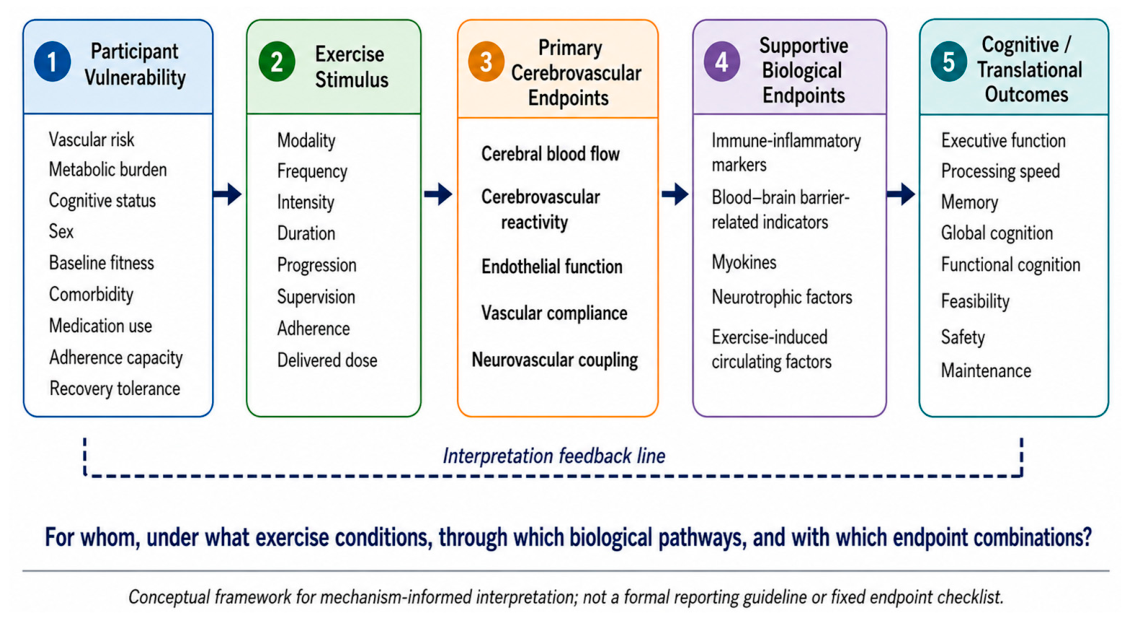
Figure 2.
Conceptual response patterns linking participant vulnerability, exercise stimulus match, and biological responsiveness in exercise-cognition studies of aging. Participant vulnerability and capacity, including vascular-inflammatory burden, metabolic risk, cognitive baseline, baseline fitness, comorbidity, frailty or fatigue, recovery capacity, and adherence capacity, may influence whether a prescribed exercise stimulus is sufficiently matched, under-dosed, or poorly tolerated. A well-matched and tolerable stimulus may support adaptive biological responses, such as vascular and metabolic adaptation, inflammatory regulation, and neuromuscular or neurotrophic support, which may contribute to cognitive resilience. In contrast, an insufficient stimulus may produce limited biological adaptation and a weak or null cognitive signal, whereas a poorly tolerated stimulus may increase burden, reduce adherence, or produce unclear and attenuated responses. These response patterns are conceptual and should be interpreted in relation to mechanistic endpoints, delivered dose, adherence, recovery capacity, and baseline participant vulnerability rather than as fixed responder categories or clinical prescription rules.
Figure 2.
Conceptual response patterns linking participant vulnerability, exercise stimulus match, and biological responsiveness in exercise-cognition studies of aging. Participant vulnerability and capacity, including vascular-inflammatory burden, metabolic risk, cognitive baseline, baseline fitness, comorbidity, frailty or fatigue, recovery capacity, and adherence capacity, may influence whether a prescribed exercise stimulus is sufficiently matched, under-dosed, or poorly tolerated. A well-matched and tolerable stimulus may support adaptive biological responses, such as vascular and metabolic adaptation, inflammatory regulation, and neuromuscular or neurotrophic support, which may contribute to cognitive resilience. In contrast, an insufficient stimulus may produce limited biological adaptation and a weak or null cognitive signal, whereas a poorly tolerated stimulus may increase burden, reduce adherence, or produce unclear and attenuated responses. These response patterns are conceptual and should be interpreted in relation to mechanistic endpoints, delivered dose, adherence, recovery capacity, and baseline participant vulnerability rather than as fixed responder categories or clinical prescription rules.
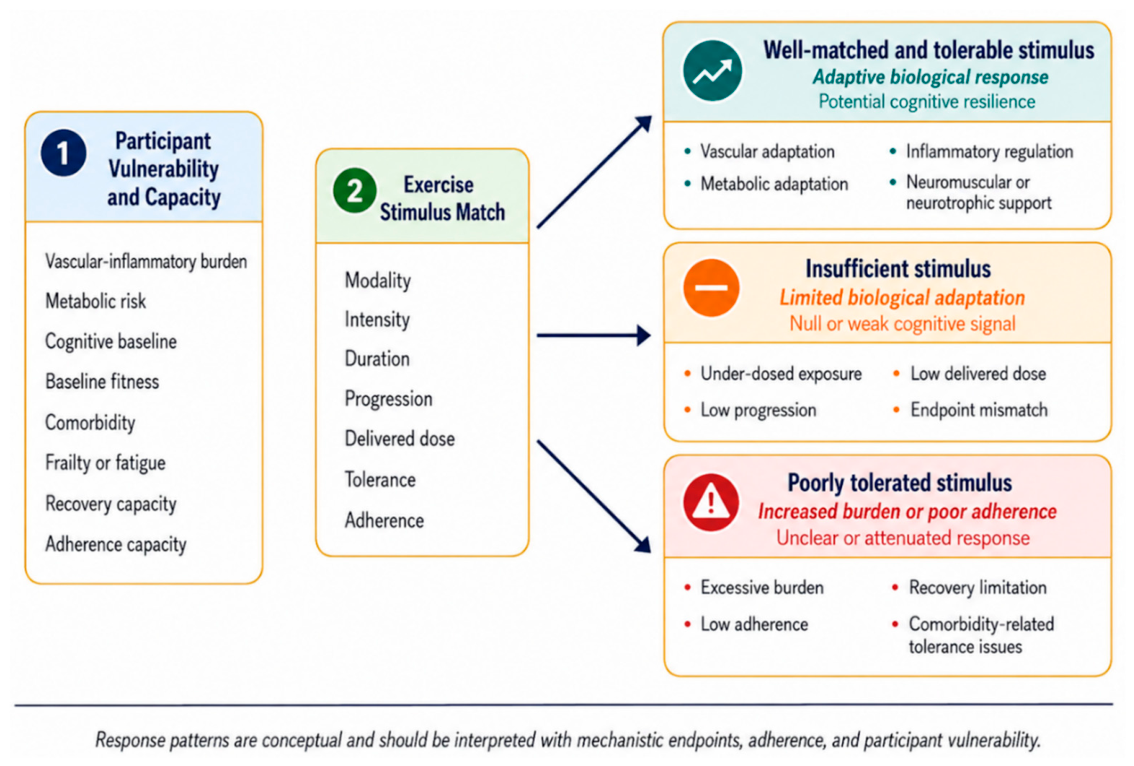

Table 1.
Cerebrovascular and supportive biological endpoint domains for mechanism-informed exercise-cognition studies.
Table 1.
Cerebrovascular and supportive biological endpoint domains for mechanism-informed exercise-cognition studies.
| Endpoint domain | Examples of measures | Mechanistic relevance | Interpretive value | Main limitations | Supporting key references |
|---|---|---|---|---|---|
| Cerebral blood flow | Global or regional cerebral blood flow assessed by MRI, arterial spin labeling, transcranial Doppler, or related perfusion approaches | Reflects cerebral perfusion and oxygen/nutrient delivery, which may be relevant to vascular cognitive vulnerability | Helps determine whether exercise is associated with perfusion-related adaptation | Resting blood flow does not necessarily indicate improved vascular reserve, cerebrovascular reactivity, or neurovascular coupling | [29,30,31,32,33,34] |
| Cerebrovascular reactivity | CO₂ challenge, breath-hold response, MRI-based CVR, transcranial Doppler-based reactivity | Reflects the capacity of cerebral vessels to respond to vasoactive stimuli | Provides a more dynamic index of vascular responsiveness than resting perfusion alone | Results depend on stimulus type, gas-delivery method, imaging or recording modality, and analytic approach | [29,35,36] |
| Neurovascular coupling | Task-evoked BOLD fMRI, NIRS responses, or other measures linking neural activation and local vascular response | Captures coordination between neural activity, metabolic demand, and local vascular regulation | Useful when the hypothesis concerns functional brain activation and vascular responsiveness | Signals may reflect both neural and vascular factors; interpretation is difficult when vascular function differs across age or risk groups | [37,39] |
| Endothelial function | Flow-mediated dilation, peripheral arterial tonometry, circulating endothelial markers | Reflects systemic vascular health and nitric oxide-related vascular regulation | May provide supportive evidence that exercise engages vascular pathways | Peripheral endothelial function does not automatically demonstrate improved cerebral vascular regulation | [2,8,29] |
| Arterial stiffness and vascular compliance | Pulse wave velocity, augmentation index, central blood pressure, vascular compliance indices | Reflects large-vessel aging, pulsatile flow transmission, and downstream microvascular stress | Relevant to vascular cognitive risk and long-term cerebrovascular burden | Associations with cognition do not establish direct exercise-induced brain vascular adaptation | [30,38] |
| Peripheral inflammatory markers | C-reactive protein, IL-6, TNF-α, IL-10, other cytokines or inflammatory profiles | Reflect systemic inflammatory status that may interact with vascular and cognitive vulnerability | May help identify broader biological responsiveness to exercise | Peripheral markers should not be overinterpreted as direct evidence of central neuroimmune change | [40,41,42] |
| Blood-brain barrier-related indicators | BBB permeability imaging, albumin ratio, vascular integrity markers, endothelial or tight-junction-related indicators | Relevant to vascular integrity, inflammatory regulation, and neurovascular health | May be informative in populations with vascular or metabolic vulnerability | Human evidence is heterogeneous; many mechanistic claims remain translational or disease-specific | [13,43] |
| Myokines and muscle-derived signals | BDNF, irisin/FNDC5-related markers, cathepsin B, GPLD1, clusterin, or other exercise-responsive circulating factors | May connect skeletal muscle contraction, metabolism, neuroplasticity, and brain health | Useful when interventions are expected to produce neuromuscular or metabolic adaptation | Circulating levels may not reflect central nervous system activity or causal mediation | [12,14,44,45,46,47,48] |
| Neurotrophic markers | BDNF and related neurotrophic indicators | Relevant to synaptic plasticity, neurogenesis-related hypotheses, and exercise-brain signaling | May support interpretation of neuroplastic or systemic-to-brain signaling pathways | Responses vary by assay, timing, modality, training status, and participant characteristics | [40,44,45,46] |
| Cognitive outcomes | Executive function, processing speed, memory, attention, global cognition, functional cognition | Indicate clinical or functional relevance of exercise-related change | Essential for determining whether biological adaptation is linked to meaningful cognitive outcomes | Practice effects, ceiling effects, outcome heterogeneity, and short follow-up may limit mechanistic interpretation | [4,22,23,24,25] |
Note. BBB, blood-brain barrier; BDNF, brain-derived neurotrophic factor; BOLD, blood oxygen level-dependent; CO₂, carbon dioxide; CVR, cerebrovascular reactivity; IL, interleukin; MRI, magnetic resonance imaging; NIRS, near-infrared spectroscopy; TNF-α, tumor necrosis factor-alpha.
Table 2.
Exercise Modalities as Biological Stimuli for Mechanism-Informed Cognitive Aging Studies.
| Exercise modality | Primary stimulus profile | Mechanistic pathways most plausibly engaged | Endpoint alignment | Interpretation cautions | Supporting key references |
|---|---|---|---|---|---|
| Aerobic exercise | Repeated cardiorespiratory and hemodynamic demand through walking, cycling, treadmill exercise, or other rhythmic endurance activities | Cardiorespiratory fitness, shear stress, endothelial function, cerebral perfusion, cerebrovascular reactivity, autonomic regulation, metabolic regulation | Cerebral blood flow, cerebrovascular reactivity, endothelial function, cardiorespiratory fitness, blood pressure, executive function, processing speed | Benefits should not be assumed without adequate intensity, progression, adherence, and delivered dose; vascular and cognitive responses may not follow the same time course | [8,9,10,32,33,34,49,50] |
| Resistance training | Repeated neuromuscular loading through machine-based, free-weight, elastic-band, or body-weight exercise | Muscle strength, insulin sensitivity, functional capacity, muscle-derived signaling, neuromuscular reserve, metabolic health | Strength, functional performance, metabolic markers, myokines, neurotrophic markers, selected cognitive domains such as executive function | Should not be interpreted as superior or inferior to aerobic exercise; mechanistic relevance depends on whether the study hypothesis involves neuromuscular, metabolic, or muscle-brain pathways | [12,14,50,51,52] |
| Multicomponent exercise | Combined aerobic, resistance, balance, coordination, flexibility, or functional training components | Broader physical function, mobility, balance, cardiorespiratory and neuromuscular adaptation, cognitive engagement, adherence potential | Functional capacity, mobility, balance, fitness, strength, cognitive outcomes, feasibility, adherence, selected vascular or metabolic endpoints | Component effects may be difficult to separate; reporting must specify component content, progression, intensity, and delivered dose | [50,53,54] |
| Mind-body exercise | Coordinated movement, posture control, breathing, attention, and often social or group-based participation, as in Tai Chi or Qigong | Balance, coordination, attentional engagement, autonomic regulation, stress modulation, adherence, social participation | Balance, mobility, executive function, attention, adherence, quality of participation, autonomic or stress-related indicators where relevant | Should not be assumed to produce the same hemodynamic or vascular stimulus as moderate-to-vigorous aerobic training | [55] |
| Low-intensity functional movement | Light walking, mobility exercise, stretching, functional movement practice, or low-load activities adapted to frailty or low tolerance | Movement confidence, functional maintenance, sedentary interruption, safety, gradual conditioning | Feasibility, tolerance, physical function, sedentary behavior, safety, patient-reported outcomes | May be highly relevant for vulnerable participants, but mechanistic expectations should match the likely stimulus intensity | [49] |
| Combined exercise plus behavioral support | Exercise combined with supervision, coaching, self-monitoring, social support, or strategies intended to improve intervention delivery | Delivered dose, adherence, maintenance, self-efficacy, behavioral engagement, long-term feasibility | Adherence, retention, delivered dose, feasibility, maintenance, cognitive and functional outcomes | Behavioral support may influence outcomes independently of physiological exercise dose; interpretation should separate stimulus delivery from behavioral context | [15,16,49] |
| Higher-intensity or progressive training | Structured progression toward higher aerobic or resistance intensity when tolerated | Stronger cardiorespiratory, vascular, metabolic, or neuromuscular stimulus | Fitness, strength, vascular responsiveness, metabolic markers, adverse events, recovery, tolerance | May increase biological stimulus but also increase burden; tolerance and safety must be interpreted in relation to baseline vulnerability | [17,49] |
Note. This table is intended to support mechanistic interpretation rather than to rank exercise modalities or provide clinical prescription guidance. The appropriate modality depends on the hypothesis, participant vulnerability, delivered dose, and selected endpoints.
Table 3.
Mechanism-Informed Interpretation Matrix for Future Exercise-Cognition Studies.
| Design or interpretation question | Mechanism-informed consideration | Endpoint implication | Main caution | Supporting key references |
|---|---|---|---|---|
| What biological pathway is the exercise intervention expected to engage? | The intervention should be linked to a plausible vascular, metabolic, neuromuscular, inflammatory, neurotrophic, or behavioral mechanism | Select endpoints that correspond to the expected pathway rather than adding broad outcome panels | A cognitive change alone does not identify the biological pathway involved | [8,12,13,14,29,30,31,32,33,34,35,36,37,38,39,40,41,42,43,44,45,46,47,48] |
| Is the prescribed exercise stimulus adequately described? | Modality, frequency, intensity, duration, progression, supervision, and adherence should be reported clearly | Exercise exposure should be interpretable as a biological stimulus, not only as a behavioral label | Poor intervention reporting limits replication and weakens mechanistic interpretation | [15,16,17,49] |
| Was the delivered dose sufficient and tolerable for the study population? | Baseline fitness, frailty, vascular risk, comorbidity, fatigue, and recovery capacity may influence whether the intended stimulus is achieved | Delivered dose, adherence, tolerance, and progression should be considered alongside biological and cognitive outcomes | A null cognitive effect may reflect insufficient or poorly tolerated exposure rather than biological inactivity | [18,28,49,56,57,58,59,60,61] |
| Are cerebrovascular endpoints aligned with the hypothesis? | Cerebral blood flow, cerebrovascular reactivity, endothelial function, vascular compliance, and neurovascular coupling reflect different aspects of vascular function | The selected cerebrovascular endpoint should match the pathway being tested | Cerebrovascular measures are not interchangeable and require method-specific interpretation | [29,30,31,32,33,34,35,36,37,38,39] |
| Are supportive biological markers justified? | Inflammatory markers, blood-brain barrier-related indicators, myokines, and neurotrophic factors may clarify broader biological responsiveness | Supportive markers should be selected according to modality, population vulnerability, and expected adaptation | Peripheral biomarkers should not be overinterpreted as direct evidence of central neuroimmune change | [13,40,41,42,43,44,45,46,47,48] |
| Is the cognitive outcome sensitive to the expected mechanism? | Cognitive domains differ in sensitivity to vascular, neural, metabolic, and functional pathways | Executive function, processing speed, memory, global cognition, or functional outcomes should be selected according to the study hypothesis | Practice effects, ceiling effects, baseline cognitive status, and test heterogeneity may obscure interpretation | [4,22,23,24,25,58,59] |
| How should participant vulnerability be handled? | Vascular risk, metabolic burden, cognitive status, sex, fitness, medication use, and comorbidity may modify response | Baseline vulnerability should be considered prospectively in design and analysis | Vulnerability should not be used only as a post hoc explanation for inconsistent findings | [1,2,3,19,56,57,58,59] |
| How should responder heterogeneity be interpreted? | Apparent response differences may reflect true biological variability, adherence, baseline status, measurement error, or statistical classification | Responder analyses should be linked to exercise exposure and mechanistic endpoints | Simple responder/non-responder labels may be misleading without measurement and statistical caution | [18,28,60,61] |
| What makes the study mechanistically interpretable? | Strong interpretation requires alignment among participant vulnerability, exercise stimulus, biological endpoints, and cognitive or translational outcomes | The endpoint battery should be hypothesis-driven and proportionate to the study aim | Measuring more endpoints does not necessarily improve interpretation if their roles are unclear | [15,16,17,62,63,64] |
Note. This matrix is not a formal guideline or endpoint checklist. It is intended to help align intervention design, endpoint selection, and interpretation in future exercise-cognition studies.
Disclaimer/Publisher’s Note: The statements, opinions and data contained in all publications are solely those of the individual author(s) and contributor(s) and not of MDPI and/or the editor(s). MDPI and/or the editor(s) disclaim responsibility for any injury to people or property resulting from any ideas, methods, instructions or products referred to in the content. |
© 2026 by the authors. Licensee MDPI, Basel, Switzerland. This article is an open access article distributed under the terms and conditions of the Creative Commons Attribution (CC BY) license.
Copyright: This open access article is published under a Creative Commons CC BY 4.0 license, which permit the free download, distribution, and reuse, provided that the author and preprint are cited in any reuse.


