
Submitted:
23 June 2026
Posted:
24 June 2026
You are already at the latest version
Abstract
To reveal the influence of water accumulation in open pits on the stability of boundary coal-rock pillars, this study investigates a boundary coal-rock pillar between an underground coal mine and an adjacent open pit in western China. Coal-rock physical property tests, hydrochemical analysis, permeability tests, and theoretical calculations of water-resisting coal-rock pillars were conducted to examine seepage channel development, physical property changes, and stability evolution under long-term water accumulation. The results show that the mechanical strength of coal and rock specimens decreases under the saturated state. The average uniaxial compressive strength reduction of rock specimens exceeds 40%, while that of coal specimens is 7.6~18.2%. The tensile and shear strengths decrease by 30.0~57.1% and 7.5~34.6%, respectively. The hydraulic conductivity of intact specimens is mostly 10-4~10-3m/d, whereas that of fractured specimens increases to 10-3~10-2m/d. The calculated width of water-resisting coal pillars increases by 19.7~21.9% under long-term water accumulation. Long-term water accumulation in the open pit changes the external hydraulic boundary of the boundary coal-rock pillar, allowing water to migrate inward along bedding planes, joints, primary fractures, mining-induced fractures, and coal seam pores. This process promotes pore-fracture connection and seepage channel formation, weakens particle cementation and structural-plane shear resistance, and reduces the structural integrity, bearing capacity, and water-resisting capacity of the coal-rock pillar. Therefore, the stability deterioration of boundary coal-rock pillars is a continuous process involving channel formation, sustained seepage, strength degradation, fracture development, permeability enhancement, and further stability reduction.
Keywords:
water accumulation in open pits
; boundary coal-rock pillar
; seepage channel
; strength degradation
; effective water-resisting and bearing zone
1. Introduction
Coal resources occupy a dominant position in China’s energy structure. With the continuous exploitation of coal resources, both the depth and intensity of mining have increased, and hydrogeological conditions have become increasingly complex. As a result, mine water hazards have gradually become one of the key factors restricting the safe and efficient production of coal mines. Among these hazards, water inrush has long been a major focus of mine water hazard prevention and control because of its sudden occurrence and severe consequences [1,2,3].
During coal mining, lateral water bodies formed in open pits or abandoned goafs may exert sustained hydraulic pressure and induce water–rock interaction on adjacent working faces and boundary coal-rock pillars. Water can migrate into the interior of boundary coal-rock pillars through pores, joints, bedding planes, and mining-induced fractures, thereby altering their mechanical properties, seepage characteristics, and structural integrity, ultimately leading to strength degradation. Under the long-term influence of water accumulation, the bearing capacity and water-resisting capacity of water-resisting coal-rock pillars may gradually decrease, and in severe cases, this may induce coal-rock pillar instability or even water inrush accidents [4,5,6].
In recent years, considerable progress has been made in studies on coal mine goafs and water-resisting coal pillars. Regarding coal pillar width and stability, previous studies have investigated the failure width of coal pillars and the stability of strip coal pillars through theoretical analysis, field monitoring, and numerical simulation, and have further discussed the reasonable width of water-resisting coal pillars [7,8,9,10,11]. In terms of coal-rock damage under water action, researchers have also examined the effects of immersion duration, water pressure, hydrochemical conditions, and moisture state on the strength and pore-fracture structure of coal samples [12,13,14,15,16,17,18,19]. With respect to seepage channel formation, several studies have analyzed fracture connection, permeability evolution, and the formation mechanisms of water hazard channels from the perspectives of stress–seepage coupling, lateral seepage–axial loading, coal seam water-injection seepage, and hydro-mechanical coupling [2,3,20,21,22,23]. In addition, some studies have shown that water-level recovery and fluctuation in open pits can alter pore water pressure and the stress conditions of structural planes in rock masses, thereby exerting a sustained influence on the stability of adjacent rock masses [17,24,25,26].
Although the above studies have made important progress in theoretical analysis, experimental simulation, and numerical methods, several limitations remain. Most existing studies have focused mainly on water accumulation in underground mine goafs, while relatively limited attention has been paid to the stability of boundary coal-rock pillars under lateral water accumulation from open pits. In addition, previous research has generally emphasized a single mechanism, such as stress or seepage, whereas the changes in the physical properties of coal-rock pillars, the development of seepage channels, and the stability evolution mechanism under stress–seepage interaction remain insufficiently understood. In practical engineering settings, the effects of water accumulation and boundary conditions on fracture development and stability still require further analysis.
Based on this background, this study takes the boundary coal-rock pillar between an underground coal mine and an adjacent open pit in a western mining area of China as the research object. Coal-rock physical property tests, hydrochemical analysis, permeability tests, and theoretical calculations are conducted to investigate the strength and seepage characteristics of coal and rock under natural and saturated states. Hydrochemical characteristics are used to identify the connection between underground seepage water and accumulated water in the open pit. Furthermore, based on the calculation of the required width of the water-resisting coal-rock pillar, the influence of long-term water accumulation on the water-resisting and bearing capacities of the boundary coal-rock pillar is analyzed, and the development characteristics and formation mechanism of seepage channels under water accumulation are discussed. The results can provide a reference for the safety evaluation of boundary coal-rock pillars and the prevention and control of mine water hazards under similar conditions of lateral water accumulation from open pits.
2. Overview of the Study Area
2.1. Subsection
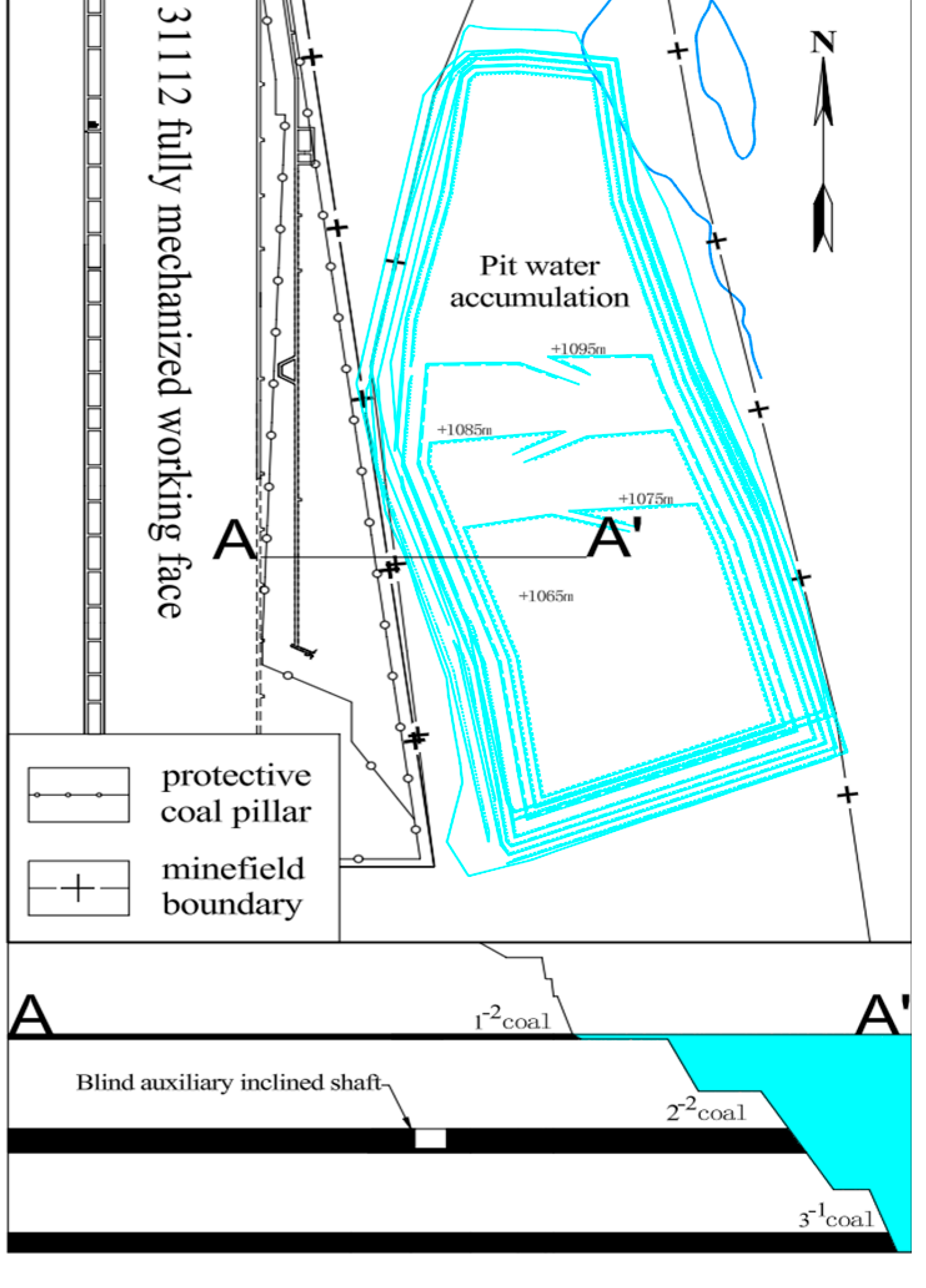
The mine is located in Inner Mongolia Autonomous Region, China, and its eastern minefield boundary is adjacent to an open pit, representing a typical adjacent mining area with an "open pit–underground mine" configuration. The minefield covers an area of 13.2021 km². The main minable seams are the No. 2-2 and No. 3-1 coal seams of the Jurassic Yan’an Formation, with average thicknesses of 4.83 m and 3.57 m, respectively. The geological structure of the mining area is generally simple, characterized by a broad and gentle monocline. The strata strike N25°W, dip toward S65°W, and have a dip angle of 1°-3°. The main aquifers in the area include the Quaternary loose-rock pore aquifer, the Cretaceous Zhidan Group clastic-rock pore-fracture aquifer, and the Jurassic sandstone fractured confined aquifer. The main aquicludes are Pleistocene Malan loess, Jurassic mudstone, and sandy mudstone.
Figure 1.
Schematic Plan of Mining and Stripping Engineering in the Open Pit.
2.2. Water Accumulation in the Adjacent Open Pit
After the extreme rainfall event on July 21, 2012, the water level of the nearby river rose sharply. At that time, small-mine roadways in the No. 2-2 coal seam existed on the eastern side of the open pit. As the water level and hydraulic pressure in these small-mine roadways increased, the accumulated water broke through the protective coal pillar along the sidewall of the open pit, allowing a large volume of river water to flow into the open pit through the small-mine roadways. Since then, a large amount of water has remained accumulated in the open pit. Existing data indicate that the water level in the open pit has generally remained around +1107 m for a long period and can reach +1109.716 m at relatively high levels. It is also controlled by river recharge and drainage conditions. The inundated area is mainly composed of the No. 2-2 coal seam, the No. 3-1 coal seam, and the sandstone and sandy mudstone between them. These strata are spatially close to the eastern boundary coal-rock pillar of the study mine, providing the hydrogeological conditions for lateral recharge and seepage toward the underground mining space.
2.3. Exploration of the Boundary Coal-Rock Pillar
To determine the condition of the eastern boundary coal pillar, geophysical exploration, drilling, and surface horizontal borehole exploration have been conducted. The exploration results show that the coal seams within the area investigated by directional drilling along the eastern boundary of the minefield are intact, and no evidence of open pit encroachment was identified.
The minimum distance between the No. 2-2 coal seam and the eastern boundary coal pillar of the mine is 84.9 m, which is greater than the calculated required width of 20 m for the water-resisting coal-rock pillar. The minimum distance between the No. 3-1 coal seam and the eastern boundary coal pillar is 74 m, which is also greater than the calculated required width of 23 m. However, continuous seepage previously occurred in the coal-crossing section of the auxiliary inclined shaft and in the return airway of the 31112 working face. After curtain grouting treatment, the measured seepage flow rate remained at 7-25 m³/h, indicating that a certain hydraulic connection may exist between the accumulated water in the open pit and the underground mining space.
3. Materials and Methods
3.1. Exploration of the Boundary Coal-Rock Pillar
Sampling boreholes were arranged in the boundary coal-rock pillar area adjacent to the accumulated water in the open pit. The sampling depths ranged from 90 to 270 m, covering the No. 2-2 and No. 3-1 coal seams as well as their roof and floor strata, including sandy mudstone, siltstone, fine sandstone, and medium sandstone.

Table 1.
This is a Tables should be placed in the main text near to the first time they are cited.
| Test Type | Number of Specimens | Saturated Specimens | Specimen Dimensions |
| Uniaxial compressive strength | 118 | 37 | Φ50 mm × 100 mm |
| Shear strength | 109 | 39 | Φ50 mm × 50 mm |
| Tensile strength | 112 | 38 | Φ50 mm × 25 mm |
| Permeability test | 30 | — | Φ25 mm × 50 mm |
Specimens used for mechanical property tests were prepared as follows: the specimens for the uniaxial compressive strength test had a diameter of 50 mm and a height of 100 mm; the specimens for the shear strength test had a diameter of 50 mm and a height of 50 mm; and the specimens for the tensile strength test, conducted using the Brazilian splitting method, had a diameter of 50 mm and a height of 25 mm. The non-parallelism between the two ends of each specimen was controlled within ±0.05 mm, and the deviation between the end face and the specimen axis was controlled within ±0.25°.
Specimens used for the permeability test had a diameter of 25 mm and a height of 50 mm, with flat end faces. In this study, intact specimens refer to specimens without visible through-going fractures or obvious end damage before testing. Fractured specimens refer to specimens in which identifiable through-going fractures were prefabricated or generated by loading while the overall structure was still maintained. These specimens were used to simulate the seepage state after weak structural planes inside the coal-rock pillar became connected.
Saturated specimens were prepared using the vacuum saturation method. The specimens were placed in a vacuum drying chamber, evacuated to -0.09 MPa, and maintained for 2 h. They were then immersed in deionized water for 48 h until their mass became essentially stable, so that the specimens reached the saturated state required for testing.
The coal-rock mechanical property tests included uniaxial compressive strength, tensile strength, and shear strength tests. All tests were conducted using an MTS815 electro-hydraulic servo rock mechanics testing system. The uniaxial compressive strength test was performed at a loading rate of 2 kN/s to determine the axial bearing capacity of coal and rock specimens with different lithologies. The tensile strength test was conducted using the Brazilian splitting method at a loading rate of 0.5 kN/s to characterize the resistance of coal and rock specimens to tensile failure. The shear strength test was carried out using shear fixtures with angles of 40°, 50°, and 60° at a loading rate of 1 kN/s, and the cohesion and internal friction angle were calculated based on the Mohr–Coulomb strength criterion.
The permeability tests were conducted using an LDY-1 high-temperature and high-pressure flow apparatus (Figure 2), with deionized water used as the seepage medium. Tests were performed on both intact and fractured specimens, together with long-term seepage observations, to analyze the permeability characteristics of different coal and rock strata under fracture development and sustained seepage conditions. The permeability test results were used to evaluate the water-conducting capacity of different lithological layers within the boundary coal-rock pillar and the conditions for the development of potential seepage channels.
3.2. Exploration of the Boundary Coal-Rock Pillar
Three representative water samples were collected, including a water sample from the sealed section of the drainage roadway in the 31106 working face, a seepage water sample from the return airway of the 31112 working face, and a water sample from the accumulated water in the open pit.
The test indicators included major ions (K+, Na+, Ca2+, Mg2+, Cl-, SO42-, HCO3-, and CO32-), pH, total dissolved solids(TDS), total hardness, and total alkalinity. The test results were analyzed by comparing the ionic composition, mineralization degree, and other hydrochemical characteristics of the water samples, so as to identify the source composition of seepage water in the 31112 working face [27].
3.3. Theoretical Analysis of Coal-Rock Pillar Stability
Water action can alter the strength parameters, fracture structure, and energy evolution characteristics of coal-rock pillars, thereby further affecting their bearing capacity and stability [6,10,11]. To reveal the influence of water accumulation in the open pit on the stability of the boundary coal-rock pillar, this study introduces the theory of water-resisting coal-rock pillar design based on coal-rock mechanical property tests, permeability tests, and hydrochemical analysis, and analyzes the stability response of the boundary coal-rock pillar under long-term water accumulation. According to the tensile strength test results of the No. 2-2 and No. 3-1 coal seams, the theoretical widths of the water-resisting coal-rock pillar under the natural state and after water action were calculated, respectively. The variations in the required coal-rock pillar width under different water-level conditions were then compared by considering parameters such as coal seam thickness, actual water head, and safety factor.
Meanwhile, combined with the changes in coal-rock strength, the enhanced permeability of fractured specimens, and the hydrochemical similarity of water samples, the effects of water accumulation in the open pit on the bearing capacity, water-resisting capacity, and seepage channel formation of the boundary coal-rock pillar were comprehensively analyzed. This provides a basis for the subsequent discussion of the stability evolution mechanism.
4. Results
4.1. Coal-Rock Physical Property Tests Results
To analyze the changes in the physical properties of the boundary coal-rock pillar and its surrounding rock under the influence of water accumulation in the open pit, uniaxial compressive strength, tensile strength, shear strength, and permeability tests were conducted on coal and rock specimens with different lithologies. The results are shown in Figure 3.
As shown in Figure 3a–c, the mechanical strength of most coal and rock specimens under the saturated state was lower than that under the natural state. Specifically, the average reduction in the uniaxial compressive strength of rock specimens exceeded 40%, while the uniaxial compressive strength of the No.2-2 and No.3-1 coal specimens decreased by 7.6% and 18.2%, respectively. The tensile strength of most coal and rock specimens decreased by 30.0%~57.1%, and the shear strength decreased by 7.5%~34.6%. In terms of lithology, the compressive strength of sandstone and argillaceous rock specimens decreased more markedly, with medium sandstone, siltstone, and sandy mudstone all showing varying degrees of reduction. The decrease in compressive strength of coal specimens was relatively small, but their tensile strength and shear strength still exhibited a decreasing trend.
The permeability test results show that the hydraulic conductivity of intact specimens was generally low, mostly on the order of 10-4~10-3m/d. In contrast, the hydraulic conductivity of fractured specimens increased significantly, reaching the order of 10-3~10-2m/d. After fracture formation, the hydraulic conductivity of medium sandstone, fine sandstone, sandy mudstone, and coal specimens all increased. Although the intact siltstone specimen did not show obvious water permeability, its fractured specimen exhibited a certain water-conducting capacity.
Overall, under the long-term influence of water accumulation in the open pit, the changes in the physical properties of the boundary coal-rock pillar are mainly reflected in two aspects. First, the strength of most coal and rock specimens decreases under the saturated state, weakening the bearing capacity and failure resistance of the coal-rock pillar. Second, after fracture connection, hydraulic conductivity increases, leading to a reduction in the water-resisting capacity of the coal-rock pillar.
4.2. Hydrochemical Testing Results
To investigate the hydrochemical composition of the accumulated water in the open pit and the related underground water samples, this study selected three water samples for hydrochemical testing: the water sample from the return airway of the 31112 working face (No. 1), the water sample from the accumulated water in the open pit (No. 2), and the water sample from the drainage roadway of the 31106 working face (No. 3). A Piper diagram was plotted based on the test results, as shown in Figure 4.
The test results show that the hydrochemical characteristics of water samples No. 1 and No. 2 are similar, whereas they differ markedly from those of water sample No. 3. Specifically, water samples No. 1 and No. 2 show similar concentrations of Na+ and HCO3-, as well as similar pH and total dissolved solids values, while these parameters differ considerably from those of water sample No. 3.
4.3. Hydrochemical Testing Results
A reasonably designed water-resisting coal pillar can effectively isolate hazardous water sources and reduce the likelihood of mine water hazards. To evaluate the rationality of coal pillar design, most coal mines calculate the width of the water-resisting coal-rock pillar using Equation (1):
Where L is the width of the coal-rock pillar (m); K is the safety factor; M is the coal seam thickness (m); P is the actual water head (MPa); and Kp is the tensile strength of coal (MPa).
In this study, because the mine has long been affected by water accumulation, especially where the western water-resisting coal pillar has remained in an immersed state for a long period, its condition differs from that under normal circumstances. Therefore, the modified formula for the immersed state should be adopted [15]:
Where Rt is the softening coefficient of the tensile strength of the coal pillar, defined as the ratio of the uniaxial tensile strength of the coal specimen after immersion to its initial tensile strength, namely:
Where is the tensile strength after change, and is the tensile strength before change.
In this study, the safety factor K was taken as 5. The average thickness of the No. 2-2 coal seam is 5 m. The thickness of the No. 3-1 coal seam ranges from 0.85 to 4.67 m, with an average of 3.57 m; therefore, 4 m was adopted for calculation. The floor elevations of the No. 2-2 and No. 3-1 coal seams were taken as +1095 m and +1055 m, respectively. Based on the maximum riverbed elevation of the Wulanmulun River (+1138 m) and the maximum water level of the accumulated water in the open pit (+1110 m), the values of P for the No. 2-2 coal seam were set as 0.15 and 0.55 MPa, respectively, and those for the No. 3-1 coal seam were set as 0.45 and 0.85 MPa, respectively.
As shown in Table 2, under the same coal seam conditions, the results calculated using the modified formula, which considers the reduction in tensile strength after water action, are greater than those obtained using the conventional formula. This indicates that long-term water accumulation increases the required design width of the water-resisting coal-rock pillar. For the No. 2-2 coal seam, when the water level elevation increases from +1110 m to +1140 m, the corrected width increases from 10.17 m to 19.47m. For the No. 3-1 coal seam, the corrected width increases from 13.33 m to 18.32 m.
5. Discussion
5.1. Analysis of Seepage Channel Development in the Boundary Coal-Rock Pillar
The boundary coal-rock pillar is located between the open pit and the underground mining space, serving as an important water-resisting and load-bearing structure that prevents accumulated water in the open pit from entering the underground mining area. Under non-accumulated-water conditions, its stability is mainly controlled by its intrinsic strength and stress state. However, after long-term water accumulation in the open pit, the outer side of the coal-rock pillar changes from a relatively open boundary into a hydraulic boundary continuously subjected to water pressure. Previous studies have indicated that, during open pit closure and water accumulation, groundwater level recovery can increase pore water pressure in the rock mass and gradually subject structural planes to water action, thereby reducing the shear resistance of the rock mass and affecting slope stability [24]. This indicates that water accumulation in the open pit does not merely act as a static water body, but can continuously change the stability of the surrounding rock mass through pore water pressure transmission.
The process of mine water inrush is mainly controlled by both water sources and water-conducting channels. It has been suggested that, during the formation of water-conducting channels, the stress field and seepage field interact with each other. Fracture propagation increases the permeability of the rock mass, while water entering the fractures further reduces rock strength, promoting the gradual connection of water-conducting channels [2]. For the study area, long-term water accumulation in the open pit provides a continuous water source and lateral hydraulic pressure for the boundary coal-rock pillar. Bedding planes, joints, primary fractures, mining-induced fractures, and weakly cemented planes within the coal-rock pillar provide basic pathways for water infiltration. As water migrates into the coal-rock pillar along these weak structural planes, local fractures continue to propagate under the combined effects of water pressure and stress disturbance. Originally discontinuous pores and fractures gradually become connected, allowing local hydraulic connections to further develop into seepage channels.
Considering the actual conditions of the study area, the accumulated water in the open pit covers the No. 2-2 coal seam, the No. 3-1 coal seam, and the sandstone and sandy mudstone layers between them. Continuous seepage previously occurred in the coal-crossing section of the auxiliary inclined shaft and in the return airway of the 31112 working face, indicating that a certain hydraulic connection may exist between the accumulated water in the open pit and the underground mining space. The hydrochemical test results further show that the water sample from the return airway of the 31112 working face is more similar in hydrochemical composition to the water sample from the accumulated water in the open pit, suggesting the presence of hydraulic connection or mixing between them. Therefore, when analyzing the influence of water accumulation in the open pit on the underground mining space, it is necessary to consider not only seepage channels within aquifers, but also the controlling effect of fractures and pores inside the coal-rock pillar on water migration. Coal seams are usually regarded as relatively water-resisting or weakly permeable layers. However, a coal seam is not a completely dense medium; instead, it consists of a multi-scale pore-fracture structure composed of pores, microfractures, and bedding fractures. Under the long-term action of water accumulation and lateral hydraulic pressure, external water can enter the coal seam along these pore and fracture structures, and part of the water may also remain in coal matrix pores and microfractures. Once the pore-fracture system inside the coal seam becomes connected with external accumulated water, roof and floor fractures, or mining-induced fractures, the coal seam itself may transform from a relatively water-resisting structure into a locally water-conducting structure, thereby altering the water-resisting capacity of the boundary coal-rock pillar.
Based on the inundated strata in the study area, underground seepage phenomena, and hydrochemical similarity of the water samples, the seepage process from the accumulated water in the open pit toward the underground mining space can be generalized as a continuous "water source–seepage channel–working face" action mode (Figure 5). In this mode, the accumulated water in the open pit acts as a continuous water source, while bedding planes, joint fractures, mining-induced fractures, and pore-fracture networks inside the boundary coal-rock pillar constitute the main seepage channels. Water pressure transmission, water–rock interaction, and fracture propagation jointly promote permeability enhancement, ultimately allowing seepage water to migrate toward the underground working face.
Long-term water action can further affect the pore-fracture structure of the coal-rock pillar. Existing immersion simulation tests have shown that, after long-term exposure to simulated mine water, the porosity of coal samples can increase from 0.25% to 1.2%, the degree of pore-fracture development is enhanced, and mechanical strength decreases with increasing immersion time [16]. Therefore, under the long-term presence of water accumulation in the open pit, once water enters the coal-rock pillar, it may further reduce the water-resisting capacity of the pillar by weakening cementation, reducing the frictional resistance of structural planes, and promoting pore-fracture connection.
Combined with the permeability test results, the intact coal and rock specimens generally exhibit weak water-conducting capacity, whereas the hydraulic conductivity of fractured specimens increases significantly. This indicates that strata with higher permeability, more developed fractures, or weaker cementation are more likely to become pathways for water infiltration and water pressure transmission from the accumulated water in the open pit. Liu et al. investigated the failure characteristics of water-resisting coal pillars under stress–seepage coupling and found that, with increasing coal pillar width, the damage variable, maximum tensile stress, porosity, and average water flow velocity inside the coal pillar generally decrease. This indicates that the degree of internal fracture development and seepage velocity of a coal pillar are closely related to its water-resisting capacity [3]. Therefore, the formation of seepage channels is not the result of instantaneous connection of a single fracture, but a progressive process governed by the combined effects of fracture propagation, pore connection, permeability enhancement, and continuous water pressure transmission.
In summary, under the long-term influence of water accumulation in the open pit, water infiltrates along weak structural planes such as rock fractures, bedding planes, coal cleats, and mining-induced fractures, while pore-fracture propagation and connection are promoted by the combined effects of water pressure, water–rock interaction, and stress disturbance. Moreover, because different lithological layers vary in fracture development, cementation state, and permeability, water does not diffuse uniformly within the coal-rock pillar. Instead, concentrated seepage preferentially occurs along zones with better connectivity and stronger water-conducting capacity, gradually forming seepage channels that control the migration direction and influence range of water. This process also provides the basis for subsequent changes in the physical properties and the stability reduction of the coal-rock pillar.
5.2. Influence Mechanism of Water Accumulation in the Open Pit on the Physical Properties of Coal and Rock
The preceding test results show that the average strength of coal and rock specimens in the natural state is higher than that in the saturated state, while their permeability in the natural state is also significantly lower than that in the saturated state. The more developed the pore and fracture structures in coal, the more easily water can enter the coal body along pores and fractures, weakening interparticle bonding and thereby degrading its mechanical properties. Meanwhile, immersion duration and hydrochemical characteristics are also important factors affecting coal pillar stability [15]. These findings are consistent with the phenomena observed in this study.
After entering the coal-rock pillar, water migrates inward along primary pores, microfractures, and bedding planes, gradually reducing interparticle cementation and frictional resistance on fracture surfaces. For sandstone specimens, water mainly reduces compressive and tensile strengths by weakening particle cementation, decreasing frictional resistance along microfracture surfaces, and promoting fracture propagation. For specimens with high argillaceous content, clay minerals are prone to swelling, softening, and local argillization after water exposure, resulting in reduced strength along bedding planes and weakly cemented planes. For coal specimens or coal-bearing rock specimens, primary fractures and cleats are relatively developed, allowing water to diffuse more readily along fractures and reduce local structural integrity. In terms of test indicators, compressive strength reflects the overall bearing capacity of the coal-rock pillar, whereas tensile strength and shear strength reflect fracture propagation, bedding-plane slip, and structural-plane weakening. The test results indicate that water action not only affects the strength of the coal-rock matrix, but also weakens the mechanical behavior of fracture surfaces and weakly cemented planes.
Figure 6.
Schematic diagram of pore-fracture structure evolution in the coal-rock pillar.
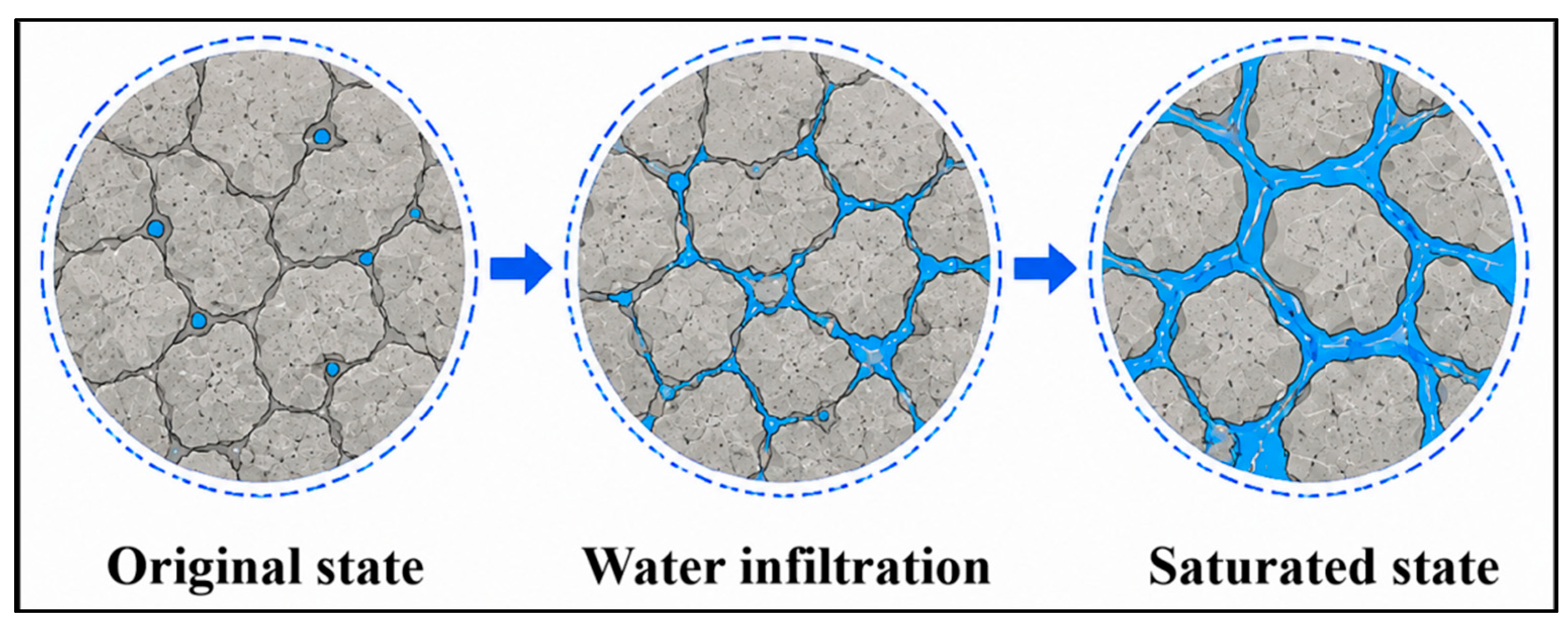
Permeability change is an important manifestation of coal-rock structure evolution under long-term water–rock interaction. The intact specimens generally have low hydraulic conductivity, indicating that the water-conducting capacity of the coal-rock matrix itself is limited when no obvious through-going fractures have formed. In contrast, the hydraulic conductivity of fractured specimens increases significantly, indicating that fracture development and connection can markedly reduce seepage resistance and enhance the water-conducting capacity of the coal-rock pillar. Stress–seepage coupling tests have shown that an increase in water content in coal samples promotes fracture propagation and porosity growth, thereby reducing seepage resistance and increasing average flow velocity. By comparison, under low water content and larger coal pillar width conditions, coal samples exhibit higher strength, smaller axial deformation, and lower permeability and porosity. As internal damage in the coal pillar intensifies, porosity and water flow velocity increase simultaneously, and the risk of water inrush also rises [3]. Therefore, seepage channel formation is not the result of the instantaneous connection of a single fracture, but a progressive process jointly controlled by fracture propagation, pore connection, and permeability enhancement.
Overall, water accumulation in the open pit first enters the coal-rock pillar along pre-existing pores, fractures, and bedding planes, changing its moisture state. Subsequently, water weakens particle cementation and the shear resistance of structural planes, resulting in reductions in compressive strength, tensile strength, and overall bearing capacity. Under the combined action of stress and water pressure, local fractures further propagate and gradually connect, enhancing the permeability of the coal-rock pillar. This enhanced permeability, in turn, promotes further inward water migration, forming a feedback process of "strength degradation–fracture propagation–permeability enhancement–further water pressure transmission."
5.3. Mechanism of the Influence of Water Accumulation in the Open Pit on Coal-Rock Pillar Stability
The boundary coal-rock pillar is an engineering structure composed of coal seams, partings, roof and floor strata, and internal structural planes. Its stability cannot be evaluated solely based on the strength of individual coal or rock specimens. Xie et al. proposed that coal pillar failure and instability are nonlinear processes jointly controlled by internal structure, roof and floor conditions, and mining disturbance [28]. For the research object in this study, water accumulation in the open pit imposes lateral hydraulic pressure, pore water pressure, and long-term water–rock interaction on the boundary coal-rock pillar in addition to the original in situ stress and mining-induced stress. Therefore, its stability evolution exhibits clear multi-factor coupling characteristics.
The influence of water accumulation in the open pit on the stability of the boundary coal-rock pillar can be understood as an evolution process that develops progressively from the outside inward. First, long-term water accumulation in the open pit changes the external hydraulic boundary condition of the boundary coal-rock pillar, causing the outer side of the pillar to be continuously subjected to lateral hydraulic pressure. Subsequently, water infiltrates into the coal-rock pillar along bedding planes, joints, mining-induced fractures, coal cleats, and pore-fracture networks, forming local seepage channels. Under the combined effects of water pressure, water–rock interaction, and stress disturbance, the cemented structure of the coal-rock mass and the stability of weak structural planes are reduced. Fractures further propagate, permeability increases, and water pressure can continue to be transmitted into the interior of the coal-rock pillar. Therefore, the stability reduction of the boundary coal-rock pillar is not a single strength degradation process, but the result of mutual promotion among hydraulic boundary change, seepage channel development, and changes in the physical properties of coal and rock.
Studies on the equivalent width of coal pillars affected by water immersion have shown that, after water enters a coal pillar, the cohesion, internal friction angle, and elastic modulus of the coal pillar decrease, causing the water-immersed zone and the damaged zone to interact with each other. Meanwhile, the peak stress of the water-affected coal pillar decreases, the width of the elastic core zone shrinks, and the bearing capacity declines significantly [5]. This indicates that the key factor controlling coal pillar stability reduction is not only the local strength degradation of the coal-rock mass, but also the gradual shrinkage of the effective region that can maintain structural integrity and bearing capacity.
Water-resisting coal pillars affected by water accumulation in goafs have been divided into a plastic zone, an elastic zone, and a water-pressure damage zone, and it has been pointed out that the relatively intact elastic zone inside the coal pillar is the part that truly performs the water-resisting function [29]. This zoning concept is also applicable to boundary coal-rock pillars affected by lateral water accumulation from the open pit. With the long-term action of water accumulation in the open pit, the coal-rock mass near the water side is more likely to develop into a water-affected zone and a fracture-developed zone, and local areas may gradually transform into a water-pressure damage zone or a plastic failure zone. In contrast, the relatively intact, low-permeability area inside the coal-rock pillar with higher bearing capacity constitutes the main effective water-resisting and bearing zone.
Figure 7.
Schematic Diagram of the Seepage–Damage Evolution Mechanism of the Boundary Coal-Rock Pillar under the Influence of Water Accumulation in the Open Pit.
Figure 7.
Schematic Diagram of the Seepage–Damage Evolution Mechanism of the Boundary Coal-Rock Pillar under the Influence of Water Accumulation in the Open Pit.
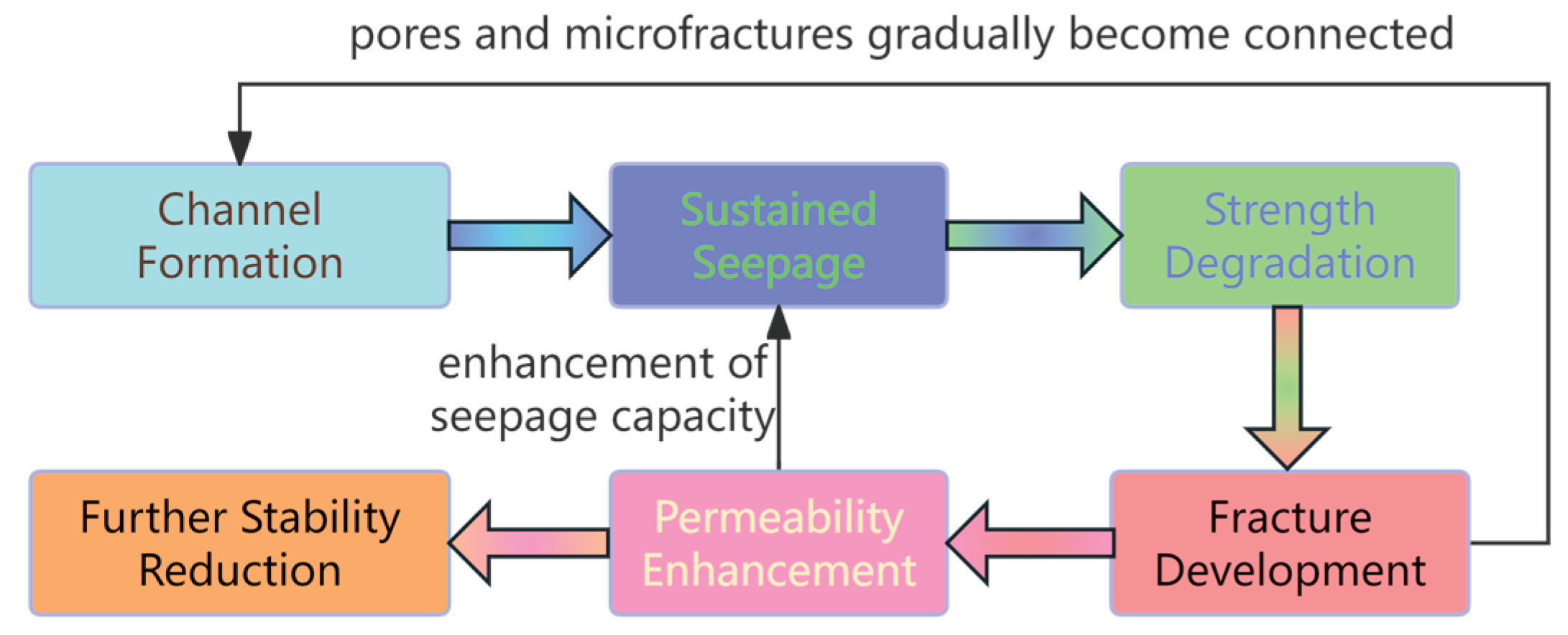
The theoretical calculation results of the water-resisting coal-rock pillar in this study show that, after water immersion reduces the tensile strength of coal specimens, the required coal-rock pillar width becomes greater than that obtained from the conventional calculation. This indicates that, under long-term water accumulation, higher requirements are imposed on the effective width and structural integrity of the boundary coal-rock pillar. Accordingly, a continuous action process of "channel formation–sustained seepage–strength degradation–fracture development–permeability enhancement–further stability reduction" is formed. This process causes the boundary coal-rock pillar to evolve from local water influence on the outer side to continuous internal structural weakening, ultimately resulting in the simultaneous decline of its water-resisting capacity and bearing capacity.
6. Conclusions
- The formation of seepage channels is not caused by the instantaneous connection of a single fracture, but is a progressive process controlled by the combined effects of fracture propagation, pore connection, permeability enhancement, and continuous water pressure transmission. Long-term water accumulation in the open pit changes the external hydraulic boundary of the boundary coal-rock pillar, causing it to continuously bear lateral hydraulic pressure. Water can migrate along bedding planes, joints, primary fractures, mining-induced fractures, coal seam pores, and cleats. When multi-scale pores and fractures become interconnected, local seepage channels gradually develop into water-conducting pathways, thereby strengthening the hydraulic connection between the accumulated water in the open pit and the underground mining space.
- Long-term water accumulation changes the physical properties and internal structure of the coal-rock pillar. After entering the coal-rock pillar, water can migrate along pores, fractures, and bedding planes, weakening particle cementation and fracture-surface friction, reducing the shear resistance of structural planes, and promoting fracture propagation and pore-fracture connection. The responses of different lithologies are jointly controlled by mineral composition, cementation state, fracture development degree, and pore connectivity. The influence of water accumulation in the open pit is not limited to strength reduction, but is manifested as a combined change involving reduced structural integrity, enhanced seepage capacity, and weakened bearing capacity.
- Under the influence of water accumulation in the open pit, the stability evolution of the boundary coal-rock pillar is a coupled process in which seepage channel development and physical property changes mutually promote each other. Long-term water accumulation forms a continuous action process of "channel formation,sustained-seepage,strength-degradation,fracture-development,permeability enhancement,further stability reduction." This process gradually expands the water-affected zone and plastic failure zone, continuously reduces the effective water-resisting and bearing zone, and ultimately leads to a decline in the water-resisting capacity and stability of the boundary coal-rock pillar.
Author Contributions
Conceptualization, J.H.(Junhai He) and C.L.(Cunjin Lu); methodology, J.X.(Jinpeng Xu); validation, J.H.(Junhai He) and C.L.(Cunjin Lu); formal analysis, J.H.(Junhai He); investigation, H.Z.(Hui Zhao); resources, Y.Z.(Yongqiang Zhang); data curation, J.H.(Junhai He) and H.Z.(Hui Zhao); writing—original draft preparation, J.H.(Junhai He); writing—review and editing, C.L.(Cunjin Lu); visualization, J.H.(Junhai He); supervision, J.X.(Jinpeng Xu).; project administration, Y.Z.(Yongqiang Zhang); funding acquisition,C.L.(Cunjin Lu) and J.X.(Jinpeng Xu). All authors have read and agreed to the published version of the manuscript.
Funding
This research was funded by the Major Science and Technology Projects of Xinjiang Uygur Autonomous Region (No.2024A01003), the National Natural Science Foundation of China (No. 42502232, 52274243), and the Fundamental Research Funds for the Central Universities (No. 2024QN11025).
Data Availability Statement
The original contributions presented in this study are included in thearticle. Further inquiries can be directed to the corresponding author.
Acknowledgments
We would like to express our sincere gratitude for the financial support providedby these funding projects.
Conflicts of Interest
The authors declare no conflict of interest.
References
- Ju, F.; Wang, D.; Wang, Z.W. Coal pillar stability investigation for high-intensity mining in the water-rich coal seam: A case study. Min. Metall. Explor. 2024, 41, 743–768. [Google Scholar] [CrossRef]
- Ma, D.; Duan, H.Y.; Zhang, J.X.; Bai, H.B. A state-of-the-art review on rock seepage mechanism of water inrush disaster in coal mines. Int. J. Coal Sci. Technol. 2022, 9, 50. [Google Scholar] [CrossRef]
- Liu, Q.; Xue, Y.; Ma, D.; Li, Q. Failure characteristics of the water-resisting coal pillar under stress-seepage coupling and determination of reasonable coal pillar width. Water 2023, 15, 1002. [Google Scholar] [CrossRef]
- Fan, J.; Li, Z.; Feng, G.; Zhang, H.; Qi, C.; Zhang, J. Failure analysis of coal pillars and overburden from underground water reservoir under the mining-water invasion coupling effect. Eng. Fail. Anal. 2023, 151, 107406. [Google Scholar] [CrossRef]
- Shi, Z.X.; Zhu, G.A.; Zi, Z.K. Research on water immersion damage characteristics and equivalent width of coal pillar. Sci. Rep. 2024, 14, 31456. [Google Scholar] [CrossRef] [PubMed]
- Zhang, J.; Gao, S.S.; Liu, H.; Yang, T.; Wu, J.; He, Y.; Jia, Z. Study on roadway roof deformation and coal pillar energy accumulation instability. Sci. Rep. 2024, 14, 27603. [Google Scholar] [CrossRef] [PubMed]
- Gu, S.C.; Zhang, W.; Wen, J.H.; et al. Analysis of reasonable setting width of water-resisting coal pillar. J. Xi’an Univ. Sci. Technol. (In Chinese) 2024, 44, 1060–1070. [Google Scholar]
- Li, Z.; Fan, J.Y.; Feng, G.R.; et al. Failure characteristics and reasonable width of water-resisting coal pillars under mining-induced seepage coupling. J. China Coal Soc. (In Chinese) 2023, 48, 4011–4023. [Google Scholar]
- Liu, B.; He, L.; Luo, L.P. Numerical simulation of water-resisting coal pillar setting under fluid-solid coupling. J. Min. Saf. Eng. (In Chinese) 2009, 26, 445–449, 454. [Google Scholar]
- Hu, B.N. Stability analysis of coal pillars in strip mining. J. China Coal Soc. (In Chinese) 1995, 20, 205–210. [Google Scholar]
- Wang, R.; Yan, S.; Bai, J.B.; et al. Calculation of coal pillar failure width and instability mechanism under highwall mining. Rock. Soil Mech. (In Chinese) 2019, 40, 3167–3180. [Google Scholar]
- Liu, W.T.; Chen, D.Q.; Liu, Y.B.; et al. Macroscopic failure characteristics and seepage law of goaf-side damaged coal pillars under confined water accumulation. Coal Geol. Explor. (In Chinese) 2025, 53, 140–153. [Google Scholar]
- Shangguan, J.H.; Guo, H.T.; Cao, S.G.; Sun, J.L. Study on damage rupture and crack evolution law of coal samples under the influence of water immersion pressure. Water 2025, 17, 263. [Google Scholar] [CrossRef]
- Yao, Q.; Tang, C.; Xia, Z.; et al. Mechanisms of failure in coal samples from underground water reservoir. Eng. Geol. 2020, 267, 105494. [Google Scholar] [CrossRef]
- Xu, X.Y.; Huangfu, M.N.; Ma, M.T.; et al. Discussion on the strength deterioration mechanism of water-immersed coal samples and optimization method for the design formula of water-resisting coal pillars. Coal Sci. Technol. Mag. (In Chinese) 2024, 45, 56–62. [Google Scholar]
- Xu, Z.M.; Xiong, S.J.; Yuan, H.Q.; et al. Simulation test on structural evolution and damage deterioration mechanism of water-immersed boundary coal pillars in abandoned goaf. J. China Coal Soc. (In Chinese) 2025, 50, 1100–1114. [Google Scholar]
- Liu, F.Y.; Yang, K.; Yang, T.H.; Gao, Y.; Li, J.D.; Liu, Q.; Fu, Q. Pumped storage hydropower in an abandoned open-pit coal mine: Slope stability analysis under different water levels. Front. Earth Sci. 2022, 10, 941119. [Google Scholar] [CrossRef]
- Wang, B.F.; Zhou, D.; Zhang, J.; Liang, B. Study on the strength deterioration characteristic and damage model of coal pillar dams with repeated water immersion in underground reservoirs. Sci. Rep. 2024, 14, 6338. [Google Scholar] [CrossRef] [PubMed]
- Pi, Z.K.; Li, R.; Wang, Y.; Xiong, J.W.; Li, J.Y.; Zhang, Y.F.; Peng, B. Experimental investigation into the impact of cyclic high-low pressure water immersion on the pore structure and mechanical properties of coal. Sci. Rep. 2025, 15, 1288. [Google Scholar] [CrossRef] [PubMed]
- Liu, X.L.; Jiang, D.H. Coal sample failure and hydro-mechanical coupling mechanism under lateral seepage and axial loading. Saf. Coal Mines (In Chinese) 2023, 54, 175–181. [Google Scholar]
- Ge, J.L.; Wang, Y.M.; Liu, T. Numerical simulation of seepage evolution law of coal seam water injection based on UDF. Saf. Coal Mines (In Chinese) 2024, 55, 78–85. [Google Scholar]
- Lian, Y.; Qi, T.Y.; Liu, Q. Study on water inrush mode and water-conducting channel evolution mechanism of roof-type goaf water. Saf. Coal Mines (In Chinese) 2023, 54, 42–48. [Google Scholar]
- Ma, G.L.; Chen, X.; Fan, C.N.; et al. Study on microscopic seepage characteristics and macroscopic failure of coal under different hydraulic loading paths. Rock. Soil Mech. (In Chinese) 2023, 44, 1779–1788. [Google Scholar]
- Gao, Y.; Li, J.D.; Yang, T.H.; Meng, L.; Deng, W.; Zhang, P. Formation of pit lake and slope stability following mine closure: A case study of Fushun West Open-pit Mine. Geomat. Nat. Hazards Risk 2024, 15. [Google Scholar] [CrossRef]
- Wu, Q.; Gao, J.L.; Zeng, Y.F.; et al. Research on full life-cycle protection and utilization of coal mine water in China. Strateg. Study CAE (In Chinese) 2025, 27, 184–204. [Google Scholar]
- Hao, H.J.; Zhai, X.R.; Hu, R.; et al. Influence of water accumulation in closed mines on adjacent production mines. Ind. Mine Autom. (In Chinese) 2022, 48, 60–65. [Google Scholar]
- Ji, H.Y.; Wang, W.B.; Xin, Y.J.; et al. Acoustic emission fractal-permeability model and experimental study of coal samples under hydraulic coupling. J. China Coal Soc. (In Chinese) 2024, 49, 3381–3398. [Google Scholar]
- Xie, H.P.; Zhou, H.W.; Zhao, G.X. Research progress on stability theory and analysis method of strip coal pillars. China Min. Mag. (In Chinese) 1998, 7, 37–41. [Google Scholar]
- Gu, W.; Xu, D.L.; Wang, Y.Q.; Miao, K.; Yao, S.M.; Zhang, H.; Han, Z.F. Research on the stability and water isolation of waterproof coal pillars between adjacent working faces under the influence of water ponding goaf—A case study. Appl. Sci. 2024, 14, 884. [Google Scholar] [CrossRef]
Figure 2.
Schematic diagram of the LDY-1 high-temperature and high-pressure flow apparatus.
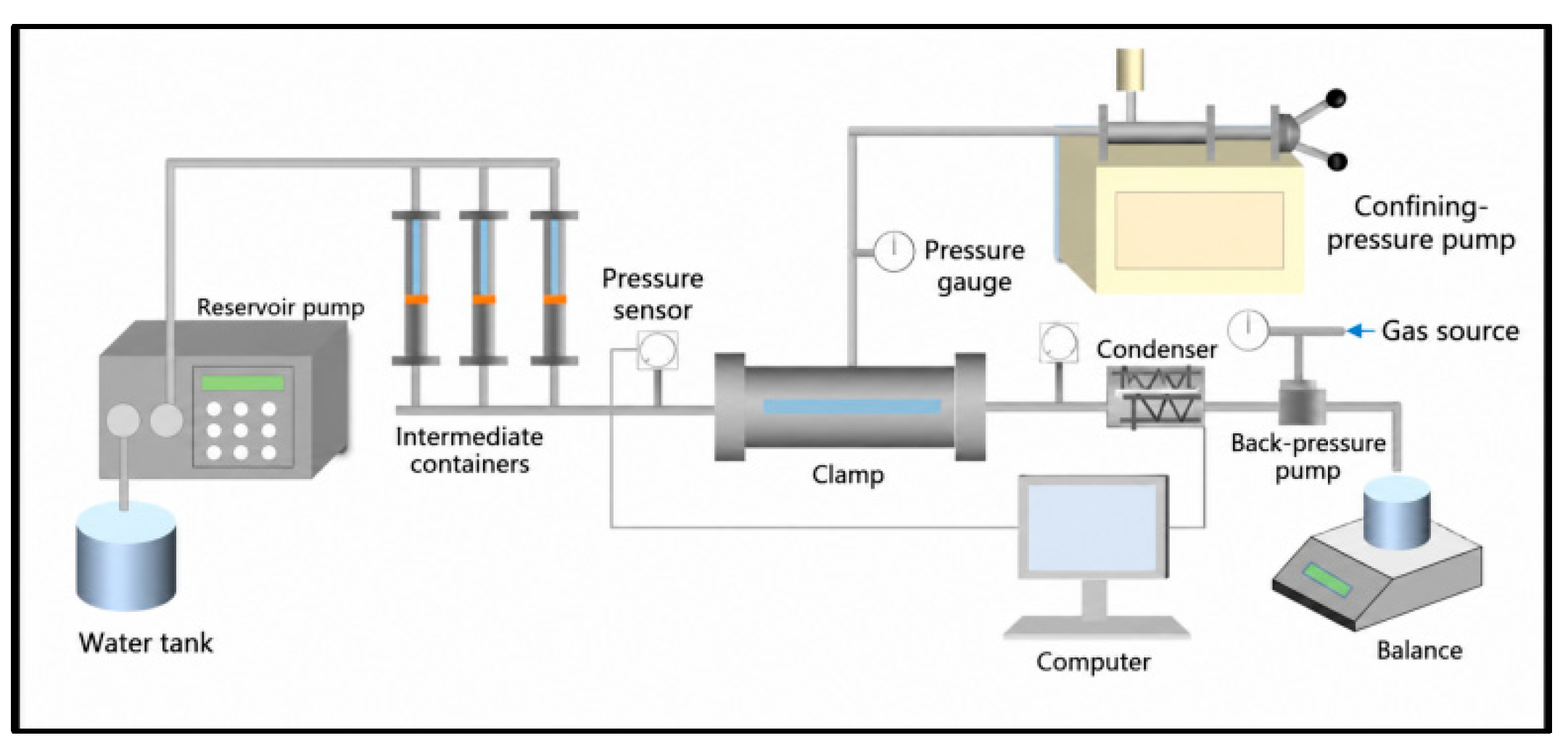
Figure 3.
Physical property test results of coal and rock specimens. (a) Compressive Strength; (b) Tensile Strength; (c) Shear Strength; (d) Permeability Test.
Figure 3.
Physical property test results of coal and rock specimens. (a) Compressive Strength; (b) Tensile Strength; (c) Shear Strength; (d) Permeability Test.
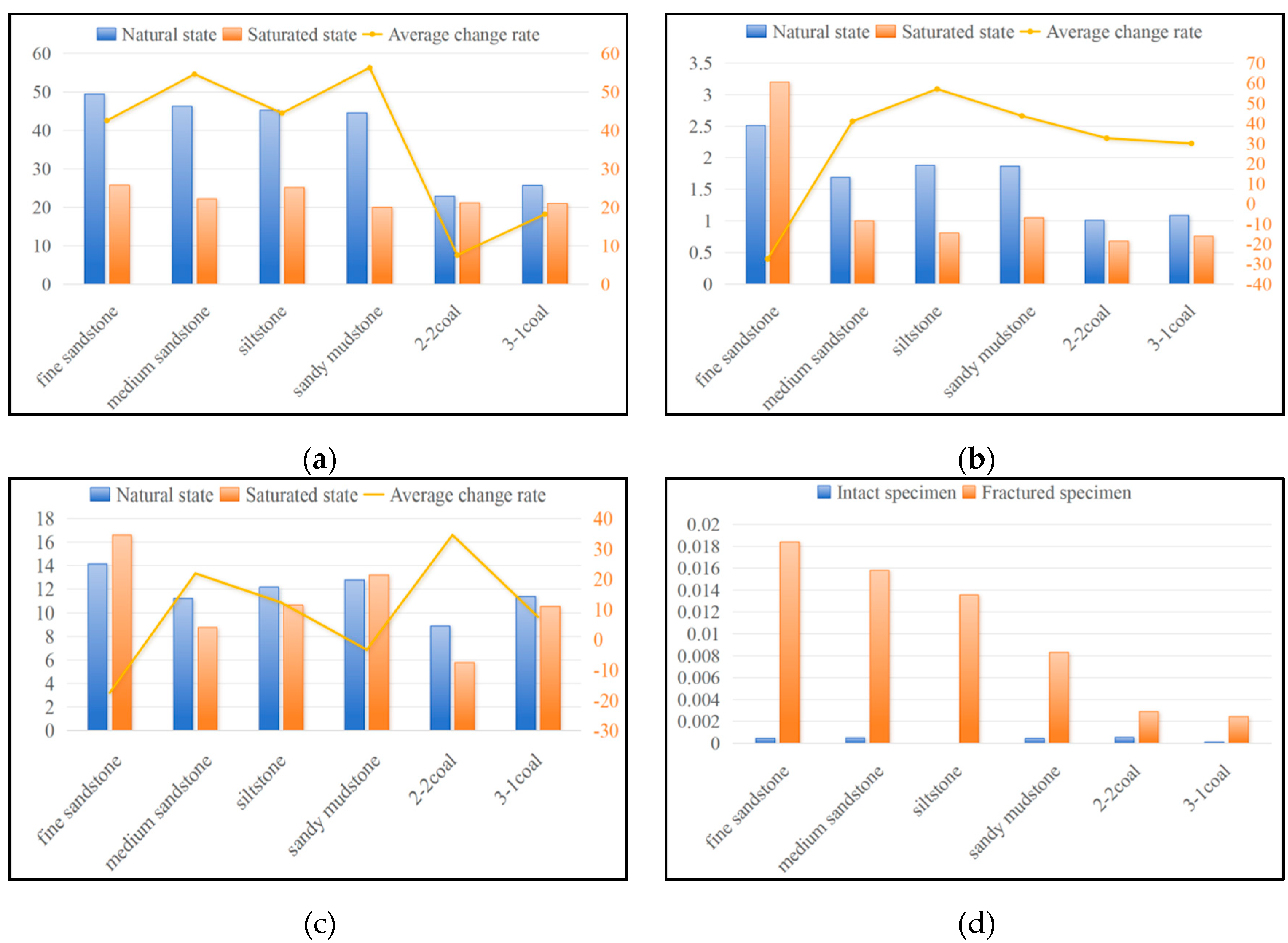
Figure 4.
Piper Diagram of Hydrochemical Test Results.
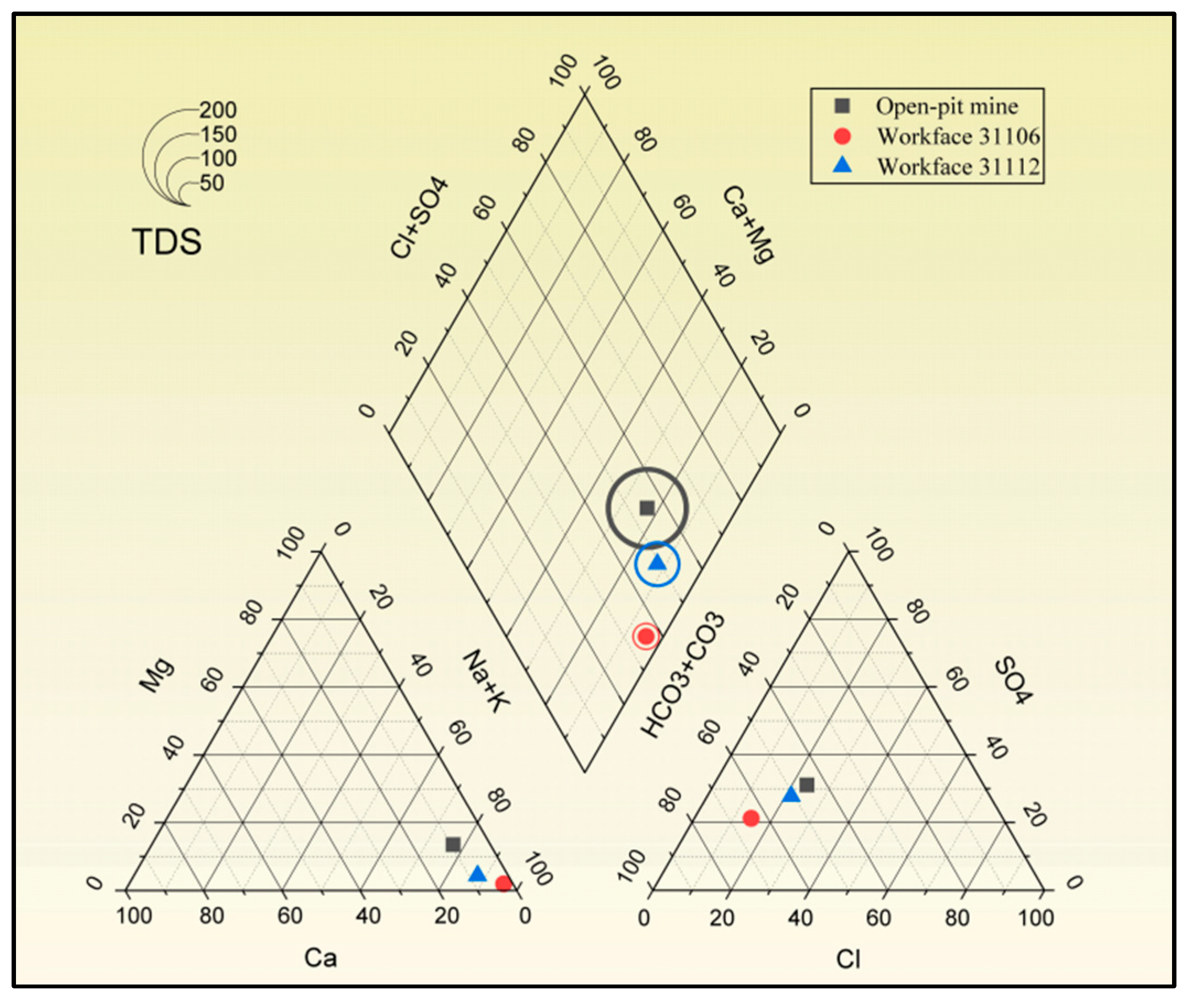
Figure 4.
Schematic diagram of the seepage process of water accumulation in the open pit.
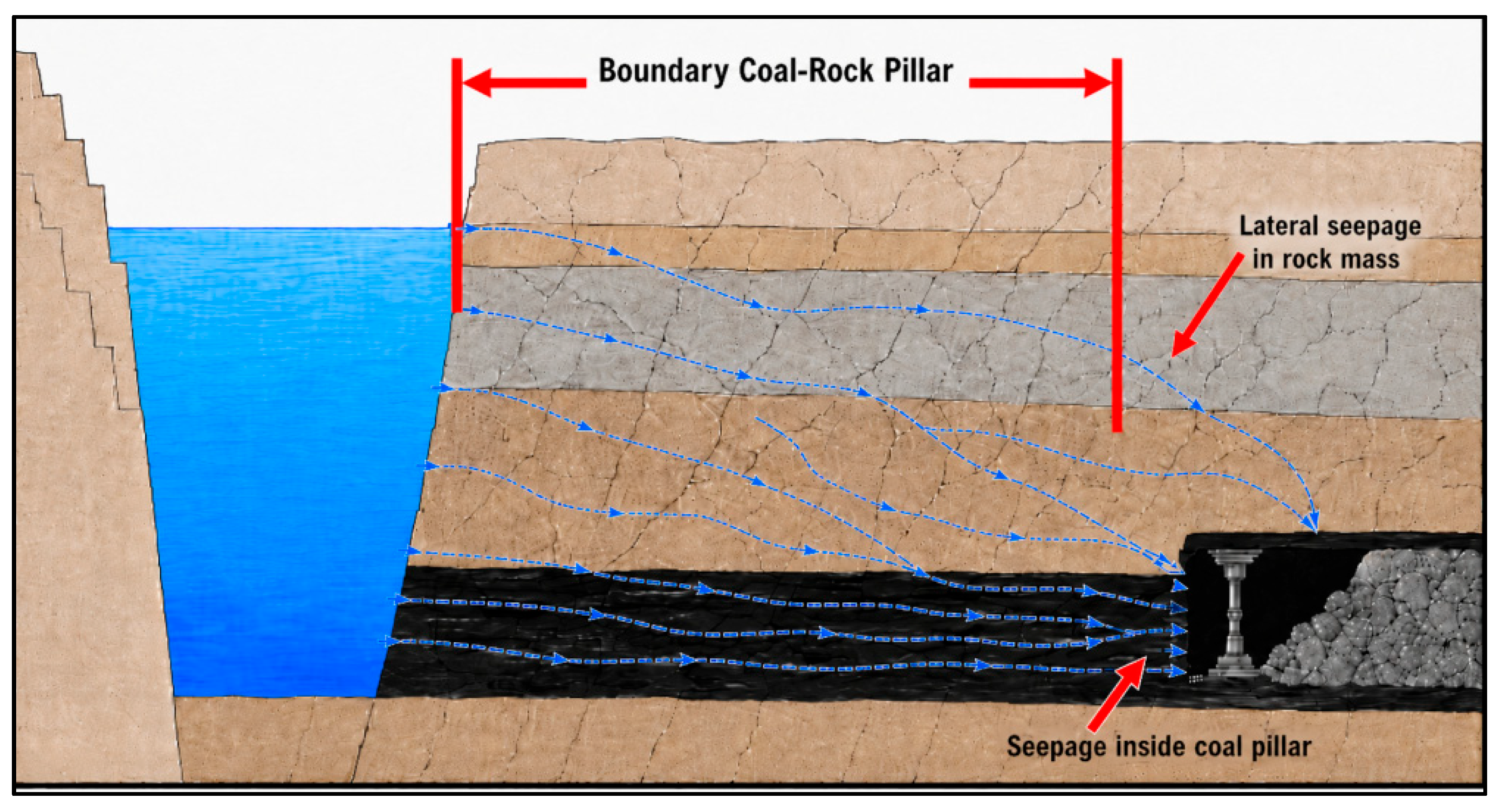
Table 2.
Theoretically Calculated Width of the Water-Resisting Coal-Rock Pillar.
| Coal Seam | Water Level Elevation / m | (R_t) | (P) / MPa | Normal Calculated Width / m | Water-Accumulation-Corrected Width / m | Increase after Water-Accumulation Correction / % |
| No.2-2 | 1110 | 0.67 | 0.15 | 8.34 | 10.17 | 21.94 |
| No.2-2 | 1140 | 0.67 | 0.55 | 15.98 | 19.47 | 21.84 |
| No.3-1 | 1110 | 0.7 | 0.45 | 11.13 | 13.33 | 19.77 |
| No.3-1 | 1140 | 0.7 | 0.85 | 15.3 | 18.32 | 19.74 |
Disclaimer/Publisher’s Note: The statements, opinions and data contained in all publications are solely those of the individual author(s) and contributor(s) and not of MDPI and/or the editor(s). MDPI and/or the editor(s) disclaim responsibility for any injury to people or property resulting from any ideas, methods, instructions or products referred to in the content. |
© 2026 by the authors. Licensee MDPI, Basel, Switzerland. This article is an open access article distributed under the terms and conditions of the Creative Commons Attribution (CC BY) license (http://creativecommons.org/licenses/by/4.0/).
Copyright: This open access article is published under a Creative Commons CC BY 4.0 license, which permit the free download, distribution, and reuse, provided that the author and preprint are cited in any reuse.


