
Submitted:
22 June 2026
Posted:
23 June 2026
You are already at the latest version
Abstract
Environmental considerations shape corporate strategy, risk management, and firm valuation. Yet, empirical evidence on the links between environmental performance, environmental disclosures and corporate financial performance is mixed and often omits risk implications. We develop a holistic framework to examine the endogenous inter-relations among corporate environmental performance (CEP), environmental disclosure (CED), financial performance, and risk. We then analyse the simultaneous links between CEP, CED, and both accounting- and market-based measures of performance and risk for a large panel of US listed firms.
The findings reveal that environmental performance and environmental disclosure have fundamentally distinct economic implications. Environmental performance is associated with lower accounting profitability but higher market valuation and lower operating and market risk. These findings suggest that while substantive environmental initiatives may involve short-term costs, they enhance long-term value and organisational resilience. In contrast, environmental disclosure is associated with higher accounting profitability but lower market valuation and higher operating and market risk. This finding suggests that environmental communication may strengthen stakeholder relations while simultaneously increasing investor awareness of environmental exposures and sustainability-related uncertainties. We also find a strong positive association between environmental performance and environmental disclosure, suggesting that environmental reporting increasingly reflects underlying environmental actions rather than symbolic signalling alone.
Overall, the results highlight the importance of distinguishing between environmental actions and environmental communication when evaluating corporate environmental strategy, firm value, and risk. Overall, the results carry implications for managers, investors, and regulators seeking to evaluate the role of corporate environmental strategy in corporate resilience, transparency, and value creation.
Keywords:
ESG disclosure
; environmental performance
; corporate risk
; financial performance
; financial risk
; operating risk
; market risk
; sustainability reporting
; corporate environmental strategy
; endogeneity
1. Introduction
As concerns over climate change, environmental degradation, biodiversity loss, and resource scarcity intensify, corporate environmental responsibility has become a central issue for firms, investors, regulators, and policymakers worldwide. Environmental considerations increasingly shape corporate strategy, investment decisions, regulatory frameworks (e.g. ISSB S1 and S2), and enterprise risk management practices. Consequently, understanding how corporate environmental performance (CEP) and corporate environmental disclosure (CED) influence firm performance and risk has become an important research priority within the broader ESG and sustainable finance literature.
Existing research has examined the relationships among CEP, CED, and corporate financial performance (CFP) from multiple theoretical perspectives, producing mixed and often conflicting empirical findings. Studies grounded in the resource-based view (RBV) argue that superior environmental performance can enhance competitiveness, innovation, legitimacy, and long-term firm value (Hart, 1995; Russo & Fouts, 1997). In contrast, shareholder value perspectives suggest that environmental initiatives may impose costs that reduce profitability and shareholder wealth (Barnea & Rubin, 2010; Friedman, 1970). Similarly, research on environmental disclosure yields conflicting conclusions. While some studies suggest that environmental disclosure improves transparency, reduces information asymmetry, and strengthens stakeholder relationships (Clarkson et al., 2008; Qiu et al., 2016), others argue that disclosure may primarily serve symbolic legitimacy objectives rather than reflect substantive environmental performance (Cho & Patten, 2007; Patten, 2002).
Recent developments in the ESG and sustainable finance literature further highlight the complexity of these relationships. Emerging evidence suggests that the financial consequences of environmental actions and disclosures vary considerably across institutional settings, reporting regimes, and market conditions. Studies report inconsistent associations between ESG activities, disclosure practices, firm value, stock returns, and risk exposure (Escobar-Saldívar et al., 2026; Kaspard et al., 2026; Khandelwal et al., 2023). Similarly, recent evidence indicates that environmental disclosures may not always translate into superior market outcomes, particularly where disclosure credibility and comparability remain uncertain (Munir & Pratama, 2025; Nassirzadeh et al., 2026). Collectively, this literature suggests that the economic implications of environmental performance and environmental disclosure remain far from settled.
Despite extensive research on the environmental–financial performance nexus, two important limitations remain. First, most studies examine only selected pairwise relationships between environmental performance, environmental disclosure, financial performance, and risk. Relatively few studies simultaneously examine these variables while explicitly accounting for their endogenous inter-relations (e.g. Al-Tuwaijri et al., 2004). Second, and more importantly, firm risk has largely remained peripheral to environmental-financial accountability research despite being central to contemporary ESG debates. This omission is surprising given that environmental initiatives are increasingly justified not only as value-creation mechanisms but also as tools for managing operational, regulatory, reputational, and market risks (Benlemlih et al., 2018; Boutin-Dufresne & Savaria, 2004; Hockerts, 2015; Jo & Na, 2012; Kaspard et al., 2026; McGuireet al., 1988; Oikonomou et al., 2012; Qiu et al., 2016; Sharfman & Fernando, 2008; Spicer, 1978).
Accordingly, this study develops a holistic framework for examining the inter-relations among corporate environmental performance, environmental disclosure, financial performance, and firm risk. Specifically, we simultaneously analyse the endogenous links among CEP, CED, CFP, and corporate financial risk (CFR), while distinguishing between accounting-based and market-based dimensions of performance and risk. This approach enables us to investigate not only whether environmental activities matter for financial outcomes, but also how environmental actions and environmental communication affect different dimensions of firm risk and value.
The study makes three principal contributions. First, we explicitly distinguish between environmental performance and environmental disclosure, two concepts that are frequently conflated within the broader CSR and ESG literature (Hockerts, 2015; Margolis & Walsh, 2003; Orlitzky et al., 2003). This distinction is increasingly important because environmental actions and environmental communication may generate fundamentally different stakeholder responses and economic outcomes. Recent evidence suggests that investors increasingly differentiate between substantive environmental performance and disclosure-based ESG signals (Khandelwal et al., 2023; Munir & Pratama, 2025; Nassirzadeh et al., 2026).
Second, we extend the environmental-financial accountability literature by explicitly incorporating both operating and market risk into the analysis. While most prior studies focus on profitability or firm value, contemporary ESG debates increasingly emphasise resilience, volatility, downside protection, and exposure to transition-related uncertainty. By examining both accounting-based and market-based dimensions of risk alongside financial performance, the study provides a more complete assessment of the economic consequences of environmental strategies.
Third, we address endogeneity using a simultaneous equations framework. Environmental performance, disclosure, profitability, valuation, and risk are likely to be jointly determined through complex feedback mechanisms. Profitable firms may possess greater resources to invest in environmental initiatives and disclosure, while environmental strategies may themselves influence profitability, firm value, and risk. Similarly, firms facing greater uncertainty may strategically increase environmental engagement as part of broader legitimacy-building and risk-management efforts. Our empirical framework explicitly accounts for these simultaneous relationships.
We also extend prior empirical work by Al-Tuwaijri et al. (2004) and Clarkson et al. (2008; 2011) by employing a comprehensive longitudinal dataset covering a broad cross-section of US listed firms across multiple industries. Unlike earlier studies that focus primarily on highly polluting sectors or cross-sectional samples, our analysis captures environmental performance and disclosure using comprehensive measures widely employed in contemporary ESG research. Environmental performance is measured using LSEG Asset4 environmental performance scores (Ioannou & Serafeim, 2015; Shaukat et al., 2016), while environmental disclosure is measured using Bloomberg environmental disclosure scores (Benlemlih et al., 2018; Qiu et al., 2016).
Our findings provide strong evidence that environmental performance, environmental disclosure, financial performance, and risk are jointly determined. More importantly, the results reveal that environmental performance and environmental disclosure have fundamentally different implications for firm value creation and risk management. Environmental performance is associated with lower accounting profitability but higher market valuation and lower operating and market risk. These findings suggest that substantive environmental initiatives may impose short-term costs while simultaneously generating long-term value and enhancing organisational resilience. In contrast, environmental disclosure is associated with higher accounting profitability but lower market valuation and higher operating and market risk. This pattern suggests that environmental communication may strengthen stakeholder relations and operating outcomes while simultaneously increasing investor awareness of environmental exposures and sustainability-related uncertainties.
Moreover, firms with stronger accounting performance exhibit weaker environmental performance, whereas firms with higher market valuation tend to provide more extensive environmental disclosures. In addition, firms facing greater market uncertainty appear more likely to engage in environmental performance activities, consistent with the view that environmental initiatives increasingly serve strategic risk-management objectives. Finally, we find a strong positive association between environmental performance and environmental disclosure, suggesting that environmental reporting increasingly reflects underlying environmental actions rather than symbolic signalling alone.
Overall, the study contributes to the growing ESG and business risk literature by demonstrating that environmental performance and environmental disclosure represent distinct dimensions of corporate environmental strategy with different implications for profitability, firm value, and risk. The findings underscore the importance of jointly modelling environmental actions, environmental communication, financial performance, and risk within an integrated endogenous framework and carry important implications for managers, investors, regulators, and policymakers seeking to evaluate the role of ESG in corporate resilience, transparency, risk management, and long-term value creation.
2. Literature Review and Hypothesis Development
2.1. Corporate Environmental Performance, Environmental Disclosure, Operating Performance, and Operating Risk
The relationship between corporate environmental performance (CEP) and corporate financial performance (CFP) has attracted substantial scholarly attention across management, accounting, finance, and economics. Drawing on the resource-based view (RBV) of the firm (Hart, 1995), scholars argue that superior environmental performance can constitute a strategic capability that enhances competitiveness, operational efficiency through product, process or resource innovations, better stakeholder relations, and ultimately firm profitability. Empirical evidence provides some support for this view, although findings remain mixed (Beurden & Gossling, 2008; Margolis & Walsh, 2003; Russo & Fouts, 1997; Waddock & Graves, 1997). There is also an alternative perspective rooted in corporate governance perspective which suggests that firms must first achieve satisfactory financial performance before undertaking costly environmental initiatives with uncertain or long-term payoffs (Arora & Dharwadkar, 2011). Finally, as argued by Al-Tuwaijri et al. (2004) and Clarkson et al. (2011), both environmental and financial performance may ultimately be jointly determined by unobservable firm characteristics such as managerial quality, organisational capabilities, or strategic orientation. Consequently, the relationship between CEP and profitability may be characterised by reverse causality or simultaneity.
As with CEP, prior evidence (e.g. Brammer & Pavelin, 2008; Cormier & Magnan, 1999; Qiu et al., 2016) suggests that firms possessing sufficient financial resources and stronger operating performance are better positioned to provide extensive and objective corporate environmental disclosures (CED). Producing high-quality environmental disclosures requires substantial investments in reporting systems, environmental monitoring, governance structures, assurance processes, and stakeholder engagement activities that profitable firms are better able to undertake (Brammer & Pavelin, 2008; Cormier & Magnan, 1999; Qiu et al., 2016). At the same time, environmental disclosure may itself influence financial operating performance by strengthening legitimacy, enhancing stakeholder trust, and improving reputation among various stakeholders including customers, and employees, thus leading to higher profits and cashflows (Lev, Petrovits, & Radhakrishnan, 2010; Qiu et al., 2016). Hence as with CEP, relation between CED and profitability may also be endogenous.
Despite the substantial literature on CEP, CED, and profitability, relatively limited attention has been paid to the role of operating risk within the environmental-financial accountability framework. This omission is notable because risk mitigation has long been viewed as a central strategic rationale for corporate environmental and broader CSR activities (Husted, 2005). Husted (2005) conceptualises CSR investments as strategic real options capable of reducing operational uncertainty and protecting firms from adverse shocks. Moreover, Hart (1995) argues that environmental responsibility can strengthen stakeholder relationships and improve organisational resilience, particularly when firms effectively communicate their environmental actions to external stakeholders. From this perspective, environmental disclosure may help reduce operating risk by improving stakeholder trust, reducing reputational conflict, and enhancing organisational legitimacy. Effective environmental communication may strengthen relationships with regulators, customers, suppliers, employees, and local communities, thereby reducing operational disruptions and earnings volatility.
However, an alternative possibility is that extensive environmental disclosure may increase stakeholder scrutiny and expose firms to greater accountability pressures. Enhanced transparency can reveal operational vulnerabilities, environmental liabilities, or implementation challenges that may increase perceived uncertainty surrounding firm operations. Consequently, environmental disclosure may have both stabilising and destabilising effects on operating outcomes.
Environmental performance may also affect operating risk, although the direction of this relationship remains theoretically ambiguous. On the one hand, environmental performance may reduce operating risk by improving resource efficiency, strengthening stakeholder relationships, reducing exposure to environmental incidents, and enhancing organisational resilience (Hart, 1995; Husted, 2005). On the other hand, environmental initiatives often require significant investments and organisational change, potentially reducing short-term profitability even while lowering long-term operating risk. This distinction between contemporaneous financial costs and longer-term risk-management benefits has received limited attention in the prior literature.
To date, very few studies have simultaneously examined the links among CEP, CED, operating performance, and operating risk. As Orlitzky and Benjamin (2001, p. 370) observe, much of the existing literature focuses on performance levels while largely ignoring performance variability and risk dimensions. Existing evidence also suggests that extensive and objective environmental disclosure may mitigate idiosyncratic business risk by lowering information asymmetry and improving transparency (Benlemlih et al., 2018). More recent evidence however indicates that sustainability-related disclosure may be interpreted differently across institutional contexts and may not uniformly generate positive financial effects, reinforcing the need to jointly consider disclosure, performance, and risk outcomes (Nassirzadeh et al., 2026; Munir & Pratama, 2025).
Accordingly, our study simultaneously examines the relationships among CEP, CED, profitability, and operating risk while explicitly accounting for the endogenous nature of these relationships. This focus responds directly to recent calls within the sustainability and risk literature for more integrated analyses capable of simultaneously addressing ESG actions, disclosure quality, financial performance, and risk dynamics (Kaspard et al., 2026). Given the mixed theoretical and empirical evidence, we refrain from making strong directional predictions.
2.2. Corporate Environmental Performance, Environmental Disclosure, Market Performance, and Market Risk
In addition to accounting-based performance, prior research has also examined the capital market implications of CEP and CED. Drawing on the RBV and strategic management perspectives, scholars argue that superior environmental performance may signal superior managerial quality, organisational capabilities, and strategic positioning (Hart, 1995; Ullman, 1985). Investors may therefore reward firms with strong environmental performance through higher market valuations. However, an alternative perspective grounded in traditional shareholder value arguments suggests that environmental initiatives may impose costly constraints on firms and reduce financial competitiveness (Barnea & Rubin, 2010; Bushee, 1998; Friedman, 1970). Environmental investments such as pollution-control systems, emissions reduction technologies, or sustainable supply-chain restructuring may involve substantial costs and uncertain payoffs. Consequently, financial markets may discount firms pursuing aggressive environmental strategies.
Consistent with these competing perspectives, empirical evidence on the relationship between CEP and market performance remains mixed. Some studies document a positive association between CEP and market valuation measures such as Tobin’s Q (Al-Tuwaijri et al., 2004; Clarkson et al., 2011; Dowell, Hart, & Young, 2000), while others report negative associations (Barth & McNichols, 1994; Brammer, Brooks, & Pavelin, 2006; Hughes, 2000). Recent international evidence similarly documents heterogeneous and often negative relationships between ESG indicators and stock returns, with results varying across institutional settings, ESG dimensions, and firm characteristics (Escobar-Saldívar et al., 2026).
The literature examining the relationship between environmental disclosure and market performance also produces inconsistent findings. Earlier studies relying primarily on negative environmental disclosures often report adverse market reactions (Freedman & Patten, 2004; Lorraine, Collinson, & Power, 2004; Shane & Spicer, 1983). In contrast, more recent studies using broader and more objective disclosure measures report positive valuation effects (Clarkson et al., 2011; Nassirzadeh et al. 2026). However, evidence continues to highlight substantial ambiguity in this relation. For example, Khandelwal et al. (2023) report a negative ESG disclosure premium, suggesting that firms with higher disclosure may earn lower stock returns, potentially reflecting disclosure costs, or risk-pricing effects. Environmental disclosures thus may be viewed more cautiously if investors perceive them as symbolic, costly, or indicative of heightened environmental exposure. In line with these arguments, Munir and Pratama (2025) document that environmental disclosure does not have a significantly positive effect on firm value in emerging markets where disclosure comparability and credibility remain uneven.
Importantly, Al-Tuwaijri et al. (2004) and Clarkson et al. (2011) argue that CEP, CED, and market performance are jointly determined, potentially reflecting superior managerial quality or strategic capability. However, despite explicitly acknowledging endogeneity, these studies omit consideration of market risk. The omission of market risk is surprising given longstanding theoretical arguments that environmental responsibility may function as an effective risk-management strategy (Chen & Metcalf, 1980; McGuire et al., 1988; Spicer, 1978). Studies argue and find that superior environmental performance can reduce implicit stakeholder claims, strengthen corporate legitimacy, and provide insurance-like protection against downside market risk (Oikonomou et al., 2012; Salama et al., 2011). There is also an alternative argument supported by empirical evidence that firms operating in environmentally sensitive or controversial industries may face higher baseline market risk and therefore engage more actively in environmental initiatives as a reputational or legitimacy-building strategy (Jo & Na, 2012; Toms, 2002). Consequently, the relationship between CEP and market risk may itself be endogenous due to simultaneity and reverse causality.
Compared with CEP, the relationship between environmental disclosure and market risk remains relatively underexplored. Existing studies generally assume uni-directional causality. For example, Cormier and Magnan (1999) treat market risk as a determinant of disclosure, arguing that riskier firms disclose more information to reduce information asymmetry. In contrast, Benlemlih et al. (2018) suggest that extensive environmental disclosure can itself reduce market risk by improving transparency and investor confidence. However, without explicitly accounting for endogeneity, the direction of causality remains difficult to establish.
Overall, prior evidence concerning the relationships among CEP, CED, market performance, and market risk remains theoretically and empirically inconclusive. Following Al-Tuwaijri et al. (2004) and Clarkson et al. (2011), but extending their framework by explicitly incorporating market risk, we treat CEP, CED, market performance, and market risk as jointly endogenous. Given the mixed findings in prior research, we again refrain from making strong directional predictions.
2.3. The Relationship Between Corporate Environmental Performance and Environmental Disclosure
The relationship between environmental performance and environmental disclosure represents a central issue in the environmental accountability literature. Competing theoretical perspectives offer conflicting predictions regarding the direction of this relationship. Drawing on legitimacy theory and socio-political perspectives, some scholars argue that firms with weaker environmental performance may engage in greater environmental disclosure as a form of impression management designed to preserve legitimacy and deflect stakeholder scrutiny (Cho & Patten, 2007; Patten, 1991, 2002). Under this view, environmental disclosure may function symbolically rather than substantively.
In contrast, RBV and voluntary disclosure theory (VDT) perspectives suggest that firms with stronger environmental performance are more likely to provide extensive environmental disclosure (Al-Tuwaijri et al., 2004; Clarkson et al., 2008; Qiu et al., 2016). Superior environmental performers may have stronger incentives to voluntarily disclose environmental information in order to differentiate themselves from competitors, enhance reputation, attract investors, and strengthen stakeholder relations. Consistent with this perspective, recent evidence documents a strong positive relationship between emission performance and environmental disclosure, suggesting that firms increasingly use disclosure to communicate credible environmental commitment and reduce investor uncertainty (Munir & Pratama, 2025). Despite disagreement regarding the nature of the CEP–CED association, scholars generally agree that environmental performance and environmental disclosure are closely interrelated and should therefore be examined jointly within environmental-financial accountability analyses (cf. Al-Tuwaijri et al., 2004). Accordingly, we include both CEP and CED as endogenous variables in our framework.
Overall, the preceding discussion highlights substantial theoretical ambiguity and mixed empirical evidence concerning the relationships among environmental performance, environmental disclosure, financial performance, and firm risk. Nevertheless, literature reinforces the view that environmental disclosure, environmental performance, firm valuation, and financial risk are deeply interconnected. Yet existing studies continue to examine these dimensions largely in isolation, particularly with limited attention to simultaneity and risk integration. Our study addresses this gap by jointly modelling CEP, CED, financial performance, and risk within a unified endogenous framework. In doing so, it contributes to the emerging ESG and business risk literature by explicitly examining whether environmental actions and environmental communication have distinct implications for firm performance and risk. This distinction has become increasingly important as investors, regulators, and other stakeholders seek to differentiate between substantive environmental outcomes and environmental transparency.
3. Data and Methodology
3.1. Sample
Our sample covers US firms listed on NYSE, AMEX or NASDAQ over the period, 2005-2020. The data set is developed via merging of several databases. Financial variables are obtained from Compustat/CRSP(CCM), environmental disclosures scores are obtained from Bloomberg and environmental performance scores from LSEG (formerly Asset4 and Refinitiv). Institutional ownership data is obtained from ThomsonReuters Stock Ownership database. To be consistent with prior studies, we drop observations corresponding to firms belonging to financial sector. This then leads us to a final usable sample of 7877 firm-year observations covering a wide cross section of industries.
3.2. Endogenous Variables
The environmental performance score (CEP) as defined by LSEG “measures a company’s impact on living and non-living natural systems, including the air, land and water, as well as complete ecosystems. It reflects how well a company uses best management practices to avoid environmental risks and capitalize on environmental opportunities”. It covers ’hard’ performance indicators (as classified by Clarkson et al., 2008) such as information on energy used, CO2 emissions, water and waste recycled, and spills and pollution controversies. Hence, the aggregate environmental performance score can be considered to provide a largely objective measure of a firm’s overall environmental performance and it has been used by prior related literature (e.g. Ioannou & Serafeim, 2015; Shaukat et al., 2016).
The environmental disclosure score (CED) is developed by Bloomberg. Bloomberg assigns the disclosure scores to companies based on data points collected via multiple sources including annual reports, standalone sustainability reports and company websites etc. The data points used for calculating the disclosure scores are based on the GRI framework and capture standardized cross-sector and industry-specific metrics. The weighted score is normalized to range from zero, for companies that do not disclose any environmental data, to 100 for those disclosing every data point collected. Moreover, the individual company score is expressed as a percentage, so as to make the score comparable across companies. The score is also tailored to be industry relevant, so that each company is evaluated only in terms of the data that is relevant to its industry sector. For example, ‘Phones Recycled’ is only considered in the score for telecommunications companies and not for other sectors. The data points are also weighted (based on a proprietary weighting scheme) in terms of relevance. For example, ‘Green House Gas emissions’ would be weighted more heavily than other data points in computing the E disclosure score. Hence, the E disclosure score captures both the quantity (i.e. number of E items reported by a company)) as well as the quality (in terms of objective and industry-relevant data) of environmental disclosures. Approximately 80% of environmental disclosure items covered are objective data items, while only 20% are ‘soft’ i.e. subjective data points. Thus, these environmental scores largely capture what Clarkson et al. (2008) would call a firm’s ‘hard’ environmental disclosure. A number of recent studies have used Bloomberg disclosure scores (e.g. Benlemlih et al., 2018; Qiu et al., 2016; Utz & Wimmer, 2014).
In alternative model specifications, we employ two different measures of firm financial performance, i.e. an accounting-based profitability measure (return on assets, ROA) and stock-based performance measure (Tobin’s_Q), both used in prior related literature (e.g. Dowell et al., 2000; Waddock & Graves, 1997). Depending on the financial performance measure employed in the model, we employ corresponding measures of firm risk. Hence in the models including profitability, consistent with prior related literature (e.g. McGuire et al., 1988) we use standard deviation of ROA over three-year period (SD_ROA) as the corresponding operating risk measure. In the models employing stock-based measure of financial performance, we employ stock Volatility a measured by the standard deviation of the firm’s daily stock’s return as the measure of firm risk (cf. Jo & Na, 2012; McGuire et al., 1988).
As discussed above, we expect to find the following endogenous links (visualised by Figure 1). First, we expect a unidirectional link running from CEP to CED. Second, we expect a bi-directional link of both CEP and CED with both measures of firm financial performance i.e. operating and market. Third, we expect a bi-directional link between CEP and both measures of firm risk. Fourth, we postulate that CED affects both measures of risk. Finally, we expect a unidirectional link running from CED to both measures of firm financial risk.
3.3. Exogenous Regressors and Control Variables
The decisions to include/exclude particular variables are driven by theoretical considerations and the identification requirements for the system of equations. In particular, we control for firm size (Size) as measured by the natural logarithm of total assets in all the regressions. Larger firms face greater public scrutiny as well as stakeholder responsibility pressures and thus are more likely to engage in broader social responsibility, including environmental activities (Brammer & Pavelin, 2006 and 2008; Cho & Patten, 2007; Qiu et al., 2016). We also expect a negative relationship between size and firm’s risk: prior studies suggest that larger firms are less exposed to risk, as they are more able to manage risk especially in times of high volatility (e.g. Jo & Na, 2012).
Leverage is measured by total debt to total assets ratio. Prior evidence suggests higher leverage to be associated with higher firm risk (Abdelghani, 2005). Thus, a positive association is expected between firm’s leverage and risk. Higher leverage is also expected to boost firm financial performance.
Following prior studies, we control for capital expenditure scaled by total assets (CapEx) while modelling firm environmental performance (Shaukat et al., 2016). We also control for asset growth (Asst_Grwth), as measured by total assets in year t minus total assets in year t-1 divided by total assets in year t-1, in the equations explaining environmental disclosures and firm risk (cf. Jo & Na, 2012; Qiu et al., 2016).
Arora and Dharwadkar (2011) and Clarkson et al. (2011) argue and find empirical support for the claim that firms pursuing a proactive environmental strategy are the ones with greater financial resources. We therefore control for financial slack (Fin_Slack, measured as the ratio of the sum of cash and short-term investments and total receivables to the book value of total assets, cf. Arora and Dharwadkar, 2011; Qiu et al., 2016; Shaukat et al., 2016) while modeling environmental disclosures.
Many financial institutions are likely to focus on financial performance of their investee firms (in particular, short-term returns) and therefore might be reluctant for their investee firms to make CSR investments, the financial benefits of which may require longer time horizons to materialise. Accordingly, we expect a negative relation between institutional shareholdings (Inst_Hold, measured as shareholdings of financial institutions disclosed in 13F statements) and measures of environmental performance and, possibly, disclosure (cf. Qiu et al., 2016).
Finally, asset intangibility as a proxy for firm’s investments in R&D (Asst_Intangibility, measured as the ratio of intangible assets to total assets) is likely to relate to both firm financial performance and risk (cf. Jo & Na, 2012).
3.4. Model Specification
The discussion above leads us to formulate the following system of equations (with expected links between the endogenous variables visualised by Figure 1):
Fin_Perfit = α0 + α1 *CEPit + α2 *CEDit + α3*Sizeit + α4*Leverageit + α5*Asst_Intangibilityit +
Industry fixed effects + Year fixed effects + ε1
Industry fixed effects + Year fixed effects + ε1
Riskit = β0+ β1*CEPit + β2*CEDit + β3*Fin_Perfit + β4*Sizeit + β5*Leverageit + β6*Asst_Grwthit +
β7*Asst_Intangibilityit + Industry fixed effects + Year fixed effects + ε2
β7*Asst_Intangibilityit + Industry fixed effects + Year fixed effects + ε2
CEPit = γ0 + γ1*Fin_Perfit + γ2*Sizeit + γ3* Riskit + γ4*CapExit + γ5*Inst_Holdit + Industry fixed effects +
Year fixed effects + ε3
Year fixed effects + ε3
CEDit = δ0 + δ1*CEPit + δ2*Fin_Perfit + δ3*Sizeit + δ4*Asst_Grwthit + δ5* Fin_Slackit + δ6*Inst_Holdit +
Industry fixed effects + Year fixed effects + ε4
Industry fixed effects + Year fixed effects + ε4
As mentioned earlier, the models employing ROA as a measure of financial performance (Fin_Perfit) employ SD_ROA as the measure of risk (Riskit), while models employing Tobin’s Q as a performance indicator include Volatility as a risk measure. We include industry and year fixed effects in all the equations to account for the panel structure of the dataset. Industry fixed effects are based on 17-industry classification by Fama and French (1997). The models are estimated via 3SLS.
3.5. Descriptive Statistics
Table 1 provides descriptive statistics for the variables used in this study. The average scores for environmental performance and disclosures are 20.185 and 16.053 (out of 100), respectively. The average firm has ROA of -0.004 and Tobin’s Q of 2.267. The average firm size measured as natural log of total assets is 7.861, which correspond to approx. $2.6bn. The average firm is moderately leveraged (at 23%), spends about 3.6% of total assets on capital expenditures p.a., has the annual asset growth of -0.138, financial slack corresponding to 20% of total assets, and institutional investors hold on average, 72.1% of firm’s outstanding equity. Finally, intangible assets represent on average about 20% of the total asset base. For several variables, the median and mean values are reasonably close to each other indicating lack of skewness in the corresponding distributions.
4. Results
Table 2 and Table 3 present the main results of the analyses. While Table 2 reports parameter estimates for the model employing accounting-based measures (i.e. ROA and SD_ROA as proxies for financial performance and risk, respectively), Table 3 presents results for the model employing market-based indicators (i.e. Tobin’s Q and Volatility, respectively).
Table 2 and Table 3 illustrate that environmental performance (CEP) and environmental disclosure (CED) have distinct and often contrasting implications for firm performance and risk. More importantly, the results provide strong evidence that environmental performance, environmental disclosure, financial performance, and risk are jointly determined, thereby supporting the importance of analysing these relationships within an integrated endogenous framework rather than through isolated pairwise associations.
Table 2 shows that environmental performance is negatively associated with accounting profitability (ROA), whereas environmental disclosure is positively associated with profitability. The negative coefficient on CEP suggests that firms engaging in more intensive environmental initiatives may incur substantial contemporaneous costs associated with environmental investments, process redesign, technology adoption, emissions reduction, compliance activities, and broader sustainability programmes. Such expenditures may reduce short-term profitability even when they are undertaken with the expectation of generating longer-term strategic benefits. This finding is consistent with the view that environmental performance often represents a form of strategic investment whose economic benefits materialise gradually through enhanced operational efficiency, innovation, regulatory preparedness, and reputational capital.
In contrast, environmental disclosure exhibits a positive association with accounting profitability. This finding suggests that transparent environmental communication may help firms strengthen relationships with key stakeholders and improve operating performance. From the perspective of stakeholder theory and voluntary disclosure theory, extensive disclosure can reduce information asymmetry, improve corporate legitimacy, facilitate stakeholder engagement, and strengthen customer and employee loyalty. Firms that communicate their environmental commitments effectively may therefore be better positioned to convert environmental initiatives into tangible operating benefits.
The market-based results reported in Table 3 reveal a markedly different pattern. Environmental performance is positively associated with Tobin’s Q, whereas environmental disclosure is negatively associated with market valuation. These findings suggest that investors distinguish between substantive environmental actions and environmental communication. The positive association between CEP and firm value indicates that financial markets increasingly recognise environmental performance as a signal of superior strategic positioning, managerial quality, long-term resilience, and preparedness for future environmental regulation and stakeholder expectations. Investors may therefore view environmental performance as an indicator of sustainable value creation and competitive advantage.
By contrast, the negative relationship between environmental disclosure and Tobin’s Q suggests that markets may interpret extensive disclosure more cautiously. One possible explanation is that investors perceive environmental disclosure as a response to existing environmental concerns, regulatory pressure, or stakeholder scrutiny. Alternatively, extensive disclosure may draw attention to environmental risks and liabilities that would otherwise receive less market attention. In increasingly sophisticated ESG markets, investors may place greater weight on demonstrated environmental outcomes than on disclosure efforts alone. This finding highlights the importance of distinguishing between environmental communication and substantive environmental performance when evaluating ESG strategies.
The results also reveal important differences in the effects of CEP and CED on firm risk. Table 2 indicates that environmental performance reduces operating risk, whereas environmental disclosure increases it. The negative association between CEP and operating risk suggests that firms with stronger environmental performance experience more stable operating outcomes. This finding is consistent with the resource-based view and risk-management perspectives, which argue that effective environmental management can improve resource efficiency, strengthen stakeholder relationships, reduce regulatory exposure, and enhance organisational resilience. Environmental performance may therefore contribute to greater stability in operating earnings by reducing the likelihood of environmental incidents, stakeholder conflicts, and operational disruptions.
In contrast, environmental disclosure is positively associated with operating risk. This finding may indicate that firms engaging in extensive environmental reporting may simultaneously be undertaking complex environmental initiatives and organisational changes that increase short-term operational variability. The result highlights that environmental disclosure may not always be associated with lower business risk and that the economic implications of transparency can depend on the broader organisational context in which disclosures occur.
The market-risk results reported in Table 3 further reinforce the distinction between environmental performance and disclosure. Environmental performance is negatively associated with stock return volatility, whereas environmental disclosure is positively associated with market risk. These findings are particularly noteworthy because they support the argument that environmental performance can function as a form of strategic risk management. Firms with superior environmental performance may be perceived by investors as being better equipped to manage environmental liabilities, regulatory change, stakeholder pressures, and transition-related risks. As a consequence, environmental performance appears to provide a degree of downside protection that reduces market uncertainty and volatility.
Conversely, the positive association between environmental disclosure and stock return volatility suggests that extensive environmental reporting may increase investor attention to environmental exposures and sustainability-related uncertainties. Environmental disclosures may reveal information about future compliance costs, environmental liabilities, transition challenges, or strategic risks that become incorporated into market expectations. In this sense, greater transparency may reduce information asymmetry while simultaneously increasing the amount of risk-relevant information available to investors. This interpretation is particularly relevant in contemporary ESG markets where investors increasingly scrutinise environmental disclosures as indicators of future risk exposure.
The analyses also provide evidence of other important relationships among the endogenous variables. In the accounting-based specification, firms with stronger profitability exhibit higher operating risk but lower environmental performance. The latter finding suggests that firms may face trade-offs between short-term profitability and environmental investments, consistent with the view that environmental initiatives require substantial financial and managerial resources. Moreover, lower operating risk is associated with stronger environmental performance, suggesting that firms enjoying operational stability are better able to undertake green initiatives.
The market-based specification also reveals further significant relationships among endogenous variables, in some cases differing from those based on the accounting-based specification. Firms with higher market valuations provide more extensive environmental disclosures but do not exhibit significantly stronger environmental performance. This finding suggests that highly valued firms may use environmental disclosure as a strategic communication mechanism to maintain legitimacy and stakeholder support. At the same time, firms experiencing higher stock return volatility tend to exhibit stronger environmental performance, indicating that firms facing greater market uncertainty may increase environmental investments as part of broader risk-management, legitimacy-building, or strategic adaptation efforts.
Regarding the determinants of environmental disclosure, both models provide strong support for the resource-based view (RBV) and voluntary disclosure theory (VDT). Environmental performance is strongly and positively associated with environmental disclosure across both specifications. Firms with superior environmental performance therefore appear more willing to disclose environmental information, suggesting that environmental reporting increasingly reflects underlying environmental actions rather than symbolic impression management alone. As ESG reporting requirements continue to expand globally, firms may face increasing incentives to ensure consistency between environmental performance and environmental communication.
The analyses also document several noteworthy effects of the control variables. Firm size is strongly positively associated with environmental performance but negatively associated with environmental disclosure. Larger firms appear to possess the resources and capabilities necessary to implement substantive environmental initiatives, while simultaneously adopting more selective disclosure strategies after controlling for environmental performance. Leverage reduces accounting profitability and increases both operating and market risk, consistent with conventional finance theory. Capital expenditure is positively associated with environmental performance, suggesting that environmental improvement often requires sustained investment in physical assets, technology, and operational infrastructure (although the corresponding effect is significant in the accounting-based specification only). Financial slack positively influences environmental disclosure, indicating that resource-rich firms may allocate greater resources to environmental communication. Finally, institutional ownership is negatively associated with environmental performance but positively associated with environmental disclosure, suggesting that institutional investors may place greater emphasis on transparency and ESG reporting than on costly environmental investments with uncertain short-term returns.
Overall, the findings demonstrate that environmental performance and environmental disclosure represent fundamentally different dimensions of corporate environmental strategy. Environmental performance appears to function as a mechanism for enhancing both operational and market stability while contributing positively to firm value, albeit at the cost of lower short-term profitability. Environmental disclosure, by contrast, appears to improve accounting performance but is associated with higher operating and market risk and lower market valuation. These contrasting results highlight the importance of distinguishing between environmental actions and environmental communication when evaluating the economic consequences of ESG strategies.
5. Discussion, Conclusions, and Implications
This study develops a holistic framework for examining the inter-relations among corporate environmental performance (CEP), corporate environmental disclosure (CED), corporate financial performance (CFP), and corporate financial risk (CFR), while explicitly accounting for the endogenous nature of these relationships. By simultaneously modelling environmental actions, environmental communication, financial outcomes, and risk using both accounting-based and market-based measures, the study provides a more comprehensive understanding of the economic consequences of corporate environmental strategies. In doing so, it extends prior environmental-financial accountability research by incorporating firm risk as an integral component of the analysis and by explicitly distinguishing between environmental performance and environmental disclosure.
Our findings provide strong evidence that CEP, CED, CFP, and CFR are jointly determined and that several of the relationships among these variables are bi-directional. More importantly, the results demonstrate that environmental performance and environmental disclosure are not interchangeable dimensions of ESG strategy. Rather, they represent distinct corporate activities that generate different financial and risk outcomes and appear to be valued differently by stakeholders and capital markets.
First, we find that environmental performance is associated with lower operating risk, lower market risk, and higher market valuation, while simultaneously being associated with lower accounting profitability. These findings suggest that substantive environmental performance functions as a strategic investment that may impose short-term financial costs but generates important long-term benefits. Consistent with the resource-based view (Hart, 1995), superior environmental performance may reflect stronger managerial capabilities, superior strategic positioning, enhanced stakeholder relationships, and greater organisational resilience. The positive association between CEP and market valuation indicates that investors increasingly recognise these long-term benefits and view environmental performance as a signal of future competitiveness and preparedness for emerging environmental challenges.
The negative relationship between CEP and both operating and market risk further supports the view that environmental performance serves as an effective risk-management mechanism. This finding is consistent with arguments that environmental investments can reduce exposure to regulatory sanctions, stakeholder conflicts, environmental incidents, reputational damage, and other sources of uncertainty (Godfrey et al., 2005; Oikonomou et al., 2012; Sharfman & Fernando, 2008). In this sense, environmental performance appears to provide a form of organisational resilience and downside protection that is valued by investors. At the same time, the negative association between CEP and accounting profitability suggests that the costs of environmental initiatives are borne in the short run, whereas many of their benefits are realised over longer horizons and therefore reflected more strongly in market valuations than in contemporaneous accounting returns.
Second, we find that environmental disclosure is positively associated with accounting profitability but negatively associated with market valuation. Furthermore, environmental disclosure is positively related to both operating and market risk. These findings suggest that the economic consequences of environmental disclosure are fundamentally different from those of environmental performance. While disclosure appears to support operating performance, possibly through improved stakeholder engagement, legitimacy, transparency, and organisational accountability, investors appear to interpret extensive environmental disclosure more cautiously.
One possible explanation is that environmental disclosure conveys information not only about environmental achievements, but also about environmental exposures, future compliance obligations, transition challenges, and sustainability-related uncertainties. Consequently, while greater transparency may strengthen operational stakeholder relations and improve internal governance processes, it may simultaneously increase investor awareness of firm-specific environmental risks. The findings suggest that capital markets increasingly differentiate between substantive environmental actions and environmental communication, placing greater value on demonstrated environmental performance than on disclosure alone.
Third, the analyses provide evidence of further important simultaneous relationships among the endogenous variables. Firms with stronger accounting performance appear to exhibit weaker environmental performance, suggesting the existence of short-term trade-offs between profitability and environmental investment. This finding is consistent with the view that environmental initiatives require substantial financial and managerial resources and may compete with other value-generating activities in the short run. Moreover, we also find that only firms benefitting from operational stability are able to undertake positive environmental initiatives.
At the same time, firms with stronger market valuation tend to provide more extensive environmental disclosures, suggesting that successful firms may use environmental communication as part of broader legitimacy-building and stakeholder-management strategies. The results also indicate that firms facing greater market volatility are more likely to exhibit stronger environmental performance, consistent with the notion that environmental investments may be used strategically to mitigate uncertainty, strengthen resilience, and address emerging environmental risks such as transition and physical risks.
Fourth, we document a strong positive association between environmental performance and environmental disclosure across both accounting-based and market-based specifications. This finding provides support for the resource-based view (RBV) and voluntary disclosure theory (VDT), suggesting that firms with superior environmental performance are more willing and able to communicate their environmental achievements to stakeholders. Importantly, the result implies that environmental disclosure increasingly reflects underlying environmental actions rather than merely symbolic impression management. In an era of growing ESG scrutiny and reporting regulation, firms appear to face stronger incentives to ensure consistency between what they do and what they disclose.
The findings carry several important implications for managerial practice. For managers, the results highlight the need to distinguish between environmental performance and environmental disclosure when designing ESG strategies. Environmental performance appears to generate value primarily through enhanced resilience, lower risk, and stronger market valuation, although these benefits may come at the expense of short-term profitability. Environmental disclosure, by contrast, appears to generate operational benefits through improved stakeholder engagement and transparency but may also increase investor scrutiny and the visibility of environmental risks. Managers should therefore view environmental disclosure not as a substitute for environmental performance, but as a complementary mechanism that must be supported by credible underlying actions.
The results also have important implications for investors and financial market participants. Investors increasingly face the challenge of distinguishing between firms that excel at communicating sustainability commitments and those that achieve substantive environmental outcomes. Our findings suggest that these dimensions should be evaluated separately. While environmental disclosure provides useful information about transparency and governance quality, environmental performance appears to be more closely associated with long-term value creation and risk reduction. Investors relying solely on disclosure-based ESG assessments may therefore overlook important differences in firms’ underlying environmental capabilities and risk profiles.
From a policy perspective, the findings contribute to ongoing debates concerning ESG reporting regulation and sustainability disclosure standards. The positive relationship between environmental performance and disclosure suggests that environmental reporting increasingly reflects substantive environmental actions, which supports current efforts to enhance disclosure standardisation, comparability, and assurance. At the same time, the finding that disclosure may increase perceived risk and reduce market valuation highlights the importance of ensuring that environmental information is decision-useful, balanced, and comparable across firms. Regulators should therefore continue to strengthen reporting frameworks that improve disclosure quality while reducing information overload and inconsistencies in ESG reporting practices.
More broadly, the findings suggest that environmental performance and environmental disclosure play different roles within the corporate risk-management process. Environmental performance appears to reduce both operating and market risk through substantive improvements in organisational resilience and stakeholder relations, whereas environmental disclosure primarily affects how firms are perceived and evaluated by stakeholders. Effective ESG strategies therefore require both substantive environmental action and credible communication, but the economic consequences of these activities should not be assumed to be identical.
Finally, our findings have important implications for future research. The results demonstrate that the relationships among environmental performance, environmental disclosure, financial performance, and risk are deeply endogenous and cannot be adequately understood through isolated pairwise analyses. Future studies should continue to employ integrated modelling approaches capable of addressing simultaneity, reverse causality, and omitted-variable bias. Further research could also explore whether the relationships documented here vary across institutional environments, regulatory regimes, industries, ownership structures, and different ESG dimensions.
References
- Abdelghani, K.E. Informational content of the cost of equity capital: Empirical evidence. Managerial Auditing Journal 2005, 20(9), 928–935. [Google Scholar] [CrossRef]
- Al-Tuwaijri, S.A.; Christensen, T.E.; Hughes, K.E. The relations among environmental disclosure, environmental performance, and economic performance: a simultaneous equations approach. Accounting, Organizations and Society 2004, 29(5-6), 447–471. [Google Scholar] [CrossRef]
- Arora, P.; Dharwadkar, R. Corporate governance and corporate social responsibility (CSR): the moderating roles of attainment discrepancy and organization slack. Corporate Governance: An International Review 2011, 19(2), 136–152. [Google Scholar] [CrossRef]
- Barnea, A.; Rubin, A. Corporate social responsibility as a conflict between shareholders. Journal of Business Ethics 2010, 97(1), 71–86. [Google Scholar] [CrossRef]
- Barth, M.E.; McNichols, M.F. Estimation and market valuation of environmental liabilities relating to superfund sites. Journal of Accounting Research 1994, 32, 177–209. [Google Scholar] [CrossRef]
- Benlemlih, M.; Shaukat, A.; Qiu, Y.; Trojanowski, G. Environmental and social disclosures and firm risk. Journal of Business Ethics 2016, 152(3), 613–626. [Google Scholar] [CrossRef]
- Beurden, P.; Gossling, T. The worth of values: A literature review on the relation between corporate social and financial performance. Journal of Business Ethics 2008, 82(2), 407–424. [Google Scholar] [CrossRef]
- Boutin-Dufresne, F.; Savaria, P. Corporate social responsibility and financial risk. Journal of Investing 2004, 13(1), 57–66. [Google Scholar] [CrossRef]
- Brammer, S.; Brooks, C.; Pavelin, S. Corporate social performance and stock returns: UK evidence from disaggregate measures. Financial Management 2006, 35(3), 97–116. [Google Scholar] [CrossRef]
- Brammer, S.; Pavelin, S. Voluntary environmental disclosures by large UK companies. Journal of Business Finance and Accounting 2006, 33(7-8), 1168–1188. [Google Scholar] [CrossRef]
- Brammer, S.; Pavelin, S. Factors influencing the quality of corporate environmental disclosure. Business Strategy and the Environment 2008, 17(2), 120–136. [Google Scholar]
- Chen, K.H.; Metcalf, R.W. The relationship between pollution control record and financial indicators revisited. Accounting Review 1980, 55(1), 168–177. [Google Scholar] [CrossRef]
- Cho, C.H.; Patten, D.M. The role of environmental disclosures as tools of legitimacy: a research note. Accounting, Organizations and Society 2007, 32(7-8), 639–647. [Google Scholar] [CrossRef]
- Clarkson, P.M.; Li, Y.; Richardson, G.D.; Vasvari, F.P. Revisiting the relation between environmental performance and environmental disclosure: an empirical analysis. Accounting, Organizations and Society 2008, 33(4), 303–327. [Google Scholar] [CrossRef]
- Clarkson, P.M.; Li, Y.; Richardson, G.D.; Vasvari, F.P. Does it really pay to be green? Determinants and consequences of proactive environmental strategies. Journal of Accounting and Public Policy 2011, 30(2), 122–144. [Google Scholar] [CrossRef]
- Cormier, D.; Magnan, M. Corporate environmental disclosure strategies: determinants, costs and benefits. Journal of Accounting, Auditing and Finance 1999, 14(3), 429–451. [Google Scholar] [CrossRef]
- Dowell, G.; Hart, S.; Yeung, B. Do corporate global environmental standards create or destroy market value? Management Science 2000, 46(8), 1059–1074. [Google Scholar] [CrossRef]
- Escobar-Saldívar, L. J.; Villarreal-Samaniego, D.; Santillán-Salgado, R. J. ESG and Its Components: Impact on Stock Returns Across Firm Sizes in Europe and the United States. Risks 2026, 14(1), 4. [Google Scholar] [CrossRef]
- Fama, E.F.; French, K. Industry costs of equity. Journal of Financial Economics 1997, 43(2), 153–193. [Google Scholar] [CrossRef]
- Freedman, M.; Patten, D.M. Evidence on the pernicious effect of financial report environmental disclosure. Accounting Forum 2004, 28(1), 27–41. [Google Scholar] [CrossRef]
- Friedman, M. The social responsibility of business is to increase its profits. New York Times Magazine 1970, 32, 122–126. [Google Scholar]
- Godfrey, P.C. The relationship between corporate philanthropy and shareholder wealth: A risk management perspective. Academy of Management Review 2005, 30(4), 777–798. [Google Scholar] [CrossRef]
- Hart, S.L. A natural resource based view of the firm. Academy of Management Review 1995, 20(4), 986–1014. [Google Scholar] [CrossRef]
- Hockerts, K. A cognitive perspective on the business case for corporate sustainability. Business Strategy and the Environment 2015, 24(2), 102–122. [Google Scholar]
- Hughes, K. The value relevance of nonfinancial measures of air pollution in the electric utility industry. Accounting Review 2000, 75(2), 209–228. [Google Scholar] [CrossRef]
- Husted, B.W. Risk management, real options, and corporate social responsibility. Journal of Business Ethics 2005, 60(2), 175–183. [Google Scholar] [CrossRef]
- Ioannou, I.; Serafeim, G. The impact of corporate social responsibility on investment recommendations: Analysts’ perceptions and shifting institutional logics. Strategic Management Journal 2015, 36(7), 1053–1081. [Google Scholar]
- Jo, H.; Na, H. Does CSR reduce firm risk? Evidence from controversial industry sectors. Journal of Business Ethics 2012, 110(4), 441–457. [Google Scholar] [CrossRef]
- Kaspard, J.; Kamel, C.; Khalil, F.; Beainy, R. Financial Performance, Risk, and Market Integration of Sustainability-Oriented Equity Indices: Implications for the Sustainability Transition (2010–2025). Risks 2026, 14(5), 99. [Google Scholar] [CrossRef]
- Khandelwal, V.; Sharma, P.; Chotia, V. ESG disclosure and firm performance: an asset-pricing approach. Risks 2023, 11(6), 112. [Google Scholar] [CrossRef]
- Lev, B.; Petrovits, C.; Radhakrishnan, S. Is doing good good for you? How corporate charitable contributions enhance revenue growth. Strategic Management Journal 2010, 31(2), 182–200. [Google Scholar]
- Lorraine, N.H.J.; Collison, D.J.; Power, D.M. An analysis of the stock market impact of environmental performance information. Accounting Forum 2004, 28(1), 7–26. [Google Scholar] [CrossRef]
- Margolis, J.D.; Walsh, J.P. Misery loves companies: Rethinking social initiatives by business. Administrative Science Quarterly 2003, 48(2), 268–305. [Google Scholar] [CrossRef]
- McGuire, J.B.; Simdgren, A.; Schneeweis, T. Corporate social responsibility and firm financial performance. Academy of Management Journal 1988, 31, 854–872. [Google Scholar] [CrossRef]
- Munir, A. R.; Pratama, A. Emission Performance, Environmental Disclosure, and Firm Value: Evidence from Southeast Asia. Risks 2025, 13(12), 235. [Google Scholar] [CrossRef]
- Nassirzadeh, F.; Askarany, D.; Keyvani, F. Risk or Reward? Assessing the Market Value Implications of CSR Disclosure and Family Ownership. Risks 2026, 14(2), 33. [Google Scholar] [CrossRef]
- Oikonomou, I.; Brooks, C.; Pavelin, S. The impact of corporate social performance on financial risk and utility: A longitudinal analysis. Financial Management 2012, 41(2), 483–515. [Google Scholar] [CrossRef]
- Orlitzky, M.; Benjamin, J. D. Corporate social performance and firm risk: A meta-analytic review. Business & Society 2001, 40(4), 369–396. [Google Scholar] [CrossRef]
- Orlitzky, M.; Schmidt, F.L.; Rynes, S.L. Corporate social and financial performance: A meta-analysis. Organization Studies 2003, 24(3), 403–441. [Google Scholar] [CrossRef]
- Patten, D. M. Exposure, legitimacy, and social disclosure. Journal of Accounting and Public Policy 1991, 10(4), 297–308. [Google Scholar] [CrossRef]
- Patten, D.M. The relation between environmental performance and environmental disclosure: A research note. Accounting, Organizations and Society 2002, 27(8), 763–764. [Google Scholar] [CrossRef]
- Qiu, Y.; Shaukat, A.; Tharyan, R. Environmental and social disclosures: Link with corporate financial performance. British Accounting Review 2016, 48(1), 102–116. [Google Scholar] [CrossRef]
- Russo, M.V.; Fouts, P.A. A resource-based perspective on corporate environmental performance and profitability. Academy of Management Journal 1997, 40(3), 534–559. [Google Scholar] [CrossRef]
- Salama, A.; Anderson, K.; Toms, S. Does community and environmental responsibility affect firm risk? Evidence from UK panel data 1994-2006. Business Ethics: A European Review 2011, 20(2), 192–204. [Google Scholar] [CrossRef]
- Shaukat, A.; Qiu, Y.; Trojanowski, G. Board attributes, corporate social responsibility strategy, and corporate environmental and social performance. Journal of Business Ethics 2016, 135(3), 569–585. [Google Scholar]
- Shane, P.; Spicer, B. Market response to environmental information produced outside the firm. Accounting Review 1983, 58(3), 521–538. [Google Scholar] [CrossRef]
- Sharfman, M.P.; Fernando, C.S. Environmental risk management and the cost of capital. Strategic Management Journal 2008, 29(6), 569–592. [Google Scholar] [CrossRef]
- Spicer, B.H. Investors, corporate social performance, and information disclosure: An empirical study. Accounting Review 1978, 55(1), 94–111. [Google Scholar] [CrossRef]
- Toms, J. S. Firm resources, quality signals and the determinants of corporate environmental reputation: some UK evidence. British Accounting Review 2002, 34(3), 257–282. [Google Scholar] [CrossRef]
- Ullmann, A. A. Data in search of a theory: A critical examination of the relationships among social performance, social disclosure, and economic performance of US firms. Academy of Management Review 1985, 10(3), 540–557. [Google Scholar] [CrossRef]
- Utz, S.; Wimmer, M. Are they any good at all? A financial and ethical analysis of socially responsible mutual funds. Journal of Asset Management 2014, 15, 72–82. [Google Scholar] [CrossRef]
- Waddock, S.A.; Graves, S.B. The corporate social performance-financial performance link. Strategic Management Journal 1997, 18(4), 303–319. [Google Scholar] [CrossRef]
- Walden, W.D.; Schwartz, B.N. Environmental disclosures and public policy pressure. Journal of Accounting and Public Policy 1997, 16(2), 125–154. [Google Scholar] [CrossRef]
Figure 1.
Predicted relations between the endogenous variables.
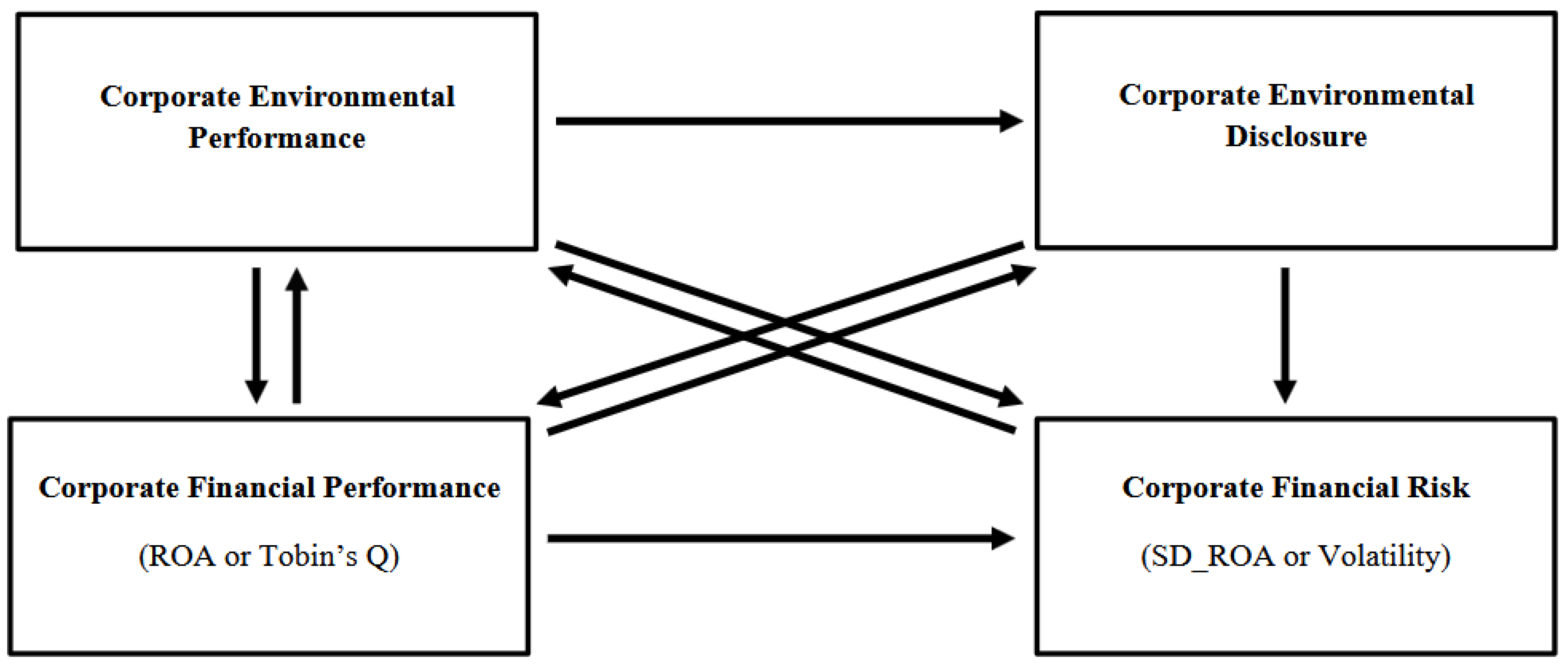

Table 1.
Descriptive statistics.
| Variable | Mean | Median | S.D. | Min | Max | Pair-wise correlation coefficients | ||||||||||||
| (1) | (2) | (3) | (4) | (5) | (6) | (7) | (8) | (9) | (10) | (11) | (12) | |||||||
| (1) | CEP | 20.185 | 8.960 | 24.948 | 0.000 | 98.550 | 1.000 | |||||||||||
| (2) | CED | 16.053 | 8.264 | 17.235 | 0.775 | 84.298 | 0.767 | 1.000 | ||||||||||
| (3) | ROA | -0.004 | 0.030 | 0.201 | -1.025 | 0.335 | 0.209 | 0.171 | 1.000 | |||||||||
| (4) | Tobin’s_Q | 2.267 | 1.619 | 1.764 | 0.795 | 10.585 | 0.044 | 0.046 | 0.211 | 1.000 | ||||||||
| (5) | SD_ROA | 0.035 | 0.015 | 0.058 | 0.000 | 0.349 | -0.102 | -0.072 | -0.251 | 0.222 | 1.000 | |||||||
| (6) | Volatility | 0.111 | 0.093 | 0.061 | 0.039 | 0.356 | -0.196 | -0.191 | -0.354 | 0.053 | 0.447 | 1.000 | ||||||
| (7) | Size | 7.861 | 7.840 | 1.901 | 3.319 | 12.501 | 0.584 | 0.520 | 0.203 | -0.192 | -0.268 | -0.377 | 1.000 | |||||
| (8) | Leverage | 0.235 | 0.191 | 0.213 | 0.000 | 0.977 | 0.145 | 0.136 | -0.091 | -0.006 | 0.034 | 0.099 | 0.054 | 1.000 | ||||
| (9) | CapEx | 0.036 | 0.022 | 0.045 | 0.000 | 0.246 | 0.058 | 0.074 | 0.061 | 0.054 | 0.249 | 0.129 | -0.039 | 0.167 | 1.000 | |||
| (10) | Asst_Grwth | -0.138 | -0.061 | 0.326 | -1.956 | 0.388 | 0.120 | 0.101 | -0.052 | -0.148 | -0.169 | -0.102 | 0.079 | -0.001 | 0.019 | 1.000 | ||
| (11) | Fin_Slack | 0.200 | 0.099 | 0.236 | 0.001 | 0.959 | 0.004 | 0.015 | -0.116 | 0.451 | 0.316 | 0.274 | -0.199 | -0.207 | -0.144 | -0.103 | 1.000 | |
| (12) | Inst_Hold | 0.721 | 0.787 | 0.240 | 0.069 | 1.000 | 0.112 | 0.065 | 0.094 | 0.038 | -0.000 | -0.005 | 0.103 | 0.128 | 0.069 | 0.010 | 0.061 | 1.000 |
| (13) | Asst_Intangibility | 0.200 | 0.103 | 0.232 | 0.001 | 0.874 | 0.133 | 0.151 | -0.002 | -0.096 | 0.134 | 0.084 | 0.035 | 0.310 | 0.766 | 0.056 | -0.281 | 0.026 |
Note to Table 1: All the variables are defined in “Data and methodology” section.
Table 2.
Simultaneous equation model employing accounting-based measures of financial performance and risk.
Table 2.
Simultaneous equation model employing accounting-based measures of financial performance and risk.
| Dependent variable → | ROA | SD_ROA | CEP | CED | ||||||||
|---|---|---|---|---|---|---|---|---|---|---|---|---|
| Regressors ↓ | Coeff. | z-stat | p-value | Coeff. | z-stat | p-value | Coeff. | z-stat | p-value | Coeff. | z-stat | p-value |
| CEP | -0.018 | -5.63 | 0.000 | -0.020 | -7.69 | 0.000 | 1.133 | 21.18 | 0.000 | |||
| CED | 0.006 | 2.51 | 0.012 | 0.043 | 11.67 | 0.000 | ||||||
| ROA | 1.753 | 14.97 | 0.000 | -56.292 | -6.25 | 0.000 | 3.848 | 0.77 | 0.441 | |||
| SD_ROA | -89.128 | -4.05 | 0.000 | |||||||||
| Size | 0.078 | 8.16 | 0.000 | -0.120 | -7.79 | 0.000 | 11.613 | 50.80 | 0.000 | -5.747 | -9.14 | 0.000 |
| Leverage | -0.145 | -9.25 | 0.000 | 0.340 | 13.76 | 0.000 | ||||||
| CapEx | 18.220 | 2.99 | 0.003 | |||||||||
| Asst_Grwth | -0.020 | -3.02 | 0.003 | -2.468 | -5.11 | 0.000 | ||||||
| Fin_Slack | 4.919 | 4.02 | 0.000 | |||||||||
| Inst_Hold | -10.347 | -8.24 | 0.000 | 6.457 | 8.71 | 0.000 | ||||||
| Asst_Tangibility | 0.082 | 5.44 | 0.000 | -0.183 | -9.27 | 0.00 | ||||||
| Intercept, Year and Industry FE | Yes | Yes | Yes | Yes | ||||||||
Note to Table 2: The system is estimated by 3SLS method. All the variables are defined in “Data and methodology” section.
Table 3.
Simultaneous equation model employing market-based measures of financial performance and risk.
Table 3.
Simultaneous equation model employing market-based measures of financial performance and risk.
| Dependent variable → | Tobin’s_Q | Volatility | CEP | CED | ||||||||
|---|---|---|---|---|---|---|---|---|---|---|---|---|
| Regressors ↓ | Coeff. | z-stat | p-value | Coeff. | z-stat | p-value | Coeff. | z-stat | p-value | Coeff. | z-stat | p-value |
| CEP | 0.730 | 6.82 | 0.000 | -0.024 | -7.23 | 0.000 | 1.144 | 14.73 | 0.000 | |||
| CED | -0.603 | -7.45 | 0.000 | 0.035 | 7.79 | 0.000 | ||||||
| Tobin’s_Q | -0.034 | -5.62 | 0.000 | 0.052 | 0.11 | 0.911 | 2.496 | 4.72 | 0.000 | |||
| Volatility | 38.544 | 2.24 | 0.025 | |||||||||
| Size | 1.614 | 5.08 | 0.000 | 0.005 | 0.76 | 0.450 | 11.537 | 45.95 | 0.000 | -5.745 | -6.66 | 0.000 |
| Leverage | 0.586 | 1.65 | 0.099 | 0.047 | 6.39 | 0.000 | ||||||
| CapEx | -2.863 | -0.49 | 0.627 | |||||||||
| Asst_Grwth | 0.002 | 0.38 | 0.702 | -0.997 | -1.77 | 0.076 | ||||||
| Fin_Slack | -6.242 | -2.36 | 0.018 | |||||||||
| Inst_Hold | -8.426 | -7.33 | 0.000 | 3.157 | 2.97 | 0.003 | ||||||
| Asst_Tangibility | -1.318 | -2.52 | 0.012 | -0.028 | -2.71 | 0.007 | ||||||
| Intercept, Year and Industry FE | Yes | Yes | Yes | Yes | ||||||||
Note to Table 3: The system is estimated by 3SLS method. All the variables are defined in “Data and methodology” section.
Disclaimer/Publisher’s Note: The statements, opinions and data contained in all publications are solely those of the individual author(s) and contributor(s) and not of MDPI and/or the editor(s). MDPI and/or the editor(s) disclaim responsibility for any injury to people or property resulting from any ideas, methods, instructions or products referred to in the content. |
© 2026 by the authors. Licensee MDPI, Basel, Switzerland. This article is an open access article distributed under the terms and conditions of the Creative Commons Attribution (CC BY) license.
Copyright: This open access article is published under a Creative Commons CC BY 4.0 license, which permit the free download, distribution, and reuse, provided that the author and preprint are cited in any reuse.


