

Submitted:
22 June 2026
Posted:
23 June 2026
You are already at the latest version
Abstract
Chronic lymphocytic leukemia (CLL) is a biologically heterogeneous B-cell malignancy in which B-cell receptor signaling, microenvironmental interactions, genomic lesions, and epigenetic deregulation cooperate to shape disease behavior. The imprinted DLK1-DIO3 locus at chromosome 14q32 contains the largest human miRNA cluster and has been implicated in cancer-related regulatory networks; however, its systems-level contribution to CLL remains incompletely defined. In the present study, we investigated the potential involvement of DLK1-DIO3 miRNAs in CLL biology by integrating public transcriptomic datasets with miRNA-centered pathway analysis. GSE70830 was used as a discovery dataset and GSE66117 as a supportive validation cohort to identify genes consistently downregulated in CLL compared with normal B cells. The overlap between the two datasets yielded a 345-gene consensus downregulated CLL signature, which was subsequently used as gene filter input for DIANA-miRPath v3.0 analysis of the expressed DLK1-DIO3 miRNA cluster. This analysis identified eight enriched KEGG pathways, mainly converging on B-cell receptor signaling, NF-kappa B signaling, cell adhesion molecules, leukocyte transendothelial migration, and glycan-related processes. DIANA-miRPath v4.0 was further used as a pathway-centered refinement approach, supporting the involvement of individual DLK1-DIO3 miRNAs in signaling, adhesion, migration, and microenvironment-associated programs. Post hoc annotation also showed that members of an IGHV-associated DLK1-DIO3 miRNA panel were represented within several of these pathway categories. Overall, our findings support a systems-level association between the DLK1-DIO3 miRNA locus and CLL-relevant transcriptional programs, providing a hypothesis-generating framework that warrants further experimental validation.
Keywords:
chronic lymphocytic leukemia
; DLK1-DIO3 locus
; microRNAs
; B-cell receptor signaling
; systems biology
1. Introduction
Chronic lymphocytic leukemia (CLL) is a heterogeneous lymphoid malignancy characterized by the proliferation and accumulation of mature CD5+ B-cells [1]. CLL is pathogenetically distinguished by the presence or absence of mutations in the immunoglobulin heavy chain variable region (IGHV) genes indicating memory B-cell or pre-germinal center origin respectively. However, CLL pathogenesis is more complex involving microenvironment interaction with B-cells, structural genomic aberrations, and epigenetic changes. Moreover, a vast number of driver somatic mutations accumulate in malignant cells providing genetic heterogeneity with unmutated-CLL carry more driver mutations than mutated-CLL. Driver mutations cluster in several different pathways providing interpatient heterogeneity. These pathways include including NOTCH1 signaling, BCR and TLR signaling, MAPK-ERK pathway, NF-kappaB signaling, chromatin modifiers, cell cycle, metabolism, inflammation, MYC and Wnt signaling, DNA damage response, and RNA splicing [2,3].
MicroRNAs (miRNAs) are short non-coding RNAs, ~22 nt long, with the potential to promote translation repression and mRNA destabilization through binding to complementary sequences in the 3ʹ untranslated region (3ʹ UTR) of target mRNAs. There, by localizing to target gene promoters and enhancers regulate transcription, RNA processing and chromatin accessibility. A functional characteristic of miRNAs is that a single miRNA is able to target several hundreds of different target genes, whereas a single target mRNA can be targeted by different miRNAs [4,5]. More than half of the miRNAs are located in introns (and occasionally exons) of protein coding genes and are transcribed, under the action of RNA polymerase II, with their host genes. The remaining is intergenic and transcribed independently of their host genes. Their transcription is controlled by transcription factors (TFs) and epigenetic modifications. A 10% of miRNAs is broadly expressed among most tissues, whereas another ~10% is cell-type specific and under the control of tissue-specific TFs [5,6,7]. Genomic regions containing miRNAs genes are often deleted, amplified or translocated in human cancers, thus affecting their expression and the consequent downstream target mRNA expression. MiRNAs are also able to form complex networks with known potent oncogenes such as MYC enhancing each other’s expression promoting oncogenesis [8]. Epigenetic modifications affecting the 3D chromatin conformation, a common feature in oncogenesis, modulate miRNAs expression. For example, CpG islands of promoters of tumour suppressive miRNAs tend to be hypermethylated in cancer leading to their aberrant s silencing. Moreover, miRNAs interaction with EZH2 or MLL histone methyltransferases form feedback pathways promoting altered histone methylation levels such as H3K27me3 and H3K4me3 respectively promoting oncogenesis [9,10]. Further, dysregulation of miRNAs biogenesis machinery leads to nascent miRNAs aberrant expression with defective activity. Finally, miRNAs activity can be modulated by competing endogenous RNAs, or by mutations of miRNAs-binding sites at the 3′UTR of the target mRNA with final result the event of malignant transformation [4,5]. The involvement of miRNAs in CLL pathogenesis has been first reported more than two decades ago when Calin and colleagues reported that mir-15 and mir-16 are located at chromosome 13q14, a region frequently deleted in CLL, and that are also deleted or down-regulated in the majority of CLL cases [11]. Later studies based on genome-wide expression analyses also provided evidence that miRNAs expression is associated with established prognostic factors such IGHV mutations and is able to identify patients with shorter time to first treatment, suggesting an overall prognostic impact of miRNAs in CLL biology, whereas they can be used as therapeutic targets in the CLL context [12,13].
DLK1-DIO3 represents one of the largest imprinted clusters in mammals located at chromosome 14q32 in humans and 12qF in mice, a region conserved between the two species. That particular imprinted domain contains the paternally expressed protein coding gens DLK1, RTL1, DIO3 and BEGAIN, and the maternally MEG3 (GTL2), MEG8 (RIAN), and antisense RTL1. The imprinting status of the locus is regulated by the germline-derived intergenic differentially methylated region (IG-DMR) required for the parental-specific expression of the cluster acting as a bipartite element with two antagonistic cis-regulatory elements within the IG-DMR ensuring the germ-line specific DNA methylation pattern at DLK1-DIO3 [14,15]. Importantly, the DLK1-DIO3 locus contains 54 miRNAs thus representing the largest one in the human genome. Aberrant expression of these miRNAs is implicated in the pathogenesis of several benign diseases, solid and blood cancers as well. Their effect is achieved through modulation of important signaling pathways, cytokine signaling cascades, epigenetic modifications, and it has been proposed that they can be used as biomarkers for the diagnosis and prognosis of several cancers [16,17,18].
Aim of our study is to investigate the putative pathogenetic, diagnostic, and functional role, and the overall involvement and the resulting networks of the DLK1-DIO3 contained miRNAs in CLL using a systems biology implementation. Βy integrating two public transcriptomic datasets, we derived a 345-gene consensus downregulated CLL signature and used this gene set to interrogate the functional landscape of the DLK1-DIO3 miRNA cluster. Gene-restricted DIANA-miRPath v3.0 analysis highlighted CLL-relevant pathways centered on B-cell receptor (BCR)/NF-kappaB signaling and adhesion/migration-related processes, whereas pathway-centered v4.0 analysis was used for mechanistic refinement.
2. Methods
2.1. Public Datasets and Study Design
To identify a robust set of transcripts consistently downregulated in chronic lymphocytic leukemia (CLL), we performed a two-step transcriptomic analysis using publicly available RNA-seq datasets from the Gene Expression Omnibus (GEO). The primary discovery analysis was based on GSE70830, which includes transcriptomic profiles from 10 CLL samples and 5 normal peripheral blood CD19+ B-cell samples [19]. An independent validation analysis was subsequently performed using GSE66117, which contains transcriptomic data from purified B cells derived from CLL cases and normal controls [20].
2.2. Derivation of a Downregulated Gene CLL Signature
For the discovery step, we used the processed differential expression file corresponding to the Normal versus CLL comparison from GSE70830. Genes were classified as downregulated in CLL when they fulfilled both of the following criteria: negative log2 fold-change and false discovery rate-adjusted q-value < 0.05. Because the comparison was structured as Normal versus CLL, negative fold-change values corresponded to lower expression in CLL relative to normal CD19+ B cells.
For independent validation, the processed expression matrix from GSE66117 was analyzed together with sample annotations derived from the corresponding GEO series matrix file. Samples annotated as CLL were compared with the normal/control B-cell samples included in the dataset. Since raw read counts were not available in the uploaded validation files, this step was performed on processed expression values and was therefore considered exploratory validation rather than a formal count-based replication analysis. Expression values were log2-transformed following addition of a pseudocount, and differential expression between CLL and normal samples was assessed. Multiple-testing correction was performed using the Benjamini-Hochberg procedure. Genes showing adjusted p value < 0.05 and lower expression in CLL than in controls were retained as downregulated in the validation dataset.
To define a robust consensus set for downstream systems-level analyses, the overlap between the discovery and validation downregulated gene lists was calculated at the gene symbol level. Genes shared by both datasets were considered a high-confidence CLL downregulated signature. This consensus gene set was prioritized for subsequent pathway-oriented interrogation in relation to the DLK1-DIO3 miRNA cluster.
2.3. miRPath Analysis
To investigate the functional landscape potentially regulated by the DLK1-DIO3 miRNA cluster in CLL, pathway enrichment analysis was performed using DIANA-miRPath v3.0 [21]. In order to capture the overall contribution of the locus as a coordinated imprinted miRNA cluster, the analysis was based on the full set of expressed DLK1-DIO3miRNAs rather than on a restricted subset of cluster members. To focus the analysis on transcripts consistently repressed in CLL, the 345-gene consensus downregulated signature derived from the overlap between GSE70830 and GSE66117 was used as gene filter input.
To refine the biologic architecture of the pathways identified in the primary analysis, a secondary pathway-centered analysis was subsequently performed using DIANA-miRPath v4.0 [22]. In this follow-up step, the pathways emerging from the v3.0 gene-restricted analysis were re-examined in order to further explore the contribution of individual DLK1-DIO3 miRNAs and their putative target relationships within the most relevant functional categories. Τo further connect the pathway-centered analysis with the IGHV-associated biology of the DLK1-DIO3 locus, we performed a focused post hoc annotation of the existing DIANA-miRPath v4.0 output. Specifically, we inspected whether members of an IGHV-associated DLK1-DIO3 miRNA panel derived from Bryant et al. were represented among the individual miRNAs contributing to the v4.0 pathway-centered results [23]. This panel included miR-543-5p, miR-495-3p, miR-409-3p, miR-411-3p, miR-410-3p, miR-493-5p, and miR-493-3p. This step was not treated as a separate enrichment analysis, but as an interpretive annotation of the v4.0 refinement output, designed to assess whether previously reported IGHV-linked DLK1-DIO3 miRNAs were embedded within the pathway themes identified by the whole-cluster analysis. The analytical workflow of this study is presented in Figure 1 and Supplementary Table S1.
3. Results
3.1. Identification of Downregulated Transcripts in CLL
We first interrogated GSE70830 as the discovery dataset to define genes transcriptionally repressed in CLL relative to normal peripheral blood CD19+ B cells. Application of the predefined filtering criteria identified 1236 genes that were significantly downregulated in CLL (Supplementary Table S2). This finding indicates that, in addition to well-established overexpressed oncogenic programs, CLL is characterized by a broad component of transcriptional loss involving a substantial number of coding transcripts.
To examine whether this pattern could be reproduced in an unrelated cohort, we next analyzed GSE66117 as an independent validation dataset. This series includes purified B-cell transcriptomes from CLL and normal/control samples, thus providing an appropriate framework for cross-dataset comparison [20]. Analysis of the processed expression matrix identified a large set of genes (n = 2145) with significantly lower expression in CLL than in the control samples, supporting the presence of a reproducible downregulated transcriptional compartment in CLL biology (Supplementary Table S3). Because this validation analysis relied on processed expression values rather than raw counts, the results were interpreted conservatively as supportive external validation.
To increase robustness and reduce dataset-specific noise, we intersected the discovery and validation downregulated gene sets. This analysis yielded 345 genes consistently downregulated in CLL across both datasets. The number of overlapping downregulated genes are presented as Venn diagram in Figure 2 and presented as a list in Supplementary Table S4. We considered this overlapping subset to represent the most reliable downregulated CLL transcriptional signature derived from the present analysis.
The biological plausibility of this consensus signature was supported by the presence of several genes with recognized relevance to B-cell identity, signaling, adhesion, and leukemic cell biology. Among the representative genes retained in the overlap were EBF1, CR1, ITGA4, TRIB2, SMAD3, MYC, NT5E, and PLD4. Notably, several of these overlapping genes map onto biologic processes already implicated in CLL. Reduced EBF1 expression is compatible with erosion of normal B-cell identity, whereas diminished CR1/CR2 expression has long been recognized as a feature of the CLL phenotype; in parallel, ITGA4/CD49d and NT5E/CD73 point to pathways linked to microenvironmental retention, immune regulation, and clinical aggressiveness [24,25,26]. The recurrence of such genes across two independent transcriptomic resources suggests that the final 345-gene set captures reproducible aspects of CLL-associated transcriptional repression rather than dataset-restricted fluctuations.
Overall, our transcriptomic workflow identified a reproducible set of genes downregulated in CLL relative to normal B cells. While 1236 downregulated genes were detected in the discovery cohort, cross-dataset integration reduced this list to a 345-gene consensus signature supported by both GSE70830 and GSE66117. This high-confidence transcriptional output was subsequently prioritized for DLK1-DIO3 miRNA-centered downstream analysis.
3.2. DLK1-DIO3 miRNA Pathway Analysis Identifies CLL-Relevant Signaling and Microenvironment-Associated Programs
Using DIANA-miRPath v3.0 with the 345-gene consensus downregulated CLL signature as gene filter, eight significantly enriched KEGG pathways were identified (Figure 3 and Supplementary Table S5). These pathways converged on two main biologic themes relevant to CLL pathobiology: core leukemic signaling and microenvironment-related cellular interaction. This pattern is biologically consistent with contemporary models of CLL, in which persistent antigen receptor signaling and microenvironmental support are not parallel phenomena but tightly interconnected determinants of leukemic fitness [23,27].
Among the most biologically relevant pathways were B-cell receptor signaling and NF-kappaB signaling, indicating that the DLK1-DIO3 miRNA cluster may be linked to signaling programs central to CLL cell activation, survival, and maintenance. The presence within the enriched signature of BLNK, MALT1, VAV3, and BIRC3 further strengthens this interpretation, because these nodes lie at the interface between BCR-triggered signaling and NF-κB pathway activation, both of which are repeatedly associated with disease behavior and treatment response in CLL [28,29]. In parallel, cell adhesion molecules (CAMs) and leukocyte transendothelial migration suggested a role for the cluster in pathways involved in cellular adhesion, trafficking, and interaction with the tissue microenvironment.
Inspection of the genes contributing to the enriched pathways further supported their biologic relevance to CLL. The B-cell receptor signaling pathway included CR2, BLNK, DAPP1, MALT1, and VAV3, whereas the NF-kappaB signaling pathway included TRAF5, BLNK, MALT1, and BIRC3. Pathways related to cellular interaction with the microenvironment were represented by JAM3, ITGB2, and ESAM in cell adhesion molecules and by JAM3, CYBB, VAV3, ITGB2, and ESAM in leukocyte transendothelial migration, indicating convergence on signaling and adhesion programs central to CLL biology.
The enrichment of mucin-type O-glycan and glycosaminoglycan biosynthesis pathways suggests that the transcriptional footprint associated with the DLK1-DIO3 cluster may also extend to cell-surface glycosylation and extracellular interaction programs. Additional enriched pathways included circadian entrainment. Although arrhythmogenic right ventricular cardiomyopathy (ARVC) also emerged in the enrichment output, this pathway was interpreted cautiously, likely reflecting shared structural or adhesion-related components rather than direct disease-specific relevance.
Taken together, the miRPath v3.0 analysis indicated that the DLK1-DIO3 miRNA locus is potentially associated with a coordinated regulatory program centered on BCR/NF-kappaB signaling and adhesion/migration-related pathways, both of which are highly relevant to CLL biology.
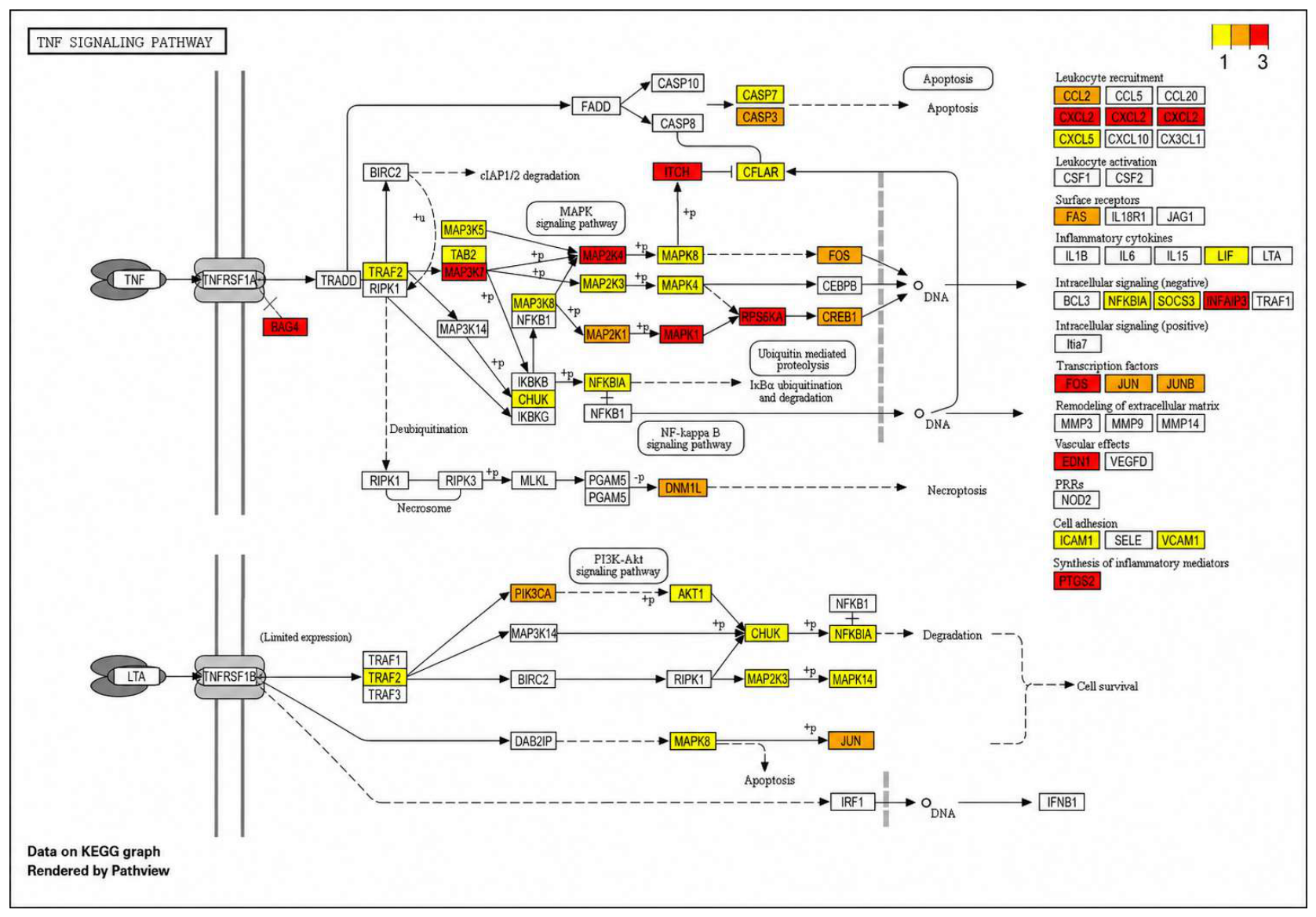
The top pathways identified by miRPath v3.0 were subsequently examined using DIANA-miRPath v4.0. in a pathway-centered manner (Supplementary Table S6). This secondary analysis was not used as an independent validation step, but rather as a refinement strategy to further resolve the contribution of individual cluster miRNAs and their putative targets within the pathways prioritized by the gene-restricted v3.0 analysis. In this way, the v4.0 analysis served to expand the mechanistic interpretation of the v3.0 findings while preserving the 345-gene downregulated CLL signature as the primary biologic framework of the study. Among the significant KEGG pathways, we present Proteoglycans in Cancer (Supplementary Figure S1), Pathways in Cancer (Supplementary Figure S2), and TNF signaling pathway (Figure 4), that strongly corroborate the data from v3.0 analysis.
Collectively, these findings support the view that the DLK1-DIO3 miRNA locus may modulate CLL biology through coordinated effects on signaling, adhesion, and microenvironment-dependent transcriptional programs.
We then examined whether the pathway-centered v4.0 output contained members of the focused IGHV-associated DLK1-DIO3 miRNA panel. Five of the seven panel members—miR-495-3p, miR-409-3p, miR-411-3p, miR-410-3p, and miR-493-5p—were represented within the existing v4.0 results. These miRNAs were observed across pathways related to adhesion, cytoskeletal organization, MAPK/PI3K-related signaling, and leukocyte transendothelial migration (Supplementary Table S7). Thus, although the 7-miRNA panel was not analyzed as an independent enrichment arm, its representation within the v4.0 output suggests that the IGHV-associated component of the DLK1-DIO3 locus is embedded within the same signaling, adhesion, migration, and microenvironment-related programs highlighted by the primary whole-cluster analysis.
4. Discussion
MiRNAs aberrant expression in CLL may affect key signal targets such, BCL2, CCND1, TP53, MYC, and PTEN among others, modulate signaling pathways including B-cell receptor signaling pathway PI3K/AKT, JAK/STAT, Wnt, NF-kappaB, and NOTCH leading to increased cell proliferation and CLL progression, decreased apoptosis, and resistance to treatment [30,31].
Besides their putative involvement in CLL pathogenesis, miRNAs may predict patients who can achieve complete remission and undetectable minimal residual disease as well with immunochemotherapy. Among the 25 differentially expressed miRNAs that constitute a predictive signature, three belong to the DLK1-DIO3 locus that is miR-412, miR-134, and miR-494. That effect is independent of the IGHV mutational status or aberrant karyotypes [32].
MiRNAs have a prognostic value in CLL as they can predict overall survival, time to first treatment (TTFT) and progression free survival. Especially miR-412 has an impact on PFS, while miR-582-3p, miR-323-3p, miR-665, miR-376b-3p, miR-370, and miR-582-3p member of the DLK1-DIO3 locus has impact on TTFT [33,34].
Although our results describe an involvement of DLK1-DIO3 miRNAs in CLL pathogenesis through regulatory networks with well-established pathways such as BCR signaling and NF-kappaB, they also provide evidence of novel pathways that are very probably involved in CLL pathogenesis under the transcriptional control of 14q32 miRNAs [2,35]. Our data are particularly well aligned with the recent report by Bryant et al., who showed that DLK1-DIO3 miRNAs are coordinately expressed with MEG3 in CLL and may account for up to one quarter of the IGHV-associated transcriptomic signature [23]. In that study, miR-409-3p and miR-411-3p directly repressed the GAB1 3′UTR, providing functional support for a mechanistic link between this locus and BCR pathway [23]. Our pathway-level findings therefore extend the existing literature by suggesting that the effect of the DLK1-DIO3 locus may not be limited to isolated miRNA-mRNA pairs, but may converge on broader signaling and trafficking programs relevant to CLL progression.
Glycosylation is known to be associated with CLL accounting for the low levels of B-cell receptor surface expression, and especially the unmutated subtype enhancing signal transduction via increased tyrosine phosphorylation and mediate the crosstalk between cancer cells and the microenvironment [36,37,38]. Aberrant glycosylated forms on the surface of cancer cells makes them attractive therapeutic targets for drug delivery systems [39]. Thus, our findings implicate both glycosylation and microenvironment which are under the DLK1-DIO3 miRNAs control. This axis is highly plausible in CLL biology. Defective glycosylation of the mi chain and CD79a has been shown to contribute to reduced surface BCR expression in CLL, while more recent work demonstrated that sialylation regulates CLL migration through post-translational modification of CD49d, coupling glycan remodeling to microenvironmental trafficking [37,38]. Because endothelial and stromal interactions are major determinants of CLL survival and drug resistance, the coexistence in our analysis of glycan pathways with CAM/transendothelial migration pathways provides evidence for a possible coordinated, rather than incidental, microenvironmental signature [27].
Mucin-type O-glycosylation has a role in protein stability regulation, and is essential for proper development, differentiation and growth of cells. Mucin-type O-glycosylation exhibits substrate function for non-enzymatic sugar-binding proteins inducing signal transduction affecting cell growth and apoptosis, cell-to-cell interactions and cell-matrix interactions as well. Abnormal mucin-type O-glycosylation has been associated with oncogenesis, whereas mucin-type O-glycosylation therapeutic targeting has been explored though various strategies [41,42]. Our findings suggest that DLK1-DIO3 contained miRNAs cluster may also extend to cell-surface glycosylation and extracellular interaction programs. Therapeutic targeting of those miRNAs could probably represent a potential alternative against such pathway.
Circadian rhythm maintains cellular homeostasis operating through transcription-translation feed-back loops involving the essential clock genes including CLOCK, BMAL1, NPAS2, PERs, CRYs, RORs, REV-ERBs, DECs, CK1ε, NONO and TIM which are all targeted by DLK1-DIO3 miRNAs. It has been shown that perturbation of circadian rhythm is associated with higher risk of hematological malignancies occurrence by affecting the major cancer hallmarks. In particular, aberrant expression of BMAL1 and PER1-2 genes disrupt MYC and CCND1 expression enhancing cell proliferation and inhibiting apoptosis [42,43]. We would nevertheless interpret the circadian signal cautiously. Rather than claiming a direct circadian mechanism for DLK1-DIO3 miRNAs in CLL, it is safer to state that our data raise the possibility that transcriptional programs intersecting calcium signaling, kinase activity, and MYC-linked cellular timing may also lie within the downstream footprint of this locus [42].
Arrhythmogenic right ventricular cardiomyopathy is a rare inherited myocardial disorder characterized by fibro-fatty replacement of the right ventricle and is associated with the occurrence of ventricular arrhythmias, syncope and sudden death. Acquired ARVC cases related to anthracycline treatment for lymphomas have been reported [44]. Interestingly, recent retrospective data suggest an increased risk of cardiovascular adverse events including sudden death among CLL patients under ibrutinib treatment. Several patients harbored high-risk arrhythmogenic genotypes, hypertension, hyperlipidemia, obesity and diabetes [45]. The ARVC pathway was retained in the enrichment output but should be interpreted cautiously, because it was driven by a very limited gene contribution and most likely reflects shared structural and adhesion-related modules rather than disease-specific cardiac biology. We therefore do not regard ARVC as a core mechanistic conclusion of the present study, in contrast to the stronger and more CLL-relevant signals involving BCR/NF-κB signaling, cell adhesion, and leukocyte transendothelial migration. Even though the data are limited, in our opinion, ARVC should be taken in consideration in patients who undergo BTK is treatment which can very probably be exacerbated by the regulatory effect of DLK1-DIO3 miRNAs.
DLK1-DIO3 miRNAs are involved in BTKis resistance in CLL through the regulation of PTEN/AKT/mTOR pathway in the absence of BTK or PLCG2 mutations. In particular, miR-494, miR-495, miR-543 miR-899, miR-433, and miR-733 are upregulated in BTK resistant cells and downregulate PTEN mediating chemoresistance and subsequent reduced apoptosis [46]. This observation is especially relevant because targeted-therapy resistance in CLL is increasingly recognized as broader adaptive rewiring involving PI3K/AKT and microenvironment-associated transcriptional circuits [47]. In this context, our enrichment of BCR/NF-κB and adhesion-related pathways provides an additional mechanism by which DLK1-DIO3 miRNAs may participate in non-canonical resistance pathways.
These recent years research advances have expanded our understanding of miRNAs functions in network context in cancer pathogenesis. The interaction between miRNAs-target genes leads to complex networks in which individual nodes are connected to many other nodes. The connection between these nodes may explain biological behavior and clinical utility [6]. Furthermore, miRNAs encoded polycistronic clusters tend to be transcribed with their host genes and possess the ability of co-expressed miRNAs individually or jointly target multiple different targets within the same pathway [6]. Several miRNAs of the specific imprinted cluster to be transcribed as polycistronic units and our data are consistent with a coordinated pathway-level effect of the locus, although they do not by themselves establish polycistronic transcription [17]. This more cautious interpretation is also more consistent with the published CLL data, which support strong co-expression of 14q32 miRNAs with MEG3 and coordinated locus behavior, but do not reduce the biology of the cluster to a single experimentally resolved transcriptional unit in this disease context [23].
It has been demonstrated that DLK1-DIO3 miRNAs cluster, located approximately 4.5Mbp upstream the IGH locus, represent 37% of the differentially expressed miRNAs in mCLL vs. umCLL. Most of these miRNAs (92.5%) are downregulated in umCLL and in mutCLL with competent BCR signaling compared to their BCR signaling deficient counterparts. Furthermore, a 14q32 miRNAs-target mRNAs interaction network revealed several miRNAs able to regulate CLL transcriptome through and thus modulate pathways such as Wnt, BCR signaling and Ras pathways. Most interestingly, network analysis reveals strong interaction between the DLK1-DIO3 miRNAs and the 49 (25.5%) of the 200 mRNAs most strongly associated with the IGHV status suggesting a potential ability of these miRNAs to perturbate entire transcriptional networks, highlighting a regulatory role in IGHV-associated transcription [23]. Importantly, our study complements Bryant et al. based on a different conceptual framework: rather than stratifying CLL by IGHV/BCR-competence states, we first derived a consensus downregulated-versus-normal signature across two public datasets and then asked which pathways could be plausibly embedded within a DLK1-DIO3-centered regulatory framework. This distinction matters, because it suggests that the locus may shape not only subgroup differences within CLL, but also part of the broader differences in expression between leukemic and normal B cells. The focused annotation of our miRpath v4.0 output further supports this connection without changing the hierarchy of the study. Five members of the Bryant-derived IGHV-associated DLK1-DIO3 panel are present within the existing pathway-centered results, particularly in pathways linked to adhesion/migration and MAPK–PI3K-related signaling. This observation provides an additional interpretation between the published IGHV-centered 14q32 network and our own analysis. Importantly, we do not present this as an independent validation of the 7-miRNA panel, but rather as supportive evidence that miRNAs previously implicated in IGHV-associated transcriptional divergence are also represented within the broader DLK1-DIO3 pathway footprint identified here.
Several limitations of the present study should be acknowledged. First, this is an in silico systems-biology analysis based on public transcriptomic datasets, and therefore the proposed regulatory links between DLK1-DIO3 miRNAs, downregulated target genes, and CLL-relevant pathways should be considered hypothesis-generating rather than experimentally validated. Second, although GSE70830 was used as the primary discovery dataset and GSE66117 as an independent supportive cohort, the validation step relied on processed expression values rather than raw read counts; therefore, it should be interpreted as supportive cross-dataset confirmation and not as formal count-based replication. Third, miRNA-target and pathway enrichment analyses depend on the completeness and assumptions of the underlying annotation databases, and predicted miRNA-target relationships may not necessarily reflect active regulation in CLL cells. Fourth, the DIANA-miRPath v3.0 analysis allowed gene-restricted interrogation of the 345-gene consensus signature, whereas the v4.0 analysis was used only as a pathway-centered refinement step and not as an independent validation strategy. Similarly, the focused IGHV-associated miRNA annotation was performed post hoc within the existing v4.0 output and should be viewed as an additional interpretation of previously published IGHV-centered 14q32 data rather than as a separate enrichment analysis. Experimental validation in primary CLL samples or appropriate functional models will be required to confirm the biological relevance of the proposed DLK1-DIO3 miRNA–target–pathway relationships.
Our system approach may lead to the prediction of regulatory networks that DLK1-DIO3 contained miRNAs participate in, and the identification of miRNA-target gene hubs. Different strategies of miRNAs-based drugs have been developed and several miRNAs-therapeutics are under phase I/II clinical trials [48,49]. From a translational perspective, this possibility is supported by recent evidence that blood miRNA signatures can predict remission depth in CLL, while broader reviews continue to support ncRNAs as emerging biomarkers and therapeutic targets in the disease. Therefore, targeting DLK1-DOI3 miRNAs or inhibiting their transcriptional program it would probably affect the regulatory networks that are regulated by those miRNAs. Furthermore, as 14q32 miRNAs are mainly maternally expressed and under the MEG3-differentially methylated region, a putative therapeutic strategy could be represented by the disruption of the MEG-DMR using CRISPR technology.
5. Conclusions
Our findings support a systems-level association between the DLK1-DIO3 miRNA locus and CLL-relevant transcriptional programs. Our data expand the current knowledge on DLK1-DIO3 imprinted miRNAS cluster reporting novel pathways probably involved in CLL pathogenesis and, moreover, provide a hypothesis-generating framework that warrants further experimental validation.
Supplementary Materials
The following supporting information can be downloaded at the website of this paper posted on Preprints.org.
Author Contributions
Conceptualization: G.S.M. and L.B., literature review and data collection and data analysis: G.S.M., Y.V.S., K.I.T. and L.L., drafting of the original manuscript: G.S.M. and L.B., critical revision and editing: E.H, E.K. and D.P., supervision: G.S.M. and L.B. All authors have read and agreed to the published version of the manuscript.
Funding
No funding received.
Institutional Review Board Statement
Not applicable.
Informed Consent Statement
Not applicable.
Data Availability Statement
Our study is a systems biology analysis based on publicly available transcriptomic datasets. Therefore, data sharing is not applicable to this article.
Conflicts of Interest
The authors declare no conflicts of interest.
References
- Hallek, M. Chronic Lymphocytic Leukemia: 2025 Update on the Epidemiology, Pathogenesis, Diagnosis, and Therapy. Am. J. Hematol. 2025, 100, 450–480. [Google Scholar] [CrossRef] [PubMed]
- Knisbacher, B.A.; Lin, Z.; Hahn, C.K.; Nadeu, F.; Duran-Ferrer, M.; Kristen, E.; Stevenson, K.E.; Tausch, E.; Julio Delgado, J.; Alex Barbera-Mourelle, A.; et al. Molecular map of chronic lymphocytic leukemia and its impact on outcome. Nat. Genet. 2022, 54, 1664–1674. [Google Scholar] [CrossRef] [PubMed]
- Bosch, F.; Dalla-Favera, R. Chronic lymphocytic leukaemia: From genetics to treatment. Nat. Rev. Clin. Oncol. 2019, 16, 684–701. [Google Scholar] [CrossRef] [PubMed]
- Lin, S.; Gregory, R.I. MicroRNA biogenesis pathways in cancer. Nat. Rev. Cancer 2015, 15, 321–333. [Google Scholar] [CrossRef] [PubMed]
- Ding, S.; Wang, P. The Life of MicroRNAs: Biogenesis, Function and Decay in Cancer. Biomolecules 2025, 15, 1393. [Google Scholar] [CrossRef] [PubMed]
- Bracken, C.P.; Scott, H.S.; Goodall, G.J. A network-biology perspective of microRNA function and dysfunction in cancer. Nat. Rev. Genet. 2016, 17, 719–732. [Google Scholar] [CrossRef] [PubMed]
- Kim, H.; Lee, Y.Y.; Kim, V.N. The biogenesis and regulation of animal microRNAs. Nat. Rev. Mol. Cell Biol. 2025, 26, 276–296. [Google Scholar] [PubMed]
- Benetatos, L.; Vartholomatos, G.; Hatzimichael, E. Polycomb group proteins and MYC: The cancer connection. Cell Mol. Life Sci. 2014, 71, 257–269. [Google Scholar] [PubMed]
- Benetatos, L.; Voulgaris, E.; Vartholomatos, G.; Hatzimichael, E. Non-coding RNAs and EZH2 interactions in cancer: Long and short tales from the transcriptome. Int. J. Cancer 2013, 133, 267–274. [Google Scholar] [PubMed]
- Benetatos, L.; George Vartholomatos, G. MicroRNAs mark in the MLL-rearranged leukemia. Ann. Hematol. 2013, 92, 1439–1450. [Google Scholar] [CrossRef] [PubMed]
- Calin, G.A.; Calin, D.D.; Shimizu, M.; Bichi, R.; Zupo, S.; Noch, E.; Aldler, H.; Rattan, S.; Keating, M.; Rai, K.; et al. Frequent deletions and down-regulation of micro- RNA genes miR15 and miR16 at 13q14 in chronic lymphocytic leukemia. Proc. Natl. Acad. Sci. USA 2002, 99, 15524–15529. [Google Scholar] [CrossRef] [PubMed]
- Calin, G.A.; Ferracin, M.; Cimmino, A.; Di Leva, G.; Shimizu, M.; Wojcik, S.E.; Iorio, M.V.; Visone, R.; Sever, N.I.; Muller Fabbri, M.; et al. A MicroRNA signature associated with prognosis and progression in chronic lymphocytic leukemia. N. Engl. J. Med. 2005, 353, 1793–1801. [Google Scholar] [CrossRef] [PubMed]
- Ali, A.; Mahla, S.B.; Reza, V.; Hossein, A.; Bahareh, K.; Mohammad, H.; Fatemeh, S.; Mostafa, A.B.; Leili, R. MicroRNAs: Potential prognostic and theranostic biomarkers in chronic lymphocytic leukemia. EJHaem 2024, 5, 191–205. [Google Scholar] [CrossRef] [PubMed]
- Weinberg-Shukron, A.; Youngson, N.A.; Ferguson-Smith, A.C.; Edwards, C.A. Epigenetic control and genomic imprinting dynamics of the Dlk1-Dio3 domain. Front. Cell Dev. Biol. 2023, 11, 1328806. [Google Scholar] [CrossRef] [PubMed]
- Aronson, B.E.; Scourzic, L.; Shah, V.; Swanzey, E.; Kloetgen, A.; Polyzos, A.; Sinha, A.; Azziz, A.; Caspi, I.; Li, J.; et al. A bipartite element with allele-specific functions safeguards DNA methylation imprints at the Dlk1-Dio3 locus. Dev. Cell 2021, 56, 3052–3065.e5. [Google Scholar] [PubMed]
- Benetatos, L.; Voulgaris, E.; Vartholomatos, G. DLK1-MEG3 imprinted domain microRNAs in cancer biology. Crit. Rev. Eukaryot. Gene Expr. 2012, 22, 1–15. [Google Scholar] [CrossRef] [PubMed]
- Benetatos, L.; Hatzimichael, E.; Londin, E.; Vartholomatos, G.; Loher, P.; Rigoutsos, I.; Briasoulis, E. The microRNAs within the DLK1-DIO3 genomic region: Involvement in disease pathogenesis. Cell Mol. Life Sci. 2013, 70, 795–814. [Google Scholar] [PubMed]
- Manodoro, F.; Marzec, J.; Chaplin, T.; Miraki-Moud, F.; Moravcsik, E.; Jovanovic, J.V.; Wang, J.; Iqbal, S.; Taussig, D.; Grimwade, D. Loss of imprinting at the 14q32 domain is associated with microRNA overexpression in acute promyelocytic leukemia. Blood 2014, 123, 2066–2074. [Google Scholar] [CrossRef] [PubMed]
- Liao, W.; Jordaan, G.; Nham, P.; Phan, R.T.; Pelegrini, M.; Sharma, S. Gene expression and splicing alterations analyzed by high throughput RNA sequencing of chronic lymphocytic leukemia specimens. BMC Cancer 2015, 15, 714. [Google Scholar] [CrossRef] [PubMed]
- Kushwaha, G.; Dozmorov, M.; Wren, J.D.; Qiu, J.; Shi, H.; Xu, D. Hypomethylation coordinates antagonistically with hypermethylation in cancer development: A case study of leukemia. Hum. Genom. 2016, 10, 18. [Google Scholar] [CrossRef]
- Vlachos, I.S.; Zagganas, K.; Paraskevopoulou, M.D.; Georgios Georgakilas, G.; Karagkouni, D.; Vergoulis, T.; Dalamagas, T.; Hatzigeorgiou, A.G. DIANA-miRPath v3.0: Deciphering microRNA function with experimental support. Nucleic Acids Res. 2015, 43, W460–W466. [Google Scholar] [PubMed]
- Tastsoglou, S.; Skoufos, G.; Miliotis, M.; Karagkouni, D.; Koutsoukos, I.; Karavangeli, A.; Kardaras, F.; Hatzigeorgiou, A.G. DIANA-miRPath v4.0: Expanding target-based miRNA functional analysis in cell-type and tissue contexts. Nucleic Acids Res. 2023, 51, W154–W159. [Google Scholar] [CrossRef] [PubMed]
- Bryant, D.; Smith, L.; Rogers-Broadway, K.R.; Karydis, L.; Woo, J.; Blunt, M.D.; Forconi, F.; Stevenson, F.K.; Goodnow, C.; Russell, A.; et al. Network analysis reveals a major role for 14q32 cluster miRNAs in determining transcriptional differences between IGHV-mutated and unmutated CLL. Leukemia 2023, 37, 1454–1463. [Google Scholar] [PubMed]
- Li, L.; Zhang, D.; Cao, X. EBF1, PAX5, and MYC: Regulation on B cell development and association with hematologic neoplasms. Front. Immunol. 2024, 15, 1320689. [Google Scholar] [CrossRef] [PubMed]
- Pozzo, F.; Tissino, E.; Zucchetto, A.; Gattei, V. CD49d in chronic lymphocytic leukemia: A molecule with multiple regulation layers. Comment to “Sialylation regulates migration in chronic lymphocytic leukemia”. Haematologica 2024, 109, 362–363. [Google Scholar] [PubMed]
- Allard, D.; Chrobak, P.; Bareche, Y.; Allard, B.; Tessier, P.; Bergeron, M.A.; Johnson, N.A.; Stagg, J. CD73 Promotes Chronic Lymphocytic Leukemia. Cancers 2022, 14, 3130. [Google Scholar] [CrossRef] [PubMed]
- Cerreto, M.; Foà, R.; Natoni, A. The Role of the Microenvironment and Cell Adhesion Molecules in Chronic Lymphocytic Leukemia. Cancers 2023, 15, 5160. [Google Scholar] [CrossRef] [PubMed]
- Meijers, R.W.J.; Muggen, A.F.; Leon, L.G.; de Bie, M.; van Dongen, J.J.M.; Hendriks, R.W.; Langerak, A.W. Responsiveness of chronic lymphocytic leukemia cells to B-cell receptor stimulation is associated with low expression of regulatory molecules of the nuclear factor-κB pathway. Haematologica 2020, 105, 182–192. [Google Scholar] [PubMed]
- Diop, F.; Moia, R.; Favini, C.; Spaccarotella, E.; De Paoli, L.; Bruscaggin, A.; Spina, V.; Terzi-di-Bergamo, L.; Arruga, F.; Tarantelli, C.; et al. Biological and clinical implications of BIRC3 mutations in chronic lymphocytic leukemia. Haematologica 2020, 105, 448–456. [Google Scholar] [PubMed]
- Chu, A.; Soto, F.; Hurtado, R.; Tirado, C.A. Epigenetics in B-CLL. Int. J. Genom. 2026, 2026, 5877313. [Google Scholar] [CrossRef]
- Doghish, A.S.; Abulsoud, A.I.; Elshaer, S.S.; Abdelmaksoud, N.M.; Zaki, M.B.; El-Mahdy, H.A.; Ismail, A.; Fathi, D.; Elsakka, E.G.E. miRNAs as cornerstones in chronic lymphocytic leukemia pathogenesis and therapeutic resistance- An emphasis on the interaction of signaling pathways. Pathol. Res. Pract. 2023, 243, 154363. [Google Scholar] [CrossRef] [PubMed]
- Duroux-Richard, I.; Gagez, A.-L.; Alaterre, E.; Letestu, R.; Khalifa, O.; Jorgensen, C.; Leprêtre, S.; Tchernonog, E.; Moreaux, J.; Cartron, G.; et al. miRNA profile at diagnosis predicts treatment outcome in patients with B-chronic lymphocytic leukemia: A FILO study. Front. Immunol. 2022, 13, 983771. [Google Scholar] [CrossRef] [PubMed]
- Aghayan, A.H.; Arab, A.; Haddadi, S.; Mirazimi, Y.; Hosseinzadeh, A.; Mohtashami, T.; Atashi, A. Investigating the prognostic value of non-coding RNAs in chronic lymphocytic leukemia: Insights from a systematic review and meta-analysis. BMC Cancer 2025, 25, 1739. [Google Scholar] [CrossRef] [PubMed]
- Nano, E.; Reggiani, F.; Amaro, A.A.; Monti, P.; Colombo, M.; Bertola, N.; Ferrero, F.; Fais, F.; Bruzzese, A.; Martino, E.A.; et al. MicroRNA Profiling as a Predictive Indicator for Time to First Treatment in Chronic Lymphocytic Leukemia: Insights from the O-CLL1 Prospective Study. Noncoding RNA 2024, 10, 46. [Google Scholar] [CrossRef] [PubMed]
- El-Daly, S.M.; Bayraktar, R.; Anfossi, S.; Calin, G.A. The Interplay between MicroRNAs and the Components of the Tumor Microenvironment in B-Cell Malignancies. Int. J. Mol. Sci. 2020, 21, 3387. [Google Scholar] [CrossRef] [PubMed]
- Krysov, S.; Potter, K.N.; Mockridge, C.I.; Coelho, V.; Wheatley, I.; Packham, G.; Freda KStevenson, F. K Surface IgM of CLL cells displays unusual glycans indicative of engagement of antigen in vivo. Blood 2010, 115, 4198–4205. [Google Scholar] [CrossRef] [PubMed]
- Natoni, A.; Cerreto, M.; De Propris, M.S.; Del Giudice, I.; Soscia, R.; Peragine, N.; Intoppa, S.; Milani, M.L.; Guarini, A.; Foà, R. Sialylation regulates migration in chronic lymphocytic leukemia. Haematologica 2023, 108, 1851–1860. [Google Scholar] [CrossRef] [PubMed]
- Vuillier, F.; Dumas, G.; Magnac, C.; Prevost, M.-C.; Lalanne, A.I.; Oppezzo, P.; Melanitou, E.; Dighiero, G.; Payelle-Brogard, B. Lower levels of surface B-cell-receptor expression in chronic lymphocytic leukemia are associated with glycosylation and folding defects of the mu and CD79a chains. Blood 2005, 105, 2933–2940. [Google Scholar] [CrossRef] [PubMed]
- Diniz, F.; Coelho, P.; Duarte, H.O.; Sarmento, B.; Reis, C.A.; Gomes, J. Glycans as Targets for Drug Delivery in Cancer. Cancers 2022, 14, 911. [Google Scholar] [CrossRef] [PubMed]
- Zhang, Y.; Sun, L.; Lei, C.; Li, W.; Han, J.; Zhang, J.; Zhang, Y. A Sweet Warning: Mucin-Type O-Glycans in Cancer. Cells 2022, 11, 3666. [Google Scholar] [CrossRef] [PubMed]
- Sun, L.; Zhang, Y.; Li, W.; Zhang, J.; Zhang, Y. Mucin Glycans: A Target for Cancer Therapy. Molecules 2023, 28, 7033. [Google Scholar] [CrossRef] [PubMed]
- Motiei, M.; Abu-Dawud, R.; Relógio, A.; Assaf, C. Circadian rhythms in haematological malignancies: Therapeutic potential and personalised interventions. eBioMedicine 2024, 110, 105451. [Google Scholar] [CrossRef] [PubMed]
- Sanford, A.B.A.; da Cunha, L.S.; Machado, C.B.; de Pinho Pessoa, F.M.C.; dos Santos Silva, A.N.; Ribeiro, R.M.; Moreira, F.C.; de Moraes Filho, M.O.; de Moraes, M.E.A.; de Souza, L.E.B.; et al. Circadian Rhythm Dysregulation and Leukemia Development: The Role of Clock Genes as Promising Biomarkers. Int. J. Mol. Sci. 2022, 23, 8212. [Google Scholar] [CrossRef] [PubMed]
- Al Mubaid, A.; Baba, M.; Vinod, V.; Siddiqui, O.; Marsh-Kates, K.; Hussein, A. Chemotherapy-Induced Arrhythmogenic Right Ventricular Cardiomyopathy. JACC Case Rep. 2026, 31, 106556. [Google Scholar] [CrossRef] [PubMed]
- Tomasulo, E.; Itsara, A.; Haigney, M.; Rosing, D.R.; Ahn, I.E.; Peer, C.; Kozel, B.A.; Luperchio, T.; Ge, G.; Figg, W.D.; et al. Sudden death and asymptomatic arrhythmia in chronic lymphocytic leukemia patients treated with ibrutinib. Heart Rhythm. 2026, 23, 766–773. [Google Scholar] [CrossRef] [PubMed]
- Kapoor, I.; Bodo, J.; Hill, B.T.; Almasan, A. Cooperative miRNA-dependent PTEN regulation drives resistance to BTK inhibition in B-cell lymphoid malignancies. Cell Death Dis. 2021, 12, 1061. [Google Scholar] [CrossRef] [PubMed]
- Blombery, P.; Chatzikonstantinou, T.; Gerousi, M.; Rosenquist, R.; Gaidano, G.; Pospisilova, S.; Roberts, A.W.; Birkinshaw, R.W.; Rossi, D.; Scarfo, L.; et al. ERIC, the European Research Initiative on CLL. Resistance to targeted therapies in chronic lymphocytic leukemia: Current status and perspectives for clinical and diagnostic practice. Leukemia 2025, 39, 2049–2060. [Google Scholar] [CrossRef] [PubMed]
- Wang, Z.; Peng, Y.; Zhou, H.; Zhang, M.; Ju, D.; Chen, Z. MiRNA-based drugs: Challenges and delivery strategies. Appl. Microbiol. Biotechnol. 2025, 109, 247. [Google Scholar] [PubMed]
- Di Martino, M.T.; Tagliaferri, P.; Tassone, P. MicroRNA in cancer therapy: Breakthroughs and challenges in early clinical applications. J. Exp. Clin. Cancer Res. 2025, 44, 126. [Google Scholar] [CrossRef] [PubMed]
Figure 1.
Analytical workflow for the identification of DLK1-DIO3 miRNA-associated pathways in CLL. Downregulated genes in CLL were identified using two public GEO datasets: GSE70830 as the discovery dataset and GSE66117 as the validation dataset. The resulting consensus downregulated gene signature was used as gene-filter input in DIANA-miRPath v3.0 together with the DLK1-DIO3 cluster miRNAs, leading to the identification of DLK1-DIO3 miRNA-enriched pathways. These pathways were further evaluated using DIANA-miRPath v4.0 as a refinement step, with additional annotation of pathways associated with the IGHV-related DLK1-DIO3 miRNA subset. The workflow summarizes the transition from transcriptomic repression in CLL to whole-cluster pathway enrichment and focused IGHV-miRNA pathway interpretation.
Figure 1.
Analytical workflow for the identification of DLK1-DIO3 miRNA-associated pathways in CLL. Downregulated genes in CLL were identified using two public GEO datasets: GSE70830 as the discovery dataset and GSE66117 as the validation dataset. The resulting consensus downregulated gene signature was used as gene-filter input in DIANA-miRPath v3.0 together with the DLK1-DIO3 cluster miRNAs, leading to the identification of DLK1-DIO3 miRNA-enriched pathways. These pathways were further evaluated using DIANA-miRPath v4.0 as a refinement step, with additional annotation of pathways associated with the IGHV-related DLK1-DIO3 miRNA subset. The workflow summarizes the transition from transcriptomic repression in CLL to whole-cluster pathway enrichment and focused IGHV-miRNA pathway interpretation.
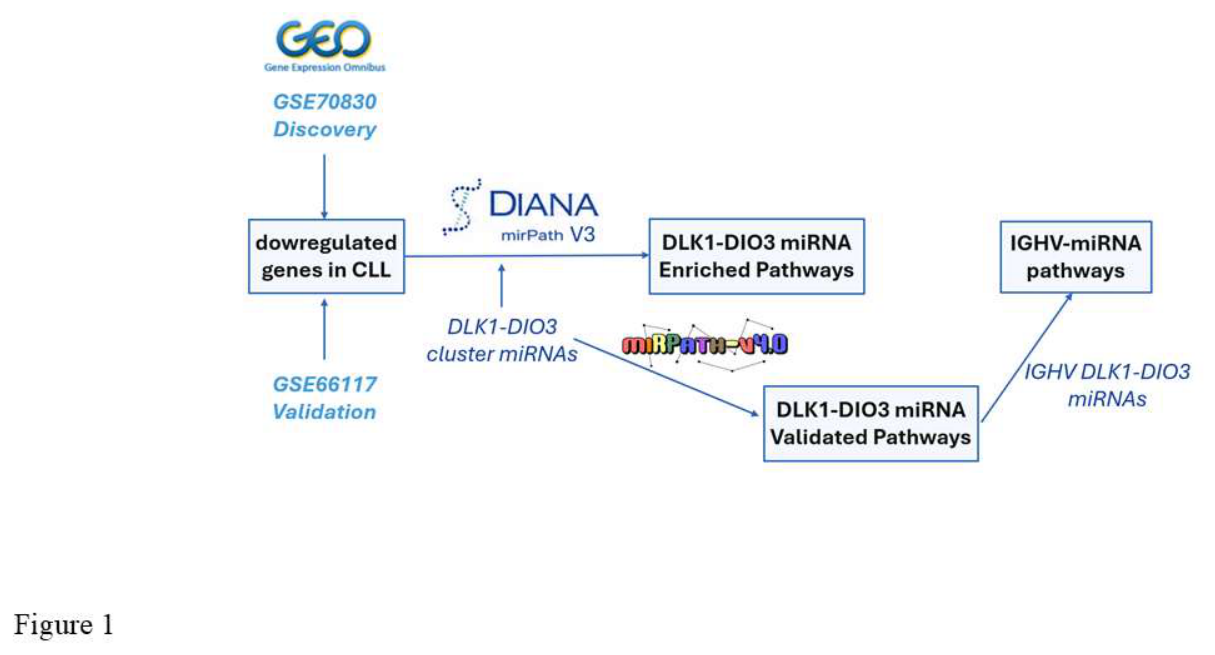
Figure 2.
Venn diagram of downregulated genes identified in GSE70830 and GSE66117.
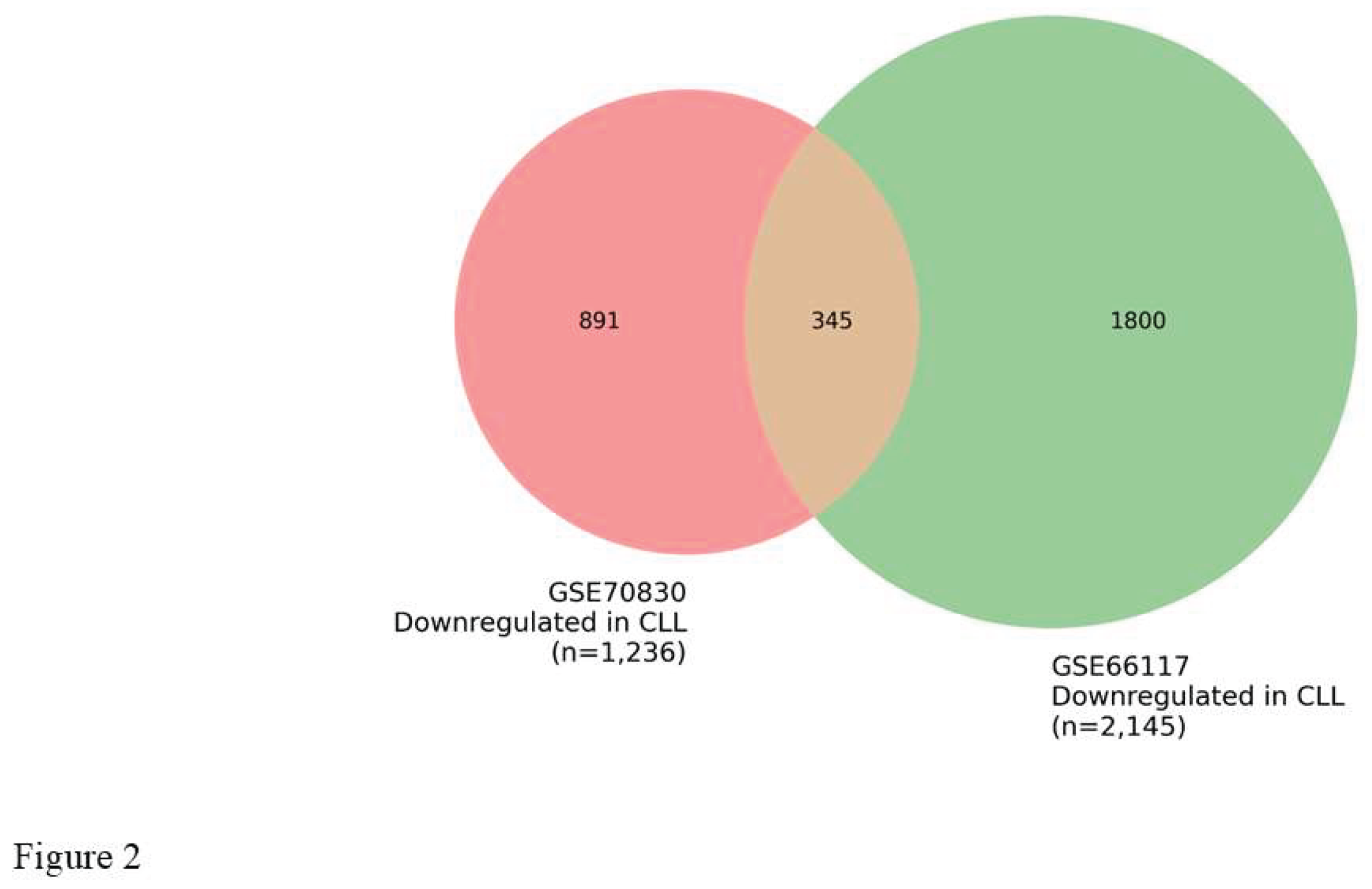
Figure 3.
KEGG pathways enriched by DIANA-miRPath v3.0 using the 345-gene consensus downregulated CLL signature as gene filter. The x-axis represents pathway significance as −log10 (p value), whereas bubble size corresponds to the number of genes contributing to each pathway.
Figure 3.
KEGG pathways enriched by DIANA-miRPath v3.0 using the 345-gene consensus downregulated CLL signature as gene filter. The x-axis represents pathway significance as −log10 (p value), whereas bubble size corresponds to the number of genes contributing to each pathway.
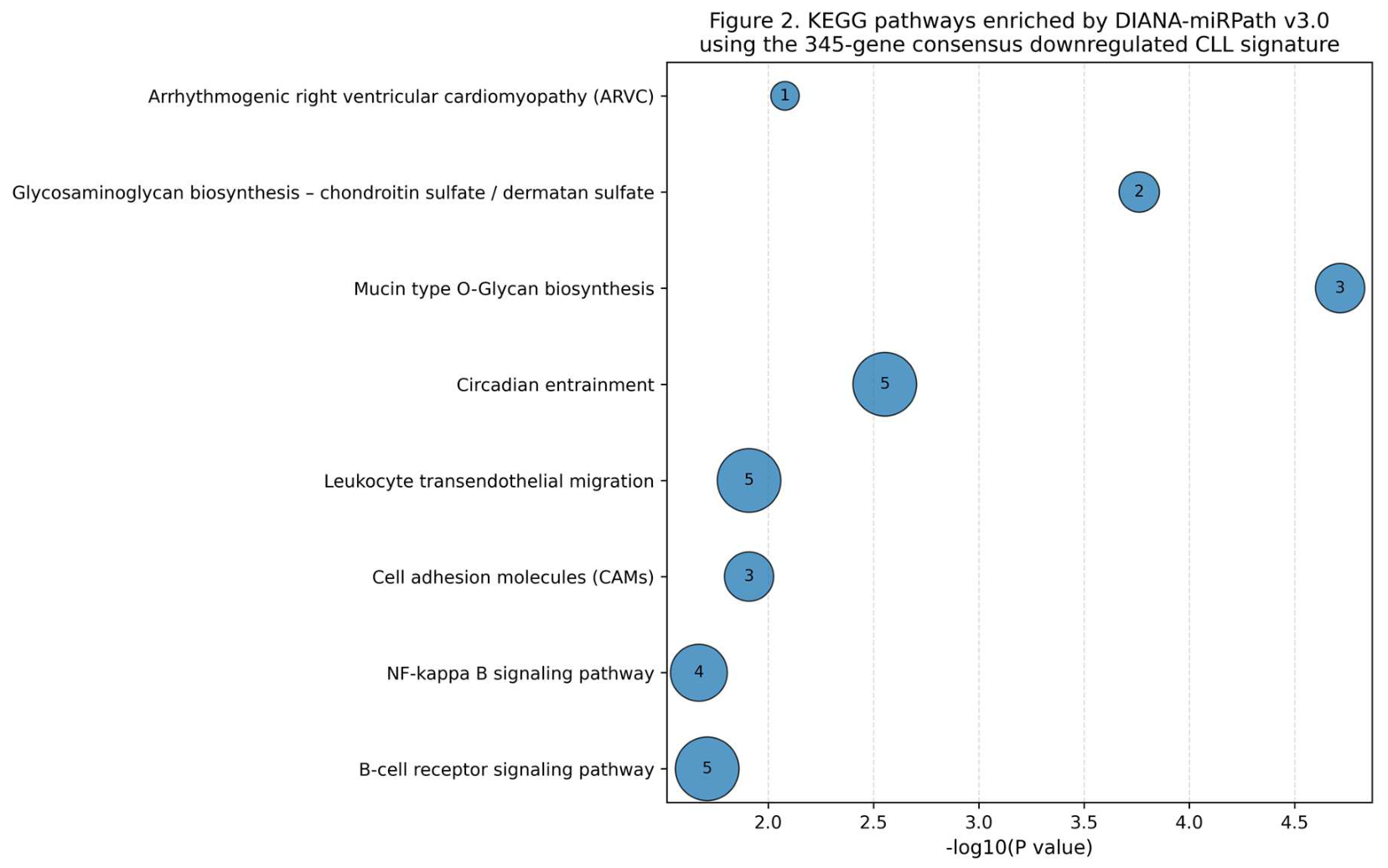
Figure 4.
TNF signaling pathway identified in the DIANA-miRPath v4.0 analysis of DLK1-DIO3 miRNAs. The KEGG TNF signaling pathway was visualized using Pathview. Colored nodes represent genes mapped from the DLK1-DIO3 miRNA-target/pathway analysis, with color intensity indicating the number of associated miRNAs or mapped regulatory events. The pathway contains several CLL- and cancer-relevant modules, including NF-kappaB regulation, MAPK/AP-1 signaling, apoptosis/survival control, inflammatory cytokine signaling, leukocyte recruitment, and adhesion-related outputs. This map supports the inclusion of TNF signaling as a biologically relevant v4.0 pathway linking DLK1-DIO3 miRNAs to inflammatory, NF-kappaB-associated, and microenvironment-dependent programs in CLL.
Figure 4.
TNF signaling pathway identified in the DIANA-miRPath v4.0 analysis of DLK1-DIO3 miRNAs. The KEGG TNF signaling pathway was visualized using Pathview. Colored nodes represent genes mapped from the DLK1-DIO3 miRNA-target/pathway analysis, with color intensity indicating the number of associated miRNAs or mapped regulatory events. The pathway contains several CLL- and cancer-relevant modules, including NF-kappaB regulation, MAPK/AP-1 signaling, apoptosis/survival control, inflammatory cytokine signaling, leukocyte recruitment, and adhesion-related outputs. This map supports the inclusion of TNF signaling as a biologically relevant v4.0 pathway linking DLK1-DIO3 miRNAs to inflammatory, NF-kappaB-associated, and microenvironment-dependent programs in CLL.
Disclaimer/Publisher’s Note: The statements, opinions and data contained in all publications are solely those of the individual author(s) and contributor(s) and not of MDPI and/or the editor(s). MDPI and/or the editor(s) disclaim responsibility for any injury to people or property resulting from any ideas, methods, instructions or products referred to in the content. |
© 2026 by the authors. Licensee MDPI, Basel, Switzerland. This article is an open access article distributed under the terms and conditions of the Creative Commons Attribution (CC BY) license (http://creativecommons.org/licenses/by/4.0/).
Copyright: This open access article is published under a Creative Commons CC BY 4.0 license, which permit the free download, distribution, and reuse, provided that the author and preprint are cited in any reuse.


