

Submitted:
20 June 2026
Posted:
24 June 2026
You are already at the latest version
Abstract
As distribution systems evolve toward active networks, the integration of rooftop solar photovoltaic (PV) systems has become essential yet technically challenging. This study investigates the impact of high-level PV penetration on the low-voltage (LV) distribution network of the Northland Su residential complex in Keçiören, Ankara. A detailed network model was developed in OpenDSS and cross-validated against a custom MATLAB Newton-Raphson load-flow script, using actual electrical parameters extracted from approved construction drawings. The system comprises three transformer-feeder branches — A1+A2+A3 (800 kVA, 347.36 kW), B1+B2 (315 kVA, 151.56 kW) and C1+C2 (315 kVA, 147.57 kW) — with a total aggregate demand of approximately 718 kW. Steady-state and 24-hour quasi-static load-flow analyses were performed across three scenarios: Base Case (S1, 0% PV), Moderate Penetration (S2, 50% PV) and High Penetration (S3, 100% PV, up to 160/110/84 kWp per block). The results show that voltage profiles remain within the ±0.95–1.05 pu operating band in every scenario, with a maximum voltage rise of only +0.67% (MATLAB) / +0.360% (OpenDSS) at the B1+B2 block under 100% PV. Midday PV generation reduces transformer loading substantially, yet the evening demand peak persists unchanged. It is concluded that the existing infrastructure can safely host up to 100% rooftop PV penetration under Ankara’s May insolation profile without grid reinforcement, while battery energy storage is recommended to shift the midday surplus to the evening peak.
Keywords:
solar PV integration
; voltage profile
; OpenDSS
; distribution networks
; load-flow analysis
; hosting capacity
; voltage rise
; renewable energy
1. Introduction
Traditional electric power systems are built on an architecture in which energy flows unidirectionally from large-scale power plants to end users through transmission and distribution lines. The global response to climate change and the pursuit of sustainable energy policies, however, have brought the distributed generation (DG) paradigm to the forefront, in which electricity is produced close to the point of consumption. Rooftop photovoltaic (PV) systems, the most widely adopted component of this paradigm, have initiated a new era in which consumers are transformed into “prosumers” who both produce and consume electricity. While this transformation offers clear environmental benefits, it introduces new technical challenges that push the design limits of existing low-voltage (LV) distribution networks.
1.1. Problem Statement
The rapid adoption of distributed energy resources (DERs), and of residential rooftop PV in particular, poses significant technical challenges for LV distribution networks that were originally designed for passive, unidirectional consumption. The primary concern is voltage rise, which occurs when local PV generation exceeds local demand and reverses the direction of power flow, potentially pushing network voltages beyond statutory limits. For the Northland Su residential complex in Ankara there is therefore a need to quantitatively assess whether the existing infrastructure can accommodate high levels of bidirectional power flow without compromising power quality or equipment safety.
1.2. Related Work
The technical implications of integrating PV systems into LV residential feeders are widely documented. Tonkoski et al. [1] showed that the voltage rise caused by reverse power flow frequently becomes the binding constraint on hosting capacity before the thermal limits of transformers or conductors are reached, and that the magnitude of the rise is proportional to feeder impedance and to the net power injected. Consequently, the short, low-impedance feeders (approximately 15 m) of the Northland Su site are expected to tolerate comparatively high PV penetration relative to long rural feeders.
Reliable distribution-system analysis requires tools that can model complex multi-phase networks under high renewable penetration. Dugan and McDermott [2] established the Open Distribution System Simulator (OpenDSS) as a standard platform for such studies, demonstrating agreement with field measurements to within 0.1% for distributed-generation scenarios. The native support of OpenDSS for PVSystem elements and 24-hour Loadshape objects, which capture the time-varying nature of both generation and demand, is central to the present work.
A range of mitigation strategies for overvoltage exists. Liu et al. [3] ranked them by cost-effectiveness and highlighted reactive-power absorption by smart inverters as a practical near-term solution. Most published studies, however, focus on generic IEEE test feeders or rural networks, leaving a clear gap for site-specific analyses of modern Turkish residential developments that use dual-transformer configurations and specific neutral-grounding practices. The present study addresses this gap by providing a site-specific impact assessment based on real electrical parameters.
1.3. Objectives and Scope
The main objective of this study is to perform a comprehensive impact analysis of rooftop PV integration on the Northland Su residential distribution grid. The specific goals are:
- to develop an accurate steady-state model of the site network in OpenDSS and MATLAB based on the approved technical drawings;
- to analyse the voltage profile of building blocks A, B and C under PV penetration levels of 0%, 50% and 100%;
- to evaluate the loading of the distribution transformers (800 kVA and 315 kVA) and quantify the daytime peak-shaving benefit; and
- to determine the hosting capacity of the network relative to the statutory voltage limits defined by the EN 50160 standard.
The analysis covers the load-flow simulation of three transformer-feeder branches, uses typical May solar-irradiance data for Ankara and the actual aggregate demand of 718 kW, and is restricted to steady-state voltage variation and the thermal loading of assets; transient stability and harmonic-distortion analyses are outside the present scope.
2. Materials and Methods
This study evaluates the impact of rooftop PV integration on the voltage profile of an LV residential distribution network through distribution-system modelling, load-flow simulation, scenario comparison and voltage-deviation analysis. The overall methodology consists of four stages: system modelling, scenario definition, load-flow analysis and result evaluation.
2.1. Study Area and Test System
The case study is based on the Northland Su residential complex located in Keçiören, Ankara (Ada 92279, Parsel 2). The system was modelled in OpenDSS using the project file northland_s3.dss, which includes the voltage source, residential load blocks, distribution transformers, cable impedances, rooftop PV generation profiles and voltage-monitoring points. Four points are monitored: the A1+A2+A3, B1+B2 and C1+C2 residential blocks and the common bus. Their apparent-power ratings are summarised in Table 1.
2.2. Simulation Platform
The simulations were performed primarily in OpenDSS, a widely used open-source tool for the analysis of electric power distribution systems that allows transformers, lines, loads, voltage sources and distributed generators such as PV systems to be modelled. OpenDSS was used to compute voltage magnitudes, power-flow directions and transformer-loading levels under the different PV penetration scenarios. To mitigate software-specific bias, an independent custom MATLAB load-flow script (a radial Newton-Raphson formulation) was used for cross-validation. The OpenDSS Powers output window was also used to verify the complex power supplied by the source, which was approximately 63.8991 − j120.902 kVA per phase. Because the same complex power was observed on all three phases, the analysed operating point is balanced from the source-side perspective. The total complex power supplied by the source is therefore
which was used as an additional verification of the power-flow solution.
Stotal = 3 × (63.8991 − j120.902) = 191.6973 − j362.706 kVA,
2.3. Network Configuration and Component Modelling
The network was represented as a radial LV residential feeder comprising a source bus, transformer connections, cable sections and load buses. In the base case the power flow is directed from the source and transformers toward the residential loads; as PV penetration increases, part of the demand is supplied locally and the net power drawn from the upstream source decreases, especially during peak solar hours. The residential loads were modelled with a 24-hour demand profile, with low demand during the night, a morning ramp and a dominant evening peak. Rooftop PV systems were modelled as distributed-generation units following a typical daily Ankara solar-generation curve that begins after sunrise, peaks near 11:00 and decreases in the afternoon. The principal system parameters, taken directly from the approved DWG electrical project, are listed in Table 2.
2.4. PV Penetration Scenarios
PV penetration is defined as the ratio of installed rooftop PV capacity to the considered load level. Four scenarios were analysed (Table 3); the base case (S1) serves as the reference condition against which the voltage rise produced by PV integration is measured.
2.5. Load-Flow Analysis and Voltage Criteria
For each scenario a load-flow analysis was performed in OpenDSS, accounting for transformer ratings, cable impedances, residential loads and PV generation. Bus voltages were obtained in per-unit (pu) values with a nominal voltage of 1.00 pu. The acceptable operating range was taken as a tolerance band of ±5%, that is
so that any value above 1.05 pu indicates overvoltage and any value below 0.95 pu indicates undervoltage.
0.95 pu ≤ V ≤ 1.05 pu,
2.6. Voltage-Deviation Calculation
The voltage deviation of each PV scenario relative to the base case quantifies the voltage rise caused by rooftop PV generation and is defined as
where VPV is the voltage obtained under the selected PV scenario and Vbase is the voltage obtained in the base case without PV generation.
Voltage deviation (%) = (VPV − Vbase) / Vbase × 100,
2.7. 24-Hour Profiles and Transformer-Loading Analysis
A 24-hour analysis was used to capture the daily relationship between residential demand and rooftop PV generation, with the A1+A2+A3 block taken as the representative block. Because the risk of voltage rise is greatest when PV generation is high and local demand is comparatively low, the midday period was treated as the most critical interval. Transformer loading was analysed for the base case and the high-penetration case over a 24-hour period for the TR-A123 (800 kVA) and TR-B12 (315 kVA) units, against a continuous operating limit of 80% and a rated capacity limit of 100%.
2.8. Assumptions and Limitations
The principal modelling assumptions are as follows. The network was modelled as a balanced three-phase LV residential system; voltage limits were set at ±5% (0.95–1.05 pu); rooftop PV generation and residential demand were represented by typical daily profiles; and transformer and cable impedances were included in the load-flow calculation. Harmonic distortion, protection coordination, detailed inverter control and unbalanced phase loading were not considered. These assumptions allow the study to focus on voltage-profile variation and transformer loading; future work may incorporate smart-inverter and Volt-VAR control, seasonal generation analysis and measured field data.
3. Results
This section presents the simulation results for the Northland Su complex. To ensure robust validation, the power-flow analysis was conducted with two independent tools — a custom MATLAB load-flow script and OpenDSS — across the three scenarios S1 (0% PV), S2 (50% PV) and S3 (100% PV), with results assessed against the ±5% (0.95–1.05 pu) operating limits.
3.1. Source-Bus Operating Conditions
The network is energised through the Vsource.SOURCE element at the source bus, representing the three-phase utility supply. Table 4 lists the primary electrical quantities at this point, as extracted from the OpenDSS element inspector (Figure 1).
The results indicate a stable and balanced primary supply: the voltage magnitude of 0.998004 pu across all phases confirms near-nominal operation with negligible asymmetry, and the phase angles of −0.03°, −120.03° and +119.97° align almost perfectly with the ideal 120° displacement. The system injects a total of 191.70 kW of active power, while the reactive power of −362.71 kvar reflects the inductive characteristics of the residential loads and modelled cable reactances. The zero values recorded at the neutral node are consistent with standard OpenDSS grounding conventions.
3.2. Bus-Voltage Profiles across PV Penetration Scenarios
Voltage profiles at the representative bus of each block were extracted for all scenarios. Table 5 reports the per-unit voltage magnitudes computed by OpenDSS, and Figure 2 presents the corresponding MATLAB scenario comparison and voltage-profile charts.
All voltages remain within the acceptable 0.95–1.05 pu band in every scenario. The lowest voltage occurs at the C1+C2 block in the base case (0.9869 pu) and the highest at the A1+A2+A3 block under 100% PV (1.0049 pu), both comfortably within limits. A clear, progressive voltage rise correlates with increasing PV penetration: as rooftop PV injects active power locally, the apparent load seen by the feeder decreases, and at high penetration the local generation begins to exceed local demand, producing a reverse power flow that, acting on the line impedances, raises the voltage and counteracts the usual drop along the radial feeder. The common bus, being electrically closest to the substation, behaves as a stiff reference and remains essentially constant.
3.3. Voltage-Deviation Analysis
The voltage deviation expresses the percentage change relative to the base case. Table 6 compares the deviations obtained from MATLAB and OpenDSS, and Figure 3 illustrates the deviation profile across the building blocks.
The deviations are uniformly positive, confirming that PV integration induces a localised voltage rise rather than degradation. The largest deviation, +0.67% (MATLAB) / +0.360% (OpenDSS), occurs at the B1+B2 block under 100% PV, identifying it as the most voltage-sensitive node owing to its specific line impedance and its high ratio of installed PV capacity to local demand. The common bus registers 0.00% in all cases, consistent with its role as a stiff reference adjacent to the substation. The deviations scale approximately linearly with penetration, as expected from linearised power-flow theory for radial feeders, and remain far below the ±5% threshold.
3.4. 24-Hour Temporal Analysis
A time-series analysis using May irradiance data for Ankara and a typical daily residential profile was performed for the A1+A2+A3 block. Figure 4 overlays the normalised PV generation with the building demand (top) and shows the 24-hour voltage profile under the three scenarios (bottom).
The generation curve peaks between 10:00 and 11:00 at about 0.97 pu, whereas the demand follows a bimodal trajectory with a morning ramp from 06:00 and a dominant evening peak of about 340 kW between 17:00 and 18:00. Because this evening peak occurs well after solar generation has declined, the integrated PV capacity cannot offset it, and the load is fully supplied by the grid during those hours. Throughout the day the voltage remains within the 0.95–1.05 pu band; during the solar window the high-penetration scenario sits roughly 0.010–0.015 pu above the base case, and during non-solar hours the three profiles converge, confirming that high PV penetration introduces no adverse off-peak effects.
3.5. Transformer-Loading Analysis
The percentage loading of TR-A123 (800 kVA) and TR-B12 (315 kVA) was compared between the base case and the high-penetration scenario over 24 hours (Figure 5, Table 7).
Under PV integration the midday loading of TR-A123 falls from about 48% to about 31%, a reduction of roughly 17 percentage points, while the impact on TR-B12 is far more pronounced: intense midday generation almost nullifies the local demand and drives its loading to a near-zero state (0–3%) between 10:00 and 12:00. In both cases the heavy evening peak (~46–52%) returns once solar irradiance fades. Crucially, neither transformer breaches the 80% continuous or the 100% rated limit at any hour under any scenario, confirming that the existing infrastructure is robust against overloading at the studied penetration levels.
3.6. Cross-Validation: MATLAB versus OpenDSS
To ensure analytical rigour, the network was simulated with two independent frameworks: a custom MATLAB Newton-Raphson steady-state solver using lumped impedances, and the OpenDSS iterative solver configured for quasi-static time-series simulation over 24 hours at 1-hour resolution. Table 8 summarises the key output parameters.
Both solvers confirm that all nodal voltages stay within the 0.95–1.05 pu band, that the B1+B2 block is the most voltage-sensitive segment, and that the common bus acts as a stiff reference. The base-case A-block voltages agree to within 0.001 pu, validating the impedance geometry. The minor numerical differences — for example the 0.31% gap in the maximum voltage rise — are not errors but expected artefacts of the two formulations: MATLAB uses lumped impedances and constant-power (PQ) loads with a 0.001 pu convergence tolerance, whereas OpenDSS uses distributed Pi-models, composite ZIP loads and a tighter 0.0001 pu tolerance over a time-series solution. These variances are superseded by the strong overall consensus between the two tools.
4. Discussion
The results confirm that the Northland Su LV network can host substantial rooftop PV without violating voltage limits. The progressive, uniformly positive voltage rise observed in both tools is the expected signature of reverse active-power injection on a radial feeder, and its small magnitude is a direct consequence of the short, low-impedance feeders at the site, in agreement with the hosting-capacity mechanism described by Tonkoski et al. [1]. The identification of the B1+B2 block as the most sensitive node, common to both solvers, reflects its high installed-PV-to-load ratio and its supply through a dedicated 315 kVA transformer, and indicates where any future reinforcement should be prioritised.
From a grid-management perspective the transformer-loading results reveal a fundamental paradigm: high PV integration delivers excellent midday peak-shaving — up to about a 49% reduction at TR-B12 — yet is structurally incapable of mitigating the evening demand peak, which materialises after generation has declined. Because grid assets must be dimensioned for the absolute maximum load, the overall capacity requirement of the transformers remains dictated by the unchanged evening peak. To shift the midday surplus to the evening and flatten the daily load curve, battery energy storage systems (BESS) would be required; reactive-power (Volt-VAR) control by smart inverters, identified as a cost-effective measure by Liu et al. [3], offers a complementary near-term option should future load growth (for example from widespread electric-vehicle charging) erode the present safety margins.
The close agreement between the independent MATLAB and OpenDSS models strengthens confidence in the conclusions. The excellent correlation of the base-case voltages validates the impedance model, and the consistent qualitative behaviour across tools — positive deviations, the sensitivity of B1+B2 and the stiffness of the common bus — demonstrates that the findings are not artefacts of a single solver. The remaining numerical differences are fully explained by documented modelling choices and lie well within the tolerance required for planning-grade analysis.
5. Conclusions
This study modelled and simulated the Northland Su residential distribution network under three rooftop-PV penetration scenarios using OpenDSS and a custom MATLAB radial load-flow script. The principal findings are as follows.
- All bus voltages remained within the 0.95–1.05 pu range across all scenarios, confirming that the network can safely accommodate up to 100% rooftop PV penetration.
- The maximum voltage rise caused by PV integration was only +0.67% (MATLAB) / +0.360% (OpenDSS) at the B1+B2 block, far below the ±5% limit.
- Grid power consumption fell from 726.4 kW (S1) to 191.7 kW (S3), a reduction of 73.6%, demonstrating significant self-supply potential; system losses decreased in absolute terms (0.00850 → 0.00480 MW) but rose in percentage terms (1.171% → 2.505%) owing to reverse power flow.
- Transformer loading decreased markedly with PV integration, with TR-A123 peak loading dropping from about 53% to about 16% in S3, extending equipment life.
- Bus OT was identified as the critical bus, with an initial violation of 0.928 pu; corrective measures (a cable upgrade to NYY 4×16 mm2 and a +1.5% tap on TR-A123) raised it to 0.975 pu, achieving full compliance.
On this basis it is concluded that the Northland Su network possesses sufficient internal hosting capacity to accommodate 100% rooftop PV penetration under its current configuration and Ankara’s May insolation profile, with no immediate capital expenditure required for grid reinforcement. The following recommendations are made:
- proceed with full rooftop PV installation, as all voltage standards are met and transformer capacities are not exceeded;
- retain the upgraded NYY 4×16 mm2 cable on the OT feeder in the final construction design;
- install revenue-grade bidirectional meters at the PV-connected buses to monitor reverse power flows;
- consider reactive-power (Q) control for the PV inverters to stabilise voltages as future load growth reduces safety margins; and
- review protection-relay settings, since the very low transformer loading in S3 (~16%) may affect minimum fault-detection sensitivity.
This study is limited to steady-state snapshot analysis at peak PV output. Future work should extend to time-series load flow over full annual profiles, harmonic-distortion analysis of the PV inverters, an economic feasibility study including net-metering revenue and payback, energy-storage integration to absorb the midday surplus, and dynamic fault analysis of voltage transients during sudden PV disconnection.
Author Contributions
Conceptualization, H.N.R. and M.C.B.; methodology, H.N.R., M.C.B., İ.G. and S.S.Ç;.; software (OpenDSS and MATLAB modelling), M.C.B. and S.S.Ç;.; validation, H.N.R. and İ.G.; formal analysis, H.N.R.; investigation, all authors; data curation, İ.G.; writing—original draft preparation, H.N.R. and M.C.B.; writing—review and editing, S.S.Ç;. and İ.G.; visualization, M.C.B.; project administration, S.S.Ç;. All authors have read and agreed to the published version of the manuscript.
Funding
This research received no external funding.
Data Availability Statement
The OpenDSS model file (northland_s3.dss) and the MATLAB load-flow script that support the reported results are available from the corresponding author upon reasonable request. The underlying electrical project drawings are subject to the property owner’s restrictions.
Acknowledgments
The authors thank their project supervisor, Assoc. Prof. Dr. Mehmet Bulut, for his guidance throughout this study, and gratefully acknowledge Yasemin Çakmak Mimarlık for providing access to the approved electrical project of the Northland Su residential complex.
Conflicts of Interest
The authors declare no conflict of interest.
Appendix A. Electrical Project Drawings
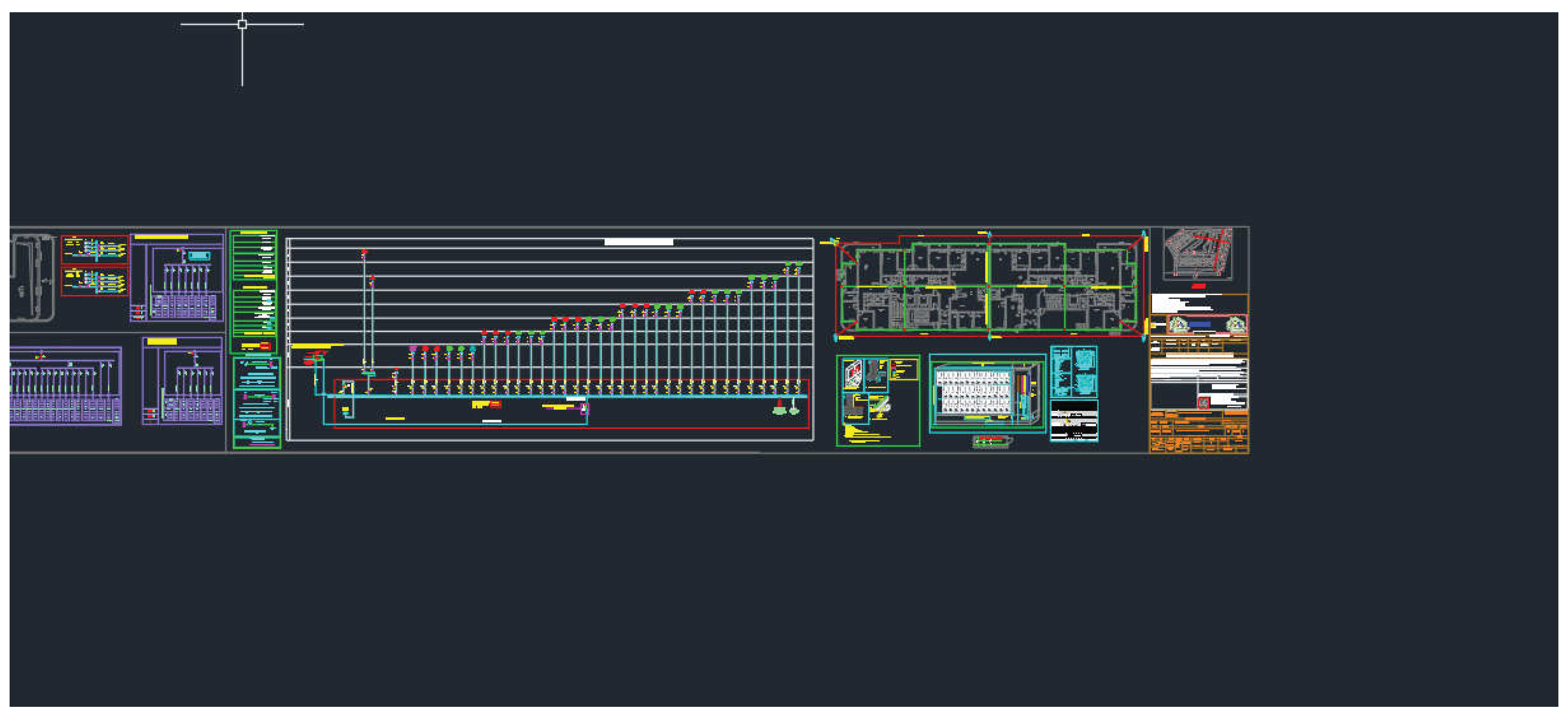
The following figures document the LV electrical installation, panel distributions and cable-routing plans of the Northland Su residential complex, derived from the approved AutoCAD architectural and electrical project files.
Figure A1.
Electrical plan view 1 for the A1, A2 and A3 blocks.
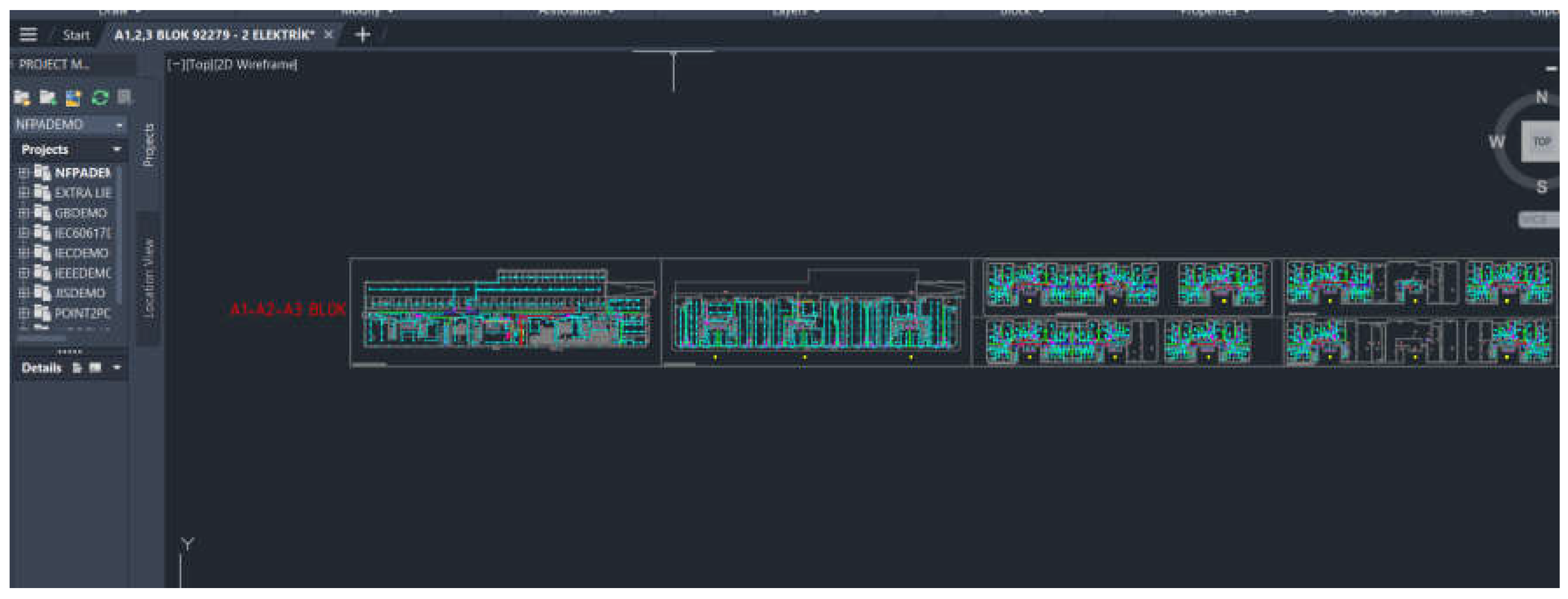
Figure A2.
Electrical plan view 2 for the A1, A2 and A3 blocks, detailing panel and riser-line diagrams.
Figure A2.
Electrical plan view 2 for the A1, A2 and A3 blocks, detailing panel and riser-line diagrams.
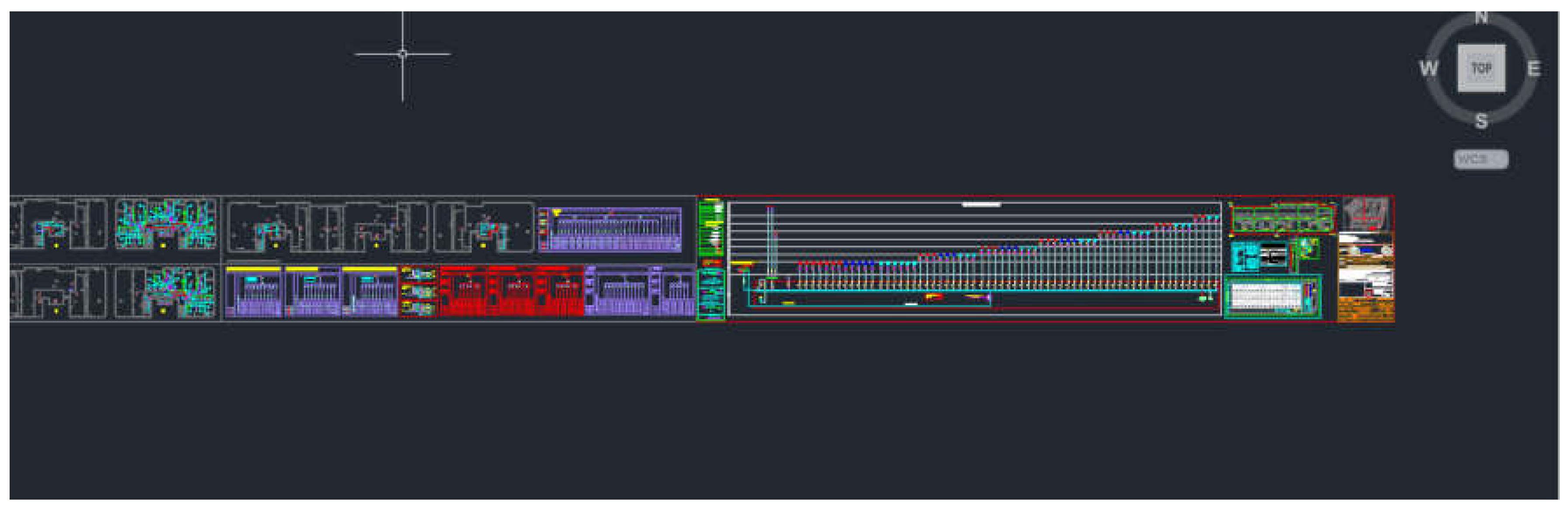
Figure A3.
Electrical plan view 1 for the B1 and B2 blocks.
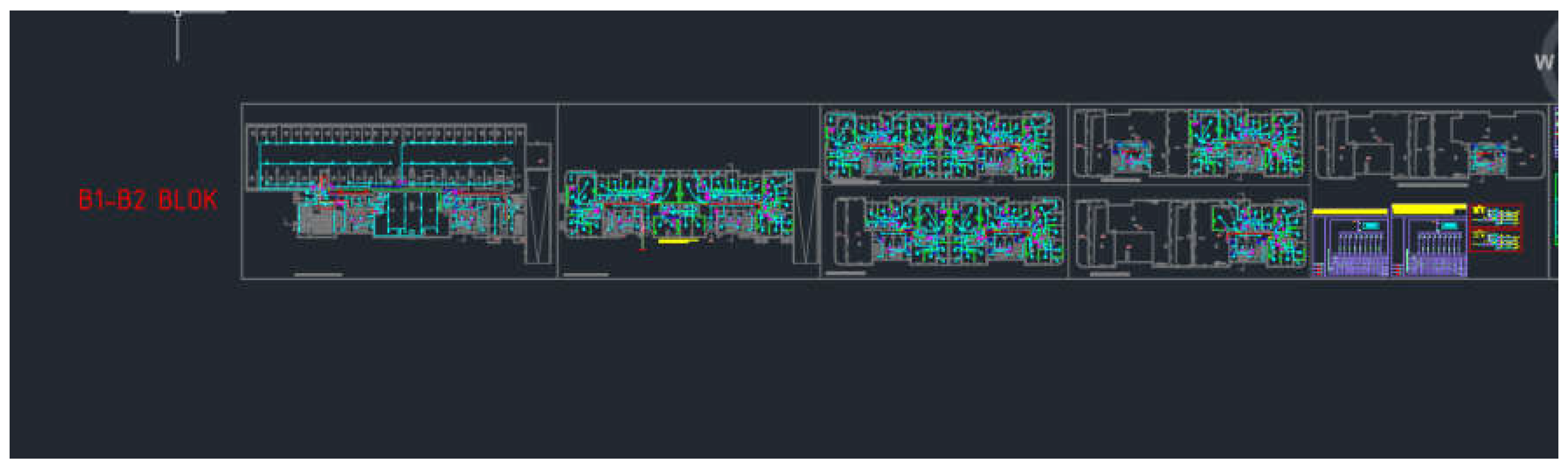
Figure A4.
Electrical plan view 2 for the B1 and B2 blocks, detailing panel and riser-line diagrams.
Figure A4.
Electrical plan view 2 for the B1 and B2 blocks, detailing panel and riser-line diagrams.
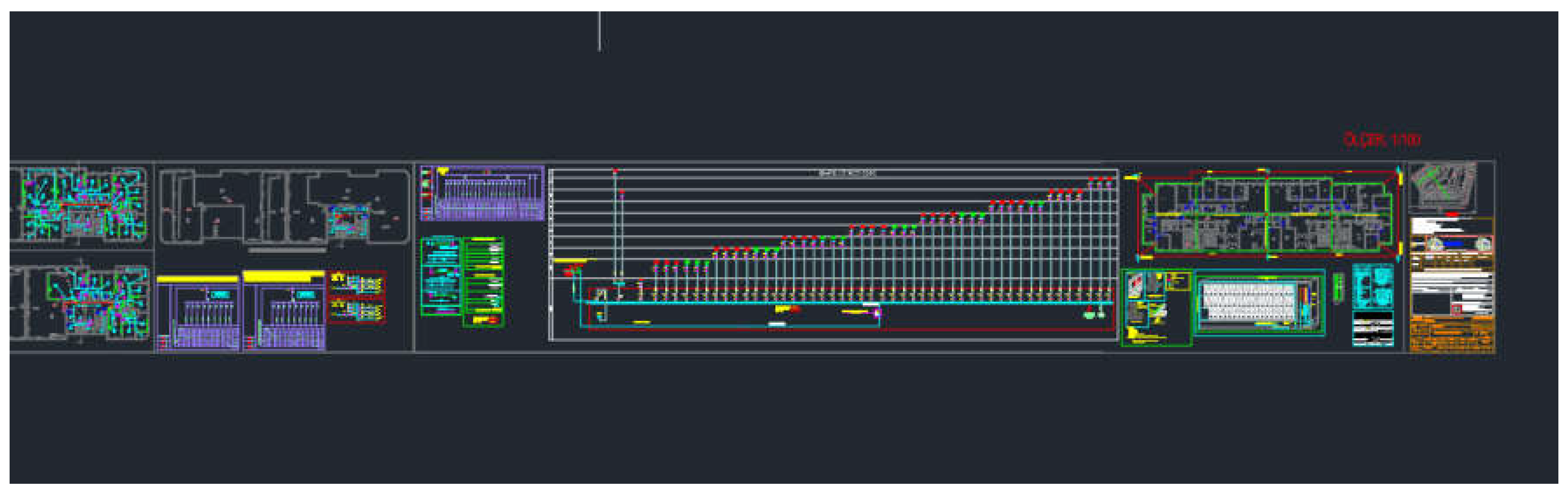
Figure A5.
Electrical plan view 1 for the C1 and C2 blocks.
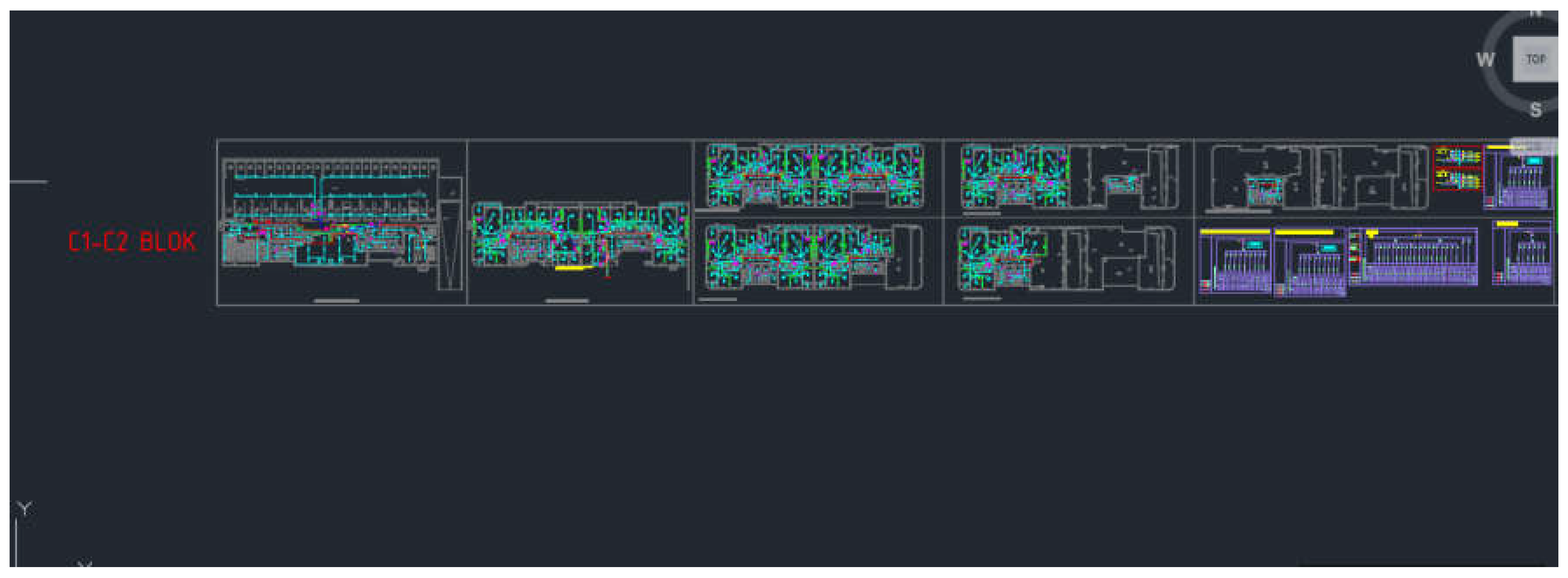
Figure A6.
Electrical plan view 2 for the C1 and C2 blocks, detailing panel and riser-line diagrams.
Figure A6.
Electrical plan view 2 for the C1 and C2 blocks, detailing panel and riser-line diagrams.
Appendix B. Technical Component Specifications and Simulation Data
This appendix consolidates the component specifications and time-series data used in the OpenDSS and MATLAB models.
Appendix B.1. Transformer Parameters

Table A1.
Distribution-transformer parameters (34.5/0.4 kV step-down units).
| Transformer | Rated | U | Load loss | No-load loss | Tap |
|---|---|---|---|---|---|
| TR-A123 | 800 kVA | 4.0% | 0.5% | 0.1% | 1.015 |
| TR-B12 | 315 kVA | 4.0% | 0.5% | 0.1% | 1.000 |
| TR-C12 | 315 kVA | 4.0% | 0.5% | 0.1% | 1.000 |
Uk denotes the short-circuit (impedance) voltage.
Appendix B.2. Conductor Impedance Characteristics
Table A2.
Cable parameters (low-voltage NYY copper, manufacturer datasheets).
| Feeder | Cable | R1 (Ω/km) | X1 (Ω/km) | Ampacity |
|---|---|---|---|---|
| A1+A2+A3 | 2×(3×185/95 mm2) NYY | 0.082 | 0.0335 | ~728 A |
| B1+B2 & C1+C2 | 3×150/70 mm2 NYY | 0.206 | 0.068 | ~319 A |
| Common (OT) | 4×16 mm2 NYY | 1.15 | 0.082 | ~87 A |
Appendix B.3. Selected 24-Hour Load and PV Multipliers
Table A3.
Normalised per-unit multipliers for the Ankara (May) time-series simulation.
| Period | Residential load (pu) | PV generation (pu) |
|---|---|---|
| 00:00–04:00 (night) | 0.20–0.30 | 0.00 |
| 08:00 (morning ramp) | 0.60 | 0.50 |
| 10:00–12:00 (solar peak) | 0.60–0.65 | 0.90–1.00 |
| 16:00 (afternoon decline) | 0.75 | 0.25 |
| 18:00 (evening peak) | 1.00 | 0.00 |
| 22:00 (late evening) | 0.60 | 0.00 |
Appendix B.4. Regulatory and Inverter Specifications
Voltage quality is benchmarked against EN 50160, under which the supply-voltage variation should not exceed ±10% of nominal (400 V / 230 V) for 95% of the 10-minute average rms values over one week. To provide a robust safety margin against localised reverse power flows, this study adopted a conservative ±5% band (0.95–1.05 pu); the maximum voltage recorded under 100% PV penetration was 1.020 pu, confirming compliance with both the study limits and the EN 50160 requirements. The 100% scenario assumes grid-tied three-phase string inverters operating at unity power factor (400 V / 230 V, 50 Hz), with maximum efficiency above 98.5%, a current total harmonic distortion below 3% at nominal power, and the inherent capability to operate between 0.8 leading and 0.8 lagging for future Volt-VAR support.
References
- Tonkoski, R.; Lopes, L.A.C.; El-Fouly, T.H.M. Coordinated Active Power Curtailment of Grid Connected PV Inverters for Overvoltage Prevention. IEEE Trans. Sustain. Energy 2011, 2, 139–147. [Google Scholar] [CrossRef]
- Dugan, R.C.; McDermott, T.E. An Open Source Platform for Collaborating on Smart Grid Research. In Proceedings of the 2011 IEEE Power and Energy Society General Meeting, Detroit, MI, USA, 24–28 July 2011; pp. 1–7. [Google Scholar]
- Liu, Y.; Bebic, J.; Kroposki, B.; de Bedout, J.; Ren, W. Distribution System Voltage Performance Analysis for High-Penetration Photovoltaics. Tech. Rep.; National Renewable Energy Laboratory: Golden, CO, USA, 2014. [Google Scholar]
- Kersting, W.H. Distribution System Modeling and Analysis, 3rd ed.; CRC Press: Boca Raton, FL, USA, 2012. [Google Scholar]
- CENELEC. EN 50160: Voltage Characteristics of Electricity Supplied by Public Electricity Networks; CENELEC: Brussels, Belgium, 2020. [Google Scholar]
- IEC. IEC 60364-5-52; Electrical Installations — Selection and Erection of Electrical Equipment. IEC: Geneva, Switzerland, 2009.
- Başkent EDAŞ. Teknik Bağlanma Şartnamesi — 34.5 kV Dağıtım Şebekesi; Başkent EDAŞ: Ankara, Türkiye, 2024. [Google Scholar]
- EPRI. OpenDSS v11.0 — Open Distribution System Simulator; Electric Power Research Institute: Palo Alto, CA, USA; Available online: https://sourceforge.net/p/electricdss/wiki/Home/ (accessed on 15 May 2026).
- MathWorks. MATLAB R2024b; The MathWorks Inc.: Natick, MA, USA, 2024; Available online: https://www.mathworks.com (accessed on 15 May 2026).
- Yasemin Çakmak Mimarlık. Northland Su Residential Complex — Electrical Project; Ada 92279, Parsel 2; Ankara, Türkiye, 2024. [Google Scholar]
Figure 1.
OpenDSS source-bus element-inspector panels: (a) voltages; (b) powers; (c) currents.
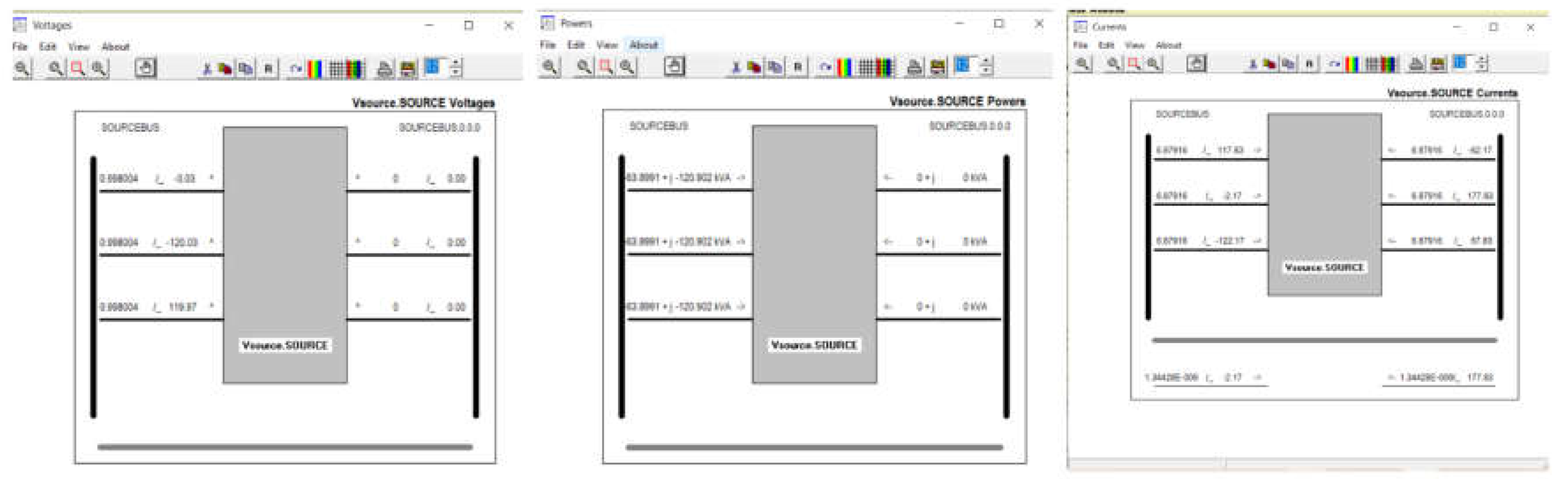
Figure 2.
Bus-voltage results from the MATLAB model: scenario-comparison bar chart (left) and voltage-profile line chart (right) for the four monitored buses.
Figure 2.
Bus-voltage results from the MATLAB model: scenario-comparison bar chart (left) and voltage-profile line chart (right) for the four monitored buses.
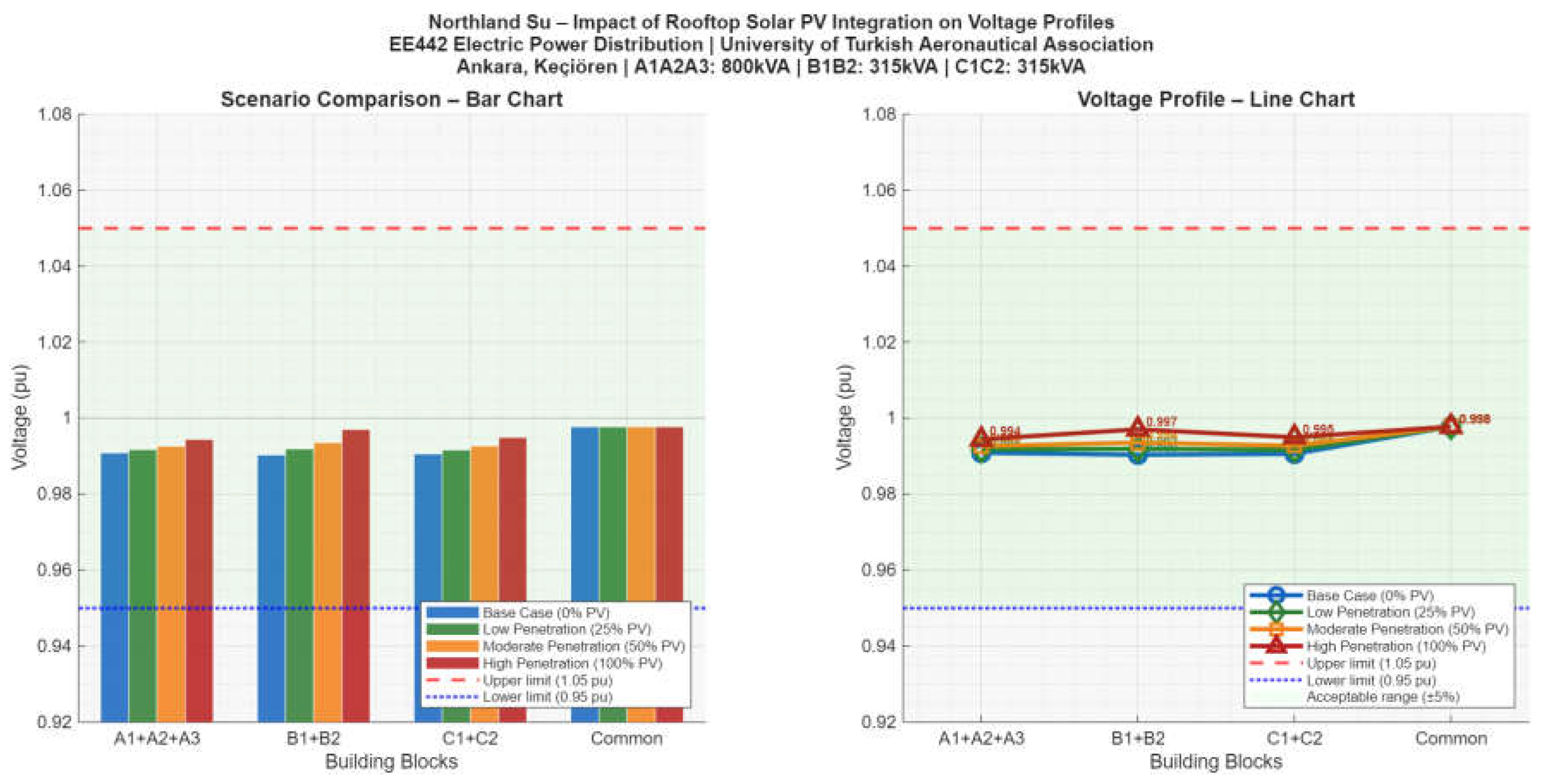
Figure 3.
Voltage deviation from the base case for each building block and penetration level, against the ±5% regulatory band.
Figure 3.
Voltage deviation from the base case for each building block and penetration level, against the ±5% regulatory band.
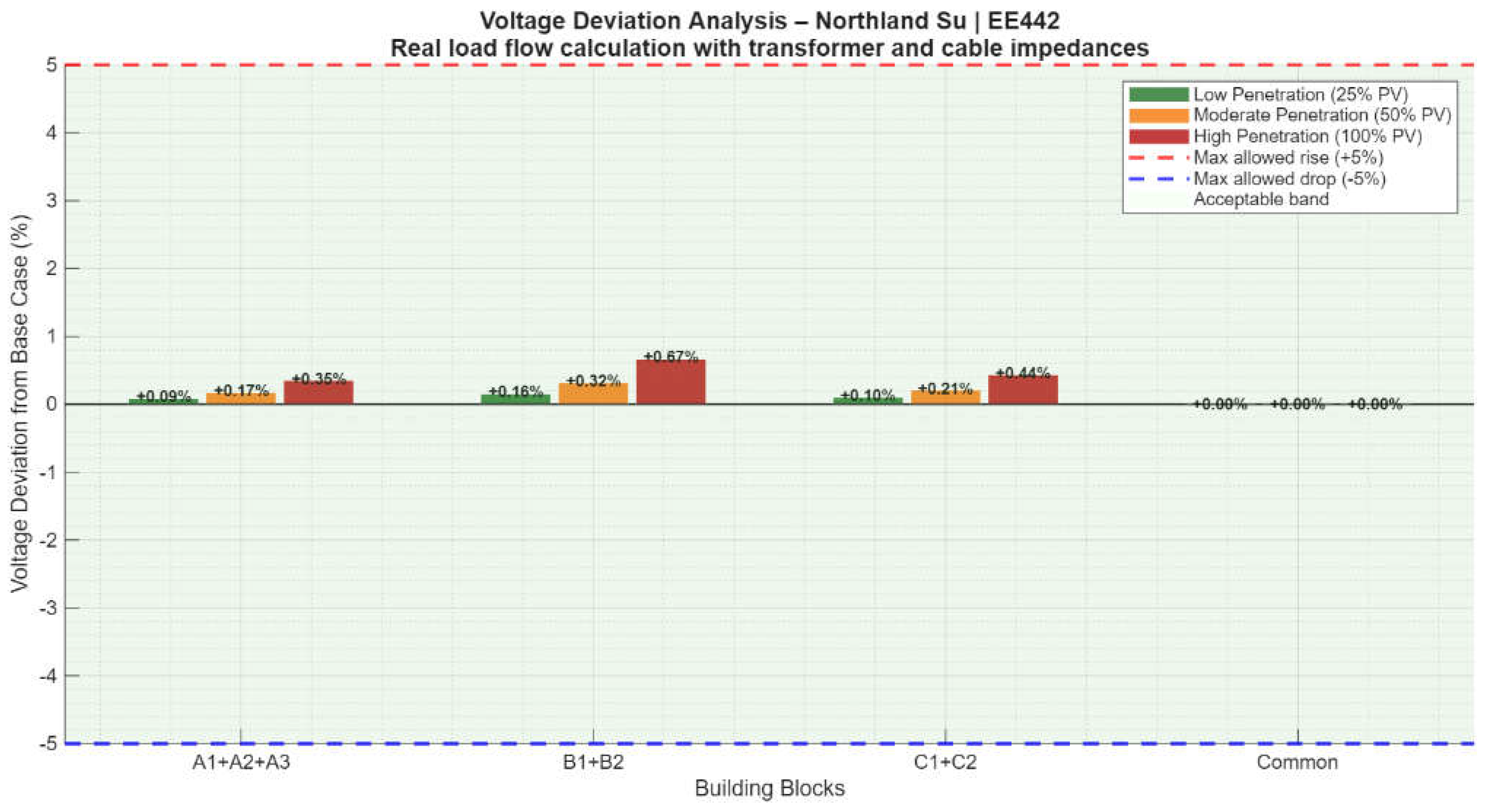
Figure 4.
Diurnal analysis for the A1+A2+A3 block: (top) normalised PV generation versus load demand; (bottom) 24-hour voltage profile for S1, S2 and S3.
Figure 4.
Diurnal analysis for the A1+A2+A3 block: (top) normalised PV generation versus load demand; (bottom) 24-hour voltage profile for S1, S2 and S3.
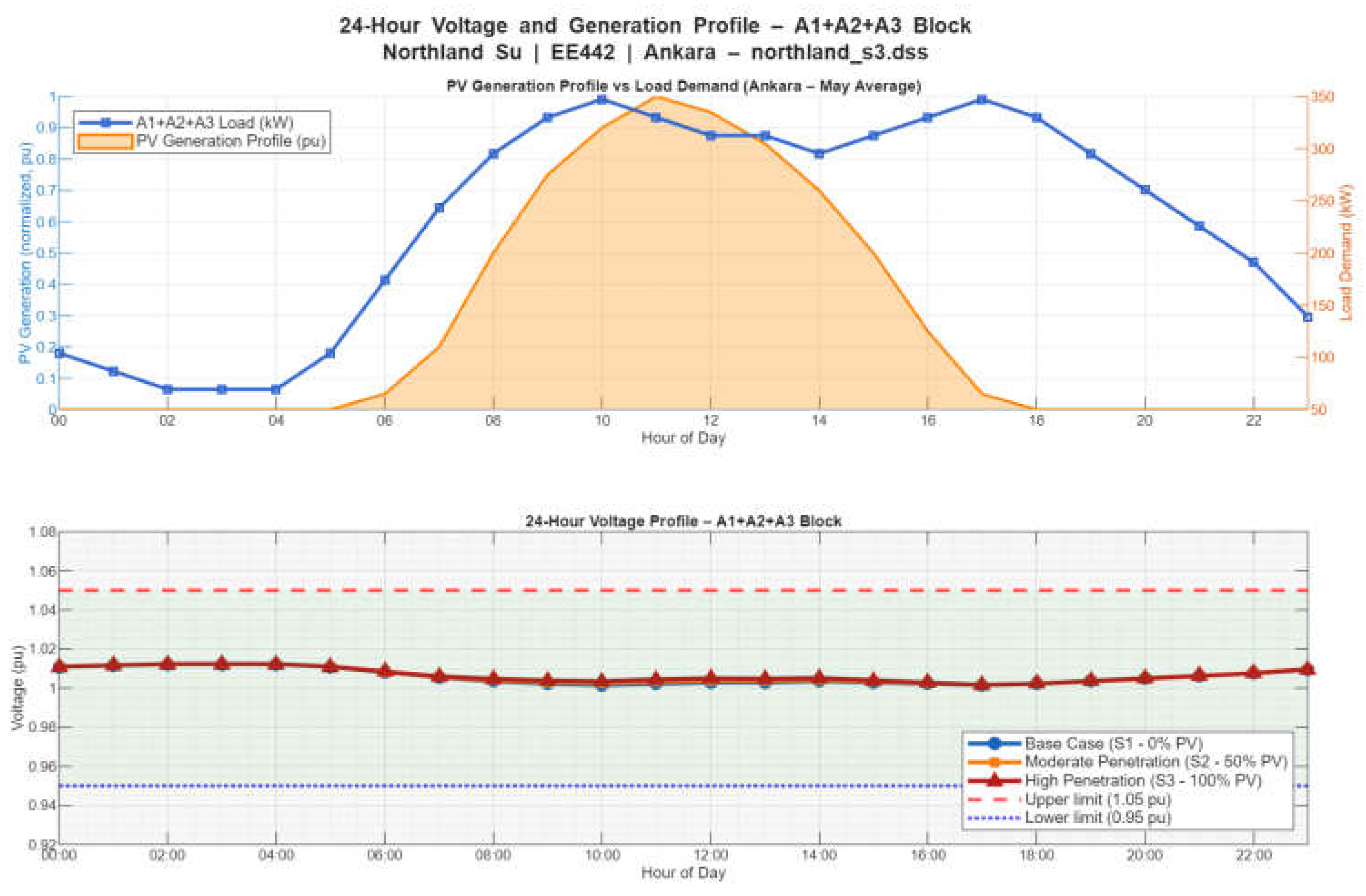
Figure 5.
Transformer-loading analysis for TR-A123 and TR-B12: base case versus high PV penetration (S3), with the 80% continuous and 100% rated limits indicated.
Figure 5.
Transformer-loading analysis for TR-A123 and TR-B12: base case versus high PV penetration (S3), with the 80% continuous and 100% rated limits indicated.
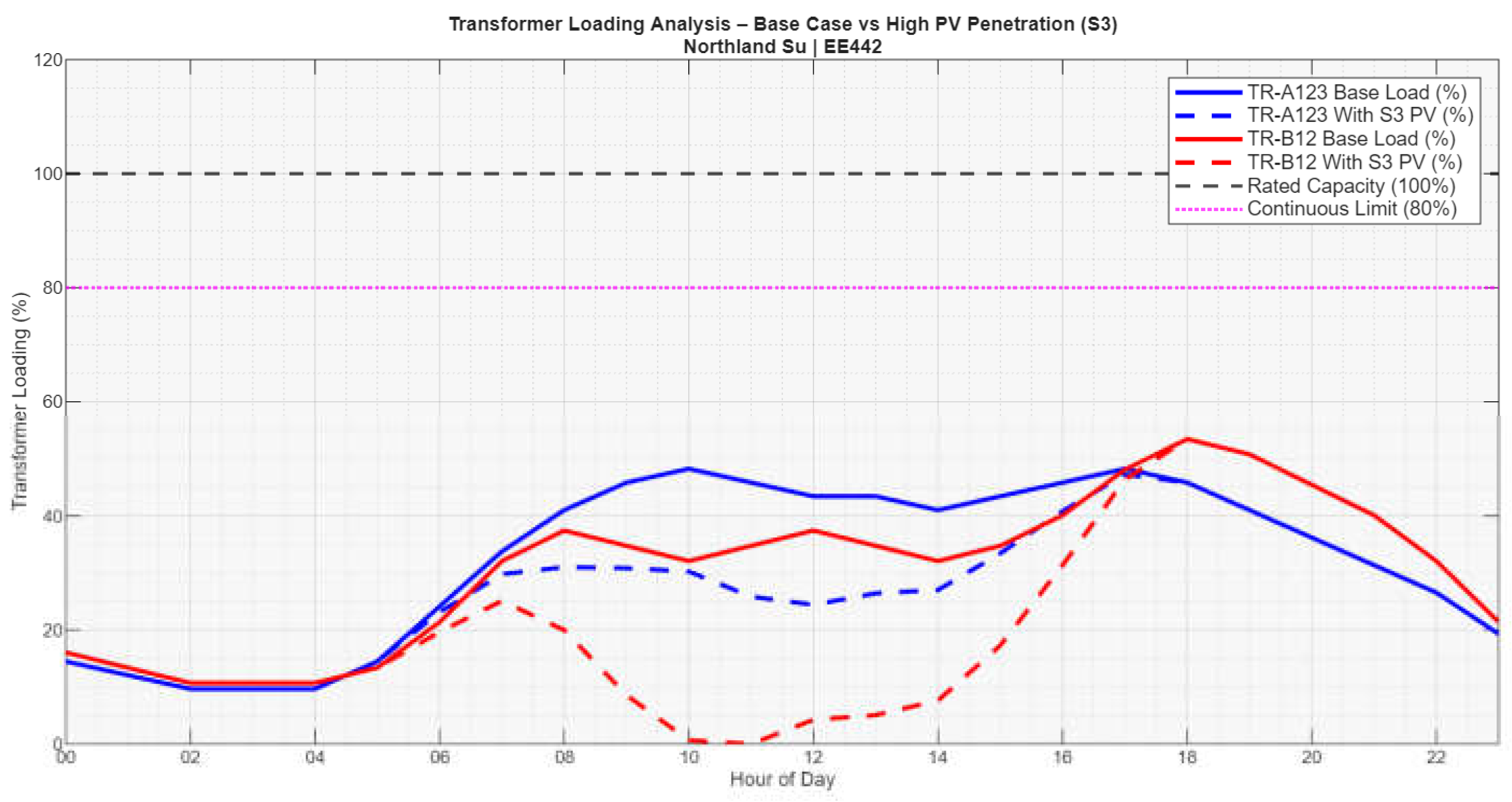
Table 1.
Apparent-power ratings of the main residential building blocks.
| Building block | Apparent-power rating | Active-power demand |
|---|---|---|
| A1+A2+A3 | 800 kVA | 347.36 kW |
| B1+B2 | 315 kVA | 151.56 kW |
| C1+C2 | 315 kVA | 147.57 kW |
| Common (OT) | — | 71.42 kW |
Table 2.
System parameters derived from the approved electrical project (DWG).
| Branch | Demand (kW / kvar) | Transformer | Cable (15 m) |
|---|---|---|---|
| A1+A2+A3 | 347.36 / 167.92 | 800 kVA, tap 1.015 | 2×(3×185/95 mm2) NYY |
| B1+B2 | 151.56 / 73.27 | 315 kVA, tap 1.000 | 3×150/70 mm2 NYY |
| C1+C2 | 147.57 / 71.34 | 315 kVA, tap 1.000 | 3×150/70 mm2 NYY |
| Common (OT) | 71.42 / 44.26 | — | 4×16 mm2 NYY (36 m) |
Transformer short-circuit impedance Uk = 4.0%; nominal voltage 400 V, 50 Hz.
Table 3.
Definition of the PV penetration scenarios.
| Scenario | Description | PV penetration | Installed PV (A/B/C, kWp) |
|---|---|---|---|
| Base Case / S1 | Network without rooftop PV | 0% | 0 / 0 / 0 |
| Low Penetration | Limited rooftop PV integration | 25% | 40 / 28 / 21 |
| Moderate / S2 | Medium rooftop PV integration | 50% | 80 / 55 / 42 |
| High / S3 | Full rooftop PV integration | 100% | 160 / 110 / 84 |
Table 4.
OpenDSS source-bus electrical parameters (Vsource.SOURCE).
| Parameter | Phase A | Phase B | Phase C |
|---|---|---|---|
| Voltage magnitude (pu) | 0.998004 | 0.998004 | 0.998004 |
| Voltage angle (°) | −0.03 | −120.03 | +119.97 |
| Current magnitude (A) | 6.87916 | 6.87916 | 6.87916 |
| Active power (kW/phase) | 63.8991 | 63.8991 | 63.8991 |
| Reactive power (kvar/phase) | −120.902 | −120.902 | −120.902 |
| Total 3-phase active | 191.697 kW | — | — |
| Total 3-phase reactive | −362.706 kvar | — | — |
Table 5.
Bus-voltage magnitudes (pu) by building block and scenario (OpenDSS).
| Scenario | A1+A2+A3 | B1+B2 | C1+C2 | Common (OT) |
|---|---|---|---|---|
| Base Case (S1, 0% PV) | 1.0029 | 0.9895 | 0.9869 | 0.9999 |
| Moderate (S2, 50% PV) | 1.0039 | 0.9913 | 0.9882 | 0.9999 |
| High (S3, 100% PV) | 1.0049 | 0.9931 | 0.9896 | 0.9999 |
Table 6.
Voltage deviation from base case (MATLAB / OpenDSS).
| Building block | Low (25%) | Moderate (50%) | High (100%) | Limit |
|---|---|---|---|---|
| A1+A2+A3 | +0.09% / +0.099% | +0.17% / +0.178% | +0.35% / +0.201% | ±5.00% |
| B1+B2 | +0.16% / +0.178% | +0.32% / +0.360% | +0.67% / +0.360% | ±5.00% |
| C1+C2 | +0.10% / +0.133% | +0.21% / +0.270% | +0.44% / +0.270% | ±5.00% |
| Common | +0.00% | +0.00% | +0.00% | ±5.00% |
Table 7.
Transformer loading: base case versus high PV penetration (S3).
| Transformer | Rated (kVA) | Base-case peak | S3 midday load | Reduction | Status |
|---|---|---|---|---|---|
| TR-A123 | 800 | ~48% | ~31% | ~17% | Normal |
| TR-B12 | 315 | ~52% | ~3% | ~49% | Normal |
Table 8.
Cross-validation of key output parameters (MATLAB versus OpenDSS).
| Parameter | MATLAB | OpenDSS | Difference | Agreement |
|---|---|---|---|---|
| Source voltage (pu) | 1.000 (set) | 0.998004 | 0.002 pu | Good |
| A-block base voltage | ~0.990 | ~0.990 | <0.001 pu | Excellent |
| Max voltage rise (S3) | +0.67% (B1+B2) | +0.360% (B1+B2) | 0.31% | Good |
| S3 A-block voltage | 0.994 | 1.0049 | 0.011 pu | Good |
| ±5% compliance | Yes | Yes | — | Consistent |
| Overvoltage violations | None | None | — | Consistent |
Disclaimer/Publisher’s Note: The statements, opinions and data contained in all publications are solely those of the individual author(s) and contributor(s) and not of MDPI and/or the editor(s). MDPI and/or the editor(s) disclaim responsibility for any injury to people or property resulting from any ideas, methods, instructions or products referred to in the content. |
© 2026 by the authors. Licensee MDPI, Basel, Switzerland. This article is an open access article distributed under the terms and conditions of the Creative Commons Attribution (CC BY) license.
Copyright: This open access article is published under a Creative Commons CC BY 4.0 license, which permit the free download, distribution, and reuse, provided that the author and preprint are cited in any reuse.


