

Submitted:
21 June 2026
Posted:
24 June 2026
You are already at the latest version
Abstract
The expanding nutritional supplement market has created increasing confusion regarding the relative importance of various nutrients and nutritional interventions. While classical nutrition science recognizes essential nutrients as necessary for survival, clinicians and consumers are frequently confronted with a growing number of conditional nutrients, bioactive compounds, longevity supplements, and therapeutic nutritional strategies. A systematic framework for prioritizing these interventions remains lacking.We propose the IOM Nutrient Prioritization Principle, a systems-based framework that integrates nutrient dependency biology with clinical nutritional decision-making. The model recognizes a hierarchical relationship among four levels of nutritional intervention: (1) foundational and orthomolecular nutrition, (2) increased-demand nutrients, (3) therapeutic nutritional interventions, and (4) optimization and longevity strategies.Essential nutrients serve as the biological foundation for mitochondrial function, redox balance, enzymatic activity, and physiological resilience. Conditional nutrients depend upon the presence of these foundational nutrients and adequate metabolic function. Therapeutic nutritional interventions utilize nutrients at pharmacological or orthomolecular doses for specific clinical objectives, while optimization strategies aim to further enhance resilience, performance, and healthy aging.The framework suggests that correction of foundational nutrient deficiencies should precede higher-level interventions. This principle may help explain inconsistent responses to advanced supplementation strategies and provides a practical systems-based approach to nutritional prioritization in chronic disease management and preventive medicine.
Keywords:
orthomolecular medicine
; nutrient prioritization
; essential nutrients
; conditional nutrients
; nutritional therapy
; systems medicine
; mitochondrial function
; redox biology
; chronic disease
; healthy aging
1. Introduction
The global supplement market has expanded rapidly, presenting clinicians and patients with a wide array of nutritional compounds, often marketed with claims of superior antioxidant or metabolic benefits. This has led to conceptual confusion, where non-essential or conditional nutrients are frequently promoted as substitutes for essential nutrients.
From an orthomolecular and systems medicine perspective, this equivalence may oversimplify underlying biological relationships. Essential nutrients are non-negotiable determinants of physiological function, whereas many secondary compounds depend on these foundational substrates for synthesis and activity[1,2,3].
Despite longstanding recognition of essential nutrients in classical nutrition science, a nutrient dependency framework has not been fully articulated within a systems biology context. This paper proposes such a framework and integrates it with mitochondrial function, redox biology, and chronic disease mechanisms.
This framework is intended to complement existing nutritional and clinical approaches by providing a systems-level perspective on nutrient interactions.
2. Essential Nutrients: Foundational Determinants of Physiology
2.2. Biochemical Roles
Essential nutrients serve as:
2.3. Deficiency and Disease (Edited with Refs)
Deficiency leads to well-characterized diseases:
Beyond classical deficiency syndromes, subclinical insufficiency contributes to:
These observations are consistent with the triage theory of micronutrients, which posits that inadequate intake leads to long-term damage through prioritization of short-term survival functions[2].
3. Conditional (Secondary) Nutrients: Dependent Systems
3.2.1. Glutathione Synthesis
Glutathione synthesis requires:
- Amino acids (cysteine, glycine, glutamate)
- Cofactors (vitamin B6, riboflavin)
- Selenium (glutathione peroxidase function)
→ Without essential nutrients, glutathione may be difficult to maintain[10].
3.2.2. Antioxidant Enzyme Systems
- Superoxide dismutase (SOD) → requires zinc, copper, manganese
- Catalase → requires iron
- Glutathione peroxidase → requires selenium
3.2.3. Mitochondrial Function
-
CoQ10 synthesis depends on:
- ○
- tyrosine
- ○
- B vitamins
-
Carnitine synthesis depends on:
- ○
- vitamin C
- ○
- lysine
- ○
- methionine
Mitochondrial energy metabolism is highly dependent on micronutrient sufficiency, and dysfunction is a central feature of chronic disease[8].
This classification also applies to widely marketed structural and performance supplements such as collagen peptides, branched-chain amino acids (BCAAs), and protein-derived products. These compounds are not essential nutrients, but rather conditional substrates whose function depends on essential nutrient sufficiency. For example, collagen synthesis requires vitamin C, amino acids, and micronutrient cofactors; without adequate vitamin C, collagen formation is impaired regardless of collagen intake. Thus, supplementation with collagen peptides cannot compensate for deficiencies in essential nutrients and should be interpreted within a nutrient dependency framework.
4. The IOM Nutrient Prioritization Principle
The Nutrient Dependency Framework describes the biological relationships among nutrients. The Nutrient Prioritization Principle translates these relationships into a practical clinical framework.
The principle can be summarized as:
Foundation Before Optimization.
Nutritional interventions should generally proceed from foundational biological requirements toward increasingly specialized and advanced strategies.
The framework consists of four hierarchical levels.
Level 1. Foundational and Orthomolecular Nutrition
The highest priority is establishing adequate intake and physiological sufficiency of essential nutrients.
Examples include:
- vitamins
- minerals
- essential fatty acids
- quality protein
These nutrients provide the biochemical foundation for mitochondrial function, antioxidant systems, tissue repair, and metabolic regulation.
Level 2. Increased-Demand Nutrients
Certain nutrients may become conditionally important during aging, stress, illness, recovery, or chronic disease.
Examples include:
- taurine
- glycine
- glutamine
- creatine
- coenzyme Q10
This level reflects the IOM Nutrient Demand Principle, which proposes that physiological stress and disease often increase nutrient requirements beyond normal endogenous production.
Level 3. Therapeutic Nutritional Interventions
Certain nutrients may be used at pharmacological or orthomolecular doses to address specific pathological conditions.
Examples include:
- high-dose vitamin C
- high-dose vitamin D
- niacin
- N-acetylcysteine
- glutathione
- alpha-lipoic acid
At this level, nutrients function as therapeutic agents rather than merely nutritional requirements.
Level 4. Optimization and Emerging Strategies
The final level focuses on optimization of resilience, performance, healthy aging, and longevity.
Examples include:
- polyphenols
- probiotics
- adaptogens
- NMN
- spermidine
- urolithin A
- PQQ
These interventions should generally be considered after foundational nutritional adequacy has been established.
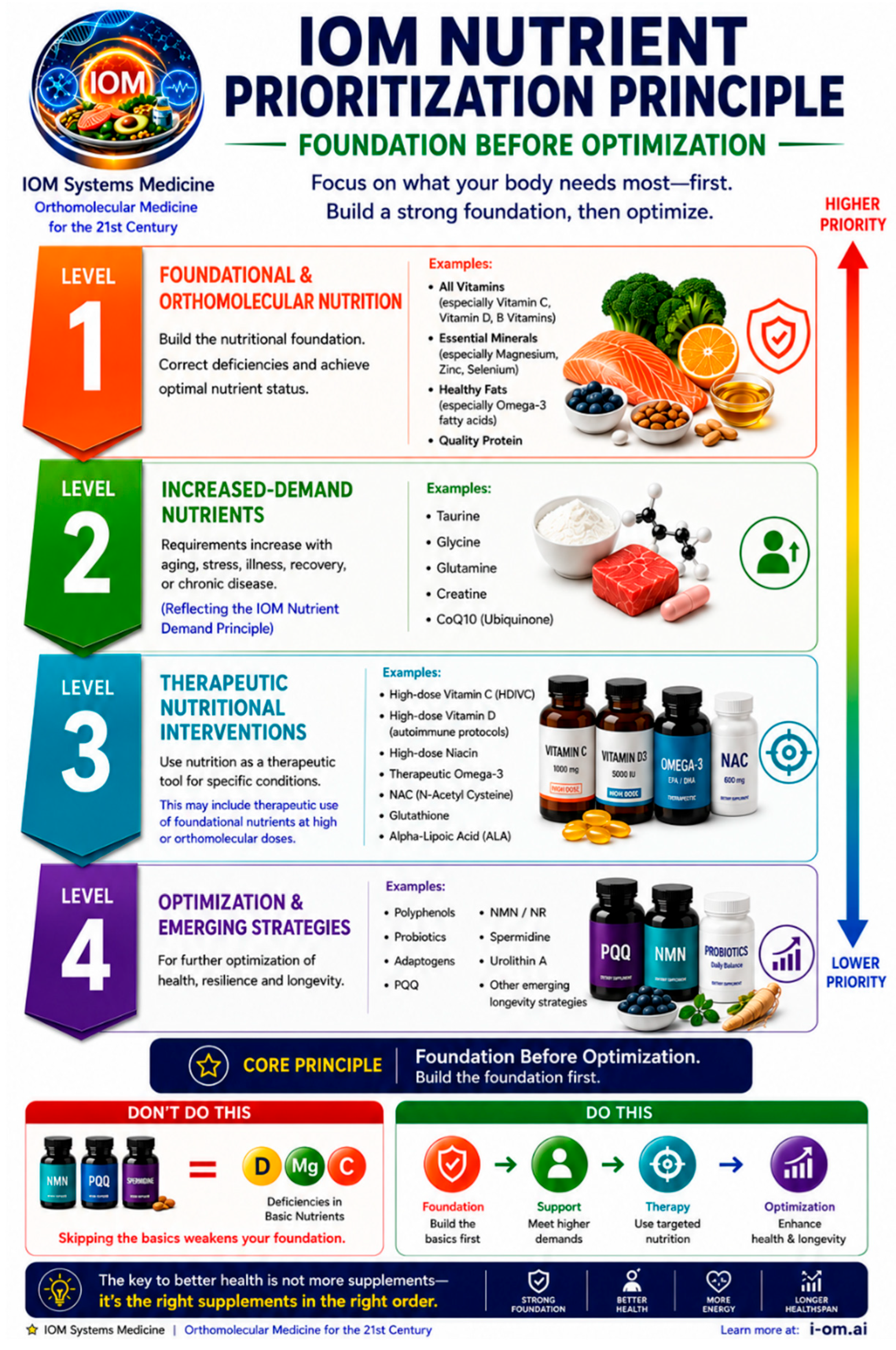
Figure 2.
The IOM Nutrient Prioritization Principle.
The framework illustrates the hierarchical prioritization of nutritional interventions. Foundational and orthomolecular nutrition forms the biological basis for increased-demand nutrients, therapeutic nutritional interventions, and optimization strategies. The core principle is "Foundation Before Optimization."
5. Relationship Between Nutrient Dependency and Nutrient Prioritization
The Nutrient Dependency Framework and the Nutrient Prioritization Principle are complementary but distinct concepts.
Nutrient dependency describes biological relationships.
Nutrient prioritization describes clinical decision-making.
Biological hierarchy:
Essential Nutrients→ Conditional Nutrients→ Physiological Systems→ Health Outcomes
Clinical hierarchy:
Level 1 Foundation→ Level 2 Increased Demand→ Level 3 Therapeutic Nutrition→ Level 4 Optimization
The clinical hierarchy is derived from the biological hierarchy and reflects the principle that advanced interventions are unlikely to achieve optimal results when foundational nutritional requirements remain unmet.
4. Systems Mechanism: From Nutrient Deficiency to Disease
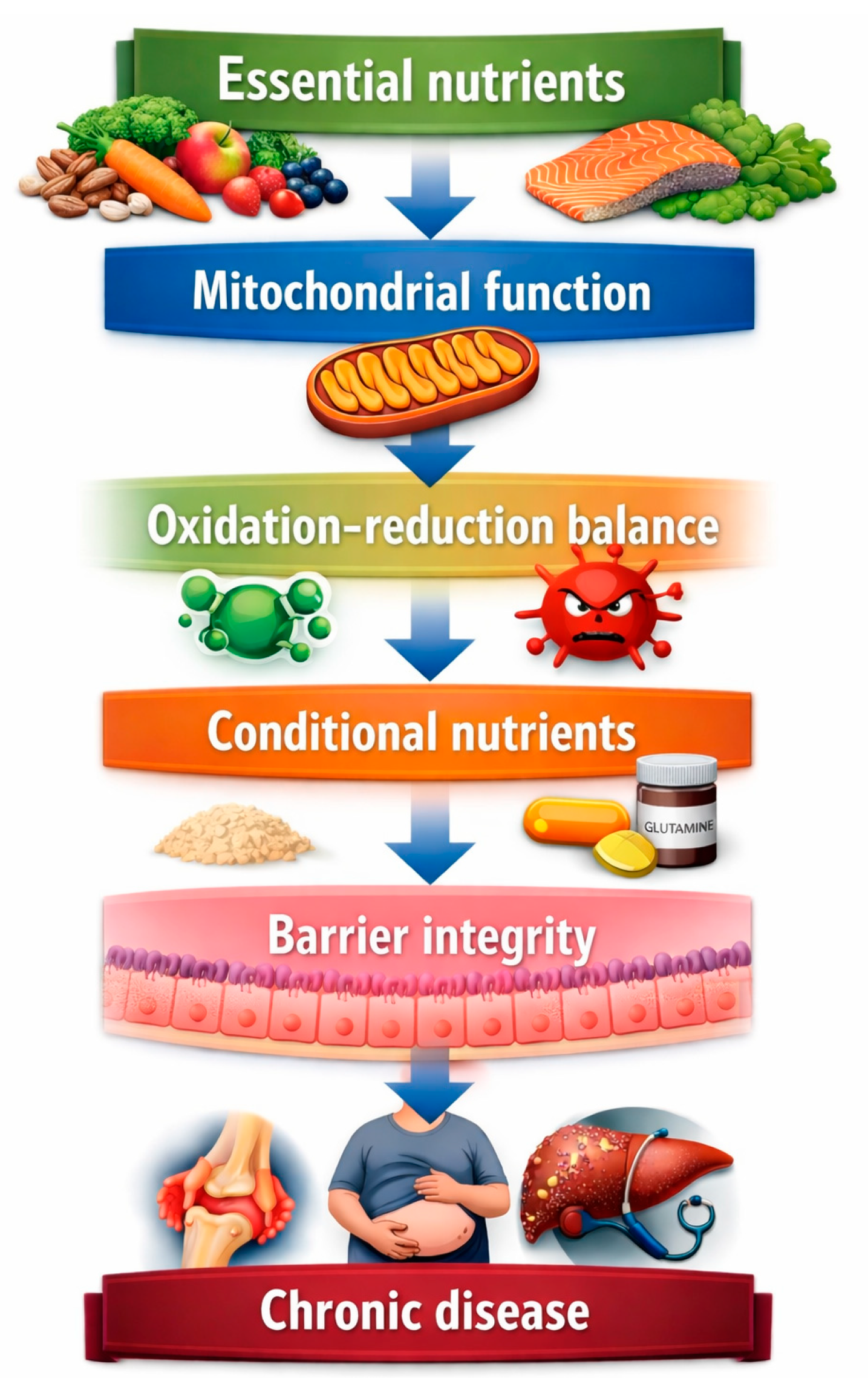
The nutrient dependency framework and its relationship to disease can be summarized as a systems cascade (Figure 1), linking essential nutrient sufficiency to mitochondrial function, redox balance, and downstream disease processes.
This framework can be described as:
This cascade aligns with systems-level models of chronic disease involving mitochondrial dysfunction, oxidative stress, and inflammatory signaling pathways.
5. Clinical Implications
5.2. Misconceptions in Supplementation
A common misconception:
“High-potency antioxidants can replace essential nutrients”
This may not be supported by current biochemical understanding.
For example:
5.3. Implications for Chronic Disease
This framework provides a basis for understanding:
- cancer metabolism (redox imbalance, mitochondrial dysfunction)
- cardiovascular disease (endothelial dysfunction, oxidative stress)
- metabolic disorders (insulin resistance, inflammation)
Restoring essential nutrient sufficiency may:
Author Contributions
The author is solely responsible for all aspects of the manuscript.
Funding
This research received no external funding.
Institutional Review Board Statement
Not applicable.
Informed Consent Statement
Not applicable.
Data Availability Statement
No new data were created or analyzed in this study. Data sharing is not applicable to this article.
References
- Pauling, L. Orthomolecular Psychiatry. Varying the Concentrations of Substances Normally Present in the Human Body May Control Mental Disease. Science 1968, 160, 265–271. [Google Scholar] [CrossRef] [PubMed]
- Ames, B.N. Low Micronutrient Intake May Accelerate the Degenerative Diseases of Aging through Allocation of Scarce Micronutrients by Triage. Proc. Natl. Acad. Sci. USA 2006, 103, 17589–17594. [Google Scholar] [CrossRef] [PubMed]
- McCann, J.C.; Ames, B.N. Vitamin K, an Example of Triage Theory: Is Micronutrient Inadequacy Linked to Diseases of Aging? Am. J. Clin. Nutr. 2009, 90, 889–907. [Google Scholar] [CrossRef] [PubMed]
- Carr, A.C.; Maggini, S. Vitamin C and Immune Function. Nutrients 2017, 9, 1211. [Google Scholar] [CrossRef] [PubMed]
- Jones, D.P. Redefining Oxidative Stress. Antioxid. Redox Signal 2006, 8, 1865–1879. [Google Scholar] [CrossRef] [PubMed]
- Levine, M.; Conry-Cantilena, C.; Wang, Y.; et al. Vitamin C Pharmacokinetics in Healthy Volunteers: Evidence for a Recommended Dietary Allowance. Proc. Natl. Acad. Sci. U S A 1996, 93, 3704–3709. [Google Scholar] [CrossRef] [PubMed]
- Holick, M.F. Vitamin D Deficiency. N Engl. J. Med. 2007, 357, 266–281. [Google Scholar] [CrossRef] [PubMed]
- Nunnari, J.; Suomalainen, A. Mitochondria: In Sickness and in Health. Cell 2012, 148, 1145–1159. [Google Scholar] [CrossRef] [PubMed]
- Jones, D.P. Redefining Oxidative Stress. Antioxid. Redox Signal 2006, 8, 1865–1879. [Google Scholar] [CrossRef] [PubMed]
- Wu, G.; Fang, Y.-Z.; Yang, S.; et al. Glutathione Metabolism and Its Implications for Health. J. Nutr. 2004, 134, 489–492. [Google Scholar] [CrossRef] [PubMed]
- Valko, M.; Leibfritz, D.; Moncol, J.; et al. Free Radicals and Antioxidants in Normal Physiological Functions and Human Disease. Int. J. Biochem Cell Biol. 2007, 39, 44–84. [Google Scholar] [CrossRef] [PubMed]
Figure 1.
Nutrient dependency framework and disease cascade. Essential nutrients support mitochondrial function and maintain redox balance, enabling the synthesis and function of conditional nutrients. Deficiency in essential nutrients disrupts this framework, leading to impaired conditional systems, barrier dysfunction, chronic inflammation, and eventual disease manifestation.
Figure 1.
Nutrient dependency framework and disease cascade. Essential nutrients support mitochondrial function and maintain redox balance, enabling the synthesis and function of conditional nutrients. Deficiency in essential nutrients disrupts this framework, leading to impaired conditional systems, barrier dysfunction, chronic inflammation, and eventual disease manifestation.
Disclaimer/Publisher’s Note: The statements, opinions and data contained in all publications are solely those of the individual author(s) and contributor(s) and not of MDPI and/or the editor(s). MDPI and/or the editor(s) disclaim responsibility for any injury to people or property resulting from any ideas, methods, instructions or products referred to in the content. |
© 2026 by the authors. Licensee MDPI, Basel, Switzerland. This article is an open access article distributed under the terms and conditions of the Creative Commons Attribution (CC BY) license (http://creativecommons.org/licenses/by/4.0/).
Copyright: This open access article is published under a Creative Commons CC BY 4.0 license, which permit the free download, distribution, and reuse, provided that the author and preprint are cited in any reuse.


