

Submitted:
22 June 2026
Posted:
23 June 2026
You are already at the latest version
Abstract
This paper argues that the combination of systems mapping and opportunity identification offers a coherent pedagogical frame to support sociotechnical practice. Opportunity identification is treated as the cognitive capacity to recognize leverage points for intervention in complex systems, while systems mapping tools provide the scaffolding through which students learn to navigate ambiguity, integrate non-technical knowledge, and locate those leverage points. We report empirical evidence from an undergraduate engineering elective in which students investigate a wicked problem of their choice using multiple systems mapping tools. The course emphasizes problem exploration over solution convergence and is explicitly designed to help students engage with communities, paradigms, and knowledge fields outside engineering. The paper draws on qualitative evidence from semi-structured post-course interviews with 13 students across three course cohorts. The interview protocol included a case-based section to assess students' ability to transfer systems mapping tools and opportunity-identification reasoning to an unfamiliar sociotechnical challenge. Interview data were analysed using a combined deductive--inductive coding approach. The study is anchored in a new framework that integrates three bodies of literature: Richmond's Systems Thinking process model, the KEEN Entrepreneurially Minded Learning framework, and Ardichvili et al.'s Opportunity Identification and Development model. The paper offers an empirically grounded account of how systems mapping pedagogy develops students' capacity to navigate ambiguity, integrate non-technical knowledge, and identify intervention possibilities in complex sociotechnical systems and offers practical design insights for educators seeking to build sociotechnical capacity in undergraduate engineering curricula.
Keywords:
systems thinking
; systems mapping
; engineering education
; sociotechnical thinking
; opportunity identification
; wicked problems
; STOP framework
; undergraduate pedagogy
1. Introduction
Engineering graduates increasingly face problems that cannot be solved through technical expertise alone. Wicked problems such as climate adaptation, food insecurity, automation-driven unemployment, and water scarcity are characterized by a high degree of ambiguity: the relevant actors, feedback structures, and leverage points are rarely visible at the outset, and the social, economic, and political dimensions of these problems are as consequential as their technical ones [1]. However, despite growing calls for reform in engineering education, most programs offer limited opportunities for students to engage with problems of this complexity before graduation [2]. Curricula tend to converge students towards solution design before they have fully explored the problem space, and few pedagogical approaches explicitly develop students’ capacity to integrate technical reasoning with social, economic, and political analysis under uncertainty [3].
This gap is consequential. If engineering graduates are expected to contribute to sociotechnical challenges, designing solutions within systems that involve diverse stakeholders, competing constraints, and uncertain feedback, then their education must provide structured practice in navigating that complexity [4]. The question is not whether sociotechnical thinking matters, but how it can be concretely taught and assessed.
Sociotechnical thinking is defined as the ability to identify, address and integrate the social and technical dimensions of engineering [5,6,7]. The term was officially added to the EER Taxonomy in 2020 [8]. The need for sociotechnical thinking was, in part, motivated by observations of engineering work, for example Trevelyan (2014), who noted that practicing engineers described their work as more sociotechnical in nature than students do, demonstrating a distinction between training and practice [9]. This was echoed by Leydens et al. (2018), as they noted the situatedness of engineering problems in real social contexts, and the importance of engaging systems thinking, sociocultural and ethical considerations, communication and collaboration in this engineering problem-solving [10]. Sociotechnical thinking is further conceptualized as a response to the presence of sociotechnical dualisms and a recognition of engineering as a broader sociotechnical practice [11].
Trist and Bamforth’s foundational work demonstrated that technical systems and social systems are fundamentally interdependent, and that optimizing one without regard for the other produces suboptimal outcomes [12]. This insight, originally developed in organizational contexts, has since been extended to large-scale infrastructure, energy transitions, and public policy [13]. In engineering contexts specifically, sociotechnical problems are those in which the behaviour of the system cannot be understood or improved through technical analysis alone because social structures, institutional norms, power relations, and human values are constitutive elements of the system rather than external constraints on it [14]. Despite this recognition, research in engineering education has documented a persistent “culture of disengagement” in which students’ concern for public welfare and attention to the social dimensions of engineering actually declines over the course of their degree [15]. Leydens and Lucena argue that this pattern is not incidental but structural: engineering curricula systematically privilege technical problem-solving while marginalizing the social, political, and ethical reasoning required for responsible practice in complex systems [16]. Addressing this pattern requires pedagogical approaches that do not merely add social content to technical curricula, but that fundamentally restructure how students learn to reason about problems that span technical and social domains.
Systems thinking offers a promising response. Its emphasis on feedback, interdependence, and dynamic behavior provides both a cognitive toolkit and a set of representational practices that can help students move beyond linear, technically bounded reasoning [17,18,19]. Systems mapping, which refers to the use of structured visual tools such as actor maps, causal loop diagrams, and iceberg models, translates this reasoning into observable, assessable, and communicable form [20]. When students construct system maps, they are not simply learning to think differently; they are producing artifacts that externalize assumptions, reveal relationships, and make reasoning shareable across disciplinary and stakeholder boundaries. In a study of freshman engineering students in a project-based course, Frank and Elata demonstrated that systems thinking capacity can be developed in the early stages of engineering education; however, their work focused on complex technical systems rather than the sociotechnical dimensions emphasized here [21]. In a related series of work, Khajeloo and Siegel evaluated concept maps as a tool for helping students examine interconnections between concepts and identify causal mechanisms, observing that scaffolding was central to their effectiveness [22].
Navigating sociotechnical complexity requires more than analytical skill. It also demands dispositional capacities, the willingness to question assumptions, the ability to integrate knowledge across disciplinary and stakeholder boundaries, and an orientation toward identifying where meaningful intervention is possible. These dispositions align closely with what the entrepreneurship education literature describes as entrepreneurial mindset, particularly as operationalized through the KEEN framework’s dimensions of Curiosity, Connections, and Creating Value [23]. DeWaters and Kotla, for example, used an open-ended sociotechnical design challenge in a first-year engineering course to develop both sociotechnical thinking and entrepreneurial mindset, particularly along the KEEN dimensions of Curiosity, Connections, and Creating Value, illustrating that open-ended challenges can simultaneously target both capacities [24]. In this paper, entrepreneurial mindset is not treated as a pathway to venture creation but as a set of action-oriented dispositions that complement systems thinking by bridging analytical understanding of a system with the motivation and orientation to act on that understanding. When paired with systems thinking skills, these dispositions support what we term sociotechnical judgment or the capacity to reason about when, where, and how to intervene in complex systems.
This paper argues that systems mapping provides a structured pedagogical approach for engaging undergraduate engineers with precisely this kind of complexity. Crucially, the argument is not simply that systems thinking can be taught, but that structured systems mapping practice develops specific capacities: scoping ambiguous problems, surfacing non-technical drivers, recognizing feedback structures, identifying leverage points, and reasoning about where opportunity for change lies. These capacities constitute a form of sociotechnical judgment that extends well beyond technical skill.
This paper addresses the following question:
What capacities do undergraduate engineering students develop through structured systems mapping practice, and how do these tools support their ability to scope ambiguous problems, identify leverage points, and reason about intervention in complex or unfamiliar sociotechnical challenges?
The paper reports empirical evidence from Systems Mapping, an undergraduate engineering elective at the University of Toronto designed to give students time, tools, and structure to develop this kind of thinking. It draws on qualitative interview data from 13 students across three course cohorts, analyzed through the STOP (Systems Thinking for Opportunity) framework. The sections that follow present the theoretical framework, course context, methods, findings, and implications for engineering education.
1.1. Theoretical Framework: The STOP Framework
This study is anchored in the STOP (Systems Thinking for Opportunity) framework, an integrative conceptual framework developed in the broader doctoral research from which this paper is drawn [25]. The framework has been used both to structure the interview protocol and to organize the deductive phase of data analysis. STOP synthesizes three theoretical strands to provide both an instructional design tool and an analytic lens for examining how students develop systems-oriented sociotechnical competencies. Figure 1 illustrates the framework.
The first framework draws on Ardichvili, Cardozo, and Ray’s Opportunity Identification (OI) and Development model [26], which conceptualizes opportunity recognition as a dynamic, iterative process shaped by entrepreneurial alertness, prior knowledge, and social networks. Within STOP, opportunity identification is treated not as a discrete act of discovery but as the cognitive capacity to recognize leverage points for intervention in complex systems, an outcome that systems mapping can concretely develop. The STOP framework is generally designed after the layout for OI’s framework and therefore, many components are utilized across boxes 1 to 5.
The second framework draws on the KEEN (Kern Entrepreneurial Engineering Network) Entrepreneurially Minded Learning (EML) framework [23], which operationalizes the dispositional capacities introduced above through three dimensions: Curiosity (exploring the world and questioning assumptions), Connections (integrating knowledge across domains and stakeholders), and Creating Value (identifying impact and acting on opportunity). In the context of STOP, KEEN provides the dispositional and competency-oriented bridge between systems analysis and action-oriented reasoning and shows up in boxes 1, 2 and 4.
The third framework is drawn from Richmond’s Systems Thinking (ST) Competency Model [17], which specifies core cognitive skills for reasoning about complex systems: Dynamic Thinking (reasoning over time), Closed-Loop Thinking (recognizing feedback), System-as-Cause Thinking (locating causality within system structure), Operational Thinking (specifying mechanisms), and Forest Thinking (integrating parts into wholes). These skills constitute the cognitive foundation for sociotechnical reasoning. Additionally, Richmond describes ST as a process for approaching problems. Hence, Box 5 refers to ST as a process, and Box 6 refers to it as a set of skills.
2. Materials and Methods
2.1. Course Context
Systems Mapping is a 13-week undergraduate engineering elective at the University of Toronto [27]. The course is open to students across all engineering disciplines and is offered on a yearly basis.
The course is structured around the investigation of wicked problems selected by the students. Past topics have ranged from lithium mining ethics to transit access inequity to cybersecurity in healthcare. Students use multiple systems mapping tools to explore their problems over the semester. The course emphasizes problem exploration over solution convergence and is explicitly designed to help students engage with communities, paradigms, and knowledge fields outside engineering.
Each week includes 4 hours of weekly instruction, combining mini-lectures and active learning activities. Lectures cover core concepts including systems thinking, wicked problems, epistemology, paradigms and perspectives, and power structures, and feature guest speakers from diverse fields such as policy, energy, urban planning, and community engagement. The course provides structured time for team-based mapping work, peer feedback, and expert consultation.
Assessment is organized into individual and team components. Individual assessment includes system maps, a final self-evaluation, and course engagement. Team assessment includes scaffolded assignments that progressively build toward a final system map and presentation. This design ensures students develop their systems mapping skills iteratively rather than producing a single artifact at term’s end. The course was developed based on the “Map the System” competition at the University of Oxford [28] and is primarily focused on understanding the societal and environmental challenges around the problem students are working on and exploring different tools to help them visualize the overall scope of the problem.
2.2. Participants
This study was part of a broader study that included a survey instrument on ST knowledge, which acted as a screening tool for this work. Participants were selected through purposive sampling from students who completed both the pre- and post-course surveys, consented to the use of their data, and expressed willingness to participate in a follow-up interview. Participants were further prioritized based on entrepreneurial interest and course performance, yielding a rich sample that was weighted toward high-performing students with either clear or tentative interest in entrepreneurship. The entrepreneurial interest was determined based on a question in the screening survey around willingness to start a venture after graduation. A total of 13 students were interviewed across three cohorts of the course. The sample included students from Mechanical, Civil, Electrical and Computer, Industrial, Aerospace, and Engineering Science programs, ranging from second- to fifth-year standing (post-engineering internship). Table 1 presents the participant distribution; participants are numbered within each cohort, so an in-text reference such as “P1 (2023)” identifies the first participant from the 2023 cohort.
Interviews were conducted via Zoom after final grades were awarded, and lasted approximately one hour. To reduce response bias arising from students’ relationship with their instructors, a researcher outside the teaching team conducted all interviews. All interviews were recorded and transcribed with participant consent, following ethical protocols approved by the University of Toronto Research Ethics Board (Protocol #42066).
2.3. Interview Protocol
The interview protocol was organized into five thematic sections, each aligned with one or more components of the STOP framework. Section 1 (ST Learning Outcomes) explored the development of systems thinking skills, guided by Richmond’s competency framework [17]. Students were asked to define systems thinking, identify specific tools learned in the course, and discuss their confidence in using these tools. Section 2 (Problem Space Exploration) examined how students selected and scoped the problem addressed in their project, reflecting early-stage opportunity identification processes from Ardichvili et al.’s model [26]. Section 3 (OI) assessed how students interpreted findings as potential opportunities for intervention, drawing on the opportunity development process including recognition, evaluation, and elaboration. Section 4 (Transfer Task) presented students with a water scarcity case study set in Jordan, a wicked problem integrating environmental, political, economic, and social factors, to assess transfer of systems thinking tools to an unfamiliar context [29]. Section 5 (Entrepreneurial Motivation) investigated broader entrepreneurial interest and the influence of systems thinking on entrepreneurial mindset, informed by the KEEN framework [23].
2.4. Data Analysis
Interview data were analyzed using a combined deductive and inductive coding approach [30]. Deductive codes organized data around theoretical constructs drawn from the framework components, including Dynamic Thinking, Closed-Loop Thinking, Curiosity, Connections, Creating Value, and Opportunity Recognition. The inductive phase employed iterative open coding to capture themes emerging from participants’ accounts that were not fully encompassed by the theoretical scaffolding. Some categories included Course Takeaways, Teamwork and Communication, Feedback and Mentorship, and Ambiguity and Scope Management. Analytical reliability was strengthened through peer debriefing with independent reviewers who had expertise in engineering education and systems thinking research. NVivo 14 was used to document code frequencies, patterns of co-occurrence, and representative quotations. Thematic saturation was monitored throughout the analysis; by the third cohort, no new conceptual categories were emerging from the transcripts.
3. Results
The findings are organized around three categories that reflect the research question: (1) the shift from solution-first thinking to systemic inquiry, (2) the role of systems mapping tools in developing sociotechnical reasoning and identifying leverage points; and (3) evidence of skill transfer to an unfamiliar sociotechnical challenge.
3.1. From Solution-First Thinking to Systemic Inquiry
A consistent finding across interviews was that systems mapping shifted how students approached complex problems. Students described moving from a default orientation, jumping quickly to solutions based on technical training, toward a more deliberate process of questioning, scoping, and exploring the problem space before committing to intervention.
Participant P1 (2022) described this transition directly: “Initially I had more of a direct approach to problem solving... the problem definition was already there. Whereas with the problems we’re dealing with in the course... the problem definition takes a lot more effort than the actual solution... pay much more attention on the problem definition itself, because oftentimes, it can either streamline the solutions or in fact hinder the solution process.”
This shift was not merely attitudinal. Students described concrete changes in practice: spending more time researching before proposing interventions, actively seeking perspectives outside engineering, and treating their initial understanding as partial and revisable. P3 (2024) captured this: “The first stage is properly understanding the problem... I was having some ideas. But... before jumping into those ideas... just brainstorm all the different aspects of the problem.”
A dominant competency outcome was the reorganization of prior knowledge. Students consistently described systems thinking as a way to structure what they already knew, identify what they did not know, and adapt existing concepts to complex sociotechnical contexts. Rather than treating prior knowledge as a static resource to be applied, students approached it as something that needed to be interrogated, reorganized, and tested against system evidence. This is significant because opportunity identification theory positions prior knowledge as one of the primary inputs shaping whether individuals can detect and evaluate opportunities [26]. When students reported that systems mapping forced them to confront the limits of their disciplinary training, they were describing a process through which prior knowledge became more reliable as a basis for reasoning about intervention.
P4 (2022) emphasized the importance of incorporating “so many different perspectives,” describing this practice as a way to “de-bias your own personal lens.” Within the logic of the STOP framework, this represents a concrete mechanism through which systems thinking strengthens the quality of prior knowledge as an input to opportunity work. Students were not simply accumulating more information; they were restructuring how they organized and evaluated what they knew, making their knowledge base more defensible as a platform for identifying where change is both needed and feasible.
Several students contrasted the ambiguity of the Systems Mapping course with their prior engineering coursework, where the problem, constraints, and relevant concepts are effectively pre-selected. P5 (2023) noted that their team “started off with cybersecurity and then we scoped it down to hospitals... because... during Covid a lot of hospitals were attacked.” This is an example of prior knowledge being updated through evidence and re-anchored to a specific actor set, vulnerability profile, and contextual driver, making the opportunity space more defensible.
Students also described learning to manage scope as an iterative, knowledge-dependent process rather than a one-time decision. P3 (2022) reflected: “When the scope is too big... we’re more bound to miss things... But when you try to narrow down your scope... much more impactful. Taking that leap to actually narrow my scope down was huge.” Another participant described an oscillating strategy: “Where do you stop? ... scope down a bit, but then scope up a bit and then see how our understanding shifts” (P1, 2024). This iterative scoping reflects a form of knowledge calibration that is characteristic of mature systems reasoning, where narrowing produces an actionable frame and broadening checks whether the frame remains coherent when second-order effects are reintroduced.
A related dimension of this shift was students’ growing recognition that non-technical drivers are load-bearing elements of engineering challenges. P2 (2023) articulated this integration: “In every situation like 70, 80% is understanding the problem... you have to analyze all the different stakeholders... consider economic, social, political, environmental, and engineering side of things.” This represents a shift in what “counts” as relevant knowledge for engineering practice, consistent with the sociotechnical reasoning the course was designed to develop. Importantly, this broadening of relevance criteria directly counters the pattern of disengagement from public welfare concerns that has been documented in conventional engineering programs [15].
The shift from solution-first thinking to systemic inquiry was showcased in not only how students approached problem scoping but also in three specific dispositional dimensions aligned with the KEEN framework: how students directed their curiosity, how they made connections across domains, and how they reasoned about creating value. The following subsections examine each in order.
3.1.1. Structuring Curiosity Through Systems Thinking
Curiosity emerged strongly across participants’ reflections, although the data suggest that systems thinking may not have created this disposition from scratch. A more plausible interpretation is that many students entered the course with an existing inclination toward questioning and exploration, and that the course provided a language, structure, and set of tools that helped surface and direct that curiosity more intentionally. P1 (2024) explained: “I think I just kind of was interested in solving problems. And just the idea of using Systems Thinking was interesting to me. And it was like a different approach than what I was used to.” Systems mapping expanded how that interest could be pursued while functioning not as the origin of curiosity, but as a scaffold that strengthened students’ willingness to investigate complexity and uncertainty.
P2 (2024) also reflected on curiosity as a combination of intellectual exploration and ethical engagement: “I always found myself wondering how things connect, even outside class. When we started looking at the systems around waste management, I kept thinking—who else is involved, and why hasn’t anyone done this better yet?” This reflection captures curiosity directed toward finding leverage for responsible change, not just satisfying intellectual interest.
3.1.2. Making Connections Across Domains
A second major sub-theme, drawing on the KEEN framework’s Connections dimension, represented students’ ability to synthesize across domains and recognize how knowledge, experience, and people interrelate in shaping opportunities. Participants described this integrative thinking as one of the most distinctive outcomes of systems learning. Whereas traditional engineering coursework often emphasizes compartmentalized analysis, the Systems Mapping course required students to engage with multiple perspectives simultaneously: technical, environmental, political, and human.
P3 (2023) reflected: “It was the first time I really had to think about what my discipline doesn’t cover. We were all forced to talk to people in other fields and think about why their perspectives mattered to our map. It made me realize that the best ideas usually live in the space between disciplines.” This sense of intellectual cross-pollination emphasizes that innovation emerges from integrating diverse viewpoints rather than mastering isolated expertise.
P1 (2024) connected this to professional aspiration: “I’ll find my own company that provides value to the industry... not just more efficient products or faster engines, but something that is new and unique and also addressing sustainability. I think that’s only possible if you’re aware of what’s happening in all the different sectors that touch yours.” Such statements highlight a maturing capacity to identify and link related domains, a hallmark of systems-informed engineering practice.
3.1.3. Creating Value Through Systemic Reasoning
The third sub-theme reflected how participants described the outcomes of engaging with systems thinking in the context of creating value. Rather than equating value with technical novelty or immediate problem solving, students increasingly framed value in terms of impact, leverage, and intentional intervention within complex systems. P2 (2023) described using evidence to avoid premature narrowing onto a single solution: “Use that research to basically not look for solutions but look for classes of solutions and see where the highest impact is.” This orientation reflects a shift from producing isolated answers toward structuring the broader solution landscape and selecting intervention families that can generate the greatest downstream benefits.
Creating value also included a personal dimension related to agency and fulfillment. P2 (2024) described this as: “It’s also the idea of bringing something unique to the world and having your own something that you’ve produced become a reality. That’s very satisfying to me.” This sense of ownership over ideas illustrates how systems thinking fosters a mindset attuned to both action and reflection. Students increasingly viewed engineering as a creative endeavor where value arises from understanding systems deeply enough to intervene responsibly.
3.2. Systems Mapping Tools Enable Sociotechnical Reasoning
The students reported using a variety of system mapping tools to help them integrate sociotechnical considerations. This section examines how the various tools enabled this. A review of the most frequently used tools suggests Actor Map, the Five Rs Framework and Causal Loop Diagrams (each referenced by 10 participants), the Iceberg Model, and the Impact Gaps Canvas and Levers of Change analysis to be the most referenced tools. Students did not use these tools in isolation; rather, they described an evolving toolkit that adapted to the complexity and stage of each project. This section presents the tools organized by frequency of reference, with the most discussed tools presented first.
3.2.1. Actor Maps and Stakeholder Reasoning
Actor maps visualize the stakeholders involved in a system, their roles, and the relationships and influence pathways between them. Grounded in stakeholder theory [31], they provide a structured approach for identifying how the interests, power, and interdependencies among actors shape system behaviour.
The Actor Map was the most widely referenced tool. Students used it to visualize stakeholder relationships, trace influence pathways, and identify disconnections or misalignments that might represent spaces for intervention. P1 (2022) described its use in a civic mobility context: “I was in charge of making the timeline for the project... with the various bodies, the TTC, the Metro Line support, the political and the social aspects, and the decisions that Metrolinx made and how it impacted those other layers.” This illustrates the student’s use of the Actor Map to align project components with multiple stakeholder perspectives, demonstrating System-as-Cause Thinking by tracing how system interdependencies shape system behavior.
P2 (2022) described its practical value for opportunity recognition: “If you do something to one actor, how does that affect the other actor through the relationship?... if I’m trying to create a startup that really solves a problem, I need to really take into all the stakeholders.” This suggests that students used the Actor Map not only to document relationships but also to anticipate system-wide ripple effects, recognizing how stakeholder behaviors and dependencies might reinforce or counteract each other.
P1 (2024) observed a diagnostic insight: “the people who have the expertise are not as strongly connected to the people who have the authority to make regulations,” suggesting that mapping stakeholder relations could identify where innovation or policy reform might be most impactful. From a learning perspective, the Actor Map enabled students to think systemically about influence, power, and collaboration. By visualizing complex stakeholder connections, students appeared better able to identify the sociotechnical dynamics that constrain or enable system change.
3.2.2. Five Rs Framework and Problem Scoping
The Five Rs Framework organizes system analysis into five dimensions: Roles (who is involved), Relationships (how actors interact), Rules (formal and informal norms governing behaviour), Resources (what flows through the system), and Results (what the system produces) [32]. It provides a structured entry point for decomposing complex sociotechnical problems into analysable components.
The Five Rs Framework (Roles, Relationships, Rules, Resources, Results) was valued for its capacity to structure complex information and facilitate problem scoping. P1 (2022) noted how layering “the problem into different sections” and identifying “relationships, roles, and actors between the independent bodies and also the public bodies” allowed the team to develop more informed pathways for solution development.
P2 (2022) described the tool as “a good visualization overall” for unpacking the root causes of car dependency, especially the embedded “rules and mental models.” The participant reflected that the Five Rs could help identify “underlying struggles of a problem” in potential startup contexts. This aligns with opportunity identification theory, where uncovering hidden constraints or unbalanced resource flows often precedes opportunity recognition [26]. Additionally, P5 (2023) described it as “the main one that really helped us... broaden our understanding,” which later allowed the team to refine their project focus more effectively.
However, despite positive perceptions, some participants noted challenges. P3 (2023) highlighted ambiguity in classifying elements under “roles” versus “actors,” especially in automation contexts where human involvement was minimal. This observation underscores that while the Five Rs provides a useful organizing tool, there may be limitations in domains where the connections between machines and human actors are not clearly defined.
3.2.3. Causal Loop Diagrams and Dynamic Reasoning
Causal Loop Diagrams represent feedback structures within a system by mapping causal relationships between variables, identifying reinforcing and balancing loops, and illustrating how system behaviour emerges from these interactions over time [33].
Students valued CLDs for making dynamic relationships explicit and for revealing where interventions could meaningfully influence system behavior. Participants consistently highlighted the value of CLDs in surfacing dynamic system behaviors. One student noted that feedback loops were the aspect they worked with most, emphasizing the multiple iterations required to refine a representation that felt clear and manageable. This process of iterating on causal structures encouraged students to reason dynamically, helping them discern which feedback relationships most strongly shaped system behavior and where leverage might exist.
However, some participants noted limitations. One observed that CLDs sometimes functioned more effectively for articulating existing understanding than for generating new insights, describing them as visual representations of understanding already developed. Another noted that CLDs are most effective when elements are quantifiable, implying that the tool may be better suited to technically measurable systems. These observations highlight an important pedagogical consideration: the effectiveness of CLDs for opportunity generation may depend on students’ prior conceptual understanding and the nature of the system being analyzed.
3.2.4. The Iceberg Model and Deep Structure
The Iceberg Model is a layered analytical framework that moves from visible events at the surface to underlying patterns, systemic structures, and mental models [20]. It prompts analysts to look beyond symptoms and identify the deeper drivers that produce observable system behaviour.
The Iceberg Model, which moves from visible events to underlying patterns, structures, and mental models, helped students deepen their analysis beyond surface-level symptoms. P1 (2022) described how it enabled the team to trace how public attitudes toward transportation, specifically car-centric mental models, reinforced infrastructure outcomes: “That helped the team further understand what the mindset is with citizens or residents in the GTA... if public support is present, subsequent plans and projects will become relatively easier.” This reflection illustrates how the Iceberg Model enabled students to surface deeper layers, identifying leverage points for changing social norms or communication strategies.
Some participants adapted the tool to fit their problem domains. P3 (2022), for instance, initially sought to use the Iceberg Diagram to represent multiple perspectives but found the structure too rigid for capturing pluralistic viewpoints. They eventually developed a customized model to visualize each stakeholder’s values. This creative adaptation highlights how students internalized the logic of the Iceberg and demonstrates systems thinking as a reasoning process rather than solely a framework to follow.
P2 (2022) connected the tool to future professional practice: “I want to create a startup that solves a problem... I want to discover or unveil the underlying things... that [iceberg diagram] I can then use to solve.” This suggests that the Iceberg Model not only supported analytical understanding but also shaped how students envisioned approaching opportunity discovery in professional or entrepreneurial contexts.
3.2.5. Tool Integration and Leverage Point Identification
The Levers of Change analysis draws on Meadows’ leverage points framework [20], which identifies where intervention in a system is likely to produce the most significant and durable change by moving from shallow leverage points such as parameters and subsidies to deeper ones such as system goals and paradigms.
A recurring pattern was that students combined tools iteratively rather than using them in isolation. Students described moving from structural understanding (Actor Maps, Five Rs) to causal reasoning (CLDs, Iceberg) to identifying places in the system where they might intervene. This staged progression represents a form of opportunity identification reasoning consistent with the STOP framework.
P4 (2022) described this process through multi-perspective research: “You interview people... wealthy, not wealthy... government employees... engineers... NGOs... You do a lot of firsthand and second-hand research... and then you synthesize that research into trying to understand what the areas are where we can make a change.” This is opportunity evaluation through knowledge triangulation: students use diverse evidence streams to reorganize what they think they know into a more reliable system account, and the phrase “areas where we can make a change” is explicitly evaluative, filtering broad concern into bounded opportunity spaces. The same participant described a process of first building contextual understanding, then identifying areas amenable to change, and finally evaluating which interventions offered the “highest chance of impact.” Students were not selecting interventions based on preference but evaluating them across mechanism types (technical, infrastructural, behavioral) against system constraints. P3 (2024) noted that this evaluation required justification: “developing different ideas... write like a six-page essay of why this idea is the best idea... then... prototyping... try it out.” Although the essay was a course assignment, students described it as a knowledge-integration artifact that forced coherent synthesis of prior knowledge, evidence, and causal logic, while prototyping functioned as real-world knowledge testing.
3.3. ST Skills Transfer to an Unfamiliar Sociotechnical Challenge
To assess whether students could apply systems mapping skills beyond their course projects, participants were presented with a case study on water scarcity in Jordan, a wicked problem integrating environmental, political, economic, and social dimensions that none had studied previously. This allowed for showcasing students’ ability to apply the tools to a case where they had almost no context.
Students demonstrated meaningful transfer of reasoning strategies. P1 (2023) proposed a comparative approach grounded in systems logic: “I believe it’s not only Jordan that is at a severely high risk... it’ll be beneficial to explore what the other countries in a similar situation are doing... rate them according to how applicable or relevant that plan would be for Jordan’s case, given that each country would have different starting conditions.” This reflects Dynamic Thinking and contextual adaptation: the student recognized that solutions cannot be copied across systems without accounting for structural differences.
Other participants described how they would apply specific tools. Several proposed beginning with Actor Maps to identify stakeholders (government agencies, agricultural users, NGOs, international bodies) and their relationships, then moving to Causal Loop Diagrams to trace feedback between urbanization, agricultural demand, and water governance. P2 (2022) emphasized investigating why the status quo persists: “look into the government’s current plan... infrastructure... who’s over-exploiting... and why... not stopping that.” This shift from solution knowledge to constraint knowledge, understanding the forces that stabilize the system, represents a sophisticated form of systems reasoning.
Students also demonstrated awareness of their own reasoning limitations in the transfer task. P2 (2022) noted: “Sometimes when I do research, I get a little bit of confirmation bias... predetermined theories... search specifically for confirmation... wanted to get better at.” This metacognitive awareness of confirmation bias, developed through course practice, is directly relevant to the quality of opportunity evaluation in complex systems. The recognition that one’s own prior knowledge can produce misleading frames is itself a systems-level insight, reflecting System-as-Cause Thinking applied to the researcher’s own reasoning process.
P4 (2023) repeatedly referenced the Iceberg Model as one of “the most valuable tools” for understanding policy-related systems, especially in analyzing government motivations surrounding water scarcity. This suggests that students did not simply recall tools from the course but selected and adapted them based on the demands of the new problem context.
The staged reasoning pattern observed in course projects also appeared in the transfer task. Students proposed beginning with structural tools to map the problem landscape, moving to causal tools to trace feedback dynamics, and culminating in evaluative reasoning about where intervention would be most impactful. P4 (2022) described this progression explicitly: “Once I start to understand the context... areas where we can make a change... highest chance of impact by bettering our technology.” This was not a memorized sequence; students adapted the progression to the specific characteristics of the Jordan case, selecting tools based on what the problem demanded rather than following a prescribed order.
Notably, several participants expressed concern about the limits of what they could know about an unfamiliar system. Rather than projecting assumptions from their course projects, they articulated strategies for managing uncertainty: seeking local perspectives, triangulating across data sources, and treating their initial maps as provisional. This pattern, summarized across multiple participants’ reflections on the Jordan case, points to a disposition toward epistemic humility that is consequential for professional practice, where engineers frequently encounter systems they have not previously studied and must make judgments under conditions of incomplete knowledge. The fact that students demonstrated this disposition in a low-stakes interview context suggests that the course cultivated a reasoning habit rather than a performance behavior.
4. Discussion
4.1. Systems Thinking as a Capability Amplifier
The central finding of this study is that systems mapping pedagogy functioned primarily as a capability amplifier. It strengthened the cognitive systems thinking competencies specified by Richmond [17], and the dispositional and relational antecedents to opportunity identification described by Ardichvili et al. [26], developing both through structured engagement with sociotechnical complexity.
The difference between amplifying capabilities and producing outcomes matters for engineering education because it separates opportunity readiness, the ability to identify and justify intervention spaces in complex systems, from solution generation or entrepreneurial intent. The course did not primarily teach students what to think about sociotechnical systems; it developed how they think about them. Students learned to treat their own prior knowledge as partial and revisable, to seek perspectives beyond their discipline, to iterate on problem frames, and to translate system understanding into bounded and defensible intervention logic.
Interpreted through the STOP framework, the findings show development across multiple capability spaces. Students demonstrated several of the systems reasoning competencies Richmond identifies, namely Dynamic Thinking, Closed-Loop Thinking, and System-as-Cause Thinking, applying these to reason across time and patterns, attend to feedback and causality, and offer structural explanations of system behavior, all of which are key elements of Richmond’s framework [17]. Consistent with the dispositional shifts described in the KEEN framework, students also exhibited increased curiosity about complex challenges, stronger connection-making across domains and stakeholders, and a broadened conception of value creation oriented toward systemic impact [23]. With respect to opportunity identification, students described learning to scope opportunity spaces, evaluate intervention feasibility against system constraints, and justify proposed changes through evidence rather than intuition, paralleling the antecedents to opportunity recognition specified by Ardichvili et al. [26].
Importantly, the course encouraged entrepreneurial mindset, defined as a way of thinking to produce a competitive advantage in uncertainty [24]. The qualitative findings show mindset-aligned shifts consistent with entrepreneurship education frameworks, including increased curiosity about complex challenges and a broadened conception of value creation. However, systems thinking did not, on its own, activate the motivational and contextual drivers, such as creativity and innovation, that have been argued to underpin entrepreneurial intention [24]. The most defensible conclusion is that systems thinking education can cultivate opportunity-relevant cognition and mindset dispositions within sociotechnical problems.
4.2. From Teaching Systems Thinking to Developing Sociotechnical Judgment
Prior work has shown that systems thinking capacity can be developed in early engineering programs through structured project-based experiences, as Frank and Elata demonstrated with freshman students working on complex technical systems [21]. This study extends those findings by showing what structured systems mapping practice enables students to do in explicitly sociotechnical, rather than purely technical, contexts. Students did not simply learn systems thinking as a concept; they went beyond the technical aspects of systems and developed capacity for navigating sociotechnical complexity. In a similar context, DeWaters and Kotla showed that an open-ended sociotechnical design challenge could develop sociotechnical thinking and entrepreneurial mindset in parallel [24]; the present study contributes a complementary path in which scaffolded systems mapping makes the systems reasoning work of that integration concretely visible and assessable.
These capacities included: scoping ambiguous problems through iterative boundary negotiation, surfacing non-technical drivers that are invisible to conventional engineering analysis, recognizing feedback structures that sustain existing system behavior, identifying leverage points where intervention could meaningfully shift outcomes, and reasoning about opportunity in terms of systemic fit rather than technical novelty. These capacities are not captured by asking whether students “learned systems thinking.” They represent a form of sociotechnical judgment, the ability to reason about when, where, and how to intervene in complex systems in ways that account for social, political, and institutional dimensions alongside technical ones.
This framing connects the study’s findings to the broader sociotechnical systems tradition. Trist and Bamforth’s original insight was that technical and social subsystems must be jointly optimized [12]. The students in this study were not taught this principle as an abstraction; they enacted it through mapping practices that required them to trace how social structures, institutional norms, and human values interact with technical elements to produce system behavior. In this sense, systems mapping pedagogy offers a concrete mechanism for developing the ability to identify, address, and integrate social and technical dimensions of engineering that foundational Science and Technology Studies scholarship has long argued is necessary but that engineering curricula have struggled to cultivate [14]. It also responds to long-standing observations that practicing engineering work is more sociotechnical than engineering training typically reflects [9,10], and to recent calls in the sociotechnical thinking literature for pedagogies that operationalize the construct rather than treat it abstractly [11].
The distinction between systems thinking as a concept and systems thinking as a practiced capacity is consequential for assessment. If the goal is to evaluate whether students have developed sociotechnical judgment, then assessment must go beyond self-reported knowledge gains and examine how students reason through novel, ambiguous problems. The case-based transfer task used in this study, where students applied systems mapping tools to the Jordan water scarcity problem, offers one model for this kind of assessment. Students’ ability to select appropriate tools, adapt their reasoning to unfamiliar constraints, and recognize the limitations of their own prior knowledge provides richer evidence of sociotechnical learning than surveys or reflections alone.
4.3. Tool-Mediated Reasoning and Knowledge Architecture
A significant finding was the role of systems mapping tools not merely as visualization aids but as cognitive scaffolds that structured how students organized and revised knowledge. Students described tools as forcing them to externalize assumptions, specify relationships, and make causal claims explicit, transforming private reasoning into shared, inspectable, and revisable representations. This is aligned with earlier work on concept mapping as a tool for surfacing and organizing complex conceptual structures [22,34].
Students’ accounts suggest that this tool-mediated reasoning also carried implications for collaborative work. When teams built and revised maps together, the resulting artifacts appeared to reduce ambiguity by making relationships and assumptions visible across disciplinary boundaries [22]. Although the interview protocol did not focus specifically on collaboration, participants described map-building as requiring negotiation of meaning and reconciliation of competing perspectives, suggesting that these tools may also function as coordination infrastructure in team-based engineering work.
The staged progression from structural tools (Actor Maps, Five Rs) through causal tools (CLDs, Iceberg Models) to evaluative tools (Levers of Change) appeared to support a developmental sequence in students’ reasoning. Students who engaged with the full suite reported more sophisticated opportunity reasoning than those who relied on a single tool. This suggests that the scaffolded course design, which introduced tools progressively and required their integration, played a meaningful role in developing the layered reasoning that characterizes sociotechnical judgment.
The finding that students rarely relied on a single tool, but instead combined tools iteratively, also has design implications. It suggests that systems mapping courses should not present tools as standalone methods but as components of an inquiry process. The pedagogical value lies not in mastery of any individual tool but in the ability to orchestrate multiple representations toward a coherent system account that can support intervention logic.
4.4. Implications for Engineering Education
The findings point to several practical implications for engineering programs seeking to develop sociotechnical capacity. First, systems mapping courses can be credibly positioned as vehicles for developing the cognitive and relational competencies required to identify, address, and integrate the social and technical dimensions of engineering problems. These competencies appear to emerge most effectively when students engage with authentic wicked problems of their own choosing; the motivational and intellectual investment that students described was closely tied to the personal relevance of their selected topics.
Second, the results indicate that the scaffolded introduction of mapping tools matters for learning outcomes. Courses that present systems tools as standalone methods, rather than as components of an integrated inquiry process, may miss the developmental trajectory observed in this study, where students progressed from structural understanding through causal reasoning to intervention logic.
Finally, the findings suggest that systems mapping courses may contribute to entrepreneurial mindset development even when entrepreneurship is not explicitly taught. The connection between sociotechnical thinking, opportunity identification, and entrepreneurial mindset observed in this study suggests that programs seeking to develop both sociotechnical reasoning and entrepreneurial capacity could pair systems mapping with complementary experiences such as venture practice, mentorship, or exposure to entrepreneurial ecosystems.
4.5. Limitations
Several limitations should be acknowledged. First, the interview sample was purposively selected and weighted toward high-performing, entrepreneurially inclined students. The findings may therefore present a more favorable account of the course’s pedagogical effects than would emerge from a broader sample. Second, the study relies substantially on retrospective self-report, which is subject to memory effects and social desirability. While the use of a third-party interviewer combined with the case-based transfer task helps mitigate this concern, it does not eliminate the interpretive limitations inherent in self-reported learning data.
Third, the research was conducted within a small student sample within a single elective course at a single institution; the findings cannot be assumed to transfer to other settings without further comparative research. Fourth, the research team includes the course’s developers and instructors, which introduces a potential positionality bias in both the interpretation of student accounts and the framing of the course’s pedagogical effects. This was partially mitigated by having a third-party researcher conduct the interviews and by peer debriefing during coding, but it remains a limitation that future independent replications could address. Finally, because students applied systems tools to course projects and case contexts rather than to live sociotechnical interventions, the study demonstrates reasoning capacity rather than demonstrated impact in professional settings.
5. Conclusions
This paper examined how structured systems mapping pedagogy develops sociotechnical thinking in undergraduate engineering students. Drawing on interviews with 13 students across three cohorts of an engineering elective, the findings demonstrate that systems mapping practice develops specific, assessable capacities that go beyond “learning systems thinking” as a concept. Students developed the ability to scope ambiguous problems through iterative boundary negotiation, to surface non-technical drivers that are invisible to conventional engineering analysis, and to identify leverage points for intervention in complex sociotechnical systems. They demonstrated these capacities both in course projects and in a transfer task involving an unfamiliar challenge.
The study contributes to engineering education in three ways. First, it provides an empirically grounded account of what systems mapping helps students do, anchored in the STOP framework’s integration of systems thinking, entrepreneurial mindset, and opportunity identification theory. Second, it demonstrates a qualitative interview methodology, including a case-based transfer task, for assessing sociotechnical learning outcomes. Third, it offers practical design insights: the scaffolded progression from structural mapping (Actor Maps, Five Rs) through causal reasoning (CLDs, Iceberg Models) to intervention logic (Levers of Change) appears to support the staged development of sociotechnical judgment.
Future research should examine systems mapping instruction across multiple institutions and contexts, employ longitudinal designs to track whether these capacities persist and transfer to professional practice, and investigate how systems thinking pedagogy can be paired with complementary approaches such as mentorship, venture practice, or stakeholder engagement to support not only sociotechnical reasoning capacity but also the motivation and confidence to act on it.
Author Contributions
Conceptualization, A.A.; Course Development, E.M. and L.R.; Methodology, A.A.; Formal Analysis, A.A.; Investigation, A.A.; Writing—Original Draft Preparation, A.A.; Writing—Review & Editing, A.A., L.R. and E.M.; Supervision, L.R. and E.M. All authors have read and agreed to the published version of the manuscript.
Funding
This research was funded by the NEO Materials Catalyst Fund.
Institutional Review Board Statement
This study was conducted in accordance with the Declaration of Helsinki and approved by the University of Toronto Research Ethics Board (Protocol #42066).
Informed Consent Statement
Informed consent was obtained from all subjects involved in the study.
Data Availability Statement
The data presented in this study are not publicly available due to privacy and ethical restrictions, as they contain information that could compromise the privacy of research participants.
Acknowledgments
The authors gratefully acknowledge the students who participated in interviews for this study.
Conflicts of Interest
The authors declare no conflict of interest.
References
- Martin, M.J.; Diem, S.J.; Karwat, D.M.A.; Krieger, E.M.; Rittschof, C.C.; Bayon, B.; Aghazadeh, M.; Asensio, O.; Zeilkova, T.J.; Garcia-Cazarin, M.; et al. The Climate Is Changing. Engineering Education Needs to Change as Well. J. Eng. Educ. 2022, 111, 740–746. [Google Scholar] [CrossRef]
- Habbal, F.; Kolmos, A.; Hadgraft, R.G.; Holgaard, J.E.; Reda, K. Reshaping Engineering Education: Addressing Complex Human Challenges; Springer: Cham, Switzerland, 2024. [Google Scholar]
- Chen, J.; Du, X.; Jiang, D.; Guerra, A.; Nørgaard, B. A Review Study with a Systematic Approach: Pedagogical Development for Educators in Higher Engineering Education. Eur. J. Eng. Educ. 2023, 49, 299–329. [Google Scholar] [CrossRef]
- Earle, A.; La Hiz, D. The Wicked Problem of Teaching about Wicked Problems: Design Thinking and Emerging Technologies in Sustainability Education. Manag. Learn. 2020, 52, 581–603. [Google Scholar] [CrossRef]
- Erickson, J.; Claussen, S.; Leydens, J.A.; Johnson, K.E.; Tsai, J. Real-World Examples and Sociotechnical Integration: What’s the Connection? In Proceedings of the ASEE Virtual Annual Conference, Virtual, 22–26 June 2020. [Google Scholar]
- Mazzurco, A.; Daniel, S. Socio-Technical Thinking of Students and Practitioners in the Context of Humanitarian Engineering. J. Eng. Educ. 2020, 109, 243–261. [Google Scholar] [CrossRef]
- Zacharias, K.; Seniuk Cicek, J.; Wilkinson, L.; Rodier, C.; Patterson, L.M.; Rodrigues, R.B.; Tallman, K. Transdisciplinary Approaches in Canadian Engineering Education: Convergences and Challenges. In Proceedings of the 2023 ASEE Annual Conference & Exposition, Baltimore, MD, USA, 25–28 June 2023. [Google Scholar]
- Finelli, C. EER Taxonomy Version 1.2; University of Michigan: Ann Arbor, MI, USA, 2020. Available online: http://taxonomy.engin.umich.edu/wp-content/uploads/2013/01/EER-Taxonomy-Version-1.2.pdf (accessed on 30 April 2026).
- Trevelyan, J. Towards a Theoretical Framework for Engineering Practice. In Engineering Practice in a Global Context: Understanding the Technical and the Social; Williams, B., Figueiredo, J., Trevelyan, J., Eds.; CRC Press/Balkema: Leiden, The Netherlands, 2014; pp. 33–60. [Google Scholar]
- Leydens, J.A.; Johnson, K.; Claussen, S.; Blacklock, J.; Moskal, B.M.; Cordova, O. Measuring Change over Time in Sociotechnical Thinking: A Survey/Validation Model for Sociotechnical Habits of Mind. In Proceedings of the 2018 ASEE Annual Conference & Exposition, Salt Lake City, UT, USA, 24–27 June 2018. [Google Scholar] [CrossRef]
- Rodrigues, R.B.; Seniuk Cicek, J. A Scoping Literature Review of Sociotechnical Thinking in Engineering Education. Eur. J. Eng. Educ. 2024, 49, 807–833. [Google Scholar] [CrossRef]
- Trist, E.L.; Bamforth, K.W. Some Social and Psychological Consequences of the Longwall Method of Coal-Getting. Hum. Relat. 1951, 4, 3–38. [Google Scholar] [CrossRef]
- Geels, F.W. From Sectoral Systems of Innovation to Socio-Technical Systems: Insights about Dynamics and Change from Sociology and Institutional Theory. Res. Policy 2004, 33, 897–920. [Google Scholar] [CrossRef]
- Baxter, G.; Sommerville, I. Socio-Technical Systems: From Design Methods to Systems Engineering. Interact. Comput. 2011, 23, 4–17. [Google Scholar] [CrossRef]
- Cech, E.A. Culture of Disengagement in Engineering Education? Sci. Technol. Hum. Values 2014, 39, 42–72. [Google Scholar]
- Leydens, J.A.; Lucena, J.C. Engineering Justice: Transforming Engineering Education and Practice; IEEE Press/Wiley: Hoboken, NJ, USA, 2018. [Google Scholar]
- Richmond, B. Systems Thinking: Critical Thinking Skills for the 1990s and Beyond. Syst. Dyn. Rev. 1993, 9, 113–133. [Google Scholar] [CrossRef]
- Moore, E.; Romkey, L.; Azad, A. Engineering Change: Introducing Systems Thinking as an Engineering Leadership Skill. In Proceedings of the 2024 ASEE Annual Conference & Exposition, Portland, OR, USA, 23–26 June 2024. [Google Scholar] [CrossRef]
- Monat, J.P.; Gannon, T.F.; Amissah, M. The Case for Systems Thinking in Undergraduate Engineering Education. Int. J. Eng. Pedagog. 2022, 12, 50–88. [Google Scholar] [CrossRef]
- Meadows, D.H. Thinking in Systems: A Primer; Chelsea Green Publishing: White River Junction, VT, USA, 2008. [Google Scholar]
- Frank, M.; Elata, D. Developing the Capacity for Engineering Systems Thinking (CEST) of Freshman Engineering Students. Syst. Eng. 2005, 8, 187–195. [Google Scholar] [CrossRef]
- Khajeloo, M.; Siegel, M. Concept Map as a Tool to Assess and Enhance Students’ System Thinking Skills. Instr. Sci. 2022, 50, 571–597. [Google Scholar] [CrossRef]
- Network, Kern Entrepreneurial Engineering. Engineering Unleashed: The KEEN Framework for Entrepreneurially Minded Learning; KEEN: Waukesha, WI, USA, 2020. [Google Scholar]
- DeWaters, J.; Kotla, B. Using an Open-Ended Socio-Technical Design Challenge for Entrepreneurship Education in a First-Year Engineering Course. Front. Educ. 2023, 8, 1198161. [Google Scholar] [CrossRef]
- Azad, A. Systems Thinking for Opportunity: Developing SocioTechnical Reasoning in Undergraduate Engineers. Ph.D. Thesis, University of Toronto, Toronto, ON, Canada, 2026. [Google Scholar]
- Ardichvili, A.; Cardozo, R.; Ray, S. A Theory of Entrepreneurial Opportunity Identification and Development. J. Bus. Ventur. 2003, 18, 105–123. [Google Scholar] [CrossRef]
- Moore, E. TEP448: Using System Mapping to Tackle Complex Problems. In Course Syllabus; University of Toronto: Toronto, ON, Canada, 2022. [Google Scholar]
- Map the System. University of Oxford. Available online: https://www.mapthesystem.sbs.ox.ac.uk/ (accessed on 30 April 2026).
- Stanley, B. Dealing with the Water Deficit in Jordan; Urban Poverty and Environment Program Initiative; International Development Research Centre: Ottawa, ON, Canada, 2006; Available online: https://www.idrc.ca/in_focus_cities (accessed on 30 April 2026).
- Saldaña, J. The Coding Manual for Qualitative Researchers, 4th ed.; SAGE: London, UK, 2021. [Google Scholar]
- Freeman, R.E. Strategic Management: A Stakeholder Approach; Pitman: Boston, MA, USA, 1984. [Google Scholar]
- Omidyar Group. Systems Practice; Omidyar Group: Redwood City, CA, USA, 2017; Available online: https://docs.kumu.io/content/Workbook-012617.pdf (accessed on 30 April 2026).
- Sterman, J.D. Business Dynamics: Systems Thinking and Modeling for a Complex World; Irwin/McGraw-Hill: Boston, MA, USA, 2000. [Google Scholar]
- Sutherland, S.; Katz, S. Concept Mapping Methodology: A Catalyst for Organizational Learning. Eval. Program Plan. 2005, 28, 257–269. [Google Scholar] [CrossRef]
Figure 1.
The STOP Framework (Systems Thinking for Opportunity): mapping opportunity identification (OI) antecedents to KEEN competencies and embedding systems thinking (ST) skills to represent opportunity development as an iterative, feedback-driven cycle [25].
Figure 1.
The STOP Framework (Systems Thinking for Opportunity): mapping opportunity identification (OI) antecedents to KEEN competencies and embedding systems thinking (ST) skills to represent opportunity development as an iterative, feedback-driven cycle [25].
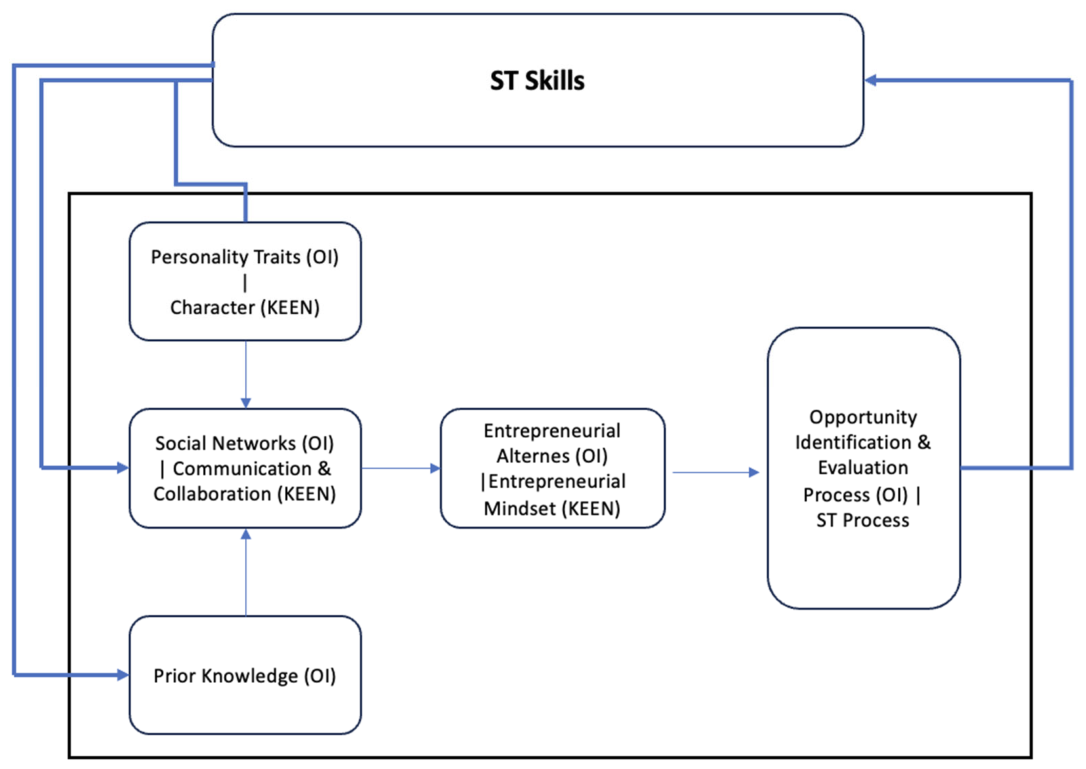

Table 1.
Distribution of interview participants across three cohorts. Participants are numbered within each cohort.
Table 1.
Distribution of interview participants across three cohorts. Participants are numbered within each cohort.
| Participant | Cohort | Program Level | Discipline |
| P1 (2022) | 2022 | 2nd year | Mechanical |
| P2 (2022) | 2022 | 4th year | Civil |
| P3 (2022) | 2022 | 4th year | Electrical and Computer |
| P4 (2022) | 2022 | 2nd year | Electrical and Computer |
| P1 (2023) | 2023 | 2nd year | Industrial |
| P2 (2023) | 2023 | 5th year | Electrical and Computer |
| P3 (2023) | 2023 | 4th year | Electrical and Computer |
| P4 (2023) | 2023 | 3rd year | Electrical and Computer |
| P5 (2023) | 2023 | 5th year | Electrical and Computer |
| P1 (2024) | 2024 | 4th year | Electrical and Computer |
| P2 (2024) | 2024 | 3rd year | Aerospace |
| P3 (2024) | 2024 | 4th year | Energy Systems |
| P4 (2024) | 2024 | 4th year | Aerospace |
Disclaimer/Publisher’s Note: The statements, opinions and data contained in all publications are solely those of the individual author(s) and contributor(s) and not of MDPI and/or the editor(s). MDPI and/or the editor(s) disclaim responsibility for any injury to people or property resulting from any ideas, methods, instructions or products referred to in the content. |
© 2026 by the authors. Licensee MDPI, Basel, Switzerland. This article is an open access article distributed under the terms and conditions of the Creative Commons Attribution (CC BY) license.
Copyright: This open access article is published under a Creative Commons CC BY 4.0 license, which permit the free download, distribution, and reuse, provided that the author and preprint are cited in any reuse.


