

Submitted:
22 June 2026
Posted:
23 June 2026
You are already at the latest version
Abstract
Generative artificial intelligence (GenAI) is becoming increasingly relevant to foreign language education, as tools such as ChatGPT are used to support teaching, learning, feedback, materials development, and assessment-related activities. However, AI-generated language does not automatically lead to language learning. Its educational value depends on how teachers design prompts that support learner effort, communicative practice, revision, reflection, and responsible classroom use. This article argues that prompt engineering should be understood not merely as a technical skill, but as an extension of foreign language teachers’ pedagogical expertise. It first situates prompt design within key principles of language teaching, and then provides practice-oriented guidance for designing ChatGPT-supported tasks by clarifying learning goals, learner and AI roles, task stages, output limits, feedback boundaries, monitoring procedures, and transparency requirements. The article presents prompting techniques, practical examples, reusable templates, classroom applications, model lessons, and prompt-repair strategies for common foreign language teaching purposes. It also discusses ethical and pedagogical risks and offers safeguards for responsible use. The article concludes that pedagogically informed prompt engineering may help language teachers use ChatGPT as a supportive classroom tool while preserving teacher judgment, learner authorship, communicative participation, and conditions for meaningful language development.
Keywords:
prompt engineering
; foreign language
; ChatGPT
; techniques
; applications
; practices
1. Introduction
Generative artificial intelligence (GenAI) – a subset of AI systems capable of producing novel content such as text, images, explanations, feedback, and learning materials – has moved from novelty to classroom reality. In foreign language settings, learners increasingly use GenAI tools to translate ideas, generate drafts, correct grammar, summarize readings, rehearse presentations, and prepare for speaking tasks (Vũ & Hà, 2026; Zaim et al., 2025). Teachers use the same technologies to create lesson plans, adapt texts, develop quizzes, produce model dialogues, generate rubrics, and provide feedback. This rapid adoption creates both opportunity and risk. More specifically, GenAI can expand access to language input and individualized support, but it can also weaken the learning processes through which languages are acquired: effortful production, negotiation of meaning, noticing, feedback uptake, revision, and reflection (Yan et al., 2024).
The central problem is that GenAI tools can generate language without guaranteeing language learning. A learner who submits an AI-generated essay may appear more proficient than they are. A teacher who accepts AI-generated feedback without review may unintentionally provide inaccurate, culturally inappropriate, or developmentally unsuitable guidance. A classroom that uses GenAI primarily to produce answers may reduce opportunities for productive struggle. Therefore, the important question is not whether foreign language teachers should use GenAI, but how they can design AI-supported learning in ways that preserve communicative purpose, learner agency, teacher judgment, and ethical responsibility.
Prompt engineering is often presented as the solution. In technical contexts, prompt engineering refers to the design and refinement of instructions that guide large language models toward useful outputs (Liu et al., 2023; Sahoo et al., 2024; Schulhoff et al., 2024). Practical guides commonly emphasize clarity, specificity, constraints, role assignment, examples, prompt chaining, and iterative refinement. These principles are valuable, and applied guides in other fields show how examples, tables, workflows, and case studies can make prompt engineering accessible to practitioners (Ekin, 2026). However, foreign language teachers need more than generic prompt tips because the success of a classroom prompt depends not only on the quality of AI output, but also on the quality of the learning activity it creates.
This article argues that prompt engineering for language teachers should be treated as pedagogical design. Here, engineering is used in the applied sense of intentional prompt design, testing, refinement, and constraint-setting. A prompt used in a foreign language classroom is not merely an instruction to GenAI. It is a compact lesson design, which defines the communicative goal, the learner role, the AI role, the linguistic focus, the expected output, the feedback process, the ethical boundary, and the evidence of learning. A weak prompt asks GenAI to complete the work, while a strong pedagogical prompt creates conditions for learners to think, compare, speak, write, revise, evaluate, and reflect.
Although many of the principles discussed in this article may apply to other GenAI tools, the paper focuses on ChatGPT (OpenAI, 2022) as the main practical example because of its widespread use in educational settings and its relevance to everyday foreign language classroom tasks. The paper makes three contributions. First, it reframes prompt engineering as a dimension of language-teacher expertise. Second, it organizes key prompt-design decisions into a practical checklist that teachers can use when preparing ChatGPT-supported foreign language tasks. Third, it provides examples, prompt templates, figures, tables, model lessons, and safeguards what teachers can adapt across writing, speaking, vocabulary, reading, pragmatics, and assessment. The core argument is that the strongest use of ChatGPT in foreign language classrooms is not answer generation, but guided participation in meaningful language tasks.
2. Prompt engineering as pedagogical design
2.1. Beyond generic prompt tips
Generic prompt engineering begins with a practical insight: better prompts produce better outputs. A vague prompt such as “Create a lesson” may generate a broad and unfocused response, while a more specific prompt such as “Create a 45-minute B1 lesson on polite requests in emails, including pre-task noticing, pair work, language focus, and a short reflection” is more likely to produce usable material. In classroom practice, specificity matters because teachers need outputs aligned with level, time, curriculum, and learner needs.
However, output quality is not the same as learning quality. A prompt that produces a polished essay may be technically successful but pedagogically weak if it replaces learner writing. A prompt that produces three revision questions may be less impressive as a product but stronger as a learning tool. Language learning depends on input, interaction, output, feedback, noticing, and reflection (Long, 1996; Schmidt, 1990; Swain, 2005). Prompts that bypass these processes risk improving performance while reducing development.
|
Prompt comparison: output generation vs learning support Weak prompt: Rewrite this student paragraph in perfect [language]. Stronger prompt: The learner is at a B1 level. Do not rewrite the paragraph. Identify two strengths, two areas for improvement, and two questions that help the learner revise independently. Focus only on organization and clarity. The stronger prompt preserves learner authorship and supports formative revision rather than substitution. |
2.2. Prompt engineering as teacher professional knowledge
Prompt engineering should be located within the teacher’s professional knowledge. Teachers already design tasks, sequence instruction, select input, scaffold interaction, adapt materials, and assess performance. Prompt engineering extends these responsibilities into human-AI interaction. The teacher must decide what GenAI should do, what it should not do, how much support is appropriate, how output will be checked, and how learners will demonstrate ownership.
This view is consistent with responsible AI guidance, which emphasizes human oversight, transparency, privacy, fairness, and institutional accountability (European Commission, 2022; Miao & Holmes, 2023). In foreign language classrooms, these principles are concrete. Teachers must avoid entering identifiable student data into public tools, prevent GenAI from replacing learner production, check for inaccurate explanations, and ensure that GenAI feedback does not erase learner voice or impose narrow native-speaker norms. If prompt engineering is understood as part of teacher professional knowledge, then effective classroom prompting requires more than technical fluency with a GenAI tool. Table 1 summarizes the knowledge domains and their role in pedagogical prompt design.
3. Theoretical foundations
3.1. Task-based language teaching
Task-based language teaching (TBLT) offers a strong foundation for responsible AI use because it begins with meaningful language action rather than isolated practice. In TBLT, learners use language to complete communicative tasks such as solving a problem, planning an event, comparing options, reaching a decision, giving advice, or producing a text for a real or simulated audience (Ellis, 2003; Long, 2015; Nunan, 2004; Willis & Willis, 2007). Accuracy remains important, but it is integrated into meaningful use.
GenAI can support TBLT by generating role cards, producing input texts, simulating audiences, offering feedback, suggesting alternative expressions, and helping learners prepare for interaction. Yet GenAI can also undermine TBLT if it completes the communicative work for learners. The teacher’s task is to position GenAI as a resource within the task cycle, not as the performer of the task.
3.2. CEFR and the action-oriented classroom
The CEFR Companion Volume frames learners as social agents who mobilize linguistic, sociolinguistic, pragmatic, plurilingual, and intercultural resources to act in meaningful contexts (Council of Europe, 2020). This action-oriented view aligns closely with task-based prompt engineering and with earlier communicative approaches that emphasize grammatical, sociolinguistic, and strategic dimensions of language ability (Canale & Swain, 1980). It encourages teachers to ask not only what language learners know, but what they can do with language.
A CEFR-informed classroom prompt should therefore specify communicative action. For example, instead of asking ChatGPT to create a grammar exercise, a teacher might ask it to design a B1 task in which learners advise a classmate, use modal verbs, respond to follow-up questions, and self-assess clarity and politeness. The prompt connects language form with communicative function.
3.3. Formative feedback and learner agency
GenAI feedback is attractive because it is immediate, detailed, and scalable. Yet feedback is only effective when learners understand it and can act on it (Hattie & Timperley, 2007; Hyland & Hyland, 2019). If GenAI provides too many corrections, rewrites the learner’s text, or uses language beyond the learner’s level, it may reduce rather than increase learning.
For this reason, GenAI feedback prompts should be constrained. They should focus on selected criteria, avoid complete rewriting, use accessible language, and require learner decisions. The learner should remain the author of the text and the evaluator of AI suggestions.
4. Key decisions in foreign language prompt design
Prompt design in foreign language teaching should begin with a communicative learning purpose, not with an AI tool itself. Figure 1 presents a task-based cycle for integrating ChatGPT into foreign language classrooms. Effective foreign language prompt design begins with the communicative outcome, learner profile, and task stage. Teachers then write a constrained prompt that defines AI’s role, output format, and boundaries. The resulting output should not be treated as automatically correct or pedagogically appropriate. Learners should evaluate it against task criteria, revise or perform the task themselves, and document how ChatGPT was used. Finally, the teacher validates whether learners can demonstrate the target language or communicative outcome independently. Table 2 translates this process into a practical checklist for planning AI-supported foreign language tasks.
5. Core prompting techniques for foreign language teachers
The following prompting techniques are not presented as technical tricks. They are pedagogical design moves that help teachers control the learning process, protect learner agency, align ChatGPT use with communicative outcomes, and ensure that AI support remains connected to classroom aims.
5.1. Clear and specific instructions
Clarity and specificity are foundational. In foreign language education, a strong prompt should usually include level, topic, task purpose, time, interaction pattern, language focus, and desired output format. Without these details, ChatGPT may produce material that is too advanced, too long, culturally irrelevant, or disconnected from the lesson’s aim.
|
Example: improving specificity Weak prompt: Make a speaking activity. Stronger prompt: Create a 15-minute B1 pair-speaking activity on planning a weekend trip. Learners must make suggestions, agree, disagree politely, and reach a decision. Include role cards, useful phrases, and a self-assessment checklist. |
5.2. Explicit constraints
Constraints help teachers control AI output. Useful constraints include word count, CEFR level, number of questions, type of questions, feedback scope, tone, genre, and prohibited actions. Constraints are particularly important when ChatGPT is used with younger or lower-proficiency learners.
|
Example: constrained reading prompt Create a 220-word B1 reading text about reducing plastic waste. Use short paragraphs, avoid idioms, include the words reduce, recycle, waste, protect, and environment, and write five comprehension questions: two factual, two inference-based, and one personal-response question. |
5.3. Role prompting
Role prompting assigns ChatGPT a function, such as conversation partner, feedback assistant, vocabulary coach, text simplifier, or rubric checker. In foreign language contexts, the role should be bounded. Asking ChatGPT to act as “teacher” may be too broad. A safer approach is to define a limited role and specify what ChatGPT should not do. Table 3 illustrates how common AI roles can be bounded through explicit safeguards so that ChatGPT supports classroom learning without taking over learner production or teacher judgment.
5.4. Few-shot prompting
Few-shot prompting gives the model examples of the desired output, drawing on the capacity of large language models to perform tasks from examples provided in the prompt (Brown et al., 2020). In foreign language teaching, it is useful for controlling feedback tone, response length, proficiency level, and task format. Examples can prevent AI tools from producing overly technical, discouraging, or advanced language.
|
Example: few-shot feedback style Use this feedback style: - Your opinion is clear. Add one example to support it. - Your sentence is understandable. Check the verb tense in the second clause. Now give feedback on the learner paragraph below. Use the same simple and supportive style. Do not rewrite the paragraph. |
5.5. Prompt chaining
Prompt chaining breaks complex tasks into stages. It is especially useful for writing, project work, problem-solving, and speaking preparation. Instead of asking ChatGPT to produce a complete final answer, the teacher guides learners through a sequence: brainstorm, select, organize, draft, receive feedback, revise, and reflect. Table 4 situates prompt chaining alongside other prompting techniques that can be adapted for foreign language teaching.
6. Reusable prompt templates for teachers
The following templates are designed for adaptation rather than direct copying. Teachers can complete the bracketed fields by adding the learner level, lesson goal, target language, task criteria, text, vocabulary set, or communicative purpose. The templates are intentionally structured to prevent common problems such as over-automation, level mismatch, vague feedback, and lack of learner reflection. They also keep ChatGPT use connected to classroom decision-making by specifying what ChatGPT should produce, what it should not do, and how learners will use the output. Table 5 provides reusable prompt templates for common foreign language teaching purposes.
7. Classroom applications
The following section illustrates how ChatGPT-supported prompt engineering can be applied across common areas of foreign language teaching. As shown in Figure 2, each classroom application should connect a specific AI function with a learner process and a safeguard that preserves learner agency, teacher judgment, and responsible classroom use.
7.1. Writing feedback
Writing feedback is one of the most immediate applications of GenAI in foreign language classrooms. To preserve authorship, GenAI feedback should be limited to comments, priorities, and revision questions rather than full rewriting. For example, students can first write a 150-word email requesting information about a school exchange programme. The teacher then uses a ChatGPT feedback prompt that focuses on clear purpose, organization, politeness, and grammar, while explicitly prohibiting full rewriting. Students revise their own email, highlight changes, and submit a reflection explaining which ChatGPT suggestions they accepted or rejected.
7.2. Speaking rehearsal
GenAI can simulate interlocutors and provide repeated practice, which is valuable in contexts where learners have limited opportunities to speak a foreign language outside class (Belda-Medina & Calvo-Ferrer, 2022). However, GenAI should support rather than replace human interaction (Meadan et al., 2026). A strong sequence is: ChatGPT rehearsal, peer interaction, teacher feedback, and learner reflection. For example, learners can rehearse asking for information at an airport desk with ChatGPT, then perform the same scenario with a classmate. ChatGPT provides preparation, but the communicative event remains social.
7.3. Vocabulary development
Vocabulary learning requires repeated exposure, retrieval, depth of processing, and meaningful use (Nation, 2013). GenAI is useful for generating contextualized examples, gap-fill tasks, sorting tasks, and communicative practice. However, prompts should avoid isolated word lists. A better prompt asks ChatGPT to create a problem-solving task in which learners must use target words to make decisions, negotiate, or produce a spoken or written outcome.
7.4. Reading adaptation
Teachers often need to adapt authentic texts to the learner’s level. GenAI can simplify vocabulary and sentence structure quickly, but simplification may remove nuance, argument structure, or cultural information (Aldamen et al., 2026). Therefore, reading adaptation prompts should require ChatGPT to list what it changed and what may have been lost. Learners can then compare the original and simplified texts, turning ChatGPT adaptation into a critical reading activity.
7.5. Intercultural pragmatics
Foreign language learners need to understand how language choices vary by relationship, power, distance, genre, and context (Pflaeging & Schleef, 2026; Taguchi, 2019). ChatGPT can generate multiple versions of requests, apologies, disagreements, and invitations. However, teachers must prevent cultural stereotyping. Prompts should explicitly state that appropriateness depends on situation and community, not fixed national stereotypes.
7.6. CEFR-informed assessment practice
GenAI can help learners understand assessment expectations by generating practice tasks and self-assessment checklists (Bearman et al., 2023). It should not replace teacher judgment or official CEFR assessment. A responsible prompt asks ChatGPT to create a CEFR-informed task, but not to assign an official level. This distinction preserves the formative role of ChatGPT and the professional role of teachers.
8. Model lessons
8.1. Model lesson 1: Writing a polite request email
Context: B1 foreign language learners are learning how to write semi-formal emails. The communicative outcome is to request information clearly and politely.
Stage 1 - Noticing: The teacher prompts ChatGPT to generate two short emails: one too direct and one appropriate. Students compare tone, greeting, request forms, and closing. This stage develops awareness before production.
Stage 2 - Planning: Students complete a planning table with a greeting, reason for writing, two questions, polite closing, and signature. ChatGPT can generate the planning table, but students fill it in.
Stage 3 - Drafting: Students write their first draft without ChatGPT completing it.
Stage 4 - Focused feedback: ChatGPT gives comments on purpose, politeness, organization, and grammar, but does not rewrite the text.
Stage 5 - Revision and reflection: Students revise, highlight changes, and explain one ChatGPT suggestion they accepted and one they rejected.
|
Teacher prompt for the feedback stage Read this B1 learner email. Do not rewrite it. Give feedback on purpose, politeness, organization, and grammar. For each category, give one short comment and one revision question. Use simple [language]. End with a four-item checklist for revision. |
8.2. Model lesson 2: Giving advice in spoken interaction
Context: A2-B1 learners practice giving advice to classmates using “should”, “could”, “why don’t you”, and “maybe you can”.
Stage 1 - Input: ChatGPT generates problem cards about school-related issues while avoiding sensitive topics.
Stage 2 - Controlled practice: Students match advice expressions to problem cards and identify which expressions are more polite or supportive.
Stage 3 - ChatGPT rehearsal: Learners practice with ChatGPT, which asks one question at a time and gives delayed feedback after three exchanges.
Stage 4 - Peer role-play: Students perform the role-play with classmates. This maintains human interaction as the central communicative event.
Stage 5 - Reflection: Learners identify one phrase they used successfully and one communication strategy they want to improve.
|
Student-facing speaking prompt Act as a classmate with a simple school problem. Tell me the problem in two sentences. Wait for my advice. Ask one follow-up question. After three exchanges, give feedback on clarity, politeness, and use of advice phrases. Do not correct every grammar mistake. |
8.3. Model lesson 3: Reading adaptation and critical AI literacy
Context: B1 learners read a short article about online learning. The teacher wants to make the text accessible without hiding the fact that simplification changes texts.
The prompt asks ChatGPT for a simplified version, a list of changed vocabulary, and an explanation of any removed details. Learners compare the original and simplified versions, identify meaning differences, and discuss whether simplification helped or weakened the text.
This lesson develops reading comprehension and critical AI literacy at the same time. Learners see that AI output is useful, but not neutral.
9. Ethical risks and safeguards
GenAI can support foreign language teaching, but its outputs should not be accepted uncritically. Before using ChatGPT-generated materials, feedback, or assessment support in class, teachers need a simple review process to check whether the output is accurate, level-appropriate, unbiased, privacy-safe, and pedagogically useful. Figure 3 presents a responsible prompt review loop for managing AI-related risks before classroom use.
9.1. Hallucination
GenAI may produce explanations that sound fluent and convincing but are factually wrong (Georgiou, 2026). In foreign language contexts, this may include false grammar rules, inaccurate cultural claims, unnatural examples, or invented academic references. For this reason, prompts should explicitly instruct ChatGPT not to invent facts, sources, or examples when it is uncertain. Teachers should also verify AI outputs before using them in class, especially when the content concerns grammar explanations, intercultural knowledge, or references (Shoufan & Esmaeil, 2026).
9.2. Overcorrection
GenAI can support feedback and revision, but it may also rewrite learner work too extensively. When this happens, the learner’s original meaning, voice, and developmental level may disappear. This is especially problematic in language learning because errors can show what learners are ready to notice and improve. Prompts should therefore ask ChatGPT to give feedback, identify patterns, and correct only errors linked to the lesson focus rather than fully rewriting the text (Schultz, 2026).
9.3. Bias and linguistic normativity
GenAI systems may reproduce linguistic and cultural biases from their training data (Georgiou, 2025a). In English language teaching, this can mean privileging dominant varieties such as Standard American or British English, treating other varieties as deficient, or producing culturally narrow examples. Teachers should therefore prompt ChatGPT to include international English contexts, avoid stereotypes, and focus on intelligibility, appropriateness, and communicative effectiveness rather than native-speaker norms alone (Bender et al., 2021).
9.4. Privacy
Teachers should avoid uploading identifiable learner data into GenAI tools because student writing, names, locations, classroom events, or personal experiences may contain sensitive information. Before using ChatGPT to analyse or adapt learner texts, teachers should anonymize the data, remove personal details, and follow institutional and national data-protection policies. This is particularly important when GenAI tools are hosted by external providers whose data storage and training practices may not be fully transparent (Miao & Holmes, 2023).
9.5. Learner dependency
GenAI can provide immediate explanations and answers, but excessive reliance may reduce learners’ independence, critical thinking, and willingness to struggle productively with language (Georgiou, 2025b). If students always receive complete answers, they may skip the cognitive work needed for noticing, hypothesis-testing, revision, and self-monitoring. Prompts should therefore ask ChatGPT to provide hints, guiding questions, examples, and staged feedback rather than final products. This keeps ChatGPT use supportive while preserving learner agency.
9.6. Academic integrity
Students need clear rules about when GenAI assistance is allowed, what kinds of support are acceptable, and how GenAI use should be acknowledged. Instead of relying only on AI-detection tools, teachers can make learning processes more visible through process logs, drafts, revision histories, oral explanations, and AI-use declarations. These practices help distinguish acceptable support from misconduct and encourage students to reflect on how models such as ChatGPT contributed to their work (Gonsalves, 2025).
|
AI-use declaration template I used AI to: brainstorm ideas / check vocabulary / receive feedback / practice speaking / improve organization. The most useful AI suggestion was: _____. I accepted it because: _____. I rejected this suggestion: _____. My final work is my own because: _____. |
10. Prompt failure modes and repairs
Prompt failure should be treated as part of iterative instructional design rather than as a reason to abandon GenAI use. When AI output is unsuitable, the teacher can revise the prompt by adding context, constraints, examples, criteria, or safeguards. In foreign language classrooms, common failures include unclear instructions, level mismatch, over-automation, overcorrection, hallucination, cultural bias, feedback overload, lack of reflection, hidden GenAI use, and teacher overtrust. Table 6 summarizes these failure modes, shows how they may appear in classroom prompts, and suggests practical repairs.
11. Discussion
This article has argued that prompt engineering for foreign language teachers should be understood as a form of pedagogical design rather than as a purely technical skill. This shift is important because the value of GenAI in language education does not depend only on the fluency or speed of AI-generated output. In foreign language classrooms, the more important question is whether AI-supported tasks create opportunities for learners to notice language, produce meaning, receive feedback, revise their work, interact with others, and reflect on their learning. These processes are central to second language development, particularly in relation to noticing, interaction, output, and feedback uptake (Hattie & Timperley, 2007; Long, 1996; Schmidt, 1990; Swain, 2005).
The discussion also highlights the continuing importance of teacher judgment. ChatGPT can generate texts, dialogues, explanations, quizzes, feedback, and assessment-related materials, but it does not automatically know local curriculum goals, learner histories, classroom relationships, cultural expectations, institutional policies, or assessment standards. Teachers, therefore, remain responsible for deciding what ChatGPT should do, what it should not do, how much support is appropriate, and how AI output will be checked before use. This position is consistent with responsible AI guidance, which emphasizes human oversight, transparency, privacy, fairness, and accountability in educational settings (European Commission, 2022; Miao & Holmes, 2023).
A key implication is that ChatGPT use should be integrated into classroom workflows rather than treated as a shortcut to final products. The practical checklist proposed in this article helps teachers specify the learning target, learner level, communicative situation, input materials, process stage, ChatGPT role, output format, monitoring procedure, prompt refinement, and transparency expectations. These decisions make ChatGPT use more pedagogically controlled. For example, ChatGPT can support brainstorming without writing the final answer, provide feedback without erasing the learner’s voice, simulate speaking practice without replacing peer interaction, and generate assessment practice without assigning official proficiency levels. In this way, ChatGPT becomes a pedagogical support tool that encourages participation and reflection rather than a substitute for learner effort or teacher expertise (Council of Europe, 2020).
Implementation requires more than giving teachers lists of useful prompts. Professional development should help teachers evaluate AI output, identify hallucinations, avoid overcorrection, protect learner privacy, recognize bias, and design process-based assessments. Teachers need opportunities to compare weak and strong prompts, revise prompts collaboratively, build local prompt banks, and adapt templates to their own learners and curricula. They also need institutional guidance on acceptable AI use, AI-use declarations, data protection, and academic integrity. Without such support, ChatGPT integration may remain inconsistent, overly dependent on individual teacher confidence, or disconnected from curriculum and assessment policy (Bearman et al., 2023; Gonsalves, 2025; Miao & Holmes, 2023).
The article also suggests that responsible AI use in foreign language education should be evaluated through evidence of learning, not only through the quality of AI-generated output. A polished ChatGPT-generated paragraph, dialogue, or rubric is not necessarily evidence that learners have developed communicative competence. Stronger evidence may come from learner drafts, revision histories, oral explanations, peer interaction, reflection logs, self-assessment checklists, and teacher observations. This is especially important because ChatGPT can improve visible performance while reducing the productive struggle through which learners develop independence, accuracy, and communicative confidence (Yan et al., 2024; Zaim et al., 2025).
12. Conclusions
This article has presented a practical checklist, prompt templates, classroom applications, model lessons, ethical safeguards, and failure-mode repairs to show how ChatGPT can support lesson planning, writing feedback, speaking rehearsal, vocabulary learning, reading adaptation, intercultural pragmatics, CEFR-informed assessment practice, and AI literacy while preserving teacher judgment, learner agency, transparency, privacy, and academic integrity. However, the guidance remains conceptual and practice-oriented rather than empirically validated, and it should be tested across different foreign language contexts, learner ages, proficiency levels, institutions, and GenAI tools. Future research should examine whether pedagogically designed prompts improve learning outcomes such as writing revision quality, speaking confidence, vocabulary retention, reading comprehension, feedback uptake, and critical AI literacy.
Funding
This study received no funding.
Conflicts of Interest
There is no conflict of interest to disclose.
References
- Aldamen, H.; Alnemrat, A.; Al-Deaibes, M.; Alsharefeen, R. Using AI to adapt reading input for mixed-proficiency EFL learners. Front. Educ. 2026, 11, 1737903. [Google Scholar] [CrossRef]
- Bearman, M.; Ryan, J.; Ajjawi, R. Discourses of artificial intelligence in higher education: A critical literature review. High. Educ. 2023, 86(2), 369–385. [Google Scholar]
- Belda-Medina, J.; Calvo-Ferrer, J. R. Using chatbots as AI conversational partners in language learning. Appl. Sci. 2022, 12(17), 8427. [Google Scholar] [CrossRef]
- Bender, E. M.; Gebru, T.; McMillan-Major, A.; Shmitchell, S. On the dangers of stochastic parrots: Can language models be too big?🦜. In Proceedings of the 2021 ACM conference on fairness, accountability, and transparency, 2021, March; pp. 610–623. [Google Scholar]
- Brown, T. B.; Mann, B.; Ryder, N.; Subbiah, M.; Kaplan, J. D.; Dhariwal, P.; Neelakantan, A.; et al. Language models are few-shot learners. Adv. Neural Inf. Process. Syst. 2020, 33, 1877–1901. [Google Scholar]
- Canale, M.; Swain, M. Theoretical bases of communicative approaches to second language teaching and testing. Appl. Linguist. 1980, 1(1), 1–47. [Google Scholar] [CrossRef]
- Council of Europe. Common European Framework of Reference for Languages: Learning, teaching, assessment - Companion volume; Council of Europe Publishing, 2020. [Google Scholar]
- Ekin, S. Prompt engineering for ChatGPT: A quick guide to techniques, tips, and best practices. J. Eng. Technol. 2026, 43, 52–68. [Google Scholar] [CrossRef]
- Ellis, R. Task-based language learning and teaching; Oxford University Press, 2003. [Google Scholar]
- European Commission. Ethical guidelines on the use of artificial intelligence and data in teaching and learning for educators; Publications Office of the European Union, 2022. [Google Scholar]
- Georgiou, G. P. ChatGPT exhibits bias toward developed countries over developing ones, as indicated by a sentiment analysis approach. J. Lang. Soc. Psychol. 2025a, 44(1), 132–141. [Google Scholar]
- Georgiou, G. P. ChatGPT produces more “lazy” thinkers: Evidence of cognitive engagement decline. arXiv 2025b, arXiv:2507.00181. [Google Scholar]
- Georgiou, G. P. Key Features to Distinguish Between Human-and AI-Generated Texts: Perspectives from University Professors. AI Educ. 2026, 2(1), 2. [Google Scholar] [CrossRef]
- Gonsalves, C. Addressing student non-compliance in AI use declarations: implications for academic integrity and assessment in higher education. Assess. Eval. High. Educ. 2025, 50(4), 592–606. [Google Scholar]
- Hattie, J.; Timperley, H. The power of feedback. Rev. Educ. Res. 2007, 77(1), 81–112. [Google Scholar] [CrossRef]
- Hyland, K.; Hyland, F. (Eds.) Feedback in second language writing: Contexts and issues, 2nd ed.; Cambridge University Press, 2019. [Google Scholar]
- Liu, P.; Yuan, W.; Fu, J.; Jiang, Z.; Hayashi, H.; Neubig, G. Pre-train, prompt, and predict: A systematic survey of prompting methods in natural language processing. ACM Comput. Surv. 2023, 55(9), 1–35. [Google Scholar] [CrossRef]
- Long, M. H. The role of the linguistic environment in second language acquisition. In Handbook of second language acquisition; Ritchie, W., Bhatia, T., Eds.; Academic Press, 1996; pp. 413–468. [Google Scholar]
- Long, M. H. Second language acquisition and task-based language teaching; Wiley Blackwell, 2015. [Google Scholar]
- Meadan, H.; Alqunaysi, R.; Jennings, S.; Douglas, S. N.; Reilly, A. M.; Xiong, J. “Nothing Can Replace Authentic Human Interaction”: EI/ECSE Professionals’ Perception of AI. Top. Early Child. Spec. Educ. 2026, 20. [Google Scholar] [CrossRef]
- Miao, F.; Holmes, W. Guidance for generative AI in education and research; UNESCO, 2023; Available online: https://www.unesco.org/en/articles/guidance-generative-ai-education-and-research.
- Nation, I. S. P. Learning vocabulary in another language, 2nd ed.; Cambridge University Press, 2013. [Google Scholar]
- Nunan, D. Task-based language teaching; Cambridge University Press, 2004. [Google Scholar]
- OpenAI. Introducing ChatGPT. 30 November 2022. Available online: https://openai.com/index/chatgpt/.
- Pflaeging, J.; Schleef, E. Sociolinguistic Competence in Curricula, Teacher Cognition, and Classroom Practice: Research Gaps and Future Directions. Languages 2026, 11(3), 47. [Google Scholar] [CrossRef]
- Sahoo, P.; Singh, A. K.; Saha, S.; Jain, V.; Mondal, S.; Chadha, A. A systematic survey of prompt engineering in large language models: Techniques and applications. arXiv 2024, arXiv:2402.07927. [Google Scholar]
- Schmidt, R. The role of consciousness in second language learning. Appl. Linguist. 1990, 11(2), 129–158. [Google Scholar] [CrossRef]
- Schulhoff, S.; Ilie, M.; Balepur, N.; Kahadze, K.; Liu, A.; Si, C.; Resnik, P. The prompt report: A systematic survey of prompt engineering techniques. arXiv 2024, arXiv:2406.06608. [Google Scholar]
- Schultz, H. Feedback-Only AI for Writing Instruction: A Constrained-Generative Tool That Preserves Authorship. Bus. Prof. Commun. Q. 2026. [Google Scholar] [CrossRef]
- Shoufan, A.; Esmaeil, A. A. A. AI hallucination from students’ perspective: A thematic analysis. arXiv 2026, arXiv:2602.17671. [Google Scholar]
- Swain, M. The output hypothesis: Theory and research. In Handbook of research in second language teaching and learning; Hinkel, E., Ed.; Lawrence Erlbaum, 2005; pp. 471–483. [Google Scholar]
- Taguchi, N. (Ed.) The Routledge handbook of second language acquisition and pragmatics; Routledge, 2019. [Google Scholar]
- Vũ, V. B.; Hà, T. A. The use of generative AI tools by EFL university students for L2 oral presentations: a mixed methods study. Lond. Rev. Educ. 2026, 24(1), 10. [Google Scholar] [CrossRef]
- Willis, D.; Willis, J. Doing task-based teaching; Oxford University Press, 2007. [Google Scholar]
- Yan, L.; Greiff, S.; Teuber, Z.; Gašević, D. Promises and challenges of generative artificial intelligence for human learning. Nat. Hum. Behav. 2024, 8(10), 1839–1850. [Google Scholar] [CrossRef] [PubMed]
- Zaim, M.; Arsyad, S.; Waluyo, B.; Ardi, H.; Al Hafizh, M.; Zakiyah, M.; Hardiah, M. Generative AI as a cognitive co-pilot in English language learning in higher education. Educ. Sci. 2025, 15(6), 686. [Google Scholar] [CrossRef]
Figure 1.
Task-based ChatGPT integration cycle for foreign language classrooms.
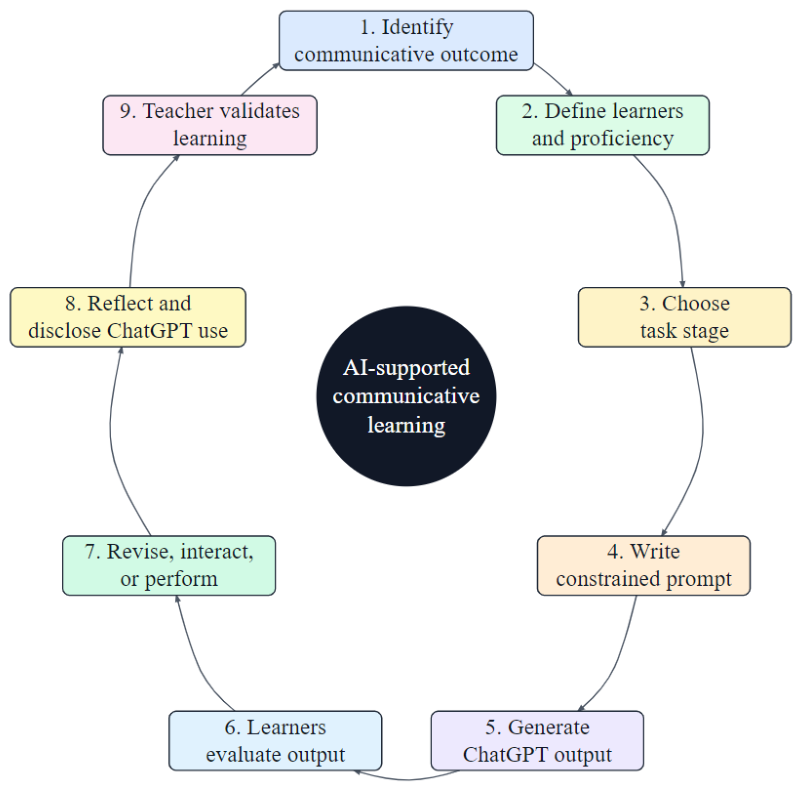
Figure 2.
Multidimensional classroom application matrix for ChatGPT-supported foreign language teaching.
Figure 2.
Multidimensional classroom application matrix for ChatGPT-supported foreign language teaching.
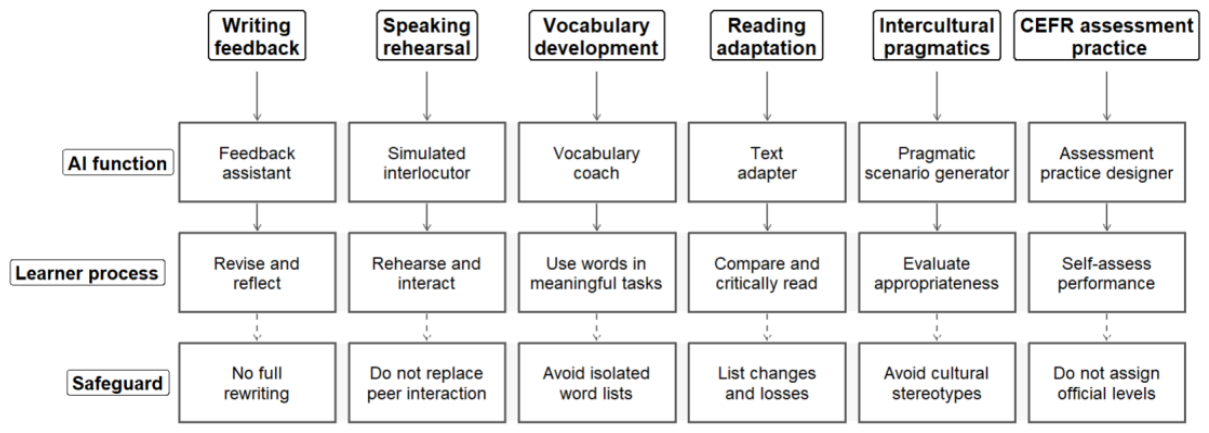
Figure 3.
Responsible prompt review loop for managing AI-related risks before classroom use.
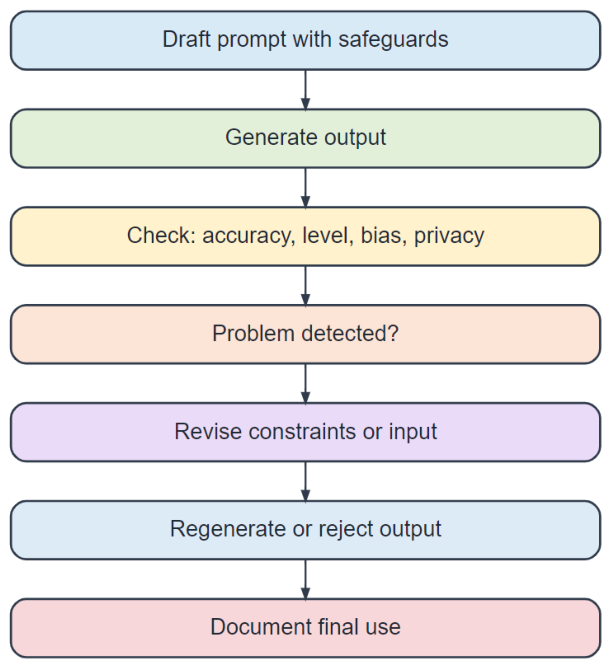

Table 1.
Teacher knowledge domains involved in foreign language prompt design.
| Knowledge domain | Role in prompt engineering |
| Linguistic knowledge | Selecting grammar, vocabulary, discourse, pragmatics, register, and intelligibility goals |
| Pedagogical knowledge | Designing tasks, scaffolds, feedback cycles, interaction patterns, and reflection |
| Assessment knowledge | Aligning prompts with rubrics, CEFR descriptors, formative criteria, and evidence of learning |
| Ethical knowledge | Protecting privacy, avoiding bias, ensuring disclosure, and maintaining learner agency |
| Technological knowledge | Understanding hallucination, prompt drift, model variability, and output limits |
| Contextual knowledge | Adapting prompts to learner age, proficiency, culture, curriculum, and classroom resources |
Table 2.
Practical checklist for foreign language prompt design.
| Component | Guiding question | Example |
| Target | What skill, function, genre, or language feature is being developed? | Practice polite requests in a semi-formal email |
| Audience | Who are the learners and what is their level? | Grade 9 Thai EFL learners at A2-B1 level |
| Situation | What communicative context frames the task? | Writing to a school office to ask for information |
| Knowledge input | What input, examples, rubric, or vocabulary should ChatGPT use? | Use these five target phrases and this checklist |
| Process | Which stage should ChatGPT support? | Brainstorming only; do not write the final answer |
| Role | What should ChatGPT do and not do? | Act as feedback assistant, not ghostwriter |
| Output | What format should ChatGPT produce? | A table with strengths, suggestions, and revision questions |
| Monitoring | How will learners check the output? | Compare ChatGPT feedback with teacher rubric |
| Prompt refinement | How will prompts be improved after review? | Reduce language to B1 and add examples |
| Transparency | How will ChatGPT use be documented? | Learner submits an AI-use reflection log |
Table 3.
Useful AI roles and safeguards in foreign language classrooms.
| AI role | Use | Risk | Safeguard |
| Conversation partner | Fluency rehearsal | Replacing peer interaction | Ask one question at a time; give delayed feedback |
| Feedback assistant | Writing revision | Ghostwriting | Do not rewrite; give comments and questions |
| Vocabulary coach | Lexical practice | Word-list memorization | Create a communicative task using target words |
| Rubric checker | Assessment preparation | False authority | Give formative suggestions, not official scores |
| Text adapter | Reading support | Meaning distortion | List what was simplified or removed |
Table 4.
Prompting techniques adapted for foreign language teaching.
| Technique | Description | Foreign language use | Sample prompt |
| Zero-shot prompting | No example is given | Quick classroom material generation | Create five B1 discussion questions about online learning. |
| Few-shot prompting | Examples guide the output | Feedback tone and consistency | Use the example comments below and give similar feedback. |
| Role prompting | ChatGPT is assigned a role | Speaking rehearsal | Act as a hotel receptionist and ask one question at a time. |
| Constraint prompting | Rules limit output | Level and format control | Use B1 vocabulary and no more than 150 words. |
| Prompt chaining | Task is divided into steps | Writing process | First brainstorm, then outline, then revise. |
| Contrastive prompting | ChatGPT compares alternatives | Grammar and pragmatics | Compare direct and indirect requests. |
| Critique prompting | ChatGPT evaluates a draft | Peer-review training | Find two strengths and one improvement point. |
| Reflection prompting | Learner explains ChatGPT use | AI literacy | Ask what suggestion the learner accepted and why. |
Table 5.
Reusable foreign language prompt templates.
| Purpose | Template |
| Lesson planning | Create a [time]-minute [level] lesson on [topic]. The communicative goal is [goal]. Include pre-task, task, language focus, feedback, and reflection stages. |
| Writing feedback | Give feedback on this [level] learner text. Focus on [criteria]. Do not rewrite it. Give strengths, suggestions, and revision questions. |
| Speaking rehearsal | Act as [role]. Ask one question at a time. Use [level] [language]. After [number] turns, give delayed feedback on [criteria]. |
| Vocabulary learning | Create a communicative task using these words: [list]. Learners must use the words to [communicative purpose]. |
| Reading adaptation | Simplify this text for [level]. Preserve the main meaning. List what you changed and explain why. |
| Grammar noticing | Create a noticing task where learners compare sentences using [grammar point] and infer the rule. |
| Intercultural pragmatics | Create scenarios showing different ways to [function]. Avoid stereotypes and explain that appropriateness depends on context. |
| Assessment practice | Create a CEFR-informed practice task for [level]. Include a self-assessment checklist, but do not assign an official level. |
| AI literacy | Ask learners to evaluate the AI output for accuracy, usefulness, bias, missing information, and fit for purpose. |
Table 6.
Common prompt failure modes and repairs.
| Failure mode | Description | Example | Repair |
| Under-specification | Prompt lacks level, aim, or format | Create a lesson | Add level, time, skill, topic, and outcome |
| Over-automation | GenAI completes learner work | Write my essay | Ask for feedback, outline, or questions only |
| Level mismatch | Output too advanced or too simple | C1 text for A2 learners | Specify CEFR level and sentence length |
| Overcorrection | Learner voice disappears | Rewrite perfectly | Limit correction to target feature |
| Hallucination | GenAI invents facts or rules | Fake grammar explanation | Require uncertainty and verification |
| Cultural bias | Output reflects narrow assumptions | Stereotyped examples | Request diverse, context-sensitive examples |
| Feedback overload | Too many corrections overwhelm learners | Correct everything | Limit feedback to two or three priorities |
| No reflection | Learner copies output without learning | Use this answer | Add reflection and revision log |
| Hidden GenAI use | Student submits GenAI output as original | No disclosure | Require process evidence and AI-use declaration |
| Teacher overtrust | Teacher accepts output uncritically | Wrong rubric feedback | Teacher validates before use |
Disclaimer/Publisher’s Note: The statements, opinions and data contained in all publications are solely those of the individual author(s) and contributor(s) and not of MDPI and/or the editor(s). MDPI and/or the editor(s) disclaim responsibility for any injury to people or property resulting from any ideas, methods, instructions or products referred to in the content. |
© 2026 by the author. Licensee MDPI, Basel, Switzerland. This article is an open access article distributed under the terms and conditions of the Creative Commons Attribution (CC BY) license.
Copyright: This open access article is published under a Creative Commons CC BY 4.0 license, which permit the free download, distribution, and reuse, provided that the author and preprint are cited in any reuse.


