

Submitted:
22 June 2026
Posted:
23 June 2026
You are already at the latest version
Abstract
Healthcare continuous data often deviate from normality, which can substantially increase the risk of making invalid inferences, given that many inferential statistical procedures rely on normality assumption. To obviate this issue, we propose a new family of non-normal distributions based on a linear combination of the quantile functions of standard logistic and uniform (0, 1) distributions. This new family of non-normal distributions is characterized by using the methods of L-moments, conventional moments, and percentiles. Its performance is compared among the three methods in the context of parameter estimation and data modeling. The results of Monte Carlo simulation and bootstrapping techniques indicate that the L-moment-based estimates of parameters of L-skewness and L-kurtosis are substantially less biased than their percentile-based estimates of left-right tail-weight ratio (a measure of skewness) and tail-weight factor (a measure of kurtosis), which in turn are superior to their moment-based counterparts of skewness and kurtosis, especially for small sample sizes and higher-order moments. On the other hand, the data modeling results indicate that the percentile-based fits of the proposed distributions provide slightly better approximations to real-world healthcare data than their L-moment-based counterparts, whereas both percentile- and L-moment-based methods are superior to their conventional moment-based counterparts.
Keywords:
logistic quantile
; polynomial mixture
; non-normal distribution
; healthcare data
; Monte Carlo simulation
; estimation
1. Introduction
Real-world healthcare data (e.g., hospital charges, length of hospital stays, cholesterol, glucose, blood pressure, body mass index [BMI], waist circumference, ankle circumference, chest circumference, etc.) often exhibit non-normal characteristics (e.g., skewness, heavy tails, peaked at the center of the distribution), which may pose challenges to the classical data modeling approaches and inferential statistical procedures, such as t-tests, analysis of variance (ANOVA), and linear regression that rely on normality assumption of the outcome variable.
Many applied and methodological research studies demonstrate that continuous healthcare and biomedical data frequently deviate from the well-known normal distribution, suggesting the use of data transformations, non-parametric techniques, or alternative modeling strategies. Empirical studies and reviews (e.g., [1,2]) show that clinical variables such as laboratory biomarkers, symptom scores, healthcare costs, and length of hospital stays are often skewed, heavy-tailed, or bounded, rendering normality assumptions inappropriate. Systematic reviews (e.g., [3]) further suggest that non-normal distributions are typical rather than the exception across health and social science research, with right skewness and excess kurtosis being particularly prevalent. Applied methodological papers (e.g., [4,5]) highlight that reliance on mean and standard deviation for describing non-normal data can lead to misleading interpretation and inferential errors. In health economics and outcomes research (e.g., [6,7]), healthcare cost and healthcare utilization data consistently exhibit strong positive skew and non-normal variance structures, which motivates the use of generalized linear and non-parametric models.
The quest for developing new probability distributions to provide accurate modeling of non-normal data is not new. Historically, a variety of frameworks or systems have been developed as a contribution to the long-standing stream of research for modeling non-normal distributions. Some of the well-known historical contributions to modeling non-normal distributions with skewness and kurtosis include studies such as: [8,9] introduced a differential equation-based framework to systematically classify, and model skewed and kurtotic distributions. [10] proposed a transformation-based distribution system that generates flexible skewed distributions through parametric transformations of normal distribution. [11] introduced the Box-Cox transformation to normalize non-normal data via power transformation. [12], later expanded by [13], proposed the g-and-h family of distributions, a quantile-based framework that allows independent control of skewness and tail weight. [14] developed a cubic polynomial transformation method to generate non-normal distributions from a standard normal variable, which was later extended by [15] to simulate correlated multivariate non-normal distributions. [16] introduced the skew-normal distribution, the first formal skew-elliptical family preserving mathematical tractability. [17] proposed the skewed t distribution for financial modeling, while [18] introduced skewed distributions via scale mixtures for Bayesian modeling of skewness and heavy tails. [19] introduced a family of power transformations to reduce skewness and make data closer to normal or symmetric, a feature like Box-Cox transformation but more flexible. Finally, [20] extended Fleishman’s framework with a fifth-order polynomial transformation, expanding the feasible skewness-kurtosis region.
Although each of these frameworks or distributions possesses distinct properties and can model specific form of non-normality, no single distribution is universally applicable to model all types of non-normal data. As a result, researchers continue to develop new families of distributions tailored to specific data characteristics, such as high skewness, heavy tails, and bimodality. Selected examples of recent contributions to the field of non-normal distributions include studies such as: The ‘sinh-arcsinh transformation’ proposed by [21] as a four-parameter distribution that includes symmetric and skewed forms with a variety of tail weights. [22] proposed a robust mixture modeling framework based on multivariate t distribution with Box-Cox transformation, which can handle skewness, outliers, and data transformation. [23] proposed the Lambert W × F distribution that can help normalize heavy-tailed data.
Mixture polynomials based on quantile functions of well-known probability distributions (e.g., normal, Cauchy) have emerged as promising alternative techniques for modeling non-normal data, particularly in applications where skewness, tail behavior, presence of outliers, and distributional heterogeneity are of concern. [24] introduced two families of mixture polynomials known as quantile mixtures of normal quantile and Cauchy quantile, respectively, characterized through the methods of L-moments [25] and trimmed L-moments [26], and provided examples of their applications in modeling non-normal continuous data, especially in the field of daily stock returns. Mixture polynomials defined in [24] as linear combinations of quantile functions of two distributions (e.g., normal and uniform) – referred to as quantile mixtures – offer a flexible alternative to density-based mixture models, especially when likelihood-based inference becomes intractable or unstable.
The normal-quantile and uniform (NQU) mixture polynomial (e.g., [24]) can yield a wide variety of non-normal probability distributions, which can provide flexible yet smooth approximations to non-normal continuous data. Despite their potential, these NQU mixture polynomials have their own limitations. One of the limitations of NQU mixture polynomial distributions is that they may not provide accurate fits to some non-normal data. For example, Figure 1 (panels a and c) shows two L-moment-based NQU pdfs superimposed, respectively, over the student (df = 7) distribution and Amazon (AMZN) stock daily return rate (percent change) data for 10 years between 8/18/2014 and 8/16/2024, downloaded from the website https://www.nasdaq.com/market-activity/stocks/amzn/historical. The AMZN stock daily return rate data were also used in [27].
Also provided in Figure 1 (panels b and d) are two L-moment-based pdfs of logistic-quantile and uniform (LQU) mixture polynomial distribution – the proposed family of distributions in this paper – superimposed over the two distributions, the student (df = 7) distribution and AMZN stock daily return rate data. Inspection of Figure 1 indicates that LQU pdfs (panels b and d) provide a better fit to the distributions than the NQU pdfs (panels a and c). Also, from Table 1, the percentile estimates of the LQU pdfs in Figure 1 are substantially closer to parameter values than their NQU based counterparts. Likewise, the Euclidean distance (d) – used as similarity index – values based on LQU fits are substantially smaller than those based on NQU fits.
Another limitation of quantile mixtures is that they have not received enough attention in the fields of healthcare, biomedical sciences or public health for modeling non-normal data, particularly in conjunction with logistic-quantile framework.
In this paper, we propose a new class of probability distributions, known henceforth as logistic-quantile and uniform (LQU) mixture polynomial distribution, by combining a logistic-quantile function with a quadratic polynomial of uniform (0, 1)-quantile function to solve a problem of accurately modeling non-normal healthcare data. The proposed class of distributions incorporates flexibility of logistic distribution and simplicity of uniform distribution, yielding a coherent modeling framework capable of accommodating features such as skewness and heavy tails of non-normal data. We characterize the proposed distributions and develop their theoretical properties using three methods, namely, the method of L-moments (MoLM) [25], method of percentiles (MoP) [28], and method of moments (MoM) [29]. Also, we discuss parameter estimation for each method of characterization and illustrate their performance by modeling real-world continuous healthcare data.
The rest of the paper is organized as follows: In Section 2, we provide an overview of theoretical background by defining terminology used in the methodology. In Section 3, we present methodology to characterize LQU mixture polynomial distributions through the methods of MoLM and MoP and derive systems of equations for solving model parameters that determine location, scale, and shape of the LQU distribution for each framework. The MoM-based methodology along with derivation of system of equations for mean, standard deviation, skewness, and kurtosis is presented in the Appendix A. In Section 4, we describe the steps for implementing the proposed methodology in the context of parameter estimation and modeling healthcare data and provide results of Monte Carlo simulation and bootstrapping technique. In Section 5, we discuss the results. In Section 6, we provide concluding remarks.
2. Theoretical Background
2.1. Standard Logistic Distribution
Let be a random variable from a standard logistic distribution (with location and scale parameters of 0 and 1, respectively), then its probability density function (pdf) and cumulative distribution function (cdf) can be given, respectively, as [30] follows:
where and (rounded to 3 decimal places) is Euler’s number. The quantile function (qf) (i.e., the inverse cdf) of this standard logistic distribution is given by:
where denotes the natural logarithm (i.e., logarithm to the base ) and is a realization of random variable , also the quantile function, of uniform (0, 1) distribution. Although both the standard normal (, ) and standard logistic (location , scale ) distributions are bell-shaped and symmetric about their mean , the latter has fatter tails and shorter peak height (at ) than the former (see Figure 2). To compare the differences in the tail region of the two distributions (standard normal and standard logistic), Table 2 shows their percentiles.
2.2. Method of L-Moments (Mo
M)
The method of L-moments (MoLM), introduced by [25], has been widely applied in modeling non-normal distributions primarily in hydrology and agriculture. Let be a continuous random variable with cumulative distribution function (cdf), , and quantile function (qf), , then its first four theoretical -moments can be defined as [24,25] follows:
The values of and represent the location and scale parameters of the distribution. Specifically, is the arithmetic mean, referred to as the -mean and denotes the -scale, which is one-half the Gini’s coefficient of mean difference [29, pp. 47-48]. The higher order -moments, and , can be converted into dimensionless -moment ratios known as -skewness and -kurtosis , as follows:
The -moment based methodology has been used in a variety of fields such as hydrology and meteorology (e.g., [31,32,33,34,35,36,37,38]), engineering (e.g., [39,40]), extreme value analysis (e.g., [41]), stock price modeling (e.g., [24]), and malware detection (e.g., [42]).
The L-moment-based methodology is widely recognized as a more robust and reliable alternative to conventional moment-based approach and, in many cases, maximum likelihood estimation – specifically for small sample sizes and distributions that deviate substantially from normality (e.g., [24,25,26,31]). Because of this advantage, several theoretical and applied studies have been conducted to compare the performance of -moments and L-correlation with that of conventional moments and Pearson correlation in the context of various non-normal distributions. For example, [43] developed an -moment based characterization of the third- and fifth-order power method distributions. [44] proposed an L-moment-based doubling method for the family of generalized lambda distribution. [45] extended this L-moment-based doubling technique for power method distributions using standard normal and logistic variables. [46] proposed an L-moment-based double power method distribution using uniform and triangular variables. [47,48] studied L-moment-based Burr (Type III and Type XII) and Dagum distributions, respectively. See [49,50,51,52,53,54] for additional L-moment-based studies.
2.3. Method of Percentiles (MoP)
Let be a continuous random variable with quantile function (qf), , as in equation (3), then the method of percentiles (MoP) based analogs of location, scale, skew function, and kurtosis function associated with are respectively defined by its median (), inter-decile range (), left-right tail-weight ratio (, a skew function), and tail-weight factor (, a kurtosis function), which can be written [55,56] as follows:
Some examples of studies that have used the percentile-based methods are: The method of percentile-based generalized lambda distribution [28], the Tukey g-and-h distributions [57], the standard normal-based power method distributions [58], the Tukey distributions [59]. The MoP-based methodology has not received enough attention in the fields of healthcare, biomedical sciences, and public health.
3. Methodology
3.1. Logistic-Quantile and Uniform Mixture Polynomial
The logistic-quantile and uniform (LQU) mixture polynomial distribution in the context of this paper is defined as [24] follows:
where is a random variable or a quantile function (qf) of uniform (0, 1) distribution, is the quantile function of the standard logistic distribution given in equation (3), , , , and are the real-valued model parameters that determine the location, scale, and shape of the resulting LQU distribution.
The pdf and cdf of the LQU mixture polynomial distribution in equation (14) can be given in parametric forms [24] as follows:
where on the right-hand side of equation (15) is the first derivative of the LQU mixture polynomial in equation (14).
3.2. LQU Distribution via Method of
-Moments (MoLM)
The first four L-moments [25] of the proposed LQU mixture polynomial distribution can be derived by integrating equations (4)-(7) after replacing with of equation (14) on the right-hand sides of equations (4)-(7). Thus, the simplified forms of the first four -moments of the LQU mixture polynomial distribution can be written as follows:
Substituting equations (18)-(20) into equations (8) and (9), the simplified formulae for -skewness and -kurtosis can be subsequently written as follows:
The closed-form formulae for obtaining the values of model parameters of an MoM-based LQU distribution, obtained by solving equations (17)-(20) after substituting specified values , , , and , respectively, on the right-hand sides of these equations, can be given as follows:
where , and on the right-hand sides of equations (23)-(26) can be either specified by the user or computed from data samples, for example, in data modeling examples (see Figure 1).
For a standardized MoM-based LQU distribution, the closed-form formulae for the model parameters can be obtained by substituting , , respectively, on the right-hand sides of equations (23)-(24) as follows:
where and are the specified values or sample estimates of and .
Alternatively, the model parameters and of an MoLM-based LQU distribution can be obtained by solving the system of equations (17), (18), (21), and (22) after substituting specified values of and (e.g., 0 and for the standardized LQU distribution) on the right hand sides of equations (17) and (18) and specified values of and on the right-hand sides of equations (21) and (22), respectively. It is noted that the values of and for the standard logistic (SL) and standard normal (SN) distributions are: SL (, ) and SN (, ), respectively.
3.3. LQU Distribution via Method of Percentiles (MoP)
The method of percentiles (MoP) based parameters of median (), inter-decile range (), left-right tail-weight ratio (, a skew function), and tail-weight factor (, a kurtosis function) associated with LQU mixture polynomial distribution of the form in equation (14) can be obtained by simplifying equations (10)-(13) after substituting on the right-hand sides of these equations with of equation (14). Thus, the simplified forms of the MoP-based parameters of the LQU mixture polynomial distribution can be written as follows:
The closed-form formulae for the model parameters of an MoP-based LQU distribution, obtained by solving equations (31)-(34) after substituting specified values , , , and , respectively, on the right-hand sides of these equations, can be given as follows:
To demonstrate this methodology, provided in Figure 3(a) and 3(b) are the pdfs of MoM-, MoM-, and MoP-based LQU mixture polynomial distributions superimposed over the histograms of random samples (n = 2000) of data taken from the (a) student distribution with 4 degrees of freedom, , and (b) log-logistic distribution with shape and scale parameters of 10 and 6, , respectively. Sample estimates of the first four indices for each method were obtained and used on the right-hand sides of each system of equations before solving for the values of model parameters . The solved values of model parameters were substituted into equations (14) and (15) for obtaining LQU pdf for each method.
Specifically, for the MoM-based method, the values of sample estimates were computed for each dataset in Figure 3 (panels a and b) using equations given in [25, pp. 113-114]. These values of sample estimates were used on the right-hand sides of equations (23)-(26) for solving for the model parameters , which were subsequently substituted into equations (14) and (15) to obtain the quantile function of MoM-based LQU distribution and its pdf.
The MoM-based methodology is presented in the Appendix A. For the MoM-based method, the values of sample estimates were computed for each dataset in Figure 3 (panels a and b) using Fisher’s k-statistics [29, pp. 299-300] and equations (A.2)-(A.3). These sample estimates were used on the right-hand sides of equations (A.4)-(A.7) to solve for the model parameters , which were substituted into equations (14) and (15) to obtain the quantile function of MoM-based LQU distribution and its pdf.
For the MoP-based methodology, the sample estimates were computed for each dataset in Figure 3 (panels a and b) using methodology given in [55, p. 5]. These values of sample estimates were used on the right-hand sides of equations (35)-(38) for solving for the model parameters , which were substituted into equations (14) and (15) to obtain the quantile function of MoP-based LQU distribution and its pdf.
4. Results
In Figure 4 and Figure 5, we present four symmetric and four asymmetric MoLM-based LQU distributions, respectively, with specified values of L-mean , L-scale , L-skewness , and L-kurtosis . Presented on the right-hand sides of Table 4 and Table 5 are the MoLM-based model parameters of each LQU distribution. These model parameters were obtained by solving equations (17), (18), (21), and (22) after substituting the specified values of , , , and on the right-hand sides of these equations. Also presented in Table 4 and Table 5 are the MoM-based parameters of mean (, standard deviation , skewness , and kurtosis , and MoP-based parameters of median , inter-decile range , left-right tail-weight ratio , and tail-weight factor , which were obtained by substituting the MoLM-based model parameters into equations (A.4)-(A.7) and (31)-(34), respectively.
The LQU distributions in Figure 4 and Figure 5 with their corresponding MoLM-, MoM-, and MoP-based parameters are used for Monte Carlo simulation results presented in Table 6, Table 7, Table 8, Table 9, Table 10 and Table 11.
It can be noted from Table 4 and Table 5 that for the MoLM-based LQU distributions with and , the model parameters and can be given as and , respectively, which can also be verified by substituting equations (19) and (20) into equations (8) and (9). Also, from equations (17) and (18), and , which can be verified from Table 4 and Table 5.
For the symmetric LQU distributions (with and ) in Figure 4, (or ). As a result, and from equation (19) and substituting equation (20) into equation (9).
Monte Carlo simulation results, presented in Table 6, Table 7, Table 8, Table 9, Table 10 and Table 11, were obtained with 10,000 replications using R (Version 4.5.2) [61]. The random number generator was initialized using `set.seed (814)` to ensure reproducibility.
Specifically, sample estimates of higher-order parameters of skewness and kurtosis for each method were obtained for each LQU distribution in Figure 4 and Figure 5. sample estimate for sample size ( 25, 100, 500, 1,000) obtained with 10,000 replications. Computations of Monte Carlo estimates (MC Est) with associated root mean square error (RMSE), bootstrap estimates (Boot Est) with associated standard error (SE) and 95% confidence intervals (95% CI) were performed in R (Version 4.5.2) [61] on a Windows 11 machine with Intel i7-12700H CPU (2.30 GHz, 14 cores) and 32 GB RAM. Execution time was measured using `proc.time()`. The user time (UT), system time (ST), and elapsed time (ET) were reported for each sample size (n) in Table 6, Table 7, Table 8, Table 9, Table 10 and Table 11.
4.1. Monte Carlo Simulation Results: Parameter Estimation
The results of Monte Carlo simulations, presented in Table 6, Table 7, Table 8, Table 9, Table 10 and Table 11, in the context of parameter estimation for the logistic-quantile and uniform (LQU) mixture polynomial distributions of Figure 4 and Figure 5 demonstrate the advantages of the MoM-based procedure over the MoM- and MoP-based procedures, respectively. Figure 4 and Figure 5 display pdfs of four symmetric and four asymmetric MoLM-based LQU distributions with L-mean = 0, L-scale = 1, and specified values of L-skewness , L-kurtosis . The MoLM-based parameters of location, scale, skewness, and kurtosis , , , and associated with each LQU distribution in Figure 4 and Figure 5 are displayed on the left-hand sides of Table 4 and Table 5. The solved values of model parameters associated with each MoLM-based LQU distribution in Figure 4 and Figure 5 are displayed on the right-hand sides of Table 4 and Table 5. These solved values of model parameters for each MoLM-based LQU distribution were obtained by solving equations (17), (18), (21), and (22) after substituting specified values of , , , and on the right-hand sides of these equations. Also presented on the left-hand sides of Table 4 and Table 5 are the MoM- and MoP-based parameters of location, scale, skewness and kurtosis, which were computed by substituting solved values of from the right-hand sides of Table 4 and Table 5 into equations (A.4)-(A.7) and equations (31)-(34), respectively, for each LQU distribution in Figure 4 and Figure 5.
Presented in Table 6, Table 7, Table 8, Table 9, Table 10 and Table 11 are the values of MoM-based parameters of -skewness and -kurtosis , MoM-based parameters of skewness and kurtosis , MoP-based parameters of left-right tail-weight ratio and tail-weight factor , their Monte Carlo estimates (MC Est) with root mean square estimates (RMSE), corresponding bootstrap estimates (Boot Est) with standard errors (SE) and 95% confidence intervals (95% CI). For obtaining these results, an R (Version 4.5.2) [61] algorithm consisting of bootstrap functions from the `boot` [62] package was written to simulate 10,000 independent samples of sizes = 25, 100, 500, and 1,000 for computing the MoM-based estimates ( and ) of -skewness and -kurtosis ( and ), the MoM-based estimates ( and ) of skewness and kurtosis , and MoP-based estimates of ( and ) of left-right tail-weight ratio and tail-weight factor ( and ) based on the values of solved model parameters given in Table 4 and Table 5 for each LQU distribution in Figure 4 and Figure 5.
The estimates ( and ) of were computed using `samlmu()` function of the R package `lmom` [63]. The estimates ( and ) of and were computed using `skewness()` and `kurtosis()` functions of the R package `e1071` [64]. The estimates ( and ) of and were computed by substituting the 10th , 25th, 50th, 75th, and 90th percentiles – obtained using `quantile()` function in R (Version 4.5.2) [61] – into equations (10)-(13) after substituting with of equation (14). From each independent sample of 10,000 statistics, bootstrapped average estimates (Boot Est) with associated standard errors (SE) and 95% confidence intervals (95% CI) were computed for each type of estimate using 10,000 resamples via bootstrap functions of the R package `boot` [62].
If a parameter was outside its associated bootstrapped 95% CI, then the percentage of relative bias (RB%) was computed for the estimate as follows:
RB% = 100 × (Estimate – Parameter)/Parameter (39)
Inspection of Table 6, Table 7, Table 8, Table 9, Table 10 and Table 11 indicates that each of the MoM-based estimates is superior to its corresponding MoM- and MoP-based counterparts in terms of smaller values of RMSE, SE and smaller RB%, each indicating the relative precision of MoLM-based procedure. Superiority of MoLM-based estimation is most pronounced in the context of smaller sample sizes and higher order moments. For example, for the fourth LQU distribution (LQU4) in Figure 5, for , the simulated MoM-based estimates () of L-skewness and L-kurtosis were, on average, 100.65% and 99.49% of their respective parameters (). On the other hand, the simulated MoM-based estimates () of skewness and kurtosis were, on average, 72.24% and 33.50% of their respective parameters (). The simulated MoP-based estimates () of left-right tail-weight ratio and tail-weight factor were, on average, 145.20% and 105.56% of their respective parameters (). Further inspection of Table 6, Table 7, Table 8, Table 9, Table 10 and Table 11 indicates that the relative biases (RB%) of the MoM-based estimates are substantially smaller than those associated with MoM- and MoP-based estimates.
Additionally, it can be verified from inspection of Table 6, Table 7, Table 8, Table 9, Table 10 and Table 11 that the bootstrapped standard error (SE) associated with each of the MoM-based estimates ( and ) is much smaller than the SE associated with each of the MoM-based estimates ( and ), but similar to the MoP-based estimates (). To compare SEs, we can use relative standard error (RSE) for each type of estimate, where RSE = 100 × SE/Estimate. For example, for the fourth LQU distribution (LQU4) in Figure 5, with , the RSE values associated with MoM-based estimates and were 0.15% and 0.06%, respectively. On the other hand, the RSE values associated with MoM-based estimates and were 0.43% and 0.35%, respectively, whereas the RSE values associated with MoP-based estimates and were 0.11% and 0.06%, respectively. Thus, in terms of RSE, the MoLM- and MoP-based estimates are superior to the MoM-based estimates, while both MoLM- and MoP-based estimates have similar precision.
4.2. Results from Data Modeling Examples
In Figure 6 (panels a-f), we present examples of modeling real-world healthcare data with the logistic-quantile and uniform (LQU) distributions. Specifically, in Figure 6 (panels a-d), we present histograms of chest circumference (cm), thigh circumference (cm), bodyfat percent, and abdomen circumference (cm) data superimposed, respectively, by the pdfs of MoLM-, MoM-, and MoP-based LQU distributions. These data were obtained from [65]. In Figure 6 (panels e and f), we present histograms of cholesterol and plasma fibrinogen data superimposed by the pdfs of MoLM-, MoM-, and MoP-based LQU distributions. The cholesterol data used in Figure 6 (e) was obtained from the Heart Disease dataset from the UC Irvine Machine Learning Repository (https://archive.ics.uci.edu/dataset/45/heart+disease), which was collected from 303 patients at Cleveland Clinic. The plasma fibrinogen data used in Figure 6 (f) was obtained from Mendeley Data website (https://data.mendeley.com/datasets/r8j84ksgf9/1) [66].
To superimpose the pdfs of MoLM-, MoM-, and MoP-based LQU distributions over each histogram in Figure 6, we first computed sample estimates of location, scale, skewness, and kurtosis for each method. Then, we substituted these sample estimates on the right-hand sides of the set of equations for each method and solved for the values of model parameters , which were subsequently substituted into equations (14) and (15) to obtain the quantile function and pdf for each method.
For example, for the MoM-based method, the values of sample estimates were computed for each dataset in Figure 6 (panels a-f) using equations given in [25, pp. 113-114]. These values of sample estimates were used on the right-hand sides of equations (23)-(26) for solving for the model parameters , which were subsequently substituted into equations (14) and (15) to obtain the quantile function of MoM-based LQU distribution and its pdf.
For the MoM-based method, the values of sample estimates were computed for each dataset in Figure 6 (panels a-f) using Fisher’s k-statistics [29, pp. 299-300] and equations (A.2)-(A.3). These sample estimates were used on the right-hand sides of equations (A.4)-(A.7) to solve for the model parameters , which were substituted into equations (14) and (15) to obtain the quantile function of MoM-based LQU distribution and its pdf.
For the MoP-based methodology, the sample estimates were computed for each dataset in Figure 6 (panels a-f) using methodology given in [55, p. 5]. These values of sample estimates were used on the right-hand sides of equations (35)-(38) for solving for the model parameters , which were subsequently substituted into equations (14) and (15) to obtain the quantile function of MoP-based LQU distribution and its pdf.
Inspection of Figure 6 (panels a-f) indicates that the MoLM- and MoP-based LQU pdfs provide substantially better approximations to real-world healthcare data than that provided by MoM-based LQU pdfs. A closer look at Figure 6 indicates that MoP-based LQU pdfs provide a slightly better approximation than MoLM-based LQU pdfs. To support this claim, Table 13 provides percentile parameters obtained from each of the data variables in Figure 6 (panels a-f) and percentile estimates obtained, respectively, from the MoLM- and MoP-based LQU pdfs superimposed over each of the histograms in Figure 6. Also provided in Table 13 is the Euclidean distance (d) – used as similarity index (smaller means better fit) – between percentile parameters and estimates. Based on the values of d from Table 13, the MoP-based LQU pdfs provide a better fit to the chest circumference, thigh circumference, bodyfat percentage, and abdomen circumference data variables than the MoLM-based LQU pdfs, while MoLM-based LQU pdfs provide a better fit to the cholesterol and plasma fibrinogen data.

Table 3.
Sample estimates with solved values of model parameters for the MoM-, MoM-, and MoP-based pdfs of LQU distributions in Figure 3.
Table 3.
Sample estimates with solved values of model parameters for the MoM-, MoM-, and MoP-based pdfs of LQU distributions in Figure 3.
| Sample Estimates | Model Parameters | ||||||||
| Sample | Method | Location | Scale | Skewness | Kurtosis | ||||
| MoM | -0.0082 | 0.7631 | -0.0180 | 0.1796 | 0.8458 | -1.3484 | -0.5396 | 1.0778 | |
| MoM | -0.0082 | 1.4925 | 0.0011 | 9.7052 | 2.8038 | -5.6269 | 0.0042 | 1.6334 | |
| MoP | 0.0332 | 3.1392 | 1.0698 | 0.4728 | 0.3777 | -0.5237 | -0.3306 | 0.8699 | |
| MoLM | 6.1255 | 0.6228 | 0.0559 | 0.1100 | 6.5165 | -1.9000 | 1.6771 | 0.6599 | |
| MoM | 6.1255 | 1.1599 | 0.9936 | 4.2248 | 7.6355 | -5.3004 | 3.4205 | 0.9032 | |
| MoP | 6.0377 | 2.6847 | 0.8247 | 0.5071 | 6.1432 | -0.6140 | 0.8058 | 0.5760 | |
Mathematica (Version 14.2) [60] was used for computing sample estimates from each data distribution in Figure 6, solving for the model parameters for each of the methods (MoLM, MoM, and MoP), obtaining the pdfs of the MoLM-, MoM-, and MoP-based LQU distributions, and computing percentiles from data variables and LQU pdfs in Figure 6. The sample estimates along with solved values of model parameters are presented in Table 12, whereas the percentile parameters and estimates along with the values of Euclidean distance (d) for each method are presented in Table 13.
M-, MoM-, and MoP-based pdfs of LQU distributions superimposed over the (a) Chest circumference, (b) Thigh circumference, (c) Bodyfat percentage, (d) Abdomen circumference, (e) Cholesterol, and (f) Plasma fibrinogen data. .
Note: Chest = Chest circumference, Thigh = Thigh circumference, Bodyfat% = Bodyfat percentage, Abdomen = Abdomen circumference, Chol = Cholesterol, Plasma fib = Plasma fibrinogen data.
5. Discussion
In this paper, we introduced a new family of logistic-quantile and uniform (LQU) mixture polynomial distributions as a linear combination of the quantile functions of standard logistic and uniform (0, 1) distributions. This family is characterized by the method of L-moments (MoLM), method of moments (MoM), and method of percentiles (MoP). System of equations for the parameters of location, scale, skewness, and kurtosis were derived for each of these three methods (MoM, MoM, and MoP). A methodology was provided to solve for the model parameters for each method of characterization. Also, for each method, the performance of this family of LQU distributions was assessed in the context of parameter estimation and modeling of healthcare data.
The MoM-based procedure for the family of LQU distributions was superior to the MoM- and MoP-based procedures in the context of parameter estimation. The MoM-based estimates of -skewness and -kurtosis can be far less biased than the MoM-based estimates of skewness and kurtosis even for small samples drawn from distributions with severe departures from normality (e.g., [25,31,43]). The simulation results in Table 9, Table 10 and Table 11 clearly indicate the superiority of the MoM-based estimates ( and ) of -skewness and -kurtosis over their corresponding MoM-based estimates ( and ) of skewness and kurtosis and MoP-based estimates ( and ) of left-right tail-weight ratio and tail-weight factor in terms of much smaller relative biases (RB%) and smaller standard errors (SE) in the context of asymmetric LQU distributions in Figure 5. For example, for the fourth LQU distribution (LQU4) in Figure 5, for , the simulated MoM-based estimates () of L-skewness and L-kurtosis were, on average, 100.65% and 99.49% of their respective parameters (). On the other hand, the simulated MoM-based estimates () of skewness and kurtosis were, on average, 72.24% and 33.50% of their respective parameters (). The simulated MoP-based estimates () of left-right tail-weight ratio and tail-weight factor were, on average, 145.20% and 105.56% of their respective parameters ().
Another comparison of MoM-based estimates with their MoM- and MoP-based counterparts can be made by comparing their relative standard errors (RSEs), where (St. Error/Estimate). From Table 6, Table 7, Table 8, Table 9, Table 10 and Table 11, it is evident that the MoLM-based estimates of and are similar in precision to the MoP-based estimates of as their RSEs are similar, but the MoLM-based estimates are more efficient than the MoM-based estimates of , as their RSEs are considerably smaller than the RSEs associated with the MoM-based estimates of and . For example, for the fourth LQU distribution (LQU4) in Figure 5, with , the RSE values associated with MoM-based estimates and were 0.15% and 0.06%, respectively. On the other hand, the RSE values associated with MoM-based estimates and were 0.43% and 0.35%, respectively, whereas the RSE values associated with MoP-based estimates and were 0.11% and 0.06%, respectively. Thus, in terms of RSE, the MoLM- and MoP-based estimates are superior to the MoM-based estimates, while both MoLM- and MoP-based estimates have similar precision.
In terms of modeling healthcare data, the pdfs of MoP-based LQU distributions provide a slightly better approximation than the pdfs of MoLM-based LQU distributions, with each framework being superior to MoM-based approximation. Inspection of Figure 3 and Figure 6 clearly indicates this fact. From Table 13, the percentile estimates associated with MoP-based LQU pdfs in Figure 6 (panels a-d) are much closer to their corresponding percentile parameters with smaller Euclidean distance (d) compared to the MoLM-based LQU pdfs.
6. Conclusions
In conclusion, for parameter estimation, the MoLM-based family of logistic-quantile and uniform (LQU) mixture polynomial distributions are superior to the MoM- and MoP-based families because of its capability to produce more precise estimates of the parameters, whereas the MoP-based family is generally superior to the MoLM- and MoM-based families in terms of providing better fits (approximations) to the empirical distributions of real-world data. Future research in developing multivariate LQU distributions for generating correlated data is recommended.
Author Contributions
M.D.P. designed and conducted the research from start to finish; A.C. and J.A.T. contributed to the writing and editing of the manuscript. All authors have read and agreed to the published version of the manuscript.
Funding
No funding was received for conducting this research study.
Data Availability Statement
The datasets used in this study can be downloaded from the websites provided within Section 4.2 of this paper.
Acknowledgments
Authors would like to acknowledge and thank all anonymous reviewers for their time and useful comments.
Conflicts of Interest
The authors declare that the research was conducted in the absence of any commercial or financial relationships that could be construed as a potential conflict of interest.
Appendix A. Method of Moments (MoM) Based LQU Distribution
The method of moments (MoM) based product moments associated with the logistic-quantile and uniform (LQU) mixture polynomial distributions can be obtained by first evaluating the following integral for .
where in equation (A.1) is the LQU mixture polynomial of the form in equation (14), is the pdf of random variable Uniform.
The first four MoM-based conventional moments associated with the LQU mixture polynomial distribution can be computed by separately integrating equation (A.1) for . Then, these four moments can be substituted into the formulae of mean , variance , and the following formulae of skewness and kurtosis from Kendall and Stuart (1977):
After substituting the first four moments () – obtained by integrating equation (A.1) for – into equations (A.2) and (A.3), the formulae for the measures of skewness and kurtosis , preceded by those of the mean and standard deviation for the MoM-based LQU distributions can be given as follows:
The model parameters, , associated with the MoM-based standardized LQU mixture polynomial distribution can be determined by simultaneously solving equations (A.4)-(A.7) using Mathematica (Version 14.2) (Wolfram Research Inc., 2025) function FindRoot after substituting mean () = 0, standard deviation () = 1, and the specified values of skewness and kurtosis on the right-hand-sides of equations (A.4)-(A.7), respectively. The solved values of can then be substituted into equations (14), (15), and (16), respectively, to obtain the quantile function (qf), probability density function (pdf), and cumulative distribution function (cdf) of a standardized LQU mixture polynomial distribution
References
- Ludbrook, J. Issues in biomedical statistics: comparing means under normal distribution theory. Aust. N. Z. J. Surg. 1995, 65(11), 798–803. [Google Scholar] [CrossRef]
- Healy, M. Statistics from the inside. 12: Non-normal data. Arch. Dis. Child. 1994, 70(2), 158–163. [Google Scholar] [CrossRef] [PubMed]
- Bono, R.; Blanca, M.J.; Arnau, J.; Gomez-Benito, J. Non-normal distributions commonly used in health, education, and social sciences: A systematic review. Front. Psychol. 2017, 8, 1602. [Google Scholar] [CrossRef] [PubMed]
- Madadizadeh, F.; Eazti Asar, M.; Hosseini, M. Common statistical mistakes in descriptive statistics reports of normal and non-normal variables in biomedical sciences research. Iran. J. Public Health 2015, 44(11), 1557–1558. Available online: https://pmc.ncbi.nlm.nih.gov/articles/PMC4703239/. [PubMed]
- Sainiani, K.L. Dealing with non-normal data. PM&R 2012, 4(12), 1001–1005. [Google Scholar] [CrossRef] [PubMed]
- Jones, A.M.; Lomas, J.; Moore, P.T.; Rice, N. A quasi-Monte-Carlo comparison of parametric and semiparametric regression methods for heavy-tailed and non-normal data: an application to healthcare costs. J. R. Stat. Soc. Ser. A 2016, 179(4), 951–974. [Google Scholar] [CrossRef] [PubMed]
- Malehi, A.S.; Pourmotahari, F.; Angali, K.A. Statistical models for the analysis of skewed healthcare cost data: A simulation study. Health Econ. Rev. 2015, 5(11). [Google Scholar] [CrossRef] [PubMed]
- Pearson, K. Mathematical contributions to the theory of evolution. II. Skew variation in homogeneous material. Proc. R. Soc. Lond. 1894, 57, 257–260. Available online: http://www.jstor.org/stable/115392.
- Pearson, K. LIII. On lines and planes of closest fit to systems of points in space. Lond. Edinb. Dublin Philos. Mag. J. Sci. 1901, 2(11), 559–572. [Google Scholar] [CrossRef]
- Johnson, N. Systems of frequency curves generated by methods of translation. Biometrika 1949, 36(1-2), 149–176. [Google Scholar] [CrossRef]
- Box, G.E.P.; Cox, D.R. An analysis of transformations. J. R. Stat. Soc. B 1964, 26(2), 211–252. [Google Scholar] [CrossRef]
- Tukey, J.W. Exploratory data analysis; Pearson, 1977. [Google Scholar]
- Hoaglin, D.C. Summarizing shape numerically: The g-and-h distributions. In Exploring Data Tables, Trends, and Shapes; Hoaglin, D.C., Mosteller, F., Tukey, J.W., Eds.; John Wiley & Sons, 1985; pp. 461–513. [Google Scholar]
- Fleishman, A.I. A method for simulating non-normal distributions. Psychometrika 1978, 43(4), 521–532. [Google Scholar] [CrossRef]
- Vale, C.D.; Maurelli, V.A. Simulating multivariate nonnormal distributions. Psychometrika 1983, 48(3), 465–471. [Google Scholar] [CrossRef]
- Azzalini, A. A class of distributions which includes the normal ones. Scand. J. Stat. 1985, 12(2), 171–178. [Google Scholar]
- Hansen, B.E. Autoregressive conditional density estimation. Int. Econ. Rev. 1994, 35(3), 705–730. [Google Scholar] [CrossRef]
- Fernandez, C.; Steel, M. On Bayesian modeling of fat tails and skewness. J. Am. Stat. Assoc. 1998, 93(441), 359–371. [Google Scholar] [CrossRef]
- Yeo, I.-K.; Johnson, R. A new family of power transformations to improve normality or symmetry. Biometrika 2000, 87(4), 954–959. [Google Scholar] [CrossRef]
- Headrick, T.C. Fast fifth-order polynomial transforms for generating univariate and multivariate non-normal distributions. Comput. Stat. Data Anal. 2002, 40(4), 685–711. [Google Scholar] [CrossRef]
- Jones, M.C.; Pewsey, A. Sinh-arcsinh distributions. Biometrika 2009, 96(4), 761–780. [Google Scholar] [CrossRef]
- Lo, K.; Gottardo, R. Flexible mixture modeling via the multivariate t distribution with the Box-Cox transformation: an alternative to the skew-t distribution. Stat. Comput. 2012, 22(1), 33–52. [Google Scholar] [CrossRef] [PubMed]
- Goerg, G.M. The Lambert way to Gaussianize heavy-tailed data with the inverse of Tukey’s h transformation as a special case. Sci. World J. 2015, 2015(909231), 16 pages. [Google Scholar] [CrossRef] [PubMed]
- Karvanen, J. Estimation of quantile mixtures via L-moments and trimmed L-moments. Comput. Stat. Data Anal. 2006, 51, 947–959. [Google Scholar] [CrossRef]
- Hosking, J.R. L-moments: Analysis and estimation of distributions using linear combinations of order statistics. J. R. Stat. Soc. Ser. B 1990, 52(1), 105–124. [Google Scholar] [CrossRef]
- Elamir, E.A.; Seheult, A.H. Trimmed L-moments. Comput. Stat. Data Anal. 2003, 43(3), 299–314. [Google Scholar] [CrossRef]
- Pant, M.D.; Chakraborty, A.; Moudden, I.E. Modeling non-normal distributions with mixed third-order polynomials of standard normal and logistic variables. Mathematics 2025, 13, 1019. [Google Scholar] [CrossRef]
- Karian, Z.A.; Dudewicz, E.J. Modeling the generalized lambda distribution to data: a method based on percentiles. Commun. Stat.-Simul. Comput. 1999, 28(3), 793–819. [Google Scholar] [CrossRef]
- Kendall, M.G.; Stuart, A. The Advanced Theory of Statistics, 4th ed.; Macmillan: New York, 1977. [Google Scholar]
- Balakrishnan, N. Handbook of the logistic distribution; Marcel Dekker: New York, 1992. [Google Scholar]
- Hosking, J.R.M.; Wallis, J.R. Regional Frequency Analysis: An Approach based on L-moments; Cambridge University Press: Cambridge, 1997. [Google Scholar]
- Ben-Zvi, A.; Azmon, B. Joint use of L-moment diagram and goodness-of-fit test: a case study of diverse series. J. Hydrol. 1997, 198(1-4), 245–259. [Google Scholar] [CrossRef]
- Adamowski, K. Regional analysis of annual maximum and partial duration flood data by nonparametric and L-moment methods. J. Hydrol. 2000, 229(3-4), 219–231. [Google Scholar] [CrossRef]
- Smithers, J.C.; Schulze, R.E. A methodology for the estimation of short duration design storms in South Africa using a regional approach based on L-moments. J. Hydrol. 2001, 241(1-2), 42–52. [Google Scholar] [CrossRef]
- Pandey, M.D.; Van Gelder, P.H.A.J.M.; Vrijling, J.K. The estimation of extreme quantiles of wind velocity using L-moments in the peaks-over-threshold approach. Struct. Saf. 2001, 23(2), 179–192. [Google Scholar] [CrossRef]
- Wang, Z.; Zeng, Z.; Lai, C.; Lin, W.; Wu; X. Chen, X. A regional frequency analysis of precipitation extremes in Mainland China with fuzzy c-means and L-moments approaches. Int. J. Climatol. 2017, 37(S1), 429–444. Available online: https://doi-org.proxy.lib.odu.edu/10.1002/joc.5013. [CrossRef]
- Nanjegowda, R.A.; Parambath, S.K. A novel bias correction method for extreme rainfall events based on L-moments. Int. J. Climatol. 2022, 42(1), 250–264. Available online: https://doi-org.proxy.lib.odu.edu/10.1002/joc.7242.
- Mahmoudi, M.E.; Eslamian, S.; Soltani, S.; Tahanian, M. Regionalization of rainfall intensity-duration-frequency (IDF) curves with L-moments method using neural gas networks. Theor. Appl. Climatol. 2023, 151, 1–11. Available online: https://doi-org.proxy.lib.odu.edu/10.1007/s00704-022-04143-z. [CrossRef]
- Chen, X.; Tung, Y.-K. Investigation of polynomial normal transform. Struct. Saf. 2003, 25(4), 423–445. [Google Scholar] [CrossRef]
- Zhao, Y.-G.; Tong, M.-N.; Lu, Z.-H.; Xu, J. Monotonic expression of polynomial normal transformation based on the first four L-moments. J. Eng. Mech. 2020, 146(7), 06020003. [Google Scholar] [CrossRef]
- Silva Lomba, J.; Fraga Alves, M.I. L-moments for automatic threshold selection in extreme value analysis. Stoch. Environ. Res. Risk Assess. 2020, 34, 465–491. Available online: https://doi-org.proxy.lib.odu.edu/10.1007/s00477-020-01789-x. [CrossRef]
- Rose, A.J.; Schubert Kabban, C.M.; Graham, S.R.; Henry, W.C.; Rondeau, C.M. Malware classification through Abstract Syntax Trees and L-moments. Comput. Secur. 2025, 148, 104082. [Google Scholar] [CrossRef]
- Headrick, T. A characterization of power method transformations through L-moments. J. Probab. Stat. 2011, 22 pages, Article ID 497463. [Google Scholar] [CrossRef]
- Headrick, T.C.; Pant, M.D. A doubling method for the generalized lambda distribution. ISRN Appl. Math. 2012, 19 pages, Article ID 725754. [Google Scholar] [CrossRef]
- Pant, M.D.; Headrick, T.C. A doubling technique for power method transformation. Appl. Math. Sci. 2012, 6(130), 6437–6475. [Google Scholar]
- Pant, M.D.; Headrick, T.C. Simulating uniform- and triangular-based double power method distributions. J. Stat. Econom. Methods 2017a, 6(1), 1–44. [Google Scholar]
- Pant, M.D., Headrick, T.C.: A method for simulating Burr Type III and Type XII distributions through L-moments and L-correlations. ISRN Applied Mathematics 2013, 14 pages (2013a). [CrossRef]
- Pant, M.D., Headrick, T.C.: An L-moment based characterization of the family of Dagum distributions. Journal of Statistical and Econometric Methods 2(3), 17-40 (2013b). [CrossRef]
- Pant, M.D., Headrick, T.C.: Simulating Burr Type VII distributions through the method of L-moments and L-correlations. Journal of Statistical and Econometric Methods 3(3), 23-63 (2014). [CrossRef]
- Headrick, T.C., Pant, M.D.: Simulating non-normal distributions with specified L-moments and L-correlations. Statistica Neerlandica 66(4), 422-441 (2012b). [CrossRef]
- Headrick, T.C., Pant, M.D.: Characterizing Tukey h and hh-distributions through L-moments and the L-correlation. ISRN Applied Mathematics 2012, 20 pages, Article ID 980153 (2012c). [CrossRef]
- Headrick, T.C., Pant, M.D.: A method for simulating nonnormal distributions with specified L-skew, L-kurtosis, and L-correlation. ISRN Applied Mathematics 2012, 23 pages, Article ID 980827 (2012d). [CrossRef]
- Headrick, T.C., Pant, M.D.: A logistic L-moment-based analog for the Tukey g-h, g, h, and h-h system of distributions. ISRN Probability and Statistics 2012, 23 pages, Article ID 245986 (2012e). [CrossRef] [PubMed]
- Headrick, T.C., Pant, M.D.: An L-moment-based analog for the Schmeiser-Deutsch class of distributions. ISRN Applied Mathematics 2012, 16 pages, Article ID 475781 (2012f). [CrossRef]
- Pant, M.D.; Headrick, T.C. A characterization of the Burr Type III and Type XII distributions through the method of percentiles and the Spearman correlation. Commun. Stat. – Simul. Comput. 2017b, 46(2), 1611–1627. [Google Scholar] [CrossRef]
- Pant, M.D.; Headrick, T.C. Characterizing log-logistic (LL) distributions through methods of percentiles and L-moments. Appl. Math. Sci. 2017c, 11(7), 311–329. [Google Scholar] [CrossRef]
- Kuo, T.C.; Headrick, T.C. Simulating Univariate and Multivariate Tukey g-and-h Distributions based on the Method of Percentiles. ISRN Probab. Stat. 2014, 645823, 10 pages. [Google Scholar] [CrossRef]
- Koran, J.; Headrick, T.C.; Kuo, T.C. Simulating univariate and multivariate nonnormal distributions through the method of percentiles. Multivar. Behav. Res. 2015, 50(2), 216–232. [Google Scholar] [CrossRef] [PubMed]
- Ptukhin, Y.; Sheng, Y.; Headrick, T. Derivation of the percentile based Tukey distributions. Behaviormetrika 2022, 49, 149–163. [Google Scholar] [CrossRef]
- Wolfram Research, Inc.: Mathematica, Version 14.2. Wolfram Research Inc: Champaign, IL, 2025; Available online: https://www.wolfram.com/mathematica.
- R Core Team: R: A language and environment for statistical computing, Version 4.5.2. R Foundation for Statistical Computing: Vienna, Austria, 2025; Available online: https://www.R-project.org/.
- Canty, A.; Ripley, B.D. boot Bootstrap R (S-Plus) Funct. R Package Version 1.3-30 2024. [CrossRef]
- Hosking, J.R.M. lmom: L-Moments. R package, version 3.2. 2024. Available online: https://CRAN.R-project.org/package=lmom.
- Meyer, D.; Dimitriadou, E.; Hornik, K.; Weingessel, A.; Leisch, F. e1071. Misc Funct. Dep. Stat. Probab. Theory Group (Formerly: E1071) TU Wien. R Package Version 1.7-17 2025. [Google Scholar] [CrossRef]
- Johnson, R.W. Modeling percentage of body fat to simple body measurements. J. Stat. Educ. 1996, 4(1). Available online: https://jse.amstat.org/v4n1/datasets.johnson.html. [CrossRef]
- Guo, Y.; He, Y. “Data for: Effect of Morning Blood Pressure Peak on Early Progressive Ischemic Stroke: A Prospective Clinical Study”. Mendeley Data 2019, V1. [Google Scholar] [CrossRef]
Figure 1.
L-moment-based NQU (panels a and c) and LQU (panels b and d) pdfs superimposed over the student (df = 7) distribution (panels a and b) and AMZN stock daily return rate data (panels c and d). Also given are the first four L-moments () for the (df = 7) distribution and AMZN stock daily return rate data, respectively.
Figure 1.
L-moment-based NQU (panels a and c) and LQU (panels b and d) pdfs superimposed over the student (df = 7) distribution (panels a and b) and AMZN stock daily return rate data (panels c and d). Also given are the first four L-moments () for the (df = 7) distribution and AMZN stock daily return rate data, respectively.
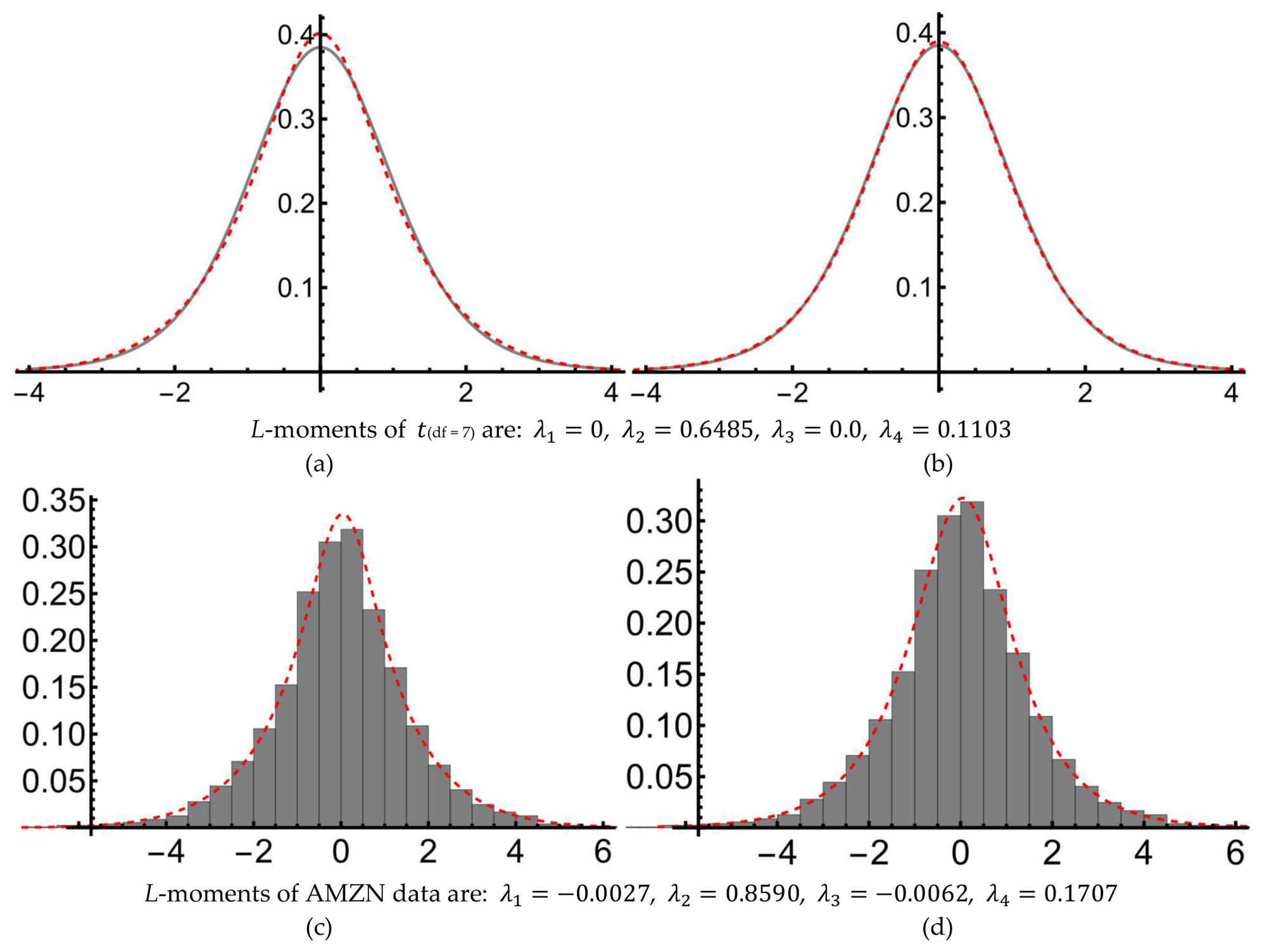
Figure 2.
Standard normal distribution (, ) versus standard logistic distribution (location , scale ).
Figure 2.
Standard normal distribution (, ) versus standard logistic distribution (location , scale ).
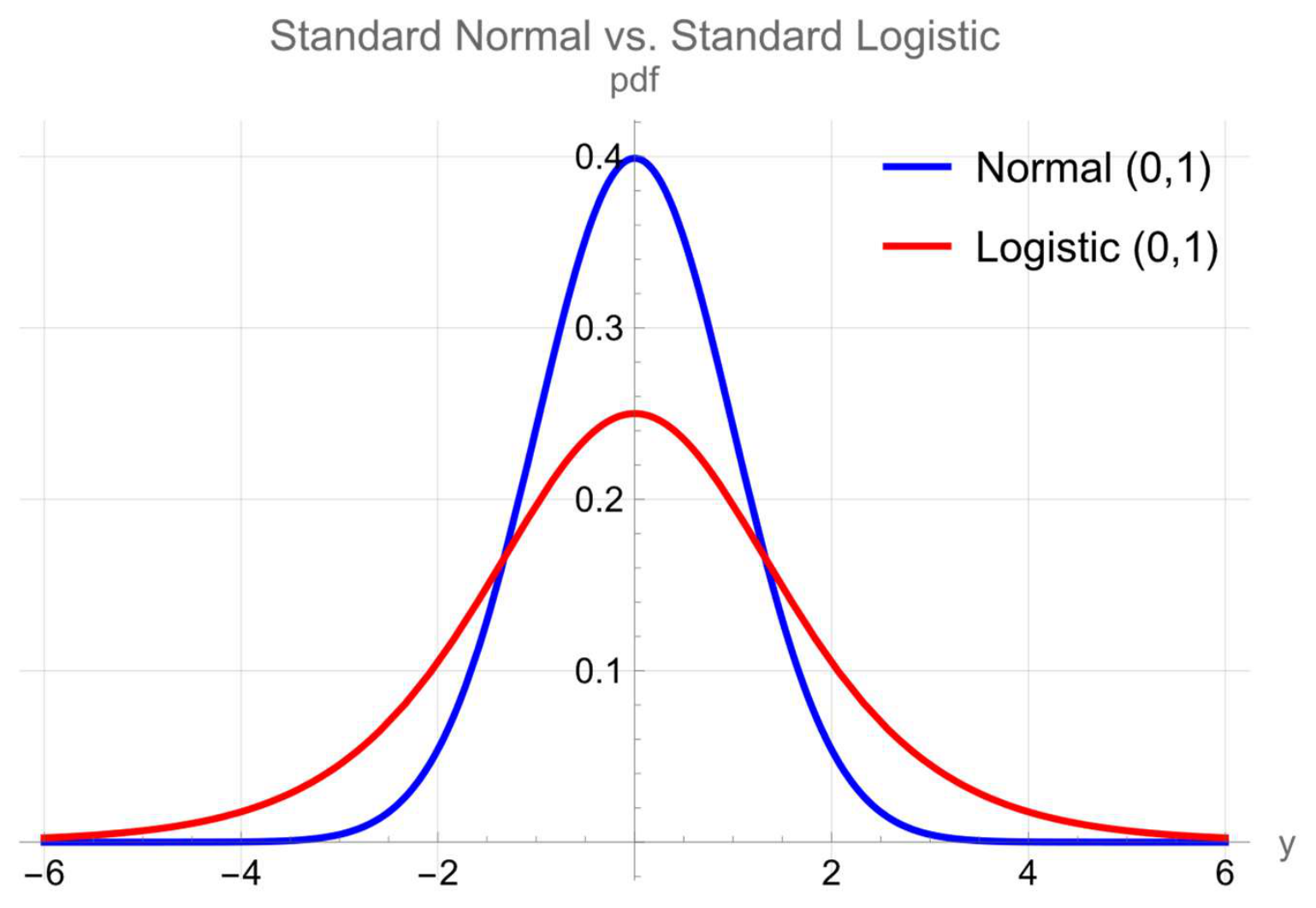
Figure 3.
The pdfs of MoM-, MoM-, and MoP-based LQU mixture polynomial distributions superimposed over the histogram of a random sample () of data taken from the (a) student -distribution with 4 degrees of freedom, and (b) log-logistic distribution with shape and scale parameters of 10 and 6, , respectively. .
Figure 3.
The pdfs of MoM-, MoM-, and MoP-based LQU mixture polynomial distributions superimposed over the histogram of a random sample () of data taken from the (a) student -distribution with 4 degrees of freedom, and (b) log-logistic distribution with shape and scale parameters of 10 and 6, , respectively. .
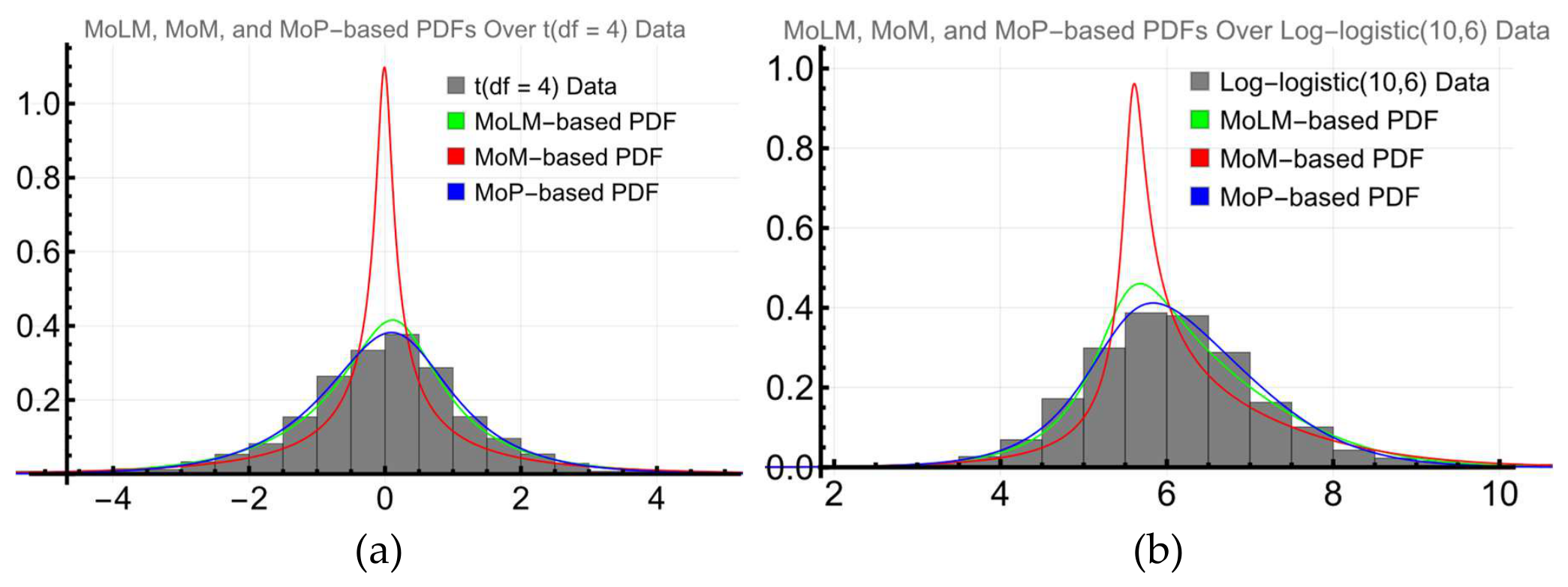
Figure 4.
Four symmetric LQU distributions with specified values of -kurtosis . The MoM-based model parameters shown in Table 4 were obtained by substituting , and specified values of into equations (17), (18), (21), and (22). Note: For a symmetric LQU distribution, .
Figure 4.
Four symmetric LQU distributions with specified values of -kurtosis . The MoM-based model parameters shown in Table 4 were obtained by substituting , and specified values of into equations (17), (18), (21), and (22). Note: For a symmetric LQU distribution, .
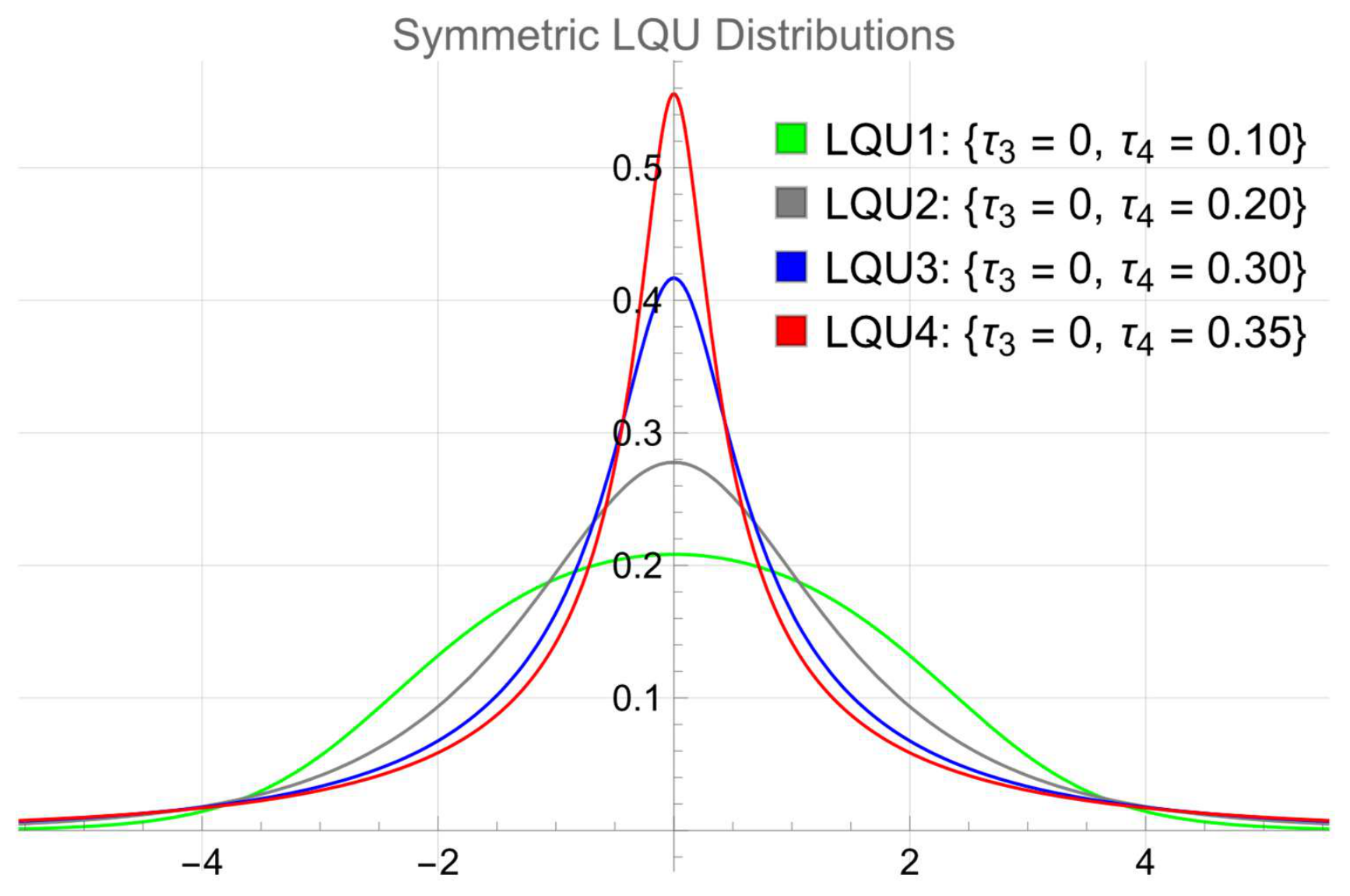
Figure 5.
Four asymmetric LQU distributions with specified values of -skewness and -kurtosis . The MoM-based model parameters shown in Table 5 were obtained by substituting , and specified values of and into equations (17), (18), (21), and (22).
Figure 5.
Four asymmetric LQU distributions with specified values of -skewness and -kurtosis . The MoM-based model parameters shown in Table 5 were obtained by substituting , and specified values of and into equations (17), (18), (21), and (22).
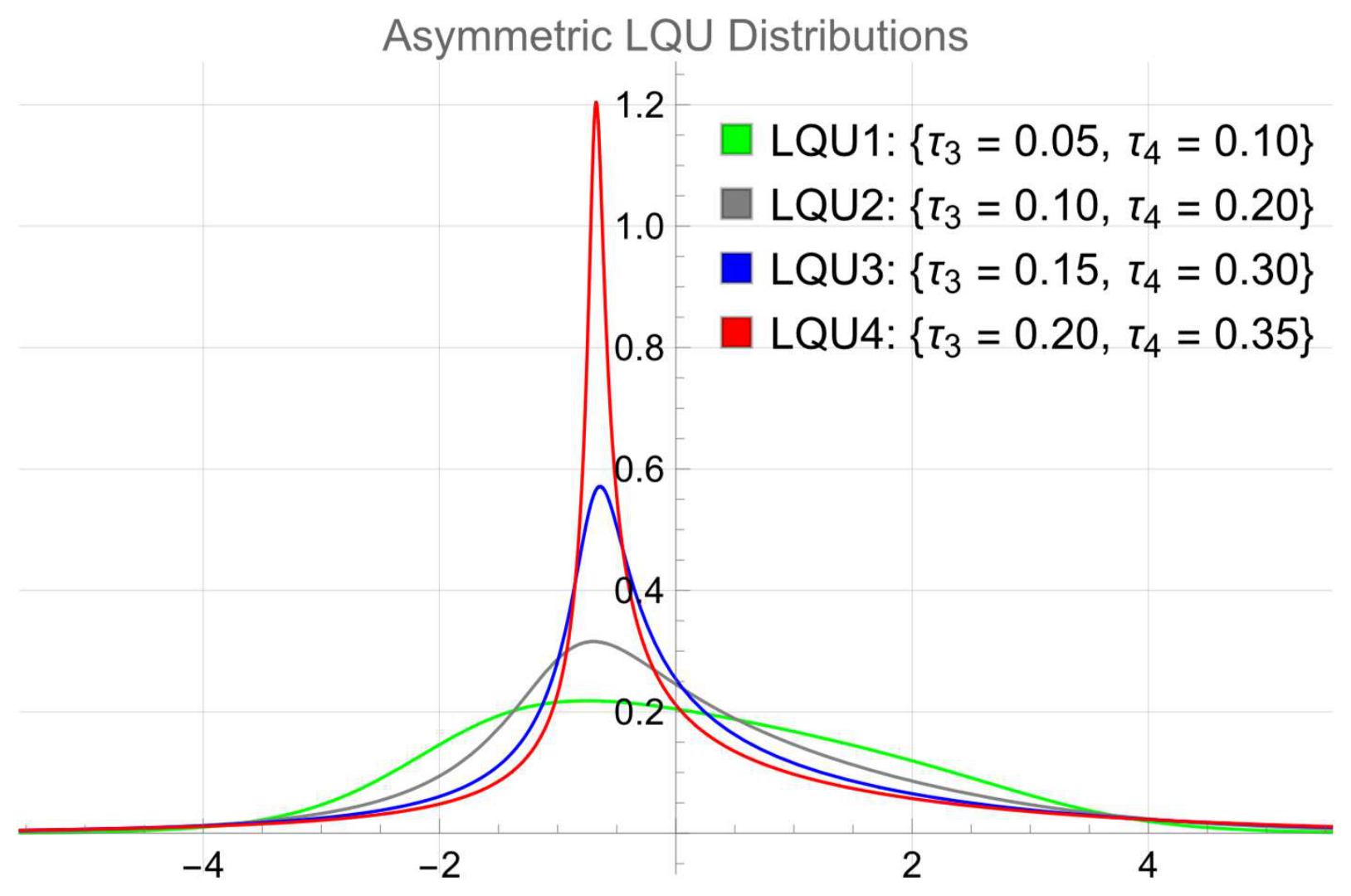
Figure 6.
Mo
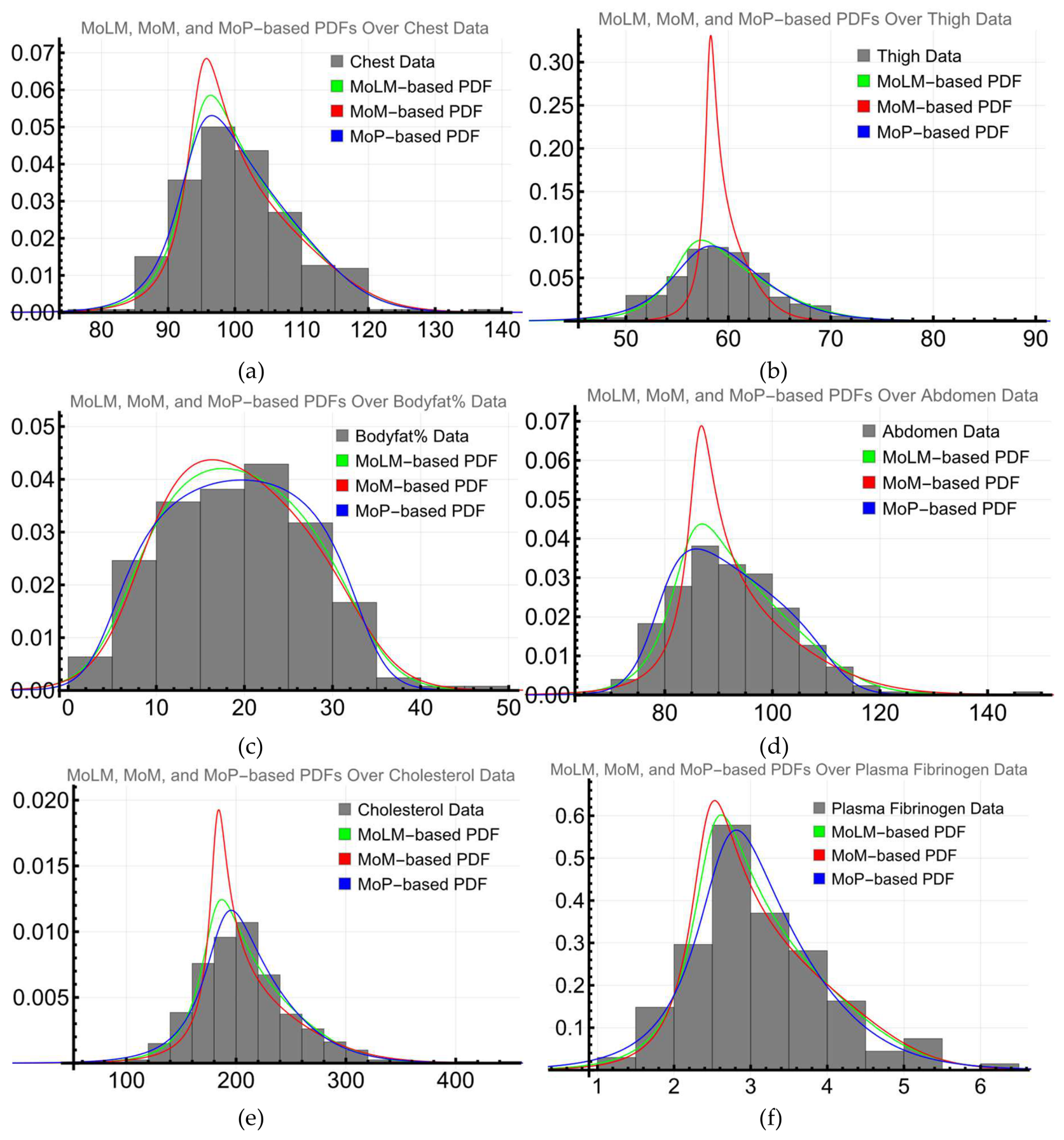
Table 1.
Percentile parameters for the (df = 7) distribution and AMZN stock daily return rate data in Figure 1 with model parameters and percentile estimates based on NQU and LQU approximations, respectively.
Table 1.
Percentile parameters for the (df = 7) distribution and AMZN stock daily return rate data in Figure 1 with model parameters and percentile estimates based on NQU and LQU approximations, respectively.
| (df = 7) | NQU | LQU | ||
| Percentile Parameters (P) | Model Parameters |
Percentile Estimates (E) |
Model Parameters |
Percentile Estimates (E) |
| .05 -1.8946 .10 -1.4149 .25 -0.7111 .50 0.0000 .75 0.7111 .90 1.4149 .95 1.8956 |
|
.05 -1.9446 .10 -1.4408 .25 -0.6989 .50 0.0000 .75 0.6989 .90 1.4408 .95 1.9446 |
|
.05 -1.9126 .10 -1.4222 .25 -0.7072 .50 0.0000 .75 0.7072 .90 1.4222 .95 1.9126 |
| AMZN Data | NQU | LQU | ||
| Percentile Parameters (P) | Model Parameters | Percentile Estimates (E) | Model Parameters | Percentile Estimates (E) |
| .05 -2.6082 .10 -1.8864 .25 -0.8552 .50 0.0021 .75 0.9048 .90 1.8238 .95 2.5721 |
|
.05 -2.6439 .10 -1.8994 .25 -0.8632 .50 0.0127 .75 0.8655 .90 1.8656 .95 2.5944 |
|
.05 -2.5944 .10 -1.8707 .25 -0.8761 .50 0.0128 .75 0.8785 .90 1.8371 .95 2.5451 |
Table 2.
Standard normal vs. standard logistic distribution.
| Standard Normal (,) | Standard Logistic (Location= 0, Scale= 1) | ||||
| Mean | SD | Peak Height | Mean | SD | Peak Height |
| 0 | 1 | 0.3989 | 0 | 0.25 | |
| Percentiles | Percentiles | ||||
| .01 .05 .10 .25 .50 .75 .90 .95 .99 |
-2.3263 -1.6449 -1.2816 -0.6745 0.0000 0.6745 1.2816 1.6449 2.3263 |
.01 .05 .10 .25 .50 .75 .90 .95 .99 |
-4.5951 -2.9444 -2.1972 -1.0986 0.0000 1.0986 2.1972 2.9444 4.5951 |
||
Note: SD = standard deviation.
Table 4.
MoM-, MoM-, and MoP-based parameters of location, scale, skewness, and kurtosis together with MoM-based model parameters for the four symmetric LQU distributions in Figure 4.
Table 4.
MoM-, MoM-, and MoP-based parameters of location, scale, skewness, and kurtosis together with MoM-based model parameters for the four symmetric LQU distributions in Figure 4.
| Parameters | MoLM-based Model Parameters | ||||||||
| Dist. | Method | Location | Scale | Skewness | Kurtosis | ||||
| LQU1 | MoM | 0 | 1 | 0 | 0.10 | -1.2 | 2.4 | 0 | 0.6 |
| MoM | 0 | 1.7619 | 0 | -0.2126 | ---- | ---- | ---- | ---- | |
| MoP | 0 | 4.5567 | 1 | 0.5527 | ---- | ---- | ---- | ---- | |
| LQU2 | MoM | 0 | 1 | 0 | 0.20 | 0.6 | -1.2 | 0 | 1.2 |
| MoM | 0 | 1.8486 | 0 | 2.1566 | ---- | ---- | ---- | ---- | |
| MoP | 0 | 4.3133 | 1 | 0.4722 | ---- | ---- | ---- | ---- | |
| LQU3 | MoM | 0 | 1 | 0 | 0.30 | 2.4 | -4.8 | 0 | 1.8 |
| MoM | 0 | 1.9847 | 0 | 5.8288 | ---- | ---- | ---- | ---- | |
| MoP | 0 | 4.0700 |
|
0.3821 | ---- | ---- | ---- | ---- | |
| LQU4 | MoM | 0 | 1 | 0 | 0.35 | 3.3 | -6.6 | 0 | 2.1 |
| MoM | 0 | 2.0684 | 0 | 7.9382 | ---- | ---- | ---- | ---- | |
| MoP | 0 | 3.9483 | 1 | 0.3328 | ---- | ---- | ---- | ---- | |
Note: Dist. = Distribution, LQU = Logistic-quantile and Uniform.
Table 5.
MoM-, MoM-, and MoP-based parameters of location, scale, skewness, and kurtosis together with MoM-based model parameters for the four asymmetric LQU distributions in Figure 5.
Table 5.
MoM-, MoM-, and MoP-based parameters of location, scale, skewness, and kurtosis together with MoM-based model parameters for the four asymmetric LQU distributions in Figure 5.
| Parameters | MoLM-based Model Parameters | ||||||||
| Dist. | Method | Location | Scale | Skewness | Kurtosis | ||||
| LQU1 | MoLM | 0 | 1 | 0.05 | 0.10 | -0.95 | 0.9 | 1.5 | 0.6 |
| MoM | 0 | 1.7655 | 0.2226 | -0.1838 | ---- | ---- | ---- | ---- | |
| MoP | -0.125 | 4.5567 | 0.8094 | 0.5527 | ---- | ---- | ---- | ---- | |
| LQU2 | MoM | 0 | 1 | 0.10 | 0.20 | 1.1 | -4.2 | 3.0 | 1.2 |
| MoM | 0 | 1.8621 | 0.5141 | 2.2401 | ---- | ---- | ---- | ---- | |
| MoP | -0.25 | 4.3133 | 0.6359 | 0.4722 | ---- | ---- | ---- | ---- | |
| LQU3 | MoM | 0 | 1 | 0.15 | 0.30 | 3.15 | -9.3 | 4.5 | 1.8 |
| MoM | 0 | 2.0129 | 0.8108 | 5.8649 | ---- | ---- | ---- | ---- | |
| MoP | -0.375 | 4.0700 | 0.4773 | 0.3821 | ---- | ---- | ---- | ---- | |
| LQU4 | MoM | 0 | 1 | 0.20 | 0.35 | 4.3 | -12.6 | 6.0 | 2.1 |
| MoM | 0 | 2.1162 | 1.0640 | 7.8575 | ---- | ---- | ---- | ---- | |
| MoP | -0.5 | 3.9483 | 0.3456 | 0.3328 | ---- | ---- | ---- | ---- | |
Note: Dist. = Distribution, LQU = Logistic-quantile and Uniform.
Table 6.
Parameters, Monte Carlo estimate (MC Est) with RMSE, and bootstrap estimate (Boot Est) with SE along with 95% bootstrap confidence interval (95% CI) for the MoM-based symmetric LQU distributions in Figure 4.
Table 6.
Parameters, Monte Carlo estimate (MC Est) with RMSE, and bootstrap estimate (Boot Est) with SE along with 95% bootstrap confidence interval (95% CI) for the MoM-based symmetric LQU distributions in Figure 4.
| Dist. | Parameter | MC Est (RMSE) | Boot Est (SE) | 95% CI | RB% |
| (UT: 52.03 sec, ST: 8.54 sec, ET: 65.21 sec) | |||||
| LQU1 | 0.0007 (0.0919) | 0.0007 (0.0009) | (-0.0012, 0.0025) | ---- | |
| 0.1021 (0.0693) | 0.1021 (0.0007) | (0.1007, 0.1034) | 2.10 | ||
| LQU2 | 0.0010 (0.1247) | 0.0009 (0.0013) | (-0.0015, 0.0034) | ---- | |
| 0.1984 (0.0847) | 0.1984 (0.0008) | (0.1967, 0.2000) | ---- | ||
| LQU3 | 0.0012 (0.1702) | 0.0012 (0.0017) | (-0.0021, 0.0045) | ---- | |
| 0.2951 (0.0979) | 0.2950 (0.0010) | (0.2931, 0.2970) | -1.63 | ||
| LQU4 | 0.0012 (0.1951) | 0.0012 (0.0020) | (-0.0026, 0.0050) | ---- | |
| 0.3441 (0.1032) | 0.3441 (0.0010) | (0.3421, 0.3462) | -1.69 | ||
| (UT: 42.31 sec, ST: 6.46 sec, ET: 67.67 sec) | |||||
| LQU1 | 0.0009 (0.0434) | 0.0009 (0.0004) | (0.0000, 0.0017) | ---- | |
| 0.1006 (0.0304) | 0.1006 (0.0003) | (0.1000, 0.1011) | ---- | ||
| LQU2 | 0.0014 (0.0616) | 0.0014 (0.0006) | (0.0002, 0.0027) | ---- | |
| 0.1997 (0.0384) | 0.1997 (0.0004) | (0.1989, 0.2005) | -0.15 | ||
| LQU3 | 0.0020 (0.0866) | 0.0020 (0.0009) | (0.0003, 0.0038) | ---- | |
| 0.2989 (0.0447) | 0.2989 (0.0004) | (0.2980, 0.2998) | -0.37 | ||
| LQU4 | 0.0023 (0.1002) | 0.0023 (0.0010) | (0.0003, 0.0043) | ---- | |
| 0.3487 (0.0470) | 0.3487 (0.0005) | (0.3477, 0.3496) | -0.37 | ||
| (UT: 51.19 sec, ST: 7.05 sec, ET: 66.24 sec) | |||||
| LQU1 | 0.0002 (0.0191) | 0.0002 (0.0002) | (-0.0002, 0.0006) | ---- | |
| 0.1001 (0.0132) | 0.1001 (0.0001) | (0.0998, 0.1003) | ---- | ||
| LQU2 | 0.0002 (0.0275) | 0.0002 (0.0003) | (-0.0003, 0.0008) | ---- | |
| 0.1999 (0.0169) | 0.1999 (0.0002) | (0.1996, 0.2002) | ---- | ||
| LQU3 | 0.0002 (0.0390) | 0.0002 (0.0004) | (-0.0006, 0.0010) | ---- | |
| 0.2997 (0.0196) | 0.2997 (0.0002) | (0.2994, 0.3001) | ---- | ||
| LQU4 | 0.0002 (0.0452) | 0.0002 (0.0005) | (-0.0007, 0.0011) | ---- | |
| 0.3497 (0.0206) | 0.3497 (0.0002) | (0.3493, 0.3501) | ---- | ||
| (UT: 43.85 sec, ST: 4.40 sec, ET: 67.22 sec) | |||||
| LQU1 | 0.0002 (0.0134) | 0.0002 (0.0001) | (-0.0001, 0.0004) | ---- | |
| 0.1001 (0.0093) | 0.1001 (0.0001) | (0.0999, 0.1002) | ---- | ||
| LQU2 | 0.0003 (0.0194) | 0.0003 (0.0002) | (-0.0001, 0.0006) | ---- | |
| 0.2000 (0.0119) | 0.2000 (0.0001) | (0.1998, 0.2002) | ---- | ||
| LQU3 | 0.0003 (0.0276) | 0.0003 (0.0003) | (-0.0002, 0.0009) | ---- | |
| 0.3000 (0.0138) | 0.3000 (0.0001) | (0.2997, 0.3002) | ---- | ||
| LQU4 | 0.0004 (0.0320) | 0.0004 (0.0003) | (-0.0003, 0.0010) | ---- | |
| 0.3499 (0.0145) | 0.3499 (0.0001) | (0.3496, 0.3502) | ---- | ||
Note: RB% = 100*(Estimate – Parameter)/Parameter.
Table 7.
Parameters, Monte Carlo estimate (MC Est) with RMSE, and bootstrap estimate (Boot Est) with SE along with 95% bootstrap confidence interval (95% CI) for the MoM-based symmetric LQU distributions in Figure 4.
Table 7.
Parameters, Monte Carlo estimate (MC Est) with RMSE, and bootstrap estimate (Boot Est) with SE along with 95% bootstrap confidence interval (95% CI) for the MoM-based symmetric LQU distributions in Figure 4.
| Dist. | Parameter | MC Est (RMSE) | Boot Est (SE) | 95% CI | RB% |
| (UT: 41.51 sec, ST: 4.61 sec, ET: 63.53 sec) | |||||
| LQU1 | 0.0009 (0.3863) | 0.0009 (0.0039) | (-0.0069, 0.0083) | ---- | |
| -0.6013 (0.7456) | -0.6013 (0.0063) | (-0.6137, -0.5887) | 182.8 | ||
| LQU2 | 0.0004 (0.7079) | 0.0001 (0.0071) | (-0.0139, 0.0143) | ---- | |
| 0.5033 (2.1777) | 0.5031 (0.0142) | (0.4755, 0.5308) | -76.66 | ||
| LQU3 | -0.0005 (1.0666) | -0.0005 (0.0105) | (-0.0209, 0.0204) | ---- | |
| 1.8189 (4.5661) | 1.8192 (0.0215) | (1.7765, 1.8614) | -68.79 | ||
| LQU4 | -0.0010 (1.2355) | -0.0010 (0.0124) | (-0.0254, 0.0229) | ---- | |
| 2.4865 (6.0007) | 2.4865 (0.0249) | (2.4373, 2.5358) | -68.68 | ||
| (UT: 41.95 sec, ST: 4.17 sec, ET: 64.19 sec) | |||||
| LQU1 | 0.0040 (0.2234) | 0.0040 (0.0022) | (-0.0004, 0.0083) | ---- | |
| -0.3222 (0.4644) | -0.3222 (0.0045) | (-0.3310, -0.3134) | 51.55 | ||
| LQU2 | 0.0092 (0.5276) | 0.0093 (0.0053) | (-0.0010, 0.0197) | ---- | |
| 1.5638 (1.7021) | 1.5637 (0.0160) | (1.5324, 1.5950) | -27.49 | ||
| LQU3 | 0.0151 (0.9163) | 0.0152 (0.0091) | (-0.0028, 0.0331) | ---- | |
| 4.1517 (3.5617) | 4.1522 (0.0315) | (4.0904, 4.2143) | -28.77 | ||
| LQU4 | 0.0179 (1.1089) | 0.0181 (0.0111) | (-0.0035, 0.0402) | ---- | |
| 5.5346 (4.5925) | 5.5346 (0.0393) | (5.4586, 5.6122) | -30.28 | ||
| (UT: 40.27 sec, ST: 3.86 sec, ET: 66.51 sec) | |||||
| LQU1 | 0.0015 (0.1057) | 0.0015 (0.0011) | (-0.0006, 0.0036) | ---- | |
| -0.2357 (0.2328) | -0.2356 (0.0023) | (-0.2402, -0.2311) | 10.87 | ||
| LQU2 | 0.0035 (0.2803) | 0.0036 (0.0028) | (-0.0020, 0.0089) | ---- | |
| 2.0193 (1.0499) | 2.0193 (0.0104) | (1.9993, 2.0399) | -6.37 | ||
| LQU3 | 0.0067 (0.5310) | 0.0067 (0.0053) | (-0.0037, 0.0173) | ---- | |
| 5.3997 (2.5024) | 5.3996 (0.0243) | (5.3524, 5.4475) | -7.36 | ||
| LQU4 | 0.0085 (0.6640) | 0.0085 (0.0066) | (-0.0047, 0.0213) | ---- | |
| 7.2973 (3.3585) | 7.2969 (0.0329) | (7.2322, 7.3611) | -8.07 | ||
| (UT: 44.63 sec, ST: 4.22 sec, ET: 69.20 sec) | |||||
| LQU1 | 0.0011 (0.0748) | 0.0011 (0.0007) | (-0.0004, 0.0025) | ---- | |
| -0.2219 (0.1704) | -0.2219 (0.0017) | (-0.2252, -0.2185) | 4.37 | ||
| LQU2 | 0.0029 (0.2042) | 0.0029 (0.0020) | (-0.0011, 0.0070) | ---- | |
| 2.1001 (0.8120) | 2.1002 (0.0082) | (2.0844, 2.1162) | -2.62 | ||
| LQU3 | 0.0057 (0.3951) | 0.0057 (0.0039) | (-0.0019, 0.0135) | ---- | |
| 5.6392 (2.0211) | 5.6392 (0.0203) | (5.6001, 5.6794) | -3.25 | ||
| LQU4 | 0.0072 (0.4983) | 0.0072 (0.0049) | (-0.0025, 0.0169) | ---- | |
| 7.6470 (2.7605) | 7.6470 (0.0273) | (7.5944, 7.7015) | -3.67 | ||
Note: RB% = 100*(Estimate – Parameter)/Parameter.
Table 8.
Parameters, Monte Carlo estimate (MC Est) with RMSE, and bootstrap estimate (Boot Est) with SE along with 95% bootstrap confidence interval (95% CI) for the MoP-based symmetric LQU distributions in Figure 4.
Table 8.
Parameters, Monte Carlo estimate (MC Est) with RMSE, and bootstrap estimate (Boot Est) with SE along with 95% bootstrap confidence interval (95% CI) for the MoP-based symmetric LQU distributions in Figure 4.
| Dist. | Parameter | MC Est (RMSE) | Boot Est (SE) | 95% CI | RB% |
| (UT: 42.25 sec, ST: 3.60 sec, ET: 63.97 sec) | |||||
| LQU1 | 1.0883 (0.4759) | 1.0883 (0.0047) | (1.0792, 1.0976) | 8.83 | |
| 0.5509 (0.0992) | 0.5509 (0.0010) | (0.5490, 0.5529) | ---- | ||
| LQU2 | 1.1029 (0.5281) | 1.1030 (0.0052) | (1.0927, 1.1133) | 10.29 | |
| 0.4753 (0.1024) | 0.4753 (0.0010) | (0.4733, 0.4773) | 0.66 | ||
| LQU3 | 1.1613 (0.7066) | 1.1613 (0.0068) | (1.1479, 1.1745) | 16.13 | |
| 0.3961 (0.1062) | 0.3961 (0.0011) | (0.3940, 0.3981) | 3.66 | ||
| LQU4 | 1.2145 (0.8607) | 1.2145 (0.0083) | (1.1983, 1.2309) | 21.45 | |
| 0.3543 (0.1081) | 0.3543 (0.0011) | (0.3523, 0.3564) | 6.46 | ||
| (UT: 38.57 sec, ST: 3.35 sec, ET: 64.78 sec) | |||||
| LQU1 | 1.0176 (0.2107) | 1.0177 (0.0021) | (1.0136, 1.0217) | 1.76 | |
| 0.5513 (0.0534) | 0.5513 (0.0005) | (0.5503, 0.5524) | -0.25 | ||
| LQU2 | 1.0216 (0.2366) | 1.0217 (0.0024) | (1.0171, 1.0263) | 2.16 | |
| 0.4721 (0.0554) | 0.4721 (0.0006) | (0.4710, 0.4732) | ---- | ||
| LQU3 | 1.0379 (0.3134) | 1.0380 (0.0031) | (1.0319, 1.0442) | 3.79 | |
| 0.3850 (0.0567) | 0.3850 (0.0006) | (0.3839, 0.3861) | 0.76 | ||
| LQU4 | 1.0525 (0.3716) | 1.0525 (0.0037) | (1.0453, 1.0598) | 5.25 | |
| 0.3378 (0.0565) | 0.3378 (0.0006) | (0.3367, 0.3389) | 1.50 | ||
| (UT: 41.06 sec, ST: 2.96 sec, ET: 64.78 sec) | |||||
| LQU1 | 1.0039 (0.0928) | 1.0039 (0.0009) | (1.0021, 1.0057) | 0.39 | |
| 0.5523 (0.0242) | 0.5523 (0.0002) | (0.5518, 0.5528) | ---- | ||
| LQU2 | 1.0051 (0.1035) | 1.0051 (0.0010) | (1.0031, 1.0071) | 0.51 | |
| 0.4720 (0.0252) | 0.4720 (0.0003) | (0.4716, 0.4725) | ---- | ||
| LQU3 | 1.0088 (0.1346) | 1.0088 (0.0013) | (1.0062, 1.0115) | 0.88 | |
| 0.3825 (0.0256) | 0.3825 (0.0003) | (0.3820, 0.3830) | ---- | ||
| LQU4 | 1.0119 (0.1567) | 1.0120 (0.0016) | (1.0088, 1.0151) | 1.19 | |
| 0.3337 (0.0254) | 0.3337 (0.0003) | (0.3332, 0.3342) | 0.27 | ||
| (UT: 43.33 sec, ST: 3.50 sec, ET: 65.84 sec) | |||||
| LQU1 | 1.0017 (0.0650) | 1.0017 (0.0007) | (1.0004, 1.0030) | 0.17 | |
| 0.5526 (0.0173) | 0.5526 (0.0002) | (0.5522, 0.5529) | ---- | ||
| LQU2 | 1.0021 (0.0733) | 1.0021 (0.0007) | (1.0007, 1.0035) | 0.21 | |
| 0.4722 (0.0179) | 0.4722 (0.0002) | (0.4719, 0.4726) | ---- | ||
| LQU3 | 1.0037 (0.0958) | 1.0037 (0.0010) | (1.0018, 1.0055) | 0.37 | |
| 0.3824 (0.0182) | 0.3824 (0.0002) | (0.3820, 0.3828) | ---- | ||
| LQU4 | 1.0051 (0.1115) | 1.0051 (0.0011) | (1.0029, 1.0073) | 0.51 | |
| 0.3334 (0.0180) | 0.3334 (0.0002) | (0.3330, 0.3337) | 0.18 | ||
Note: RB% = 100*(Estimate – Parameter)/Parameter.
Table 9.
Parameters, Monte Carlo estimate (MC Est) with RMSE, and bootstrap estimate (Boot Est) with SE along with 95% bootstrap confidence interval (95% CI) for the MoLM-based asymmetric LQU distributions in Figure 5.
Table 9.
Parameters, Monte Carlo estimate (MC Est) with RMSE, and bootstrap estimate (Boot Est) with SE along with 95% bootstrap confidence interval (95% CI) for the MoLM-based asymmetric LQU distributions in Figure 5.
| Dist. | Parameter | MC Est (RMSE) | Boot Est (SE) | 95% CI | RB% |
| (UT: 41.55 sec, ST: 2.80 sec, ET: 62.08 sec) | |||||
| LQU1 | 0.0508 (0.0919) | 0.0508 (0.0009) | (0.0489, 0.0526) | ---- | |
| 0.1022 (0.0701) | 0.1022 (0.0007) | (0.1009, 0.1036) | 2.20 | ||
| LQU2 | 0.1005 (0.1239) | 0.1004 (0.0012) | (0.0980, 0.1029) | ---- | |
| 0.1991 (0.0877) | 0.1991 (0.0009) | (0.1974, 0.2008) | ---- | ||
| LQU3 | 0.1505 (0.1680) | 0.1505 (0.0017) | (0.1472, 0.1538) | ---- | |
| 0.2971 (0.1051) | 0.2971 (0.0010) | (0.2950, 0.2992) | -0.97 | ||
| LQU4 | 0.2013 (0.1918) | 0.2012 (0.0019) | (0.1974, 0.2049) | ---- | |
| 0.3482 (0.1168) | 0.3482 (0.0012) | (0.3459, 0.3505) | ---- | ||
| (UT: 53.07 sec, ST: 3.71 sec, ET: 61.82 sec) | |||||
| LQU1 | 0.0509 (0.0434) | 0.0509 (0.0004) | (0.0501, 0.0518) | 1.80 | |
| 0.1006 (0.0308) | 0.1006 (0.0003) | (0.1000, 0.1012) | ---- | ||
| LQU2 | 0.1013 (0.0611) | 0.1013 (0.0006) | (0.1002, 0.1026) | 1.30 | |
| 0.1998 (0.0401) | 0.1998 (0.0004) | (0.1990, 0.2006) | ---- | ||
| LQU3 | 0.1518 (0.0853) | 0.1518 (0.0009) | (0.1501, 0.1535) | 1.20 | |
| 0.2993 (0.0488) | 0.2993 (0.0005) | (0.2984, 0.3003) | ---- | ||
| LQU4 | 0.2022 (0.0978) | 0.2022 (0.0010) | (0.2003, 0.2042) | 1.10 | |
| 0.3495 (0.0546) | 0.3495 (0.0005) | (0.3484, 0.3506) | ---- | ||
| (UT: 43.43 sec, ST: 2.67 sec, ET: 64.92 sec) | |||||
| LQU1 | 0.0502 (0.0191) | 0.0502 (0.0002) | (0.0499, 0.0506) | ---- | |
| 0.1001 (0.0134) | 0.1001 (0.0001) | (0.0998, 0.1003) | ---- | ||
| LQU2 | 0.1002 (0.0273) | 0.1002 (0.0003) | (0.0997, 0.1007) | ---- | |
| 0.2000 (0.0176) | 0.2000 (0.0002) | (0.1996, 0.2003) | ---- | ||
| LQU3 | 0.1502 (0.0384) | 0.1502 (0.0004) | (0.1494, 0.1509) | ---- | |
| 0.2999 (0.0214) | 0.2999 (0.0002) | (0.2995, 0.3004) | ---- | ||
| LQU4 | 0.2002 (0.0441) | 0.2002 (0.0004) | (0.1993, 0.2010) | ---- | |
| 0.3500 (0.0240) | 0.3500 (0.0002) | (0.3495, 0.3505) | ---- | ||
| (UT: 42.87 sec, ST: 3.39 sec, ET: 67.81 sec) | |||||
| LQU1 | 0.0502 (0.0134) | 0.0502 (0.0001) | (0.0499, 0.0504) | ---- | |
| 0.1001 (0.0094) | 0.1001 (0.0001) | (0.0999, 0.1002) | ---- | ||
| LQU2 | 0.1002 (0.0192) | 0.1002 (0.0002) | (0.0998, 0.1006) | ---- | |
| 0.2000 (0.0124) | 0.2000 (0.0001) | (0.1998, 0.2003) | ---- | ||
| LQU3 | 0.1502 (0.0271) | 0.1502 (0.0003) | (0.1497, 0.1508) | ---- | |
| 0.3000 (0.0152) | 0.3000 (0.0002) | (0.2997, 0.3003) | ---- | ||
| LQU4 | 0.2003 (0.0311) | 0.2003 (0.0003) | (0.1996, 0.2009) | ---- | |
| 0.3500 (0.0170) | 0.3500 (0.0002) | (0.3497, 0.3503) | ---- | ||
Note: RB% = 100*(Estimate – Parameter)/Parameter.
Table 10.
Parameters, Monte Carlo estimate (MC Est) with RMSE, and bootstrap estimate (Boot Est) with SE along with 95% bootstrap confidence interval (95% CI) for the MoM-based asymmetric LQU distributions in Figure 5.
Table 10.
Parameters, Monte Carlo estimate (MC Est) with RMSE, and bootstrap estimate (Boot Est) with SE along with 95% bootstrap confidence interval (95% CI) for the MoM-based asymmetric LQU distributions in Figure 5.
| Dist. | Parameter | MC Est (RMSE) | Boot Est (SE) | 95% CI | RB% |
| (UT: 31.83 sec, ST: 3.20 sec, ET: 66.56 sec) | |||||
| LQU1 | 0.1892 (0.3869) | 0.1891 (0.0039) | (0.1814, 0.1965) | -15.00 | |
| -0.5778 (0.7716) | -0.5778 (0.0066) | (-0.5907, -0.5646) | 214.4 | ||
| LQU2 | 0.4002 (0.7026) | 0.4000 (0.0070) | (0.3863, 0.4139) | -22.16 | |
| 0.5782 (2.2228) | 0.5780 (0.0148) | (0.5492, 0.6072) | -74.19 | ||
| LQU3 | 0.5950 (1.0483) | 0.5949 (0.0101) | (0.5753, 0.6150) | -26.62 | |
| 1.9310 (4.5356) | 1.9312 (0.0223) | (1.8872, 1.9747) | -67.08 | ||
| LQU4 | 0.7686 (1.1995) | 0.7686 (0.0117) | (0.7455, 0.7912) | -27.76 | |
| 2.6326 (5.8391) | 2.6327 (0.0261) | (2.5815, 2.6840) | -66.50 | ||
| (UT: 35.61 sec, ST: 4.02 sec, ET: 68.19 sec) | |||||
| LQU1 | 0.2179 (0.2225) | 0.2178 (0.0022) | (0.2135, 0.2222) | -2.11 | |
| -0.2935 (0.4795) | -0.2935 (0.0047) | (-0.3027, -0.2844) | 59.68 | ||
| LQU2 | 0.4895 (0.5126) | 0.4895 (0.0051) | (0.4796, 0.4997) | -4.79 | |
| 1.6529 (1.7300) | 1.6529 (0.0163) | (1.6211, 1.6850) | -26.21 | ||
| LQU3 | 0.7545 (0.8697) | 0.7545 (0.0086) | (0.7376, 0.7716) | -6.96 | |
| 4.2452 (3.5433) | 4.2455 (0.0318) | (4.1833, 4.3085) | -27.62 | ||
| LQU4 | 0.9797 (1.0230) | 0.9799 (0.0103) | (0.9597, 1.0005) | -7.92 | |
| 5.5998 (4.4951) | 5.5999 (0.0389) | (5.5240, 5.6766) | -28.73 | ||
| (UT: 34.76 sec, ST: 4.09 sec, ET: 70.86 sec) | |||||
| LQU1 | 0.2223 (0.1052) | 0.2223 (0.0011) | (0.2202, 0.2244) | ---- | |
| -0.2062 (0.2393) | -0.2062 (0.0024) | (-0.2109, -0.2015) | 12.19 | ||
| LQU2 | 0.5103 (0.2715) | 0.5103 (0.0027) | (0.5050, 0.5156) | ---- | |
| 2.1081 (1.0623) | 2.1082 (0.0105) | (2.0878, 2.1292) | -5.89 | ||
| LQU3 | 0.8011 (0.5016) | 0.8011 (0.0050) | (0.7913, 0.8110) | ---- | |
| 5.4630 (2.4827) | 5.4629 (0.0242) | (5.4161, 5.5105) | -6.85 | ||
| LQU4 | 1.0485 (0.6075) | 1.0485 (0.0061) | (1.0364, 1.0602) | -1.46 | |
| 7.2774 (3.2765) | 7.2769 (0.0320) | (7.2148, 7.3402) | -7.38 | ||
| (UT: 36.15 sec, ST: 2.72 sec, ET: 75.06 sec) | |||||
| LQU1 | 0.2227 (0.0744) | 0.2227 (0.0007) | (0.2213, 0.2242) | ---- | |
| -0.1928 (0.1747) | -0.1928 (0.0017) | (-0.1962, -0.1894) | 4.90 | ||
| LQU2 | 0.5131 (0.1975) | 0.5131 (0.0020) | (0.5092, 0.5170) | ---- | |
| 2.1857 (0.8152) | 2.1858 (0.0082) | (2.1702, 2.2019) | -2.43 | ||
| LQU3 | 0.8075 (0.3723) | 0.8076 (0.0037) | (0.8005, 0.8149) | ---- | |
| 5.6875 (1.9826) | 5.6875 (0.0199) | (5.6486, 5.7272) | -3.02 | ||
| LQU4 | 1.0579 (0.4544) | 1.0579 (0.0045) | (1.0490, 1.0667) | ---- | |
| 7.5946 (2.6528) | 7.5947 (0.0263) | (7.5435, 7.6467) | -3.35 | ||
Note: RB% = 100*(Estimate – Parameter)/Parameter.
Table 11.
Parameters, Monte Carlo estimate (MC Est) with RMSE, and bootstrap estimate (Boot Est) with SE along with 95% bootstrap confidence interval (95% CI) for the MoP-based asymmetric LQU distributions in Figure 5.
Table 11.
Parameters, Monte Carlo estimate (MC Est) with RMSE, and bootstrap estimate (Boot Est) with SE along with 95% bootstrap confidence interval (95% CI) for the MoP-based asymmetric LQU distributions in Figure 5.
| Dist. | Parameter | MC Est (RMSE) | Boot Est (SE) | 95% CI | RB% |
| (UT: 35.47 sec, ST: 3.22 sec, ET: 67.35 sec) | |||||
| LQU1 | 0.8958 (0.3975) | 0.8958 (0.0039) | (0.8883, 0.9035) | 10.67 | |
| 0.5508 (0.1003) | 0.5508 (0.0010) | (0.5489, 0.5528) | ---- | ||
| LQU2 | 0.7387 (0.3696) | 0.7388 (0.0036) | (0.7317, 0.7459) | 16.17 | |
| 0.4749 (0.1067) | 0.4749 (0.0011) | (0.4728, 0.4769) | 0.57 | ||
| LQU3 | 0.6165 (0.4185) | 0.6165 (0.0039) | (0.6089, 0.6242) | 29.16 | |
| 0.3947 (0.1160) | 0.3947 (0.0012) | (0.3924, 0.3970) | 3.30 | ||
| LQU4 | 0.5018 (0.4333) | 0.5018 (0.0040) | (0.4939, 0.5099) | 45.20 | |
| 0.3513 (0.1260) | 0.3513 (0.0012) | (0.3489, 0.3537) | 5.56 | ||
| (UT: 45.88 sec, ST: 4.75 sec, ET: 66.05 sec) | |||||
| LQU1 | 0.8274 (0.1730) | 0.8274 (0.0017) | (0.8241, 0.8307) | 2.22 | |
| 0.5513 (0.0541) | 0.5513 (0.0005) | (0.5502, 0.5523) | -0.25 | ||
| LQU2 | 0.6588 (0.1565) | 0.6588 (0.0015) | (0.6558, 0.6618) | 3.60 | |
| 0.4719 (0.0583) | 0.4719 (0.0006) | (0.4708, 0.4731) | ---- | ||
| LQU3 | 0.5095 (0.1653) | 0.5095 (0.0016) | (0.5064, 0.5128) | 6.75 | |
| 0.3845 (0.0639) | 0.3845 (0.0006) | (0.3833, 0.3858) | 0.63 | ||
| LQU4 | 0.3815 (0.1572) | 0.3815 (0.0015) | (0.3785, 0.3845) | 10.39 | |
| 0.3370 (0.0700) | 0.3370 (0.0007) | (0.3356, 0.3383) | 1.26 | ||
| (UT: 31.13 sec, ST: 2.50 sec, ET: 68.50 sec) | |||||
| LQU1 | 0.8133 (0.0758) | 0.8133 (0.0008) | (0.8118, 0.8147) | 0.48 | |
| 0.5523 (0.0246) | 0.5523 (0.0002) | (0.5518, 0.5527) | ---- | ||
| LQU2 | 0.6409 (0.0672) | 0.6409 (0.0007) | (0.6396, 0.6423) | 0.79 | |
| 0.4719 (0.0266) | 0.4719 (0.0003) | (0.4714, 0.4725) | ---- | ||
| LQU3 | 0.4843 (0.0684) | 0.4843 (0.0007) | (0.4830, 0.4857) | 1.47 | |
| 0.3823 (0.0292) | 0.3823 (0.0003) | (0.3817, 0.3829) | ---- | ||
| LQU4 | 0.3533 (0.0631) | 0.3533 (0.0006) | (0.3521, 0.3546) | 2.23 | |
| 0.3333 (0.0321) | 0.3333 (0.0003) | (0.3327, 0.3340) | ---- | ||
| (UT: 41.25 sec, ST: 2.89 sec, ET: 67.16 sec) | |||||
| LQU1 | 0.8111 (0.0530) | 0.8111 (0.0005) | (0.8101, 0.8122) | 0.21 | |
| 0.5526 (0.0175) | 0.5526 (0.0002) | (0.5522, 0.5529) | ---- | ||
| LQU2 | 0.6381 (0.0474) | 0.6381 (0.0005) | (0.6372, 0.6390) | 0.35 | |
| 0.4722 (0.0190) | 0.4722 (0.0002) | (0.4718, 0.4726) | ---- | ||
| LQU3 | 0.4805 (0.0484) | 0.4805 (0.0005) | (0.4795, 0.4814) | 0.67 | |
| 0.3824 (0.0208) | 0.3824 (0.0002) | (0.3819, 0.3828) | ---- | ||
| LQU4 | 0.3492 (0.0445) | 0.3492 (0.0004) | (0.3483, 0.3501) | 1.04 | |
| 0.3333 (0.0229) | 0.3333 (0.0002) | (0.3329, 0.3338) | 0.15 | ||
Note: RB% = 100*(Estimate – Parameter)/Parameter.
Table 12.
Sample estimates with solved values of model parameters for the MoM-, MoM-, and MoP-based pdfs of LQU distributions superimposed over histograms of data variables in Figure 6.
Table 12.
Sample estimates with solved values of model parameters for the MoM-, MoM-, and MoP-based pdfs of LQU distributions superimposed over histograms of data variables in Figure 6.
| Data | Sample Estimates | Model Parameters | |||||||
| Method | Location | Scale | Skewness | Kurtosis | |||||
| Chest | MoM | 100.82 | 4.6705 | 0.4956 | 0.6638 | 101.24 | -10.743 | 14.868 | 3.9830 |
| MoP | 99.650 | 21.480 | 0.6887 | 0.5249 | 100.07 | -7.0250 | 12.375 | 3.9140 | |
| MoM | 100.82 | 8.4305 | 0.6775 | 0.9441 | 102.60 | -16.913 | 20.041 | 4.0966 | |
| Thigh | MoLM | 59.406 | 2.8740 | 0.2297 | 0.4663 | 60.326 | -6.4331 | 6.8907 | 2.7977 |
| MoP | 59.000 | 13.070 | 0.8671 | 0.4935 | 60.152 | -3.7563 | 2.9063 | 3.1289 | |
| MoM | 59.406 | 5.2500 | 0.8163 | 2.5894 | 61.279 | -7.6810 | 5.9035 | 1.5070 | |
| Bodyfat% | MoLM | 19.151 | 4.7759 | 0.0742 | 0.3947 | 12.299 | 12.219 | 2.2257 | 2.3684 |
| MoP | 19.200 | 22.050 | 1.0155 | 0.5839 | 9.8172 | 19.031 | -0.5313 | 1.6498 | |
| MoM | 19.151 | 8.3687 | 0.1455 | -0.3509 | 13.393 | 8.3491 | 4.7509 | 2.5771 | |
| Abdomen | MoLM | 92.556 | 5.9433 | 0.5712 | 0.7867 | 91.743 | -9.7989 | 17.137 | 4.7202 |
| MoP | 90.950 | 26.480 | 0.7701 | 0.5684 | 84.588 | 7.3500 | 10.750 | 2.7307 | |
| MoM | 92.556 | 10.783 | 0.8334 | 2.1807 | 100.15 | -34.629 | 29.159 | 6.649 | |
| Chol | MoLM | 207.85 | 24.108 | 2.7273 | 4.1129 | 223.19 | -85.234 | 81.819 | 24.677 |
| MoP | 204.00 | 107.70 | 0.7455 | 0.4759 | 229.27 | -75.063 | 49.063 | 29.241 | |
| MoM | 207.85 | 44.446 | 0.9266 | 2.5718 | 245.93 | -164.12 | 131.94 | 28.739 | |
| Plasma fib | MoLM | 3.0904 | 0.4909 | 0.0592 | 0.0764 | 3.2896 | -1.5832 | 1.7772 | 0.4586 |
| MoP | 2.9800 | 2.1680 | 0.7626 | 0.4797 | 3.4281 | -1.3525 | 0.9125 | 0.5735 | |
| MoM | 3.0904 | 0.8875 | 0.6681 | 0.7380 | 3.1968 | -1.6276 | 2.1223 | 0.4057 | |
Note: Chest = Chest circumference, Thigh = Thigh circumference, Bodyfat% = Bodyfat percentage, Abdomen = Abdomen circumference, Chol = Cholesterol, Plasma fib = Plasma fibrinogen data.
Table 13.
Percentile parameters (P) obtained from data variables, percentile estimates (E) obtained, respectively, from MoLM- and MoP-based LQU pdfs superimposed over the histograms of six data variables in Figure 6 (panels a-f), and Euclidean distances (d).
Table 13.
Percentile parameters (P) obtained from data variables, percentile estimates (E) obtained, respectively, from MoLM- and MoP-based LQU pdfs superimposed over the histograms of six data variables in Figure 6 (panels a-f), and Euclidean distances (d).
| Data / LQU pdf | Percentile | d | ||||||
| .05 | .10 | .25 | .50 | .75 | .90 | 0.95 | ||
| Chest (P) | 88.80 | 91.10 | 94.20 | 99.60 | 105.30 | 112.30 | 117.00 | |
| MoLM (E) | 89.01 | 91.56 | 95.11 | 99.59 | 105.92 | 112.37 | 116.18 | 1.4648 |
| MoP (E) | 88.23 | 90.89 | 94.79 | 99.65 | 106.06 | 112.37 | 116.09 | 1.4595 |
| Thigh (P) | 51.10 | 53.00 | 56.00 | 59.00 | 62.30 | 66.00 | 68.60 | |
| MoLM (E) | 51.78 | 53.60 | 56.07 | 58.83 | 62.45 | 66.26 | 68.67 | 0.9753 |
| MoP (E) | 50.76 | 52.93 | 55.96 | 59.00 | 62.41 | 66.00 | 68.42 | 0.4082 |
| Bodyfat% (P) | 6.00 | 8.30 | 12.40 | 19.20 | 25.30 | 30.00 | 32.60 | |
| MoLM (E) | 5.94 | 8.34 | 12.89 | 18.97 | 25.32 | 30.30 | 32.89 | 0.6875 |
| MoP (E) | 5.91 | 8.09 | 12.73 | 19.20 | 25.60 | 30.14 | 32.28 | 0.6108 |
| Abdomen (P) | 76.60 | 79.50 | 84.50 | 90.90 | 99.20 | 105.70 | 111.20 | |
| MoLM (E) | 77.40 | 80.56 | 85.18 | 91.13 | 99.22 | 107.18 | 111.80 | 2.1977 |
| MoP (E) | 76.94 | 79.43 | 84.10 | 90.95 | 99.15 | 105.91 | 109.31 | 1.9753 |
| Chol (P) | 145.00 | 158.00 | 179.00 | 204.00 | 230.00 | 265.00 | 292.00 | |
| MoLM (E) | 146.47 | 161.26 | 179.88 | 201.03 | 232.40 | 266.97 | 288.72 | 6.5409 |
| MoP (E) | 139.54 | 158.00 | 181.44 | 204.00 | 232.69 | 265.70 | 288.34 | 7.5423 |
| Plasma fib (P) | 1.82 | 2.05 | 2.52 | 2.98 | 3.56 | 4.21 | 4.79 | |
| MoLM (E) | 1.86 | 2.14 | 2.50 | 2.94 | 3.61 | 4.31 | 4.74 | 0.1634 |
| MoP (E) | 1.67 | 2.04 | 2.52 | 2.98 | 3.56 | 4.21 | 4.66 | 0.1987 |
Disclaimer/Publisher’s Note: The statements, opinions and data contained in all publications are solely those of the individual author(s) and contributor(s) and not of MDPI and/or the editor(s). MDPI and/or the editor(s) disclaim responsibility for any injury to people or property resulting from any ideas, methods, instructions or products referred to in the content. |
© 2026 by the authors. Licensee MDPI, Basel, Switzerland. This article is an open access article distributed under the terms and conditions of the Creative Commons Attribution (CC BY) license (http://creativecommons.org/licenses/by/4.0/).
Copyright: This open access article is published under a Creative Commons CC BY 4.0 license, which permit the free download, distribution, and reuse, provided that the author and preprint are cited in any reuse.


