

Submitted:
20 June 2026
Posted:
23 June 2026
You are already at the latest version
Abstract
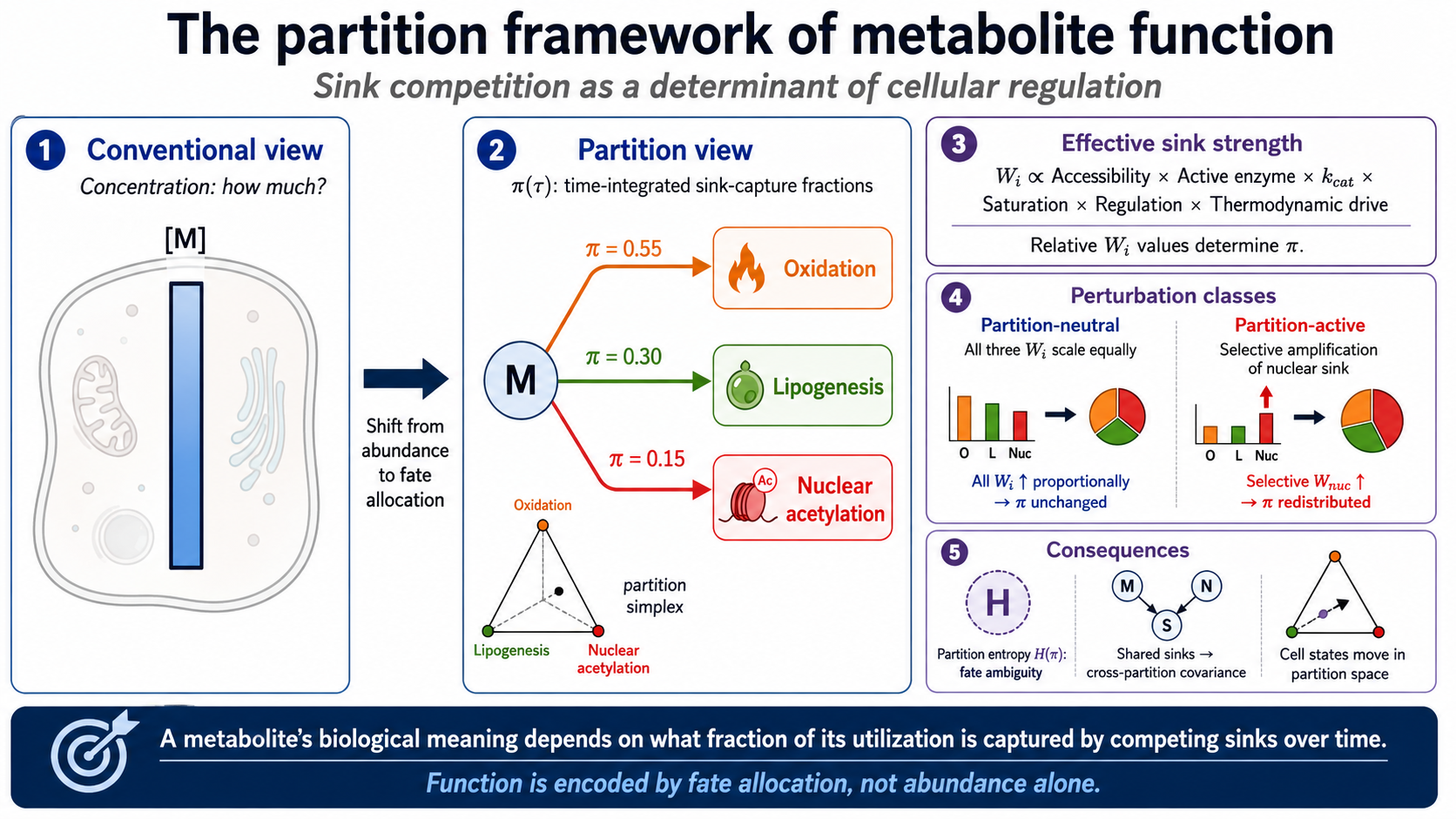
Metabolites are commonly interpreted through abundance, pathway flux, pathway assignment, or thermodynamic feasibility. These measurements are essential, but they do not by themselves explain how the same molecule is assigned to different biochemical functions. Here we develop the partition theory of metabolite function to describe this allocation explicitly. We define the partition vector, π(τ), for a metabolite M as the central variable of the framework. Its components represent the time-integrated fractions of M captured by competing reaction, pathway, or compartmental sinks during a biologically relevant decision window τ. Because π(τ) is normalized, it describes how metabolite utilization is distributed among competing fates, rather than how much metabolite is present or how much total flux passes through a pathway. This framework leads naturally to partition entropy as a measure of metabolite-fate ambiguity, to partition-control relations that distinguish flux-changing from fate-redirecting perturbations, to cross-metabolite coupling through shared sinks, and to history dependence when downstream marks or assembly states retain the record of metabolite use. The framework does not replace metabolic control analysis, flux balance analysis, or thermodynamic flux analysis. Rather, it reorganizes quantities that these approaches already help define into a metabolite-centered state variable, the fraction of utilization captured by each competing sink. A literature-constrained acetyl-CoA example illustrates how sink sensitivity can be evaluated without inventing a universal empirical acetyl-CoA partition vector.
Keywords:
metabolite partitioning
; molecular networks
; systems biology
; metabolomics
; metabolic control
; compartmentalization
; partition entropy
; acetyl-CoA
; epigenetic metabolism
Copyright: This open access article is published under a Creative Commons CC BY 4.0 license, which permit the free download, distribution, and reuse, provided that the author and preprint are cited in any reuse.


