

Submitted:
19 June 2026
Posted:
23 June 2026
You are already at the latest version
Abstract
Background: Antiviral resistance (AVR) can compromise antiviral therapeutics, but population-level monitoring of resistance-associated mutations remains limited. We developed a wastewater epidemiology framework using SARS-CoV-2 as a model pathogen to evaluate spatial, temporal, and therapeutic class-specific resistance dynamics. Methods: We analyzed ~10,000 SARS-CoV-2-positive wastewater samples from six Ontario public health regions collected between October 2021 and July 2024. Fifty-five resistance-associated mutations were screened, including mutations linked to remdesivir, nirmatrelvir, sotrovimab, and spike mutations associated with immune escape. Mutations detected in ≥10 samples at ≥1% frequency were retained for spatiotemporal analysis using LOESS smoothing and Kruskal–Wallis testing. Results: Twelve mutations met inclusion thresholds. S:E340D linked to sotrovimab resistance was geographically widespread but transient and low frequency. Five remdesivir-associated polymerase mutations were sporadic with sharp localized peaks, including two mutations exceeding 99% frequency in isolated catchments. Three nirmatrelvir-associated protease mutations showed prolonged circulation and regional enrichment, including S:Q3452K reaching 100% frequency in urban sewersheds and but varied significantly by region (p = 0.00029). FLiRT and FLuQE mutations were most persistent and abundant. LOESS smoothing revealed asynchronous peak timing across regions, while Kruskal–Wallis testing confirmed significant geographic variation for multiple mutations. Conclusion: These findings demonstrate that wastewater surveillance enables population-scale monitoring of AVR and immune escape-associated mutations and offers a scalable model for broader therapeutic surveillance.
Keywords:
antiviral resistance
; remdesivir
; sotrovimab
; nirmatrelvir
; wastewater surveillance
; public health genomics
1. Introduction
Antiviral resistance is an emerging global health threat that can compromise the long-term effectiveness of therapeutic strategies and undermine pandemic preparedness [1]. While clinical surveillance remains the primary approach for detecting resistance mutations, it is constrained by limited sampling coverage, testing access, and lag times in sequencing and data sharing [2]. These limitations highlight the need for scalable, real-time platforms capable of monitoring antiviral resistance dynamics across entire populations, regardless of healthcare access or testing behavior.
Wastewater surveillance (WWS) has proven to be a powerful tool for community-level tracking of infectious diseases. Throughout the COVID-19 pandemic, WWS was deployed globally to monitor SARS-CoV-2 viral load, detect emerging variants, and identify spike mutations associated with immune escape [3,4,5,6,7,8]. While WWS has been demonstrated for monitoring antibiotic resistance [9,10], the same matrix has yet to be fully leveraged for monitoring resistance to antiviral drugs.
SARS-CoV-2 provides a timely and well-characterized model to evaluate this approach. In response to the pandemic, several antiviral therapies were rapidly developed and deployed. Remdesivir, a viral RNA-dependent RNA polymerase (RdRp) inhibitor, was the first approved antiviral for COVID-19 and received emergency use authorization in May 2020. It was followed by molnupiravir, authorized in late 2021, and nirmatrelvir–ritonavir (Paxlovid), a main protease (Mpro) inhibitor authorized around the same period [11]. In parallel, several monoclonal antibody (mAb) therapies such as bamlanivimab, casirivimab-imdevimab, and sotrovimab were introduced to reduce severe outcomes in high-risk populations [12,13].
Shortly after clinical deployment, resistance-associated mutations were reported in both treated individuals and global genomic datasets. Mutations in the RdRp gene (nsp12), including E802D, C799Y, and M794I, have been associated with decreased susceptibility to remdesivir [14,15,16]. In the Mpro gene (nsp5), mutations such as T169I and A173T emerged under nirmatrelvir pressure and have been linked to resistance phenotypes [14,17]. Similarly, spike mutations such as S:E340D/K/A/V and S:P337L/T reduce the neutralization activity of sotrovimab [12,18,19]. More recently, S:R346T, S:F456L (FLiRT), and S:Q493E (FLuQE) have been linked to broad immune escape, limiting vaccine-elicited neutralization across multiple Omicron sublineages [20,21,22,23].
While these resistance-associated mutations have been characterized clinically, their emergence and dynamics at the population level remain poorly understood, particularly in the absence of widespread and continuous clinical sequencing. WWS has the potential to close this gap by detecting early-phase resistance emergence, regional amplification, and population-scale circulation trends. Here, we used SARS-CoV-2 as a model system to evaluate the utility of wastewater-based genomic surveillance for detecting and characterizing mutations associated with antiviral resistance. We analyzed ~10,000 wastewater samples collected from six public health regions in Ontario, Canada, spanning a 34-month period from October 2021 to July 2024. Our goal was to assess WWS as a scalable, complementary resistance monitoring system, with potential to enhance early-warning capabilities and inform public health responses to antiviral resistance threats.
2. Materials and Methods
Sample collection and processing. As part of the province-wide wastewater surveillance initiative for SARS-CoV-2 variants by the Ontario Ministry of the Environment, Conservation and Parks (MECP) and public health organization and university partners, wastewater samples were collected, preprocessed and sequenced by participating university partners [6,8,24]. Overall, this study includes data from approximately 10, 000 samples collected from across six Ontario health regions over the period of 34 months (October 2021 to July 2024). 24-hr composite samples were collected using different sampling methods including passive torpedo samplers and autosamplers [8,24]. The SARS-CoV-2 nucleic acid quantification, extraction, and tiled-amplicon metagenomic sequencing on Illumina platforms was performed following the protocol used in literature published by the consortium [6,8,24,25].
Data processing. Pair-end sequence data for all samples were quality-filtered and trimmed to remove adapter sequences using cutadapt v3.7 [26]. Thereafter, the remaining high quality reads were mapped to a SARS-CoV-2 reference genome (NC_045512.2) using minimap2 v2.28 [27] that generated an alignment file (bam files) for each of the samples.
Estimating mutation frequency. Mapped genomes were screened with Alcov [28] using the default minimum read depth of 10 for the manually curated experimentally validated mutations that encode resistance to antiviral therapies for SARS-CoV-2 infection described in literature, including those reported in Stanford Coronavirus Resistance Database (CoV-RDB; https://covdb.stanford.edu) [13,14,17,19,29,30,31]. Data were filtered for samples with incomplete metadata. Also, mutations occurring in fewer than 10 samples and frequencies < 1% were filtered.
Statistical analysis. All statistical analyses were performed in RStudio (v1.4.1717). To characterize spatiotemporal patterns of resistance-associated mutations, we applied non-parametric Kruskal-Wallis tests to assess regional differences in frequencies for each mutation. Temporal trends were visualized using LOESS smoothing, with mutation frequencies plotted across the sampling period. Only mutations detected in ≥10 samples at a frequency ≥1% were included in downstream analysis. Descriptive statistics for each qualified mutation included the number of samples detected, median frequency, interquartile range (IQR), region of first detection, peak abundance, and timing of peak signal. p-values <0.05 were considered statistically significant.
3. Results
We assessed 10, 000 SARS-CoV-2 positive wastewater samples for their potential for use in tracking the emergence of resistance of SARS-CoV-2 to antiviral therapies. The frequency of 55 unique mutations that had been experimentally validated to be associated with resistance to antiviral drug therapies in SARS-CoV-2 infection, specifically three main therapies including nirmatrelvir, remdesivir, and sotrovimab were investigated (Supplementary Table S1).
Spatiotemporal characterization of the spike mutation S:E340D associated with sotrovimab resistance. The spike mutation S:E340D, a substitution within the receptor-binding domain (RBD) known to confer resistance to the monoclonal antibody sotrovimab, was detected in 46 wastewater samples collected between October 2021 and July 2024. This mutation was identified in all six Ontario public health regions and met established inclusion criteria (≥10 samples at ≥1% frequency). S:E340D was first detected in the South West region on February 23, 2022, at a frequency of 2.6%, marking one of the earliest wastewater-documented resistance-associated spike mutations in the surveillance network (Table 1). The peak detection occurred in the North East region on February 25, 2022, reaching 5.63%, yet no single region exhibited recurrent elevation over time. Across the dataset, the mutation maintained a median frequency of 1.55% (IQR: 0.85%), with no instances exceeding 10%. Despite broad geographic coverage, Kruskal-Wallis testing revealed no significant regional differences in mutation abundance (p = 0.176), underscoring a pattern of spatially diffuse or low-level circulation (Figure 1). The absence of fixation or persistent elevation suggests that S:E340D emerged transiently under selective pressure, possibly influenced by sotrovimab prescribing practices or shifting population immunity. While no catchment reached dominance by this mutation, its recurrence across multiple sewer sheds and early emergence in the surveillance timeline emphasize the sensitivity of wastewater genomics in capturing early-phase resistance-associated immunoevasive substitutions, even in the absence of clinical sequencing confirmation
Spatiotemporal surveillance of remdesivir resistance associated mutations in wastewater. Abundance of 12 RNA-dependent RNA polymerase (ORF1b) mutations previously implicated in reduced susceptibility to remdesivir were assessed. Of these, five mutations (ORF1b:N189S, S750A, M785I, C790F, and E127V) met predefined inclusion thresholds and were retained for quantitative assessment (Figure 2a–e). The five mutations demonstrated markedly heterogeneous detection patterns in both time and space. ORF1b:S750A was the most frequently detected (n = 142), followed by M785I (135 samples) and C790F (106 samples); N189S and E127V were detected in 21 and 24 samples, respectively. All five mutations were observed in at least four health regions, with S750A, M785I, and C790F exhibiting province-wide distribution. Median frequencies ranged from 1.89% (N189S) to 3.32% (C790F). These values, while subdominant, exceeded detection thresholds consistently and, in some instances, surged. Temporal onset varied across mutations. The earliest detections were observed in the North East region: M785I and C790F emerged in October 2021, both exceeding 5% frequency at first detection (Figure 2c,d, Table 1). In contrast, S750A first appeared shortly after (October 27, 2021) at 1.51% (Figure 2b), while N189S and E127V emerged later, in Toronto (January 2022) and Eastern Ontario (December 2021), respectively (Figure 2a,e). This staggered temporal emergence across geographically distinct catchments suggests either independent introduction events or early cryptic dissemination. Despite modest median frequencies, all five mutations exhibited isolated yet pronounced peaks in specific regions. C790F and M785I reached maximum frequencies of 100% and 99.86%, respectively, in Southwest Ontario, both in 2023, suggesting near-complete dominance of resistance-associated variants within those sewer sheds. N189S peaked at 37.33% in Central East in early 2024, while S750A and E127V reached 7.14% (East) and 9.09% (North East), respectively. These spikes were temporally bounded, and no mutation demonstrated sustained elevation over consecutive surveillance intervals. Statistical testing revealed no significant spatial enrichment for any of the five mutations. Kruskal–Wallis comparisons of mutation frequency across regions yielded p-values ranging from 0.41 to 0.93, suggesting that the observed regional variation reflects stochastic introduction or limited amplification rather than persistent or localized expansion. Notably, even mutations with province-wide detection (e.g., S750A, M785I) failed to show region-specific concentration, indicating diffusion-like patterns of circulation. Taken together, these data demonstrate that remdesivir resistance–associated mutations circulate at low to moderate abundance in Ontario wastewater but appear non-uniformly, transiently, and without consistent spatial anchoring. The detection of such mutations at high frequency in isolated events, approaching or reaching fixation in some catchments could raise important questions about localized treatment pressure, clonal sweeps, or epidemiologically siloed transmission chains. These signals, inaccessible to traditional clinical sequencing frameworks, underscore the unique value of wastewater genomics for detecting resistance emergence below the clinical radar.
Spatiotemporal dynamics of main protease resistance–associated mutations detected in wastewater. Thirty-two mutations described previously to be associated with nirmatrelvir resistance were screened, but only three ORF1a mutations (T3432I, Q3452K, and R3451S) were detected above interpretive thresholds in wastewater collected from six Ontario public health regions (Figure 3a–c). These mutations exhibited distinct geographic and temporal trajectories, including multiple independent episodes of high frequency, and in two cases, complete fixation in wastewater viral populations. Q3452K was the most frequently observed mutation, detected in 264 samples and present in all six health regions. It emerged early, first appearing in North East Ontario on January 10, 2021, at 16.33% frequency, and later reached 100% abundance in the Toronto area on June 21, 2023, representing a transient but complete replacement of circulating lineages in that catchment (Table 1s. Its median frequency was 3.85% (IQR: 6.1%), and Kruskal-Wallis testing confirmed significant regional variation (p = 0.00029), reflecting its concentration in high-population urban zones (Figure 3b). T3432I, though less frequent (38 samples), displayed a similarly punctuated trajectory. It was first detected in Central East Ontario in December 2021 with a strikingly high initial abundance (16.36%) and peaked at 100% in the East region on November 10, 2022. Despite these spikes, its overall abundance was more variable (median = 3.43%, IQR: 6.24%), and regional differences approached but did not reach statistical significance (p = 0.064) (Figure 3a). R3451S was detected in 60 samples across five regions and exhibited a more subdued pattern. First identified in Central West Ontario on December 13, 2021, at 1.5%, it peaked at 100% in South West Ontario in April 2024, suggesting delayed but episodic amplification. However, its lower median abundance (2.74%) and nonsignificant spatial variation (p = 0.263) indicate limited regional fixation or expansion (Figure 3c). Notably, all three mutations exhibited sharp, localized peaks in abundance, frequently exceeding 90%, followed by rapid dissipation. This pattern is consistent with transient selective sweeps or stochastic amplification events within sewer sheds, rather than sustained evolutionary dominance. The early detection of these mutations, often months before peak abundance, demonstrates the sensitivity of wastewater genomics for capturing the leading edge of resistance emergence. Their detection across disparate regions and time points also raises the possibility of convergent resistance evolution under nirmatrelvir pressure in community settings.
Temporal and spatial dynamics of FLiRT and FLuQE mutations in Ontario wastewater. The FLiRT (S:R346T, S:F456L), and FLuQE (S:Q493E) spike mutations previously associated with reduced neutralization by vaccine-elicited antibodies were detected at high prevalence and sustained abundance in wastewater samples collected across six public health regions in Ontario, between October 2021 and July 2024 (Figure 4a–c). S:R346T was the most persistent and dominant of the mutations, detected in 1,539 samples across all six public health regions, representing the highest frequency among all resistance-associated spike mutations in this study. First identified on May 10, 2022, in Toronto area Ontario at 4% frequency (Table 1), it reached 100% in Toronto by September 30, 2022. The mutation sustained a median abundance of 89.12% (IQR: 66.61%) and showed statistically significant regional variation (Kruskal–Wallis p = 0.00001). This mutation exhibited spatial dynamics within the study period (Kruskal–Wallis p = 0.00001) (Figure 4a). This temporal consistency and spatial spread suggest strong selection in populations with widespread vaccine-derived immunity. Similarly, S:F456L was detected in 1,092 samples across all six health regions. It was first observed in South West Ontario on January 11, 2022, at 1.39% frequency, and later peaked at 100% in Central West on August 7, 2023 (median frequency:74.74%; IQR: 48.21%) with significant spatial variability across regions (p = 0.00001). Its detection spanned a 20-month period with consistently elevated signal across multiple catchments (Figure 4b). Prior studies have shown that F456L reduces neutralization by vaccine-elicited sera across multiple Omicron sublineages, including XBB.1.5 and EG.5, and remains resilient in transmission due to minimal fitness trade-offs (Cao et al., 2023; Tamura et al., 2023). Conversely, S:Q493E was detected in 269 samples, with the first occurrence on February 24, 2022, in Toronto, at a low frequency of 1.82%, and peaked on March 08, 2024, in the same region. This mutation had a median frequency of 34.75% (IQR=63.57%) with significant regional differences (p = 0.00285). Although detected less frequently than the FLiRT mutations, S:Q493E exhibited sharp temporal peaks and broad geographic distribution (Figure 4c). The widespread appearance, high frequency, and occurrence of these FLiRT and FLuQE mutations across all monitored regions distinguish them from other resistance-associated mutations in this dataset.
4. Discussion
This study demonstrates the utility of wastewater-based genomic surveillance for detecting and monitoring SARS-CoV-2 mutations associated with reduced susceptibility to antiviral therapeutics and vaccine-elicited neutralizing antibodies. By integrating regionally distributed, longitudinal wastewater sampling with high-resolution amplicon-based sequencing, we captured the presence, temporal patterns, and geographic distribution of functionally important spike and non-spike substitutions at the population level, independent of clinical case reporting or sequencing volume. Among the resistance-associated mutations tracked, those linked to remdesivir and nirmatrelvir targets exhibited divergent patterns. The RdRp mutations associated with remdesivir resistance were observed intermittently and at low-to-moderate abundance, without sustained signal dominance. These patterns are consistent with prior reports indicating that such mutations confer partial resistance but often impose fitness cost in untreated populations [32,33,34]. In contrast, Mpro mutations associated with nirmatrelvir, particularly ORF1a:Q3452K and T3432I, were detected at higher frequencies and displayed regional amplification, and prolonged environmental presence, suggesting local treatment-driven selection. These patterns reinforce the complexity of interpreting antiviral resistance in real-world settings and emphasize the importance of environmental surveillance to detect early ecological signatures of potential drug adaptation.
Notably, remdesivir was introduced in Canada under emergency use authorization in July 2020 [35]. In this study, the earliest wastewater detection of a remdesivir-associated mutation (ORF1b:M785I) occurred in October 2021, shortly after widespread clinical use, while nirmatrelvir-associated mutations (e.g., ORF1a:T3432I) first emerged in late 2021, consistent with early-stage post-authorization exposure [36]. The mutation associated with resistance to monoclonal antibody sotrovimab assessed in this study also emerged in relation to therapeutic and immunization timelines. Sotrovimab received clinical use authorization in late 2021 [37], and its associated resistance mutation, S:E340D, was first detected in wastewater in this study in February 2022, reflecting rapid post-deployment selection. The temporal alignment of mutation emergence with therapeutic rollout supports the utility of wastewater genomics in capturing early signals of treatment-driven resistance evolution.
The FLiRT and FLuQE spike mutations associated with immune escape, (S:R346T, S:F456L, and S:Q493E) showed the most consistent and sustained wastewater signals. These mutations have been documented in experimental studies to impair neutralization by vaccine-elicited antibodies without disrupting ACE2 binding [18,23,38]. S:R346T and S:F456L were detected across all six regions at high frequency and over extended periods, including multiple catchments with near-total prevalence in wastewater viral populations. S:Q493E was less frequently detected but demonstrated episodic dominance and broad geographic distribution. These detection patterns occurred during phases of widespread vaccination [39,40]. The differences in abundance, persistence, and regional concentration between spike mutations and those associated with RdRp. Mpro resistance may reflect differential selection pressures and transmission dynamics. Spike substitutions that reduce vaccine-elicited neutralization can disseminate broadly through population-level transmission, while drug-resistance mutations often arise within treated individuals and may not spread without continued therapeutic exposure [41,42].
While wastewater surveillance does not resolve infection history, treatment status, or clinical outcome, it can reveal the relative scale and spatial patterning of viral mutations over time [8,25]. Importantly, this study highlights the capacity of wastewater genomic surveillance to detect functionally significant substitutions that may not be visible through limited or delayed clinical sequencing. Several of the spike mutations were detected at high abundance in wastewater samples during early phases of regional circulation, underscoring the potential for anticipatory surveillance. Because wastewater integrates signal from all infected individuals, regardless of symptoms, healthcare access, or testing behavior, it enables population-scale monitoring of not only viral evolutionary trends, but also the emergence of antiviral resistance [8,25].
The tracked mutations have documented associations with reduced neutralization or antiviral sensitivity but their contextual relevance may vary depending on co-circulating variants, immunity levels, and therapeutic use patterns not captured in this study [14,32]. Future integration of wastewater genomics with clinical sequencing, prescription data, and serological studies will be necessary to triangulate sources of resistance and evaluate their real-world impact. Nonetheless, this study establishes that wastewater genomics can sensitively and systematically track the emergence and spread of SARS-CoV-2 mutations linked to antiviral resistance and immune evasion. The ability to monitor these mutations in real time across entire populations offers a valuable complement to clinical genomic surveillance, particularly in the context of declining testing volumes and shifting immunity profiles.
5.0. Conclusion
This study demonstrates that wastewater-based genomic surveillance can be used to monitor viral mutations associated with resistance to antiviral therapies. Using SARS-CoV-2 as a model, we tracked the spatiotemporal behavior of mutations previously linked to reduced susceptibility to small-molecule antivirals and neutralizing antibodies. By focusing on substitutions previously linked to reduced susceptibility to remdesivir, nirmatrelvir, and neutralizing antibodies, we show that resistance-associated mutations exhibit distinct patterns of environmental persistence, regional spread, and frequency. This finding supports the application of wastewater genomics for real-time monitoring of antiviral resistance trends, complementing clinical sequencing and enhancing early warning capacity for public health interventions. In addition, it provides a foundation for extending this approach to other viral pathogens requiring ongoing therapeutic monitoring.
Supplementary Materials
The following supporting information can be downloaded at the website of this paper posted on Preprints.org. Supplementary Table S1.
Author Contributions
Conceptualization, O.L., L.G; methodology, O.L., V.P.; software, OL, A.K.O., J.J.K., T.C.C; validation, OL; formal analysis, O.L; investigation, O.L; resources, L.G.; data curation, O.L, V.P; writing—original draft preparation, O.L; writing—review and editing, O.L., V.P., A.K.O., J.J.K., T.C.C., and L.G; visualization, O.L.; project administration, O.L., V.P.; funding acquisition, O.L., L.G. All authors have read and agreed to the published version of the manuscript.
Funding
We acknowledge support from Ontario Genomics through the COVID-19 Regional Genomics Initiative (CORGI) to LG, funding from the Ontario Wastewater Surveillance Initiative (OWSI) of the Ontario Ministry of Environment Conservation and Parks (MECP) provided for this work through their leadership and resources dedicated to the establishment and funding of a province-wide wastewater testing program and fostering multidisciplinary collaboration within the program. Additional support was provided by the Canada Research Chairs Program to OL and LG, and the Article Publication Cost support granted to O.L.
Institutional Review Board Statement
Not applicable.
Data Availability Statement
The raw data supporting the conclusions of this article is hosted on the Canadian iMicroSeq Data Portal (https://imicroseq-dataportal.ca/).
Conflicts of Interest
The authors declare no conflicts of interest. The funders had no role in the design of the study; in the collection, in the analyses, interpretation of data, in the writing of the manuscript or in the decision to publish the results.
References
- Yamin, D.; Uskoković, V.; Wakil, A.; Goni, M.; Shamsuddin, S.; Mustafa, F.; Alfouzan, W.; Alissa, M.; Alshengeti, A.; Almaghrabi, R.; et al. Current and Future Technologies for the Detection of Antibiotic-Resistant Bacteria. Diagnostics 2023, 13, 3246. [CrossRef]
- Strasfeld, L.; Chou, S. Antiviral Drug Resistance: Mechanisms and Clinical Implications. Infectious Disease Clinics of North America 2010, 24, 413–437. [CrossRef]
- Abu Ali, H.; Yaniv, K.; Bar-Zeev, E.; Chaudhury, S.; Shagan, M.; Lakkakula, S.; Ronen, Z.; Kushmaro, A.; Nir, O. Tracking SARS-CoV-2 RNA through the Wastewater Treatment Process. ACS EST Water 2021, 1, 1161–1167. [CrossRef]
- Bitter, L.C.; Kibbee, R.; Jiménez, G.C.; Örmeci, B. Wastewater Surveillance of SARS-CoV-2 at a Canadian University Campus and the Impact of Wastewater Characteristics on Viral RNA Detection. ACS EST Water 2022, acsestwater.2c00060. [CrossRef]
- D’Aoust, P.M.; Tian, X.; Towhid, S.T.; Xiao, A.; Mercier, E.; Hegazy, N.; Jia, J.-J.; Wan, S.; Kabir, M.P.; Fang, W.; et al. Wastewater to Clinical Case (WC) Ratio of COVID-19 Identifies Insufficient Clinical Testing, Onset of New Variants of Concern and Population Immunity in Urban Communities. Science of The Total Environment 2022, 853, 158547. [CrossRef]
- Lawal, O.U.; Zhang, L.; Parreira, V.R.; Brown, R.S.; Chettleburgh, C.; Dannah, N.; Delatolla, R.; Gilbride, K.A.; Graber, T.E.; Islam, G.; et al. Metagenomics of Wastewater Influent from Wastewater Treatment Facilities across Ontario in the Era of Emerging SARS-CoV-2 Variants of Concern. Microbiol Resour Announc 2022, e00362-22. [CrossRef]
- Oloye, F.F.; Xie, Y.; Asadi, M.; Cantin, J.; Challis, J.K.; Brinkmann, M.; McPhedran, K.N.; Kristian, K.; Keller, M.; Sadowski, M.; et al. Rapid Transition between SARS-CoV-2 Variants of Concern Delta and Omicron Detected by Monitoring Municipal Wastewater from Three Canadian Cities. Science of The Total Environment 2022, 841, 156741. [CrossRef]
- Overton, A.K.; Knapp, J.J.; Lawal, O.U.; Gibson, R.; Fedynak, A.A.; Adebiyi, A.I.; Maxwell, B.; Cheng, L.; Bee, C.; Qasim, A.; et al. Genomic Surveillance of a Canadian Airport Wastewater Samples Allows Early Detection of Emerging SARS-CoV-2 Lineages 2024.
- Adefisoye, M.A.; Okoh, A.I. Identification and Antimicrobial Resistance Prevalence of Pathogenic Escherichia Coli Strains from Treated Wastewater Effluents in Eastern Cape, South Africa. MicrobiologyOpen 2016, 5, 143–151. [CrossRef]
- Li, A.-D.; Li, L.-G.; Zhang, T. Exploring Antibiotic Resistance Genes and Metal Resistance Genes in Plasmid Metagenomes from Wastewater Treatment Plants. Frontiers in Microbiology 2015, 6, 1025. [CrossRef]
- Hammond, J.; Leister-Tebbe, H.; Gardner, A.; Abreu, P.; Bao, W.; Wisemandle, W.; Baniecki, M.; Hendrick, V.M.; Damle, B.; Simón-Campos, A.; et al. Oral Nirmatrelvir for High-Risk, Nonhospitalized Adults with Covid-19. N Engl J Med 2022, 386, 1397–1408. [CrossRef]
- Gupta, A.; Gonzalez-Rojas, Y.; Juarez, E.; Crespo Casal, M.; Moya, J.; Falci, D.R.; Sarkis, E.; Solis, J.; Zheng, H.; Scott, N.; et al. Early Treatment for Covid-19 with SARS-CoV-2 Neutralizing Antibody Sotrovimab. N Engl J Med 2021, 385, 1941–1950. [CrossRef]
- Huygens, S.; Oude Munnink, B.; Gharbharan, A.; Koopmans, M.; Rijnders, B. Sotrovimab Resistance and Viral Persistence After Treatment of Immunocompromised Patients Infected With the Severe Acute Respiratory Syndrome Coronavirus 2 Omicron Variant. Clinical Infectious Diseases 2023, 76, e507–e509. [CrossRef]
- Nooruzzaman, M.; Johnson, K.E.E.; Rani, R.; Finkelsztein, E.J.; Caserta, L.C.; Kodiyanplakkal, R.P.; Wang, W.; Hsu, J.; Salpietro, M.T.; Banakis, S.; et al. Emergence of Transmissible SARS-CoV-2 Variants with Decreased Sensitivity to Antivirals in Immunocompromised Patients with Persistent Infections. Nat Commun 2024, 15, 7999. [CrossRef]
- Szemiel, A.M.; Merits, A.; Orton, R.J.; MacLean, O.A.; Pinto, R.M.; Wickenhagen, A.; Lieber, G.; Turnbull, M.L.; Wang, S.; Furnon, W.; et al. In Vitro Selection of Remdesivir Resistance Suggests Evolutionary Predictability of SARS-CoV-2. PLoS Pathog 2021, 17, e1009929. [CrossRef]
- Hedskog, C.; Rodriguez, L.; Roychoudhury, P.; Huang, M.-L.; Jerome, K.R.; Hao, L.; Ireton, R.C.; Li, J.; Perry, J.K.; Han, D.; et al. Viral Resistance Analyses From the Remdesivir Phase 3 Adaptive COVID-19 Treatment Trial-1 (ACTT-1). The Journal of Infectious Diseases 2023, 228, 1263–1273. [CrossRef]
- Tamura, T.J.; Choudhary, M.C.; Deo, R.; Yousuf, F.; Gomez, A.N.; Edelstein, G.E.; Boucau, J.; Glover, O.T.; Barry, M.; Gilbert, R.F.; et al. Emerging SARS-CoV-2 Resistance After Antiviral Treatment. JAMA Netw Open 2024, 7, e2435431. [CrossRef]
- Cameroni, E.; Bowen, J.E.; Rosen, L.E.; Saliba, C.; Zepeda, S.K.; Culap, K.; Pinto, D.; VanBlargan, L.A.; De Marco, A.; Di Iulio, J.; et al. Broadly Neutralizing Antibodies Overcome SARS-CoV-2 Omicron Antigenic Shift. Nature 2022, 602, 664–670. [CrossRef]
- Rockett, R.; Basile, K.; Maddocks, S.; Fong, W.; Agius, J.E.; Johnson-Mackinnon, J.; Arnott, A.; Chandra, S.; Gall, M.; Draper, J.; et al. Resistance Mutations in SARS-CoV-2 Delta Variant after Sotrovimab Use. N Engl J Med 2022, 386, 1477–1479. [CrossRef]
- Aden, D.; Zaheer, S. Investigating the FLiRT Variants of COVID-19: Is It an Emerging Concern? Pathology - Research and Practice 2024, 262, 155542. [CrossRef]
- Kaku, Y.; Yo, M.S.; Tolentino, J.E.; Uriu, K.; Okumura, K.; Ito, J.; Sato, K. Virological Characteristics of the SARS-CoV-2 KP.3, LB.1, and KP.2.3 Variants. The Lancet Infectious Diseases 2024, 24, e482–e483. [CrossRef]
- Kumar, P.; Jayan, J.; Sharma, R.K.; Gaidhane, A.M.; Zahiruddin, Q.S.; Rustagi, S.; Satapathy, P. The Emerging Challenge of FLiRT Variants: KP.1.1 and KP.2 in the Global Pandemic Landscape. QJM: An International Journal of Medicine 2024, 117, 485–487. [CrossRef]
- Li, P.; Faraone, J.N.; Hsu, C.C.; Chamblee, M.; Zheng, Y.-M.; Carlin, C.; Bednash, J.S.; Horowitz, J.C.; Mallampalli, R.K.; Saif, L.J.; et al. Characteristics of JN.1-Derived SARS-CoV-2 Subvariants SLip, FLiRT, and KP.2 in Neutralization Escape, Infectivity and Membrane Fusion 2024.
- D’Aoust, P.M.; Hegazy, N.; Ramsay, N.T.; Yang, M.I.; Dhiyebi, H.A.; Edwards, E.; Servos, M.R.; Ybazeta, G.; Habash, M.; Goodridge, L.; et al. SARS-CoV-2 Viral Titer Measurements in Ontario, Canada Wastewaters throughout the COVID-19 Pandemic. Sci Data 2024, 11, 656. [CrossRef]
- Magbor, P.; Wang, W.; Gugan, G.; Olabode, A.S.; Becker, D.G.; Parreira, V.R.; Lawal, O.U.; Fedynak, A.; Zhang, L.; Rizvi, F.; et al. Spatiotemporal Structure of SARS-CoV-2 Mutational Frequencies in Wastewater Samples from Ontario. Preprint 2025, doi:. [CrossRef]
- Martin, M. Cutadapt Removes Adapter Sequences from High-Throughput Sequencing Reads. EMBnet.journal 2011, 17, 10–12. [CrossRef]
- Li, H. New Strategies to Improve Minimap2 Alignment Accuracy. Bioinformatics 2021, 37, 4572–4574. [CrossRef]
- Ellmen, I.; Lynch, M.D.J.; Nash, D.; Cheng, J.; Nissimov, J.I.; Charles, T.C. Alcov: Estimating Variant of Concern Abundance from SARS-CoV-2 Wastewater Sequencing Data 2021, 2021.06.03.21258306.
- Birnie, E.; Biemond, J.J.; Appelman, B.; De Bree, G.J.; Jonges, M.; Welkers, M.R.A.; Wiersinga, W.J. Development of Resistance-Associated Mutations After Sotrovimab Administration in High-Risk Individuals Infected With the SARS-CoV-2 Omicron Variant. JAMA 2022, 328, 1104. [CrossRef]
- Carvajal, J.J.; García-Castillo, V.; Cuellar, S.V.; Campillay-Véliz, C.P.; Salazar-Ardiles, C.; Avellaneda, A.M.; Muñoz, C.A.; Retamal-Díaz, A.; Bueno, S.M.; González, P.A.; et al. New Insights into the Pathogenesis of SARS-CoV-2 during and after the COVID-19 Pandemic. Front. Immunol. 2024, 15, 1363572. [CrossRef]
- Tzou, P.L.; Tao, K.; Pond, S.L.K.; Shafer, R.W. Coronavirus Resistance Database (CoV-RDB): SARS-CoV-2 Susceptibility to Monoclonal Antibodies, Convalescent Plasma, and Plasma from Vaccinated Persons. PLoS ONE 2022, 17, e0261045. [CrossRef]
- Bhattacharya, M.; Chatterjee, S.; Lee, S.-S.; Dhama, K.; Chakraborty, C. Antibody Evasion Associated with the RBD Significant Mutations in Several Emerging SARS-CoV-2 Variants and Its Subvariants. Drug Resistance Updates 2023, 71, 101008. [CrossRef]
- Chatterjee, S.; Bhattacharya, M.; Dhama, K.; Lee, S.-S.; Chakraborty, C. Resistance to Nirmatrelvir Due to Mutations in the Mpro in the Subvariants of SARS-CoV-2 Omicron: Another Concern? Molecular Therapy - Nucleic Acids 2023, 32, 263–266. [CrossRef]
- Focosi, D.; McConnell, S.; Casadevall, A.; Cappello, E.; Valdiserra, G.; Tuccori, M. Monoclonal Antibody Therapies against SARS-CoV-2. The Lancet Infectious Diseases 2022, 22, e311–e326. [CrossRef]
- Lamb, Y.N. Remdesivir: First Approval. Drugs 2020, 80, 1355–1363. [CrossRef]
- Lamb, Y.N. Nirmatrelvir Plus Ritonavir: First Approval. Drugs 2022, 82, 585–591. [CrossRef]
- Heo, Y.-A. Sotrovimab: First Approval. Drugs 2022, 82, 477–484. [CrossRef]
- Wang, Q.; Guo, Y.; Iketani, S.; Nair, M.S.; Li, Z.; Mohri, H.; Wang, M.; Yu, J.; Bowen, A.D.; Chang, J.Y.; et al. Antibody Evasion by SARS-CoV-2 Omicron Subvariants BA.2.12.1, BA.4 and BA.5. Nature 2022, 608, 603–608. [CrossRef]
- Watson, O.J.; Barnsley, G.; Toor, J.; Hogan, A.B.; Winskill, P.; Ghani, A.C. Global Impact of the First Year of COVID-19 Vaccination: A Mathematical Modelling Study. The Lancet Infectious Diseases 2022, 22, 1293–1302. [CrossRef]
- Zhang, S.; Yang, Z.; Chen, Z.-L.; Yue, S.-J.; Zhang, S.; Tang, Y.-P. Why Does COVID-19 Continue to Spread despite Mass Vaccination? Front. Public Health 2022, 10, 938108. [CrossRef]
- Kim, Y.; Gaudreault, N.N.; Meekins, D.A.; Perera, K.D.; Bold, D.; Trujillo, J.D.; Morozov, I.; McDowell, C.D.; Chang, K.-O.; Richt, J.A. Effects of Spike Mutations in SARS-CoV-2 Variants of Concern on Human or Animal ACE2-Mediated Virus Entry and Neutralization. Microbiol Spectr 2022, 10, e01789-21. [CrossRef]
- Lusvarghi, S.; Wang, W.; Herrup, R.; Neerukonda, S.N.; Vassell, R.; Bentley, L.; Eakin, A.E.; Erlandson, K.J.; Weiss, C.D. Key Substitutions in the Spike Protein of SARS-CoV-2 Variants Can Predict Resistance to Monoclonal Antibodies, but Other Substitutions Can Modify the Effects. Journal of Virology 2021, 96.
Figure 1.
Temporal dynamics of the S:E340D mutation associated with sotrovimab resistance, detected in wastewater samples from six Ontario regions between October 2021 and July 2024. Wastewater samples were analyzed using an amplicon-based sequencing approach. Reference-based variant calling was performed against the Wuhan strain. Mutations were reported based on thresholds of a minimum read depth of 10, a relative abundance of ≥1%, and detection in at least 10 samples.
Figure 1.
Temporal dynamics of the S:E340D mutation associated with sotrovimab resistance, detected in wastewater samples from six Ontario regions between October 2021 and July 2024. Wastewater samples were analyzed using an amplicon-based sequencing approach. Reference-based variant calling was performed against the Wuhan strain. Mutations were reported based on thresholds of a minimum read depth of 10, a relative abundance of ≥1%, and detection in at least 10 samples.
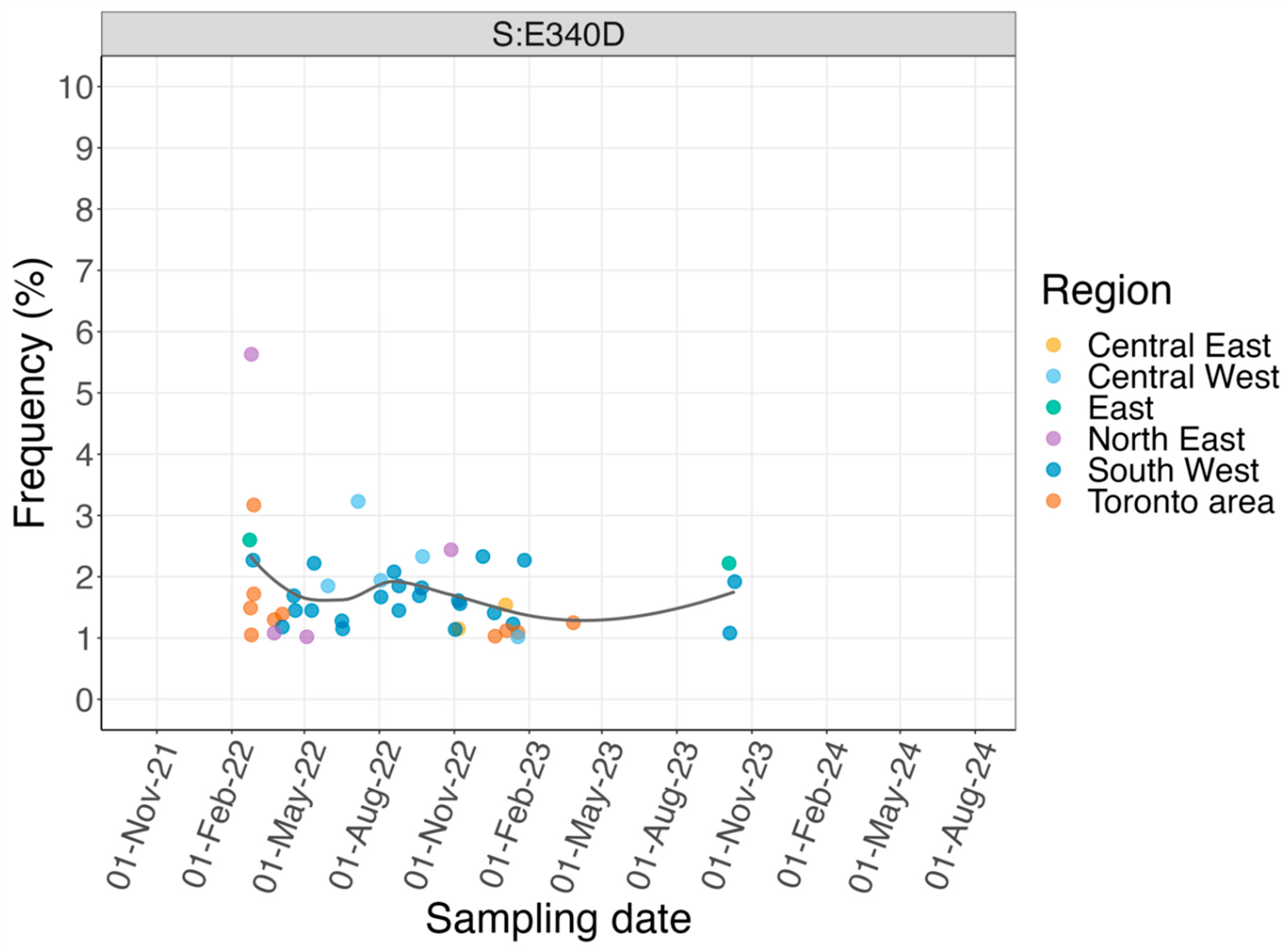
Figure 2.
Temporal trends of mutations associated with remdesivir resistance, detected in wastewater samples from six Ontario regions between October 2021 and July 2024. Wastewater samples were analyzed using an amplicon-based sequencing approach. Reference-based variant calling was performed against the Wuhan strain. Mutations were reported based on thresholds of a minimum read depth of 10, a relative abundance of ≥1%, and detection in at least 10 samples.
Figure 2.
Temporal trends of mutations associated with remdesivir resistance, detected in wastewater samples from six Ontario regions between October 2021 and July 2024. Wastewater samples were analyzed using an amplicon-based sequencing approach. Reference-based variant calling was performed against the Wuhan strain. Mutations were reported based on thresholds of a minimum read depth of 10, a relative abundance of ≥1%, and detection in at least 10 samples.
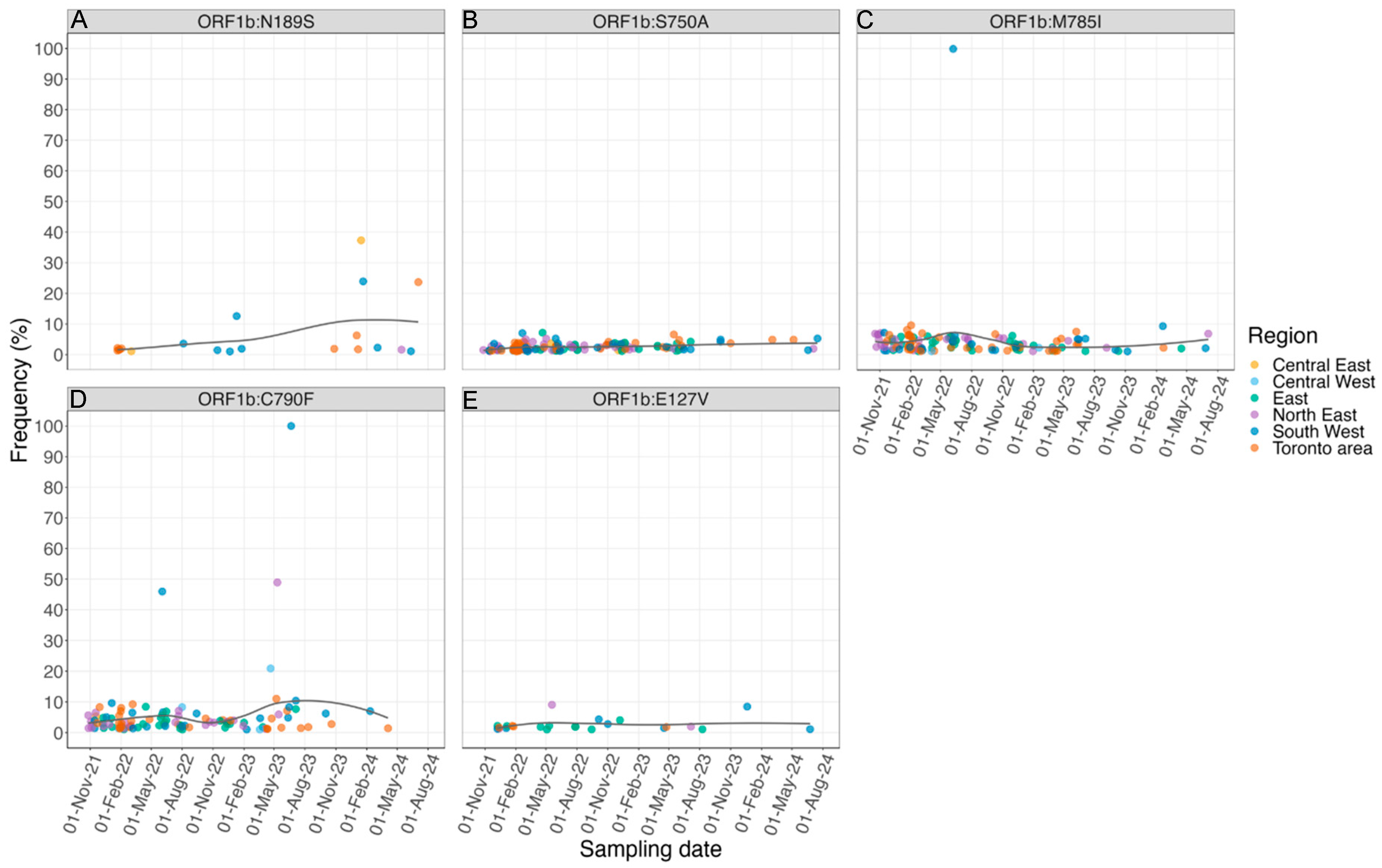
Figure 3.
Temporal trends of mutations associated with nirmatrelvir resistance, detected in wastewater samples from six Ontario regions between October 2021 and July 2024. Wastewater samples were analyzed using an amplicon-based sequencing approach. Reference-based variant calling was performed against the Wuhan strain. Mutations were reported based on thresholds of a minimum read depth of 10, a relative abundance of ≥1%, and detection in at least 10 samples.
Figure 3.
Temporal trends of mutations associated with nirmatrelvir resistance, detected in wastewater samples from six Ontario regions between October 2021 and July 2024. Wastewater samples were analyzed using an amplicon-based sequencing approach. Reference-based variant calling was performed against the Wuhan strain. Mutations were reported based on thresholds of a minimum read depth of 10, a relative abundance of ≥1%, and detection in at least 10 samples.
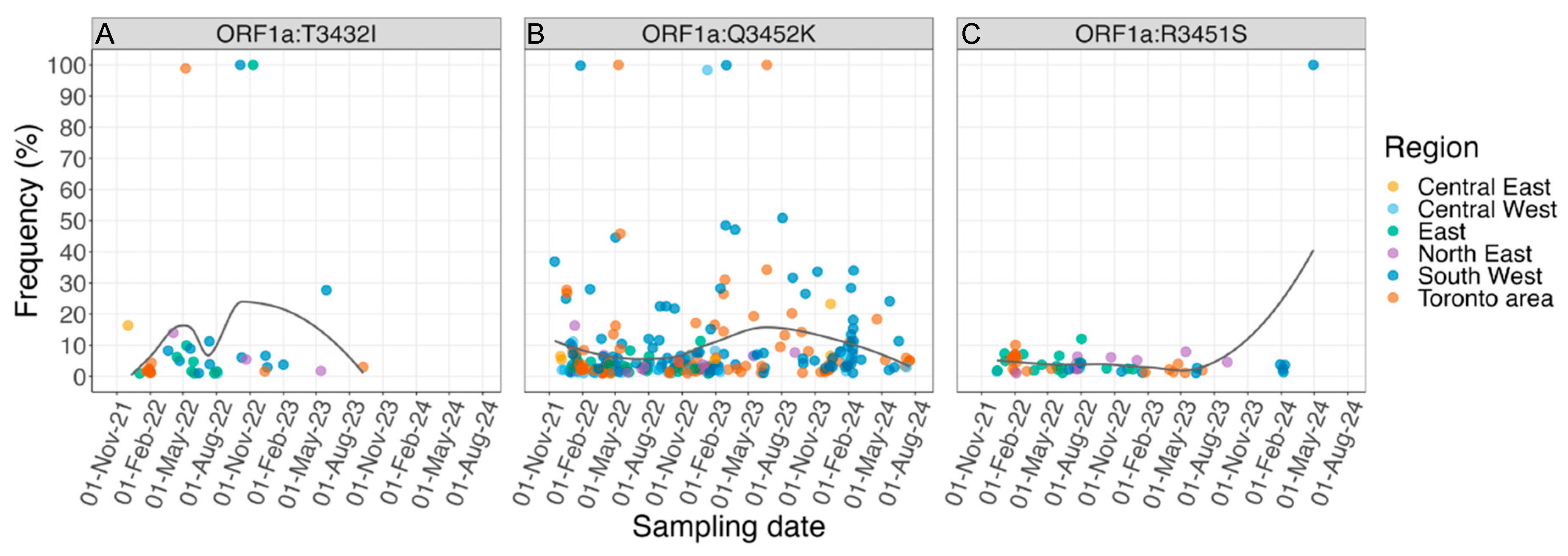
Figure 4.
Temporal trends of mutations associated with resistance to monoclonal antibody–based immunotherapies and vaccine escape, detected in wastewater samples from six Ontario regions between October 2021 and July 2024. Wastewater samples were analyzed using an amplicon-based sequencing approach. Reference-based variant calling was performed against the Wuhan strain. FLiRT (S:R346T and S:F456L) and FLuQE (S:Q493E) mutations were reported based on thresholds of a minimum read depth of 10, a relative abundance of ≥1%, and detection in at least 10 samples.
Figure 4.
Temporal trends of mutations associated with resistance to monoclonal antibody–based immunotherapies and vaccine escape, detected in wastewater samples from six Ontario regions between October 2021 and July 2024. Wastewater samples were analyzed using an amplicon-based sequencing approach. Reference-based variant calling was performed against the Wuhan strain. FLiRT (S:R346T and S:F456L) and FLuQE (S:Q493E) mutations were reported based on thresholds of a minimum read depth of 10, a relative abundance of ≥1%, and detection in at least 10 samples.
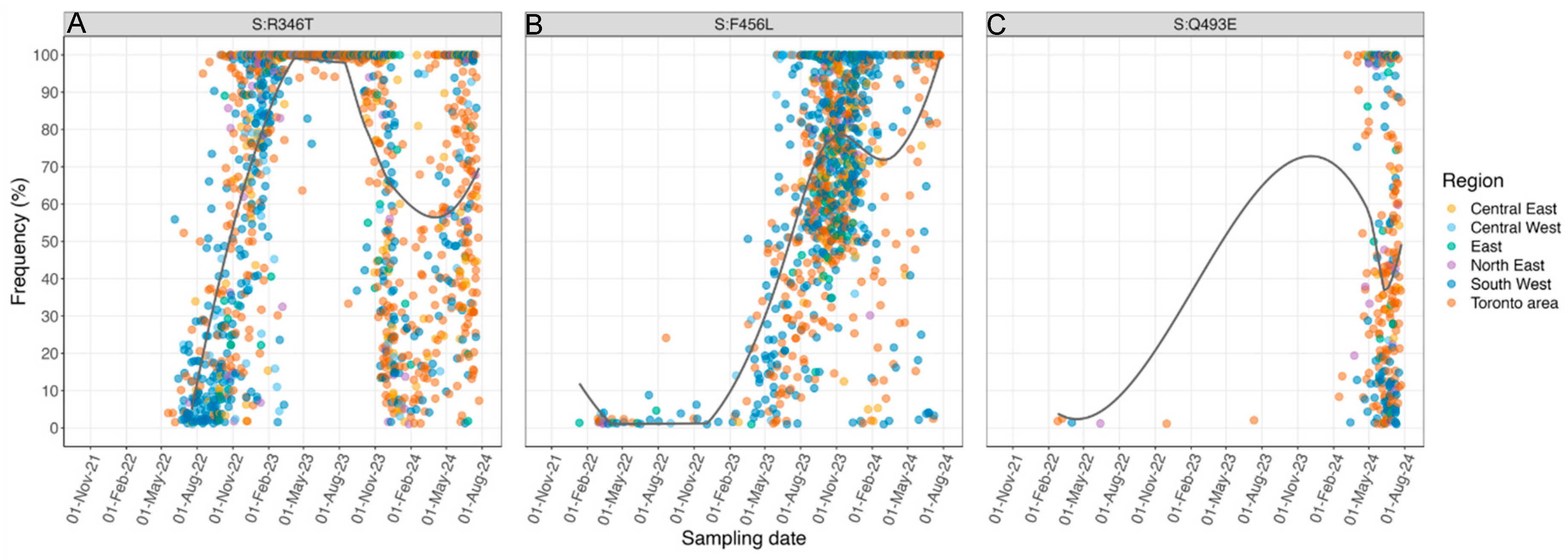

Table 1.
Summary of mutations associated with resistance of SARS-CoV-2 to antiviral therapies detected in Ontario wastewater.
Table 1.
Summary of mutations associated with resistance of SARS-CoV-2 to antiviral therapies detected in Ontario wastewater.
| Mutation | Mutation Class | # Samples | Median Abundance | IQR | Regions | First Detection | First Detection | First Detection Abundance | First Peak Region | First Peak Date | Peak Abundance | Kruskal_Wallis_p |
| S:E340D | Sotrovimab | 46 | 1.55 | 0.85 | East | 2022-02-23 | 2.6 | North East | 2022-02-25 | 5.63 | 0.17577 | |
| ORF1b:N189S | Remdesivir | 21 | 1.89 | 2.15 | 4 | Toronto area | 2022-01-21 | 1.32 | Central East | 2024-01-15 | 37.33 | 0.93098 |
| ORF1b:S750A | Remdesivir | 142 | 2.11 | 1.67 | 6 | North East | 2021-10-27 | 1.51 | East | 2022-04-21 | 7.14 | 0.67205 |
| ORF1b:M785I | Remdesivir | 135 | 3.08 | 3.13 | 6 | North East | 2021-10-18 | 6.82 | South West | 2022-06-07 | 99.86 | 0.41058 |
| ORF1b:C790F | Remdesivir | 106 | 3.32 | 3.76 | 6 | North East | 2021-10-26 | 5.66 | South West | 2023-06-21 | 100 | 0.56394 |
| ORF1b:E127V | Remdesivir | 24 | 1.94 | 0.79 | 4 | East | 2021-12-08 | 2.22 | North East | 2022-05-19 | 9.09 | 0.92325 |
| ORF1a:T3432I | Nirmatrelvir | 38 | 3.43 | 6.24 | 6 | Central East | 2021-12-02 | 16.36 | East | 2022-11-10 | 100 | 0.06437 |
| ORF1a:Q3452K | Nirmatrelvir | 261 | 3.8 | 5.91 | 6 | South West | 2021-11-16 | 36.9 | Toronto area | 2023-06-21 | 100 | 0.00033 |
| ORF1a:R3451S | Nirmatrelvir | 60 | 2.74 | 3.94 | 5 | Central West | 2021-12-13 | 1.5 | South West | 2024-04-29 | 100 | 0.26266 |
| S:R346T | FLiRT | 1539 | 89.12 | 66.61 | 6 | Toronto area | 2022-05-19 | 4 | Toronto area | 2022-09-30 | 100 | 0.00001 |
| S:F456L | FLiRT | 1092 | 74.74 | 47.98 | 6 | East | 2022-01-11 | 1.39 | South West | 2023-06-01 | 100 | 0.00001 |
| S:Q493E | FLuQE | 269 | 34.75 | 63.53 | 6 | Toronto area | 2022-02-24 | 1.82 | Toronto area | 2024-03-08 | 100 | 0.00285 |
*IQR = Interquartile Range.
Disclaimer/Publisher’s Note: The statements, opinions and data contained in all publications are solely those of the individual author(s) and contributor(s) and not of MDPI and/or the editor(s). MDPI and/or the editor(s) disclaim responsibility for any injury to people or property resulting from any ideas, methods, instructions or products referred to in the content. |
© 2026 by the authors. Licensee MDPI, Basel, Switzerland. This article is an open access article distributed under the terms and conditions of the Creative Commons Attribution (CC BY) license (http://creativecommons.org/licenses/by/4.0/).
Copyright: This open access article is published under a Creative Commons CC BY 4.0 license, which permit the free download, distribution, and reuse, provided that the author and preprint are cited in any reuse.


