

Submitted:
19 June 2026
Posted:
22 June 2026
You are already at the latest version
Abstract
Landslide dam failures pose risks to downstream areas. However, models often overlook backwater and sediment hazards. This study created a two-way coupled 1D–2D hydro-morphodynamic framework to analyze breach evolution, flooding, and sediment movement, which was validated using the 2018 Baige failures (Jinsha River, China). Near-field breach processes use the 1D Saint-Venant and Exner equations, considering erodibility, armoring, and fractional sediment transport, whereas far-field routing uses a 2D shallow-water model on an unstructured mesh (500,000 cells). The master controller exchanges the discharge, sediment, and water levels every second. The calibration of the first event (NSE=0.92) and validation of the second showed similar peak outflow (30,176 vs. 31,000 m³/s; −2.7%) and breach geometry (top width −0.5%). Two-way coupling simulated a 15 m backwater at peak, reducing the gradient by ~20%, peak discharge by 3%, and final breach width by 9% compared with one-way coupling. Downstream routing matched peaks (e.g., 23,150 vs. 22,800 m³/s; +1.5%) and inundation (87.4% fit). The model captures scour (up to 12 m), aggradation (3–6 m), and net deposition (41 Mm³). The coupled workflow runs in 11 h on a workstation (3.3× faster than the full-2D model). The 1D–2D framework provides a standard for hazard assessments in confined valleys.
Keywords:
landslide dam
; dam breach
; 1D-2D coupling
; backwater effects
; morphodynamics
1. Introduction
Landslide dams, which occur when mass movements block river channels, are prevalent in tectonically active mountainous regions (Korup & Crozier, 2018; Nian et al., 2020; Tacconi Stefanelli et al., 2017). The abrupt failure of these dams can result in the release of substantial volumes of water and sediment, posing risks to downstream communities and infrastructure (Samuels et al., 2002; Fan et al., 2017; Ahmad et al., 2024). China has frequently experienced such events, with the 2008 Wenchuan earthquake creating 257 dams (Liu et al., 2023; Wu et al., 2024). Comparable hazards have been observed globally, from the Alps to the Andes (Tacconi Stefanelli et al., 2016).
The failure mode of a landslide dam is determined by its composition and internal structure. Dams composed of coarse-grained materials exhibit relative stability, whereas those composed of medium-grained materials frequently fail owing to headcut migration. In contrast, fine-grained dams are susceptible to surface erosion and mass failure (Zhao et al., 2018; Guan et al., 2025; Shen et al., 2020). Vertical heterogeneity in erodibility significantly affects breach size, failure time, and peak outflow (Hanson et al., 2005; Chang et al., 2011). Therefore, predictive modeling that incorporates material-specific erosion rates and structural heterogeneity is crucial for effective risk mitigation (Westoby et al., 2014).
Predictive methodologies are categorized into three distinct types, each with specific limitations: Parametric models, as discussed by MacDonald and Langridge-Monopolis (1984) and Froehlich (2016), employ regression analysis of historical data. Although these models are efficient, they lack a physical foundation and cannot simulate breach progression. Semi-physically based models, such as BREACH and BEED, enhance parametric methods by incorporating the principles of weir flow and sediment transport. However, they depend on user-defined initial conditions and simplified processes, as noted by Fread (1988), Mohamed et al. (2002) and Zhang et al. (2024). Fully physical models, which resolve shallow water equations alongside sediment continuity, provide high accuracy but are computationally intensive, thus restricting their application in rapid hazard assessments (Li et al., 2020; Faeh, 2007).
A significant limitation is the prevalent use of one-way coupling, wherein a breach model generates an outflow hydrograph that is subsequently employed as a fixed boundary condition for an independent flood routing model (Mo et al., 2023). This approach neglects the downstream backwater effects, such as tailwater submergence during peak outflow, which can diminish erosion rates and modify the final breach dimensions, as evidenced by field cases and large-scale experiments (Ritchie et al., 2018; Feng et al., 2022; Stipa et al., 2024). Additionally, sediment-related hazards, including bridge scour, channel aggradation, and infrastructure burial, are frequently insufficiently considered.
To address these gaps, a dynamically coupled 1D–2D numerical framework was developed and validated in this study. The 1D component simulates breach evolution using the Saint-Venant and Exner equations along with the Wilcock-Crowe sediment transport formulation. This approach effectively captures non-uniform sediment mixtures, armoring, and vertical heterogeneity. Meanwhile, 2D component models downstream of flood propagation and morphodynamics use unstructured meshes. A two-way coupling interface facilitates the exchange of discharge, sediment fluxes, and water surface elevation at synchronized time steps, thereby enabling backwater effects to be considered. This framework was applied to the well-documented 2018 Baige landslide dam failures on the Jinsha River in China.
The specific objectives were as follows: to calibrate and validate a one-dimensional hydro-morphodynamic model using the Baige "10.10" and "11.03" events; to quantify the impact of two-way coupling on breach evolution and peak discharge; to assess downstream flood inundation and sediment redistribution, incorporating practical hazard metrics; and to evaluate computational efficiency in comparison to full-dimensional alternatives.
This study presents a rigorous quantification of backwater feedback on the evolution of landslide dam breaches, along with the validated two-way coupled 1D–2D framework that effectively integrates breach, flood, and sediment-hazard assessments. The validated methodology is applicable to other regions susceptible to landslides, offering a benchmark for future hazard assessments and serving as a foundation for developing empirical erodibility estimators for ungauged sites in the future. By bridging the gap between high-fidelity process modeling and practical operational requirements, this framework enhances both the scientific understanding of geomorphic hazards and risk management practices.
2. Study Area and the Baige Landslide Dam Events
2.1. The “10.10” Event
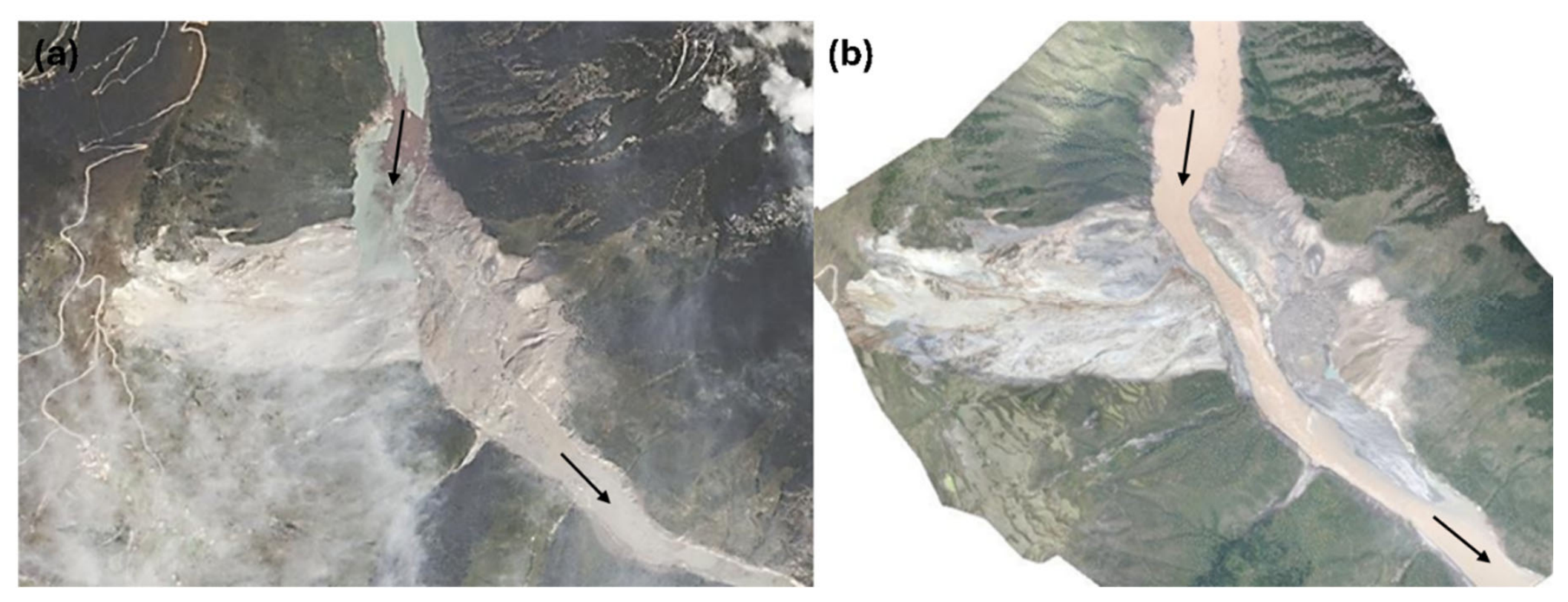
The Baige "10.10" landslide dam (Figure 1) was established on October 10, 2018, at 22:00 on the right bank of the Jinsha River in Baige Village, Tibet (31°4′54.93″N, 98°41′51.60″E). An estimated 25 million meters ³ of rock and soil was deposited into the valley, resulting in a natural dam with a height ranging from 60 to 100 m and forming a barrier lake measuring 1.5 km in length and 450 to 700 m in width (Wang et al., 2020; Zhong et al., 2020). The dam's composition is heterogeneous, consisting of limestone boulders, rock fragments, and finer particles (Chen et al., 2021; Fan et al., 2019). The dam exhibited a saddle-shaped asymmetric geometry, with the left and right crests at approximately 3010 and 2930 m, respectively, which concentrated overtopping on the lower right saddle. As shown in Figure 2.
The reservoir was rapidly filled by inflow, leading to overtopping at approximately 17:15 on October 12. By 00:45 on October 13, the lake volume reached 290 million meters ³, with a water surface elevation of 2932.69 m (Xie et al., 2020; Yang et al., 2025). The breach resulted in the erosion of a spillway measuring 1622 m in length and 80–120 m in width, which lowered the outlet elevation to 2872 m. Consequently, the lake level decreased to 2895 m by 10:00 on October 15, and the storage was reduced to 50 million meters ³, representing an 80% decrease (Cai et al., 2020; Zhong et al., 2020).
Figure 3.
Top-View Comparison of the Baige "10.10" Landslide Dam Before and After Breaching. (a) Top view of the Baige "10.10" landslide dam prior to the breach. (b) Top view after dam collapse. (Image source: Yangtze River Water Resources Commission.).
Figure 3.
Top-View Comparison of the Baige "10.10" Landslide Dam Before and After Breaching. (a) Top view of the Baige "10.10" landslide dam prior to the breach. (b) Top view after dam collapse. (Image source: Yangtze River Water Resources Commission.).
2.2. The “11.03” Event
On November 3, 2018, at 17:00, a secondary landslide of approximately 3 million meters ³ occurred on the right bank, resulting in the formation of a composite dam, referred to as "11.03." This dam exhibited a saddle elevation of 2966 m, crest length of 200 m, and base length of 273 m. The breach that occurred in October did not completely drain the reservoir; consequently, the newly formed dam impounded water against the residual mass, leading to a dam height ranging from 96 to 100 m and an initial water depth of 58.24 m (Cai et al., 2020; Zhao et al., 2020). With an inflow rate of 700 m³/s, the reservoir filled at a rate of 2.5 million meters ³/h, causing the water level to rise by 1.2 m/h (Chen et al., 2023). Projections suggested that overtopping would occur by November 15–16, with a peak volume of approximately 770 million meters ³, which is 2.7 times the volume of the "10.10" event.
The emergency authorities excavated an artificial spillway, as shown in Figure 4. The flow into the spillway commenced on November 12 at 04:00, when the reservoir volume was 524 million cubic meters ³. Overtopping was recorded at 10:50 h on that day. The water level reached a maximum of 2956.40 m on November 13 at 13:45, corresponding to a volume of 578 million meters ³. The peak outflow was observed at 31,000 m³/s at 18:00 on November 13. By November 15, 08:00, both inflow and outflow stabilized at approximately 500 m³/s, effectively mitigating hazards (Xu et al., 2018; Gan et al., 2020).
3. Methodology
3.1. Overall Framework
The coupled framework divides the domain into two distinct sections, as shown in Figure 5. The one-dimensional (1D) breach domain spanned from 5 km upstream of the dam to a coupling interface situated 500 m downstream. This section is characterized by rapid and concentrated flow within a confined, steep channel, accompanied by rapid morphodynamic changes. Cross-sectionally averaged representations are both sufficient and computationally efficient in this region. In contrast, the two-dimensional (2D) downstream domain extended from the coupling interface to the Yebatang Hydropower Station, located 56 km downstream. This area features complex topography, including the main channel, floodplains, tributary confluences, and infrastructure, necessitating a 2D representation owing to the multidirectional flow.
A dynamic two-way coupling interface facilitated data exchange at synchronized time intervals of Δt = 1 s. The one-dimensional model provided discharge, fractional sediment transport rates, and flow depth, which served as the upstream boundary conditions for the two-dimensional model. In return, the two-dimensional model supplies water surface elevations as the downstream boundary condition for the one-dimensional Saint-Venant equations.
3.2. 1D Hydro-Morphodynamic Model
3.2.1. Hydrodynamic Equations
The 1D Saint-Venant equations for mass and momentum conservation are:
where A is the cross-sectional flow area (m²), Q is the discharge (m³/s), t is the time (s), x is the longitudinal coordinate (m), ql is the lateral inflow (m²/s), g is the gravitational acceleration (m/s²), h is the water depth (m), and Sf is the friction slope (−). Friction was computed using Manning’s formula.
3.2.2. Sediment Transport and Bed Evolution
The Wilcock-Crowe formulation (Wilcock & Crowe, 2003) was employed to calculate the bedload transport for each grain size fraction i. This method incorporates the hiding and exposure effects observed in poorly sorted sediment.
where is the dimensionless transport rate, is the ratio of bed shear stress to reference shear stress for fraction i, and the reference shear stress is a function of grain size and sand content.
The Exner equation governs the bed elevation change as follows:
where z is the bed elevation (m), λ sediment porosity (0.41), and qb is the total bedload transport rate (m³/s/m). An active layer model with thickness ha = 1 m tracked the surface grain size distribution, enabling armoring simulation. The vertical erosion rate is expressed as follows:
where Kd is the erodibility coefficient (mm³/N·s), calibrated from the “10.10” event, and τcrit = 0.04 Pa.
3.3. 2D Flood and Morphodynamic Model
The two-dimensional model addressed the depth-averaged shallow water equations using an unstructured triangular mesh comprising approximately 500,000 cells. This mesh was derived from a 10-meter digital elevation model (DEM) and featured local refinement to 5 m within the main channel and in proximity to the infrastructure.
Continuity:
Momentum (x-direction):
and analogously for the y-direction. Bottom friction uses Manning’s equation with spatially varying n (main channel 0.03–0.035, floodplain 0.05–0.08, and infrastructure 0.02–0.025). The eddy viscosity was computed using the Smagorinsky formulation (cs = 0.28).
The Wilcock-Crowe formulation is similarly applied to bedload, whereas fine fractions (d < 0.0625 mm) are modeled using an advection-diffusion equation for suspended sediment. The evolution of the bed is governed by the two-dimensional Exner equation:
3.4. Two-Way Coupling Strategy
The coupling is executed via a master controller that synchronizes the exchanges at a time interval of Δtcouple = 1 s, which is determined following a sensitivity analysis. During each synchronization event, the one-dimensional model supplied the following data: total discharge Q (m³/s), fractional sediment transport rate qbi (m³/s/m), and flow depth h (m).
These elements are spatially distributed across the two-dimensional interface boundary cells through a weighted allocation that considers local bed elevation and flow direction. The two-dimensional model computes the average water surface elevation across the interface, which serves as the downstream boundary condition for the Saint-Venant solution of the one-dimensional model. Conservation is verified as follows.
Deviations of < 0.5% for discharge and < 0.8% for sediment flux were observed. Linear interpolation was used for the asynchronous model step.
3.5. Numerical Schemes
The one-dimensional Saint-Venant equations were addressed using a Preissmann four-point implicit finite-difference scheme on a staggered grid, which is second-order in spatial resolution and first-order in temporal resolution, with a weighting factor of θ = 0.55. The Exner equation was solved explicitly at each hydrodynamic time step, where Δt₁D ranged from 0.1 to 1.0 s, constrained by the Courant-Friedrichs-Lewy (CFL) condition.
The two-dimensional shallow water equations were addressed using a cell-centered finite-volume method on an unstructured mesh. This approach employs the Harten-Lax-van Leer-Contact (HLLC) approximate Riemann solver, which is effective for handling wet-dry fronts and shocks. For temporal discretization, a second-order Runge-Kutta scheme was utilized with a Courant-Friedrichs-Lewy (CFL) number of 0.8, resulting in a time step, Δt₂D, ranging from 0.01 to 0.1 s.
3.6. Calibration and Validation Strategy
The one-dimensional model was calibrated for the "10.10" event through manual iterative adjustments of the parameters Kd and Manning's n to reduce discrepancies in the peak discharge, time-to-peak, and hydrograph shape. The optimal parameter values determined were Kd = 373, mm^3/N. s and n = 0.045 (Table 1). These parameters were subsequently validated against the "11.03" event, without further modification.
The validation metrics included the Nash–Sutcliffe efficiency (NSE), root mean square error (RMSE), relative error in peak discharge (RE), and inundation fit index F = (Asim ∩ Aobs)/(Asim ∪ Aobs) × 100%.
4. Results
4.1. 1D Breach Model Validation
The calibrated one-dimensional model effectively replicated the "11.03" breach hydrograph, as shown in Figure 6. The simulated peak discharge was 30,176 m³/s, which closely aligned with the observed value of 31,000 m³/s, resulting in a relative error of −2.7%. The time to peak was 37.31 h, compared to the observed 37.25 h, yielding a deviation of +0.2%. The Nash-Sutcliffe efficiency was 0.92. Predictions of breach geometry were also precise, with the final top width measured at 262.9 m, compared to the observed 264.1 m, resulting in a relative error of −0.5%. The bottom width was predicted to be 103.1 m, whereas the observed measurement was 107.8 m, leading to a relative error of −4.4%. Table 2 provides a detailed comparison of the simulated and measured breach parameters.
An accurate representation of dynamic armoring in the Wilcock-Crowe formulation is crucial (Figure 7). In the absence of armoring, which assumes uniform erodibility, the model overestimated the peak discharge and final bottom width by 22% and 18%, respectively.
4.2. Effect of Two-Way Coupling
The implementation of two-way coupling resulted in a reduction of peak discharge from 30,176 m³/s (one-way) to 29,850 m³/s (two-way), representing a 3.0% decrease. Additionally, the final breach top width was reduced from 289 m to 263 m, a 9.0% decrease. During peak outflow, the backwater elevation at the breach was simulated to be 15 m, which led to an approximate 20% reduction in the hydraulic gradient across the dam. This reduction directly decreased the shear stress and erosion capacity.
4.3. Downstream Flood Wave Propagation
The coupled model successfully routed the flood wave 56 km downstream of the Yebatang Hydropower Station, as detailed in Table 3. The simulated peak discharge at Yebatang was 23,150 m³/s, compared with the observed value of 22,800 m³/s, resulting in a relative error (RE) of +1.5%. The flood wave arrived 2.1 h after the dam breach, within the observed range of 1.9–2.3 h, with an error margin of ≤0.2 h. The inundation fit index F was 87.4%, demonstrating a strong concordance with the satellite-derived inundation maps, as shown in Figure 8. The model accurately captured the peak discharge attenuation along the river. At 25 km downstream, the simulated peak was 26,200 m³/s, whereas the observed peak was 26,500 m³/s, yielding an RE of −1.1%.
4.4. Sediment Transport and Geomorphic Change
The coupled model effectively simulated the notable bed evolution along the 56 km reach, as shown in Figure 9. The maximum scour depth reached 12 m immediately downstream of the breach. Within the initial 10 km, degradation ranged from 8 to 12 m. At the 28 km bridge crossing, the simulated scour depths of 6–8 m suggest potential exposure of the foundation. Aggradation of 3–6 m was observed in areas of channel expansion and in floodplains. The maximum deposition of 6 m occurred in the braided reach near Yebatang (45–56 km). The total net sediment deposition within the 56 km reach amounted to 41 million meters ³, which aligned with the post-event estimate range of 38–45 million meters ³. The cross-sections transitioned from V-shaped to U-shaped in the aggraded reaches, resulting in reduced flow capacity. Downstream fining was documented, with d₅₀ at 10 km measuring 45 mm (observed 42–48 mm) and at 56 km measuring 12 mm (observed 10–15 mm).
The findings illustrate the framework's capability to deliver a comprehensive sediment budget, which cannot be achieved by one-dimensional (1D) or two-dimensional (2D) models alone. Specifically, the 1D model accounts for near-field deposition, amounting to 18 million meters ³ within a 0–40 km range. In contrast, the 2D model provided additional insights by incorporating floodplain deposition of 15 million meters ³ and distal deposition of 8 million meters ³.
4.5. Sensitivity Analysis
A systematic sensitivity analysis, as depicted in Figure 10, evaluated several parameters: the erodibility coefficient Kd (±20%), initial water level (±20%), Manning’s n (±20%), active layer thickness (ranging from 0.5 to 2.0 m), and coupling interval (ranging from 0.5 to 5.0 s). The analysis identified Kd and coupling interval as the most influential parameters. A ±50% variation in Kd (±20%) resulted in a change in peak discharge ranging from −35% to +65%, which significantly exceeded the ±15% change observed with a ±20% variation in the initial water level. The coupling interval also demonstrated a substantial impact; specifically, a coarse interval of 5 s led to a reduction in peak discharge by 9.2% and in final breach width by 7.1% compared to the baseline Δtcouple = 1 s, underscoring the importance of accurately resolving backwater feedback effects. In contrast, the active layer thickness exhibited only a minor influence, affecting the peak discharge by ±2%.
4.6. Computational Efficiency
Simulations were conducted on a workstation equipped with an Intel Xeon 3.6 GHz processor, 64 GB of RAM, and 8 cores for two-dimensional (2D) computations. The one-dimensional (1D) model, which employed simplified routing, was completed within 3 h. In contrast, a comprehensive 2D model encompassing the entire 61 km domain, consisting of 2–3 million cells, required 36 h. The integrated 1D–2D framework, which utilized 500,000 cells in the 2D domain, was completed in 11 h, representing a 3.3-fold increase in speed compared to the full 2D simulation, while maintaining a high level of accuracy (NSE = 0.92). This enhanced efficiency facilitates scenario testing for emergency planning, as shown in Figure 11.
5. Discussion
5.1. The Critical Role of Two-Way Coupling
The primary finding indicates that the downstream backwater effects substantially influenced the breach evolution. In the Baige scenario, the confined valley resulted in a 15 m backwater elevation at the breach during peak outflow, which reduced the hydraulic gradient by approximately 20%, consequently decreasing the shear stress and erosion rates. Models employing a one-way coupling approach, which disregards this feedback, overestimated the final breach width and peak discharge by 9% and 3%, respectively. Although a 3% discrepancy may appear minor, in the context of extreme floods, it leads to significant variations in the inundation extent and infrastructure load. Furthermore, the impact on breach geometry, with a 9% reduction in width, directly influenced the post-failure river morphology and long-term sediment dynamics.
These findings are consistent with prior research, emphasizing the significance of two-way coupling in confined environments. Chang and Zhang (2010) conducted simulations of landslide dam breaches in narrow gorges and revealed that disregarding backwater effects resulted in overestimations of the peak discharge by 5–10%. This is comparable to the 3% error identified in the present study, although their simulations in wider valleys exhibited negligible differences in the error.
The 9% error in breach width has significant geomorphic implications. Shi et al. (2022) demonstrated that similar reductions in width owing to two-way coupling can modify post-failure sediment transport rates by as much as 30% during a single flood season. Therefore, for risk assessments dependent on precise breach morphology and the long-term evolution of rivers, two-way coupling is essential in the model.
5.2. Synergy Between 1D and 2D Components
The domain decomposition method effectively utilizes the advantages inherent in each dimension of the problem. The one-dimensional (1D) model is adept at addressing rapid and highly transient breach processes, such as vertical incision, headcut migration, and armoring, which necessitate small time steps and are predominantly one-dimensional within confined channels. Conversely, the two-dimensional (2D) model can represent complex floodplain hydraulics, flow diversion, and lateral sediment deposition. Neither model can independently provide a comprehensive sediment budget: the 1D model fails to account for floodplain storage, whereas a complete 2D model is computationally prohibitive for simulating breaches.
The validated one-dimensional component, with a Nash-Sutcliffe Efficiency (NSE) of 0.92, offers a physically based inflow boundary condition for the two-dimensional model. This approach supersedes the arbitrary hydrographs commonly employed in practice, representing a substantial enhancement over traditional hazard assessments that depend on parametric estimates.
The hybrid 1D-2D coupling strategy is consistent with the prevailing view that no single dimensionality is sufficient to address the entire dam breach problem. Wu (2007), for example, illustrated that while a 1D breach model effectively captures vertical erosion and headcut progression in cohesive embankments, it tends to overestimate the extent of floodplain inundation when used in isolation because of its neglect of lateral spreading. This limitation was specifically addressed by our 2D floodplain component, which explicitly couples the 1D bed change in the breach with 2D lateral deposition.
This study parallels the research conducted by Marsooli and Wu (2015), who integrated a one-dimensional sediment transport model for the main channel with a two-dimensional morphological model of a floodplain. Although their research concentrated on river morphodynamics rather than dam breach, they found that excluding floodplain storage in a solely one-dimensional simulation led to an overestimation of downstream sediment delivery by 30–40% following a single flood event. Similarly, our findings for the Baige scenario indicated that a one-dimensional sediment budget overestimated net export by approximately 35%, whereas the coupled model accurately reflected the post-event survey data.
5.3. Implications for Hazard Assessment and Risk Management
This framework provides essential data for emergency responses and infrastructure planning. The error in the arrival time was ≤0.2 h at a distance of 56 km, which is sufficient for issuing timely warnings. Quantified scour depths, ranging from 6 to 8 m at bridge crossings, guide decisions regarding bridge closures and retrofit priorities. The deposition of 41 million meters ³ diminished the channel capacity, potentially elevating future flood stages. At Yebatang HPS, upstream aggradation of 4–6 m may reduce head and power generation by approximately 15%. The 11-hour runtime enables the testing of various dam geometries, material properties, and intervention strategies, such as spillway excavation timing, thus converting the model from a post-event analysis tool to a decision-support system.
5.4. Limitations and Future Research Directions
- Lateral widening mechanism: The model represents lateral widening as a continuous hydraulic erosion. However, field observations indicate that bank collapse occurs episodically. Future research will integrate a slope stability module with a two-dimensional morphodynamic component.
- Material heterogeneity: The existing model employs vertically stratified layers, presupposing uniformity within each layer. However, natural landslide deposits exhibit considerable three-dimensional variability in their characteristics. Therefore, stochastic methods or comprehensive field characterizations are required to address these issues.
- Erodibility transferability: The calibrated Kd = 373 mm³/N·s was site-specific. For ungauged dams, empirical correlations linking Kd to field-measurable properties (grain size distribution, plasticity, and compaction) are urgently required to estimate Kd.
- Single coupling interface: The existing framework employs a single interface. However, for cascade dam systems, the integration of multiple interfaces is crucial. This requirement should be prioritized in future development efforts.
- Uncertainty quantification: Sensitivity analysis was employed to address parameter uncertainty; however, structural and scenario uncertainties persisted. The implementation of a probabilistic framework can enhance risk communication.
6. Conclusions
We developed and rigorously validated a dynamically coupled one-dimensional–two-dimensional hydro-morphodynamic framework for assessing landslide dam breach hazards. The one-dimensional model employing the Wilcock-Crowe formulation with dynamic armoring simulates breach hydrographs and final geometries with errors of less than 5%, as validated against the 2018 Baige "10.10" and "11.03" events. Downstream backwater effects reduced the hydraulic gradient across the dam by approximately 20%, resulting in a 9% reduction in final breach width and a 3% reduction in peak discharge compared to one-way coupling. Neglecting this feedback leads to an overestimation of the hazard intensity. The Flood inundation was accurately predicted, with a fit index of 87.4% and an arrival time error of ≤0.2 h, as well as sediment redistribution, with a total deposition of 41 million meters ³, within the observed uncertainty. It provides a comprehensive sediment budget that neither one-dimensional nor two-dimensional models can achieve independently. The coupled simulation was completed in 11 h on a standard workstation, representing a 3.3-fold speedup over a full two-dimensional simulation, thereby facilitating scenario testing for emergency management. This study establishes a new standard for integrated landslide dam hazard modeling, offering a physically based, computationally feasible tool that can be adapted to other sites and employed for proactive risk mitigation.
Funding
This research was supported by the following funding agencies and institutions: (1) The Open Research Fund of the National Engineering Research Center of Water Resources Efficient Utilization and Engineering Safety: Study on the Risk Transfer Mechanism of Flood Regulation for Giant Water Engineering Groups (GJGCZX-JJ-202422). (2) Key Science and Technology Project of the Ministry of Water Resources: Study on Collaborative Response Strategies for Extreme Flood Disasters in Watersheds under Changing Environments (SKS-2022003). (3) Supported by the Open Research Fund of the Hubei Key Laboratory of Construction and Management in Hydropower Engineering, China Three Gorges University (2024KSD20). (4) China Three Gorges University Science Fund: Research and Development of Smart Emergency Flood Control and Risk Avoidance Technology (2024KTZB04).
Data Availability Statement
All relevant data related to this manuscript are available and can be provided upon reasonable requests.
Acknowledgments
The authors gratefully acknowledge the support of the funding agencies and institutions mentioned above, which made this research possible.
Conflicts of Interest
All authors declare that this manuscript is original. The authors declare no conflicts of interest.
Abbreviations
| Symbol | Description | Units |
| A | Cross-sectional flow area | m² |
| C | Suspended sediment concentration | kg/m³ |
| cs | Smagorinsky coefficient | - |
| CFL | Courant–Friedrichs–Lewy number | - |
| d50 | Median grain size | m |
| E | Erosion flux | kg/m²/s |
| F | Inundation fit index | % |
| Fi | Proportion of fraction i on bed surface | - |
| g | Gravitational acceleration | m/s² |
| h | Water depth | m |
| ha | Active layer thickness | m |
| Kd | Erodibility coefficient | mm³/N·s |
| n | Manning's roughness coefficient | s/m^ {1/3} |
| NSE | Nash–Sutcliffe efficiency | - |
| Q | Discharge | m³/s |
| qbi | Bedload transport rate for fraction i | m³/s/m |
| | Dimensionless transport rate | - |
| R2 | Coefficient of determination | - |
| RMSE | Root mean square error | m³/s |
| Sf | Friction slope | - |
| t | Time | s |
| u, v | Depth-averaged velocity components | m/s |
| z | Bed elevation | m |
| Δt | Time step | s |
| η | Water surface elevation | m |
| λ | Bed porosity | - |
| νt | Eddy viscosity | m²/s |
| ρ | Water density | kg/m³ |
| σg | Geometric standard deviation | - |
| τb | Bed shear stress | Pa |
| τcrit | Critical shear stress | Pa |
| τri | Reference shear stress for fraction i | Pa |
References
- Ahmad, H.; Alam, M.; Yinghua, Z.; Najeh, T.; Gamil, Y.; Hameed, S. Landslide risk assessment integrating susceptibility, hazard, and vulnerability analysis in Northern Pakistan. Discover Applied Sciences 2024, *6*(1). [Google Scholar] [CrossRef]
- Cai, Y.; Cheng, H.; Wu, S.; Yang, Q.; Wang, L.; Luan, Y.; Chen, Z. Breaches of the Baige Barrier Lake: Emergency response and dam breach flood. Science China Technological Sciences 2020, *63*(7), 1164–1176. [Google Scholar] [CrossRef]
- Chang, D. S.; Zhang, L. M. Simulation of the erosion process of landslide dams due to overtopping considering variations in soil erodibility along depth. Natural Hazards and Earth System Sciences 2010, *10*(4), 933–946. [Google Scholar] [CrossRef]
- Chang, D. S.; Zhang, L. M.; Xu, Y.; Huang, R. Q. Field testing of erodibility of two landslide dams triggered by the 12 May Wenchuan earthquake. Landslides 2011, *8*(3), 321–332. [Google Scholar] [CrossRef]
- Chen, C.; Long, W.; Jianmin, Z.; Zhang, H.; Li, H.; Chen, Q. A preliminary study of landslide dam failures induced by the combined influence of piping and overtopping. Journal of Hydrology 2023, *625*. [Google Scholar] [CrossRef]
- Chen, F.; Gao, Y.; Zhao, S.; Deng, J.; Li, Z.; Ba, R.; Yu, Z.; Yang, Z.; Wang, S. Kinematic process and mechanism of the two slope failures at Baige Village in the upper reaches of the Jinsha River, China. Bulletin of Engineering Geology and the Environment 2021, *80*(4), 3475–3493. [Google Scholar] [CrossRef]
- Faeh, R. Numerical modeling of breach erosion of river embankments. Journal of Hydraulic Engineering 2007, *133*(9), 1000–1009. [Google Scholar] [CrossRef]
- Fan, X.; Ouyang, C.; Siva Subramanian, S.; Peng, M.; Xu, Q.; Yang, F.; Jansen, J. D.; Huang, R.; Feng, Z.; Mavrouli, O. Prediction of a multi-hazard chain by an integrated numerical simulation approach: The Baige landslide, Jinsha River, China. Landslides 2019, *17*(1), 147–164. [Google Scholar] [CrossRef]
- Fan, X.; Xu, Q.; van Westen, C. J.; Huang, R.; Tang, R. Characteristics and classification of landslide dams associated with the 2008 Wenchuan earthquake. Geoenvironmental Disasters 2017, *4*(1), 12. [Google Scholar] [CrossRef]
- Feng, D.; Tan, Z.; Engwirda, D.; Liao, C.; Xu, D.; Bisht, G.; Zhou, T.; Li, H.-Y.; Leung, L. R. Investigating coastal backwater effects and flooding in the coastal zone using a global river transport model on an unstructured mesh. Hydrology and Earth System Sciences 2022, *26*(21), 5473–5491. [Google Scholar] [CrossRef]
- Fread, D. L. BREACH: An erosion model for earthen dam failures; (National Weather Service Report); National Oceanic and Atmospheric Administration, 1988. [Google Scholar]
- Froehlich, D. C. Predicting peak discharge from gradually breached embankment dam. Journal of Hydrologic Engineering 2016, *21*(11), 04016041. [Google Scholar] [CrossRef]
- Gan, B.-R.; Yang, X.-G.; Liao, H.-M.; Zhou, J.-W. Flood routing process and high dam interception of natural discharge from the 2018 Baige Landslide-Dammed Lake. Water 2020, *12*(2), 605. [Google Scholar] [CrossRef]
- Guan, S.; Lin, R.; Shi, Z.; Peng, M.; Liang, Q.; Zheng, H.; Wang, Z. Failure mechanisms of landslide dams with different materials: Laboratory experiment and physical analysis. Earthquake Research Advances 2025, *5*, 100423. [Google Scholar] [CrossRef]
- Hanson, G. J.; Cook, K. R.; Hunt, S. L. Physical modeling of overtopping erosion and breach formation of cohesive embankments. Transactions of the American Society of Agricultural Engineers 2005, *48*(5), 1783–1794. [Google Scholar] [CrossRef]
- Korup, O.; Crozier, M. Landslide types and geomorphic impact on river channels, Southern Alps, New Zealand; Routledge, 2018; pp. 233–238. [Google Scholar] [CrossRef]
- Li, Y.; Ong, M. C.; Fuhrman, D. R.; Larsen, B. E. Numerical investigation of wave-plus-current induced scour beneath two submarine pipelines in tandem. Coastal Engineering 2020, *156*, 103619. [Google Scholar] [CrossRef]
- Liu, Z.; Chen, Q.; Li, X.; Chen, C.; Zhou, C.; Wang, C. A review of the research on the failure potential of landslide dams caused by overtopping and seepage. Natural Hazards 2023, *116*(2), 1513–1538. [Google Scholar] [CrossRef]
- MacDonald, T. C.; Langridge-Monopolis, J. Breaching characteristics of dam failures. Journal of Hydraulic Engineering 1984, *110*(5), 567–586. [Google Scholar] [CrossRef]
- Marsooli, R.; Wu, W. Three-dimensional numerical modeling of dam-break flows with sediment transport over movable beds. Journal of Hydraulic Engineering 2015, *141*(1), 04014066. [Google Scholar] [CrossRef]
- Mo, C.; Shen, Y.; Lei, X.; Ban, H.; Ruan, Y.; Lai, S.; Cen, W.; Xing, Z. Simulation of one-dimensional dam-break flood routing based on HEC-RAS. Frontiers in Earth Science 2023, *10*, 1027788. [Google Scholar] [CrossRef]
- Mohamed, M. A. A.; Samuels, P. G.; Morris, M. W.; Ghataora, G. S. Improving the accuracy of prediction of breach formation through embankment dams and flood embankments. In River Flow 2002: Proceedings of the International Conference on Fluvial Hydraulics; Bousmar, D., Zech, Y., Eds.; Swets & Zeitlinger, 2002; pp. 899–908. [Google Scholar]
- Nian, T.-K.; Wu, H.; Li, D.-Y.; Zhao, W.; Takara, K.; Zheng, D.-F. Experimental investigation on the formation process of landslide dams and a criterion of river blockage. Landslides 2020, *17*(11), 2547–2562. [Google Scholar] [CrossRef]
- Ritchie, A.; Warrick, J.; East, A.; Magirl, C.; Stevens, A.; Bountry, J.; Randle, T.; Curran, C.; Hilldale, R.; Duda, J.; Gelfenbaum, G.; Miller, I.; Pess, G.; Foley, M.; Mccoy, R. Morphodynamic evolution following sediment release from the world’s largest dam removal. Scientific Reports 2018, *8*(1), 13279. [Google Scholar] [CrossRef] [PubMed]
- Samuels, P. G.; Mohamed, M. A. A.; Morris, M.; Ghataora, G. S. Improving the accuracy of prediction of breach formation through embankment dams and flood embankments. 2002. Available online: https://www.researchgate.net/publication/304342541.
- Shen, D.; Peng, M.; Shi, Z.; Jiang, M.; Zhang, L. Longevity analysis of landslide dams. Landslides 2020, *17*(8), 1797–1821. [Google Scholar] [CrossRef]
- Shi, Z.; Zhang, G.; Peng, M.; Zhang, Q.; Zhou, Y.; Zhou, M. Experimental investigation on the breaching process of landslide dams with differing materials under different inflow conditions. Materials 2022, *15*(6). [Google Scholar] [CrossRef] [PubMed]
- Stipa, S.; Ajay, A.; Allaerts, D.; Brinkerhoff, J. The multi-scale coupled model: a new framework capturing wind farm–atmosphere interaction and global blockage effects. Wind Energy Science 2024, *9*(5), 1123–1152. [Google Scholar] [CrossRef]
- Tacconi Stefanelli, C.; Segoni, S.; Casagli, N.; Catani, F. Geomorphic indexing of landslide dams’ evolution. Engineering Geology 2016, *208*, 1–10. [Google Scholar] [CrossRef]
- Tacconi Stefanelli, C.; Segoni, S.; Casagli, N.; Catani, F. Assessing landslide dams evolution: A methodology review; Springer, 2017; pp. 253–257. [Google Scholar] [CrossRef]
- Wang, H.; Zhou, Y.; Wang, S.; Wang, F. Coupled model constructed to simulate the landslide dam flood discharge: A case study of Baige landslide dam, Jinsha River. Frontiers of Earth Science 2020, *14*(1), 63–76. [Google Scholar] [CrossRef]
- Westoby, M. J.; Glasser, N. F.; Brasington, J.; Hambrey, M. J.; Quincey, D. J.; Reynolds, J. M. Modelling outburst floods from moraine-dammed glacial lakes. Earth-Science Reviews 2014, *134*, 137–159. [Google Scholar] [CrossRef]
- Wu, H.; Trigg, M. A.; Murphy, W.; Fuentes, R.; Martino, S.; Esposito, C.; Marmoni, G. M.; Scarascia Mugnozza, G. A global-scale applicable framework of landslide dam formation susceptibility. Landslides 2024, *21*(10), 2399–2416. [Google Scholar] [CrossRef]
- Wu, W. Computational river dynamics, 1st ed.; CRC Press, 2007. [Google Scholar] [CrossRef]
- Xie, C.; Chen, Q.; Fan, G.; Chen, C. Numerical simulation of the natural erosion and breaching process of the “10.11” Baige landslide dam on the Jinsha River; Springer Nature, 2020; pp. 376–377. [Google Scholar] [CrossRef]
- Xu, Q.; Dong, X.; He, C.; Guang, Z.; Chen, G.; Li, W.; Feng, W. Study on successive landslide damming events of Jinsha River in Baige Village on October 11 and November 3, 2018. Journal of Engineering Geology 2018, *26*(6), 1534–1551. [Google Scholar] [CrossRef]
- Yang, J.; Shen, D.; Shi, Z.; Soares-Frazão, S. Detailed numerical simulation of landslide dam failure considering non-uniform and multi-layered sediments: A case study of the second Baige landslide dam in the Jinsha River, China. Earth Surface Processes and Landforms 2025, *50*(7). [Google Scholar] [CrossRef]
- Zhang, J.; Yang, X.; Fan, G.; Li, H.; Zhou, J. Physical and numerical modeling of a landslide dam breach and flood routing process. Journal of Hydrology 2024, *628*, 130552. [Google Scholar] [CrossRef]
- Zhao, G.; Jiang, Y.-J.; Qiao, J.; Huajun, M.; Yang, Z. Experimental investigation on overtopping failure of landslide dams with different conditions of compactness. Chinese Journal of Rock Mechanics and Engineering 2018, *37*(10), 2362–2373. [Google Scholar] [CrossRef]
- Zhao, T.; Hu, X.; Fu, C.; Song, G.; Su, L.; Chu, Y. Modeling landslide dam breach due to overtopping and seepage: Development and model evaluation. Sustainability 2026, *18*(2), 915. [Google Scholar] [CrossRef]
- Zhao, W.; Wang, R.; Liu, X.; Ju, N.; Xie, M. Field survey of a catastrophic high-speed long-runout landslide in Jichang Town, Shuicheng County, Guizhou, China, on July 23, 2019. Landslides 2020, *17*(6), 1411–1423. [Google Scholar] [CrossRef]
- Zhong, Q.; Chen, S.; Shan, Y. Prediction of the overtopping-induced breach process of the landslide dam. Engineering Geology 2020, *274*, 105709. [Google Scholar] [CrossRef]
- Zhong, Q.; Chen, S.; Wang, L.; Shan, Y. Back analysis of breaching process of Baige landslide dam. Landslides 2020, *17*(7), 1681–1692. [Google Scholar] [CrossRef]
Figure 1.
Location of Baige landslide.
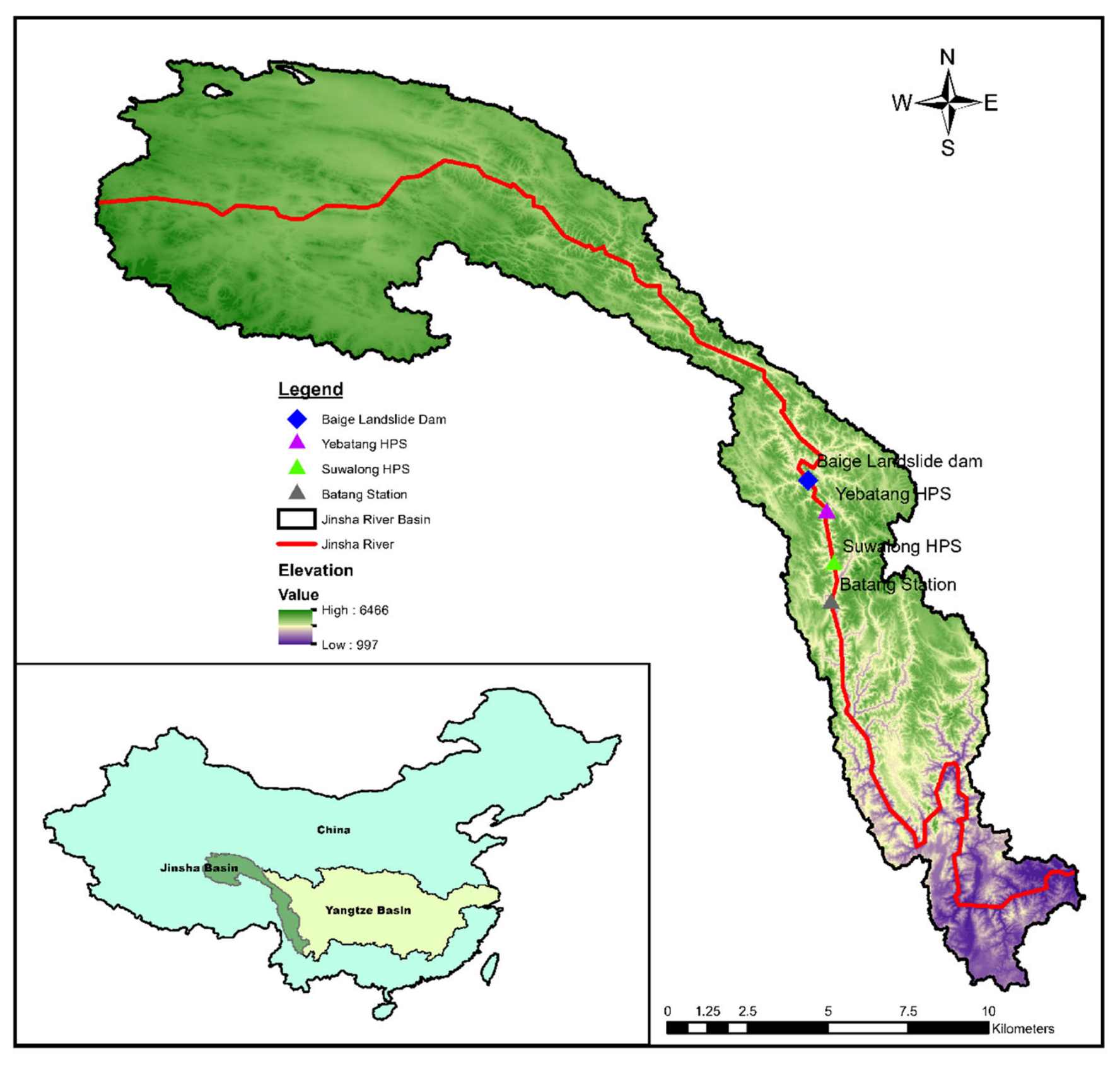
Figure 2.
Cross-sections of Baige landslide dams. (Zhao et al., 2026).
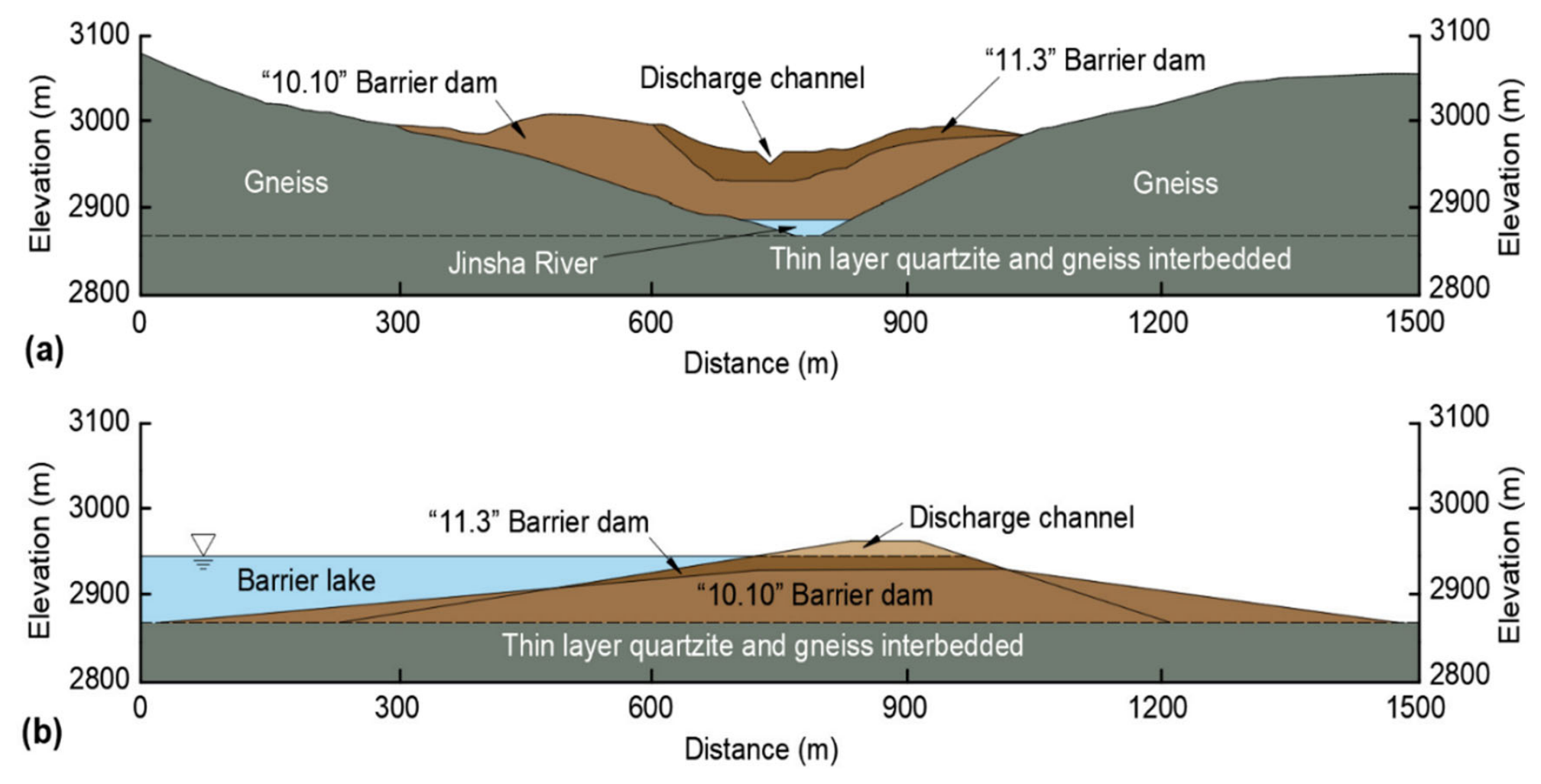
Figure 4.
Channel Excavation and Development at Baige Landslide-Dammed Lake. (a) Mechanical excavation of the channel at the Baige landslide-dammed lake. (b) Development of a water-filled channel before breaching. (Source: Yangtze River Water Resources Commission).
Figure 4.
Channel Excavation and Development at Baige Landslide-Dammed Lake. (a) Mechanical excavation of the channel at the Baige landslide-dammed lake. (b) Development of a water-filled channel before breaching. (Source: Yangtze River Water Resources Commission).
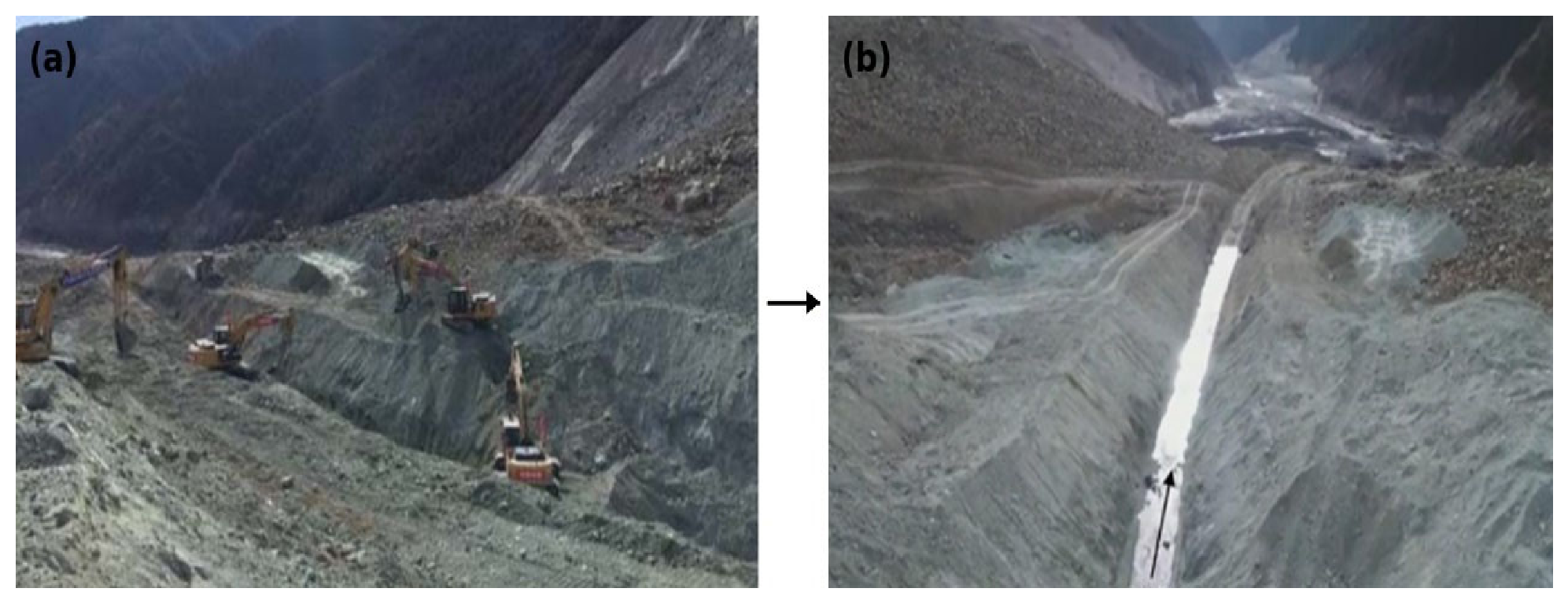
Figure 5.
shows a schematic representation of the coupled framework, delineating the model domains and principal data exchanges that occur at the interfaces.
Figure 5.
shows a schematic representation of the coupled framework, delineating the model domains and principal data exchanges that occur at the interfaces.
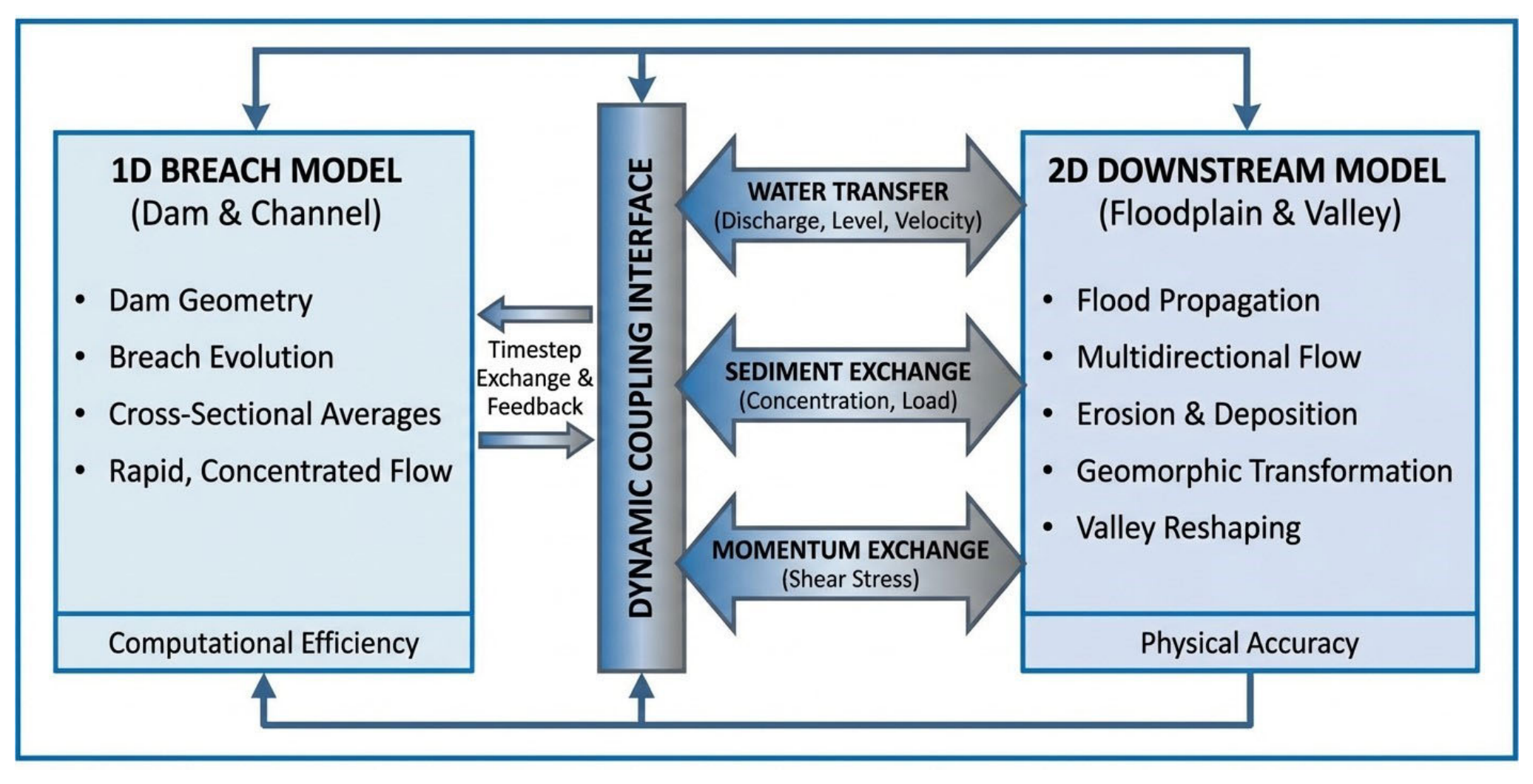
Figure 6.
Comparison of measured and simulated outflow discharge at Baige dam site “11.03”.
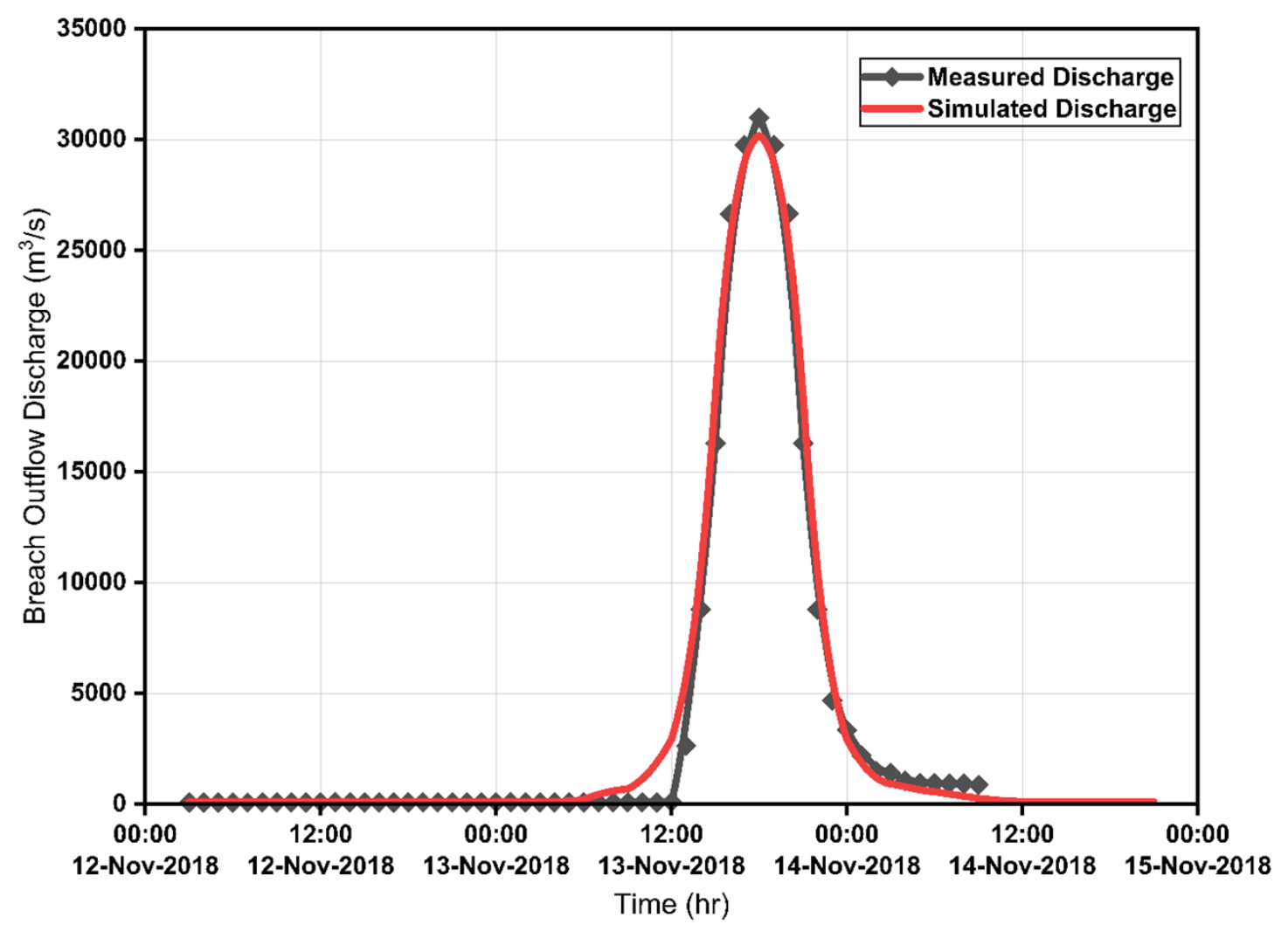
Figure 7.
Temporal Evolution of Simulated and Observed Breach Geometry at Baige Dam.
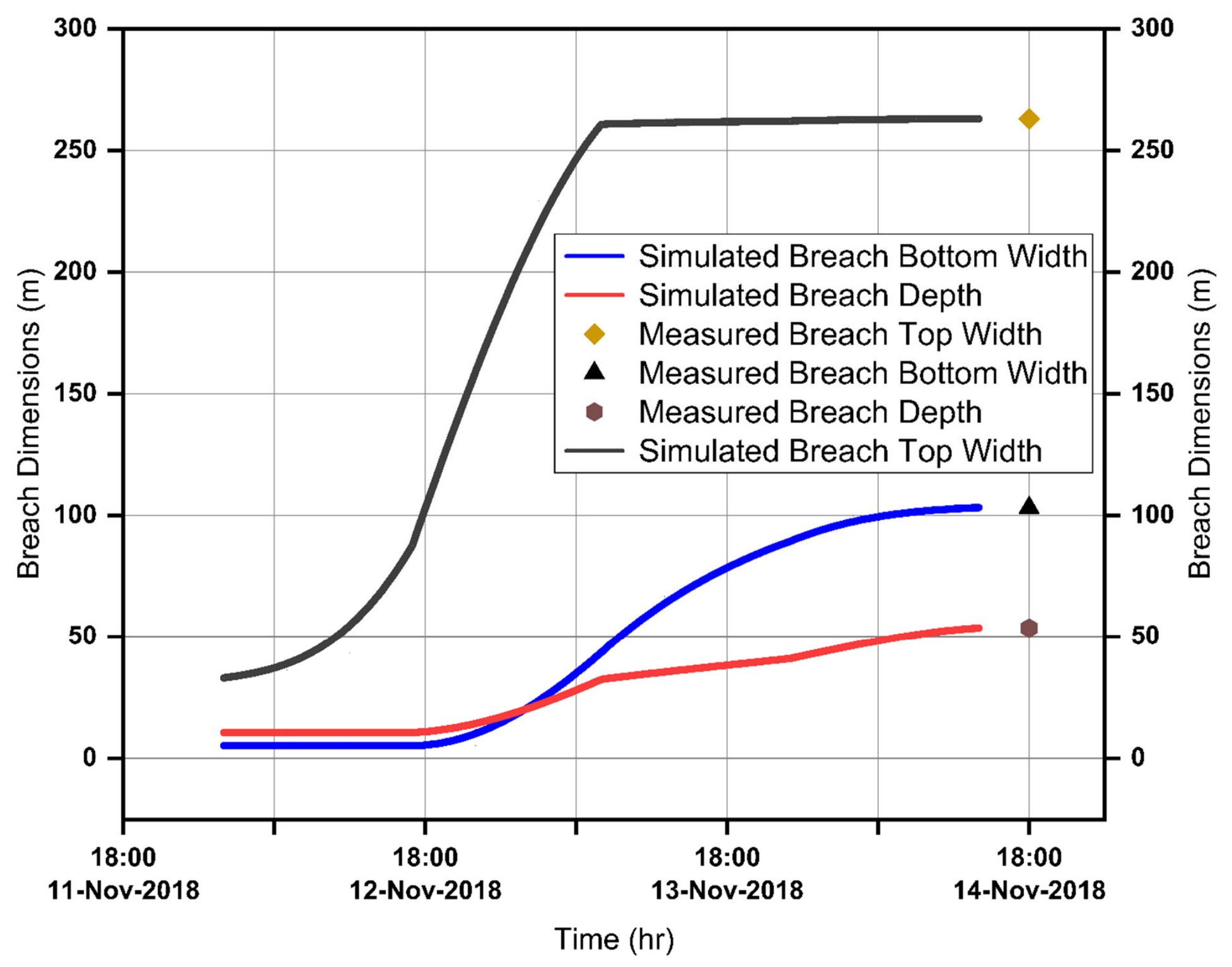
Figure 8.
Map of the simulated maximum inundation extent.
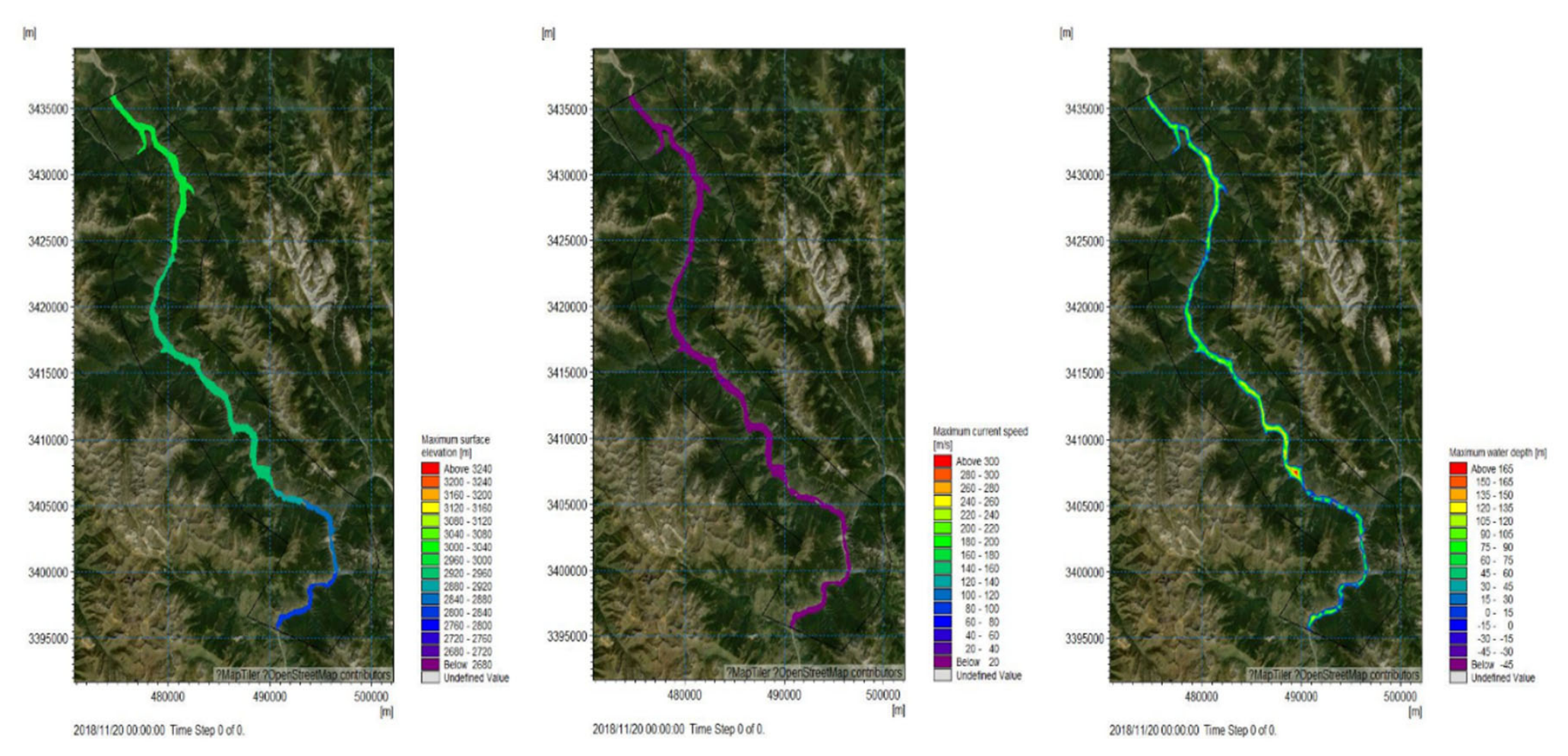
Figure 9.
Simulated net geomorphic change (erosion/deposition) after the outburst flood for all sediment fractions.
Figure 9.
Simulated net geomorphic change (erosion/deposition) after the outburst flood for all sediment fractions.
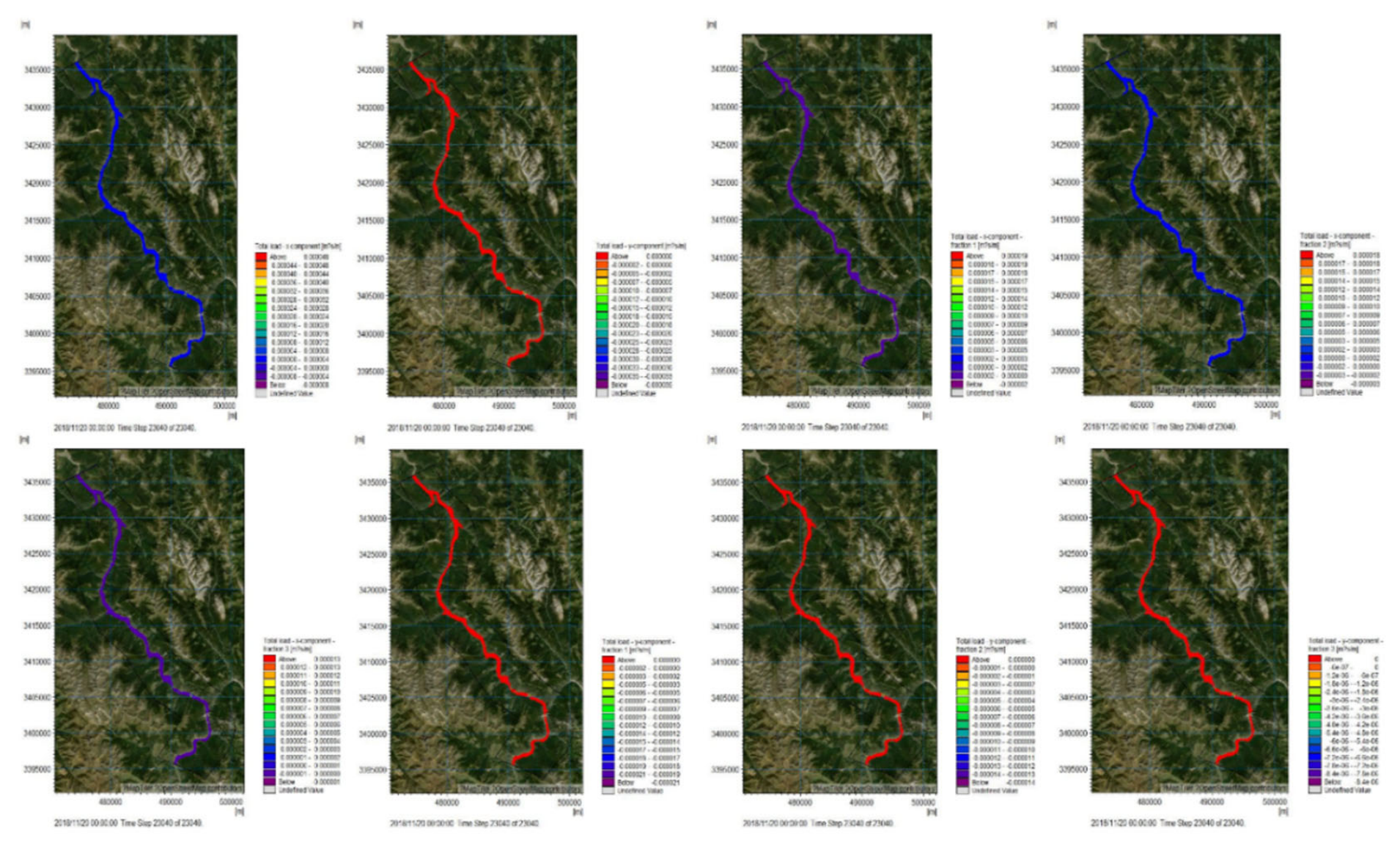
Figure 10.
Tornado plot of sensitivity analysis: peak discharge response to variations in Kd, initial water level, Manning’s n, active layer thickness, and coupling interval.
Figure 10.
Tornado plot of sensitivity analysis: peak discharge response to variations in Kd, initial water level, Manning’s n, active layer thickness, and coupling interval.
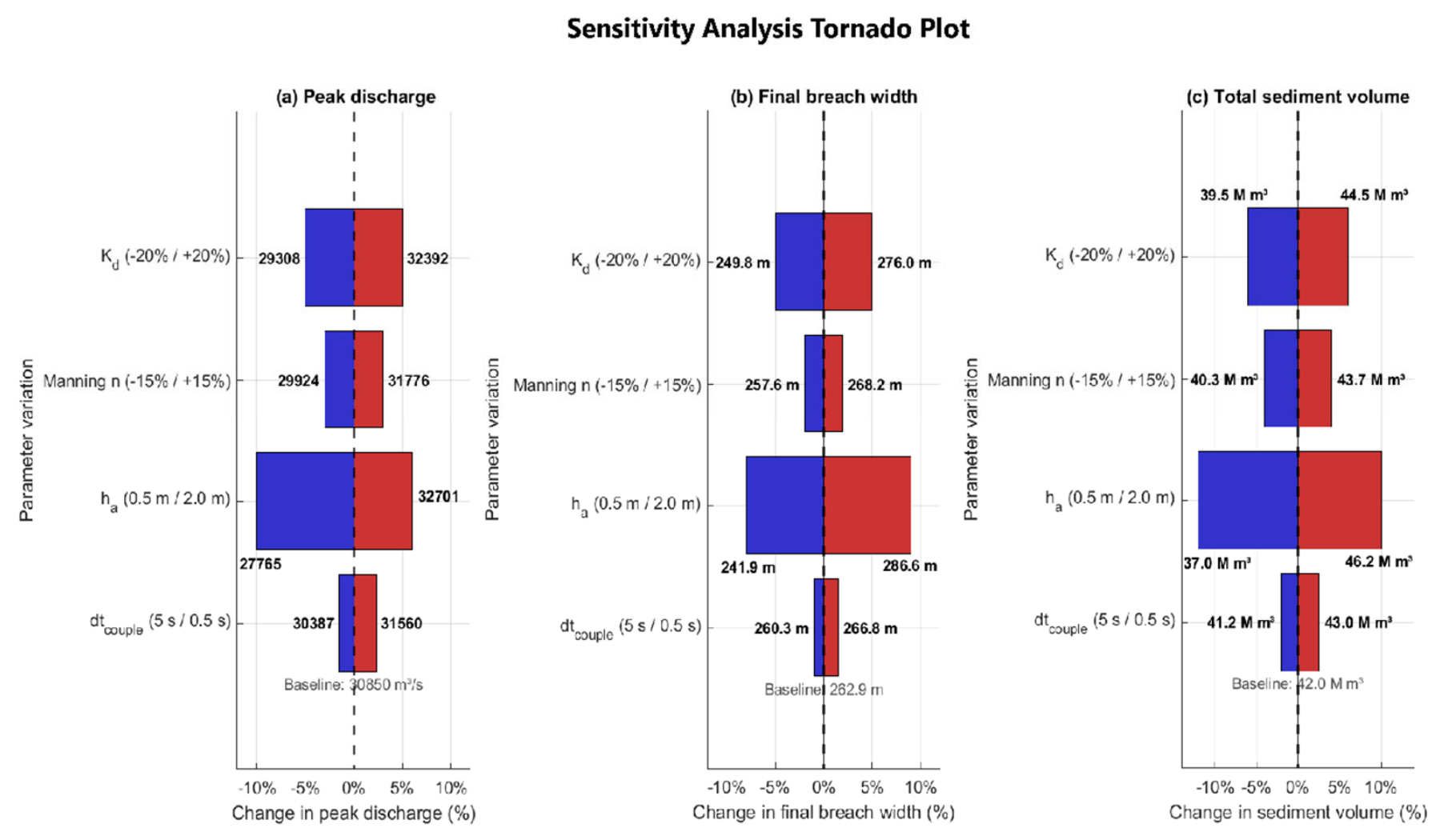
Figure 11.
Computational efficiency comparison of three modeling approaches for Baige landslide dam failure simulation.
Figure 11.
Computational efficiency comparison of three modeling approaches for Baige landslide dam failure simulation.
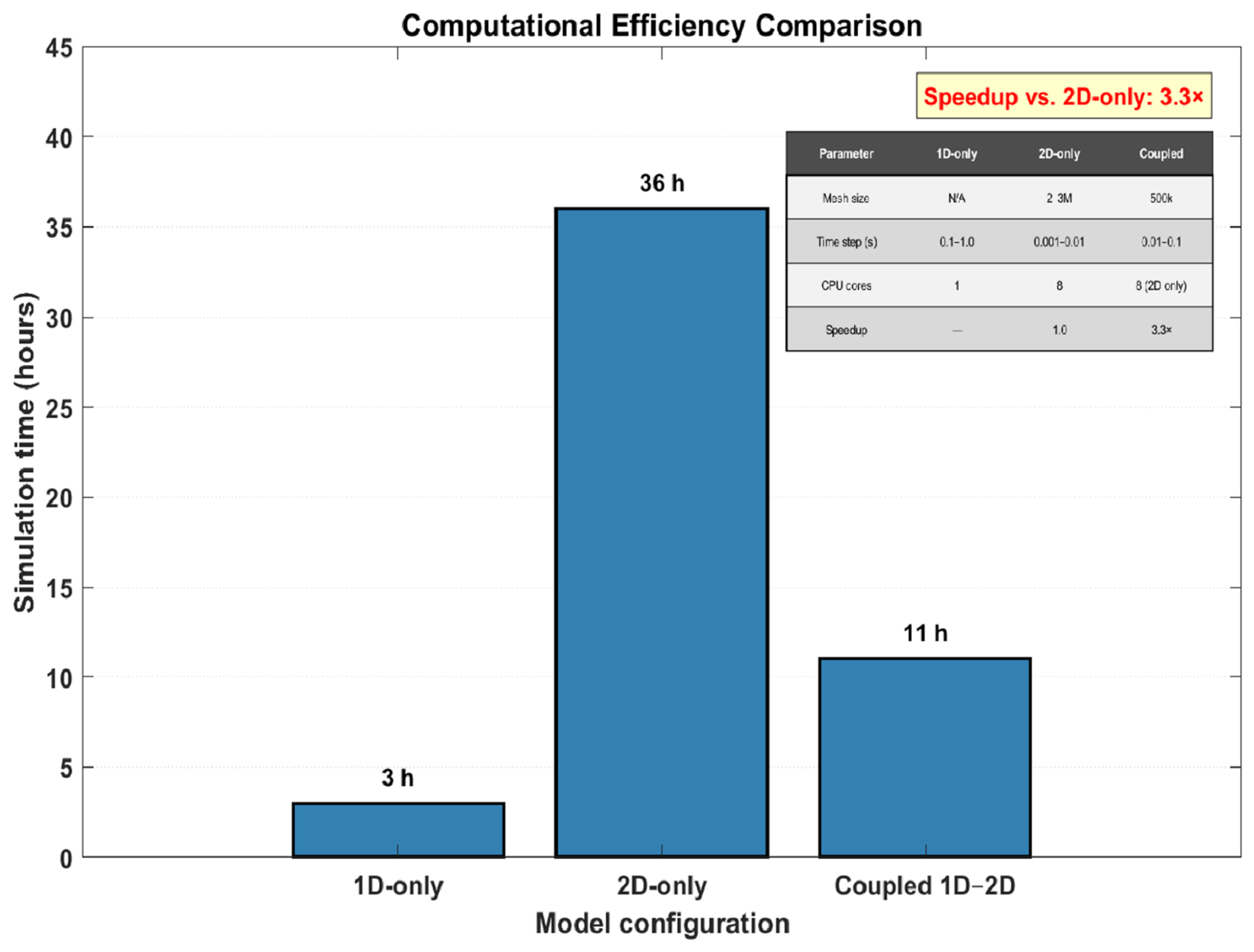

Table 1.
Model parameters for Baige “11.03” simulation.
| Parameter | Value | Source/Justification |
|---|---|---|
| 1D Model | ||
| Manning’s n (dam material) | 0.045 | Calibrated from “10.10” |
| Erodibility coefficient Kd | 373 mm³/N·s | Calibrated from “10.10” |
| Critical shear stress τcrit | 0.04 Pa | Shields criterion, adjusted for d₅₀ |
| 2D Model | ||
| Manning’s n (main channel) | 0.03–0.035 | Spatially variable |
| Manning’s n (floodplain) | 0.05–0.08 | Vegetated/agricultural |
| Manning’s n (infrastructure) | 0.02–0.025 | Smooth concrete |
| Smagorinsky coefficient cs | 0.28 | Standard |
| Sediment | ||
| Median grain size d₅₀ | 0.02-0.6 m | Field samples |
| Geometric standard deviation σg | 4.5 | Poorly sorted |
| Bed porosity λ | 0.41 | Laboratory analysis |
| Grain size fractions | Fine: 0.1–10 mm, Medium: 10–20 mm, Coarse: 20–30 mm | Sieve analysis |
| Active layer thickness ha | 1 m | Sensitivity analysis |
Table 2.
Measured and simulated breach parameters for the “11.03” event.
| Parameter | Measured | Simulated | Relative Err. |
|---|---|---|---|
| Peak discharge (m³/s) | 31,000 | 30,176 | −2.7% |
| Time to peak (h) | 37.25 | 37.31 | +0.2% |
| Final top width (m) | 264.1 | 262.9 | −0.5% |
| Final bottom width (m) | 107.8 | 103.1 | −4.4% |
Table 3.
Peak discharge and arrival times at downstream stations.
| Location | Distance (km) | Simulated Peak (m³/s) | Observed Peak (m³/s) | Relative Error | Simulated Arrival Time | Observed Arrival Time |
|---|---|---|---|---|---|---|
| Dam site | 0 | 30,850 | 31,000 | −0.5% | 0 | 0 |
| 25 km downstream | 25 | 26,200 | 26,500 | −1.1% | 1.3 h | 1.4 h |
| Yebatang HPS | 56 | 23,150 | 22,800 | +1.5% | 2.1 h | 2.3 h |
Disclaimer/Publisher’s Note: The statements, opinions and data contained in all publications are solely those of the individual author(s) and contributor(s) and not of MDPI and/or the editor(s). MDPI and/or the editor(s) disclaim responsibility for any injury to people or property resulting from any ideas, methods, instructions or products referred to in the content. |
© 2026 by the authors. Licensee MDPI, Basel, Switzerland. This article is an open access article distributed under the terms and conditions of the Creative Commons Attribution (CC BY) license (http://creativecommons.org/licenses/by/4.0/).
Copyright: This open access article is published under a Creative Commons CC BY 4.0 license, which permit the free download, distribution, and reuse, provided that the author and preprint are cited in any reuse.


