

Submitted:
18 June 2026
Posted:
23 June 2026
You are already at the latest version
Abstract
(1) Background: Artificial intelligence (AI) is increasingly shaping clinical practice and medical education, yet its responsible integration across the medical education continuum remains incompletely defined; (2) Methods: This narrative review synthesizes literature on AI applications in undergraduate, graduate, and continuing medical education, with attention to institutional systems, learning systems, and readiness and safety systems. Relevant studies were identified through targeted literature searches, reference-list review, and qualitative thematic synthesis; (3) Results: Across institutional systems, AI has been frequently examined in admissions, selection, educational administration, and workforce-linked logistics, where it may support efficiency and consistency but raises concerns regarding fairness, transparency, and authenticity of learner-generated materials. Within learning systems, AI-enabled tutoring, simulation, feedback, assessment, clinical reasoning support, and examination-facing tools show promise for personalization and supervised skill development; however, much of the evidence remains early-stage and relies on usability, satisfaction, confidence, or short-term performance rather than durable learning, clinical transfer, or behavior change. Readiness and safety literature highlights growing demand for AI literacy, while curricula, governance, privacy safeguards, bias mitigation, and accountability structures remain uneven; (4) Conclusions: AI should be implemented as a supervised educational and institutional support system, rather than as a substitute for clinical reasoning, faculty judgment, or professional responsibility.
Keywords:
artificial intelligence
; medical education
; undergraduate medical education
; graduate medical education
; continuing medical education
; large language models
; AI literacy
; clinical reasoning
; educational assessment
; AI governance
1. Introduction
Artificial intelligence (AI) is rapidly transforming healthcare and clinical practice, evolving digital health toward accessible, personalized, and data-informed care. As AI is increasingly applied to clinical diagnosis, clinical judgment, risk prediction, and decision support, medical education must evolve to equip physicians with the skills required to use these technologies ethically and safely in practice [1]. Advances in natural language processing and machine learning have expanded the potential role of AI in medical education, from answering learner questions to generating learning materials, providing feedback, and simulating virtual patient interactions [2,3]. However, guidance on how these systems should be integrated into educational practice remains limited.
Across the medical education continuum, AI applications differ by training stage while sharing common goals of enhancing learning, supporting clinical competence, and improving educational efficiency. In undergraduate medical education (UGME), AI is commonly directed toward foundational learning, tutoring systems, simulation, clinical reasoning exercises, and AI literacy [1]. In graduate medical education (GME), AI is increasingly embedded within specialty-specific training and clinical workflows, including diagnostic support, telemedicine, management, decision-making processes, and the use of more inclusive datasets [4]. In continuing medical education (CME), AI can support lifelong professional development by enhancing clinical decision-making and personalizing academic and practice-based learning experiences [5]. Technologies such as virtual and augmented reality, adaptive learning platforms, and AI-powered assessments may further support personalized learning, targeted feedback, simulated educational experiences, learner monitoring, and reduced administrative burden [6].
However, AI implementation in medical education also introduces important challenges. Studies have linked AI models with hallucinations, inaccuracy, bias, inequity, and security concerns [7]. AI may also weaken critical thinking skills and diminish meaningful mentorship relationships if adopted without careful educational design [8]. Effective integration therefore requires institutional governance, faculty oversight, and clear expectations for appropriate use to preserve academic integrity and ensure that AI strengthens medical training.
A prevailing educational question is how these systems should be embedded within educational structures while preserving clinical reasoning, judgment, learner autonomy, equity, and accountability. Educational initiatives, curricula, and implementation strategies vary across institutions, specialties, and stages of training, making structured integration challenging. Much of the existing literature focuses on individual stages of training, with less attention to how AI applications and outcomes compare across UGME, GME, and CME. Such comparison is important because learners at each stage have distinct educational needs, clinical responsibilities, and competency expectations, which may influence how AI tools are adopted, evaluated, and integrated into training This gap highlights the need for a broader synthesis of how AI can be integrated across lifelong medical learning.
Therefore, this comprehensive narrative review aims to help address this gap by synthesizing current evidence on the applications and learning-related outcomes of AI across undergraduate, graduate, and continuing medical education. A narrative review was selected as the aim was conceptual synthesis rather than quantitative aggregation or exhaustive systematic coverage. Moreover, the field contains heterogeneous study designs, rapidly evolving technologies, diverse outcome measures, and many early-stage implementations that are not readily comparable through meta-analysis across UGME, GME, and CME. By mapping current applications, limitations, and implementation challenges, this review aims to inform educators, institutions, and policymakers as they integrate AI into medical training across the full education continuum.
2. Materials and Methods
2.1. Study Design and Scope
This narrative review examined applications of artificial intelligence (AI) across the medical education continuum, including undergraduate medical education (UGME), graduate medical education (GME), and continuing medical education (CME). This review focused on how AI technologies are being incorporated into medical education, with particular attention to 1) institutional systems, 2) learning systems, and 3) readiness and safety considerations across three different stages of medical training (Figure 1). A narrative approach was selected because the literature in this area includes heterogeneous and/or limited technologies, educational settings, learner populations, study designs, and outcome measures across UGME, GME, and CME.
2.2. Literature Identification and Selection
Relevant literature was identified through targeted searches of published articles and reference lists of retrieved articles. The search targeted contemporary studies examining the implementation, evaluation, and conceptual development of AI tools within educational contexts. Priority was given to studies providing insight into current AI applications across different stages of medical training as the objective was conceptual synthesis rather than exhaustive coverage. Search terms included, but were not limited to, combinations of terms related to artificial intelligence, machine learning, large language models (LLM), generative AI, medical education, undergraduate medical education, graduate medical education, residency education, continuing medical education, admissions, assessment, simulation, clinical reasoning, AI literacy, ethics, governance, and learner perceptions. Studies focused primarily on clinical AI performance were included only when they had a clear educational, training-related, professional-development, or implementation-relevant component.
2.3. Study Characteristics
The review included various study designs, such as pilot studies, observational analyses, conceptual discussions, reports, and review articles describing the implementation or evaluation of AI tools within medical education. Many studies represented early-stage or proof-of-concept implementations, conducted within single institutions and over short evaluation periods. A narrative review was therefore well suited to synthesizing this varied emerging evidence across a nascent field.
2.4. Data Organization and Synthesis
Because AI applications in medical education operate at different levels of the educational system, findings were organized into three thematic domains: 1) institutional systems, 2) learning systems, and 3) readiness and safety systems (Figure 1). This structure distinguished tools used for institutional decision-making and administration from those used directly in teaching, learning, assessment, and clinical reasoning, while also separating the ethical, governance, literacy, and accountability issues that shape responsible implementation. Institutional systems included admissions, selection, educational administration, learning management, and workforce-linked educational logistics. Learning systems included tutoring, simulation, feedback, assessment, clinical reasoning, and examination-facing tools. Readiness and safety systems included AI literacy, learner and faculty perceptions, ethics, governance, privacy, bias, and professional accountability. Within each domain, evidence was examined across UGME, GME, and CME to identify recurring patterns, differences across training stages, implementation challenges, and areas where evidence remains limited. Findings were synthesized qualitatively, with an emphasis on how AI applications are currently used, where evidence is strongest or emerging, and what educational and governance considerations are relevant for responsible integration across the medical education continuum.
3. Results
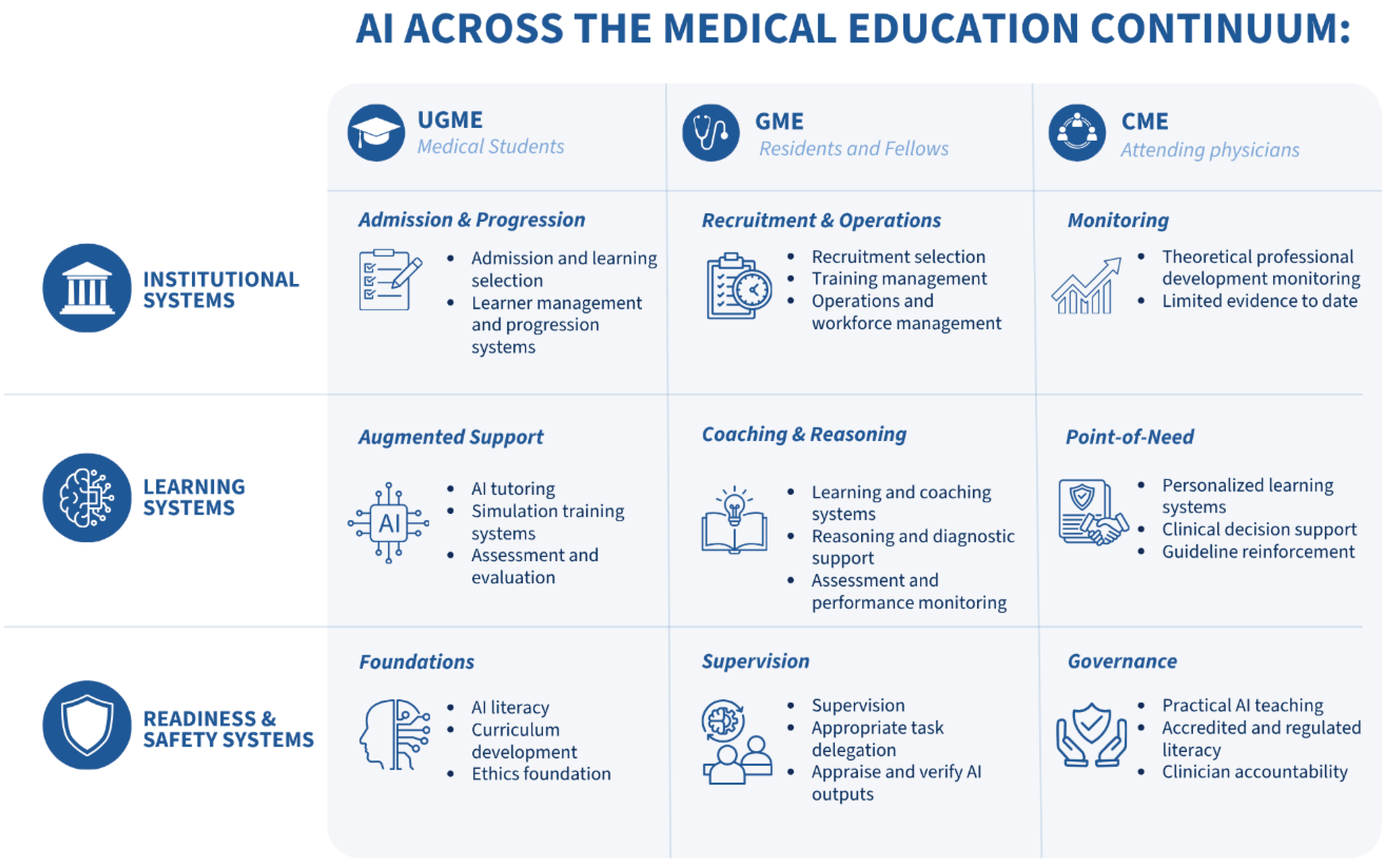
We organized the findings into three domains that reflect where AI adoption is currently emerging across medical education: institutional systems, learning systems, and readiness and safety systems. This structure was chosen to distinguish applications focused on educational administration, learner development, and responsible implementation, thereby clarifying the barriers and opportunities that differ across UGME, GME, and CME (Figure 2).
3.1. Institutional Systems: Administration and Educational Logistics
Across the educational continuum, institutional applications of AI are oriented towards improving the efficiency, consistency, and personalization of administrative decision-making. Within this domain, the evidence is strongest for admissions and selection, more conceptual for learning-management applications, and sparse for CME-specific institutional systems. The central institutional question is whether AI can improve efficiency, consistency, and responsiveness while maintaining fairness, transparency, and accountability in educational decision-making.
3.1.1. Institutional Systems - Undergraduate Medical Education
In UGME admissions, machine learning (ML) has primarily been evaluated for structured applicant screening and interview selection. Models trained on predefined application features reproduced faculty screening decisions with high accuracy; subsequent human-AI evaluations improved performance while maintaining a strong negative predictive value, supporting AI as a screening aid [9]. Similarly, a prospective random forest model including grade point average (GPA) and demographic variables also replicated faculty recommendations without measurable differences across gender or underrepresented applicant groups [10]. Predictive models also offer opportunities to enhance efficiency and consistency in structured screening tasks when integrated with human evaluation [9,10].
At the same time, generative AI complicates the admissions function by weakening confidence in the authenticity and interpretability of qualitative application components. Applicant use of AI in personal essays appears to be increasing, although one study found no significant effect on interview or acceptance outcomes [11]. Additionally, evaluator ratings of AI-assisted or fully AI-generated essays were comparable to human-written submissions, with no meaningful differences detected, suggesting that personal essays may become less reliable as evidence of applicant voice or motivation [12]. Taken together, the UGME admissions literature therefore presents a dual effect: predictive models may improve efficiency and consistency in structured screening while generative AI raises questions about the validity of personal essays and other qualitative materials as admissions evidence [9,10,11].
Beyond admissions, comprehensive AI-integrated learning management systems (LMS) remain largely unrealized in UGME. The literature describes high potential for platforms that track learner performance, engagement, and demographic data to predict performance, identify at-risk students, personalize learning pathways, estimate grades, and automate administrative documentation [13,14]. Course tracking systems may also eventually integrate individual progress with institutional and national requirements to generate personalized course recommendations [15]. However, because no comprehensive AI-integrated UGME LMS implementation was identified, current conclusions in this area remain limited.
3.1.2. Institutional Systems - Graduate Medical Education
In GME, institutional uses of AI also focus on applicant selection and screening, narrative material evaluation, and logistics. ML decision support tools have shown strong predictive performance for interview selection and ranking tasks, including a screening model that maintained discrimination after removal of united states medical licensing exam scores and identified applicants initially overlooked by human reviewers [16]. In parallel, natural language processing (NLP) has also been applied to experience descriptions, personal statements, and letters of recommendation. These studies suggest that combining structured data with NLP features may improve prediction compared with NLP alone; they also found that language related to leadership and research involvement was associated with interview outcomes [17,18].
However, the GME admissions evidence shows important limitations. AI-selected applicants may diverge from program director-selected applicants despite model training on program-specific criteria [19]. Reviews of AI in residency admissions further note that many studies acknowledge bias risks, while relatively few explicitly model fairness or demographic effects; as such, models trained on skewed historical data may reproduce prior inequities [20]. Similar to UGME, generative AI creates authenticity concerns, as AI-generated personal statements and letters of recommendation may be difficult to distinguish from human-written content and may receive comparable or higher ratings, while detection tools show variable performance and false-positive risks [20,21,22].
Finally, there is early evidence for AI-enabled workforce and training logistics. ML models incorporating operating room hours, trauma evaluations, admissions, consults, and patient rounds have been used to predict orthopedic resident on-call workload, with one study reporting that 24.7% of shifts could potentially be reduced through demand-based scheduling [23]. Moreover, hierarchical reinforcement learning model applied retrospectively to operating room (OR) increased fellow OR exposure in alignment with their competency-based curricula, redistributed resident OR exposure by postgraduate year without compromising compliance with institutional rules, and preserved OR capacity [24]. Together, these tools may help distribute training opportunities more fairly, protect exposure, and create the possibility to tailor exposure to optimize learning.
3.1.3. Institutional Systems - Continuing Medical Education
CME-specific institutional evidence is sparse. No clearly documented AI applications were identified for CME admissions or selection and no empirically evaluated applications focused exclusively on this educational level [2,25]. Cross-continuum LMS concepts could theoretically support adherence to institutional and national standards, learner monitoring, and placement optimization across the education continuum [15,24]. However, the current evidence base does not establish CME-specific administrative systems. This absence is important because practicing clinicians are already exposed to AI through clinical workflows, yet institutional structures for tracking, governing, and evaluating AI-related professional learning remain underdeveloped.
3.2. Learning Systems: Tutoring, Simulation, Reasoning, Feedback, Assessment, and Exams
Learning systems represent a major domain of AI application in medical education, encompassing tools that support explanation, practice, feedback, clinical reasoning, and assessment. Across the continuum, these applications are increasingly being evaluated for technical performance and contributions to learner development, supervision, and educational outcomes. A central question is how AI can be integrated into instructional systems in ways that support learning while preserving faculty oversight, learner judgment, and assessment of validity. This section examines these issues across UGME, GME, and CME, where AI applications range from foundational scaffolding and simulation to workflow-embedded reasoning support and lifelong learning.
3.2.1. Learning Systems - Undergraduate Medical Education
Evidence for AI in medical education is expanding quickly, but its growth has outpaced the capacity for equitable implementation across institutions and regions. For instance, a recent scoping review identified 310 studies on AI in undergraduate medical education concentrated in North America, Western Europe, Australia, and parts of the Asia-Pacific, reflecting rapid growth but also geographic limitations [26]. Resources may be directed first toward foundational AI teaching infrastructure rather than toward the premature adoption of complex AI systems without adequate technical support [27].
UGME applications of AI are increasingly framed around how these tools support core educational functions, such as explanation, practice, feedback, and assessment. LLM-mediated tutoring and dialogic coaching represent one prominent use case, with LLMs used to clarify concepts, prompt clinical reasoning, and provide stepwise explanations that can scaffold learner understanding [2]. Virtual patient work, including history taking, counseling, preference-sensitive communication, scalable patient-learner dialogue, case variation, and feedback, extends this learning approach into simulated practice [28,29,30]. Adjacent applications (i.e., AI-based question generation, personalized feedback, and adaptive tutoring) also show promise for improving diagnostic accuracy and learning outcomes, although evidence for effects on clinical reasoning remains inconclusive because of methodological heterogeneity [31,32,33,34]. Generative AI has also been used for assessment material development; ChatGPT-generated script concordance tests, which assess how closely a learner’s clinical reasoning aligns with expert judgment, showed no significant differences from psychiatrist-generated tests in scenario quality or clinical reasoning prompts [35].
The educational value of AI tools in UGME appears to depend on context and outcome selection. Standalone tools, including automated chest X-ray interpretation and LLM-supported case resolution, have been associated with high usability and learners' willingness to use them again in the future; however, these tools did not consistently improve diagnostic accuracy and, in some cases, produced lower accuracy despite faster responses [36,37]. Studies focusing on examinations show a related pattern. Newer LLMs’ (e.g. GPT-4, GPT-4o and successive models) performance often exceeds pass thresholds for examinations and may match or outperform students on structured written assessments, but LLM performance is weaker in applied emergency medicine tasks, image-based questions, multimodal content, and higher-reasoning items [38,39,40,41,42,43]. Due to concerns about accuracy, hallucination, academic integrity, and safety considerations, there is little support for unsupervised use of AI in critical learning contexts; rather, there is support for the context-dependent, supervised use of AI as an adjunct to traditional medical education [38,44,45]. Overall, these findings suggest that learner satisfaction, usability, and examination performance are insufficient proxies for educational benefit; future evaluations should prioritize clinically meaningful outcomes such as diagnostic accuracy, reasoning quality, safe tool use, and transfer to supervised practice.
3.2.2. Learning Systems - Graduate Medical Education
In GME, AI is being explored to strengthen learning by extending opportunities for practice, feedback, and clinical reasoning. AI-driven simulated patients support deliberate practice in communication, team-based scenarios, diagnostic reasoning, and clinical decision-making through adaptive dialogue and evolving clinical states. In one randomized study, this approach improved theoretical knowledge, clinical thinking, consultation skills, and diagnostic ability compared with traditional teaching [46,47]. ML approaches may also strengthen feedback systems by rapidly assessing attending evaluations of resident performance, including screening for low-quality or low-utility feedback to help improve feedback across programs and individual faculty [48]. Together, these applications position AI as a tool for improving feedback within clinical training workflows.
Diagnostics and clinical reasoning training have also been supported with AI in GME. ARIES (Adaptive Radiology Interpretation and Education System) improved radiology residents’ diagnostic accuracy and differential diagnosis performance, especially in rare diseases, and CorneAI, an AI-powered diagnostic application designed to classify eye disease, increased diagnostic accuracy among ophthalmology trainees [49,50]. LLMs may also broaden diagnostic possibilities and help reduce premature diagnostic closure. Although, related AI-supported simulation tools have been associated with lower trainee confidence in simulation-based training environments, underscoring the need to integrate these systems as supports for reflective reasoning rather than substitutes for learner judgment and to prevent overreliance [51,52]. However, learner level appears important: some studies found that residents used more strategically focused reasoning than AI systems and attending physicians gained minimal benefit from AI assistance, suggesting that AI may be most useful for learners still developing expertise rather than experienced clinicians [49,50,51].
Assessment and examination performance represent another major area of AI applications in GME, where results are shaped by model architecture, domain, and implementation. Successive generative AI models appear to outperform earlier generations, with high accuracy reported in orthopedic and internal medicine examinations; however, performance varies by specialty and question type particularly for image-based or underrepresented subspecialty questions [53,54]. This pattern is also evident within contemporary LLMs: comparative evaluations show performance hierarchies, with ChatGPT-4 achieving higher accuracy than previously reported ChatGPT-3.5 results on the Turkish Medical Specialty Training Entrance Exam, although differences in study design and language of administration limit direct comparison [55,56]. Implementation choices were also shown to shape performance, as synchronized audio-visual input improved observed structured clinical exams (OSCE) grading agreement compared with single modality inputs, and written exam performance improved when models were allowed follow-up attempts [57,58]. Beyond test-taking, AI may support question generation, formative feedback, and early identification of learners at risk of examination failure, particularly when outputs are validated by experts[59,60]. However, use in general surgery oral-board simulations revealed variable accuracy indicating that high-stakes assessment use requires expert oversight [61]. Current literature suggests that AI is best used to scaffold supervised performance development, reasoning support, and assessment preparation, with safeguards matched to task complexity and learner level.
3.2.3. Learning Systems - Continuing Medical Education
In CME, AI is best framed as targeted learning support for practicing clinicians, with educational value arising from personalization, rapid information access, and feedback embedded in clinical work. Broader medical education evidence shows that AI is commonly used to provide individualized feedback and guided learning pathways, while CME-specific recommender systems can link patient records with previously clinician-rated educational recommendations and retrieve relevant content at the point of care [62,63].
Most CME clinical reasoning evidence comes from AI systems embedded in clinical workflows rather than from interventions specifically targeting education. Electronic health record (EHR)-integrated systems, hybrid ontology-based models, case-based reasoning tools, and neural network decision support have been used for patient summaries, treatment recommendations, and guideline adherence [64,65,66,67]. These tools may strengthen evidence-based reasoning under uncertainty, but most studies assess accuracy, workflow, or clinician trust rather than learning, retention, or behavior change. Literature supports the idea that educational dimensions must be measured because they may shape adoption, particularly where implementation depends on workflow integration, organizational support, and explainable recommendations that clinicians can trust [65,67,68].
Similarly, CME examination evidence remains limited to knowledge checks and self-testing: LLMs can perform well on guideline-driven text-based questions, especially with domain-specific knowledge, but while broader benchmark syntheses continue to show weaker performance on tasks requiring more practice-like reasoning and judgment [69,70,71]. There is, however, an emphasis on the need for explicit policies governing AI use in lifelong learning and caution against equating AI exam performance with clinical competence [72].
3.3. Readiness and Safety Systems: AI Literacy, Learner Perceptions, Ethics, and Governance
Readiness and safety systems represent the conditions required for AI to be used responsibly across medical education. These systems include AI literacy, curriculum preparation, ethical and technical safeguards, and governance structures that define appropriate use. Across UGME, GME, and CME, the central challenge is whether learners and clinicians can appraise its outputs, recognize its limitations, preserve core clinical competence, and apply it safely within supervised educational and clinical settings.
3.3.1. Readiness and Safety Systems - Undergraduate Medical Education
Medical students generally report positive attitudes toward AI and express strong demand for formal AI education. In a survey of 4,596 students, including 4,313 medical students from 192 faculties across 48 countries, 67.6% expressed positive attitudes toward AI in healthcare and 76.1% wanted more AI teaching [73]. Students commonly view AI as a potential support for information access, diagnostic accuracy, patient education, and clinical outcomes [74,75]. However, in one recent cohort study students placed greater importance on preserving baseline clinical competence without AI than with AI, suggesting that AI education should strengthen, rather than displace, core clinical reasoning and patient-care skills [76].
Student concerns focus on the professional, ethical, and educational consequences of AI adoption, such as job displacement, deskilling, and uncertainty about appropriate use [74,75]. Job displacement concerns appear less prominent among more senior students and may diminish with greater exposure and AI literacy [74]. Deskilling remains a central concern because AI may reduce opportunities for independent practice, encourage automation reliance, erode critical thinking, and weaken the doctor-patient relationship [77,78,79]. Together, these concerns support explicit UGME teaching in responsible AI use, with emphasis on ethics, critical appraisal and validation, data considerations and bias, and governance [77,80,81,82].
Formal UGME AI curricula remain limited, partly because core content has not yet been standardized. Emerging frameworks propose a broad competency base that includes ethics, legal and data considerations, theory and application, critical appraisal, and attitudes toward AI [81,83]. Existing curricula are commonly delivered as elective or modular courses [84,85]. These elective models may improve feasibility by allowing flexible implementation, but they also raise equity and selection concerns that require evaluation [83,86]. Learner preferences also affect curriculum design. Many students favor hands-on training with actual AI tools and multidisciplinary collaboration, although student support for mandatory AI education is not uniform [76,82,87]. Evidence of effectiveness remains difficult to establish because most studies rely on satisfaction and self-reported confidence [88]. Implementation is also constrained by limited faculty expertise, though proposed solutions include interdisciplinary course design teams and faculty preparation involving physicians, bioinformatics scientists, and EHR experts [89,90]. The evidence supports longitudinal, competency-based AI education, but does not yet define the optimal timing, assessment strategy, or balance between mandatory and elective content.
3.3.2. Readiness and Safety Systems - Graduate Medical Education
In GME, AI literacy is increasingly framed as a requirement for supervised clinical practice, but current curricula remain variable in scope, duration, and evaluative rigor. Programs range from one-day courses to residency-spanning curricula, with radiology receiving the greatest attention and other specialties represented to a lesser extent [2,91,92]. Most initiatives are based in North America with additional examples from Europe and Asia, raising concern that access to AI training may remain uneven across specialties and resource settings [2,92]. Existing curricula commonly cover AI fundamentals, clinical applications, critical appraisal, and ethical considerations such as privacy, transparency, algorithmic bias, overreliance, and erosion of humanistic care [91,93,94,95,96]. However, comprehensive professional competency remains uncommon. One proposed framework included technical concepts, clinical applications, regulatory processes, ethics and bias, economic implications, and data management, but remained conceptual without implementation data [97].
Evaluation of GME AI curricula remains limited, with most studies measuring learner satisfaction and few incorporating pre- and post-course knowledge testing. Where reported, residents valued active learning, hands-on laboratories, and case-based approaches [98]. Residents’ outlook on AI is generally positive, anticipating that AI will cause a change in practice and a decreased workload, but concerns about ethical use have been identified [99,100]. These concerns support mapping AI competencies onto Accreditation Council for Graduate Medical Council Milestones and Entrustable Professional Activities, including critical appraisal, ethical judgment, and collaborative human-AI decision-making [101]. Mapping AI competencies is critical to enable residents to decide when not to use AI, when to override it, and when to seek human supervision.
3.3.3. Readiness and Safety Systems - Continuing Medical Education
AI education in CME remains early in its development, with current provision characterized by brief, heterogeneous, and predominantly online formats. Most programs are short, standalone sessions (<1 hour), although some longer courses exist [102,103]. This limited delivery format sits alongside considerable variation in content, which ranges from introductory terminology and neural networks to Python programming, classical ML, convolutional neural networks, and broader data science methods [102]. More recent specialty and faculty-focused frameworks have begun to clarify the competencies practicing clinicians require. The European Society of Gastrointestinal Endoscopy curriculum includes AI principles, algorithms, data quality, model performance metrics, limitations, and bias [104]. A family medicine training review proposes a tiered faculty AI competency structure distinguishing basic, proficient, and expert skills. The review identifies proficient-level AI literacy (emphasizing practical AI use, critical appraisal, ethical oversight, and transparent patient communication) as the appropriate minimum target for family medicine faculty rather than expecting all clinicians to develop expert technical competence [105]. CME AI education also lacks mature infrastructure for accreditation, delivery, and evaluation. Many programs are not systematically aligned with certification structures such as the Accreditation Council for Continuing Medical Education (ACCME) or the European Accreditation Council for Continuing Medical Education (EACCME) credit, and provision is dominated by professional institutions and commercial entities, with limited academic involvement [103,106]. Evaluation remains narrow, usually assessed through learner reaction, satisfaction, perceived knowledge, and limited pre- and post-testing [107,108]. Despite strong clinician interest, participation is further constrained by workload, limited protected time, funding, and institutional support [109]. More flexible and practical CME approaches may help clinicians develop AI-related skills effectively.
4. Discussion
This review characterizes AI in medical education as a rapidly expanding field in early consolidation across UGME, GME, and CME. Applications are distributed across three domains: 1) institutional systems, 2) learning systems, and 3) readiness and safety systems. By organizing the evidence across three domains and comparing UGME, GME, and CME, we show that AI may increasingly serve as a support layer for selection, feedback, simulation, assessment, workflow organization, and professional learning across the education continuum. However, the evidence remains uneven, with stronger support for structured tasks that have defined inputs, measurable outputs, and short-term endpoints, and weaker evidence for clinical reasoning, multimodal interpretation, longitudinal learning outcomes, and governance. The CME gap may be particularly important because practicing clinicians are likely to encounter AI directly in clinical workflows, while also shaping AI use across the wider continuum through supervision, teaching, and role modelling. Currently, the literature reflects rapid experimentation and local implementation, rather than a mature evidence base for scalable educational integration.
A central implication is that AI is best positioned as an augmentative, decision-support layer within supervised educational systems [2]. Across domains, a recurring pattern was that AI appears most useful when it reduces friction around bounded educational tasks while leaving judgment, context, and accountability with human educators. In admissions and selection, ML models can improve consistency and reduce reviewer workload when applied to structured application data although faculty oversight and fairness monitoring remain necessary [9,10,20]. This, however, positions institutional AI as a mechanism for making human decision-making more consistent, transparent, and auditable. Similarly, in learning environments, LLMs, virtual patients, and decision-support systems may provide adaptive feedback, case variation, and reasoning prompts, but they may require instructional framing to prevent passive dependence or uncritical acceptance of AI output [31,32,33]. In assessment, AI may assist with question generation, formative feedback, grading support, and self-testing, yet high-stakes use remains undesired without expert validation because model performance is variable and error-prone in clinically complex contexts, and academic integrity risks remain unresolved [38,44,61]. A further unresolved concern is that AI-augmented learning may impair trainee skill development in ways that short-term satisfaction or accuracy outcomes cannot capture [78,79]. Long-term research is therefore needed to determine how AI affects competence development, independent reasoning, and safe professional practice over time.
The performance boundary across studies is largely task and context dependent. AI systems tend to perform best in structured, text-based, and rule-bounded tasks, including written examinations, guideline-based questions, structured admissions screening, and some forms of formative assessment. Their performance is less reliable in settings requiring visual interpretation, multimodal synthesis, contextual judgment, or complex clinical reasoning [40,43,61]. This distinction is important for curriculum design because AI should be matched to the level of task structure, verifiability, and learner supervision available in each educational setting, and educators should be cognizant of their limitations.
The readiness and safety literature identifies a persistent implementation gap: interest in AI has advanced faster than the educational systems needed to govern its use. Existing curricula often focus on introductory concepts, technical foundations, or self-reported confidence, while few programs provide longitudinal training in critical appraisal, bias, privacy, accountability, hallucination, appropriate delegation, and human-AI collaboration [81,83,94] This mismatch is consequential because many learners and clinicians are exposed to AI without structured guidance, oversight, or accountability. AI literacy should therefore be treated as a core professional competency ideally embedded longitudinally through a spiral curriculum rather than delivered only as isolated electives [110]. Faculty development is essential for implementation, because educators may lack the data science and AI knowledge needed to teach these topics, guide student use, and support meaningful integration of AI-related content into classroom and clinical learning environments [90]. A mature curriculum should therefore teach both use and restraint: how to prompt, interpret, and verify AI output, but also how to recognize when AI use is inappropriate, inequitable, unsafe, or educationally counterproductive.
CME represents a particularly underdeveloped segment of the evidence base. This is notable because practicing clinicians may be directly exposed to AI through clinical workflows, EHR-integrated tools, patient communication systems, and decision-support platforms. CME-specific AI education remains weakly connected to certification or professional standards, a limitation compounded by competing clinical workload pressures [102,103,106]. Many AI tools used by practicing physicians are evaluated for accuracy, workflow efficiency, or trust rather than educational outcomes or safer clinical decision-making or capacity to critically appraise and appropriately override AI recommendations [65,67,68]. This creates a risk that AI adoption in practice may advance faster than the educational systems needed to guide responsible use. Because attendings targeted by CME often teach and supervise learners across undergraduate and graduate medical education, integrating AI into CME could have effects that extend across the wider medical education system. A shift in emphasis is likely required: CME can be viewed as a system-level lever for faculty readiness, supervision quality, and safe clinical implementation rather than a peripheral endpoint.
Governance must evolve alongside implementation. Admissions algorithms require fairness monitoring and transparent oversight because models trained on historical decisions may reproduce existing inequities. Generative AI also complicates evaluation of essays, letters, and other narrative materials, especially when AI-generated text is difficult to distinguish from human writing and detection tools carry false-positive risks [12,21,22,111]. Learning analytics and LMS-based systems raise additional concerns about sensitive learner data, privacy, surveillance, and the reduction of professional development to measurable digital traces [14,112,113]. Ethical AI education should therefore include how to question, validate, govern, and limit its use. At the policy level, the lagging nationally recognized AI literacy standards and limited AI content in high-stakes assessments may contribute to curricular heterogeneity and uneven institutional readiness. Institutions should define what data may be used, who can access learner analytics, how AI recommendations are reviewed, how errors are reported, and how learners can challenge or contextualize algorithmic judgments.
4.1. Future Directions
Future work should move beyond proof-of-concept studies toward rigorous, longitudinal, and implementation-focused evaluation. Priority outcomes include skill retention after AI withdrawal, learner response to incorrect AI output, subgroup fairness, privacy safeguards, faculty workload, transfer to clinical practice, and unintended effects such as overreliance or deskilling. Modular implementation may be preferable to broad deployment of opaque end-to-end systems, because smaller tools with defined functions can be validated, monitored, and revised more transparently. Until stronger evidence is available, AI in medical education should be framed as a supervised educational and institutional support system: useful for structured assistance, feedback, personalization, and logistics, but dependent on human judgment, accountable governance, and continuous evaluation. For institutions, the immediate priority is not rapid deployment of every available AI tool, but careful alignment between tool function, educational purpose, learner stage, faculty supervision, and governance capacity. Future reviews should focus on scoping and systematic evaluations of individual domains across all learner stages.
4.2. Limitations
This review has several limitations. First, it was designed as a structured narrative review rather than a systematic review due to previously mentioned considerations and, therefore, does not provide an exhaustive evaluation of all published studies. Second, the search strategy was iterative rather than PRISMA-based and formal risk-of-bias scoring was not performed. The breadth of the review allowed comparison across UGME, GME, and CME, but limited the depth of appraisal possible for each included study. Third, due to the expanding field and literature, the synthesis should be updated as more robust implementation studies, external validations, and longitudinal educational outcomes become available.
5. Conclusions
This comprehensive narrative review highlights several limitations in the current literature. First, many studies evaluate satisfaction, confidence, usability, or short-term test performance rather than durable learning, clinical transfer, or behavior change. Second, many tools are evaluated in single institutions, single specialties, or controlled scenarios, limiting generalizability. Third, AI models and clinical workflows change quickly, meaning that findings may become outdated as model capabilities, institutional policies, and user behavior evolve. Fourth, few studies examine what happens when AI output is incorrect, when learners over-trust recommendations, or when AI access is withdrawn after training. Overall, the educational risk of AI lies in whether it can produce correct answers and if it changes how clinicians learn, reason, supervise, and act across the entire education continuum.
Supplementary Materials
Not applicable.
Author Contributions
Conceptualization, R.P., C.H., and A.B.; methodology, R.P. and C.H.; validation, R.P. and C.H.; formal analysis, R.P. and C.H.; investigation, R.P., C.H., and A.B.; resources, A.B.; data curation, R.P., C.H., and A.B.; writing—original draft preparation, R.P. and C.H.; writing—review and editing, , R.P., C.H., A.U., A.S., S.S., E.E., O.S., and A.B; visualization, R.P. and C.H.; supervision, A.B.; project administration, A.B.; funding acquisition, A.B. All authors have read and agreed to the published version of the manuscript.
Funding
This research was funded by National Institute of Health/National Institute of General Medical Sciences (NIH/NIGMS), grant number R25 GM155478.
Institutional Review Board Statement
Not applicable.
Informed Consent Statement
Not applicable.
Data Availability Statement
No new data were created or analyzed in this study. Data sharing is not applicable to this article.
Acknowledgments
We would like to acknowledge the Intelligent Clinical Care Center research group for support provided for this study. The authors gratefully acknowledge Kimberly Espinoza Pereira, PhD, for her editorial support and significant contributions to the development and refinement of the manuscript.
Conflicts of Interest
The authors declare no conflict of interest. The funders had no role in the design of the study; in the collection, analyses, or interpretation of data; in the writing of the manuscript, or in the decision to publish the results.
Abbreviations
The following abbreviations are used in this manuscript:
| ACCME | Accreditation Council for Continuing Medical Education |
| AI | Artificial intelligence |
| ARIES | Adaptive Radiology Interpretation and Education System |
| CME | Continuing medical education |
| EACCME | European Accreditation Council for Continuing Medical Education |
| EHR | Electronic health record |
| GME | Graduate medical education |
| GPA | Grade point average |
| LLM | Large language model |
| LMS | Learning management system |
| ML | Machine learning |
| NLP | Natural language processing |
| OR | Operating room |
| OSCE | Observed structured clinical exams |
| UGME | Undergraduate medical education |
References
- Rincón, E.H.H.; Jimenez, D.; Aguilar, L.A.C.; Flórez, J.M.P.; Tapia, Á.E.R.; Peñuela, C.L.J. Mapping the Use of Artificial Intelligence in Medical Education: A Scoping Review. BMC Med. Educ. 2025, 25. [Google Scholar] [CrossRef] [PubMed]
- Gordon, M.; Daniel, M.; Ajiboye, A.; Uraiby, H.; Xu, N.Y.; Bartlett, R.; Hanson, J.; Haas, M.; Spadafore, M.; Grafton-Clarke, C.; et al. A Scoping Review of Artificial Intelligence in Medical Education: BEME Guide No. 84 - PubMed. Med. Teach. 2024, 46. [Google Scholar] [CrossRef] [PubMed]
- Hallquist, E.; Gupta, I.; Montalbano, M.; Loukas, M. Applications of Artificial Intelligence in Medical Education: A Systematic Review. Cureus J. Med. Sci. 2025, 17. [Google Scholar] [CrossRef] [PubMed]
- Valikodath, N.G.; Ting, D.S.W.; Cole, E.; Campbell, J.P.; Pasquale, L.R.; Chiang, M.F.; Chan, R.V.P. Impact of Artificial Intelligence on Medical Education in Ophthalmology. Transl. Vis. Sci. Technol. 2021, 10. [Google Scholar] [CrossRef] [PubMed]
- Webber, C.J.; Whitworth, P.; Stenner, S.P. The Future of Artificial Intelligence in Medical Education and Continuing Medical Education. Prim. Care Clin. Off. Pract. 2025, 52. [Google Scholar] [CrossRef] [PubMed]
- Khakpaki, A. Advancements in Artificial Intelligence Transforming Medical Education: A Comprehensive Overview. Taylor Fr. 2025, 30. [Google Scholar] [CrossRef] [PubMed]
- Li, W.; Shi, H.-Y.; Xiao-Ling, C.; Rehman, A.-U.; Ge, M.-W.; Shen, L.-T.; Hu, F.-H.; Jia, Y.-J.; Chen, H.-L. Application of Artificial Intelligence in Medical Education: A Meta-Ethnographic Synthesis. In Taylor & Francis; 2024; p. 47. [Google Scholar] [CrossRef] [PubMed]
- Hosseini, F. Artificial Intelligence in Healthcare: Applications, Challenges, and Future Directions. A Narrative Review Informed by International, Multidisciplinary Expertise. Front. Digit. Health 2025. [Google Scholar] [CrossRef] [PubMed]
- Keir, G.; Hu, W.; Filippi, C.G.; Ellenbogen, L.; Woldenberg, R. Using Artificial Intelligence in Medical School Admissions Screening to Decrease Inter- and Intra-Observer Variability. JAMIA Open 2023, 6. [Google Scholar] [CrossRef] [PubMed]
- Triola, M.M.; Reinstein, I.; Marin, M.; Gillespie, C.; Abramson, S.; Grossman, R.I.; Rivera, R.J. Artificial Intelligence Screening of Medical School Applications: Development and Validation of a Machine-Learning Algorithm. Acad. Med. 2023, 98. [Google Scholar] [CrossRef] [PubMed]
- Spies, Nicholas C.; Ratts, Valerie S.; Hagemann, Ian S. Estimating the Prevalence of Generative AI Use in Medical School Application Essays. medRxiv 2024. [Google Scholar] [CrossRef]
- Choi, Joshua; Zhao, Jenny; Ngo, Thuy-Anh; Grierson, Lawrence. Investigating the Threat of AI to Undergraduate Medical School Admissions: A Study of Its Potential Impact on the Rating of Applicant Essays. Can. Med. Educ. J. 2025. [Google Scholar] [CrossRef] [PubMed]
- Madaki, A.; Abdullah, A.; Alsharaf, E. Leveraging Ai-Driven Online Learning Management Systems to Improve Teaching and Learning in Medical Education: Insights from the Medical Library. 2025.
- Mahamad, S.; Chin, Y.H.; Zulmuksah, N.I.N.; Haque, M.M.; Shaheen, M.; Nisar, K. Technical Review: Architecting an AI-Driven Decision Support System for Enhanced Online Learning and Assessment. Future Internet 2025, 17, 383. [Google Scholar] [CrossRef]
- Almansour, Mohammad; Soliman, Mona; Aldekhyyel, Raniah; Binkheder, Samar; Temsah, Mohamad-Hani; Malki, Khalid H.; Almansour, Mohammad; Soliman, Mona; Aldekhyyel, Raniah; Binkheder, Samar; et al. An Academic Viewpoint (2025) on the Integration of Generative Artificial Intelligence in Medical Education: Transforming Learning and Practices. Cureus 2025, 17. [Google Scholar] [CrossRef] [PubMed]
- Burk-Rafel, J.; Reinstein, I.; Feng, J.; Kim, M.B.; Miller, L.H.; Cocks, P.M.; Marin, M.; Aphinyanaphongs, Y. Development and Validation of a Machine Learning-Based Decision Support Tool for Residency Applicant Screening and Review. Acad. Med. 2021, 96. [Google Scholar] [CrossRef] [PubMed]
- Drum, B.; Shi, J.; Peterson, B.; Lamb, S.; Hurdle, J.F.; Gradick, C. Using Natural Language Processing and Machine Learning to Identify Internal Medicine-Pediatrics Residency Values in Applications - PubMed. Acad. Med. J. Assoc. Am. Med. Coll. 2023, 98. [Google Scholar] [CrossRef] [PubMed]
- Mahtani, A.U.; Reinstein, I.; Marin, M.; Burk-Rafel, J. A New Tool for Holistic Residency Application Review: Using Natural Language Processing of Applicant Experiences to Predict Interview Invitation. Acad. Med. 2023, 98. [Google Scholar] [CrossRef] [PubMed]
- Hassan, M.; Ayad, Marco; Nembhard, Christine E.; Hayes-Dixon, Andrea; Lin, Anna; Janjua, Mahin; Franko, Jan; May, C. Tee Artificial Intelligence Compared to Manual Selection of Prospective Surgical Residents. J. Surg. Educ. 2024, 82. [Google Scholar] [CrossRef] [PubMed]
- Sumner, M.D.; Howell, T.C.; Soto, A.L.; Kaplan, S.; Tracy, E.T.; Zaas, A.K.; Migaly, J.; Kirk, A.D.; Shah, K. The Use of Artificial Intelligence in Residency Application Evaluation-A Scoping Review - PubMed. J. Grad. Med. Educ. 2025, 17. [Google Scholar] [CrossRef] [PubMed]
- Cumbo, Nicole; Williams, Whitney; Canterino, Joseph C; Aikman, Noelle; Baum, Jonathan D. Can Residency Programs Detect Artificial Intelligence Use in Personal Statements? Cureus 2025, 17. [Google Scholar] [CrossRef] [PubMed]
- Wihlidal, J.G.J.; Wolter, N.E.; Propst, E.J.; Lin, V.; Au, M.; Amin, S.; Siu, J.M. Generative AI in Otolaryngology Residency Personal Statement Writing: A Mixed-Methods Analysis - PubMed. The Laryngoscope 2025, 135. [Google Scholar] [CrossRef] [PubMed]
- Abbas, A.; Toor, J.; Margalik, D.A.; Du, J.T.; Versteeg, A.; Yee, N.J.; Finkelstein, J.A.; Abouali, J.; Nousiainen, M.T.; Kreder, H.J.; et al. Machine Learning to Improve Resident Scheduling: Harnessing Artificial Intelligence to Enhance Resident Wellness. J. Reg. Med. Campuses 2025, 8. [Google Scholar] [CrossRef]
- Wallner, Christoph; Puscz, Flemming; Schmidt, Sonja Verena; Reinkemeier, Felix; Lehnhardt, Marcus; Drysch, Marius. Hierarchical Reinforcement Learning for Fair Operating Room Scheduling in Plastic Surgery. Plast. Reconstr. Surg. Glob. Open 2025, 13. [Google Scholar] [CrossRef] [PubMed]
- Lewis, L.S.; Hartman, A.M.; Brennan-Cook, J.; Felsman, I.C.; Colbert, B.; Ledbetter, L.; Gedzyk-Nieman, S.A. Artificial Intelligence and Admissions to Health Professions Educational Programs: A Scoping Review. Nurse Educ. 2025, 50. [Google Scholar] [CrossRef] [PubMed]
- Simoni, J.; Urtubia-Fernandez, J.; Mengual, E.; Simoni, D.A.; Royo, M.; Egaña-Yin, D.; Hertog, O.L.A.; López-Ortiz, L.; Muñoz-Tomás, A.; Santiago-Martínez, P.; et al. Artificial Intelligence in Undergraduate Medical Education: An Updated Scoping Review. BMC Med. Educ. 2025, 25. [Google Scholar] [CrossRef] [PubMed]
- Nguyen, T.A.; Nguyen, T.B.; Nguyen, D.C.; Vu, A.D.; Dang, K.L.; Le, N.Q.; Ngo, D.A.; Nguyen, D.K.; Hoang, V.T.; Ngo, T.B. What Are the Opportunities and Challenges of Using AI in Medical Education in Vietnam? JMIR Med. Educ. 2025, 11, e77817–e77817. [Google Scholar] [CrossRef] [PubMed]
- Cook, D.; Overgaard, J.; Pankratz, S.; Fiol, G.; Aarke, C. Virtual Patients Using Large Language Models: Scalable, Contextualized Simulation of Clinician-Patient Dialogue With Feedback. 2025.
- Yu, H.; Zhou, J.; Li, L.; Chen, S.; Gallifant, J.; Shi, A.; Li, X.; Hua, W.; Jin, M.; Chen, G. AIPatient: Simulating Patients with EHRs and LLM Powered Agentic Workflow. 2024. [Google Scholar] [PubMed]
- Zeng, J.; Qi, W.; Shen, S.; Liu, X.; Li, S.; Wang, B.; Dong, C.; Zhu, X.; Shi, Y.; Lou, X. Embracing the Future of Medical Education With Large Language Model-Based Virtual Patients: Scoping Review. 2025.
- Guo, Eddie; Ramchandani, Rashi; Park, Ye-Jean; Gupta, Mehul. OSCEai: Personalized Interactive Learning for Undergraduate Medical Education. Can. Med. Educ. J. 2024, 16. [Google Scholar] [CrossRef] [PubMed]
- Kıyak, Y.S.; Emekli, E.; İş Kara, T.; Coşkun, Ö.; Budakoğlu, I.İ. AI Teaches Surgical Diagnostic Reasoning to Medical Students: Evidence from an Experiment Using a Fully Automated, Low-Cost Feedback System - PubMed. J. Surg. Educ. 2025, 82. [Google Scholar] [CrossRef] [PubMed]
- Turner, L.; Kelleher, M.; Overla, S.; Zheng, W.; Gregath, A.; Gharib, M.; Zahn, A.; Santen, S.A.; Weber, D.E. Harnessing the Generative Power of AI to Move Closer to Personalized Medical Education. Acad. Med. 2025, 100. [Google Scholar] [CrossRef] [PubMed]
- Wei, H.; Dai, Y.; Yuan, K.; Li, K.Y.; Hung, K.F.; Hu, E.M.; Lee, A.H.C.; Chang, J.W.W.; Zhang, C.; Li, X. AI-Powered Problem- and Case-Based Learning in Medical and Dental Education: A Systematic Review and Meta-Analysis - PubMed. Int. Dent. J. 2025, 75. [Google Scholar] [CrossRef] [PubMed]
- Hudon, A.; Kiepura, B.; Pelletier, M.; Phan, V. Using ChatGPT in Psychiatry to Design Script Concordance Tests in Undergraduate Medical Education: Mixed Methods Study. JMIR Med. Educ. 2024, 10, e54067–e54067. [Google Scholar] [CrossRef] [PubMed]
- Dao, Lan; Harmouch, Sabrina Sofia; Chin, Anne; Dao, Tien; Thian, Zhe; Chartrand-Lefebvre, Carl; Cohen, Joseph Paul. Effect of an Artificial Intelligence Chest X-Ray Disease Prediction System on the Radiological Education of Medical Students: A Pilot Study. medRxiv 2022. [Google Scholar] [CrossRef]
- Marco Montagna Impact of Clinical Decision Support Systems on Medical Students’ Case-Solving Performance: Comparison Study with a Focus Group. JMIR Med. Educ. 2025, 11, e55709. Available online: https://mededu.jmir.org/2025/1/e55709. [CrossRef] [PubMed]
- Kaleci, Ahmet Ozan; Şahinbaş, Burcu; Ağadayı, Ezgi; Çelikkaya, Sümeyye İdil; Altun, Ahmet; Kardan, Emre Kemal. Performance of Large Language Models in Medical Exams: A Comparison Between ChatGPT and Medical Students. Tıp Eğitimi Dünyası 2025, 24. [Google Scholar] [CrossRef]
- Jaworski, Aleksander; Jasiński, Dawid; Jaworski, Wojciech; Hop, Aleksandra; Janek, Artur; Sławińska, Barbara; Konieczniak, Lena; Rzepka, Maciej; Jung, Maximilian; Sysło, Oliwia; et al. Comparison of the Performance of Artificial Intelligence Versus Medical Professionals in the Polish Final Medical Examination. Cureus 2024, 16. [Google Scholar] [CrossRef] [PubMed]
- Al-Thani, S.N.; Anjum, S.; Bhutta, Z.A.; Bashir, S.; Majeed, M.A.; Khan, A.S.; Bashir, K. Comparative Performance of ChatGPT, Gemini, and Final-Year Emergency Medicine Clerkship Students in Answering Multiple-Choice Questions: Implications for the Use of AI in Medical Education - PubMed. Int. J. Emerg. Med. 2025, 18. [Google Scholar] [CrossRef] [PubMed]
- Gotta, J.; Le Hong, Q.A.; Koch, V.; Gruenewald, L.D.; Geyer, T.; Martin, S.S.; Scholtz, J.E.; Booz, C.; Pinto Dos Santos, D.; Mahmoudi, S.; et al. Large Language Models (LLMs) in Radiology Exams for Medical Students: Performance and Consequences - PubMed. RoFo : Fortschritte auf dem Gebiete der Rontgenstrahlen und der Nuklearmedizin 2025, 197. [Google Scholar] [CrossRef] [PubMed]
- Luitel, Prajjwol; Paudel, Sujan; Upadhya, Devansh; Yadav, Amit; Jung Kunwar, Gehendra. Performance of ChatGPT-4 on the Nepalese Undergraduate Medical Licensing Examination: A Cross-Sectional Study. J. Med. Educ. Curric. Dev. 2025, 12. [Google Scholar] [CrossRef] [PubMed]
- Roos, J.; Kasapovic, A.; Jansen, T.; Kaczmarczyk, R. Artificial Intelligence in Medical Education: Comparative Analysis of ChatGPT, Bing, and Medical Students in Germany - PubMed. JMIR Med. Educ. 2023, 9. [Google Scholar] [CrossRef] [PubMed]
- Soulage, Christophe O.; Van Coppenolle, Fabien; Guebre-Egziabher, Fitsum. The Conversational AI “ChatGPT” Outperforms Medical Students on a Physiology University Examination. Adv. Physiol. Educ. 2024. [Google Scholar] [CrossRef] [PubMed]
- Keskin, A.; Aygun, T. Determining the Reliability of Artificial Intelligence Programs in Medical Faculty Board Exams - PubMed. Pak. J. Med. Sci. 2025, 41. [Google Scholar] [CrossRef] [PubMed]
- Hicke, Y.; Geathers, J.; Rajashekar, N.; Chan, C.; Jack, A.G.; Sewell, J.; Preston, M.; Cornes, S.; Shung, D.; Kizilcec, R. MedSimAI: Simulation and Formative Feedback Generation to Enhance Deliberate Practice in Medical Education. arXiv.org 2025. [Google Scholar] [CrossRef]
- Xu, L.; Xu, Q.; Liu, C.; Chen, B.; Wang, C. Virtual Standardized Patients for Improving Clinical Thinking Ability Training in Residents: Randomized Controlled Trial. JMIR Med. Educ. 2025, 11, e73196–e73196. [Google Scholar] [CrossRef] [PubMed]
- Neves, S.E.; Chen, M.J.; Ku, C.M.; Karan, S.; DiLorenzo, A.N.; Schell, R.M.; Lee, D.E.; Diachun, C.A.B.; Jones, S.B.; Mitchell, J.D. Using Machine Learning to Evaluate Attending Feedback on Resident Performance. Orig. Clin. Res. Rep. 2021, 132. [Google Scholar] [CrossRef] [PubMed]
- Chi, M.; Cui, Y.; Xi, L. Frontiers | Advances in the Application of Artificial Intelligence in Ophthalmic Education and Clinical Training. Front. Med. 2026, 12. [Google Scholar] [CrossRef] [PubMed]
- Rudie, Jeffrey D; Duda, Jeffrey; Duong, Michael Tran; Chen, Po-Hao; Xie, Long; Kurtz, Robert; Ware, Jeffrey B; Choi, Joshua; Mattay, Raghav R; Botzolakis, Emmanuel J; et al. Brain MRI Deep Learning and Bayesian Inference System Augments Radiology Resident Performance. J. Digit. Imaging 2021, 34. [Google Scholar] [CrossRef] [PubMed]
- Audion, Antonin; Henkeme, Mathieu; Balanca, Baptiste; Lilot, Marc; Rimmelé, Thomas; Abaakil, Ismail; Cejka, Jean-Christophe. The Cognitive Safety Net: Comparing Human and AI Diagnostic Reasoning during Complex Clinical Situations. medRxiv 2025. [Google Scholar] [CrossRef]
- Shah, C.; Davtyan, K.; Nasrallah, I.; Bryan, R.N.; Mohan, S. Artificial Intelligence-Powered Clinical Decision Support and Simulation Platform for Radiology Trainee Education - PubMed. J. Digit. Imaging 2023, 36. [Google Scholar] [CrossRef] [PubMed]
- Hayes, D.S.; Barré, A.; Muchow, R.D. Assessing the Third Wave of Generative AI: Performance of Advanced Models on Text-Based Questions From the 2024 Orthopaedic In-Training Examination - PubMed. J. Am. Acad. Orthop. Surg. 2025. [Google Scholar] [CrossRef] [PubMed]
- Lin, S.Y.; Hsu, Y.Y.; Ju, S.W.; Yeh, P.C.; Hsu, W.H.; Kao, C.H. Assessing AI Efficacy in Medical Knowledge Tests: A Study Using Taiwan’s Internal Medicine Exam Questions from 2020 to 2023 - PubMed. Digit. HEALTH 2024, 10. [Google Scholar] [CrossRef] [PubMed]
- Gencer, Gülcan; Gencer, Kerem; Gencer, Gülcan; Gencer, Kerem. A Comparative Analysis of ChatGPT and Medical Faculty Graduates in Medical Specialization Exams: Uncovering the Potential of Artificial Intelligence in Medical Education. Cureus 2024, 16. [Google Scholar] [CrossRef] [PubMed]
- Koçak, Murat; Oğuz, Ali Kemal; Akçalı, Zafer. The Role of Artificial Intelligence in Medical Education: An Evaluation of Large Language Models (LLMs) on the Turkish Medical Specialty Training Entrance Exam. BMC Med. Educ. 2025, 25. [Google Scholar] [CrossRef] [PubMed]
- Mahmoud, R.; Shuster, A.; Kleinman, S.; Arbel, S.; Ianculovici, C.; Peleg, O. Evaluating Artificial Intelligence Chatbots in Oral and Maxillofacial Surgery Board Exams: Performance and Potential - PubMed. Journal of oral and maxillofacial surgery : official journal of the American Association of Oral and Maxillofacial Surgeons 2025, 83. [Google Scholar] [CrossRef] [PubMed]
- Kang, Shinyoung; Holcomb, Michael J.; Shakur, Ameer H.; Hein, David; Ngo, Huong-Tra; Schuler, Hunter; Jarrett, Philip C.; Dalton, Thomas O.; Jamieson, Andrew R. Automated Assessment of OSCE Physical Exams Using Multimodal AI. medRxiv 2026. [Google Scholar] [CrossRef]
- Makarand Joshi, Abhisht; Mortezaagha, Pouria; Inkpen, Diana; Seale, Edward; Archibald, Douglas; Noel, Kendall; Rahgozar, Arya. Early Identification of Family Medicine Residents at Risk of Failure Using Natural Language Processing and Explainable Artificial Intelligence. medRxiv 2025. [Google Scholar] [CrossRef]
- Fowler, T.; Pullen, S.; Birkett, L. Performance of ChatGPT and Bard on the Official Part 1 FRCOphth Practice Questions - PubMed. Br. J. Ophthalmol. 2024, 108. [Google Scholar] [CrossRef] [PubMed]
- Silvestri, C.; Roshal, J.; Shah, M.; Widmann, W.D.; Townsend, C.; Brian, R.; L’Huillier, J.C.; Navarro, S.M.; Lund, S.; Sathe, T.S.; et al. Evaluation of a Novel Large Language Model (LLM)-Powered Chatbot for Oral Boards Scenarios. Glob. Surg. Educ.-J. Assoc. Surg. Educ. 2024, 2024 3 3. [Google Scholar] [CrossRef]
- Chan, K.; Zary, N. Applications and Challenges of Implementing AI in Medical Education. JMIR Med. Educ. 2019, 5. [Google Scholar] [PubMed]
- Gil, M.; El Sherif, R.; Pluye, M.; Fung, B.C.M.; Grad, R.; Pluye, P. Towards a Knowledge-Based Recommender System for Linking Electronic Patient Records With Continuing Medical Education Information at the Point of Care. IEEE Access 2019, 7, 15955–15966. [Google Scholar] [CrossRef]
- Hagan, R.; Gillan, C.J.; Shyamsundar, M. Applying AI to Manage Acute and Chronic Clinical Condition. In Technologies and Applications for Big Data Value; 2022. [Google Scholar] [CrossRef]
- Nuno Soares Domingues From Engineering Principles to Healthcare Practice: A Hybrid Reasoning Framework for Transparent Clinical Decision Support. Artif. Intell. Health Null. 2026, 0(0), 025470102. [CrossRef]
- Baroud, Shadia Yahya; El- Halees, Alaa M.; Baraka, Rebhi S.; Yahaya, Nor Adnan. AI - Driven CBR and Ontological Integration Framework for Enhancing Breast Cancer Care: Case Study. 2024 4th International Conference on Robotics, Automation and Artificial Intelligence (RAAI), 2024. [Google Scholar] [CrossRef]
- Simon, G.; DiNardo, C.D.; Takahashi, K.; Cascone, T.; Powers, C.; Stevens, R.; Allen, J.; Antonoff, M.B.; Gomez, D.; Keane, P.; et al. Applying Artificial Intelligence to Address the Knowledge Gaps in Cancer Care - PubMed. The oncologist 2019, 24. [Google Scholar] [CrossRef] [PubMed]
- Antoniadi, Anna Markella; Du, Yuhan; Guendouz, Yasmine; Wei, Lan; Mazo, Claudia; Becker, Brett A.; Mooney, Catherine; Antoniadi, Anna Markella; Du, Yuhan; Guendouz, Yasmine; et al. Current Challenges and Future Opportunities for XAI in Machine Learning-Based Clinical Decision Support Systems: A Systematic Review. Appl. Sci. 2021, Vol. 11 11. [Google Scholar] [CrossRef]
- Fast, D.; Adams, L.C.; Busch, F.; Fallon, C.; Huppertz, M.; Siepmann, R.; Prucker, P.; Bayerl, N.; Truhn, D.; Makowski, M.; et al. Autonomous Medical Evaluation for Guideline Adherence of Large Language Models. npj Digit. Med. 2024, 7, 358. [Google Scholar] [CrossRef] [PubMed]
- Giuffrè, M.; Distefano, A.; Kresevic, S.; Croce, L.; Shung, D. Guideline-Enhanced Large Language Models Outperform Physician-Test Takers on EASL Campus Quizzes Multiple Choice Questions. JHEP Rep. 2025, 7. [Google Scholar] [PubMed]
- Gong, E.J.; Bang, C.S.; Lee, J.J.; Baik, G.H. Knowledge-Practice Performance Gap in Clinical Large Language Models: Systematic Review of 39 Benchmarks. J. Med. Internet Res. 2025. [Google Scholar] [CrossRef] [PubMed]
- Lin, J.C.; Kurapati, S.S.; Younessi, D.N.; Scott, I.U.; Gong, D.A.; Lin, J.C.; Kurapati, S.S.; Younessi, D.N.; Scott, I.U.; Gong, D.A. Ethical and Professional Decision-Making Capabilities of Artificial Intelligence Chatbots: Evaluating ChatGPT’s Professional Competencies in Medicine. Med. Sci. Educ. 2024, 34, 2. [Google Scholar] [CrossRef] [PubMed]
- Busch, F.; Hoffmann, L.; Truhn, D.; Ortiz-Prado, E.; Makowski, M.R.; Bressem, K.K.; Adams, L.C.; Abdala, N.; Navarro, Á.A.; Aerts, H.J.W.L.; et al. Global Cross-Sectional Student Survey on AI in Medical, Dental, and Veterinary Education and Practice at 192 Faculties. BMC Med. Educ. 2024, 24. [Google Scholar] [CrossRef] [PubMed]
- Almehmadi, B.; Bakhsh, T.M.; Noor Elahi, I.; Hariri, N. Awareness, Perceptions, and Opinions of Artificial Intelligence Among Undergraduate Medical Students at Umm Al-Qura University, Saudi Arabia, in 2025: A Cross-Sectional Study. Cureus 2025. [Google Scholar] [CrossRef] [PubMed]
- Jackson, P.; Ponath Sukumaran, G.; Babu, C.; Tony, M.C.; Jack, D.S.; Reshma, V.R.; Davis, D.; Kurian, N.; John, A. Artificial Intelligence in Medical Education - Perception among Medical Students. BMC Med. Educ. 2024, 24. [Google Scholar] [CrossRef] [PubMed]
- Flaglor, K.L.; Rueff, G.; Monaco, P.; Rusinol, A.E.; Hernandez, M. Integration of Artificial Intelligence Into a Medical Curriculum: Evolving Student Perceptions and Faculty Development Challenges. Cureus J. Med. Sci. 2026, 18. [Google Scholar] [CrossRef]
- Abdullah, H.M.A.; Naeem, N.-K.; Malkana, G.A.; Javed, M.; Shahzaib, M.M. Exploring the Ethical Implications of ChatGPT in Medical Education: Privacy, Accuracy, and Professional Integrity in a Cross-Sectional Survey. Cureus 2024. [Google Scholar] [CrossRef] [PubMed]
- Natali, C.; Marconi, L.; Dias Duran, L.D.; Cabitza, F. AI-Induced Deskilling in Medicine: A Mixed-Method Review and Research Agenda for Healthcare and Beyond. Artif. Intell. Rev. 2025, 58. [Google Scholar] [CrossRef]
- Perkins, M.; Pregowska, A. The Role of Artificial Intelligence in Higher Medical Education and the Ethical Challenges of Its Implementation. Artif. Intell. Health 2024, 2, 1. [Google Scholar] [CrossRef]
- Mohammad Amini, M.; Jesus, M.; Fanaei Sheikholeslami, D.; Alves, P.; Hassanzadeh Benam, A.; Hariri, F. Artificial Intelligence Ethics and Challenges in Healthcare Applications: A Comprehensive Review in the Context of the European GDPR Mandate. Mach. Learn. Knowl. Extr. 2023, 5, 1023–1035. [Google Scholar] [CrossRef]
- Pupic, N.; Ghaffari-zadeh, A.; Hu, R.; Singla, R.; Darras, K.; Karwowska, A.; Forster, B.B. An Evidence-Based Approach to Artificial Intelligence Education for Medical Students: A Systematic Review. PLoS Digit Health 2023, 2, e0000255. [Google Scholar] [CrossRef] [PubMed]
- Rueff, G.; Monaco, P.; Rusinol, A.E.; Hernandez, M. Challenges in the Rapid and Responsible Integration of Generative Artificial Intelligence (AI) Into a New Medical School Curriculum. Cureus 2025. [Google Scholar] [CrossRef] [PubMed]
- Singla, R.; Pupic, N.; Ghaffarizadeh, S.-A.; Kim, C.; Hu, R.; Forster, B.B.; Hacihaliloglu, I. Developing a Canadian Artificial Intelligence Medical Curriculum Using a Delphi Study. npj Digit. Med. 2024, 7. [Google Scholar] [CrossRef] [PubMed]
- Abid, A.; Murugan, A.; Banerjee, I.; Purkayastha, S.; Trivedi, H.; Gichoya, J. AI Education for Fourth-Year Medical Students: Two-Year Experience of a Web-Based, Self-Guided Curriculum and Mixed Methods Study. JMIR Med. Educ. 2024, 10, e46500. [Google Scholar] [CrossRef] [PubMed]
- Elhoshy, H.; Rashed, S.; Fouad, S.; Abouzeid, E.; Talaat, W. Evaluation of an Artificial Intelligence Course Integration into the Undergraduate Medical Curriculum in Egypt: A Mixed-Methods Study. Educ. Med. J. 2025. [Google Scholar] [CrossRef]
- Mihalas, G.; Cotoraci, C.; Boru, C. Integrating Artificial Intelligence in the Medical Curriculum: Approaches and Strategies. MEDINFO2025-Healthc. Smart X Med. Deep 2025, 329. [Google Scholar] [CrossRef]
- Ejaz, H.; McGrath, H.; Wong, B.; Guise, A.; Vercauteren, T.; Shapey, J. Artificial Intelligence and Medical Education: A Global Mixed-Methods Study of Medical Students’ Perspectives. Digit. HEALTH 2022. [Google Scholar] [CrossRef] [PubMed]
- Lai, N.M.; Lim, Y.S.; Win, M.T.; Bhargava, P.; Thomas, P.; Ong, Q.C. The Effectiveness of Artificial Intelligence in Undergraduate Health Professions Education: Systematic Review and Meta-Analysis of Randomized Controlled Trials. JMIR Med. Educ. 2026, 12, e88933. [Google Scholar] [CrossRef] [PubMed]
- Grunhut, J.; Marques, O.; Wyatt, A.T.M. Needs, Challenges, and Applications of Artificial Intelligence in Medical Education Curriculum. JMIR Med. Educ. 2022, 8, e35587. [Google Scholar] [CrossRef] [PubMed]
- Seth, P.; Hueppchen, N.; Miller, S.D.; Rudzicz, F.; Ding, J.; Parakh, K.; Record, J.D. Data Science as a Core Competency in Undergraduate Medical Education in the Age of Artificial Intelligence in Health Care. JMIR Med. Educ. 2023, 9, e46344. [Google Scholar] [CrossRef] [PubMed]
- Perchik, J.D.; Smith, A.D.; Elkassem, A.A.; Park, J.M.; Rothenberg, S.A.; Tanwar, M.; Yi, P.H.; Sturdivant, A.; Tridandapani, S.; Sotoudeh, H. Artificial Intelligence Literacy: Developing a Multi-Institutional Infrastructure for AI Education - PubMed. Acad. Radiol. 2023, 30. [Google Scholar] [CrossRef] [PubMed]
- Verghese, B.G.; Iyer, C.; Borse, T.; Cooper, S.; White, J.; Sheehy, R.; Verghese, B.G.; Iyer, C.; Borse, T.; Cooper, S.; et al. Modern Artificial Intelligence and Large Language Models in Graduate Medical Education: A Scoping Review of Attitudes, Applications & Practice. BMC Med. Educ. 2025 25:1 2025, 25. [Google Scholar] [CrossRef] [PubMed]
- Alkhalili, Kenan; Ali, Sarah. A Critical Narrative Synthesis Toward Precision Medical Training in Radiology Education | Published in Inquisiva Open. Inquisiva Open 2025, 1. [Google Scholar] [CrossRef]
- Lindqwister, A.L.; Hassanpour, S.; Lewis, P.J.; Sin, J.M. AI-RADS: An Artificial Intelligence Curriculum for Residents. Acad. Radiol. 2021, 28, 1810–1816. [Google Scholar] [CrossRef] [PubMed]
- Van Kooten, M.J.; Tan, C.O.; Hofmeijer, E.I.S.; Van Ooijen, P.M.A.; Noordzij, W.; Lamers, M.J.; Kwee, T.C.; Vliegenthart, R.; Yakar, D. A Framework to Integrate Artificial Intelligence Training into Radiology Residency Programs: Preparing the Future Radiologist. Insights Into Imaging 2024, 15. [Google Scholar] [CrossRef] [PubMed]
- Venugopal, V.K.; Kumar, A.; Tan, M.O.; Szarf, G. Curriculum Check, 2025—Equipping Radiology Residents for AI Challenges of Tomorrow. Abdom. Radiol. 2025, 50, 6251–6261. [Google Scholar] [CrossRef] [PubMed]
- Tejani, A.; Fielding, J.; Peshock, R. What Should Radiology Residency and Fellowship Training in Artificial Intelligence Include? A Trainee’s Perspective—Radiology In Training. Radiology 2021, 299. [Google Scholar] [PubMed]
- Salastekar, N.V.; Maxfield, C.; Hanna, T.N.; Krupinski, E.A.; Heitkamp, D.; Grimm, L.J. Artificial Intelligence/Machine Learning Education in Radiology: Multi-Institutional Survey of Radiology Residents in the United States. Acad. Radiol. 2023, 30, 1481–1487. [Google Scholar] [CrossRef] [PubMed]
- Banerjee, M.; Chiew, D.; Patel, K.T.; Johns, I.; Chappell, D.; Linton, N.; Cole, G.D.; Francis, D.P.; Szram, J.; Ross, J.; et al. The Impact of Artificial Intelligence on Clinical Education: Perceptions of Postgraduate Trainee Doctors in London (UK) and Recommendations for Trainers. BMC Med. Educ. 2021, 21. [Google Scholar] [CrossRef] [PubMed]
- Ooi, S.K.G.; Makmur, A.; Soon, A.Y.; Fook-Chong, S.; Liew, C.; Sia, S.Y.; Ting, Y.; Lim, C.Y. Attitudes toward Artificial Intelligence in Radiology with Learner Needs Assessment within Radiology Residency Programmes: A National Multi-Programme Survey. 2019. [Google Scholar] [CrossRef] [PubMed]
- Tolentino, R.; Baradaran, A.; Gore, G.; Pluye, P.; Abbasgholizadeh-Rahimi, S. Curriculum Frameworks and Educational Programs in AI for Medical Students, Residents, and Practicing Physicians: Scoping Review. JMIR Med. Educ. 2024, 10, e54793. [Google Scholar] [CrossRef] [PubMed]
- Hedderich, D.M.; Keicher, M.; Wiestler, B.; Gruber, M.J.; Burwinkel, H.; Hinterwimmer, F.; Czempiel, T.; Spiro, J.E.; Pinto Dos Santos, D.; Heim, D.; et al. AI for Doctors—A Course to Educate Medical Professionals in Artificial Intelligence for Medical Imaging. Healthcare 2021, 9, 1278. [Google Scholar] [CrossRef] [PubMed]
- Schuur, F.; Rezazade Mehrizi, M.H.; Ranschaert, E. Training Opportunities of Artificial Intelligence (AI) in Radiology: A Systematic Review. Eur. Radiol. 2021, 31, 6021–6029. [Google Scholar] [CrossRef] [PubMed]
- Mori, Y.; Kopylov, U.; Sinonquel, P.; Ebigbo, A.; Dekker, E.; De Groof, A.J.; Ahmad, O.F.; Kader, R.; Saftoiu, A.; Schoon, E.; et al. Curriculum for Safe and Effective Use of Artificial Intelligence in Endoscopy: European Society of Gastrointestinal Endoscopy (ESGE) Position Statement. Endoscopy 2026, 58, 202–210. [Google Scholar] [CrossRef] [PubMed]
- Al Otaibi, M.; Al Otaibi, M.; Konswa, A.; Alrasheed, A.; Al Abood, A.; Alsulaiman, B.; Kofi, M. Use of AI by Family Medicine Trainers in Training: A Narrative Review. Eur. J. Contemp. Educ. E-Learn. 2025, 4. [Google Scholar] [CrossRef]
- Charow, R.; Jeyakumar, T.; Younus, S.; Dolatabadi, E.; Salhia, M.; Al-Mouaswas, D.; Anderson, M.; Balakumar, S.; Clare, M.; Dhalla, A.; et al. Artificial Intelligence Education Programs for Health Care Professionals: Scoping Review. JMIR Med. Educ. 2021, 7, e31043. [Google Scholar] [CrossRef] [PubMed]
- Davidson, A.E.; Jose, A.; Shickel, B.; Smith, K.E.; Rashidi, P.; Levites Strekalova, Y.; Bihorac, A. Building AI Competence in the Healthcare Workforce with the AI for Clinical Care Workshop: A Bridge2AI for Clinical CHoRUS Project. J. Clin. Transl. Sci. 2025, 9, 1–24. [Google Scholar] [CrossRef] [PubMed]
- Nishihara, T.W.; Kalaw, F.G.P.; Engmann, A.; Motoyoshi, A.; Mensah-Kane, P.; Gupta, D.; Patronilo, V.; Zangwill, L.M.; Hallaj, S.; Panahi, A.; et al. Fostering Multidisciplinary Collaboration in Artificial Intelligence and Machine Learning Education: Tutorial Based on the AI-READI Bootcamp. JMIR Med. Educ. 2025, 11, e83154–e83154. [Google Scholar] [CrossRef] [PubMed]
- Chatzichristos, C.; Chatzichristos, G.; Borremans, I.; Gruyaert, S.; De Vos, I.; De Vos, M.; De Backere, F. Bridging the AI-Literacy Gap in Health Care: Qualitative Analysis of the Flanders Case Study. J. Med. Internet Res. 2025, 27, e76709–e76709. [Google Scholar] [CrossRef] [PubMed]
- Kim, D.-H.; Kang, Y.J.; Lee, Y.-M. Twelve Tips for Developing and Implementing AI Curriculum for Undergraduate Medical Education. Med. Educ. Online 2025, 30. [Google Scholar] [CrossRef] [PubMed]
- Simister, S.; Huish, E.; Tsai, E.; Hai, L.; Halim, A. Can Artificial Intelligence Deceive Residency Committees? A Randomized Multicenter Analysis of Letters of Recommendation. J. Am. Acad. Orthop. Surg. 2024. [Google Scholar] [CrossRef] [PubMed]
- Abdullahi, D.; Kabir, F.S.; Lawal, U.S. Impact of Artificial Intelligence on Assessment, Engagement and Motivation among Secondary School Students in Kaduna State, Nigeria. Int. J. Res. Innov. Soc. Sci. 2025, 9, 9360–9369. [Google Scholar] [CrossRef]
- Sarkar, A.R.; Chuang, Y.-S.; Mohammed, N.; Jiang, X. De-Identification Is Not Enough: A Comparison between de-Identified and Synthetic Clinical Notes. Sci. Rep. 2024, 14. [Google Scholar] [CrossRef] [PubMed]
Figure 1.
Artificial intelligence applications in medical education organized into three thematic domains: 1) institutional systems, 2) learning systems, and 3) readiness and safety systems.
Figure 1.
Artificial intelligence applications in medical education organized into three thematic domains: 1) institutional systems, 2) learning systems, and 3) readiness and safety systems.
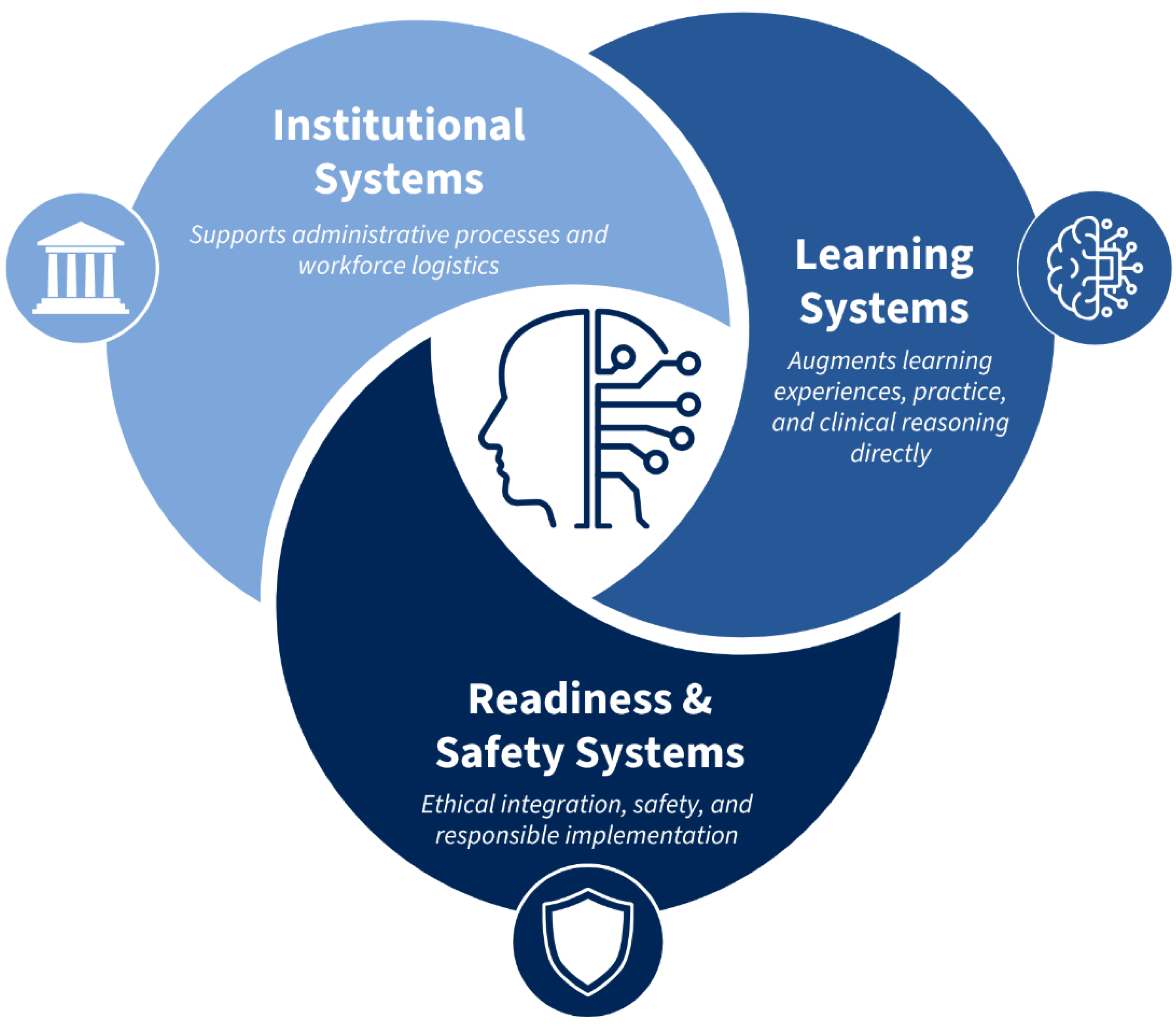
Figure 2.
Overview of artificial intelligence across the education continuum, including undergraduate medical education, graduate medical education, and continuing medical education, organized by three domains; AI, artificial intelligence; CME, continuing medical education; GME, graduate medical education; UGME, undergraduate medical education.
Figure 2.
Overview of artificial intelligence across the education continuum, including undergraduate medical education, graduate medical education, and continuing medical education, organized by three domains; AI, artificial intelligence; CME, continuing medical education; GME, graduate medical education; UGME, undergraduate medical education.
Disclaimer/Publisher’s Note: The statements, opinions and data contained in all publications are solely those of the individual author(s) and contributor(s) and not of MDPI and/or the editor(s). MDPI and/or the editor(s) disclaim responsibility for any injury to people or property resulting from any ideas, methods, instructions or products referred to in the content. |
© 2026 by the authors. Licensee MDPI, Basel, Switzerland. This article is an open access article distributed under the terms and conditions of the Creative Commons Attribution (CC BY) license (http://creativecommons.org/licenses/by/4.0/).
Copyright: This open access article is published under a Creative Commons CC BY 4.0 license, which permit the free download, distribution, and reuse, provided that the author and preprint are cited in any reuse.


