

Submitted:
19 June 2026
Posted:
22 June 2026
You are already at the latest version
Abstract
Railway track geometry degradation is a key determinant of infrastructure safety, ride comfort, maintenance demand, and lifecycle cost. This paper presents a measure-ment-based assessment of track geometry degradation on the analyzed section of railway line M300 in Romania, with emphasis on its practical use for maintenance prioritization. The study uses in-situ track-geometry inspection records collected by a track measuring vehicle (VMC) between 2020 and 2023 on a curved double-track sector, and evaluates the main geometric defect families used in railway practice, including alignment, gauge, longitudinal level, cross-level, and twist. In addition to conventional defect identification, severity grading, and penalty-point scoring, the paper introduces three mainte-nance-oriented decision-support tools: the Defect Severity Index (DSI), the Defect Recur-rence Factor (DRF), and a Maintenance Priority Matrix (MPM). These indicators are added to the existing workflow in order to compare inspection campaigns, identify persistent defect families, and translate measured degradation into maintenance priorities. The re-sults show that degradation is spatially selective and defect-family dependent, with cross-level and longitudinal-level defects dominating the cumulative penalty score. The DSI ranged from 467 points/km in September 2022 to 3183 points/km in March 2022, con-firming a non-linear degradation and recovery pattern. The proposed indices provide an interpretable extension of the existing penalty-point framework and support condi-tion-based maintenance planning on conventional railway lines.
Keywords:
railway infrastructure
; track geometry degradation
; VMC measurements
; defect scoring
; maintenance prioritization
; Defect Severity Index
; Defect Recurrence Factor
; Maintenance Priority Matrix
; conventional railway
; Romania
1. Introduction
Railway infrastructure performance is strongly dependent on the ability of the track system to preserve its geometric quality under traffic loads, ballast degradation, substructure variability, environmental action, and maintenance disturbance. Repeated loading progressively modifies track geometry, increases dynamic wheel–rail interaction, reduces ride quality, and accelerates deterioration of superstructure and substructure components [1,2,3,4]. For this reason, the monitoring and interpretation of geometric parameters remain a core task in railway maintenance engineering.
Among the indicators used in conventional track assessment, longitudinal level, alignment, gauge, and cross-level are the most operationally relevant because they describe the actual running condition of the track and can be directly linked to safety thresholds, maintenance actions, and local infrastructure weaknesses [2,3,5,6]. Recent reviews confirm that railway administrations increasingly rely on track geometry data not only for reactive correction of isolated defects but also for condition assessment, maintenance planning, and degradation modelling [4,5,6,7,8,9].
The literature shows a clear transition from periodic inspection toward data-driven and predictive maintenance. Recent studies have reviewed machine-learning approaches for track geometry degradation, broader data-driven predictive maintenance strategies for rail systems, and the emerging convergence of monitoring, AI, and digital twins [8,9,10,11]. However, the implementation of such approaches still depends on the availability of reliable field measurements and on interpretable engineering workflows able to translate recorded irregularities into practical maintenance decisions.
Measurement technologies have evolved accordingly. In addition to manual inspection and localized devices, track recording vehicles and in-service monitoring platforms can provide continuous high-resolution data on the geometric condition of the track [12,13,14,15,16]. Still, high-level predictive frameworks do not eliminate the need for transparent case-based analysis. Infrastructure managers continue to require physically interpretable results showing which defects dominate, how they are distributed, and how their severity affects maintenance priority.
Within this context, the present paper investigates a real case study from the Romanian railway network. The analysis focuses on the a section on the railway line M 300 and uses VMC measurement records processed under the national defect-scoring logic. The novelty of the paper lies in converting a measurement-centered engineering study into a maintenance-oriented infrastructure manuscript. Rather than proposing a black-box predictive model, the paper develops a clear interpretation framework linking defect families, severity grades, and cumulative penalty scores to maintenance relevance. This responds to the practical gap between advanced degradation modelling and day-to-day decision-making in conventional railway maintenance [17,18,19,20].
To strengthen this maintenance-oriented interpretation without replacing the existing defect-scoring logic, the study additionally introduces a set of transparent indices. The Defect Severity Index (DSI) normalizes the penalty score by monitored track length, the Defect Recurrence Factor (DRF) identifies defect families that persist across successive inspection campaigns, and the Maintenance Priority Matrix (MPM) combines severity and recurrence in order to support practical intervention ranking.
The objectives of the paper are therefore to:
- characterize the measured geometric condition of the selected track section;
- identify the defect families with the greatest influence on the cumulative maintenance score;
- quantify degradation severity using the Defect Severity Index;
- evaluate the recurrence of the main defect families using the Defect Recurrence Factor; and show how point-based defect assessment can support maintenance prioritization through the Maintenance Priority Matrix.
These objectives are operationalized by adding the DSI, DRF, and MPM to the existing assessment workflow, while preserving the original penalty-point interpretation used in railway maintenance practice.
2. Materials and Methods
2.1. Study Area
The analyzed case study concerns a sector on the railway Line M300, between km 473+000 and km 476+000. The selected section belongs to a conventional double-track railway and includes several horizontal curves, making it suitable for the study of geometry deterioration under constrained operating conditions. The sector is equipped with type 60 rails, timber and concrete sleepers, and mixed track geometry features over the two tracks. The curve radii reported in the source dataset range approximately between 240 m and 435 m, while cant values vary between 65 mm and 110 mm. The permitted maximum speed for the analyzed section is 50 km/h.
Because the investigated sector is a double-track section, the 3 km physical length corresponds to 6 track-km for penalty-score normalization. The main characteristics of the study area are summarized in Table 1.
2.2. Data Source and Monitoring Window
The paper is based on real VMC measurements covering the time frame 2020–2023. The underlying dataset consists of recorded band diagrams and processed defect tables extracted from the geometry inspection workflow. The analysis focuses on the recurring identification of defect families and their contribution to the cumulative technical condition of the section.
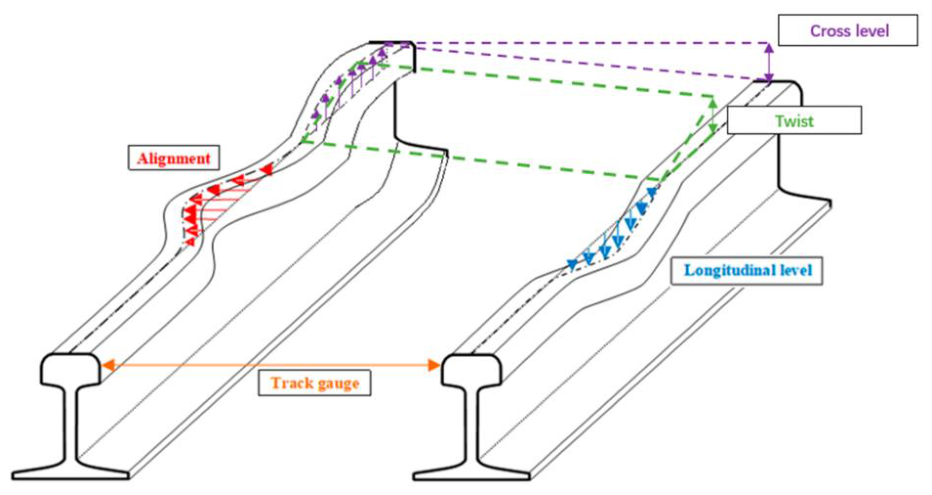
The monitored defect families follow the coding used in the Romanian inspection framework:
- • C: direction/alignment defects;
- • L/l: gauge widening and narrowing;
- • A/J: longitudinal level defects;
- • N/V: cross-level defects;
- • R: twist/torsion defects.
Figure 1.
Schematic diagram of track geometry parameters [9].
Figure 1.
Schematic diagram of track geometry parameters [9].
2.3. Geometric Quality and Defect Assessment Framework
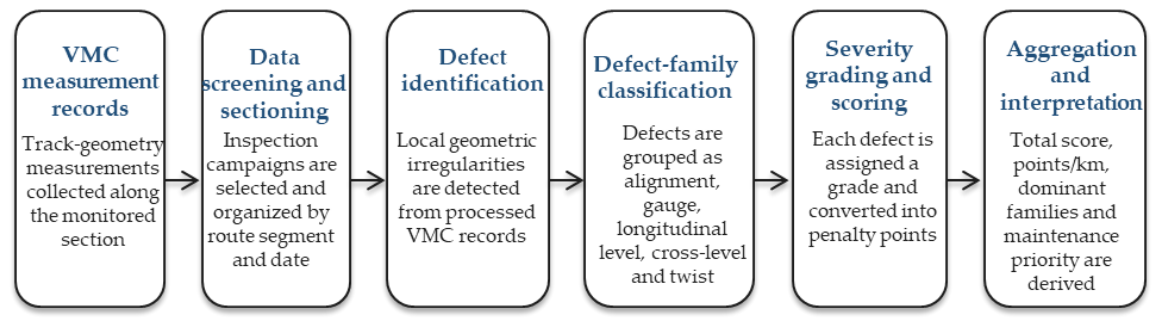
To ensure a transparent conversion of raw geometry measurements into maintenance-relevant indicators, the assessment framework used in this study links three interpretation levels: measured geometric parameters, defect severity grades, and cumulative penalty scores. The VMC records were first interpreted according to the main defect families used in Romanian railway practice, namely alignment, gauge, longitudinal level, cross-level, and twist. Each identified defect was then assigned to a severity grade, and the corresponding penalty score was used to quantify its maintenance relevance.
This approach is useful because the penalty-point system is nonlinear: higher-grade defects receive a disproportionately larger score than lower-grade defects. Therefore, the final score does not only reflect the number of defects, but also their severity. For example, a limited number of grade 4 or grade 5 defects may have a stronger influence on the total score than a larger number of grade 3 defects. The cumulative score was calculated for each inspection campaign and then normalized by the analyzed length of the section in order to obtain a comparable score expressed in points per kilometer.
The total penalty score was calculated as:
where is the cumulative penalty score, Ni is the number of defects belonging to grade or category i, and pi is the penalty score assigned to that defect grade. The normalized score was then obtained as:
where Pkm is the score per kilometer and L is the total analyzed length of the monitored section. This normalization allows the results from different inspection campaigns to be compared directly and supports the interpretation of track condition from a maintenance-prioritization perspective.
To extend the existing assessment framework, three additional maintenance-oriented indicators were used. These indicators do not replace the penalty-point system; instead, they make the interpretation of severity, recurrence, and priority more explicit.
The Defect Severity Index (DSI) is calculated as:
where DSIc is the severity index for campaign c, Ptot,c is the cumulative penalty score for that campaign, and L is the monitored track length.
The Defect Recurrence Factor (DRF) was defined as:
where DRFj is the recurrence factor of defect family j, nj is the number of campaigns in which defect family j was recorded and Nc is the total number of inspection campaigns.
For ranking purposes, a family-level normalized severity score (FDSI) and a Weighted Defect Priority Score (WDPS) were also used:
The Maintenance Priority Matrix then combines severity and recurrence to classify each defect family as routine monitoring, targeted monitoring, corrective intervention, or priority intervention

Table 1.
Penalty scores assigned to defect severity grades in the Romanian track-geometry assessment framework.
Table 1.
Penalty scores assigned to defect severity grades in the Romanian track-geometry assessment framework.
| Defect . | Assigned penalty score | Maintenance interpretation |
|---|---|---|
| 2 | 10 | Low-weight defect included in cumulative assessment |
| 3 | 100 | Moderate defect relevant for maintenance monitoring |
| 4 | 1000 | High-severity defect with major influence on the total score |
| 5 | 1500 | Very severe defect requiring urgent maintenance interpretation |
| 6 | 2000 | Critical defect with maximum penalty impact |
2.4. Analysis Workflow
The workflow adopted in the paper is as follows:
- organize measurement results by inspection measurements;
- identify defect families and severity grades;
- calculate cumulative penalty points and point score per kilometer, and the Defect Severity Index, and the Defect Severity Index;
- analyze the relative contribution of each defect family to the total score;
- calculate the Defect Recurrence Factor for the main defect families;
- calculate the Weighted Defect Priority Score for family-level ranking;
- classify defect families using the Maintenance Priority Matrix; and
- interpret the resulting quality class and maintenance priority from an infrastructure -maintenance perspective.
This extended procedure is consistent with the wider railway literature, where track geometry is increasingly used as a practical decision variable for maintenance planning, degradation monitoring, and risk-oriented intervention selection [5,9,17,18,19,20].
Figure 2.
Workflow used to convert VMC measurements into maintenance-oriented penalty scores.
3. Results
3.1. General Character of the Measured Degradation
The section exhibits a degradation pattern that is localized and defect-family dependent, rather than uniformly distributed. This is an important practical result because it indicates that maintenance decisions should not be based solely on average section quality; instead, they should consider the relative weight of each defect family and the concentration of defects in particular locations. Such behavior is fully consistent with previous field-based studies showing that track geometry degradation is cumulative yet spatially selective [18,19,20,25].
3.2. September 2020 Inspection Campaigns
To provide a clearer maintenance-oriented interpretation of the September 2020 inspection, the total penalty points were grouped by defect type over the entire monitored section. This representation highlights not only the cumulative condition of the track, but also the relative importance of each defect family in the final score. Together, these categories accounted for the majority of the total penalty score, indicating that the poor condition of the section was mainly associated with vertical and transverse geometry instability rather than with gauge-related defects. The diagram therefore confirms that the maintenance priority for this inspection should be directed toward correcting support-related and level-related irregularities along the analyzed route.
Figure 3 and Table 3 show the defect counts and penalty points for September 2020 campaign.
Figure 3.
Defect counts and penalty-point totals for September 2020.
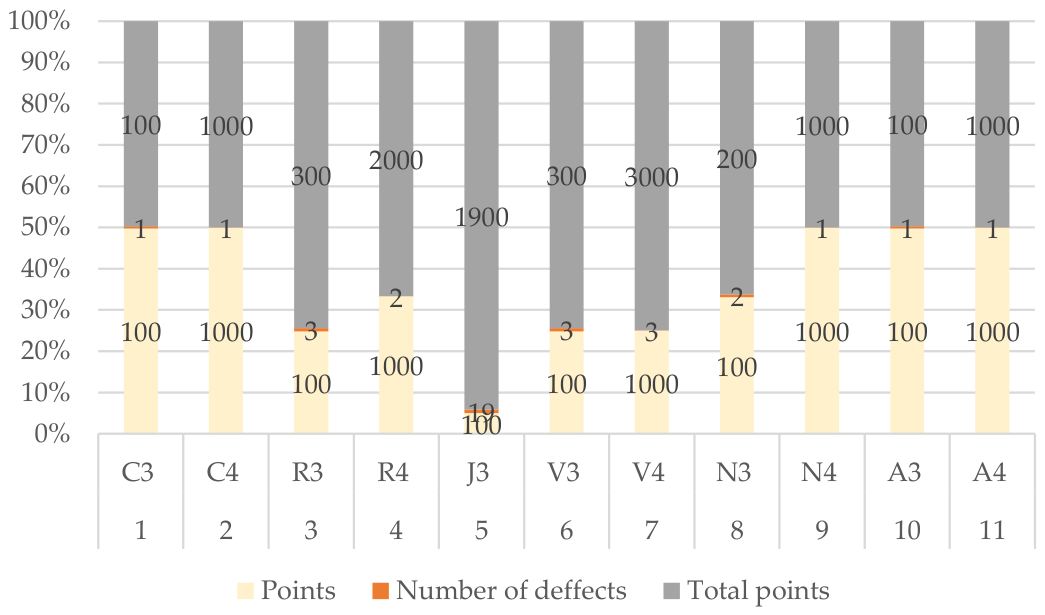
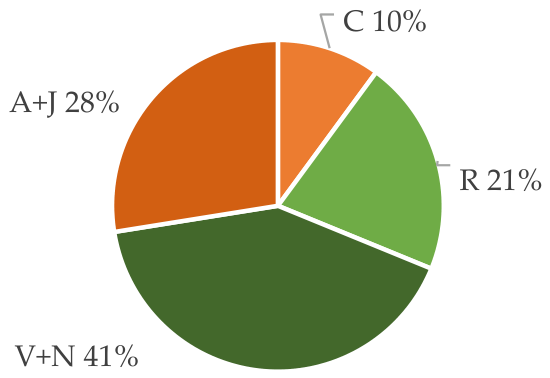
Figure 4.
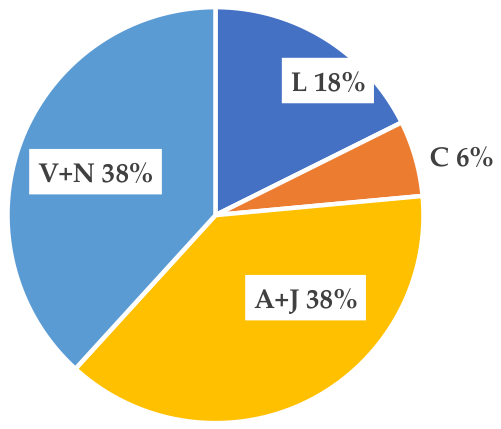
Relative contribution of defect families to the September 2020 score.
The first clearly documented measurements in the analyzed series are for September 2020. The processed defect table indicates a total of 10,900 penalty points for the analyzed two-track section, which corresponds to 1816 points/km over the total 6 km monitored length. Because the investigated sector is a double-track section, the 3 km physical length between km 473+000 and km 476+000 corresponds to 6 track-km used for penalty-score normalization. According to the source assessment, this leads to an unsatisfactory quality class.
The severity distribution for this measurements was dominated by grade 3 defects (83%), followed by grade 4 defects (13%) and grade 5 defects (4%), with grade 6 defects practically absent in the visible distribution. This indicates that the section’s poor rating was not driven by a large number of extreme defects alone, but by the accumulation of moderate and high-penalty irregularities.
The contribution of defect families to the total score is particularly informative. The score composition shows that:
- cross-level defects (V + N) contributed approximately 41% of the total score;
- longitudinal level defects (A + J) contributed approximately 28%;
- twist defects (R) contributed approximately 21%;
- direction defects (C) contributed approximately 10%;
- gauge defects (L + l) were marginal in the visible score composition.
This result is highly significant for maintenance interpretation, because it shows that the section’s poor condition was primarily a level-related problem, with cross-level and longitudinal level together generating roughly two-thirds of the total penalty score.
Table 2.
Defect counts and penalty-point totals for September 2020.
| Defect Type | Penalty points | Number of defects | Total penalty points |
|---|---|---|---|
| C3 | 100 | 1 | 100 |
| C4 | 1000 | 1 | 1000 |
| R3 | 100 | 3 | 300 |
| R4 | 1000 | 2 | 2000 |
| J3 | 100 | 19 | 1900 |
| V3 | 100 | 3 | 300 |
| V4 | 1000 | 3 | 3000 |
| N3 | 100 | 2 | 200 |
| N4 | 1000 | 1 | 1000 |
| A3 | 100 | 1 | 100 |
| A4 | 1000 | 1 | 1000 |
| TOTAL | 10900 |
3.3. April 2021 Inspection Campaigns
The April 2021 measurements presents a markedly different picture. The total penalty score recorded for the section was 3400 points, which corresponds to approximately 567 points/km over the same 6 km analyzed length, Figure 5. Compared with September 2020, this represents a substantial reduction in the cumulative score.
The 2021 defect Table 4 shows a much simpler defect portfolio:
6 occurrences of L3, 2 of C3, 11 of J3, 2 of V3, 1 of V4, 1 of N3, and 2 of A3. No grade 5 defects are visible in this measurements, and only one grade 4 defect remained. From a maintenance perspective, this indicates a significant post-intervention or post-recovery improvement in the measured track condition.
Two observations are especially relevant:
- longitudinal level defects remained persistent, with J3 continuing to dominate the counts;
- the overall severity profile became much less critical, indicating a reduction of higher-penalty irregularities.
This comparison between the 2020 and 2021 measurements supports the argument that penalty-point analysis is useful not only for diagnosing poor condition, but also for evaluating the effectiveness of maintenance actions.
Figure 5.
Defect counts and penalty-point totals for April 2021.
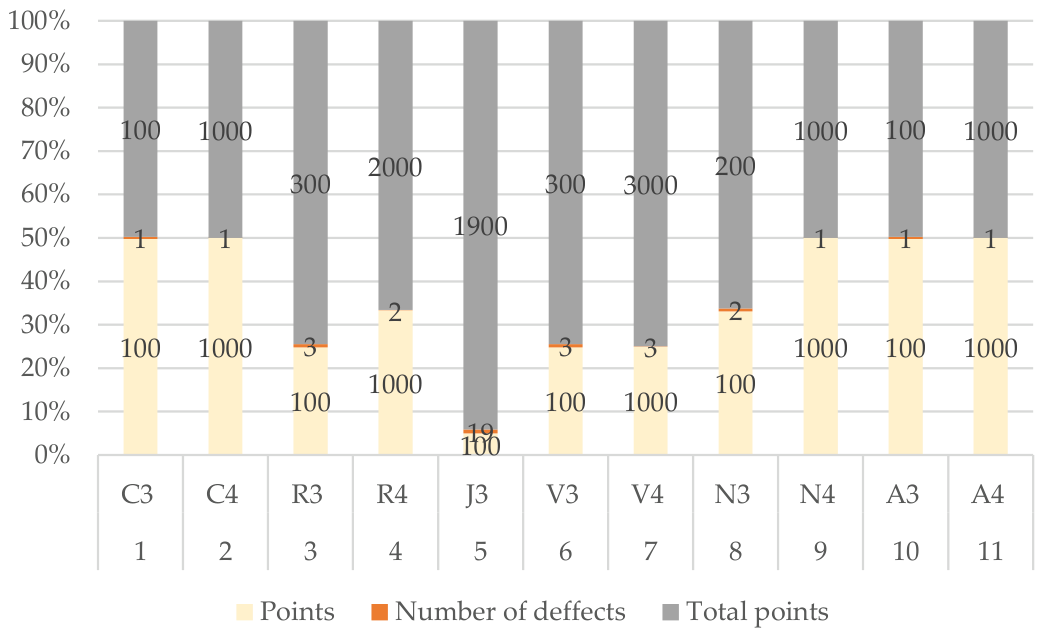
Figure 6.
Relative contribution of defect families to the April 2021 score.
3.4. Extension to the 2022–2023 Monitoring Window
3.5. Cumulative Assessment of Defect Evolution, 2020–2023
Following the individual assessment of the September 2020 and April 2021 inspection campaigns, the analysis was extended to the entire monitoring period from September 2020 to September 2023. For this purpose, all available measurement campaigns were consolidated under the same defect classification and penalty-point framework. The cumulative figures presented below provide a comparative overview of the evolution of defect counts, severity grades, total penalty scores, and the contribution of the main defect families over time. This representation allows the multi-year behavior of the monitored section to be examined consistently, while maintaining the same maintenance-oriented interpretation criteria for all inspection campaigns.
Out of the eight defect types considered in the assessment, five are associated with support-related degradation mechanisms, mainly subgrade settlement and/or a non-compliant ballast prism. When the seven inspection campaigns are analyzed together, these defect types account for approximately 75% of the cumulative penalty score. This shows that the overall degradation pattern of the section was mainly governed by track-support deficiencies rather than by isolated rail, fastening, or gauge-related defects.
The centralized defect-family assessment for the entire monitoring period is presented in Table 10 and Figure 8. The results show that the cumulative penalty score was not evenly distributed among the defect families. Cross-level defects, represented by the V + N group, and longitudinal level defects, represented by the A + J group, generated the highest cumulative scores over the analyzed period. Together, these two categories accounted for more than 60% of the total penalty score, indicating that vertical and transverse geometry irregularities were the dominant contributors to the technical condition of the section.
Figure 7.
Contribution of support-related defects to the cumulative penalty score over the seven inspection campaigns.
Figure 7.
Contribution of support-related defects to the cumulative penalty score over the seven inspection campaigns.
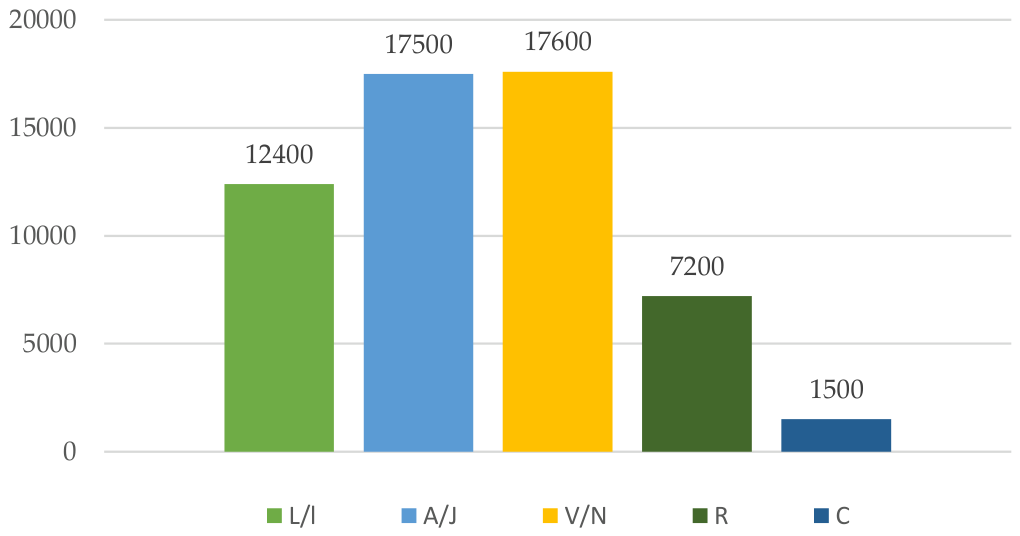
Figure 8.
Evolution of penalty-point scores by defect family over the 2020–2023 monitoring period.
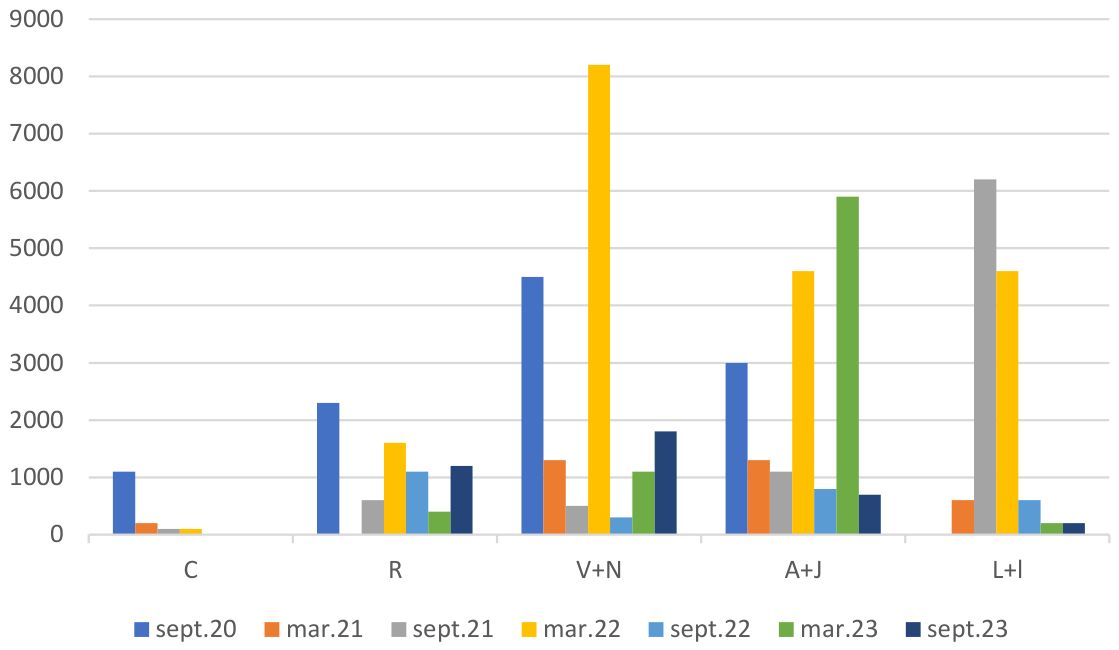
The evolution by inspection campaign also shows that the highest cumulative score was recorded in March 2022, mainly due to the strong contribution of V + N defects and the simultaneous increase in A + J and L + I defects. In contrast, the lowest total score was observed in September 2022, when all defect families recorded relatively reduced penalty values. Alignment defects, represented by the C group, had a limited contribution after September 2020, while twist defects, represented by the R group, showed recurrent but moderate contributions throughout the monitoring period. This centralized representation therefore provides a clearer comparison of the dominant defect mechanisms affecting the analyzed section between September 2020 and September 2023.
3.6. Maintenance-Oriented Indices Added to the Existing Workflow
The proposed indices were calculated using the penalty scores already reported in the existing workflow. The DSI was first determined for each inspection campaign by dividing the total penalty score by the monitored length of 6 track-km. This preserves the original penalty-point logic while enabling direct comparison between campaigns.
Using a monitored length of 6 track-km, the DSI was calculated for each inspection campaign. The resulting values are summarized in Table 11.
The DSI values confirm that the monitored section did not deteriorate in a simple linear manner. The highest degradation level was recorded in March 2022, while the lowest value was observed in September 2022. The reduction between September 2020 and April 2021 also shows that the normalized indicator can help interpret post-intervention or post-recovery changes in track geometry condition. The temporal evolution of the DSI is illustrated in Figure 9.
The DRF and WDPS were then calculated for each defect family using the cumulative defect-family scores presented in Table 10. These indicators show whether the dominant defect families are isolated or persistent across the monitoring period.
As shown in Table 12 and Figure 10, the highest WDPS values were obtained for cross-level defects (V+N) and longitudinal-level defects (A+J). These defect families combine high cumulative severity with full recurrence across the seven inspection campaigns, making them the most important maintenance priorities in the analyzed section.
The highest WDPS values were obtained for cross-level defects (V+N) and longitudinal-level defects (A+J). These defect families combine high cumulative severity with full recurrence across the seven inspection campaigns, making them the most important maintenance priorities in the analyzed section. The relative ranking of defect families according to WDPS is presented in Figure 10.
According to the Maintenance Priority Matrix, V+N and A+J were classified as priority intervention categories, L+l as corrective intervention, R as monitoring and targeted correction, and C as routine monitoring. The recurrence pattern of the main defect families is shown in Figure 11.
4. Discussion
The present case study confirms a point that is strongly supported in the literature: track geometry degradation is not simply a gradual average worsening of the track, but a defect-specific and location-sensitive process [17,18,19,20,25]. In the studied case, the dominant contribution of cross-level and longitudinal-level defects in September 2020 indicates that vertical and transverse geometric instability were the principal maintenance drivers.
This finding aligns with recent research showing that level-related parameters are especially informative for identifying ballast- and support-related deterioration. Studies on track geometry degradation, ballast condition, and maintenance planning consistently highlight the practical importance of longitudinal-level-derived indicators and related geometric patterns [25,26]. The strong contribution of cross-level and twist in the present study further suggests that local support asymmetry and curve-related behavior should be examined when diagnosing root causes.
The improvement observed between September 2020 and April 2021 also supports a second important conclusion: cumulative penalty-point analysis is useful for evaluating maintenance effectiveness. A reduction from approximately 1816 points/km to 567 points/km is not merely a numerical change; it implies a shift from a defect portfolio containing several high-penalty irregularities to one dominated largely by lower-grade defects. This type of interpretation is particularly valuable for conventional infrastructure managers because it bridges the gap between raw measurement data and maintenance strategy.
The added DSI, DRF, WDPS, and MPM strengthen the maintenance interpretation by distinguishing between severe but temporary defects and persistent defect families. This distinction is important because recurrent level-related defects may indicate deeper support problems that are not visible from a single inspection campaign alone.
In this context, the proposed DSI–DRF–MPM framework intentionally avoids black-box prediction and instead emphasizes transparent engineering interpretation.
That choice is deliberate. The current literature increasingly explores machine learning, reinforcement learning, and digital-twin-enabled maintenance [8,9,10,11,27,28,29,30], but the practical deployment of such methods still depends on sound field interpretation. In that sense, the present study should be understood as a measurement-to-maintenance framework: it establishes the engineering logic necessary before more advanced condition-based and predictive tools can be implemented.
Finally, the dominance of level-related defects also suggests possible underlying mechanisms that deserve further investigation, such as ballast degradation, tamping effectiveness, or local transition effects. Recent studies on tamping performance, ballast monitoring, and settlement behavior show that repeated geometry problems are often rooted in support conditions rather than in superficial alignment issues alone [31,32,33,34]. This is especially relevant if later measurements reveal repeated recurrence of the same defect families at the same locations.
The study also has several limitations. First, the analysis is based on a single railway section, and the proposed indicators should be validated on additional sections with different geometric, operational, and maintenance conditions. Second, the available dataset is based on track geometry inspection records and does not include direct measurements of ballast condition, subgrade stiffness, drainage performance, or traffic loading. Third, the exact timing and type of maintenance interventions were not fully integrated into the analysis. Therefore, the observed reductions in penalty scores can be interpreted as changes in track geometry condition but cannot be attributed quantitatively to specific maintenance actions. Future studies should combine the proposed indices with spatial recurrence mapping, intervention records, and infrastructure condition data.
5. Conclusions
This paper presented an in-situ assessment of track geometry degradation on the analyzed section of railway line M300 using VMC records and maintenance-oriented defect scoring. The main conclusions are as follows.
First, the selected section exhibited a maintenance-relevant, non-uniform degradation pattern, confirming that local defect concentration is more informative than average section quality alone.
Second, the September 2020 measurements showed a poor geometric condition, with a total of 1816 points/km and an unsatisfactory classification. The score structure revealed that cross-level and longitudinal level defects were the dominant contributors.
Third, the April 2021 measurements showed a markedly lower cumulative score of approximately 567 points/km, indicating substantial geometric recovery and a reduced presence of high-penalty defects.
Fourth, the comparison between measurements demonstrates that penalty-point analysis can support both diagnosis and maintenance evaluation, especially when defect-family contribution is analyzed together with total score.
Fifth, the study provides a practical infrastructure-management framework for converting geometry inspection data into maintenance priorities. It can therefore serve as a foundation for future work on multi-temporal degradation modelling, defect recurrence analysis, and condition-based or predictive maintenance implementation.
Sixth, the integration of DSI, DRF, WDPS, and MPM provides a transparent extension of the existing penalty-point workflow. These indicators require no additional measurement equipment, but they improve the interpretation of existing inspection data by linking severity, recurrence, and maintenance priority.
Future work should extend the present multi-year assessment toward spatial recurrence mapping, intervention-effectiveness evaluation, and predictive modelling of the dominant defect families
Author Contributions
Conceptualization, Madalina Ciotlaus, Marcian Domuta; methodology, Ciotlaus Madalina; validation, Alexandra Denisa Danciu, Vladimir Marusciac; formal analysis, Alexandra Denisa Danciu; investigation, Marcian Domuta; resources, Marcian Domuta; data curation, Vladimir Marusciac, Mihai Liviu Dragomir; writing—original draft preparation, Madalina Ciotlaus, Marcian Domuta; writing—review and editing, Madalina Ciotlaus, Alexandra Denisa Danciu; visualization, Mihai Liviu Dragomir, Gabriela Pau. All authors have read and agreed to the published version of the manuscript.
Acknowledgments
The authors have reviewed and edited the output and take full responsibility for the content of this publication.
Conflicts of Interest
The authors declare no conflicts of interest.
References
- Esveld, C. Modern Railway Track; MRT-Productions: Zaltbommel, The Netherlands, 2001. [Google Scholar]
- Berggren, E.G.; Li, M.X.D.; Spännar, J. A New Approach to the Analysis and Presentation of Vertical Track Geometry Quality and Rail Roughness. Wear 2008, 265, 1488–1496. [Google Scholar] [CrossRef]
- Li, M.X.D.; Berggren, E.G.; Berg, M.; Persson, I. Assessing Track Geometry Quality Based on Wavelength Spectra and Track-Vehicle Dynamic Interaction. Veh. Syst. Dyn. 2008, 46, 261–276. [Google Scholar] [CrossRef]
- de Melo, A.L.O.; Kaewunruen, S.; Papaelias, M.; Bernucci, L.L.B.; Motta, R. Methods to Monitor and Evaluate the Deterioration of Track and Its Components in a Railway In-Service: A Systemic Review. Front. Built Environ. 2020, 6, 118. [Google Scholar] [CrossRef]
- Soleimanmeigouni, I.; Ahmadi, A.; Kumar, U. Track Geometry Degradation and Maintenance Modelling: A Review. Proc. Inst. Mech. Eng. Part F J. Rail Rapid Transit 2018, 232, 73–102. [Google Scholar] [CrossRef]
- Falamarzi, A.; Moridpour, S.; Nazem, M. A Review of Rail Track Degradation Prediction Models. Aust. J. Civ. Eng. 2019, 17, 152–166. [Google Scholar] [CrossRef]
- Xie, J.; Huang, J.; Zeng, C.; Jiang, S.-H.; Podlich, N. Systematic Literature Review on Data-Driven Models for Predictive Maintenance of Railway Track: Implications in Geotechnical Engineering. Geoscience 2020, 10, 425. [Google Scholar] [CrossRef]
- Davari, N.; Veloso, B.; Costa, G.d.A.; Pereira, P.M.; Ribeiro, R.P.; Gama, J. A Survey on Data-Driven Predictive Maintenance for the Railway Industry. Sensors 2021, 21, 5739. [Google Scholar] [CrossRef] [PubMed]
- Liao, Y.; Han, L.; Wang, H.; Zhang, H. Prediction Models for Railway Track Geometry Degradation Using Machine Learning Methods: A Review. Sensors 2022, 22, 7275. [Google Scholar] [CrossRef] [PubMed]
- Bianchi, G.; Fanelli, C.; Freddi, F.; Giuliani, F.; La Placa, A. Systematic Review Railway Infrastructure Monitoring: From Classic Techniques to Predictive Maintenance. Adv. Mech. Eng. 2025, 17, 16878132241285631. [Google Scholar] [CrossRef]
- Mutlu, U.; Kaewunruen, S. Digitalised Predictive Maintenance in Railways: A Systematic Review of AI, BIM, and Digital Twins. Infrastructures 2026, 11, 87. [Google Scholar] [CrossRef]
- Khajehei, H.; Ahmadi, A.; Soleimanmeigouni, I.; Nissen, A. Allocation of Effective Maintenance Limit for Railway Track Geometry. Struct. Infrastruct. Eng. 2019, 15, 1597–1612. [Google Scholar] [CrossRef]
- European Committee for Standardization. EN 13848-1:2019 Railway Applications—Track—Track Geometry Quality—Part 1: Characterization of Track Geometry; CEN: Brussels, Belgium, 2019. [Google Scholar]
- European Committee for Standardization. EN 13848-5:2017 Railway Applications—Track—Track Geometry Quality—Part 5: Geometric Quality Levels—Plain Line, Switches and Crossings; CEN: Brussels, Belgium, 2017. [Google Scholar]
- Weston, P.F.; Ling, C.S.; Roberts, C.; Goodman, C.J.; Li, P.; Goodall, R.M. Monitoring Vertical Track Irregularity from In-Service Railway Vehicles. Proc. Inst. Mech. Eng. Part F J. Rail Rapid Transit 2007, 221, 75–88. [Google Scholar] [CrossRef]
- Weston, P.F.; Ling, C.S.; Goodman, C.J.; Roberts, C.; Li, P.; Goodall, R.M. Monitoring Lateral Track Irregularity from In-Service Railway Vehicles. Proc. Inst. Mech. Eng. Part F J. Rail Rapid Transit 2007, 221, 89–100. [Google Scholar] [CrossRef]
- Sadeghi, J.; Askarinejad, H. Development of Improved Railway Track Degradation Models. Struct. Infrastruct. Eng. 2010, 6, 675–688. [Google Scholar] [CrossRef]
- Andrade, A.R.; Teixeira, P.F. Uncertainty in Rail-Track Geometry Degradation: Lisbon–Oporto Line Case Study. J. Transp. Eng. 2010, 137, 193–200. [Google Scholar] [CrossRef]
- Guler, H.; Jovanovic, S.; Evren, G. Modelling Railway Track Geometry Deterioration. Proc. Inst. Civ. Eng. Transp. 2011, 164, 65–75. [Google Scholar] [CrossRef]
- Jovanović, S.; Guler, H.; Čoko, B. Track Degradation Analysis in the Scope of Railway Infrastructure Maintenance Management Systems. Građevinar 2015, 67, 247–258. [Google Scholar] [CrossRef]
- Sadeghi, J.; Askarinejad, H. An Investigation into the Effects of Track Structural Conditions on Railway Track Geometry Deviations. Proc. Inst. Mech. Eng. Part F J. Rail Rapid Transit 2009, 223, 415–425. [Google Scholar] [CrossRef]
- Sadeghi, J. Development of Railway Track Geometry Indexes Based on Statistical Distribution of Geometry Data. J. Transp. Eng. 2010, 136, 693–700. [Google Scholar] [CrossRef]
- Sadeghi, J.; Fathali, M.; Boloukian, N. Development of a New Track Geometry Assessment Technique Incorporating Rail Cant Factor. Proc. Inst. Mech. Eng. Part F J. Rail Rapid Transit 2008, 223, 255–263. [Google Scholar] [CrossRef]
- Andrade, A.R.; Teixeira, P.F. Hierarchical Bayesian Modelling of Rail Track Geometry Degradation. Proc. Inst. Mech. Eng. Part F J. Rail Rapid Transit 2013, 227, 364–375. [Google Scholar] [CrossRef]
- Soleimanmeigouni, I.; Ahmadi, A.; Nissen, A.; Xiao, X. Prediction of Railway Track Geometry Defects: A Case Study. Struct. Infrastruct. Eng. 2019, 15, 987–1001. [Google Scholar] [CrossRef]
- Zhao, W.; Qiang, W.; Yang, F.; Jing, G.; Guo, Y. Data-Driven Ballast Layer Degradation Identification and Maintenance Decision Based on Track Geometry Irregularities. Int. J. Rail Transp. 2024, 12, 581–603. [Google Scholar] [CrossRef]
- Sresakoolchai, J.; Kaewunruen, S. Railway Infrastructure Maintenance Efficiency Improvement Using Deep Reinforcement Learning Integrated with Digital Twin Based on Track Geometry and Component Defects. Sci. Rep. 2023, 13, 2439. [Google Scholar] [CrossRef] [PubMed]
- Fumeo, E.; Oneto, L.; Anguita, D. Condition Based Maintenance in Railway Transportation Systems Based on Big Data Streaming Analysis. Procedia Comput. Sci. 2015, 53, 437–446. [Google Scholar] [CrossRef]
- Lasisi, A.; Attoh-Okine, N. Principal Components Analysis and Track Quality Index: A Machine Learning Approach. Transp. Res. Part C Emerg. Technol. 2018, 91, 230–248. [Google Scholar] [CrossRef]
- Bai, L.; Liu, R.; Sun, Q.; Wang, F.; Wang, F. Classification-Learning-Based Framework for Predicting Railway Track Irregularities. Proc. Inst. Mech. Eng. Part F J. Rail Rapid Transit 2016, 230, 598–610. [Google Scholar] [CrossRef]
- Guo, Y.; Markine, V.; Jing, G. Review of Ballast Track Tamping: Mechanism, Challenges and Solutions. Constr. Build. Mater. 2021, 300, 123940. [Google Scholar] [CrossRef]
- Offenbacher, S.; Antony, B.; Barbir, O.; Auer, F.; Landgraf, M. Evaluating the Applicability of Multi-Sensor Equipped Tamping Machines for Ballast Condition Monitoring. Measurement 2021, 172, 108881. [Google Scholar] [CrossRef]
- Wang, H.; Markine, V. Modelling of the Long-Term Behaviour of Transition Zones: Prediction of Track Settlement. Eng. Struct. 2018, 156, 294–304. [Google Scholar] [CrossRef]
- Varandas, J.N.; Hölscher, P.; Silva, M.A.G. Settlement of Ballasted Track under Traffic Loading: Application to Transition Zones. Proc. Inst. Mech. Eng. Part F J. Rail Rapid Transit 2014, 228, 242–259. [Google Scholar] [CrossRef]
- CFR (Romanian Railways). “Instruction 300: Instruction for the Maintenance of Railway Lines” [Instrucția 300 - Instrucția de întreținere a liniilor ferate]. 1982. (in Romanian) [Google Scholar]
- CFR (Romanian Railways). “Instruction 303: Instruction for Railway Track Renewal Works” [Instrucția 303 - Instrucția pentru lucrările de refacție a liniei de cale ferată]. 1986. (in Romanian) [Google Scholar]
- CFR (Romanian Railways). “Instruction 310: Instruction for the Use of the Track Measurement Trolley” [Instrucția 310 - Instrucția pentru folosirea căruciorului de măsurat calea]. 1956. (in Romanian) [Google Scholar]
- CFR (Romanian Railways). “Instruction 314: Instruction for Standards and Tolerances for Tracks, Turnouts, Bridges and Tunnels” [Instrucția 314 - Instrucția pentru norme și toleranțe la linii, schimbătoare de cale, poduri și tuneluri]. 1989. (in Romanian) [Google Scholar]
- CFR (Romanian Railways). “Instruction 348: Instruction for Non-Destructive Testing of Rails Using the Rail Flaw Detector” [Instrucția 348 Defectoscopul - Instrucția pentru controlul nedistructiv al șinelor]. 1972. (in Romanian) [Google Scholar]
- CFR (Romanian Railways). “Instruction for the Diagnosis of the Track and Contact Line Performed with the TMC Track Measurement Vehicle” [Instrucția pentru diagnoza căii și liniei de contact efectuată cu automotorul TMC]. 2006. (in Romanian) [Google Scholar]
- CFR (Romanian Railways). “Instruction 329: Instruction for the Use of Track Measurement Coaches” [Instrucția 329 - Instrucția pentru folosirea vagoanelor de măsurat calea]. 1972. (in Romanian) [Google Scholar]
- CFR (Romanian Railways). “Instruction 306: Instructions for Determining Rail Defects and Inspecting Rails in Track” [Instrucția 306 - Instrucțiuni pentru determinarea defectelor șinelor și pentru verificarea șinelor în cale]. 1972. (in Romanian) [Google Scholar]
- CFR (Romanian Railways). “Instruction 302: Instruction for Carrying Out Major Railway Track Renewal Works” [Instrucția 302 - Instrucția pentru executarea lucrărilor de reparație radicală a liniei ferate]. 1986. (in Romanian) [Google Scholar]
- CFR (Romanian Railways). “Instruction 341: Instruction for the Design, Maintenance and Supervision of Continuous Welded Track” [Instrucția 341 - Instrucția pentru alcătuirea, întreținerea și supravegherea căii fără joante]. 1980. (in Romanian) [Google Scholar]
Figure 9.
Evolution of the Defect Severity Index over the 2020–2023 monitoring period.
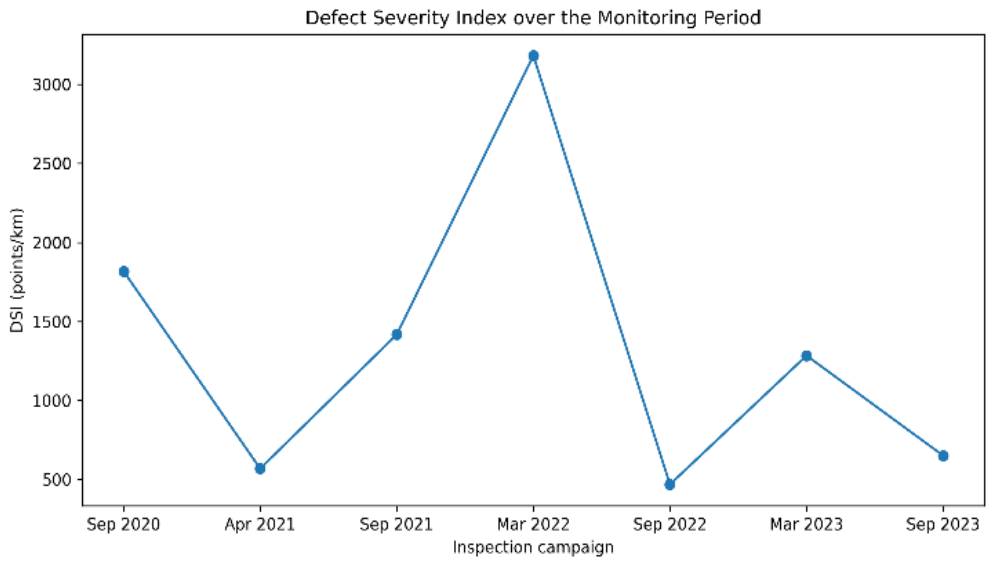
Figure 10.
Weighted Defect Priority Score by defect family.
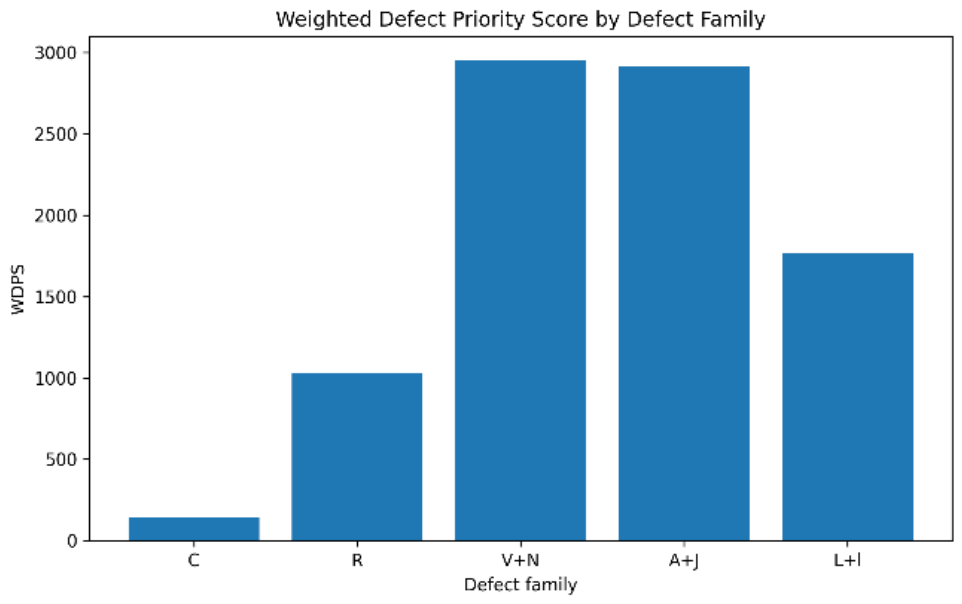
Table 1.
Main characteristics of the analyzed section.
| Parameter | Value |
|---|---|
| Line | M300 |
| Interval | km 473+000-476+000 |
| Physical length | 3 km |
| Analyzed length | 6 track-km |
| Track | double-track conventional railway |
| Rail type | type 60 |
| Sleepers | timber and concrete |
| Curve radii | 240-435 m |
| Cant | 65-110 mm |
| Speed | 50 km/h |
Table 4.
Defect counts and penalty-point totals for April 2021.
| Defect Type | Penalty points | Number of defects | Total penalty points |
|---|---|---|---|
| L3 | 100 | 6 | 600 |
| C3 | 100 | 2 | 200 |
| J3 | 100 | 11 | 1100 |
| V3 | 100 | 2 | 200 |
| V4 | 1000 | 1 | 1000 |
| N3 | 100 | 1 | 100 |
| A3 | 100 | 2 | 200 |
| TOTAL | 3400 |
Table 5.
Defect counts and penalty-point totals for September 2021.
| Defect Type | Penalty points | Number of defects | Total penalty points |
|---|---|---|---|
| L3 | 100 | 12 | 1200 |
| L4 | 1000 | 5 | 5000 |
| C3 | 100 | 1 | 100 |
| R3 | 100 | 6 | 600 |
| J3 | 100 | 11 | 1100 |
| V3 | 100 | 2 | 200 |
| N3 | 100 | 3 | 300 |
| TOTAL | 8500 |
Table 6.
Defect counts and penalty-point totals for March 2022.
| Defect Type | Penalty points | Number of defects | Total penalty points |
|---|---|---|---|
| L3 | 100 | 6 | 600 |
| L4 | 1000 | 1 | 1000 |
| L5 | 1500 | 2 | 3000 |
| C3 | 100 | 1 | 100 |
| R3 | 100 | 1 | 100 |
| R5 | 1500 | 1 | 1500 |
| J3 | 100 | 25 | 2500 |
| J4 | 1000 | 1 | 1000 |
| V3 | 100 | 3 | 300 |
| V4 | 1000 | 6 | 6000 |
| V5 | 1500 | 1 | 1500 |
| N3 | 100 | 4 | 400 |
| A3 | 100 | 1 | 100 |
| A4 | 1000 | 1 | 1000 |
| TOTAL | 19100 |
Table 7.
Defect counts and penalty-point totals for September 2022.
| Defect Type | Penalty points | Number of defects | Total penalty points |
|---|---|---|---|
| L3 | 100 | 6 | 600 |
| R3 | 100 | 1 | 100 |
| R4 | 1000 | 1 | 1000 |
| J3 | 100 | 8 | 800 |
| N3 | 100 | 3 | 300 |
| TOTAL | 2800 |
Table 8.
Defect counts and penalty-point totals for March 2023.
| Defect Type | Penalty points | Number of defects | Total penalty points |
|---|---|---|---|
| L3 | 100 | 2 | 200 |
| R3 | 100 | 4 | 400 |
| J3 | 100 | 19 | 1900 |
| J4 | 1000 | 4 | 4000 |
| V4 | 1000 | 1 | 1000 |
| N3 | 100 | 1 | 100 |
| A3 | 100 | 1 | 100 |
| TOTAL | 7700 |
Table 9.
Defect counts and penalty-point totals for September 2023.
| Defect Type | Penalty points | Number of defects | Total penalty points |
|---|---|---|---|
| L3 | 100 | 2 | 200 |
| R3 | 100 | 2 | 200 |
| R4 | 1000 | 1 | 1000 |
| J3 | 100 | 6 | 600 |
| N3 | 100 | 3 | 300 |
| A3 | 100 | 1 | 100 |
| V5 | 1500 | 1 | 1500 |
| TOTAL | 3900 |
Table 10.
Defect-family penalty scores, 2020–2023.
| Defect type | sept.20 | mar.21 | sept.21 | mar.22 | sept.22 | mar.23 | sept.23 |
|---|---|---|---|---|---|---|---|
| C | 1100 | 200 | 100 | 100 | 0 | 0 | 0 |
| R | 2300 | 0 | 600 | 1600 | 1100 | 400 | 1200 |
| V+N | 4500 | 1300 | 500 | 8200 | 300 | 1100 | 1800 |
| A+J | 3000 | 1300 | 1100 | 4600 | 800 | 6000 | 700 |
| L+l | 0 | 600 | 6200 | 4600 | 600 | 200 | 200 |
Table 11.
Campaign-level Defect Severity Index values for the 2020–2023 monitoring period.
| Inspection campaign | Total penalty score | DSI (points/km) | Interpretation |
|---|---|---|---|
| Sept 2020 | 10900 | 1817 | High |
| April 2021 | 3400 | 567 | Moderate |
| Sept 2021 | 8500 | 1417 | High |
| March 2022 | 19100 | 3183 | Critical |
| Sept 2022 | 2800 | 467 | Low |
| March 2023 | 7700 | 1283 | High |
| Sept 2023 | 3900 | 650 | Moderate |
Table 12.
Family-level recurrence and maintenance-priority indices.
| Defect family | DRF | WDPS | Maintenance priority |
|---|---|---|---|
| C | 0.57 | 143 | Routine monitoring |
| R | 0.86 | 1029 | Monitoring and targeted correction |
| V+N | 1 | 2950 | Priority intervention |
| A+J | 1 | 2917 | Priority intervention |
| L+l | 0.857 | 1771 | Corrective intervention |
Disclaimer/Publisher’s Note: The statements, opinions and data contained in all publications are solely those of the individual author(s) and contributor(s) and not of MDPI and/or the editor(s). MDPI and/or the editor(s) disclaim responsibility for any injury to people or property resulting from any ideas, methods, instructions or products referred to in the content. |
© 2026 by the authors. Licensee MDPI, Basel, Switzerland. This article is an open access article distributed under the terms and conditions of the Creative Commons Attribution (CC BY) license (http://creativecommons.org/licenses/by/4.0/).
Copyright: This open access article is published under a Creative Commons CC BY 4.0 license, which permit the free download, distribution, and reuse, provided that the author and preprint are cited in any reuse.


