

Submitted:
21 June 2026
Posted:
22 June 2026
You are already at the latest version
Abstract
Accumulation of radionuclides in crops products can pose public health risks. Parameters of 137Cs root uptake by maize were investigated at 4 growth stages from leaf development to ripening (June-September) in the post-Chernobyl area of the Plavsk radioactive hotspot (Tula region of Russia). It has been established that chernozem of the agrosystem still contains about 180 kBq 137Cs m-2. Seasonal trends of 137Cs activity concentrations in above- and belowground parts of maize differ appreciably. In aerial parts, 137Cs accumulation rate increases as vegetative organs develop from June to July, then they drop when generative organs appear in August. In the belowground biomass, the 137Cs content increases with the growth of fine roots, which, due to their rhizofiltration capacity, have maximal radionuclide concentration. However, at all stages of growth radionuclide transfer to maize occurs with low intensity and does not directly depend on changes in biomass, dry matter content, 40K content; and only slightly relates to the ash content. The transfer factor is estimated to be 6.2 x 10⁻³ for cob kernels (grain) and 3.8 x 10⁻² for stems and leaves, which corresponds to the IAEA recommended values and ensures acceptable levels of 137Cs accumulation in crop products produced on the territory.
Keywords:
radiocaesium
; Chernobyl
; root uptake
; bioaccumulation
; transfer factor
; seasonal variations
; maize
1. Introduction
One of the most serious pathways of agricultural land contamination is atmospheric fallout following accidents at radiation-related facilities. Typically, the contamination covers large areas and is very long-term, which creates difficulties in the use and rehabilitation of affected croplands. In particular, after the Chernobyl NPP accident in 1986, radioactive contamination of soil with the main dose-contributing radionuclide 137Cs in excess of 37 kBq m2 was recorded in Europe over an area of about 215,900 km2, of which 60,000 km2 was in the European part of Russia alone, including >23,000 km2 of agricultural land [1]. A revision of radioecological state of these arable lands after 30 years (which corresponds to a half-life of 137Cs with T1/2 30.17 years) showed that the area of cropland remaining radioactively contaminated had decreased by only 32-47% [2], depending on the landscape and cropping features in different regions, with the major part of the radionuclide still concentrated within the arable horizon [3,4]. Nowadays, 40 years after the Chernobyl accident, the spread of 137Cs along the food chain "agricultural soils–crops–(farm animals)–humans" still poses certain risks to public health, but at the same time, well-detectable quantities of the radionuclide make it possible to clarify migration patterns in natural conditions of post-Chernobyl territories.
Cereals are usually the reference for other agricultural crops, as they form the basis of a field rotation under different bioclimatic conditions and zones. Moreover, maize, wheat and rice are considered by FAO to be among the world's essential human food staples and key elements of global food security, accounting for ≈40% of calories and protein in food consumption [5,6]. Maize (Zea mays L.) is a leading cereal crop widely cultivated in various regions and countries over an area of ≈200 million hectares, with the highest productivity (≈6 000 kg ha-1) among cereals and annual global world production ≈1.1 billion tons [6,7]. Belonging to Graminea family, maize differs from other cereals in the type of photosynthesis C4, high rates of metabolism and biomass growth and specific architecture of roots and shoots, which distinguishes it as a separate agro-industrial group. It is a multipurpose crop, used mainly as feed and food, and also partly for non-food purposes [6]. In the human diet fresh, boiled, frozen, or canned kernels, maize flour and meal, as well as processed maize products (corn flakes, etc.) are valued for their high starch content, essential mineral elements and B vitamins [8].
However, the nutritional value of maize for humans and livestock is only realised if food and feed are environmentally safe for consumption. Maize is considered to be sensitive to abiotic stresses, including metal toxicity [9]. In turn, contamination of food products with heavy metals and radionuclides can negatively impact human health and is a serious agricultural problem in many countries [10]. Generalized IAEA analysis of 137Cs transfer to maize grain, stems, and shoots in radioactively contaminated territories, conducted for temperate, subtropical and tropical climate zones, shows that the intensity of biological migration of the radionuclide in the “soil – maize” system is somewhat higher than for cereals in general, and, besides, increases significantly in conditions of hot arid climate [11,12]. It appears that quantitative assessment of the intensity of 137Cs accumulation in maize based on the predictor coefficient (transfer factor, TF) is extremely important in theoretical and applied senses. Although the TF is not a complete constant even for a fixed “soil-plant” pair, it is currently the main tool for estimating the intensity of 137Cs root uptake according to the phylogenetic model of radionuclide bioavailability [13,14,15].
The question arises, to what extent does the accuracy of TF estimation depend on the stage of a crop phenological development at which the accumulation of 137Cs in biomass is accounted for? There is not much information that sheds light on this problem, especially in the context of field research on radioactively contaminated land. However, there are reasons to consider seasonal variations in the intensity of root uptake of 137Cs as a significant factor in TF variability [16,17,18]. Seasonal changes in 137Cs activity concentrations in leaves were observed for macrophytes of Glyboke Lake in the Chornobyl Exclusion Zone [18], as well as in coniferous and deciduous broad-leaf trees in the radioactive contamination zone around the Fukushima-1 NPP [19]. A decrease in TF was shown as the fruiting bodies of the Boletus edulis grew [20]. In field model experiments, significant variability in TF was shown depending on the growth stage of the agricultural crop, and in the case of cereals (wheat, brown rice), the trends in 137Cs accumulation in straw and grain had different temporal fluctuations [21]. In contrast, in another pot experiment, a synchronous increase in TF values was found in both brown rice grain and its straw as plants grew, and the trend was maintained for root uptake of 137Cs from soils with different properties [22]. At the same time, some field studies did not reveal any regular changes in 137Cs activity concentration in plants of Ericaceae and Juncaceae families, but revealed seasonal trends for a member of the family Cyperaceae depending on ontogenesis stage [23]. Thus, there is no common understanding of the patterns of changes in 137Cs activity concentration in crop organs at different stages of their growth and assessment of the significance of seasonal changes in TF for predicting the intensity of transport of radionuclides from soil to plant.
The aim of the present study was to determine the intensity of root uptake and to quantify 137Cs fluxes into maize at different growth stages of plants. The study was conducted to elucidate: (i) the possibility of intra-seasonal dynamics of 137Cs transfer to maize at different stages of plant ontogenesis; (ii) 137Cs intra-planta bioaccumulation patterns with consideration of the radionuclide distribution over plant organs as they differentiate and develop; (iii) the specific of 137Cs root uptake by maize compared to the total flux of mineral nutrients and potassium (by 40K) into plant; (iv) the value of TF in “arable clayey soil – maize” system of semi-arid ambient in the remote period after accidental radionuclide fallout; (v) food hygienic characteristics of maize products from the long-term radioactively contaminated area.
It is assumed that the solution of these questions can supplement the general understanding of the processes of root uptake and biological migration of 137Cs in agrosystems located in the areas of major radioactive fallout.
2. Materials and Methods
2.1. Study Area, Soil and Crop Characteristics
Field observations under seasonal variability in 137Cs root uptake characteristics by maize have been conducted in 2021 in the pronounced area of Chernobyl fallout formed in the southern part of the Tula region of Russia (≈650 km north-east of the Chernobyl nuclear power plant) – the so-called “Plavsk radioactive hotspot” (PRH). In 1986, the PRH lands were contaminated by 137Cs at a level of 185-555 kBq m-2, which was 5-15 times higher than the state standard [1]. At present, the farmlands are still significantly polluted with 137Cs, exceeding the permissible level of its accumulation in the soil by 4-6 times [4,24]. An old ploughed horizon (Aop) is ubiquitous in the territory, indicating deep tillage to a depth of 30 cm after the Chernobyl fallout as a countermeasure to reduce the root uptake of 137Cs by crops [4]. Soils of the PRH area are mainly presented by arable Luvic Chernozems with high humus content (6.8±0.2% of Corg), neutral pHH2O (6.6±0.1), bulk density 1.1-1.2 g cm-3, Ktot 2.0±0.1%, Kex 235±54 mg kg-1, clay loamy texture (clay 42.0%, silt 57.8%, sand 0.2%), and mineral composition enriched in clay minerals of the illite and montmorillonite groups [4,25]. Soils with such properties have a pronounced ability to selectively sorb and firmly fix 137Cs in the interlayer space of clay minerals [26,27], thereby reducing its bioavailability for plants, but at the same time retaining the radionuclide in the surface root zone for a long time.
The experimental plot was situated in the central part of the PRH area (Figure 1). It was located on the non-erodible middle part of the interfluve slope, with a gradient of 2o and an absolute altitude of 237 MSL. In 2021, the place in the crop rotation on this plot was occupied by Pioneer maize grain hybrid P7515 (170 by FAO classification – early maturing), which is characterized by drought tolerance, disease tolerance and high yield potential. In the autumn preceding the maize sowing, the chernozem soil was ploughed to a depth of 20 cm (Ap’’ layer) and 60 kg ha-1 of P and K fertilizers (in terms of the active ingredient) were applied. In spring, when sowing at the end of the second decade of May, the soil was cultivated to a depth of 6-8 cm (Ap’ layer) and 144 kg ha-1 N fertilizer was applied. The seeding rate was 70-80 thousand units ha-1, with a row spacing of 70-75 cm, seeds were placed 15-20 cm apart in the row.
2.2. Sampling and Processing
Simultaneous soil and crop sampling in the maize agrosystem was carried out monthly from 19 June to 18 September 2021 at approximately equal intervals. Weather conditions in the study area in 2021 did not differ much from the long-term rates, with average air temperature of +16.8 °C (+1 – +34.1 °C) and precipitation of 311 mm (63 days with precipitation, mostly in May and September, and 60 days without precipitation, mostly in July and August) during the growing season, according to the Plavsk weather station.
The sampling dates corresponded to the following stages of phenological development of maize on the international BBCH-scale: June – leaf development (codes 14-15, 4-5 true leaves unfolded); July – stem elongation (codes 32-34, 3–4 nodes detectable); August – development of fruit (codes 71-73, beginning of kernels development and early milk); September – ripening (codes 87-89, physiological maturity and fully ripe) [28]. The listed stages of maize growth are hereafter referred to as S1-S4, respectively.
At each observation period, 3 points were selected on a homogeneous reference site of ≈625 m2 area within the experimental plot, in which soil and vegetation characteristics were recorded in combination with each other. Aerial part of the biomass was taken from a fixed area of 1x1 m and manually clipped to at a height of 2 cm from the ground surface to minimise external contamination of the shoots. As a rule, a sample of the above-ground part of the biomass, taken from the recording area, was made up of 14-16 maize plants. The roots remaining in the soil were taken from the same area to a depth of the main rooting zone (Ap’+Ap’’+Aop horizons, ≈30 cm). Plant height and root length were determined at the time of sampling. In addition, large samples of both above- and belowground parts of plants (10-14 kg) were collected over the experimental plot along Z-shaped routes in order to separate various organs and fractions of maize biomass in sufficient quantities and ensure the accuracy of subsequent γ-spectrometric analysis. At the S1 growth stage, plants were divided into above- and below-ground parts only; as maize developed and its vegetative and generative organs formed, the biomass fractionation was increasingly detailed. At growth stages S3 and S4 the following individual biomass fractions were collected: stems, leaves, cob husks, cob kernels, cob stalk, tassels; root necks, brace roots (5-10 mm), medium size seminal and lateral roots (1-3 mm), and fine roots (< 1 mm).
Soil sampling was carried out in a stratified random manner in 3 replicates [29]. Soil core samples were taken to a depth of 30 cm in 10 cm increments using an 8 cm diameter steel cylindrical sampler. Each time, the depths of the soil horizons within the strata sampled were described.
After transfer to the laboratory, aboveground fractions of biomass were weighed for the fresh biomass determination, washed under running water. The maize roots were repeatedly and thoroughly washed from the soil particles under a head of water on a system of screens with a mesh diameter of 1 mm and 0.25 mm until the washing water was completely clear. The thinnest roots that passed through the sieve 0.25 mm were collected quantitatively in a pan, washed by multiple decantation, and then combined with the biomass of fine roots. The fractions of maize roots were then air dried and weighed to determine the fresh biomass. Finally, plant samples were dried at 75oC for 24-48 h, weighed for the dry biomass determination and then ground in a special mill.
Soil samples were dried at room temperature, weighed, ground using an agate ball mill and sieved to particles ≤1 mm. Soil moisture and bulk density were recorded during sample processing.
2.3. Laboratory Analyses
Determination of the γ-emitting radionuclides – technogenic 137Cs and naturally occurred 40K – in soil and crop was carried out using Canberra γ-spectrometer (USA) with ultrapure germanium (HPGe) semiconductor detector. Analysis of 137Cs was of direct and primary interest for this study; the content of 40K in arable chernozem and maize’s organs was determined for comparison in seasonal trends of root uptake of both radionuclides. The detection efficiency of 137Cs (661.5 keV) was 2.5%; the detection efficiency of 40K (1460.8 keV) – 1.2%. The analytical error of γ-spectrometry did not exceed 2%.
Supplementary soil and maize properties (soil moisture and bulk density, dry matter and ash content in biomass fractions) were determined in 3–4 replicates by conventional techniques.
2.4. Calculations and Statistics
To estimate the seasonal variations in intensity of 137Cs root uptake from radioactively contaminated arable chernozem by maize, the values of TF was calculated as (1):
where Aplant was the activity concentration of 137Cs in total biomass or maize or in its fraction (Bq kg-1), and Asoil was the weighted average activity concentration of 137Cs in rooting zone 30 cm deep (Bq kg-1).
TFtot = Aplant / Asoil,
The process of 137Cs transfer from roots to shoots in maize was evaluated by the translocation coefficient (TLC) calculated as (2):
where Aaerial parts and Aroots were activity concentrations of 137Cs in the respective above- or belowground biomass fractions (Bq kg-1).
TLC = Aaerial parts / Aroots,
Potential phytoremediation ability (PPA) was defined as (3):
where Mplant and Msoil were dry mass of maize and rooting zone of soil, respectively, normalised per 1 m2.
PPA = (Aplant ˣ Mplant) / (Asoil ˣ Msoil) ˣ 100 (%),
The obtained data were analysed using the Microsoft Excel 2003 (Microsoft Co., USA) and Statistica 8.0 (Statsoft, USA) software packages using basic descriptive statistics and one-way analysis of variance (ANOVA) with Tukey's posterior test. Factor analysis was carried out based on the principal component analysis (PCA) method with a selection of 2 significant load factors according to the scree test with an explanation of 88% of the variance. Statistical significance was assumed at α < 0.05.
3. Results
3.1. Current Characteristics of 137Cs Accumulation in Arable Chernozem
Assessment of the current level of 137Cs accumulation in the soil of the maize agrosystem in the PRH area revealed an average of 4.6 times the permissible level of 37 kBq m-2, up to a maximum of 6.6 times (Table 1).
In individual sampling points the activity concentrations of 137Cs in the surface 30-cm layer of arable chernozem varied from ≈330 to 750 Bq kg-1 in spite of their insignificant distance from each other, which indicated a micro-focal distribution of the radionuclide in the soil cover. Such microfocal spatial heterogeneity of soil contamination with 137Cs, initially formed during the atmospheric Chernobyl precipitation into terrestrial ecosystems, persists on agricultural lands of PRH area even 35–40 years after the accident with a coefficient of variation (Cv) of 20%. Similar patterns of spatial variability in 137Cs accumulation levels in arable soils of the PRP area were noted in earlier observations by Golosov et al. in 1999 [30], in the modern study of Zhidkin et al. [24], and have also been recorded in remote croplands of Central Europe following the Chernobyl fallout [31,32]. Apparently, it may be possible to recognize the persistence of certain microspatial heterogeneity in 137Cs distribution in the post-Chernobyl area’s croplands as a characteristic feature of contamination in the areas of major radioactive fallout.
The vertical distribution of 137Cs throughout the Ap/ (0-5 cm) – Ap// (5-21 cm) – Aop (21-30 cm) horizons was more uniform than spatial: the maximum difference in activity concentrations between the mean values for the layers 0-10, 10-20, and 20-30 cm did not exceed 120 Bq kg-1, i.e. less than 25% (in August) (Figure 2). The greatest uncertainty in the levels of 137Cs content was observed in the layer 20-30 cm – both due to incomplete homogenization of the material during deep remedial ploughing in 1986 and due to the possible inclusion into this layer of underlying A horizon, which has an insignificant radionuclide content. In general, the distribution of 137Cs activity concentrations and inventories in the stratified core of the plough and old plough horizons was rather uniform, without any seasonal dynamics of radionuclide redistribution.
On average, 137Cs inventories were distributed almost equally in the 0-10, 10-20, and 20-30 cm layers: 35, 35, and 30%, respectively. Homogenization of 137Cs content in plough layers is expected and often assumed a priori by many researchers, although there are few studies that empirically confirming this assumption. For example, in experiments with simulated deposition of 137Cs on soil and its subsequent manual ploughing, it was shown that the radionuclide content within the surface 20-cm layer levelled off after 3 treatment cycles [33]. Also uniform distribution of 137Cs within the Ap horizon treated by a mouldboard tillage technique was found 7 years after the Fukushima Daiichi accident [34]. The obtained data confirm that after deep rehabilitation ploughing and subsequent several decades of shallower agroturbation, the vertical distribution of 137Cs within stratified plough horizons (Ap/ – Ap// – Aop) can be considered uniform, which is important to take into account when developing a soil sampling and monitoring schemes in radioactively contaminated agricultural landscapes.
The absence of seasonal changes in the distribution pattern of 137Cs in plough horizon is largely explained and indirectly confirms the concept of an extremely strong fixation of radiocaesium in clay chernozems, which determines the minor desorption of the radionuclide from soil exchange complex during atmospheric precipitation. The actual absence of an increase in 137Cs mobility during rainfall, including intensive or prolonged, was also noted in a number of field observations in different ecological conditions [3,35,36,37]. Such data indicate a low importance of processes of downward water migration of 137Cs in chernozem-like soils during the periods of seasonal precipitation.
3.2. Root Uptake of 137Cs by Maize at Different Growth Stages and Intra-Planta Distribution of 137Cs
Unlike in soil, 137Cs activity concentrations in the maize biomass varied significantly throughout the crop ontogenesis from leaf development to ripening (Table 2). The 137Cs content in total biomass increased between growth stages S1 and S2 during leaf development and stem elongation, when the crop was at the peak of physiological activity, but then gradually declined by ≈2 times at the S3 and S4 stages during the periods of appearance and development of generative organs. However, it should be noted that in the maize agrosystem in the PRH area, seasonal fluctuations in 137Cs content in total biomass were only evident at the trend level without confirmation of their statistical significance. Similar results with uneven accumulation of 137Cs by plants during the vegetation period, but without certain patterns were obtained in field observations for the above- and belowground parts of berry plants and medicinal herbs, as well as for higher vascular macrophytes in areas of the Ukrainian Polesye affected by Chernobyl fallout [18,38] or for leaves and branches of konara oak (Quercus serrata) in the Fukushima region [39].
The trends in seasonal changes in 137Cs activity concentrations in the organs of maize are more clearly expressed, if to consider the shoots and roots separately. Although the overall trend of seasonal variations in 137Cs activity concentrations in aerial biomass was similar to that of total biomass (which explains by the absolute dominance of aboveground parts in the general organ structure), it is in the aboveground part of maize that the change in 137Cs activity concentrations during growth was expressed most clearly and statistically confirmed. The maximum concentrations of 137Cs activity concentrations were recorded in July at stage S2 (stem elongation) and minimum – in September at stage S4 (ripening). The difference between average values was as high as 2.5. This would seem to confirm the concept of "dilution effect" of 137Cs activity concentrations as plant biomass increases, which has been proposed by several authors [18,19,26,39,40]. But, in fact, the process was more complicated: a significant reduction in 137Cs activity concentrations occurred only after the beginning of cobs development (S3), most probably not owing to further increase in biomass, but due to the characteristic low content of the radionuclide in maize kernels. Thus, the overall picture of seasonal changes in the 137Cs content in maize is apparently associated to a greater extent with changes in the structure of the biomass at different stages of growth, which are superimposed by seasonal fluctuations in the levels of radiocaesium accumulation in individual plant organs.
In vegetative organs, an increase in 137Cs activity concentrations was generally observed during the period of intensive growth of vegetative organs in June and July (S1-S2), the lowest values were observed in August upon entering the generative phase (S3). A similar pattern of seasonal rise and fall in 137Cs activity concentrations in green biomass seems to be characteristic of annual plants with an intermittent vegetation cycle, including agricultural crops [3,40,41], regardless of the current year's weather conditions (air temperature or rainfall) [38]. But then in September at maturity and fully ripe (S4) the radionuclide content in the stems and leaves of maize increased slightly again. Thus, in terms of "dilution effect”, the dynamics of 137Cs content in maize shoots during the growing season can be explained only partially for selected stages of plant growth. There was also no evidence of a reduction in the 137Cs content in stems and leaves as they aged, owing to the mechanism of translocation into young leaves noted by some authors for woody species [19,43,44,45].
For the maize’s generative organs – cobs and tassels, no statistically significant fluctuations in the 137Cs accumulation level were found from the stage S3 of the beginning of the kernel’s formation to the stage S4 of full crop maturity.
Variability in the average 137Cs activity concentrations in the belowground biomass of maize was also weakly expressed. Only in the last period of observations at the end of the growing season (S4) 137Cs activity concentrations decreased with statistical significance, primarily due to a reduction in metabolic activity and gradual die-back of the middle and especially fine roots.
In general, when comparing seasonal fluctuations of 137Cs activity concentrations in the above- and belowground parts of maize, relatively independent seasonal trends could be observed. They represented fluctuations in the characteristic levels of the radionuclide accumulation in individual plant organs and tissues, which in turn differed markedly in 137Cs activity concentrations throughout the entire growing time. Finally, before the harvest in September, 137Cs activity concentrations in aerial parts of maize decreased in the following order: leaves > tassels, cob husks > cob stalks, stems > kernels, with the maximum difference in values being ≈10-fold. The phenomenon of effective protection of the grain of the Graminea family plants against the accumulation of radioactive elements is well known and has been confirmed in many previous studies [3,4,22,40,46,47,48]. There is also a more general hypothesis that vegetative organs protect maize kernels from negative abiotic factors, in particular, heat stress [49]. However, the differentiation of 137Cs accumulation inside the cob revealed in the present study (at the stage of ripeness S4 the ratios of activity concentrations in cob were: kernel: stalk: husks = 1: 3: 4), as well as 4 times higher radiocaesium content in maize’s male generative organs (tassels) compared to the female ones (cobs) are rather new and interesting facts.
In the belowground part of maize by the end of the growing season, the following distribution of 137Cs activity concentrations was observed: fine roots > medium roots > brace roots, root necks. The difference in the accumulation of the radionuclide between the fine roots and the root neck in August (S3) and September (S4) was 7–13 times. It is characteristic that the highest 137Cs activity concentrations were associated with fine roots, which have the greatest absorption capacity and supply plants with nutrients from the soil. It can be supposed that at S1 and S2 stages of phenological development, fine roots of maize were also characterized by significantly higher rates of 137Cs accumulation than medium ones, but the difficulty of collecting representative samples during the juvenile period did not allow differentiating the belowground biomass by root size for these stages. At growth stages S3 and S4 after the emergence of brace roots, they were characterized by parameters of 137Cs accumulation relatively similar to those for the root necks and stems of maize.
The ability of some plant species roots to act as a biological barrier for 137Cs has been confirmed in several field observations and model experiments [3,4,47,50,51], and it is reasonable to assume that the rhizofiltration effect of ecotoxicants is achieved precisely due to the fine roots, which are the first and most actively interacting with the soil. The accumulation of 137Cs in roots with difficult subsequent transfer to the aboveground part may be determined by the "avoidance strategy" used by plants to protect stress-sensitive photosynthetic tissues from the accumulation of pollutants [52].
An important applied aspect of the obtained data on 137Cs activity concentrations in different fractions of the maize biomass was the assessment of the full compliance of the food products obtained in the fields of PRH with the sanitary-hygienic requirements of the Russian Federation, which correspond to 60 Bq kg-1 dry weight [53]. In turn, maize stems and leaves, which were characterised by a relatively higher 137Cs content, also met the requirements of the state veterinary regulations for cattle feed, amounting to ≤ 80 Bq kg-1 dry weight (were in force until 2016) [54].
4. Discussion
4.1. Comparative Analysis of 137Cs Activity Concentrations and Basic Growth and Development Parameters of Maize at Different Growth Stages
During the observation period, the maize plants have undergone significant changes in growth and phenological development indicators. The height of the aerial part of the crop increased 6-fold and its biomass more than 300-fold; in the belowground biomass, the same parameters changed by a factor of 3 and 14, respectively (Table 3). The greatest rate of maize shoot's linear increment was observed in June-July during the period of leaf unfolding between growth stages S1 and S2 (≈5 cm per day on average), while the increase in aboveground biomass was most pronounced in August-September during the fruiting and ripening between growth stages S3 and S4 (≈66 g m-2 per day on average). Maize roots were most located in the Ah’+Ap’’ horizons, forming a rhizosphere space about 20 cm deep by July, while belowground biomass increment continued from July to August (≈7 g m-2 per day on average), changing to a decrease in biomass by September when some of the roots died off. Nevertheless, the total biomass of maize increased steadily over the whole observation period, with its dynamics were strongly influenced by the growth dynamics of the aerial parts of the crop (correlation coefficient r2 = 0.99).
In addition to changes in biometric traits of maize, the biomass structure changed significantly during the growing season, especially when generative organs appeared and developed. The ratio of above- to belowground parts of maize biomass also changed: if in June at growth stage S1 the roots dominated the shoots at a ratio of 3:2, then from July until the end of the growing season at stages S2-S4 the belowground biomass was in proportion to the aboveground as 1:5 – 1:6. These structural changes largely determined the seasonal variability in dry matter content. Thus, increased growth of vegetative mass of maize in July due to the intensification of photosynthesis was accompanied by a 1.5-2-fold decrease in dry matter content both in the shoots and in the roots, but after the cob formation this indicator significantly increased until September (twice as much as the initial estimate for the total biomass).
The seasonal variability of ash content was different and revealed a gradual decrease in percentage of mineral nutrients in the above- and belowground organs (≈3 and ≈2 times, respectively), which corresponded to a downward trend in transpiration rates from seedling to ripeness [55]. Zhang et al. [56] considered that the prevalence of root biomass at an early stage of plant ontogenesis allows maize roots to absorb nutrients better, which contributes to the successful formation of shoot organs, while the reduced intensity of root growth in the later stages of crop development contributes to formation of dry matter content in the shoots. The content of potassium in maize (according to 40K) changed in close correlation with ash content (r2=0.75), reflecting its essential contribution to the total flux of nutrients from soils to plants.
When seasonal fluctuations of the levels of 137Cs accumulation in maize biomass were compared with variations in the productivity shoots and roots, the dry matter content or 40K activity concentration, no co-directional or opposite pairwise correlations were found. There was only a moderate positive correlation between 137Cs activity concentrations and ash content in total biomass of maize (r2=0.57), most likely testifying to passive involvement of the radionuclide in metabolism during the periods of intensive root uptake of nutrients.
In turn, multi-factor analysis with the ordination of features along axes 1 and 2 of the principal components confirmed the specificity of 137Cs accumulation in maize, which was reflected in the opposition between its content and biomass productivity, as well as the overall consumption of nutrients during the growth season (Figure 3a), explaining 88% of the variance. The characteristics of total and aboveground biomass of maize shifted along the first ordinal axis closely related to biomass growth and dry matter formation as it passed through ontogenetic stages; while belowground biomass characteristics remained relatively stable and separated from the varying characteristics of aboveground biomass along the second ordinal axis (Figure 3b). Similar changes in the structure of maize biomass at the stages of ontogenesis were in good agreement with the above-described seasonal dynamics of 137Cs activity concentrations in the total, above- and belowground biomass.
According to PCA imaging data, the most impressive result was the distinction between of 137Cs from 40K, as well as ash content along the second ordinal axis. While the seasonal trend of 40K content in maize, as expected, completely coincided with the dynamics of the general accumulation of mineral elements, 137Cs showed specific accumulation in biomass, mainly due the suppression of its translocation to from roots to shoots. In the modern literature, the question of the similarity or difference between 137Cs and potassium in the processes of plant nutrition is controversial. Due to the similarity of the chemical properties of potassium and 137Cs, and due to the main mechanism of Cs+ penetration into plant cells through non-specific cation channels common to monovalent ions [3,41,57,58], a number of researchers have drawn analogies between these elements [19,59,60,61]. Others point out that the biogeochemical cycles of 137Cs and potassium in the "soil-plant" system are not analogous [41,58,62,63,64,65]. There is also experimental evidence that at a high available potassium content in soil, e.g. ≥1 mmol l-1 or kg-1 (in the studied arable chernozems of the PRH area Kex is 10-18 mmol kg-1 [25]), root uptake of 137Cs actually does not correlate with potassium [66,67]. The data obtained in this study can be considered as intermediate between the two positions: passive involvement of 137Cs in maize biomass during periods of intensive consumption of nutrients was detected, but its distribution in the plant organs did not coincide with the distribution of potassium.
A paired analysis of 137Cs activity concentrations in the crop biomass and basic growth and phenological development parameters of maize did reveal certain complicated patterns (Figure 4). The conditional share of 137Cs to total and aboveground biomass was indeed highest in June (S1) and lowest in September (S4); but the ratio 137Cs/DMC was maximum in July (S2) and the minimum in September (S4). The 137Cs to ash or 40K ratios were highest in July (S3) and September (S4) and lowest in June (S1).
And in the belowground part of maize, similar trends were observed for 137Cs/biomass and 137Cs/DMC ratios, but relatively smoothed seasonal fluctuations in the 137Cs/ahs and 137Cs/40K ratios, with a maximum in August (S3). Thus, the trigger for the variability of 137Cs transfer parameters from soil to maize plants was obviously the ratio of intensity of the main physiological processes – photosynthesis, consumption of nutrients, biosynthesis, transport and decay of substances, emergence of generative organs, etc. – which changes as the crop progresses through the stages of ontogenesis.
4.2. TF and TLC Values at Different Growth Stages of Maize
A valuable indicator of 137Cs biological migration is TF, which reflects the intensity of element consumption by roots and can be used as a predictor in a phylogenetic model of radionuclide transfer from soil to plants [14]. The TF values obtained in this study varied during the growing season, reflecting fluctuations in 137Cs content in maize and its separate organs (Table 4). While the fluctuations of TF values in aboveground biomass and its fractions showed no statistically significant differences at growth stages, the seasonal course of TF parameters in belowground part and especially in roots showed a marked increase from leaf development stage in June (S1) to cobs development stage in August (S3), followed by a reduction to baseline TFroots values at maturation (S4). Seasonal variations in TF value in total biomass of maize were "dampened" by the predominance of aerial part in its structure.
The seasonal variations in TF of 137Cs for the main consumed products of maize cultivation – kernels (grain) and green matter (stems + leaves + young cobs) for fodder – were also not statistically confirmed. The quantitative TF values obtained for grain as well as stems + leaves of maize grown in the semi-arid PRH area were in reasonable agreement and fell within the range of variation of the average TF values recommended by the IAEA for temperate [11] and arid [12] areas, estimated as 1.2 x 10⁻² and 8.0 x 10⁻⁴ (grain), and 2.2 x 10⁻² and 3.8 x 10⁻³ (stems and leaves), respectively. Thus, it can be assumed that for practical purposes of agricultural land-use planning in areas contaminated by condensed radioactive fallout, generalised or empirically determined regional TF values are an acceptable tool for decision making.
The intensity of intra-plant transfer of radionuclides from belowground to aboveground organs is also an important feature of biological 137Cs migration, which is characterized by the TLC index. In particular, Zhu et al. [68] and Staunton et al. [69] suggested that differences in the behavior of radionuclides in “soil–plant” systems with different plant species may be determined not by the total root uptake of 137Cs, but by the specificity of their transfer from roots to shoots. Rather uUnexpectedly and notably, the TLC values were slightly greater than 1 at the early growth stages of maize (S1 and S2) and less than 1 at the reproductive stages (S3 and S4). So the predominant accumulation of 137Cs in the roots of plants from the Gramineae family, identified in a number of studies [4,46,69,70], is probably achieved during the ripening period, including the harvest stage.
4.3. Inventories of 137Cs in Maize, Balance of the Radionuclide in “Arable Chernozem–Maize” System, PRA Value
Owing to a steady increase in maize biomass, total 137Cs inventories involved in the crop also increased continuously from the initial observation date in June until the plants reached full maturity in September, regardless of seasonal variations in the radionuclide content in the above- or belowground parts (Figure 5). From the developmental stage of 3–5 leaves (S1) to ripening (S4), total 137Cs inventories in maize biomass increased from 4 to 280 Bq m-2, i.e. ≈80-fold, while the biomass itself grew by 115 times. Consequently, in the process of plant growth, 137Cs was continuously consumed by the crop even at the late stage of ripeness, and not only redistributed between tissues, as was noted in several studies based on comparative measurement of the radionuclide activity concentrations in young and old leaves [18,40,70].
At all stages of maize growth, the main pool of 137Cs was associated with leaves, where 35-54% of total radionuclide inventories were stored. The subdominant contribution to 137Cs inventories at the end of the vegetative phase of plant development was made by stems (40%) and at the end of the reproductive phase by maize cobs (40%). Tassels, which accumulated ≈1% of the total 137Cs inventories, served as the minimum significant depot for the accumulation of the radionuclide, corresponding to their share in the total maize biomass.
From the point of view of the possible organization of phytoremediation measures, it is important that in the period from July to September, at growth stages S2–S4, the 137Cs inventories in aerial parts exceeded those in the roots by 4–15 times. Thus, most of the radionuclide contained in maize aboveground biomass can potentially be removed with the harvest. However, in the overall balance of 137Cs inventories in the system “arable chernozem–maize” the radionuclide removal with the annual harvest was not more than 0.2%, while in the soil more than 99.8% is deposited accordingly (Table 5). Such a distribution of 137Cs, apparently, was due to both the physiological discrimination of its root uptake by maize and the very low bioavailability of the radionuclide from neutral clayey soils [15].
In general, the PRA value of 0.2% in an agrosystem of maize cultivated on radioactively contaminated clayey chernozem seemed too low even in comparison with the natural 137Cs decay rate, which is 2.3% per year (according to the radiocaesium decay constant). On the other hand, low bioavailability of 137Cs for maize determined the hygienic safety of products obtained in the PRH area and directly consumed by humans or transmitted through cattle into human food chains. This makes it possible to confirm that maize belongs to so-called “safe crops” at all stages of its growth, including both baby corn and fully ripe kernels.
5. Conclusions
The Chernobyl accident in 1986 became a trigger of large-scale studies of the behaviour of 137Cs in the environment. Yet, the patterns of seasonal fluctuation in the radionuclide transfer from contaminated soils to agricultural crops still remain insufficiently studied, while being related to changes in the most important physiological and metabolic processes during plant phenological stages, they can clarify the specific of biological migration of 137Cs.
For maize cultivated in the post-Chernobyl PRH area with a current 137Cs content of 176±19 kBq m-2 (498±57 Bq kg-1) in arable clayey chernozem, the study showed low TF values in the total biomass from the development stage of 3–5 leaves to the stage of ripening with statistically insignificant seasonal fluctuations (1.5 x 10⁻² – 3.6 x 10⁻² with geometric mean 2.2 x 10⁻²). Along with this, reliable even though asynchronous changes during the vegetation season were found for TF values and hence 137Cs activity concentrations in the above- and belowground parts of maize. In the aerial parts of maize, maximum 137Cs activity concentrations were observed at the end of the vegetative stage in July, which declined to a minimum in August-September with transition to the reproductive stage. Seasonal dynamics of 137Cs content in aboveground biomass was associated with leaves and stems, while the generative organs (cobs and tassels) were characterized by only slightly variable levels of the radionuclide accumulation. At the same time, in August, an increase in the 137Cs content was observed in maize roots, which was apparently due to the maximum degree of development of fine roots responsible for the ability of rhizofiltration. Therefore, the key to understanding of the 137Cs transfer in the “soil-plant” system lies in systematic recording of its accumulation in plant organs, which have characteristic levels of radionuclide accumulation (significantly changing during growth), while changes in the structure of biomass are manifested precisely during the seasonal stages of ontogenesis.
Significant differentiation of 137Cs accumulation levels in individual organs of maize revealed in the present study, which were established at juvenile growth stage and maintained during the growing season, as well as specificity of seasonal variability of radiocaesium in plants in comparison with total biomass, dry matter, nutrients and 40K might be another reason to pay more attention to study of 137Cs root uptake and translocation in ontogenesis. Such investigations seem to be useful for phylogenetic predictions of 137Cs transfer to crops, which is necessary for land use decisions on radioactively contaminated agricultural lands.
As regards assessment of the current possibility of commercial maize cultivation on croplands of the PRH area, low bioavailability of the radionuclide from clayey chernozem, as well as pronounced discrimination of its penetration into kernels allow to recognize the proposed approach to actively use 137Cs-contaminated sites in agriculture based on the cultivation of “safe crops” as environmentally sound and acceptable.
Author Contributions
Conceptualization, T.P. and A.K.; methodology, T.P. and O.D.; validation, T.P., O.D. and N.K.; formal analysis, T.P. and O.D.; investigation, T.P., O.D., N.K., L.T. and M.G.; resources, T.P., N.K., L.T. and M.G.; data curation, T.P., N.K. and O.D.; writing—original draft preparation, T.P., O.D. and A.K.; writing—review and editing, T.P. and A.K.; visualization, T.P. and O.D.; supervision, A.K.; project administration, A.K.; funding acquisition, A.K. All authors have read and agreed to the published version of the manuscript.
Funding
This research was supported by the grant of the Government of the Russian Federation, agreement №075-15-2025-008 from 27.02 2025.
Acknowledgments
The authors thank Ph.D. Olga Komissarova for her assistance in organizing and conducting field work.
Conflicts of Interest
The authors declare no conflicts of interest. The funders had no role in the design of the study; in the collection, analyses, or interpretation of data; in the writing of the manuscript; or in the decision to publish the results.
References
- De Cort, M.; Dubois, G.; S. D., F.; MG, G.; Y. A., I.; Janssens, A.; Jones, A.; G. N., K.; Kvasnikova, E.; I. I., M.; et al. Atlas of Caesium 137 Deposition on Europe after the Chernobyl Accident. EUR 1673 EN/RU; 1998; ISBN 92-828-3140-X. [Google Scholar]
- Voronov, S. I.; Lutoshkin, A. V.; Popova, A. Yu.; et al. Russian National Report. 30 Years of the Chernobyl Accident: Results and Prospects for Overcoming Its Consequences in Russia 1986-2016; Ministry of the Russian Federation for Civil Defense, Emergencies and Elimination of Consequences of Natural Disasters: Moscow, 2016; 202p. (in Russian) [Google Scholar]
- Burger, A.; Lichtscheidl, I. Stable and Radioactive Cesium: A Review about Distribution in the Environment, Uptake and Translocation in Plants, Plant Reactions and Plants’ Potential for Bioremediation. Sci. Total Environ. 2018, 618, 1459–1485. [Google Scholar] [CrossRef] [PubMed]
- Komissarova, O.; Paramonova, T. Land Use in Agricultural Landscapes with Chernozems Contaminated after Chernobyl Accident: Can We Be Confident in Radioecological Safety of Plant Foodstuff? Int. Soil Water Conserv. Res. 2019, 7, 158–166. [Google Scholar] [CrossRef]
- Reeves, T.G.; Thomas, G.; Ramsay, G. Save and Grow in Practice: Maize, Rice, Wheat; 2016; Vol. 53, ISBN 9788578110796. [Google Scholar]
- Erenstein, O.; Jaleta, M.; Sonder, K.; Mottaleb, K.; Prasanna, B.M. Global Maize Production, Consumption and Trade: Trends and R&D Implications. Food Secur. 2022, 14, 1295–1319. [Google Scholar] [CrossRef]
- Wang, K.; Wu, Z.; Zhang, M.; Lu, X.; Lai, J.; Zhang, M.; Wang, Y. Metal Ion Transport in Maize: Survival in a Variable Stress Environment. J. Genet. Genom. 2025, 52, 297–306. [Google Scholar] [CrossRef] [PubMed]
- Ranum, P.; Peña-Rosas, J.P.; Garcia-Casal, M.N. Global Maize Production, Utilization, and Consumption. Ann. N. Y. Acad. Sci. 2014, 1312, 105–112. [Google Scholar] [CrossRef] [PubMed]
- Yang, Zh.; Cao, Y.; Shi, Y.; Qin, F.; Jiang; Sh, C.; Yang. Genetic and Molecular Exploration of Maize Environmental Stress Resilience: Towards Sustainable Agriculture. Mol. Plant 2023, 16, 1496–1517. [Google Scholar] [CrossRef] [PubMed]
- Souri, M.K.; Hatamian, M.; Tesfamariam, T. Plant Growth Stage Influences Heavy Metal Accumulation in Leafy Vegetables of Garden Cress and Sweet Basil. Chem. Biol. Technol. Agric. 2019, 6, 1–7. [Google Scholar] [CrossRef]
- International Atomic Energy Agency. Handbook of parameter values for the prediction of radionuclide transfer in terrestrial and freshwater environments; STI/DOC/010/472; IAEA: Vienna, 2010; 194p. [Google Scholar]
- International Atomic Energy Agency. Soil–Plant Transfer of Radionuclides in Non-Temperate Environments; IAEA-TECDOC-1979; IAEA: Vienna, 2021; 96p. [Google Scholar]
- Willey, N.; Tang, S. Some Effects of Nitrogen Nutrition on Caesium Uptake and Translocation by Species in the Poaceae, Asteraceae and Caryophyllidae. Environ. Exp. Bot. 2006, 58, 114–122. [Google Scholar] [CrossRef]
- Beresford, N.A.; Barnett, C.L.; Guillén, J. Can Models Based on Phylogeny Be Used to Predict Radionuclide Activity Concentrations in Crops? J. Environ. Radioact. 2020, 218. [Google Scholar] [CrossRef] [PubMed]
- Flouret, A.; Henner, P.; Coppin, F.; Pierrisnard, S.; Carasco, L.; Février, L. Cesium Transfer to Millet and Mustard as a Function of Cs Availability in Soils. J. Environ. Radioact. 2022, 243. [Google Scholar] [CrossRef] [PubMed]
- Rafferty, B.; Dawson, D.E.; Colgan, P.A. Seasonal Variations in the Transfer of 137Cs and 40K to Pasture Grass and Its Ingestion by Grazing Animals. Sci. Total Environ. 1994, 145, 125–134. [Google Scholar] [CrossRef] [PubMed]
- Strebl, F.; Ehlken, S.; Gerzabek, M.H.; Kirchner, G. Behaviour of Radionuclides in Soil/Crop Systems Following Contamination; 2007; Vol. 10, ISBN 9780080438726. [Google Scholar]
- Ganzha, C.D.; Gudkov, D.I.; Ganzha, D.D.; Nazarov, A.B. Accumulation and Distribution of Radionuclides in Higher Aquatic Plants during the Vegetation Period. J. Environ. Radioact. 2020, 222, 106361. [Google Scholar] [CrossRef] [PubMed]
- Kenzo, T.; Saito, S.; Miura, S.; Kajimoto, T.; Kobayashi, N.I.; Tanoi, K. Seasonal Changes in Radiocesium and Potassium Concentrations in Current-Year Shoots of Saplings of Three Tree Species in Fukushima, Japan. J. Environ. Radioact. 2020, 223–224, 106409. [Google Scholar] [CrossRef] [PubMed]
- Falandysz, J.; Saba, M.; Strumińska-Parulska, D. 137Caesium, 40K and Total K in Boletus Edulis at Different Maturity Stages: Effect of Braising and Estimated Radiation Dose Intake. Chemosphere 2021, 268. [Google Scholar] [CrossRef] [PubMed]
- Sabbarese, C.; Stellato, L.; Cotrufo, M.F.; D’Onofrio, A.; Ermice, A.; Lubritto, C.; Terrasi, F.; Alfieri, S.; Migliore, G. Dependence of Radionuclide Transfer Factor on Growth Stage for a Soil-Lettuce Plant System. Environ. Model. Softw. 2002, 17, 545–551. [Google Scholar] [CrossRef]
- Choi, Y.H.; Lim, K.M.; Jun, I.; Park, D.W.; Keum, D.K.; Lee, C.W. Root Uptake of Radionuclides Following Their Acute Soil Depositions during the Growth of Selected Food Crops. J. Environ. Radioact. 2009, 100, 746–751. [Google Scholar] [CrossRef] [PubMed]
- McGee, E.J.; Synnott, H.J.; Colgan, P.A. A New Method for Prediction of Radiocaesium Levels in Vegetation: Evidence from Irish Uplands. J. Environ. Radioact. 1993, 18, 53–70. [Google Scholar] [CrossRef]
- Zhidkin, A.P.; Shamshurina, E.N.; Golosov, V.N.; Komissarov, M.A.; Ivanova, N.N.; Ivanov, M.M. Detailed Study of Post-Chernobyl Cs-137 Redistribution in the Soils of a Small Agricultural Catchment (Tula Region, Russia). J. Environ. Radioact. 2020, 223–224, 106386. [Google Scholar] [CrossRef] [PubMed]
- Komissarova, O.L.; Paramonova, T.A.; Kuzmenkova, N. V.; Turykin, L.A.; Pavlov, K. V.; Shcheglov, A.I. Comparative Analysis of Biological Caesium-137 and Stable Potassium Migration in Agrosystems of the Chernozemic Zone. Mosc. Univ. Soil Sci. Bull. 2022, 77, 227–236. [Google Scholar] [CrossRef]
- Sanzharova, N.I.; Fesenko, S. V.; Spiridonov, S. The Classification of Russian Soils on the Basis of Transfer Factors of Radionuclides from Soil to Farm Crops. Radioprotection 2002, 37, C1-521–C1-526. [Google Scholar] [CrossRef]
- Konoplev, A. Fukushima and Chernobyl: Similarities and Differences of Radiocesium Behavior in the Soil–Water Environment. Toxics 2022, 10, 578. [Google Scholar] [CrossRef] [PubMed]
- Lorenz, D.; Eichhorn, K.; Bleiholder, H.; Klose, R.; Meier, U.; Weber, E. Growth Stages of Mono-and Dicotyledonous Plants; Federal Biological Research Centre for Agriculture and Forestry: Grossbeeren/Erfurt, Germany, 2001. [Google Scholar]
- International Atomic Energy Agency. Soil Sampling for Environmental Contaminants; IAEA-TECDOC-1415; IAEA: Vienna, 2004; 81p. [Google Scholar]
- Golosov, V.N.; Walling, D.E.; Panin, A. V.; Stukin, E.D.; Kvasnikova, E. V.; Ivanova, N.N. The Spatial Variability of Chernobyl-Derived 137Cs Inventories in a Small Agricultural Drainage Basin in Central Russia. Appl. Radiat. Isot. 1999, 51, 341–352. [Google Scholar] [CrossRef] [PubMed]
- Kirchner, G. Establishing Reference Inventories of 137Cs for Soil Erosion Studies: Methodological Aspects. Geoderma 2013, 211–212, 107–115. [Google Scholar] [CrossRef]
- Lettner, H.; Bossew, P.; Hubmer, A.K. Spatial Variability of Fallout Caesium-137 in Austrian Alpine Regions. J. Environ. Radioact. 1999, 47, 71–82. [Google Scholar] [CrossRef]
- Bréchignac, F.; Madoz-Escande, C.; Gonze, M.A.; Schulte, E.H. Controlled Lysimetric Simulation of Accidents Giving Rise to Radioactive Pollution of the Agricultural Environment: Synthetic Overview of Research Carried out at IPSN. Radioprotection 2001, 36, 277–302. [Google Scholar] [CrossRef]
- Li, P.; Gong, Y.; Komatsuzaki, M. Temporal Dynamics of 137Cs Distribution in Soil and Soil-to-Crop Transfer Factor under Different Tillage Systems after the Fukushima Daiichi Nuclear Power Plant Accident in Japan. Sci. Total Environ. 2019, 697. [Google Scholar] [CrossRef] [PubMed]
- Matsunaga, T.; Koarashi, J.; Atarashi-Andoh, M.; Nagao, S.; Sato, T.; Nagai, H. Comparison of the Vertical Distributions of Fukushima Nuclear Accident Radiocesium in Soil before and after the First Rainy Season, with Physicochemical and Mineralogical Interpretations. Sci. Total Environ. 2013, 447, 301–314. [Google Scholar] [CrossRef] [PubMed]
- Zhang, X.C. (John. Dynamic Depth Distribution of Cesium-133 near Soil Surfaces in Packed Soils under Multiple Simulated Rains. Catena 2020, 194, 104710. [Google Scholar] [CrossRef]
- Matsunami, H.; Uchida, T.; Kobayashi, H.; Ota, T.; Shinano, T. Comparative Dynamics of Potassium and Radiocesium in Soybean with Different Potassium Application Levels. J. Environ. Radioact. 2021, 233, 106609. [Google Scholar] [CrossRef] [PubMed]
- Grabovskyi, V.A.; Dzendzelyuk, O.S.; Kushnir, O.S. Temporal and Seasonal Variations of Radiocaesium Content in Some Plants from the Western Part of Ukrainian Polesye. J. Environ. Radioact. 2013, 117, 2–8. [Google Scholar] [CrossRef] [PubMed]
- Sakashita, W.; Miura, S.; Nagakura, J.; Kanasashi, T.; Shinomiya, Y. Seasonal Stability of 137Cs in Coppiced Quercus Serrata Current-Year Branches: Toward the Estimation of Trunk 137Cs Activity Concentrations without Felling. Ecol. Indic. 2021, 133, 108361. [Google Scholar] [CrossRef]
- Al-Oudat, M.; Al Attar, L.; Othman, I. Transfer Factor of 137Cs and 90Sr to Various Crops in Semi-Arid Environment. J. Environ. Radioact. 2021, 228, 106525. [Google Scholar] [CrossRef] [PubMed]
- Salt, C.A.; Kay, J.W.; Jarvis, K.E. The Influence of Season and Leaf Age on Concentrations of Radiocaesium (137Cs), Stable Caesium (133Cs) and Potassium in Agrostis Capillaris. Environ. Pollut. 2004, 130, 359–369. [Google Scholar] [PubMed]
- Kawachi, N.; Yin, Y.G.; Suzui, N.; Ishii, S.; Yoshihara, T.; Watabe, H.; Yamamoto, S.; Fujimaki, S. Imaging of Radiocesium Uptake Dynamics in a Plant Body by Using a Newly Developed High-Resolution Gamma Camera. J. Environ. Radioact. 2016, 151. [Google Scholar] [CrossRef] [PubMed]
- Goor, F.; Thiry, Y. Processes, Dynamics and Modelling of Radiocaesium Cycling in a Chronosequence of Chernobyl-Contaminated Scots Pine (Pinus Sylvestris L.) Plantations. Sci. Total Environ. 2004, 325, 163–180. [Google Scholar] [CrossRef] [PubMed]
- Tagami, K.; Uchida, S.; Ishii, N.; Kagiya, S. Translocation of Radiocesium from Stems and Leaves of Plants and the Effect on Radiocesium Concentrations in Newly Emerged Plant Tissues. J. Environ. Radioact. 2012, 111, 65–69. [Google Scholar] [CrossRef] [PubMed]
- Yoshihara, T.; Matsumura, H.; Tsuzaki, M.; Wakamatsu, T.; Kobayashi, T.; Hashida, S. nosuke; Nagaoka, T.; Goto, F. Changes in Radiocesium Contamination from Fukushima in Foliar Parts of 10 Common Tree Species in Japan between 2011 and 2013. J. Environ. Radioact. 2014, 138, 220–226. [Google Scholar] [CrossRef] [PubMed]
- Djingova, R.; Kovacheva, P.; Todorov, B.; Zlateva, B.; Kuleff, I. On the Influence of Soil Properties on the Transfer of 137Cs from Two Soils (Chromic Luvisol and Eutric Fluvisol) to Wheat and Cabbage. J. Environ. Radioact. 2005, 82, 63–79. [Google Scholar] [CrossRef] [PubMed]
- Karunakara, N.; Rao, C.; Ujwal, P.; Yashodhara, I.; Kumara, S.; Ravi, P.M. Soil to Rice Transfer Factors for Grown in India Pb, Cs: A Study on Rice. J. Environ. Radioact. 2013, 118, 80–92. [Google Scholar] [CrossRef] [PubMed]
- Al Attar, L.; Al-Oudat, M.; Safia, B.; Ghani, B.A. Transfer Factor of 90Sr and 137Cs to Lettuce and Winter Wheat at Different Growth Stage Applications. J. Environ. Radioact. 2015, 150. [Google Scholar] [CrossRef] [PubMed]
- Li, T.; Zhang, X. Peng; Liu, Q.; Liu, J.; Chen, Y. Quan; Sui, P. Yield Penalty of Maize (Zea Mays L.) under Heat Stress in Different Growth Stages: A Review. J. Integr. Agric. 2022, 21, 2465–2476. [Google Scholar] [CrossRef]
- Kamel, H.A.; Eskander, S.B.; Aly, M.A.S. Physiological Response of Epipremnum Aureum for Cobalt-60 and Cesium-137 Translocation and Rhizofiltration. Int. J. Phytoremediation 2007, 9, 403–417. [Google Scholar] [CrossRef] [PubMed]
- Aung, H.P.; Djedidi, S.; Yokoyama, T.; Suzuki, S.; Bellingrath-Kimura, S.D. Transfer of Radiocesium to Four Cruciferous Vegetables as Influenced Byorganic Amendment under Different Field Conditions in Fukushima Prefecture. J. Environ. Radioact. 2015, 140, 148–155. [Google Scholar] [CrossRef] [PubMed]
- Iqbal, M.M.; Farooq, M.A.; Khan, W. ud D.; Ashraf, U.; Alfaghom, A.T.; Alamri, S. Maize Growth and Physiological Dynamics: Arsenic Uptake Modulation under Combined Abiotic Stresses of Salinity, Boron and Arsenic. Environ. Technol. Innov. 2025, 37, 103915. [Google Scholar] [CrossRef]
- SanPiN 2.3.2.1078-01. Sanitary and Epidemiological Rules and Regulations. Hygienic requirements for food safety and nutritional value. Chief State Sanitary Doctor of the Russian Federation, 06.11.2001 (In Russian). Available online: https://base.garant.ru/4178234/ (accessed on 14 April 2026).
- VP 13.5.13/06-01. Veterinary rules and regulations. Veterinary and sanitary requirements for the radiation safety of feed, feed additives, and feed raw materials. Permissible levels of 90Sr and 137Cs. Ministry of Agriculture of the Russian Federation 19.12. 2000. (In Russian). Available online: https://base.garant.ru/71973506/ (accessed on 14 April 2026).
- Ma, Y.; Wu, Y.; Song, X. Seasonal Responses of Maize Growth and Water Use to Elevated CO2 Based on a Coupled Device with Climate Chamber and Weighing Lysimeters. Sci. Total Environ. 2020, 741, 140344. [Google Scholar] [CrossRef] [PubMed]
- Zhang, G.; Hou, Y.; Zhang, H.; Fan, H.; Wen, X.; Han, J.; Liao, Y. Optimizing Planting Pattern and Nitrogen Application Rate Improves Grain Yield and Water Use Efficiency for Rain-Fed Spring Maize by Promoting Root Growth and Reducing Redundant Root Growth. Soil Tillage Res. 2022, 220, 105385. [Google Scholar] [CrossRef]
- Ehlken, S.; Kirchner, G. Seasonal Variations in Soil-to-Grass Transfer of Fallout Strontium and Cesium and of Potassium in North German Soils. J. Environ. Radioact. 1996, 33, 147–181. [Google Scholar] [CrossRef]
- Prorok, V.V.; Dacenko, O.I.; Bulavin, L.A.; Poperenko, L.V.; White, P.J. Mechanistic Interpretation of the Varying Selectivity of Cesium-137 and Potassium Uptake by Radish (Raphanus Sativus L.) under Field Conditions near Chernobyl. J. Environ. Radioact. 2016, 152, 85–91. [Google Scholar] [CrossRef] [PubMed]
- Kamei-Ishikawa, N.; Tagami, K.; Uchida, S. Estimation of 137Cs Plant Root Uptake Using Naturally Existing 133Cs. J. Nucl. Sci. Technol. 2008, 6, 146–151. [Google Scholar]
- Sanches, N.; Anjos, R.M.; Mosquera, B. 40K/137Cs Discrimination Ratios to the Aboveground Organs of Tropical Plants. J. Environ. Radioact. 2008, 99, 1127–1135. [Google Scholar] [CrossRef] [PubMed]
- Yoshihara, T.; Yoschenko, V.; Watanabe, K.; Keitoku, K. A through Year Behavior of 137Cs in a Japanese Flowering Cherry Tree in Relation to That of Potassium. J. Environ. Radioact. 2019, 202, 32–40. [Google Scholar] [CrossRef] [PubMed]
- Quinto, F.; Sabbarese, C.; Visciano, L.; Terrasi, F.; D’Onofrio, A. 137Cs, 60Co and 40K Uptake by Lettuce Plants in Two Distributions of Soil Contamination. J. Environ. Radioact. 2009, 100, 607–612. [Google Scholar] [CrossRef] [PubMed]
- Smolders, E.; Shaw, G. Changes in Radiocaesium Uptake and Distribution in Wheat during Plant Development: A Solution Culture Study. Plant Soil 1995, 176, 1–6. [Google Scholar] [CrossRef]
- Uematsu, S.; Vandenhove, H.; Sweeck, L.; Van Hees, M.; Wannijn, J.; Smolders, E. Variability of the Soil-to-Plant Radiocaesium Transfer Factor for Japanese Soils Predicted with Soil and Plant Properties. J. Environ. Radioact. 2016, 153. [Google Scholar] [CrossRef] [PubMed]
- Tsukada, H.; Hasegawa, H.; Hisamatsu, S.; Yamasaki, S. Rice Uptake and Distributions of Radioactive 137Cs, Stable 133Cs and K from Soil. Environ. Pollut. 2002, 117, 403–409. [Google Scholar] [CrossRef] [PubMed]
- Smolders, E.; Sweeck, L.; Merckx, R.; Cremers, A. Cationic Interactions in Radiocaesium Uptake from Solution by Spinach. J. Environ. Radioact. 1997, 34, 161–170. [Google Scholar] [CrossRef]
- Takeda, A.; Tsukada, H.; Unno, Y.; Takaku, Y.; Hisamatsu, S. Effects of Organic Amendments on the Natural Attenuation of Radiocesium Transferability in Grassland Soils with High Potassium Fertility. J. Environ. Radioact. 2020, 217, 106207. [Google Scholar] [CrossRef] [PubMed]
- Zhu, Y.G.; Shaw, G.; Nisbet, A.F.; Wilkins, B.T. Effect of External Potassium Supply and Plant Age on the Uptake of Radiocaesium (137Cs) by Broad Bean (Vicia Faba): Interpretation of Results from a Large-Scale Hydroponic Study. Environ. Exp. Bot. 2002, 47, 173–187. [Google Scholar] [CrossRef]
- Staunton, S.; Hinsinger, P.; Guivarch, A.; Brechignac, F. Root Uptake and Translocation of Radiocaesium from Agricultural Soils by Various Plant Species. Plant Soil 2003, 254, 443–455. [Google Scholar] [CrossRef]
- Smolders, E.; Van Den Brande, K.; Merckx, R. Concentrations of 137Cs and K in Soil Solution Plant Availability of 137Cs in Soils. Environ. Sci. Technol. 1997, 31, 3432–3438. [Google Scholar] [CrossRef]
Figure 1.
Location of the PRH area and experimental plot with maize agrosystem (point ZM-21): (a) and (b) on the map of generalized levels of the 137Cs pollution in Europe after the Chernobyl accident, May 1986 [1]; c) on the Google Earth image.
Figure 1.
Location of the PRH area and experimental plot with maize agrosystem (point ZM-21): (a) and (b) on the map of generalized levels of the 137Cs pollution in Europe after the Chernobyl accident, May 1986 [1]; c) on the Google Earth image.
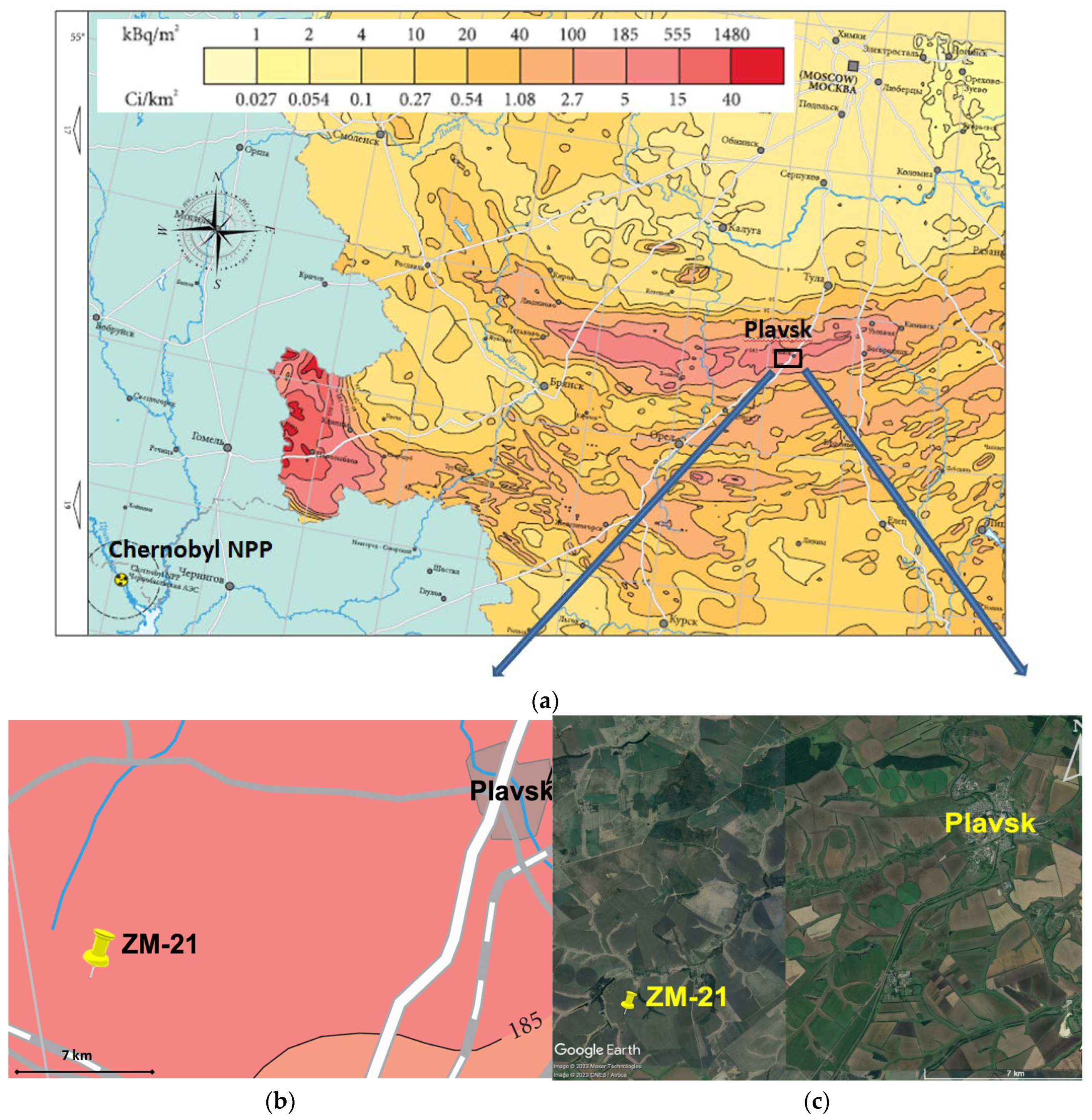
Figure 2.
Vertical distribution of 137Cs in 0-30 cm topsoil layer of arable chernozem of the PRH at different observation periods: (a) activity concentrations, Bq kg-1, (b) inventories, kBq m-2.
Figure 2.
Vertical distribution of 137Cs in 0-30 cm topsoil layer of arable chernozem of the PRH at different observation periods: (a) activity concentrations, Bq kg-1, (b) inventories, kBq m-2.
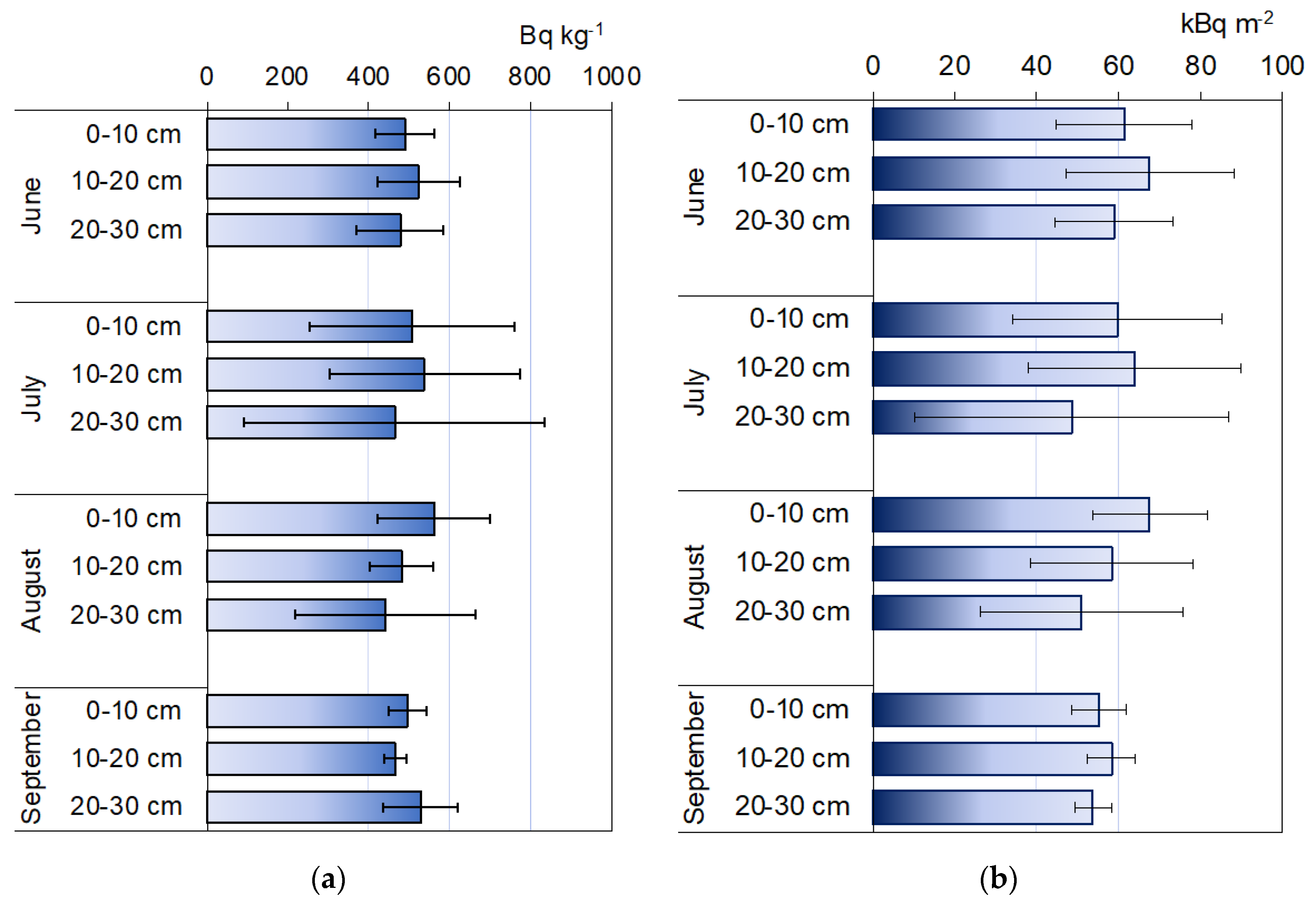
Figure 3.
Projection of biomass (g m-2), dry matter content (DMC) (%), ash content (%), 40K and 137Cs activity concentration (Bq kg-1) values in aboveground biomass (AB), belowground biomass (BB) and total biomass (TB) of maize cultivated in the PRH area at crop growth stages S1-S4, obtained from the PCA. Biplot of factors (a) and cases (b). The percentage of total variance is indicated near principal component axes.
Figure 3.
Projection of biomass (g m-2), dry matter content (DMC) (%), ash content (%), 40K and 137Cs activity concentration (Bq kg-1) values in aboveground biomass (AB), belowground biomass (BB) and total biomass (TB) of maize cultivated in the PRH area at crop growth stages S1-S4, obtained from the PCA. Biplot of factors (a) and cases (b). The percentage of total variance is indicated near principal component axes.
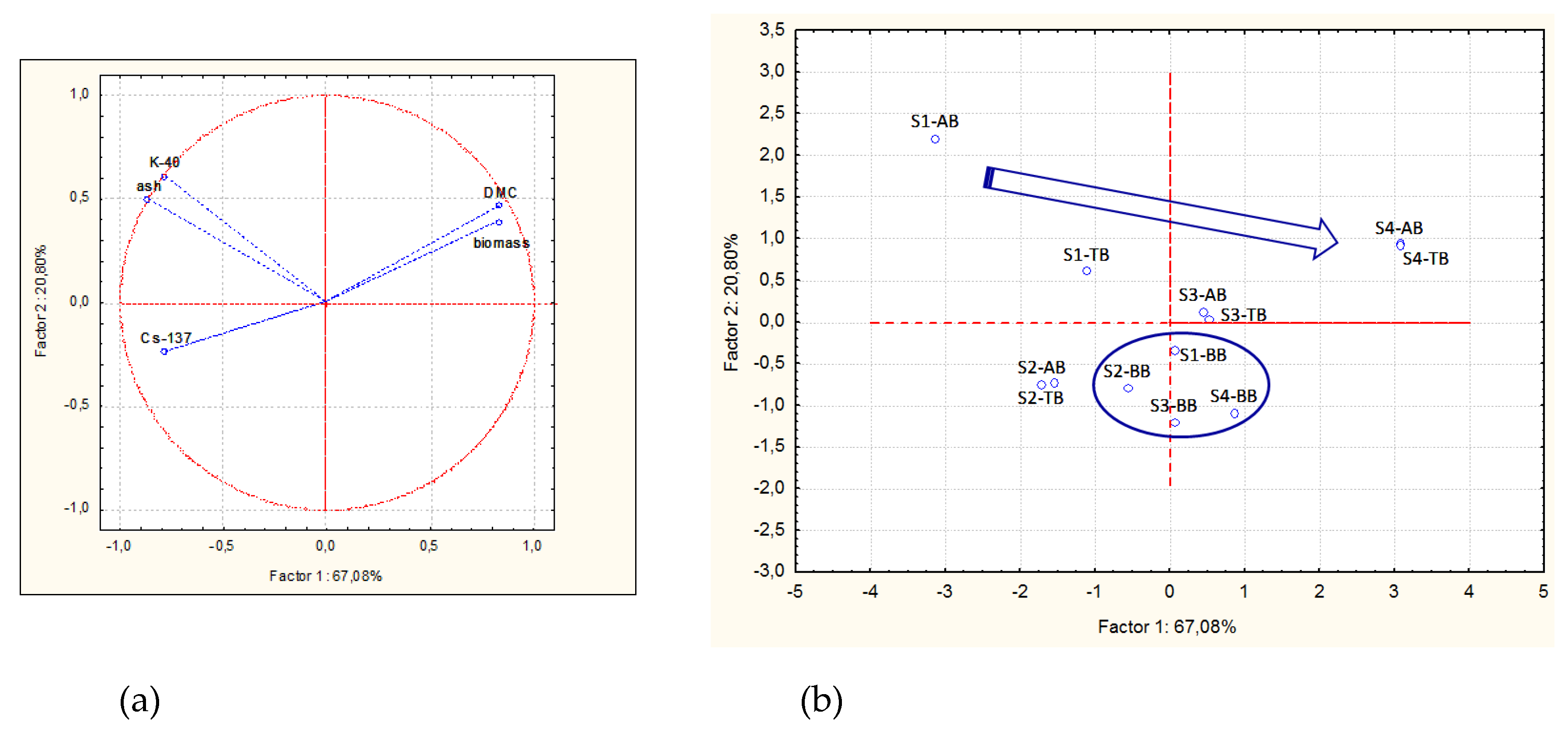
Figure 4.
The ratio of the of 137Cs activity concentrations (Bq kg-1) in the total, above- and belowground biomass to the characteristics of: (a) biomass (g m-2); (b) dry matter content (DMC, %); (c) ash content (%); (d) activity concentrations of 40K (Bq kg-1) at different stages of maize growth in the PRH area.
Figure 4.
The ratio of the of 137Cs activity concentrations (Bq kg-1) in the total, above- and belowground biomass to the characteristics of: (a) biomass (g m-2); (b) dry matter content (DMC, %); (c) ash content (%); (d) activity concentrations of 40K (Bq kg-1) at different stages of maize growth in the PRH area.
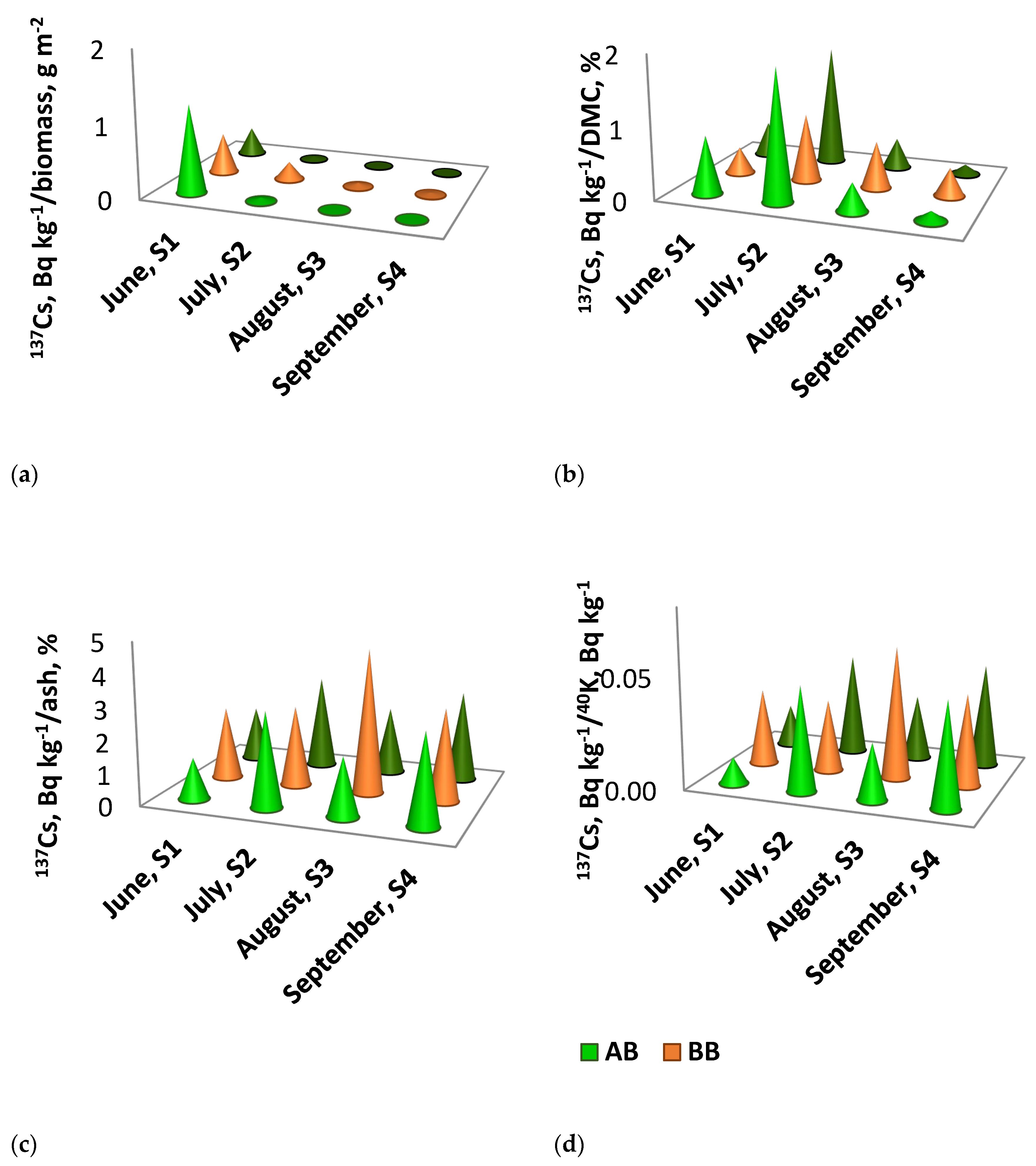
Figure 5.
Inventories of 137Cs in maize cultivated in the PRH area at different growth stages, Bq m-2.
Figure 5.
Inventories of 137Cs in maize cultivated in the PRH area at different growth stages, Bq m-2.
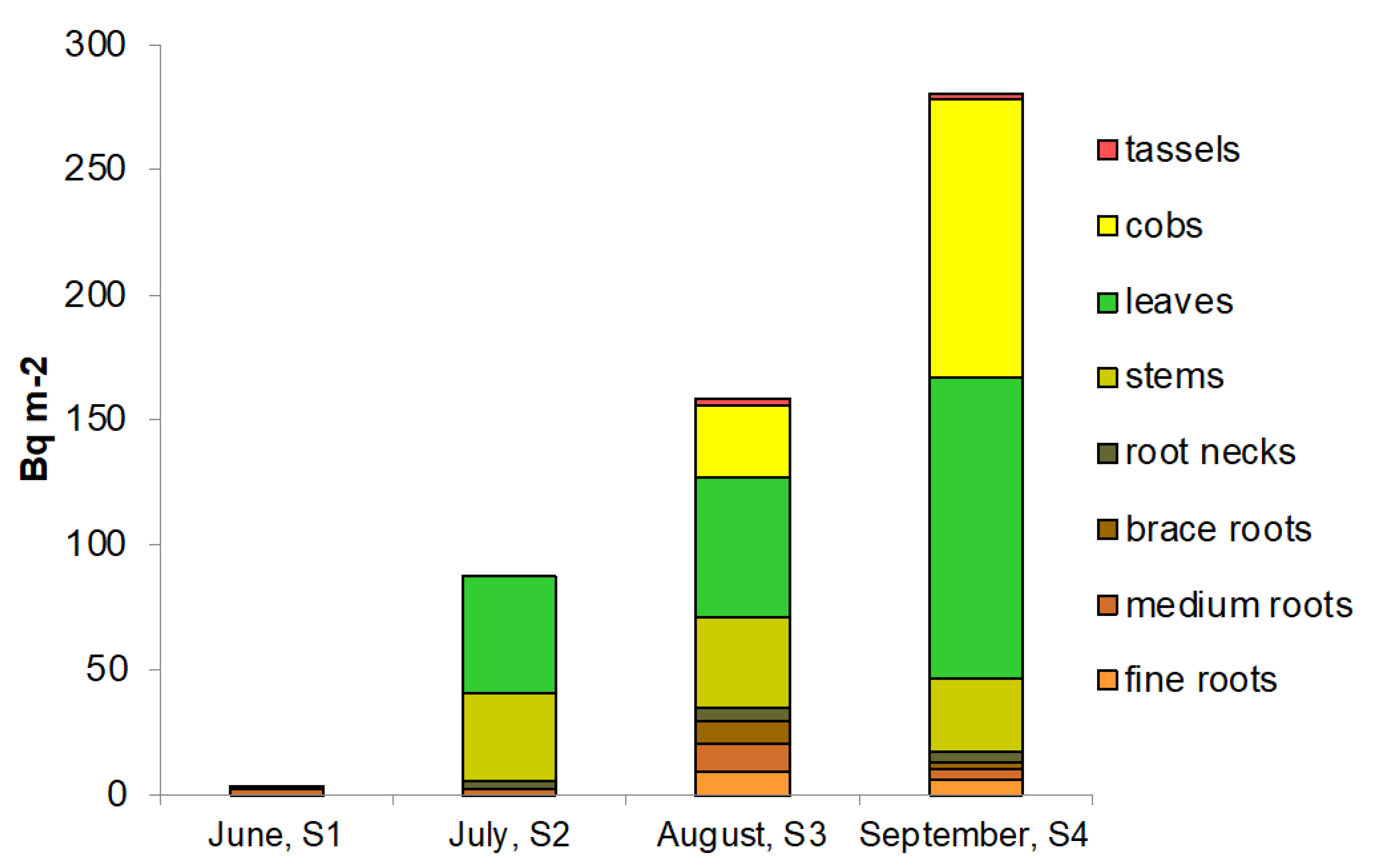

Table 1.
Content of 137Cs in 30-cm topsoil layer of arable chernozem of the maize agrosystem in the PRH area.
Table 1.
Content of 137Cs in 30-cm topsoil layer of arable chernozem of the maize agrosystem in the PRH area.
| Month, stage of maize growth | Mean ± CI 1 | Median | Range | Cv, % |
|---|---|---|---|---|
| Activity concentration, Bq kg-1 | ||||
| June, S1 | 497 ± 75 a 2 | 472 | 448–573 | 13 |
| July, S2 | 504 ± 244 a | 433 | 333–747 | 43 |
| August, S3 | 497 ± 65a | 465 | 463–563 | 12 |
| September, S4 | 493 ± 25 a | 491 | 472-516 | 4 |
| June–September, S1-S4 | 498 ± 57 a | 472 | 333–747 | 20 |
| Inventory, kBq m-2 | ||||
| June, S1 | 188 ± 45 a | 181 | 152–231 | 21 |
| July, S2 | 172 ± 75 a | 151 | 120–246 | 38 |
| August, S3 | 177 ± 9 a | 174 | 171–186 | 4 |
| September, S4 | 167 ± 5 a | 169 | 162–169 | 2 |
| June–September, S1-S4 | 176 ± 19 a | 171 | 120–246 | 19 |
1 here and below in the tables, Mean ± CI is arithmetic mean ± confidence interval at α < 0.05; 2 here and below in the figures and tables, identical letters show statistically insignificant and different letters – significant differences between the mean values after Tukey’s HSD multiple comparison at α < 0.05.
Table 2.
137Cs activity concentrations in maize cultivated in the PRH area at different growth stages, Bq kg-1.
Table 2.
137Cs activity concentrations in maize cultivated in the PRH area at different growth stages, Bq kg-1.
| Plant part | June, S1 | July, S2 | August, S3 | September, S4 |
|---|---|---|---|---|
| TB 1 | 11.8±1.7a | 17.9±2.2a | 9.7±2.8a | 7.6±2.4a |
| AB 2, including | 13.8±2.1a | 18.7±2.4b | 9.0±3.1ac | 7.6±2.5c |
| – stems | – | 16.4±1.3a | 5.0±2.1b | 7.4±1.5b |
| – leaves | – | 31.6±2.8a | 21.3±2.3b | 31.0±9.0ab |
| – cobs | – | – | 7.7±5.5a | 4.1±1.6a |
| – cob husks | – | – | – | 12.6±3.3 |
| – cob stalks | – | – | – | 8.6±3.0 |
| – kernels (grain) | – | – | – | 3.1±1.3 |
| – tassels | – | – | 15.8±2.9a | 14.8±3.8a |
| BB 3, including | 10.7±1.6a | 11.7±0.9a | 13.6±1.7a | 7.3±1.1b |
| – root necks | – | 10.3±0.9a | 5.0±0.6b | 3.8±0.7b |
| – roots, including | – | 13.9±1.5a | 20.8±2.5b | 11.1±1.6a |
| – brace roots | – | – | 12.4±2.1a | 4.6±0.9b |
| – medium roots | – | – | 20.5±1.2a | 11.2±1.2b |
| – fine roots | – | – | 65.8±9.2a | 22.4±3.4b |
1 TB – total biomass; 2 AB – aboveground biomass; 3 BB – belowground biomass (here and below in tables).
Table 3.
General characteristics of maize biomass, C, N, ash content and 40K activity concentrations in the crop at different growth stages in the PRH area.
Table 3.
General characteristics of maize biomass, C, N, ash content and 40K activity concentrations in the crop at different growth stages in the PRH area.
| Characteristics | June, S1 | July, S2 | August, S3 | September, S4 |
|---|---|---|---|---|
| Height of shoots, cm | 38±3a | 163±12b | 252±6c | 240±9c |
| Root length, cm | 9±1a | 21±2b | 23±3b | 23±1b |
| Dry biomass, g m-2 | ||||
| – TB | 30.7±2.7a | 412.0±199.3b | 1622.8±112.4c | 3576.7±217.0d |
| – AB, including | 11.3±1.3a | 364.0±224.2b | 1365.5±128.5c | 3339.3±229.6d |
| – stems | – | 218.4±134.5a | 723.3±173.3b | 412.0±74.5c |
| – leaves | – | 145.6±89.7a | 266.0±12.0b | 388.7±26.4c |
| – cobs | – | – | 359.3±130.4a | 2521.3±284.8b |
| – cob husks | – | – | – | 138.7±35.2 |
| – cob stalks | – | – | – | 288.0±33.5 |
| – kernels (grain) | – | – | – | 2233.3±332.7 |
| – tassels | – | – | 16.8±6.9a | 17.3±6.9a |
| – BB, including | 19.3±3.5a | 48.0±10.4b | 257.3±27.0c | 237.3±32.1c |
| – root necks | – | 29.5±6.4a | 116.1±12.2b | 121.0±16.4b |
| – roots, including | – | 18.5±4.0a | 141.2±6.3b | 116.4±5.5c |
| – brace roots | – | – | 74.4±7.8a | 48.14±6.51b |
| – medium roots | – | – | 52.6±5.5a | 41.2±5.6b |
| – fine roots | – | – | 14.2±1.5a | 27.0±3.7b |
| Dry matter content, % | ||||
| – TB | 23.8±7.2ab | 10.3±6.6a | 22.2±4.6b | 52.9±11.0c |
| – AB, including | 16.7±6.5ab | 10.1±7.0a | 22.5±4.6b | 55.2±11.5c |
| – stems | – | 10.5±3.7a | 22.5±8.9a | 16.5±3.0a |
| – leaves | – | 18.7±4.4a | 28.9±3.8b | 22.4±1.7a |
| – cobs | – | – | 16.9±6.5a | 65.9±14.1b |
| – cob husks | – | – | – | 59.8±5.9 |
| – cob stalks | – | – | – | 44.3±7.3 |
| – kernels (grain) | – | – | – | 69.1±12.7 |
| – tassels | – | – | 44.0±6.9a | 78.8±8.0b |
| – BB, including | 28.0±7.6a | 12.1±3.4b | 20.5±4.7a | 18.5±3.4ab |
| – root necks | – | 10.8±1.9a | 22.9±5.1b | 19.4±3.5b |
| – roots, including | – | 14.3±2.9a | 18.6±2.4a | 17.6±3.5a |
| – brace roots | – | – | 22.2±3.4a | 20.8±2.2a |
| – medium roots | – | – | 15.6±3.0a | 16.1±2.1a |
| – fine roots | – | – | 10.8±2.8a | 14.2±3.6a |
| Ash content, % | ||||
| – TB | 6.8±0.9a | 6.1±0.1a | 4.6±0.6b | 2.7±0.2c |
| – AB, including | 10.5±0.7a | 6.3±0.1b | 4.8±0.7c | 2.7±0.2d |
| – stems | – | 7.8±1.2a | 3.7±0.8b | 2.7±0.3b |
| – leaves | – | 7.4±0.8a | 9.8±0.5b | 11.2±0.4c |
| – cobs | – | – | 3.4±0.6a | 1.4±0.2b |
| – cob husks | – | – | – | 3.4±0.1 |
| – cob stalks | – | – | – | 1.3±0.5 |
| – kernels (grain) | – | – | – | 1.3±0.1 |
| – tassels | – | – | 5.5±0.3a | 5.9±0.2a |
| – BB, including | 4.6±0.7 | 4.6±0.6a | 3.0±0.3b | 2.5±0.2b |
| – root necks | – | 4.2±0.8a | 1.5±0.2b | 2.0±0.1c |
| – roots, including | – | 5.2±0.3a | 4.2±0.7a | 3.1±0.1b |
| – brace roots | – | – | 3.6±0.5a | 2.5±0.1b |
| – medium roots | – | – | 4.4±0.1a | 3.0±0.5b |
| – fine roots | – | – | 6.8±0.3a | 4.2±0.3b |
| 40K, Bq kg-1 | ||||
| – TB | 623±17a | 393±61b | 334±38b | 163±29c |
| – AB, including | 1154±32a | 661±28b | 348±38c | 162±30d |
| – stems | – | 679±11a | 281±33b | 275±65b |
| – leaves | – | 633±16a | 529±90ab | 448±97b |
| – cobs | – | – | 366±10a | 103±15b |
| – cob husks | – | – | – | 448±161 |
| – cob stalks | – | – | – | 139±27 |
| – kernels (grain) | – | – | – | 77±4 |
| – tassels | – | – | 410±11a | 77±19b |
| – BB, including | 311±8a | 358±16b | 230±42c | 179±20c |
| – root necks | – | 304±7a | 91±50b | 158±16c |
| – roots, including | – | 444±58a | 343±34b | 200±24c |
| – brace roots | – | – | 386±28a | 242±52b |
| – medium roots | – | – | 311±51a | 240±7b |
| – fine roots | – | – | 237±6a | 64±2b |
Table 4.
TF and TLC values for maize agrosystem at different growth stages of the crop cultivated in the PRH area.
Table 4.
TF and TLC values for maize agrosystem at different growth stages of the crop cultivated in the PRH area.
| Parameter | June, S1 | July, S2 | August, S3 | September, S4 | June–Sept., S1–S41 |
|---|---|---|---|---|---|
| TFTB | 2.4 x 10⁻² a | 3.6 x 10⁻² a | 2.0 x 10⁻² a | 1.5 x 10⁻² a | 2.2 x 10⁻² |
| TFAB | 2.8 x 10⁻² a | 3.7 x 10⁻² a | 1.8 x 10⁻² a | 1.5 x 10⁻² a | 2.3 x 10⁻² |
| TFstems and leaves | 2.8 x 10⁻² a | 3.7 x 10⁻² a | 4.5 x 10⁻² a | 1.9 x 10⁻² a | 3.8 x 10⁻² |
| TFcobs | – | – | 1.6 x 10⁻² a | 8.4 x 10⁻³ a | 1.1 x 10⁻² |
| TFkernels(grain) | – | – | – | 6.2 x 10⁻³ | 6.2 x 10⁻³ |
| TFBB | 2.2 x 10⁻² a | 2.3 x 10⁻² abc | 2.7 x 10⁻² b | 1.5 x 10⁻² c | 2.1 x 10⁻² |
| TBroots | 2.2 x 10⁻² a | 2.8 x 10⁻² ab | 4.2 x 10⁻² b | 2.2 x 10⁻² a | 3.0 x 10⁻² |
| TLC | 1,10 a | 1,29 a | 0,47 b | 0,68 b | 0,82 |
1 geometric mean.
Table 5.
Balance of 137Cs inventories in the “arable chernozem–maize” system in the PRH area before harvesting (September, S4).
Table 5.
Balance of 137Cs inventories in the “arable chernozem–maize” system in the PRH area before harvesting (September, S4).
| Component | 137Cs, kBq m-2 | 137Cs, % |
|---|---|---|
| Soil (0-30 cm) | 167 | 99.8 |
| TB | 2.8 x 10⁻¹ | 0.17 |
| AB | 2.6 x 10⁻¹ | 0.16 |
| BB | 1.8 x 10⁻² | 0.01 |
Disclaimer/Publisher’s Note: The statements, opinions and data contained in all publications are solely those of the individual author(s) and contributor(s) and not of MDPI and/or the editor(s). MDPI and/or the editor(s) disclaim responsibility for any injury to people or property resulting from any ideas, methods, instructions or products referred to in the content. |
© 2026 by the authors. Licensee MDPI, Basel, Switzerland. This article is an open access article distributed under the terms and conditions of the Creative Commons Attribution (CC BY) license.
Copyright: This open access article is published under a Creative Commons CC BY 4.0 license, which permit the free download, distribution, and reuse, provided that the author and preprint are cited in any reuse.


