
Submitted:
21 June 2026
Posted:
23 June 2026
You are already at the latest version
Abstract
Adiponectin is an important metabolic biomarker associated with insulin sensitivity, obesity, type 2 diabetes, and cardiovascular risk, but routine adiponectin measurement still depends mainly on centralized laboratory platforms. To provide a practical method for rapid and decentralized serum testing, we developed a smartphone-based quantitative lateral flow immunoassay (LFIA) for adiponectin and evaluated its analytical performance. The platform integrates a colorimetric gold nanoparticle-based LFIA strip, a smartphone reader equipped with macro-optics and controlled illumination, and a dedicated Android application for standardized image acquisition and quantitative grayscale analysis. Following systematic optimization of critical assay parameters, the developed method achieved a quantitative range of 0.32-40 mg/L, with limits of detection (LOD) and quantification (LOQ) of 0.16 and 0.32 mg/L, respectively. Analytical evaluation demonstrated good repeatability and intermediate precision, with within-run coefficients of variation of 2.40-4.66% and between-run coefficients of variation of 3.31-6.12%. Interference testing indicated borderline interference performance, with bilirubin, triglycerides, and hemoglobin recoveries slightly above the predefined acceptance limit and rheumatoid factor at the lower acceptance boundary under the evaluated moderate-concentration condition. Accelerated stability testing showed that the strips retained acceptable analytical responses after storage at 50 °C for 28 days. Method comparison using 125 clinical serum samples demonstrated close agreement with a commercial particle-enhanced turbidimetric immunoassay (PETIA) comparator method, with good linear association by ordinary regression (R² = 0.9688) and minimal mean bias by Bland-Altman analysis (-0.0392 mg/L; 95% limits of agreement: -1.1601 to 1.0817 mg/L). These results indicate that the proposed smartphone-assisted LFIA is an operationally simple method for quantitative serum adiponectin determination and may support point-of-care or near-patient metabolic biomarker monitoring.
Keywords:
adiponectin
; lateral flow immunoassay
; smartphone‐assisted detection
; analytical evaluation
; point‐of‐care testing
; quantitative analysis
; gold nanoparticles
; PETIA
; clinical method comparison
1. Introduction
Adiponectin is an adipocyte-derived protein hormone that plays a central role in glucose regulation, lipid metabolism, insulin sensitivity, and vascular homeostasis [1,2,3]. Reduced circulating adiponectin concentrations have been consistently associated with obesity, type 2 diabetes, metabolic syndrome, and atherosclerotic cardiovascular disease [4,5,6]. Experimental and translational studies further indicate that adiponectin enhances insulin action and exerts anti-inflammatory and anti-atherogenic effects in multiple tissues [7,8]. Prospective clinical investigations have linked low adiponectin with increased risk of incident type 2 diabetes and coronary events [2,3,9]. Because adiponectin receptors and downstream signaling pathways are closely involved in metabolic homeostasis, adiponectin has become an important biomarker and therapeutic target in metabolic medicine [4,5,6,8,10].
Despite the clinical relevance of adiponectin, routine measurement remains largely dependent on centralized analytical platforms. Current methods for adiponectin quantification include enzyme-linked immunosorbent assays (ELISA), radioimmunoassays (RIA), chemiluminescent enzyme immunoassays (CLEIA), multimer-selective immunoassays, and particle-enhanced turbidimetric immunoassays (PETIA) [11,12,13]. ELISA and RIA are widely used but are commonly batch-based or require specialized handling, whereas automated CLEIA and PETIA/LTIA formats improve throughput but remain dependent on laboratory analyzers, reagent-specific calibration, trained personnel, centralized quality-control systems, and defined laboratory environments [11,12,13]. Consequently, their accessibility may be limited in primary care clinics, community screening programs, and resource-limited settings [4,5,11,12,13].
Lateral flow immunoassays (LFIAs) offer operational advantages for decentralized testing because they are simple, rapid, inexpensive, disposable, and compatible with point-of-care workflows [14,15,16,17,18,19,20]. However, conventional colorimetric LFIAs are often qualitative or semi-quantitative and may depend on visual interpretation, which introduces user-dependent variability and limits their use when accurate biomarker quantification is required [14,15,16,17,18]. Smartphone-assisted diagnostics provide a practical route to improve quantitative LFIA readout by combining standardized image acquisition, embedded computation, and portable data processing with paper-based assays [21,22,23,24,25].
For adiponectin specifically, strip-based quantitative LFIA development remains limited compared with the broader expansion of LFIA technology in infectious disease testing and other protein biomarkers. Although improved nanoparticle reporters, strip engineering, and smartphone-assisted readout have advanced the general LFIA field [14,15,16,17,18,21,22,23,24,25,26,27], adiponectin-oriented decentralized assays still face methodological challenges, including quantitative sensitivity across clinically relevant serum concentrations and signal standardization under practical use conditions. Alternative biosensing strategies for adiponectin have been reported, including a biomimetic electrochemical microfluidic platform based on molecularly imprinted polymers with serum detection over 0-50 μg/mL and a limit of detection of 0.25 μg/mL [28]. However, such approaches require electrochemical instrumentation and microfluidic integration rather than the operational simplicity of disposable LFIA strips.
This study therefore aimed to develop a smartphone-based quantitative LFIA for serum adiponectin determination and to evaluate its analytical performance. The proposed platform combines a gold nanoparticle-based strip, a compact smartphone reader with macro-optics and controlled illumination, and a custom Android application implemented with OpenCV-assisted image processing [29]. Using an analytical evaluation framework informed by commonly used clinical laboratory principles, the assay was evaluated for optimization parameters, precision, linearity, dynamic range, LOD, LOQ, interference, accelerated stability, and agreement with a commercial PETIA comparator method.
2. Materials and Methods
2.1. Materials
Recombinant adiponectin protein, adiponectin detection antibody (Adiponectin Ab1, CY-2405), adiponectin capture antibody (Adiponectin Ab2, CY-2406), and anti- Adiponectin Ab1 for the control line were obtained from Chuangye Biotechnology (Shaoxing, China). Chloroauric acid (HAuCl4), boric acid, sodium borate, trisodium citrate dihydrate, sodium carbonate, potassium carbonate (K2CO3), sodium azide, Tween-20, sucrose, trehalose, bovine serum albumin (BSA), and phosphate-buffered saline (PBS) were purchased from Sinopharm Chemical Reagent Co. (Shanghai, China). Nitrocellulose membrane (NC140) was obtained from Sartorius (Göttingen, Germany). Glass fiber conjugate pads (SB08), sample pads (SM3-125), and absorbent pads (ABP-370) were sourced from Jinbiao Biotechnology (Shanghai, China). All other chemicals were of analytical grade and used as received without additional purification.
2.2. Instruments
An HM3035 dispensing instrument (Jinbiao Biotechnology, Shanghai, China) was used for reagent deposition during strip fabrication. The assembled cards were cut into 3 mm strips using a ZQ3500 guillotine cutter (Jinbiao Biotechnology, Shanghai, China). A Redmi Android smartphone (Xiaomi, Beijing, China) equipped with a macro lens attachment (Apexel APL-MS009, focal length 5.5-7 mm) and integrated LED illumination was used as the portable imaging reader. During measurement, the reader maintained a fixed strip-to-camera geometry, controlled illumination, and a constrained imaging window to reduce user-dependent variation in focus, field of view, and signal acquisition. The smartphone model, camera resolution, exposure/focus/white-balance settings, LED illumination conditions, and strip-to-camera distance were fixed during all measurements.
2.3. Antibody Conjugation onto AuNPs
Monodisperse gold nanoparticles (AuNPs) were synthesized using the classical citrate reduction method [38]. Briefly, chloroauric acid solution was heated to boiling under continuous stirring, followed by rapid addition of trisodium citrate, and the reaction was continued until a stable wine-red colloid was formed. The final AuNP colloid was adjusted to OD = 1.0 and used as the colorimetric labeling probe for adiponectin detection. For antibody conjugation, 10 mL aliquots of AuNP colloid were adjusted to pH 8.0 using 1% (w/v) K2CO3. Adiponectin Ab1 (120 µg) was added to the colloid and gently mixed, followed by incubation at room temperature for 20 min. Subsequently, 4 mL of 1% BSA in 25 mM Tris-HCl buffer (pH 8.0) was added to block unoccupied binding sites, and the suspension was incubated for another 20 min. The conjugates were collected by centrifugation at 8000 × g for 30 min at 4 °C and washed three times with 0.25% BSA in 50 mM Tris-HCl buffer (pH 8.0). The final pellet was resuspended in storage buffer containing 50 mM Tris-HCl borate (pH 8.0), 0.2% BSA, 2% sucrose, 2% trehalose, 0.1% Tween-20, and 0.2% NaN3. The Adiponectin Ab1-AuNP conjugates were stored at 2–8 °C until use.
2.4. Buffer Solutions
The principal buffer systems used throughout assay fabrication and operation were as follows: antibody conjugate blocking buffer (25 mM Tris-HCl buffer, 1% BSA, pH 8.0), antibody conjugate washing buffer (50 mM Tris-HCl buffer, 0.25% BSA, pH 8.0), conjugate storage buffer (50 mM Tris-HCl, 0.2% BSA, 2% sucrose, 2% trehalose, 0.1% Tween-20, 0.2% NaN3, pH 8.0), line dispensing buffer (20 mM PBS, 1% sucrose, pH 8.0), and assay running buffer (PBS containing 0.1% Tween-20 and 2% BSA, pH 7.4). These buffers were selected to maintain colloidal stability, reduce nonspecific adsorption, and support reproducible strip flow.
2.5. LFIA Strip Assembly
The LFIA strip consisted of four components: a sample pad (SM3-125), a conjugate pad (SB08) preloaded with AuNP conjugates, a nitrocellulose membrane (NC140), and an absorbent pad (ABP-370). Adiponectin Ab2 was used as the capture reagent on the test line at 1.5 mg/mL, and anti-Adiponectin Ab1 was used as the control-line reagent at 1.0 mg/mL. Both were diluted in line dispensing buffer and striped onto the nitrocellulose membrane at approximately 1 µL/cm using the HM3035 dispenser, followed by drying at 37 °C for 2 h. The Adiponectin Ab1-AuNP conjugate was dispensed onto the conjugate pad at 5 µL/cm and dried at 37 °C for 2 h. The sample pad, conjugate pad, nitrocellulose membrane, and absorbent pad were then laminated on an adhesive backing card with 2–3 mm overlap between adjacent components. The assembled cards were cut into 3 mm strips and stored in sealed aluminum foil pouches containing desiccant until use. Scheme 1B shows a schematic of the assembled lateral flow test strip.
2.6. Software Development
A custom Android application ("Smartphone rapid detection software for Adiponectin", version 1.0) was developed to control the smartphone-based reader and perform quantitative image analysis. This software is registered with the China National Copyright Administration (Registration No. 16482384). The application was developed following Android app development principles, using Intents for Activity transitions and data transfer, and Fragment/ViewPager components for page reusability.
The image-acquisition module uses the smartphone camera equipped with a macro lens and LED ring light to capture LFIA strip images under a fixed geometry. A custom SurfaceView provides real-time camera preview, while an OverlayView class extending View draws a transparent rectangular alignment window on the preview. This constrained frame guides the user to position the test and control lines within the designated imaging region. Dynamic permissions for camera and file read/write operations are requested at runtime.
The quantification module uses the OpenCV library (version 4.8.0, available from https://opencv.org/releases/) for image processing [25]. Captured images are resized to 50 × 150 pixels using Imgproc.resize() and converted to grayscale using Imgproc.cvtColor() with COLOR_BGR2GRAY. Test-line, control-line, and background regions of interest (ROIs) are identified according to the fixed strip geometry within the reader. The background ROI is selected from an adjacent membrane region without visible line signal.The average grayscale values for the test line (IT), control line (IC), and background (IB) are calculated, and the T/C ratio is computed using Equation (1):
RT/C = (IB – IT) / (IB – IC)
A predefined third-order polynomial calibration model embedded in the application converts T/C ratios into adiponectin concentrations according to Equation (2):
y = ax3 + bx2 + cx + d
The final batch-specific calibration equation used in the smartphone application was:
y = 44.7572x3 – 24.3369x2 + 10.2318x – 0.6953
Here x is the T/C ratio and y is the adiponectin concentration in mg/L. Images with incomplete strip insertion, incorrect line alignment, severe blur, strong shadowing, saturated pixels, or an invalid control line are excluded from quantitative analysis.
2.7. Assay Procedure
To initiate each test, a mixture of 10 µL serum and 80 µL running buffer (PBS, 0.1% Tween-20, 2% BSA, pH 7.4) was prepared and deposited onto the sample pad of the LFIA strip. After sample application, the strip was inserted into the smartphone reader so that the test and control lines were aligned with the predefined imaging area. Driven by capillary flow, adiponectin in the sample bound to the Adiponectin Ab1-AuNP conjugates on the conjugate pad, forming Adiponectin Ab1-AuNP-adiponectin complexes. These immunocomplexes were captured at the test line by immobilized adiponectin antibody (Ab2), producing a visible red band with intensity proportional to adiponectin concentration. Excess Adiponectin Ab1-AuNP continued to migrate and was captured at the control line, confirming proper strip flow. After 15 min of development, the strip was imaged under controlled illumination using the smartphone reader, and the application calculated the adiponectin concentration based on the predefined calibration model. A schematic of the assay workflow and image analysis is presented in Scheme 1.
2.8. Optimization Procedures
2.8.1. Detection Antibody Labeling Amount Optimization
Adiponectin Ab1 at quantities of 40, 80, 120, and 160 µg was added to separate 10 mL aliquots of AuNP solution (OD = 1.0, pH 8.0 adjusted with 1% K2CO3). Conjugation, blocking, washing, and storage were performed as described in Section 2.3. Conjugate pads prepared with each labeling condition were assembled into LFIA strips and tested using adiponectin standards at representative low, medium, and high concentrations (2.5, 12.5, and 40.0 mg/L; n = 3 per concentration). After 15 min of development, the strips were imaged using the smartphone reader, and T/C ratios were calculated. The labeling amount that produced the strongest specific response while maintaining low background and acceptable reproducibility was selected for subsequent experiments.
2.8.2. Capture Antibody Concentration Optimization
Capture antibody (Adiponectin Ab2) was diluted to 0.5, 1.0, 1.5, and 2.0 mg/mL in 20 mM PBS (pH 8.0) containing 1% sucrose. Each solution was dispensed onto nitrocellulose membranes at 1 µL/cm using the HM3035 dispenser, followed by drying at 37 °C for 2 h. Test strips were assembled and evaluated using adiponectin standards at representative low, medium, and high concentrations (2.5, 12.5, and 40.0 mg/L; n = 3 per concentration). The corresponding T/C ratios were calculated after 15 min of development. The capture antibody concentration providing the best balance between signal intensity, concentration discrimination, and reagent economy was selected.
2.8.3. BSA Concentration in the Running Buffer Optimization
Running buffers containing 0.5%, 1%, 2%, 3%, and 5% BSA in PBS with 0.1% Tween-20 (pH 7.4) were prepared. Test strips (n = 5 per condition) were evaluated with blank samples (0 mg/L) and a representative adiponectin-positive standard (12.5 mg/L) under the optimized strip-construction conditions. After 15 min of development, T/C ratios were measured to assess the effect of BSA concentration on nonspecific background suppression and specific signal generation.
2.8.4. Tween-20 Concentration in the Running Buffer Optimization
Running buffers containing 0.01%, 0.05%, 0.10%, 0.20%, and 0.50% Tween-20 were prepared using PBS with the optimized BSA concentration at pH 7.4. LFIA strips (n = 10 per condition) were tested using a representative adiponectin standard (2.5 mg/L). The T/C ratio and coefficient of variation were calculated after 15 min of development to determine the surfactant concentration that best supported sample wetting, flow uniformity, and assay reproducibility while preserving analytical sensitivity.
2.8.5. Assay Time Optimization
Test strips were tested with adiponectin standards covering both low and high concentration levels (0.5, 1, 2, 10, 20, and 40 mg/L). Images were captured at 5, 8, 10, 12, 15, and 20 min after sample application (n = 5 per time point). The development of the test-line signal was monitored over time using the smartphone-based reader, and the calculated adiponectin concentrations were plotted against assay time.
2.9. Analytical Evaluation of the Developed LFIA
After the assay design was established, the smartphone-based LFIA was evaluated using a workflow informed by commonly used clinical assay evaluation principles. The evaluation plan included precision, linearity, quantitative working range, LOD, LOQ, interference testing, method comparison with a commercial PETIA comparator procedure, accelerated stability assessment, and statistical agreement analysis [30,31,32,33,34,35,36,37].
2.9.1. Precision
Precision was assessed with reference to CLSI EP15 principles using three serum levels representing low, medium, and high adiponectin concentrations, approximately 5, 15, and 30 mg/L, respectively [30]. For within-run precision, each sample was tested 20 times within a single day to estimate repeatability. For between-run precision, the same samples were tested over 12 separate days to estimate intermediate precision. Mean value and coefficient of variation (CV) were calculated for each concentration level.
2.9.2. Linearity and Sensitivity
Adiponectin standards across the expected concentration interval were analyzed to establish the quantitative working range and assess linearity using an approach informed by CLSI EP06 principles [31]. Calibration was performed using serum-matrix calibrators spanning 0-40 mg/L, and each concentration was measured in triplicate. Analytical sensitivity was characterized by estimation of LOD and LOQ with reference to CLSI EP17 concepts [32]. LOD was estimated from low-level signal behavior near the blank response and retained conservatively as the blank mean plus 3 SD. LOQ was evaluated using low-concentration adiponectin levels of 0.10, 0.20, 0.30, 0.40, and 0.50 mg/L, each measured in triplicate. The allowable imprecision criterion for LOQ was CV ≤ 20%, together with acceptable recovery for quantitative reporting, where the acceptable recovery range is 85%–115%.
2.9.3. Interference Testing
Potential interference from common serum interferents was investigated using an approach informed by CLSI EP07 interference-assessment principles [33]. Moderate-level adiponectin samples (~20 mg/L) were spiked with bilirubin (0.35 mg/mL), triglycerides (18 mg/mL), hemoglobin (8 mg/mL), and rheumatoid factor (800 IU/mL), because such substances are recognized sources of analytical bias in immunoassays [37]. Spiked samples were compared with the corresponding unspiked control, and recoveries within 85-115% of the control value were considered acceptable for this analytical interference assessment. Each interference condition was tested in triplicate.
2.9.4. Method Comparison
Clinical method comparison was carried out using 125 human serum samples covering the measured clinical adiponectin interval. Residual serum samples were collected from the Clinical Laboratory Center, Second Affiliated Hospital of Wenzhou Medical University between February 2026 and April 2026. The study protocol was approved by the Ethics Committee of the Second Affiliated Hospital of Wenzhou Medical University (Protocol No. MR-33-26-014646). These specimens used for assay validation were obtained from randomly selected patients, and their adiponectin concentrations ranged from 1.52 to 12.01 mg/L, providing test results across the evaluated clinical adiponectin interval. Each sample was tested using the developed LFIA and a commercial PETIA comparator assay (Hitachi 7180 automatic biochemical analyzer, reagents from Chuangye Biotechnology Co., Ltd., Shaoxing, China, lot No. 20260228); all measurements were performed according to the manufacturer's instructions. Method comparison was interpreted using statistical approaches informed by CLSI EP09 principles. Ordinary least-squares regression was used to evaluate method association, while Bland-Altman analysis was used to assess agreement, mean bias, and 95% limits of agreement [34,35,36].
2.9.5. Accelerated Stability
Accelerated stability studies were performed to evaluate the storage robustness of the LFIA strips under stressed conditions. Batches of strips were stored at 21, 37, and 50 °C for up to 28 days. At weekly intervals, stored strips were used to test three adiponectin levels (5, 15, and 30 mg/L), and their responses were compared with those of freshly stored strips kept at 2–8 °C. Stability was considered acceptable if the measured response remained within 85–115% of the initial value. These accelerated experiments assess strip robustness under elevated-temperature storage conditions.
2.10. Application of the Developed LFIA to Clinical Serum Samples
For practical application, each clinical serum specimen was analyzed under the optimized assay conditions. Ten microliters of serum were mixed with 80 µL of running buffer and applied to the strip. After 15 min of development, the strip was inserted into the smartphone reader and analyzed by the dedicated application. The corresponding serum sample was also tested using the commercial PETIA comparator method for comparative evaluation.
2.11. Statistical Analysis
Statistical evaluation of the obtained results was performed using the Statistica package (13.3). Quantitative data are presented as mean ± standard deviation (SD). Linear regression analysis was used to evaluate the relationship between the smartphone-based LFIA and the commercial PETIA comparator method. Method agreement was further assessed using Bland–Altman analysis, and the mean bias with 95% limits of agreement was calculated. A paired t-test was used to assess whether the mean difference between the two methods was statistically significant. A p value < 0.05 was considered statistically significant.
3. Results
3.1. Optimization of Assay Parameters
To establish assay conditions that yielded robust analytical performance, the principal parameters affecting the smartphone-based LFIA were systematically optimized using the T/C ratio as the response metric. The T/C ratio was selected because it reduces the influence of background intensity and strip-to-strip variation, thereby providing a more stable basis for optimization. The labeling amount of detection antibody on AuNPs, the concentration of capture antibody on the test line, the BSA content in the running buffer, the Tween-20 concentration in the running buffer, and the assay development time were sequentially evaluated. Because the smartphone reader uses a fixed imaging geometry and controlled illumination, the optimization process focused on maximizing concentration-dependent signal while minimizing nonspecific background and preserving acceptable strip flow behavior.
3.1.1. Detection Antibody Labeling Amount
The amount of detection antibody conjugated onto the AuNP surface was first optimized because insufficient labeling can reduce assay sensitivity, whereas excessive labeling may compromise colloidal stability or reduce probe activity. As shown in Figure 1(a), the T/C ratio increased progressively as the amount of Adiponectin Ab1 used for AuNP conjugation increased from 40 to 120 μg per 10 mL AuNP solution. When the labeling amount was further increased to 160 μg, no further significant enhancement in signal was observed, and overloading of the nanoparticle surface was considered undesirable from the standpoint of signal reproducibility and conjugate stability. Therefore, 120 μg Adiponectin Ab1 per 10 mL AuNP solution was selected as the optimal labeling amount, as it provided strong specific signal while maintaining low background and good reproducibility.
3.1.2. Capture Antibody Concentration on the Test Line
The concentration of capture antibody immobilized on the nitrocellulose membrane was subsequently optimized because it directly influences complex-capture efficiency and final signal intensity. As shown in Figure 1(b), the T/C ratio increased progressively as the concentration of Adiponectin Ab2 on the test line increased from 0.5 to 1.5 mg/mL for the tested adiponectin standards. When the concentration was further increased to 2.0 mg/mL, no further significant enhancement in signal was observed, suggesting that additional reagent consumption would not provide a proportional analytical benefit. Therefore, 1.5 mg/mL was selected as the optimal capture antibody concentration, as it provided strong test-line development while maintaining economical reagent usage and stable membrane performance.
3.1.3. BSA Concentration in the Running Buffer
The BSA content in the running buffer was systematically varied to minimize nonspecific background while preserving specific signal generation. As shown in Table 1, a BSA concentration of 2% yielded the highest T/C ratio for the 12.5 mg/L adiponectin standard (0.68 ± 0.02), accompanied by a low blank response (0.01 ± 0.01). At a lower BSA level (0.5%), the blank T/C ratio rose to 0.04 ± 0.02, indicating incomplete blocking of nonspecific interactions. Conversely, increasing BSA to 3% or 5% reduced the positive signal to 0.55 ± 0.02 and 0.43 ± 0.02, respectively, likely because excessive protein content altered capillary flow and impeded immunocomplex migration. Therefore, 2% BSA was adopted as the optimal concentration for the running buffer.
3.1.4. Tween-20 Concentration in the Running Buffer
The concentration of Tween-20 in the running buffer was further adjusted, as this nonionic surfactant plays a critical role in facilitating sample wetting, ensuring uniform capillary flow, and minimizing strip-to-strip variability. Table 2 demonstrates that a Tween-20 concentration of 0.10% gave the highest T/C ratio for the 2.5 mg/L adiponectin standard (0.20 ± 0.01) and the best reproducibility (CV = 6.3%). At a lower concentration (0.01%), both the T/C ratio and reproducibility deteriorated (0.13 ± 0.02; CV = 16.1%), indicating inadequate wetting and non-uniform sample migration. Raising the Tween-20 level beyond 0.10% to 0.20% or 0.50% led to a gradual decline in T/C ratio to 0.18 ± 0.02 and 0.15 ± 0.02, respectively, suggesting that excess surfactant may interfere with the capture process or reduce the stability of the immunocomplexes. Consequently, 0.10% Tween-20 was chosen as the optimal concentration for the running buffer.
3.1.5. Optimal Assay Time
The LFIA development process included determining the optimal reaction time for reading the results. We examined the test line signal intensity at various times after sample application using several adiponectin concentrations. The test line appeared visible by the first evaluated time point of 5 min for high adiponectin concentrations, but lower concentrations required more time for adequate signal development. The signal intensity increased with time and reached a plateau before 12 min for the tested sample concentrations. Beyond 15 min, no significant increase in T line intensity was observed, indicating that the antibody binding reaction had reached equilibrium. Therefore, 15 min was chosen as the assay incubation time for all subsequent tests (Figure 2). This provides a good balance between speed and signal completion, consistent with typical lateral flow assay operation times.
3.2. Analytical Evaluation
3.2.1. Precision of the LFIA
The precision of the smartphone-based LFIA was evaluated at three clinically relevant adiponectin levels. As summarized in Table 3, the method demonstrated strong reproducibility. Within-run CVs were 2.40%, 3.38%, and 4.66% for the high (~30 mg/L), medium (~15 mg/L), and low (~5 mg/L) samples, respectively. Between-run CVs were 3.31%, 4.86%, and 6.12% for the same levels. All CV values were well below the generally accepted 15% criterion for quantitative immunoassays, indicating acceptable repeatability and intermediate precision for quantitative immunoassay use.
3.2.2. Linearity, LOD, and LOQ
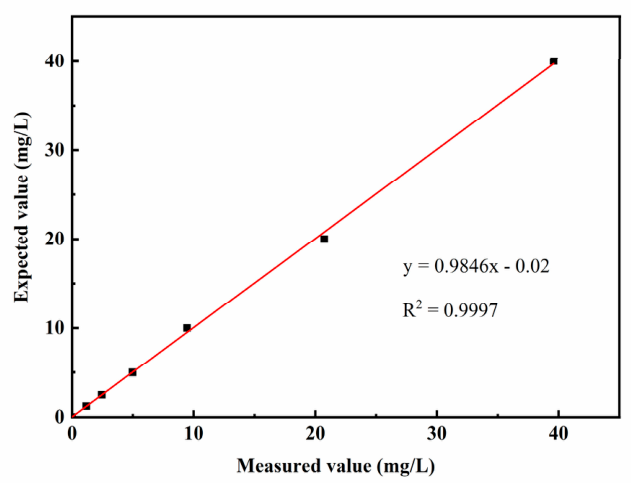
The assay demonstrated a broad quantitative range from 0.32 to 40 mg/L. Across this interval, adiponectin standards produced a monotonic and quantitatively interpretable response. The third-order calibration model was used within the smartphone application to convert the T/C ratio into adiponectin concentration, while linearity was evaluated by comparing measured values with expected values. Regression analysis of measured versus expected concentrations yielded y = 0.9846x - 0.02 and R² = 0.9994, indicating good linear association within the operating range. The LOD and LOQ were estimated as 0.16 and 0.32 mg/L, respectively. In the LOQ evaluation, the 0.10 and 0.20 mg/L levels did not meet the 20% imprecision criterion (CVs of 39.51% and 25.26%, respectively). The 0.30 mg/L level first met the criterion, with a mean measured concentration of 0.32 mg/L, SD of 0.057 mg/L, CV of 18.14%, and recovery of 106.7%; therefore, the LOQ was set at 0.32 mg/L. These results indicate that the developed LFIA has sufficient analytical sensitivity for serum adiponectin measurement within a clinically relevant range.
Figure 3.
Linearity assessment of the smartphone-based LFIA using serum adiponectin calibrators. Expected adiponectin concentration is plotted on the x-axis and measured LFIA concentration on the y-axis. Each concentration point was measured in triplicate.
Figure 3.
Linearity assessment of the smartphone-based LFIA using serum adiponectin calibrators. Expected adiponectin concentration is plotted on the x-axis and measured LFIA concentration on the y-axis. Each concentration point was measured in triplicate.
3.2.3. Interference Testing
Interference testing showed borderline performance under the evaluated moderate-concentration condition. Using 19.81 mg/L as the unspiked control value, bilirubin, triglycerides, and hemoglobin produced recoveries of approximately 116%, slightly above the predefined 85-115% acceptance limit, whereas rheumatoid factor produced a recovery of approximately 85%, at the lower acceptance boundary. These results should therefore be interpreted as borderline rather than fully acceptable for moderate-level interference performance.

Table 4.
Interference testing for the smartphone-based LFIA for adiponectin (n = 3).
| Interferent | Concentration of Interferent | Adiponectin (mg/L) |
LFIA Assay Result (mg/L) |
Recovery (%) |
|---|---|---|---|---|
| Control | - | 20 | 19.81 ± 0.65 | 100 |
| Bilirubin | 0.35 mg/mL | 20 | 22.93 ± 0.81 | 116 |
| Triglycerides | 18 mg/mL | 20 | 23.01 ± 0.45 | 116 |
| Hemoglobin | 8 mg/mL | 20 | 22.93 ± 0.52 | 116 |
| Rheumatoid Factor | 800 IU/mL | 20 | 16.91 ± 0.34 | 85 |
3.2.4. Accelerated Stability Testing
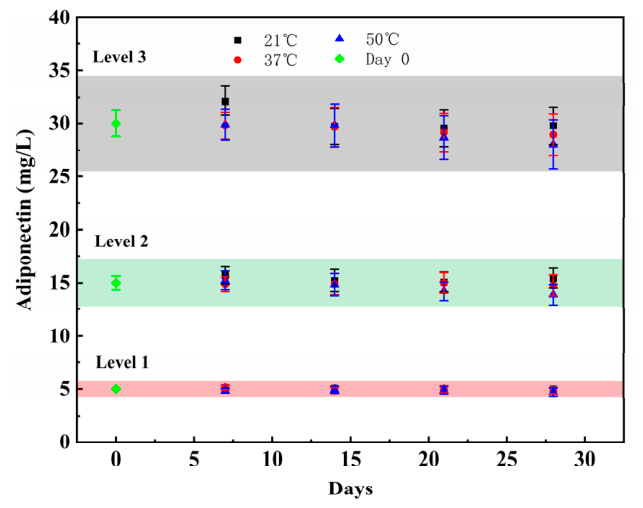
The LFIA strips maintained acceptable analytical performance during accelerated storage. When stored at 21, 37, and 50 °C for up to 28 days, the measured responses for the low, medium, and high adiponectin levels remained within 85–115% of their initial values. Even after storage at 50 °C, no marked decline in signal intensity or loss of sensitivity was observed within the tested period. These accelerated stability results indicate good short-term thermal robustness of the LFIA strips.
Figure 4.
Accelerated stability of LFIA strips stored at 21, 37, and 50 °C for up to 28 days. Responses at three adiponectin levels remained within the predefined 85–115% acceptance interval.
Figure 4.
Accelerated stability of LFIA strips stored at 21, 37, and 50 °C for up to 28 days. Responses at three adiponectin levels remained within the predefined 85–115% acceptance interval.
3.3. Application of the Method and Statistical Analysis of the Results
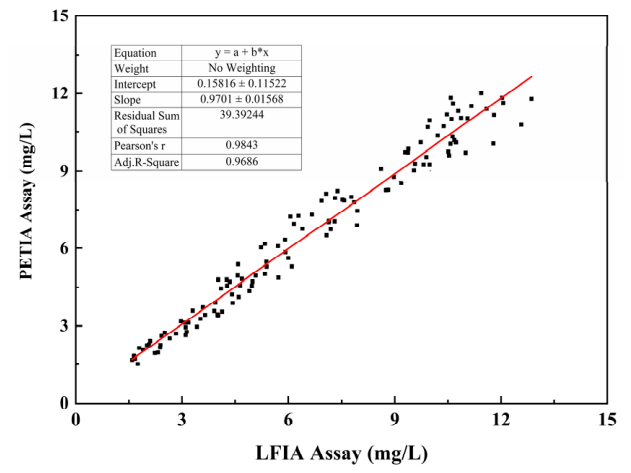
The practical analytical performance of the smartphone-based LFIA was evaluated using 125 clinical serum specimens and compared with the commercial PETIA comparator method. In the method-comparison analysis, the LFIA result was plotted on the x-axis and the PETIA comparator result was plotted on the y-axis. Linear regression showed a good association between the two methods, with the equation y = 0.9701x + 0.1582, Pearson's r = 0.9843, and R虏 = 0.9688. These results indicate a close linear relationship between the smartphone-based LFIA and the commercial PETIA comparator method across the evaluated clinical concentration range.
Figure 5.
Linear correlation between the smartphone-based LFIA and the commercial PETIA comparator method for 125 clinical serum samples.
Figure 5.
Linear correlation between the smartphone-based LFIA and the commercial PETIA comparator method for 125 clinical serum samples.
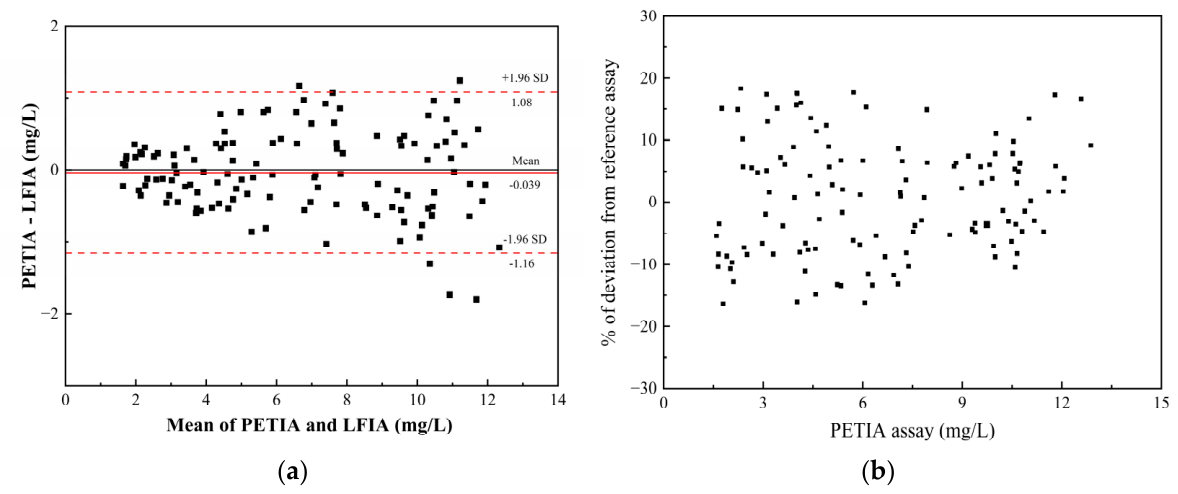
Bland-Altman analysis was used to further evaluate agreement. The mean bias, calculated as PETIA minus LFIA, was -0.0392 mg/L, with 95% limits of agreement ranging from -1.1601 to 1.0817 mg/L. The paired t-test showed no significant difference between the two methods (p = 0.4449). These findings indicate that the smartphone-based LFIA provides results broadly consistent with the commercial PETIA comparator method across the evaluated clinical concentration range.
Figure 6.
Bland-Altman analysis of agreement between the smartphone-based LFIA and the commercial PETIA comparator method: (a) difference plot versus the average concentration; (b) percentage-difference plot versus the PETIA value.
Figure 6.
Bland-Altman analysis of agreement between the smartphone-based LFIA and the commercial PETIA comparator method: (a) difference plot versus the average concentration; (b) percentage-difference plot versus the PETIA value.
4. Discussion
Adiponectin is increasingly recognized as a clinically informative biomarker for metabolic health, insulin resistance, obesity-associated disorders, and cardiovascular risk assessment [4,5,6,8,10]. Accurate and accessible adiponectin measurement may therefore support metabolic-risk evaluation and longitudinal monitoring. However, routine testing still relies primarily on centralized laboratory immunoassays, which limits the feasibility of rapid decentralized testing in primary care, community-based screening, and resource-limited environments [4,5,11,12,13].
In this study, we developed a smartphone-based quantitative LFIA for serum adiponectin and evaluated its analytical performance. The results support the feasibility of the proposed method for quantitative serum adiponectin testing. By integrating a colorimetric gold nanoparticle LFIA strip with a customized smartphone reader and a dedicated image-analysis algorithm, the platform combines rapid operation, low sample volume, instrument simplicity, and quantitative signal processing.
The analytical sensitivity and dynamic range of the method are suitable for serum adiponectin determination. The assay achieved LOD and LOQ estimates of 0.16 and 0.32 mg/L, respectively, and a quantitative range of 0.32-40 mg/L. This range covers concentrations relevant to metabolic biomarker assessment and may reduce the need for extensive sample dilution. The within-run and between-run CVs were below 10% across the evaluated concentration levels, supporting acceptable repeatability and intermediate precision.
Method comparison with 125 clinical serum samples showed good agreement between the smartphone-assisted LFIA and the commercial PETIA comparator method. The regression analysis produced a high R虏 value, and Bland-Altman analysis showed minimal mean bias with most differences distributed within the 95% limits of agreement. The paired t-test showed no significant mean difference between the two methods. These findings indicate that the developed LFIA can generate quantitative results broadly consistent with an established laboratory-based comparator method. PETIA was used as a commercial comparator rather than a higher-order reference procedure. The evaluated specimens covered adiponectin concentrations from 1.52 to 12.01 mg/L, supporting comparison across the evaluated clinical interval in this study.
Comparative performance is summarized in Table 5. Compared with centralized PETIA-based laboratory testing and reported electrochemical/microfluidic adiponectin sensing, the present smartphone-assisted LFIA emphasizes rapid operation, low sample volume, disposable strip format, quantitative smartphone-based readout, and 125-sample clinical method comparison against a commercial PETIA comparator procedure.
Potential sources of variability remain in colorimetric LFIA systems. Membrane properties, antibody immobilization efficiency, AuNP conjugate stability, sample matrix effects, strip insertion, lighting uniformity, ROI selection, lot-specific calibration, and smartphone-camera settings may all influence quantitative results. The fixed reader geometry, controlled illumination, defined imaging window, T/C-ratio calculation, lot-specific calibration equation, and quality-control acceptance rules were used to minimize these sources of variation and support standardized quantitative readout across the evaluated workflow.
The accelerated stability results indicate good short-term thermal robustness, as strip responses remained within the predefined 85-115% interval after 28 days at elevated temperatures. Continued real-time stability and lot-to-lot reproducibility monitoring will support shelf-life assignment and manufacturing consistency.
Overall, the present study positions the developed smartphone-assisted LFIA as an analytical method for quantitative serum adiponectin determination. The strongest contribution of this work is not a new sensing mechanism, but the integration of LFIA, smartphone-based quantitative readout, and clinical method comparison into a practical workflow for decentralized adiponectin analysis.
5. Conclusions
A smartphone-based quantitative colorimetric LFIA was developed for serum adiponectin determination and evaluated through analytical studies. By integrating a gold nanoparticle-based LFIA strip, a portable smartphone reader, and a custom image-analysis algorithm, the platform provides rapid and practical adiponectin quantification with low sample volume and a 15 min assay time. The assay showed a quantitative range of 0.32-40 mg/L, LOD and LOQ estimates of 0.16 and 0.32 mg/L, respectively, acceptable precision, borderline moderate-level interference results, with several recoveries slightly above the predefined acceptance limit, and good agreement with a commercial PETIA comparator method in 125 clinical serum samples. These results support the potential of smartphone-assisted LFIA as a practical analytical method for decentralized adiponectin testing.
Supplementary Materials
The following supporting information can be downloaded at the website of this paper posted on Preprints.org. Table S1: Raw data for the coefficient of variation for the within-run assay; Table S2: Raw data for the coefficient of variation for the between-run assay; Table S3: Raw data for interference testing.
Author Contributions
Conceptualization, Y.L. and R.Z.; Methodology, Y.L., R.Z. and N.Z.; Software, Y.L. and L.L.; Validation, Y.L., R.Z. and N.Z.; Formal Analysis, Y.L., R.Z. and L.L.; Investigation, Y.L., R.Z. and N.Z.; Resources, G.L. and S.K.-E.G.; Data Curation, Y.L. and R.Z.; Writing-Original Draft Preparation, Y.L. and R.Z.; Writing-Review & Editing, G.L., S.K.-E.G. and N.Z.; Supervision, G.L. and S.K.-E.G.; Funding Acquisition, Y.L., G.L. and S.K.-E.G. All authors have read and agreed to the published version of the manuscript.
Funding
This research was funded by China 2025 College Student Innovation and Entrepreneurship Training Program, grant number 202516405001S.
Institutional Review Board Statement
The study was conducted in accordance with the Declaration of Helsinki, and approved by the Ethics Committee of The Second Affiliated Hospital of Wenzhou Medical University (Protocol No. MR-33-26-014646, approval date: February 25, 2026).
Informed Consent Statement
Informed consent was obtained from all subjects involved in the study.
Data Availability Statement
The data presented in this study are available on request from the corresponding author.
Acknowledgments
The authors thank all volunteers and clinical staff involved in sample collection and assay evaluation.
Conflicts of Interest
The authors declare no conflicts of interest.
Abbreviations
The following abbreviations are used in this manuscript:
| AuNP | Gold Nanoparticle |
| BSA | Bovine Serum Albumin |
| CLSI | Clinical and Laboratory Standards Institute |
| CV | Coefficient of Variation |
| LFIA | Lateral Flow Immunoassay |
| LOD | Limit of Detection |
| LOQ | Limit of Quantification |
| PBS | Phosphate Buffered Saline |
| PETIA | Particle-Enhanced Turbidimetric Immunoassay |
| ROI | Region of Interest |
| T/C Ratio | Test Line-to-Control Line Ratio |
References
- Wang, Z.V.; Scherer, P.E. Adiponectin, the past two decades. J. Mol. Cell Biol. 2016, 8, 93–100. [Google Scholar] [CrossRef] [PubMed]
- Achari, A.E.; Jain, S.K. Adiponectin, a therapeutic target for obesity, diabetes, and endothelial dysfunction. Int. J. Mol. Sci. 2017, 18, 1321. [Google Scholar] [CrossRef] [PubMed]
- Fang, H.; Judd, R.L. Adiponectin regulation and function. Compr. Physiol. 2018, 8, 1031–1063. [Google Scholar] [CrossRef]
- Frühbeck, G.; Catalán, V.; Rodríguez, A.; Gómez-Ambrosi, J. Adiponectin-leptin ratio is a functional biomarker of adipose tissue inflammation. Nutrients 2019, 11, 454. [Google Scholar] [CrossRef] [PubMed]
- Khoramipour, K.; Chamari, K.; Hekmatikar, A.A.; Ziyaiyan, A.; Taherkhani, S.; Elguindy, N.M.; Bragazzi, N.L. Adiponectin: Structure, physiological functions, role in diseases, and effects of nutrition. Nutrients 2021, 13, 1180. [Google Scholar] [CrossRef] [PubMed]
- Straub, L.G.; Scherer, P.E. Metabolic messengers: Adiponectin. Nat. Metab. 2019, 1, 334–339. [Google Scholar] [CrossRef] [PubMed]
- Jo, D.; Son, Y.; Yoon, G.; Song, J.; Kim, O.Y. Role of adiponectin and brain derived neurotrophic factor in metabolic regulation involved in adiposity and body fat browning. J. Clin. Med. 2021, 10, 56. [Google Scholar] [CrossRef] [PubMed]
- Choi, H.M.; Doss, H.M.; Kim, K.S. Multifaceted physiological roles of adiponectin in inflammation and diseases. Int. J. Mol. Sci. 2020, 21, 1219. [Google Scholar] [CrossRef] [PubMed]
- Kawada, T. Serum adiponectin and cardiovascular disease: Mechanism of the association. Br. J. Pharmacol. 2018, 175, 3184. [Google Scholar] [CrossRef] [PubMed]
- Parida, S.; Siddharth, S.; Sharma, D. Adiponectin, obesity, and cancer: clash of the bigwigs in health and disease. Int. J. Mol. Sci. 2019, 20, 2519. [Google Scholar] [CrossRef] [PubMed]
- Risch, L.; Hoefle, G.; Saely, C.; Berchthold, S.; Weber, M.; Gouya, G.; Rein, P.; Langer, P.; Marte, T.; Aczel, S.; et al. Evaluation of two fully automated novel enzyme-linked immunosorbent assays for the determination of human adiponectin in serum. Clin. Chim. Acta 2006, 373, 121–126. [Google Scholar] [CrossRef] [PubMed]
- Nishimura, A.; Sawai, T. Determination of adiponectin in serum using a latex particle-enhanced turbidimetric immunoassay with an automated analyzer. Clin. Chim. Acta 2006, 371, 163–168. [Google Scholar] [CrossRef] [PubMed]
- Hayama, S.; Higuchi, T.; Miyakoshi, H.; Nakano, Y. Analytical evaluation of a high-molecular-weight (HMW) adiponectin chemiluminescent enzyme immunoassay. Clin. Chim. Acta 2010, 411, 2073–2078. [Google Scholar] [CrossRef] [PubMed]
- Bahadır, E.B.; Sezgintürk, M.K. Lateral flow assays: Principles, designs and labels. TrAC Trends Anal. Chem. 2016, 82, 286–306. [Google Scholar] [CrossRef]
- Wang, J.; Zhang, J.; Ju, Y. Introduction to "Lateral Flow Assays: Methods and Applications". Sens. Diagn. 2025, 4, 721–722. [Google Scholar] [CrossRef]
- Li, J.; Macdonald, J. Multiplexed lateral flow biosensors: Technological advances. Biosens. Bioelectron. 2016, 83, 177–192. [Google Scholar] [CrossRef] [PubMed]
- Dincer, C.; Bruch, R.; Kling, A.; Dittrich, P.S.; Urban, G.A. Multiplexed point-of-care testing-xPOCT. Trends Biotechnol. 2017, 35, 728–742. [Google Scholar] [CrossRef] [PubMed]
- Quesada-González, D.; Merkoçi, A. Nanomaterial-based devices for point-of-care diagnostic applications. Chem. Soc. Rev. 2018, 47, 4697–4709. [Google Scholar] [CrossRef] [PubMed]
- Bikkarolla, S.K.; Venkatesan, K.; Revathy, Y.R.; Parameswaran, S.; Krishnakumar, S.; Dendukuri, D. The quantitative detection of Cystatin-C in patient samples using a colorimetric lateral flow immunoassay. Biosensors 2024, 14, 30. [Google Scholar] [CrossRef] [PubMed]
- Zhang, X.; Fishlock, S.; Sharpe, P.; McLaughlin, J. Performance of colorimetric lateral flow immunoassays for renal function evaluation with human serum Cystatin C. Biosensors 2025, 15, 445. [Google Scholar] [CrossRef] [PubMed]
- McCracken, K.E.; Yoon, J.-Y. Recent approaches for optical smartphone sensing in resource-limited settings: A brief review. Anal. Methods 2016, 8, 6591–6601. [Google Scholar] [CrossRef]
- Park, J. Smartphone based lateral flow immunoassay quantifications. J. Immunol. Methods 2024, 533, 113745. [Google Scholar] [CrossRef] [PubMed]
- Natarajan, S.; DeRosa, M.C.; Shah, M.I.; Jayaraj, J. Development and evaluation of a quantitative fluorescent lateral flow immunoassay for Cystatin-C, a renal dysfunction biomarker. Sensors 2021, 21, 3178. [Google Scholar] [CrossRef] [PubMed]
- Bian, L.; Xiong, Y.; Zhao, H.; Guo, H.; Li, Z.; Ye, K.; Zhang, Z.; Liu, T.; Wu, Y.; Lin, G. Europium (III) chelate nanoparticle-based lateral flow immunoassay strips for rapid and quantitative detection of Cystatin C in serum. J. Chromatogr. B 2022, 1194, 123133. [Google Scholar] [CrossRef] [PubMed]
- Shen, L.; Hagen, J.A.; Papautsky, I. Point-of-care colorimetric detection with a smartphone. Lab Chip 2012, 12, 4240–4243. [Google Scholar] [CrossRef] [PubMed]
- Alam, N.; Tong, L.; He, Z.; Tang, R.; Ahsan, L.; Ni, Y. Mechanically compressed barriers improve paper-based lateral flow assay sensitivity for COVID-19 nucleic acid detection. Ind. Eng. Chem. Res. 2023, 62, 18800–18809. [Google Scholar] [CrossRef]
- Dzantiev, B.B.; Byzova, N.A.; Urusov, A.E.; Zherdev, A.V. Immunochromatographic methods in food analysis. TrAC Trends Anal. Chem. 2014, 55, 81–93. [Google Scholar] [CrossRef]
- Mihailescu, C.M.; Stanc, D.; Savin, M.; Moldovan, C.A.; Dinulescu, S.; Radulescu, C.H.; Firtat, B.; Muscalu, G.; Brasoveanu, C.; Ion, M.; et al. Platform with biomimetic electrochemical sensors for adiponectin and leptin detection in human serum. Talanta 2020, 210, 120643. [Google Scholar] [CrossRef] [PubMed]
- OpenCV. Open Source Computer Vision Library. Available online: https://opencv.org/ (accessed on 10 August 2025).
- Clinical and Laboratory Standards Institute. CLSI Document EP15-A3; User Verification of Precision and Estimation of Bias; Approved Guideline-Third Edition. Clinical and Laboratory Standards Institute: Wayne, PA, USA, 2014.
- Clinical and Laboratory Standards Institute. CLSI Document EP06; Evaluation of Linearity of Quantitative Measurement Procedures. 2nd ed. Clinical and Laboratory Standards Institute: Wayne, PA, USA, 2020.
- Clinical and Laboratory Standards Institute. CLSI Document EP17-A2; Evaluation of Detection Capability for Clinical Laboratory Measurement Procedures; Approved Guideline-Second Edition. Clinical and Laboratory Standards Institute: Wayne, PA, USA, 2012.
- Clinical and Laboratory Standards Institute. CLSI Document EP07; Interference Testing in Clinical Chemistry. 3rd ed. Clinical and Laboratory Standards Institute: Wayne, PA, USA, 2018.
- Clinical and Laboratory Standards Institute. CLSI Document EP09; Measurement Procedure Comparison and Bias Estimation Using Patient Samples. 3rd ed. Clinical and Laboratory Standards Institute: Wayne, PA, USA, 2018.
- Giavarina, D. Understanding Bland-Altman analysis. Biochem. Med. 2015, 25, 141–151. [Google Scholar] [CrossRef]
- Doğan, N.O. Bland-Altman analysis: A paradigm to understand correlation and agreement. Turk. J. Emerg. Med. 2018, 18, 139–141. [Google Scholar] [CrossRef] [PubMed]
- Selby, C. Interference in immunoassay. Ann. Clin. Biochem. 1999, 36, 704–721. [Google Scholar] [CrossRef] [PubMed]
- Kimling, J.; Maier, M.; Okenve, B.; Kotaidis, V.; Ballot, H.; Plech, A. Turkevich Method for Gold Nanoparticle Synthesis Revisited. J. Phys. Chem. B 2006, 110, 15700–15707. [Google Scholar] [CrossRef] [PubMed]
Scheme 1.
Schematic representation of the testing procedure using the smartphone-based LFIA. Antibody Conjugation onto AuNPs (A), composition of the LFIA (B), and detection principle of assay procedure (C).
Scheme 1.
Schematic representation of the testing procedure using the smartphone-based LFIA. Antibody Conjugation onto AuNPs (A), composition of the LFIA (B), and detection principle of assay procedure (C).
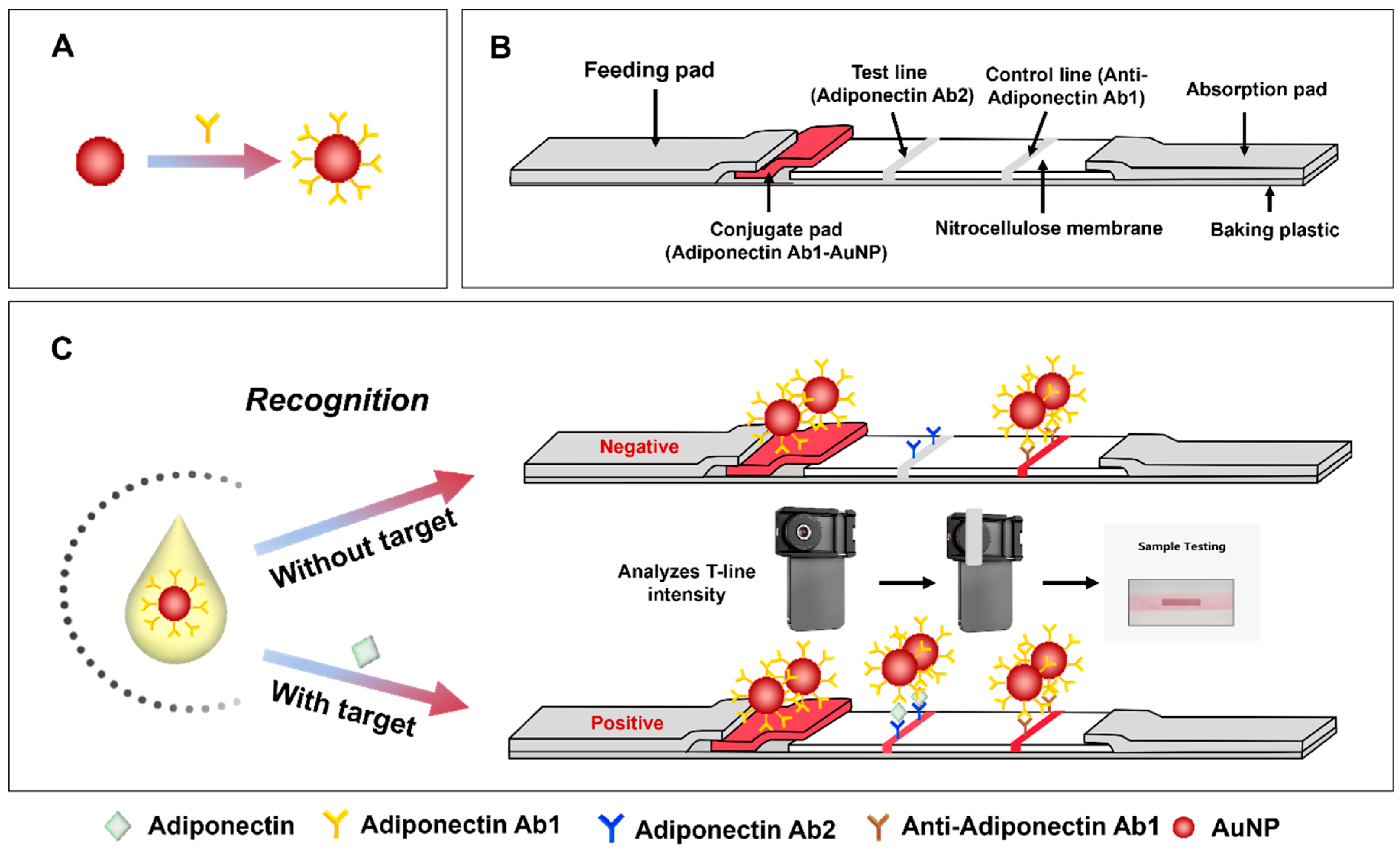
Figure 1.
Optimization of detection antibody labeling amount (a) and capture antibody concentration (b) for the smartphone-based LFIA.
Figure 1.
Optimization of detection antibody labeling amount (a) and capture antibody concentration (b) for the smartphone-based LFIA.
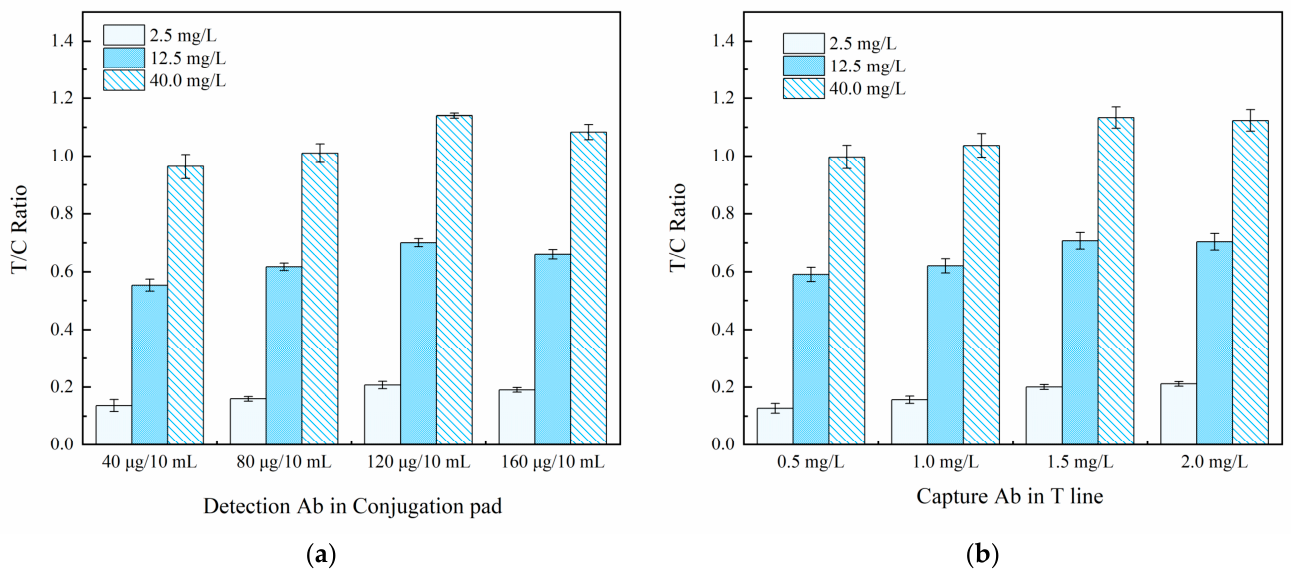
Figure 2.
Optimization of assay development time for six adiponectin concentrations: (a) 40, 20, and 10 mg/L; (b) 2, 1, and 0.5 mg/L. Images were acquired at 5, 8, 10, 12, 15, and 20 min after sample application.
Figure 2.
Optimization of assay development time for six adiponectin concentrations: (a) 40, 20, and 10 mg/L; (b) 2, 1, and 0.5 mg/L. Images were acquired at 5, 8, 10, 12, 15, and 20 min after sample application.
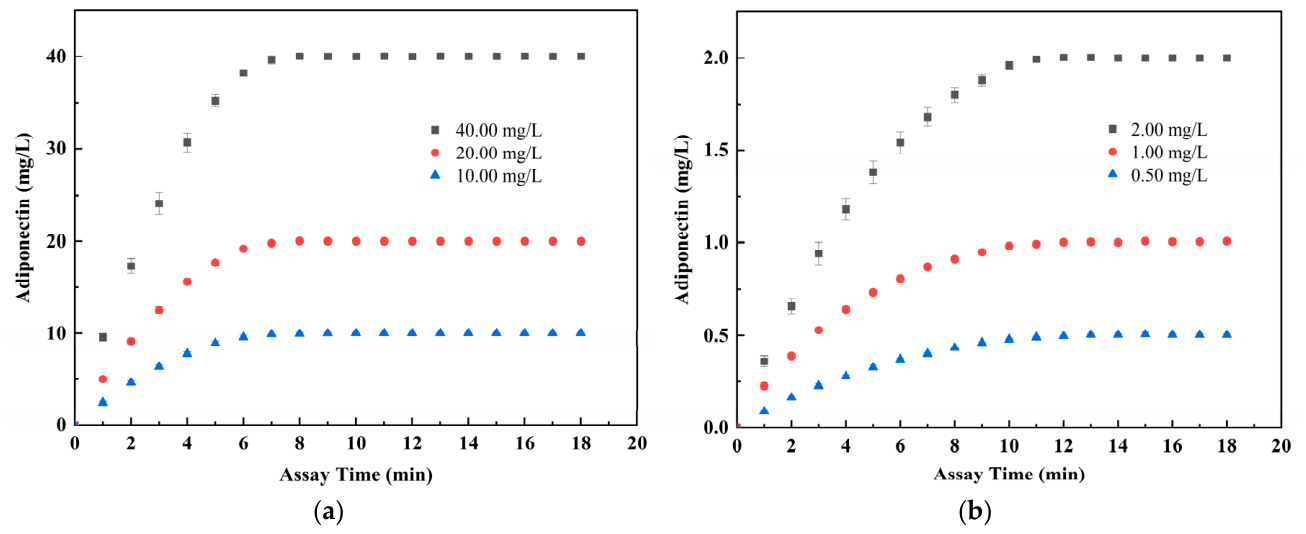
Table 1.
Effect of BSA concentration on T/C ratio.
| BSA Concentration (%) | Blank Sample (0 mg/L) | 12.5 mg/L Standard |
|---|---|---|
| 0.5 | 0.04 ± 0.02 | 0.51 ± 0.03 |
| 1.0 | 0.03 ± 0.01 | 0.58 ± 0.03 |
| 2.0 | 0.01 ± 0.01 | 0.68 ± 0.02 |
| 3.0 | 0.01 ± 0.01 | 0.55 ± 0.02 |
| 5.0 | 0.01 ± 0.01 | 0.43 ± 0.02 |
Table 2.
Effect of Tween-20 concentration on T/C ratio and reproducibility.
| Tween-20 Concentration (%) | T/C Ratio (2.5 mg/L) | CV% (n = 10) |
|---|---|---|
| 0.01 | 0.13 ± 0.02 | 16.1 |
| 0.05 | 0.16 ± 0.01 | 8.8 |
| 0.10 | 0.20 ± 0.01 | 6.3 |
| 0.20 | 0.18± 0.02 | 9.8 |
| 0.50 | 0.15 ± 0.02 | 13.2 |
Table 3.
Reproducibility of the smartphone-based LFIA for Adiponectin.
| Adiponectin Levels (mg/L) |
Within-Run (n=20) | Between-Run (n=12) | ||
|---|---|---|---|---|
| Average (mg/L) | CV (%) | Average (mg/L) | CV (%) | |
| High (~30) | 31.29 | 2.40 | 31.51 | 3.31 |
| Medium (~15) | 14.87 | 3.38 | 15.10 | 4.86 |
| Low (~5) | 5.08 | 4.66 | 5.03 | 6.12 |
Table 5.
Concise comparison of representative adiponectin detection methods.
| Method/Platform | Target/Sample | Analytical Performance | Assay Time | Clinical Comparison | Main Feature |
|---|---|---|---|---|---|
| Smartphone-based colorimetric LFIA, this work | Adiponectin/serum | LOD: 0.16 mg/L; LOQ: 0.32 mg/L; range: 0.32-40 mg/L | 15 min | 125 clinical serum samples compared with PETIA | Quantitative LFIA; 15 min assay; 125-sample PETIA comparison |
| Centralized PETIA comparator immunoassay [12] | Adiponectin/serum | Laboratory assay dependent | Instrument/workflow dependent | Used as the commercial comparator in this study | Established laboratory comparator method; centralized automated analyzer required |
| Biomimetic electrochemical microfluidic sensor [28] | Adiponectin/serum | LOD: 0.25 mg/L; range: 0-50 mg/L | Not specified here | Reported agreement with ELISA in human serum samples | Sensitive detection; requires electrochemical/microfluidic instrumentation |
Disclaimer/Publisher’s Note: The statements, opinions and data contained in all publications are solely those of the individual author(s) and contributor(s) and not of MDPI and/or the editor(s). MDPI and/or the editor(s) disclaim responsibility for any injury to people or property resulting from any ideas, methods, instructions or products referred to in the content. |
© 2026 by the authors. Licensee MDPI, Basel, Switzerland. This article is an open access article distributed under the terms and conditions of the Creative Commons Attribution (CC BY) license (http://creativecommons.org/licenses/by/4.0/).
Copyright: This open access article is published under a Creative Commons CC BY 4.0 license, which permit the free download, distribution, and reuse, provided that the author and preprint are cited in any reuse.


