
Submitted:
18 June 2026
Posted:
22 June 2026
You are already at the latest version
Abstract
Background: Accurate preoperative localization of hyperfunctioning parathyroid glands is essential for minimally invasive surgery in primary hyperparathyroidism (PHPT). Although dual-phase 99mTc-MIBI planar scintigraphy is widely used, its diagnostic performance may be limited in small or ectopic lesions. Hybrid SPECT/CT imaging combines functional and anatomical information and may improve localization accuracy. The aim of this study is to evaluate the diagnostic contribution of SPECT/CT to dual-phase 99mTc-MIBI planar scintigraphy for preoperative localization in patients with PHPT. Methods: This retrospective study included 128 patients with biochemically confirmed PHPT who underwent dual-phase 99mTc-MIBI planar scintigraphy followed by delayed-phase SPECT/CT imaging before parathyroidectomy between January 2020 and May 2024. Imaging findings were compared with postoperative histopathological results. Sensitivity, specificity, positive predictive value (PPV), negative predictive value (NPV), and accuracy were calculated. The effects of lesion size, biochemical parameters, and ultrasonographic findings on imaging performance were also evaluated. Results: Histopathology confirmed parathyroid lesions in 122 of 128 patients (95.3%). The sensitivity, specificity, PPV, NPV, and accuracy of planar imaging were 57.4%, 66.7%, 97.2%, 7.1%, and 57.8%, respectively, whereas those of SPECT/CT were 92.6%, 66.7%, 98.3%, 30.8%, and 91.4%, respectively. SPECT/CT findings showed significant concordance with histopathology (p=0.001), while planar imaging did not (p=0.247). Among lesions smaller than 1 cm, sensitivities were 37.1% for planar imaging and 91.4% for SPECT/CT. SPECT/CT also provided superior anatomical localization, particularly in ectopic lesions and in patients with concomitant thyroid pathology. Conclusion: SPECT/CT demonstrated substantially higher diagnostic performance than dual-phase planar scintigraphy for preoperative localization in PHPT. Its incremental value was particularly evident in subcentimeter lesions, ectopic parathyroid adenomas, and patients with coexisting thyroid disease.
Keywords:
primary hyperparathyroidism
; parathyroid scintigraphy
; SPECT/CT
; 99mTc-MIBI
; preoperative localization
1. Introduction
Primary hyperparathyroidism (PHPT) is a clinical condition that develops due to uncontrolled parathyroid hormone (PTH) secretion as a result of the autonomization of the parathyroid glands. In terms of etiology, approximately 80-85% of cases are caused by a solitary parathyroid adenoma [1]. In PHPT cases with symptomatic hypercalcemia, surgery is still considered the first-choice definitive treatment [2]. Advances in imaging techniques and surgical capabilities have enabled the use of minimally invasive parathyroidectomy (MIP) in many centers [3]. In patients scheduled for surgery, preoperative localization studies should be performed to determine the location and number of hyperfunctioning parathyroid glands, as well as to assess whether minimally invasive surgical treatment can be performed [4]. Preoperative localization studies can be conducted using invasive or non-invasive methods [5]. Technetium-99m–2-hexakis-methoxy-isobutyl-isonitrile (99mTc-MIBI) scintigraphy, widely used in many nuclear medicine centers, is currently one of the most commonly utilized standard methods for imaging parathyroid lesions preoperatively, along with ultrasonography (US) [6]. Reported sensitivity rates for dual-phase 99mTc-MIBI planar imaging range from 74% to 87% [7]. While this technique has both availability and advantages, it also has certain limitations. The aim of this clinical study is to investigate the contribution of single photon emission computed tomography/computed tomography (SPECT/CT), a hybrid imaging technique that combines radionuclide imaging with X-ray-based computed tomography to provide both anatomical and functional information in a single image, to the diagnostic accuracy of dual-phase 99mTc-MIBI planar scintigraphy in patients with a biochemical diagnosis of PHPT, using a larger patient cohort compared to previous studies in the literature.
Additionally, this study aims to compare the diagnostic performance of this modality with US findings, and to evaluate the impact of lesion size and patients’ biochemical hormone levels on the diagnostic value of these imaging techniques.
2. Materials and Methods
Ethical Approval: This retrospective study was approved by the Clinical Research and Ethics Committee of Gaziantep University and conducted in accordance with the 1964 Declaration of Helsinki (Decision No: 2024/171, Date: 15.05.2024).
Patient Selection: This retrospective study included 128 patients with biochemically confirmed PHPT who underwent dual-phase 99mTc-MIBI planar scintigraphy and SPECT/CT imaging during the preoperative period at the Nuclear Medicine Department of Gaziantep University. All patients had available histopathological data following parathyroidectomy.
Imaging Protocol: All imaging procedures were performed using a GE Healthcare Medical Systems NM/CT 860 dual-head gamma camera (General Electric, Milwaukee, WI, USA). Patients received an intravenous injection of 20 mCi (740 MBq) 99mTc-MIBI, followed by planar imaging at 20 and 90 minutes. Anterior-positioned 10-minute images were acquired from the level of the mandibular angle to the superior border of the heart, using a 128×128 matrix, a peak energy level of 140 keV with a 10% window, a zoom factor of 2.5, and a low-energy high-resolution (LEHR) parallel-hole collimator. Following the late-phase planar imaging, SPECT/CT imaging was performed using the same device. SPECT imaging was acquired using a LEHR collimator, a zoom factor of 1, a 140 keV peak energy level with a 10% window, and a 128×128 matrix in step-and-shoot mode with 6-degree steps, capturing 60 images over 360 degrees, with 30 seconds per image. Immediately after SPECT acquisition, CT imaging was performed using a low-dose CT system (4 slices) with X-ray tube settings of 120 kV and 10 mA. The scan was conducted in 3.75 mm standard slices with a helical pitch of 1 and full rotation mode. The scan time per slice was 6-7 seconds, and total CT acquisition was completed in approximately 4.5 minutes.
Image Evaluation: The obtained images were reviewed independently by two nuclear medicine physicians. In planar imaging, any focal uptake outside the physiological uptake regions between the mandibular angle and the superior border of the heart was considered positive for parathyroid pathology. In SPECT/CT images, these regions were examined in three dimensions, and any uptake corresponding to a lesion on CT, excluding physiological uptake areas, was recorded as positive. Findings were classified as negative or positive activity uptake, and for positive cases, the anatomical localization was documented. Postoperative pathology reports were reviewed through the hospital information and automation system. Histopathological diagnoses associated with PHPT (parathyroid adenoma, parathyroid hyperplasia, parathyroid carcinoma) were considered lesion-positive. Lesions diagnosed as normal parathyroid tissue or non-parathyroid tissue were considered lesion-negative. Imaging results were statistically analyzed by comparing them with pathology findings.
Statistical Method: The normal distribution of numerical variables was tested using the Shapiro-Wilk test. Descriptive statistics were presented as mean ± standard deviation and median (minimum-maximum) for numerical variables, and as frequency and percentage for categorical variables. Relationships between categorical variables were analyzed using the Chi-square test, while relationships between numerical variables were assessed using the Spearman rank correlation coefficient. Sensitivity, specificity, positive predictive value (PPV) and negative predictive value (NPV) and accuracy rates were calculated for diagnostic tests. All analyses were performed using SPSS version 22.0 for Windows, with p<0.05 considered statistically significant.
3. Results
The study consisted of 128 patients diagnosed with PHPT who had not previously undergone neck surgery, including 102 (79.7%) females and 26 (20.3%) males. The patients’ ages ranged from 16 to 80 years, with a mean age (±SD) of 47.7 ± 13.2 years. Serum biochemical parameters measured within the 30 days before scintigraphic imaging were as follows: PTH levels ranged from 68.5 to 1376.1 pg/mL, with a mean of 265 (±192.9) pg/mL; calcium levels (Ca+2) ranged from 8.9 to 13.6 mg/dL, with a mean of 11.6 (±1.7) mg/dL; phosphorus (P) levels ranged from 1 to 7 mg/dL, with a mean of 2.4 (±0.7) mg/dL; and vitamin D levels ranged from 6.5 to 89.2 ng/mL, with a mean of 16.9 (±10.2) ng/mL (normal ranges: PTH, 12–88 pg/ml; Ca²⁺, 8.8–10.6 mg/dl; P, 2.5–4.5 mg/dl). A single lesion was identified in all 128 patients undergoing parathyroidectomy. Histopathological analysis revealed parathyroid adenoma in 118 (92.2%) cases, parathyroid carcinoma in 4 (3.1%) cases, parathyroid hyperplasia in 1 (0.8%) case, normal parathyroid tissue in 3 (2.3%) cases, and non-parathyroid tissue in 2 (1.6%) cases. In patients diagnosed with parathyroid carcinoma, lesion sizes ranged from 15 to 45 mm (mean 29.3±11.1 mm), and PTH levels ranged from 460.2 to 1376.1 pg/mL (mean 879±397.3 pg/mL). Histopathology confirmed 95.3% of the lesions as positive, whereas planar imaging identified 56.2% and SPECT/CT identified 89.8% of the lesions (Figure 1, Table 1). Among the 9 (7%) lesions classified as ectopic, 1 was intrathyroidal, 6 were located in the upper-anterior mediastinum or related to the trachea, and 2 were in the paraesophageal area. SPECT/CT provided information about the location and anatomical relationships of all ectopic lesions, whereas planar imaging detected 7 of these 9 ectopic lesions but provided insufficient localization details.
Evaluation Based on Biochemical Parameters: In 72 patients with a lesion detected (+) by planar imaging, PTH levels ranged from 95.5 to 1376.1 pg/mL, with a mean of 288.1 (±228) pg/mL. In 56 patients with a lesion (-) on planar imaging, PTH levels ranged from 68.5 to 798.1 pg/mL, with a mean of 240 (±142.6) pg/mL. In 115 patients with a lesion (+) on SPECT/CT, PTH levels ranged from 92.7 to 1376.1 pg/mL, with a mean of 275.4 (±202.7) pg/mL. In 13 patients with a lesion (-) on SPECT/CT, PTH levels ranged from 68.5 to 396.7 pg/mL, with a mean of 192.8 (±89.9) pg/mL. When pathology results were compared with planar imaging findings, 70 cases were considered true positives (lesions detected by both pathology and planar imaging), 52 cases were false negatives (lesions detected by pathology but not by planar imaging), 2 cases were false positives (lesions detected by planar imaging but not by pathology), and 4 cases were true negatives (lesions not detected by either method). Chi-square analysis revealed no significant association between pathology findings and planar imaging results (p = 0.247). The sensitivity of planar imaging was 57.4%, specificity was 66.7%, PPV was 97.2%, NPV was 7.1%, and accuracy was 57.8%. When pathology results were compared with SPECT/CT findings, 113 cases were considered true positives, 9 were false negatives, 2 were false positives, and 4 were true negatives. Lesion locations identified as positive on SPECT/CT were consistent with surgical findings. Chi-square analysis showed a significant association between pathology and SPECT/CT results (p = 0.001). SPECT/CT had a sensitivity of 92.6%, specificity of 66.7%, PPV of 98.3%, NPV of 30.8%, and accuracy of 91.4%. Among the lesions, 70 (54.7%) were correctly identified as positive by both planar imaging and SPECT/CT, 9 (7%) were false negatives in both modalities, 1 (0.8%) was a false positive in both modalities, and 4 (3.1%) were true negatives in both modalities. Planar imaging missed 44 (34.4%) lesions that were detected by SPECT/CT. No lesion detected by planar imaging was missed by SPECT/CT (Table 2).
Evaluation Based on Ultrasonographic Findings: US data were available for 126 of the 128 patients. In 11 cases, no parathyroid lesion was identified on US; however, 5 of these lesions were detected by planar imaging, and 10 (including 3 ectopic lesions) were identified by SPECT/CT with precise anatomical localization. Additionally, in 2 cases, US detected a lesion that was not identified by either planar imaging or SPECT/CT. Among 13 patients with coexisting thyroid pathology (2 with nodular thyroid disease and 11 with multinodular goiter), histopathology confirmed parathyroid lesions. In these cases, 5 lesions were not detected by US (2 with nodular thyroid disease and 3 with multinodular goiter). Planar imaging detected only 2 of these lesions, whereas SPECT/CT identified all 5 lesions with precise anatomical localization, including 2 in ectopic locations.
Evaluation Based on Lesion Size: To assess the sensitivity of planar imaging and SPECT/CT concerning lesion size, 126 lesions with available US data were categorized into two groups based on their long axis: <1 cm and ≥1 cm. Lesion sizes ranged from 5 to 45 mm, with a mean of 13.6 (±6.3) mm. Among these, 91 (72.2%) lesions were ≥1 cm, and 35 (27.8%) were <1 cm.
Of the 35 lesions <1 cm, planar imaging detected 13 (37.1%) as positive and 22 (62.9%) as negative, whereas SPECT/CT detected 32 (91.4%) as positive and 3 (8.6%) as negative. The sensitivity of planar imaging for lesions <1 cm was 37.1%, whereas it was 91.4% for SPECT/CT. Among the 91 lesions ≥1 cm, planar imaging detected 59 (64.8%) as positive and 32 (35.2%) as negative, whereas SPECT/CT detected 83 (91.2%) as positive and 8 (8.8%) as negative. Chi-square analysis revealed a significant relationship between lesion size and planar imaging (p = 0.005), but no significant relationship was found between lesion size and SPECT/CT (p = 0.969).
4. Discussion
PHPT is a clinical condition resulting from the autonomous function of the parathyroid glands, leading to uncontrolled PTH secretion, which affects multiple organ systems and causes various symptoms, findings, and complications [1]. In a study by Ruda et al. [8] involving 20,225 PHPT patients, the etiology was found to consist of 88.9% single adenomas, 5.7% multiglandular hyperplasia, 4.1% double adenomas, and 0.7% parathyroid carcinoma. In our study, which included 128 PHPT cases, histopathological examination of lesions following surgery revealed 118 (92.2%) parathyroid adenomas, 4 (3.1%) parathyroid carcinomas, 1 (0.8%) parathyroid hyperplasia, 3 (2.3%) normal parathyroid tissues, and 2 (1.6%) non-parathyroid tissues. Surgical intervention is the primary treatment option for biochemically diagnosed and symptomatic hypercalcemic PHPT cases [2]. The fact that solitary adenoma is responsible for 80-85% of cases, along with advancements in imaging techniques and surgical procedures, has led to MIP becoming the preferred approach among surgeons [3]. Accordingly, preoperative localization studies should be performed to determine the number and location of hyperfunctioning parathyroid glands and assess the feasibility of minimally invasive surgical treatment [4]. Currently, 99mTc-MIBI scintigraphy, in combination with US, is the most commonly used standard imaging modality in the preoperative period for identifying parathyroid lesions [6]. The sensitivity of US varies between 55% and 87%, depending on the location of the parathyroid lesion, with lower sensitivity in cases of ectopic parathyroid tissue or normocalcemic PHPT [9]. The sensitivity of dual-phase 99mTc-MIBI imaging has been reported to range between 74% and 87% [7]. When used in conjunction with US, the sensitivity for detecting parathyroid lesions increases to 81-95% [10]. In our study, the sensitivity of dual-phase planar 99mTc-MIBI imaging was found to be 57.4%. In a meta-analysis conducted by Ruda et al. [8], the sensitivity of dual-phase 99mTc-MIBI scintigraphy for solitary adenoma was reported as 88.4%. However, in the same study, the sensitivity decreased to 44.5% and 30% in cases with four-gland hyperplasia or double adenomas, respectively. In our study, the sensitivity of dual-phase planar 99mTc-MIBI imaging alone was found to be 57.4%, which is lower compared to similar studies in the literature.
The introduction of SPECT imaging enabled three-dimensional evaluation in parathyroid scintigraphy and improved the detection of ectopic, multiglandular, and small lesions compared with planar imaging [11]. However, despite better lesion localization, SPECT alone remains limited in providing precise anatomical details. By combining functional and anatomical imaging, SPECT/CT has been reported to improve lesion localization, particularly in ectopic adenomas, small lesions with low radiotracer uptake, and obese patients [12,13]. While the literature reports variable diagnostic performances for SPECT/CT compared with planar imaging [14], a meta-analysis by Wei et al. [15] demonstrated higher sensitivity and PPV values for SPECT/CT than for SPECT or planar scintigraphy and recommended its use before minimally invasive parathyroidectomy. Similarly, Pata et al. [16] reported that SPECT/CT improved lesion localization and reduced operative time compared with SPECT alone. In our study, SPECT/CT demonstrated markedly higher sensitivity and accuracy than planar imaging and showed stronger concordance with histopathological findings.
Ectopic parathyroid adenomas are observed in 9–22% of PHPT patients and are more common in persistent or recurrent disease [17]. Although the combined use of US, planar scintigraphy, and SPECT improves lesion detection [18], accurate anatomical localization may remain challenging. Öksüz et al. [19] demonstrated significantly higher lesion-based sensitivity for SPECT/CT than for planar scintigraphy, particularly in small adenomas and ectopic lesions. In our study, SPECT/CT successfully localized all ectopic lesions and provided detailed anatomical information, whereas planar imaging failed to adequately define lesion localization in several cases (Figure 2). Similarly, Serra et al. [20] reported that SPECT/CT contributed substantially to surgical planning, particularly in retrotracheal adenomas. These findings support the additional value of SPECT/CT in anatomically complex or ectopic lesions.
There is no consensus on the optimal timing for SPECT/CT and SPECT imaging. Both early- and delayed-phase imaging protocols have been used. However, due to the rapid washout observed in 15-40% of parathyroid adenomas, lesion detection becomes more challenging. To avoid missing lesions with early washout, early-phase SPECT imaging is often recommended in clinical settings [12,21]. Faster clearance is more common in hyperplastic glands [10]. In a study by Perez-Monte et al. [22], comparing early and late-phase SPECT images in 47 patients, early-phase images achieved a sensitivity of 91%, while the sensitivity dropped to 74% in the late-phase due to rapid washout. However, no significant difference was found between early and late-phase SPECT techniques in hyperplastic glands. In our clinic, considering radiation exposure, SPECT/CT imaging was only performed in the delayed phase, and the sensitivity for SPECT/CT was found to be 92.6%.
According to the literature, 8-33% of patients with PHPT have multiple gland hyperplasia (MGH). Hyperplastic glands are typically smaller than solitary parathyroid adenomas, which may reduce detection rates. In cases of MGH, the sensitivity of US and 99mTc-MIBI is significantly lower compared to solitary adenomas. The use of SPECT/CT and 4D CT in these patients has been reported to provide more comprehensive information regarding localization and anatomical details, thereby increasing the likelihood of achieving a safe and successful operation [21,23]. Although the success rate of parathyroidectomy is over 95%, surgical failure remains one of the most common complications today [24]. Persistent hyperparathyroidism (pHPT) after parathyroidectomy occurs in 2-22% of cases and may recur in 1-10% of cases [25]. In patients presenting with perPHPT/recPHPT, scar formation and altered anatomy after previous surgeries pose significant technical challenges. The most common causes of perPHPT include MGH or missed ectopic parathyroid glands. Therefore, preoperative imaging is crucial in reoperative perPHPT/recPHPT cases [26,27]. In a study by Wimmer et al. [28], conducted a prospective study comparing 99mTc-MIBI SPECT and 99mTc-MIBI SPECT/CT imaging in 28 patients with HPT who had previously undergone neck surgery. The exact localization of abnormal glands was successfully predicted in 24 of 28 patients (86%) using SPECT/CT, whereas SPECT alone was successful in only 12 of 28 patients (43%, p<0.004). SPECT/CT detected all three ectopically located pathological glands, while SPECT identified only one. Specificity was reported as 97% for SPECT/CT and 92% for SPECT, with overall accuracy of 95% and 81%, respectively. Due to various factors in PHPT patients, the sensitivity of 99mTc-MIBI scintigraphy has been reported to vary from 43% to 100%. Factors such as gland weight, preoperative serum PTH level, and plasma calcium levels are known to influence the sensitivity of 99mTc-MIBI scintigraphy [29].
Ozkan et al. [13] reported higher lesion-based sensitivity and accuracy for SPECT/CT than for dual-phase planar scintigraphy and demonstrated that subcentimeter lesions missed on planar imaging could be successfully detected by SPECT/CT. Similarly, Bural et al. [30] showed that SPECT/CT provided superior localization performance for parathyroid adenomas smaller than 1 cm, mainly due to the additional anatomical information provided by CT imaging. In our study, 35 lesions had a long axis smaller than 1 cm, and SPECT/CT correctly detected 32 (91.4%) of these lesions, whereas planar imaging identified only 13 (37.1%). Furthermore, lesion size showed a significant association with planar imaging findings (p = 0.005), but not with SPECT/CT results (p = 0.969). These findings support the additional diagnostic value of SPECT/CT in the detection of subcentimeter parathyroid lesions (Figure 3).
Biochemical values and disease severity can affect the sensitivity of scintigraphy results. High serum calcium and PTH levels, as well as conditions such as vitamin D deficiency, increase the likelihood of positive scintigraphy results [12]. In a study by Ciappuccini et al. [31], in 94 PHPT patients who underwent dual-phase 99mTc-MIBI planar scintigraphy followed by delayed-phase SPECT/CT, a significant relationship was found between high serum calcium and PTH levels, lesion size, and the likelihood of SPECT/CT being positive (p<0.001). In our study, planar imaging demonstrated false-negative findings even in patients with elevated PTH levels, while SPECT/CT demonstrated superior ability to detect true positive cases even with lower PTH levels.
Concomitant thyroid disease is common in patients with PHPT and may reduce the diagnostic accuracy of both US and planar scintigraphy because of nonspecific 99mTc-MIBI uptake in thyroid lesions [22,33]. In our study, SPECT/CT successfully detected all histopathologically confirmed lesions in patients with coexisting thyroid pathology, including ectopic lesions that were missed by US or planar imaging. Similarly, Shafiei et al. [34] reported higher sensitivity and accuracy for SPECT/CT than for SPECT or planar imaging in PHPT patients with nodular goiter. These findings suggest that SPECT/CT provides additional diagnostic value in patients with concomitant thyroid abnormalities.
5. Study Limitations
This study has several limitations. First, its retrospective single-center design may limit the generalizability of the findings. Second, the number of pathology-negative cases was relatively low, which may have affected the robustness of specificity and negative predictive value calculations. Third, only delayed-phase SPECT/CT imaging was performed; therefore, the potential additional contribution of early-phase SPECT/CT could not be evaluated. Finally, surgical outcomes such as operative duration or complication rates were not analyzed.
6. Conclusions
SPECT/CT demonstrated substantially higher diagnostic performance than dual-phase planar scintigraphy for preoperative localization in patients with primary hyperparathyroidism. Its additional diagnostic value was particularly evident in ectopic lesions, subcentimeter parathyroid adenomas, and patients with concomitant thyroid pathology. These findings support the complementary role of SPECT/CT in improving lesion localization and preoperative evaluation in PHPT.
Institutional Review Board Statement
The study was conducted in accordance with the Declaration of Helsinki and approved by the Clinical Research and Ethics Committee of Gaziantep University (Decision No: 2024/171, approved on 15 May 2024).
Informed Consent Statement
The requirement for informed consent was waived by the Clinical Research and Ethics Committee of Gaziantep University due to the retrospective nature of the study and the use of anonymized clinical and imaging data.
References
- Alenezi, S.A.; Asa’ad, S.M.; Elgazzar, A.H. Scintigraphic parathyroid imaging: concepts and new developments. Res. Rep. Nucl. Med. 2015, 9–18. [Google Scholar] [CrossRef]
- Islam, A.K. Advances in the diagnosis and the management of primary hyperparathyroidism. Ther. Adv. Chronic Dis. 2021, 12, 20406223211015965. [Google Scholar] [CrossRef] [PubMed]
- Walker, M.D.; Silverberg, S.J. Primary hyperparathyroidism. Nat. Rev. Endocrinol. 2018, 14(2), 115–125. [Google Scholar] [PubMed]
- El-Hady, H.A.; Radwan, H.S. Focused parathyroidectomy for single parathyroid adenoma: a clinical account of 20 patients. Electron Physician 2018, 10(6), 6974–6980. [Google Scholar] [CrossRef] [PubMed]
- Aydın, C.; Polat, S. B.; Dellal, F. D.; et al. The diagnostic value of parathyroid hormone washout in primary hyperparathyroidism patients with negative or equivocal 99 m Tc-MIBI results. Diagn. Cytopathol. 2019, 47(2), 94–99. [Google Scholar] [PubMed]
- Tsai, K.; Liang, T.Z.; Grant, E.G.; Swanson, M.S.; Barnett, B. Optimal imaging modality for diagnosis of parathyroid adenoma: Case report and review of the literature. J. Clin. Transl. Endocrinol. Case Rep. 2020, 17, 100065. [Google Scholar] [CrossRef]
- Mariani, G.; Gulec, S.A.; Rubello, D.; et al. Preoperative localization and radioguided parathyroid surgery. J. Nucl. Med. 2003, 44(9), 1443–1458. [Google Scholar] [PubMed]
- Ruda, J.M.; Hollenbeak, C.S.; Stack, B.C., Jr. A systematic review of the diagnosis and treatment of primary hyperparathyroidism from 1995 to 2003. Otolaryngol. Head. Neck Surg. 2005, 132(3), 359–372. [Google Scholar] [CrossRef] [PubMed]
- Park, H.S.; Hong, N.; Jeong, J.J.; Yun, M.; Rhee, Y. Update on Preoperative Parathyroid Localization in Primary Hyperparathyroidism. Endocrinol. Metab. . 2022, 37(5), 744–755. [Google Scholar] [CrossRef] [PubMed]
- Petranović Ovčariček, P.; Giovanella, L.; Carrió Gasset, I.; et al. The EANM practice guidelines for parathyroid imaging. Eur. J. Nucl. Med. Mol. Imaging. 2021, 48(9), 2801–2822. [Google Scholar] [CrossRef] [PubMed]
- García-Talavera San Miguel, P.; Gómez-Caminero López, F.; Villanueva Curto, J.G.; Tamayo Alonso, M.P.; Martín Gómez, M.E. Update of the role of Nuclear Medicine techniques in the pre-surgical localization of primary hyperparathyroidism. Rev. Esp. Med. Nucl. Imagen Mol. (Engl Ed) . 2019, 38(2), 123–135. [Google Scholar] [CrossRef]
- Uludag, M. Preoperative Localization Studies in Primary Hyperparathyroidism. Med. Bull. Sisli Etfal Hosp. 2017, 53(1), 7–15. [Google Scholar] [CrossRef]
- Ozkan, Z.G.; Unal, S. N.; Kuyumcu, S.; et al. Clinical Utility of 99mTc-MIBI SPECT/CT for Preoperative Localization of Parathyroid Lesions. Indian J. Surg. 2017, 79(4), 312–318. [Google Scholar] [PubMed]
- Semirgin, S.U. Diagnostic value of conventional dual-phase radionuclide imaging and early SPECT/CT imaging in the evaluation of parathyroid pathologies. Kocatepe Med. J. 2020, 21(2), 176–182. [Google Scholar]
- Wei, W.J.; Shen, C.T.; Song, H.J.; Qiu, Z.L.; Luo, Q.Y. Comparison of SPET/CT, SPET and planar imaging using 99mTc-MIBI as independent techniques to support minimally invasive parathyroidectomy in primary hyperparathyroidism: A meta-analysis. Hell. J. Nucl. Med. 2015, 18(2), 127–135. [Google Scholar] [PubMed]
- Pata, G.; Casella, C.; Magri, G.C.; et al. Financial and clinical implications of low-energy CT combined with 99m Technetium-sestamibi SPECT for primary hyperparathyroidism. Ann. Surg. Oncol. 2011, 18(9), 2555–2563. [Google Scholar] [PubMed]
- Gowrishankar, S.V.; Bidaye, R.; Das, T.; et al. Intrathyroidal parathyroid adenomas: Scoping review on clinical presentation, preoperative localization, and surgical treatment. Head. Neck. 2023, 45(3), 706–720. [Google Scholar] [PubMed]
- Turan, B.; Yazkan, R. Clinical And Surgical Approach To Ectopic Paratiroid Glands. Med. J. SDU. 2019, 26(2), 221–227. [Google Scholar] [CrossRef]
- Oksüz, M. O.; Dittmann, H.; Wicke, C.; et al. Accuracy of parathyroid imaging: a comparison of planar scintigraphy, SPECT, SPECT-CT, and C-11 methionine PET for the detection of parathyroid adenomas and glandular hyperplasia. Diagn. Interv. Radiol. 2011, 17(4), 297–307. [Google Scholar] [PubMed]
- Serra, A.; Bolasco, P.; Satta, L.; et al. Role of SPECT/CT in the preoperative assessment of hyperparathyroid patients. Radiol. Med. 2006, 111(7), 999–1008. [Google Scholar] [CrossRef] [PubMed]
- Erdil, T.Y.; Uslu Beşli, L. Clinical value of single photon emission computed tomography/computed tomography in the evaluation of 99mTc-MIBI parathyroid scintigraphy. Nucl. Med. Semin. 2016, 2(1), 49–56. [Google Scholar]
- Perez-Monte, J.E.; Brown, M. L.; Shah, A. N.; Ranger, N. T.; et al. Parathyroid adenomas: accurate detection and localization with Tc-99m sestamibi SPECT. Radiology. 1996, 201(1), 85–91. [Google Scholar] [CrossRef] [PubMed]
- Zajíčková, K.; Včelák, J.; Lešková, Z.; Grega, M.; Goltzman, D.; Zogala, D. Multiglandular Parathyroid Disease in Primary Hyperparathyroidism With Inconclusive Conventional Imaging. Physiol. Res. 2022, 71(2), 233–240. [Google Scholar] [CrossRef] [PubMed]
- Uludag, M.; Unlu, M. T.; Kostek, M.; Caliskan, O.; Aygun, N.; Isgor, A. Persistent and Recurrent Primary Hyperparathyroidism: Etiological Factors and Pre-Operative Evaluation. Med. Bull. Sisli Etfal Hosp. 2023, 57(1), 1–17. [Google Scholar]
- Alhefdhi, A.; Schneider, D.F.; Sippel, R.; Chen, H. Recurrent and persistence primary hyperparathyroidism occurs more frequently in patients with double adenomas. J. Surg. Res. 2014, 190(1), 198–202. [Google Scholar] [CrossRef] [PubMed]
- Udelsman, R. Approach to the patient with persistent or recurrent primary hyperparathyroidism. J. Clin. Endocrinol. Metab. 2011, 96(10), 2950–2958. [Google Scholar] [CrossRef] [PubMed]
- Gouveia, S.; Rodrigues, D.; Barros, L.; et al. Persistent primary hyperparathyroidism: an uncommon location for an ectopic gland--case report and review. Arq. Bras. Endocrinol. Metabol. 2012, 56(6), 393–403. [Google Scholar] [CrossRef] [PubMed]
- Wimmer, G.; Bale, R.; Kovacs, P.; et al. Virtual neck exploration in patients with hyperparathyroidism and former cervical operations. Langenbecks Arch. Surg. 2008, 393(5), 687–692. [Google Scholar] [CrossRef] [PubMed]
- Qiu, Z.L.; Wu, B.; Shen, C.T.; Zhu, R.S.; Luo, Q.Y. Dual-phase 99mTc-MIBI scintigraphy with delayed neck and thorax SPECT/CT and bone scintigraphy in patients with primary hyperparathyroidism: correlation with clinical or pathological variables. Ann. Nucl. Med. 2014, 28(8), 725–735. [Google Scholar] [PubMed]
- Bural, G.G.; Muthukrishnan, A.; Oborski, M.J.; Mountz, J.M. Improved Benefit of SPECT/CT Compared to SPECT Alone for the Accurate Localization of Endocrine and Neuroendocrine Tumors. Mol. Imaging Radionucl. Ther. 2012, 21(3), 91–96. [Google Scholar] [CrossRef] [PubMed]
- Ciappuccini, R.; Morera, J.; Pascal, P.; et al. Dual-phase 99mTc sestamibi scintigraphy with neck and thorax SPECT/CT in primary hyperparathyroidism: a single-institution experience. Clin. Nucl. Med. 2012, 37(3), 223–228. [Google Scholar] [CrossRef] [PubMed]
- Lorberboym, M.; Ezri, T.; Schachter, P.P. Preoperative technetium Tc 99m sestamibi SPECT imaging in the management of primary hyperparathyroidism in patients with concomitant multinodular goiter. Arch. Surg. 2005, 140(7), 656–660. [Google Scholar] [CrossRef] [PubMed]
- Hurley, D.L.; Gharib, H. Evaluation and management of multinodular goiter. Otolaryngol. Clin. North Am. 1996, 29(4), 527–540. [Google Scholar] [PubMed]
- Shafiei, B.; Hoseinzadeh, S.; Fotouhi, F.; et al. Preoperative ⁹⁹mTc-sestamibi scintigraphy in patients with primary hyperparathyroidism and concomitant nodular goiter: comparison of SPECT-CT, SPECT, and planar imaging. Nucl. Med. Commun. 2012, 33(10), 1070–1076. [Google Scholar] [PubMed]
Figure 1.
Distribution of Lesion Detection Rates by Imaging Method. SPECT/CT: single photon emission computed tomography/computed tomography.
Figure 1.
Distribution of Lesion Detection Rates by Imaging Method. SPECT/CT: single photon emission computed tomography/computed tomography.
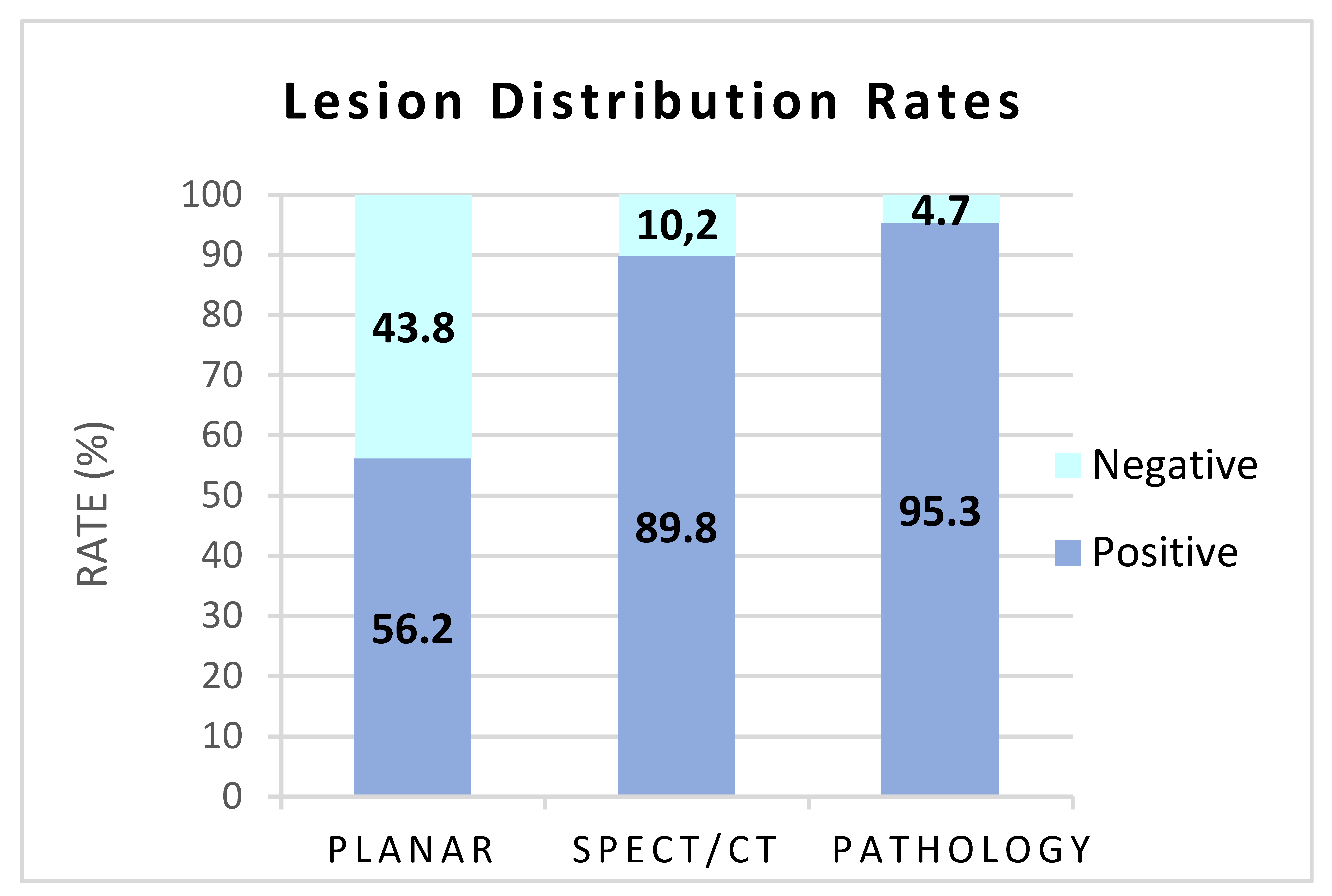
Figure 2.
A 36-year-old female patient with biochemically confirmed primary hyperparathyroidism and negative ultrasonographic findings. Early planar imaging demonstrated focal 99mTc-MIBI retention in the mediastinal region (a), which persisted on delayed images (b). Delayed-phase SPECT/CT revealed a focal uptake corresponding to a right anterior paratracheal lesion at the mediastinal inlet, consistent with a parathyroid adenoma (c, d). Histopathological examination confirmed parathyroid adenoma. SPECT/CT provided precise anatomical localization of the ectopic lesion.
Figure 2.
A 36-year-old female patient with biochemically confirmed primary hyperparathyroidism and negative ultrasonographic findings. Early planar imaging demonstrated focal 99mTc-MIBI retention in the mediastinal region (a), which persisted on delayed images (b). Delayed-phase SPECT/CT revealed a focal uptake corresponding to a right anterior paratracheal lesion at the mediastinal inlet, consistent with a parathyroid adenoma (c, d). Histopathological examination confirmed parathyroid adenoma. SPECT/CT provided precise anatomical localization of the ectopic lesion.
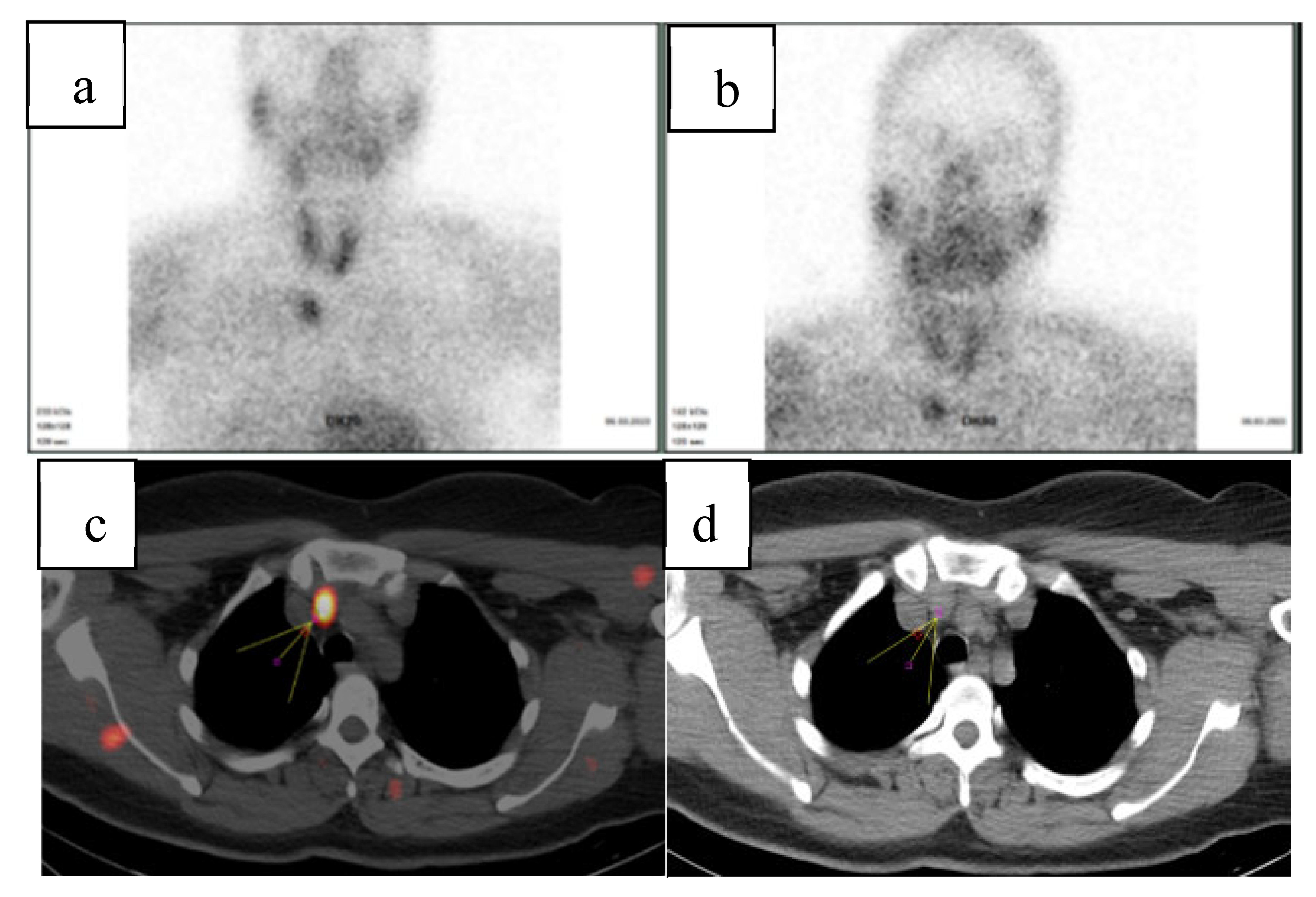
Figure 3.
A 42-year-old female patient with primary hyperparathyroidism. Early and delayed dual-phase planar scintigraphy showed no distinct focal retention suspicious for parathyroid adenoma (a, b). Delayed-phase SPECT/CT demonstrated focal low-level 99mTc-MIBI uptake corresponding to a nodular lesion located posterior to the left thyroid lobe (c, d). Histopathological evaluation confirmed parathyroid adenoma. SPECT/CT enabled the detection and anatomical localization of a subcentimeter lesion that was not clearly visualized on planar imaging.
Figure 3.
A 42-year-old female patient with primary hyperparathyroidism. Early and delayed dual-phase planar scintigraphy showed no distinct focal retention suspicious for parathyroid adenoma (a, b). Delayed-phase SPECT/CT demonstrated focal low-level 99mTc-MIBI uptake corresponding to a nodular lesion located posterior to the left thyroid lobe (c, d). Histopathological evaluation confirmed parathyroid adenoma. SPECT/CT enabled the detection and anatomical localization of a subcentimeter lesion that was not clearly visualized on planar imaging.
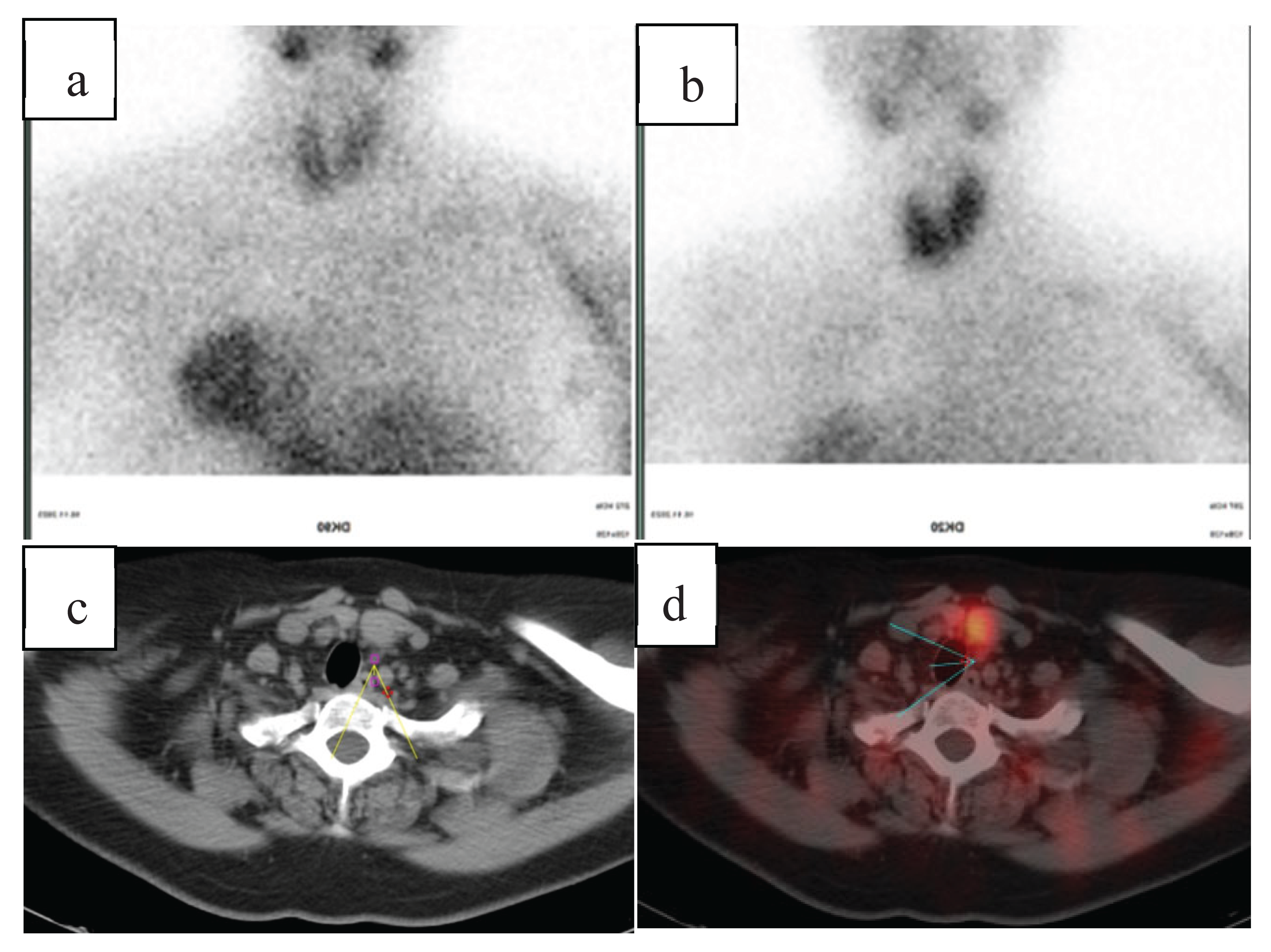

Table 1.
Distribution of Results According to Pathology and Imaging Methods.
| Lesion | n | % | |
|---|---|---|---|
| Planar Imaging |
Positive
Negative |
72
56 |
56.2
43.8 |
| SPECT/CT |
Positive
Negative |
115
13 |
89.8
10.2 |
| Pathology |
Positive
Negative |
122
6 |
95.3
4.7 |
n: number of lesions; SPECT/CT: single photon emission computed tomography/computed tomography.
Table 2.
Evaluation the Results of Methods on a Lesion Basis.
| n | % | |
|---|---|---|
| Planar (+); SPECT/CT (+); Pathology (+) | 70 | 54.7 |
| Planar (-); SPECT/CT (+); Pathology (+) | 44 | 34.4 |
| Planar (-); SPECT/CT (-); Pathology (+) | 9 | 7.0 |
| Planar (-); SPECT/CT (-); Pathology (-) | 4 | 3.1 |
| Planar (+); SPECT/CT (+); Pathology (-) | 1 | 0.8 |
n: number of lesions; SPECT/CT: single photon emission computed tomography/computed tomography.
Disclaimer/Publisher’s Note: The statements, opinions and data contained in all publications are solely those of the individual author(s) and contributor(s) and not of MDPI and/or the editor(s). MDPI and/or the editor(s) disclaim responsibility for any injury to people or property resulting from any ideas, methods, instructions or products referred to in the content. |
© 2026 by the authors. Licensee MDPI, Basel, Switzerland. This article is an open access article distributed under the terms and conditions of the Creative Commons Attribution (CC BY) license (http://creativecommons.org/licenses/by/4.0/).
Copyright: This open access article is published under a Creative Commons CC BY 4.0 license, which permit the free download, distribution, and reuse, provided that the author and preprint are cited in any reuse.


