

Submitted:
18 June 2026
Posted:
22 June 2026
You are already at the latest version
Abstract
The selection of georeferenced meteorological databases is a critical technical and financial factor in photovoltaic (PV) system sizing. This study evaluates how database choice affects PV generation estimates and economic feasibility by combining bibliometric screening, technical validation, financial indicators, and multicriteria analysis. A bibliometric review of 5,658 documents indexed in Scopus and Web of Science supports the selection of seven databases, which are compared across ten Brazilian locations. PV generation is estimated using both a simplified sizing approach and a higher-temporal-resolution model based on hourly irradiance, ambient temperature, and module thermal coefficients, enabling comparison with measured generation in a three-year case study in João Pessoa. Performance is assessed using MAE, MAPE, RMSE, R2, NPV, payback, and the Analytic Hierarchy Process. NASA POWER shows the strongest overall multicriteria performance, ranking first in seven of the ten locations. Database choice causes variations of up to 4.70 years in payback and BRL 105,709.36 in NPV for the same system, equivalent to USD 21,082.84 at the May 22, 2026 exchange rate. The simplified CRESESB-based method overestimates annual generation by 6.79%–12.64%, whereas NASA POWER reaches a best annual deviation of −1.66% in 2024.
Keywords:
photovoltaic solar energy
; georeferencing
; meteorological databases
; photovoltaic power generation estimation
; Analytic Hierarchy Process (AHP)
1. Introduction
Photovoltaic (PV) solar energy encompasses a diversification of technologies whose performance is affected by solar irradiance and other local climatic factors [1]. The wide variety of climatic databases represents the first obstacle in evaluating the performance of PV systems, making it necessary to consider irradiance, temperature, and climatic anomalies [2]. Georeferenced climatic data sources fall into three categories: surface stations, satellite products, and reanalysis databases. Surface stations such as those of INMET provide direct measurements of global horizontal irradiance (GHI), but their irregular coverage limits their applicability in the interior of Brazil [3]. Satellite products such as NSRDB (NREL) expand geographic coverage at the cost of uncertainties in regions with high cloudiness [4]. Reanalysis databases such as ERA-5 and MERRA-2 combine observations from multiple sources with numerical models, producing continuous time series with resolutions between 0.25° and 0.625° (Table 1).
In the Brazilian context, [5] evaluated MERRA-2, ERA5, ERA5-Land, and CFSv2 at 35 INMET stations. MERRA-2 presents the lowest errors in 90% of the locations, with Pearson correlation coefficients between 0.8999 and 0.9488, indicating a strong linear association between estimated and observed values. ERA5 achieved competitive performance, except from August to October. The literature shows that it is methodologically valid to compare databases with different spatial resolutions, provided that they are validated using statistical metrics and confronted with real measurements [6,7,8].
IEA-PVPS Task 13 [9] identifies irradiance data as the main source of uncertainty in PV estimates, with Normalized Root Mean Square Error (NRMSE) between 4% and 8% on a monthly scale. [10] demonstrate that this uncertainty broadens the distribution of projected payback and reduces the probability of profitability in high-volatility scenarios. In Brazil, [11] show, through Monte Carlo simulations (a technique based on repeated random sampling to quantify uncertainties), that solar resource variability, combined with the regulatory rules of auctions, can reduce the NPV of a project from nearly BRL 8 million in a deterministic scenario to less than BRL 2 million in a scenario with capping. In this arrangement, the investor is not remunerated for generation above the contracted guarantee, but remains exposed to losses resulting from low generation, showing that deterministic analyses tend to overestimate asset value by disregarding climatic risk.
The choice of database constitutes a multicriteria decision-making problem, with conflicting criteria such as statistical accuracy, spatial coverage, and economic impact. AHP, developed by Saaty [12], is widely used in the renewable energy field because of its intuitive hierarchical structure and mathematical consistency verification [13]. Its application in this research is justified by the heterogeneity of scales among the criteria MAPE, RMSE, , NPV, and payback, as well as by the need to assign differentiated weights to technical and financial aspects.
The main objective of this article is to verify the effect of different georeferenced databases on the estimation of PV solar energy generation potential. To this end, the uncertainties associated with the comparison among seven climatic databases widely used in the literature are quantified: the National Institute of Meteorology (INMET) [14], the China Meteorological Administration (CMA) [15], the Prediction of Worldwide Energy Resources database (NASA POWER) [16], the National Renewable Energy Laboratory (NREL) [4], ECMWF Reanalysis v5 (ERA-5) [17], the National Oceanic and Atmospheric Administration (NOAA) [18], and the Modern-Era Retrospective Analysis for Research and Applications, Version 2 (MERRA-2) [19]. The reviewed literature indicates that studies carrying out comparative analyses among different databases, encompassing both the estimation of generation potential and the financial evaluation of the results, are still relatively infrequent in Brazil.
Therefore, the results estimated by each database are compared with real-world generation data from photovoltaic systems monitored through the PVOutput platform [20], an open-access online platform used for monitoring and sharing PV system data, as well as from systems installed and monitored by the authors themselves, over the twelve months of 2024. In addition, a case study performs the comparison for the years 2023, 2024, and 2025.
For this comparison, statistical performance metrics are applied, namely: MAE, MAPE, RMSE, and , making it possible to quantify the accuracy and variability of the estimates provided by each database. In addition, economic and financial analyses and a multicriteria evaluation using AHP, a structured decision-support method, are carried out. In this way, it becomes possible to systematically integrate energy, statistical, and financial criteria in the ranking of the evaluated databases. An earlier and more preliminary version of this discussion was presented in a conference paper [21], whereas the present manuscript substantially expands the analysis through bibliometric screening, multicriteria evaluation, and validation against real-world PV system data.
2. Materials and Methods
2.1. Bibliometric Analysis
The bibliometric analysis covers documents indexed in Scopus and Web of Science (1970–2025), using the descriptors “geospatial”, “solar data”, and “photovoltaic”, to identify the databases most recurrent in the literature. Subsequently, time series from INMET, NOAA, CMA, NASA POWER, NREL, MERRA-2, and ERA-5 are used to estimate PV generation in ten reference systems distributed across ten federal units in the five regions of Brazil, obtained from the PVOutput platform and from systems monitored by the authors, a company located in Northeastern Brazil. For each analyzed system, the monthly reference generation, the rated power of the PV modules, the rated system power, and the temperature coefficient of the PV module are kept constant across the simulations, while only the climatic conditions associated with each database are varied.
The comparative analysis is structured into three stages: (i) estimation using the simplified method (a method commonly employed by integration companies in the Brazilian PV sector, using data from the Sergio de Salvo Brito Reference Center for Solar and Wind Energy (CRESESB) [22]); (ii) estimation using higher-temporal-granularity modeling, with hourly variation in irradiance, temperature, and module thermal coefficients; and (iii) comparison with real-world data through statistical metrics.
2.2. Mathematical Model
The generation time series are obtained from a computational architecture developed in Python and organized into classes to standardize the technical parameters of the PV systems analyzed. The modeling framework is structured in two stages: (i) numerical processing and simulation in Python; and (ii) consolidation and comparative analysis of the results. To evaluate more realistically the impact of different meteorological databases on the estimation of PV generation potential, a modeling approach with hourly resolution for irradiance and temperature is adopted, referred to in this study as higher-temporal-granularity modeling. Unlike approaches found in the literature, and commonly used by integration companies in the Brazilian PV market, which are based only on annual averages of solar irradiation, the modeling adopted in this study makes it possible to incorporate the temporal variability of irradiance and temperature, as well as their effects on the electrical performance of PV modules.
2.2.1. Simplified Generation Estimate
As a market reference, the method adopted here, referred to as the simplified method for estimating PV generation potential, is widely used in preliminary quotations of PV systems. This procedure is based on the insolation method presented by Villalva and Gazoli [22], in which the generated energy is estimated from the incident solar irradiation, the rated system power, and the number of days in the analyzed period:
where is the average daily irradiation (kWh/m2/day), is the rated power of the PV system (Wp), and represents the number of days in the month, with a scale adjustment by 1000. In practical applications, typical system losses on the order of 20% are considered.
2.2.2. Generation Estimate by Higher-Temporal-Granularity Modeling
Unlike the simplified method, the proposed modeling approach considers the variation in irradiance, local hourly ambient temperature, and the temperature coefficient of the PV module, extracted from the corresponding datasheet. The ideal system efficiency is adjusted by Equations 2, 3, and 4, according to [23,24]. The instantaneous power is calculated as follows:
where W/m2, °C, is the MPPT tracking efficiency, and is the performance ratio. Cell temperature is estimated using the Ross model [25]:
Monthly energy is obtained from hourly numerical integration ( h):
The complete simulation procedure, integrating Equations (2)–(4), is summarized in Algorithm 1.
| Algorithm 1: Pseudocode for PV generation simulation using meteorological databases |
|
2.3. Statistical Metrics and Economic Modeling
The performance of each database is evaluated using MAE [26], RMSE [27], MAPE, and [28]:
where and are the real and estimated generation, respectively. The relative percentage error is calculated by:
The financial analysis adopts annual revenue , investment , simple payback [29], and net present value (NPV) [29]:
where i represents the minimum attractive rate of return and n the project lifetime. In this study, the financial analysis adopts a constant annual cash flow, simple payback, and NPV calculated using a fixed discount rate of 10%, consistently applied across all compared scenarios. Under these assumptions, NPV expresses the economic attractiveness of the system on a conservative and comparable basis across the analyzed databases.
2.4. Application of the AHP Method
The problem is structured in three levels: (i) Objective, corresponding to the selection of the most accurate database for PV system sizing; (ii) Criteria, composed of MAPE, RMSE, , NPV, and payback; and (iii) Alternatives, represented by the seven evaluated databases.
The pairwise judgments are defined according to Saaty’s fundamental scale [12], preserving reciprocity among the matrix elements. The adopted weighting structure reflects the analytical priorities of the present study, as defined by the authors, and assigns greater importance to direct statistical agreement with measured generation (MAPE, RMSE, and ) than to derived financial indicators (NPV and payback). This choice is motivated by the fact that the economic indicators are downstream consequences of the generation estimates and therefore should not dominate the ranking of meteorological databases. Accordingly, in the order [MAPE, RMSE, , NPV, payback], the following matrix is adopted:
The weight vector w is computed using the eigenvector method, by solving
where is the largest eigenvalue of the pairwise comparison matrix A, and w is the associated principal eigenvector. Since eigenvectors are defined up to a multiplicative constant, the principal eigenvector is normalized by the sum of its components, ensuring that . For the adopted matrix, this procedure yields and the normalized weight vector
corresponding to MAPE = 37.33%, RMSE = 19.71%, = 29.69%, NPV = 7.56%, and payback = 5.71%. The consistency of the judgments is verified by and , indicating satisfactory internal consistency according to Saaty’s criterion [12]. In this study, the AHP ranking is interpreted as a structured decision-support synthesis of technical and financial criteria under the adopted weighting assumptions, rather than as a universal or weight-independent determination of the best database.
The score of each database is obtained by weighted aggregation (14), using min–max normalization for minimization criteria (15) and maximization criteria (16):
2.4.1. Sensitivity Analysis of the AHP Weighting Structure
Because the AHP ranking depends on the adopted criterion weights, a sensitivity analysis is performed to assess the robustness of the multicriteria results, following procedures commonly adopted in AHP applications in the energy field [30]. In addition to the baseline weights derived from the Saaty matrix, four alternative weighting scenarios are evaluated: a balanced scenario with equal weights, a technically oriented scenario, an economically oriented scenario, and a statistically oriented scenario. The corresponding weights are summarized in Table 2. For each scenario, the partial criterion contributions previously obtained for each database and location are rescaled relative to the baseline weight vector and then recombined under the alternative weighting structure, so that the resulting AHP scores remain directly comparable across scenarios.
A complementary one-at-a-time analysis is also performed by perturbing one baseline weight at a time from to , while the remaining weights are proportionally renormalized so that the total weight remains equal to one. After each perturbation, the AHP scores are recalculated and the resulting ranking is compared in terms of the highest average AHP score obtained among the evaluated databases.
2.5. Analyzed Projects
The reference PV systems are distributed across the five Brazilian regions and are listed in Table 3, encompassing commercial and residential installations with different installed capacities and climatic conditions. Although the sample is restricted to ten projects, its geographic distribution provides broad climatic coverage across the five Brazilian regions. This limitation results from the availability of real-world generation data obtained from the PVOutput platform, which reduces the number of systems eligible for analysis.
3. Results and Discussion
3.1. Bibliometric Results
The review identifies 5,658 documents (96.4% scientific articles), with continuous growth since 2009 and a peak of 721 publications in 2024. In accordance with Lotka’s law[31], most author entries have up to two publications, whereas a minority concentrates the most substantial scientific output.
To directly support the selection of the meteorological databases adopted in the present study, and to corroborate their relevance for this type of analysis in the international literature, an additional screening examines the full bibliometric corpus in order to identify documents explicitly referring to the seven databases evaluated here.
NREL (58 documents), ERA-5 (53 documents), and MERRA-2 (36 documents) are the most frequently identified databases in the international literature, reflecting their widespread use in solar resource assessment and PV generation studies. Representative examples include Multicriteria GIS Modeling of Wind and Solar Farms in Colorado for NREL [32], Potential Assessment of Photovoltaic Power Generation in China for ERA-5 [33], and Long-Term Patterns of European PV Output Using 30 Years of Validated Hourly Reanalysis and Satellite Data for MERRA-2 [34]. Among these, MERRA-2 is associated with the most highly cited representative paper in this subset, with 988 citations [34].
NASA POWER appears in 16 documents, all published between 2019 and 2025, which indicates more recent adoption, particularly in tropical and data-scarce regions; a representative example is Spatial Forecasting of Solar Radiation Using ARIMA Model [35]. NOAA appears in 26 documents spanning a wide temporal range; however, these mentions include references to NOAA products and instruments, and not exclusively to irradiance datasets for PV design, as illustrated by Artificial Neural Network Based Daily Local Forecasting for Global Solar Radiation [36]. INMET and CMA remain underrepresented in the global corpus, with only 2 and 4 identified documents, respectively, which is consistent with their more regional scope. Representative examples are Analysis of Seasonal Aspects of Nebulosity on the Project of Fixed Photovoltaic Installations at the City of Belém, Brazil for INMET [37] and Constructing a Gridded Direct Normal Irradiance Dataset in China During 1981–2014 for CMA [38]. These results further support their inclusion in the present comparative analysis as geographically relevant alternatives to global reanalysis products.
3.2. Comparative Analysis by Database
The annual percentage errors in the estimated photovoltaic generation are summarized in the heat map shown in Figure 1, computed according to Equation (9). Before the annual comparison, all meteorological series are temporally harmonized to an hourly resolution following the temporal standardization procedure proposed in [6]. In addition, each photovoltaic system is simulated using the technical specifications of its respective reference installation, including the rated module power, module thermal coefficient, number of modules, inverter Maximum Power Point Tracking (MPPT) efficiency, and module Nominal Operating Cell Temperature (NOCT). This procedure ensures that the inter-database comparison reflects differences in the meteorological inputs rather than inconsistencies in the photovoltaic system parameterization.
Figure 1 shows that the estimation performance remains strongly site-dependent across Brazil. NASA POWER provides the lowest absolute annual error in Teófilo Otoni (MG), João Pessoa (PB), Marabá (PA), Parnamirim (RN), and Maratá (RS), with deviations ranging from to . NREL performs best in Olinda (PE), with an error of only , while MERRA-2 yields the smallest deviation in Rio de Janeiro (RJ), with . In contrast, INMET produces the lowest relative deviation in Florianópolis (SC) and Primavera do Leste (MT), although in both cases the remaining errors are still substantial, especially in Primavera do Leste, where even the best available database retains a deviation of .
The Northeastern coastal sites reveal distinct behaviors among the products. In João Pessoa, NASA POWER is the most accurate database, with an error of , whereas NOAA overestimates generation by and both ERA-5 and MERRA-2 underestimate by nearly . In Parnamirim, NASA POWER again provides the closest annual estimate (), followed by CMA () and NREL (). In Olinda, however, NREL, CMA, and NOAA all show competitive behavior, with deviations between and , while ERA-5 and MERRA-2 exhibit markedly negative biases of approximately . These results indicate that no single database dominates the entire Northeastern region, even under relatively similar tropical coastal conditions.
The largest discrepancies are observed in Primavera do Leste (MT), which represents the most critical case in the present study. All databases show large positive deviations except INMET, with errors ranging from for NASA POWER to for NOAA. This systematic overestimation suggests that local atmospheric and land-use factors, including seasonal aerosol loading and biomass-burning influences, are not adequately represented by the evaluated large-scale products [9,39]; in addition, the measured series was affected by operational interruptions of the PV system, with months of extremely low generation that may reflect not only shutdown periods, but also the combined influence of adverse climatic conditions and partial system unavailability. Marília (SP) also shows large positive deviations for most gridded databases, particularly CMA (), NOAA (), MERRA-2 (), and ERA-5 (), while INMET strongly underestimates the annual generation (). These two locations reinforce that annual agreement is highly sensitive to local representativeness and cannot be generalized across different climatic regions.
The INMET database exhibits the strongest negative bias overall, especially in Rio de Janeiro (RJ), where the error reaches , and in Primavera do Leste (MT) and Marília (SP), with deviations of and , respectively. These large underestimations may reflect structural limitations of isolated ground stations in regions with complex terrain, strong cloud variability, or limited spatial representativeness. Nevertheless, INMET performs competitively in Florianópolis (SC), where its error of is still the lowest among the available databases, and in Olinda (PE), where its negative deviation is lower than that observed for ERA-5 and MERRA-2.
CMA shows a marked tendency toward overestimation in most locations, including Marília (SP), Florianópolis (SC), Maratá (RS), Marabá (PA), and especially Primavera do Leste (MT), where the deviation reaches . The only site where CMA slightly underestimates generation is Olinda (PE), with . NOAA likewise exhibits a predominantly positive bias and produces the largest positive error in several cities, including Parnamirim (RN), Marabá (PA), and Rio de Janeiro (RJ). ERA-5 and MERRA-2 display very similar spatial behavior, alternating between moderate positive deviations in the South, Southeast, and Midwest and negative deviations in parts of the Northeast, which is consistent with their shared reanalysis-based character.
It is important to emphasize that good agreement in annual totals does not necessarily imply adequate month-by-month adherence. Positive and negative monthly deviations may compensate over the year, producing a small annual error even when the seasonal representation remains weak. For this reason, the annual heat map should be interpreted jointly with the financial analysis and the multicriteria ranking.
Table 4 summarizes the distribution of annual percentage errors by database. Among the databases with complete coverage of all ten locations, NASA POWER presents the median closest to zero (median = 8.68%) and a comparatively moderate dispersion (IQR = 33.18), indicating the most balanced overall performance across the full sample. NOAA exhibits the lowest IQR among the databases with complete coverage (29.06), but also a high positive median (18.30%), revealing a consistent overestimation bias. NREL shows the lowest dispersion overall (IQR = 13.89), but only for six locations, which limits its spatial representativeness. CMA records the highest maximum error (86.71%) and one of the largest dispersions, while ERA-5 and MERRA-2 present very similar statistical behavior, both with moderate positive medians and large interquartile ranges. INMET stands out for the most consistent negative bias (median = ), confirming its structural tendency to underestimate generation in several of the evaluated sites.
3.3. AHP Multicriteria Analysis
Table 5 presents the AHP scores by city and database under the adopted weighting structure of 37.33% for MAPE, 19.71% for RMSE, 29.69% for , 7.56% for NPV, and 5.71% for payback. Under these assumptions, NASA POWER ranks first in seven of the ten locations, with an average score of 87.2 and a minimum of 69.8, indicating the strongest overall multicriteria performance among the databases with complete spatial coverage. NREL attains the second-highest average score (73.5), although it is available for only six locations, whereas MERRA-2 and ERA-5 show intermediate average performance, with 58.8 and 58.7, respectively. INMET exhibits the largest spatial variability, ranging from 8.4 to 86.7, which reflects its strongly site-dependent behavior.
Figure 2 consolidates the results by counting the number of locations in which each database ranks first in the three evaluated criteria, whereas Figure 3 details the geographic distribution of those leads by location and criterion.
Under the adopted weighting structure, NASA POWER clearly dominates the consolidated ranking with 19 first-place results: 5 in generation accuracy, 7 in financial adherence, and 7 in AHP score. It leads in generation accuracy in Teófilo Otoni/MG, João Pessoa/PB, Marabá/PA, Parnamirim/RN, and Maratá/RS; in financial adherence in Teófilo Otoni/MG, Marília/SP, João Pessoa/PB, Marabá/PA, Parnamirim/RN, Primavera do Leste/MT, and Maratá/RS; and in AHP score in Teófilo Otoni/MG, Marília/SP, João Pessoa/PB, Marabá/PA, Parnamirim/RN, Primavera do Leste/MT, and Maratá/RS. This result confirms that NASA POWER provides the most consistent joint performance across the adopted statistical, financial, and multicriteria summaries.
INMET ranks second overall with 5 first-place results, concentrated in generation accuracy in Marília/SP, Florianópolis/SC, and Primavera do Leste/MT, as well as in financial adherence and AHP score in Florianópolis/SC. NREL and MERRA-2 follow with 3 first-place results each, but in much more localized patterns. NREL concentrates all three of its leads in Olinda/PE, where it ranks first simultaneously in generation accuracy, financial adherence, and AHP score. MERRA-2 shows the same threefold leadership in Rio de Janeiro/RJ. By contrast, CMA, ERA-5, and NOAA do not rank first in any of the three consolidated criteria, despite showing competitive performance in specific cities. To verify whether this multicriteria ranking remains stable under alternative weighting assumptions, the sensitivity analysis described in Section 2.4 is applied to the baseline AHP model.
Figure 4 compares the average AHP score profiles obtained under the four alternative weighting scenarios against the baseline ranking, whereas Table 6 summarizes the one-at-a-time perturbation analysis around the baseline weight vector.
Figure 4 shows that the weighting structure affects the relative distances among databases and may also modify the top-ranked alternative under sufficiently different priority schemes. NASA POWER remains the highest-ranked database in the baseline, technically oriented, balanced, and statistically oriented scenarios, with average AHP scores of 87.19, 87.06, 75.99, and 88.32, respectively. However, under the economically oriented scenario, NREL becomes the top-ranked database, with an average score of 73.02, while NOAA and CMA also gain relative competitiveness. These results suggest that NASA POWER exhibits the most robust overall multicriteria performance across the tested scenarios, although its leadership is not strictly preserved when the weighting structure strongly favors the economic criteria.
The one-at-a-time sensitivity analysis summarized in Table 6 further confirms this robustness. When each baseline weight is independently varied from to , NASA POWER remains the top-ranked database in terms of average AHP score in all perturbations. This result indicates that the main multicriteria conclusion of the study is stable not only across predefined alternative scenarios, but also under continuous local variations around the baseline AHP weight vector.
The financial impact of meteorological database choice is illustrated in Figure 5. Primavera do Leste/MT and Rio de Janeiro/RJ provide complementary examples of how the multicriteria ranking should be interpreted. In Primavera do Leste, NASA POWER ranks first in the AHP analysis, but it estimates an annual generation of 22,548.69 kWh compared with the measured 13,533.37 kWh, corresponding to an error of , a projected payback of 3.04 years, and a 25-year NPV of BRL 115,733.96, compared with the observed values of 5.06 years and BRL 46,176.50; by contrast, INMET yields 8,847.74 kWh, presenting the smallest annual deviation at this location (), but still produces a markedly conservative estimate, with a payback of 7.74 years and an NPV of BRL 10,024.60. This wide range suggests that the divergence in Primavera do Leste is related not only to meteorological representation, but also to the low generation observed in some months, possibly associated with a combination of adverse climatic conditions and partial operational unavailability of the system, as shown in Figure 6.
In Rio de Janeiro/RJ, by contrast, the closest agreement with the measured system is achieved by MERRA-2, which estimates 8,082.51 kWh against the measured 8,175.53 kWh (), with a payback of 2.54 years versus the observed 2.51 years and an NPV of BRL 44,916.46 compared with the recorded BRL 45,634.17, as shown in Figure 6. Taken together, these cases show that NASA POWER is the most robust database overall; however, leadership in an aggregate multicriteria evaluation does not necessarily translate into the most accurate financial projection for every location [9,10,11].
3.4. Case Study: System Installed in Northeastern Brazil
The 5.50 kWp photovoltaic system installed in João Pessoa, in Northeastern Brazil, was originally designed and installed in a commercial context. The original sizing adopted the simplified method described in Equation (1), based on the solar irradiance data provided by CRESESB. For the analyzed system, the commercial proposal estimated an average monthly generation of 762 kWh/month, equivalent to 9144 kWh/year, annual savings of BRL 7680.96 (approximately USD 1524.94 at the exchange rate of May 22, 2026), and a simple payback of 3.13 years for an investment of BRL 24,062.10 (approximately USD 4777.17 at the exchange rate of May 22, 2026). The analysis compares three scenarios for the years 2023, 2024, and 2025, adopted as a temporal horizon because they correspond to a period close to the preparation of the proposal, prepared in August 2022: (i) the simplified method; (ii) higher-temporal-granularity modeling; and (iii) generation measured by the inverter through the manufacturer’s monitoring platform.
The location of the case-study system is shown in Figure 7, highlighting its position in the tropical coastal zone of Northeastern Brazil. Monthly generation patterns are first compared in Figure 8, Figure 9 and Figure 10, whereas the resulting annual and financial indicators are summarized in Table 7 and Figure 11. This comparative structure is also consistent with previous applications of the same methodological approach, in which simplified market-based sizing was contrasted with higher-temporal-granularity technical modeling and real-world measured system performance [40].
This geographic setting is relevant because the coastal tropical environment provides additional context for interpreting the behavior of the evaluated meteorological databases in the case study.
Figure 8, Figure 9 and Figure 10 help explain why annual agreement and month-by-month adherence do not necessarily coincide. In 2023, NASA POWER provides the best overall agreement among the available databases, combining the smallest annual deviation () with the lowest mean absolute monthly deviation (MAE = 45.63 kWh). By contrast, NOAA shows a systematic positive bias throughout the year, resulting in an annual overestimation of , while NREL presents a pronounced monthly inconsistency that substantially degrades its month-by-month adherence.
The contrast becomes clearer in 2024. In this year, CMA remains closer to the measured series in several individual months and yields a mean absolute monthly deviation (45.86 kWh) slightly lower than that of NASA POWER (49.33 kWh). However, CMA exhibits predominantly positive deviations over the year and therefore overestimates the annual total by . NASA POWER, despite larger deviations in some individual months, alternates positive and negative errors more effectively and achieves a much closer annual result, with a deviation of only . This case directly illustrates the temporal compensation effect discussed in this study.
The 2025 results provide the complementary situation. NASA POWER again shows the best month-by-month adherence among the complete datasets, with MAE = 67.24 kWh, whereas MERRA-2 and ERA-5 achieve annual totals that are slightly closer to the measured system, with deviations of and , respectively, against for NASA POWER. Thus, a closer annual aggregate does not necessarily imply the best monthly tracking. In addition, the INMET series is only partially available in 2025 and therefore should be interpreted with caution, while NREL is omitted because no valid monthly series is available for that year.
Taken together, these three yearly comparisons reinforce the central interpretation of the case study: the most appropriate database cannot be selected solely from annual totals or solely from month-by-month adherence. NASA POWER stands out for its more balanced and robust behavior across the three years, particularly when annual consistency and temporal representation are interpreted jointly, which supports its adoption as the comparative basis for the higher-temporal-granularity modeling conducted in this work.
As shown in Table 7, the simplified CRESESB-based method produces a fixed annual generation estimate of 9,144.00 kWh regardless of the year under analysis, a structural characteristic that directly reflects its static nature, since it relies on a single irradiance reference value and therefore cannot capture interannual climatic variability. In 2023, this results in a generation overestimation of , a payback underestimated by , and an NPV overestimated by BRL 2,540.94 (approximately USD 506.77 at the exchange rate of May 22, 2026), corresponding to . In 2024, the corresponding deviations are , , and BRL 2,372.43 (approximately USD 473.16), equivalent to . In 2025, when the measured system records its lowest annual generation across the three-year period (8,118.20 kWh), the limitations of the simplified method become even more evident: the generation deviation reaches , the payback is underestimated by , and the NPV is overestimated by BRL 5,759.33 (approximately USD 1,148.65), corresponding to . This is the largest financial distortion observed in the case study.
NASA POWER, used as the climatic database in the higher-temporal-granularity model, yields year-specific estimates of 8,365.21, 8,420.05, and 8,460.41 kWh for 2023, 2024, and 2025, respectively, thereby following the interannual variation of the measured system more closely. Its generation deviations remain within and , with the 2024 result being particularly noteworthy, as the annual deviation is only . The corresponding NPV deviations range from to , equivalent to BRL 1,335.01 (approximately USD 266.26) in 2023, BRL 1,085.38 (approximately USD 216.47) in 2024, and BRL 2,609.28 (approximately USD 520.40) in 2025, consistently smaller than those obtained with the simplified method.
This contrast illustrates one of the central contributions of the present study: whereas the simplified method propagates the same annual generation assumption to all years and, consequently, to all financial indicators, the higher-temporal-granularity model captures year-to-year changes in generation potential by accounting for hourly irradiance variability, ambient and module temperature effects, and module-specific technical parameters. As a result, it reduces the uncertainty associated with payback and NPV estimates and improves the reliability of investment decisions based on pre-installation energy assessments.
4. Conclusions
Seven georeferenced meteorological databases for PV system sizing across ten locations in different climatic regions of Brazil were evaluated using accuracy, financial adherence, and multicriteria AHP criteria. NASA POWER emerged as the database with the strongest overall multicriteria performance under the adopted weighting structure, particularly in locations where annual agreement remained comparatively stable across the evaluated criteria. ERA-5 and MERRA-2 constituted viable alternatives in specific coastal and southeastern contexts, whereas INMET showed strong site dependence associated with the spatial limitations of ground stations and local representativeness. CMA showed a systematic tendency toward overestimation in much of Brazil. Primavera do Leste (MT) remained the most critical case, with large deviations across nearly all databases, indicating that local atmospheric complexity, land-use dynamics, and possible operational interruptions of the measured system can substantially affect the comparison between estimated and observed generation.
The sensitivity analysis showed that NASA POWER remained the highest-ranked database in the baseline, technically oriented, balanced, and statistically oriented scenarios, whereas NREL became the top-ranked alternative under the economically oriented scenario. Therefore, NASA POWER may be regarded as the most robust overall database, although its leadership is not strictly invariant to changes in criterion weights. Differences among the databases produced variations of up to 4.70 years in payback and BRL 105,709.36 (approximately USD 21,082.84, at the exchange rate of May 22, 2026) in projected NPV for the same system. The three-year case study in João Pessoa (PB) further reinforced these findings: the simplified CRESESB-based method consistently overestimated annual generation by , , and in 2023, 2024, and 2025, respectively, while NASA POWER yielded narrower generation deviations of , , and , together with smaller NPV deviations and a closer representation of interannual variability. Taken together, these results show that database selection significantly influences both PV generation estimates and economic feasibility, and that aggregate multicriteria superiority should always be interpreted together with site-specific validation.
Author Contributions
Conceptualization, A.A.A.N., B.A.S. and W.L.A.N.; methodology, A.A.A.N.; software, A.A.A.N.; validation, A.A.A.N., B.A.S. and W.L.A.N.; formal analysis, A.A.A.N.; investigation, A.A.A.N.; resources, A.A.A.N.; data curation, A.A.A.N.; writing—original draft preparation, A.A.A.N.; writing—review and editing, A.A.A.N., B.A.S. and W.L.A.N.; visualization, A.A.A.N.; supervision, B.A.S. and W.L.A.N.; project administration, B.A.S. and W.L.A.N. All authors have read and agreed to the published version of the manuscript.
Funding
This research was funded by the Coordenação de Aperfeiçoamento de Pessoal de Nível Superior (CAPES), Brazil, grant number 88887.147897/2025-00, through a doctoral scholarship granted to the first author. The APC was funded by the authors.
Institutional Review Board Statement
Not applicable.
Informed Consent Statement
Not applicable.
Data Availability Statement
The meteorological data used in this study are publicly available from the following sources: NASA POWER (https://power.larc.nasa.gov), ERA-5 via the Copernicus Climate Data Store (https://cds.climate.copernicus.eu), MERRA-2 via NASA GES DISC (https://disc.gsfc.nasa.gov), NREL/NSRDB (https://nsrdb.nrel.gov), NOAA Climate Data Online (https://www.ncdc.noaa.gov/cdo-web), and INMET (https://bdmep.inmet.gov.br). PV generation data for nine of the ten analyzed locations were obtained from the PVOutput platform (https://pvoutput.org), an open-access repository for PV system monitoring data. The data from the case-study system in João Pessoa (PB) were collected from a privately monitored installation and are not publicly available due to confidentiality restrictions.
Acknowledgments
The authors would like to thank the Federal University of Campina Grande (UFCG) for providing the institutional infrastructure that supported this research, and SunLumen Engenharia for providing access to the monitored PV system data used in the case study. During the preparation of this manuscript, the authors used Claude (Anthropic) for purposes of language editing and writing assistance. The authors have reviewed and edited the output and take full responsibility for the content of this publication.
Conflicts of Interest
The authors declare no conflicts of interest.
Abbreviations
The following abbreviations are used in this manuscript:
| AHP | Analytic Hierarchy Process |
| CMA | China Meteorological Administration |
| CRESESB | Sergio de Salvo Brito Reference Center for Solar and Wind Energy |
| GHI | Global Horizontal Irradiance |
| INMET | Instituto Nacional de Meteorologia |
| MAE | Mean Absolute Error |
| MAPE | Mean Absolute Percentage Error |
| MARR | Minimum Attractive Rate of Return |
| MERRA-2 | Modern-Era Retrospective Analysis for Research and Applications v.2 |
| MPPT | Maximum Power Point Tracking |
| NOAA | National Oceanic and Atmospheric Administration |
| NPV | Net Present Value |
| NREL | National Renewable Energy Laboratory |
| PR | Performance Ratio |
| PV | Photovoltaic |
| RMSE | Root Mean Square Error |
References
- Suri, M.; Huld, T.; Cebecauer, T.; Dunlop, E.D. Geographic Aspects of Photovoltaics in Europe: Contribution of the PVGIS Website. IEEE J. Sel. Top. Appl. Earth Obs. Remote Sens. 2008, 1, 34–41. [Google Scholar] [CrossRef]
- Rudniak, J. Comparison of local solar radiation parameters with data from a typical meteorological year. Therm. Sci. Eng. Prog. 2020, 16, 100465. [Google Scholar] [CrossRef]
- Pinho, J.T.; Galdino, M.A. Manual de Engenharia para Sistemas Fotovoltaicos; CEPEL–CRESESB: Rio de Janeiro, 2014. [Google Scholar]
- Sengupta, M.; Xie, Y.; Lopez, A.; Habte, A.; Maclaurin, G.; Shelby, J. The National Solar Radiation Data Base (NSRDB). Renew. Sustain. Energy Rev. 2018, 89, 51–60. [Google Scholar] [CrossRef]
- Araujo, M.A.d.S.G.; Aguilar, S.; Souza, R.C.; Cyrino Oliveira, F.L. Global Horizontal Irradiance in Brazil: A Comparative Study of Reanalysis Datasets with Ground-Based Data. Energies 2024, 17, 5063. [Google Scholar] [CrossRef]
- AlFaraj, J.; Popovici, E.; Leahy, P. Solar Irradiance Database Comparison for PV System Design: A Case Study. Sustainability 2024, 16, 6436. [Google Scholar] [CrossRef]
- Tahir, Z.U.R.; et al. Improving the accuracy of solar radiation estimation from reanalysis datasets using surface measurements. Sustain. Energy Technol. Assess. 2021. [Google Scholar] [CrossRef]
- Müller, R.; Matsoukas, C.; Gratzki, A.; Behr, H.; Hollmann, R. The CM-SAF operational scheme for the satellite-based retrieval of solar surface irradiance — A LUT based eigenvector hybrid approach. Remote Sens. Environ. 2009, 113, 1012–1024. [Google Scholar] [CrossRef]
- Technical Report IEA-PVPS T13-12:2021; IEA-PVPS Task 13. Uncertainties in Photovoltaic System Yield Predictions and Assessments. International Energy Agency, 2020.
- Wieland, S.; Gürsal, U. Uncertainty propagation in financial models of photovoltaic systems. Sci. Rep. 2026, 16, 5004. [Google Scholar] [CrossRef] [PubMed]
- Bastian-Pinto, C.d.L.; Fernández y Fernández, E. Investment decision of photovoltaic projects based on stochastic modelling of solar irradiation and shortfall penalties foreseen in centralized-generation auction’s contracts. J. Braz. Soc. Mech. Sci. Eng. 2022. [Google Scholar] [CrossRef]
- Saaty, T.L. Decision Making with the Analytic Hierarchy Process. Int. J. Serv. Sci. 2008, 1, 83–98. [Google Scholar] [CrossRef]
- Pohekar, S.; Ramachandran, M. Application of multi-criteria decision making to sustainable energy planning — A review. Renew. Sustain. Energy Rev. 2004, 8, 365–381. [Google Scholar] [CrossRef]
- Instituto Nacional de Meteorologia. Instituto Nacional de Meteorologia (INMET). Ministério da Agricultura e Pecuária. Accessed on. 2026. (accessed on 5 May 2026).
- China Meteorological Administration. China Meteorological Administration (CMA). China Meteorological Administration. Accessed on. 2026. (accessed on 5 May 2026).
- NASA POWER Project. NASA Prediction Of Worldwide Energy Resources (POWER). Accessed on. National Aeronautics and Space Administration, 2026. (accessed on 5 May 2026).
- Hersbach, H.; Bell, B.; Berrisford, P.; Hirahara, S.; Horányi, A.; Muñoz-Sabater, J.; Nicolas, J.; Peubey, C.; Radu, R.; Schepers, D.; et al. The ERA5 global reanalysis. Q. J. R. Meteorol. Soc. 2020, 146, 1999–2049. [Google Scholar] [CrossRef]
- National Centers for Environmental Information. Climate Data Online (CDO). Accessed on. National Oceanic and Atmospheric Administration, 2026. (accessed on 5 May 2026).
- Gelaro, R.; et al. The Modern-Era Retrospective Analysis for Research and Applications, Version 2 (MERRA-2). J. Clim. 2017, 30, 5419–5454. [Google Scholar] [CrossRef] [PubMed]
- PVOutput. PVOutput: Solar Energy System Performance Monitoring. Accessed on. 2024. (accessed on 2025). [Google Scholar]
- Neto, A.A.; Lopes, F.V.; Abrahão, R. The Role of Spatial Databases for Climatic and Solar/Wind Energy Generation Studies: A Bibliometric Review. In Proceedings of the 2023 Workshop on Communication Networks and Power Systems (WCNPS), 2023; pp. 1–7. [Google Scholar] [CrossRef]
- Villalva, M.G.; Gazoli, J.R. Energia Solar Fotovoltaica: Conceitos e Aplicações; Érica: São Paulo, 2012. [Google Scholar]
- Crook, J.A.; Jones, L.A.; Forster, P.M.; Crook, R. Climate change impacts on future photovoltaic and concentrated solar power energy output. Energy Environ. Sci. 2011, 4, 3101–3109. [Google Scholar] [CrossRef]
- Duffie, J.A.; Beckman, W.A. Solar Engineering of Thermal Processes, 1 ed.; Wiley, 2013. [Google Scholar]
- Ross, R.G., Jr. Interface design considerations for terrestrial solar cell modules. In Proceedings of the Proceedings of the 12th IEEE Photovoltaic Specialists Conference, Baton Rouge, LA, USA, 1976; pp. 801–806. [Google Scholar]
- Hyndman, R.J.; Koehler, A.B. Another Look at Measures of Forecast Accuracy. Int. J. Forecast. 2006, 22, 679–688. [Google Scholar] [CrossRef]
- Willmott, C.J.; Matsuura, K. Advantages of the mean absolute error (MAE) over the root mean square error (RMSE) in assessing average model performance. Clim. Res. 2005, 30, 79–82. [Google Scholar] [CrossRef]
- Chicco, D.; Warrens, M.J.; Jurman, G. The Coefficient of Determination R-Squared Is More Informative than SMAPE, MAE, MAPE, MSE and RMSE in Regression Analysis Evaluation. PeerJ Comput. Sci. 2021, 7, e623. [Google Scholar] [CrossRef] [PubMed]
- Brigham, E.F.; Ehrhardt, M.C. Financial Management: Theory & Practice, 15 ed.; Cengage Learning: Boston, 2016. [Google Scholar]
- Daugavietis, J.E.; Soloha, R.; Dace, E.; Ziemele, J. A Comparison of Multi-Criteria Decision Analysis Methods for Sustainability Assessment of District Heating Systems. Energies 2022, 15, 2411. [Google Scholar] [CrossRef]
- da Silva, S.; Perlin, M.; Matsushita, R.; Santos, A.A.P.; Imasato, T.; Borenstein, D. Lotka’s law for the Brazilian scientific output published in journals. J. Inf. Sci. 2019, 45, 705–709. [Google Scholar] [CrossRef]
- Janke, J.R. Multicriteria GIS modeling of wind and solar farms in Colorado. Renew. Energy 2010, 35, 2228–2234. [Google Scholar] [CrossRef]
- Qiu, T.; Wang, L.; Lu, Y.; et al. Potential assessment of photovoltaic power generation in China. Renew. Sustain. Energy Rev. 2022, 154. [Google Scholar] [CrossRef]
- Pfenninger, S.; Staffell, I. Long-term patterns of European PV output using 30 years of validated hourly reanalysis and satellite data. Energy 2016, 114, 1251–1265. [Google Scholar] [CrossRef]
- Shadab, A.; Ahmad, S.; Said, S. Spatial forecasting of solar radiation using ARIMA model. Remote Sens. Appl. Soc. Environ. 2020, 20. [Google Scholar] [CrossRef]
- Amrouche, B.; Le Pivert, X. Artificial neural network based daily local forecasting for global solar radiation. Appl. Energy 2014, 130, 623–632. [Google Scholar] [CrossRef]
- Alcântara, L.; Campos, M. Analysis of Seasonal Aspects of Nebulosity on the Project of Fixed Photovoltaic Installations at the City of Belém, Brazil. IEEE Lat. Am. Trans. 2019, 17. [Google Scholar] [CrossRef]
- Qin, W.; Wang, L.; Gueymard, C.A.; Bilal, M.; Lin, A.; Wei, J.; Zhang, M.; Yang, X. Constructing a Gridded Direct Normal Irradiance Dataset in China during 1981–2014. Renew. Sustain. Energy Rev. 2020, 134, 110004. [Google Scholar] [CrossRef]
- Pereira, E.B.; Martins, F.R.; Gonçalves, A.R.; Costa, R.S.d.; Lima, F.L.d.; Rüther, R.; Abreu, S.L.d.; Tiepolo, G.M.; Pereira, S.V.; Souza, J.G.d. Atlas brasileiro de energia solar, 2 ed.; INPE: São José dos Campos, 2017. [Google Scholar] [CrossRef]
- Neto, A.A.A.; Lopes, F.V.; Abrahão, R. Assessing the Impact of Inverter Failures on the Efficiency of Photovoltaic Generators. Proc. 2024 Workshop Commun. Netw. Power Syst. (WCNPS) 2024, 1–7. [Google Scholar] [CrossRef]
Figure 1.
Heat map of annual generation estimation percentage errors by database and city. Positive values indicate overestimation relative to the measured system, whereas negative values indicate underestimation.
Figure 1.
Heat map of annual generation estimation percentage errors by database and city. Positive values indicate overestimation relative to the measured system, whereas negative values indicate underestimation.
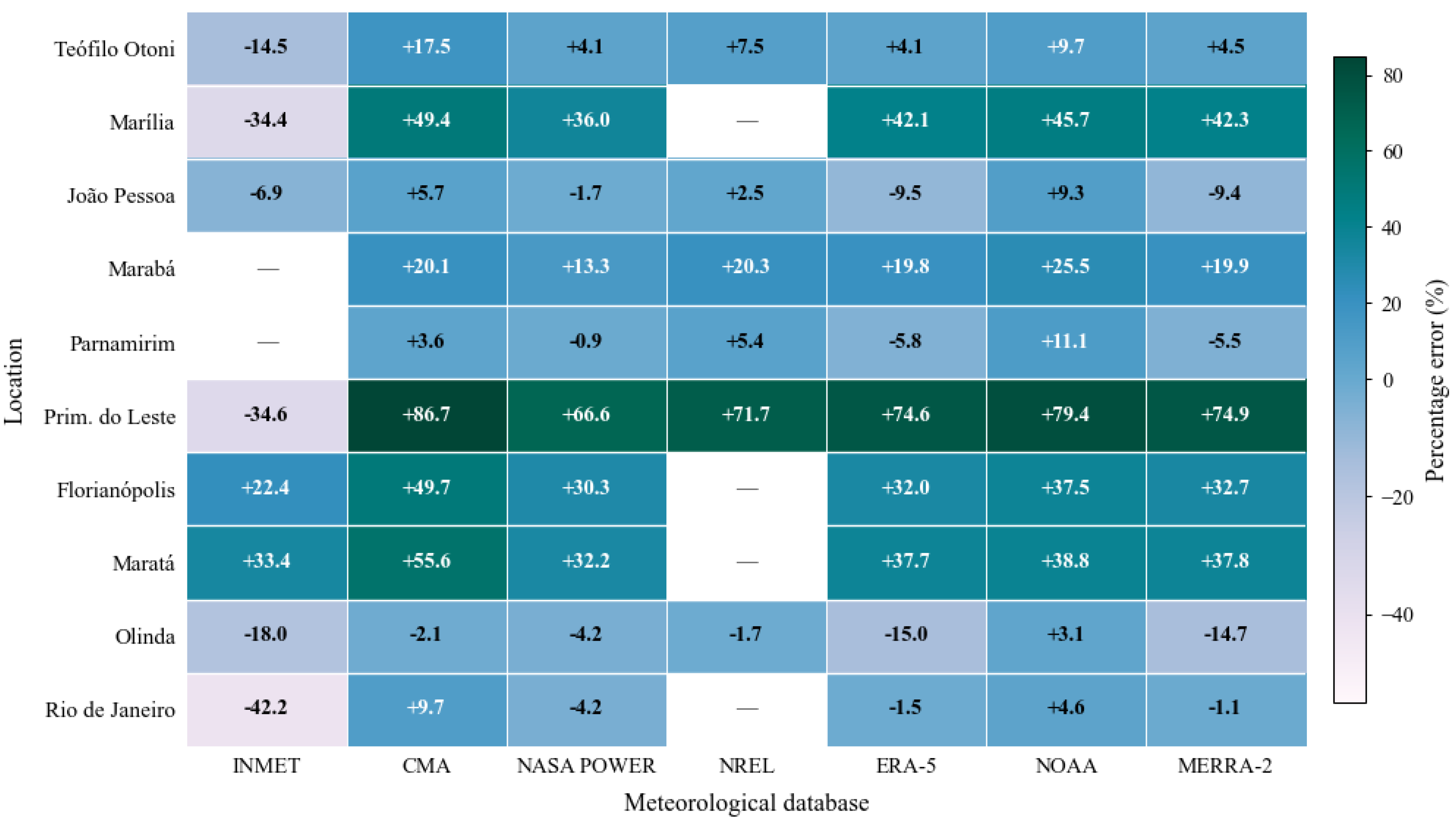
Figure 2.
Consolidated ranking: count of locations in which each database ranks first in terms of generation accuracy, financial adherence, and AHP score.
Figure 2.
Consolidated ranking: count of locations in which each database ranks first in terms of generation accuracy, financial adherence, and AHP score.
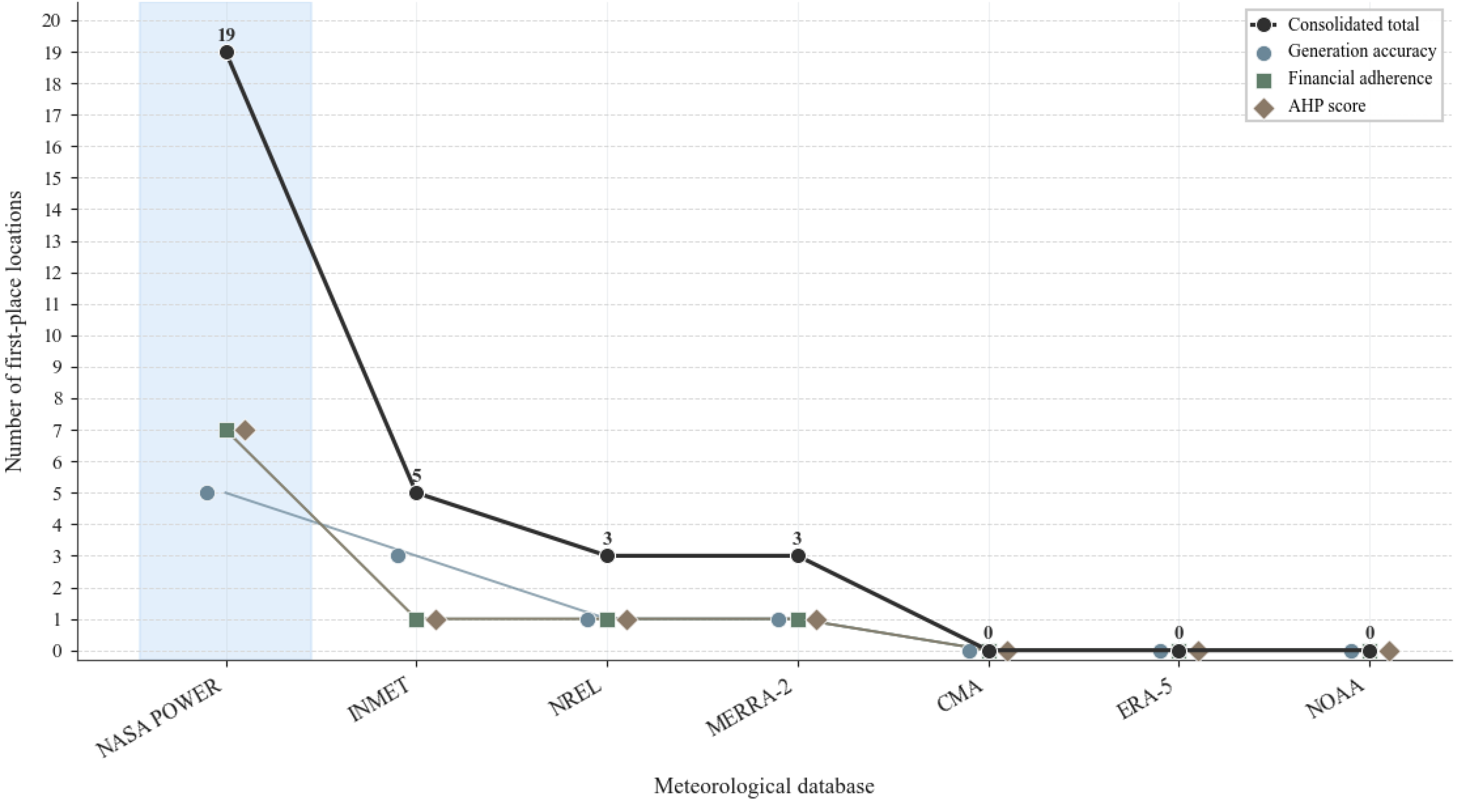
Figure 3.
Leadership matrix by meteorological database, location, and criterion. Markers denote first-place rankings: circle (G), generation accuracy; square (P), financial adherence; and diamond (A), AHP score. Gray dots indicate data availability without leadership. Totals are shown on the right.
Figure 3.
Leadership matrix by meteorological database, location, and criterion. Markers denote first-place rankings: circle (G), generation accuracy; square (P), financial adherence; and diamond (A), AHP score. Gray dots indicate data availability without leadership. Totals are shown on the right.
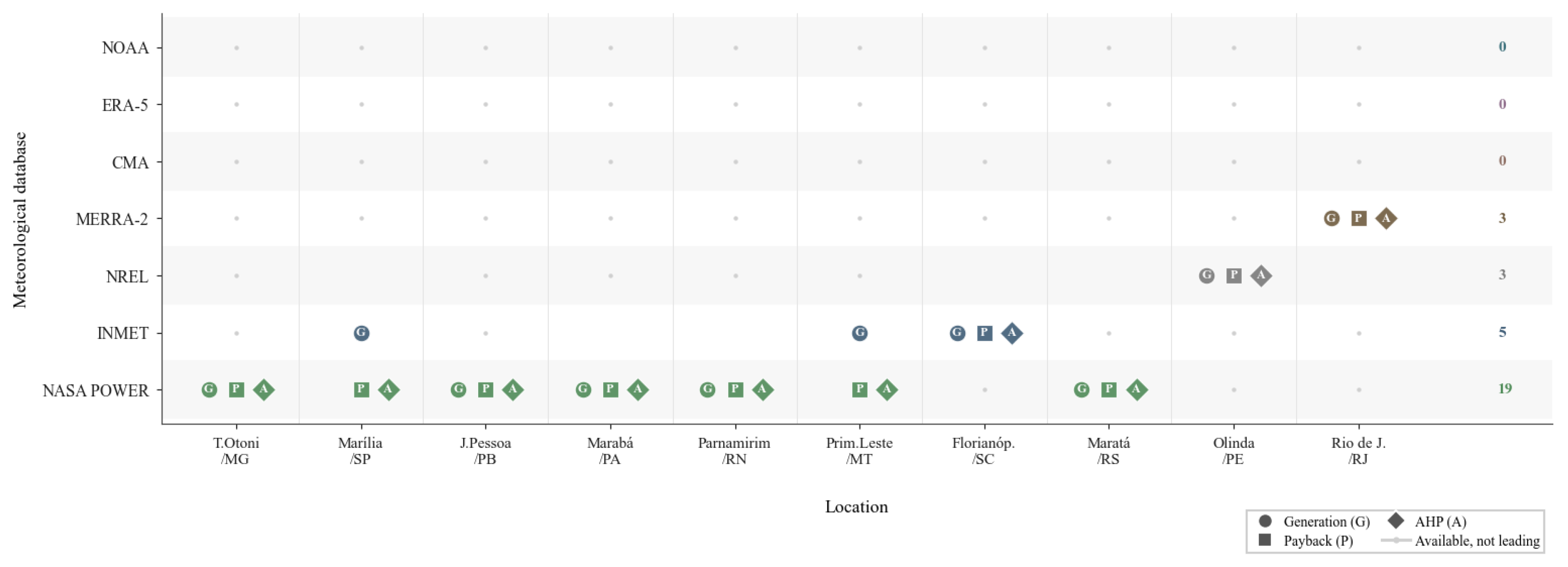
Figure 4.
Sensitivity of the average AHP score to alternative weighting scenarios. In each panel, the dashed line represents the baseline AHP score profile and the solid line represents the corresponding alternative weighting scenario.
Figure 4.
Sensitivity of the average AHP score to alternative weighting scenarios. In each panel, the dashed line represents the baseline AHP score profile and the solid line represents the corresponding alternative weighting scenario.
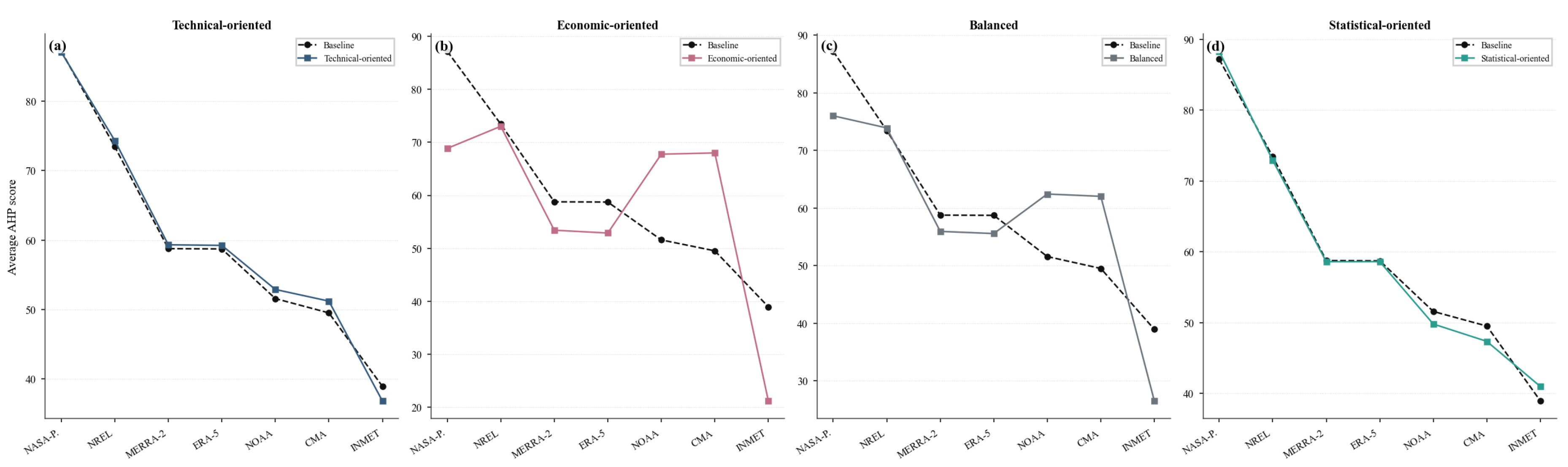
Figure 5.
Comparison of the economic indicators estimated by each database for the ten locations: (a) payback; (b) 25-year NPV. Dashed lines indicate the real values.
Figure 5.
Comparison of the economic indicators estimated by each database for the ten locations: (a) payback; (b) 25-year NPV. Dashed lines indicate the real values.
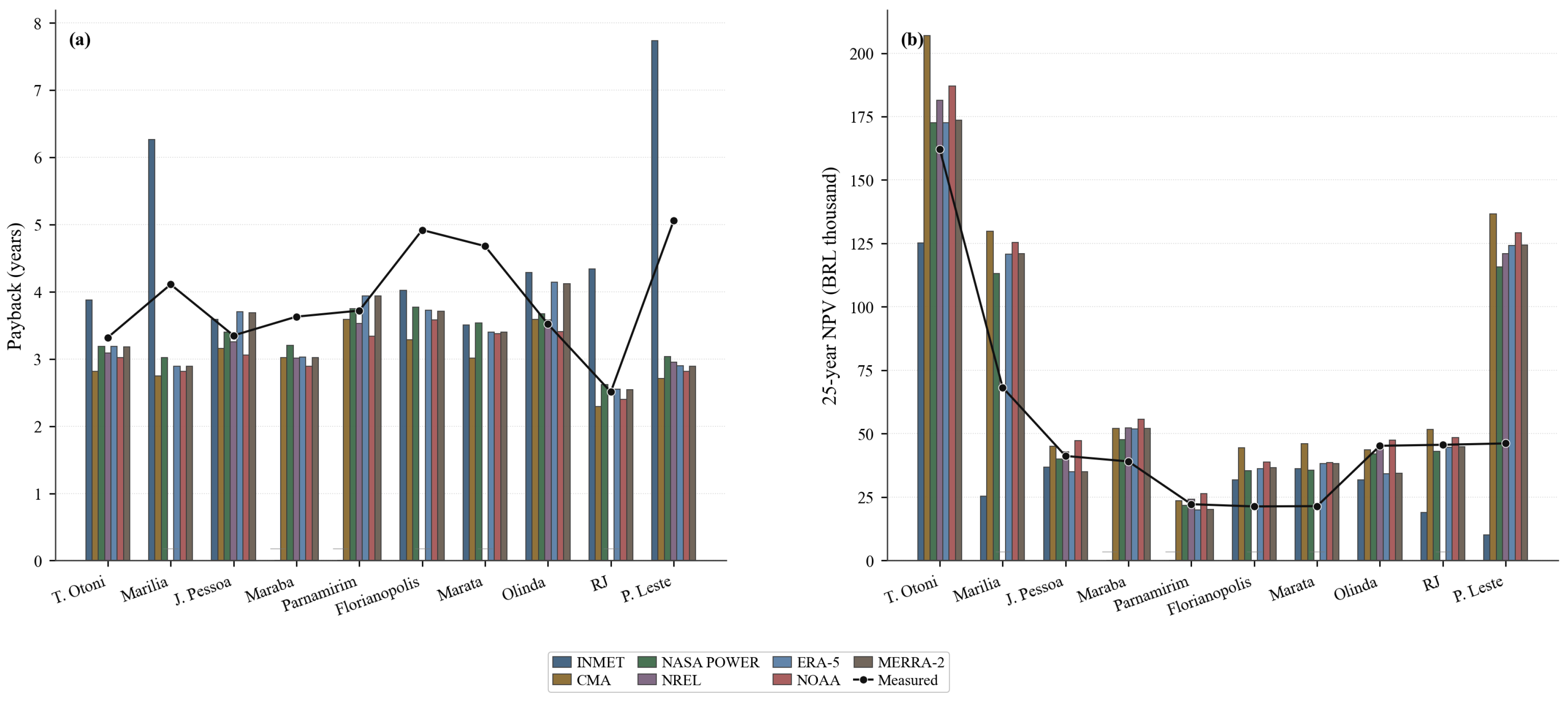
Figure 6.
Monthly generation estimated from the meteorological databases highlighted in the financial discussion, compared with the measured generation of the real PV systems. The panels show NASA POWER and INMET for Primavera do Leste/MT, and MERRA-2 for Rio de Janeiro/RJ, illustrating that aggregate multicriteria leadership does not necessarily coincide with the most accurate local financial projection.
Figure 6.
Monthly generation estimated from the meteorological databases highlighted in the financial discussion, compared with the measured generation of the real PV systems. The panels show NASA POWER and INMET for Primavera do Leste/MT, and MERRA-2 for Rio de Janeiro/RJ, illustrating that aggregate multicriteria leadership does not necessarily coincide with the most accurate local financial projection.
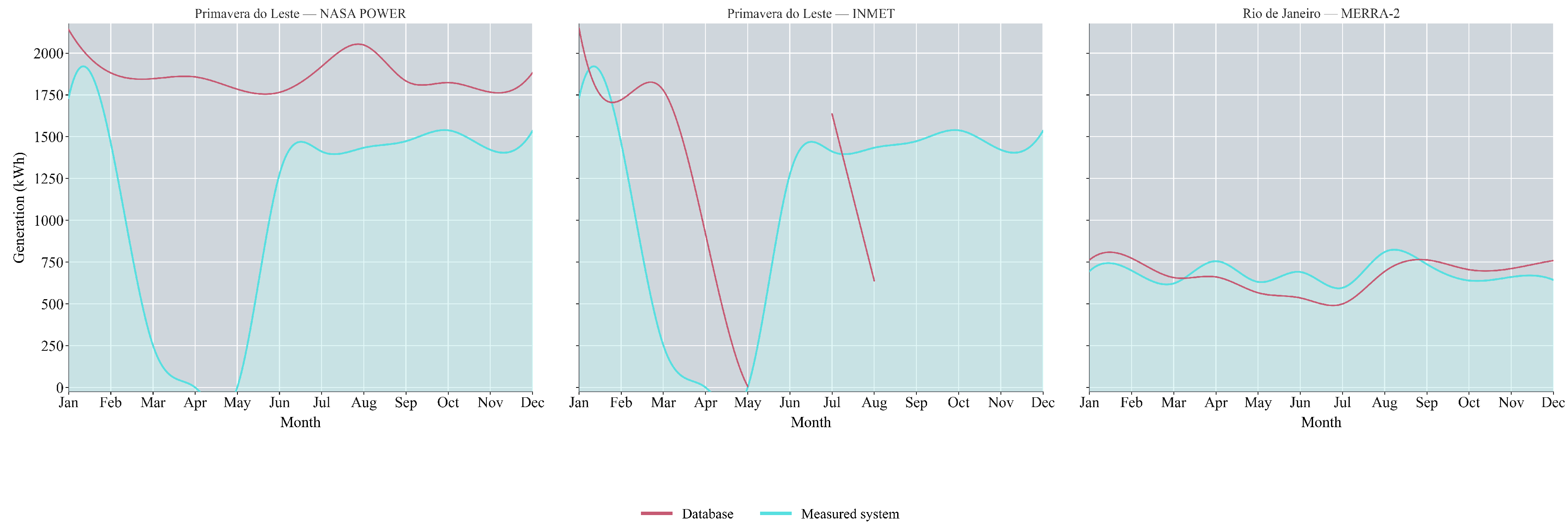
Figure 7.
Location of the case-study photovoltaic system in João Pessoa, Paraíba, Northeastern Brazil, highlighting its position in a tropical coastal zone.
Figure 7.
Location of the case-study photovoltaic system in João Pessoa, Paraíba, Northeastern Brazil, highlighting its position in a tropical coastal zone.
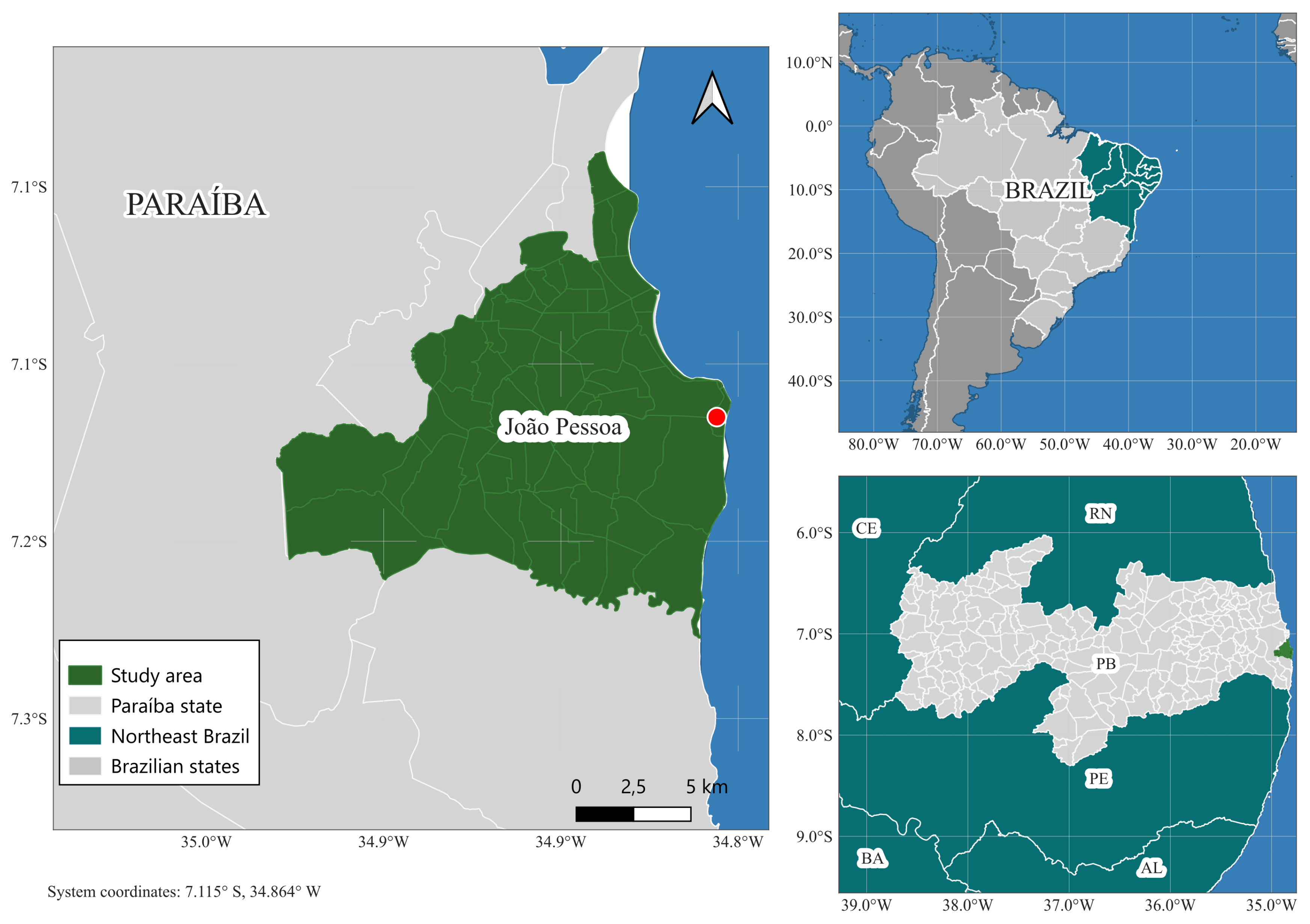
Figure 8.
Monthly generation estimated from each meteorological database, compared with the measured generation of the real PV system in João Pessoa (PB) in 2023. Only databases with available monthly data are shown.
Figure 8.
Monthly generation estimated from each meteorological database, compared with the measured generation of the real PV system in João Pessoa (PB) in 2023. Only databases with available monthly data are shown.
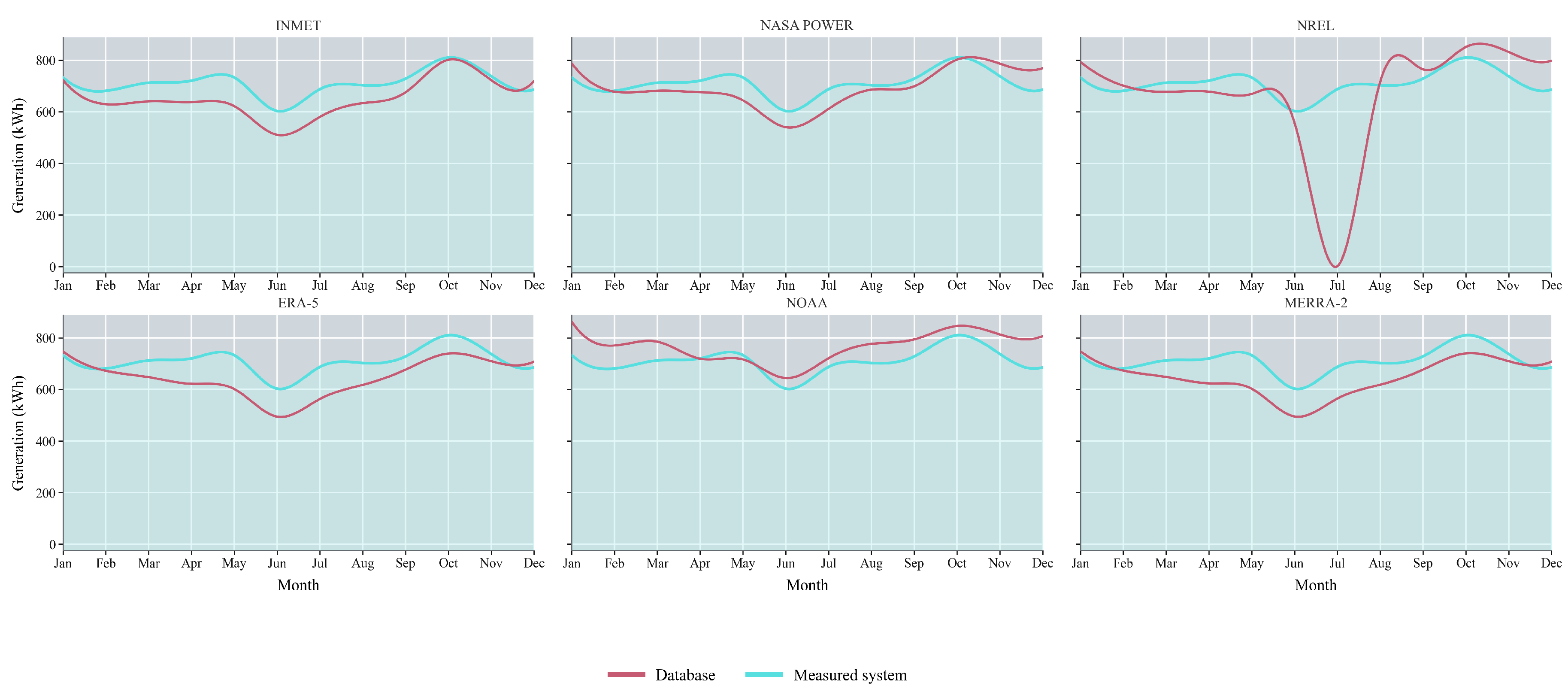
Figure 9.
Monthly generation estimated from each meteorological database, compared with the measured generation of the real PV system in João Pessoa (PB) in 2024.
Figure 9.
Monthly generation estimated from each meteorological database, compared with the measured generation of the real PV system in João Pessoa (PB) in 2024.
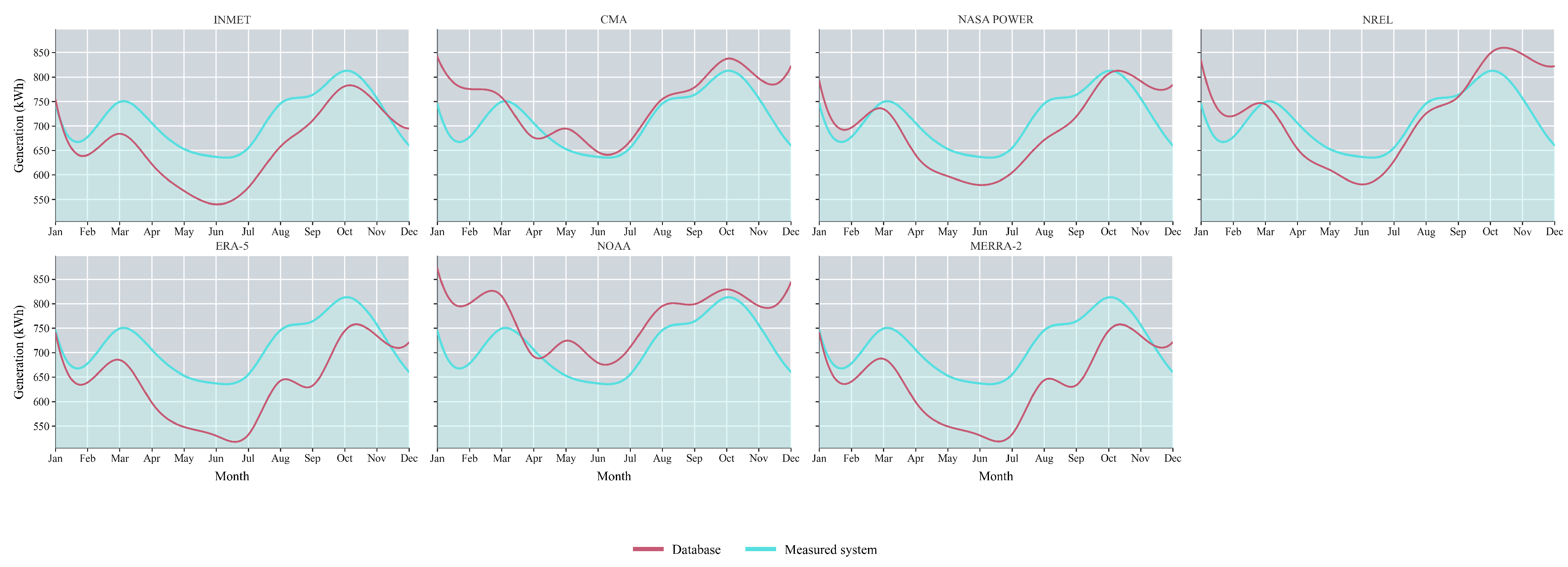
Figure 10.
Monthly generation estimated from each meteorological database, compared with the measured generation of the real PV system in João Pessoa (PB) in 2025. Databases with incomplete or unavailable monthly series are shown only where valid data exist.
Figure 10.
Monthly generation estimated from each meteorological database, compared with the measured generation of the real PV system in João Pessoa (PB) in 2025. Databases with incomplete or unavailable monthly series are shown only where valid data exist.
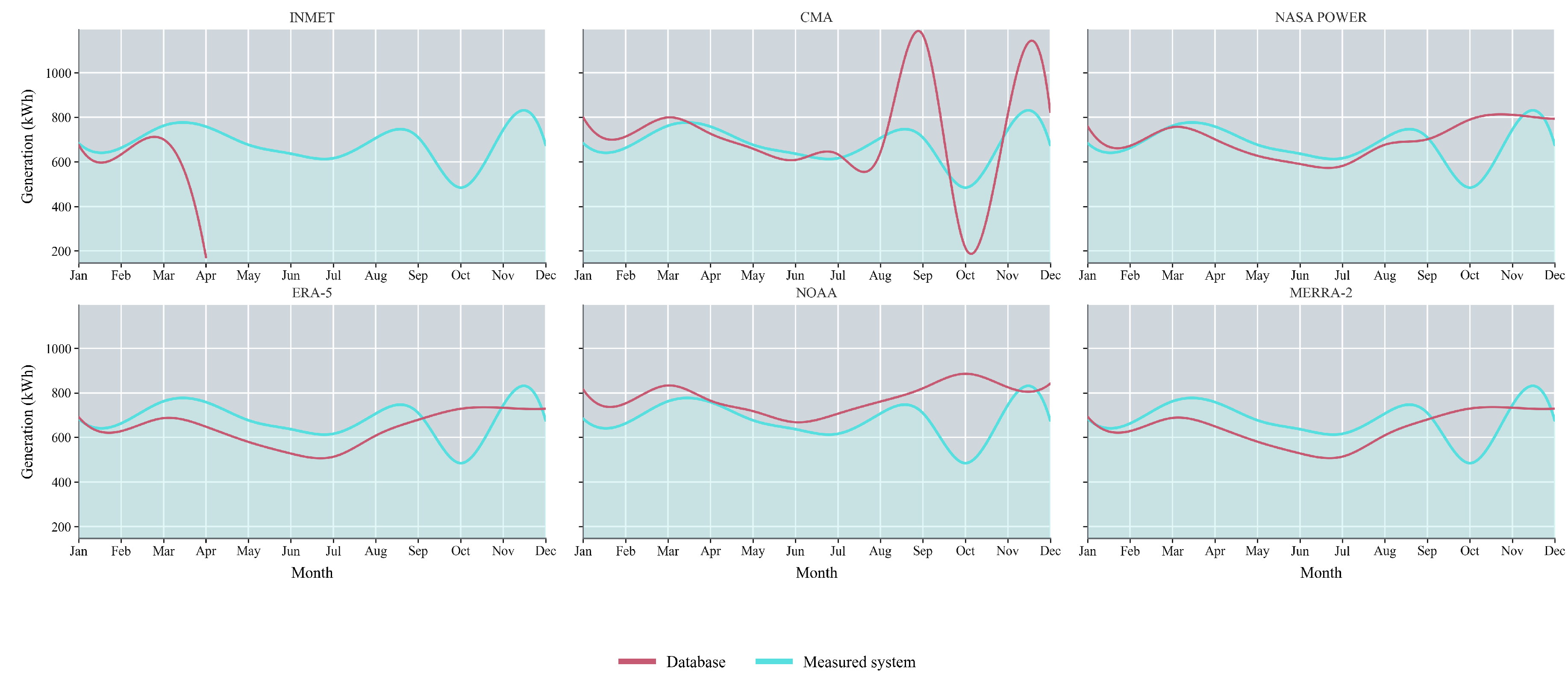
Figure 11.
Monthly generation estimated by the simplified CRESESB method and by NASA POWER, compared with the measured generation of the real PV system in João Pessoa (PB) for 2023, 2024, and 2025, illustrating the differences between annual agreement and month-by-month adherence.
Figure 11.
Monthly generation estimated by the simplified CRESESB method and by NASA POWER, compared with the measured generation of the real PV system in João Pessoa (PB) for 2023, 2024, and 2025, illustrating the differences between annual agreement and month-by-month adherence.
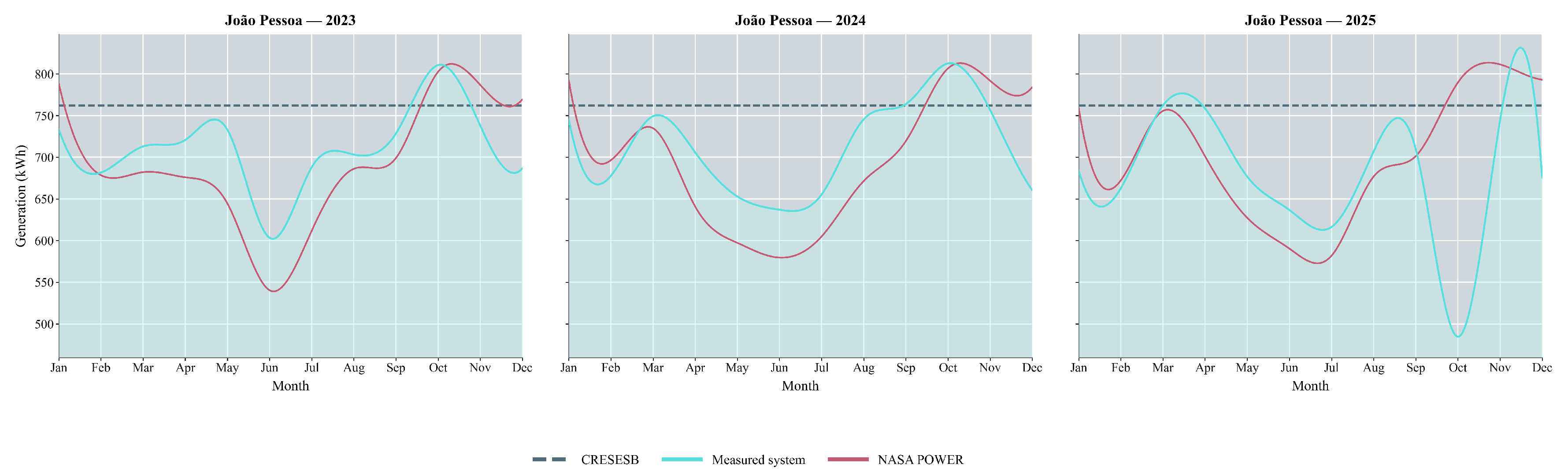

Table 1.
Spatial and temporal resolution of the evaluated databases.
| Database | Spatial res. | Temporal res. | Period |
|---|---|---|---|
| INMET | Point-based (stations) | Hourly | 1961–present |
| NASA POWER | (≈ 55 km) | Hourly | 1981–present |
| ERA-5 | (≈ 28 km) | Hourly | 1979–present |
| MERRA-2 | (≈ 55 km) | Hourly | 1980–present |
| NREL/NSRDB | ≈ 4 km | Hourly | 1998–present |
| CMA | ≈ 50 km | Hourly | Variable |
| NOAA | Variable | Hourly | Variable |
Table 2.
Alternative weighting scenarios adopted in the AHP sensitivity analysis.
| Scenario | MAPE | RMSE | NPV | Payback | |
|---|---|---|---|---|---|
| Balanced | 20% | 20% | 20% | 20% | 20% |
| Technical-oriented | 30% | 25% | 30% | 8% | 7% |
| Economic-oriented | 18% | 12% | 15% | 30% | 25% |
| Statistical-oriented | 42% | 23% | 25% | 5% | 5% |
Table 3.
Technical, geographic, and economic characterization of the analyzed PV systems.
| Location | State | Lat. | Lon. | Tariff | Cost | MARR | Lifetime | ||
|---|---|---|---|---|---|---|---|---|---|
| (deg) | (deg) | (kWp) | (kWh/year) | (BRL/kWh) | (BRL/kWp) | (%) | (years) | ||
| Teófilo Otoni | MG | 23.36 | 29,643 | 0.95 | 4,000 | 10 | 25 | ||
| Marília | SP | 14.88 | 14,971 | 0.95 | 3,800 | 10 | 25 | ||
| João Pessoa | PB | 5.50 | 8,562 | 0.84 | 4,000 | 10 | 25 | ||
| Marabá | PA | 6.50 | 7,708 | 0.93 | 4,000 | 10 | 25 | ||
| Parnamirim | RN | 3.85 | 5,919 | 0.70 | 4,000 | 10 | 25 | ||
| Florianópolis | SC | 6.64 | 5,700 | 0.90 | 3,800 | 10 | 25 | ||
| Maratá | RS | 6.02 | 5,140 | 0.95 | 3,800 | 10 | 25 | ||
| Olinda | PE | 6.36 | 10,566 | 0.77 | 4,500 | 10 | 25 | ||
| Rio de Janeiro | RJ | 6.23 | 8,175 | 0.85 | 2,800 | 10 | 25 | ||
| Primavera do Leste | MT | 16.64 | 13,553 | 0.85 | 3,500 | 10 | 25 |
Lat. and Lon. are given in decimal degrees; negative values indicate south latitude and west longitude. : installed capacity; : measured annual generation; MARR: minimum attractive rate of return.
Table 4.
Descriptive statistics of percentage errors by database.
| Database | Median | IQR | Min. | Max. | n |
|---|---|---|---|---|---|
| INMET | −16.25 | 34.87 | −42.21 | 33.43 | 8 |
| CMA | 18.82 | 42.92 | −2.06 | 86.71 | 10 |
| NASA POWER | 8.68 | 33.18 | −4.25 | 66.62 | 10 |
| NREL | 6.49 | 13.89 | −1.70 | 71.66 | 6 |
| ERA-5 | 11.93 | 40.99 | −14.96 | 74.63 | 10 |
| NOAA | 18.30 | 29.06 | 3.13 | 79.43 | 10 |
| MERRA-2 | 12.21 | 40.96 | −14.71 | 74.94 | 10 |
Median: median; IQR: interquartile range (); Min. and Max.: observed extreme values; n: number of locations with available data.
Table 5.
AHP scores by database and location. The highest value in each row is shown in bold. “—” indicates data unavailability, whereas 0.0 indicates the lowest normalized performance among the evaluated databases for that location.
Table 5.
AHP scores by database and location. The highest value in each row is shown in bold. “—” indicates data unavailability, whereas 0.0 indicates the lowest normalized performance among the evaluated databases for that location.
| City | INMET | CMA | NASA-P. | NREL | ERA-5 | NOAA | MERRA-2 |
|---|---|---|---|---|---|---|---|
| Teófilo Otoni/MG | 8.4 | 43.9 | 94.9 | 84.4 | 90.5 | 73.9 | 89.3 |
| Marília/SP | 37.3 | 37.4 | 94.2 | — | 71.6 | 57.1 | 70.7 |
| João Pessoa/PB | 55.1 | 67.3 | 92.5 | 77.0 | 0.0 | 20.5 | 2.3 |
| Marabá/PA | — | 56.1 | 86.7 | 52.8 | 56.4 | 13.3 | 55.5 |
| Parnamirim/RN | — | 70.7 | 90.7 | 70.9 | 60.7 | 13.3 | 62.5 |
| Primavera do Leste/MT | 38.7 | 13.3 | 75.4 | 58.4 | 55.2 | 37.3 | 54.0 |
| Florianópolis/SC | 86.7 | 13.3 | 69.8 | — | 59.6 | 45.8 | 58.0 |
| Maratá/RS | 85.5 | 13.3 | 86.3 | — | 71.5 | 66.8 | 71.3 |
| Olinda/PE | 0.0 | 95.9 | 87.0 | 97.2 | 25.5 | 95.3 | 27.3 |
| Rio de Janeiro/RJ | 0.0 | 83.7 | 94.3 | — | 96.1 | 92.5 | 96.6 |
| Average | 39.0 | 49.5 | 87.2 | 73.5 | 58.7 | 51.6 | 58.8 |
| Minimum | 0.0 | 13.3 | 69.8 | 52.8 | 0.0 | 13.3 | 2.3 |
| Maximum | 86.7 | 95.9 | 94.9 | 97.2 | 96.1 | 95.3 | 96.6 |
Table 6.
One-at-a-time sensitivity analysis of the AHP weighting structure.
| Criterion perturbed | Baseline weight (%) | Perturbation range | Top database | Share of top positions (%) |
|---|---|---|---|---|
| MAPE | 37.33 | −30% to +30% | NASA POWER | 100.0 |
| RMSE | 19.71 | −30% to +30% | NASA POWER | 100.0 |
| 29.69 | −30% to +30% | NASA POWER | 100.0 | |
| NPV | 7.56 | −30% to +30% | NASA POWER | 100.0 |
| Payback | 5.71 | −30% to +30% | NASA POWER | 100.0 |
In each case, one baseline weight is independently perturbed while the remaining weights are proportionally renormalized so that the total remains equal to one
Table 7.
Comparison of financial indicators for João Pessoa (PB) in 2023, 2024, and 2025.
| Year | Indicator | CRESESB | Measured system | NASA POWER |
|---|---|---|---|---|
| 2023 | Annual generation (kWh) | 9,144.00 | 8,540.30 | 8,365.21 |
| Annual savings (BRL) | 7,680.96 | 7,173.85 | 7,026.78 | |
| Payback (years) | 3.13 | 3.35 | 3.42 | |
| NPV–25 years (BRL) | 45,658.28 | 41,055.24 | 39,720.23 | |
| Generation deviation | +7.07% | — | −2.05% | |
| Payback deviation | −6.60% | — | +2.09% | |
| NPV deviation | +11.21% | — | −3.25% | |
| 2024 | Annual generation (kWh) | 9,144.00 | 8,562.40 | 8,420.05 |
| Annual savings (BRL) | 7,680.96 | 7,192.42 | 7,072.84 | |
| Payback (years) | 3.13 | 3.35 | 3.40 | |
| NPV–25 years (BRL) | 45,658.28 | 41,223.75 | 40,138.37 | |
| Generation deviation | +6.79% | — | −1.66% | |
| Payback deviation | −6.36% | — | +1.69% | |
| NPV deviation | +10.76% | — | −2.63% | |
| 2025 | Annual generation (kWh) | 9,144.00 | 8,118.20 | 8,460.41 |
| Annual savings (BRL) | 7,680.96 | 6,819.29 | 7,106.74 | |
| Payback (years) | 3.13 | 3.53 | 3.39 | |
| NPV–25 years (BRL) | 45,658.28 | 37,836.85 | 40,446.10 | |
| Generation deviation | +12.64% | — | +4.22% | |
| Payback deviation | −11.22% | — | −4.04% | |
| NPV deviation | +20.67% | — | +6.90% |
Investment: BRL 24,062.10; Tariff: BRL 0.84/kWh; MARR: 10%; deviations are relative to the measured system.
Disclaimer/Publisher’s Note: The statements, opinions and data contained in all publications are solely those of the individual author(s) and contributor(s) and not of MDPI and/or the editor(s). MDPI and/or the editor(s) disclaim responsibility for any injury to people or property resulting from any ideas, methods, instructions or products referred to in the content. |
© 2026 by the authors. Licensee MDPI, Basel, Switzerland. This article is an open access article distributed under the terms and conditions of the Creative Commons Attribution (CC BY) license (http://creativecommons.org/licenses/by/4.0/).
Copyright: This open access article is published under a Creative Commons CC BY 4.0 license, which permit the free download, distribution, and reuse, provided that the author and preprint are cited in any reuse.


