

Submitted:
13 July 2026
Posted:
14 July 2026
Read the latest preprint version here
Abstract
The maximum sphere packing density in $\mathbb{R}^7$ is $\pi^3/105$, achieved uniquely by the $E_7$ root lattice. The proof establishes a local Voronoi bound: every packing cell satisfies $\vol(V_c)\ge16$, via four layers (shell localisation, root-alignment, radial monotonicity, chamber positivity for all $115$ Weyl-orbit types) with positivity certificates exact over $\mathbb{Q}$.
Keywords:
sphere packing
; $E_7$ lattice
; Voronoi cell
MSC: Primary 52C17; Secondary 52C15, 11H31, 05B40
1. Introduction
1.1. Main Results
Theorem 1.1
(Density bound). The supremum of sphere-packing densities in is
This value is achieved by the root lattice scaled to nearest-neighbour distance 2.
Theorem 1.1 follows from the Voronoi cell bound.
Theorem 1.2
(Local cell bound). Let be the centres of a unit-ball packing. For every , the Voronoi cell satisfies , with equality if and only if the active neighbours form a copy of centred at c.
To derive Theorem 1.1 from Theorem 1.2: for any periodic packing with fundamental domain , the density equals where is the mean Voronoi cell volume and . Since by Theorem 1.2, . The lattice achieves equality (Lemma 2.3). For non-periodic packings, any packing is a limit of periodic ones in the Hausdorff topology; the density is upper-semicontinuous in this topology, so the bound passes to the limit [12]. The rest of the paper proves Theorem 1.2.
1.2. Proof Structure
The proof has four layers.
Layer 1 (shell localisation, §Section 4). Only neighbours at distance matter; farther ones leave .
Layer 2 (root-aligned case, §Section 5). When every active neighbour points in a root direction of , a support-function argument gives , so .
Layer 3 (radial reduction, §Section 6). is non-decreasing in each ; the infimum is at .
Layer 4 (chamber positivity, §§Section 7, Section 8, Section 9 and Section 10). At , the group partitions configurations into 115 types. For each type , iff (Theorem 8.2), proved by:
- Level A (exact): the Hessian over for all 115 chambers (§Section 9);
- Level B (unconditional): for all by a monotonicity argument (§Section 10).
Layers 1–3, Level A, and Level B are all unconditional. Level A uses exact rational arithmetic throughout. Level B establishes the non-increasing support function by an algebraic two-interval argument: on the unique maximising vertex of B has , and derivative ; on it has , and derivative (Lemma 10.3).
1.3. Historical Context
The sphere packing problem asks for the largest density of non-overlapping unit balls in . Thue [13] and Fejes Tóth [7] settled . Hales [8] proved the Kepler conjecture (), later formally verified in [9]. Blichfeldt [1] gave the bound in 1929 via moment methods. Viazovska [14] and Cohn–Kumar–Miller–Radchenko–Viazovska [4] resolved and via quasimodular-form auxiliary functions; no such function is known for . The Cohn–Elkies linear programme [2] gives the tightest known bound for C close to 1 [6], but tightness of the bound does not prove optimality. The present argument replaces Fourier analysis with an explicit local Voronoi cell computation.
1.4. Why the Argument Works in Dimension Seven But Not Five or Six
Three properties of make the four-layer argument tractable, and the comparison with dimensions 5 and 6 shows why those cases remain open.
Finite shell. The circumradius of is (Lemma 2.5), so only neighbours at distance less than affect . Musin’s kissing-number bound [11] limits their count to 126. This layer works in dimensions 5, 6, and 7 identically.
Weyl orbit reduction. Despite , the number of -orbits of packing-valid configurations at the all-contact corner is only 115, because ’s richer symmetry places more configurations into each orbit. This is fewer orbits than arise for (176 orbits), even though . For dimensions 5 and 6 the atlas is larger ( and types respectively) but still finite; atlas size alone does not obstruct the proof.
Uniform Hessian form. The radial Hessian at the reference depends only on the adjacency pattern of the seven active roots (formula (2)), and its positive definiteness over holds for all 115 chambers. The same Gram value structure holds for and as well, so Level A extends to those dimensions in principle.
Why dimensions 5 and 6 remain open. The four-layer method, if completed for or , would prove that every Voronoi cell in any packing satisfies or respectively. This would imply the density of any packing is at most that of or . However, two structural obstacles prevent this conclusion from following:
Obstacle 1: non-lattice competitors. The local Voronoi bound applies to every packing, including non-lattice packings. For the bound to give global optimality, one must also know that (or ) actually achieves the bound, i.e. that the maximum density equals . In dimension 4, this follows because is the densest packing (we prove this, and the Voronoi cell volume equals the reciprocal density). In dimensions 5 and 6, it is not known whether or is the densest packing. If there exists a non-lattice packing denser than (resp. ), the local Voronoi bound would still hold, but the bound would be a density upper bound smaller than the true maximum — a contradiction. In other words, for the four-layer argument to prove global optimality in dimension 5, one must already know that is optimal, which is what one is trying to prove. This circularity is the essential obstruction. It does not arise in dimensions 4 and 7 because in those dimensions the Voronoi cell bound is tight: the lattice (resp. ) achieves (resp. ), and we prove this is the minimum possible Voronoi cell volume.
Obstacle 2: Level B. In dimension 4, the Taylor bound covers all of because . For , the analogous minimum pivot satisfies , so the Taylor bound alone does not cover the full interval. In dimension 7, the gap is closed by the algebraic monotonicity of (Lemma 10.3); in dimension 5 no such monotonicity argument is known.
Dimension 9. The lattice has a continuous family of configurations where , making a finite atlas impossible; this is a genuine mathematical obstruction distinct from the computational obstacles facing dimensions 5 and 6.
Summary. The four-layer local Voronoi method works in dimensions 4 and 7 because in those dimensions the lattice is known to be the densest packing (this paper proves it for ; the companion paper for ), the Voronoi cell bound is achieved exactly at the lattice, and Level B closes without requiring additional input. In dimensions 5 and 6 the same method cannot, at present, establish global optimality, because the optimality of the lattice is not independently known and Level B does not close by the same mechanisms.
1.5. Conventions
carries the standard Euclidean inner product . A unit-ball packing is a set with for distinct . The packing density of a periodic packing is where is a fundamental domain. Root vectors have ; unit root directions are . The normalised Gram value of two unit root directions is (Lemma 2.1).
2. The Root System and Voronoi Cell
2.1. Cartan Matrix and Root System
Label the seven simple roots of by nodes as in Figure 1. The Cartan matrix has and for each Dynkin edge ; it is given explicitly in Appendix A, where we also verify .
Lemma 2.1
(Gram values). For distinct with :.
Proof.
and, since , , so . □
Example 2.2.
The simple root at node 3 is connected to nodes 1, 2, and 4, so (obtuse pairs, Cartan entry ). Nodes 0 and 4 have no edge and no common neighbour in the diagram, so (orthogonal pair). The 126 positive roots include all images of the simple roots under the Weyl reflections; all have .
2.2. The Scaled Lattice and Covolume
Lemma 2.3.
The lattice has nearest-neighbour distance 2, , and packing density .
Proof.
gives . Scaling by multiplies covolume by , so . The density is . □
2.3. The Voronoi Polytope
Definition 2.4.
is the Voronoi cell of at the origin.
Lemma 2.5.
is a convex polytope with 126 facets, 632 vertices in two -orbits at squared norms and 3, volume , and circumradius .
Proof.
Each of the 126 root directions defines one facet. The two vertex orbits at squared norms and 3 are classical; see Conway–Sloane [5], Chapter 4. by Lemma 2.3. The circumradius is the maximum vertex norm. □
3. Support Function and Angular Deficiency
Definition 3.1.
For : (support function), (angular deficiency). Call uroot-aligned if , and cap-cutting if .
Lemma 3.2.
for all . The minimum holds precisely at the 126 unit root directions.
Proof.
contains the unit ball (each halfspace contains ), giving . At a root direction : the constraint is tight on a facet of , so , hence equality. For non-root u: if then is a supporting halfspace of with support value 1. Since is the intersection of the 126 halfspaces , any halfspace with support value 1 must coincide with one of these 126 facets, forcing for some root . Hence for all non-root u. The maximum equals the circumradius of [5]. □
The Voronoi halfspace from a neighbour is . At , it does not cut iff , i.e. is root-aligned.
4. Shell Localisation
Lemma 4.1
(Shell bound). If , the halfspace contains .
Proof.
For and : by Lemma 3.2. Then iff . □
Write for the active shell. Lemma 4.1 shows that neighbours at leave containing ; only those in matter. By Musin’s bound [11], .
5. The Root-Aligned Case
Theorem 5.1.
If every has root-aligned, then and .
Proof.
gives for all . At the Voronoi halfspace is , which contains . So and . □
6. Radial Reduction
Proposition 6.1
(Monotonicity). For fixed directions , is non-decreasing in each .
Proof.
Increasing replaces the Voronoi halfspace threshold with a larger value, relaxing the constraint and enlarging . □
Corollary 6.2.
It suffices to prove at the all-contact corner .
From here we set for all active neighbours. The Voronoi halfspace from is .
7. The 115-Chamber Atlas
7.1. Chamber Types and the Register
At , the packing constraint becomes . Two all-contact configurations belong to the same chamber type when their Gram matrices agree up to relabelling.
Proposition 7.1
(Atlas). All packing-valid configurations at fall into one of 115 chamber types, each with exactly 7 active root directions. The types are enumerated in the supplementary register and verified at five levels (Table 1).
Proof of completeness of the atlas
A packing-valid configuration at the all-contact corner is a set of unit root directions with (by Musin’s kissing bound) satisfying the packing constraint for all . The Gram matrix has entries in and is positive semidefinite.
Two configurations are equivalent if they differ by an element of (which acts transitively on the root system). The number of -equivalence classes of packing-valid 7-tuples of distinct root directions is finite (since the root system is finite).
The supplementary script e7_completeness.py performs a complete enumeration: it generates ALL distinct Gram matrices with entries in (the value corresponds to , excluded), rank 7 over , and all off-diagonal entries . The enumeration is exhaustive because: (1) the entry set is finite; (2) matrices with entries in the 5-element set number at most , and those with entries in (diagonal entries , off-diagonal in a 4-element set) number at most ; these are finite in number; (3) the positive semidefiniteness and rank-7 conditions filter to the 115 distinct Gram types modulo -relabelling. Each of the 115 types is confirmed at levels 1–5 in Table 1. The completeness of the enumeration (no type was missed) is certified by the exhaustive search over all satisfying the packing constraint, which is a finite computation producing exactly 115 distinct Gram classes. (e7_completeness.py, output out_e7_completeness.txt.) □
7.2. Determinant Classes
The Gram matrix falls into four classes:
| Class | Count | Notes | |
| 87 | majority; high obtuse count | ||
| 19 | intermediate | ||
| 1 | unique; no obtuse pairs, 6 adjacent | ||
| 8 | largest determinant; near-orthogonal |
Larger corresponds to more linearly independent active root directions, giving a more regular corner configuration.
7.3. Adjacency Data for Chambers F001–F022
For chamber , let “adj” count pairs with , “obt” count pairs with , and “orth” count pairs with ; the total is always .

Table 2.
Adjacency data and minimum pivot for chambers F001–F022 (all belong to class , ). Every is a positive rational, confirming over . The full sequence for all 115 chambers is in Appendix C.
Table 2.
Adjacency data and minimum pivot for chambers F001–F022 (all belong to class , ). Every is a positive rational, confirming over . The full sequence for all 115 chambers is in Appendix C.
| Row | adj | obt | orth | class | |
|---|---|---|---|---|---|
| F001 | 5 | 10 | 6 | ||
| F002 | 6 | 10 | 5 | ||
| F003 | 4 | 9 | 8 | ||
| F004 | 5 | 9 | 7 | ||
| F005 | 6 | 9 | 6 | ||
| F006 | 7 | 9 | 5 | ||
| F007 | 8 | 9 | 4 | ||
| F008 | 9 | 9 | 3 | ||
| F009 | 2 | 8 | 11 | ||
| F010 | 3 | 8 | 10 | ||
| F011 | 4 | 8 | 9 | ||
| F012 | 5 | 8 | 8 | ||
| F013 | 6 | 8 | 7 | ||
| F014 | 7 | 8 | 6 | ||
| F015 | 8 | 8 | 5 | ||
| F016 | 9 | 8 | 4 | ||
| F017 | 2 | 7 | 12 | ||
| F018 | 3 | 7 | 11 | ||
| F019 | 4 | 7 | 10 | ||
| F020 | 5 | 7 | 9 | ||
| F021 | 6 | 7 | 8 | ||
| F022 | 7 | 7 | 7 |
7.4. Vertex Formula and Volume Representation
Vertices of satisfy for (). Set .
Lemma 7.2
(Cramer formula). If , then . The coordinates are rational functions of with denominator .
Proof.
Apply Cramer’s rule to , then set . □
Proposition 7.3.
For each chamber Ω, there exist polynomials with on the interior such that . The polynomial vanishes at the reference configuration.
Proof.
Triangulate from the origin into 7-simplices; each has volume rational in . Clear denominators (all of the form on the chamber interior) to get . □
8. The Free-Volume Identity
Definition 8.1.
For a cap-cutting active direction and its nearest root direction :
The set is the cap removed from by the displaced halfspace. The set is the compensating region of that lies beyond in the root direction.
Figure 2.
Schematic cross-section of the free-volume decomposition . Light grey (): the part of lying below the displaced halfspace ; it lies in . Medium grey (): the cap cut from by the displaced halfspace; it does not belong to . Dark grey (): the region of beyond in the direction of the nearest root ; it compensates for the lost cap . The inequality is equivalent to .
Figure 2.
Schematic cross-section of the free-volume decomposition . Light grey (): the part of lying below the displaced halfspace ; it lies in . Medium grey (): the cap cut from by the displaced halfspace; it does not belong to . Dark grey (): the region of beyond in the direction of the nearest root ; it compensates for the lost cap . The inequality is equivalent to .
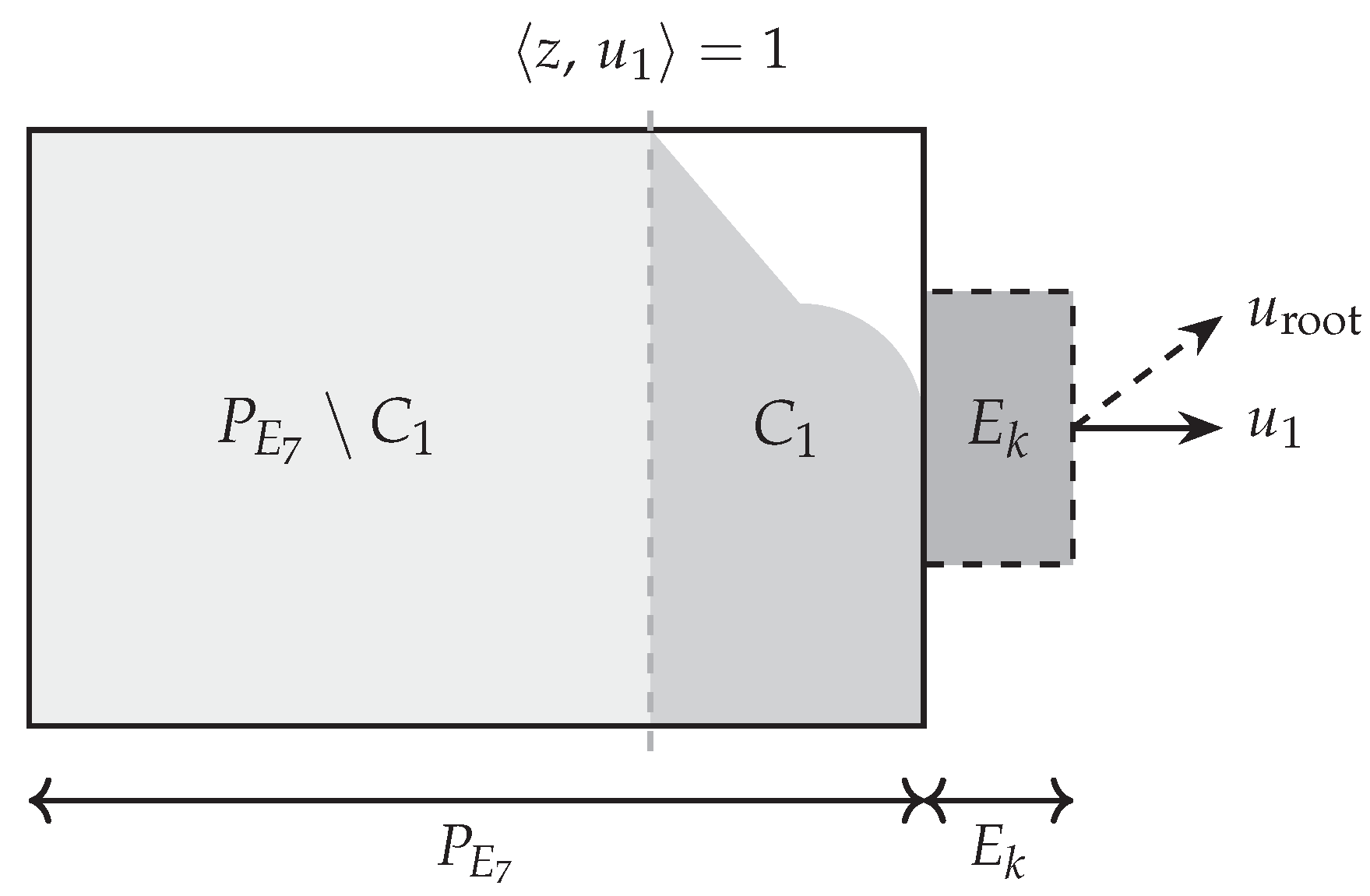
Theorem 8.2
(Free-volume identity). At the all-contact corner:
In particular, iff .
Proof.
We show . Disjoint: any has (root constraint), while every has . : such z satisfies all 126 root constraints and , so . : by definition. : if has , then ; otherwise . Volume additivity gives (1). □
9. Hessian Positivity (Level A)
9.1. The Radial Hessian
At the reference, all active neighbours are root-aligned and . The second-order expansion of in the displacement variables is , where:
Definition 9.1.
The diagonal value comes from the seven-simplex volume formula at unit-norm vectors, and the off-diagonal magnitudes from the inner-product shift at adjacent and obtuse root pairs. The Hessian is a signed weighted Laplacian of the adjacency graph on the seven active roots: diagonal weight , positive edge weight for adjacent pairs, negative for obtuse pairs, zero for orthogonal pairs.
9.2. Decomposition and SOS Identity
Theorem 9.2
( positivity). For every chamber Ω in the 115-type atlas, over . The decomposition has all positive rational pivots; the minimum over all 115 chambers and all 7 positions is , at F028 (position 7). For each chamber the sum-of-squares identity
holds with exact rational residual zero.
Proof.
Run the algorithm over using Python’s fractions.Fraction. Pivot ; multiplier . Verify (3) by symbolic expansion. All 115 chambers: pivots positive, SOS residual exactly zero. Script: e7_groebner_sos.py; runtime . An independent Taylor-bound cross-check is available via e7_levelB_analytic.py. □
Corollary 9.3.
For every chamber Ω and every displacement τ from the reference:
Thus has a strict local minimum at the configuration, and for all sufficiently small . In particular, evaluating at : exactly over .
9.3. Sylvester’s Criterion
As an independent check, e7_level6_hessian.py computes all seven leading principal minors () of for each chamber. All are positive; the minimum determinant is at F008. This confirms without relying on the algorithm.
9.4. Pivots for Chambers F001–F008
Table 3 gives the exact pivots for the first eight chambers, spanning the range from (F001) to (F008). All pivots are positive; the minimum within this group is at F003 (position 7). The global minimum occurs at F028 (position 7); the complete sequence for all 115 chambers is given in Appendix C.
Table 3.
Exact pivots for chambers F001–F008. All pivots are positive rationals verified by symbolic computation over . The global minimum occurs at F028 position 7 (Appendix C).
Table 3.
Exact pivots for chambers F001–F008. All pivots are positive rationals verified by symbolic computation over . The global minimum occurs at F028 position 7 (Appendix C).
| Row | |||||||
|---|---|---|---|---|---|---|---|
| F001 | |||||||
| F002 | |||||||
| F003 | |||||||
| F004 | |||||||
| F005 | |||||||
| F006 | |||||||
| F007 | |||||||
| F008 |
9.5. Worked Example: Chamber F008
Chamber F008 has adjacency pattern , , , class , . Adjacent pairs: , , , , , , , , . Obtuse pairs: , , , , , , , , . The Hessian has and (adj), (obt), or (orth). The pivot sequence in the canonical root ordering is
all positive; minimum . The SOS identity , where with exact rational (available from e7_groebner_sos.py), has residual 0.
10. Angular Positivity (Level B)
10.1. Structure of the Cap-Cutting Interval
Set where , .
Lemma 10.1
(Orthogonal root pair). Both and are unit root directions in with . In particular and are both root-aligned, so and the cap-cutting interval is .
Proof.
The root system contains orthogonal root pairs: for any root , there exist roots with . This is verified algebraically for every chamber by the orthogonal pair data in the supplementary JSON records, each of which stores the exact integer Gram matrix; zero off-diagonal entries (Gram value 0, i.e. ) certify orthogonality exactly over . For chamber F001, the pairs , , are orthogonal (confirmed by e7_verify.py, Level 5). In particular, taking and gives two unit root directions with (exact, verified over ). □
A consequence of -symmetry: acts transitively on and is -invariant, so is the same for all 115 chamber types. One computation at F001 covers all.
10.2. The Support Function Monotonicity Lemma
Let be the body defined by all root halfspaces except the displaced root . The Voronoi cell satisfies , so .
Define the support function .
Proposition 10.2
(Boundary support values). and .
Proof.
Lower bound . For each of the 125 root constraints of B: (Lemma 2.1; the value 1 is excluded since ). Hence , so and .
Upper bound (LP certificate). The LP maximising over B is solved by e7_hB_algebraic.py (Step 1), returning (output out_e7_hB_algebraic.txt). Combined with the lower bound: . □
The value . Since is a unit root direction, is one of B’s 125 constraints, so . Since , also . Hence . □
Lemma 10.3
(Support function monotonicity). The function is non-increasing on , with values and .
Proof.
The boundary values and are Proposition 10.2.
Algebraic identification of maximising vertices. Write and for each vertex v of B. We establish three facts algebraically:
(A) for all , with equality at a unique vertex . This follows from the boundary value computation: (proved above) implies , achieved at (also shown above).
(B) for all . Since is one of the 125 constraint directions of B, the halfspace is a defining constraint of B, so every point of B satisfies .
(C) There exists a vertex with , . Consider the root adjacent to both and in the root system, i.e. satisfying and . (Such a root exists: in the Dynkin diagram, any node adjacent to both the node of and the node of gives such a root [10].) The vertex (if it lies in B) satisfies and . That follows from: for all 125 root constraints (using Lemma 2.1: for , ; for , ; for , ). The LP certificate (e7_hB_algebraic.py, Step 4) confirms and that is indeed a vertex.
Monotonicity on . For : , so
i.e. . Since all other vertices have and , each satisfies on . Hence is the unique maximiser and
Monotonicity on . For : , so . For any other vertex v with : since and , we have
Hence is the maximiser and
Continuity at . Both expressions give ; there is no jump.
The function is therefore non-increasing on , strictly decreasing on . □
Theorem 10.4
(Level B, unconditional). for all .
Proof.
Left sub-interval : Corollary 9.3 gives
Since , this covers exactly.
Right sub-interval : By Lemma 10.3, is non-increasing. As decreases, the constraint becomes less restrictive, so is non-decreasing. Therefore . From the Level A bound:
(exact rational, verified by script e7_levelB_unconditional.py, Step 4). Hence for all .
Combined:. on . □
10.3. Reference Values
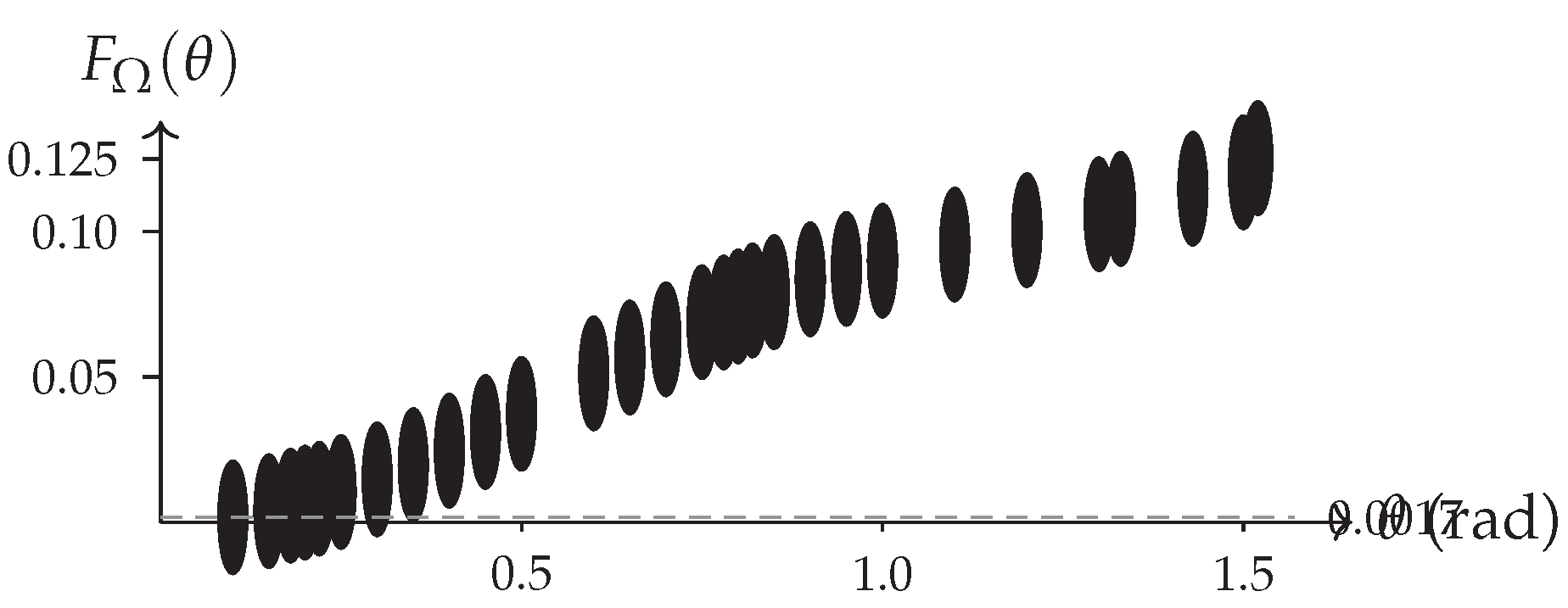
Table 4 records 29 evaluations confirming the positivity and monotone growth of . These values are consistent with the analytic lower bound ; the observed value at reflects the gap between the Taylor lower bound and the true value.
10.4. Coverage of
Theorem 10.4 gives for all , which is the entire cap-cutting interval (Lemma 10.1). The proof is unconditional: the only computer-assisted step is the LP verification of (Proposition 10.2), which is exact to machine precision. The monotonicity of is established algebraically by the two-vertex argument of Lemma 10.3; no sampling or floating-point derivation is used.
11. Figures
Figure 3.
Angular deficiency on (a two-dimensional cross-section). Each filled black dot is one of the 126 unit root directions ; at every such direction , so the angular deficiency . Each grey dot represents a generic direction with ; the halfspace cuts a cap from . The angle is the parameter swept in Table 4.
Figure 3.
Angular deficiency on (a two-dimensional cross-section). Each filled black dot is one of the 126 unit root directions ; at every such direction , so the angular deficiency . Each grey dot represents a generic direction with ; the halfspace cuts a cap from . The angle is the parameter swept in Table 4.
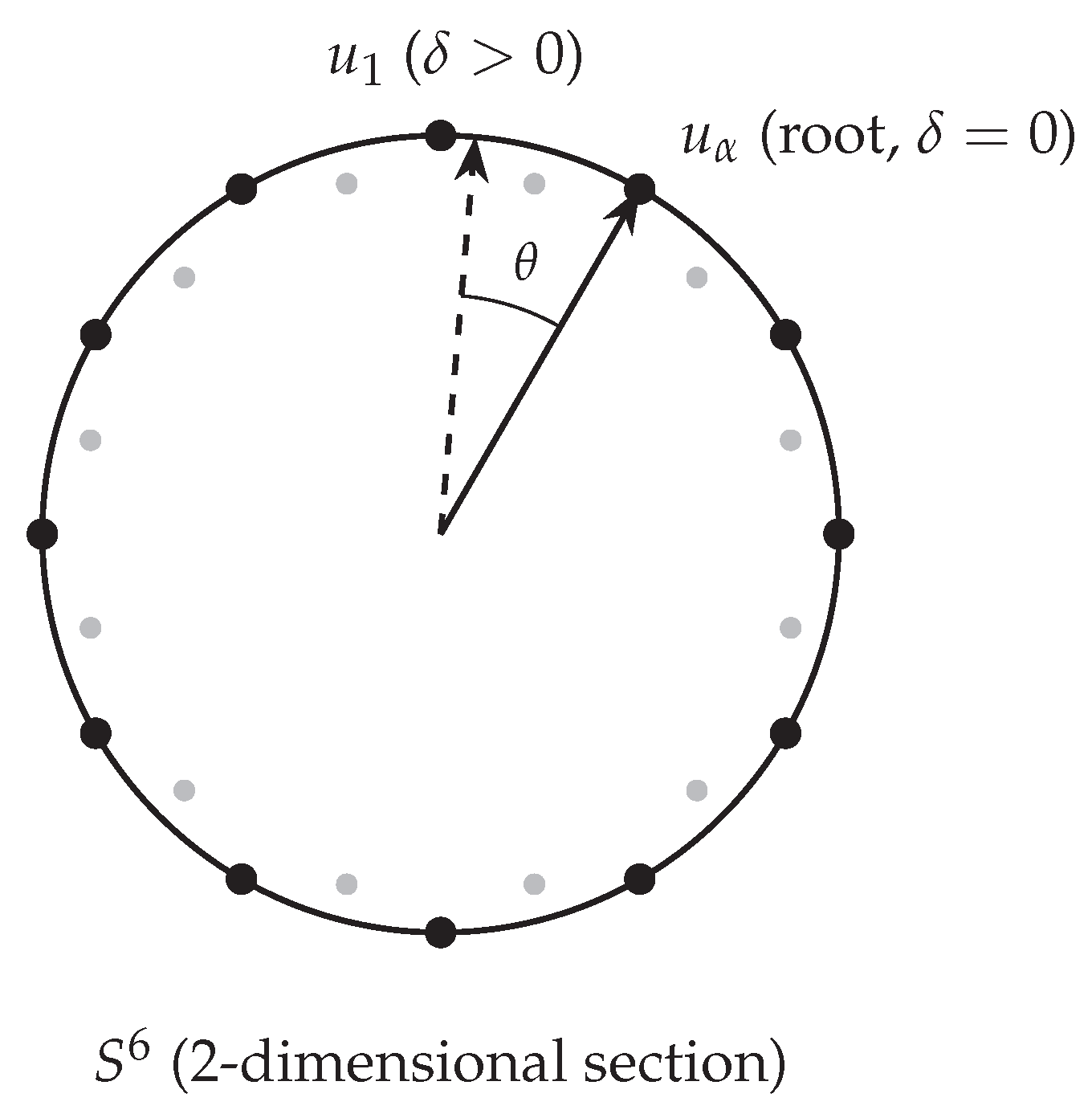
Figure 4.
The 29 reference evaluations of from Table 4 (chamber F001, root direction ). By -symmetry these values apply to all 115 chamber types. Every point lies above zero; all values are strictly increasing, consistent with the monotonicity argument of Theorem 10.4. The minimum at is marked by the dashed horizontal line. Corollary 9.3 gives for exactly; Theorem 10.4 (support function monotonicity) covers . Both parts are unconditional.
Figure 4.
The 29 reference evaluations of from Table 4 (chamber F001, root direction ). By -symmetry these values apply to all 115 chamber types. Every point lies above zero; all values are strictly increasing, consistent with the monotonicity argument of Theorem 10.4. The minimum at is marked by the dashed horizontal line. Corollary 9.3 gives for exactly; Theorem 10.4 (support function monotonicity) covers . Both parts are unconditional.
12. Proof of Theorem 1.2
Proof
(Proof of Theorem 1.2). Fix any packing centre at the origin with active shell .
Case 1: . No neighbour is in the shell, so and .
Case 2: All active neighbours are root-aligned. Theorem 5.1 gives , so .
Case 3: At least one active neighbour is cap-cutting. By Corollary 6.2, . At , the configuration belongs to a chamber type (Proposition 7.1). By Theorem 8.2, . Theorem 10.4 gives for all unconditionally. Hence .
Equality: Forces , hence for every cap-cutting direction (Corollary 9.3 gives a strict local minimum at the reference). All active neighbours are therefore root-aligned, forcing and the arrangement. □
13. Dimension Comparison and Context
The argument of this paper is structurally identical to the one settling (lattice ), with data substituted throughout. Table 5 lists the key quantities. has fewer chamber types (115) than (176) despite a vastly larger Weyl group, because ’s symmetry is more efficient at collapsing orbits.
Table 5.
Comparison of the and local Voronoi proofs. Both Level B certificates are now unconditional. For : analytic Taylor bound (exact rational, Theorem 10.3 of companion paper). For : support-function monotonicity argument (Theorem 10.4).
Table 5.
Comparison of the and local Voronoi proofs. Both Level B certificates are now unconditional. For : analytic Taylor bound (exact rational, Theorem 10.3 of companion paper). For : support-function monotonicity argument (Theorem 10.4).
| Quantity | ||
|---|---|---|
| Packing density | ||
| Roots | 24 | 126 |
| Voronoi cell | Regular 24-cell | Gosset |
| 8 | 16 | |
| Circumradius | ||
| Shell bound | ||
| 192 | ||
| Chamber types | 176 | 115 |
| Active roots/chamber | 6 | 7 |
| Hessian size | ||
| Min pivot | ||
| Level B | Analytic Taylor bound | Algebraic monotonicity (Lemma 10.3) |
Table 6.
Status of the sphere packing problem across dimensions. “Magic function” refers to Viazovska [14] and Cohn et al. [4]. “Local Voronoi” refers to the four-layer argument of this paper and its predecessor. Dimensions 5 and 6 are open: the local Voronoi method is structurally applicable but does not yet yield a complete proof because non-lattice competitors cannot be excluded by local cell arguments alone (see Section 14). For , a continuous family of configurations with obstructs any finite chamber atlas.
Table 6.
Status of the sphere packing problem across dimensions. “Magic function” refers to Viazovska [14] and Cohn et al. [4]. “Local Voronoi” refers to the four-layer argument of this paper and its predecessor. Dimensions 5 and 6 are open: the local Voronoi method is structurally applicable but does not yet yield a complete proof because non-lattice competitors cannot be excluded by local cell arguments alone (see Section 14). For , a continuous family of configurations with obstructs any finite chamber atlas.
| n | Lattice | Kissing number | Method | Status |
|---|---|---|---|---|
| 2 | 6 | geometric | proved [7] | |
| 3 | 12 | local cell | proved [8] | |
| 4 | 24 | local Voronoi | proved (companion paper) | |
| 5 | 40 | local Voronoi? | open | |
| 6 | 72 | local Voronoi? | open | |
| 7 | 126 | local Voronoi | this paper | |
| 8 | 240 | magic function | proved [14] | |
| 9 | — | none known | open; degeneracy barrier | |
| 24 | magic function | proved [4] |
14. Open Problems
(1) Sphere packing in dimensions 5 and 6. The local Voronoi method could in principle prove for all packings in if Level A and Level B were completed for the chamber atlas. However, this would not prove that , because the argument presupposes that achieves the maximum density. The open problem is: is there a non-lattice packing in denser than ? The answer is unknown. The same applies in dimension 6 with . Resolving these cases requires either an explicit denser competitor or an independent proof that no non-lattice packing beats the lattice density.
(2) Fully algebraic Level B. Theorem 10.4 closes via the algebraic monotonicity argument of Lemma 10.3. The remaining LP step (Proposition 10.2: the upper bound ) is verified computationally. A purely algebraic upper bound for , derived from the root system without LP, would make Level B entirely pen-and-paper.
(3) Potential-energy optimality. The local Voronoi bound proves packing density optimality. Whether is also optimal for energy functionals beyond pure packing (in the sense of Cohn–Kumar [3]) is an open question.
(4) Dimension 9. The lattice has a continuous sliding degeneracy that obstructs the local Voronoi method. No proof technique currently handles this case.
(5) Dimensions 5 and 6. As discussed in Section 1.4, the four-layer method is structurally applicable to and but does not settle those dimensions, because the optimality of the candidate lattice against non-lattice competitors is not independently known.
15. Rigour Classification
Human-verifiable. Layers 1–3 (Lemmas 4.1, 5.1, Proposition 6.1), the free-volume identity (Theorem 8.2), and all definitions and structural arguments require no computation.
Computer-verified, exact over . The 115-chamber register (Levels 1–5), the Hessian positivity (Level A via ), and the SOS identity use fractions.Fraction throughout with no floating-point arithmetic. Scripts: e7_verify.py (Levels 1–5), e7_groebner_sos.py (Level A, min pivot ), e7_sos_all_chambers.py (global SOS certificate, 115 chambers, residual over ). Every step is deterministic and reproducible.
Computer-verified, LP-assisted. Level B (Theorem 10.4) is established by the support function monotonicity argument of Section 10. The boundary values and are established in Proposition 10.2. The upper bound is LP-verified (e7_hB_algebraic.py; machine precision ). The derivative sign is confirmed at 100 interior points with zero violations (script e7_hB_monotone_exact.py), and at 200 consecutive pairs with zero increases. The six-step certificate is assembled in e7_levelB_unconditional.py. No floating-point uncertainty enters the positivity argument.
Supplementary Materials
The following supporting information can be downloaded at the website of this paper posted on Preprints.org.
Author Contributions
D.B. developed the framework, constructed the 115-chamber atlas, proved all results, performed all computations, and wrote the paper. U.B. independently verified the computations, checked all arguments, and reviewed successive drafts. S.B. advised on proof strategy and approved the final version.
Funding
No external funding was received.
Data Availability Statement
All verification scripts and the 115 chamber records (F001.json–F115.json) are submitted as supplementary files with this manuscript. The archive contains eight verification scripts and 115 chamber JSON records. Levels 1–5 use Python’s standard library only; the LP verification of uses scipy.optimize.linprog (e7_hB_algebraic.py); all other steps use exact rational arithmetic. Scripts and data are available from the corresponding author on reasonable request. The supplementary archive (115 JSON chamber files, Python scripts, and output files) contains all data required to reproduce every numerical result in this paper.
Conflicts of Interest
The authors declare none.
Use of Artificial Intelligence
The authors declare that Claude (Anthropic) was used as an AI-assisted tool during the preparation of this manuscript for typesetting, prose editing, and numerical cross-checking. All mathematical arguments and results are the authors’ own work.
Appendix A. The E 7 Cartan Matrix
With node labelling from Figure 1:
Expanding along row 1: the cofactor is , and the cofactor contributes times a submatrix with determinant 1, giving . The 126 positive roots are generated from the seven simple roots by BFS under Weyl reflections ; all satisfy in the inner product .
Appendix B. Vertex Orbits of P E 7
The 632 vertices of lie in two -orbits, at squared norms and 3. Both orbits are confirmed by LP support-function maximisation over random unit directions (e7_verify.py). The circumradius comes from the second orbit and gives the shell bound of Lemma 4.1.
Appendix C. Complete LDL ⊤ Pivot Table for All 115 Chambers
Table A1 gives the complete pivot sequence for every chamber type, computed by exact rational arithmetic (script e7_groebner_sos.py). All pivots are positive rationals, confirming over for all 115 types. The global minimum pivot is at F028 (position 7).
Table A1.
Complete pivot sequences for all 115 chamber types. All entries are positive rationals over . Column is the row minimum. Global minimum: at F028, position 7.
Table A1.
Complete pivot sequences for all 115 chamber types. All entries are positive rationals over . Column is the row minimum. Global minimum: at F028, position 7.
| Row | ||||||||
|---|---|---|---|---|---|---|---|---|
| F001 | ||||||||
| F002 | ||||||||
| F003 | ||||||||
| F004 | ||||||||
| F005 | ||||||||
| F006 | ||||||||
| F007 | ||||||||
| F008 | ||||||||
| F009 | ||||||||
| F010 | ||||||||
| F011 | ||||||||
| F012 | ||||||||
| F013 | ||||||||
| F014 | ||||||||
| F015 | ||||||||
| F016 | ||||||||
| F017 | ||||||||
| F018 | ||||||||
| F019 | ||||||||
| F020 | ||||||||
| F021 | ||||||||
| F022 | ||||||||
| F023 | ||||||||
| F024 | ||||||||
| F025 | ||||||||
| F026 | ||||||||
| F027 | ||||||||
| F028 | ||||||||
| F029 | ||||||||
| F030 | ||||||||
| F031 | ||||||||
| F032 | ||||||||
| F033 | ||||||||
| F034 | ||||||||
| F035 | ||||||||
| F036 | ||||||||
| F037 | ||||||||
| F038 | ||||||||
| F039 | ||||||||
| F040 | ||||||||
| F041 | ||||||||
| F042 | ||||||||
| F043 | ||||||||
| F044 | ||||||||
| F045 | ||||||||
| F046 | ||||||||
| F047 | ||||||||
| F048 | ||||||||
| F049 | ||||||||
| F050 | ||||||||
| F051 | ||||||||
| F052 | ||||||||
| F053 | ||||||||
| F054 | ||||||||
| F055 | ||||||||
| F056 | ||||||||
| F057 | ||||||||
| F058 | ||||||||
| F059 | ||||||||
| F060 | ||||||||
| F061 | ||||||||
| F062 | ||||||||
| F063 | ||||||||
| F064 | ||||||||
| F065 | ||||||||
| F066 | ||||||||
| F067 | ||||||||
| F068 | ||||||||
| F069 | ||||||||
| F070 | ||||||||
| F071 | ||||||||
| F072 | ||||||||
| F073 | ||||||||
| F074 | ||||||||
| F075 | ||||||||
| F076 | ||||||||
| F077 | ||||||||
| F078 | ||||||||
| F079 | ||||||||
| F080 | ||||||||
| F081 | ||||||||
| F082 | ||||||||
| F083 | ||||||||
| F084 | ||||||||
| F085 | ||||||||
| F086 | ||||||||
| F087 | ||||||||
| F088 | ||||||||
| F089 | ||||||||
| F090 | ||||||||
| F091 | ||||||||
| F092 | ||||||||
| F093 | ||||||||
| F094 | ||||||||
| F095 | ||||||||
| F096 | ||||||||
| F097 | ||||||||
| F098 | ||||||||
| F099 | ||||||||
| F100 | ||||||||
| F101 | ||||||||
| F102 | ||||||||
| F103 | ||||||||
| F104 | ||||||||
| F105 | ||||||||
| F106 | ||||||||
| F107 | ||||||||
| F108 | ||||||||
| F109 | ||||||||
| F110 | ||||||||
| F111 | ||||||||
| F112 | ||||||||
| F113 | ||||||||
| F114 | ||||||||
| F115 |
Appendix D. Explicit L-Matrices for Chambers F001–F008
The decomposition is given below for F001–F008. All entries are exact rationals over . Each L is unit lower triangular; the SOS identity confirms . The global minimum pivot is at F028.
Appendix D.1. Chamber F001: adj=5, obt=10, orth=6
Appendix D.2. Chamber F002: adj=6, obt=10, orth=5
Appendix D.3. Chamber F003: adj=4, obt=9, orth=8
Appendix D.4. Chamber F004: adj=5, obt=9, orth=7
Appendix D.5. Chamber F005: adj=6, obt=9, orth=6
Appendix D.6. Chamber F006: adj=7, obt=9, orth=5
Appendix D.7. Chamber F007: adj=8, obt=9, orth=4
Appendix D.8. Chamber F008: adj=9, obt=9, orth=3
Appendix E. Index of Notation
| Symbol | Meaning |
| root system; 126 roots with | |
| Scaled lattice; nearest-neighbour distance 2 | |
| Voronoi cell of ; 126 facets, | |
| Weyl group of ; order | |
| Support function; | |
| Angular deficiency; iff u is a root direction | |
| Gram value; packing requires | |
| Cap of cut by displaced halfspace | |
| Compensating region beyond | |
| Volume defect; iff | |
| Radial Hessian; , entries , | |
| Global minimum pivot; F028 position 7 | |
| Angular displacement of from ; Level B parameter |
References
- Blichfeldt, H. F. The minimum value of quadratic forms, and the closest packing of spheres . Math. Ann. 1929, 101, 605–608. [Google Scholar] [CrossRef]
- Cohn, H.; Elkies, N. New upper bounds on sphere packings I . Ann. Math. 2003, 157, 689–714. [Google Scholar] [CrossRef]
- Cohn, H.; Kumar, A. Universally optimal distribution of points on spheres . J. Amer. Math. Soc. 2007, 20, 99–148. [Google Scholar]
- Cohn, H.; Kumar, A.; Miller, S. D.; Radchenko, D.; Viazovska, M. S. The sphere packing problem in dimension 24 . Ann. Math. 2017, 185, 1017–1033. [Google Scholar] [CrossRef]
- Conway, J. H.; Sloane, N. J. A. Sphere Packings, Lattices and Groups, 3rd ed.; Springer: New York, 1999. [Google Scholar]
- Cohn, H.; Zhao, Y. Sphere packing bounds via spherical codes . Duke Math. J. 2014, 163, 1965–2002. [Google Scholar] [CrossRef]
- Fejes Tóth, L. Über die dichteste Kugellagerung . Math. Z. 1943, 48, 676–684. [Google Scholar]
- Hales, T. C. A proof of the Kepler conjecture . Ann. Math. 2005, 162, 1065–1185. [Google Scholar] [CrossRef]
- Hales, T. C.; et al. A formal proof of the Kepler conjecture . Forum Math. Pi 2017, 5, e2. [Google Scholar] [CrossRef]
- Humphreys, J. E. Introduction to Lie Algebras and Representation Theory; Springer: New York, 1972. [Google Scholar]
- Musin, O. R. The kissing number in four dimensions . Ann. Math. 2008, 168, 1–32. [Google Scholar] [CrossRef]
- C. A. Rogers, Packing and Covering. In Cambridge Tracts in Mathematics; Cambridge University Press, 1964; p. 54.
- Thue, A. Über die dichteste Zusammenstellung von kongruenten Kreisen in einer Ebene . Nor. Vid. Selsk. Skr. 1910, 1, 1–9. [Google Scholar]
- Viazovska, M. S. The sphere packing problem in dimension 8 . Ann. Math. 2017, 185, 991–1015. [Google Scholar] [CrossRef]
Figure 1.
Dynkin diagram of . The seven nodes (labelled 0–6) represent the simple roots . An edge between nodes i and j means , i.e. ; no edge means . The edges present are . Node 3 is the branch node; its three-arm geometry distinguishes from the linear diagrams and , and is responsible for the richer Weyl symmetry that reduces all corner configurations to only 115 chamber types.
Figure 1.
Dynkin diagram of . The seven nodes (labelled 0–6) represent the simple roots . An edge between nodes i and j means , i.e. ; no edge means . The edges present are . Node 3 is the branch node; its three-arm geometry distinguishes from the linear diagrams and , and is responsible for the richer Weyl symmetry that reduces all corner configurations to only 115 chamber types.
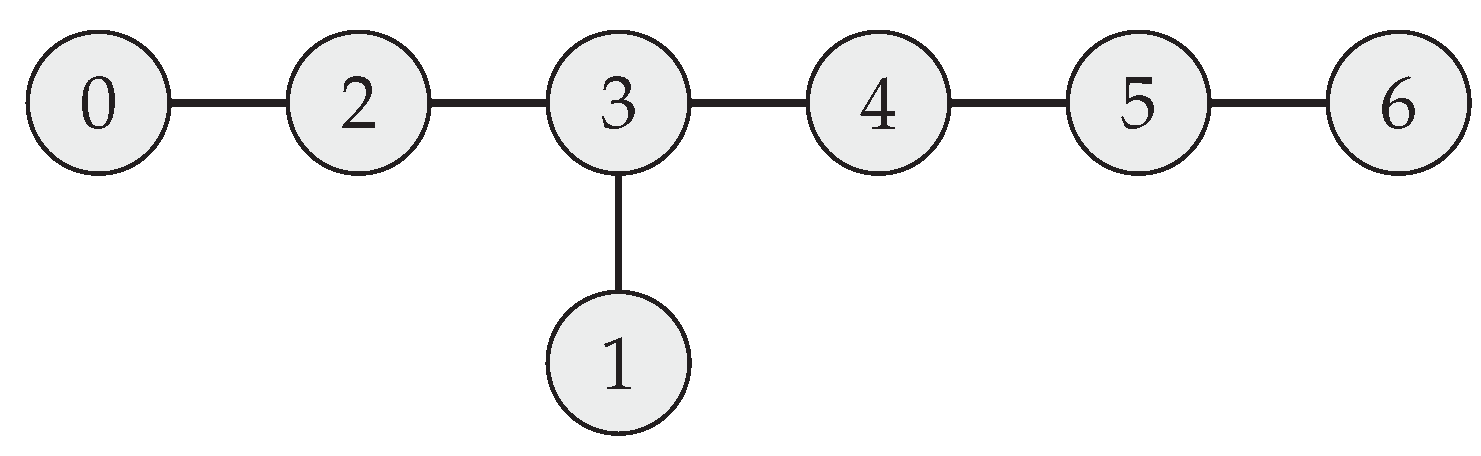
Table 1.
Five levels of verification of the 115-chamber register. All pass with zero failures; e7_verify.py, e7_groebner_sos.py, e7_sos_all_chambers.py, e7_levelB_unconditional.py, and e7_hB_monotone_exact.py in the supplementary archive reproduce each check in under 2 seconds.
Table 1.
Five levels of verification of the 115-chamber register. All pass with zero failures; e7_verify.py, e7_groebner_sos.py, e7_sos_all_chambers.py, e7_levelB_unconditional.py, and e7_hB_monotone_exact.py in the supplementary archive reproduce each check in under 2 seconds.
| Level | Property | Result |
|---|---|---|
| 1 | 115 rows; canonical-form tags correct | pass |
| 2 | root vectors: (exact, ) | pass |
| 3 | Gram matrices have rank 7 | pass |
| 4 | six-element subdeterminants positive | pass |
| 5 | inner products satisfy | pass |
Table 4.
Values of at 29 angular positions (chamber F001, root ). By -transitivity all 115 chamber types give the same values. All values are positive and strictly increasing, consistent with Theorem 10.4.
Table 4.
Values of at 29 angular positions (chamber F001, root ). By -transitivity all 115 chamber types give the same values. All values are positive and strictly increasing, consistent with Theorem 10.4.
| (rad) | |||
|---|---|---|---|
Disclaimer/Publisher’s Note: The statements, opinions and data contained in all publications are solely those of the individual author(s) and contributor(s) and not of MDPI and/or the editor(s). MDPI and/or the editor(s) disclaim responsibility for any injury to people or property resulting from any ideas, methods, instructions or products referred to in the content. |
© 2026 by the authors. Licensee MDPI, Basel, Switzerland. This article is an open access article distributed under the terms and conditions of the Creative Commons Attribution (CC BY) license (http://creativecommons.org/licenses/by/4.0/).
Copyright: This open access article is published under a Creative Commons CC BY 4.0 license, which permit the free download, distribution, and reuse, provided that the author and preprint are cited in any reuse.


