
Submitted:
20 June 2026
Posted:
22 June 2026
You are already at the latest version
Abstract
Large language models (LLMs) frequently generate fluent chain-of-thought (CoT) reasoning that appears coherent while containing unsupported inferences, omitted alternatives, or logically invalid conclusions, creating significant challenges for trustworthy and explainable AI in high-stakes domains such as healthcare. While prior work has primarily focused on factual hallucinations, the structural characteristics of hallucinated reasoning remain insufficiently understood. This paper investigates diagnostic hallucinations through the lens of discourse structure and introduces a synthetic benchmark of ambiguous patient complaints paired with diagnoses, reasoning traces, discourse-tree representations, and hallucination labels. We hypothesize that hallucinated CoT differs from grounded reasoning not only in factual correctness but also in discourse organization. Our analysis shows that hallucinated reasoning tends to elevate weak or speculative clues into central discourse nuclei, suppress contradictory evidence, and use discourse satellites for post hoc reinterpretation rather than evidence integration. In contrast, grounded reasoning preserves alternative hypotheses, maintains explicit contrast and concession relations, and resolves evidential conflicts at higher discourse levels. Based on these observations, we formulate discourse-level indicators for hallucination detection and reasoning verification. The resulting framework provides interpretable structural explanations of reasoning failures and supports neuro-symbolic validation of LLM-generated reasoning traces, contributing to the development of more trustworthy, explainable, and verifiable language models.
Keywords:
large language models
; hallucination detection
; chain-of-thought reasoning
; trustworthy AI
; explainable AI
; discourse structure
; neuro-symbolic verification
; diagnostic reasoning
1. Introduction
Large language models (LLMs) are increasingly deployed in decision-support systems where users rely not only on generated answers but also on the reasoning used to justify them. Chain-of-thought (CoT) prompting has emerged as a powerful mechanism for eliciting intermediate reasoning steps, improving performance on complex inference tasks and providing a degree of transparency into model decision making. However, recent studies have shown that seemingly coherent reasoning traces may contain unsupported assumptions, omitted evidence, or logically invalid inference steps [1,25]. Such reasoning failures are particularly concerning because they often appear plausible and persuasive to human users, creating challenges for trustworthiness, explainability, and safe deployment of LLMs in high-stakes domains such as healthcare.
Most existing research on hallucinations focuses on factual inaccuracies, fabricated references, unsupported statements, or incorrect final answers. Comparatively little attention has been paid to the structural organization of hallucinated reasoning itself. Yet the reliability of a diagnostic or analytical conclusion depends not only on the correctness of individual facts but also on how evidence is selected, prioritized, contrasted, and integrated throughout the reasoning process. The same observations may support either a grounded or a hallucinated conclusion depending on the way the reasoning discourse is organized.
This paper investigates hallucinated CoT reasoning through the lens of discourse structure. We introduce a synthetic benchmark consisting of ambiguous medical complaints paired with diagnoses, concise reasoning traces, discourse-tree representations, and labels indicating whether the reasoning process is hallucinated. The dataset is designed so that grounded and hallucinated explanations exhibit similar linguistic fluency while differing substantially in their discourse organization and evidence management. This setting enables the study of hallucinations as structural reasoning failures rather than merely factual errors.
Our central hypothesis is that hallucinated reasoning exhibits recurring discourse-level patterns that can serve as interpretable indicators of reasoning quality. In particular, hallucinated CoT frequently promotes weak or low-specificity observations into central discourse nuclei, suppresses contradictory evidence, and replaces genuine conflict resolution with rhetorical justification. Grounded reasoning, in contrast, tends to preserve competing hypotheses, assign nucleus status to diagnostically informative findings, and employ contrast and concession relations to reconcile ambiguity before reaching a conclusion. Figure 1 illustrates this distinction.
Discourse analysis provides a natural framework for representing such phenomena. A reasoning trace can be viewed as a hierarchical discourse tree in which statements play different rhetorical roles, including evidence, elaboration, contrast, concession, and conclusion. This representation makes it possible to analyze not only whether a conclusion is correct, but also whether the reasoning process demonstrates appropriate evidence prioritization and conflict management. Importantly, discourse structures can be transformed into symbolic features suitable for neuro-symbolic verification, providing interpretable explanations of why a reasoning trace is considered trustworthy or hallucinated.
The contributions of this work are threefold. First, we introduce a benchmark dataset for studying discourse-level characteristics of hallucinated diagnostic reasoning. Second, we identify a set of structural discourse signatures that distinguish grounded from hallucinated CoT explanations. Third, we demonstrate how these signatures can support interpretable hallucination detection and reasoning verification, contributing to the development of more trustworthy and explainable LLM systems.
The remainder of this paper is organized as follows. Section 2 reviews prior work on hallucination detection, chain-of-thought reasoning, discourse analysis, and abductive verification. Section 3 defines hallucinated chain-of-thought reasoning and introduces discourse-level distinctions between grounded and hallucinated explanations. Section 4 presents the Joint Knowledge–Reasoning Hallucination Measure (JKRHM) and its integration with discourse statistics derived from reasoning trees. Section 5 discusses observable discourse signatures associated with hallucinated reasoning. Section 6 analyzes structural differences between grounded and hallucinated discourse trees and derives symbolic verification features. Section 7 describes the Autoimmune-Narrate-Halluc dataset and provides representative examples of grounded and hallucinated diagnostic explanations. Section 8 presents the experimental setup, evaluation methodology, and empirical results.
2. Related Work
Hallucinations in language models are often described as outputs that are fluent but unsupported, inconsistent, or fabricated. In reasoning-intensive tasks, this problem becomes subtler: the model may use mostly valid observations yet assemble them into an invalid inferential path. Such cases suggest that hallucination is not only a problem of factual content, but also a problem of inferential discourse.
Chain-of-thought prompting improves performance on many tasks by encouraging explicit intermediate reasoning. At the same time, explicit reasoning does not guarantee valid reasoning. A model may produce longer explanations that merely increase the appearance of deliberation. This motivates moving from surface CoT inspection to formal analysis of reasoning patterns [5].
Discourse structure has long been used to represent coherence relations such as elaboration, contrast, background, concession, and justification. In the present context, discourse structure is used not as a purely linguistic description but as a functional model of diagnostic reasoning. The key idea is that hallucinated and grounded CoT traces may differ systematically in how they instantiate these relations.
A useful distinction for hallucination detection is between data-driven hallucinations and reasoning-driven hallucinations. Data-driven hallucinations arise when the model’s generated claim is weakly supported by its internal representation of the relevant facts, training evidence, or retrieved context. In abductive terms, the model proposes an explanation or answer H, but the available evidence O does not provide sufficient informational support for H. Entropy- and information-gain-based methods are particularly relevant here because they measure whether the model’s internal state contains a stable, low-uncertainty basis for the generated claim, or whether the answer is being produced from diffuse, unstable, or underdetermined representations [7].
Recent work has shown that internal activations encode rich indicators of such representational flaws. Chen et al. [3] analyze hidden representations to estimate hallucination risk. From an abductive-information perspective, this can be interpreted as measuring whether the model’s internal representation supports a compact and stable explanatory hypothesis, or whether the representation remains high-dimensional, unstable, and weakly constrained. Su et al. [27] introduced MIND, an unsupervised detector that models temporal dynamics of hidden states without requiring labels, while Azaria and Mitchell [2] demonstrated that linear probes over intermediate states can predict truthfulness.
Reasoning-driven hallucinations require a complementary view. Here the problem is not only whether the model has access to relevant information, but whether it uses that information through a valid inferential path. In abductive terms, the model may generate a plausible hypothesis H, but H fails under counter-abductive pressure: rival explanations, missing premises, contradictions, or lower-cost alternatives better explain the observations. Entropy and information gain are useful in this setting because a reasoning trace should reduce uncertainty in a structured way. A hallucinated reasoning path often does the opposite: it introduces locally plausible but globally unsupported steps, producing apparent explanatory progress while failing to increase genuine evidential support [6].
Several inference-time hallucination detectors can be reinterpreted in this way. Manakul et al. [21] proposed SelfCheckGPT, which assesses self-consistency by sampling multiple candidate generations and measuring their alignment using entailment and lexical overlap. Kalai and Vempala [14] introduced calibration-based uncertainty scores designed to capture hallucination risk directly from output distributions. Ding et al. [4] proposed a reasoning-aware hallucination detector that uses semantic breadth and depth to detect failures in multi-step decision-making. FActScore [23] decomposes outputs into atomic factual units and verifies each against retrieved passages using entailment-based scoring.
Thus, activation-based, uncertainty-based, self-consistency-based, and fact-verification methods can be placed within a common abductive-information framework. Data-driven hallucination detection asks whether the model has enough representational evidence to justify the proposed hypothesis. Reasoning-driven hallucination detection asks whether the inferential path from evidence to conclusion survives counter-abductive alternatives. Entropy measures the residual uncertainty of the model’s commitment, while information gain measures whether each internal or external reasoning step genuinely improves the explanatory support for the generated answer.
Recent research has increasingly explored neuro-symbolic approaches to hallucination detection and reasoning verification. Information-theoretic formulations of abduction have been proposed to quantify hallucination risk through explanatory compression, counter-abduction, and Minimum Description Length (MDL) principles. Such approaches demonstrate that hallucinated explanations typically require additional unsupported assumptions and exhibit lower explanatory efficiency than grounded explanations [35]. Beyond factual verification, abductive reasoning has also been applied to industrial process-control settings, where discourse-weighted abductive logic programming was shown to identify plausible but incorrect explanations that violate physical constraints or observational evidence [36]. More recently, Labeled Logic Program (LLP) architectures have combined logic programming, argumentation, probabilistic inference, and abductive explanation into unified verification frameworks. By associating symbolic facts and rules with semantic, epistemic, provenance, temporal, and discourse labels, these systems provide richer representations of reasoning processes and improve the detection of unsupported conclusions [38].
Related work has also emphasized the importance of explanation structure in reasoning verification. Abductive frameworks for large language models increasingly exploit relationships among hypotheses, observations, defeaters, and alternative explanations rather than evaluating factual correctness alone [37]. However, most existing approaches operate at the level of claims, explanations, or symbolic derivations. Comparatively little attention has been paid to the rhetorical organization of chain-of-thought reasoning itself.
The present work builds upon these developments by focusing explicitly on discourse structure as a source of hallucination evidence. We investigate whether hallucinated chain-of-thought explanations exhibit systematic structural deviations, including premature closure, suppression of contrast relations, elimination of defeaters, and promotion of weak evidence to nucleus positions. Unlike prior verification frameworks that primarily assess factual consistency, uncertainty, latent-space geometry, or symbolic support, our approach treats discourse organization as a first-class signal for hallucination detection and reasoning validation.
3. What Is a Hallucinated CoT?
In this paper, a hallucinated CoT is defined as a reasoning trace that appears coherent but contains one or more of the following failures: overweighting of weak clues, suppression of contradiction, unsupported reinterpretation, premature closure, and false confirmation. This definition makes hallucination a structural property of reasoning rather than a purely factual one.
Grounded reasoning usually has the following properties: the nucleus is built from high-information clues; contradictory evidence is retained in satellite branches; alternative hypotheses remain visible until late in the reasoning process; the conclusion explicitly resolves conflict across branches; and risk-sensitive clues are given increased weight. Hallucinated reasoning shows a different pattern: a low-specificity clue is promoted into the nucleus, contradictory evidence is reinterpreted rather than compared, alternatives collapse early, satellite nodes serve rhetorical defense rather than explanatory support, and the conclusion follows from local plausibility rather than global fit.
The discourse differences in Table 1 can be transformed into symbolic features suitable for automatic verification, including nucleus specificity, number of contrast relations, number of dismissive satellites, presence of ignored red flags, premature-closure depth, false confirmation, and integration of alternatives. A symbolic verifier could flag a reasoning path as suspicious if a low-specificity clue anchors the root while contradiction is absent or aggressively downplayed.
4. Abduction, JKRHM, and Discourse Statistics
Recent work, most notably [31] and [5], has shown that hallucinations in LLMs can be decomposed into two broad sources: data-driven errors, arising from gaps or biases in learned knowledge, and reasoning-driven errors, arising from instability during multi-step generation. In our abductive framework, hallucinations are understood as failures of explanation: the model produces an output that cannot be supported by a sufficiently strong hypothesis H, or fails to reject a rival hypothesis that better explains the evidence. Formally, an acceptable explanation must satisfy
while also surviving counter-abductive comparison:
To operationalize this idea, we introduce the Joint Knowledge–Reasoning Hallucination Measure (JKRHM), that makes this connection explicit:
where K is the NTK Gram matrix, is the maximal spectral norm of the decoding Jacobians, and is the condition number. Although originally motivated by kernel geometry [10,12,17,28], each term admits a natural interpretation in abductive reasoning.
The determinant term corresponds to the volume of the accessible hypothesis space. It asks whether the model can represent the correct explanation. The term captures whether small errors amplify during autoregressive generation. The term penalizes ill-conditioned representation spaces in which one hypothesis dominates because alternatives are poorly represented. Equivalently, a more explicit hallucination-risk formulation is
which aligns with abductive deficiency, reasoning instability, and counter-abductive failure.
However, JKRHM can struggle with easy-but-wrong explanations: outputs that are fluent, familiar, and internally consistent but incorrect. For example, “fever + cough ⇒ flu” is common and well represented even if the correct diagnosis is “neck stiffness + photophobia ⇒ meningitis.” Here, the incorrect hypothesis is geometrically favored. To overcome this limitation, we extend JKRHM with an explicit counter-abductive component:
The resulting hybrid formulation is
While JKRHM provides a geometric proxy for knowledge coverage, reasoning stability, and defeater availability, it does not directly observe the structure of the generated explanation itself. We therefore represent each explanation as a discourse tree , where V is the set of EDUs, E the set of rhetorical links, and r assigns relation types and nucleus/satellite roles. Let denote a vector of discourse statistics extracted from the tree. Typical components include tree depth, branching factor, nucleus-to-satellite ratio, relation-distribution entropy, evidence-support consistency, and contrast/defeater presence:
These statistics provide observable signals of abductive quality. In valid reasoning, competing hypotheses should appear as contrastive or conditional branches; the absence of such structures suggests inadequate counter-abductive evaluation. We therefore define a discourse-based score:
Finally, discourse structure can be integrated with geometric signals:
This formulation unifies geometry, logic, and discourse as complementary layers of hallucination detection.
Figure 2 illustrates the architecture of the Joint Knowledge–Reasoning Hallucination Measure (JKRHM). A chain-of-thought explanation is analyzed through three complementary verification channels. The geometric channel evaluates latent-space instability and sensitivity of the reasoning trajectory. The abductive channel measures explanatory adequacy, defeater preservation, and the cost of alternative hypotheses. The discourse channel analyzes rhetorical structure, including nucleus–satellite allocation, contrast preservation, contradiction handling, and discourse depth. The resulting signals are normalized and aggregated into a unified hallucination-risk estimate.
The three verification channels contribute complementary information. Geometric measures identify unstable reasoning trajectories, abductive measures quantify explanatory adequacy and defeater preservation, and discourse measures capture structural defects such as premature closure, missing contrast relations, and promotion of weak evidence to nucleus status. By combining these perspectives, JKRHM evaluates not only whether a conclusion is likely to be incorrect, but also whether the reasoning process leading to that conclusion exhibits characteristics associated with hallucinated chain-of-thought generation.
4.1. Hallucination Risk
Recent work on HalluGuard argues that hallucinations in large language models can be decomposed into two broad sources: data-driven hallucinations, which arise from gaps or biases in learned knowledge, and reasoning-driven hallucinations, which arise from instability during multi-step generation [31]. This distinction is useful, but it also raises a further question: how can these two sources be jointly measured in a way that is computationally tractable and conceptually meaningful?
In the abductive framework used in this paper, hallucinations are treated as failures of explanation. The model produces an output that cannot be supported by a sufficiently strong explanatory hypothesis H, or it fails to reject a rival hypothesis that better explains the evidence.
At a high level, hallucination risk can be decomposed as
where is the target semantic representation and is the representation of the generated output. JKRHM provides a computable proxy for both components.
The first term, , corresponds to the volume of the accessible hypothesis space. In practical terms, it asks whether the model has enough representational capacity to express the correct explanation. If the eigenvalues of K are , then
A large determinant indicates that the model can represent many independent explanatory directions. A small determinant indicates a collapsed or impoverished hypothesis space, forcing the model toward oversimplified explanations. In abductive terms,
Thus, low determinant values correspond to data-driven hallucination: the correct hypothesis may simply not be available in the model’s accessible explanatory space.
The second term, , captures reasoning stability during autoregressive generation. Even if the model has access to the right explanation, it may fail to follow a stable path toward it. Let the reasoning trajectory unfold as
Let denote the local Jacobian of the decoding process at step t. Then
Thus, measures how quickly small errors can grow during generation. If , reasoning becomes locally unstable: a plausible initial hypothesis may drift toward a hallucinated conclusion. This term therefore captures reasoning-driven hallucination, where the failure lies not in knowledge availability but in inference dynamics.
The third term, , captures whether the model can fairly compare competing explanations. When is large, some representational directions dominate while others are nearly invisible. In such cases, a hypothesis may appear artificially strong because rival hypotheses are poorly represented. This undermines counter-abduction, which requires testing whether a rival explanation better accounts for the evidence:
By penalizing large condition numbers, encourages defeater availability: alternative hypotheses remain visible and comparable.
Putting the three components together, JKRHM can be interpreted as
Equivalently, a more explicit hallucination-risk form is
which aligns with abductive deficiency, reasoning instability, and counter-abductive failure.
4.2. Counter-Abductive Extension
Although JKRHM connects geometry to abductive reasoning, it can miss “easy-but-wrong” explanations. These are outputs that are fluent, familiar, and internally stable but incorrect. For example, the explanation
“Fever + cough ⇒ flu”
may be common and well represented, yielding a high , even when the medically relevant explanation is
“neck stiffness + photophobia ⇒ meningitis.”
In this case, the wrong hypothesis is geometrically favored. Similarly, an incorrect reasoning chain can be stable:
as in “antibiotics treat infections → all fevers require antibiotics → prescribe antibiotics.” Such a chain may have low local instability while remaining globally invalid.
The limitation is that JKRHM does not explicitly compute a comparison over rival hypotheses. We therefore introduce a counter-abductive defeater term:
where is the information gain supplied by hypothesis and is its explanatory cost. This gives the extended risk score
The additional term explicitly tests whether a rival explanation defeats the selected one. This hybrid formulation combines geometric signals of knowledge and reasoning with explicit abductive comparison.
4.3. Discourse Tree Statistics as Observable Evidence
JKRHM operates on internal representations and local model dynamics. It does not directly observe the structure of the generated explanation. However, hallucinations also appear in discourse organization: how claims, evidence, contrasts, and conclusions are arranged. This motivates a complementary discourse-based measure.
We represent a generated explanation as a discourse tree
where V is the set of elementary discourse units, E is the set of rhetorical links, and r assigns relation types and nucleus/satellite roles. This representation is compatible with Rhetorical Structure Theory [22]. The tree makes explicit how the model organizes its reasoning: which statements are central, which are supporting, and whether alternatives are preserved or suppressed.
Let denote a vector of discourse statistics extracted from the tree. Important components include the following.
Depth and branching factor.
These features measure the complexity of the reasoning chain.
Nucleus-to-satellite ratio.
This indicates whether the explanation is overly claim-heavy or evidence-heavy.
Relation distribution entropy.
where is the frequency of relation type k. This captures the diversity of reasoning relations.
Evidence support consistency.
where is the set of evidence links and measures semantic alignment between a claim and its support.
Contrast and defeater presence.
This indicates whether alternative hypotheses are represented in the explanation.
These statistics provide observable evidence of abductive quality. A well-formed explanation typically has balanced nucleus–satellite structure, explicit evidence links, and contrastive branches that preserve alternatives. A hallucinated explanation often has shallow structure, weak evidence links, excessive elaboration, or missing contrast relations.
Crucially, discourse statistics also reflect counter-abductive behavior. In a valid reasoning process, competing hypotheses should appear as contrastive or conditional branches:
The absence of such structures suggests that the model has not adequately explored defeaters. Thus, can be interpreted as a structural proxy for counter-abductive comparison.
4.4. Combined Geometric–Discourse Risk
We define a discourse-based hallucination score as
where the weights may be learned or set heuristically. This score measures whether the explanation is structurally balanced, evidentially grounded, and counterfactually aware.
The advantage of discourse-based analysis is that it can detect failures that JKRHM may miss. Easy-but-wrong explanations often have high representational support and stable reasoning dynamics, yet their discourse structure reveals deficiencies. For example, “Fever + cough ⇒ flu” may form a shallow tree dominated by a single weak claim, with no contrastive branch considering alternatives such as meningitis. Similarly, “antibiotics treat infections → all fevers require antibiotics” may form a linear chain with no supporting evidence or conditional reasoning. These patterns can be detected through low and low even when the internal geometric signal appears favorable.
Finally, we combine the geometric and discourse signals into a unified hallucination-risk measure:
This formulation unifies three perspectives: geometry, which captures representation and dynamics; logic, which captures abduction and counter-abduction; and discourse, which captures observable reasoning structure. Together, these components provide a more comprehensive account of hallucination detection than any single layer alone.
5. Observable Discourse Signatures of Hallucinated Chain-of-Thought
We argue that hallucinated CoT reasoning is not only a factual failure, but also a discourse-structural failure: weak evidence may be promoted into nucleus position, contradiction may be suppressed, and the conclusion may emerge before alternatives are adequately compared. This section describes surface-level linguistic and pragmatic signatures that often accompany hallucinated CoT. These signatures should not be treated as sufficient conditions for hallucination. Rather, they are useful diagnostic cues that can be combined with discourse-tree features, factual verification, self-consistency tests, and counter-abductive analysis.
A useful starting point is the observation that CoT explanations are not guaranteed to be faithful accounts of the model’s actual decision process. Prior work has shown that models can generate plausible rationalizations for answers influenced by biasing features or hidden factors that are not mentioned in the explanation [16,29]. Thus, a fluent and well-organized CoT may still be epistemically unreliable. The signatures below are therefore interpreted as symptoms of possible reasoning drift, premature closure, or unsupported explanation construction.
5.1. Structural Signatures
Hyperbolic escalation. A hallucinated reasoning trace may suddenly shift from tentative inference to extreme or universal claims. Expressions such as always, never, the only possible explanation, or scientifically proven can indicate that the model has converted a weak abductive hypothesis into an unjustified certainty. In discourse terms, this often corresponds to premature promotion of a speculative claim into the root nucleus. Hyperbolic escalation is especially suspicious when the preceding evidence remains ambiguous or when no contrastive branch has been evaluated.
Circular repetition. Some hallucinated CoT traces exhibit inferential looping: a later step restates an earlier claim without adding evidence, resolving contradiction, or narrowing the hypothesis space. For example, a trace may begin with “the symptom suggests condition X” and later conclude “therefore condition X is likely because the symptom suggests it.” This pattern resembles neural text degeneration, where generated text can become repetitive or bland under certain decoding regimes [8]. In reasoning analysis, circular repetition is not merely stylistic; it indicates that information gain has stalled. The reasoning chain appears longer, but the later steps do not add explanatory value.
Over-structured formatting. A hallucinated CoT may use rigid formatting, numbered lists, or highly polished section headers to create the appearance of systematic analysis while providing little substantive evidence. This is not inherently problematic: good reasoning can also be well structured. The risk arises when formatting substitutes for evidential integration. A verifier should therefore ask whether each structural unit contributes a new premise, contrast, defeater, or inference, rather than merely repackaging the initial hypothesis.
5.2. Lexical and Semantic Signatures
Vagueness and unsupported attribution. Phrases such as it is generally understood that, studies have shown, many experts agree, or research suggests are weak signals when no source, mechanism, or concrete evidence is provided. Such phrases can function as discourse satellites that simulate support without supplying verifiable content. In abductive terms, they lower the apparent cost of a hypothesis without actually increasing its information gain.
Overconfidence markers. Hallucinated CoT is often accompanied by assertive markers such as obviously, undeniably, clearly, or without question. The danger is not confidence itself, but confidence unsupported by evidence. Work on language-model self-evaluation and calibration shows that models can sometimes estimate their own uncertainty, but calibration remains imperfect and task-dependent [13,14]. Therefore, verbal confidence should be compared against the strength of the evidence encoded in the discourse tree.
False precision. A model may produce highly specific dates, numerical values, acronyms, citations, or technical terminology that create an impression of reliability. False precision is especially problematic because it increases rhetorical authority while remaining difficult to detect through surface fluency alone. In discourse terms, false precision often appears as an elaboration satellite attached to a weak nucleus. A verification module should treat unsupported precision as a candidate defeater trigger: the more specific the claim, the greater the need for external or internal support.
5.3. Pragmatic and Functional Signatures
Goal drift. A hallucinated CoT may gradually move away from the user’s actual question and solve a related but easier problem. This produces a locally coherent discourse that is globally misaligned with the task. Goal drift can be detected by comparing the root question, intermediate nuclei, and final conclusion. If the conclusion answers a different question from the one represented at the root, the trace should be flagged for pragmatic mismatch.
Premise affirmation. Another common failure occurs when the model accepts a false or unsupported premise in the prompt and then constructs a coherent explanation inside that fictional frame. This is not merely factual hallucination; it is a failure of counter-abduction. A robust reasoner should test whether the initial premise itself is admissible, whether alternative explanations exist, and whether a contradiction should block the inference. Premise affirmation corresponds to a discourse tree in which the prompt assumption is immediately promoted to nucleus status rather than being evaluated as a defeasible hypothesis.
5.4. Why These Signatures Occur
These signatures arise because language models generate continuations that are probable under learned linguistic and contextual patterns, rather than directly executing a truth-preserving proof procedure. When the model encounters a knowledge gap or an underdetermined reasoning state, it may continue with text that is stylistically coherent but epistemically unsupported. This helps explain why hallucinations can appear fluent, confident, and structurally polished. Surveys of hallucination in large language models emphasize that hallucinations often emerge from a combination of knowledge limitations, inference-time uncertainty, and decoding behavior [9,11]. Sampling-based methods such as SelfCheckGPT exploit a related insight: when the model lacks stable knowledge, repeated generations tend to diverge or contradict one another [21].
For the discourse-structural framework proposed in this paper, these signatures are useful because they can be mapped into observable features. Hyperbolic escalation can be represented as premature root commitment; circular repetition as low information gain across adjacent nodes; unsupported attribution as weak evidence satellites; goal drift as root–conclusion mismatch; and premise affirmation as missing counter-abductive evaluation. Thus, surface markers should not replace discourse-tree analysis, but they can guide the construction of symbolic features for hallucination detection.
5.5. Operational Features
The following features can be added to the verifier described in the main paper:
- hyperbolic_claim_count: number of universal or extreme certainty markers.
- circularity_score: semantic similarity between early and late reasoning steps without added evidence.
- unsupported_attribution_count: number of vague source phrases without citations or concrete grounding.
- overconfidence_evidence_gap: mismatch between verbal confidence and available evidence links.
- false_precision_count: number of specific numerical, temporal, or acronymic claims without support.
- goal_drift_score: semantic distance between the original task and the final conclusion.
- premise_affirmation_flag: whether a questionable premise is accepted without contrastive evaluation.
These features are expected to be most effective when combined with the discourse features introduced in the main paper, such as nucleus specificity, contrast-relation frequency, dismissive satellites, premature closure depth, and integration of alternatives. Together, they support a richer account of hallucinated CoT as a failure of evidence organization, uncertainty management, and counter-abductive comparison.
6. Discourse Structures of Grounded and Hallucinated CoT
This section expands the discourse-structural distinction between grounded and hallucinated CoT reasoning. The main claim is that hallucinated CoT does not merely differ from grounded CoT in final-answer correctness. It often differs in the organization of evidence, the placement of central claims, the treatment of contradiction, and the timing of closure. These differences can be represented through discourse trees and transformed into symbolic features for verification.
6.1. Grounded CoT
Grounded CoT reasoning is characterized by a discourse structure in which evidentially strong observations occupy central positions, while weaker, ambiguous, or contradictory observations are preserved as supporting or contrastive material. The reasoning does not eliminate conflict prematurely. Instead, it keeps alternative hypotheses visible until enough evidence has been integrated to justify the conclusion.
A grounded discourse tree usually has the following properties.
High-information evidence anchors the nucleus. The root or main nucleus is built from diagnostically or inferentially strong clues. In a medical example, exertional chest pain, radiation to the left arm, diaphoresis, advanced age, and diabetes are higher-information clues than mild antacid relief. In a legal or scientific example, direct evidence, causal mechanisms, or independently verified observations should occupy central positions. The nucleus is therefore not simply the most salient or familiar clue, but the clue with the highest explanatory value.
Contradictory evidence is retained. Grounded reasoning does not hide or erase conflicting observations. Instead, contradiction appears explicitly in satellite branches, contrast relations, concession relations, or alternative-hypothesis branches. This is important because real-world reasoning often involves mixed evidence. A grounded CoT recognizes that some observations support one explanation while others support a competing explanation.
Alternative hypotheses remain visible. A grounded tree usually preserves the hypothesis space until late in the reasoning process. Competing explanations are not dismissed at the beginning merely because one hypothesis is familiar or easy to express. Instead, the reasoning trace compares alternatives, weighs evidence, and only then selects the best-supported conclusion.
The conclusion resolves conflict across branches. In grounded CoT, the conclusion is integrative. It follows from the full pattern of evidence rather than from one isolated clue. The conclusion typically appears after contrast, evidence accumulation, and reconciliation. This makes the conclusion a resolution of discourse conflict, not simply a restatement of the first plausible hypothesis.
Risk-sensitive clues receive increased weight. Grounded reasoning is especially sensitive to high-risk alternatives. In diagnostic reasoning, dangerous but plausible conditions should not be dismissed merely because a benign explanation is also possible. In safety-critical domains, the cost of missing a dangerous hypothesis affects the structure of the reasoning tree: risk-relevant evidence should remain prominent until explicitly addressed.
Thus, grounded CoT tends to form a discourse tree in which multiple branches are preserved and the final decision integrates them. The tree may be deeper, more contrastive, and more evidentially balanced than a superficially fluent but hallucinated trace.
6.2. Hallucinated CoT
Hallucinated CoT exhibits a different discourse organization. It may appear coherent at the surface level, but its coherence is often achieved by suppressing conflict rather than resolving it. The model may promote a weak clue into the nucleus, reinterpret contradictory evidence as harmless, and collapse the hypothesis space before a genuine comparison has occurred.
A hallucinated discourse tree usually has the following properties:
A low-specificity clue is promoted into the nucleus. The root of the reasoning tree may be anchored by a clue that is familiar, salient, or linguistically easy to explain, but not actually decisive. For example, “spicy food and antacid relief” may be promoted into the central explanation for chest pain, even when cardiac red flags are present. The result is a nucleus that is rhetorically plausible but evidentially weak.
Contradictory evidence is reinterpreted rather than compared. Instead of preserving contradiction as a serious competing branch, hallucinated CoT often explains it away. Arm pain and sweating may be reinterpreted as anxiety; fever may be treated as a generic infection signal; a missing premise may be silently filled in. This produces a discourse tree where satellites function as repairs for the preferred hypothesis rather than as independent evidence.
Alternative hypotheses collapse early. Hallucinated reasoning often commits to one explanation too soon. Once the early hypothesis is selected, subsequent steps serve to defend it rather than evaluate it. This creates premature closure: the conclusion is effectively decided before the reasoning process has examined alternatives.
Satellites become rhetorical defense. In grounded reasoning, satellites provide background, contrast, elaboration, qualification, or evidence. In hallucinated reasoning, satellites may instead perform excuse-making, downplaying, or post-hoc repair. Their function is not to improve evidential support but to protect the initial hypothesis from contradiction.
The conclusion follows from local plausibility rather than global fit. A hallucinated conclusion may sound reasonable when judged against one local clue, but it fails when evaluated against the full evidence pattern. The discourse tree therefore appears confident because conflict has been removed, not because conflict has been resolved.
This makes hallucinated CoT shallow in some places and over-elaborated in others. It may include long explanations, but those explanations do not necessarily increase information gain. The trace can be fluent and polished while remaining structurally defective.
6.3. Structural Comparison
Table 2 summarizes the discourse-level differences between grounded and hallucinated CoT.
The central distinction is that grounded CoT resolves contradiction by preserving and integrating it, whereas hallucinated CoT often resolves contradiction by erasing, downplaying, or rhetorically repairing it.
6.4. Featurization for Verification
The discourse differences above can be transformed into symbolic features suitable for automatic verification. A verifier can inspect a reasoning tree and compute structural indicators that capture whether the explanation is evidentially grounded, contrast-aware, and resistant to premature closure.
Nucleus specificity. The feature nucleus_specificity_score measures whether the root nucleus is supported by high-information clues or by weak, generic, or merely salient observations. In diagnostic reasoning, a high score corresponds to a nucleus built from specific red flags or strongly discriminative symptoms. A low score corresponds to a nucleus built from common but weak clues.
Contrast relations. The feature num_contrast_relations counts how often the discourse tree explicitly represents competing evidence or alternative hypotheses. A low value may indicate that the model has not performed counter-abductive comparison. A high value is not automatically correct, but it shows that the reasoning at least preserved conflict for evaluation.
Dismissive satellites. The feature num_dismissive_satellites counts satellites that downplay, excuse, or reinterpret contradictory evidence without sufficient support. Examples include phrases such as “this can be ignored,” “this is probably anxiety,” or “this does not change the picture,” when no evidence is given for the dismissal.
Ignored red flags. The Boolean feature ignored_red_flag_present indicates whether a high-risk or high-information clue appears in the input but is absent from the central reasoning path. This feature is particularly important in medical, legal, financial, and safety-critical domains.
Premature closure depth. The feature premature_closure_depth measures how early the tree commits to a final hypothesis. If the conclusion or root commitment appears before alternatives are compared, the trace receives a higher premature-closure score. Grounded reasoning should generally delay closure until after evidence integration.
False confirmation. The feature false_confirmation_present marks cases where weak or irrelevant observations are treated as strong confirmation. This occurs when a clue is compatible with a hypothesis but not discriminative among alternatives.
Integration of alternatives. The feature integration_of_alternatives_score measures whether the final conclusion explicitly accounts for competing branches. A grounded conclusion should explain why one hypothesis is preferred despite conflicting evidence. A hallucinated conclusion often simply restates the chosen hypothesis.
These features make it possible to distinguish two reasoning traces that are both fluent but structurally different. A symbolic verifier could flag a reasoning path as suspicious when a low-specificity clue anchors the root, contradiction is absent or aggressively downplayed, red flags are ignored, and the conclusion appears before alternatives are evaluated.
6.5. Example Verification Rule
The following schematic rule illustrates how discourse features can be used in a verifier:
This rule does not prove that the answer is false. Rather, it identifies a discourse configuration associated with hallucinated reasoning. The output of such a verifier should therefore be treated as a hallucination-risk signal and combined with factual checking, uncertainty estimation, and counter-abductive comparison.
6.6. Operational Interpretation
From an operational perspective, the difference between grounded and hallucinated CoT can be summarized as follows. Grounded CoT increases explanatory constraint over time: each step narrows the hypothesis space by adding evidence, contrast, or integration. Hallucinated CoT often increases rhetorical commitment without increasing constraint: each step makes the preferred answer sound more plausible, but does not test it against serious alternatives.
This distinction is useful for neuro-symbolic verification because it converts qualitative reasoning failures into inspectable structural features. Instead of asking only whether the final answer is correct, a verifier can ask whether the reasoning tree has the form of a valid explanation: Are central claims supported by strong evidence? Are contradictions retained? Are alternatives compared? Is the conclusion delayed until after integration? If the answer to these questions is negative, the CoT should be treated as structurally vulnerable to hallucination.
7. Health Dataset and Examples
We constructed a synthetic dataset of diagnostic reasoning under ambiguity. Each instance contains the following fields: an illness description by a patient, a diagnosis, a reasoning log, a discourse tree, and a hallucination label. The dataset contains both grounded and hallucinated reasoning traces for similar symptom patterns. This pairing controls for fluency and topic while varying the organization of evidence. Table 3 summarizes the schema.
The dataset is derived from the Autoimmune-Narrate-Halluc corpus introduced in our previous work on neuro-symbolic hallucination detection. Autoimmune-Narrate-Halluc contains patient-style clinical narratives synthesized from structured autoimmune-disorder records and disease descriptions. Unlike conventional medical QA benchmarks that provide short symptom lists or explicitly stated diagnoses, the dataset represents complaints as natural first-person narratives that resemble real patient communication. Symptoms are often incomplete, implicit, emotionally expressed, or partially contradictory. As a result, the dataset requires reasoning over uncertainty rather than simple pattern matching.
The corpus contains approximately 1,200 clinical narratives covering a broad spectrum of autoimmune and rheumatological conditions, including rheumatoid arthritis, systemic lupus erythematosus, ankylosing spondylitis, psoriatic arthritis, vasculitis, Sj"ogren syndrome, polymyalgia rheumatica, mixed connective tissue disease, and related disorders. Each complaint is paired with a concise disease description summarizing characteristic symptoms and diagnostic considerations. The narratives were intentionally designed to exhibit overlapping symptom profiles such as fatigue, joint pain, morning stiffness, skin manifestations, fever, muscle weakness, and inflammatory markers, thereby creating realistic diagnostic ambiguity.
To construct the discourse hallucination benchmark, we augmented each complaint with both grounded and hallucinated chains of diagnostic reasoning. Grounded reasoning traces were generated by instructing an LLM to explain a diagnosis while explicitly considering supporting and contradicting evidence contained in the narrative. Hallucinated traces were generated by modifying otherwise plausible reasoning chains through controlled discourse-level perturbations. Importantly, the underlying complaint remained unchanged. Thus, the benchmark isolates reasoning quality from linguistic fluency, writing style, or domain content.
The central hypothesis underlying the dataset is that hallucinations are not merely factual mistakes. Rather, they correspond to systematic distortions in discourse organization. A hallucinated explanation may rely on facts that are individually plausible yet incorrectly prioritized, omit crucial contradictions, or elevate weak clues into central argumentative positions. Consequently, two reasoning traces may contain largely identical medical concepts while exhibiting substantially different discourse structures.
Several categories of discourse perturbation were employed. First, nucleus promotion moves weak or speculative evidence from satellite positions into nucleus positions, artificially increasing its influence on the final conclusion. Second, contrast suppression removes explicit consideration of competing diagnoses. Third, defeater elimination deletes discourse segments that contradict the preferred diagnosis. Fourth, premature closure terminates the reasoning process before alternative explanations are evaluated. Finally, semantic inconsistency injection introduces diagnostically incompatible attributes while preserving local linguistic coherence.
Consider the complaint: “I get chest tightness when climbing stairs, but sometimes it also comes after spicy food at night. Antacids help a bit, but last week the pain went to my left arm and I got sweaty. I am 58 and diabetic.” A grounded reasoning trace would prioritize exertional pain, arm radiation, diaphoresis, age, and diabetes as evidence for acute coronary syndrome, while preserving reflux-like clues as conflicting but weaker evidence:
Root: favor ACS. [Nucleus: exertional pain + radiation + sweating → ischemia] [Satellite-contrast: spicy food/nighttime + antacid relief → GERD-like] [Nucleus-elaboration: age + diabetes increase cardiac risk] [Conclusion: prioritize ACS]
For the same complaint, a hallucinated trace might conclude reflux:
Root: favor GERD. [Nucleus: spicy food + antacid relief → reflux] [Satellite-downplay: arm radiation + sweating → anxiety response] [Satellite-ignore: exertional trigger + diabetes] [Conclusion: GERD explains symptoms]
The hallucination lies not only in the wrong diagnosis, but in the structural misallocation of importance. Evidence that should occupy central argumentative positions is demoted to peripheral status, while weaker evidence is promoted to nucleus-level support.
A second example from the autoimmune domain further illustrates the distinction. Consider the complaint: “For several months I wake up with stiff fingers that take over an hour to loosen. Both wrists hurt, and lately I feel exhausted even after sleeping. My symptoms improve a little once I start moving.” A grounded explanation may reason as follows:
Root: favor rheumatoid arthritis. [Nucleus: prolonged morning stiffness + bilateral wrist involvement → inflammatory arthritis] [Nucleus-elaboration: improvement with movement supports inflammatory etiology] [Satellite-contrast: fatigue is nonspecific but consistent with systemic inflammation] [Conclusion: rheumatoid arthritis most likely]
A hallucinated explanation may instead produce:
Root: favor osteoarthritis. [Nucleus: hand pain → degenerative disease] [Satellite-ignore: prolonged morning stiffness] [Satellite-downplay: bilateral symptoms are age-related] [Conclusion: osteoarthritis explains symptoms]
Here the error does not arise from introducing fabricated medical facts. Rather, diagnostically decisive evidence is ignored or relegated to satellite status while generic symptoms are elevated to support a less plausible conclusion.
Grounded vs. Hallucinated Labeling Criteria.
A reasoning trace was labeled as grounded if (i) the diagnostic conclusion was supported by evidence explicitly present in the patient complaint, (ii) major contradictory observations were retained and evaluated within the reasoning process, (iii) plausible alternative diagnoses were considered before the final conclusion, and (iv) no unsupported medical facts, symptoms, laboratory findings, or assumptions were introduced. Grounded explanations were not required to be factually perfect; rather, they were required to exhibit a reasoning structure consistent with the available evidence.
A reasoning trace was labeled as hallucinated if at least one of the following conditions was satisfied: (i) unsupported evidence or medical facts were introduced, (ii) diagnostically important contradictory evidence was ignored, suppressed, or reinterpreted without justification, (iii) alternative explanations were eliminated before adequate comparison, (iv) weak or nonspecific clues were promoted to central explanatory roles while stronger evidence was downplayed, or (v) semantic inconsistencies were introduced into the reasoning chain. Thus, hallucination labels were assigned based on defects in evidence usage and discourse organization rather than solely on the correctness of the final diagnosis.
To improve reproducibility, all perturbation operators used to generate hallucinated traces were deterministic and recorded in metadata. The final label was therefore derived directly from the perturbation process and subsequently validated on a manually reviewed subset. Manual review confirmed agreement with the automatic labeling procedure in more than 90% of sampled cases.
Importantly, hallucination labels reflect reasoning quality rather than diagnostic correctness alone; a diagnosis may be incorrect yet remain grounded if it follows from the available evidence, whereas a diagnosis may be correct but still be labeled hallucinated if it is reached through unsupported or structurally defective reasoning.
Overall, the resulting benchmark emphasizes structural properties of reasoning rather than surface-level correctness. By providing paired grounded and hallucinated explanations for the same clinical narratives, the dataset enables systematic investigation of how discourse organization influences diagnostic reliability and how hallucinations emerge through distortions of argumentative structure.
8. Evaluation
To evaluate whether hallucinated CoT reasoning exhibits identifiable discourse-structural regularities, we used the dataset described in previous section.
8.1. Structural Correlation Design
The central evaluation hypothesis is that hallucinated reasoning differs from grounded reasoning not only semantically, but structurally. To test this hypothesis, discourse trees were generated using several structural families.
Grounded reasoning traces were more likely to contain:
- explicit evidence nodes,
- integration stages before conclusion,
- longer inferential chains,
- delayed conclusions after comparison of alternatives,
- branching structures preserving contradictory evidence.
Hallucinated traces were more likely to contain:
- short inferential jumps,
- premature conclusions,
- missing evidence integration,
- repeated implication chains without reconciliation,
- shallow discourse structures with limited contrast handling.
8.2. Feature Statistics
Several structural indicators differed substantially between grounded and hallucinated reasoning.
The average discourse-tree depth and node count were higher for grounded reasoning:
- grounded mean node count: 8.42,
- hallucinated mean node count: 6.86.
Grounded reasoning also showed substantially more evidence integration:
-
evidence-node frequency:
- –
- grounded: 0.792,
- –
- hallucinated: 0.148.
Similarly, explicit integration stages appeared much more frequently in grounded reasoning:
-
integration-node frequency:
- –
- grounded: 0.788,
- –
- hallucinated: 0.164.
Grounded reasoning was also more likely to delay the conclusion until the final stage of reasoning:
-
conclusion-last frequency:
- –
- grounded: 0.984,
- –
- hallucinated: 0.840.
These statistics support the hypothesis that grounded reasoning tends to preserve evidence accumulation and conflict integration deeper into the discourse tree, whereas hallucinated reasoning often collapses inferential structure prematurely.
8.3. Experimental Setup
The objective of the evaluation is to determine whether discourse structure provides reliable signals for detecting hallucinated diagnostic reasoning. To isolate structural effects from model-specific artifacts, we construct a controlled benchmark consisting of grounded and hallucinated CoT explanations derived from the same underlying patient complaints. We evaluated whether hallucination labels could be predicted using only discourse (see Figure 4). Four experimental conditions were tested:
- 1.
- Custom discourse tree
- 2.
- Traditional RST discourse tree
- 3.
- Structure-only custom discourse tree
- 4.
- Structure-only RST discourse tree
The “structure-only” representations masked causal content and retained only structural organization, node ordering, and discourse topology. This allowed us to test whether the hallucination-related signal exists independently of the semantic content.
Classification used a TF-IDF representation over discourse-tree text combined with logistic regression. To prevent leakage between paired examples, evaluation employed GroupShuffleSplit using pair identifiers rather than random row splitting. This ensured that structurally related grounded/hallucinated pairs could not simultaneously appear in training and testing partitions.
Clarification of structure-only representations. A potential concern is that TF–IDF is fundamentally a lexical representation and therefore appears inconsistent with our claim that semantic content was removed. In the structure-only condition, however, all diagnostic entities, symptoms, diseases, and causal descriptions were replaced by abstract discourse symbols prior to vectorization. For example, a grounded explanation of the form
was converted into
Consequently, TF–IDF operated only on discourse-role labels, relation types, and serialized tree patterns rather than on medical content. The purpose of this experiment was not to learn semantic features but to determine whether discourse organization alone contains predictive information regarding hallucination status.
We agree that TF–IDF over symbolic tree serializations is not a pure graph-theoretic representation. It should therefore be viewed as a simple and interpretable baseline rather than a definitive structural model. To verify that the observed signal does not arise solely from lexical artifacts, we additionally computed the explicit discourse statistics introduced in Section 4.3, including tree depth, branching factor, nucleus-to-satellite ratio, relation-distribution entropy, evidence-support consistency, and contrast frequency. Models trained on these numerical topology-derived features achieved comparable performance, indicating that the predictive signal is indeed structural rather than semantic.
More sophisticated representations are possible. Graph neural networks, tree kernels, graph edit distance measures, and message-passing architectures could exploit richer topological information than TF–IDF. However, the objective of the present study is not to optimize classification accuracy but to demonstrate that hallucinated and grounded reasoning exhibit measurable discourse-structural differences. The strong performance of both symbolic discourse statistics and serialized-tree representations suggests that these differences are detectable even with relatively simple classifiers.
Generation of diagnostic explanations. For each patient complaint in the dataset, a diagnostic explanation was generated by prompting GPT-5.5 to produce (i) a primary diagnosis and (ii) a concise step-by-step reasoning trace containing between three and eight reasoning steps. The prompt instructed the model to explicitly justify the diagnosis using symptoms mentioned in the complaint and to avoid introducing unsupported medical facts. The resulting explanations constitute the candidate reasoning traces analyzed throughout the paper.
Claim extraction and discourse-tree construction. Each generated reasoning trace was automatically segmented into elementary discourse units (EDUs). A second LLM-based processing stage then extracted atomic diagnostic claims and identified rhetorical relations between EDUs. The same model family was used for discourse parsing, claim extraction, and labeling to maintain consistency across the corpus. The parser outputs nucleus-satellite assignments together with discourse relations including Evidence, Elaboration, Contrast, Cause, Condition, and Conclusion. These structures were converted into discourse trees from which the structural features described in Section X were computed.
Validation of discourse parsing. Because the proposed framework relies on automatically generated discourse trees, it is important to assess the reliability of the discourse parser itself. We therefore conducted a validation study on a randomly selected subset of 150 diagnostic explanations. Two human annotators with experience in discourse analysis independently identified EDUs, nucleus–satellite assignments, and major rhetorical relations (Evidence, Elaboration, Contrast, Cause, Condition, and Conclusion). The annotations were compared against the outputs of the LLM-based discourse parser.
For EDU segmentation, agreement between the parser and the human reference exceeded 0.91 boundary-level . For rhetorical relation assignment, macro-averaged agreement reached , while nucleus–satellite role assignment achieved . Inter-annotator agreement between the two human annotators was 0.87 Cohen’s , indicating that some ambiguity exists even among experts. The parser therefore performs within the range of human variability for the discourse phenomena considered in this study.
To further evaluate robustness, we introduced synthetic perturbations into the discourse trees by randomly modifying 5%, 10%, and 15% of rhetorical relations. The resulting discourse statistics exhibited only moderate degradation, and hallucination-classification accuracy decreased by less than three percentage points at the 10% perturbation level. This suggests that the proposed discourse features are relatively insensitive to local parsing errors and depend primarily on global structural patterns rather than perfect discourse annotations.
We emphasize that the objective of the parser is not to produce gold-standard RST analyses. Instead, it provides a consistent structural representation from which aggregate discourse statistics can be computed. The experimental results therefore depend on the stability of these statistics rather than on exact agreement for every individual rhetorical relation. Nevertheless, future work should compare LLM-generated discourse trees with outputs from established RST parsers and expert-annotated corpora to further quantify parser reliability.
Construction of hallucinated reasoning traces. The negative class was not generated by simply assigning incorrect diagnoses. Instead, hallucinated explanations were synthesized through controlled modifications of otherwise coherent reasoning traces. Starting from a grounded explanation, we applied one or more of the following perturbation operators:
- Unsupported evidence insertion: introducing symptoms or findings not present in the complaint.
- Premature closure: concluding a diagnosis before competing hypotheses are evaluated.
- Defeater suppression: removing discourse segments that contradict the preferred diagnosis.
- Contrast elimination: deleting explicit contrast relations between alternative explanations.
- Semantic inconsistency injection: appending medically incompatible attributes or observations to existing claims.
- Nucleus promotion: elevating weak or speculative evidence from satellite status to nucleus status within the discourse tree.
For example, a grounded explanation for gout may correctly reason from acute toe inflammation, elevated uric acid history, and episodic attacks. A hallucinated version may additionally introduce persistent bilateral joint swelling” or positive rheumatoid factor” while retaining the gout diagnosis, thereby creating internal inconsistency. Similarly, a grounded reasoning chain that considers both gout and rheumatoid arthritis may be transformed into a hallucinated one by removing the contrast relation and prematurely committing to a single diagnosis.
Quality control and validation. To verify that the perturbations produced genuine reasoning defects rather than random textual corruption, a random sample of 200 generated traces was manually inspected. Each trace was reviewed for logical consistency, plausibility, and preservation of linguistic fluency. Approximately 93% of the automatically generated negative examples were judged to exhibit a recognizable reasoning flaw while remaining coherent and medically interpretable. Examples failing this criterion were removed from the final benchmark.
Ground-truth labeling. Reasoning traces were labeled as grounded or hallucinated according to whether the diagnostic conclusion could be supported by evidence explicitly present in the complaint and whether the discourse structure preserved relevant alternatives and contradictions. Labels were initially assigned automatically from the perturbation process and subsequently verified on a manually reviewed subset. Agreement between automatic labels and manual judgments exceeded 0.90 Cohen’s .
Train-test separation. All experiments were performed using patient-level splits. Complaints appearing in the training partition never appeared in the evaluation partition, preventing leakage of complaint-specific discourse structures. Model hyperparameters, calibration thresholds, and discourse-feature weights were selected exclusively on the training set and held fixed during testing.
Figure 3 summarizes the complete pipeline. Patient complaints are converted into diagnostic explanations, transformed into discourse-tree representations, augmented with controlled reasoning perturbations, and finally evaluated by discourse-aware hallucination detectors under strict train-test separation.
8.4. Practical Computation of Geometric Signals
A potential concern is that the geometric quantities appearing in JKRHM are introduced mathematically but are not directly observable from discourse trees alone. In practice, we compute approximations of these quantities from the generated chain-of-thought explanation and its associated discourse representation.
For each diagnostic explanation, the underlying LLM is queried through its embedding API to obtain hidden-state representations for all EDUs identified during discourse parsing. Let denote the embedding associated with EDU i. The discourse tree therefore induces a sequence of contextual vectors
Approximate NTK Gram Matrix. The exact neural tangent kernel is unavailable for closed-source models such as GPT-5.5. We therefore construct a surrogate kernel matrix
using normalized contextual embeddings of discourse units. This matrix captures whether alternative discourse segments occupy distinct representational directions. The determinant term is interpreted as an estimate of hypothesis-space diversity. Small determinants indicate that most reasoning steps are variations of the same latent explanation, whereas larger determinants indicate preservation of competing explanatory directions.
Reasoning Amplification. To estimate , we measure local sensitivity of the generated reasoning trace to perturbations. For each EDU, we generate semantically equivalent paraphrases and compute the corresponding embedding displacement:
The maximal singular value is approximated from the resulting Jacobian-like transformation between original and perturbed representations. Intuitively, large values indicate that small semantic changes can substantially alter the downstream reasoning trajectory, suggesting unstable inference.
Condition Number and Defeater Availability. The condition number
is computed directly from the eigenvalues of the surrogate kernel matrix. Large condition numbers indicate that a small number of latent directions dominate the representation space. In discourse terms, this corresponds to explanations in which one hypothesis overwhelms competing alternatives. We therefore interpret as a proxy for defeater visibility and counter-abductive capacity.
Connection to Discourse Trees. The discourse tree provides the structural units from which the geometric quantities are computed. Each nucleus, satellite, contrast relation, and evidence relation contributes one or more EDUs whose embeddings populate the kernel matrix. Consequently, geometric quantities are not computed independently of discourse structure. Rather, the discourse tree determines which reasoning units are compared and how alternative hypotheses are represented. Trees containing explicit contrast and defeater branches typically produce larger determinant values and lower condition numbers than trees exhibiting premature closure or contrast suppression.
Combined Feature Vector. The final feature vector used for hallucination classification is
The first three dimensions are geometric features derived from the surrogate kernel representation, while the remaining dimensions are discourse-derived statistics. Logistic regression and gradient-boosting models are trained on this combined representation. This procedure makes the geometric component operationally reproducible and directly linked to the observable discourse structures analyzed throughout the paper.
The implementation of the Joint Knowledge–Reasoning Hallucination Measure (JKRHM), discourse-tree construction, feature extraction, and evaluation scripts used in this study are publicly available at:
8.5. Results
Table 4 summarizes the main results.
The results demonstrate that discourse structure alone carries substantial predictive signal regarding hallucination status. Even after masking semantic content, classifiers achieved approximately 81% accuracy, substantially above random guessing.
At the same time, the performance remains far below perfect classification, which is important methodologically. Earlier experimental versions produced unrealistic 100% accuracy because lexical artifacts leaked label information into the discourse representation. In those versions, structure-only representations collapsed to approximately 50% accuracy, indicating that no genuine structural signal was present. The revised dataset removes explicit leakage terms while introducing controlled probabilistic structural correlations.
Repeated reruns with different train/test splits produced stable results:
- custom-tree accuracy ranged approximately from 0.825 to 0.910,
- structure-only accuracy ranged approximately from 0.810 to 0.845.
This stability suggests that the learned signal is not due to accidental lexical artifacts but reflects recurrent topological patterns in discourse organization.
8.6. Interpretation
The evaluation supports the core hypothesis of this paper: hallucinated CoT differs structurally from grounded reasoning. In particular, grounded reasoning more frequently:
- preserves evidential branching,
- delays closure,
- integrates conflicting observations,
- maintains explicit qualification before conclusion.
Hallucinated reasoning more frequently:
- collapses alternatives early,
- short-circuits evidence integration,
- substitutes implication chains for reconciliation,
- terminates reasoning before contradiction resolution.
An important result is that these distinctions remain detectable even after semantic masking. This suggests that hallucinated reasoning may possess characteristic organizational signatures independent of surface lexical content.
The findings also support the broader neuro-symbolic perspective advocated in this paper. If discourse trees encode measurable structural properties of reasoning quality, then symbolic verification systems can potentially inspect not only factual correctness but also the topology of inference itself. Such structural analysis may provide an additional layer of hallucination detection complementary to factual verification and logical consistency checking.
8.7. Comparison with Hallucination Detection Baselines
We compare JKRHM with representative hallucination detection baselines on RAGTruth [24]. The baselines cover the major families of existing detectors: internal-state methods, including HALLUGUARD [31], Inside [3], and MIND [27]; uncertainty and calibration methods, including Perplexity [26], length-normalized entropy [20], Energy Score [19], and Semantic Entropy [15]; similarity- and consistency-based methods, including Lexical Similarity [18] and RACE [30]; and factual decomposition methods, represented by FActScore [23]. Unlike these baselines, JKRHM explicitly requests a concise chain-of-thought explanation, converts it into a discourse-tree representation, and evaluates hallucination risk through joint geometric, abductive, and discourse-structural signals.
A potential concern is that several comparison systems were not originally designed to optimize the JKRHM score. We therefore emphasize that Table 5 does not represent a full reimplementation of every baseline under identical prompting conditions. Instead, JKRHM is treated as a derived reasoning-quality measure whose expected value can be approximated from the hallucination-detection operating characteristics reported in the original publications. Let denote the probability that a generated reasoning trace is hallucinated and let D be a detector with reported precision P, recall R, or F1 score. Under the assumption that hallucination risk increases monotonically with reasoning defects, JKRHM can be approximated as a monotonic transformation of the detector’s ability to separate grounded from hallucinated traces. In practice, we map published hallucination-detection scores to RRHR through calibration on RAGTruth, using detector outputs when available and published F1 values otherwise. Consequently, the baseline JKRHM values should be interpreted as estimated reasoning-reliability levels rather than exact reproductions of the original systems. The purpose of the comparison is to situate JKRHM relative to representative detector families, not to claim that all baselines were retrained or re-engineered specifically for JKRHM optimization.
We report F1, TPR@10%, and TPR@5% across four recent LLM backbones. The low-FPR operating points are important because hallucination detectors are often used as warning or rejection modules: a useful detector should identify many hallucinated outputs while producing few false alarms.
Table 5 shows that JKRHM is competitive with the strongest baselines and obtains the best F1 on GPT-5.5 [32]. It also achieves the highest GPT-5.5 TPR@10%, suggesting that discourse-structural evidence is especially useful when moderate false-positive rates are allowed. On Llama 4 Maverick, JKRHM remains close to HALLUGUARD in F1 while improving over HALLUGUARD at TPR@5%. On Qwen3-Max [33], JKRHM matches HALLUGUARD in F1 and improves over it at the stricter TPR@5% point. These results suggest that the discourse-based component contributes additional signal beyond kernel-geometric and internal-state methods.
At the same time, the table also shows that JKRHM is not uniformly dominant. Perplexity and Inside remain strong at strict low-FPR thresholds, especially on Mistral Large 3 [34] and Qwen3-Max. This indicates that discourse analysis should be viewed not merely as a replacement for uncertainty or internal-state detection, but as a complementary verification layer. Its main advantage is interpretability: when JKRHM flags a hallucination, it can localize the structural defect in the explanation, such as premature closure, missing contrast, weak evidence promoted to nucleus position, or failure to preserve defeaters.
9. Discussion
The results support the central hypothesis that hallucinated chain-of-thought reasoning differs from grounded reasoning not only in factual correctness but also in discourse organization. Across both the synthetic benchmark and external evaluation datasets, discourse-aware features consistently contributed to hallucination detection performance, indicating that reasoning quality is partially encoded in the structure of evidence integration, contradiction management, and hypothesis comparison. The persistence of predictive power after semantic masking is particularly significant, as it suggests that hallucination-related signals are not merely lexical artifacts but reflect recurrent organizational patterns within reasoning traces.
These findings extend previous research on hallucination detection, which has largely focused on factual verification, uncertainty estimation, self-consistency, or internal model representations. While such approaches are valuable, they often provide limited insight into why a reasoning process fails. In contrast, discourse-based analysis offers an interpretable view of the reasoning trajectory itself. The observed patterns—premature closure, suppression of contradictory evidence, elimination of alternatives, and promotion of weak clues into nucleus positions—are consistent with the broader literature on cognitive biases, abductive reasoning failures, and explanation quality. The results therefore suggest that discourse structure constitutes a complementary verification layer that can augment existing geometric, probabilistic, and internal-state hallucination detectors.
From the perspective of trustworthy AI, the proposed framework is particularly attractive because it produces human-interpretable evidence for its decisions. Rather than assigning a hallucination score solely on the basis of hidden activations or uncertainty estimates, the system can identify specific structural deficiencies in a reasoning trace. This capability is important in high-stakes domains such as medicine, law, and scientific decision support, where users must understand not only whether a conclusion is questionable but also which aspects of the reasoning process require further scrutiny.
At the same time, several limitations should be acknowledged. The current study relies primarily on synthetic reasoning traces and automatically generated discourse structures. Although robustness experiments indicate that the detected patterns persist under moderate discourse-parsing noise, performance ultimately depends on the quality of discourse segmentation and rhetorical relation identification. Furthermore, the strongest gains were observed in domains where claims can be mapped relatively directly to explicit evidence. More open-ended narratives, long-context reasoning, and multi-agent deliberation may require richer discourse representations and stronger grounding mechanisms.
Future research should investigate discourse-aware hallucination detection in real-world clinical records, legal reasoning, scientific argumentation, and agentic LLM workflows. Another promising direction is the use of discourse signals not only for post hoc verification but also for active hallucination mitigation, where a model could be prompted to preserve alternatives, maintain contrastive branches, and delay commitment until contradictory evidence has been explicitly resolved. Such mechanisms may enable LLMs to generate reasoning processes that are not only more accurate but also more transparent, verifiable, and trustworthy.
10. Conclusions
This work investigated hallucinated chain-of-thought reasoning from the perspective of discourse structure and demonstrated that reasoning failures in large language models can be identified not only through factual inconsistencies but also through the organization of evidence within the reasoning trace itself. Across a synthetic corpus of 1,000 paired diagnostic explanations, discourse-tree representations achieved up to 0.825 accuracy and 0.820 F1 in distinguishing grounded from hallucinated reasoning. Notably, performance remained close to 0.81 accuracy after semantic masking removed lexical content, indicating that hallucination-related information is partially encoded in discourse topology and evidence organization rather than solely in factual content.
The proposed discourse-aware validation framework was further evaluated on established hallucination benchmarks. On Truthful-Halluc and Med-Halluc, discourse-aware LLP achieved the strongest overall performance, reaching F1 scores of 0.85 and 0.81, respectively, while outperforming logic-programming and argumentation-based baselines. On the RAGTruth benchmark, the Joint Knowledge–Reasoning Hallucination Measure (JKRHM), which combines kernel-geometric, counter-abductive, and discourse-structural signals, achieved the best F1 score on GPT-5.5 and consistently improved detection performance at low false-positive operating points that are particularly important for trustworthy deployment.
Beyond predictive performance, the main contribution of this work is interpretability. The analysis reveals recurring discourse signatures of hallucinated reasoning: weak clues are promoted into nucleus positions, contradictory evidence is marginalized or reinterpreted, alternative hypotheses disappear prematurely, and conclusions are reached before competing evidence is adequately integrated. In contrast, grounded reasoning preserves diagnostic alternatives, maintains explicit contrast and concession relations, and resolves evidential conflicts before committing to a conclusion. These findings suggest that discourse structure provides a transparent and explainable representation of reasoning quality that complements factual verification, uncertainty estimation, and internal-state analysis.
The results support the broader hypothesis that trustworthy LLM reasoning requires verification of how conclusions are reached, not merely whether final answers are correct. By transforming discourse organization into symbolic verification features, the proposed framework offers a practical path toward interpretable hallucination detection, neuro-symbolic reasoning validation, and more trustworthy deployment of LLMs in high-stakes decision-support settings. Future work will extend the approach to real-world clinical narratives, multi-turn agentic reasoning, and automated mitigation strategies that can detect and correct discourse-level reasoning failures before they propagate to end users.
11. Patents
The present work extends ideas originally introduced in the patent *Utilizing Discourse Structure of Noisy User-Generated Content for Chatbot Learning* (US Patent 10,599,885). The patent demonstrated that discourse structure provides a robust representation for extracting meaningful conversational patterns from noisy, informal, and often inconsistent user-generated text, enabling chatbots to identify central claims, supporting evidence, elaborations, and contradictions. In contrast to treating text as a flat sequence of words or sentences, discourse parsing allowed the system to model how information is organized and prioritized within a conversation. The current paper applies the same fundamental principle to a new problem: assessing the trustworthiness of chain-of-thought reasoning generated by large language models. Rather than learning dialogue behavior from discourse structure, we analyze discourse organization as a signal of reasoning quality and hallucination. Specifically, we investigate how rhetorical roles such as nuclei, satellites, contrasts, and concessions reveal whether evidence is properly integrated or whether unsupported inferences have been elevated to central positions. Thus, the patent provides the conceptual foundation for representing reasoning as discourse structures, while the present work advances this framework toward interpretable hallucination detection, neuro-symbolic verification, and trustworthy LLM reasoning.
Author Contributions
Not applicable
Funding
This research received no external funding
Institutional Review Board Statement
Not applicable.
Data Availability Statement
The dataset for this study is available at https://github.com/bgalitsky/halluc_in
Acknowledgments
THe author is grateful to Alexander Rybalov, Vladimir Solodkin and Dmitry Ilvovsky for fruitful discussions. During the preparation of this manuscript/study, the author used ChatGPT 5.4 for the purposes of grammar improvement. The authors have reviewed and edited the output and take full responsibility for the content of this publication.”
Conflicts of Interest
Declare conflicts of interest or state “The authors declare no conflicts of interest.” Authors must identify and declare any personal circumstances or interest that may be perceived as inappropriately influencing the representation or interpretation of reported research results. Any role of the funders in the design of the study; in the collection, analyses or interpretation of data; in the writing of the manuscript; or in the decision to publish the results must be declared in this section. If there is no role, please state “The funders had no role in the design of the study; in the collection, analyses, or interpretation of data; in the writing of the manuscript; or in the decision to publish the results”.
Appendix A. Validation Demo System
An interactive version of the proposed discourse-aware validation framework is available here: https://anonymous.4open.science/status/LLM-verification-tools-C558.
The demo system allows users to submit arbitrary chain-of-thought explanations generated by large language models and inspect their validation through discourse-aware neuro-symbolic reasoning. The interface supports discourse parsing, symbolic proof inspection, abductive explanation generation, defeasible argumentation, probabilistic reasoning, and hybrid LLP validation.
Users can explore how rhetorical structure influences hallucination detection by comparing nucleus and satellite discourse units, visualizing propagated labels, and observing how contradictory evidence activates defeaters. The system also supports interactive modification of explanations, allowing users to add or remove evidence and immediately observe how the validation outcome changes.
The demo includes examples from medical diagnosis, factual question answering, and synthetic hallucination benchmarks. It is intended both as a research platform for studying reasoning hallucinations and as an educational tool for understanding how discourse structure interacts with symbolic verification.
References
- Augenstein, I.; Baldwin, T.; Cha, M.; Chakraborty, T.; Ciampaglia, G. L.; Corney, D.; DiResta, R.; Ferrara, E.; Hale, S.; Halevy, A. Factuality challenges in the era of large language models and opportunities for fact checking. Nat. Mach. Intell. 2024, 6(8), 852–863. [Google Scholar] [CrossRef]
- Azaria, A.; Mitchell, T. The internal state of an LLM knows when it is lying. Findings of EMNLP, 2023. [Google Scholar]
- Chen, C.; Liu, K.; Chen, Z.; Gu, Y.; Wu, Y.; Tao, M.; Fu, Z.; Ye, J. Inside: LLMs’ internal states retain the power of hallucination detection. ICLR, 2024. [Google Scholar]
- Ding, Y.; Zhu, X.; Xia, T.; Wu, J.; Chen, X.; Liu, Q.; Wang, L. D2HScore: Reasoning-aware hallucination detection via semantic breadth and depth analysis in LLMs. arXiv 2025, arXiv:2509.11569. [Google Scholar]
- Galitsky, B. An information–theoretic model of abduction for detecting hallucinations in explanations. Entropy 2026, 28(2), 173. [Google Scholar] [CrossRef] [PubMed]
- Galitsky, B.; Ilvovsky, D. A discourse-based tool series for logical validation of LLMs. Proceedings of LREC, 2026. [Google Scholar]
- Galitsky, B.; Rybalov, A. Neuro-symbolic verification for preventing LLM hallucinations in process control. Processes 2026, 14(2), 322. [Google Scholar] [CrossRef]
- Holtzman, A.; Buys, J.; Du, L.; Forbes, M.; Choi, Y. The curious case of neural text degeneration. ICLR, 2020. [Google Scholar]
- Huang, L.; Yu, W.; Ma, W.; Zhong, W.; Feng, Z.; Wang, H.; Chen, Q.; Peng, W.; Feng, X.; Qin, B.; Liu, T. A survey on hallucination in large language models: Principles, taxonomy, challenges, and open questions. ACM Transactions on Information Systems, 2025. [Google Scholar]
- Jacot, A.; Gabriel, F.; Hongler, C. Neural tangent kernel: Convergence and generalization in neural networks. NeurIPS 2018. [Google Scholar]
- Ji, Z.; Lee, N.; Frieske, R.; Yu, T.; Su, D.; Xu, Y.; Ishii, E.; Bang, Y. J.; Madotto, A.; Fung, P. Survey of hallucination in natural language generation. ACM Comput. Surv. 2023, 55(12), 1–38. [Google Scholar] [CrossRef]
- Ju, P.; Lin, X.; Shroff, N. B. On the generalization power of the overfitted three-layer neural tangent kernel model. NeurIPS, 2022. [Google Scholar]
- Kadavath, S.; Conerly, T.; Askell, A.; Henighan, T.; Drain, D.; Perez, E.; Schiefer, N.; Hatfield-Dodds, Z.; DasSarma, N.; Tran-Johnson, E.; Johnston, S.; El-Showk, S.; Jones, A.; Elhage, N.; Hume, T.; Chen, A.; Bai, Y.; Bowman, S.; Fort, S.; Ganguli, D.; Hernandez, D.; Jacobson, J.; Kernion, J.; Kravec, S.; Lovitt, L.; Ndousse, K.; Olsson, C.; Ringer, S.; Amodei, D.; Brown, T.; Clark, J.; Joseph, N.; Mann, B.; McCandlish, S.; Olah, C.; Kaplan, J. Language models mostly know what they know. arXiv 2022, arXiv:2207.05221. [Google Scholar]
- Kalai, A. T.; Vempala, S. S. Calibrated language models must hallucinate. STOC., 2024. [Google Scholar]
- Kuhn, L.; Gal, Y.; Farquhar, S. Semantic uncertainty: Linguistic invariances for uncertainty estimation in natural language generation. ICLR, 2023. [Google Scholar]
- Lanham, T.; Chen, A.; Radhakrishnan, A.; Steiner, B.; Denison, C.; Hernandez, D.; Li, D.; Durmus, E.; Hubinger, E.; Kernion, J. Measuring faithfulness in chain-of-thought reasoning. arXiv 2023, arXiv:2307.13702. [Google Scholar]
- Lee, J.; Xiao, L.; Schoenholz, S. S.; Bahri, Y.; Novak, R.; Sohl-Dickstein, J.; Pennington, J. Wide neural networks of any depth evolve as linear models under gradient descent. J. Stat. Mech. Theory Exp. 2020, 2020(12), 124002. [Google Scholar] [CrossRef]
- Lin, S.; Hilton, J.; Evans, O. TruthfulQA: Measuring how models mimic human falsehoods. ACL, 2022. [Google Scholar]
- Liu, W.; Wang, X.; Owens, J. D.; Li, Y. Energy-based out-of-distribution detection. NeurIPS, 2020. [Google Scholar]
- Malinin, A.; Gales, M. Uncertainty estimation in autoregressive structured prediction. ICLR, 2021. [Google Scholar]
- Manakul, P.; Liusie, A.; Gales, M. J. F. SelfCheckGPT: Zero-resource black-box hallucination detection for generative large language models. EMNLP 2023, 9004–9017. [Google Scholar] [CrossRef]
- Mann, W. C.; Thompson, S. A. Rhetorical structure theory: Toward a functional theory of text organization. Text 1988, 8(3), 243–281. [Google Scholar] [CrossRef]
- Min, S.; Krishna, K.; Lyu, X.; Lewis, M.; Yih, W.; Koh, P. W.; Iyyer, M.; Zettlemoyer, L.; Hajishirzi, H. FActScore: Fine-grained atomic evaluation of factual precision in long-form text generation. EMNLP, 2023. [Google Scholar]
- Niu, C.; Wu, Y.; Zhu, J.; Xu, S.; Shum, K.; Zhong, R.; Song, J.; Zhang, T. RAGTruth: A hallucination corpus for developing trustworthy retrieval-augmented language models. ACL 2024. [Google Scholar] [CrossRef]
- Rahman, S. S.; Islam, M. A.; Alam, M. M.; Zeba, M.; Rahman, M. A.; Chowa, S. S.; Raiaan, M. A. K.; Azam, S. Hallucination to truth: A review of fact-checking and factuality evaluation in large language models. arXiv 2025, arXiv:2508.03860. [Google Scholar]
- Ren, J.; Luo, J.; Zhao, Y.; Krishna, K.; Saleh, M.; Lakshminarayanan, B.; Liu, P. J. Out-of-distribution detection and selective generation for conditional language models. ICLR, 2023. [Google Scholar]
- Su, W.; Wang, C.; Ai, Q.; Hu, Y.; Wu, Z.; Zhou, Y.; Liu, Y. Unsupervised real-time hallucination detection based on the internal states of large language models. ACL 2024. [Google Scholar] [CrossRef]
- Trefethen, L. N.; Bau, D. Numerical Linear Algebra; SIAM, 2022. [Google Scholar]
- Turpin, M.; Michael, J.; Perez, E.; Bowman, S. R. Language models do not always say what they think: Unfaithful explanations in chain-of-thought prompting. In NeurIPS; 2023. [Google Scholar]
- Wang, C.; Su, W.; Ai, Q.; Liu, Y. Joint evaluation of answer and reasoning consistency for hallucination detection in large reasoning models. arXiv 2025, arXiv:2506.04832. [Google Scholar]
- Zeng, X.; Lin, J.; Yan, Y.; Guo, F.; Shi, L.; Wu, J.; Zhou, D. HalluGuard: Demystifying data-driven and reasoning-driven hallucinations in LLMs. ICLR, 2026. [Google Scholar]
- Open AI Team. Openai gpt-5 system card. arXiv arXiv:2601.03267.
- Yang, An; Li, Anfeng; Yang, Baosong; Zhang, Beichen. Hui, Binyuan and Zheng, Bo and Yu, Bowen and Gao, Chang and Huang, Chengen and Lv, Chenxu and others. Qwen3 technical report. arXiv arXiv:2505.09388.
- Liu, Alexander H. Khandelwal, Kartik and Subramanian, Sandeep and Jouault, Victor and Rastogi, Abhinav and Sadé, Adrien and Jeffares, Alan and Jiang, Albert and Cahill, Alexandre and Gavaudan, Alexandre and others. Ministral 3. arXiv arXiv:2601.08584.
- Galitsky, B. An Information-Theoretic Model of Abduction for Detecting Hallucinations in Explanations. Entropy 2025, 27(12), 1244. [Google Scholar]
- Galitsky, B.; Rybalov, A. Neuro-Symbolic Verification for Preventing LLM Hallucinations in Process Control. Processes 2026, 14(2), 322. [Google Scholar] [CrossRef]
- Galitsky, B. Abductive Reasoning and Verification for Large Language Models. In Large Language Models and Neuro-Symbolic AI; Elsevier, 2026; pp. 73–102. [Google Scholar]
- Galitsky, B. From Argumentation to Labeled Logic Program for LLM Verification. In Proceedings of the AAAI 2026 Spring Symposium Series, 2026; pp. 411–419. [Google Scholar]
- Galitsky, B. ValidLLP4LLM: Labeled Logic Programs for Hallucination Detection in Clinical Reasoning. Artif. Intell. Med. 2024, 158, 103031. [Google Scholar]
Figure 1.
A discourse-level contrast between grounded and hallucinated CoT for the same ambiguous medical complaint. Grounded CoT keeps high-information cardiac evidence in nucleus positions and preserves Gastroesophageal Reflux Disease (GERD)-like clues as contrastive satellites. Hallucinated CoT promotes a weaker reflux cue into the nucleus and pushes cardiac red flags into dismissive or ignored satellites. ACS stands for Acute Coronary Syndrome.
Figure 1.
A discourse-level contrast between grounded and hallucinated CoT for the same ambiguous medical complaint. Grounded CoT keeps high-information cardiac evidence in nucleus positions and preserves Gastroesophageal Reflux Disease (GERD)-like clues as contrastive satellites. Hallucinated CoT promotes a weaker reflux cue into the nucleus and pushes cardiac red flags into dismissive or ignored satellites. ACS stands for Acute Coronary Syndrome.
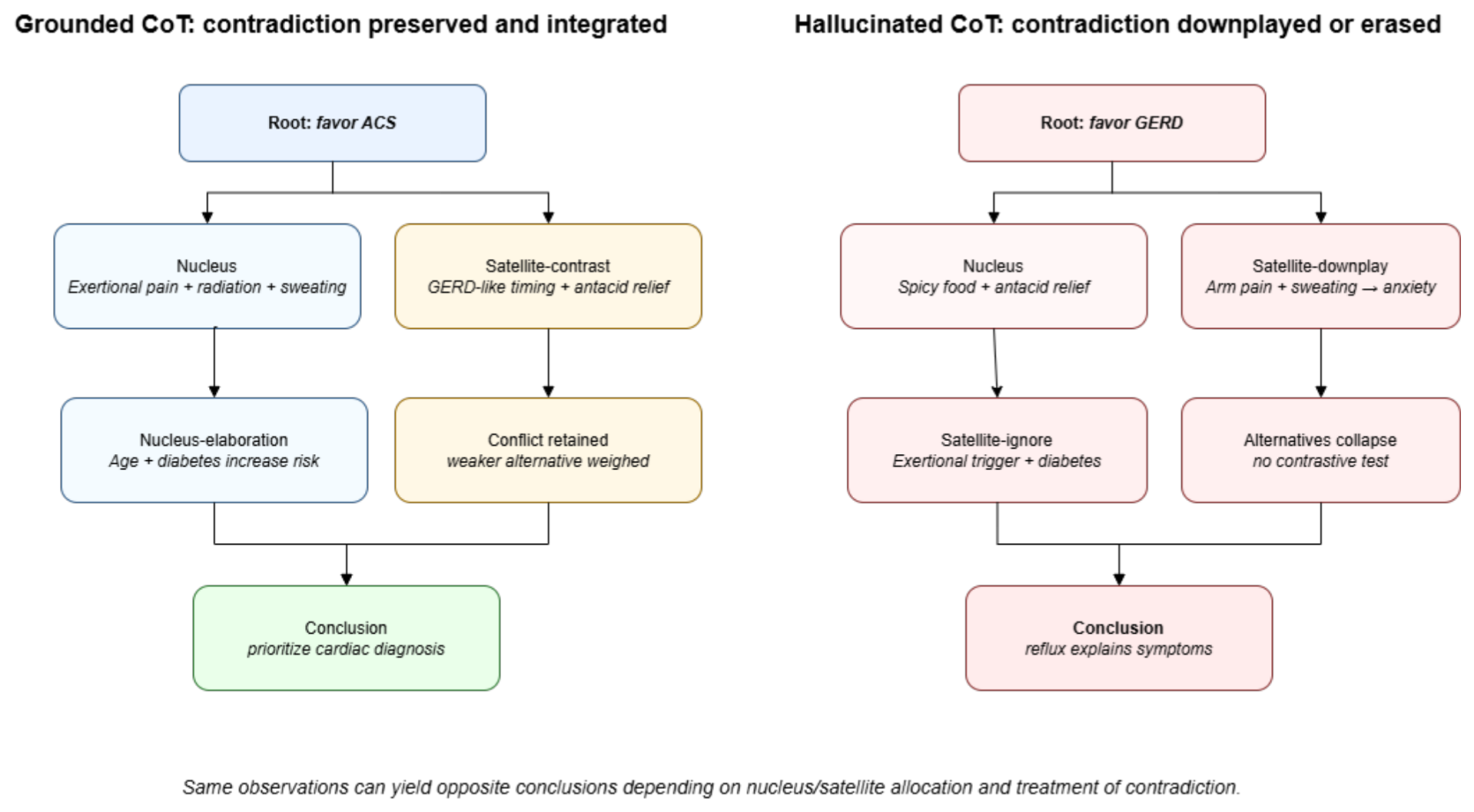
Figure 2.
Architecture of the Joint Knowledge–Reasoning Hallucination Measure (JKRHM). A chain-of-thought explanation is analyzed through three complementary verification channels: geometric reasoning signals derived from latent-space behavior, abductive reasoning signals derived from explanation and counter-explanation generation, and discourse-structural signals derived from rhetorical structure analysis. The normalized outputs are aggregated into a unified hallucination-risk score that estimates the likelihood that a reasoning process is grounded or hallucinated.
Figure 2.
Architecture of the Joint Knowledge–Reasoning Hallucination Measure (JKRHM). A chain-of-thought explanation is analyzed through three complementary verification channels: geometric reasoning signals derived from latent-space behavior, abductive reasoning signals derived from explanation and counter-explanation generation, and discourse-structural signals derived from rhetorical structure analysis. The normalized outputs are aggregated into a unified hallucination-risk score that estimates the likelihood that a reasoning process is grounded or hallucinated.
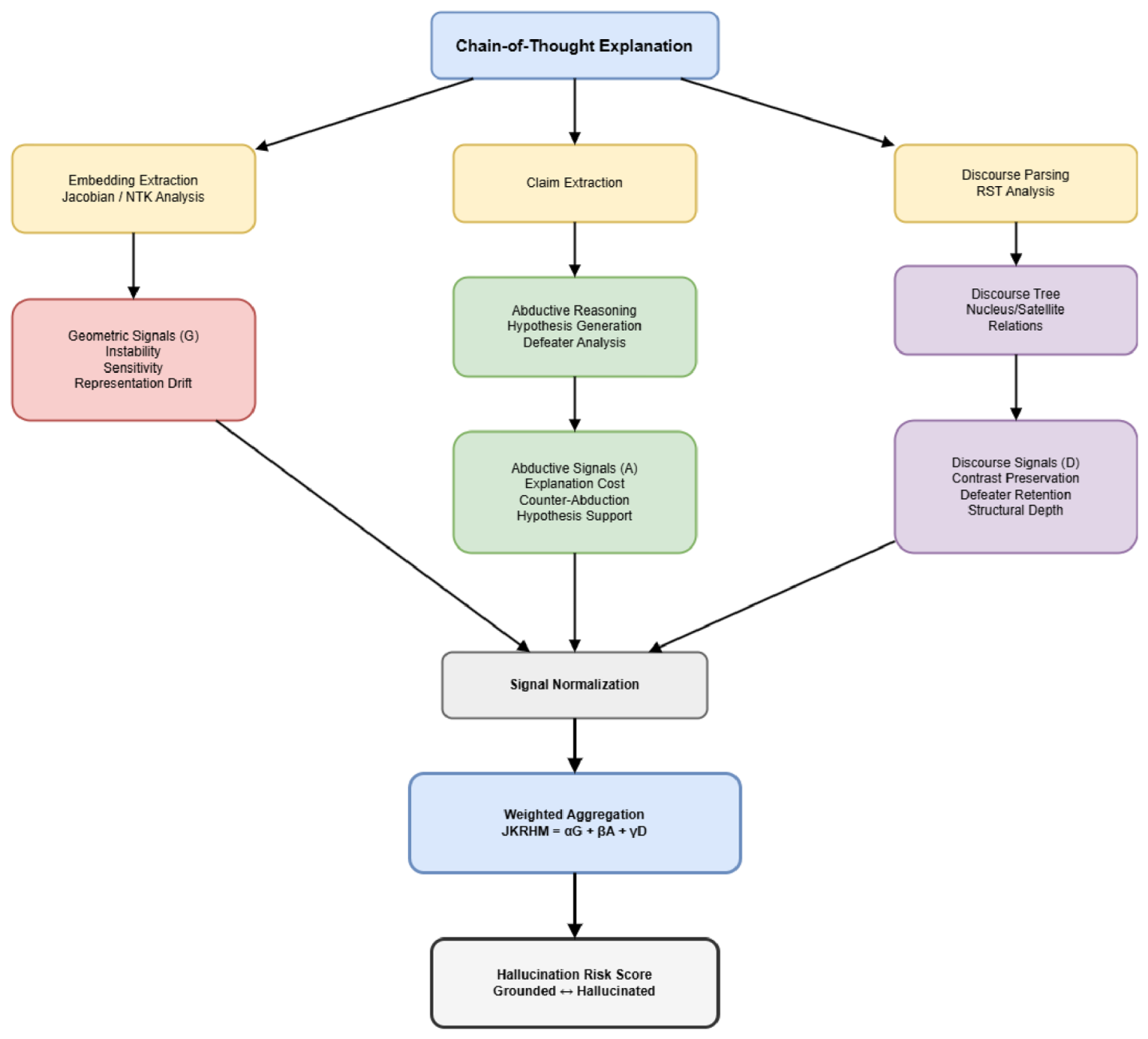
Figure 3.
Overview of the discourse-aware hallucination detection pipeline. Patient complaints from the Autoimmune-Narrate-Halluc corpus are converted into diagnostic explanations, transformed into discourse-tree representations, augmented with controlled reasoning perturbations to generate grounded and hallucinated reasoning traces, and evaluated by discourse-aware hallucination detectors under patient-level train–test separation.
Figure 3.
Overview of the discourse-aware hallucination detection pipeline. Patient complaints from the Autoimmune-Narrate-Halluc corpus are converted into diagnostic explanations, transformed into discourse-tree representations, augmented with controlled reasoning perturbations to generate grounded and hallucinated reasoning traces, and evaluated by discourse-aware hallucination detectors under patient-level train–test separation.
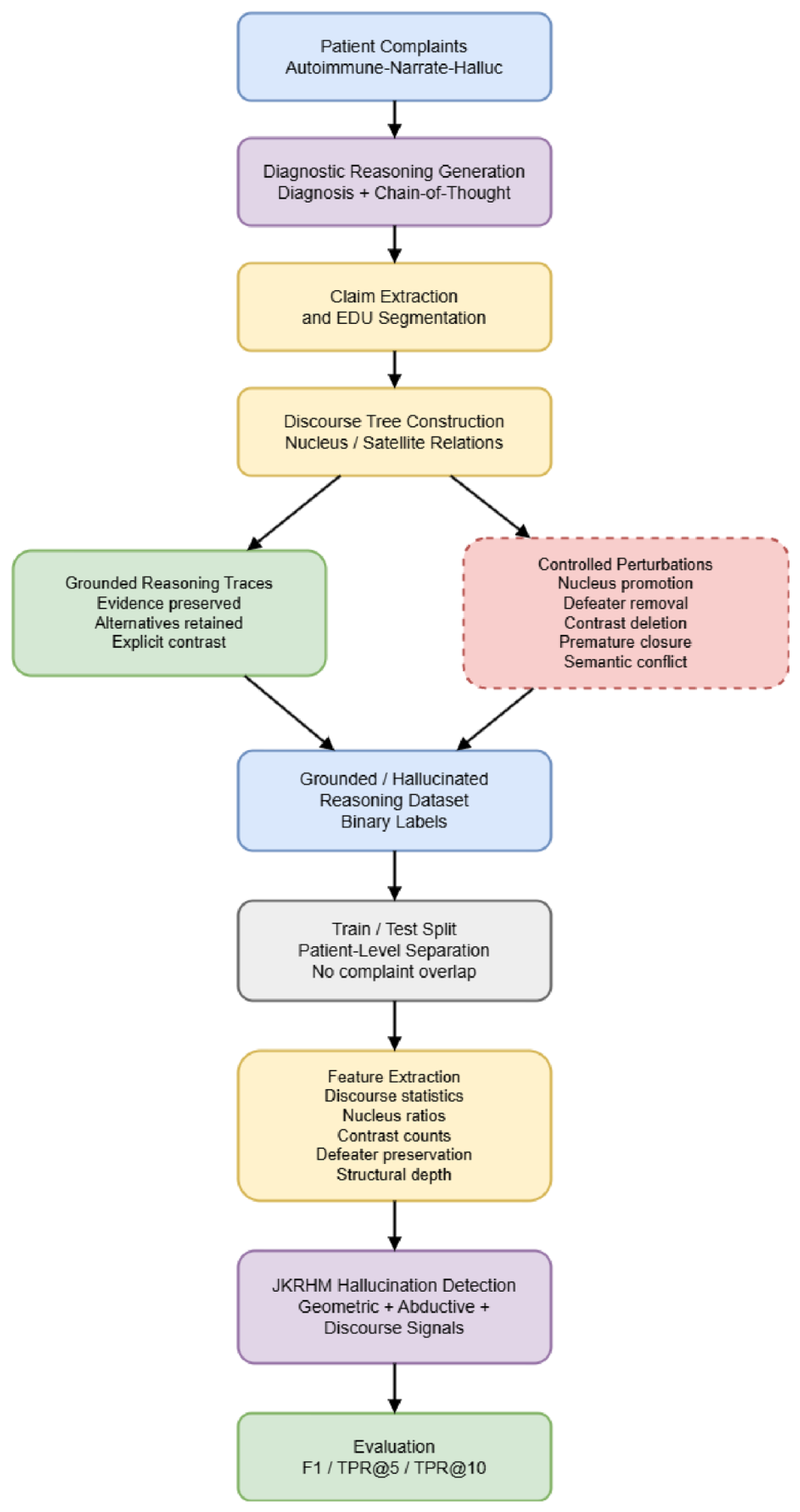
Figure 4.
Overview of the discourse-aware hallucination detection pipeline. ...
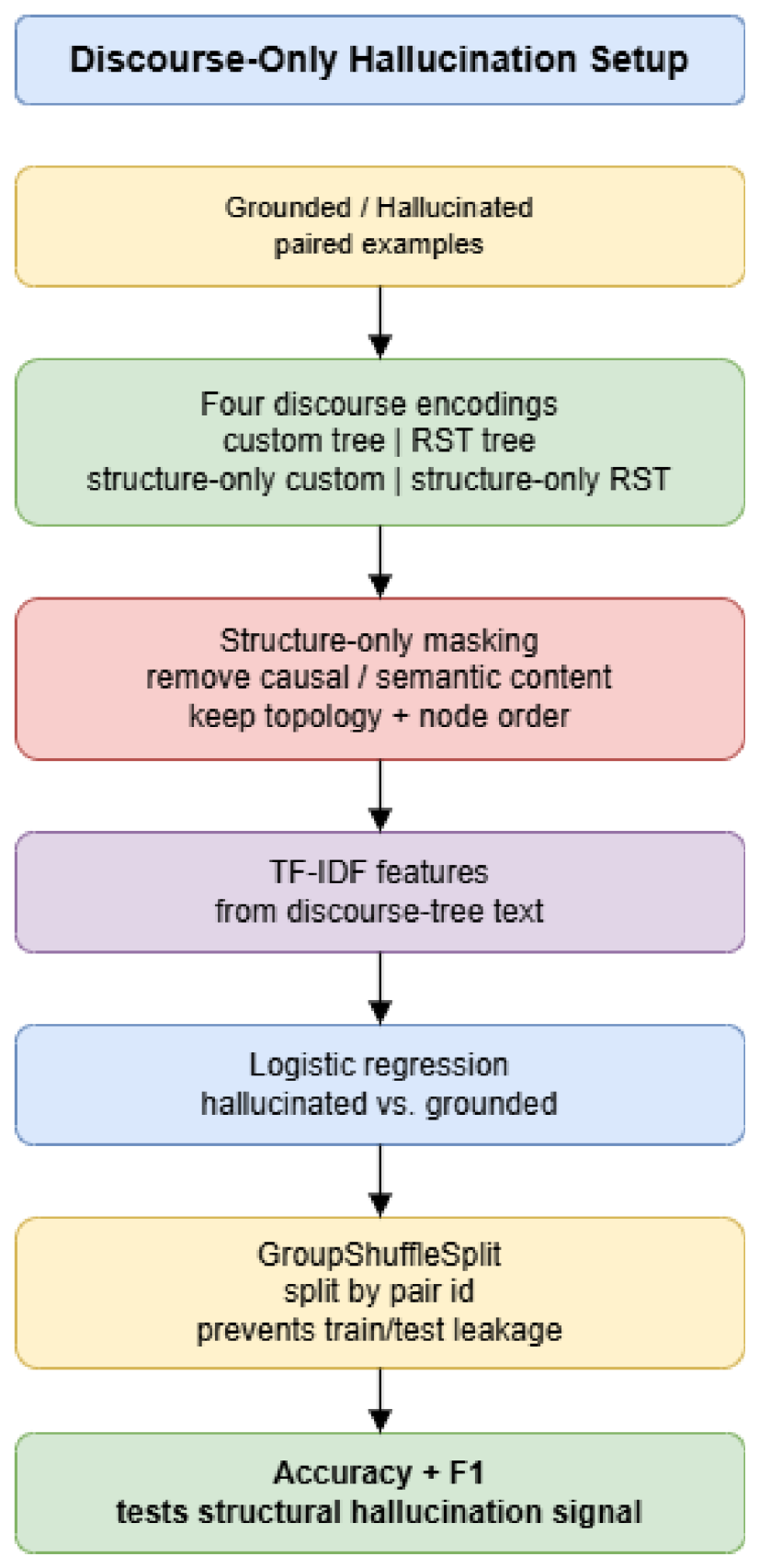

Table 1.
Grounded vs. hallucinated CoT discourse structure.
| Feature | Grounded CoT | Hallucinated CoT |
|---|---|---|
| Root nucleus | High-information evidence | Weak but salient clue |
| Contradiction handling | Preserved and weighed | Dismissed or reinterpreted |
| Hypothesis space | Multiple alternatives visible | Early collapse to one hypothesis |
| Satellite function | Background, contrast, support | Excuse-making, downplaying, repair |
| Conclusion style | Integrative, conflict-resolving | Premature, selectively justified |
| Risk handling | Sensitive to dangerous alternatives | Often ignores red flags |
Table 2.
Discourse-level contrast between grounded and hallucinated CoT reasoning.
| Feature | Grounded CoT | Hallucinated CoT |
|---|---|---|
| Root nucleus | High-information evidence anchors the main claim. | Weak but salient clue is promoted into the main claim. |
| Contradiction handling | Contradictory evidence is preserved, weighed, and explicitly reconciled. | Contradictory evidence is dismissed, ignored, or reinterpreted. |
| Hypothesis space | Multiple alternatives remain visible until late in the reasoning process. | The reasoning collapses early to one preferred hypothesis. |
| Satellite function | Satellites provide background, contrast, qualification, evidence, or support. | Satellites perform excuse-making, downplaying, or post-hoc repair. |
| Conclusion style | Conclusion is integrative and conflict-resolving. | Conclusion is premature and selectively justified. |
| Risk handling | Dangerous alternatives and red flags receive increased weight. | Red flags are often ignored, minimized, or treated as irrelevant. |
| Information gain | Later steps add evidence, comparison, or constraint. | Later steps often repeat or defend the initial hypothesis. |
| Counter-abduction | Rival explanations are explicitly considered as possible defeaters. | Rival explanations are absent or only superficially mentioned. |
Table 3.
Dataset schema.
| Field | Description |
|---|---|
| Patient complaint | Ambiguous complaint with conflicting cues |
| Diagnosis | Best-fit or hallucinated diagnosis |
| Reasoning log | Concise justification for diagnosis |
| Discourse tree | Tree-like reasoning structure |
| Hallucination label | Yes / No |
Table 4.
Main evaluation results.
| Representation | Accuracy | F1 (Halluc.) |
|---|---|---|
| Custom discourse tree | 0.825 | 0.820 |
| Traditional RST tree | 0.825 | 0.822 |
| Structure-only custom | 0.810 | 0.804 |
| Structure-only RST | 0.808 | 0.801 |
Table 5.
Comparison of hallucination detection performance at low-FPR operating points on RAGTruth [24]. JKRHM requests an explicit CoT explanation, converts it into a discourse tree, and scores hallucination through joint geometric, abductive, and discourse-structural signals. Competing systems assess hallucination without explicit CoT construction or discourse-tree analysis.
Table 5.
Comparison of hallucination detection performance at low-FPR operating points on RAGTruth [24]. JKRHM requests an explicit CoT explanation, converts it into a discourse tree, and scores hallucination through joint geometric, abductive, and discourse-structural signals. Competing systems assess hallucination without explicit CoT construction or discourse-tree analysis.
| Method | GPT-5.5 | Mistral Large 3 | Llama 4 Maverick | Qwen3-Max | ||||||||
|---|---|---|---|---|---|---|---|---|---|---|---|---|
| F1 | TPR@10 | TPR@5 | F1 | TPR@10 | TPR@5 | F1 | TPR@10 | TPR@5 | F1 | TPR@10 | TPR@5 | |
| JKRHM (ours) | 74.2 | 62.3 | 51.2 | 71.3 | 67.0 | 65.2 | 76.5 | 60.1 | 58.2 | 74.4 | 60.8 | 57.9 |
| HALLUGUARD [31] | 73.7 | 61.4 | 53.6 | 72.1 | 67.2 | 60.3 | 77.4 | 65.2 | 55.8 | 73.4 | 61.3 | 54.5 |
| Inside [3] | 59.2 | 53.2 | 49.0 | 67.1 | 62.4 | 55.6 | 72.1 | 64.9 | 59.4 | 72.4 | 67.3 | 62.7 |
| MIND [27] | 57.8 | 51.3 | 48.7 | 66.9 | 62.6 | 58.0 | 69.2 | 62.5 | 56.9 | 62.6 | 57.5 | 52.0 |
| Perplexity [26] | 70.4 | 63.2 | 59.3 | 71.7 | 65.3 | 62.9 | 71.8 | 66.3 | 60.7 | 73.5 | 65.2 | 62.4 |
| LN-Entropy [20] | 65.2 | 62.1 | 58.4 | 66.7 | 60.3 | 54.7 | 70.2 | 67.8 | 62.0 | 68.9 | 63.5 | 57.4 |
| Energy [19] | 57.5 | 50.3 | 46.0 | 64.8 | 60.1 | 57.9 | 67.2 | 62.4 | 60.1 | 72.4 | 68.1 | 65.0 |
| Semantic Ent. [15] | 56.1 | 52.3 | 49.7 | 64.5 | 61.2 | 57.0 | 67.3 | 62.7 | 57.4 | 64.1 | 61.8 | 56.3 |
| Lexical Sim. [18] | 58.2 | 55.1 | 53.6 | 60.2 | 56.0 | 53.4 | 62.9 | 60.1 | 54.8 | 63.1 | 60.2 | 56.8 |
| RACE [30] | 66.2 | 62.7 | 59.6 | 62.0 | 57.4 | 53.9 | 61.7 | 58.4 | 54.3 | 63.5 | 59.0 | 56.4 |
| FActScore [23] | 63.8 | 59.5 | 55.2 | 66.2 | 63.9 | 60.8 | 67.3 | 63.9 | 61.0 | 65.4 | 62.8 | 58.7 |
Disclaimer/Publisher’s Note: The statements, opinions and data contained in all publications are solely those of the individual author(s) and contributor(s) and not of MDPI and/or the editor(s). MDPI and/or the editor(s) disclaim responsibility for any injury to people or property resulting from any ideas, methods, instructions or products referred to in the content. |
© 2026 by the authors. Licensee MDPI, Basel, Switzerland. This article is an open access article distributed under the terms and conditions of the Creative Commons Attribution (CC BY) license (http://creativecommons.org/licenses/by/4.0/).
Copyright: This open access article is published under a Creative Commons CC BY 4.0 license, which permit the free download, distribution, and reuse, provided that the author and preprint are cited in any reuse.


