
Submitted:
19 June 2026
Posted:
22 June 2026
You are already at the latest version
Abstract
Modern proteomics faces a critical bottleneck: the vast discrepancy between the number of genes in the human genome and the exponentially greater variety of functional proteoforms that actually drive biological processes. Our paper addresses the urgent need for high-resolution systematic mapping of these proteoforms, arguing that the true frontier of molecular biology lies in the precise identification and categorization of protein variants. It centers on the development and expansion of the "2DE-pattern" database, a specialized platform designed to bridge the gap between theoretical protein sequences and the physical reality of protein expression as captured through two-dimensional electrophoresis (2DE). A database “2DE-pattern”is based on information obtained by separation of proteoforms using 2DE with following shot-gun ESI LC-MS/MS. It was launched in 2020, contains multiple isoform-centric patterns of proteoforms, and can be freely used at http://2de-pattern.pnpi.nrcki.ru. Here, we report the additional data and all updates that were added into this database. Also, it was upgraded to be more research-oriented. Some tools were incorporated into the database to allow the convenient comparative analysis of the data. Accordingly, it became now more like a knowledge database.
Keywords:
proteoforms
; database
; bioinformatics
; pattern
; 2DE
1. Introduction
As proteomics delves deeper into the protein heterogeneity associated with a huge number of proteoforms, the amount of information grows very rapidly, so there is a high demand for convenient ways to store and use this information. Therefore, databases are a crucial part of proteomics. The most well-known open-access databases are located at the National Center for Biotechnology Information (NCBI; http://www.ncbi.nlm.nih.gov) and on the SIB ExPASy bioinformatics resource portal, https://www.expasy.org/, for example, NeXtProt and UniProt (https://www.nextprot.org/, http://www.uniprot.org/) [1,2]. The Human Protein Atlas is another prominent research portal dedicated to mapping all human proteins across cells, tissues, organs, and blood [3]. The Consortium for Top-Down Proteomics (CTDP) is involved in the project aiming to define the complete set of human proteoforms [4,5]. Accordingly, a proteoform database called Proteoform Atlas was organized (http://atlas.topdownproteomics.org) [6,7]. In addition, archive databases such as PRIDE (the PRoteomics IDEntifications database) or PeptideAtlas are available where information about proteoforms can be found [8,9]. Typically, the data collected in the databases are based on the specific method by which they were obtained. As for proteoforms, two-dimensional gel electrophoresis (2DE) is ideal for their separation and subsequent identification [10,11,12]. Moreover, 2DE allows one to measure the basic parameters of a protein molecule — molecular weight (Mw) and pI — and allows for the storage of the obtained information in a highly visually accessible format [13,14,15]. Although the subsequent analysis is performed using bottom-up mass spectrometry, the overall approach is called top-down integrative proteomics [16,17,18]. To enable a complete analysis of samples, another approach was developed whereby the entire gel was divided into individual sections, which were then processed and subjected to mass spectrometry. Based on this approach, we generated proteoform profiles for several cell types [19,20,21]. Moreover, these data were used to create a web database called ‘2DE-pattern’ [22]. Although this approach is not as accurate as classical top-down mass spectrometry, it allows one to obtain a general idea of proteoform families, the so-called patterns. Here, we report more data as well as more features that were incorporated into this database recently. These updates have significantly expanded the database and enhanced the discovery power of it.
2. Materials and Methods
2.1. Sample Preparation
Human hepatocellular carcinoma cells (HepG2), embryonic lung fibroblasts (LEH); glioblastoma (primary line L) cells were cultured, collected, and extracted in the same way as it was described before [20,23,24,25]. Hepatocellular carcinoma and control tissue were extracted according to [21]. The samples contain 2 mg of protein in 100 µL of lysis buffer (7 M urea, 2 M thiourea, 4% CHAPS, 1% dithiothreitol (DTT), 2% ampholytes, pH 3-10, protease inhibitors mixture). The protein concentration in the sample was determined by the method of Bradford [26].
2.2. 2DE
All procedures were performed according to the protocols described previously [20,23,24,27]. Briefly, for classical 2DE, 1000 μg of protein was loaded onto a 24 cm long nonlinear IPG strip. After isoelectric focusing (IEF), the separation was produced on a 12% polyacrylamide gel (1 mm × 25 × 20 cm) under denaturing conditions. The gel was stained with Coomassie Blue R350, scanned with an ImageScanner III (GE Healthcare, Pittsburgh, PA, USA), and analyzed with an ImageMaster 2D Platinum 7.0 (GE Healthcare).
For sectional 2DE, 500 μg of protein was loaded onto a 7 cm long linear IPG strip. After the second dimension, the gel (1 mm x 8 × 8 cm) was stained, scanned, analyzed using ImageMaster 2D Platinum 7.0, and divided into 96 sections with defined coordinates designated as 1–12 along the Mw dimension and A–H along the pI dimension. Each section was digested with trypsin. Tryptic peptides were eluted from the gel with extraction solution (5% (v/v) acetonitrile, 5% (v/v) formic acid) and dried in a Speed Vac vacuum centrifuge. The peptides were dissolved in 5% (v/v) formic acid.
In the case of semi-virtual 2DE [19,28], the first step was the same as in classical 2DE. After IEF, the strip was cut into 48 equal sections and processed according to the trypsin digestion protocol. Samples were digested overnight at 37°C. Peptides were extracted with 150 μl of 60% acetonitrile (ACN) and 0.1% trifluoroacetic acid (TFA). The extracts were dried in a Speed Vac vacuum dryer and dissolved in 20 µL of 0.1% TFA before analysis by mass spectrometry (MS).
2.3. ESI LC-MS/MS Analysis
The analysis was completed as described previously [19,28]. Panoramic proteomic analysis of the obtained extracts was performed using filter processing and subsequent mass spectrometry (the so-called Filter Aided Sample Preparation (FASP) method) [21,29]. Centrifuge concentrators (Microcon YM–30, Merck, USA) were used for this purpose. In short, extracts containing the required amount of protein (300 μg) were placed in concentrators and sequentially treated with solutions: (a) for the reduction of disulfide bonds (100 mM DTT in 100 mM Tris-HCl, pH 8.5), then (b) for the alkylation of sulfhydryl groups (50 mM iodoacetamide, 8 M urea, 100 mM Tris-HCl, pH 8.5), (c) for hydrolysis with trypsin (Trypsin Gold, Promega, USA). Tandem mass spectrometry analysis was carried out on an Orbitrap Q-Exactive mass spectrometer (Thermo Scientific, Waltham, MA, USA) according to the protocols described previously [30].
2.4. Protein Identification
Identification of proteins was performed using the SearchGUI, an open-source graphical user interface [31]. Two unique peptides per protein were required for all protein identifications. Exponentially modified PAI (emPAI), the exponential form of protein abundance index (PAI) defined as the number of identified peptides divided by the number of theoretically observable tryptic peptides for each protein, was used to estimate protein abundance [32]. All additional information about the methods can also be reached through the front page of the database by clicking the corresponding links for protocols or articles.
2.5. Software Used for Database Construction
All data were stored in a Mysql database (version 15.1) on Linux server. Scripts that process requests from the user interface were developed using Perl 5 (version 30). Website is based on webserver Apache / 2.4.39. Interactive user interface to database is implemented using HTML, CSS, JavaScript, and JQuery library. The queries to server programs are executed using AJAX technology.
3. Results and Discussion
3.1. Overview of the Database
Our database “2DE-pattern” was developed to provide a simple and comprehensive tool to store and analyze the information about proteoforms separated according to 2DE principles. These principles are based on the fundamental physicochemical parameters of polypeptides that are isoelectric point (pI) and molecular weight (Mw). Each proteoform (polypeptide) has a specific set of these parameters. Unfortunately, the very useful database SWISS-2DPAGE is not available anymore, and the interactive website (https://world-2dpage.expasy.org/swiss-2dpage/) has been discontinued. Accordingly, we are trying to enlarge and upgrade our database. We are using three different approaches based on experimental and virtual 2DE separation and identification by mass spectrometry. The first approach is based on a classical 2DE. In addition to the experimental 2DE, we have performed the virtual 2DE for HCC samples. In this case, the information about protein abundances was obtained by the bottom-up MC of extracts. The virtual 2DE was constructed based on this experimental information and the theoretical parameters (pI, Mw) available for each polypeptide. The second one is a sectional 2DE, when a whole gel, not only selected spots, is analyzed by ESI LC-MS/MS section by section. The third one is a semi-virtual 2DE, when proteoforms are separated only by IEF according to their pI. Each approach allows for the production of a specific proteoform pattern for every isoform. All three approaches have limitations, but they are complementary to each other and allow for obtaining a better view of the combined proteoform profiles of isoforms. To generate the complete image of the proteoform landscape, the detailed information (sequence and PTMs) about each proteoform should be obtained. But this is a task of the next step in proteoform identification. Currently, the database contains information on proteoform patterns for 15,871 isoforms.
3.2. Addition in the Database Content and Search Features
Users can search the database using three distinct identifiers from the front (entry) page,
- UniProt accession number of the target protein.
- Official name of the protein.
- Gene symbol or name.
The home page provides direct links to the underlying data sources:
- Protocols: Detailed laboratory methods used to generate the data.
- References: Published papers validating the database content.
We also added the ability to check the general information about all isoforms included in the database. It can be done by clicking “All available proteins (isoforms) — Click HERE”. That will transfer users to the page where they can evaluate and compare protein expressions:
- emPAI Values: View quantitative data for detected proteoforms.
- Bulk Graph Loading: Render all available charts simultaneously.
- Pattern Comparison: Contrast and compare 2DE maps across different samples.
The data currently originates from five specific sources:
- Glia-L: Glioblastoma cell line.
- LEH: Human embryonic lung fibroblasts.
- HepG2: Hepatocellular carcinoma cell line.
- HCC: Hepatocellular carcinoma tissue samples.
- HCCCONTROL: Healthy control tissue for hepatocellular carcinoma.
3.3. Navigation Workflow
The database utilizes a hierarchical transition model to navigate from general protein data to specific experimental proteoform patterns:
[Protein Page] ---> [Isoform Page] ---> [Sample Pages (3 Types)]
Protein Page: Displays basic information, SWISS-PROT ID/Accession Number, description line, and all available isoforms.
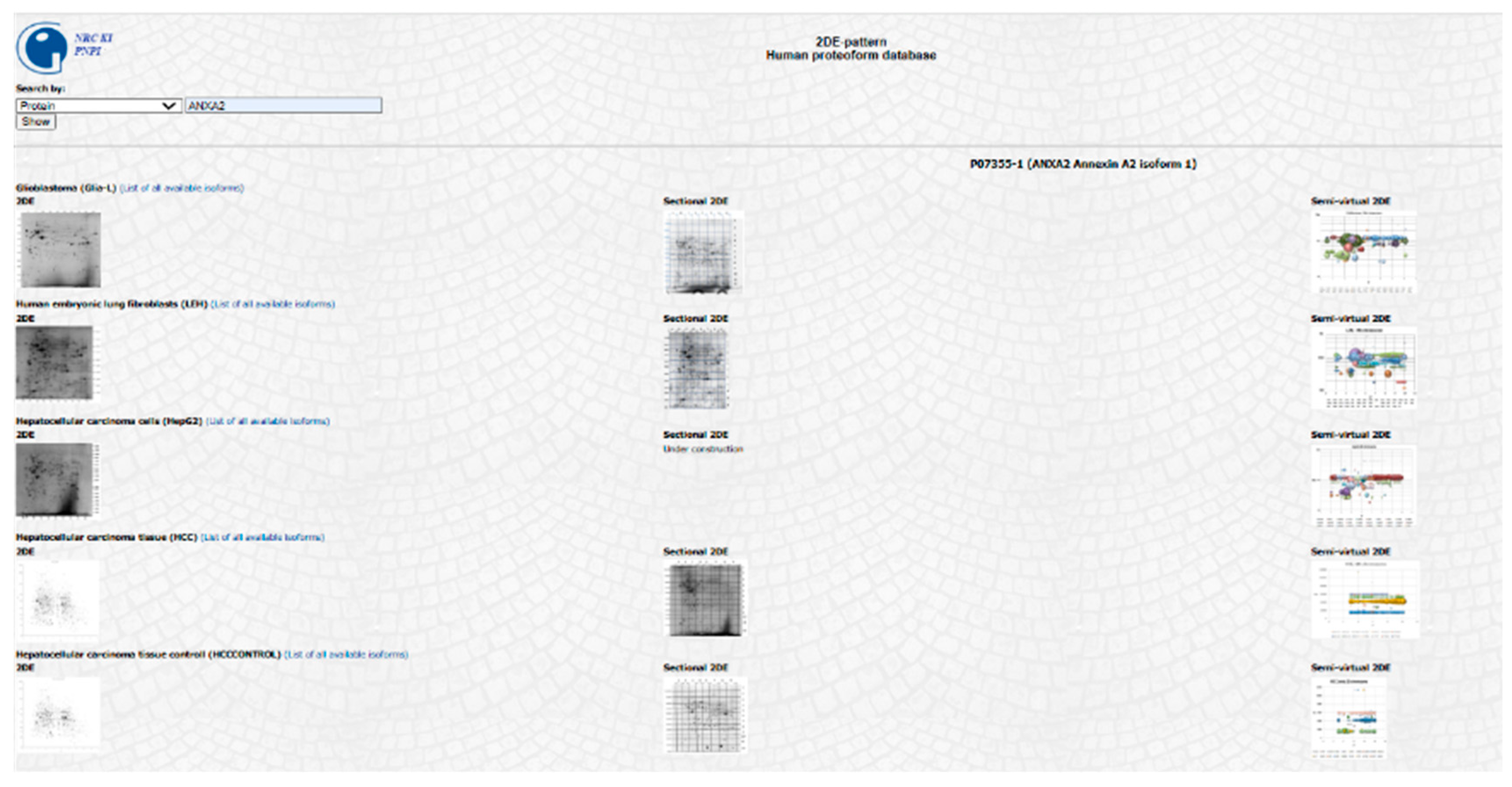
Isoform Page: Links to different sample pages and includes a master table mapping isoform data (Figure 1).
Sample Pages: Delivers specialized proteoform patterns based on the chosen analytical approach.
Figure 1.
An “isoform page” of the human proteoform database “2DE-pattern”. A selection of three types of 2DE pattern for the isoform 1 of ANXA2 (P07355-1) is presented (2DE, sectional 2DE, or semi-virtual 2DE).
Figure 1.
An “isoform page” of the human proteoform database “2DE-pattern”. A selection of three types of 2DE pattern for the isoform 1 of ANXA2 (P07355-1) is presented (2DE, sectional 2DE, or semi-virtual 2DE).
3.4. Sample Page Types & Methods
The database offers three types of sample pages determined by the experimental workflow used to analyze the proteome. First type — Classical or Virtual 2DE Maps:
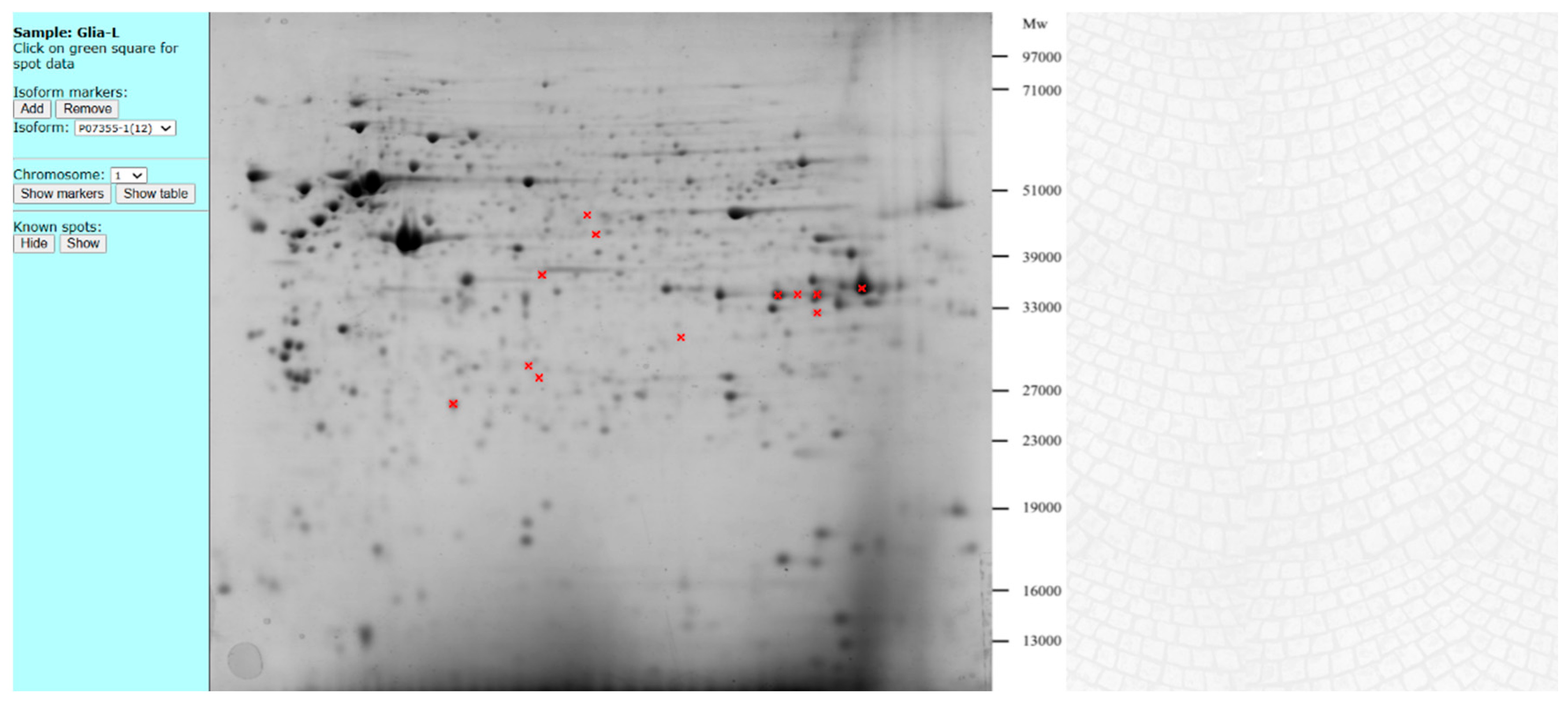
Classical 2DE Map: It displays physical, experimental gel spots where proteins were detected (Figure 2A). In the 2DE map, spots where different proteoforms of the same isoform were detected are highlighted. Accordingly, a proteoform pattern of this isoform is produced. Additionally, basic experimental information about the spot abundance and the isoform (isoform name, protein name, gene name, chromosome, theoretical pI, theoretical Mw, experimental pI, theoretical Mw, emPAI, modifications) is shown. Minimal information obtained by mass spectrometric analysis is shown in the table. Also, by clicking on a spot a user can extract information about all the isoforms that were detected in this spot. Additionally, there is an option to check each chromosome for the detected proteoforms. The classical 2DE is used for the samples Glia-L, LEH, and HepG2 (Figure 2A).
Figure 2.A.
A “sample page” of the human proteoform database “2DE-pattern”, where a classical 2DE is used. All spots, where isoforms were detected are marked in green. Information about each spot is presented in a table. Spots with proteoforms of the isoform 1 of ANXA2 (P07355-1) are shown in red.
Figure 2.A.
A “sample page” of the human proteoform database “2DE-pattern”, where a classical 2DE is used. All spots, where isoforms were detected are marked in green. Information about each spot is presented in a table. Spots with proteoforms of the isoform 1 of ANXA2 (P07355-1) are shown in red.
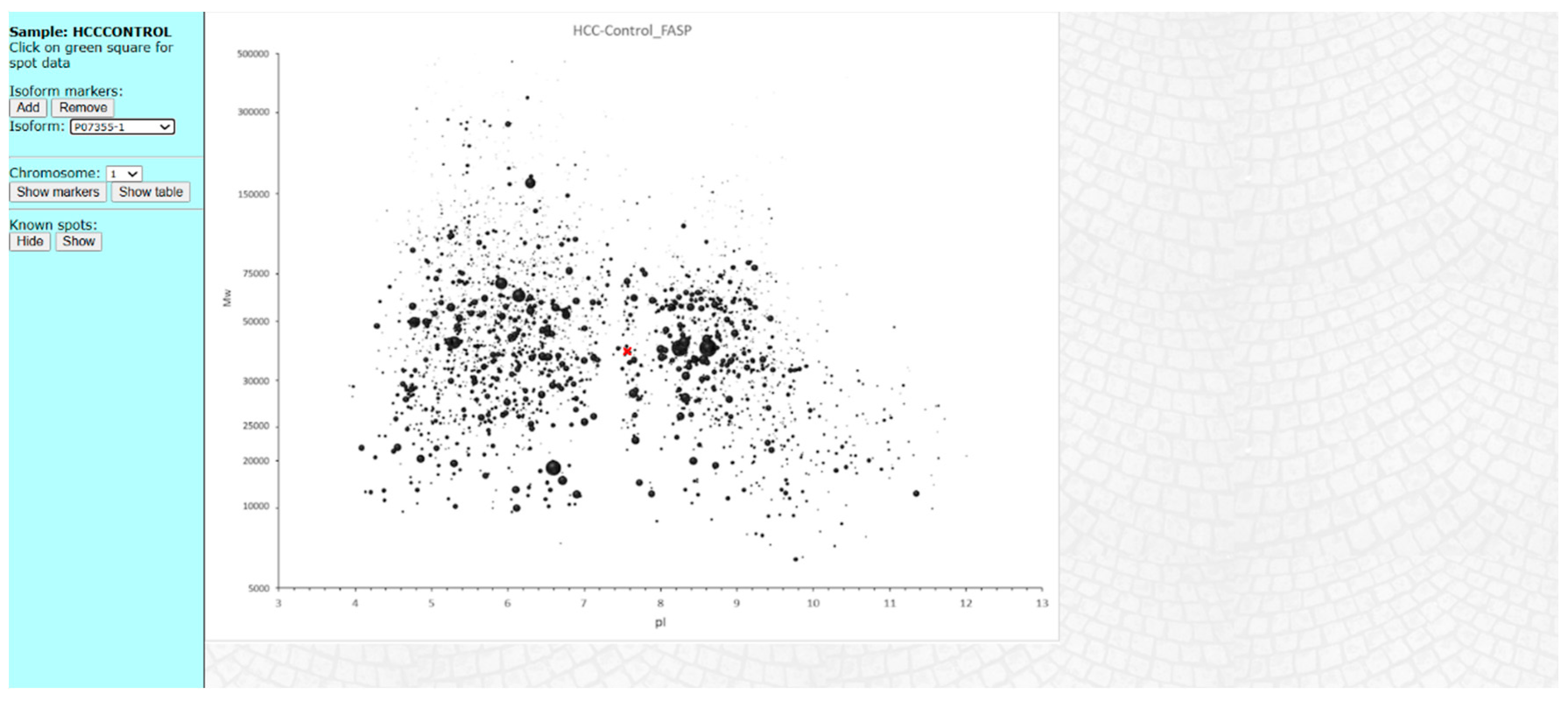
Virtual 2DE Map: Used for HCC and HCCCONTROL samples. It constructs a digital map using quantitative FASP analysis of extracts combined with theoretical physical-chemical parameters (pI and Mw) of proteins (Figure 2B). A virtual 2DE map data provides additional visual representation of the proteome state. Interestingly, the virtual 2DE map of the master protein forms (277 proteins) encoded by human chromosome 18 also resembles a liver or tumor protein map. This provides additional grounds for extrapolating many of the data obtained on chromosome 18 proteins to the entire proteome.
Figure 2.B.
A “sample page” of the human proteoform database “2DE-pattern”, where a virtual 2DE was used. Information about each spot is presented in the table. A spot of the master form of isoform 1 of ANXA2 (P07355-1) is marked by the red cross.
Figure 2.B.
A “sample page” of the human proteoform database “2DE-pattern”, where a virtual 2DE was used. Information about each spot is presented in the table. A spot of the master form of isoform 1 of ANXA2 (P07355-1) is marked by the red cross.
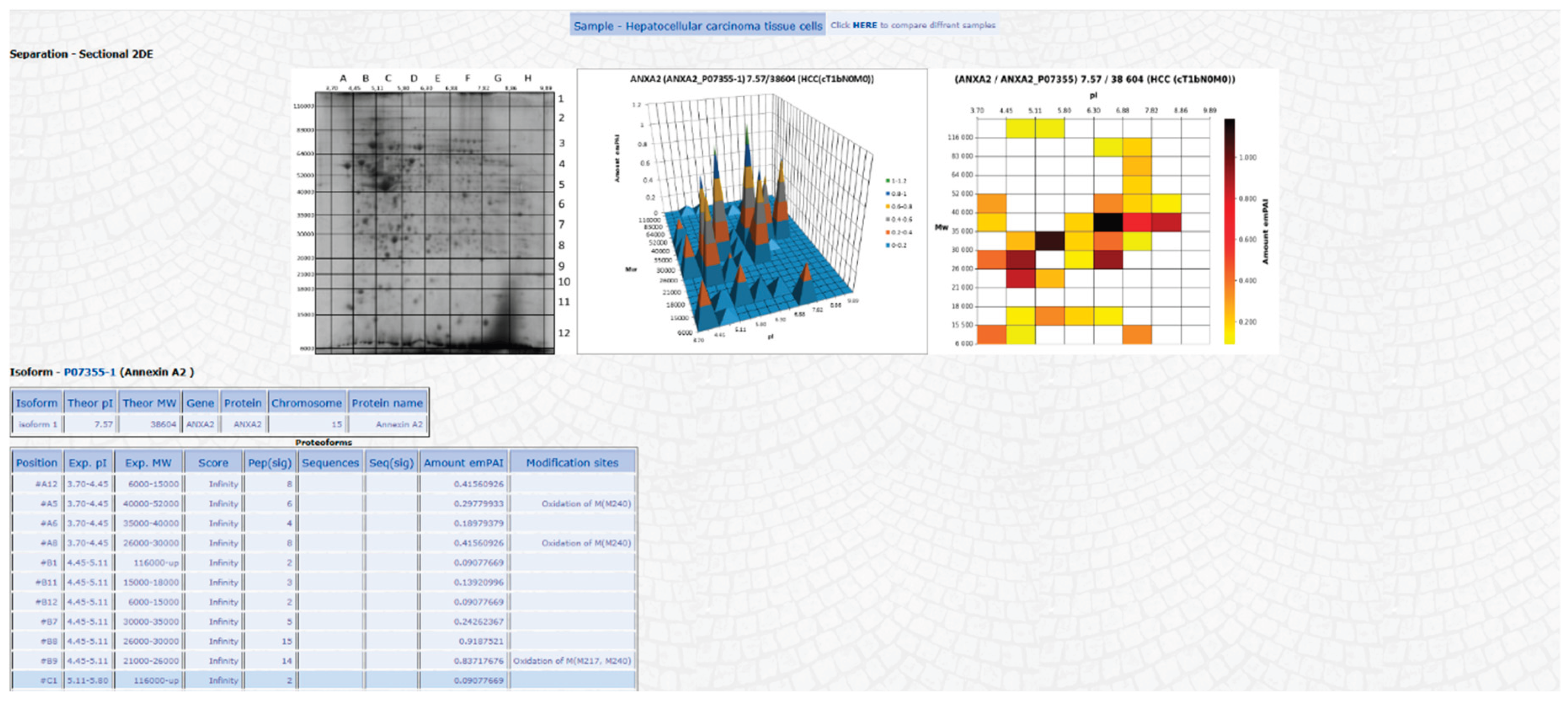
A “sample page” with a sectional 2DE was also upgraded. To improve perception and analysis, patterns were constructed in two types: volumetric (three-dimensional) in the form of pyramids, where the height of the pyramid of each section corresponded to the level of the proteoform located in this section (the emPAI parameter), and in the form of heat maps, where the color corresponded to the level of the proteoform (Figure 2C). A “sample page” with a semi-virtual 2DE looks in the same way as it was launched in 2020.
Figure 2.C.
A “sample page” with a sectional 2DE. A 2DE gel (HCC) devided into sections with determined coordinates is shown on the left. Pyramids-type and heat map-type distributions of proteoforms among the sections (proteoforms pattern) of the isoform 1 of ANXA2 (P07355-1) are shown on the right. A table contains basic theoretical information about this isoform (pI/Mw, isoform, protein, gene, chromosome). Another table contains experimental data about the proteoforms (pI/Mw coordinates of the sections, where the isoform was detected, and MS information — score, number of detected sequences, emPAI, modification sites).
Figure 2.C.
A “sample page” with a sectional 2DE. A 2DE gel (HCC) devided into sections with determined coordinates is shown on the left. Pyramids-type and heat map-type distributions of proteoforms among the sections (proteoforms pattern) of the isoform 1 of ANXA2 (P07355-1) are shown on the right. A table contains basic theoretical information about this isoform (pI/Mw, isoform, protein, gene, chromosome). Another table contains experimental data about the proteoforms (pI/Mw coordinates of the sections, where the isoform was detected, and MS information — score, number of detected sequences, emPAI, modification sites).
All different approaches have advantages and disadvantages. The data obtained by a classical experimental 2DE has high resolution but is limited to the number of proteoforms, as they were detected only in the stained spots. The virtual 2DE allows you to get unbiased images of the proteomes, which are convenient to compare with each other. But they contain only the master forms of proteins and are missing information about other proteoforms. While sectional 2DE suffers from low resolution and overlapping proteoform signals, it maps the entire gel to detect invisible, unstained proteoforms. The pattern obtained by a semi-virtual 2DE has high enough resolution in the pH direction but is missing information about the real Mw of the proteoforms. Integrating information from these four approaches, a user can reveal a comprehensive, "ideal" proteoform profile. These sample pages link directly to external databases for deeper analysis. Users can access UniProt to view known post-translational modifications (PTMs) for the isoform. Alternatively, they can use the Proteoform Atlas to check if specific proteoforms have been previously detected via top-down mass spectrometry.
4. Conclusions
This paper describes an upgraded version of the database “2DE-pattern” that was developed for storing and analysis information about patterns or profiles of human proteoforms generated according to 2DE principles [22]. A central theme here is the necessity of 2DE in an era dominated by mass spectrometry [33]. Critics often argue that high-resolution mass spectrometers can now identify thousands of proteins in a single run, seemingly rendering the "visual" approach of the 2DE-pattern database obsolete [34]. However, this argument overlooks the difference between *identification and *characterization [35]. Our approach allows to generate an “integral image” of proteoform distribution according to their physico-chemical parameters. A complete characterization of proteoforms is the more difficult problem to solve. It seems that a top-down MS can give a solution to this task. Really, there is a big progress in this area, as now the Proteoform Atlas has data about 66496 proteoforms detected in human cells (http://human-proteoform-atlas.org/ accessed on 22 May 2026). What is important is that the data from the Proteoform Atlas and integrative top-down proteomics (2DE-pattern) can be complementary to each other [21]. The primary challenge lies in unifying these experimental results. Implementing data standardization and unification protocols would provide significant benefits. Specifically, integrating key metadata—such as the average molecular weight (Mw) and calculated isoelectric point (pI) for each entry—into the Proteoform Atlas would enable direct cross-database comparisons, particularly with the "2DE-pattern" database.
The future of proteoform-based proteomics will depend on the systematic integration of proteoform mapping, functional characterization, and predictive modeling. This vision requires progress in several areas that will enhance the translational value of proteoform research [36]. Keeping and replenishment of the proteoform databases should be an undoubted basis of this process.
Author Contributions
conceptualization, supervision, writing—review and editing, Stanislav Naryzhny; software, data curation, resources, Nikolay Klopov; formal analysis, data curation, Natalia Ronzhina; formal analysis, data curation, Elena Zorina; formal analysis, data curation, Olga Legina.
Acknowledgments
The data was obtained under the Program of Fundamental Research of State Academies of Sciences for 2026-2028. Mass-spectrometry measurements were performed using the equipment of “Human Proteome” Core Facilities of the Institute of Biomedical Chemistry (Russia).
Conflicts of Interest
The authors declare no conflict of interest.
Abbreviations
The following abbreviations are used in this manuscript:
| 2DE | two-dimensional electrophoresis |
| ESI LC-MS/MS | liquid chromatography-electrospray ionization-tandem mass spectrometry |
| DTT | dithiothreitol |
| MS | mass spectrometry |
| PTM | post-translational modifications |
| emPAI | exponential modified form of protein abundance index |
| SIB | Swiss Institute of Bioinformatics |
References
- Bairoch, A. The SWISS-PROT protein sequence database and its supplement TrEMBL in 2000. Nucleic Acids Res. 2000. [Google Scholar] [PubMed]
- Lane, L.; Argoud-Puy, G.; Britan, A.; Cusin, I.; Duek, P. D.; Evalet, O.; Gateau, A.; Gaudet, P.; Gleizes, A.; Masselot, A.; Zwahlen, C.; Bairoch, A. NeXtProt: A knowledge platform for human proteins. Nucleic Acids Res. 2012, 40. [Google Scholar] [PubMed]
- Uhlén, M.; Fagerberg, L.; Hallström, B. M.; Lindskog, C.; Oksvold, P.; Mardinoglu, A.; Sivertsson, Å.; Kampf, C.; Sjöstedt, E.; Asplund, A.; Olsson, I.; Edlund, K.; Lundberg, E.; Navani, S.; Szigyarto, C. A.-K.; Odeberg, J.; Djureinovic, D.; Takanen, J. O.; Hober, S.; Alm, T.; Edqvist, P.-H.; Berling, H.; Tegel, H.; Mulder, J.; Rockberg, J.; Nilsson, P.; Schwenk, J. M.; Hamsten, M.; von Feilitzen, K.; Forsberg, M.; Persson, L.; Johansson, F.; Zwahlen, M.; von Heijne, G.; Nielsen, J.; Pontén, F. Proteomics. Tissue-based map of the human proteome. Science 2015, 347, 1260419. [Google Scholar] [PubMed]
- Smith, L. M.; Agar, J. N.; Chamot-Rooke, J.; Danis, P. O.; Ge, Y.; Loo, J. A.; Paša-Tolić, L.; Tsybin, Y. O.; Kelleher, N. L. The Human Proteoform Project: Bringing Proteoforms to Life A Plan to Define the Human Proteome. Sci. Adv. 2020, 1–18. [Google Scholar]
- Dang, X.; Scotcher, J.; Wu, S.; Chu, R. K.; Tolić, N.; Ntai, I.; Thomas, P. M.; Fellers, R. T.; Early, B. P.; Zheng, Y.; Durbin, K. R.; Leduc, R. D.; Wolff, J. J.; Thompson, C. J.; Pan, J.; Han, J.; Shaw, J. B.; Salisbury, J. P.; Easterling, M.; Borchers, C. H.; Brodbelt, J. S.; Agar, J. N.; Paša-Tolić, L.; Kelleher, N. L.; Young, N. L. The first pilot project of the consortium for top-down proteomics: A status report. Proteomics 2014, 14, 1130–1140. [Google Scholar] [PubMed]
- Hollas, M. A. R.; Robey, M. T.; Fellers, R. T.; LeDuc, R. D.; Thomas, P. M.; Kelleher, N. L. The Human Proteoform Atlas: a FAIR community resource for experimentally derived proteoforms. Nucleic Acids Res. 2021, 50, D526–D533. [Google Scholar] [CrossRef]
- Fornelli, L.; Toby, T. K.; Schachner, L. F.; Doubleday, P. F.; Srzentić, K.; DeHart, C. J.; Kelleher, N. L. Top-down proteomics: Where we are, where we are going? J. Proteomics 2018, 175, 3–4. [Google Scholar] [PubMed]
- Perez-Riverol, Y.; Bandla, C.; Kundu, D. J.; Kamatchinathan, S.; Bai, J.; Hewapathirana, S.; John, N. S.; Prakash, A.; Walzer, M.; Wang, S.; Vizcaíno, J. A. The PRIDE database at 20 years: 2025 update. Nucleic Acids Res. 2025, 53, D543–D553. [Google Scholar] [PubMed]
- Desiere, F.; Deutsch, E. W.; King, N. L.; Nesvizhskii, A. I.; Mallick, P.; Eng, J.; Chen, S.; Eddes, J.; Loevenich, S. N.; Aebersold, R. The PeptideAtlas project. Nucleic Acids Res. 2006, 34, D655–8. [Google Scholar] [CrossRef] [PubMed]
- Farrell, P. H. O. The pre-omics era : The early days of two-dimensional gels. Electrophoresis 2009, 8, 4842–4852. [Google Scholar]
- Klose, J. From 2-D electrophoresis to proteomics. Electrophoresis 2009, 30, 142–149. [Google Scholar] [CrossRef]
- Zhan, X.; Jungblut, P. R. The comparison between 2DE-MS and bottom-up LC-MS demands high-end techniques for both technologies. Electrophoresis 2022, 43, 1242–1245. [Google Scholar] [PubMed]
- Anderson, L.; Anderson, N. G. High resolution two-dimensional electrophoresis of human plasma proteins. Proc. Natl. Acad. Sci. U. S. A. 1977, 74, 5421–5425. [Google Scholar] [CrossRef] [PubMed]
- Linn, N. H.; Doustjalali, S. R.; Bhuiyan, M.; Al-Jashamy, K.; Kadir, S. Y. A.; Appalanaidu, V.; Arzuman, H.; Krishnan, A.; Lin, W. M.; Saraji, A.; Gopal, K.; Shankar, E. M.; Fatemeh, S.; Sabet, N. S. Two dimensional gel electrophoresis: An overview of proteomic technique in cancer research. J. Proteom. Bioinforma. 2014, 7, 77–81. [Google Scholar]
- Westermeier, R.; Görg, A. Two-Dimensional Electrophoresis in Proteomics. Protein Purif. Princ. High Resolut. Methods Appl. Third Ed. 2011, 411–439. [Google Scholar]
- Naryzhny, S. Puzzle of proteoforms – where is a key ? Proteomes 2024, 12, 15. [Google Scholar] [CrossRef] [PubMed]
- Woodland, B.; Necakov, A.; Coorssen, J. R. Optimized Proteome Reduction for Integrative Top-Down Proteomics. Proteomes 2023, 11. [Google Scholar] [CrossRef] [PubMed]
- Zhan, X.; Li, B.; Zhan, X.; Schlüter, H.; Jungblut, P. R.; Coorssen, J. R. Innovating the concept and practice of two-dimensional gel electrophoresis in the analysis of proteomes at the proteoform level. Proteomes 2019, 7. [Google Scholar] [CrossRef] [PubMed]
- Naryzhny, S. N.; Maynskova, M. A.; Zgoda, V. G.; Ronzhina, N. L.; Kleyst, O. A.; Vakhrushev, I. V.; Archakov, A. I. Virtual-Experimental 2DE Approach in Chromosome-Centric Human Proteome Project. J. Proteome Res. 2016, 15, 525–530. [Google Scholar] [PubMed]
- Naryzhny, S. N.; Zgoda, V. G.; Maynskova, M. A.; Novikova, S. E.; Ronzhina, N. L.; Vakhrushev, I. V.; Khryapova, E. V.; Lisitsa, A. V.; Tikhonova, O. V.; Ponomarenko, E. A.; Archakov, A. I. Combination of virtual and experimental 2DE together with ESI LC-MS/MS gives a clearer view about proteomes of human cells and plasma. Electrophoresis 2016, 37, 302–309. [Google Scholar] [PubMed]
- Zorina, E.; Ronzhina, N.; Legina, O.; Klopov, N.; Zgoda, V.; Naryzhny, S. Proteoform Patterns in Hepatocellular Carcinoma Tissues: Aspects of Oncomarkers. Proteomes 2025, 13, 27. [Google Scholar] [CrossRef] [PubMed]
- Naryzhny, S.; Klopov, N.; Ronzhina, N.; Zorina, E.; Zgoda, V.; Kleyst, O.; Belyakova, N.; Legina, O. 2DE-pattern: a database for inventory of human proteoforms. Electrophoresis 2019, 3, 1–10. [Google Scholar]
- Naryzhny, S.; Maynskova, M.; Zgoda, V.; Archakov, A. Dataset of protein species from human liver. Data Br. 2017, 12, 584–588. [Google Scholar] [CrossRef]
- Naryzhny, S.; Maynskova, M.; Zgoda, V.; Archakov, A. Zipf’s Law in Proteomics. J. Proteom. Bioinform. 2017, 10, 2–19. [Google Scholar]
- Naryzhny, S. N.; Maynskova, M. A.; Zgoda, V. G.; Ronzhina, N. L.; Kleyst, O. A.; Vakhrushev, I. V.; Archakov, A. I. Virtual-Experimental 2DE Approach in Chromosome-Centric Human Proteome Project. J. Proteome Res. 2016, 15, 525–530. [Google Scholar] [PubMed]
- Bradford, M. A Rapid and Sensitive Method for the Quantitation of Microgram Quantities of Protein Utilizing the Principle of Protein-Dye Binding. Anal. Biochem. 1976, 72, 248–254. [Google Scholar] [CrossRef] [PubMed]
- Gorg, A.; Obermaier, C.; Boguth, G.; Harder, A.; Scheibe, B.; Wildgruber, R.; Weiss, W. The current state of two-dimensional electrophoresis with immobilized pH gradients. Electrophoresis 2000, 21, 1037–1053. [Google Scholar] [PubMed]
- Naryzhny, S.; Zgoda, V.; Kopylov, A.; Petrenko, E.; Archakov, А. A semi-virtual two dimensional gel electrophoresis: IF–ESI LC-MS/MS. MethodsX 2017, 4, 260–264. [Google Scholar] [CrossRef] [PubMed]
- Wiśniewski, J. R.; Zougman, A.; Nagaraj, N.; Mann, M. Universal sample preparation method for proteome analysis. Nat. Methods 2009, 6, 359–62. [Google Scholar] [CrossRef] [PubMed]
- Zgoda, V. G.; Moshkovskii, S. A.; Ponomarenko, E. A.; Andreewski, T. V.; Kopylov, A. T.; Tikhonova, O. V.; Melnik, S. A.; Lisitsa, A. V.; Archakov, A. I. Proteomics of mouse liver microsomes: Performance of different protein separation workflows for LC-MS/MS. Proteomics 2009, 9, 4102–4105. [Google Scholar] [PubMed]
- Vaudel, M.; Barsnes, H.; Berven, F. S.; Sickmann, A.; Martens, L. SearchGUI: An open-source graphical user interface for simultaneous OMSSA and X!Tandem searches. Proteomics 2011, 11, 996–999. [Google Scholar] [PubMed]
- Ishihama, Y.; Oda, Y.; Tabata, T.; Sato, T.; Nagasu, T.; Rappsilber, J.; Mann, M. Exponentially Modified Protein Abundance Index (emPAI) for Estimation of Absolute Protein Amount in Proteomics by the Number of Sequenced Peptides per Protein. Mol. Cell. Proteom. 2005, 4, 1265–1272. [Google Scholar] [CrossRef]
- Zhan, X.; Li, B.; Zhan, X.; Schlüter, H.; Jungblut, P. R.; Coorssen, J. R. Innovating the concept and practice of two-dimensional gel electrophoresis in the analysis of proteomes at the proteoform level. Proteomes 2019, 7, 1–17. [Google Scholar] [CrossRef]
- Mann, M.; Kelleher, N. L. Precision proteomics: the case for high resolution and high mass accuracy. Proc. Natl. Acad. Sci. U. S. A. 2008, 105, 18132–18138. [Google Scholar] [CrossRef] [PubMed]
- Carbonara, K.; Andonovski, M.; Coorssen, J. R. Proteomes Are of Proteoforms: Embracing the Complexity. Proteomes 2021, 9, 38. [Google Scholar] [CrossRef] [PubMed]
- Korchak, J. A.; Stephen Yi, S.; Kelleher, N. L.; Sahni, N.; Sheynkman, G. M. Proteoform medicine: characterizing and targeting protein forms in human disease. Nat. Rev. Genet. 2026, 27, 271–291. [Google Scholar] [CrossRef] [PubMed]
Disclaimer/Publisher’s Note: The statements, opinions and data contained in all publications are solely those of the individual author(s) and contributor(s) and not of MDPI and/or the editor(s). MDPI and/or the editor(s) disclaim responsibility for any injury to people or property resulting from any ideas, methods, instructions or products referred to in the content. |
© 2026 by the authors. Licensee MDPI, Basel, Switzerland. This article is an open access article distributed under the terms and conditions of the Creative Commons Attribution (CC BY) license (http://creativecommons.org/licenses/by/4.0/).
Copyright: This open access article is published under a Creative Commons CC BY 4.0 license, which permit the free download, distribution, and reuse, provided that the author and preprint are cited in any reuse.


