

Submitted:
18 June 2026
Posted:
23 June 2026
You are already at the latest version
Abstract
Personalized learning content generation aims to dynamically construct a sequence of knowledge points and generate corresponding learning materials according to learners’ personal information, goals, and preferences, ensuring alignment with their cognitive level. Existing methods often overlook the rationality of knowledge granularity, resulting in content that is either too abstract or redundant, and making it difficult to ensure clear boundaries between knowledge points. To address these issues, we propose PLKD, Personalized Learning Content Generation Algorithm Based on Knowledge Granularity Detector. First, we adaptively determine the Granularity Threshold using user information and train a Knowledge Granularity Detector on a self-constructed granularity dataset to map any knowledge point to a granularity value within the [0,1] interval. For knowledge points that exceed the threshold and are not specific enough, we perform the Knowledge Points Split and the Peer Boundary Validation to ensure that the splited knowledge points have clear boundaries and reasonable order. Second, in the knowledge point document generation stage, we adopt the Prerequisite Knowledge Points Window mechanism to maintain contextual coherence. Meanwhile, we design the Rare Constraint for the first knowledge point, the Redundancy Constraint and the Hard Prerequisite Constraint for subsequent knowledge points. Through multiple rounds of detection and rewriting, we ensure that the generated content is accurate, non-redundant, and consistent with prerequisite logic. Experimental results demonstrate that PLKD can effectively adapt to users’ personalized needs and provides a new approach for adaptive content generation in intelligent education.
Keywords:
LLM-assisted teaching
; personalized learning content generation
; knowledge points granularity detector
; content quality constraint
1. Introduction
With the rapid advancement of artificial intelligence, personalized learning has become a research hotspot in the field of intelligent education. Unlike traditional unified teaching content generation, personalized learning content generation dynamically constructs knowledge point sequences suited to learners’ cognitive levels and generates corresponding learning materials according to their personal information, learning objectives and preferences [1]. This adaptive generation method helps mitigate drawbacks of one-size-fits-all teaching, such as low learning efficiency and mismatched content difficulty. With the powerful text generation capability of Large Language Models (LLMs), LLM-based personalized content generation boasts promising application prospects [2].
However, current LLM-based personalized learning content generation methods still face several critical challenges. Firstly, effective control over knowledge granularity remains unresolved. Original input knowledge points can be highly abstract, such as machine learning, or overly fragmented, like learning rate setting in gradient descent. Most existing approaches fail to judge and split knowledge points with reasonable granularity, producing excessively abstract or repetitive content [3]. Secondly, generated content usually has ambiguous knowledge boundaries. The absence of clear prerequisite relationships and logical progression among knowledge points tends to confuse learners [4]. Thirdly, documents covering multiple knowledge points often violate teaching logic, including rare content in the first knowledge point and repeated elaboration in subsequent knowledge points. Conventional prompt engineering and Chain-of-Thought (CoT) methods cannot systematically restrict such flaws [3].
To address the above problems, we propose PLKD, Personalized Learning content generation algorithm based on Knowledge Granularity Detector. The core idea of PLKD consists of two stages:
Stage 1: Knowledge Points Granularity Detection and Knowledge Points Split. First, we adaptively determine a reasonable granularity threshold based on user-provided personal information (such as knowledge background and learning preferences). Then, we use a self-constructed granularity dataset to train a Knowledge Granularity Detector, which maps any knowledge point to a granularity value within the interval. For knowledge points whose granularity value exceeds the user’s threshold and are not specific enough, we split them into more detailed knowledge points, supplemented by Peer Boundary Validation to ensure that the split knowledge points have clear boundaries and well-defined prerequisite relationships. Finally, we sort the split knowledge points in a reasonable order.
Stage 2: Knowledge Point Document Generation and Quality Constraints. When generating the document content for each knowledge point, we adopt the Prerequisite Knowledge Points Window mechanism, inputting the complete context of documents from nearby generated knowledge points and converting more distant knowledge points into summaries, thus balancing context length and coherence. Meanwhile, we design multiple quality constraint mechanisms: Rare Constraint for the first knowledge point, Redundancy Constraint for subsequent knowledge points, and Hard Prerequisite Constraint to ensure the generated content is non-redundant and consistent with instructional logic.
To demonstrate the effectiveness of PLKD, we designed comparative experiments with reference to existing studies [5,6,7]. We adopted an LLM-based automatic evaluation approach, conducting pairwise comparisons between texts generated by PLKD, its ablated version (PLKD w/o), the Chain-of-Thought method (CoT), and the Direct Prompting method (Dir). The evaluation is performed across five dimensions: fact accuracy relative, difficulty adaptation, personalization fit, knowledge transition reasonableness, and feedback timeliness.
The main contributions of this paper are summarized as follows:
- (1)
- We propose PLKD, Personalized Learning Content Generation Algorithm Based on Knowledge Granularity Detector, which, for the first time, introduces knowledge point granularity quantification and adaptive thresholding into the learning content generation task.
- (2)
- We design a multi-level content quality constraint mechanism, including Knowledge Points Split, Peer Boundary Validation, Prerequisite Knowledge Points Window, Rare Constraint, Redundancy Constraint, and Hard Prerequisite Constraint, which systematically enhances the logical coherence and pedagogical soundness of the generated content.
- (3)
- We construct a granularity detection dataset and design an LLM-based multi-dimensional evaluation scheme. Experimental results demonstrate the superiority of PLKD in difficulty adaptability, personalization fit, and rationality of knowledge transition.
2. Related Work
2.1. Personalized Learning Content Generation and Intelligent Education
Personalized learning content generation is one of the core tasks of Intelligent Tutoring Systems (ITS). Early research mainly relied on rule-based expert systems and knowledge tracing techniques to numerically model learners’ cognitive states [8]. With the rapid development of LLMs, natural language generation technologies have been widely applied in educational scenarios. Recent studies have shown that LLMs exhibit remarkable abilities in text generation and logical reasoning, demonstrating potential in open-ended teaching tasks and companion-style interactive functions [9]. For example, educational large models such as EduChat have enhanced their performance in various scenarios, including heuristic teaching and knowledge question answering, through instruction tuning techniques [10]. However, most existing LLM-based systems still rely on direct prompt engineering, often assuming that the input knowledge points conform to a single standard of complexity and granularity. As a result, when faced with heterogeneous knowledge concepts and learners with diverse backgrounds, the generated content tends to suffer from mismatched difficulty levels and a lack of systematic decomposition and progression. In this paper, we adaptively determine a reasonable cognitive granularity threshold based on user information, breaking through the traditional “one-size-fits-all” barrier in content generation.
2.2. Knowledge Point Modeling and Granularity Control
In the field of educational knowledge modeling, accurately identifying and segmenting “knowledge points” has always been a major challenge. Early research focused on concept representation and prerequisite relationship modeling, aiming to address the issue of prerequisite dependencies among concepts in large-scale open online courses (MOOCs) [11]. With the advent of LLMs, researchers have attempted to leverage these models for knowledge graph extraction and concept reasoning [12]. However, these works rarely pay attention to “pedagogical granularity,” that is, whether a knowledge point is too general or too trivial for a specific audience. Existing generation strategies fail to strictly constrain concepts of different levels within their appropriate explanatory boundaries using quantifiable metrics. In this paper, we propose for the first time to train a Knowledge Granularity Detector by constructing a dedicated granularity dataset, mapping knowledge points to the interval, and performing adaptive split with Peer Boundary Validation. This approach fills the gap in natural language generation where there is a lack of quantitative granularity control criteria.
2.3. Controllable Text Generation and Content Quality Constraint Mechanisms
To ensure the reliability and factual accuracy of outputs from LLMs, Controllable Text Generation has attracted widespread attention in the academic community. Early approaches mainly relied on introducing constraints at the neural network decoding stage to control text output [13]. In recent years, with further research, self-reflection mechanisms have been shown to improve output quality and task performance in various generation and reasoning tasks. For example, the Self-Refine framework utilized multi-context feedback to iteratively verify and rewrite generated content [14], while Reflexion enhanced the decision-making and error-correction capabilities of agent language models in complex tasks through language feedback and reflective memory mechanisms [15].
Although such multi-round self-verification methods have shown potential for improving output quality and task performance in general text generation and reasoning tasks, new adaptation challenges may still arise in long-form, continuous personalized learning scenarios. On one hand, as the sequence of knowledge points progresses, the model may struggle to consistently maintain attention to prior instructional context and prerequisite relationships. On the other hand, content coherence and redundancy control across knowledge nodes become more complex. To address these issues, this paper, considering the strong knowledge progression and significant context dependence in educational scenarios, designs the Prerequisite Knowledge Points Window technique to enhance content continuity, and introduces “detection-rewriting” mechanisms such as Rare Constraint, Redundancy Constraint, and Hard Prerequisite Constraint into the generation process. Compared with general chain-of-thought strategies, this mechanism places greater emphasis on explicit constraints regarding instructional order, knowledge dependencies, and content coherence, thereby improving the pedagogical organization and consistency of the generated content.
3. Problem Definition
Following the formulation of Wang et al. [7], we provide the following formal definition of the entire process of intelligent instructional content generation:
Definition 1 (Learner Profile Generation): Given the learner’s input learning goal , learning preference , and initial knowledge state , the learner profile agent generates a learner profile U to describe the learner’s current state, as shown in Equation (1):
Definition 2 (Learning Path Planning): Based on the learner profile U, the path planning agent generates the optimal learning path , as shown in Equation (2):
The learning path vector , where is the i-th chapter in the learning path, and m is the total length of the path.
Definition 3 (Knowledge Points Generation): By combining the learner profile U and the complete learning path , the knowledge points generation agent generates the knowledge point vector for the i-th chapter , as shown in Equation (3):
where the knowledge point vector , is the j-th knowledge point in the i-th chapter , and is the total number of knowledge points in that chapter.
Definition 4 (Document Generation): Given the learner profile U, the complete learning path , the current chapter , the knowledge point vector , the target knowledge point , and the retrieval-augmented generation documents , the document generation agent generates the instructional content document for the j-th knowledge point in the i-th chapter, as shown in Equation (4):
4. PLKD
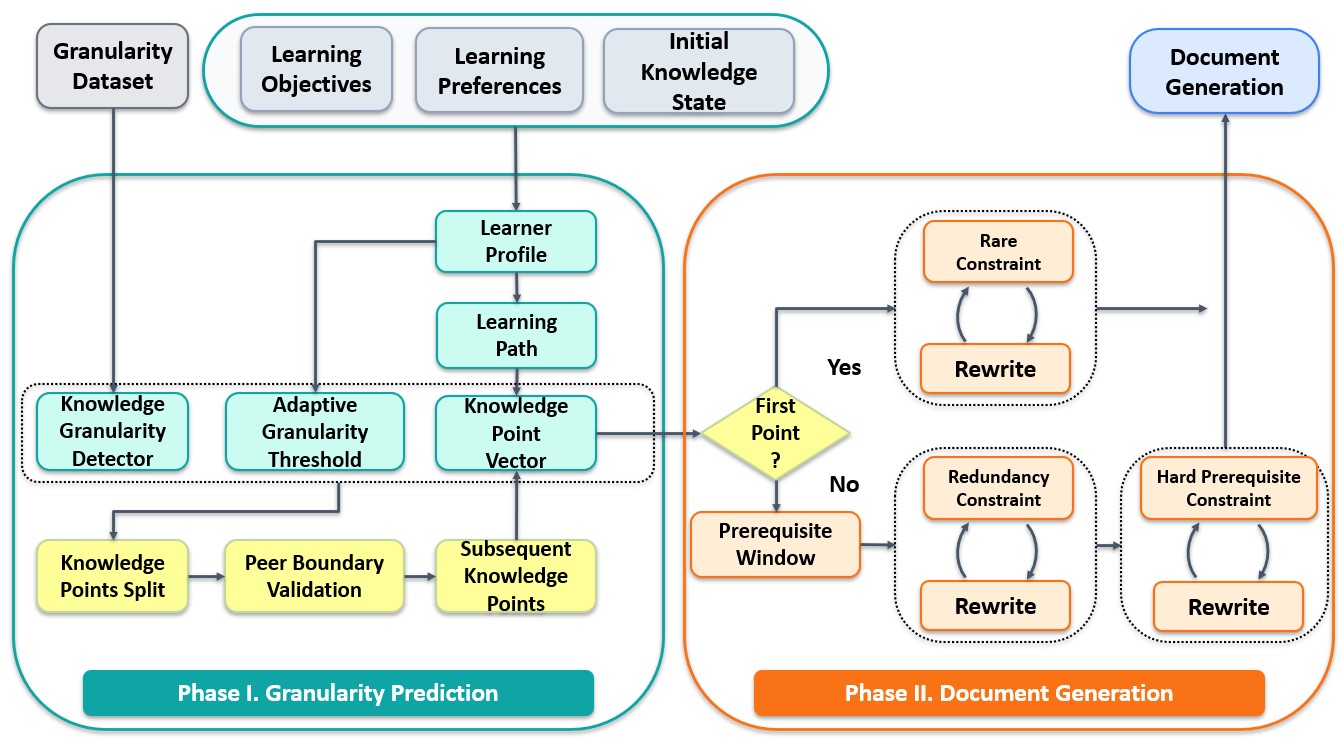
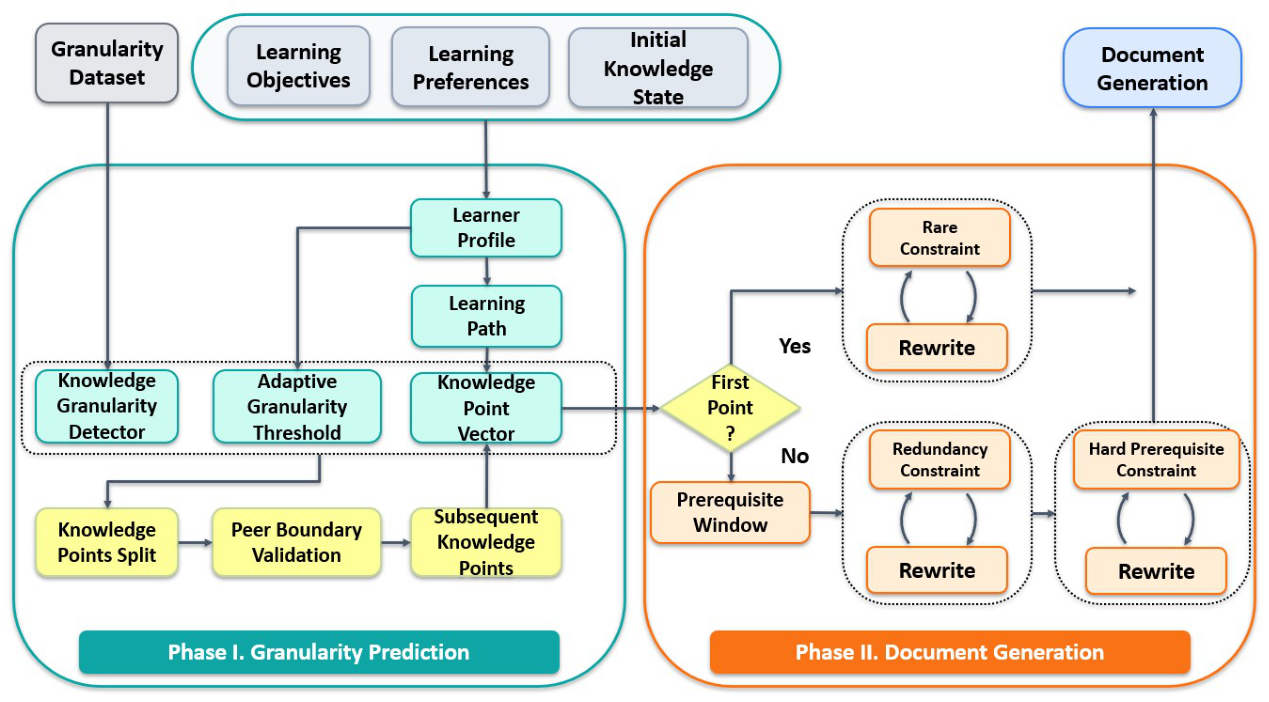
PLKD consists of two parts: “Granularity Detection” and “Content Generation,” as shown in Figure 1.
4.1. Granularity Detection
Inspired by Zadeh’s concept of fuzzy information granulation [16], we define “Knowledge Point Granularity” to quantify the specificity of a knowledge point. The broader the scope covered by a knowledge point, the closer its granularity value is to 1 (e.g., “Engineering,” “Computer Science,” “Artificial Intelligence”); conversely, the more specific the scope, the closer the granularity value is to 0 (e.g., “Inorder Traversal of Binary Trees,” “Definition of Supervised Learning,” “Bitwise AND Operation”).
The Granularity Detection module is used to reconstruct the original knowledge point vector into a fine-grained sequence of knowledge points suitable for the current learner. First, we train a granularity detector based on a self-constructed granularity dataset. Second, we adaptively output the learner’s granularity threshold according to the user’s input information. Then, we use the granularity detector to output the Knowledge Point Granularity value for each original knowledge point. Finally, we recursively perform Knowledge Points Split on those knowledge points in the original vector whose granularity values exceed the threshold. The details are as follows.
4.1.1. Granularity Detector Training
(1) Text Mapping and Feature Input. Given a knowledge point text , we first map it to a feature vector using a pre-trained embedding model . Let the feature dimension be 4096:
(2) Two-layer MLP Forward Propagation Mechanism. The prediction network gradually compresses the high-dimensional features and maps them to the granularity probability space through a multi-layer structure. The layer-wise transformation is as follows:
where the weight matrix is , the bias term is . is a Dropout layer with a dropout rate of 0.4, and is the output feature of the first layer.
where , .
At the output layer, a linear transformation followed by the Sigmoid activation function maps to a real value in the interval :
where , , .
(3) Loss Function and Objective Optimization. We use mean squared error (MSE) as the loss function and sample on the self-constructed granularity dataset. For a given batch of samples (with a default batch size ), the MSE is calculated according to Equation (9):
To improve generalization ability, we introduce regularization. The final loss function is as follows:
where the parameter set includes all weight matrices and biases in the network, controls the strength of weight decay, and denotes the Frobenius norm.
4.1.2. Granularity Detection and Split
(1) Adaptive Granularity Threshold Prediction. Based on the learner’s input learning preference and initial knowledge state , we use the adaptive granularity threshold prediction agent to generate the initial granularity threshold , as shown in Equation (11):
To prevent threshold divergence, we use a truncation function to constrain the final threshold T within the range :
(2) Recursive Knowledge Points Split. For any knowledge point , we use the trained granularity detector (comprising the embedding model and the regression network ) to determine its granularity score S:
Let the current depth be d, and the maximum allowed split depth be . If the current granularity is greater than the granularity threshold T and the maximum depth has not been reached, the Knowledge Points Split agent is used to split the high-granularity knowledge point into a set of more detailed knowledge points, denoted as :
(3) Peer Boundary Overlap Detection. For the set of child knowledge points obtained from splitting the same parent node, we take any two child knowledge points and and their respective boundary description keyword sets and . We adopt a heuristic overlap coefficient measurement mechanism:
When the overlap coefficient exceeds the preset safe overlap threshold (default ), it is determined as a significant content overlap conflict, indicating that the two knowledge points and have a large amount of overlapping content. If any pair of content-overlapping nodes exists among the child nodes split from a parent node, the parent node’s split process will be re-executed until the maximum allowed number of splits is reached.
(4) Peer Knowledge Point Sorting. After the split and Peer Boundary Validation, we use the sorting agent to sort all knowledge points in the child knowledge point set :
where is the parent knowledge point before the split.
4.2. Content Generation
The Content Generation module is designed to transform the reconstructed fine-grained knowledge point sequence into a coherent and non-redundant personalized learning document along with corresponding quizzes. First, during the content generation for the first knowledge point, we apply the Rare Constraint to ensure that beginners can smoothly transition and master fundamental concepts. Next, when generating the document content for the current knowledge point, we integrate the information from preceding knowledge points to maintain the coherence of the subsequent content. Finally, in the content generation for subsequent knowledge points, we introduce Redundancy Constraint and Hard Prerequisite Constraint, precisely eliminating overlapping content by leveraging the preceding context. The details are as follows.
4.2.1. Rare Constraint for the First Knowledge Point
Since is the entry point for beginners into this domain, if the document contains prerequisite concepts that the user has not yet learned, it may lead to learning interruption. Therefore, we specifically introduce the Rare Constraint detection and rewriting mechanism for .
Let be the rare knowledge detection agent, which compares the content of the first knowledge point document with the learner profile U and outputs the set of rare content :
If a rare constraint violation is detected (i.e., ), the rare content is rewritten by the rare knowledge rewriting agent :
4.2.2. Prerequisite Knowledge Points Window Mechanism
To ensure that the generation model fully “builds upon” the prerequisite knowledge points when generating the content for the n-th knowledge points, we construct a dynamic Prerequisite Knowledge Points Window . Considering the model’s context length limitation and attention dispersion issues, we adopt a heuristic truncation strategy: only the full text of the most recent preceding nodes (for local deduplication and smooth transition) is retained, while more distant nodes are kept as summaries.
Let the sequence of previously generated document contents be . The size of the neighboring window that retains the full text is w (default ), and the summarization function is . Then, the Prerequisite Knowledge Points Window at the n-th step can be expressed as:
where is the concatenation function. The document generation agent , based on the original input information in Equation (4), further incorporates the Prerequisite Knowledge Points Window for content retrieval and generation:
4.2.3. Redundancy Constraint for Subsequent Knowledge Points
For subsequent knowledge points with , redundancy with previous content is likely to occur, such as repeatedly explaining the same concept. In addition to enabling the model to perceive the Prerequisite Knowledge Points Window , an additional constraint mechanism is introduced for subsequent knowledge points.
Let the redundancy detection agent be , which compares the current draft with the Prerequisite Knowledge Points Window and outputs the set of redundancy issues :
If redundancy issues are detected (i.e., ), the redundant content is rewritten by the redundancy rewriting agent :
4.2.4. Hard Prerequisite Constraint
In addition to redundancy content detection, we also introduce the Hard Prerequisite Constraint for subsequent knowledge points, which ensures the smooth transition of knowledge points in the document content. If the document for a subsequent knowledge point contains content not covered by the preceding documents and not yet mastered by the learner, the Hard Prerequisite Constraint rewriter is invoked to rewrite that part of the content.
Let the hard prerequisite constraint agent be , which compares the current draft with the Prerequisite Knowledge Points Window and outputs the set of prerequisite issues :
If prerequisite issues are detected (i.e., ), the prerequisite issue content is rewritten by the hard prerequisite constraint rewriting agent :
4.3. Algorithm Description
The complete process of PLKD is shown in Algorithm 1.
| Algorithm 1 PLKD |
|
5. Experiments
Specific content awaiting subsequent refinement.
6. Conclusions
Specific content awaiting subsequent refinement.
Acknowledgments
This work was supported by the project Grant No. Chuan Jiao Han [2025] 199-90. During manuscript preparation, the authors utilized DeepSeek-V4-Pro for linguistic polishing of partial text and LaTeX formatting proofreading. All research ideas, data analysis and core arguments were independently completed and validated by the authors.
References
- Bloom, B.S. The 2 sigma problem: The search for methods of group instruction as effective as one-to-one tutoring. Educ. Res. 1984, 13, 4–16. [Google Scholar] [CrossRef]
- Ramos, L.T.; Casas, E. Applications, trends, and perspectives of large language models in education: A literature review. Authorea Prepr. 2025. [Google Scholar] [CrossRef]
- Feng, Y.; Lin, W.; Wang, Q.; Zhou, Y.; Jin, T.; Tang, X.; Wu, S.; Yao, C.; Chen, J. PELICAN: Personalized Education via LLM-powered Cognitive Diagnosis and Adaptive Tutoring, 2026. [CrossRef] [PubMed]
- Dong, C.; Yuan, Y.; Chen, K.; Cheng, S.; Wen, C. How to build an adaptive AI tutor for any course using knowledge graph-enhanced retrieval-augmented generation (KG-RAG). In Proceedings of the 2025 14th International Conference on Educational and Information Technology (ICEIT); IEEE, 2025; pp. 152–157. [Google Scholar]
- Li, H.; Dong, Q.; Chen, J.; Su, H.; Zhou, Y.; Ai, Q.; Ye, Z.; Liu, Y. Llms-as-judges: a comprehensive survey on llm-based evaluation methods. arXiv 2024, arXiv:2412.05579. [Google Scholar]
- Liu, Z.; Yin, S.X.; Goh, D.H.L.; Chen, N.F. COGENT: a curriculum-oriented framework for generating grade-appropriate educational content. arXiv 2025, arXiv:2506.09367. [Google Scholar]
- Wang, T.; Zhan, Y.; Lian, J.; Hu, Z.; Yuan, N.J.; Zhang, Q.; Xie, X.; Xiong, H. Llm-powered multi-agent framework for goal-oriented learning in intelligent tutoring system. Proc. Companion Proc. ACM Web Conf. 2025, 2025, 510–519. [Google Scholar] [CrossRef]
- Corbett, A.T.; Anderson, J.R. Knowledge tracing: Modeling the acquisition of procedural knowledge. User Model. User-Adapt. Interact. 1994, 4, 253–278. [Google Scholar]
- Kasneci, E.; Seßler, K.; Küchemann, S.; Bannert, M.; Dementieva, D.; Fischer, F.; Gasser, U.; Groh, G.; Günnemann, S.; Hüllermeier, E.; et al. ChatGPT for good? On opportunities and challenges of large language models for education. Learn. Individ. Differ. 2023, 103, 102274. [Google Scholar] [CrossRef]
- Dan, Y.; Lei, Z.; Gu, Y.; Li, Y.; Yin, J.; Lin, J.; Ye, L.; Tie, Z.; Zhou, Y.; Wang, Y.; et al. Educhat: A large language model-based conversational agent for intelligent education. In Proceedings of the China Conference on Knowledge Graph and Semantic Computing, 2024; Springer; pp. 297–308. [Google Scholar]
- Pan, L.; Li, C.; Li, J.; Tang, J. Prerequisite relation learning for concepts in moocs. Proceedings of the Proceedings of the 55th Annual Meeting of the Association for Computational Linguistics 2017, Volume 1, 1447–1456. [Google Scholar] [CrossRef]
- Pan, J.; Razniewski, S.; Kalo, J.C.; Singhania, S.; Chen, J.; Dietze, S.; Jabeen, H.; Omeliyanenko, J.; Zhang, W.; Lissandrini, M.; et al. Large Language Models and Knowledge Graphs: Opportunities and Challenges. Transactions on Graph Data and Knowledge, 2023. [Google Scholar]
- Ficler, J.; Goldberg, Y. Controlling Linguistic Style Aspects in Neural Language Generation. EMNLP 2017, 94. [Google Scholar] [CrossRef]
- Madaan, A.; Tandon, N.; Gupta, P.; Hallinan, S.; Gao, L.; Wiegreffe, S.; Alon, U.; Dziri, N.; Prabhumoye, S.; Yang, Y.; et al. Self-refine: Iterative refinement with self-feedback. Adv. Neural Inf. Process. Syst. 2023, 36, 46534–46594. [Google Scholar] [CrossRef]
- Shinn, N.; Cassano, F.; Gopinath, A.; Narasimhan, K.; Yao, S. Reflexion: Language agents with verbal reinforcement learning. Adv. Neural Inf. Process. Syst. 2023, 36, 8634–8652. [Google Scholar] [CrossRef]
- Zadeh, L.A. Toward a theory of fuzzy information granulation and its centrality in human reasoning and fuzzy logic. Fuzzy Sets Syst. 1997, 90, 111–127. [Google Scholar] [CrossRef]
Disclaimer/Publisher’s Note: The statements, opinions and data contained in all publications are solely those of the individual author(s) and contributor(s) and not of MDPI and/or the editor(s). MDPI and/or the editor(s) disclaim responsibility for any injury to people or property resulting from any ideas, methods, instructions or products referred to in the content. |
© 2026 by the authors. Licensee MDPI, Basel, Switzerland. This article is an open access article distributed under the terms and conditions of the Creative Commons Attribution (CC BY) license (http://creativecommons.org/licenses/by/4.0/).
Copyright: This open access article is published under a Creative Commons CC BY 4.0 license, which permit the free download, distribution, and reuse, provided that the author and preprint are cited in any reuse.


