

Submitted:
18 June 2026
Posted:
23 June 2026
You are already at the latest version
Abstract
Background/Objectives: Patients with severe psoriasis complicated by comorbidities such as cardiovascular disease, obesity, metabolic syndrome and/or with the involvement of high-impact areas constitute a clinical challenge. Tildrakizumab is a monoclonal antibody targeting the IL-23/Th17 axis with a proven record of efficacy and safety in these patients. Case presentation: Here we present four cases of patients with severe psoriasis and comorbidities including cardiovascular disease (Case 1), obesity (Case 2 and 3), metabolic syndrome (Case 3), and/or high-impact areas (Cases 2-4). Three patients (Cases 1-3) had previously received biologics but developed secondary failure or loss of efficacy; one patient was bio-naïve (Case 4). The treatment with tildrakizumab in all four patients led to a quick onset of complete and lasting remission with no adverse events reported. Conclusions: Tildrakizumab is a valuable therapeutic option for patients with psoriasis and complex clinical situations, and in particular, in cases with obesity and difficult-to-treat lesion location. Therapeutic success is often linked to an improvement in patient’s quality of life.
Keywords:
severe psoriasis
; comorbidities
; multi-treatment failure
; high-impact areas
; case series
1. Introduction
Psoriasis is a chronic, immune-mediated inflammatory disease characterised by keratinocyte hyperproliferation and infiltration of inflammatory cells, resulting from complex interactions between genetic predisposition, environmental factors, and immune dysregulation. In addition to cutaneous manifestations, psoriasis is associated with systemic comorbidities such as cardiovascular disease, obesity, metabolic syndrome, psoriatic arthritis, uveitis, non-alcoholic fatty liver disease, chronic inflammatory bowel diseases, anxiety, and depression. Treatment requires long-term strategies to reduce disease burden and improve quality of life [1].
The advances in the understanding of the biology of psoriasis have identified the IL-23/Th17 axis as crucial in the development and maintenance of psoriasis [2], and led to the development of treatments targeting it [3]. Tildrakizumab, an anti-IL-23p19 IgG1 monoclonal antibody, is approved for moderate-to-severe plaque psoriasis with the standard dosing regimen (100 mg at week 0 and 4, followed by subsequent injections every 12 weeks) [4]. A post hoc analysis of the pivotal studies and real-world experience showed increased efficacy of the 200 mg dosage in subgroups of patients with high disease burden or other clinical complexities, particularly in obese or multi-failure patients [5,6,7]. The favourable safety profile and effective, stable long-term clinical response make tildrakizumab a valid therapeutic option, even in patients with comorbidities and involvement of difficult-to-treat areas [5,8,9,10,11,12].
Here, we present a series of clinical cases of patients (Table 1) with severe and difficult-to-treat psoriasis with comorbidities including cardiovascular disease and obesity in whom the treatment with tildrakizumab led to a complete and lasting remission.
2. Case Presentation
2.1. Case 1 – A Patient with Extremely Severe Psoriasis and Comorbidities
A 60-year-old male patient with a significant past medical history presented with extremely severe plaque psoriasis. His comorbidities included dyslipidaemia, systemic hypertension, and a myocardial infarction, which occurred 10 years prior. His psoriasis first manifested 20 years before and had followed a chronic-relapsing course. Initially, the patient was managed with topical corticosteroids and vitamin D derivatives, providing partial symptomatic relief. As the disease progressed, narrowband ultraviolet B (NB-UVB) phototherapy cycles were employed multiple times with minimal lasting benefit. Subsequently, systemic therapy with methotrexate was initiated and continued for approximately 2 years until loss of clinical efficacy and disease control. No joint involvement was reported.
Given the persistence and worsening of the disease, biological treatment was introduced. The patient first received adalimumab, a tumour necrosis factor-alpha (TNF-α) inhibitor, for about 9 months. Although adalimumab initially improved symptoms, the patient ultimately relapsed, prompting a therapeutic switch to secukinumab, an interleukin-17A (IL-17A) inhibitor. The treatment with secukinumab resulted in an initial clinical improvement; however, after approximately 1 year, efficacy diminished, and the therapy was discontinued.
At this point, the patient exhibited extensive skin involvement, with an estimated 93% of his body surface area (BSA) affected. The clinical severity was rated as extremely high, with a Psoriasis Area and Severity Index (PASI) score of 57 (Figure 1A,B). The treatment plan was revised, and therapy with tildrakizumab 200 mg was initiated. The regimen involved a loading dose of 200 mg administered on Day 1, followed by a second dose after 28 days, and maintenance doses every 84 days thereafter (every 12 weeks). After just 6 months of tildrakizumab administration, the patient demonstrated a near-complete resolution of the psoriatic lesions, with significant reduction in erythema, scaling, and pruritus. The patient reported substantial clinical improvement and enhanced quality of life. No significant adverse events were observed during the treatment course (Figure 1C,D).
2.2. Case 2 – A Patient with Complex Psoriasis and Metabolic Syndrome
A 46-year-old man, with a maternal and paternal history of psoriasis, was affected by plaque psoriasis since without psoriatic arthritis since the age of 16 years. The familial history included also the presence of cardiovascular disease in his father. He was overweight with persistently elevated levels of total cholesterol, triglycerides, and blood pressure.
Over the years, the patient received several biologics, starting with infliximab and subsequently moving to adalimumab, ustekinumab, and secukinumab. Each therapy resulted in an initial clinical improvement, followed by a rapid and irreversible secondary loss of efficacy. As the number of therapeutic switches increased, clinical response diminished and therapeutic persistence declined. The clinical picture was also complicated by the progressive weight gain (from 90 to 120 kg over 15 years) and the onset of a metabolic syndrome.
In May 2021, while on secukinumab (started in November 2018), the patient experienced a disease flare with extensive erythematous, scaly, and thick plaques on the trunk and limbs (Figure 2A), and a particularly disabling involvement of the hands causing work impairment (Figure 2E). He reported a significant decline in mood due to repeated therapeutic failure. The clinical scores at that time were PASI 24 and Dermatology Life Quality Index (DLQI) 18; the patient weighed 120 kg for a body mass index (BMI) of 38, i.e., had grade II obesity. Laboratory findings included elevated transaminases (GOT: 72 U/L, GPT: 68 U/L), total cholesterol: 260 mg/dL, LDL cholesterol: 140 mg/dL, and triglycerides: 180 mg/dL. Abdominal ultrasound confirmed hepatic steatosis.
Given the disease progression and resistance, a class switch from IL-17 to IL-23 inhibition was considered. Tildrakizumab 200 mg was selected based on available efficacy data suggesting that this higher dosing regimen provides greater benefit in patients weighing ≥90 kg [4]. Therapy was initiated in May 2021, with injections at weeks 0, 4, and every 12 weeks thereafter. A significant clinical improvement was noted by Week 4 (PASI 12, DLQI 6; Figure 2B), and complete disease clearance was achieved by Week 12 (PASI 0 and DLQI 0; Figure 2C). Also, there was an excellent response regarding hands with complete lesion regression (Figure 2F). The patient reported substantial improvement in quality of life and the resolution of depressive symptoms. Body weight remained unchanged; laboratory parameters showed a modest improvement (GOT: 60 U/L, GPT: 56 U/L, total cholesterol: 240 mg/dL, LDL: 130 mg/dL, triglycerides: 160 mg/dL). Treatment continued at 200 mg every 12 weeks. At the most recent follow-up (May 2025), the patient remained in complete remission (PASI 0, DLQI 0; Figure 2D), with stable laboratory results and weight reduction to 110 kg. No adverse events were observed throughout the 4-year follow-up period.
2.3. Case 3 – Retreatment with Tildrakizumab in a Patient with Severe Psoriasis with Comorbidities
This 48-year-old man, with a positive familial history of psoriasis (father and brother), was affected by plaque psoriasis since the age of 28 years. He was a smoker with a past history of hepatitis C (HCV Ab+, HCV RNA–), past drug addiction, uveitis, and depression. Between 2014-21, he was treated with adalimumab, which was discontinued due to secondary inefficacy. In November 2021, the patient was started on tildrakizumab 100 mg and achieved complete remission (PASI 0, DLQI 0), however, he voluntarily discontinued his therapy with tildrakizumab after 1 year of treatment. The treatment interruption lasted 12 months and led to the worsening of his psoriasis (PASI 57.6, DLQI 30, BSA 80% and BMI 33.95; Figure 3A, 3D, 3G, 3J) with the involvement of hands and scalp (baseline Psoriasis Scalp Severity Index [PSSI] 70). Tildrakizumab 200 mg was therefore restarted. At Week 4 of re-treatment, there was an important improvement in psoriatic lesions (PASI 11.5; DLQI 0; BSA 5%; PSSI 30; Figure 3B, 3E, 3H, 3K). By Week 108, the resolution of the psoriatic lesions was complete (PASI 0; DLQI 0; PSSI 0; BSA 0%, Figure 3C, 3F, 3I, 3L). The patient regained confidence, motivation, and remained adherent to the treatment.
2.4. Case 4 – A Bio-Naïve Patient with Severe Plaque Psoriasis and Intense Itch
A 49-year-old male patient with a history of psoriasis since the age of 23 had exclusively received topical therapies and a limited course of acitretin, which was discontinued due to severe ocular dryness.
At the initial visit, the patient exhibited poor personal hygiene, with notably soiled underwear (Figure 4A and 4G), reflecting a depressive state and self-neglect attributed to the severity of his psoriasis and the prolonged inability to find effective treatment. Clinically, he presented severe plaque psoriasis characterised by thick, indurated, and hyperkeratotic plaques localised on the trunk, limbs, scalp, and genital area (Figure 4A, 4D, 4G). The lesions were particularly pruritic, with an itch numeric rating scale (NRS) score of 9. On the elbows and legs, the plaques showed visible excoriations and scratch marks caused by scratching of lesions. Disease severity scored 28 on PASI and a 4 on the Physician Global Assessment (PGA) scales. Additionally, the patient exhibited psoriatic nail involvement affecting all fingernails, complicated by a concurrent Pseudomonas aeruginosa infection of the nail of the right index finger (Figure 4J). The condition significantly impacted his quality of life, as reflected by the DLQI score of 16. No other comorbidities were reported.
Due to the severity of the disease, which affected high-impact areas and consequently compromised the patient's quality of life and, particularly, his social life, we opted for tildrakizumab, an anti-IL-23 biologic with a proven efficacy and acting faster than anti-TNF-α treatment. The treatment with tildrakizumab was initiated at a dose of 200 mg subcutaneously at Weeks 0, 4, and every 12 weeks. Concurrently, the patient received levofloxacin at 500 mg twice daily for 10 days to treat the nail infection.
A rapid clinical response was observed. After 4 weeks, i.e., after a single 200 mg dose of tildrakizumab, the hyperkeratotic component resolved completely, with a marked reduction in skin infiltration; only erythema persisted (Figure 4B, 4E, 4H, 4K). At this time, the PASI score decreased to 6.3, the DLQI improved to 6, and there was a notable reduction in itch (NRS reduced to 2). By Week 16, complete skin clearance (PASI 0) was achieved, and the psoriatic nail involvement showed significant improvement, with the nail disease PGA score improving from 3 to 1, accompanied by the regrowth of healthy nail of the finger previously affected by the infection (Figure 4C, 4F, 4I, 4L). At the 24-week follow-up, the nail psoriasis achieved complete remission. The patient is still receiving tildrakizumab at 200 mg after 2 years of therapy with excellent clinical response and no adverse events.
3. Discussion
The presented case series underscores the challenges in managing severe psoriasis, particularly in patients with multiple comorbidities and a history of partial or no response to previous treatments, including topical agents, phototherapy, conventional systemic medication, and other biologics.
Case 1 of this case series is a patient with extremely severe psoriasis affecting 93% of BSA with cardiovascular comorbidities, which are a common occurrence in psoriasis [13]. Prior to the current treatment, the patient received both conventional topical (corticosteroids, vitamin D derivatives and NB-UVB phototherapy), and systemic (methotrexate) treatments and two biologics (adalimumab, secukinumab). In this patient, the treatment with tildrakizumab led to a near complete resolution of psoriatic lesions. The efficacy of tildrakizumab in this patient highlights the value of IL-23p19 inhibition in refractory and severe psoriasis cases with extreme disease severity.
Case 2 and 3 are examples of an important therapeutic challenge: a longstanding psoriasis with severe obesity (both patients), metabolic syndrome (Case 2), the failure of multiple biologic therapies (both patients) and involvement of difficult sites such as the hands and scalp (Case 3) constituted unfavorable prognostic factors [14]. There is a strong association between psoriasis and obesity and psoriasis and metabolic syndrome; obesity in psoriasis decreases efficacy of both conventional and biological therapies [15,16]. In addition, the involvement of hands has been linked to poor patient satisfaction and increased functional impairment [17]. Given the patients’ prior exposure to TNF-α, IL-12/23 (Case 2), and IL-17 inhibitors (Case 2), a switch to an IL-23p19 inhibitor was clinically justified. Tildrakizumab was selected because of the dosing individualisation that it offers for patients with elevated body mass or high burden of disease. Several studies have demonstrated the long-term efficacy and safety of tildrakizumab at the dose of 200 mg in obese patients and those with metabolic comorbidities [5,10,15,18,19]. In this patient, tildrakizumab at 200 mg induced rapid and sustained clearance of psoriatic lesions, with a complete response maintained over 4 years despite the long history of psoriasis, failure of other biologics drugs, and severe overweight.
Beyond obesity, the clinical history in Case 3 was additionally complicated by a past history of hepatitis C, drug abuse, uveitis and depression. Moreover, the patient voluntarily stopped taking tildrakizumab after achieving complete remission, when first treated with this agent in 2021. A 12-month interruption of treatment led to a substantial disease worsening. However, the re-treatment with tildrakizumab resulted again in complete remission and helped the patient gain confidence in treatment received.
Case 4 is the only bio-naïve patient in this series. Prior to the treatment with tildrakizumab, the patient had received mainly topical treatments despite disease severity with the involvement of high-impact areas such as the genitals and scalp, and long disease duration complicated by depression and nail infection. The treatment with tildrakizumab led to a rapid and effective clinical response highlighting the speed of action and effectiveness of the drug in the bio-naïve patient.
Notably, no adverse events occurred in the four cases, despite multiple comorbidities, including Case 2 for whom the longest follow-up is available.
We wish to emphasise the importance of selecting treatments with favourable safety profiles and monitoring for potential adverse effects throughout therapy of patients with cardiovascular/metabolic comorbidities, including prior myocardial infarction and hypertension (Case 1), and obesity (Case 2 and Case 3) with metabolic syndrome (Case 2). Importantly, all patients described here reported an improvement in the quality of life, which is consistent with previous reports [20].
Admittedly the number included in this case series is small, which is a limitation of this report. Notwithstanding this, our case series adds to the growing real-world evidence supporting targeted therapies the use of tildrakizumab as an effective option in high burden disease resulting in long-term remission duration in patients with psoriasis despite comorbidities, prior biologic failures, and involvement of high-impact areas.
4. Conclusions
Tildrakizumab represents an effective therapeutic strategy with a favourable tolerability profile for patients with psoriasis and clinical complexities such as comorbidities and the involvement of high-impact body areas. The patients described here are representative of this patient category. Therapeutic success promotes therapeutic alliance between doctor and patient.
Author Contributions
Conceptualisation, C.M.; investigation, C.M., D.D’A., C.G., V.L.; data curation, C.M., D.D’A., C.G., V.L.; writing – review and editing, C.M., D.D’A., C.G., V.L. All authors read and approved the final version of the manuscript.
Funding
The editorial assistance for this manuscript was unconditionally funded by Almirall S.p.A. The article processing charge was funded by Content Ed Net SRL on behalf of Almirall S.p.A.
Institutional Review Board Statement
This retrospective review of patient data did not require ethical approval in accordance with local and national guidelines.
Informed Consent Statement
Written informed consent has been obtained from the patients to publish the details of their medical history and the accompanying images.
Data Availability Statement
All data generated or analysed during this study are included in this article. Further enquiries can be directed to the corresponding author.
Acknowledgments
The authors thank Alicja M. Gruszka MD, PhD for writing the paper on behalf of Content Ed Net S.l.r..
Conflicts of Interest
C.M. acted as a speaker or consultant for Abbvie, Eli Lilly, UCB, Pfizer and Sanofi – Regeneron. D. D’A. acted as a speaker or consultant for Abbvie, Eli Lilly, UCB, Pfizer, Novartis, Leopharma, Allmiral, and Sanofi. C.G. acted as a speaker or consultant for Abbivie, Bristol Myers Squibb, Eli Lilly, UCB, Novartis, Johnson and Johnson, Pfizer, Amgen. V.L. acted as a speaker or consultant for Abbvie, Bristol Myers Squibb, Eli Lilly, Johnson and Johnson, Novartis.
Abbreviations
The following abbreviations are used in this manuscript:
| BMI | Body mass index |
| BSA | Body surface area |
| DLQI | Dermatology life quality index |
| HCV | Hepatitis C virus |
| IL | Interleukin |
| NB-UVB | Narrow-band ultraviolet B |
| NRS | Numeric rating scale |
| PASI | Psoriasis area severity index |
| PGA | Physician’s global assessment |
| PSSI | Psoriasis scalp severity index |
References
- Armstrong, A.W.; Blauvelt, A.; Callis Duffin, K.; Huang, Y.H.; Savage, L.J.; Guo, L.; Merola, J.F. Psoriasis. Nat. Rev. Dis. Prim. 2025, 11, 45. [Google Scholar] [CrossRef] [PubMed]
- Di Cesare, A.; Di Meglio, P.; Nestle, F.O. The IL-23/Th17 axis in the immunopathogenesis of psoriasis. J. Invest Dermatol. 2009, 129, 1339–1350. [Google Scholar] [CrossRef] [PubMed]
- Fotiadou, C.; Lazaridou, E.; Sotiriou, E.; Ioannides, D. Targeting IL-23 in psoriasis: current perspectives. Psoriasis (Auckl) 2018, 8, 1–5. [Google Scholar] [CrossRef] [PubMed]
- European Medicines Agency. Ilumetri (INN-tildrakizumab), summary of product characteristics. Available online: https://www.ema.europa.eu/en/documents/product-information/ilumetri-epar-product-information_en.pdf (accessed on 19/11/25).
- Thaci, D.; Gerdes, S.; Du Jardin, K.G.; Perrot, J.L.; Puig, L. Efficacy of Tildrakizumab Across Different Body Weights in Moderate-to-Severe Psoriasis Over 5 Years: Pooled Analyses from the reSURFACE Pivotal Studies. Dermatol. Ther. (Heidelb) 2022, 12, 2325–2341. [Google Scholar] [CrossRef] [PubMed]
- Trovato, E.; Bianchelli, T.; Odorici, G.; Cuccia, A.; Di Lernia, V.G.; Lasagni, C.; Manfredini, M.; Nicolini, M.; Rech, G.; Satolli, F.; et al. Effectiveness of Tildrakizumab 200 mg in Moderate-to-Severe Plaque Psoriasis: A Multicenter Real-World Study Analyzing Patient Outcomes by Weight, PASI, BMI, and Previous Therapies. Dermatol. Ther. (Heidelb) 2025, 15, 1941–1952. [Google Scholar] [CrossRef] [PubMed]
- Valenti, M.; Ibba, L.; Di Giulio, S.; Gargiulo, L.; Malagoli, P.; Balato, A.; Bardazzi, F.; Loconsole, F.; Burlando, M.; Cagni, A.E.; et al. Optimizing Tildrakizumab Dosing in Psoriasis: A 52-Week Multicenter Retrospective Study Comparing 100 mg and 200 mg-IL PSO (Italian Landscape Psoriasis). Dermatol. Ther. (Heidelb) 2025, 15, 1427–1440. [Google Scholar] [CrossRef] [PubMed]
- Galluzzo, M.; Talamonti, M.; Cioni, A.; Maffei, V.; Shumak, R.G.; Tofani, L.; Bianchi, L.; Campione, E. Efficacy of Tildrakizumab for the Treatment of Difficult-to-Treat Areas: Scalp, Nail, Palmoplantar and Genital Psoriasis. J. Clin. Med. 2022, 11. [Google Scholar] [CrossRef] [PubMed]
- Thaci, D.; Piaserico, S.; Warren, R.B.; Gupta, A.K.; Cantrell, W.; Draelos, Z.; Foley, P.; Igarashi, A.; Langley, R.G.; Asahina, A.; et al. Five-year efficacy and safety of tildrakizumab in patients with moderate-to-severe psoriasis who respond at week 28: pooled analyses of two randomized phase III clinical trials (reSURFACE 1 and reSURFACE 2). Br. J. Dermatol. 2021, 185, 323–334. [Google Scholar] [CrossRef] [PubMed]
- Dattola, A.; Bernardini, N.; Svara, F.; Balato, A.; Caldarola, G.; D'Amico, D.; De Simone, C.; Di Brizzi, E.V.; Esposito, M.; Giofre, C.; et al. Effectiveness of tildrakizumab 200 mg: an Italian multicenter study. J. Dermatol. Treat. 2024, 35, 2420825. [Google Scholar] [CrossRef] [PubMed]
- Cacciapuoti, S.; Potestio, L.; Gallo, L.; Musumeci, M.L.; Caldarola, G.; D'Amico, D.; Caudullo, F.; Papaianni, V.; De Simone, C.; Peris, K.; et al. Short-term efficacy of tildrakizumab on difficult-to-treat areas: a real-world experience. Int. J. Dermatol. 2025, 64, 319–324. [Google Scholar] [CrossRef] [PubMed]
- Sofen, H.L.; Gebauer, K.; Spelman, L.; Yamauchi, P.S.; Yao, S.L.; Nishandar, T.; Kopeloff, I.; Crane, M.; Gogineni, R.; Kothekar, M.; et al. Efficacy and safety of tildrakizumab for the treatment of moderate-to-severe plaque psoriasis of the scalp: Week 52 results from a phase 3b, randomized, double-blind, placebo-controlled trial. J. Am. Acad. Dermatol. 2025, 92, 816–824. [Google Scholar] [CrossRef] [PubMed]
- Mehta, H.; Narang, T.; Dogra, S.; Handa, S.; Hatwal, J.; Batta, A. Cardiovascular Considerations and Implications for Treatment in Psoriasis: An Updated Review. Vasc. Health Risk Manag 2024, 20, 215–229. [Google Scholar] [CrossRef] [PubMed]
- Hjort, G.; Schwarz, C.W.; Skov, L.; Loft, N. Clinical Characteristics Associated With Response to Biologics in the Treatment of Psoriasis: A Meta-analysis. JAMA Dermatol. 2024, 160, 830–837. [Google Scholar] [CrossRef] [PubMed]
- Burshtein, J.; Armstrong, A.; Chow, M.; DeBusk, L.; Brad, G.; Gottlieb, A.B.; Gold, L.S.; Korman, N.J.; Lio, P.; Merola, J.; et al. The association between obesity and efficacy of psoriasis therapies: An expert consensus panel. J. Am. Acad. Dermatol. 2025, 92, 807–815. [Google Scholar] [CrossRef] [PubMed]
- Love, T.J.; Qureshi, A.A.; Karlson, E.W.; Gelfand, J.M.; Choi, H.K. Prevalence of the metabolic syndrome in psoriasis: results from the National Health and Nutrition Examination Survey, 2003-2006. Arch. Dermatol. 2011, 147, 419–424. [Google Scholar] [CrossRef] [PubMed]
- Muslimani, M.A.; Bolcato, V.; de Silvestri, A.; Brazzelli, V. Psoriatic patients undergoing long-term therapy with biologics: Impact of residual localization of psoriasis on quality of life in an Italian clinical setting. Dermatol. Ther. 2020, 33, e14337. [Google Scholar] [CrossRef] [PubMed]
- Fernandez, A.P.; Dauden, E.; Gerdes, S.; Lebwohl, M.G.; Menter, M.A.; Leonardi, C.L.; Gooderham, M.; Gebauer, K.; Tada, Y.; Lacour, J.P.; et al. Tildrakizumab efficacy and safety in patients with psoriasis and concomitant metabolic syndrome: post hoc analysis of 5-year data from reSURFACE 1 and reSURFACE 2. J. Eur. Acad. Dermatol. Venereol. 2022, 36, 1774–1783. [Google Scholar] [CrossRef] [PubMed]
- Trevisan, G.; Germi, L.; Naldi, L. Erythrodermic psoriasis improved by Tildrakizumab. Dermatol. Rep. 2022, 14, 9448. [Google Scholar] [CrossRef] [PubMed]
- Blauvelt, A.; Sofen, H.; Papp, K.; Gooderham, M.; Tyring, S.; Zhao, Y.; Lowry, S.; Mendelsohn, A.; Parno, J.; Reich, K. Tildrakizumab efficacy and impact on quality of life up to 52 weeks in patients with moderate-to-severe psoriasis: a pooled analysis of two randomized controlled trials. J. Eur. Acad. Dermatol. Venereol. 2019, 33, 2305–2312. [Google Scholar] [CrossRef] [PubMed]
Figure 1.
Case 1. A, B. Extensive psoriatic lesions at baseline before introducing tildrakizumab therapy. C, D. Skin appearance after 6 moths of treatment with tildrakizumab.
Figure 1.
Case 1. A, B. Extensive psoriatic lesions at baseline before introducing tildrakizumab therapy. C, D. Skin appearance after 6 moths of treatment with tildrakizumab.
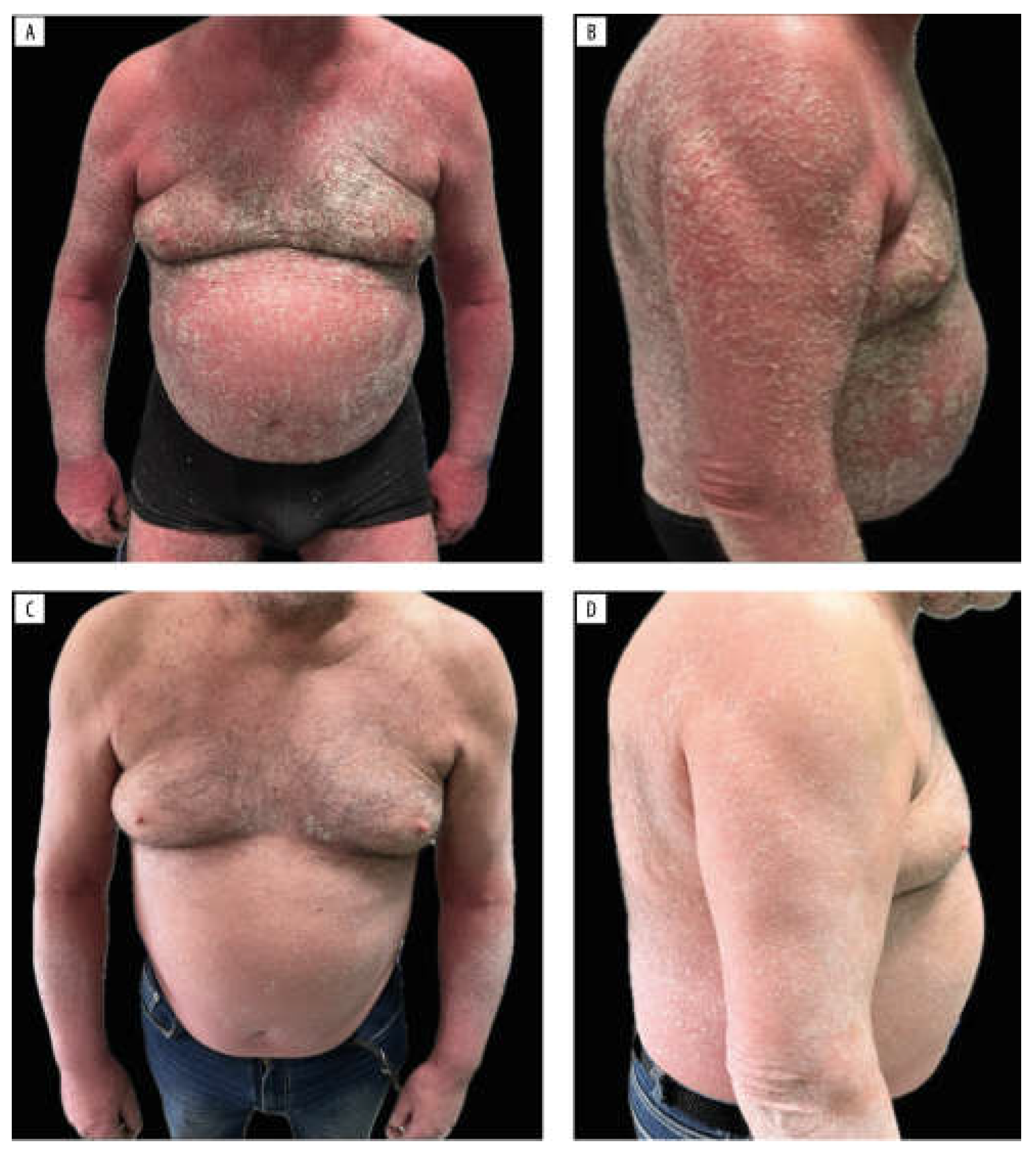
Figure 2.
Case 2. A. Week 0: extensive erythematous and desquamative plaques involving the trunk and limbs before treatment with tildrakizumab; B. Week 4: marked reduction in the extent of the plaques and in their erythematous-desquamative component; C. Week 12: complete resolution of the lesions on the trunk and limbs; D. Week 208: continued remission; E. Week 0: severe involvement of hands; F. Week 12: complete resolution of lesions on hands.
Figure 2.
Case 2. A. Week 0: extensive erythematous and desquamative plaques involving the trunk and limbs before treatment with tildrakizumab; B. Week 4: marked reduction in the extent of the plaques and in their erythematous-desquamative component; C. Week 12: complete resolution of the lesions on the trunk and limbs; D. Week 208: continued remission; E. Week 0: severe involvement of hands; F. Week 12: complete resolution of lesions on hands.
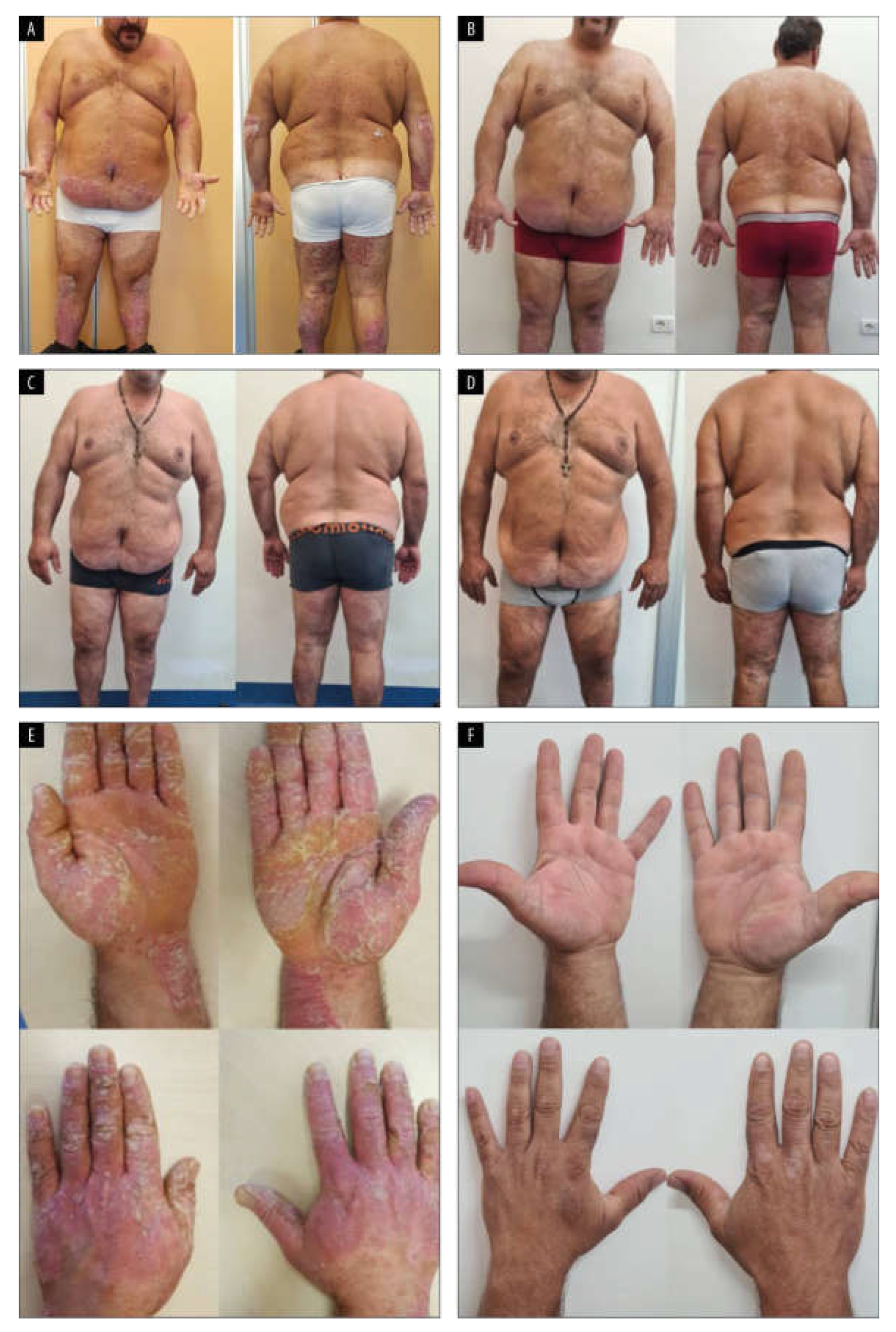
Figure 3.
Case 3. A, D, G, J. Week 0: extensive baseline erythematous and desquamative plaques involving the trunk (A), hands (D, G), limbs and head (J) before re-treatment with tildrakizumab; B, E, H, K. Week 4: improvements of psoriatic lesions C, F, I, L. Week 108: complete resolution of psoriatic lesions.
Figure 3.
Case 3. A, D, G, J. Week 0: extensive baseline erythematous and desquamative plaques involving the trunk (A), hands (D, G), limbs and head (J) before re-treatment with tildrakizumab; B, E, H, K. Week 4: improvements of psoriatic lesions C, F, I, L. Week 108: complete resolution of psoriatic lesions.
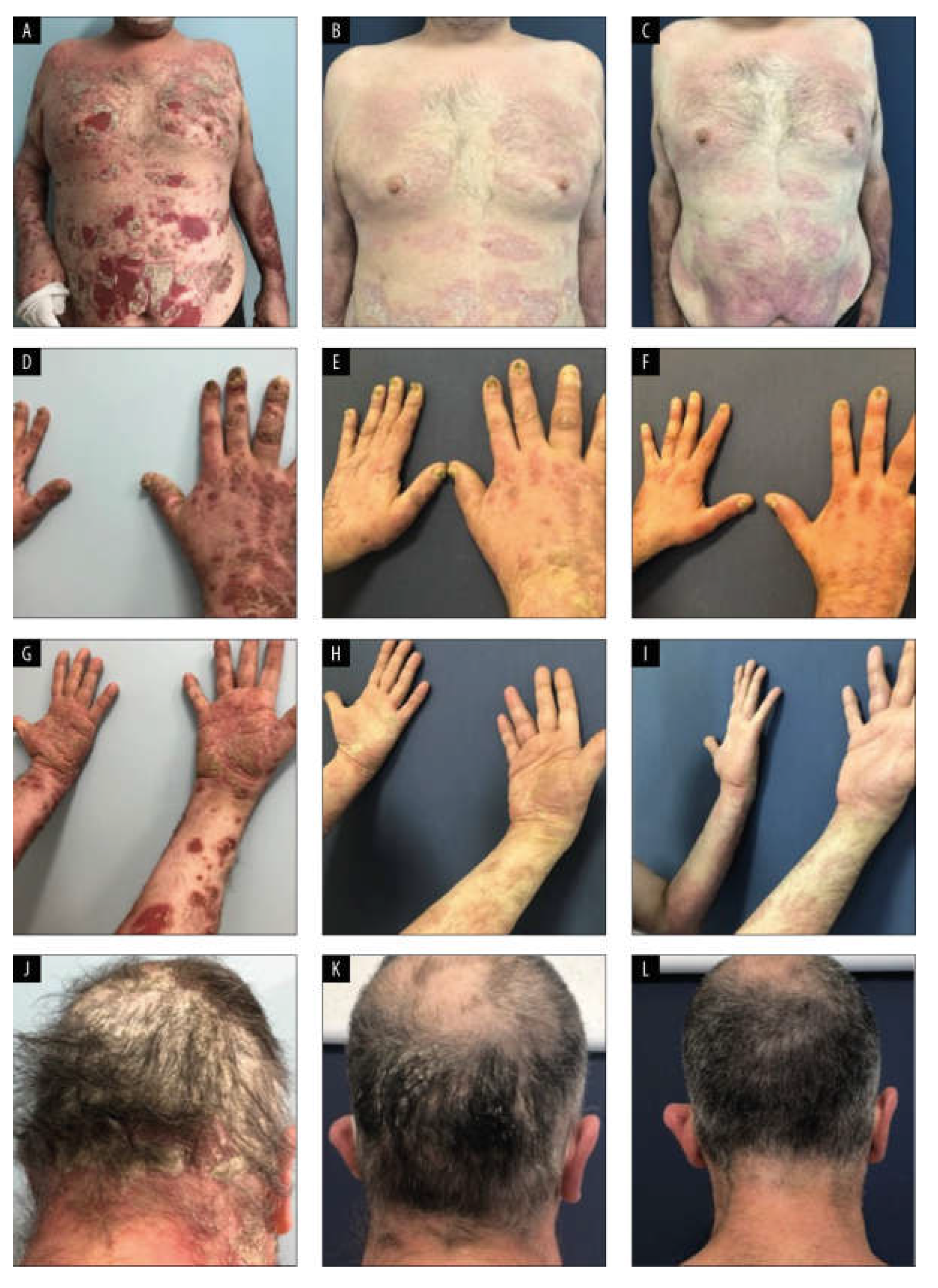
Figure 4.
Case 4. A, D, G, J. Week 0: extensive baseline erythematous and desquamative plaques involving the trunk (A), back (D), legs (G), and a concurrent Pseudomonas aeruginosa infection of the nail of the right index finger (J) before re-treatment with tildrakizumab; B, E, H, K. Week 4: improvements of psoriatic lesions; C, F, I, L. Week 16: complete resolution of psoriatic lesions.
Figure 4.
Case 4. A, D, G, J. Week 0: extensive baseline erythematous and desquamative plaques involving the trunk (A), back (D), legs (G), and a concurrent Pseudomonas aeruginosa infection of the nail of the right index finger (J) before re-treatment with tildrakizumab; B, E, H, K. Week 4: improvements of psoriatic lesions; C, F, I, L. Week 16: complete resolution of psoriatic lesions.
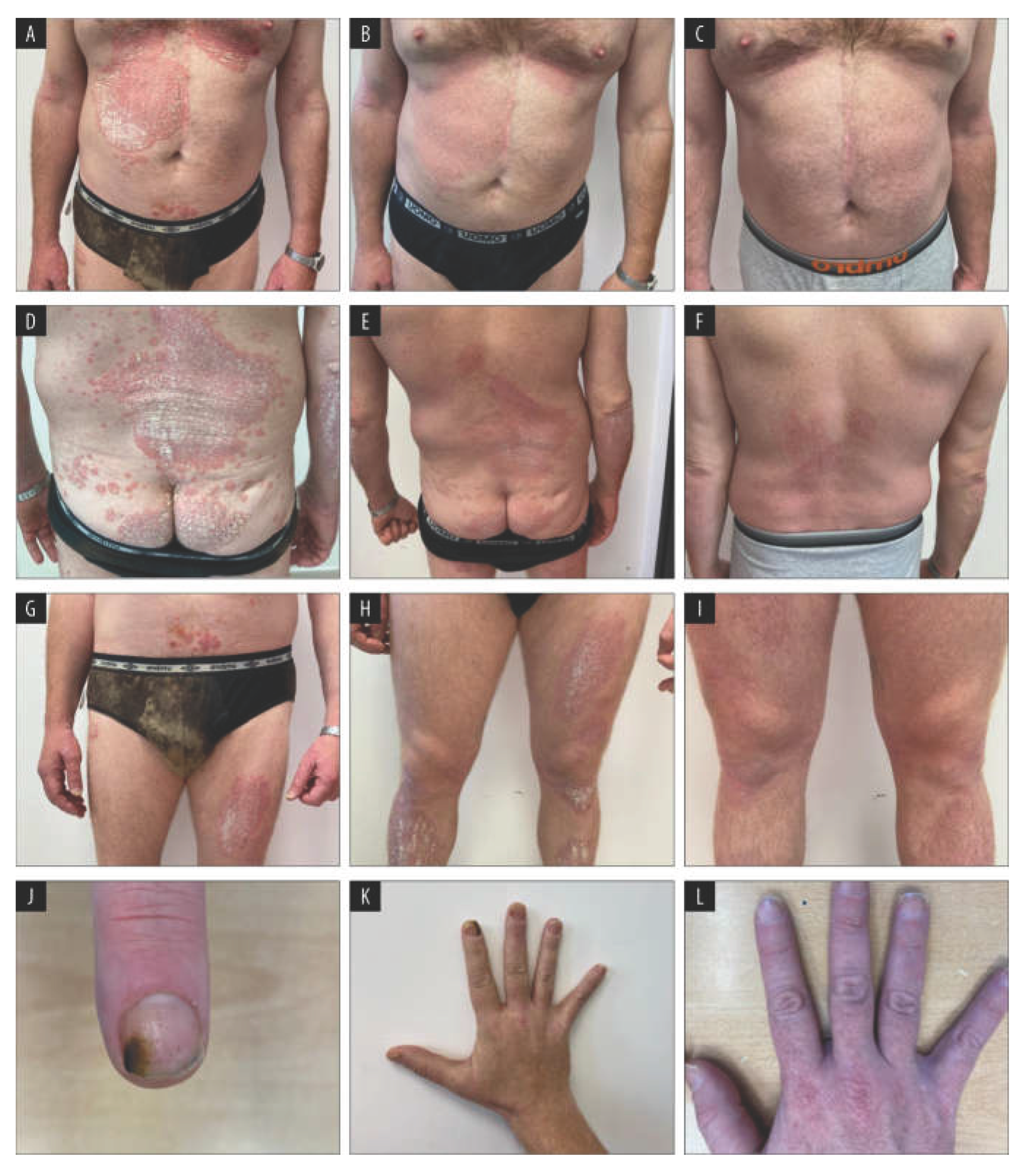

Table 1.
Patient characteristics before starting treatment with tildrakizumab and treatment results.
Table 1.
Patient characteristics before starting treatment with tildrakizumab and treatment results.
| Case 1 | Case 2 | Case 3 | Case 4 | |
|---|---|---|---|---|
| Age (years) | 60 | 46 | 48 | 49 |
| BMI | 30.10 | 38 | 33.95 | 25.35 |
| Disease duration (years) | 20 | 15 | 20 | 26 |
| Previous biologics | adalimumab secukinumab |
infliximab adalimumab ustekinumab secukinumab |
adalimumab tildrakizumab |
None |
| Comorbidities | Cardiovascular disease, dyslipidaemia, hypertension | Obesity, metabolic syndrome | Obesity, uveitis, hepatitis C, depression | Nail infection, depression |
| Smoking | No | No | Yes | No |
| Duration of treatment with tildrakizumab (years) |
1 | 4 | 1+2 | 2 |
| BSA | ||||
| Week 0 | 93% | 90% | 80% | 38% |
| Week 4 | 10% | 15% | 5% | 31% |
| Last follow-up | 0% | 0% | 0% | 0% |
| PASI | ||||
| Week 0 | 57 | 24 | 56.7 | 28 |
| Week 4 | 18 | 12 | 11.5 | 6.3 |
| Last follow-up | 0 | 0 | 0 | 0 |
| DLQI | ||||
| Week 0 | 19 | 18 | 30 | 16 |
| Week 4 | 5 | 6 | 0 | 6 |
| Last follow-up | 0 | 0 | 0 | 0 |
BMI, body mass index; BSA, body surface area; DLQI, dermatology life quality index; PASI, psoriasis area severity index.
Disclaimer/Publisher’s Note: The statements, opinions and data contained in all publications are solely those of the individual author(s) and contributor(s) and not of MDPI and/or the editor(s). MDPI and/or the editor(s) disclaim responsibility for any injury to people or property resulting from any ideas, methods, instructions or products referred to in the content. |
© 2026 by the authors. Licensee MDPI, Basel, Switzerland. This article is an open access article distributed under the terms and conditions of the Creative Commons Attribution (CC BY) license (http://creativecommons.org/licenses/by/4.0/).
Copyright: This open access article is published under a Creative Commons CC BY 4.0 license, which permit the free download, distribution, and reuse, provided that the author and preprint are cited in any reuse.


