
Submitted:
18 June 2026
Posted:
19 June 2026
You are already at the latest version
Abstract
With increasingly strict air quality standards and growing concerns about air pollution, fine and ultrafine particulate matter remains a major challenge for conventional air cleaning technologies. Due to their small size, these particles are difficult to remove using traditional filtration and separation methods. Acoustic agglomeration can be used as a pre-treatment technology to increase particle size in a high-intensity acoustic field and improve the efficiency of particle removal. This study investigates acoustic-induced agglomeration of solid aerosol particles in a dynamic airflow system. The effects of acoustic frequency were evaluated at 3, 5.5, 7.5, and 15 kHz under a sound pressure level of 135 dB and at two airflow velocities: 0.75 m/s and 1.5 m/s. These velocities corresponded to different particle residence times in the acoustic field. Arizona test dust was used as the test aerosol, and particle number concentration and particle size distribution were measured before and after the acoustic field. The results showed that acoustic agglomeration of fine and ultrafine particles was strongly affected by both acoustic frequency and particle residence time. The highest agglomeration efficiency, reaching up to 42%, was obtained at 3 kHz, 135 dB, and longer particle residence time. These findings indicate that acoustic agglomeration can promote particle size redistribution in moving airflow and may be used as a pre-treatment method for improving particulate matter removal in air quality control systems.
Keywords:
acoustic agglomeration
; dynamic airflow system
; sub-ultrasonic field
1. Introduction
Air pollution with fine and ultrafine particles is an important topic of concern in modern society. Air pollution from these particles could be emitted from anthropogenic sources such as burning fossil fuel and industries such as cement manufacturing [1]. Other sources of fine or ultrafine particles are from natural sources like dust storms, wildfires or volcanoes [2]. High levels of air pollution are commonly seen in highly populated cities with large industrial regions. With high concentrations of fine and ultrafine particles in highly populated cities with industrial environment causes high risk for people health [3]. Fine particles, smaller than 10 µm, could enter the human bloodstream through the nose and throat, while reaching the lungs, from which they could enter the blood vessel [4]. As environmental standards get increasingly stringent for manufacturers and fossil fuel users, there is more research done on the high-risk problems from fine and ultrafine particles. Research shows that fine and ultrafine particles could cause health problems like autism spectrum disorder [5]. Therefore, with advanced studies on environmental and health issues it is critical to research higher efficiency methods for fine and ultrafine particulate matter separation.
Today, traditional methods of particulate matter separation like electrostatic precipitators, fibrous filters, HEPA filters, and cyclone separators are used to reach high or full removal of different size particulate matter [6,7,8,9]. Electrostatic precipitators have high manufacturing price, high energy usage, but are effective for fine and ultrafine particulate matter separation [10]. Fibrous and HEPA filters have high energy consumption, high risk of clogging and needs to be constantly replaced [11,12]. Cyclone separators could remove only particles larger than 5 µm and have a high pressure drop, so they are ineffective for ultrafine particulate matter [13]. For that reason, single traditional methods are not enough to reach high environmental regulations with their disadvantages. Combined or hybrid methods could be used to reach higher filtration efficiency. Like hybrid electrostatic-fibric precipitator with electrostatic precipitator filtering higher percentage of particulate matter, while fibric filter is reached only by small amount of particulate matter [14]. But even with traditional and hybrid filtration systems it is hard to precipitate fine and ultrafine particulate matter. Thus, a pre-treatment stage could be used to increase the efficiency of traditional and hybrid filtration methods. Electrostatic agglomeration uses electrostatic forces to agglomerate particles with different charge [15]. Another pre-treatment technique is chemical agglomeration in which chemical reactions are used to coalescence and grow ultrafine particulate matter into larger agglomerates[16]. Third agglomeration method is acoustic agglomeration in which acoustic wave forces are used to agglomerate particulate matter into larger clusters.
First time acoustic agglomeration was observed in 1927 by Wood [17]. The researcher observed high frequency acoustic waves in oil-bath generated by piezo-electric oscillator. From that point on, more research was conducted on sound wave usage in particulate matter agglomeration. Acoustic agglomeration is driven by several interaction mechanisms happening in acoustic field [18]. Orthokinetic interaction and acoustic wake effect are two main mechanisms that acoustic agglomeration is based on. Researcher S. Dong et al. [18] observed that orthokinetic interaction is more effective in lower frequency range, while acoustic wake effect is more effective in higher frequency range and for smaller particulate matter. Orthokinetic interactions happen when airflow is affected by high acoustic field and particles in airflow are entrained by it. Smaller particles tend to be more entrained in the field, while larger particles tend to lag which is caused by inertia [19]. The acoustic wake effect is caused by acoustic field that changes particles attraction between them by flow disturbance [20]. Acoustic wake effects tend to be more effective for same or similar size particles. Orthokinetic agglomeration coefficient is expressed as [21]:
where r1, c and r2, c particle radius, (m); sound wave velocity amplitude, (m/s); relative entrainment factor between two particles.
For acoustic agglomeration research, both static and dynamic flow chambers are used. Static chambers generate standing acoustic waves, allowing the investigation of acoustic effects on particles under long residence times. In these chambers, particles and aerosols remain exposed to the acoustic field significantly longer compared to dynamic flow systems. Studies performed in static chambers often demonstrate high agglomeration efficiency. For example, at a sound pressure level of 141 dB and a frequency of 1.5 kHz, nearly complete removal of fire smoke was achieved after 2 minutes of acoustic exposure in a static chamber [22]. Dynamic flow chambers allow the evaluation of aerodynamic and acoustic field interaction. For example, three ultrasonic acoustic sources were used in a moving airflow with a velocity of 2.3 m/s to investigate acoustic agglomeration, under a frequency of 48.85 kHz and a sound pressure level of up to 147 dB, an acoustic agglomeration efficiency of up to 53% was achieved [23]. Another study for oil droplets that was done in 1000 – 5000 Hz frequency range and up to 145 dB sound pressure level reached 8.75% decrease in oil droplets under sine wave [24].
Therefore, the present study investigates the dependence of acoustic agglomeration efficiency on acoustic frequency in the sub-ultrasonic range. Although many previous studies have focused on frequencies below 3 kHz or on ultrasonic excitation, the influence of intermediate sub-ultrasonic frequencies on particle size distribution in dynamic airflow systems remains insufficiently investigated. In this study, two different airflow velocities were used to vary the particle residence time in the acoustic field and to evaluate its influence on agglomeration efficiency. The aim of this research is to assess the acoustic excitation affects particle size redistribution and to determine the suitability of acoustic agglomeration as a pre-treatment technology for improving particulate matter removal in conventional air filtration and air quality control systems.
2. Materials and Methods
For experimental research of acoustic agglomeration acoustic chamber was created using 150 mm diameter air duct elements reaching total length of 5 m. The acoustic device was set to 30 ° in airflow direction. With other research made in acoustic agglomeration field using this angle gives highest results of sound pressure level, reduces sound field suppression and increases acoustic agglomeration efficiency [25]. As a sound source Beyma CD10Fe (Beyma, Valencia, Spain) compression driver with frequency range 0.7-19 kHz and 109 dB 2.83 V @ 1 m sensitivity was used. This compression driver gives wide range of acoustic frequency and high acoustic pressure levels.
The acoustic pressure level was measured using a Brüel & Kjær Type 9727 measurement system, consisting of Type 7910 software, a Type PULSE 3560-B multichannel data acquisition unit, a portable Dell personal computer, and a Brüel & Kjær Type 8104 hydrophone. The hydrophone has a sensitivity of −211 dB re 1 V/μPa ± 2 dB and a frequency response of 0.1 Hz–100 kHz (+1.5/−6.0 dB), which covered the frequency range investigated in this study. As shown in Figure 1 the acoustic pressure level measurements were performed at the center of the air duct under no-flow conditions to ensure stable acoustic pressure readings. The acoustic device was driven by an amplifier ADATA RS360 connected to a PeakTech 3 MHz DDS function generator, which supplied sinusoidal signals.
To ensure voltage repeatability and the safe operation of the amplifier and acoustic source, a Siglent SDS1104X digital storage oscilloscope was used. The oscilloscope was connected to the acoustic source circuit to monitor the input voltage supplied by the function generator and by the amplifier and are showed as RMS (Root Mean Square).
For particulate matter generation PALAS RBG 1000 solid particle dispenser was used to inject particulate matter into airflow. Device was used for stable and repeatable dispersion of particles into an airflow. Arizona 0-3 µm test dust was used for the experiments. Standardized test dust usage helps to ensure repeatability of experimental measurements and each experimental measurement was conducted at least 3 times.
Figure 2 represents the schematic of experimental setup. A fan (1) was used to generate airflow through the acoustic chamber, while the exhaust ventilation unit (7) was used to extract air from the system and maintain a stable flow through the chamber. Airflow velocity was measured using Testo 440 dp measuring device with accuracy of ±0.03 m/s + 4%. And Table 1 shows air duct parameters, acoustic parameters and aerodynamic and particles parameters of experimental setup.
The experimental procedure was repeated at least three times for each airflow velocity and acoustic frequency. First, the fan and exhaust ventilation unit were adjusted to obtain the required airflow velocity in the acoustic chamber. The airflow velocity was measured at the selected measuring points until the desired and stable flow conditions were achieved. The airflow velocity profile was evaluated using a multi-point measurement method, including one central point and four near-wall points in the duct cross-section. After stabilization of the airflow, the particulate matter dispenser was activated. Particle concentration was monitored until a stable aerosol concentration was obtained in the chamber. After the baseline particle concentration was recorded without acoustic excitation, particle number concentration and cumulative particle size distribution can be seen in Figure 3, the acoustic source was turned on at the selected frequency, and the particle concentration and size distribution were measured under the same airflow conditions. Each measurement was conducted for 30 s, and the average particulate matter concentration over this period was recorded.
The acoustic agglomeration efficiency was calculated by comparing the total particle number concentration measured before acoustic source and under acoustic
where acoustic agglomeration efficiency (%); N0 particle number before acoustic source (particles/cm3); Na particle number after acoustic source, (particles/cm3).
Acoustic agglomeration efficiency depends not only on sound pressure level, but on particles residence time in acoustic field. That means, that the more particle is in acoustic fields, the more the acoustic agglomeration would be effective. The average residence time t is defined as[24]:
where t residence time, (s); length of acoustic field, (m); v airflow velocity in acoustic chamber, (m/s).
3. Results
3.1. Sound Pressure Level Measurement Results
Sound pressure level is one of the key acoustic parameters influencing acoustic agglomeration efficiency. Piezoceramic transducers are often used in acoustic agglomeration studies because they can generate high sound pressure levels exceeding 135 dB [23,25,26]. However, these transducers usually operate most efficiently near their resonance frequency, which limits the investigation of wider frequency range. In contrast, many studies using conventional acoustic sources focus on low-frequency excitation, typically below 5 kHz [24,27]. Therefore, the compression driver used in this study, with a frequency range of approximately 0.7–20 kHz, provides the possibility to investigate acoustic agglomeration over a wider low-, mid-, and high-frequency range below ultrasonic excitation. From a practical application perspective, acoustic agglomeration is a promising pre-treatment technology because it can enhance particle removal without directly introducing a significant additional pressure drop into the filtration system. However, its implementation should not substantially increase the overall electrical energy consumption. Therefore, sound pressure level measurements were performed at different driving voltages to evaluate the acoustic source performance and determine suitable operating conditions. Operating the compression driver at lower driving voltages can reduce electrical power consumption, limit overheating, and improve long-term operational stability while maintaining sufficient acoustic intensity for particle agglomeration. Sound pressure level measurements of acoustic compression driver are presented in Table 2.
The results show that the required driving voltage depends on the excitation frequency. In general, higher acoustic frequencies required higher driving voltages to achieve the target sound pressure level, which may increase the electrical power demand of the acoustic source. Therefore, the selection of operating frequencies was based not only on the generated sound pressure level, but also on the safe and efficient operation of the compression driver. The frequency of 3 kHz was selected as the low-frequency operating point because it reached a sound pressure level of 135 dB without requiring excessive driving voltage. The frequencies of 5.5 kHz and 7.5 kHz were selected to represent the mid-frequency range, as they provided sufficient acoustic output while remaining within safe operating conditions. For the high-frequency range, nothing in 9.5 kHz and 14 kHz range was acceptable for safe use of compression driver, so 15 kHz was selected because the sound pressure level decreased at several intermediate frequencies, whereas 15 kHz allowed the compression driver to again reach the required sound pressure level of 135 dB. Figure 4 shows measured RMS under different sound pressure levels, in which 10 kHz and 10.5 kHz where not measured because compression driver was not generating enough acoustic pressure to reach 120 dB. Red dots show the chosen frequency and their RMS.
After measuring the acoustic pressure level in the range of 120–130 dB, the operating conditions were selected based on the lowest RMS voltage required at each frequency to protect the acoustic source and prevent overheating. Four operating points were selected to achieve an acoustic pressure level of 135 dB at frequencies of 3, 5.5, 7.5, and 15 kHz.
3.2. Acoustic Agglomeration Measurement Results
Acoustic agglomeration is mainly driven by orthokinetic interaction and the acoustic wake effect. The acoustic wake effect is more effective for particles of the same or similar size, while orthokinetic interaction is associated with the different dynamic response of particles of different sizes to acoustic field. Previous studies have often investigated these mechanisms in vertical or horizontal chambers with standing acoustic waves. However, for acoustic agglomeration to be used as an efficient pre-treatment technology, its performance should also be evaluated under moving airflow conditions. Therefore, this study investigates the influence of acoustic frequency and particle residence time on acoustic agglomeration efficiency in a dynamic airflow system.
Particles entering the acoustic field are affected by the oscillating motion of the gas. This causes the particles to vibrate, and because particles of different sizes respond differently to the acoustic field, relative motion occurs between them. As a result, the probability of particle collisions increases, promoting agglomeration. One of the key factors influencing acoustic agglomeration efficiency is particle residence time in acoustic fields. As shown in Equation (2), the residence time directly depends on the airflow velocity and the length of the acoustic chamber. In this study, two airflow velocities were selected: 0.75 ± 0.06 m/s and 1.50 ± 0.09 m/s. The particle residence time represents the duration for which particles are exposed to the acoustic field. Therefore, the airflow velocity of 0.75 m/s was selected to represent the longer residence time, while 1.5 m/s was used to represent a residence time approximately two times shorter.
Figure 5 shows the acoustic agglomeration efficiency for particles ranging from 0.229 µm to 2.643 µm under shorter particle residence time conditions. The efficiency varied from approximately 6% to 24%, depending on the particle size and applied acoustic frequency. The highest values were generally observed at 15 kHz, where the efficiency increased over a wide particle size range and reached approximately 20–23% for larger particles. In comparison, lower frequencies produced weaker and more fluctuating responses. This suggests that, when the residence time is reduced due to higher airflow velocity, higher-frequency acoustic excitation may be more effective in inducing particle motion and increasing the probability of particle–particle collisions. High frequency acoustic waves could influence fine and ultrafine particles agglomeration more efficiently than lower frequency waves.
Rectangle (1) shows the efficiency of 0.5-0.9 µm size particles agglomeration, at this size particles agglomeration reaches from 15% to 20%. Rectangle (2) shows the highest agglomeration efficiency at 15 kHz and particle size 1.1-2.6 µm, reaching above 20%. The higher efficiency observed at 15 kHz may be related to stronger acoustic-induced gas oscillations and local flow disturbances in the acoustic chamber. These effects can enhance the relative motion between particles and increase the collision frequency, especially under shorter residence time conditions. The lowest efficiency was observed in 7.5 kHz frequency which could indicate that this frequency did not provide enough acoustic force to agglomerate particles under investigated airflow velocity.
When the airflow velocity decreased from 1.5 m/s to 0.75 m/s, the particle residence time in the acoustic field increased approximately two times. A longer residence time allows particles to remain exposed to acoustic field for a longer period, thereby increasing the probability of particle–particle collisions and agglomerate formation. Therefore, Figure 6 presents the acoustic agglomeration efficiency under longer residence time conditions. Although longer residence time is generally expected to improve acoustic agglomeration, the results in Figure 4 show a different particle size-dependent response compared with the shorter residence time case presented in Figure 5.
As shown in Figure 6, the most effective frequency for acoustic agglomeration under longer residence time conditions was 3 kHz, which was the lowest frequency investigated in this study. At 3 kHz, the agglomeration efficiency for particles smaller than 1 µm ranged from approximately 5% to 11%, while particles larger than 1 µm showed considerably higher efficiency. This indicates that lower-frequency acoustic fields may be more effective in promoting the growth of larger agglomerates when particles remain exposed to the acoustic field for a longer period. At 5.5 kHz and 7.5 kHz, the agglomeration efficiency followed a similar trend, increasing with particle size. However, the maximum efficiency at 5.5 kHz reached approximately 35%, whereas at 7.5 kHz it increased to about 30%. This suggests that both mid-range frequencies contributed to particle agglomeration, although their effect was weaker than that observed at 3 kHz under longer residence time conditions. At 15 kHz, the acoustic agglomeration efficiency for particles larger than 1 µm was comparable to that observed at lower frequencies. However, an increase in the number of particles smaller than 1 µm was observed. The switch between increase of particles and decrease or particle number is marked by rectangle (1). This suggests that high-frequency acoustic excitation caused a different particle size redistribution pattern compared with lower frequencies. The increase in the submicron fraction may be related to the formation of new agglomerates from particles below the lower measurement range or to partial breakup of weak agglomerates. Nevertheless, additional measurements would be required to confirm deagglomeration.
4. Discussion
Acoustic agglomeration as a pre-treatment technology is attractive for future environmental engineering technologies. While most studies are made in low frequency or ultrasonic frequency range, this study presents acoustic agglomeration of solid particles in a wide 3-15 kHz frequency range and different residence time. With acoustic agglomerations low pressure drop, it is perfect pre-treatment technology for its integration into traditional cleaning systems.
Acoustic agglomeration as a pre-treatment technology is promising for future environmental engineering and air quality control applications. While many previous studies have focused on low-frequency acoustic fields or ultrasonic excitation, the present study evaluates the agglomeration of solid aerosol particles over a wider sub-ultrasonic frequency range of 3–15 kHz and under different particle residence time conditions. This approach allows the influence of acoustic frequency and exposure time on particle size redistribution to be assessed in a dynamic airflow system.
The obtained results show that acoustic field can enhance particle agglomeration, but its effectiveness depends on both frequency and residence time. Under shorter residence time conditions, higher-frequency excitation at 15 kHz was more effective, whereas under longer residence time conditions, the lower frequency of 3 kHz produced the highest agglomeration efficiency. This indicates that the optimal acoustic frequency is not universal, but depends on the interaction between acoustic excitation, airflow velocity, and particle exposure time in the acoustic field.
For practical air quality control applications, acoustic agglomeration can be considered a suitable pre-treatment method for conventional filtration or separation systems [28], because it promotes the formation of larger particle agglomerates that can be more easily removed by downstream devices like electrostatic precipitator. In addition, if the acoustic source is operated at an appropriate frequency and driving voltage, this technology may improve particle removal without introducing a significant additional pressure drop into the system. Therefore, acoustic agglomeration has potential for integration into air quality control systems as a pre-treatment stage before traditional filtration.
Despite the observed positive effect of the acoustic field, several aspects of acoustic agglomeration remain insufficiently understood. Further research is needed to determine how agglomeration efficiency can be improved when particles have limited residence time in the acoustic field. This is important for practical air treatment systems, where airflow velocity cannot always be reduced. Another important issue is the selection of the optimal acoustic frequency, since the present results showed that higher frequency was more effective under shorter residence time conditions, while lower frequency performed better under longer residence time conditions.
5. Conclusions
In this study, the acoustic agglomeration of solid particulate matter was investigated over a wide range of acoustic frequencies and under different particle residence time conditions in a dynamic airflow system. The main conclusions are as follows:
(1) The compression driver used in this study was suitable for generating acoustic fields over a wide frequency range. However, the sound pressure level strongly depended on the applied frequency and driving voltage. Therefore, SPL measurements are necessary to select efficient and safe operating conditions for acoustic agglomeration experiments.
(2) Under shorter particle residence time conditions, corresponding to an airflow velocity of 1.5 m/s, higher-frequency acoustic fields were more effective. The results showed that acoustic agglomeration efficiency increased at 15 kHz and reached values above 25% for selected particle size ranges. This indicates that high-frequency acoustic fields can improve particle agglomeration when the exposure time in the acoustic field is limited.
(3) Under longer particle residence time conditions, corresponding to an airflow velocity of 0.75 m/s, acoustic agglomeration efficiency increased more effectively at lower frequencies. The highest efficiency was observed at 3 kHz, reaching approximately 40%. This shows that longer particle residence time can improve agglomeration efficiency, but the most effective acoustic frequency depends on airflow velocity and particle exposure time.
Overall, the results confirm that acoustic agglomeration can be used industrial exhaust and combustion systems as a pre-treatment method for particulate matter control, but its efficiency depends strongly on the combined effect of acoustic frequency, sound pressure level, airflow velocity, and particle residence time.
Author Contributions
Conceptualization, T. J. and A.C.; methodology, T. J. and A.C..; validation, T. J. and A.C.; formal analysis, T. J. and A.C.; investigation, T. J. and A.C.; data curation, T. J. and A.C.; writing—original draft preparation, T. J.; writing—review and editing, A.C.; visualization, T.J.; supervision, A.C.; project administration, T. J. and A.C.; funding acquisition, T. J. and A.C. All authors have read and agreed to the published version of the manuscript.
Funding
Not applicable.
Data Availability
Data will be made available on request.
Acknowledgments
Not applicable.
Conflicts of Interest
The authors declare no conflicts of interest.
References
- Manavi, S.E.I.; Aktypis, A.; Siouti, E.; Skyllakou, K.; Myriokefalitakis, S.; Kanakidou, M.; Pandis, S.N. Atmospheric Aerosol Spatial Variability: Impacts on Air Quality and Climate Change. One Earth 2025, 8, 101237. [CrossRef]
- Climatology of Tropospheric Aerosols. 2026, 41–49. [CrossRef]
- Kumar, P.; Morawska, L.; Birmili, W.; Paasonen, P.; Hu, M.; Kulmala, M.; Harrison, R.M.; Norford, L.; Britter, R. Ultrafine Particles in Cities. Environment International 2014, 66, 1–10. [CrossRef]
- Schraufnagel, D.E. The Health Effects of Ultrafine Particles. Exp Mol Med 2020, 52, 311–317. [CrossRef]
- Goodrich, A.J.; Bennett, D.H.; Kleeman, M.J.; Tancredi, D.J.; Ludeña, Y.J.; Hertz-Picciotto, I.; Schmidt, R.J. Fine and Ultrafine Particulate Matter Components and Autism Spectrum Disorder (ASD). Environment International 2026, 208, 110068. [CrossRef]
- Burridge, H.C.; Liu, S.; Mohamed, S.; Wood, S.G.A.; Noakes, C.J. Coupled Indoor Air Quality and Dynamic Thermal Modelling to Assess the Potential Impacts of Standalone HEPA Filter Units in Classrooms. Indoor Environments 2024, 1, 100034. [CrossRef]
- Gutierrez, J.A.; Guerrero Narvaez, J.A.; Campo Ceballos, D.A.; Muñoz Chaves, J.A. Development of a Cyclone Separator for Particulate Matter Control in Fique Bag Production: A Case Study at Empaques Del Cauca S.A. Case Studies in Chemical and Environmental Engineering 2024, 10, 100951. [CrossRef]
- Jafari, A.; Jafari Zaveh, M.; Jafari Nodoushan, M.; Golbabaei, F. High-Temperature Performance of Fibrous Polyimide Air Filters. Materials Today Physics 2026, 60, 101966. [CrossRef]
- Liu, S.; Zhang, G.; Świerczok, A.; Saleem, M.; Fouad, K.; Zhang, X.; Zhuo, Y.; Feng, Z. Numerical Optimization on Two-Stage Electrostatic Precipitator for High-Efficiency Removal of Airborne Ultrafine Particles. Separation and Purification Technology 2026, 396, 137980. [CrossRef]
- Ghosh, S.; Sahu, M.; Nawale, P.; Mandal, C. Inactivation of Bioaerosols Using Integrated Systems of O2-TiO2/CuO Heterojunction Photocatalyst and Electrostatic Precipitator for Indoor Air Disinfection. Chemical Engineering Science 2026, 328, 123797. [CrossRef]
- Bulejko, P.; Krištof, O.; Dohnal, M.; Svěrák, T. Fine/Ultrafine Particle Air Filtration and Aerosol Loading of Hollow-Fiber Membranes: A Comparison of Mathematical Models for the Most Penetrating Particle Size and Dimensionless Permeability with Experimental Data. Journal of Membrane Science 2019, 592, 117393. [CrossRef]
- Penconek, A.; Jackiewicz-Zagórska, A.; Moskal, A. Penetration of Diesel Exhaust Particles (DEPs) through Fibrous Filters Produced Using Melt-Blown Technology. KONA Powder and Particle Journal 2015, 32, 184–195. [CrossRef]
- Prasanna, N.; Subramanian, K.; Ajay, S.; Rajagopal, T.; Vigneshwaran, V. CFD Study on the Performance of Reducing Pressure Drop Holes in Cyclone Separator. Materials Today: Proceedings 2021, 43, 1960–1968. [CrossRef]
- Duan, L.; Wang, J.; Huang, Q.; Xia, S. Experimental Investigation on the Performance of Hybrid Electrostatic-Fabric Precipitators with Different Structures. Powder Technology 2023, 421, 118404. [CrossRef]
- Krupa, A.; Sobczyk, A.T.; Marchewicz, A.; Jaworek, A. Fly Ash and Sorbent Particles Agglomeration and Removal in System of Electrostatic Agglomerator and Electrostatic Precipitator. Powder Technology 2024, 431, 119075. [CrossRef]
- Zhou, L.; Xu, M.; Lu, H.; Pi, Y.; Ji, F.; Liu, Z.; Wang, Z.; Chen, H. Experimental and Multiscale Study on the Mechanism of SO3 Removal in Pectin-Modified Chemical Agglomeration. Chemical Engineering Journal 2026, 535, 175572. [CrossRef]
- Wood, R.W.; Loomis, A.L. XXXVIII. The Physical and Biological Effects of High-Frequency Sound-Waves of Great Intensity. The London, Edinburgh, and Dublin Philosophical Magazine and Journal of Science 1927, 4, 417–436. [CrossRef]
- Dong, S.; Lipkens, B.; Cameron, T.M. The Effects of Orthokinetic Collision, Acoustic Wake, and Gravity on Acoustic Agglomeration of Polydisperse Aerosols. Journal of Aerosol Science 2006, 37, 540–553. [CrossRef]
- Shi, Y.; Wei, J.; Bai, W.; Zhao, Z.; Ayantobo, O.O.; Wang, G. Theoretical Analysis of Acoustic and Turbulent Agglomeration of Droplet Aerosols. Advanced Powder Technology 2023, 34, 104145. [CrossRef]
- Zhang, Z.; Deng, Z.; Luo, P.; Shen, G.; Zhang, S. Review of Acoustic Agglomeration Technology Research. ACS Omega 2024, 9, 21690–21705. [CrossRef]
- Sheng, C.; Shen, X. Simulation of Acoustic Agglomeration Processes of Poly-Disperse Solid Particles. Aerosol Science and Technology 2007, 41, 1–13. [CrossRef]
- Zhang, G.; Ma, Z.; Shen, J.; Zhang, K.; Wang, J.; Chi, Z. Experimental Study on Eliminating Fire Smokes Using Acoustic Agglomeration Technology. Journal of Hazardous Materials 2020, 382, 121089. [CrossRef]
- Čeponis, A.; Vainorius, D.; Kilikevičienė, K.; Kilikevičius, A. Investigation of Acoustic Agglomeration of Solid Particles in a Chamber with Three Overlapping Ultrasonic Acoustic Fields. Actuators 2025, 14, 559. [CrossRef]
- Yang, Y.; Cao, Q.; Wang, Y.; Chen, H.; Zhang, Y.; Qiao, M.; Zhou, Y.; Zhu, N. Agglomeration of Oil Droplets Assisted by Low-Frequency Sonic Pretreatment. Powder Technology 2023, 428, 118860. [CrossRef]
- Čeponis, A.; Vainorius, D.; Kilikevičienė, K.; Kilikevičius, A. Investigation of Particle Agglomeration under Angular Harmonic and Non-Harmonic Ultrasonic Acoustic Fields. Applied Acoustics 2026, 242, 111088. [CrossRef]
- (PDF) Ultrasonic Aerosol Agglomeration: Manipulation of Particle Deposition and Its Impact on Air Filter Pressure Drop. ResearchGate 2026. [CrossRef]
- Luo, P.; Deng, Z.; Zhang, Z.; Shen, G.; Zhang, S. Research on Enhanced Mass Transfer Using Audible Acoustic Agglomeration Technology. International Communications in Heat and Mass Transfer 2024, 156, 107721. [CrossRef]
- Sheng, Y.; Yue, Z. Submicron Particles Removal Performance Based on Acoustoelectric Agglomeration in a Two-Stage Electrostatic Precipitator. Building and Environment 2025, 286, 113754. [CrossRef]
Figure 1.
Test bench for acoustic pressure level measurement in the center of airduct under the compression driver layout: 1—Bruel and Kjær Type 9727 measurement system with Type 7910 universal software and Type PULSE 3560-B multichannel data block; 2—Bruel and Kjær 8104 hydrophone; 3—Beyma CD10Fe compression driver, 4—Measuring point of sound pressure level.
Figure 1.
Test bench for acoustic pressure level measurement in the center of airduct under the compression driver layout: 1—Bruel and Kjær Type 9727 measurement system with Type 7910 universal software and Type PULSE 3560-B multichannel data block; 2—Bruel and Kjær 8104 hydrophone; 3—Beyma CD10Fe compression driver, 4—Measuring point of sound pressure level.
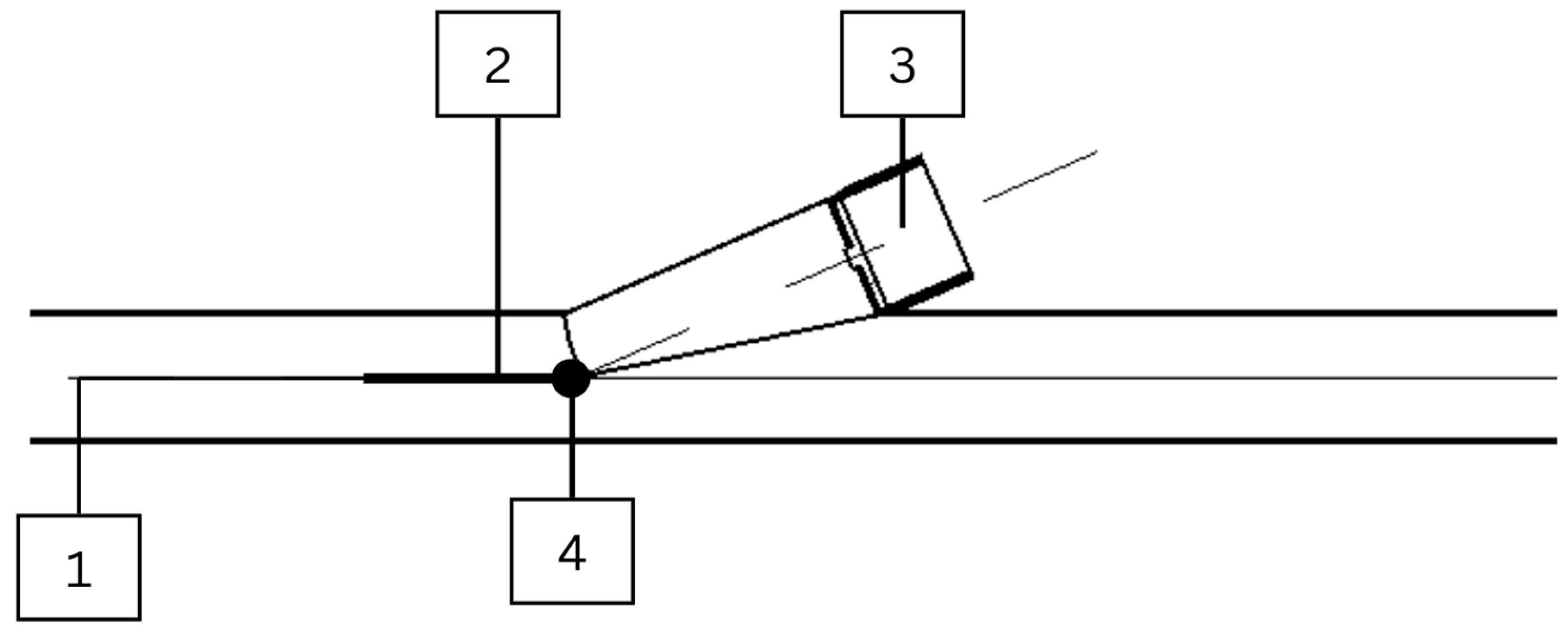
Figure 2.
Acoustic agglomeration chamber schematics: 1—Fan; 2—PALAS RGB 1000 particulate matter dispenser; 3— airflow straighteners; 4, 6—airflow velocity and particulate matter concentration measuring points; 5—compression driver; 7—vent camera.
Figure 2.
Acoustic agglomeration chamber schematics: 1—Fan; 2—PALAS RGB 1000 particulate matter dispenser; 3— airflow straighteners; 4, 6—airflow velocity and particulate matter concentration measuring points; 5—compression driver; 7—vent camera.

Figure 3.
Particle number concentration and cumulative particle size distribution.
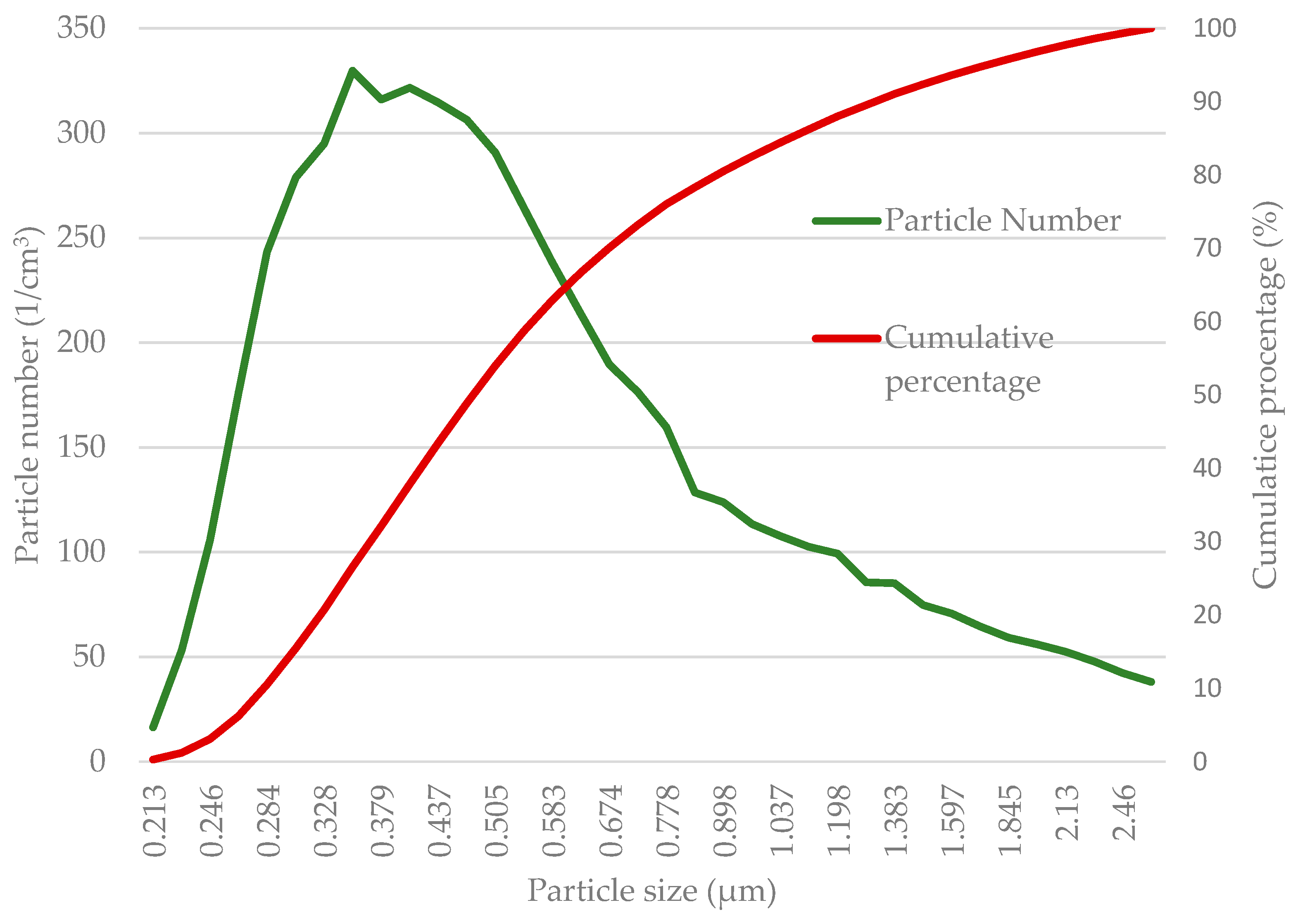
Figure 4.
RMS measurement under different sound pressure levels of compression driver.
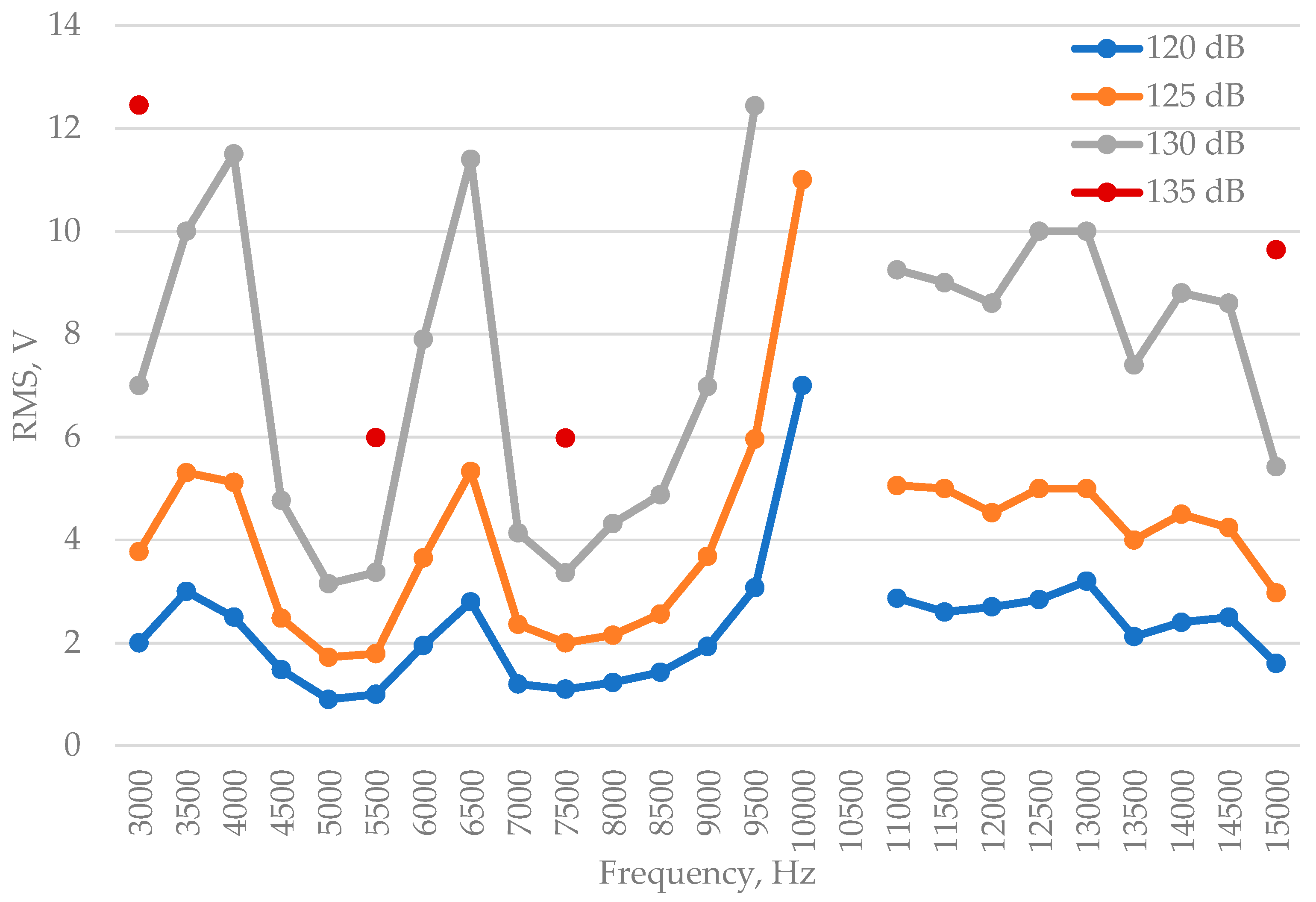
Figure 5.
Acoustic agglomeration efficiency at frequencies of 3, 5.5, 7.5, and 15 kHz and a sound pressure level of 135 dB under shorter particle residence time at an airflow velocity of 1.5 m/s.
Figure 5.
Acoustic agglomeration efficiency at frequencies of 3, 5.5, 7.5, and 15 kHz and a sound pressure level of 135 dB under shorter particle residence time at an airflow velocity of 1.5 m/s.
Figure 6.
Acoustic agglomeration efficiency at frequencies of 3, 5.5, 7.5, and 15 kHz and a sound pressure level of 135 dB under longer particle residence time conditions at an airflow velocity of 0.75 m/s.
Figure 6.
Acoustic agglomeration efficiency at frequencies of 3, 5.5, 7.5, and 15 kHz and a sound pressure level of 135 dB under longer particle residence time conditions at an airflow velocity of 0.75 m/s.
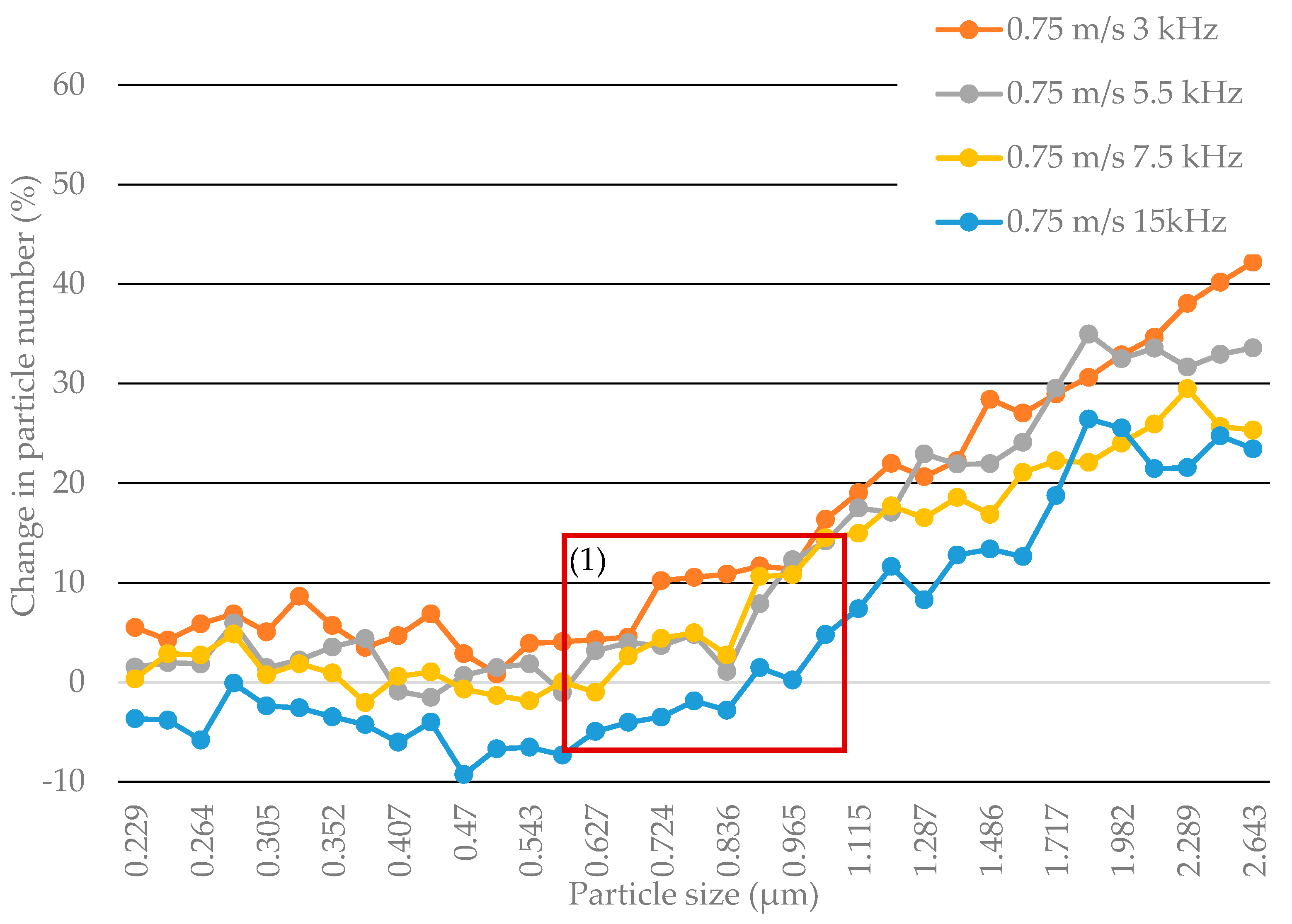

Table 1.
Experimental conditions and main study parameters.
| Air duct parameters | ||
| Duct diameter | 150 | mm |
| Total duct length | 5 | m |
| Acoustic parameters | ||
| Acoustic frequencies | 3; 5.5; 7.5; 15 | kHz |
| Sound pressure level | 135 | dB |
| Aerodynamic and particle parameters | ||
| Airflow velocity | 0.75; 1.5 | m/s |
| Volumetric flow rate | 0.013; 0.027 | m³/s |
| Measurement duration | 30 | s |
| Particle size range | 0-2.6 | µm |
| Test aerosol | Arizona dust | |
Table 2.
Sound pressure level measurements of compression driver in the center of air duct under the compression driver.
Table 2.
Sound pressure level measurements of compression driver in the center of air duct under the compression driver.
| Frequency, kHz | Sound pressure level, dB | Input RMS voltage, V |
| 3 | 135 | 12.45 |
| 3.5 | 127 | 10 |
| 4 | 130 | 11.5 |
| 4.5 | 130 | 4.77 |
| 5 | 130 | 3.15 |
| 5.5 | 135 | 5.99 |
| 6 | 130 | 7.9 |
| 6.5 | 130 | 11.4 |
| 7 | 135 | 4.14 |
| 7.5 | 130 | 5.98 |
| 8 | 130 | 4.32 |
| 8.5 | 130 | 4.88 |
| 9 | 130 | 6.98 |
| 9.5 | 130 | 12.44 |
| 10 | 127 | <13 |
| 10.5 | 120 | <13 |
| 11 | 130 | 9.25 |
| 11.5 | 120 | 9 |
| 12 | 122 | 8.6 |
| 12.5 | 128 | 10 |
| 13 | 125 | 5 |
| 13.5 | 130 | 7.4 |
| 14 | 130 | 8.8 |
| 14.5 | 130 | 8.6 |
| 15 | 135 | 9.64 |
Disclaimer/Publisher’s Note: The statements, opinions and data contained in all publications are solely those of the individual author(s) and contributor(s) and not of MDPI and/or the editor(s). MDPI and/or the editor(s) disclaim responsibility for any injury to people or property resulting from any ideas, methods, instructions or products referred to in the content. |
© 2026 by the authors. Licensee MDPI, Basel, Switzerland. This article is an open access article distributed under the terms and conditions of the Creative Commons Attribution (CC BY) license (http://creativecommons.org/licenses/by/4.0/).
Copyright: This open access article is published under a Creative Commons CC BY 4.0 license, which permit the free download, distribution, and reuse, provided that the author and preprint are cited in any reuse.


