

Submitted:
17 June 2026
Posted:
19 June 2026
You are already at the latest version
Abstract
Melanin biosynthesis proceeds through dopaquinone, a reactive ortho-quinone that partitions between eumelanin and pheomelanin depending on local thiol availability. When intracellular cysteine and glutathione are sufficient, dopaquinone is intercepted to form cysteinyldopa and ultimately pheomelanin. When thiols are depleted, dopaquinone undergoes intramolecular cyclization toward eumelanin through dopachrome, DHI, and DHICA. This much is well established. What has received less attention is the consequence that follows: eumelanin synthesis itself consumes thiols, generates quinonoid intermediates with residual electrophilic reactivity, and sustains a pro-oxidant microenvironment within the melanosome and its surroundings. The resulting oxidative burden further depletes the thiol pool, which in turn shifts subsequent dopaquinone partitioning still further toward eumelanin. We term this self-reinforcing sequence the Melanin Loop—a positive-feedback cycle in which eumelanin production creates the chemical conditions that favor yet more eumelanin production. An analogous electrophilic burden operates in photoaging. Ultraviolet radiation drives lipid peroxidation, yielding 4-hydroxynonenal (4-HNE) and acrolein—reactive carbonyl species that form covalent adducts with dermal collagen and elastin. Both the melanin loop and UV-driven carbonyl stress share a common chemical feature: nucleophilic cellular defenses are overwhelmed by electrophilic intermediates that conventional antioxidants do not efficiently neutralize. We propose that Passive Electron Donors (PEDs)—compounds capable of directly quenching electrophilic intermediates downstream of dopaquinone and downstream of lipid peroxidation—represent a rational third layer of intervention, complementing sunscreens (photon blockade) and classical antioxidants/thiols (redox buffering). This paper presents the mechanistic framework and outlines a translational research agenda; it does not claim clinical proof for any specific PED formulation.
Keywords:
melanin loop
; passive electron donor
; dopaquinone
; eumelanin
; positive feedback
; thiol depletion
; electrophilic stress
; 4-hydroxynonenal
; photoaging
; quinone chemistry
1. Introduction
Skin pigmentation research has long focused on tyrosinase activity, melanosome transfer, and the visible endpoint of melanin deposition. Photoaging research, in parallel, has centered on the UV–ROS–MMP–collagen axis. Both fields have produced effective interventions—sunscreens, tyrosinase inhibitors, retinoids, antioxidants—yet stubborn clinical problems persist. Post-inflammatory hyperpigmentation resists treatment for months. Melasma recurs despite rigorous photoprotection. Solar elastosis progresses even in patients who are diligent about sunscreen reapplication.
One reason these problems persist, we suggest, is that current strategies address the upstream trigger (UV, oxidation) or the downstream manifestation (visible pigment, wrinkles) but leave a middle chemical layer largely unattended. That layer is the electrophilic phase—the stage at which reactive quinones and reactive carbonyl species have already formed and are actively modifying cellular nucleophiles.
In melanogenesis, this electrophilic phase begins at dopaquinone and extends through the quinonoid intermediates of the eumelanin pathway. In photoaging, it begins when lipid hydroperoxides fragment into 4-HNE, malondialdehyde, and acrolein. Both share a defining chemical feature: they attack nucleophilic residues (cysteine, lysine, histidine) through Michael addition or Schiff-base formation, and the resulting adducts are largely irreversible under physiological conditions.
This paper introduces the concept of the Melanin Loop—a positive-feedback cycle in which eumelanin biosynthesis depletes intracellular thiols and sustains local electrophilic stress, thereby promoting further eumelanin production. We then extend this framework to photoaging, propose Passive Electron Donors (PEDs) as a mechanistically rational intervention at the electrophilic phase, and outline the experimental predictions that would validate or refute the hypothesis.
2. Dopaquinone as a Chemical Branch Point
2.1. The Established Biochemistry
Tyrosinase oxidizes L-tyrosine through L-DOPA to L-dopaquinone. Dopaquinone is an ortho-quinone of exceptional reactivity—its half-life in the presence of cysteine is below one second [1,2]. The fate of dopaquinone depends on the local thiol environment:
Thiol-rich conditions: Cysteine or glutathione adds across the ring at the 5-position (and to a lesser extent the 2-position), yielding 5-S-cysteinyldopa, which is subsequently oxidized to form pheomelanin [2,3].
Thiol-depleted conditions: Lacking a nucleophilic partner, dopaquinone undergoes intramolecular cyclization of its amino side chain, producing cyclodopa (leucodopachrome). Cyclodopa is rapidly oxidized to dopachrome, which rearranges to DHI or DHICA—the monomeric precursors of eumelanin [1,2].
This partitioning is not an on/off switch but a graded competition. The ratio of eumelanin to pheomelanin in any given melanocyte reflects the balance between dopaquinone production rate and local thiol concentration at the moment of synthesis [2].
2.2. Dopaquinone Is More than a Precursor
Ito, Sugumaran, and Wakamatsu (2020) emphasized that ortho-quinones produced during melanogenesis are “extremely reactive electrophiles” capable of modifying proteins and DNA through Michael-1,4-addition [1]. Dopaquinone is not merely a waypoint on the road to pigment; it is a potent electrophile that can covalently modify any accessible nucleophilic residue in its vicinity. This reactivity is the chemical engine of the melanin loop.
3. The Melanin Loop: Positive Feedback from Eumelanin to Electrophilic Stress
3.1. The Loop Mechanism
We propose that eumelanin biosynthesis is not simply the endpoint of thiol depletion but an active contributor to further thiol depletion and electrophilic stress. The cycle operates through four linked steps:
Step 1. Thiol consumption during eumelanin commitment. Once dopaquinone partitions toward the eumelanin pathway (because thiols are locally insufficient), the downstream intermediates—dopachrome, DHI, DHICA, and their oxidized quinone forms—retain electrophilic character. These intermediates can react with residual glutathione and protein thiols, further drawing down the nucleophilic buffer [1,4].
Step 2. Pro-oxidant activity of melanin intermediates. Melanogenic intermediates generate reactive oxygen species as a byproduct of their redox cycling. Denat et al. (2014) documented that melanocytes are simultaneously “instigators and victims” of oxidative stress—the act of making melanin imposes an oxidative burden on the cell that made it [5]. This is not controversial; it is the accepted explanation for the high baseline oxidative stress observed in pigmented melanocytes.
Step 3. Oxidative depletion of the thiol pool. The ROS generated during melanogenesis oxidize glutathione (GSH → GSSG) and cysteine, reducing the pool of free thiols available to intercept the next round of dopaquinone [4,6]. Del Marmol et al. (1993) showed directly that glutathione depletion increases tyrosinase activity in human melanoma cells [7]. Smit et al. (1997) demonstrated that cysteine deprivation promotes eumelanogenesis and visible pigmentation in melanocytes [8].
Step 4. Reinforced eumelanin partitioning. With fewer thiols available, the next dopaquinone molecule produced by tyrosinase is more likely to cyclize toward eumelanin rather than being captured toward pheomelanin. This returns the system to Step 1.
The net result is a positive-feedback loop: eumelanin production → thiol depletion + electrophilic/oxidative stress → further eumelanin production. We call this the Melanin Loop.
3.2. Why the Loop Matters Clinically
The melanin loop offers a mechanistic explanation for several clinical observations that are otherwise puzzling:
Post-inflammatory hyperpigmentation (PIH) persists long after inflammation resolves. If the loop is self-sustaining once initiated, pigment production can continue even after the original trigger (UV, trauma, inflammation) has ceased.
Melasma is notoriously recalcitrant. A self-amplifying loop would resist single-target interventions (tyrosinase inhibitors alone, antioxidants alone) because the feedback operates at a different chemical level.
Dark spots darken further with time if untreated. A positive-feedback mechanism predicts progressive intensification rather than spontaneous fading.
3.3. Boundary Conditions
The melanin loop does not imply that eumelanin production is inherently pathological. Eumelanin serves a vital photoprotective function. The loop becomes problematic only when it escapes normal regulatory control—when the rate of electrophilic intermediate generation exceeds the cell’s capacity to buffer it. Under physiological conditions, melanocytes maintain sufficient antioxidant and thiol reserves to keep the loop in check. Under pathological conditions (sustained UV exposure, chronic inflammation, barrier disruption), the loop may become self-sustaining.
4. The Failure of Conventional Approaches at the Electrophilic Phase
4.1. Antioxidants: Necessary But Insufficient
Vitamin C (ascorbic acid) reduces dopaquinone back to DOPA, temporarily halting forward progression [9]. This is useful but stoichiometric—each molecule of ascorbate is consumed in the process. More critically, ascorbate does not address the downstream quinonoid intermediates (dopachrome, DHI-quinone) that sustain the loop. It resets the clock at one point without breaking the cycle.
4.2. Thiols: Helpful But Depletable
Exogenous glutathione or N-acetylcysteine can replenish the thiol pool and shift partitioning toward pheomelanin [3,4]. This is the rationale behind glutathione-based lightening supplements. The limitation is kinetic: if the loop is running faster than exogenous thiols can be delivered, the intervention falls behind. Moreover, thiol supplementation does not neutralize the electrophilic intermediates that have already formed downstream of dopaquinone.
4.3. Tyrosinase Inhibitors: Upstream But Incomplete
Hydroquinone, arbutin, kojic acid, and tranexamic acid reduce dopaquinone supply by inhibiting tyrosinase or its upstream signals. They are effective at slowing the input to the loop but do not address the electrophilic intermediates already circulating within it. If the loop has been running long enough to establish a significant electrophilic burden, reducing input alone may not be sufficient to collapse it.
4.4. The Missing Layer
What none of these approaches provides is a direct means of neutralizing the electrophilic intermediates—dopaquinone, dopachrome-derived quinones, and their oxidation products—once they have formed. This is the layer we propose PEDs to occupy.
5. Parallel Electrophilic Chemistry in Photoaging
5.1. From UV to Reactive Carbonyl Species
UV radiation—particularly UVA—generates ROS through photosensitization of endogenous chromophores. These ROS initiate lipid peroxidation of membrane polyunsaturated fatty acids, producing 4-hydroxynonenal (4-HNE), malondialdehyde, and acrolein [10,11]. These are alpha,beta-unsaturated carbonyl compounds: classic electrophiles that react with protein nucleophiles through Michael addition.
5.2. Evidence for 4-HNE in Photoaging
Swiader et al. (2021) demonstrated that 4-HNE contributes to fibroblast senescence in UV-A-irradiated skin [10]. Negre-Salvayre and Salvayre (2022) documented that reactive carbonyl species drive post-translational protein modifications implicated in skin photoaging [11]. Aldini et al. (2007) showed that UVB radiation increases 4-HNE levels and toxicity in human keratinocytes [12]. Larroque-Cardoso et al. (2015) confirmed that 4-HNE modifies elastin in UV-A-exposed mice, providing a molecular mechanism for solar elastosis [13].
5.3. The Shared Chemical Logic
The melanin loop and UV-driven carbonyl stress are not the same process, but they share a defining feature: in both cases, electrophilic intermediates attack cellular nucleophiles through covalent bond formation, and the resulting adducts are not readily reversed. Conventional antioxidants (which scavenge radicals or reduce oxidized species) do not efficiently intercept these electrophilic carbons. A compound that neutralizes electrophilic intermediates would, in principle, address both the melanin loop and the carbonyl stress of photoaging.
6. Passive Electron Donors as a Third Intervention Layer
6.1. Definition and Distinction
We define a Passive Electron Donor (PED) as a compound or formulation candidate that donates electrons to electrophilic intermediates—neutralizing their reactivity toward cellular nucleophiles—without generating secondary radicals or requiring enzymatic activation.
The distinction from classical antioxidants is functional:
| Property | Classical antioxidant | Proposed PED |
| Primary target | Free radicals, ROS | Electrophilic carbons (quinones, α,β-unsaturated carbonyls) |
| Mechanism | Radical scavenging, single-electron transfer | Nucleophilic quenching, two-electron reduction, Michael addition trapping |
| Relevant assay | DPPH, ORAC, FRAP | Dopaquinone trapping, 4-HNE adduct inhibition, thiol-sparing capacity |
| Limitation addressed | Upstream oxidative initiation | Downstream electrophilic propagation |
6.2. Positioning Within a Layered Strategy
PEDs are not proposed as replacements for sunscreens, antioxidants, or tyrosinase inhibitors. They occupy a complementary layer:
Layer 1 — Photon blockade: Sunscreens reduce UV penetration.
Layer 2 — Redox buffering: Antioxidants and thiols reduce oxidative initiation and support the thiol pool.
Layer 3 — Electrophile neutralization: PEDs intercept dopaquinone-derived and lipid-peroxidation-derived electrophiles that escape Layers 1 and 2.
The rationale for Layer 3 is straightforward: no sunscreen blocks 100% of UV; no antioxidant prevents all ROS formation; no thiol supplement can maintain infinite buffering capacity. The electrophilic intermediates that slip through Layers 1 and 2 are precisely what sustains the melanin loop and drives carbonyl-mediated photoaging.
7. Translational Predictions
The melanin loop hypothesis generates testable predictions:
Prediction 1. In melanocytes subjected to sustained UV or inflammatory stimulation, intracellular GSH/GSSG ratio will decline progressively, and the eumelanin/pheomelanin ratio will shift in parallel. Interrupting the loop with a candidate PED should attenuate both the thiol decline and the eumelanin shift.
Prediction 2. Persistent hyperpigmented lesions (PIH, melasma) will show elevated markers of electrophilic stress (protein carbonyls, quinone-thiol adducts) compared to adjacent normally pigmented skin, even in the absence of active inflammation.
Prediction 3. A candidate PED that scores poorly on conventional radical-scavenging assays (DPPH, ORAC) but scores well on electrophile-trapping assays (dopaquinone capture, 4-HNE neutralization) should nonetheless reduce pigmentation in a melanocyte culture model—demonstrating that the relevant mechanism is electrophile neutralization, not radical scavenging.
Prediction 4. Timing matters. Early intervention (before the loop becomes self-sustaining) should be more effective than late intervention (after significant thiol depletion and electrophilic burden have accumulated). This predicts a clinical window of opportunity for PED application following UV exposure or inflammatory insult.
8. Limitations
This paper presents a hypothesis grounded in established biochemistry, not a clinical trial. Several caveats apply:
Pigmentation is governed by genetics (MC1R polymorphisms, skin phototype), hormones (estrogen, MSH), paracrine signaling (keratinocyte-melanocyte cross-talk), and environmental factors beyond UV (visible light, pollution, heat). The melanin loop is one mechanistic layer among many; it does not claim to explain all pigmentary disorders.
The chemical species involved—melanogenic quinones versus lipid-derived aldehydes—differ in their subcellular localization, half-lives, and detoxification pathways. Grouping them under “electrophilic stress” is useful for strategic thinking but should not obscure their distinct biology.
PED is a candidate class, not a validated therapeutic category. Any specific PED formulation must demonstrate chemical plausibility, skin compatibility, adequate penetration, biomarker efficacy, and clinical tolerability before claims can be made. Head-to-head comparison with established interventions (hydroquinone, tretinoin, sunscreen) is essential.
9. Conclusion
The Melanin Loop describes a positive-feedback cycle: eumelanin synthesis depletes intracellular thiols and generates electrophilic/oxidative stress, which shifts subsequent melanogenesis further toward eumelanin, which depletes more thiols, and so on. This self-amplifying chemistry offers a mechanistic explanation for the persistence and treatment resistance of certain hyperpigmentary conditions.
The same electrophilic logic extends to photoaging, where UV-driven lipid peroxidation produces reactive carbonyl species (4-HNE, acrolein) that form irreversible adducts with dermal proteins.
Current interventions—sunscreens, antioxidants, tyrosinase inhibitors, thiol supplements—address upstream triggers or attempt to reset individual steps, but none directly neutralizes the electrophilic intermediates that propagate both the melanin loop and carbonyl-mediated skin aging. Passive Electron Donors (PEDs) are proposed as candidates for this third intervention layer.
Whether PEDs fulfill this promise is an empirical question that requires the translational program outlined above. What the melanin loop framework contributes, independent of any specific product, is a clearer picture of where the chemical gap lies—and why filling it may matter for patients whose pigmentation and photoaging do not respond adequately to existing care.
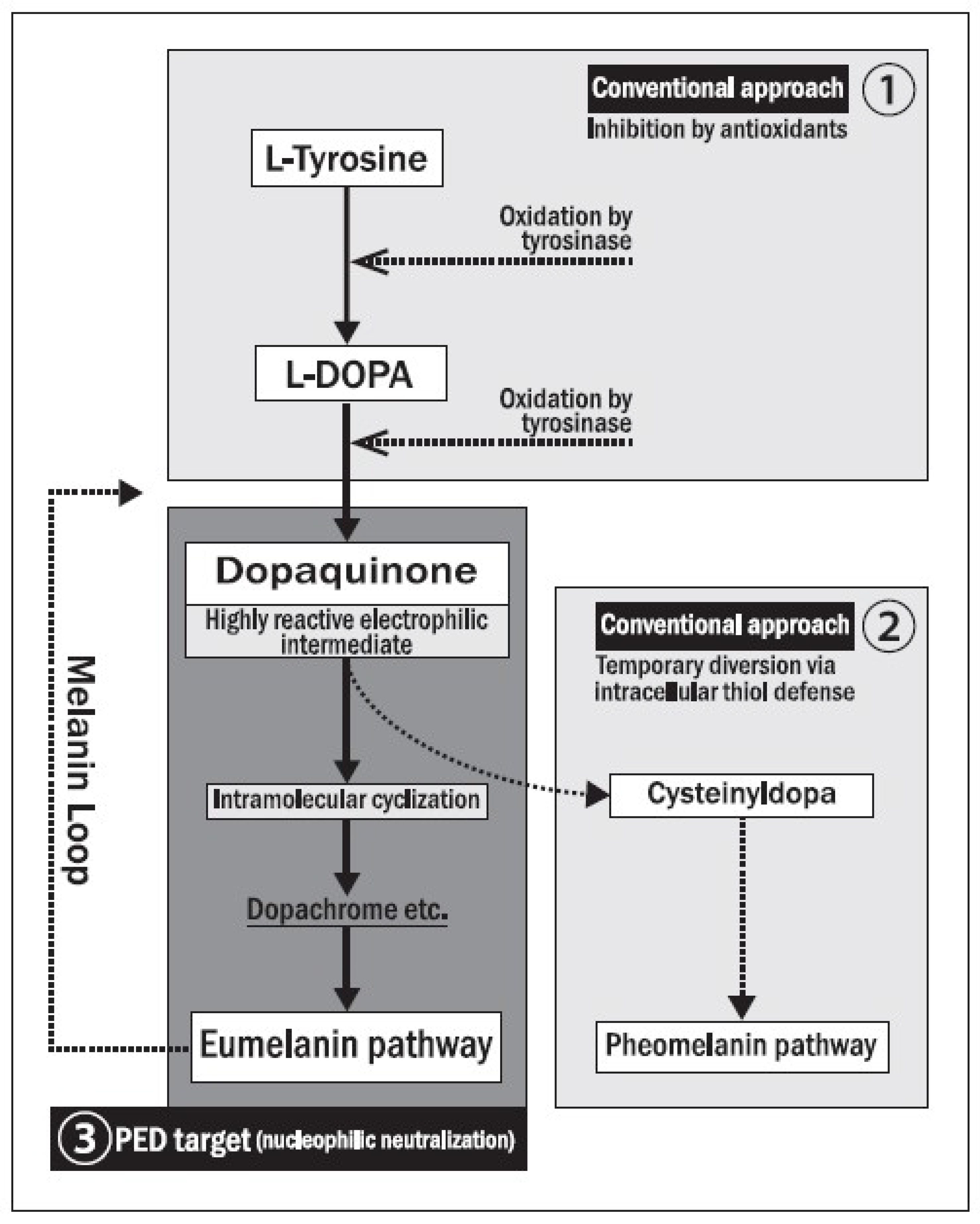
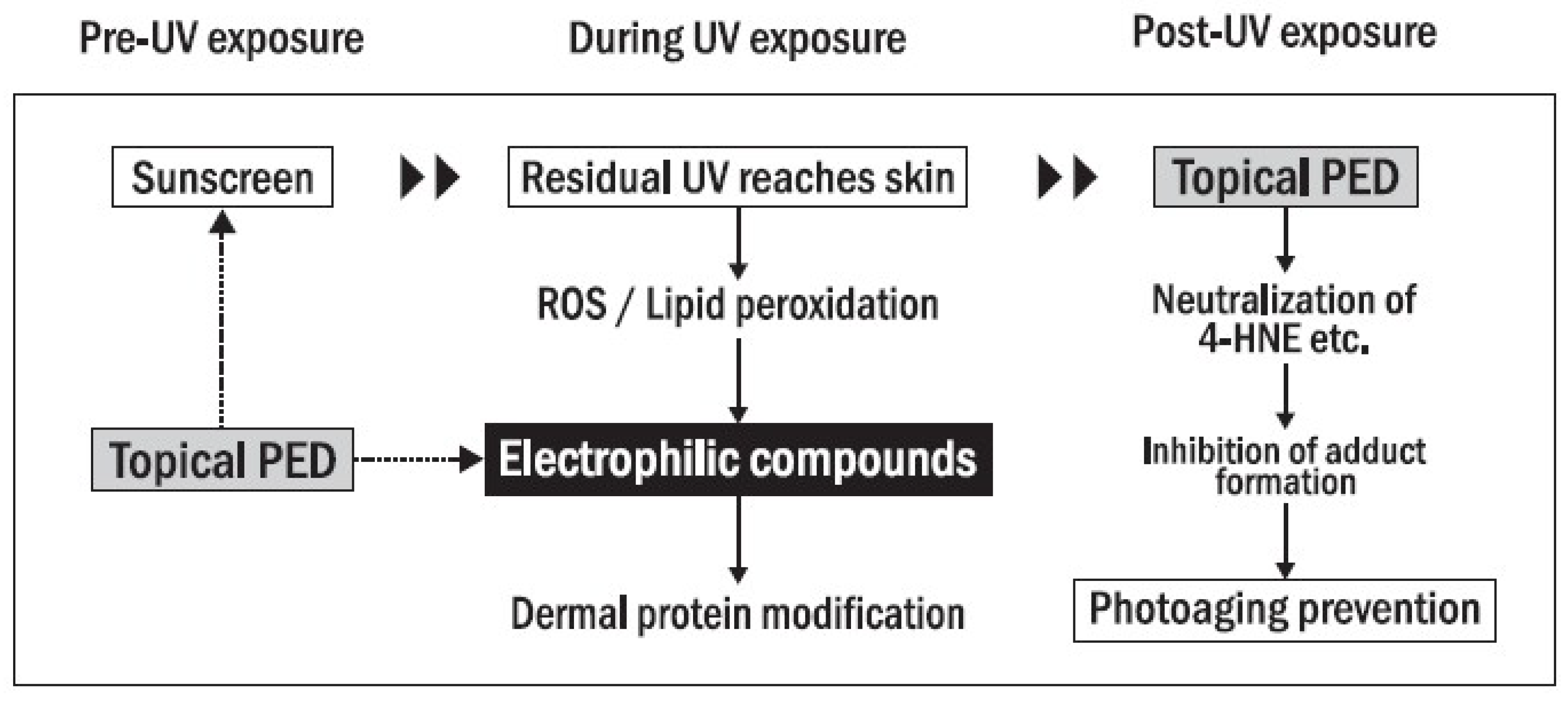
Figure 1.
The Melanin Loop. Schematic illustrating the positive-feedback cycle. Tyrosinase converts L-tyrosine through L-DOPA to dopaquinone (DQ). Under thiol-sufficient conditions (left branch), DQ is captured by cysteine/GSH to form cysteinyldopa and ultimately pheomelanin. Under thiol-depleted conditions (right branch), DQ cyclizes through dopachrome to DHI/DHICA and eumelanin. The loop (curved arrow) indicates that eumelanin pathway intermediates consume residual thiols and generate oxidative/electrophilic stress, which further depletes the thiol pool and biases subsequent DQ partitioning toward eumelanin. PED intervention (Layer 3) targets the electrophilic intermediates within the loop.
Figure 1.
The Melanin Loop. Schematic illustrating the positive-feedback cycle. Tyrosinase converts L-tyrosine through L-DOPA to dopaquinone (DQ). Under thiol-sufficient conditions (left branch), DQ is captured by cysteine/GSH to form cysteinyldopa and ultimately pheomelanin. Under thiol-depleted conditions (right branch), DQ cyclizes through dopachrome to DHI/DHICA and eumelanin. The loop (curved arrow) indicates that eumelanin pathway intermediates consume residual thiols and generate oxidative/electrophilic stress, which further depletes the thiol pool and biases subsequent DQ partitioning toward eumelanin. PED intervention (Layer 3) targets the electrophilic intermediates within the loop.
Figure 2.
Three-layer intervention strategy. Layer 1 (sunscreens) blocks UV photons before they reach the skin. Layer 2 (antioxidants, thiols) buffers the initial oxidative burst and supports the thiol pool. Layer 3 (PEDs) neutralizes electrophilic intermediates—both melanogenic quinones and lipid-peroxidation-derived carbonyls—that escape Layers 1 and 2.
Figure 2.
Three-layer intervention strategy. Layer 1 (sunscreens) blocks UV photons before they reach the skin. Layer 2 (antioxidants, thiols) buffers the initial oxidative burst and supports the thiol pool. Layer 3 (PEDs) neutralizes electrophilic intermediates—both melanogenic quinones and lipid-peroxidation-derived carbonyls—that escape Layers 1 and 2.
Conflicts of Interest
K.U. is the inventor of patents related to Passive Electron Donor (PED) technology. A.K. declares no conflicts of interest.
References
- Ito, S.; Sugumaran, M.; Wakamatsu, K. Chemical Reactivities of ortho-Quinones Produced in Living Organisms. Int. J. Mol. Sci. 2020, 21, 6080. [Google Scholar] [CrossRef] [PubMed]
- Ito, S.; Wakamatsu, K. Chemistry of Mixed Melanogenesis—Pivotal Roles of Dopaquinone. Photochem. Photobiol. 2008, 84, 582–592. [Google Scholar] [CrossRef] [PubMed]
- Boo, Y.C. Metabolic Basis and Clinical Evidence for Skin Lightening Effects of Thiol Compounds. Antioxidants 2022, 11, 503. [Google Scholar] [CrossRef] [PubMed]
- Lu, Y.; Tonissen, K.F.; Di Trapani, G. Modulating skin colour: Role of the thioredoxin and glutathione systems in regulating melanogenesis. Biosci. Rep. 2021, 41, BSR20210427. [Google Scholar] [CrossRef] [PubMed]
- Denat, L.; et al. Melanocytes as Instigators and Victims of Oxidative Stress. J. Invest. Dermatol. 2014, 134, 1512–1518. [Google Scholar] [CrossRef] [PubMed]
- Kamiński, K.; et al. Oxidative stress in melanogenesis and melanoma development. Postep. Dermatol. Alergol. 2022, 39, 205–216. [Google Scholar] [CrossRef] [PubMed]
- del Marmol, V.; et al. Glutathione depletion increases tyrosinase activity in human melanoma cells. J. Invest. Dermatol. 1993, 101, 806–809. [Google Scholar] [CrossRef]
- Smit, N.P.M.; et al. Increased melanogenesis is a risk factor for DNA damage. Photochem. Photobiol. 2008, 84, 550–555. [Google Scholar] [CrossRef] [PubMed]
- Pullar, J.M.; Carr, A.C.; Vissers, M.C.M. The Roles of Vitamin C in Skin Health. Nutrients 2017, 9, 866. [Google Scholar] [CrossRef] [PubMed]
- Swiader, A.; et al. 4-Hydroxynonenal Contributes to Fibroblast Senescence in Skin Photoaging Evoked by UV-A Radiation. Antioxidants 2021, 10, 365. [Google Scholar] [CrossRef] [PubMed]
- Negre-Salvayre, A.; Salvayre, R. Post-Translational Modifications Evoked by Reactive Carbonyl Species in UV-A-Exposed Skin. Antioxidants 2022, 11, 2281. [Google Scholar] [CrossRef] [PubMed]
- Aldini, G.; et al. Effects of UVB Radiation on 4-Hydroxy-2-trans-nonenal Metabolism and Toxicity in Human Keratinocytes. Chem. Res. Toxicol. 2007, 20, 291–300. [Google Scholar] [CrossRef] [PubMed]
- Larroque-Cardoso, P.; et al. Elastin Modification by 4-Hydroxynonenal in Hairless Mice Exposed to UV-A. J. Invest. Dermatol. 2015, 135, 1873–1881. [Google Scholar] [CrossRef] [PubMed]
- Guan, L.L.; Lim, H.W.; Mohammad, T.F. Sunscreens and Photoaging: A Review of Current Literature. Am. J. Clin. Dermatol. 2021, 22, 819–828. [Google Scholar] [CrossRef] [PubMed]
- Damiani, E.; et al. Changes in ultraviolet absorbance and hence in protective efficacy against lipid peroxidation of organic sunscreens after UVA irradiation. J. Photochem. Photobiol. B 2006, 82, 204–213. [Google Scholar] [CrossRef] [PubMed]
Disclaimer/Publisher’s Note: The statements, opinions and data contained in all publications are solely those of the individual author(s) and contributor(s) and not of MDPI and/or the editor(s). MDPI and/or the editor(s) disclaim responsibility for any injury to people or property resulting from any ideas, methods, instructions or products referred to in the content. |
© 2026 by the authors. Licensee MDPI, Basel, Switzerland. This article is an open access article distributed under the terms and conditions of the Creative Commons Attribution (CC BY) license (http://creativecommons.org/licenses/by/4.0/).
Copyright: This open access article is published under a Creative Commons CC BY 4.0 license, which permit the free download, distribution, and reuse, provided that the author and preprint are cited in any reuse.


