

Submitted:
18 June 2026
Posted:
19 June 2026
You are already at the latest version
Abstract
Background/Objectives: Poor bone quality significantly increases the risk of mechanical complications after adult spinal deformity (ASD) surgery, including proximal junctional kyphosis (PJK) and proximal junctional failure (PJF). Although teriparatide enhances bone quality, its effectiveness in preventing junctional complications after extensive correction remains unclear. This study investigated whether preoperative teriparatide administration reduces the incidence of PJK and PJF in patients with compromised bone quality undergoing ASD surgery. Methods: This retrospective cohort study reviewed 292 patients (T-score < -1.0) who underwent ASD surgery between 2015 and 2023. Patients were divided into teriparatide (n = 59) and non-teriparatide (n = 233) groups. Propensity score matching (1:2 ratio) was performed using six covariates: age, preoperative pelvic incidence minus lumbar lordosis, preoperative T1 pelvic angle, upper instrumented vertebra (UIV) cementing, UIV screw angle, and fusion length, yielding 153 matched patients (52 teriparatide, 101 non-teriparatide). Results: After matching, all baseline characteristics were well-balanced. The incidence of PJK and PJF did not differ significantly between the teriparatide and non-teriparatide groups (44.2% vs. 52.5%, P = 0.426; 9.6% vs. 9.9%, P = 1.000), nor did PJK subtype distribution (bony vs. soft-tissue). Multivariate analysis identified older age (odds ratio [OR] = 1.058), higher American Society of Anesthesiologists score (OR = 2.603, P = 0.002), UIV at the thoracolumbar junction (OR = 2.786), and greater postoperative thoracic kyphosis (OR = 1.044) as independent risk factors for PJK. Teriparatide use was not an independent predictor (OR = 0.872). Conclusions: Preoperative teriparatide did not significantly reduce the incidence of PJK or PJF after long-segment fusion for ASD. These findings suggest that improving bone quality alone is insufficient to prevent junctional complications, which are driven by complex biomechanical and patient-related factors inherent to extensive deformity correction.
Keywords:
adult spinal deformity
; proximal junctional kyphosis
; teriparatide
; osteoporosis
; propensity score matching
1. Introduction
Bone quality is a critical determinant of surgical outcomes in spinal fusion surgery, particularly in multilevel instrumented fusion for adult spinal deformity (ASD).[1] Poor bone quality significantly increases the risk of mechanical complications, including instrumentation failure and proximal junctional kyphosis (PJK).[2,3,4,5,6] The prevalence of osteoporosis and osteopenia is steadily rising, posing a clinical challenge in the treatment of these patients.[7,8] A recent systematic review of patients older than 50 years undergoing spinal surgery reported prevalences of osteoporosis and osteopenia of 34.2% and 43.5%, respectively; accordingly, up to 78.7% of patients undergoing spinal surgery have either osteopenia or osteoporosis.[7]
Teriparatide, a recombinant parathyroid hormone analog with anabolic bone-forming properties, has shown promise in reducing mechanical complications following spinal fusion surgery.[9,10,11] Multiple studies have demonstrated that perioperative teriparatide administration significantly decreases rates of pedicle screw loosening, rod fracture, and pseudarthrosis compared with bisphosphonates or no pharmacological treatment in short-segment lumbar fusion surgery.[10,12,13] Recent evidence suggests that teriparatide may also improve fusion rates and clinical outcomes in patients undergoing long-segment fusion surgery for ASD.[14,15] Conceptually, perioperative teriparatide use may reduce the incidence of PJK by enhancing bone density around the proximal junction. However, its role in PJK prevention remains controversial, likely because of the limited number of related studies.[14,15,16,17]
The present study aims to investigate whether preoperative teriparatide use prevents the development of PJK in patients with compromised bone quality, including osteopenia or osteoporosis, undergoing corrective surgery for ASD. We sought to compare PJK and proximal junctional failure (PJF) rates between teriparatide-treated and untreated patients, evaluate PJK subtypes, and identify independent risk factors for PJK development.
2. Materials and Methods
Study Design: This retrospective cohort study analyzed data from a prospectively collected ASD database at a tertiary referral center. The institutional review board approved the study and waived the requirement for informed consent due to its retrospective nature.
Study Population: The study included consecutive patients who underwent corrective surgery for symptomatic ASD between 2015 and 2023. Inclusion criteria were as follows: (1) patients aged ≥ 50 years; (2) ASD defined by at least one of the following parameters: pelvic incidence minus lumbar lordosis (PI-LL) mismatch ≥ 10°, pelvic tilt (PT) ≥ 25°, and sagittal vertical axis (SVA) ≥ 5 cm; (3) T-score less than -1.0; (4) fusion involving ≥ 5 vertebrae, including the sacrum or pelvis; and (5) completion of a 2-year follow-up. All surgeries were performed by three orthopedic spine surgeons. Pelvic fixation using conventional iliac screws was routinely performed in primary lumbosacral fusion, while fusion was limited to the sacrum without pelvic fixation in patients with milder deformities and pre-existing lumbosacral solid fusion, either from prior surgery or due to a lumbosacral transitional vertebra. Exclusion criteria included: (1) non-degenerative conditions such as infection and tumors; (2) Parkinson’s disease; or (3) revision surgery for reasons unrelated to junctional complications.
Preoperative Use of Teriparatide: Preoperative use of teriparatide (20μg/day subcutaneous injection) was indicated for patients deemed to have poor bone quality (i.e., T-score < -1.0) based on preoperative dual energy X-ray absorptiometry (DEXA). The decision to initiate teriparatide was made at the discretion of the treating physicians, considering bone quality assessments and overall patient profiles. Patients were classified into the teriparatide group only if they had received teriparatide for at least 3 months preoperatively. This 3-month minimum preoperative duration was established based on previous studies that used similar criteria for defining the teriparatide treatment group.[16,18]
Data Collection: Demographic variables included sex, age, body mass index (BMI), American Society of Anesthesiologists (ASA) grade, modified frailty index (FI-5) score, T-score (the lowest value among lumbar and hip T-scores), and Hounsfield units at the upper instrumented vertebra (UIV). Surgical variables included history of prior lumbar fusion, use of lateral lumbar interbody fusion, pelvic fixation, UIV cementing, UIV screw angle, and fusion length. Radiographic parameters included PI-LL, SS, PT, thoracic kyphosis (TK), T1 pelvic angle (TPA), and SVA, measured preoperatively and at immediate postoperative time points. In addition to these postoperative sagittal parameters, several alignment assessment schemes were evaluated such as Global Alignment and Proportion (GAP) score, Sagittal Age-Adjusted Score (SAAS), and Roussouly classification.[19,20,21]
Outcome measures: PJK was defined as a proximal junctional angle ≥ 10° and at least 10° greater than the preoperative measurement. PJK was further classified as bony PJK (vertebral fractures at the UIV or UIV+1, or fixation failure at the UIV) or soft PJK (ligamentous failure without fracture or fixation failure). PJF was defined as PJK cases requiring revision surgery. Additionally, clinical outcomes were evaluated using the Oswestry disability index (ODI), Scoliosis Research Society-22r questionnaire (SRS-22r), and Short Form-36 Physical Component Score (SF-36 PCS) preoperatively and at 2 years postoperatively.
Propensity Score Matching: Given that PJK develops from multifactorial etiologies and teriparatide was prescribed based on individual physician discretion rather than standardized criteria, we employed propensity score matching (PSM) to control for potential selection bias and confounding variables. Variables demonstrating statistically significant differences between the teriparatide and non-teriparatide groups in the unmatched cohort were included in the matching algorithm. These variables included age, preoperative PI-LL, preoperative TPA, UIV cementing, UIV screw angle, and fusion length. A logistic regression model was used to estimate the propensity score, representing the probability of receiving teriparatide treatment given the observed covariates. A 1:2 nearest-neighbor matching algorithm was employed with a caliper width of 0.2 standard deviations (SD) of the logit of the propensity score. Standardized mean differences (SMD) were calculated for all baseline variables, with SMD < 0.1 and between 0.1 and 0.2 indicating excellent and acceptable balance, respectively, between the matched groups.
Statistical Analysis: Continuous variables are presented as means ± SD and were compared using Student's t-tests or Mann-Whitney U tests, as appropriate. Categorical variables are expressed as frequencies (percentages) and were compared using chi-square tests or Fisher's exact tests. Univariate and multivariate logistic regression analyses were performed to assess the association between teriparatide use and PJK outcomes and to identify independent risk factors for PJK development. Variables with P < 0.1 in univariate analysis were entered into the multivariate model. Results are presented as odds ratios (OR) with 95% confidence intervals (CI). Statistical analyses were performed using Python (version 3.10). A P-value of < 0.05 was considered statistically significant.
3. Results
3.1. Baseline Characteristics Before Matching
A total of 292 patients met the inclusion criteria: 59 in the teriparatide group and 233 in the non-teriparatide group. Baseline demographic and clinical characteristics are summarized in Table 1. The teriparatide group was significantly older (72.3 vs. 70.5 years, P = 0.047) and exhibited more severe sagittal deformity, as indicated by a greater preoperative PI-LL mismatch (45.4° vs. 38.9°, P = 0.028) and a higher preoperative TPA (36.4° vs. 31.9°, P = 0.014). Additionally, the teriparatide group had higher rates of UIV cementing (59.3% vs. 26.6%, P < 0.001), more caudal UIV screw angle (0.8° vs. 2.6°, P = 0.005), and longer fusion length (7.0 vs. 6.3 levels, P = 0.007).
3.2. Matched Cohort Characteristics
PSM was performed using six covariates: age, preoperative PI-LL, preoperative TPA, UIV cementing, UIV screw angle, and fusion length. After matching, 153 patients remained (52 in the teriparatide group, 101 in the non-teriparatide group), resulting in a matching ratio of 1:1.94 (Figure 1A and 1B). Covariate balance was achieved for 5 of 6 variables, with all SMD below 0.1, except for fusion length (SMD = 0.114) (Figure 1C). The average absolute SMD improved from 0.406 before matching to 0.053 after matching, representing an 86.9% reduction (Figure 1C). For all 31 included variables, no significant differences were observed in demographic data, preoperative radiographic parameters, surgical variables, or preoperative and postoperative radiographic parameters (all P values > 0.05) (Table 2). Among these, 23 variables exhibited excellent balance (SMD < 0.1), while 8 variables showed acceptable balance (SMD between 0.1 and 0.2). Postoperatively, all sagittal parameters demonstrated significant changes, including PI-LL, SS, PT, TK, TPA, and SVA. The patterns of change were similar before matching (Figure 2A) and after matching (Figure 2B).
3.3. PJK and Clinical Outcomes
Before matching, the incidence of any PJK was similar between groups (50.2% vs. 49.2%, P = 1.000), as was the incidence of PJF (10.3% vs. 8.5%, P = 0.861) (Figure 3A). After matching, the incidence of PJK did not differ significantly between the groups (52.5% vs. 44.2%, P = 0.426). Similarly, PJF incidence was comparable between groups (9.9% vs. 9.6%, P = 1.000) (Figure 3B). The distribution of PJK types before matching did not differ significantly between the non-teriparatide and teriparatide groups (P = 0.857) (Figure 3C); bony PJK occurred in 25.3% of the non-teriparatide group and 22.0% of the teriparatide group, while soft PJK occurred in 24.9% and 27.1%, respectively. After matching, the distribution of PJK types remained similar between groups (P = 0.581) (Figure 3D); bony PJK occurred in 24.8% versus 23.1%, and soft PJK in 27.7% versus 21.2%, respectively. Among the 146 patients who developed PJK before matching, most occurred within the first 3 months postoperatively (39.7%), followed by 3-6 months (22.6%), 6-12 months (19.2%), and 12-24 months (18.5%) (Figure 3E). In the matched cohort, 76 patients developed PJK with a similar temporal distribution (Figure 3F); the highest incidence occurred within 0-3 months (43.4%), followed by 3-6 months (21.1%), 6-12 months (19.7%), and 12-24 months (15.8%). Among all patients in the teriparatide group, the mean treatment duration was 4.9 months before surgery and 3.7 months after surgery, for a total of 8.6 months (Table 3). The durations of teriparatide use, whether before surgery (P = 0.653), after surgery (P = 0.847), or the total duration (P = 0.604), did not differ significantly among PJK types. In the matched cohort, no significant differences were found in any clinical outcome measures, including ODI, SRS-22r, and SF-36 PCS, either preoperatively or at 2 years, between the two groups (Table 4).
3.4. Risk Factors for PJK
Univariate analysis identified several factors associated with PJK development in the overall cohort without matching (Table 5): age (OR = 1.060, P = 0.003) and ASA grade (OR = 2.690, P < 0.001), preoperative PI-LL (OR = 1.013, P = 0.034), preoperative SS (OR = 0.968, P = 0.002), preoperative PT (OR = 1.024, P = 0.024), and preoperative TPA (OR = 1.021, P = 0.032), UIV screw angle (OR = 1.056, P = 0.041), UIV levels of T11-L1 (OR = 3.133, P = 0.001), postoperative PI-LL (OR = 1.013, P = 0.034), postoperative SS (OR = 0.974, P = 0.046) and postoperative TK (OR = 1.029, P = 0.010). Notably, teriparatide use was not significantly associated with PJK in univariate analysis (OR = 0.958, P = 0.884). Multivariate logistic regression analysis demonstrated that older age (OR = 1.058, P = 0.018), higher ASA score (OR = 2.603, P = 0.002), UIV at T11-L1 (OR = 2.786, P = 0.005), and greater postoperative TK (OR = 1.044, P = 0.003) were significantly associated with the development of PJK. After adjusting for confounders, teriparatide use was not an independent predictor of PJK (OR = 0.872, P = 0.684).
4. Discussion
Teriparatide exerts anabolic effects on bone metabolism by stimulating osteoblast activity and promoting new bone formation. Previous studies have demonstrated significant improvements in bone quality parameters following perioperative administration. Yagi et al. reported that the perioperative use of teriparatide significantly improved volumetric bone mineral density and fine bone structure at the UIV+1 vertebra, resulting in reduced bone failure-type PJK in patients with ASD.[16] Similarly, Maruo et al. found that Hounsfield units at the UIV increased significantly more in the teriparatide group than in the non-teriparatide group (20.8% vs. 10.2%, P < 0.001).[22] These findings provide a strong rationale for expecting teriparatide to reduce the development of PJK, particularly bony PJK, through improved bone quality at the proximal junction where biomechanical stress is concentrated. Despite this rationale, our study found that preoperative teriparatide did not significantly reduce the incidence of PJK or PJF in patients with compromised bone quality (T-score < -1.0) undergoing long-segment fusion for ASD. After propensity score matching, PJK incidence was 44.2% in the teriparatide group versus 52.5% in the controls (P = 0.426), and PJF rates were comparable (9.6% vs. 9.9%, P = 1.000).
The role of teriparatide in preventing PJK remains controversial in recent literature. While some early studies reported beneficial effects[15,16], recent studies with more robust designs have yielded mixed results regarding its preventive efficacy against PJK. In a randomized controlled trial comparing perioperative teriparatide with denosumab in osteoporotic patients, the reduction in PJK was not statistically significant, while PJK was significantly lower in the teriparatide group.[18] Mohanty et al. conducted a propensity score-matched analysis in ASD surgery and demonstrated that while teriparatide reduced overall complication rates in osteoporotic patients undergoing long spinal fusion, it did not specifically decrease the incidence of proximal junctional complications.[14] Furthermore, a systematic review by Sardar et al. concluded that perioperative teriparatide therapy, despite representing the strongest pharmacological evidence available, still showed only level III evidence for PJK prevention, with significant heterogeneity across studies.[17] The convergence of these findings suggests a more complex relationship between bone quality improvement and PJK prevention than initially hypothesized, indicating that local bone density enhancement alone may be insufficient to prevent PJK in the multifactorial context of ASD surgery.
Multivariate analysis in this study identified several independent risk factors for PJK, including older age, higher ASA score, thoracolumbar junction UIV placement, and greater postoperative TK, which aligns with previous literature.[4,5,23,24] Notably, age and ASA score are non-modifiable patient characteristics that cannot be altered through surgical planning. In contrast, UIV selection and postoperative sagittal alignment are modifiable surgical factors that require particular attention in patients with poor bone quality. The thoracolumbar junction serves as a transition zone between the rigid thoracic spine and the mobile lumbar spine, making it susceptible to increased mechanical stress. Greater postoperative TK further compounds this biomechanical disadvantage by increasing the sagittal moment arm and lever forces at the proximal junction. Therefore, in patients with compromised bone quality, careful consideration of modifiable surgical factors—particularly avoiding UIV placement at the thoracolumbar junction when feasible and achieving appropriate sagittal alignment—may be more critical for PJK prevention than enhancing bone quality alone.
Regarding treatment duration, our cohort received teriparatide for a mean of 8.6 months (4.9 months preoperatively and 3.7 months postoperatively), which is shorter than the previous protocols reported by Yagi et al. (18 months postoperatively)[16] and Mohanty et al. (24 months total)[14]. However, the relatively short postoperative treatment duration is unlikely to have significantly influenced PJK prevention, given that two-thirds of PJK cases in our series occurred within the first 6 months postoperatively. Maruo et al. reported that patients who developed PJF had significantly shorter preoperative teriparatide treatment compared to those without PJF (34.7 vs. 86.9 days, P = 0.004).[22] In our study, all patients in the teriparatide group received at least 3 months of preoperative treatment (mean 4.9 months), which exceeds the threshold associated with PJF risk in Maruo's study. This suggests that a minimum 3-month preoperative teriparatide course may be sufficient to achieve its maximal bone-enhancing effects, and the lack of PJK protection in our cohort cannot be attributed to inadequate preoperative preparation.
Several limitations should be acknowledged. The single-center retrospective design and non-randomized allocation of patients introduce potential selection bias, despite the use of propensity score matching. The initiation and termination of teriparatide were based on physician discretion rather than standardized criteria, which may have led to heterogeneous treatment indications. We did not obtain repeat DEXA scans or measure Hounsfield units after treatment, preventing a direct assessment of bone quality improvement. The relatively short duration of postoperative treatment may have limited its protective effects. Finally, our study specifically focused on patients with T-score < -1.0, which may limit the generalizability of the results to patients with osteoporosis or normal bone density.
5. Conclusions
In patients with compromised bone quality undergoing long-segment instrumented fusion for ASD, preoperative teriparatide did not significantly reduce the incidence of PJK or PJF. While teriparatide may enhance local bone density, improvement in bone quality alone appears insufficient to prevent PJK due to the complex biomechanical and patient-related factors inherent in extensive deformity correction.
Author Contributions
Conceptualization, Park S.J. and Park J.S.; methodology, Park J.S. and Kang D.H.; software, Kang D.H.; validation, Park S.J. and Kang D.H.; formal analysis, Shin T.S.; investigation, Oh J.S.; resources, Park J.S.; data curation, Oh J.S. and Park seungjae; writing—original draft preparation, Oh J.S.; writing—review and editing, Park S.J.; visualization, Shin T.S. and Park seungjae; supervision, Park S.J.; project administration, Park S.J. All authors have read and agreed to the published version of the manuscript.
Funding
This research received no external funding.
Institutional Review Board Statement
The study was conducted in accordance with the Declaration of Helsinki, and approved by the Institutional Review Board (or Ethics Committee) of Samsung Medical Center (protocol code SMC 2024-07-144).
Informed Consent Statement
Patient consent was waived due to retrospective nature of the study.
Data Availability Statement
Data are not publicly available due to patient privacy and institutional regulation but are available from the corresponding author upon reasonable request.
Conflicts of Interest
The authors declare no conflicts of interest.
Abbreviations
The following abbreviations are used in this manuscript:
| ASD | Adult spinal deformity |
| DEXA | Dual-energy X-ray absorptiometry |
| FI-5 | 5-item modified frailty index |
| ODI | Oswestry Disability Index |
| PI-LL | Pelvic incidence minus lumbar lordosis |
| PJF | Proximal junctional failure |
| PJK | Proximal junctional kyphosis |
| PSM | Propensity score matching |
| SF-36 | PCS Short Form-36 Physical Component Score |
| SRS-22r | Scoliosis Research Society-22r questionnaire |
| SVA | Sagittal vertical axis |
| TK | Thoracic kyphosis |
| TPA | T1 pelvic angle |
| UIV | Upper instrumented vertebra |
References
- Tanaka, T.; Katayanagi, J.; Konuma, H.; Yanase, T.; Fushimi, K.; Takahashi, K.; Yoshii, T.; Jinno, T.; Inose, H. Impact of osteoporosis on perioperative complications in patients undergoing surgical treatment for lumbar spinal stenosis: a nationwide retrospective study. Asian Spine J. 2025, 19, 794–802. [Google Scholar] [CrossRef] [PubMed]
- Park, J.S.; Kim, H.J.; Park, S.J.; Kang, D.H.; Lee, C.S. A comprehensive review of risk factors and prevention strategies: how to minimize mechanical complications in corrective surgery for adult spinal deformity. Asian Spine J. 2025, 19, 463–475. [Google Scholar] [CrossRef] [PubMed]
- Park, S.J.; Park, J.S.; Kang, M.; Jung, K.; Lee, C.S.; Kang, D.H. Incidence and Risk Factors for Mechanical Failure After Anterior Column Realignment in Adult Spinal Deformity Surgery. Spine (Phila Pa 1976) 1976, 2025(50), 10–18. [Google Scholar] [CrossRef]
- Park, S.J.; Park, J.S.; Kang, D.H.; Kang, M.; Jung, K.; Lee, C.S. Different Risk Factors Between Bony and Ligamentous Proximal Junctional Failure in Patients Undergoing Thoracolumbar Fusion to Pelvis for Adult Spinal Deformity. Spine 2025, 50, 1065–1073. [Google Scholar] [CrossRef] [PubMed]
- Park, S.J.; Park, J.S.; Kang, D.H.; Kang, M.; Jung, K.; Jung, C.W.; Lee, C.S. Different characteristics between acute and delayed proximal junctional failure in elderly patients undergoing corrective surgery for adult spinal deformity: comparative analysis of risk factor, failure mode, and clinical consequences. Spine J. 2024, 24, 2377–2388. [Google Scholar] [CrossRef] [PubMed]
- Park, S.J.; Park, J.S.; Lee, C.S.; Shin, T.S.; Lee, K.H. Proximal Junctional Failure after Corrective Surgery: Focusing on Elderly Patients with Severe Sagittal Imbalance. Clin. Orthop. Surg. 2023, 15, 975–982. [Google Scholar] [CrossRef] [PubMed]
- Fan, Z.Q.; Yan, X.A.; Li, B.F.; Shen, E.; Xu, X.; Wang, H.; Zhuang, Y. Prevalence of osteoporosis in spinal surgery patients older than 50 years: A systematic review and meta-analysis. PLoS ONE 2023, 18, e0286110. [Google Scholar] [CrossRef] [PubMed]
- Chin, D.K.; Park, J.Y.; Yoon, Y.S.; Kuh, S.U.; Jin, B.H.; Kim, K.S.; Cho, Y.E. Prevalence of osteoporosis in patients requiring spine surgery: incidence and significance of osteoporosis in spine disease. Osteoporos. Int. 2007, 18, 1219–1224. [Google Scholar] [CrossRef] [PubMed]
- Ebata, S.; Takahashi, J.; Hasegawa, T.; Mukaiyama, K.; Isogai, Y.; Ohba, T.; Shibata, Y.; Ojima, T.; Yamagata, Z.; Matsuyama, Y.; et al. Role of Weekly Teriparatide Administration in Osseous Union Enhancement within Six Months After Posterior or Transforaminal Lumbar Interbody Fusion for Osteoporosis-Associated Lumbar Degenerative Disorders: A Multicenter, Prospective Randomized Study. J. Bone Jt. Surg. Am. 2017, 99, 365–372. [Google Scholar] [CrossRef] [PubMed]
- Ohtori, S.; Inoue, G.; Orita, S.; Yamauchi, K.; Eguchi, Y.; Ochiai, N.; Kishida, S.; Kuniyoshi, K.; Aoki, Y.; Nakamura, J.; et al. Comparison of teriparatide and bisphosphonate treatment to reduce pedicle screw loosening after lumbar spinal fusion surgery in postmenopausal women with osteoporosis from a bone quality perspective. Spine 2013, 38, E487-492. [Google Scholar] [CrossRef] [PubMed]
- Buerba, R.A.; Sharma, A.; Ziino, C.; Arzeno, A.; Ajiboye, R.M. Bisphosphonate and Teriparatide Use in Thoracolumbar Spinal Fusion: A Systematic Review and Meta-analysis of Comparative Studies. Spine 2018, 43, E1014–E1023. [Google Scholar] [CrossRef] [PubMed]
- Cho, P.G.; Ji, G.Y.; Shin, D.A.; Ha, Y.; Yoon, D.H.; Kim, K.N. An effect comparison of teriparatide and bisphosphonate on posterior lumbar interbody fusion in patients with osteoporosis: a prospective cohort study and preliminary data. Eur. Spine J. 2017, 26, 691–697. [Google Scholar] [CrossRef] [PubMed]
- Sardar, Z.; Coury, J.; Polly, D.; Cheung, K.; Lewis, S.J.; Deformity, A.O.S.K.F. Osteoporosis in Adult Patients Undergoing Spinal Reconstructive Surgery: Associated Complications and Management. Glob. Spine J. 2025, 15, 61S–74S. [Google Scholar] [CrossRef] [PubMed]
- Mohanty, S.; Sardar, Z.M.; Hassan, F.M.; Lombardi, J.M.; Lehman, R.A.; Lenke, L.G. Impact of Teriparatide on Complications and Patient-Reported Outcomes of Patients Undergoing Long Spinal Fusion According to Bone Density. J. Bone Jt. Surg. Am. 2024, 106, 206–217. [Google Scholar] [CrossRef]
- Seki, S.; Hirano, N.; Kawaguchi, Y.; Nakano, M.; Yasuda, T.; Suzuki, K.; Watanabe, K.; Makino, H.; Kanamori, M.; Kimura, T. Teriparatide versus low-dose bisphosphonates before and after surgery for adult spinal deformity in female Japanese patients with osteoporosis. Eur. Spine J. 2017, 26, 2121–2127. [Google Scholar] [CrossRef] [PubMed]
- Yagi, M.; Ohne, H.; Konomi, T.; Fujiyoshi, K.; Kaneko, S.; Komiyama, T.; Takemitsu, M.; Yato, Y.; Machida, M.; Asazuma, T. Teriparatide improves volumetric bone mineral density and fine bone structure in the UIV+1 vertebra, and reduces bone failure type PJK after surgery for adult spinal deformity. Osteoporos. Int. 2016, 27, 3495–3502. [Google Scholar] [CrossRef] [PubMed]
- Echt, M.; Ranson, W.; Steinberger, J.; Yassari, R.; Cho, S.K. A Systematic Review of Treatment Strategies for the Prevention of Junctional Complications After Long-Segment Fusions in the Osteoporotic Spine. Glob. Spine J. 2021, 11, 792–801. [Google Scholar] [CrossRef] [PubMed]
- Park, J.H.; Kwon, O.; Choi, J.H.; Yeom, J.S.; Park, S.M.; Kim, C.H.; Kim, H.J. Perioperative teriparatide for preventing proximal junctional kyphosis and failure in patients with osteoporosis after adult thoracolumbar spinal deformity surgery: a prospective randomized controlled trial. Osteoporos. Int. 2025, 36, 833–843. [Google Scholar] [CrossRef] [PubMed]
- Yilgor, C.; Sogunmez, N.; Boissiere, L.; Yavuz, Y.; Obeid, I.; Kleinstuck, F.; Perez-Grueso, F.J.S.; Acaroglu, E.; Haddad, S.; Mannion, A.F.; et al. Global Alignment and Proportion (GAP) Score: Development and Validation of a New Method of Analyzing Spinopelvic Alignment to Predict Mechanical Complications After Adult Spinal Deformity Surgery. J. Bone Jt. Surg. Am. 2017, 99, 1661–1672. [Google Scholar] [CrossRef] [PubMed]
- Lafage, R.; Smith, J.S.; Elysee, J.; Passias, P.; Bess, S.; Klineberg, E.; Kim, H.J.; Shaffrey, C.; Burton, D.; Hostin, R.; et al. Sagittal age-adjusted score (SAAS) for adult spinal deformity (ASD) more effectively predicts surgical outcomes and proximal junctional kyphosis than previous classifications. Spine Deform 2022, 10, 121–131. [Google Scholar] [CrossRef] [PubMed]
- Passias, P.G.; Pierce, K.E.; Raman, T.; Bortz, C.; Alas, H.; Brown, A.; Ahmad, W.; Naessig, S.; Krol, O.; Passfall, L.; et al. Does Matching Roussouly Spinal Shape and Improvement in SRS-Schwab Modifier Contribute to Improved Patient-reported Outcomes? Spine 2021, 46, 1258–1263. [Google Scholar] [CrossRef] [PubMed]
- Maruo, K.; Arizumi, F.; Kishima, K.; Yoshie, N.; Kusukawa, T.; Tachibana, T. Effects of Perioperative Teriparatide Treatment on the Hounsfield Unit Values at the Upper Instrumented Vertebra in Adult Spinal Deformity Surgery. Clin. Spine Surg. 2023, 36, E234–E238. [Google Scholar] [CrossRef] [PubMed]
- Park, S.J.; Lee, C.S.; Park, J.S.; Lee, K.J. Should Thoracolumbar Junction Be Always Avoided as Upper Instrumented Vertebra in Long Instrumented Fusion for Adult Spinal Deformity?: Risk Factor Analysis for Proximal Junctional Failure. Spine 2020, 45, 686–693. [Google Scholar] [CrossRef] [PubMed]
- Singh, V.; Oppermann, M.; Evaniew, N.; Soroceanu, A.; Nicholls, F.; Jacobs, B.; Thomas, K.; Swamy, G. Estimation of proximal junctional failure and associated risk factors in adult spine deformity surgery: an observational study from a single institution. Asian Spine J. 2025, 19, 452–462. [Google Scholar] [CrossRef] [PubMed]
Figure 1.
Assessment of propensity score matching: (A) Distribution of propensity scores before matching, (B) Distribution of propensity scores after matching, and (C) Love plot illustrating changes in standardized mean difference (SMD) for six covariates before and after matching.
Figure 1.
Assessment of propensity score matching: (A) Distribution of propensity scores before matching, (B) Distribution of propensity scores after matching, and (C) Love plot illustrating changes in standardized mean difference (SMD) for six covariates before and after matching.
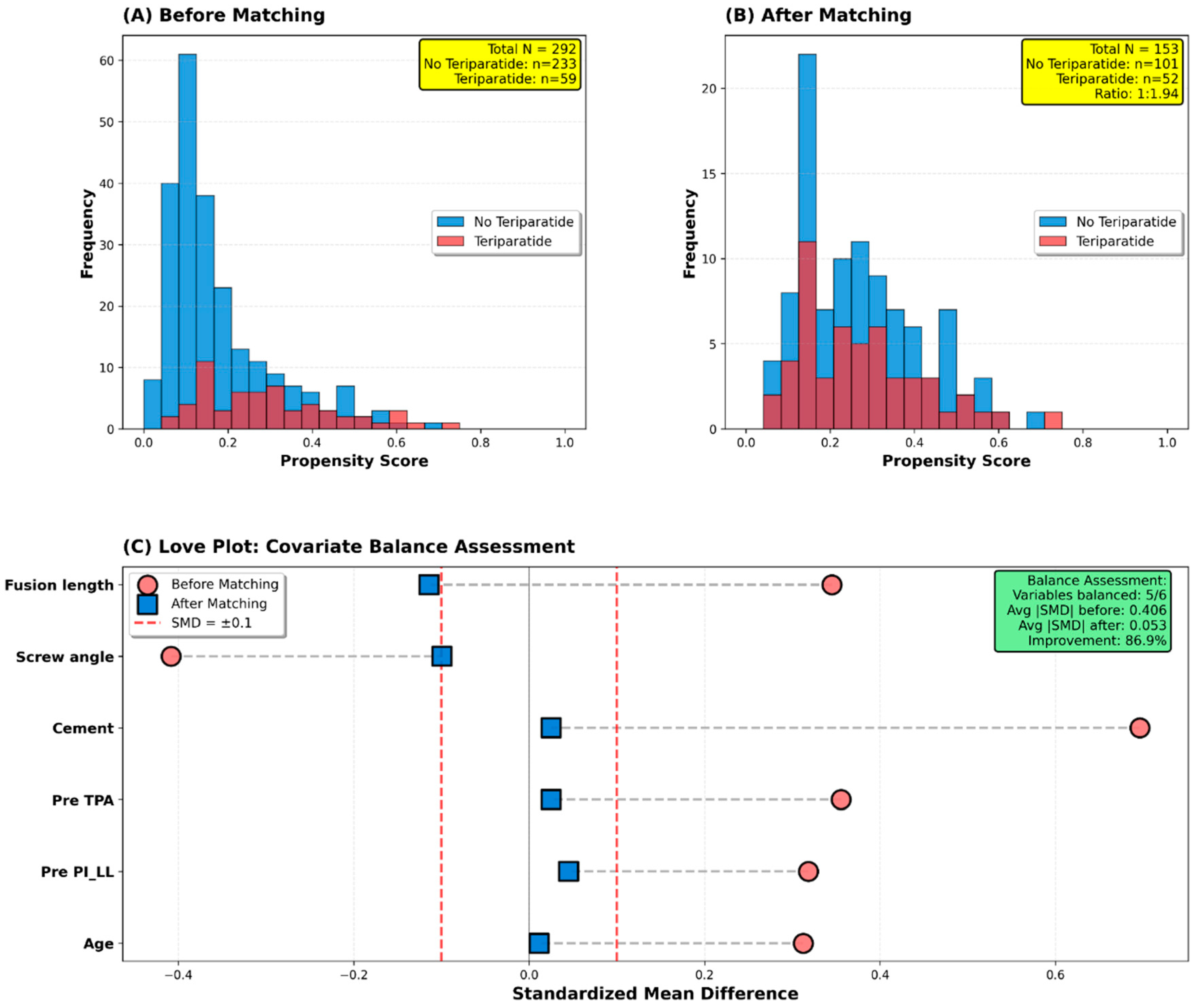
Figure 2.
Perioperative changes in sagittal parameters: (A) Before matching and (B) After matching.
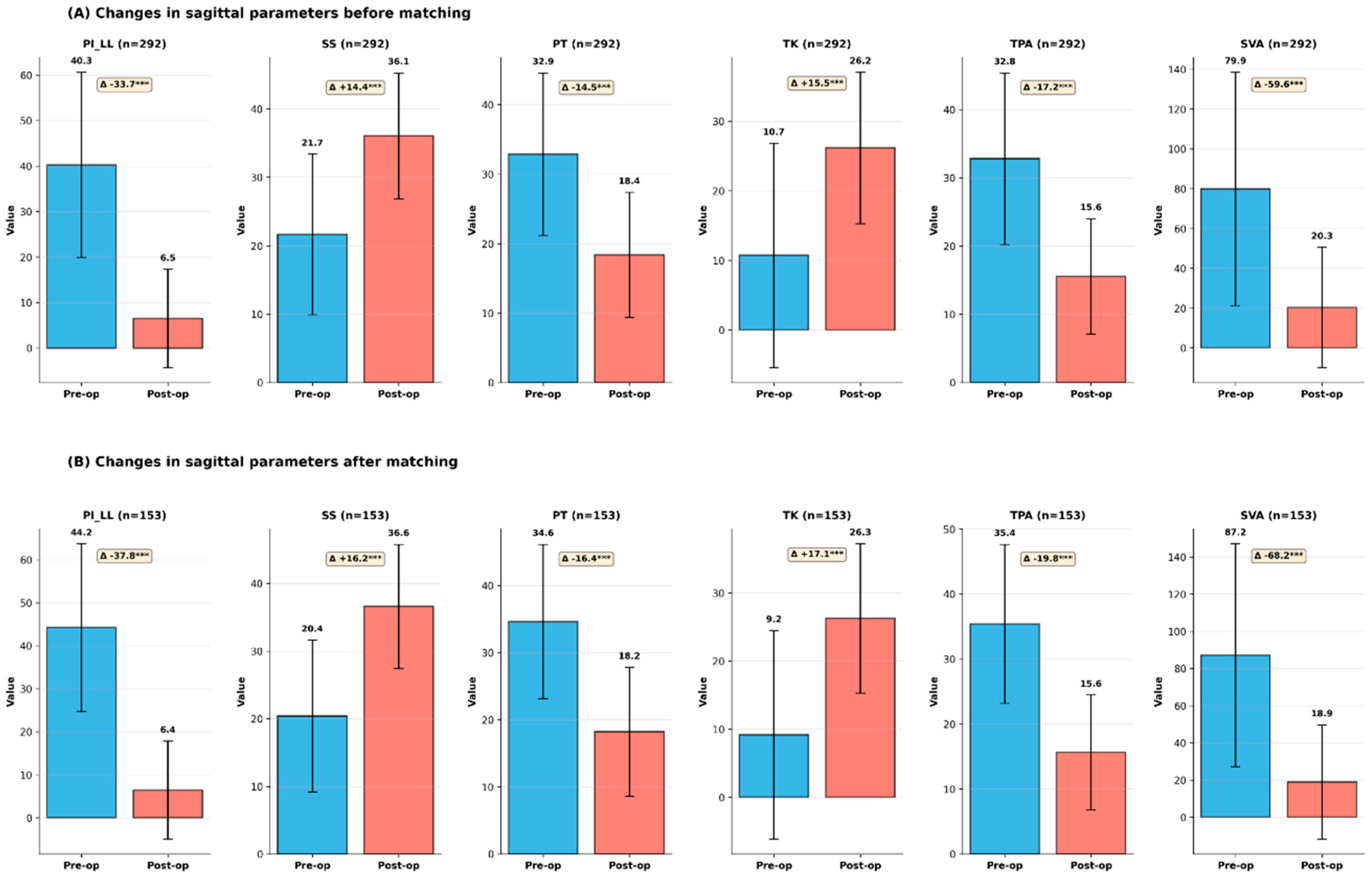
Figure 3.
PJK outcomes: (A) Incidence of PJK and PJF before matching, (B) Incidence of PJK and PJF after matching, (C) Types of PJK before matching, (D) Types of PJK after matching, (E) Time to develop PJK before matching, and (F) Time to develop PJK after matching.
Figure 3.
PJK outcomes: (A) Incidence of PJK and PJF before matching, (B) Incidence of PJK and PJF after matching, (C) Types of PJK before matching, (D) Types of PJK after matching, (E) Time to develop PJK before matching, and (F) Time to develop PJK after matching.
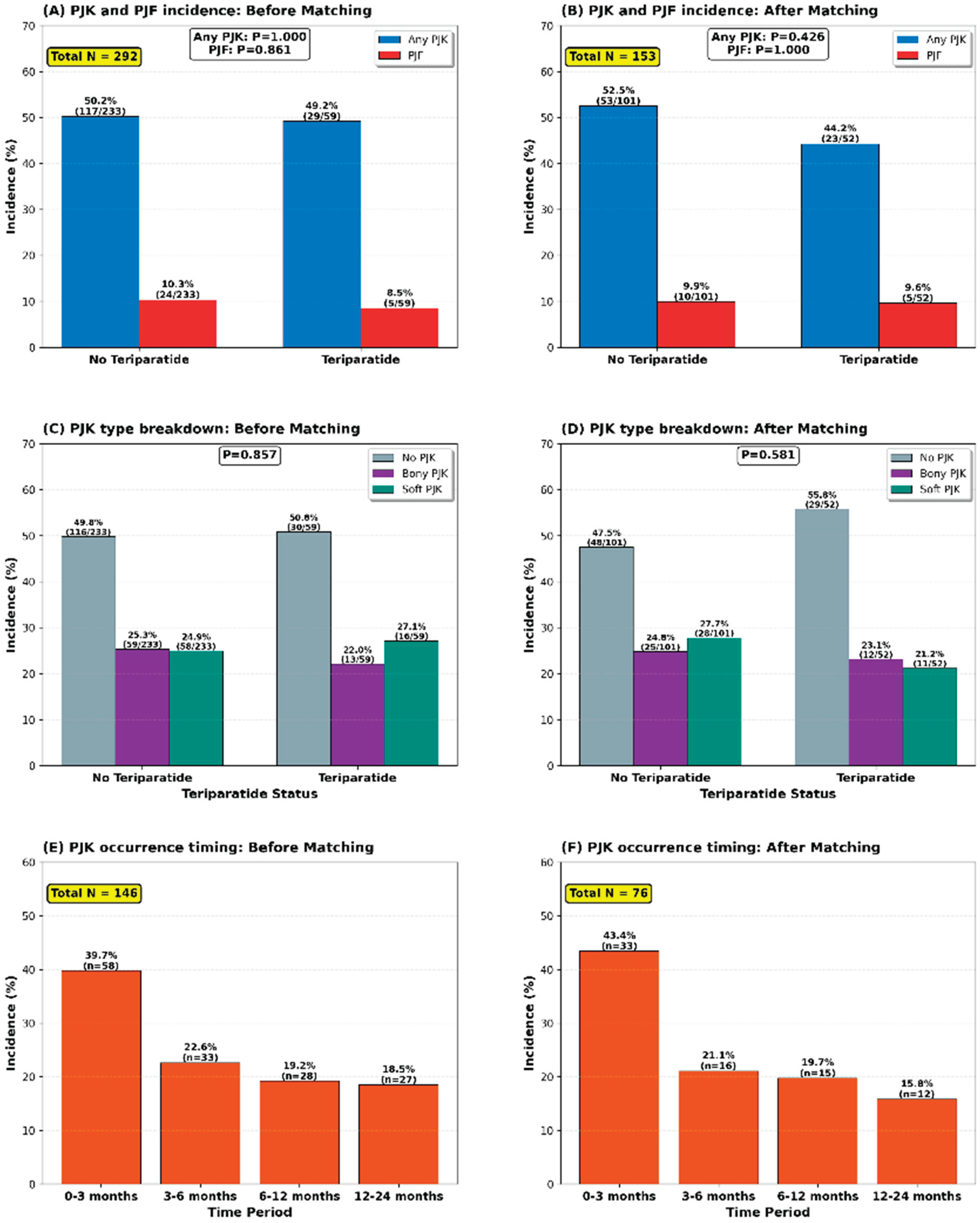

Table 1.
Comparison of baseline data before matching.
| Variables | No teriparatide (N = 292) |
Teriparatide (N = 59) |
P |
| Sex (female), n (%) | 213 (91.4%) | 58 (98.3%) | 0.067 |
| Age (years) | 70.5 ± 6.5 | 72.3 ± 5.0 | 0.047 |
| BMI (kg/m2) | 25.6 ± 3.5 | 25.5 ± 3.0 | 0.760 |
| ASA grade | 2.2 ± 0.6 | 2.2 ± 0.4 | 0.823 |
| FI-5 score | 1.3± 0.9 | 1.5 ± 0.9 | 0.082 |
| T-score | -2.0 ± 0.6 | -2.2 ± 0.8 | 0.070 |
| Hounsfield unit at the UIV | 102.8 ± 34.3 | 98.3 ± 35.9 | 0.370 |
| Preoperative PI-LL (°) | 38.9 ± 20.1 | 45.4 ± 20.7 | 0.028 |
| Preoperative SS (°) | 22.2 ± 11.6 | 19.5 ± 12.2 | 0.112 |
| Preoperative PT (°) | 33.6 ± 11.3 | 35.8 ± 12.6 | 0.071 |
| Preoperative TK (°) | 10.8 ± 15.8 | 10.5 ± 17.7 | 0.896 |
| Preoperative TPA (°) | 31.9 ± 12.4 | 36.4 ± 12.8 | 0.014 |
| Preoperative SVA (mm) | 77.8 ± 58.8 | 88.2 ± 57.8 | 0.223 |
| Prior lumbar fusion, n (%) | 85 (36.5%) | 24 (40.7%) | 0.552 |
| LLIF, n (%) | 186 (79.8%) | 48 (81.4%) | 0.793 |
| Pelvic fixation, n (%) | 187 (80.3%) | 46 (78.0%) | 0.695 |
| UIV cementing, n (%) | 62 (26.6%) | 35 (59.3%) | <0.001 |
| UIV screw angle (°) | 2.6 ± 4.4 | 0.8 ± 4.7 | 0.005 |
| Fusion length (levels) | 6.3 ± 2.2 | 7.0 ± 1.8 | 0.007 |
| Bold P values indicate statistical significance. Positive UIV screw angle indicates a cranial direction relative to upper endplate. | |||
Table 2.
Comparison of variables after 1:2 matching.
| Variables | No teriparatide (N = 101) |
Teriparatide (N = 52) |
P | SMD |
| Demographic data | ||||
| Sex (female), n (%) | 96 (95.0%) | 51 (98.1%) | 0.361 | 0.038 |
| Age (years) | 71.9 ± 5.6 | 72.0 ± 4.9 | 0.949 | 0.011 |
| BMI (kg/m2) | 25.7 ± 3.6 | 25.7 ± 3.1 | 0.908 | 0.020 |
| ASA grade | 2.2 ± 0.5 | 2.1 ± 0.4 | 0.573 | 0.046 |
| FI-5 score | 1.2 ± 0.8 | 1.4 ± 0.9 | 0.113 | 0.129 |
| T-score | -2.1 ± 0.6 | -2.2 ± 0.8 | 0.354 | 0.159 |
| Hounsfield unit at the UIV | 102.6 ± 31.8 | 98.0 ± 36.3 | 0.424 | 0.137 |
| Preoperative radiographic data | ||||
| Preoperative PI-LL (°) | 43.9 ± 19.6 | 44.8 ± 19.5 | 0.793 | 0.045 |
| Preoperative SS (°) | 20.5 ± 11.6 | 20.2 ± 10.6 | 0.856 | 0.031 |
| Preoperative PT (°) | 34.4 ± 11.4 | 35.0 ± 11.8 | 0.751 | 0.054 |
| Preoperative TK (°) | 8.4 ± 15.6 | 10.7 ± 14.9 | 0.393 | 0.146 |
| Preoperative TPA (°) | 35.3 ± 12.2 | 35.6 ± 12.5 | 0.883 | 0.025 |
| Preoperative SVA (mm) | 86.9 ± 59.7 | 87.5 ± 61.2 | 0.958 | 0.009 |
| Surgical data | ||||
| Prior lumbar fusion, n (%) | 32 (31.7%) | 20 (38.5%) | 0.402 | 0.053 |
| LLIF, n (%) | 83 (82.2%) | 43 (82.7%) | 0.937 | 0.001 |
| Pelvic fixation, n (%) | 84 (83.2%) | 42 (80.8%) | 0.712 | 0.012 |
| UIV cementing, n (%) | 57 (56.4%) | 30 (57.7%) | 0.882 | 0.025 |
| UIV screw angle (°) | 1.8 ± 4.1 | 1.4 ± 4.6 | 0.560 | 0.099 |
| Fusion length (levels) | 7.0 ± 2.1 | 6.8 ± 1.8 | 0.514 | 0.115 |
| UIV levels | 0.506 | 0.094 | ||
| L2, n (%) | 19 (18.9%) | 14 (26.9%) | ||
| T11-L1, n (%) | 25 (24.8%) | 11 (21.2%) | ||
| ≥ T10, n (%) | 57 (56.4%) | 27 (51.9%) | ||
| Postoperative radiographic data | ||||
| Postoperative PI-LL (°) | 6.5 ± 12.3 | 6.2 ± 9.5 | 0.862 | 0.030 |
| Postoperative SS (°) | 36.6 ± 9.4 | 36.7 ± 8.8 | 0.945 | 0.012 |
| Postoperative PT (°) | 17.9 ± 10.1 | 18.8 ± 8.7 | 0.581 | 0.094 |
| Postoperative TK (°) | 26.2 ± 11.5 | 26.5 ± 9.9 | 0.874 | 0.027 |
| Postoperative TPA (°) | 15.4 ± 9.0 | 16.1 ± 8.6 | 0.668 | 0.073 |
| Postoperative SVA (mm) | 20.0 ± 31.3 | 16.8 ± 29.9 | 0.539 | 0.105 |
| GAP score | 4.3 ± 3.2 | 4.7 ± 2.9 | 0.421 | 0.138 |
| GAP category | 0.328 | 0.121 | ||
| Proportioned, n (%) | 33 (32.7%) | 11 (21.2%) | ||
| Moderately disproportioned, n (%) | 46 (45.5%) | 28 (53.8%) | ||
| Severely disproportioned, n (%) | 22 (21.8%) | 13 (25.0%) | ||
| SAAS | 2.4 ± 2.9 | 2.3 ± 2.5 | 0.759 | 0.025 |
| SAAS category | 0.481 | 0.098 | ||
| Undercorrection, n (%) | 13 (12.9%) | 4 (7.7%) | ||
| Matched correction,n (%) | 19 (18.8%) | 13 (25.0%) | ||
| Overcorrection, n (%) | 69 (68.3%) | 35 (67.3%) | ||
| Roussouly classification | 0.838 | 0.002 | ||
| Restored, n (%) | 41 (40.6%) | 22 (42.3%) | ||
| Non-restored, n (%) | 60 (59.4%) | 30 (57.7%) | ||
| Bold P values indicate statistical significance. Positive UIV screw angle indicates a cranial direction relative to upper endplate. SMDs are presented as absolute values. SMD, standardized mean difference. | ||||
Table 3.
Duration of teriparatide treatment in the teriparatide group.
| Duration | Overall cohort (N = 52) | No PJK (N = 29) | Bony PJK (N = 12) | Soft PJK (N = 11) | P |
| Before surgery (months) | 4.9 ± 2.3 | 4.7 ± 2.1 | 4.8 ± 2.4 | 5.5 ± 2.7 | 0.653 |
| After surgery (months) | 3.7 ± 2.6 | 3.5 ± 2.4 | 3.9 ± 2.8 | 3.9 ± 3.1 | 0.847 |
| Total sum (months) | 8.6 ± 3.2 | 8.2 ± 2.8 | 8.7 ± 3.9 | 9.4 ± 3.7 | 0.604 |
Table 4.
Comparison of clinical outcomes between the groups for the matched cohort.
| No teriparatide (N = 101) | Teriparatide (N = 52) | P | |
| Preoperative ODI | 62.6 ± 16.5 | 61.6 ± 14.1 | 0.727 |
| Preoperative SRS-22r | 2.2 ± 0.5 | 2.3 ± 0.5 | 0.782 |
| Preoperative SF-36 PCS | 24.2 ± 13.7 | 23.4 ± 16.3 | 0.720 |
| 2-year ODI | 37.0 ± 17.7 | 32.3 ± 21.0 | 0.190 |
| 2-year SRS-22r | 3.4 ± 0.8 | 3.5 ± 0.8 | 0.497 |
| 2-year SF-36 PCS | 52.3 ± 24.8 | 57.0 ± 27.6 | 0.433 |
Table 5.
Logistic regression analysis for risk factors of PJK for unmatched overall cohort.
| Variables | Univariate analysis | Multivariate analysis | |||
| OR | P | OR | 95% CI | P | |
| Teriparatide use | 0.958 | 0.884 | 0.872 | 0.450 – 1.688 | 0.684 |
| Female (vs. male) | 1.108 | 0.821 | |||
| Age (yeas) | 1.060 | 0.003 | 1.058 | 1.010 – 1.109 | 0.018 |
| BMI (kg/m2) | 1.042 | 0.234 | |||
| ASA grade | 2.690 | <0.001 | 2.603 | 1.410 – 4.808 | 0.002 |
| FI-5 score | 1.148 | 0.281 | |||
| T-score | 0.696 | 0.863 | |||
| Hounsfield unit at the UIV | 1.005 | 0.164 | |||
| Preoperative PI-LL (°) | 1.013 | 0.034 | 1.024 | 0.994 – 1.055 | 0.118 |
| Preoperative SS (°) | 0.968 | 0.002 | 0.981 | 0.945 – 1.018 | 0.314 |
| Preoperative PT (°) | 1.024 | 0.024 | 1.005 | 0.959 – 1.053 | 0.851 |
| Preoperative TK (°) | 0.997 | 0.652 | |||
| Preoperative TPA (°) | 1.021 | 0.032 | 0.989 | 0.939 – 1.041 | 0.674 |
| Preoperative SVA (mm) | 1.003 | 0.117 | |||
| Prior lumbar fusion | 1.381 | 0.184 | |||
| LLIF | 1.090 | 0.769 | |||
| Pelvic fixation | 1.469 | 0.191 | |||
| UIV cementing | 1.242 | 0.385 | |||
| UIV screw angle (°) | 1.056 | 0.041 | 1.044 | 0.983 – 1.109 | 0.158 |
| Fusion length (levels) | 1.062 | 0.280 | |||
| UIV levels | 0.002 | 0.002 | |||
| L2 | Ref. | - | Ref. | - | - |
| T11-L1 | 3.133 | 0.001 | 2.786 | 1.369 – 5.670 | 0.005 |
| ≥ T10 | 1.870 | 0.028 | 1.259 | 0.647 – 2.449 | 0.497 |
| Postoperative PI-LL (°) | 0.991 | 0.383 | |||
| Postoperative SS (°) | 0.974 | 0.046 | 0.981 | 0.945 – 1.020 | 0.334 |
| Postoperative PT (°) | 1.017 | 0.203 | |||
| Postoperative TK (°) | 1.029 | 0.010 | 1.044 | 1.015 – 1.074 | 0.003 |
| Postoperative TPA (°) | 1.020 | 0.165 | |||
| Postoperative SVA (mm) | 1.001 | 0.853 | |||
| GAP score | 1.056 | 0.161 | |||
| GAP category | 0.293 | ||||
| Proportioned | Ref. | ||||
| Moderately disproportioned | 0.890 | 0.676 | |||
| Severely disproportioned | 1.414 | 0.294 | |||
| SAAS | 1.024 | 0.589 | |||
| SAAS category | 0.373 | ||||
| Undercorrection | 1.681 | 0.229 | |||
| Matched correction | Ref. | ||||
| Overcorrection | 1.373 | 0.240 | |||
| Roussouly restored (vs. non-restored) | 0.734 | 0.193 | |||
| Bold P values indicate statistical significance. Positive UIV screw angle indicates a cranial direction relative to upper endplate. | |||||
Disclaimer/Publisher’s Note: The statements, opinions and data contained in all publications are solely those of the individual author(s) and contributor(s) and not of MDPI and/or the editor(s). MDPI and/or the editor(s) disclaim responsibility for any injury to people or property resulting from any ideas, methods, instructions or products referred to in the content. |
© 2026 by the authors. Licensee MDPI, Basel, Switzerland. This article is an open access article distributed under the terms and conditions of the Creative Commons Attribution (CC BY) license (http://creativecommons.org/licenses/by/4.0/).
Copyright: This open access article is published under a Creative Commons CC BY 4.0 license, which permit the free download, distribution, and reuse, provided that the author and preprint are cited in any reuse.


