

Submitted:
16 June 2026
Posted:
19 June 2026
You are already at the latest version
Abstract
Biosensors have become important analytical platforms that enable rapid, selective, sensitive and portable analysis for early disease diagnosis, biomarker monitoring and point-of-care diagnostic applications. Their analytical performance depends on the coordinated function of molecular recognition elements, surface chemistry, transduction mechanisms and signal-processing strategies. Nevertheless, the analysis of real biological samples remains challenging because of low target concentrations, matrix effects, interfering species, signal noise, sensor drift and device-to-device variability. Therefore, artificial intelligence and machine learning are gaining increasing importance as data-driven tools for signal preprocessing, calibration, feature extraction, pattern recognition, quantitative prediction and diagnostic decision support. These approaches are particularly valuable for interpreting complex datasets generated by electrochemical, optical, wearable and microfluidic biosensors. This review provides a comprehensive overview of healthcare-oriented biosensor systems, beginning with molecular recognition principles, bioreceptor design, and transduction technologies, and extending to applications in clinical diagnosis and health monitoring. It also examines the roles of supervised, unsupervised and deep learning approaches in biosensor data analysis, while critically discussing model validation, generalizability, interpretability and clinical translation. By linking molecular-level recognition with computational signal interpretation, this review highlights the advantages and limitations of artificial intelligence-integrated biosensors for next-generation point-of-care diagnostics, continuous health monitoring, and personalized healthcare applications.
Keywords:
biosensor technology
; healthcare
; molecular recognition
; artificial intelligence
; machine learning
1. Introduction
Biosensor systems are important diagnostic platforms that convert biological or chemical recognition events into measurable analytical signals. These systems enable the rapid, selective and sensitive detection of metabolites, proteins, nucleic acids, hormones, pathogens, toxins and disease-related biomarkers [1]. Although conventional laboratory-based diagnostic methods offer high accuracy and reliability, they often have limitations such as time-consuming sample preparation steps, the need for specialized personnel, expensive instrumentation infrastructure and dependence on centralized laboratories [2]. Therefore, biosensor technologies are gaining increasing importance in modern healthcare systems because of advantages such as portability, low sample volume, short analysis time, low cost and compatibility with point-of-care diagnosis applications. The analytical performance of biosensors primarily depends on the selectivity of the molecular recognition process and the accurate conversion of this recognition event into a signal through an appropriate transduction mechanism [3]. Enzymes, antibodies, aptamers, molecularly imprinted polymers and other synthetic receptors are the main components that provide analyte-specific recognition in biosensors [4]. Analytical information is obtained by converting the interaction between the analyte and the recognition element into an electrochemical, optical, piezoelectric, thermal or electronic signal. Therefore, biosensor design is a multidisciplinary research field that requires the combined contribution of disciplines (chemistry, biochemistry, materials science, nanotechnology, electronics, data analysis) [5]. Biosensors used in healthcare applications not only determine the presence of an analyte but also provide important information for the early diagnosis of diseases, biomarker monitoring, evaluation of treatment effectiveness and personalized medicine applications. Analyses performed in biological samples (blood, serum, plasma, saliva, urine, sweat) have great potential for the development of real-time or rapid diagnostic systems. In particular, point-of-care diagnostic systems, wearable biosensors and continuous monitoring platforms make it possible to move healthcare services from centralized laboratories to settings closer to the patient [6]. However, important challenges still remain in the translation of biosensors into clinical applications. In real biological samples, factors (matrix effects, nonspecific adsorption, interfering species, low analyte concentrations, signal noise, signal drift, long-term stability problems, device-to-device reproducibility) may limit biosensor performance [7]. In addition, new-generation biosensor technologies (multiplex analyte detection, wearable sensors, image-based systems, continuously data-generating platforms) produce increasingly complex and multidimensional datasets. Processing such data with conventional methods and converting them into clinically significantl results may not always be sufficient [8]. In recent years, artificial intelligence and machine learning approaches have emerged as powerful tools for improving the performance of biosensor systems and interpreting complex biosensor data. Machine learning algorithms can be used at many stages, including noise reduction, baseline correction, calibration, feature extraction, concentration estimation, pattern recognition, classification and diagnostic decision support [9,10]. While supervised learning methods are applied to distinguish diseased and healthy samples or to estimate analyte concentrations, unsupervised learning approaches contribute to revealing hidden patterns in complex datasets. Deep learning methods offer important opportunities, particularly for the automated analysis of image-based, spectral, electrochemical and time-series biosensor data. However, the success of artificial intelligence-integrated biosensor systems does not depend on only the power of the algorithms used [11]. For algorithms to generate reliable results, the chemical and biochemical foundations of the biosensor must be robust. Weak molecular recognition, unstable surface chemistry, nonreproducible transduction mechanisms or low-quality data generation can limit the performance of even the most advanced machine learning models [12]. Therefore, artificial intelligence-integrated biosensors should be considered not only as data analysis platforms but also as holistic design platforms in terms of molecular recognition, surface design, signal generation and data quality [13].
In this review, biosensor systems used in healthcare are addressed within a holistic framework extending from molecular recognition principles to artificial intelligence-integrated data interpretation approaches. First, the fundamental components of biosensors, bioreceptor types, surface and immobilization strategies, transduction mechanisms and signal generation processes are explained. Then, the main applications of biosensors in point-of-care diagnosis, monitoring of metabolic and chronic diseases, diagnosis of infectious diseases, detection of cancer biomarkers and wearable health technologies are evaluated. In the following section, the roles of supervised, unsupervised and deep learning approaches in the preprocessing, feature extraction, classification, quantitative prediction and conversion of biosensor data into diagnostic decision support are examined. In addition, current applications of artificial intelligence and machine learning in fluorescence, colorimetric, SERS, microfluidic, CRISPR-based and wearable biosensor systems are discussed through example studies in the context of disease classification, biomarker profiling, multiplex analyte evaluation and portable point-of-care diagnostic. These studies are also critically evaluated in terms of key limitations such as model validation, generalizability, interpretability, and translation into clinical practice. This review aims to provide a comprehensive perspective on next-generation point-of-care diagnosis, health monitoring and personalized healthcare applications by establishing a connection between the chemical and biochemical foundations of biosensors and artificial intelligence-assisted smart diagnostic systems.
2. Biosensor Technology
Biosensor technology is defined as an interdisciplinary analytical platform that converts a biological or chemical recognition event into a measurable signal. In general, a biosensor consists of a bioreceptor or recognition element that selectively recognizes the analyte, a transducer that converts this recognition event into a physicochemical signal and a signal-processing unit that processes the resulting signal (Figure 1). The basic operating principle of biosensors is based on the stages of sample analysis, recognition of the target molecule, conversion of this recognition event into measurable signals through a transduction mechanism and interpretation of the signal [14]. Therefore, biosensors are not only analytical devices but also integrated systems that bring together chemistry, biochemistry, materials science, nanotechnology, electronics and data analysis. Glucose biosensors have a special place in the historical development of biosensors [15]. The first glucose oxidase-based electrochemical biosensors developed by Clark and Lyons initiated the introduction of biosensor technology into the field of clinical diagnosis and enabled its widespread use, particularly in diabetes monitoring [16]. Today, biosensors are not limited to glucose determination but are used for the detection of a wide range of targets (cancer biomarkers, cardiac markers, infectious agents, toxins, nucleic acids, proteins, metabolites, environmental pollutants) [17,18]. This broad range of applications demonstrates the increasing importance of biosensor technology in both basic research and healthcare applications. Such as glucose oxidase electrodes, HbA1c biosensors, uric acid biosensors, silicon biosensors, nanomaterial-based biosensors and hydrogel-based systems are widely reported in the literature for different disease diagnosis and biomedical applications [19,20,21].
Molecular recognition is the fundamental process that enables a biosensor to selectively bind the target analyte by distinguishing it from other components within a complex sample matrix. This process is based on molecular shape and size complementarity and the effects of noncovalent forces (hydrogen bonds, electrostatic interactions, hydrophobic forces, van der Waals interactions, π–π interactions) [22]. The effectiveness of the recognition event is determined not only by the binding strength between the receptor and the target but also by the specificity and kinetics of the interaction. While high affinity supports the capture of the target analyte at low concentrations, selectivity reduces cross-reactions that may be caused by structurally similar molecules [23]. Therefore, molecular recognition directly affects the sensitivity, detection limit, dynamic measurement range and probability of producing false-positive or false-negative results of the biosensor. Molecular recognition in biosensors can be achieved through natural or synthetic receptors (enzymes, antibodies, nucleic acid probes, aptamers, cells, molecularly imprinted polymers) [24]. While enzymes generally exhibit high catalytic selectivity toward specific substrates, antibodies provide strong affinity-based recognition through binding sites specific to their antigens. Aptamers are short DNA or RNA sequences that allow the formation of three-dimensional structures capable of binding to the target molecule and are gaining increasing importance because of their chemical synthesizability, low batch-to-batch variability and ease of modification [25]. In molecularly imprinted polymers (MIPs), the target molecule is used as a template during polymerization, and after its removal, artificial binding cavities complementary to the target in terms of size, shape and functional groups are formed. Although these synthetic receptors may exhibit high chemical and physical durability compared with biological receptors, maintaining selectivity and reducing nonspecific binding in complex biological samples remain important design challenges [26,27].
Biosensors are multicomponent systems, and each component directly affects the overall performance of the sensor. The main components are the analyte, bioreceptor, transducer and signal-processing unit. Any inadequacy in one of these components may limit the biosensor in terms of selectivity, sensitivity, reproducibility, stability and clinical applicability [28].
Analytes: These are the chemical or biological species intended to be detected by the biosensor. In healthcare, analytes exhibit a wide variety. Small metabolites such as glucose, lactate, cholesterol, uric acid and creatinine; proteins such as insulin, troponin, C-reactive protein, cytokines and cancer biomarkers; nucleic acids such as DNA, RNA, miRNA and viral genome fragments; pathogens such as bacteria, viruses and fungi; hormones, drug molecules and toxins are among the analytes that biosensors can target [24].
Bioreceptors: These are the most critical components that enable the biosensor to detect the analyte selectively. The specificity of the biosensor largely depends on the selectivity of the interaction established between this recognition element and the analyte. Enzymes, antibodies, aptamers, nucleic acid probes, cells, microorganisms, tissues, nanozymes and molecularly imprinted polymers are bioreceptors commonly used in biosensors [29].
Transducers: These are the components that convert the interaction between the bioreceptor and the analyte into a measurable physical or chemical signal. The transduction mechanism determines the signal type, device design, measurement sensitivity, portability and application area of the biosensor. Electrochemical, optical, piezoelectric, thermal, magnetic and electronic transducers are widely used in biosensor technology [30]. The selection of the transducer is made according to the structure of the analyte, the type of bioreceptor, the sample matrix, the desired detection limit, the portability requirement of the device, and the measurement environment. Electrochemical transducers are suitable for low-volume and portable devices. Optical transducers provide high sensitivity and real-time interaction monitoring. Piezoelectric systems can measure mass changes on the surface. Thermal systems are sensitive to heat changes resulting from biochemical reactions. Therefore, the transducer is not only the signal-generating unit of the biosensor but also the engineering component at the center of the entire analytical strategy [31].
Signal processor: The raw signal generated in the biosensor often does not directly correspond to clinical or analytical information. This signal must be amplified, filtered, normalized, correlated with calibration curves and converted into a significant result. The signal-processing step is particularly critical at low analyte concentrations, in real samples, in multiplex analyte analyses and in wearable sensors. In conventional biosensors, signal evaluation is mostly performed through parameters such as linear calibration, peak current, absorbance change, frequency shift or impedance change. However, data in modern biosensors are more complex [32]. Multisensor arrays, spectral data, electrochemical fingerprint signals, image-based colorimetric tests, and continuous time-series data may not always be interpreted sufficiently by conventional methods. At this point, chemometrics, statistical analysis, machine learning and artificial intelligence approaches help derive more significant results from biosensor data. Machine learning algorithms can be used in biosensor data for functions such as classification, regression, clustering, and feature extraction and can improve performance particularly in electrochemical, optical, microfluidic and wearable sensors [33].
2.1. Types of Biosensors
Biosensors can be classified according to different criteria. The most common classification is based on the transduction mechanism. Accordingly, biosensors are categorized as electrochemical, optical, piezoelectric, thermal, microfluidic and wearable biosensors [34].
2.1.1. Electrochemical Biosensors
Electrochemical biosensors are biosensors that measure electrical changes resulting from the interaction between the bioreceptor and the analyte. These changes may occur in the form of current, potential, resistance, conductivity, capacitance or impedance. Electrochemical biosensors are generally designed as three-electrode systems consisting of a working electrode, a reference electrode and a counter electrode. When the analyte interacts with the bioreceptor, electron transfer, ion exchange or a change in surface charge occurs at the electrode surface, and this change is recorded as the analytical signal [35]. Electrochemical biosensors are divided into different groups, including amperometric, potentiometric, voltammetric, conductometric and impedimetric biosensors. In amperometric biosensors, the current generated at a specific potential is measured [36]. Glucose oxidase-based glucose biosensors are the best-known example of this group. In potentiometric biosensors, the change in potential is monitored under near-zero current conditions. In voltammetric systems, the current response generated in relation to the applied potential is analyzed [37]. In impedimetric biosensors, charge-transfer resistance and capacitive changes at the electrode-electrolyte interface are measured [38]. The most important advantages of electrochemical biosensors are their low cost, high sensitivity, ability to operate with small sample volumes, compatibility with portable devices, ease of miniaturization and suitability for point-of-care diagnosis systems. In addition, electrochemical measurements are generally less affected by optical turbidity or colored samples [39]. Because of these characteristics, they are widely used for the determination of glucose, lactate, cholesterol, urea, uric acid, dopamine, DNA, protein biomarkers, pathogens and toxins. Electrode surface contamination, biofouling, interfering electroactive species, signal drift, and long-term stability problems are important limitations of electrochemical biosensors [40,41]. Modification of the electrode surface with nanomaterials, conductive polymers, carbon-based structures, metal nanoparticles, or MIPs can significantly reduce these problems. In electrochemical biosensors, biological recognition elements (enzymes, antibodies, nucleic acids, cells) are immobilized on the electrode surface. The electrochemical response generated as a result of the interaction between the analyte and the recognition element is converted into an electrical response by the electrochemical transducer and transformed into a readable analytical output in the signal-processing unit. A representative illustration of this process is presented in Figure 2 [42].
2.1.2. Optical Biosensors
Optical biosensors are systems that measure optical changes resulting from the interaction between the bioreceptor and the analyte. These changes can be monitored through optical parameters (fluorescence, chemiluminescence, bioluminescence, refractive index, polarization, Raman scattering, surface plasmon resonance). The basic structure of optical biosensors generally consists of a recognition unit, an optical transducer, and a signal-processing unit [43]. The binding of the analyte alters the interaction between light and matter, and this change is converted into a measurable optical signal. Optical biosensors can be designed as labeled or label-free systems. In labeled systems, fluorescent dyes, enzyme labels, quantum dots, metal nanoparticles or colorimetric markers are used. In label-free systems, refractive index, surface plasmon resonance or interferometric changes resulting from the direct binding of the target molecule are monitored [44]. Surface plasmon resonance (SPR) biosensors enable the real-time and label-free monitoring of biomolecular interactions. Fluorescence biosensors offer high sensitivity and multiplex analysis capacity [45]. Colorimetric biosensors have the advantage of simple visual readout [46]. Raman- and Surface-Enhanced Raman Spectroscopy (SERS)-based biosensors provide high selectivity by offering molecular fingerprint information [47]. The importance of optical biosensors in point-of-care diagnostic systems is gradually increasing. In particular, fluorescence-, colorimetric-, SPR- and Raman-based systems are used for rapid, sensitive and selective disease diagnosis. The most important advantages of optical biosensors are high sensitivity, real-time monitoring, multiplex analyte detection, the potential for label-free measurement and ease of generating visual results [48]. However, device cost, the need for optical alignment, sample turbidity, matrix-induced light scattering, photodegradation and the requirement for complex data analysis in some systems may be limiting factors in optical biosensors [49]. Therefore, the combined use of nanomaterials, microfluidic systems, smartphone-based imaging platforms and artificial intelligence-assisted signal-processing approaches in optical biosensors is increasing. Localized surface plasmon resonance (LSPR) is an important optical sensing approach that enables the real-time and label-free monitoring of biomolecular interactions based on shifts in the resonance wavelength caused by local refractive index changes around metallic nanostructures. Yavas et al. developed a chip for the automated, quantitative, and multiplexed analysis of breast cancer-related protein biomarkers in human serum by integrating LSPR sensing with a microfluidic channel network and micromechanical valves. In the system, gold nanorod arrays were used as sensing surfaces at the intersections of the microfluidic channels; the LSPR wavelength shift resulting from the immobilization of the capture antibody on the surface, the binding of the target biomarker, and the addition of the signal-amplifying antibody was measured in real time. The ability of the platform to perform calibration and sample measurement on the same chip contributes to more reliable quantitative analysis in complex biological samples. Figure 3 shows the design of the microfluidic LSPR chip, the gold nanorod-based sensing surface, the sandwich immunoassay mechanism, and the monitoring of the LSPR response depending on the CA15-3 concentration [50].
2.1.3. Piezoelectric and Mass-Sensitive Biosensors
Piezoelectric biosensors are systems that measure the mass change resulting from the binding of the analyte to the sensor surface as a frequency change. Quartz crystal microbalance (QCM) and surface acoustic wave (SAW) sensors are the most common examples of this group. When a bioreceptor is immobilized on piezoelectric crystals, analyte binding causes a change in the vibration frequency of the crystal [51]. This frequency change is correlated with the mass accumulated on the surface, thereby providing information about the amount of analyte. An important advantage of these systems is that the analyte can be detected directly and often without labeling [52]. Antibody-antigen interactions, DNA hybridization, cell binding, toxin determination, pathogen detection and monitoring of protein interactions can be performed using piezoelectric biosensors. Real-time measurement enables the monitoring of binding kinetics. However, piezoelectric biosensors may be affected by the viscosity of the liquid medium, temperature changes, mechanical vibrations, and nonspecific surface adsorption. In addition, surface chemistry must be carefully optimized for the accurate measurement of very small mass changes. Therefore, antifouling surface designs, stable immobilization strategies and controlled microfluidic sample delivery are highly important in piezoelectric biosensors [53,54].
2.1.4. Thermal Biosensors
Thermal biosensors are systems that provide analytical information by measuring the heat change released or consumed during biochemical reactions. Since many enzymatic reactions occur with an enthalpy change, the temperature difference generated by these reactions can be correlated with analyte concentration. In thermal biosensors, the enzyme or bioreceptor is generally immobilized in a reaction zone, and the temperature change occurring during the reaction is measured using sensitive thermistors or temperature sensors [55]. The advantage of thermal biosensors is that they can operate without being directly dependent on optical or electrochemical properties. Therefore, they may offer an alternative measurement strategy for some samples that are colored, turbid or contain electroactive interferences [56]. They can be used in metabolite determination based on enzymatic reactions. However, thermal signals are generally low in amplitude and can be easily affected by environmental temperature changes. Therefore, thermal insulation, precise temperature control and well-calibrated measurement systems are required [57].
2.1.5. Microfluidic Biosensors and Lab-on-a-Chip Systems
Microfluidic biosensors are platforms that combine biosensor components with microchannels that enable the controlled movement of liquids in very small volumes. Lab-on-a-chip systems can perform sample preparation, mixing, separation, reaction, washing and detection steps on a single miniaturized device. These systems provide major advantages, particularly for applications requiring point-of-care diagnosis, rapid analysis and low sample volumes. In microfluidic biosensors, sample consumption is low, analysis time is short, reaction efficiency is high and automation is easy [58]. The ability to analyze samples (blood, serum, saliva, urine, sweat) in small volumes is important for healthcare applications. Microfluidic platforms can be integrated with electrochemical, optical, magnetic or fluorescence transduction systems. In addition, parallel microchannels or sensor arrays can be designed for multiplex analyte detection. However, microfluidic biosensors face problems such as channel clogging, surface adsorption, sample pretreatment requirements, production cost and device standardization [59]. For translation into clinical practice, microfluidic systems must operate not only under laboratory conditions but also with real samples in a user-friendly and reproducible manner. In microfluidic lab-on-a-chip systems, analytical steps such as sample preparation, reagent transport, biorecognition, signal generation and data processing can be integrated on a single miniaturized platform. In these systems, samples and reagents are directed to the analysis chamber through microchannels, while the resulting signal is processed by readout and control units and can be evaluated through portable devices or mobile applications [60]. Figure 4 illustrates the integration of sample preparation, microfluidic transport, biorecognition, signal readout and data-processing steps on a single miniaturized lab-on-a-chip platform [61].
2.1.6. Wearable and Implantable Biosensors
Wearable biosensors are sensor systems that can be integrated with the body or placed on the skin. They can provide continuous or periodic biochemical information from samples (sweat, tears, saliva, interstitial fluid, the skin surface). Wearable biosensors can be designed in the form of patches, wristbands, smartwatches, textile-based sensors, intraoral systems or temporary tattoo sensors. These systems have great potential for personalized health monitoring, chronic disease management, athlete performance monitoring, elderly care systems and remote patient monitoring [62]. Glucose, lactate, electrolytes, cortisol, pH, alcohol, drug molecules and inflammatory biomarkers are among the targets that can be monitored using wearable biosensors. The advantages of wearable systems include real-time data generation, patient comfort, non-invasive or minimally invasive sampling, and the potential for integration with mobile health systems. Implantable biosensors aim to perform long-term and continuous measurements by being placed inside the body. Continuous glucose monitoring systems are particularly successful clinical examples in this field [63]. Figure 5 illustrates the general workflow of a DNA hydrogel-based wearable electrochemical sensor system developed for the determination of interferon-gamma in sweat samples. While the hydrogel layer enables sweat collection and the transport of the target biomarker to the sensor surface, the aptamer-based recognition mechanism allows the generation of an interferon-gamma-specific electrochemical response. The resulting signal is recorded by a portable electrochemical measurement system, converted into digital data and transferred to a smartphone application. Thus, the measurement results can be processed in real time and a rapid assessment of the user’s health status can be provided [64].
3. Biosensing in Healthcare
Biosensor technologies are becoming increasingly important in healthcare for the early diagnosis of diseases, biomarker monitoring, evaluation of treatment effectiveness and personalized medicine applications. Although conventional laboratory-based diagnostic methods offer high accuracy, they often require centralized laboratory infrastructure, specialized personnel, time-consuming sample preparation steps and high costs. In contrast, biosensors enable analytes to be detected rapidly, selectively, sensitively and often through portable systems, making it possible to move healthcare services closer to the patient [65]. Therefore, biosensors are regarded in modern diagnostic systems not only as analytical devices but also as early-warning, continuous-monitoring and clinical decision-support tools. The main advantage of biosensors in healthcare applications is their ability to rapidly and directly detect clinically significant molecular changes in biological samples [66]. A wide variety of target molecules, including glucose, lactate, cholesterol, urea, creatinine, hormones, protein biomarkers, nucleic acids, pathogens, toxins and drug molecules, can be detected in these samples. In particular, monitoring chronic diseases, rapid diagnosis of infectious diseases, detection of cancer biomarkers, and monitoring of cardiovascular risk indicators are among the main healthcare applications of biosensors. Their rapid response time, high sensitivity, portability and real-time measurement capability make biosensors strong candidates for point-of-care diagnostic applications [67].
3.1. Point-of-Care Diagnostics
Point-of-care diagnostic systems refer to tests performed in a setting close to the patient without the need for a centralized laboratory. These systems can be used in hospitals, clinics, ambulances, home settings or environments where healthcare services are limited. The main objective of the point-of-care (POC) diagnostics approach is to accelerate the clinical decision-making process and enable early initiation of treatment by providing rapid results [68]. In this context, biosensors have become one of the main components of POC diagnostic systems because they can operate with small sample volumes, provide short analysis times and be integrated into portable devices. The best-known example of POC biosensors is glucose monitoring systems [69]. Glucose biosensors have enabled patients with diabetes to monitor their blood glucose levels rapidly and regularly and have become one of the strongest examples demonstrating the clinical success of biosensor technology. This success has encouraged the development of similar portable biosensor platforms for other metabolites, cardiac biomarkers, infectious agents and cancer markers [70]. Today, electrochemical, optical, lateral flow, microfluidic and smartphone-based biosensors are being intensively investigated in the field of POC diagnostics. The contribution of POC biosensors to healthcare systems is not limited to providing rapid results. These systems can support early diagnosis, reduce disease progression and minimize hospital visits and the need for laboratory testing. They can also contribute to personalized health management through integration with remote monitoring systems [71,72]. Accordingly, Figure 6 shows the simultaneous monitoring of SARS-CoV-2 RNA sequences and β-lactam antibiotic levels on the same microfluidic electrochemical biosensor platform. Nasal swab or plasma samples are applied to the BiosensorX system; while the CRISPR/Cas13a-based recognition mechanism enables the detection of viral RNA targets, the protein-based biorecognition approach allows the monitoring of antibiotic levels. The electrochemical signals generated in the microfluidic channel are transferred to a smartphone through an NFC-enabled portable potentiostat, and the results can be evaluated at the point of care. Thus, the system enables viral load monitoring and personalized antibiotic dosing to be carried out together on a single platform [73].
3.2. Monitoring of Metabolic and Chronic Diseases
Biosensors have an important role in the management of metabolic and chronic diseases. In conditions diabetes, kidney diseases, cardiovascular diseases, liver dysfunctions and metabolic syndrome, regular monitoring of biomarkers is critical for understanding disease progression and regulating treatment. Small molecules (glucose, lactate, cholesterol, uric acid, creatinine, urea) are among the most frequently monitored targets in this field. Glucose biosensors used in diabetes monitoring are the most successful commercial application of biosensor technology in healthcare [74]. Enzyme-based electrochemical glucose sensors measure glucose concentration by utilizing the catalytic activity of enzymes (glucose oxidase or glucose dehydrogenase). These systems provide patients with real-time information and help manage the risks of hypoglycemia and hyperglycemia more effectively. In the diagnosis and monitoring of cardiovascular diseases, the rapid and sensitive determination of biomarkers (cardiac troponins, B-type natriuretic peptide (BNP), myoglobin, C-reactive protein) is important [75]. Electrochemical and optical biosensors can contribute to the early evaluation of changes associated with myocardial damage, heart failure and inflammation by enabling the detection of these biomarkers at low concentrations. In particular, portable and multiplex systems have significant potential for monitoring cardiovascular risk at the point of care and evaluating treatment response [76]. Lactate biosensors are important for monitoring athletic performance, tissue hypoxia, sepsis and metabolic stress. Uric acid biosensors can be used in the evaluation of gout, kidney function and conditions associated with oxidative stress. Creatinine and urea biosensors have potential for monitoring kidney function. Metabolic biosensors can offer important advantages, particularly in clinical decision-making processes requiring rapid results and in home-based patient monitoring [77]. Figure 7 shows the general structure of a wireless, flexible and stretchable wearable bioelectronic system developed for the simultaneous monitoring and treatment of chronic wounds. The smart wound dressing monitors biomarkers related to the wound microenvironment (temperature, pH, ammonium, glucose, lactate, uric acid) through a multiplex sensor array, while wirelessly transferring the obtained data to an external device. The system also provides controlled antimicrobial and anti-inflammatory drug release through a drug-loaded electroactive hydrogel and supports tissue regeneration through electrical stimulation. Thus, real-time evaluation of wound status and a personalized treatment approach are combined on a single wearable platform [78].
3.3. Infectious Disease Diagnosis
Rapid and accurate diagnosis of infectious diseases is of great importance for the timely initiation of appropriate treatment and the control of disease spread. Conventional microbiological methods are based on culture, PCR, or immunological tests; however, these methods may be time-consuming or require advanced laboratory infrastructure. Biosensors offer alternative diagnostic platforms for the rapid detection of bacteria, viruses, fungi, parasites or their antigens, antibodies and nucleic acids. Antibody-based immunosensors, DNA/RNA hybridization sensors, aptasensors, phage-based biosensors and CRISPR-based detection systems can be used in the diagnosis of infections [79]. Electrochemical biosensors offer the advantages of low cost and portability, while optical biosensors can provide high sensitivity and multiplex analysis capacity. In particular, the COVID-19 pandemic clearly demonstrated the need for rapid, portable and reliable diagnostic systems. During this period, biosensors became one of the important research topics for the detection of viral antigens, antibodies and nucleic acids [17]. Figure 8 illustrates the operating principle of a graphene-based field-effect transistor biosensor developed for the rapid and label-free detection of SARS-CoV-2. In the system, the graphene surface is functionalized with antibodies specific to the SARS-CoV-2 spike protein through the PBASE linker molecule and the binding of viral antigens present in the clinical sample to these antibodies produces measurable changes in the electrical properties of the graphene channel. The FET structure consisting of source, drain and gate electrodes converts this change into an electrical signal, enabling rapid and sensitive detection of the virus without sample pretreatment or an additional labeling step [80]. The most important advantage of biosensors in infectious diseases is that they enable the detection of pathogens at an early stage and at low levels. However, low viral load in real clinical samples, the complex nature of the sample matrix, cross-reactivity, false-positive/negative results and validation requirements remain important limitations. Therefore, biosensors to be used in infectious disease diagnosis must demonstrate high selectivity, a low detection limit and strong clinical validation.
3.4. Cancer Biomarker Detection
Early diagnosis of cancer is one of the key factors that significantly affect treatment success and patient survival. Cancer biomarkers can consist of different biological structures such as proteins, nucleic acids, metabolites, extracellular vesicles, circulating tumor cells and tumor-derived DNA/RNA. Biosensors have significant potential for the rapid and selective determination of these biomarkers at low concentrations. Immunosensors, aptasensors, DNA sensors, MIP-based biosensors, electrochemical and optical platforms are widely investigated in the determination of cancer biomarkers [81]. For example, CEA, PSA, CA-125, HER2, AFP and various miRNAs are among the biomarkers that can be targeted for cancer diagnosis and disease monitoring [82]. Electrochemical biosensors enable the determination of these markers in a low-cost and portable manner, while optical and SERS-based biosensors provide high sensitivity and molecular specificity. One of the biggest challenges in cancer biosensors is that biomarkers are often found in very low concentrations, and a single marker is insufficient for diagnosis [83]. Therefore, the determination of multiple biomarkers and sensor arrays are becoming increasingly important in cancer diagnosis. Figure 9 shows the preparation and operation steps of a MIP and surface-enhanced Raman scattering-based biosensor developed for the determination of the CA 15-3 biomarker associated with breast cancer. In the first stage, the gold electrode surface is cleaned and a MIP layer containing target molecule-specific voids is formed by electropolymerization of aniline in the presence of CA 15-3. After the target protein is removed from the polymer, CA 15-3 from the sample re-binds to the resulting recognition voids; then, a SERS probe consisting of gold nanostars functionalized with antibody and Raman marker attaches to the target protein. The intensity of the obtained Raman signal, in relation to the amount of CA 15-3 bound to the electrode surface, allows for the quantitative determination of the biomarker [84].
4. Artificial Intelligence and Machine Learning in Biosensor Systems
Advances in biosensor technologies have made it necessary not only to convert biological recognition events into measurable signals, but also to extract analytically and clinically significant information from these signals. In conventional biosensors, evaluation is generally based on correlating specific signal features (peak current, potential change, absorbance, fluorescence intensity, frequency shift, impedance) with calibration curves. This approach may be sufficient under controlled conditions and in systems where a single analyte is measured [85]. However, in real biological samples, matrix effects, nonspecific binding, cross-reactivity, biofouling, environmental variables and differences between devices may make the direct interpretation of the signal originating from the target analyte difficult. In addition, sensor arrays, multiplex analyte platforms, image-based systems and wearable devices that perform continuous monitoring generate high-dimensional and time-dependent datasets that cannot be fully evaluated using conventional univariate methods [86]. Artificial intelligence (AI) is a broad field of research that aims to perform functions such as perception, learning, inference, and decision-making through computational systems. Machine learning (ML) is a subfield of AI that learns relationships within data without being entirely dependent on predefined fixed rules [87]. In biosensor systems, ML is used for tasks (classification, regression, clustering, anomaly detection, pattern recognition, prediction). Deep learning is an ML approach that enables the automatic learning of feature representations from complex data, particularly images, spectra and time series, through multilayer artificial neural networks [88]. The integration of AI and ML into biosensors aims to transform the signal generated as a result of the biological recognition event into a more reliable and interpretable output, rather than directly enhancing the biological recognition event itself. Therefore, AI should not be regarded as an independent solution that compensates for a bioreceptor with insufficient selectivity, unstable surface chemistry or a non-reproducible transduction mechanism [89]. The development of reliable computational models requires selective molecular recognition, stable immobilization, controlled signal generation and standardized data collection processes. When added to this analytical foundation, ML can model complex signal patterns, distinguish variations caused by interference and convert the biosensor output into quantitative or qualitative information [90]. In an AI-integrated biosensor system, the process generally consists of sampling, biological recognition, signal generation, data collection, data processing, modeling and result generation steps. Signals obtained as a result of electrochemical, optical, mechanical or thermal transduction can be used through an appropriate computational model to estimate analyte concentration, assign samples to specific classes or monitor time-dependent changes [91]. In multiplex biomarker systems, data from different sensor channels can be combined, while in wearable platforms, individual baseline levels and temporal trends can be learned. Thus, biosensors can evolve from measurement tools that merely indicate the presence of a target into integrated analytical platforms that interpret data and provide decision support. However, high performance of the model on the training data alone is not sufficient. AI-assisted biosensors must produce similar results across different user groups, different devices, varying sample matrices and real-world operating conditions. Therefore, model performance should be evaluated not only in terms of accuracy, but also using analytical and clinical metrics appropriate to the nature of the application. In addition, issues such as explainability, data security, algorithmic bias and clinical responsibility should also be considered when transferring the system into real-world use [92]. The fundamental steps the use of AI and ML in biosensor systems are presented in Figure 10.
4.1. AI and ML Approaches for Biosensor Data Analysis
The analytical performance of biosensors depends not only on the selectivity of the bioreceptor or the sensitivity of the transduction mechanism, but also on the proper processing and interpretation of the obtained data. While electrochemical biosensors generate voltammetric curves, amperometric time series and impedance spectra, optical systems can produce fluorescence and colorimetric signals, Raman and SERS spectra, surface plasmon resonance sensorgrams and image-based outputs. In microfluidic and wearable platforms, multichannel measurements and data obtained simultaneously from different sensors are involved [93]. These data types are generally high-dimensional, interrelated, and nonlinear in structure. The method to be used for the analysis of biosensor data should be selected according to the research question, data structure, number of samples, target output and the environment in which the model will be used [94]. In cases where labeled samples are available, supervised learning methods can be used to predict the analyte type, disease status or sample class, while continuous outputs such as biomarker concentration can be determined using regression models. In cases where labels are absent or limited, unsupervised learning methods help reveal the natural structure of the data, similarities between samples and outlier measurements. Deep learning methods can reduce dependence on manual feature definition, particularly in high-dimensional data (images, spectra and time series). No algorithm is universally superior for all data types in biosensor applications [95]. In small and structured datasets, simpler methods such as logistic regression, linear discriminant analysis, partial least squares, support vector machines or random forests can provide strong and interpretable results. In contrast, data containing images, long time series or complex spectral patterns may require higher-capacity models. Therefore, model selection should be made not only according to the highest predictive performance, but also by considering the amount of data, generalizability, computational cost and interpretability requirements. Before model development, raw biosensor data must be appropriately prepared [92]. Depending on the sensor type, preprocessing steps may include baseline correction, noise filtering, smoothing, scaling, normalization, spectral or temporal alignment, outlier analysis and correction of sensor drift. Features such as peak current, peak potential, area under the curve or charge-transfer resistance can be extracted from electrochemical data; wavelength shift, band intensity, color ratio or fluorescence change from optical data; and mean, variance, slope and frequency components from time series [96]. PCA and similar dimensionality reduction methods can be used to represent high-dimensional data with a smaller number of components. However, during preprocessing and feature selection, care should be taken not to lose analytically meaningful signals or amplify experimental artifacts [97]. The separation of training, validation and test sets is critically important in the data preparation process. The inclusion of replicates belonging to the same patient, the same biological sample or the same sensor batch in both the training and test sets may cause information leakage. In such a case, the model may learn patterns specific to the patient, device or production batch instead of features associated with the target analyte. Therefore, data splitting should be performed at the patient, sample, device or production-batch level depending on the use scenario [98]. Preprocessing, normalization, feature selection and dimensionality reduction steps should be defined only on the training data and the same transformations should then be applied to the validation and test data. Although cross-validation is useful for model selection and hyperparameter optimization in limited datasets, final performance should be evaluated using an independent test set that was not used during model development. External validation with data obtained from different laboratories, devices or patient groups provides stronger evidence regarding the generalizability of the model. In classification models, sensitivity, specificity, precision, recall, F1 score and ROC-AUC should be reported together with accuracy; in regression models, mean absolute error, root mean square error, coefficient of determination and calibration performance should be reported. In this way, it can be evaluated not only whether the model is successful in a specific dataset, but also whether it produces analytically and clinically reliable results [99,100].
4.1.1. Supervised and Unsupervised Learning Approaches
In supervised learning, the model learns the relationship between input data and previously known outputs. These outputs may consist of discrete variables such as analyte type, disease status, pathogen class, or sample category, as well as continuous variables such as biomarker concentration, glucose level, or binding parameter. In contrast, in unsupervised learning, there are no predefined class labels. The algorithm attempts to reveal the internal structure of the data, similarities between samples, natural clusters and outlier measurements [90]. In biosensor applications, supervised methods are generally used for classification and quantitative prediction, whereas unsupervised methods are used for exploratory analysis, dimensionality reduction, clustering and anomaly detection. One of the main applications of supervised learning is classification. In this approach, biosensor signals are assigned to predefined classes [95]. Separating healthy and diseased samples, identifying different microorganisms, distinguishing multiple analytes from one another or classifying a particular clinical condition as positive or negative are some examples. Logistic regression, linear discriminant analysis, k-nearest neighbors, support vector machines, decision trees and random forests are widely used methods for this purpose [101]. The performance of these models depends on the dimensionality of the data, the degree of separation between classes, the number of samples, and whether the signal-output relationship is linear. Linear discriminant analysis provides an effective and interpretable approach in datasets where classes can be separated by approximately linear boundaries. In more complex and nonlinear patterns, support vector machines or tree-based models are more appropriate [88]. Support vector machines are particularly prominent for evaluating high-dimensional features in small- and medium-sized biosensor datasets. This method creates a decision boundary that maximizes the separation between classes and can also model nonlinear relationships through kernel functions [102]. Therefore, it is frequently used in the classification of electrochemical signals, Raman and SERS spectra, optical signals and multichannel sensor outputs. However, performance depends on the appropriate selection of the kernel type and the regularization and scaling parameters. In addition, the decision mechanism of the model may have more limited interpretability compared with simple linear methods [103]. The k-nearest neighbors method classifies samples according to their similarities in the feature space. Although simple and intuitive, it is sensitive to feature scaling, noise and the selected number of neighbors [104]. Tree-based methods (decision trees and random forests) have the advantage of being able to model nonlinear relationships and interactions between variables in biosensor data. Decision trees create an explicit decision structure by dividing the data through successive rules. However, a single decision tree may overfit the training data [105]. Random forests reduce this problem by combining the results of numerous decision trees trained using different subsets of data and features. They may also provide importance scores indicating which signal features contribute more to classification [88]. Therefore, they are useful in studies in which electrochemical peak features, spectral bands, sensor-array responses and clinical variables are evaluated together. However, it should be considered that feature importance does not imply causality and that importance scores may be misleading when highly correlated variables are present [106]. Another fundamental application of supervised learning is regression. Regression models enable the prediction of a continuous output from a biosensor signal. Determining analyte concentration, biomarker level, sensor lifetime or parameters related to reaction kinetics falls within this scope [107]. Linear regression, partial least squares regression, support vector regression, random forest regression and gradient boosting methods are used in biosensor data. Partial least squares regression, in particular, provides an advantage in spectral and voltammetric datasets containing a large number of strongly correlated variables. Support vector regression and tree-based regression models may offer a more flexible approach when the relationship between the signal and concentration is nonlinear. However, high predictive success should be evaluated not only by the fit to the training data, but also by the performance demonstrated in independent samples [95].
Unsupervised learning approaches allow data to be examined without predefined classes. Principal component analysis is one of the most widely used unsupervised methods in biosensor studies. Principal Component Analysis (PCA) transforms a large number of interrelated variables into a smaller number of principal components that represent a significant portion of the variance in the data. In this way, high-dimensional electrochemical or spectral data can be visualized in two- or three-dimensional space. It can be examined whether the data naturally separate according to analyte type, disease group, concentration, or experimental condition [108]. PCA can also be used to reduce noise and create more compact features for subsequent classification models. However, because it is an unsupervised method, separation observed in a PCA plot alone is not evidence of diagnostic classification [109]. PCA is often used as a dimensionality reduction step before supervised models such as Support Vector Machine (SVM), Linear Discriminant Analysis (LDA), or random forest. K-means, hierarchical clustering and density-based clustering methods can also be used to identify natural sample groups in biosensor data [91]. While k-means divides samples into a predetermined number of clusters, hierarchical clustering displays similarities between samples in a tree structure. These methods may be useful in discovering different biological conditions, analyte groups or sensor response types. However, the meaning of the obtained clusters should also be evaluated in a biological and analytical context. The cluster structure may originate from the target analyte, as well as from the experimental time, sensor batch, sample preparation method or systematic differences in the measurement device. Therefore, although unsupervised analyses are powerful tools for examining data quality and potential confounding variables, they are not sufficient on their own to generate clinical decisions [110].
4.1.2. Deep Learning for Complex Biosensor Data
Deep learning is an ML approach that can learn hierarchical features from raw or minimally processed data through multilayer artificial neural networks. While in conventional methods the features to be used for classification or regression often need to be predetermined by the researcher, deep learning models can learn these features directly from the data. Therefore, deep learning offers significant advantages in the analysis of high-dimensional and complex biosensor data such as images, spectra, voltammetric curves, and continuous time series [111]. However, the success of these methods depends on the availability of a sufficient amount of representative data and the compatibility of model complexity with the data structure. Multilayer perceptrons are feedforward artificial neural networks with one or more hidden layers between the input and output layers. These models can learn nonlinear relationships between previously extracted peak height, peak area, spectral intensity, impedance parameters or kinetic variables from biosensors [11]. They can be used to distinguish analytes or patient groups for classification purposes and to predict analyte concentration or sensor response for regression purposes. However, because the number of parameters can rapidly increase in fully connected layers, the risk of overfitting is high in small datasets. Convolutional neural networks are among the deep learning architectures widely used in biosensor research. Two-dimensional CNN models can automatically learn shape, edge, texture, and intensity differences in colorimetric test images, fluorescence and microscopy images, cell images and data obtained from microfluidic systems [112]. They can contribute to modeling varying illumination, imaging angle and background conditions in smartphone-based biosensors. One-dimensional CNN models can be used to identify local signal patterns in Raman and SERS spectra, voltammetric curves, and short time series. Thus, the model can benefit from the broader structure of the signal rather than only a few preselected peaks [113,114]. Recurrent neural networks are used in the analysis of sequential and time-dependent data. Because RNN architectures can transfer information from previous time steps to subsequent predictions, they are suitable for continuous glucose monitoring, electrochemical sensor time series, and long-term measurements obtained from wearable devices. However, classical RNNs may have difficulty preserving past information in long sequences [115]. LSTM and GRU structures reduce this limitation through gating mechanisms that regulate information flow. These models can be used not only to classify a current condition, but also to predict future biomarker levels, sensor responses, or abnormal physiological changes [116]. When biosensor data contain both local signal patterns and temporal dependencies, hybrid models such as CNN-RNN or CNN-LSTM may be preferred. In these structures, CNN layers extract local features of the signal, while recurrent layers model the changes in these features over time. This approach may be particularly useful in multichannel wearable sensor data [117]. However, the increased number of parameters and computational cost of hybrid models should be considered, and they should be expected to demonstrate a meaningful performance advantage over simpler models. Autoencoders can be used for unsupervised or self-supervised representation learning in biosensor data. In the encoder section, the data are transformed into a lower-dimensional latent representation, while in the decoder section, the input signal is reconstructed. These structures can be used for dimensionality reduction, denoising, data compression, and anomaly detection. [118] In an autoencoder trained on normal sensor responses, a high reconstruction error may indicate an unexpected biological condition, a measurement artifact, or sensor failure [88]. Transformer-based models are attracting increasing interest in modeling relationships among long sequences and multiple data sources. Through the attention mechanism, the model can directly evaluate relationships between different regions of the sequence and assign weight to time points or signal regions that are more important for prediction. This feature may provide an advantage in long-term wearable sensor records and multimodal systems in which biosensor data are processed together with clinical information [119]. However, because transformer models generally require larger datasets and high computational capacity, their use in the biosensor field is still more limited compared with CNN and LSTM models. Transfer learning and self-supervised learning offer important strategies for applying deep learning to small biosensor datasets. In transfer learning, a model pretrained on a larger dataset is adapted to a new problem using a limited number of biosensor samples. This approach is particularly useful in image-based applications [120]. Data augmentation methods can also expand the diversity of the training set; however, the applied transformations must preserve real measurement conditions and biological meaning. Deep learning models are not automatically superior to conventional ML methods. In biosensor studies, although the number of biological samples may be limited, a large number of technical replicates can be obtained from the same sample. Treating these replicates as independent samples may artificially increase model performance [121]. High-capacity networks may learn artifacts specific to the experimental day, device identity, background, or production batch rather than features related to the target analyte. Therefore, the performance of models such as CNN, LSTM [122] or transformer should be compared with simpler methods such as logistic regression [123], SVM, PLS [124] or random forest [125] and the complex model should be preferred only when it demonstrates a meaningful advantage on independent data. The interpretability of deep learning models is also important in clinical biosensor applications. Saliency maps, attention weights, feature-importance analyses, and SHAP-based explanations can show which signal regions or time points the model relies on to generate predictions. However, these explanations are not direct evidence of biological causality [13]. Whether the model relies on signal regions belonging to the target analyte or instead on the background, device identity, or experimental artifacts should be evaluated together with analytical and biological knowledge. Therefore, the value of deep learning models in biosensors depends not only on high predictive performance, but also on their reliable and generalizable integration into different sensor platforms [126].
4.2. AI- and ML-Integrated Biosensor Systems
The integration of AI and ML into biosensor systems does not only mean the subsequent analysis of data obtained from the sensor. This integration refers to combining the stages of biological recognition, signal transduction, data collection, preprocessing, pattern recognition, prediction and delivery of the results to the user within a single functional structure. Thus, the biosensor evolves from being a passive measurement tool that produces a physical or chemical signal depending solely on the presence of the target analyte into an intelligent system that can evaluate the obtained signal within context and transform it into analytically or clinically meaningful outputs [127]. This approach is particularly important in complex biological samples, multianalyte measurements, continuous-monitoring applications and point-of-care diagnostic that require user-independent evaluation. AI and ML can be integrated into biosensor systems at different levels. At the simplest level, the algorithm analyzes data generated by the sensor and transferred to an external computer. In more advanced systems, data processing is performed through a smartphone, portable reader, or cloud-based platform. In the most advanced form of integration, the model is embedded in the sensor hardware or an embedded processor, enabling real-time evaluation of the signal on the device. This approach is particularly important in environments with limited connectivity infrastructure, point-of-care applications requiring rapid decision-making and wearable systems that perform continuous monitoring [128]. However, technical requirements (low energy consumption, limited memory, rapid computation, data security) must be considered for the model to operate on the device. This integration also makes it possible to combine information from different sensor channels. Although systems based on a single biomarker may be sufficient in certain applications, the diagnosis and monitoring of complex diseases often require the joint evaluation of multiple biological signals. ML can combine data obtained from multiple electrodes, different optical channels or multiple biomarkers within a common model [110,126]. Similarly, biosensor signals can be integrated with age, sex, clinical history or physiological data obtained from wearable devices. Thus, the sensor output transforms from a simple concentration measurement into a more comprehensive pattern evaluation. However, multitype data integration also introduces additional requirements such as harmonizing data scales, time matching, managing missing data and explaining the extent to which each data source contributes to the model [129]. The integration of AI and ML into biosensor systems offers significant advantages, particularly in portable and point-of-care applications [130]. Colorimetric tests read by smartphone cameras [131], electrochemical sensors [132] connected to portable potentiostats [133], microfluidic chips [134] and wearable biosensors [129] can reduce dependence on expert users through algorithmic analysis. Automatic signal processing, correction of environmental changes, modeling of interdevice differences and direct presentation of results to the user can facilitate the field use of these systems. However, high model accuracy alone is not sufficient for successful integration [135]. Biosensor hardware, sample preparation, data transmission, software interface and the validation process must be designed together. Therefore, AI-assisted biosensors should be regarded as integrated systems developed jointly from end to end rather than as the subsequent addition of a separate algorithm to an existing sensor [128].
Yu et al. developed an integrated biosensor platform that combines an aptamer-based DNA xerogel structure with fluorescence detection and machine learning for the rapid and noninvasive detection of acute kidney injury (AKI) [136]. In the system, neutrophil gelatinase-associated lipocalin (NGAL), which is associated with AKI, was selected as the target biomarker and molecular recognition was achieved through aptamers cross-linked within the xerogel pores. N-doped carbon quantum dots were used for fluorescence signal generation, while tunable pore sizes enabled rapid enrichment of the target protein within the xerogel and enhancement of the aptamer-NGAL interaction through the nanoconfinement effect. Through this approach, a one-step measurement could be performed in human urine within approximately 5 minutes without requiring sample pretreatment, and the obtained fluorescence spectra were analyzed using support vector machines following dimensionality reduction with PCA. The test accuracy of the SVM model was reported as 97.7%, with an AUC value of approximately 0.96. In addition, an AUC value of 0.98 was obtained for the xerogel-based platform in 36 patient urine samples, which was higher than the value of 0.92 reported for commercial ELISA kits. The generation of results within approximately 2 seconds through software enhanced with machine learning strengthened the potential of the system for rapid clinical evaluation and point-of-care applications. The overall workflow of the study, including the preparation of the DNA xerogel structure, adjustment of pore size, recognition of NGAL by the aptamer, generation of the fluorescence signal and SVM-based healthy/AKI classification, is summarized in Figure 11. However, due to the limited number of clinical samples, the platform needs to be validated in larger and independent patient groups.
Liu et al. integrated a programmable colorimetric sweat chip with explainable deep learning for noninvasive health assessment [137]. In the system, different enzymes and indicators for the detection of glucose, pH and lactate were immobilized in sodium alginate-calcium-based gel capsules, and these capsules were combined on a compact chip capable of multiplex analysis. A total of 4,600 colorimetric images obtained from the chip were analyzed using different machine learning and deep learning models, primarily a convolutional neural network. The CNN model demonstrated the highest performance in both the classification and quantitative determination of glucose, pH, and lactate. It achieved 100% classification accuracy in the training, validation, and test sets, and R2 values above 0.999 were obtained in quantitative analysis. The agreement of 91.0-99.7% between the results obtained from real sweat samples and photometric and pH meter-based laboratory measurements supported the applicability of the platform for practical health monitoring. As shown in Figure 12, the overall workflow of the study consists of the analysis of exercise-induced sweat on the programmable colorimetric chip, the collection of chip images using smart imaging devices, the processing of the obtained responses with an explainable CNN model, and finally the classification and quantitative determination of glucose, pH, and lactate. In addition, class activation mapping was used to visualize which sensor regions on the chip the CNN focused on when making decisions, thereby partially explaining the model’s decision-making mechanism and contributing to the validation of the sensor design. This approach demonstrates that the integration of colorimetric biosensors with deep learning may contribute to the reliable interpretation of complex sweat data, the differentiation of individual variations, and noninvasive metabolic monitoring. However, the study is not based directly on a disease-diagnosis cohort and instead focuses primarily on exercise status, individual differences, and the monitoring of metabolic biomarkers.
For the rapid and intelligent diagnosis of urinary tract infections, Yang et al. developed a machine learning-assisted colorimetric sensor array [138]. In the platform, Fe single-atom nanozymes were functionalized with boronic acid, vancomycin, D-alanine and CTAB, and these different recognition units generated distinct color responses depending on differences in saccharides, peptides, amino acids, and charge on the surfaces of microorganisms. Thus, instead of binding specific to a single target, colorimetric fingerprints reflecting multiple surface characteristics of the microorganism were obtained. Figure 13 shows the organization of these recognition units on the sensor array, the transfer of the color responses to the computational model, and the conversion of the results into microorganism identification and the classification of healthy, bacterial infection and fungal infection groups. The obtained multidimensional optical data were subjected to dimensionality reduction using UMAP, followed by clinical classification using a support vector machine. The system was able to distinguish more than 10 UTI-associated microorganisms at different taxonomic levels within approximately one hour and achieved diagnostic accuracy of up to 97% in clinical urine samples. While 100% accuracy was obtained in distinguishing healthy and infected samples, an accuracy of approximately 93% was reported for differentiating bacterial and fungal infections. This study demonstrates that combining differential molecular recognition, nanozyme-catalyzed colorimetric signal generation, and machine learning classification on the same platform may provide a faster and potentially lower-cost UTI screening approach compared with conventional urine culture. However, the method must be validated in larger and independent patient cohorts before it can be transferred to routine clinical use.
To distinguish low-concentration amyloid species associated with Alzheimer’s disease, Xu et al. developed a platform combining a nanozyme-bioenzyme dual-coupled fluorescent sensor array with machine learning [139]. In the system, single-stranded DNAs with different sequences were attached to the surfaces of gold nanoparticles, thereby both regulating the glucose oxidase-like catalytic activity of the nanoparticles and generating different interactions with Aβ40 and Aβ42 peptides. The catalytic changes resulting from the interaction of amyloid species with the sensor elements were converted into amplified fluorescent signals through the production of hydrogen peroxide from glucose, followed by horseradish peroxidase-mediated oxidation of Amplex Red. Figure 14 collectively shows this dual-enzyme signal amplification mechanism, the responses of different AuNP-DNA sensor elements to amyloid species, and the classification of the resulting fluorescent fingerprints into healthy and Alzheimer’s disease-related groups using machine learning. The array, which initially consisted of five sensor elements, was reduced to three essential elements through machine learning-based feature selection; thus, unnecessary variables were reduced while classification performance was maintained. The optimized platform was able to distinguish the monomer, oligomer and fibril forms of Aβ40 and Aβ42 at the 200 nM level and prediction accuracy reaching 100% was reported with the KNN model. In addition, different Aβ42/Aβ40 ratios and the time-dependent aggregation process of Aβ42 were successfully classified. The complete separation achieved in plasma samples obtained from Alzheimer’s disease model mice and healthy controls supports the preclinical diagnostic potential of the system. However, the absence of human patient samples and the decrease in performance in serum-like environments compared with controlled conditions require the clinical validity of the method to be confirmed in larger and independent human cohorts.
Cheng et al. integrated a SERS-based nanosensor with a convolutional neural network for the rapid differentiation of liver diseases through direct serum analysis [140]. In the study, a paper-based SERS platform containing Au-Ag nanocomplexes was prepared by coating ZnO nanopillars grown on cellulose filter paper first with silver and then with gold nanoparticles. This structure produced strong and reproducible Raman signals with an analytical signal enhancement factor of 1.02×10⁷ and a relative standard deviation of approximately 4.99%. Serum samples were placed directly onto the sensor surface without any biomarker isolation or antibody-based target capture process. The resulting complex SERS spectra were analyzed by the CNN model without the need for manual feature extraction. In the clinical evaluation, serum samples obtained from a total of 90 individuals, including 30 healthy controls, 30 patients with hepatocellular carcinoma, and 30 patients with chronic hepatitis B, were used. Five spectra were obtained from each serum sample, generating a total of 450 SERS spectra. After background subtraction, smoothing, baseline correction, and normalization, the spectra were transferred to the CNN model. The developed model achieved 97.78% accuracy on the independent test set, while the five-fold cross-validation accuracy on the training set was reported as 95.31%. The system was able to distinguish healthy individuals, patients with hepatitis B, and cases of hepatocellular carcinoma from one another and completed the total analysis time from sample measurement to class prediction in less than one minute. In this respect, the study demonstrates that interpreting SERS-based direct serum fingerprints with deep learning has significant potential for the rapid screening of liver diseases and particularly for monitoring hepatitis-to-cancer progression. However, due to the limited sample size, the inclusion of only 10% of the available spectra in the test set, and the lack of validation of the model in more heterogeneous independent patient cohorts, the results should be regarded not as large-scale clinical validation but as a strong proof-of-concept study.
To overcome the problem of limited specificity provided by a single biomarker in cancer diagnosis, Banaei et al. combined a microfluidic SERS immunoassay platform with machine learning [141]. In the study, five protein biomarkers, namely CA19-9, HE4, MUC4, MMP7 and mesothelin, were measured simultaneously in serum samples obtained from individuals with pancreatic cancer, ovarian cancer, pancreatitis and healthy individuals. The microfluidic structure made the flow of samples and reagents more controlled, reduced the signal variability observed in conventional SERS measurements by approximately 50% and enabled more reproducible Raman responses to be obtained. The obtained Raman data were first subjected to noise reduction and then evaluated using two different supervised learning approaches. The decision tree model used Raman peak values to show which biomarkers were more decisive in classification and particularly revealed the discriminative contributions of HE4, CA19-9 and MUC4. In contrast, the k-nearest neighbors model used not only a single peak value but all Raman spectra belonging to the five biomarkers together. With this full-spectrum approach, measurement-level sensitivity of 86%, specificity of 93% and accuracy of 91% were obtained. In addition, the increase in the area under the ROC curve with the increase in the number of biomarkers demonstrated that multibiomarker analysis could provide stronger diagnostic discrimination compared with an evaluation based on a single marker. This study demonstrates that combining microfluidic immunoassay, multibiomarker measurement, SERS-based signal generation, and machine learning classification within the same system can increase specificity in distinguishing diseases with similar biomarker profiles. However, the total sample size of only 20 and the inclusion of five individuals in each clinical group limit the generalizability of the results. Therefore, the study is more a demonstration of the potential of machine learning-assisted multibiomarker analysis than a large-scale clinical validation.
Samacoits et al. developed a platform combining CRISPR-Cas12a-based molecular diagnosis with smartphone fluorescence imaging and machine learning for the rapid, low-cost, and portable detection of SARS-CoV-2 [142]. In the system, viral RNA was first extracted and amplified by RT-RPA, after which a fluorescent signal was generated using the target-dependent collateral cleavage activity of CRISPR-Cas12a. This signal was imaged using a low-cost reader consisting of a 3D-printed housing, blue LED, optical diffuser, emission filter, lens and smartphone camera. The ability to manufacture the device at a cost of approximately 10 USD increases the applicability of the method in resource-limited settings. Images obtained with the smartphone were processed using custom software; the tube region was automatically identified, the liquid area was separated from the background by segmentation and color information was analyzed in HSV space. The resulting fluorescence score was transferred to a logistic regression-based binary classifier, and the samples were classified as SARS-CoV-2 positive or negative. In laboratory experiments, the detection limit of the system was determined as 6.25 RNA copies/µL. In the clinical evaluation, 115 nasopharyngeal swab samples were used, and 90% accuracy, 87% sensitivity, and 92% specificity were obtained for all samples. In the 96 samples with higher viral loads and RT-qPCR Ct values below 33, accuracy reached 95%, sensitivity 97%, and specificity 93%. In addition, the strong correlation between the fluorescence score and RT-qPCR Ct values demonstrated that the system could provide not only positive/negative results but also semiquantitative information about viral load. This study demonstrates that integrating CRISPR-based molecular diagnosis, portable optical readout, image processing and machine learning within a single platform can constitute a powerful approach for point-of-care diagnostic systems. However, the decrease in performance in samples with low viral loads and the need for RNA extraction and amplification steps limit the completely direct and laboratory-independent use of the method.
5. Conclusion and Future Perspectives
Biosensor systems are multicomponent platforms that transform molecular recognition events into analytically and clinically significant outputs. The performance of these systems depends not only on the selectivity of the bioreceptor toward the target analyte, but also on surface chemistry, immobilization strategy, transduction mechanism, sample preparation conditions and signal-processing steps. In healthcare applications, electrochemical, optical, piezoelectric, thermal, microfluidic and wearable biosensors have provided important advances in monitoring metabolic diseases, rapidly diagnosing infections, detecting cancer biomarkers and developing point-of-care tests. However, problems such as matrix effects, nonspecific binding, biofouling, low target concentrations, sensor drift and interdevice variability in real biological samples still limit the translation of biosensors into clinical practice. AI and ML are powerful tools that contribute to overcoming these limitations, particularly in terms of data interpretation. Supervised learning methods are used for the classification of biological samples and the prediction of analyte concentrations, while unsupervised learning methods are used to identify natural patterns, clusters and outlier measurements in high-dimensional sensor data. Deep learning models can go beyond conventional univariate analyses by providing automatic feature extraction, particularly for complex data types (images, spectra, time series). This approach makes it possible to transform the sensor output from being evaluated merely as a signal value into intelligent decision-support systems in which multiple features are interpreted together. The applications discussed in this review demonstrate how AI and ML integration can be made functional in different biosensor platforms. Aptamer-based fluorescent systems, colorimetric sensor arrays, SERS platforms, microfluidic immunoassays, CRISPR-based diagnostic systems, wearable sensors and smartphone-assisted readers reveal that biological recognition, signal generation and computational interpretation can be combined within a single system. These examples demonstrate that machine learning can contribute not only at the final classification stage, but also in data preprocessing, feature selection, dimensionality reduction, noise reduction, calibration and multibiomarker integration. However, high accuracy values do not always indicate a high level of clinical evidence. Many studies are based on limited sample sizes, datasets dominated by technical replicates or single-center validation. A priority need in future AI-assisted biosensor research is the creation of larger, balanced and representative datasets. Including replicates belonging to the same patient or the same sensor batch in both the training and test sets may lead to information leakage and cause performance to appear higher than it actually is. Therefore, data splitting should be performed at the patient, sample, device and production-batch levels; preprocessing and feature-selection steps should be defined only on the training data; and the model should be validated on independent external datasets. Multicenter studies and validations conducted using different devices, different operators and varying sample matrices will be critical for evaluating the true clinical generalizability of these systems. Another important point is the joint design of biosensor hardware and the artificial intelligence model from the outset. Future intelligent biosensors should be developed not as independent algorithms added later to an existing sensor, but as integrated platforms in which the bioreceptor, transducer, sample preparation, data transmission, software and user interface are optimized simultaneously. When the chemical stability, surface reproducibility, and signal quality of the sensor are insufficient, even the most advanced model cannot produce reliable results. Therefore, computational success should be supported by robustness in analytical chemistry and biosensor engineering. Wearable and continuous-monitoring systems will be among the most important application areas of AI-assisted biosensors in the future. Because these platforms generate continuous data over time rather than a single measurement, it may be possible to determine individual baseline levels, learn physiological fluctuations and detect abnormal changes at an early stage. Joint evaluation of biochemical and physiological data obtained from multiple sensors can strengthen chronic disease management, drug monitoring, wound monitoring and personalized healthcare applications. However, technical problems such as sensor drift, biofouling, missing data, battery life, wireless communication, and secure data transfer must be resolved for long-term use. Explainability, data security, and ethical governance will also be indispensable for future clinical applications. Particularly in deep learning models, showing which signal region, time point, or biomarker the decision is based on is important for understanding the causes of false-positive and false-negative results. Methods such as SHAP, feature-importance analysis, saliency maps and attention mechanisms may be useful for this purpose; however, these explanations should not be interpreted as biological causality. In addition, patient-data privacy, algorithmic bias, performance equality across different demographic groups, cybersecurity and clinical responsibility should be addressed clearly.
Funding
This research received no external funding.
Institutional Review Board Statement
Not applicable.
Informed Consent Statement
Not applicable.
Data Availability Statement
The original contributions presented in this study are included in the article. Further inquiries can be directed to the corresponding author.
Conflicts of Interest
The authors declare no conflict of interest.
References
- Soper, S.A.; Brown, K.; Ellington, A.; Frazier, B.; Garcia-Manero, G.; Gau, V.; Gutman, S.I.; Hayes, D.F.; Korte, B.; Landers, J.L. Point-of-care biosensor systems for cancer diagnostics/prognostics. Biosens. Bioelectron. 2006, 21, 1932–1942. [Google Scholar] [PubMed]
- Andryukov, B.G.; Besednova, N.N.; Romashko, R.V.; Zaporozhets, T.S.; Efimov, T.A. Label-free biosensors for laboratory-based diagnostics of infections: Current achievements and new trends. Biosensors 2020, 10, 11. [Google Scholar] [PubMed]
- Ding, Y.; Yang, L.; Wen, J.; Ma, Y.; Dai, G.; Mo, F.; Wang, J. A comprehensive review of advanced lactate biosensor materials, methods, and applications in modern healthcare. Sensors 2025, 25, 1045. [Google Scholar] [CrossRef] [PubMed]
- Tasić, T.; Milanković, V.; Pašti, I.A.; Lazarević-Pašti, T. Harnessing molecularly imprinted polymers as artificial antibodies in electrochemical sensors for disease detection and monitoring. In Molecularly Imprinted Polymers: Path to Artificial Antibodies; Springer, 2024; pp. 201–244. [Google Scholar]
- Chalklen, T.; Jing, Q.; Kar-Narayan, S. Biosensors based on mechanical and electrical detection techniques. Sensors 2020, 20, 5605. [Google Scholar] [CrossRef] [PubMed]
- Haleem, A.; Javaid, M.; Singh, R.P.; Suman, R.; Rab, S. Biosensors applications in medical field: A brief review. Sens. Int. 2021, 2, 100100. [Google Scholar] [CrossRef]
- Singhal, C.; Chatterjee, S.; Gupta, S.; Shamsi, S.; Sharma, C.; Gautam, H.; Chaudhuri, S. Sepsis Diagnostics via Biosensors: Engineering Platforms, Artificial Intelligence Integration, and Clinical Translation. ACS Sens. 2026, 11(3), 1756–1773. [Google Scholar] [CrossRef] [PubMed]
- Gideon, O.; Samuel, H.S.; Okino, I.A. Biocompatible materials for next-generation biosensors. Discov. Chem. 2024, 1, 34. [Google Scholar] [CrossRef]
- Dave, S.; Dave, A.; Radhakrishnan, S.; Das, J.; Dave, S. Biosensors for healthcare: an artificial intelligence approach. Biosensors for emerging and re-emerging infectious diseases 2022, 365-383. Akkaş, T.; Reshadsedghi, M.; Şen, M.; Kılıç, V.; Horzum, N. The role of artificial intelligence in advancing biosensor technology: past, present, and future perspectives. Adv. Mater. 2022, 37, 365–383 2504796. [Google Scholar]
- Mpofu, K.T.; Mthunzi-Kufa, P. Intelligence and Machine Learning Based Biosensing Technologies. Current developments in biosensors and emerging smart technologies. 2025; 19. [Google Scholar]
- Taha, B.A.; Ahmed, N.M.; Talreja, R.K.; Haider, A.J.; Al Mashhadany, Y.; Al-Jubouri, Q.; Huddin, A.B.; Mokhtar, M.H.H.; Rustagi, S.; Kaushik, A. Synergizing nanomaterials and artificial intelligence in advanced optical biosensors for precision antimicrobial resistance diagnosis. ACS Synth. Biol. 2024, 13, 1600–1620. [Google Scholar] [CrossRef] [PubMed]
- Qureshi, R.; Irfan, M.; Ali, H.; Khan, A.; Nittala, A.S.; Ali, S.; Shah, A.; Gondal, T.M.; Sadak, F.; Shah, Z. Artificial intelligence and biosensors in healthcare and its clinical relevance: A review. IEEE Access 2023, 11, 61600–61620. [Google Scholar] [CrossRef]
- Vigneshvar, S.; Sudhakumari, C.; Senthilkumaran, B.; Prakash, H. Recent advances in biosensor technology for potential applications–an overview. Front. Bioeng. Biotechnol. 2016, 4, 11. [Google Scholar] [PubMed]
- Kirsch, J.; Siltanen, C.; Zhou, Q.; Revzin, A.; Simonian, A. Biosensor technology: recent advances in threat agent detection and medicine. Chem. Soc. Rev. 2013, 42, 8733–8768. [Google Scholar] [CrossRef] [PubMed]
- Clark, L.; Lyons, L. Glucose enzyme electrode. Ann. NY Acad. Sci. 1962, 102, 582–585. [Google Scholar] [CrossRef]
- Kabay, G.; DeCastro, J.; Altay, A.; Smith, K.; Lu, H.W.; Capossela, A.M.; Moarefian, M.; Aran, K.; Dincer, C. Emerging biosensing technologies for the diagnostics of viral infectious diseases. Adv. Mater. 2022, 34, 2201085. [Google Scholar] [CrossRef]
- Akim, A.M.; Safdar, N.; Yasmin, A.; Sung, Y.Y.; Muhammad, T.S.T. Cancer and disease diagnosis-biosensor as potential diagnostic tool for biomarker detection. J. Adv. Pharm. Technol. Res. 2022, 13, 243–247. [Google Scholar]
- Lin, H.; Yi, J. Current status of HbA1c biosensors. Sensors 2017, 17, 1798. Erden, P.E.; Kılıç, E. A review of enzymatic uric acid biosensors based on amperometric detection. Talanta 2013, 107, 312-323. Wang, J. Nanomaterial-based electrochemical biosensors. In Analyst; 2005; Volume 130, pp. 421–426. [Google Scholar]
- Karunakaran, C.; Rajkumar, R.; Bhargava, K. Introduction to biosensors. In Biosensors and bioelectronics; Elsevier, 2015; pp. 1–68. [Google Scholar]
- Arugula, M.A.; Simonian, A. Novel trends in affinity biosensors: current challenges and perspectives. Meas. Sci. Technol. 2014, 25, 032001. [Google Scholar] [CrossRef]
- Turner, A.P. Biosensors--sense and sensitivity. Science 2000, 290, 1315–1317. [Google Scholar] [CrossRef] [PubMed]
- Hianik, T. DNA/RNA aptamers: novel recognition structures in biosensing. Compr. Anal. Chem. 2007, 49, 801–825. [Google Scholar] [CrossRef]
- Cui, F.; Zhou, Z.; Zhou, H.S. Molecularly imprinted polymers and surface imprinted polymers based electrochemical biosensor for infectious diseases. Sensors 2020, 20, 996. Crapnell, R.D.; Dempsey-Hibbert, N.C.; Peeters, M.; Tridente, A.; Banks, C.E. Molecularly imprinted polymer based electrochemical biosensors: Overcoming the challenges of detecting vital biomarkers and speeding up diagnosis. Talanta Open 2020, 2, 100018. [Google Scholar]
- Karunakaran, R.; Keskin, M. Biosensors: components, mechanisms, and applications. In Analytical techniques in biosciences; Elsevier, 2022; pp. 179–190. [Google Scholar]
- Hock, B.; Seifert, M.; Kramer, K. Engineering receptors and antibodies for biosensors. Biosens. Bioelectron. 2002, 17, 239–249. [Google Scholar] [CrossRef] [PubMed]
- Viswananthan, J.; Govindasamy, G. Biosensors and its transducers. In Biomedical engineering and its applications in healthcare; Springer, 2019; pp. 125–151. [Google Scholar]
- Yadav, S.; Saini, A.; Devi, R.; Lata, S. Transducers in biosensors. In Biomaterials-Based Sensors: Recent Advances and Applications; Springer, 2023; pp. 101–125. [Google Scholar]
- Zhang, M.; Haider, M.R.; Huque, M.A.; Adeeb, M.A.; Rahman, S.; Islam, S.K. A low power sensor signal processing circuit for implantable biosensor applications. Smart Mater. Struct. 2007, 16, 525–530. [Google Scholar] [CrossRef]
- Koyun, A.; Ahlatcolu, E.; Koca, Y.; Kara, S. Biosensors and their principles. A Roadmap Biomed. Eng. Milest. 2012, 5, 42–117. [Google Scholar]
- Badnjević, A.; Spahić, L. Types of Biosensors. In Biosensors: Principles, Technologies, and Emerging Innovations; Springer, 2026; pp. 49–148. [Google Scholar]
- Ronkainen, N.J.; Halsall, H.B.; Heineman, W.R. Electrochemical biosensors. Chem. Soc. Rev. 2010, 39, 1747–1763. [Google Scholar] [CrossRef] [PubMed]
- Hammond, J.L.; Formisano, N.; Estrela, P.; Carrara, S.; Tkac, J. Electrochemical biosensors and nanobiosensors. Essays Biochem. 2016, 60, 69–80. [Google Scholar] [CrossRef] [PubMed]
- Pourali, A.; Rashidi, M.R.; Barar, J.; Pavon-Djavid, G.; Omidi, Y. Voltammetric biosensors for analytical detection of cardiac troponin biomarkers in acute myocardial infarction. TrAC Trends Anal. Chem. 2021, 134, 116123. [Google Scholar] [CrossRef]
- Guan, J.-G.; Miao, Y.-Q.; Zhang, Q.-J. Impedimetric biosensors. J. Biosci. Bioeng. 2004, 97, 219–226. [Google Scholar] [CrossRef] [PubMed]
- Thévenot, D.R.; Toth, K.; Durst, R.A.; Wilson, G.S. Electrochemical biosensors: recommended definitions and classification. Biosens. Bioelectron. 2001, 16, 121–131. [Google Scholar] [CrossRef] [PubMed]
- Thakur, N.; Gupta, D.; Mandal, D.; Nagaiah, T.C. Ultrasensitive electrochemical biosensors for dopamine and cholesterol: recent advances, challenges and strategies. Chem. Commun. 2021, 57, 13084-13113. Tesoro, C.; Cembalo, G.; Guerrieri, A.; Bianco, G.; Acquavia, M.A.; Di Capua, A.; Lelario, F.; Ciriello, R. A critical overview of enzyme-based electrochemical biosensors for L-dopa detection in biological samples. Chemosensors 2023, 11, 523. [Google Scholar]
- Hernandez-Vargas, G.; Sosa-Hernández, J.E.; Saldarriaga-Hernandez, S.; Villalba-Rodríguez, A.M.; Parra-Saldivar, R.; Iqbal, H.M. Electrochemical biosensors: A solution to pollution detection with reference to environmental contaminants. Biosensors 2018, 8, 29. [Google Scholar] [CrossRef] [PubMed]
- Damborský, P.; Švitel, J.; Katrlík, J. Optical biosensors. Essays Biochem. 2016, 60, 91–100. [Google Scholar] [CrossRef] [PubMed]
- Chen, C.; Wang, J. Optical biosensors: An exhaustive and comprehensive review. Analyst 2020, 145, 1605–1628. [Google Scholar] [CrossRef] [PubMed]
- Chien, F.-C.; Chen, S.-J. A sensitivity comparison of optical biosensors based on four different surface plasmon resonance modes. Biosens. Bioelectron. 2004, 20, 633–642. [Google Scholar] [CrossRef] [PubMed]
- Cunningham, B.; Lin, B.; Qiu, J.; Li, P.; Pepper, J.; Hugh, B. A plastic colorimetric resonant optical biosensor for multiparallel detection of label-free biochemical interactions. Sens. Actuators B Chem. 2002, 85, 219–226. [Google Scholar] [CrossRef]
- Cialla-May, D.; Bonifacio, A.; Markin, A.; Markina, N.; Fornasaro, S.; Dwivedi, A.; Dib, T.; Farnesi, E.; Liu, C.; Ghosh, A. Recent advances of surface enhanced Raman spectroscopy (SERS) in optical biosensing. TrAC Trends Anal. Chem. 2024, 181, 117990. [Google Scholar] [CrossRef]
- Uniyal, A.; Srivastava, G.; Pal, A.; Taya, S.; Muduli, A. Recent advances in optical biosensors for sensing applications: a review. Plasmonics 2023, 18, 735–750. [Google Scholar] [CrossRef]
- Cooper, M.A. Optical biosensors: where next and how soon? Drug Discov. Today 2006, 11, 1061–1067. [Google Scholar] [CrossRef] [PubMed]
- Yavas, O.; Acimovic, S.S.; Garcia-Guirado, J.; Berthelot, J.; Dobosz, P.; Sanz, V.; Quidant, R. Self-calibrating on-chip localized surface plasmon resonance sensing for quantitative and multiplexed detection of cancer markers in human serum. ACS Sens. 2018, 3, 1376–1384. [Google Scholar] [PubMed]
- Janshoff, A.; Galla, H.J.; Steinem, C. Piezoelectric mass-sensing devices as biosensors—an alternative to optical biosensors? Angew. Chem. Int. Ed. 2000, 39, 4004–4032. [Google Scholar]
- Pohanka, M. Overview of piezoelectric biosensors, immunosensors and DNA sensors and their applications. Materials 2018, 11, 448. [Google Scholar] [CrossRef] [PubMed]
- Trojanowicz, M.; Wcisło, M. Electrochemical and piezoelectric enantioselective sensors and biosensors. Anal. Lett. 2005, 38, 523-547. Hoß, S.G.; Bendas, G. Mass-sensitive biosensor systems to determine the membrane interaction of analytes. In Antibiotics: Methods and Protocols; Springer, 2005; pp. 145–157. [Google Scholar]
- Mosbach, K. Thermal biosensors. Biosens. Bioelectron. 1991, 6, 179–182. [Google Scholar] [CrossRef]
- Ramanathan, K.; Rank, M.; Svitel, J.; Dzgoev, A.; Danielsson, B. The development and applications of thermal biosensors for bioprocess monitoring. Trends Biotechnol. 1999, 17, 499–505. [Google Scholar] [CrossRef] [PubMed]
- Ramanathan, K.; Danielsson, B. Principles and applications of thermal biosensors. Biosens. Bioelectron. 2001, 16, 417–423. [Google Scholar] [CrossRef] [PubMed]
- Nikoleli, G.-P.; Siontorou, C.G.; Nikolelis, D.P.; Bratakou, S.; Karapetis, S.; Tzamtzis, N. Biosensors based on microfluidic devices lab-on-a-chip and microfluidic technology. In Nanotechnology and biosensors; 2018; pp. 375–394. [Google Scholar]
- Luka, G.; Ahmadi, A.; Najjaran, H.; Alocilja, E.; DeRosa, M.; Wolthers, K.; Malki, A.; Aziz, H.; Althani, A.; Hoorfar, M. Microfluidics integrated biosensors: A leading technology towards lab-on-a-chip and sensing applications. Sensors 2015, 15, 30011–30031. [Google Scholar] [PubMed]
- Estevez, M.C.; Alvarez, M.; Lechuga, L.M. Integrated optical devices for lab-on-a-chip biosensing applications. Laser Photonics Rev. 2012, 6, 463–487. [Google Scholar]
- Manessis, G.; Gelasakis, A.I.; Bossis, I. Point-of-care diagnostics for farm animal diseases: from biosensors to integrated lab-on-chip devices. Biosensors 2022, 12, 455. [Google Scholar] [PubMed]
- Zheng, Z.; Zhu, R.; Peng, I.; Xu, Z.; Jiang, Y. Wearable and implantable biosensors: mechanisms and applications in closed-loop therapeutic systems. J. Mater. Chem. B. 2024, 12, 8577–8604. [Google Scholar] [CrossRef] [PubMed]
- Guiseppi-Elie, A.; Brahim, S.; Slaughter, G.; Ward, K.R. Design of a subcutaneous implantable biochip for monitoring of glucose and lactate. IEEE Sens. J. 2005, 5, 345–355. [Google Scholar] [CrossRef]
- Dai, Y.; Mao, X.; Abulaiti, M.A.; Wang, Q.; Bai, Z.; Ding, Y.; Zhai, S.; Pan, Y.; Zhang, Y. Non-Invasive Detection of Interferon-Gamma in Sweat Using a Wearable DNA Hydrogel-Based Electrochemical Sensor. Chemosensors 2025, 13, 32. [Google Scholar]
- Kim, E.R.; Joe, C.; Mitchell, R.J.; Gu, M.B. Biosensors for healthcare: Current and future perspectives. Trends Biotechnol. 2023, 41, 374–395. [Google Scholar] [PubMed]
- Ahmed, M.M.; Singha, D.; Vanarse, V.B.; Paul, A.; Kumari, T.; Pandey, A.; Bandyopadhyay, D. Biosensing in Healthcare Applications. In Handbook on Smart Health; SAGE Publications: 1 Oliver's Yard, 55 City Road, London EC1Y 1SP; 2025, pp. 393–416.
- Kim, J.; Campbell, A.S.; de Ávila, B.E.-F.; Wang, J. Wearable biosensors for healthcare monitoring. Nat. Biotechnol. 2019, 37, 389–406. [Google Scholar] [CrossRef] [PubMed]
- Zarei, M. Portable biosensing devices for point-of-care diagnostics: Recent developments and applications. TrAC Trends Anal. Chem. 2017, 91, 26–41. [Google Scholar]
- Liu, D.; Wang, J.; Wu, L.; Huang, Y.; Zhang, Y.; Zhu, M.; Wang, Y.; Zhu, Z.; Yang, C. Trends in miniaturized biosensors for point-of-care testing. TrAC Trends Anal. Chem. 2020, 122, 115701. [Google Scholar]
- Ghafar-Zadeh, E. Wireless integrated biosensors for point-of-care diagnostic applications. Sensors 2015, 15, 3236–3261. [Google Scholar] [PubMed]
- Sun, A.C.; Hall, D.A. Point-of-care smartphone‐based electrochemical biosensing. Electroanalysis 2019, 31, 2-16. Chandra, P. Personalized biosensors for point-of-care diagnostics: from bench to bedside applications. Nanotheranostics 2023, 7, 210. [Google Scholar]
- Johnston, M.; Ates, H.C.; Glatz, R.T.; Mohsenin, H.; Schmachtenberg, R.; Goeppert, N.; Huzly, D.; Urban, G.A.; Weber, W.; Dincer, C. Multiplexed biosensor for point-of-care COVID-19 monitoring: CRISPR-powered unamplified RNA diagnostics and protein-based therapeutic drug management. Mater. Today 2022, 61, 129–138. [Google Scholar]
- Park, M.; Heo, Y.J. Biosensing technologies for chronic diseases. BioChip J. 2021, 15, 1–13. [Google Scholar] [CrossRef]
- Golfinopoulou, R.; Kintzios, S. Biosensing for Autoimmune Chronic Disease—A Review. Chemosensors 2023, 11, 366. [Google Scholar] [CrossRef]
- Morais, A.L.; Rijo, P.; Batanero Hernan, M.B.; Nicolai, M. Biomolecules and electrochemical tools in chronic non-communicable disease surveillance: a systematic review. Biosensors 2020, 10, 121. [Google Scholar] [CrossRef] [PubMed]
- Yuan, X.; Ouaskioud, O.; Yin, X.; Li, C.; Ma, P.; Yang, Y.; Yang, P.-F.; Xie, L.; Ren, L. Epidermal wearable biosensors for the continuous monitoring of biomarkers of chronic disease in interstitial fluid. Micromachines 2023, 14, 1452. [Google Scholar] [CrossRef] [PubMed]
- Shirzaei Sani, E.; Xu, C.; Wang, C.; Song, Y.; Min, J.; Tu, J.; Solomon, S.A.; Li, J.; Banks, J.L.; Armstrong, D.G. A stretchable wireless wearable bioelectronic system for multiplexed monitoring and combination treatment of infected chronic wounds. Sci. Adv. 2023, 9, eadf7388. [Google Scholar] [CrossRef] [PubMed]
- Sin, M.L.; Mach, K.E.; Wong, P.K.; Liao, J.C. Advances and challenges in biosensor-based diagnosis of infectious diseases. Expert Rev. Mol. Diagn. 2014, 14, 225–244. [Google Scholar] [CrossRef] [PubMed]
- Seo, G.; Lee, G.; Kim, M.J.; Baek, S.-H.; Choi, M.; Ku, K.B.; Lee, C.-S.; Jun, S.; Park, D.; Kim, H.G. Rapid detection of COVID-19 causative virus (SARS-CoV-2) in human nasopharyngeal swab specimens using field-effect transistor-based biosensor. ACS Nano 2020, 14, 5135–5142. [Google Scholar] [CrossRef] [PubMed]
- Jayanthi, V.S.A.; Das, A.B.; Saxena, U. Recent advances in biosensor development for the detection of cancer biomarkers. Biosens. Bioelectron. 2017, 91, 15–23. [Google Scholar] [CrossRef] [PubMed]
- Dong, Y.; Zhao, Q.; Feng, Y.; Yang, W.; Wang, B.; Wang, Y.; Gao, M.; Zhang, J.; Guan, T. Recent Advances on Sensor Technologies for the Monitoring of Tumor Markers. Molecules 2026, 26, 1139. [Google Scholar]
- Kumar, R.R.; Kumar, A.; Chuang, C.-H.; Shaikh, M.O. Recent advances and emerging trends in cancer biomarker detection technologies. Ind. Eng. Chem. Res. 2023, 62, 5691–5713. [Google Scholar] [CrossRef]
- Oliveira, D.; Carneiro, M.C.; Moreira, F.T. SERS biosensor with plastic antibodies for detection of a cancer biomarker protein. Microchim. Acta 2024, 191, 238. [Google Scholar] [CrossRef]
- Subburaj, S.; Liu, C.; Xu, T. Emerging trends in AI-integrated optical biosensors for point-of-care diagnostics: current status and future prospects. Chem. Commun. 2025, 61, 18464. [Google Scholar]
- Yoon, J.-Y. Use of machine learning/artificial intelligence in chemical sensors and biosensors. In Machine Learning and Artificial Intelligence in Chemical and Biological Sensing; Elsevier, 2024; pp. 71–81. [Google Scholar]
- Kühl, N.; Schemmer, M.; Goutier, M.; Satzger, G. Artificial intelligence and machine learning. Electron. Mark. 2022, 32, 2235–2244. [Google Scholar] [CrossRef]
- Cui, F.; Yue, Y.; Zhang, Y.; Zhang, Z.; Zhou, H.S. Advancing biosensors with machine learning. ACS Sens. 2020, 5, 3346–3364. [Google Scholar] [CrossRef] [PubMed]
- Shirgir, B.; Dimililer, K.; Asir, S. Applications of artificial intelligence in biosensors. International Symposium on Intelligent Informatics, 2023; Springer; pp. 299–315. [Google Scholar]
- Zhang, K.; Wang, J.; Liu, T.; Luo, Y.; Loh, X.J.; Chen, X. Machine learning-reinforced noninvasive biosensors for healthcare. Adv. Healthc. Mater. 2021, 10, 2100734. [Google Scholar]
- Mohamed, J.P.; Gupta, S. Artificial Intelligence-based Biosensors. In Cognitive Predictive Maintenance Tools for Brain Diseases; Chapman and Hall/CRC, 2024; pp. 112–125. [Google Scholar]
- Eswaran, V.; Murali, K.; Eswaran, V. Machine learning for biosensor signal processing. In Revolutionizing Digital Healthcare Through Artificial Intelligence and Automation; Elsevier, 2026; pp. 567–596. [Google Scholar]
- Chin, W.J.; Lim, W.Y.; Khor, S.M.; Ramakrishnan, N.; Chee, P.S.; Goh, C.-H. Advancement of machine learning algorithms in biosensors. Clin. Chim. Acta 2025, 579, 120677. [Google Scholar] [CrossRef] [PubMed]
- Mpofu, K.T.; Mthunzi-Kufa, P. Intelligence and Machine Learning Based Biosensing Technologies. Current developments in biosensors and emerging smart technologies, 2025; p. 19. [Google Scholar]
- Schackart, K.E., III; Yoon, J.-Y. Machine learning enhances the performance of bioreceptor-free biosensors. Sensors 2021, 21, 5519. [Google Scholar] [CrossRef] [PubMed]
- Bocan, A.; Siavash Moakhar, R.; del Real Mata, C.; Petkun, M.; De Iure-Grimmel, T.; Yedire, S.G.; Shieh, H.; Khorrami Jahromi, A.; Mahshid, S.S.; Mahshid, S. Machine-Learning-Aided Advanced Electrochemical Biosensors. Adv. Mater. 2025, 37, 2417520. [Google Scholar] [CrossRef] [PubMed]
- Srivastava, S.; Patel, S.; Tripathy, S.; Tariq, M. Data Analysis from Biosensors by Artificial Intelligence and Machine Learning in the Detection of Prostate Cancer. In Biosensor Technologies for Prostate Cancer: Early Detection and Precision Diagnosis; Springer, 2026; pp. 257–295. [Google Scholar]
- Flynn, C.D.; Chang, D. Artificial intelligence in point-of-care biosensing: challenges and opportunities. Diagnostics 2024, 14, 1100. [Google Scholar] [PubMed]
- Goswami, P.P.; Singh, A.V.; Singh, S.G. ZnO nanoflower-mediated paper-based electrochemical biosensor for perfect classification of cardiac biomarkers with physics-informed machine learning. Microchim. Acta 2025, 192, 258. Maruthupandi, M.; Lee, N.Y. Emerging Trends in Artificial Intelligence-Assisted Colorimetric Biosensors for Pathogen Diagnostics. Sensors 2026, 26, 439. [Google Scholar]
- Amethiya, Y.; Pipariya, P.; Patel, S.; Shah, M. Comparative analysis of breast cancer detection using machine learning and biosensors. Intel. Med. 2022, 2, 69–81. [Google Scholar] [CrossRef]
- Garcia-Junior, M.A.; Andrade, B.S.; Lima, A.P.; Soares, I.P.; Notário, A.F.O.; Bernardino, S.S.; Guevara-Vega, M.F.; Honório-Silva, G.; Munoz, R.A.A.; Jardim, A.C.G. Artificial-intelligence bio-inspired peptide for salivary detection of SARS-CoV-2 in electrochemical biosensor integrated with machine learning algorithms. Biosensors 2025, 15, 75. [Google Scholar] [PubMed]
- Ebrahimi, F.; Kumari, A.; Dellinger, K. Integration of nanoengineering with artificial intelligence and machine learning in surface-enhanced Raman spectroscopy (SERS) for the development of advanced biosensing platforms. Adv. Sens. Res. 2025, 4, 2400155. [Google Scholar] [PubMed]
- Wekalao, J.; Mandela, N. Graphene metasurface-based biosensor for direct dopamine detection utilizing surface Plasmon resonance in the terahertz regime with machine learning optimization via K-nearest neighbors regression. Plasmonics 2026, 21, 25–53. [Google Scholar]
- Cierpiak, K.; García-Galán, S.; Szczerska, M. Machine learning strategies for fiber optic biosensors in real-time wastewater surveillance. In Artificial Intelligence in Photonics; SPIE, 2025; Vol. 13727, p. 1372703. [Google Scholar]
- Uzun, S.D. Machine learning-based prediction and interpretation of electrochemical biosensor responses: A comprehensive framework. Microchem. J. 2025, 218, 115656. [Google Scholar] [CrossRef]
- Gonzalez-Navarro, F.F.; Stilianova-Stoytcheva, M.; Renteria-Gutierrez, L.; Belanche-Muñoz, L.A.; Flores-Rios, B.L.; Ibarra-Esquer, J.E. Glucose oxidase biosensor modeling and predictors optimization by machine learning methods. Sensors 2016, 16, 1483. [Google Scholar] [CrossRef] [PubMed]
- Rong, G.; Xu, Y.; Sawan, M. Machine learning techniques for effective pathogen detection based on resonant biosensors. Biosensors 2023, 13, 860. [Google Scholar] [CrossRef] [PubMed]
- Baluta, S.; Suresh, V.; Chmielowska, M.; Smeesters, L.; Cabaj, J. Improving Clinical Diagnostics and Patient Care through Artificial Intelligence and Biosensor Technologies. ACS Omega 2026, 11, 82–99. [Google Scholar] [CrossRef] [PubMed]
- Maruthupandi, M.; Lee, N.Y. Emerging Trends in Artificial Intelligence-Integrated Biochip Technologies for Biomedical Applications. Micromachines 2026, 17, 623. [Google Scholar] [CrossRef] [PubMed]
- Armghan, A.; Logeshwaran, J.; Sutharshan, S.; Aliqab, K.; Alsharari, M.; Patel, S.K. Design of biosensor for synchronized identification of diabetes using deep learning. Results Eng. 2023, 20, 101382. [Google Scholar] [CrossRef]
- Patel, S.K.; Surve, J.; Baz, A.; Parmar, Y. Optimization of novel 2D material based SPR biosensor using machine learning. IIEEE Trans. Nanobioscience. 2024, 23, 328–335. [Google Scholar] [CrossRef]
- Wekalao, J.; Elsayed, H.A.; El-Sherbeeny, A.M.; Abukhadra, M.R.; Mehaney, A. Design and optimization of a graphene-enhanced terahertz metasurfaces surface plasmon resonance biosensor with multi-material architecture for cancer detection integrating 1D-CNN machine learning for performance prediction and analysis. Plasmonics 2026, 21, 363-385. Xiong, S.; Dong, P.; Wang, C.; Li, X.; Xiao, D.; Wu, X. A Surface-Enhanced Raman Scattering-Digital Microfluidics Biosensing Platform Integrated with a 1D-Convolutional Neural Network for Noninvasive Detection of Inflammation Markers. In Plasmonics;ACS Sensors; 2026; Volume 11, pp. 2751–2762. [Google Scholar]
- Ahmed, K.; Shohidullah, M.; Mamun Ali, M.; Bui, F.M.; Chen, L.; Kumar, S. Deep learning optimized dual-analyte detection-based biosensor for monitoring pregnancy stage using a urine sample. Biomed. Opt. Express 2025, 16, 4517–4529. [Google Scholar] [PubMed]
- Chinnadurai, M. Automated lung condition prediction in IoT-based plasmonic sensor systems using a stacked ensemble of LSTM and GRU models. Microchem. J. 2026, 224, 117374. [Google Scholar]
- Datta, P.; Rohilla, R. An autonomous and intelligent hybrid CNN-RNN-LSTM based approach for the detection and classification of abnormalities in brain. Multimed. Tools Appl. 2024, 83(21), 60627–60653. [Google Scholar]
- Ma, W.; Li, M.; Chu, Z.; Chen, H. Smart biosensor for breast cancer survival prediction based on multi-view multi-way graph learning. Sensors 2024, 24, 3289. [Google Scholar] [PubMed]
- (110) Togacar, M. BioTransNet: Detection of Plant Stress Through the Conversion of Biosensor Data into RGB Channels and Combination with Transformer Networks. J. Crop Health 2025, 77, 167. [Google Scholar]
- Shafi, S.M.; Chinnappan, S.K. Hybrid transformer-CNN and LSTM model for lung disease segmentation and classification. PeerJ Comput. Sci. 2024, 10, e2444. [Google Scholar] [CrossRef] [PubMed]
- Lee, S.; Moussa, N.A.; Kang, S.H. Deep learning-enhanced nanozyme-based biosensors for next-generation medical diagnostics. Biosensors 2025, 15, 571. [Google Scholar] [PubMed]
- Lu, H.; Wu, Z.; Yang, M.; Yang, J.; Li, Y.; Zhang, J.; Zeng, G.; Hu, C.; Zhou, W.; Liu, S. Hollow Ti3C2Tx-MXene nanosphere electrochemical sensor coupled with LSTM time-series modeling for rapid detection of ascorbic acid in sweat. Microchem. J. 2026, 227, 118578. [Google Scholar]
- Mondal, H.S.; Ahmed, K.A.; Birbilis, N.; Hossain, M.Z. Machine learning for detecting DNA attachment on SPR biosensor. Sci. Rep. 2023, 13, 3742. [Google Scholar] [CrossRef] [PubMed]
- Liu, J.; Xu, Y.; Liu, S.; Yu, S.; Yu, Z.; Low, S.S. Application and progress of chemometrics in voltammetric biosensing. Biosensors 2022, 12, 494. [Google Scholar] [CrossRef] [PubMed]
- Sarankumar, R.; Elshafie, H.; Mubarakali, A.; Pathak, P. Enhanced graphene-based metasurface biosensor for brain tumor detection and behavior prediction using random forest regression. J. Electrochem. Soc. 2025, 172, 067517. [Google Scholar] [CrossRef]
- Bhaiyya, M.; Panigrahi, D.; Rewatkar, P.; Haick, H. Role of machine learning assisted biosensors in point-of-care-testing for clinical decisions. ACS Sens. 2024, 9, 4495–4519. [Google Scholar] [PubMed]
- Kokabi, M.; Tahir, M.N.; Singh, D.; Javanmard, M. Advancing healthcare: synergizing biosensors and machine learning for early cancer diagnosis. Biosensors 2023, 13, 884. [Google Scholar] [CrossRef] [PubMed]
- Zhu, S.; Zhang, J.; He, X.; Ding, L.; Luo, X.; Wen, W. AI-Assisted Molecular Biosensors: Design Strategies for Wearable and Real-Time Monitoring. Int. J. Mol. Sci. 2026, 27, 3305. [Google Scholar] [CrossRef] [PubMed]
- Lim, T.H.; Abdullah, A.F.; Lim, S.A. Improving quality of wearable biosensor data through artificial intelligence. In Biosensors in Precision Medicine; Elsevier, 2024; pp. 315–344. [Google Scholar]
- Han, G.-R.; Goncharov, A.; Eryilmaz, M.; Ye, S.; Palanisamy, B.; Ghosh, R.; Lisi, F.; Rogers, E.; Guzman, D.; Yigci, D. Machine learning in point-of-care testing: innovations, challenges, and opportunities. Nat. Commun. 2025, 16, 3165. [Google Scholar] [PubMed]
- Avci, M.B.; Kurul, F.; Topkaya, S.N.; Cetin, A.E. Smartphone-based biosensing: a review of optical imaging, microfluidic integration, and AI-enhanced analysis. Microchim. Acta 2025, 192, 786. [Google Scholar]
- Singh, A.; Sharma, A.; Ahmed, A.; Sundramoorthy, A.K.; Furukawa, H.; Arya, S.; Khosla, A. Recent advances in electrochemical biosensors: Applications, challenges, and future scope. Biosensors 2021, 11, 336. [Google Scholar] [CrossRef] [PubMed]
- Singh, I.; Gupta, A.; Gupta, C.; Mani, A.; Basu, T. AI-driven improvements in electrochemical biosensors for effective pathogen detection at point-of-care. Eng. Proc. 2024, 73, 5. [Google Scholar] [CrossRef]
- Cai, H.; Wang, D.; Zhao, Y.; Yang, C. Recent Advances in Microfluidic Chip Technology for Laboratory Medicine: Innovations and Artificial Intelligence Integration. Biosensors 2026, 16, 104. [Google Scholar] [CrossRef] [PubMed]
- Feng, Y.; Chen, C. Progress in Machine Learning-Assisted Biosensors for Alzheimer’s Disease. Biosensors 2026, 16, 161. [Google Scholar] [PubMed]
- Yu, M.; Ye, R.; Zeng, T.; Tan, L.; Zhao, Z.; Gao, W.; Chen, X.; Lian, Z.; Ma, Y.; Li, A. Constructing an ultra-rapid nanoconfinement-enhanced fluorescence clinical detection platform by using machine learning and tunable DNA xerogel “Probe”. Anal. Chem. 2023, 95, 15690–15699. [Google Scholar] [PubMed]
- Liu, Z.; Li, J.; Li, J.; Yang, T.; Zhang, Z.; Wu, H.; Xu, H.; Meng, J.; Li, F. Explainable deep-learning-assisted sweat assessment via a programmable colorimetric chip. Anal. Chem. 2022, 94, 15864–15872. [Google Scholar] [CrossRef] [PubMed]
- Yang, J.; Li, G.; Chen, S.; Su, X.; Xu, D.; Zhai, Y.; Liu, Y.; Hu, G.; Guo, C.; Yang, H.B. Machine learning-assistant colorimetric sensor arrays for intelligent and rapid diagnosis of urinary tract infection. ACS Sens. 2024, 9, 1945–1956. [Google Scholar] [CrossRef] [PubMed]
- Xu, Y.; Qian, C.; Yu, Y.; Yang, S.; Shi, F.; Xu, L.; Gao, X.; Liu, Y.; Huang, H.; Stewart, C. Machine learning-assisted nanoenzyme/bioenzyme dual-coupled array for rapid detection of amyloids. Anal. Chem. 2023, 95, 4605–4611. [Google Scholar] [PubMed]
- Cheng, N.; Chen, D.; Lou, B.; Fu, J.; Wang, H. A biosensing method for the direct serological detection of liver diseases by integrating a SERS-based sensor and a CNN classifier. Biosens. Bioelectron. 2021, 186, 113246. [Google Scholar] [CrossRef] [PubMed]
- Banaei, N.; Moshfegh, J.; Mohseni-Kabir, A.; Houghton, J.M.; Sun, Y.; Kim, B. Machine learning algorithms enhance the specificity of cancer biomarker detection using SERS-based immunoassays in microfluidic chips. RSC Adv. 2019, 9, 1859–1868. [Google Scholar] [CrossRef] [PubMed]
- Samacoits, A.; Nimsamer, P.; Mayuramart, O.; Chantaravisoot, N.; Sitthi-Amorn, P.; Nakhakes, C.; Luangkamchorn, L.; Tongcham, P.; Zahm, U.; Suphanpayak, S. Machine learning-driven and smartphone-based fluorescence detection for CRISPR diagnostic of SARS-CoV-2. ACS Omega 2021, 6, 2727–2733. [Google Scholar] [PubMed]
Figure 1.
Schematic diagram of biosensor main components [created by the authors].
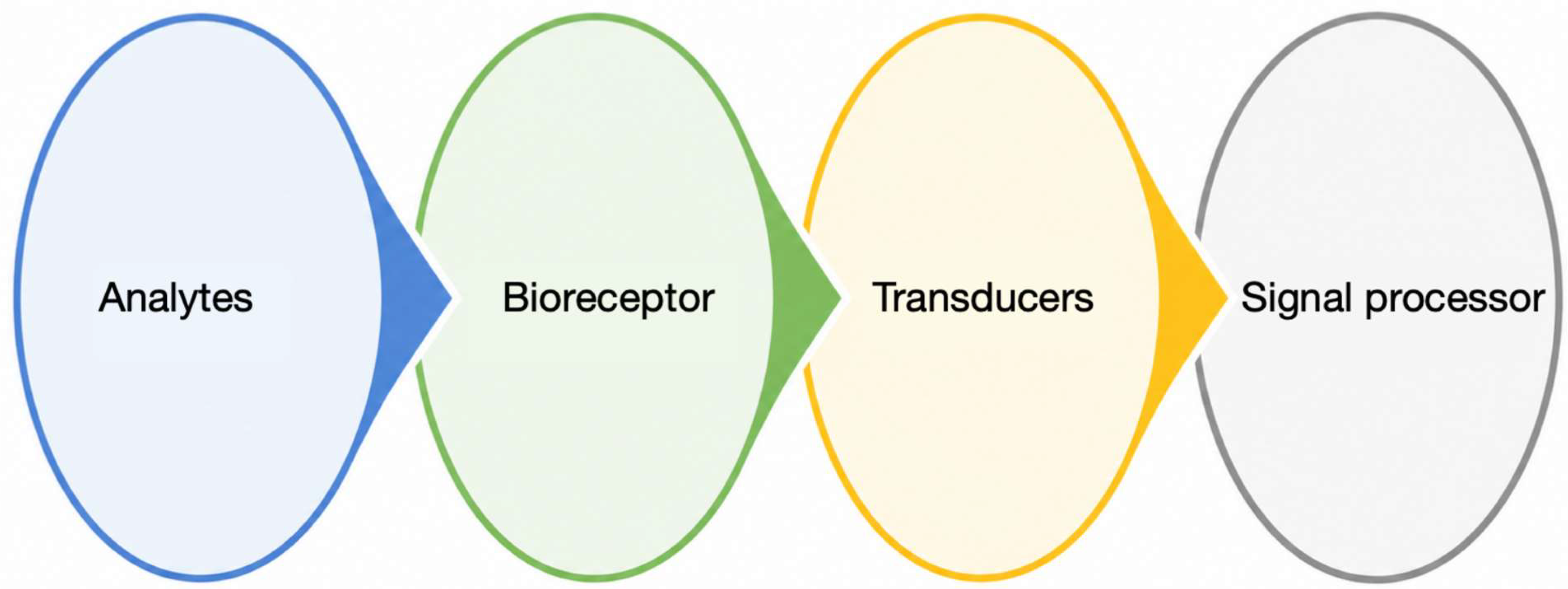
Figure 2.
Schematic representation of an electrochemical biosensor [42].
Figure 2.
Schematic representation of an electrochemical biosensor [42].
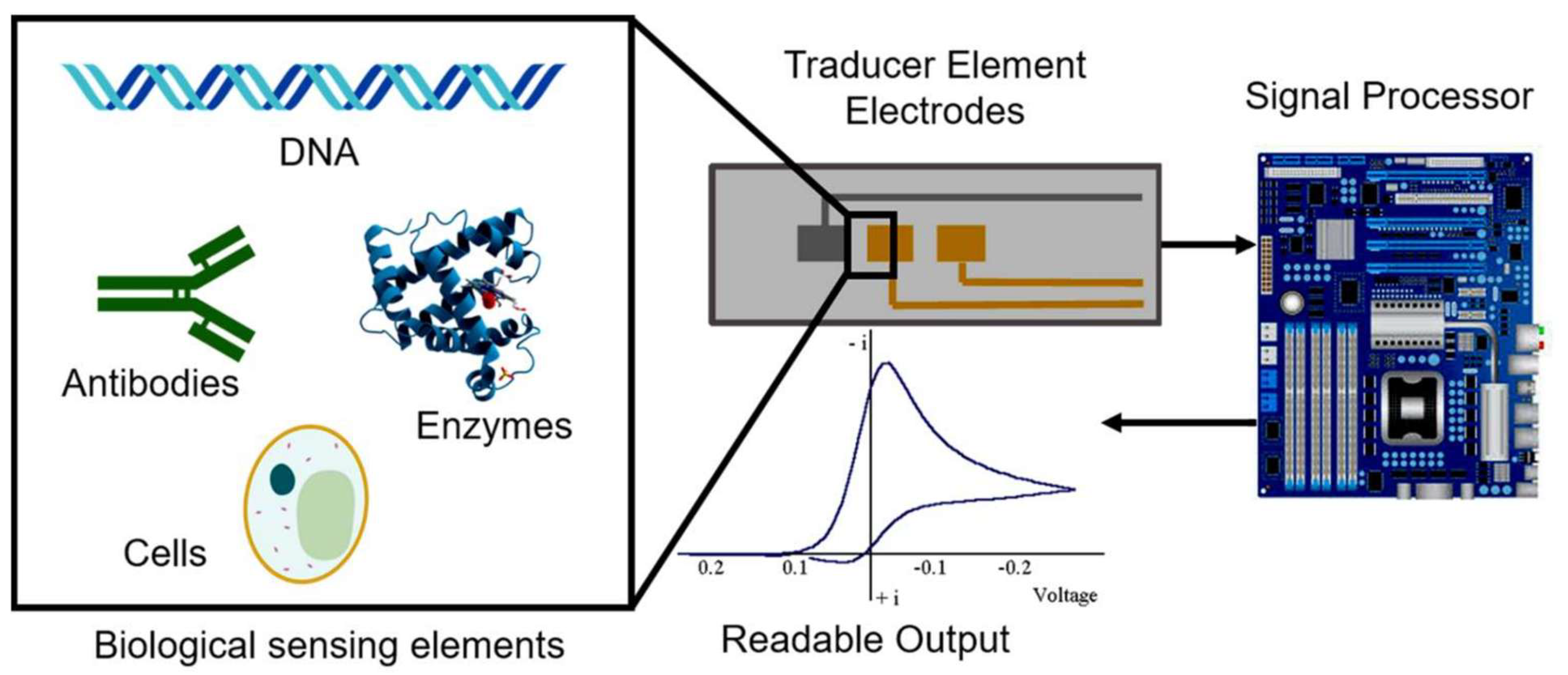
Figure 3.
Microfluidic LSPR sensor platform developed for the quantitative and multiplexed detection of cancer biomarkers in human serum [50].
Figure 3.
Microfluidic LSPR sensor platform developed for the quantitative and multiplexed detection of cancer biomarkers in human serum [50].
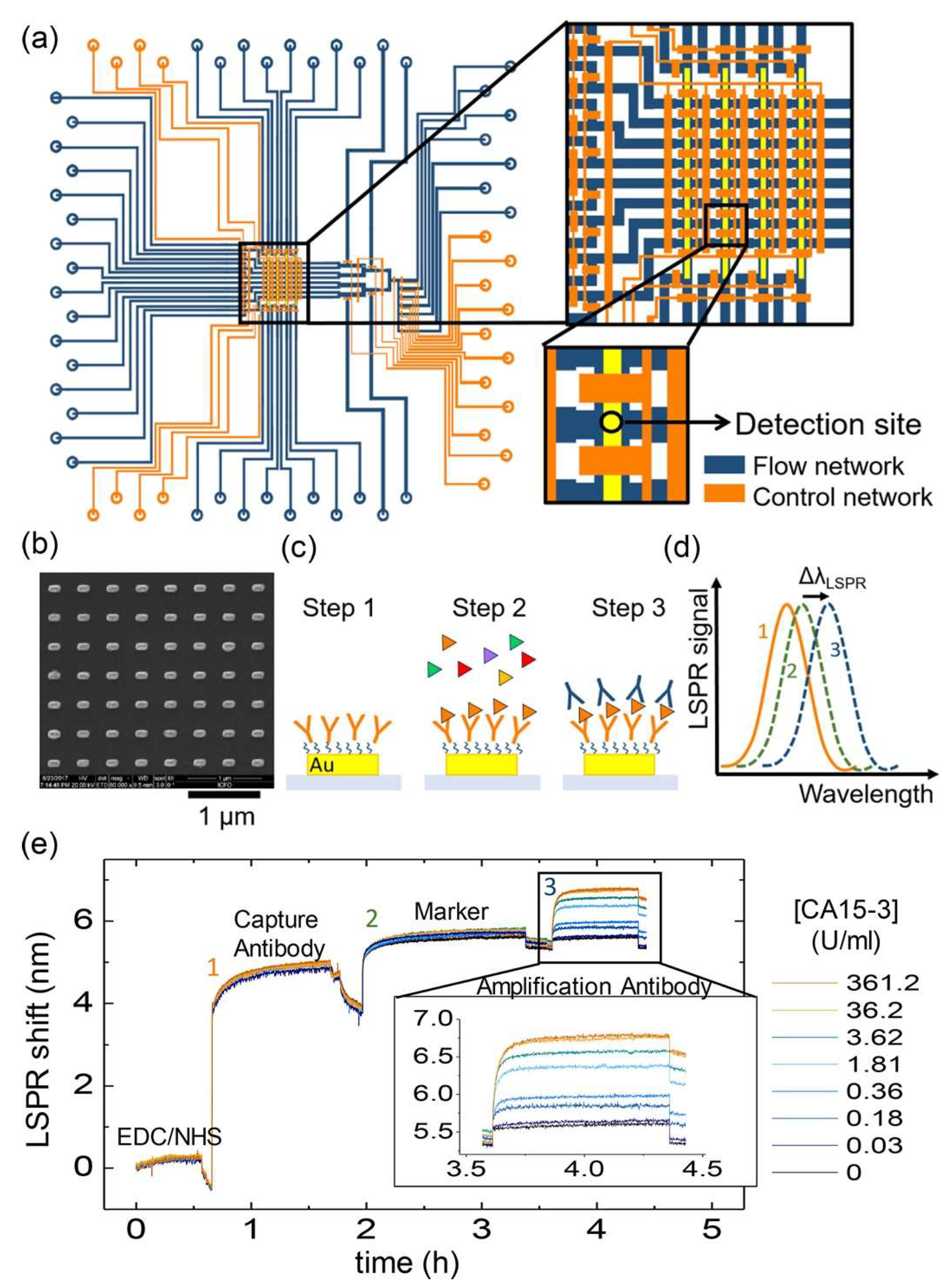
Figure 4.
Key components of a fully integrated lab-on-a-chip system: sample inlet, microfluidic channels, buffer and reagent chambers, analysis chamber, waste chamber, readout equipment, control/data-processing unit, power supply and mobile monitoring interface [61].
Figure 4.
Key components of a fully integrated lab-on-a-chip system: sample inlet, microfluidic channels, buffer and reagent chambers, analysis chamber, waste chamber, readout equipment, control/data-processing unit, power supply and mobile monitoring interface [61].
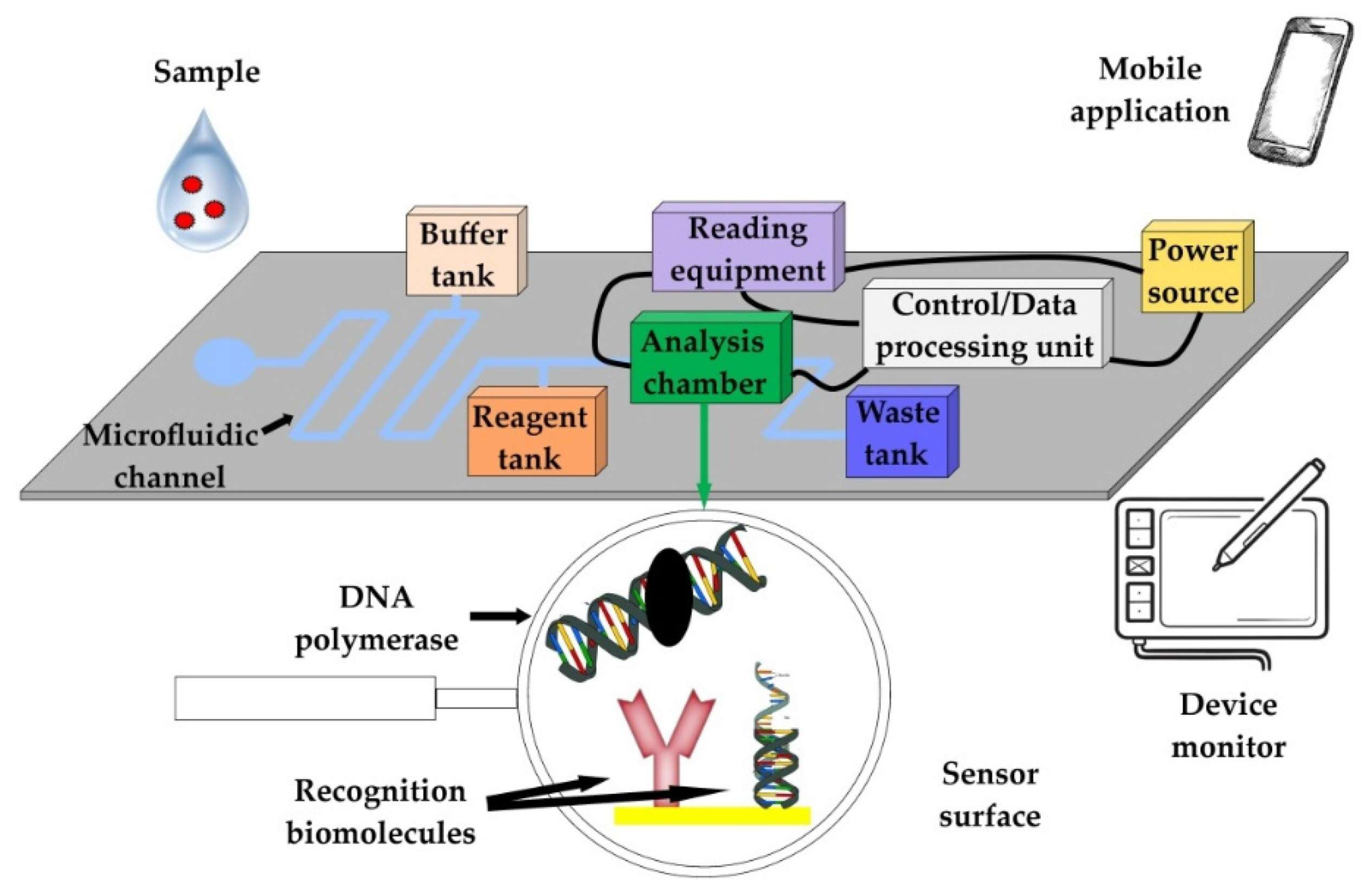
Figure 5.
Determination of interferon-gamma in sweat using a DNA hydrogel-based wearable electrochemical sensor and transfer of the resulting electrochemical data to a smartphone application through a portable measurement system [64].
Figure 5.
Determination of interferon-gamma in sweat using a DNA hydrogel-based wearable electrochemical sensor and transfer of the resulting electrochemical data to a smartphone application through a portable measurement system [64].
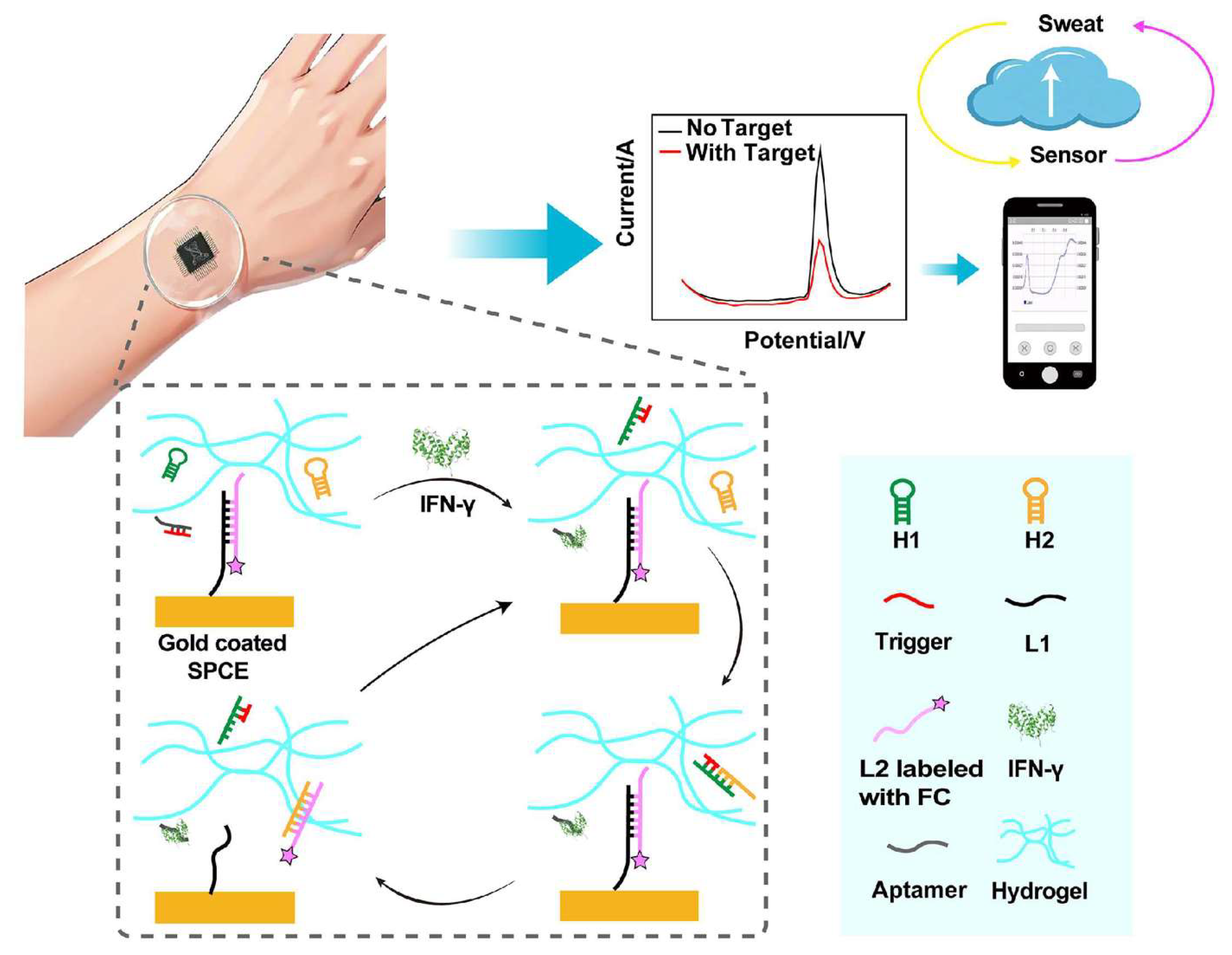
Figure 6.
Operating principle and POC application platform of the multiplex microfluidic electrochemical BiosensorX system developed for CRISPR/Cas13a-based recognition of SARS-CoV-2 RNA sequences and simultaneous monitoring of β-lactam antibiotic levels [73].
Figure 6.
Operating principle and POC application platform of the multiplex microfluidic electrochemical BiosensorX system developed for CRISPR/Cas13a-based recognition of SARS-CoV-2 RNA sequences and simultaneous monitoring of β-lactam antibiotic levels [73].
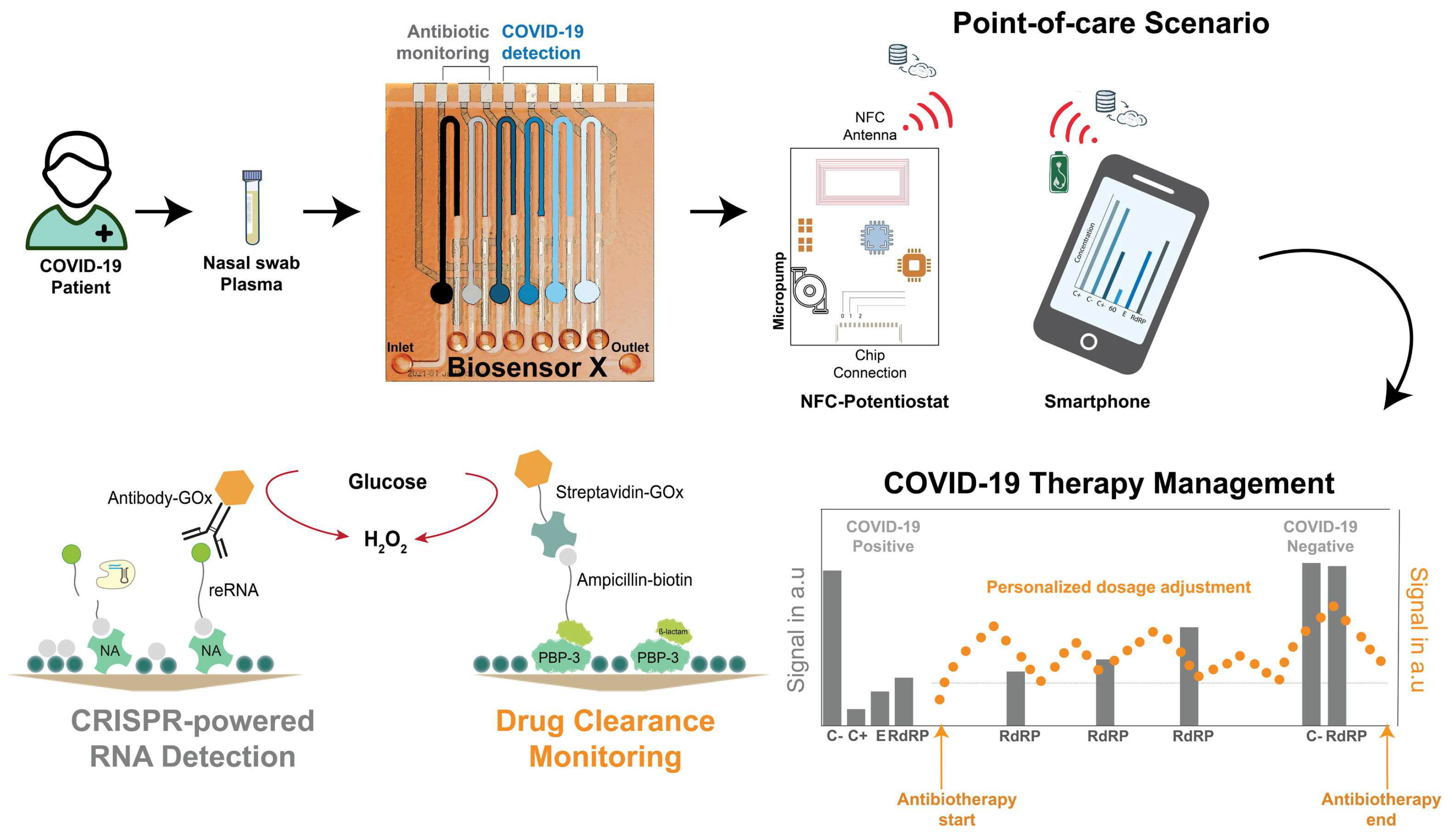
Figure 7.
A wireless, flexible and stretchable wearable electrochemical biosensor system that combines multiplex monitoring of biomarkers (temperature, pH, ammonium, glucose, lactate, uric acid) in chronic wounds with treatment through controlled drug release and electrical stimulation [78].
Figure 7.
A wireless, flexible and stretchable wearable electrochemical biosensor system that combines multiplex monitoring of biomarkers (temperature, pH, ammonium, glucose, lactate, uric acid) in chronic wounds with treatment through controlled drug release and electrical stimulation [78].
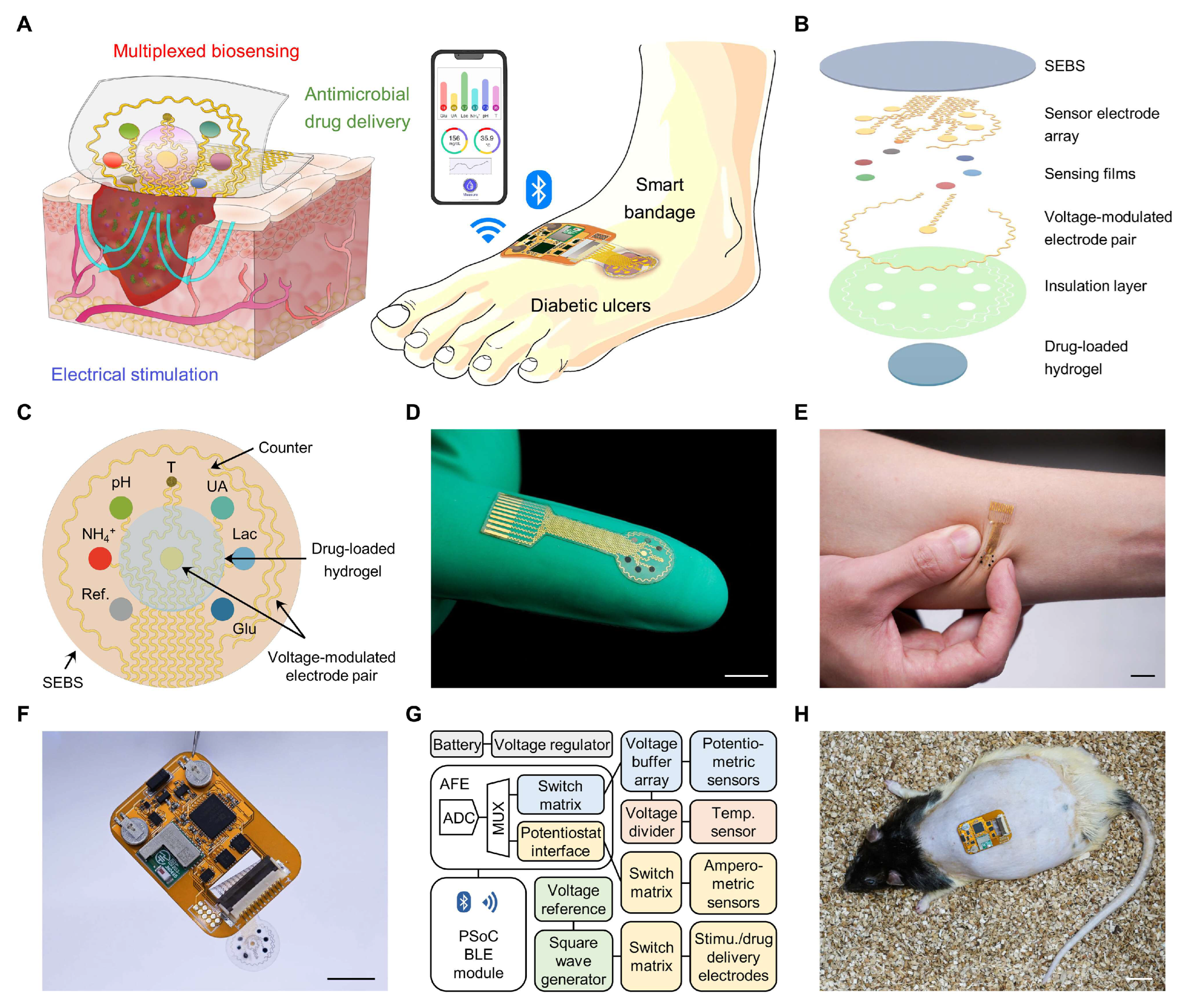
Figure 8.
The principle of a graphene-based field-effect transistor biosensor functionalized with antibodies specific to the SARS-CoV-2 spike protein for virus detection in clinical samples [80].
Figure 8.
The principle of a graphene-based field-effect transistor biosensor functionalized with antibodies specific to the SARS-CoV-2 spike protein for virus detection in clinical samples [80].
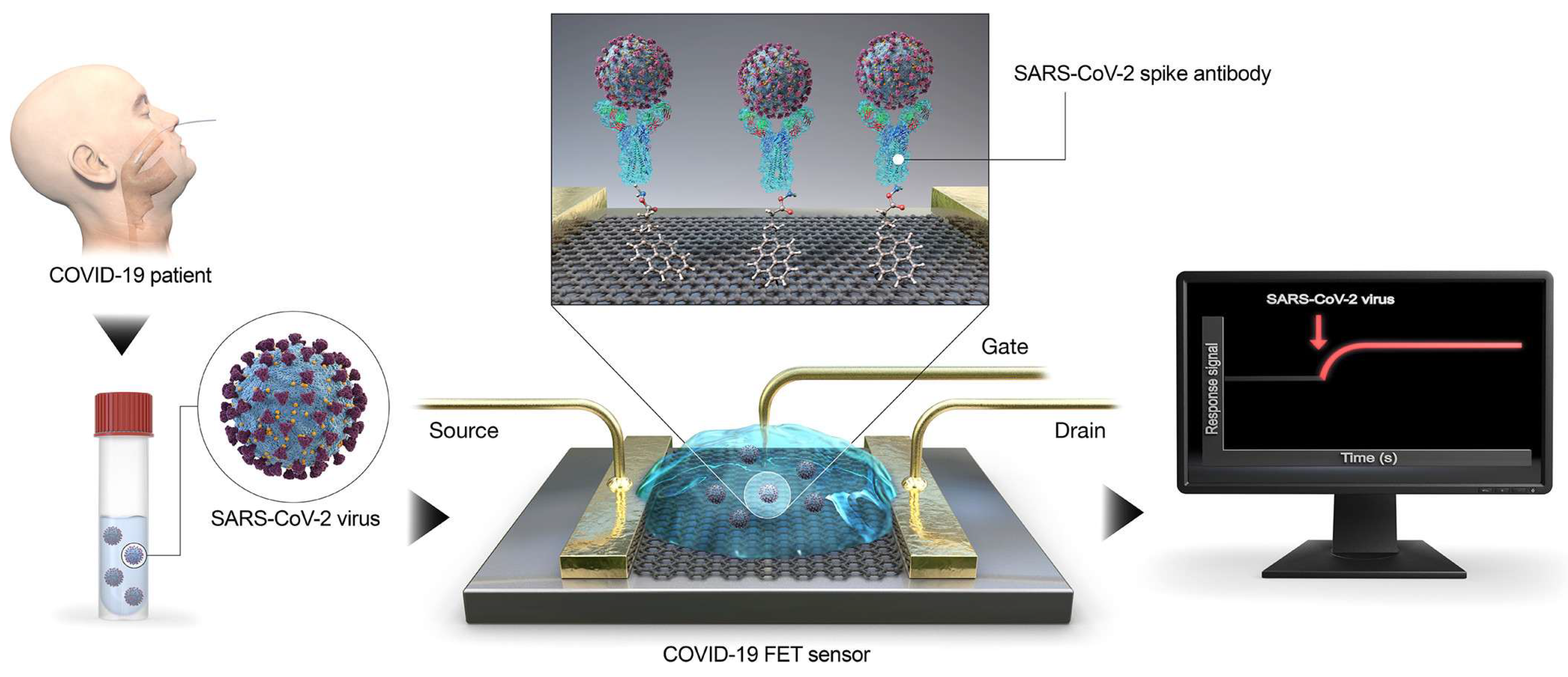
Figure 9.
The principle of a biosensor combining a molecularly imprinted polymer-based synthetic antibody with a SERS probe composed of gold nanostars functionalized with an antibody and Raman marker for the determination of the CA 15-3 cancer biomarker [84].
Figure 9.
The principle of a biosensor combining a molecularly imprinted polymer-based synthetic antibody with a SERS probe composed of gold nanostars functionalized with an antibody and Raman marker for the determination of the CA 15-3 cancer biomarker [84].
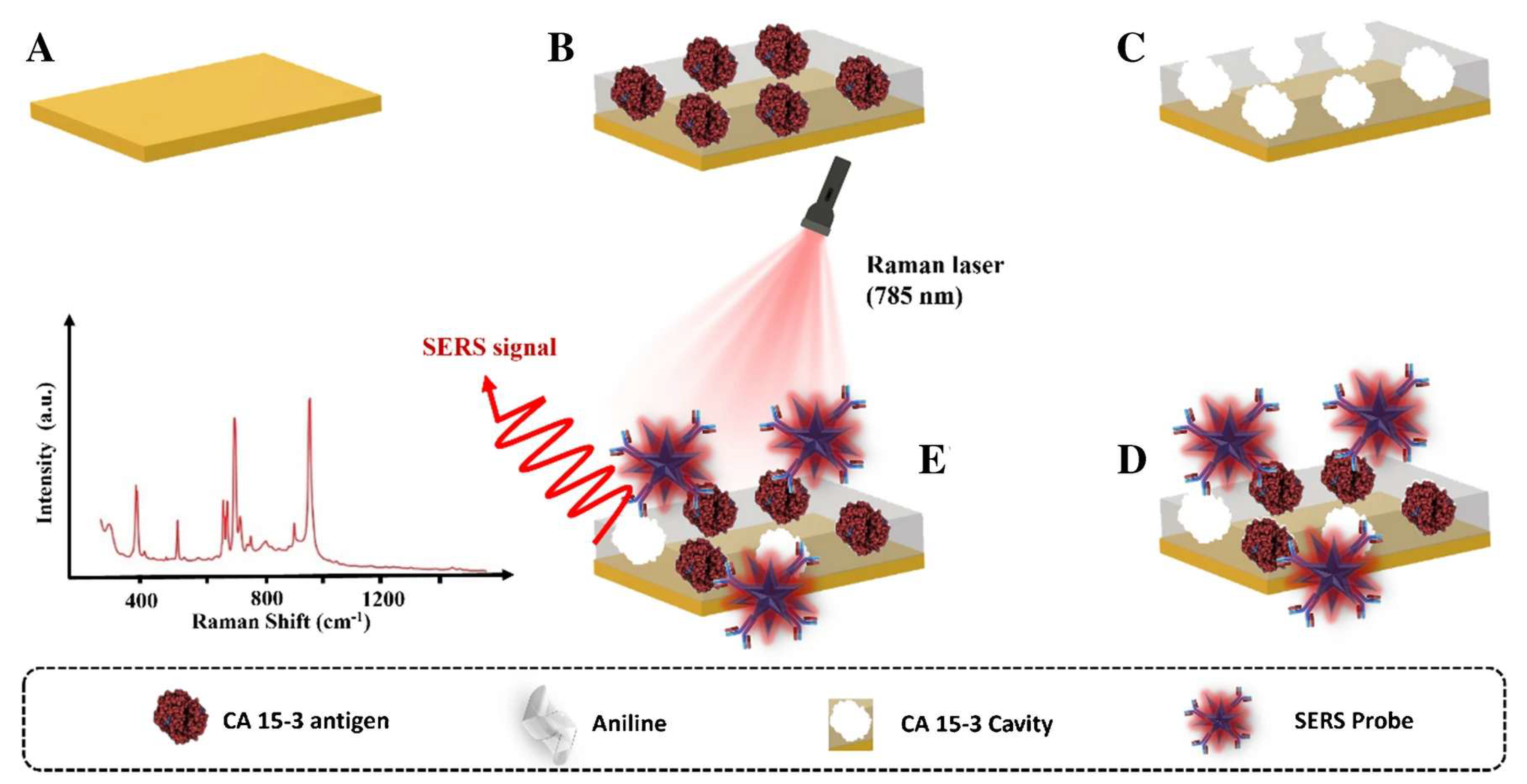
Figure 10.
Fundamental steps of AI and ML in biosensor systems [created by the authors].
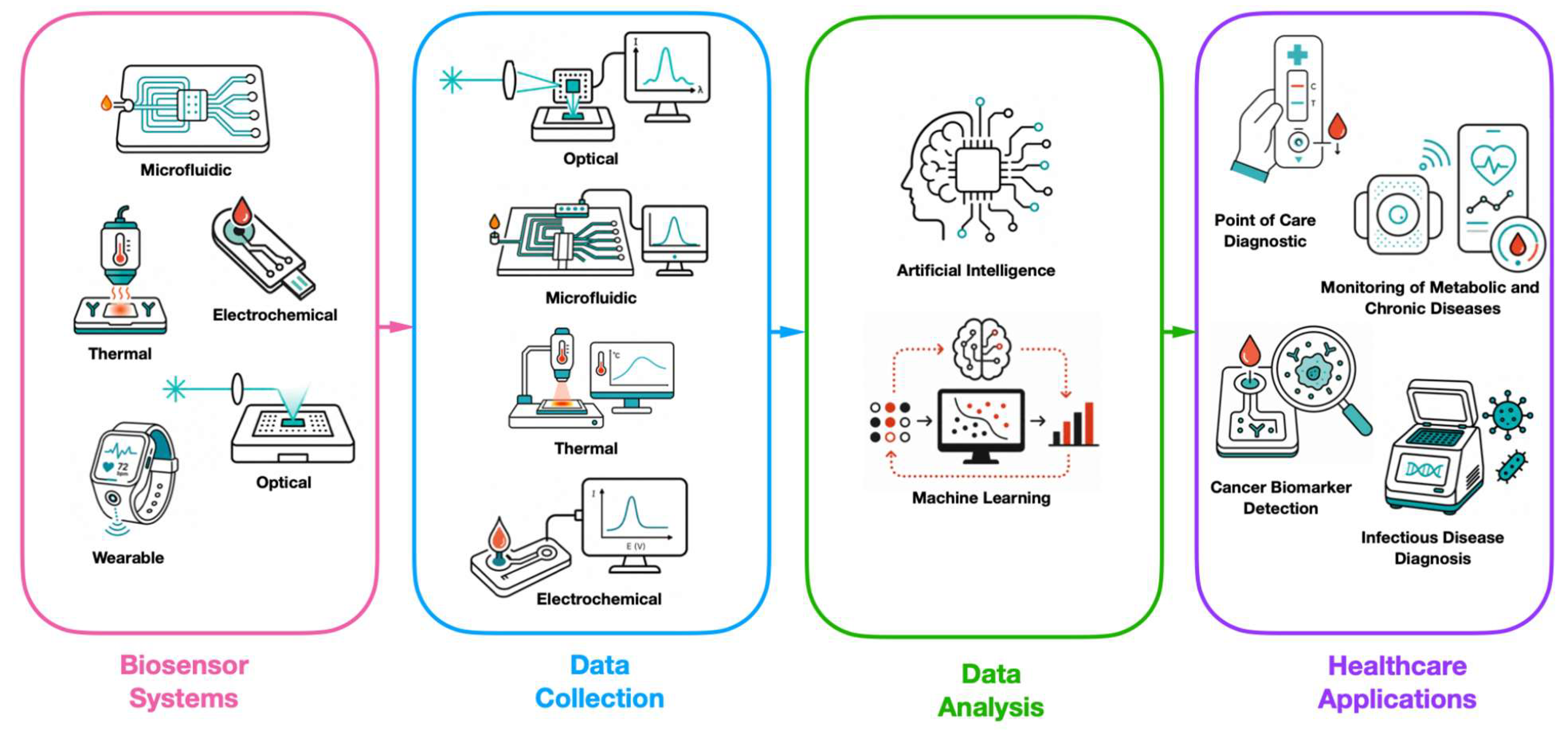
Figure 11.
Schematic representation of the machine learning-integrated DNA xerogel fluorescence platform for rapid detection of acute kidney injury [136].
Figure 11.
Schematic representation of the machine learning-integrated DNA xerogel fluorescence platform for rapid detection of acute kidney injury [136].
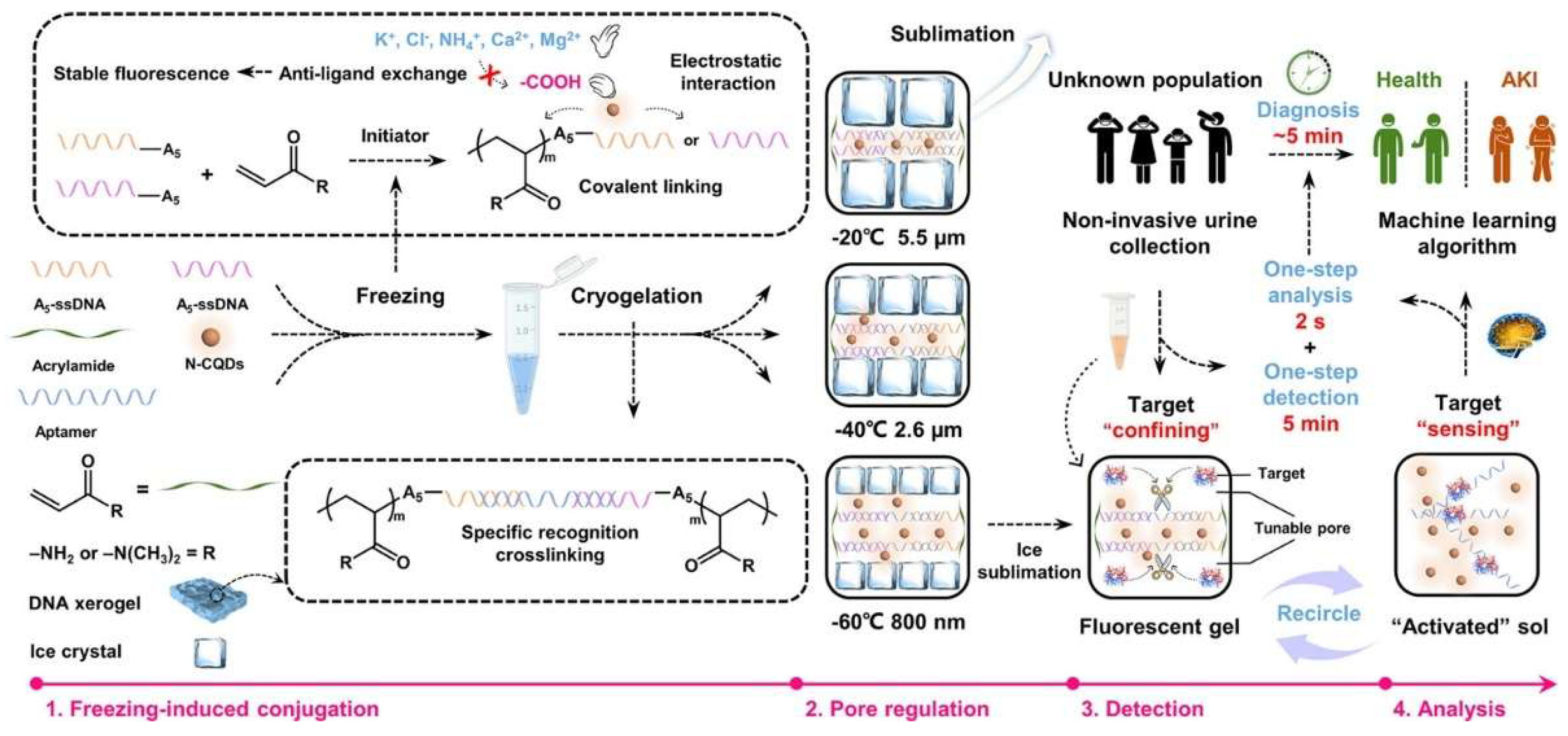
Figure 12.
Schematic diagram of glucose, pH and lactate analysis using a programmable colorimetric sweat chip integrated with deep learning [137].
Figure 12.
Schematic diagram of glucose, pH and lactate analysis using a programmable colorimetric sweat chip integrated with deep learning [137].
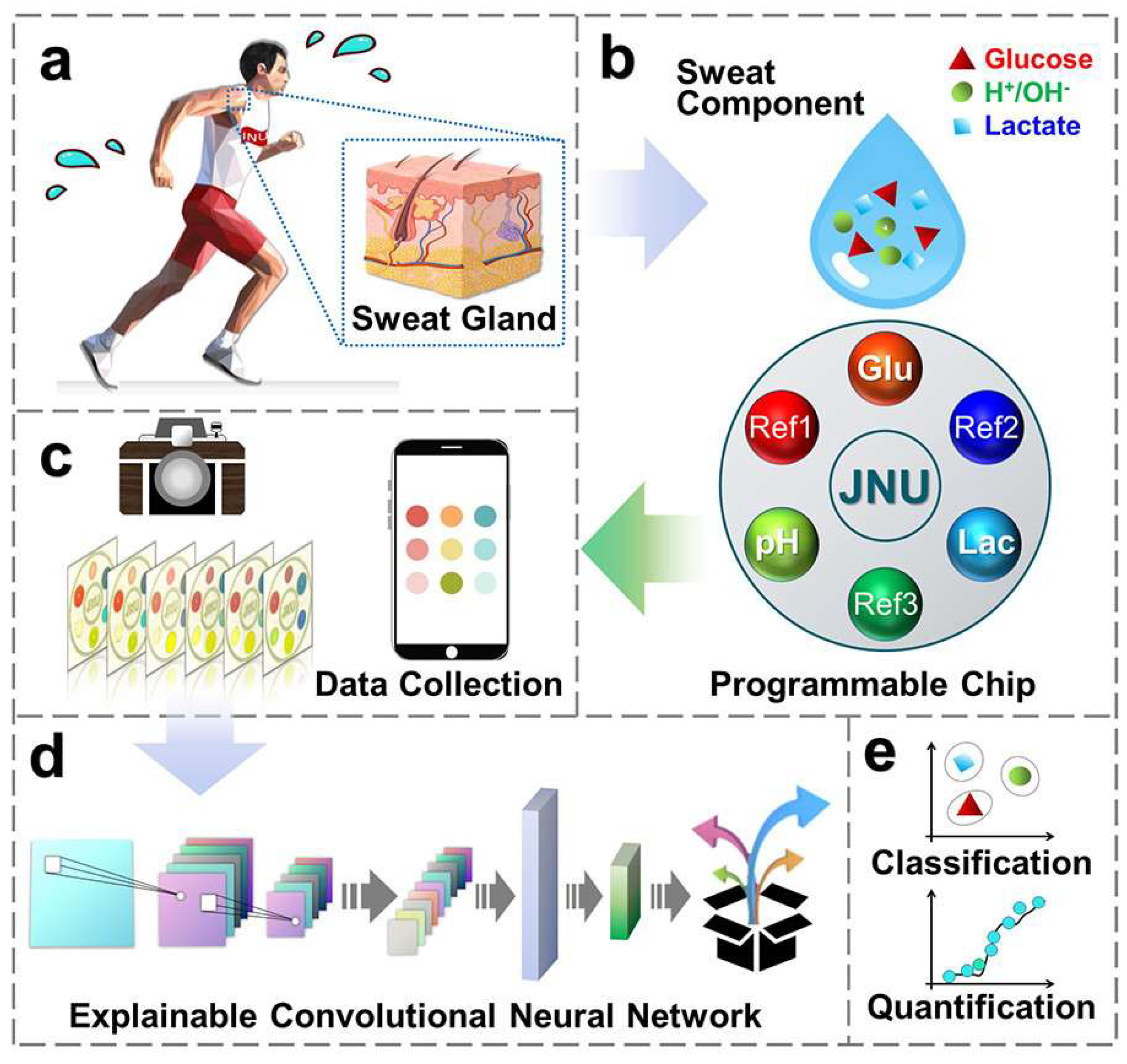
Figure 13.
The use of a ligand-functionalized Fe single-atom nanozyme sensor array for UMAP- and SVM-assisted diagnosis of urinary tract infections [138].
Figure 13.
The use of a ligand-functionalized Fe single-atom nanozyme sensor array for UMAP- and SVM-assisted diagnosis of urinary tract infections [138].
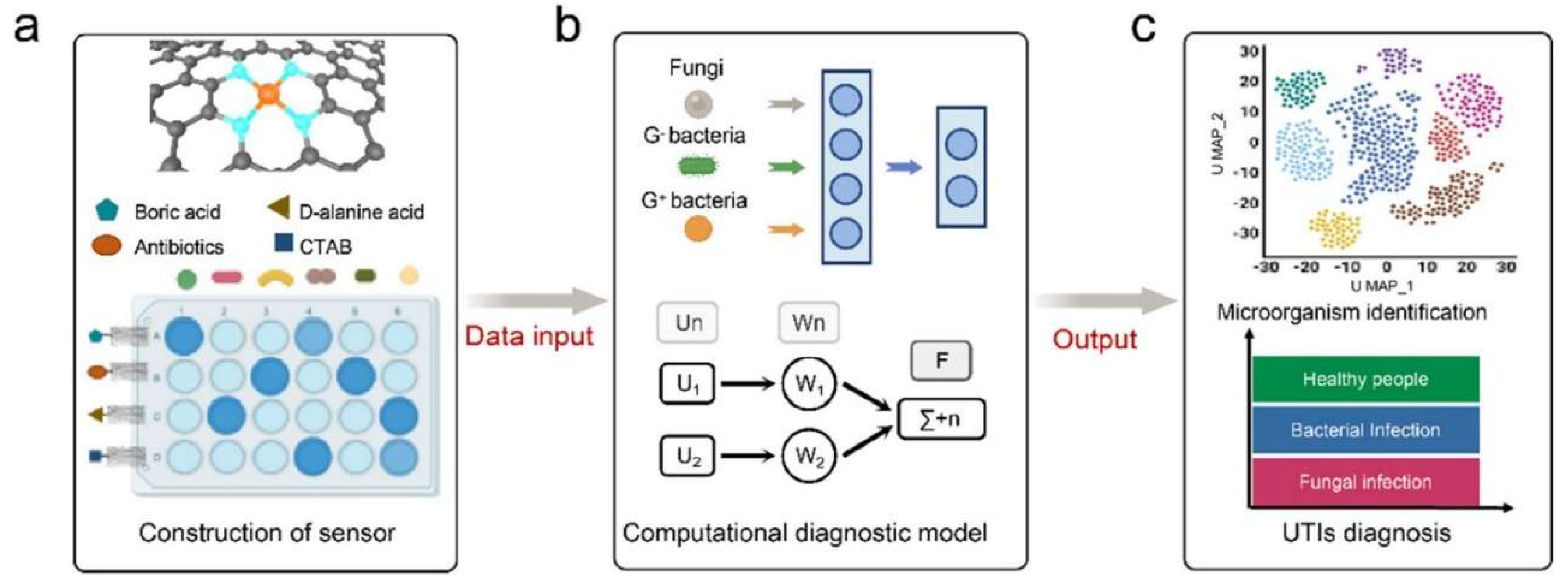
Figure 14.
Differentiation of amyloid species using a machine learning-optimized nanozyme-bioenzyme dual-coupled fluorescent sensor array [139].
Figure 14.
Differentiation of amyloid species using a machine learning-optimized nanozyme-bioenzyme dual-coupled fluorescent sensor array [139].
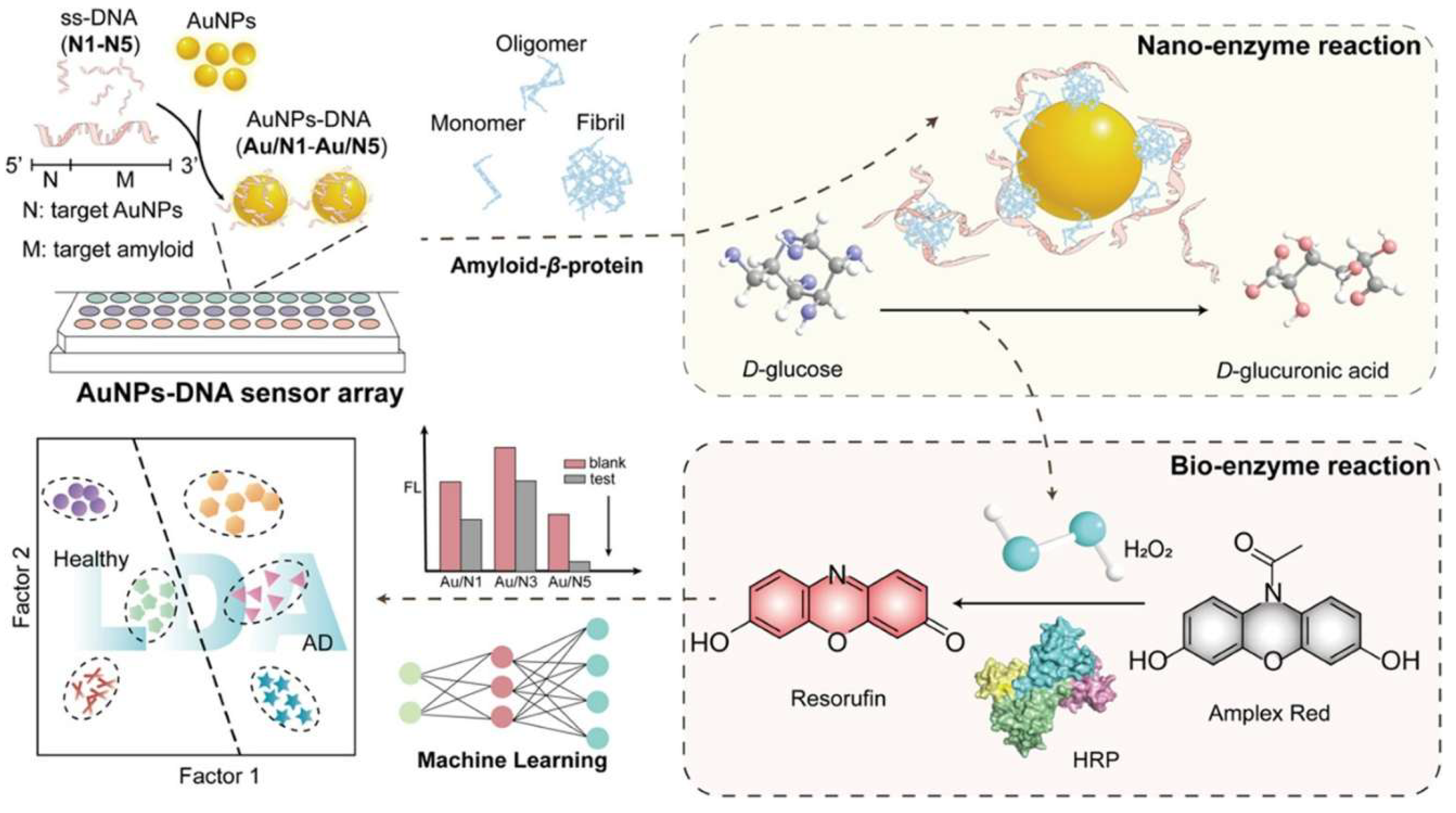
Disclaimer/Publisher’s Note: The statements, opinions and data contained in all publications are solely those of the individual author(s) and contributor(s) and not of MDPI and/or the editor(s). MDPI and/or the editor(s) disclaim responsibility for any injury to people or property resulting from any ideas, methods, instructions or products referred to in the content. |
© 2026 by the authors. Licensee MDPI, Basel, Switzerland. This article is an open access article distributed under the terms and conditions of the Creative Commons Attribution (CC BY) license.
Copyright: This open access article is published under a Creative Commons CC BY 4.0 license, which permit the free download, distribution, and reuse, provided that the author and preprint are cited in any reuse.


