

Submitted:
17 June 2026
Posted:
19 June 2026
You are already at the latest version
Abstract
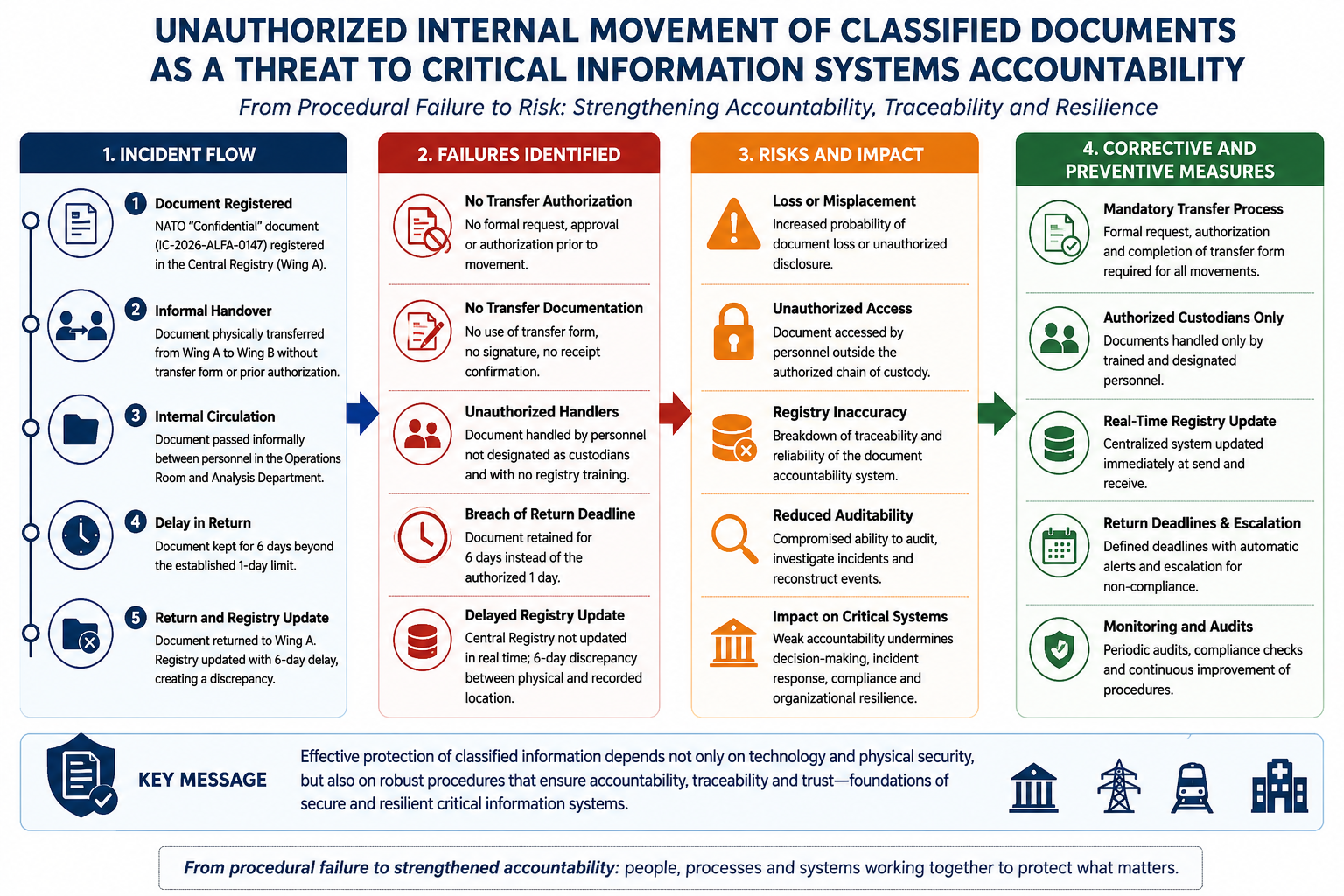
The unauthorized internal movement of classified documents represents a significant threat to information security because it compromises accountability, traceability, and document control mechanisms. This case study examines a fictional but operationally realistic incident involving the informal transfer of a NATO “Confidential” document within a Portuguese government institution. The document was moved between departments without a transfer form, prior authorization, receipt, or signature, with poor registry update, resulting in a six-day discrepancy between the document's physical location and its recorded location in the Central Registry. Using a technical-operating approach, the study analyses the sequence of events, identifies procedural failures, evaluates the resulting risks, and examines their impact on the chain of custody and organization accountability. Attention is given to the risks of document loss, unauthorized access, registry inaccuracy, and weakened auditability. The study proposes a formal document movement framework based on mandatory transfer documentation, centralized real-time recording, dual validation by sender and receiver, return deadlines, automated escalation mechanisms, and periodic audits. The findings demonstrate that effective protection of classified information depends not only on regulatory requirements but also on the consistent application of enforceable procedural controls capable of preventing and rapidly detecting non-compliant document movements.
Keywords:
classified information
; document accountability
; chain of custody
; critical information systems
; critical infrastructure protection
; information security governance
; registry management
; NATO confidential
Copyright: This open access article is published under a Creative Commons CC BY 4.0 license, which permit the free download, distribution, and reuse, provided that the author and preprint are cited in any reuse.


