
Submitted:
17 June 2026
Posted:
22 June 2026
You are already at the latest version
Abstract
Stroke is a leading cause of death and disability worldwide. Short-term exposure to ambient air pollutants and the risk of stroke has been reported in many studies, but the results vary greatly among different regions. This study aims to investigate the association of short-term exposure to air pollution and the incidence of total stroke and its subtypes in Luohu District, Shenzhen. A time-stratified case-crossover study was conducted among 21973 newly stroke cases in Luohu, Shenzhen from 2014 to 2022. Residential exposure to air pollution was assessed using validated grid datasets. Distributed lag model (DLM) and conditional logistic regression model were implemented to evaluate the relationship between ambient air pollution and the incidence of stroke and its subtypes. We found a 10 µg/m3 increment of exposure to NO2 and SO2 was positively associated with a 2.73 % (95 % confidence interval [CI]: 2.21%, 3.25 %) and 24.89 % (20.87 %, 29.06 %) increase in odd of total stroke incidence, respectively. Statistical significance has also been found in subtypes. Stronger associations were observed in females (SO2) and elderly (NO2 and SO2). Our findings indicate that exposure to NO2 and SO2 exacerbates the risk of stroke, especially in elderly and females.
Keywords:
ambient air pollution
; stroke
; incidence
1. Introduction
Stroke is a common neurological disease resulting from a lack of blood supply to the brain (ischemic stroke) or a loss of vascular integrity leading to bleeding within the brain parenchyma (hemorrhagic stroke), which can result in death and disability in severe cases [1,2]. The number of people who died or remained disabled from stroke has rapidly increased over the past 30 years. According to Global Burden of Disease Study 2023 [3,4], stroke remained the second cause of death and the third cause of disability-adjusted life-years (DALYs) among non-communicable disorders (NCDs) globally. Given that the total number of stroke-related DALYs due to risk factors increased substantially from 1990 (100 million) to 2023 (157 million), understanding risk factors has become a priority in making prevention and control measurements for stroke.
Previous studies have demonstrated that exposure to particulate air pollution may increase the risk of stroke. A systematic review and meta-analysis with a total of 6.2 million stroke events in 28 countries reported that an increase in concentrations of carbon monoxide (CO), sulfur dioxide (SO2), nitrogen dioxide (NO2), fine particle (PM2.5), inhalable particle (PM10) and ozone (O3) were associated with admission to hospital for stroke or mortality from stroke [5]. However, this review only reported the impact of shore-term exposure to air pollutants on total stroke. In terms of stroke subtypes, haemorrhagic stroke events are less than ischaemic stroke events leading to lower statistical power and fewer studies considering it as a separate outcome. And the impact of air pollutants on stroke subtypes varies greatly in different regions or countries. For example, in South London, Butland et al. [6] found no evidence of an association between ischemic stroke and exposure to PM2.5, PM10, O3 or NO2. For haemorrhagic stroke, they found a negative association with PM10. While researchers have found a positive association between hospital admission for haemorrhagic stroke and exposure to PM2.5 in Taiwan [7].
Therefore, further research is needed to analyze the impact of air pollutants from different regions or countries on the total stroke and its different subtypes (such as ischemic stroke and hemorrhagic stroke) among residents in that region. This study adopts a time stratified case crossover research method to explore the effects of short-term exposure to gas and particulate pollutants on new onset stroke and various stroke subtypes in Luohu District, Shenzhen. We also conducted stratified analyses to detect potentially vulnerable populations.
2. Materials and Methods
2.1. Study Population
We collected 31507 stroke patients residing in Luohu District from daily stroke admission records of general hospitals in Shenzhen from January 1, 2014 to December 31, 2022. Individual data on age, sex, date of admission, the International Statistical Classification of Diseases and Related Health Problems, 10th Revision (ICD-10), number of episodes and residential address were included for each subject. Based on the number of episodes recorded by the hospital, we excluded 9534 patients with a history of stroke and incomplete data. In this study, we included 21973 newly diagnosed stroke patients, including hemorrhagic stroke (ICD-10 code: I60-62), ischemic stroke (ICD-10 code: I63) and unspecified stroke (ICD-10 code: I64).
2.2. Study Design
A time-stratified case-crossover design was used to assess the association of air pollution exposure and stroke incidence [8,9]. In this design, each subject serves as their own control by assessing reference exposure before and/or after onset within a given time stratum (i.e., a month). For each subject, we defined the date of admission as the case day and chose its corresponding control days as those days sharing the same day of week with the case day in the time stratum. For example, if a subject onset on July 7, 2022 (Thursday), the July 7, 2022 was defined as the case day and all other Thursdays in July 2022 (i. e., July 14, 21, and 28) were defined as the corresponding control days. According to this approach, we matched 74832 control days for 21973 case days in our final analysis. This design could control the effects of time-invariant variables, long-term trends, and seasonality [10].
2.3. Exposure Assessment
Daily grid data (spatial resolution: 1 km × 1 km) on daily 24-hour average PM2.5, PM10, SO2, NO2, CO, and daily peak 8-hour average O3 concentrations in Luohu during 2014-2022 were retrieved from the ChinaHighAirPollutant (CHAP) dataset (accessible at: https://weijing-rs.git hub.io/product.html). The dataset was generated using a comprehensive national ground observation network, big data, and artificial intelligence technologies, with comprehensive coverage, high resolution, and excellent quality [11]. The cross-validated coefficient of determination (R2) for PM2.5, PM10, SO2, NO2, CO, and O3 was 0.92, 0.90, 0.84, 0.93, 0.80 and 0.92, respectively [11,12,13,14,15]. Exposure data at each subject’s geocoded residential address were extracted using bilinear interpolation method. The concentration of pollutants at the date of admission and 3 days prior were used to quantify the associations.
2.4. Covariates
Daily 24-hour average temperature (℃) and relative humidity (%) were obtained from the China Meteorological Administration Land Data Assimilation System (CLDAS version 3.0; spatial resolution: 0.0625◦ × 0.0625◦) [16]. Based on the obtained daily 24-h average air temperature (℃) and relative humidity (%) data, we calculated the heat index (HI) and generated the corresponding gridded dataset. Exposure to HI was assessed by extracting exposure data from the HI dataset at each subject’s geocoded residential address. As proposed in previous studies, air pollution exposure metric was defined as the case and control days and the preceding 3 days.
2.5. Statistical Analysis
Continuous variables were described using mean and standard deviation (SD), while categorical variables were described using number and percentage. Spearman’s correlation coefficient was used to estimate correlations between air pollutants.
Conditional logistic regression model and distributed lag model (DLM) were employed to investigate the association of exposure to air pollution with the odds of total stroke and cause specific stroke, respectively. The percentage change in odds of stroke incidence (calculated as [odds ratio - 1] × 100%) and its 95% confidence interval (CI) were calculated to quantify the cumulative associations for exposure to air pollution in lag 0-3 for each 10 µg/m3 increment of PM2.5, PM10, SO2, NO2, O3 and each 1 mg/m3 of CO exposures. In main models, we included natural cubic spline functions with 3 degrees of freedom (df) for HI [17,18], and a cross-basis function of air pollution exposure built by DLM [19]. A linear function for the space of air pollution exposures and the space of 4 days lag form the cross-basis function [19,20]. In addition, we further employed distributed lag non-linear models (DLNMs), where the space of air pollution exposures uses a cross-basis function with a natural cubic spline function (df = 3), while the space of 4 days lag uses a linear function. Likelihood ratio tests were used to evaluate whether the associations is non-linear. Using the lowest air pollution exposure level as the reference to evaluate the association of exposure to air pollution with incidence from total and cause specific stroke.
Stratification analyses were conducted by sex (male, female) and age (< 65 years, ≥ 65 years) to identify susceptible populations. The 2-sample z test was used to examine the difference in risk estimates for each stratification group. Sensitivity analyses were conducted to evaluate the robustness of the associations between the six air pollutants and stroke. In the sensitivity analysis, we conducted 2-pollutant models, in which each of the air pollutants was further adjusted with another pollutant in the same model. R software (version 4.3.3) was used for all the analyses. The statistical tests were two-sided, and p < 0.05 was considered as statistically significant.
3. Results
3.1. Descriptive Results
A total of 21973 subjects were included in this study. Among them, 59.0% were males, 53.6% were under 65 years old, 81.5% of the subjects were diagnosed as ischemic stroke, and 2.19% died from hemorrhagic stroke (Table 1). The mean concentration of CO, NO2, O3, PM10, PM2.5 and SO2 on the case day was 0.76 mg/m3, 31.37µg/m3, 91.50 µg/m3, 43.39 µg/m3, 25.31 µg/m3 and 8.03 µg/m3, respectively. The mean HI on the case days were 25.63℃ (range: 3.84℃ to 45.02℃) (Table 2). Spearman’s correlation analyses show that all air pollutants were intercorrelated and the correlations between PM2.5, PM10, SO2 and NO2 ranged from moderate to strong, with a correlation coefficient (r) higher than 0.50 (Table 3).
3.2. Associations Between Air Pollution and Stroke
The associations between exposure to air pollution and stroke incidence were shown in Table 4. In single-pollutant models, short-term exposure to CO, NO2, PM10, PM2.5 and SO2 was significantly associated with increased risks of total stroke. The cumulative associations from lag 0 to lag 3 were observed on CO, NO2, PM10, PM2.5 and SO2 with the increased risk of 6.98% (2.61%, 11.53% for each 1 mg/m3 increasement), 2.73% (2.21%, 3.25% for each 10 µg/m3 increasement), 1.26% (1.00%, 1.52% for each 10 µg/m3 increasement), 1.87% (95% CI: 1.37%, 2.38% for each 10 µg/m3 increasement) and 24.89% (20.87%, 29.06% for each 10 µg/m3 increasement), respectively. There was no significant association between O3 and the incidence of total stroke.
The incidence of stroke was inversely S-shaped with CO, NO2, PM10 and PM2.5 (p for nonlinear <0.05; Figure 1). Specifically, the risks associated with CO, NO2, PM10 and PM2.5 increased steadily as the concentrations increased from a low level, with turning points at approximately 1 mg/m3 for CO, 40 µg/m3 for NO2, 60 µg/m3 for PM10 and 40 µg/m3 for PM2.5, after that the risk of stroke increased rapidly with the increase of pollutant concentration.
The associations between ischemic stroke and hemorrhagic stroke and air pollutant exposure showed that NO2, PM10, PM2.5 and SO2 had significant effects on both types of stroke (Table 4, Figure 2). O3 could decrease ischemic stroke and hemorrhagic stroke incidence. CO only has a significant effect on ischemic stroke, with the percent change of ischemic stroke for every 1 mg/m3 increase in concentrations of CO were 8.49% (95% CI: 3.61%, 13.61%) in lag 0-3.
3.3. Stratified Analysis and Sensitivity Analysis
The associations between air pollution exposures and stroke incidence stratified by sex and age are shown in Table 5. Gender stratification showed that NO2, PM10, PM2.5 and SO2 increased the incidence of stroke in men and women, but the effect of SO2 on women was significantly higher than that of men (p=0.03). CO is only associated with an increased incidence of stroke in men, with an increased risk of 12.47% (95% CI: 6.55%, 18.73%) for each 1 mg/m3 increase in exposure. Age stratification showed that significantly stronger adverse effects of NO2, PM10, PM2.5 and SO2 exposure on stroke incidence among the elderly (≥65 year). The 2-pollutant analyses showed that these associations were significant and stable in NO2 and SO2, while the associations for PM10, PM2.5 and CO became insignificant when certain other pollutants were included in the same model (Table 6).
4. Discussion
In this case-crossover study, we used conditional logistic regression model and distributed lag model to explore the impact of short-term air pollutant accumulation lag on stroke incidence. This study showed that NO2 and SO2 have significantly associated with increased risks of stroke incidence and its subtypes. In addition, females were more susceptible to SO2 exposures and elderly were more susceptible to NO2 and SO2 exposures.
NO2 is a typical gaseous environmental air pollutant, originating from motor vehicles, fossil fuel plants, indoor gas stoves, and tobacco smoking [21,22]. Many studies had reported the relationship between NO2 exposure and the risk of stroke incidence, but the results were inconsistent. Zhou et.al [23] reported an increased risk of stroke and its subtypes associated with exposure to daily NO2 levels in Shanghai, which is consistent with our research results. In this study, the daily concentrations of air pollutants was 39.31 µg/m3, a little higher than our study. Chen et al. [22] also reported that NO2 had statistically significant effects on the incidence of total stroke and ischemic stroke. However, contrary to our research findings, there was no statistically significant positive correlation between the increased risk of hemorrhagic stroke and ambient NO2 levels in Chen et al.’s study. While, a large prospective cohort study conducted for women in the United States found no statistically significant association between ambient NO2 levels and risk of total stroke or ischemic stroke, but a positive association between risk of hemorrhagic stroke and NO2 [24]. The mean daily concentrations of air pollutants reported in these two studies were lower than the levels observed in our study area.
Similar results were also found in SO2 exposure and stroke. In the Beibu Gulf Region of China, Li et al. [25] reported that short term exposure to SO2 was positively associated with total stroke and ischemic stroke hospitalization. But the association was not found in hemorrhagic stroke. In two Irish urban centers, Byrne et al. [26] found no significant association between all stroke admission and SO2 exposure. Regarding the reasons for these contradictions, the different compositions of the research population, pollutant concentrations and different geographical, or ethnic factors in disparate regions may be the causes [27]. The mechanism by which NO2 and SO2 increase the risk of stroke has not been fully elucidated, but there is evidence to suggest that inhaled these pollutants activate sensory receptors in the lung to disrupt autonomic nervous system (ANS) homeostasis and activate the hypothalamic-pituitary axis [28]. ANS dysfunction is believed to be the cause of rapid increase in systemic blood pressure, increased vascular resistance, and dysfunction of the autonomic dysfunction, which has been repeatedly confirmed in human controlled exposure studies of diesel exhaust [28,29]. The acute activation of vasoconstrictor pathways and cardiac autonomic dysfunction are important mechanisms in the occurrence and development of stroke.
We also found that exposure to CO, PM10 and PM2.5 was significantly associated with increased risks of stroke in single-pollutant models, while this association turned insignificant in 2-pollutant models. Our research result was consistent with several recent studies. For example, three studies done in China [30,31,32] reported significant short-term associations between CO, PM10 and PM2.5 and admissions for ischemic stroke in single-pollutant models. Similarly, in 2-pollutant models the associations for CO, PM10 and PM2.5 became non-significant when controlling other pollution. Air pollution is the mixture of multiple toxic compounds [33,34]; given the widespread correlation between air pollutants, they may confused with each other, which may partially explain why the effect of each factor was statistically significant in separate analyses but lost significance in the multivariate model. According to the literature, another possible reason is the co-linearity issue in the regression model.
In addition, we found a negative correlation between O3 in 3-days accumulation delay and ischemic stroke in single and 2-pollutant models. There has been a negative association found in past researches. For example, Tian et al. [31] found that O3 could reduce the number of stroke patients. For every 18.7µg/m3 increased in O3, hospital admissions for ischemic stroke decreased by 0.22% in the lag of 2 days. This did not appear to be due to the confounding effects of other pollutants in our study and is therefore difficult to explain.
Stratified by sex and age revealed that elderly were more susceptible to stroke when exposed to ambient NO2 and SO2. This result was similar to many previous study results [23,31,35,36]. This may be because elderly with weak immune systems and chronic underlying diseases might be more sensitive to air-pollution exposure [22]. In our study, the association between exposure to SO2 and stroke incidence was significantly stronger in female. A study conducted in Vancouver, Canada evaluated the relationship between short-term exposure to SO2 and ischemic stroke and found that women have a significantly higher risk of emergency department visits for stroke than men [37]. A study in Suzhou, China also showed that for every 10 µg/m3 increase in SO2 concentration, the incidence of stroke in women increased by 0.88%, and no significant association was observed with men [38]. This may due to women have smaller airways [39] with higher reactivity [40]. This means that when inhaling the same concentration of SO2, the burden on the female respiratory mucosa is relatively heavier. The structural difference makes pollutants more likely to cause direct damage to women’s respiratory system, which may then affect cerebral blood vessels through systemic inflammatory reactions and other pathways.
There are some strengths in our study. First, this study adopts time-stratified case-crossover design, which can corrected potential confounding factors at the individual level, long-term trends, and seasonality. Second, our study analyzed the association between air pollution and total stroke and two common subtypes, which can distinct effects of air pollution exposure and identify individuals with the most risk. Nevertheless, our study has some limitations. First, we performed individual pollutant exposure assessment based on the average pollutant concentration in the geographic area. This method did not consider that time when people are not at their home address (such as for work or vacation) and may lead to underestimation or overestimation of individual exposure. Second, our subjects all come from the same region, and it is imperative to be cautious when extrapolating our findings to different populations.
5. Conclusions
We found that short-term exposure to NO2 and SO2 was significantly associated with increased risks of total and cause specific stroke. And elderly are more susceptible to the effects of NO2 and SO2, females are also susceptible to the effects of SO2. These findings reveal the acute adverse effects of air pollution on cerebrovascular events and emphasize the need for both the public and policy makers to take effective measures to reduce exposure to air pollution, aiding in prevent incidence of stroke.
Author Contributions
X.L.: Formal analysis, Methodology, Visualization, Writing—original draft, Writing—review and editing. R.W.: Formal analysis, Methodology, Visualization, Writing—original draft, Writing—review and editing. R.X.: Methodology, Writing—review and editing. L.D.: Investigation, Writing—review and editing. S.W.: Writing—review and editing. K.X.: Writing—review and editing. Q.L.: Writing—review and editing. X.L.: Writing—review and editing. Y.L.: Conceptualization, Data curation, Supervision, Validation, Project administration, Writing—review and editing. W.M.: Conceptualization, Data curation, Supervision, Validation, Project administration, Writing—review and editing. All authors have read and agreed to the published version of the manuscript.
Funding
None.
Institutional Review Board Statement
The study was conducted in accordance with the Declaration of Helsinki and approved by the Ethics Committee of School of Public Health, Sun Yat-sen University (2020-061) on 30 March 2020.
Informed Consent Statement
The informed consent was waived.
Data Availability Statement
The meteorological data are available at [http://data.cma.cn]. The air pollution data (CHAP dataset) are available at [https://weijing-rs.github.io]. The incidence data is not publicly available.
Conflicts of Interest
The authors declare no conflicts of interest.
Abbreviations
The following abbreviations are used in this manuscript:
| DLM | distributed lag model |
| DALYs | disability-adjusted life-years |
| NCDs | non-communicable disorders |
| CO | carbon monoxide |
| SO2 | sulfur dioxide |
| NO2 | nitrogen dioxide |
| PM2.5 | fine particle |
| PM10 | inhalable particle |
| O3 | ozone |
| ICD-10 | International Statistical Classification of Diseases and Related Health Problems, 10th Revision |
| CHAP | ChinaHighAirPollutant |
| R2 | cross-validated coefficient of determination |
| HI | heat index |
| SD | standard deviation |
| CI | confidence interval |
| df | degrees of freedom |
| DLNMs | distributed lag non-linear models |
| ANS | autonomic nervous system |
References
- Campbell, B.C.V.; Khatri, P. Stroke. Lancet 2020, 396, 129-142. [CrossRef]
- Zille, M.; Farr, T.D.; Keep, R.F.; Römer, C.; Xi, G.; Boltze, J. Novel targets, treatments, and advanced models for intracerebral haemorrhage. EBioMedicine 2022, 76, 103880. [CrossRef]
- Burden of 375 diseases and injuries, risk-attributable burden of 88 risk factors, and healthy life expectancy in 204 countries and territories, including 660 subnational locations, 1990-2023: a systematic analysis for the Global Burden of Disease Study 2023. Lancet 2025, 406, 1873-1922. [CrossRef]
- Global burden of 292 causes of death in 204 countries and territories and 660 subnational locations, 1990-2023: a systematic analysis for the Global Burden of Disease Study 2023. Lancet 2025, 406, 1811-1872. [CrossRef]
- Shah, A.S.; Lee, K.K.; McAllister, D.A.; Hunter, A.; Nair, H.; Whiteley, W.; Langrish, J.P.; Newby, D.E.; Mills, N.L. Short term exposure to air pollution and stroke: systematic review and meta-analysis. Bmj 2015, 350, h1295. [CrossRef]
- Butland, B.K.; Atkinson, R.W.; Crichton, S.; Barratt, B.; Beevers, S.; Spiridou, A.; Hoang, U.; Kelly, F.J.; Wolfe, C.D. Air pollution and the incidence of ischaemic and haemorrhagic stroke in the South London Stroke Register: a case-cross-over analysis. J Epidemiol Community Health 2017, 71, 707-712. [CrossRef]
- Chiu, H.F.; Chang, C.C.; Yang, C.Y. Relationship between hemorrhagic stroke hospitalization and exposure to fine particulate air pollution in Taipei, Taiwan. J Toxicol Environ Health A 2014, 77, 1154-1163. [CrossRef]
- Di, Q.; Dai, L.; Wang, Y.; Zanobetti, A.; Choirat, C.; Schwartz, J.D.; Dominici, F. Association of Short-term Exposure to Air Pollution With Mortality in Older Adults. Jama 2017, 318, 2446-2456. [CrossRef]
- Liu, Y.; Pan, J.; Zhang, H.; Shi, C.; Li, G.; Peng, Z.; Ma, J.; Zhou, Y.; Zhang, L. Short-Term Exposure to Ambient Air Pollution and Asthma Mortality. Am J Respir Crit Care Med 2019, 200, 24-32. [CrossRef]
- Bateson, T.F.; Schwartz, J. Control for seasonal variation and time trend in case-crossover studies of acute effects of environmental exposures. Epidemiology 1999, 10, 539-544.
- Wei, J.; Li, Z.; Wang, J.; Li, C.; Gupta, P.; Cribb, M. Ground-level gaseous pollutants (NO2, SO2, and CO) in China: daily seamless mapping and spatiotemporal variations. Atmospheric Chemistry and Physics 2023, 23, 1511-1532. [CrossRef]
- Wei, J.; Liu, S.; Li, Z.; Liu, C.; Qin, K.; Liu, X.; Pinker, R.T.; Dickerson, R.R.; Lin, J.; Boersma, K.F.; et al. Ground-Level NO(2) Surveillance from Space Across China for High Resolution Using Interpretable Spatiotemporally Weighted Artificial Intelligence. Environ Sci Technol 2022, 56, 9988-9998. [CrossRef]
- Wei, J.; Li, Z.; Xue, W.; Sun, L.; Fan, T.; Liu, L.; Su, T.; Cribb, M. The ChinaHighPM(10) dataset: generation, validation, and spatiotemporal variations from 2015 to 2019 across China. Environ Int 2021, 146, 106290. [CrossRef]
- Wei, J.; Li, Z.; Li, K.; Dickerson, R.R.; Pinker, R.T.; Wang, J.; Liu, X.; Sun, L.; Xue, W.; Cribb, M. Full-coverage mapping and spatiotemporal variations of ground-level ozone (O3) pollution from 2013 to 2020 across China. Remote Sensing of Environment 2022, 270. [CrossRef]
- Wei, J.; Li, Z.; Lyapustin, A.; Sun, L.; Peng, Y.; Xue, W.; Su, T.; Cribb, M. Reconstructing 1-km-resolution high-quality PM2.5 data records from 2000 to 2018 in China: spatiotemporal variations and policy implications. Remote Sensing of Environment 2021, 252. [CrossRef]
- LIU, J.; SHI, C.; SUN, S.; LIANG, J.; YANG, Z.-L. Improving Land Surface Hydrological Simulations in China Using CLDAS Meteorological Forcing Data. Journal of Meteorological Research 2019, 33, 1194-1206.
- Liu, C.; Chen, R.; Sera, F.; Vicedo-Cabrera, A.M.; Guo, Y.; Tong, S.; Coelho, M.; Saldiva, P.H.N.; Lavigne, E.; Matus, P.; et al. Ambient Particulate Air Pollution and Daily Mortality in 652 Cities. N Engl J Med 2019, 381, 705-715. [CrossRef]
- Xu, R.; Wei, J.; Liu, T.; Li, Y.; Yang, C.; Shi, C.; Chen, G.; Zhou, Y.; Sun, H.; Liu, Y. Association of short-term exposure to ambient PM(1) with total and cause-specific cardiovascular disease mortality. Environ Int 2022, 169, 107519. [CrossRef]
- Gasparrini, A.; Armstrong, B.; Kenward, M.G. Distributed lag non-linear models. Stat Med 2010, 29, 2224-2234. [CrossRef]
- Vicedo-Cabrera, A.M.; Sera, F.; Liu, C.; Armstrong, B.; Milojevic, A.; Guo, Y.; Tong, S.; Lavigne, E.; Kyselý, J.; Urban, A.; et al. Short term association between ozone and mortality: global two stage time series study in 406 locations in 20 countries. Bmj 2020, 368, m108. [CrossRef]
- Dennekamp, M.; Howarth, S.; Dick, C.A.; Cherrie, J.W.; Donaldson, K.; Seaton, A. Ultrafine particles and nitrogen oxides generated by gas and electric cooking. Occup Environ Med 2001, 58, 511-516. [CrossRef]
- Chen, Z.; Wang, B.; Hu, Y.; Dai, L.; Liu, Y.; Wang, J.; Cao, X.; Wu, Y.; Zhou, T.; Cui, X.; et al. Short-Term Effects of Low-Level Ambient Air NO(2) on the Risk of Incident Stroke in Enshi City, China. Int J Environ Res Public Health 2022, 19. [CrossRef]
- Zhou, Y.; Jin, Y.; Zhang, Z. Short-term exposure to nitrogen dioxide and emergency department visits for cause-stroke: a time-series study in Shanghai, China, 2013-2022. Environ Health Prev Med 2024, 29, 67. [CrossRef]
- Sun, S.; Stewart, J.D.; Eliot, M.N.; Yanosky, J.D.; Liao, D.; Tinker, L.F.; Eaton, C.B.; Whitsel, E.A.; Wellenius, G.A. Short-term exposure to air pollution and incidence of stroke in the Women’s Health Initiative. Environ Int 2019, 132, 105065. [CrossRef]
- Li, M.; Edgell, R.C.; Wei, J.; Li, H.; Qian, Z.M.; Feng, J.; Tian, F.; Wang, X.; Xin, Q.; Cai, M.; et al. Air pollution and stroke hospitalization in the Beibu Gulf Region of China: A case-crossover analysis. Ecotoxicol Environ Saf 2023, 255, 114814. [CrossRef]
- Byrne, C.P.; Bennett, K.E.; Hickey, A.; Kavanagh, P.; Broderick, B.; O’Mahony, M.; Williams, D.J. Short-Term Air Pollution as a Risk for Stroke Admission: A Time-Series Analysis. Cerebrovasc Dis 2020, 49, 404-411. [CrossRef]
- Wang, K.; Yuan, Y.; Wang, Q.; Yang, Z.; Zhan, Y.; Wang, Y.; Wang, F.; Zhang, Y. Incident risk and burden of cardiovascular diseases attributable to long-term NO(2) exposure in Chinese adults. Environ Int 2023, 178, 108060. [CrossRef]
- Kulick, E.R.; Kaufman, J.D.; Sack, C. Ambient Air Pollution and Stroke: An Updated Review. Stroke 2023, 54, 882-893. [CrossRef]
- Hudda, N.; Eliasziw, M.; Hersey, S.O.; Reisner, E.; Brook, R.D.; Zamore, W.; Durant, J.L.; Brugge, D. Effect of Reducing Ambient Traffic-Related Air Pollution on Blood Pressure: A Randomized Crossover Trial. Hypertension 2021, 77, 823-832. [CrossRef]
- Guo, P.; Wang, Y.; Feng, W.; Wu, J.; Fu, C.; Deng, H.; Huang, J.; Wang, L.; Zheng, M.; Liu, H. Ambient Air Pollution and Risk for Ischemic Stroke: A Short-Term Exposure Assessment in South China. Int J Environ Res Public Health 2017, 14. [CrossRef]
- Tian, Y.; Liu, H.; Zhao, Z.; Xiang, X.; Li, M.; Juan, J.; Song, J.; Cao, Y.; Wang, X.; Chen, L.; et al. Association between ambient air pollution and daily hospital admissions for ischemic stroke: A nationwide time-series analysis. PLoS Med 2018, 15, e1002668. [CrossRef]
- Liu, H.; Tian, Y.; Xu, Y.; Huang, Z.; Huang, C.; Hu, Y.; Zhang, J. Association between ambient air pollution and hospitalization for ischemic and hemorrhagic stroke in China: A multicity case-crossover study. Environ Pollut 2017, 230, 234-241. [CrossRef]
- Danesh Yazdi, M.; Wang, Y.; Di, Q.; Wei, Y.; Requia, W.J.; Shi, L.; Sabath, M.B.; Dominici, F.; Coull, B.A.; Evans, J.S.; et al. Long-Term Association of Air Pollution and Hospital Admissions Among Medicare Participants Using a Doubly Robust Additive Model. Circulation 2021, 143, 1584-1596. [CrossRef]
- Zhao, Y.; Guo, M.; An, J.; Zhang, L.; Tan, P.; Tian, X.; Liu, L.; Zhao, Z.; Wang, X.; Liu, X.; et al. Associations between ambient air pollution, meteorology, and daily hospital admissions for ischemic stroke: a time-stratified case-crossover study in Beijing. Environ Sci Pollut Res Int 2022, 29, 53704-53717. [CrossRef]
- Guo, Y.; Xie, X.; Lei, L.; Zhou, H.; Deng, S.; Xu, Y.; Liu, Z.; Bao, J.; Peng, J.; Huang, C. Short-term associations between ambient air pollution and stroke hospitalisations: time-series study in Shenzhen, China. BMJ Open 2020, 10, e032974. [CrossRef]
- Huang, F.; Luo, Y.; Tan, P.; Xu, Q.; Tao, L.; Guo, J.; Zhang, F.; Xie, X.; Guo, X. Gaseous Air Pollution and the Risk for Stroke Admissions: A Case-Crossover Study in Beijing, China. Int J Environ Res Public Health 2017, 14. [CrossRef]
- Szyszkowicz, M.; Porada, E.; Tremblay, N.; Grafstein, E. Sulfur dioxide and emergency department visits for stroke and seizure. Stroke Res Treat 2012, 2012, 824724. [CrossRef]
- Wang, L; Ge, Y; Lu, Y; Yang, H; Hu, Y. Study on the Effects of NO2 and SO2 in the Atmosphere on the Incidence and High Risk Factors of Stroke in Suzhou Residents. Journal of Chinese Preventive Medicine 2019, 20, 817-821. [CrossRef]
- de Marco, R.; Locatelli, F.; Sunyer, J.; Burney, P. Differences in incidence of reported asthma related to age in men and women. A retrospective analysis of the data of the European Respiratory Health Survey. Am J Respir Crit Care Med 2000, 162, 68-74. [CrossRef]
- Yunginger, J.W.; Reed, C.E.; O’Connell, E.J.; Melton, L.J., 3rd; O’Fallon, W.M.; Silverstein, M.D. A community-based study of the epidemiology of asthma. Incidence rates, 1964-1983. Am Rev Respir Dis 1992, 146, 888-894. [CrossRef]
Figure 1.
Cumulative Exposure-response Curves for Associations of Lag 0-3 Days Exposure to Air Pollution with Incidence from Total stroke.
Figure 1.
Cumulative Exposure-response Curves for Associations of Lag 0-3 Days Exposure to Air Pollution with Incidence from Total stroke.
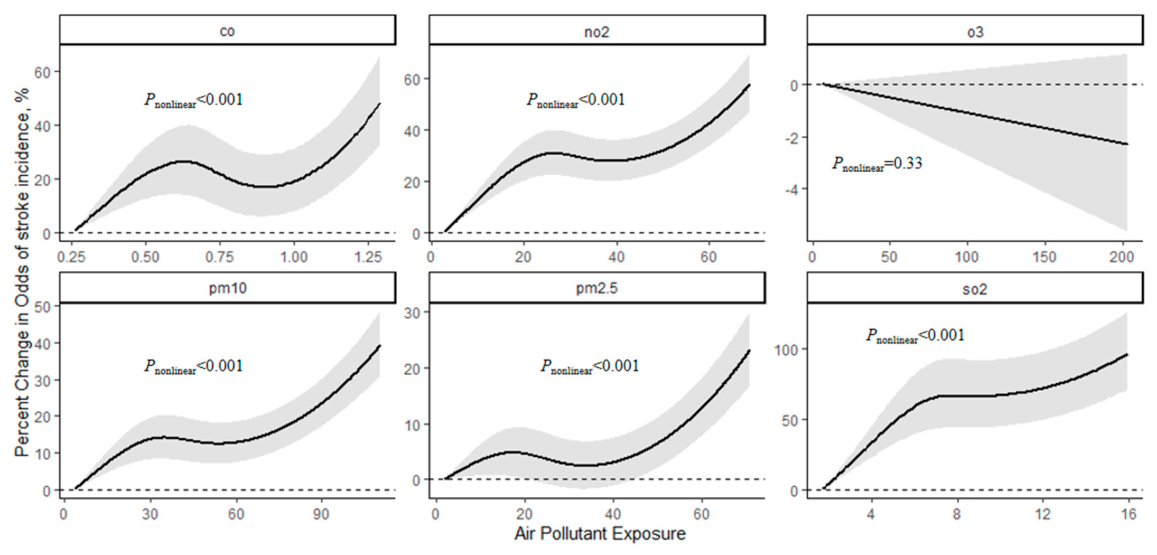
Figure 2.
Cumulative Exposure-response Curves for Associations of Lag 0-3 Days Exposure to Air Pollution with Incidence from Hemorrhagic Stroke and Ischemic Stroke.
Figure 2.
Cumulative Exposure-response Curves for Associations of Lag 0-3 Days Exposure to Air Pollution with Incidence from Hemorrhagic Stroke and Ischemic Stroke.
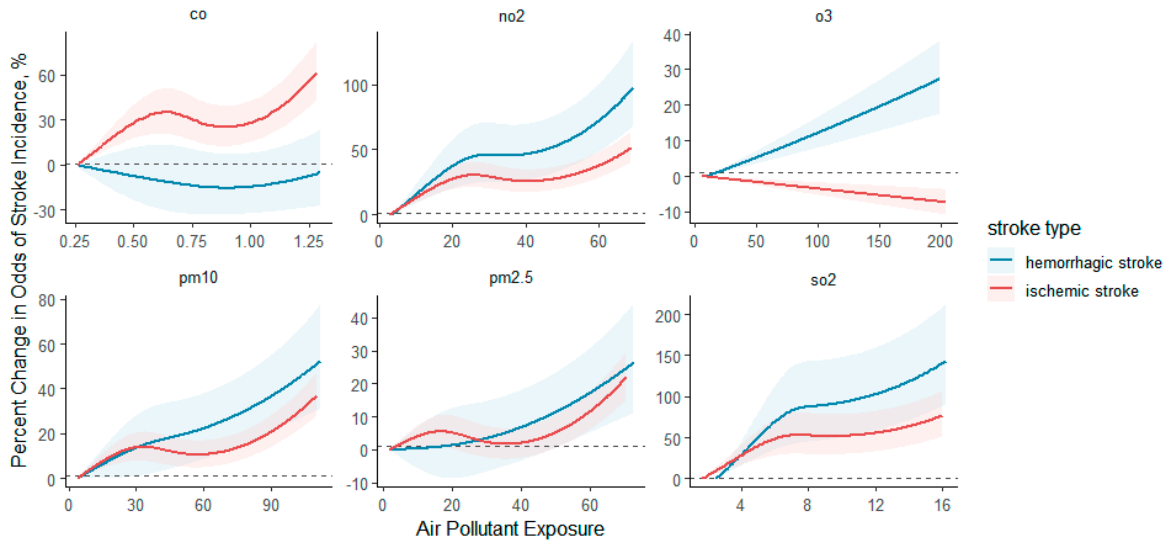

Table 1.
Characteristics of the Study Population.
| Characteristic | N (%) |
|---|---|
| New cases of stroke (case days) | 21973 |
| Control days | 74832 |
| Age, mean ± SD | 65.10 ± 14.37 |
| <65y | 10195 (46.4) |
| ≥65y | 11778 (53.6) |
| Sex | |
| Male | 12965 (59.0) |
| Female | 9008 (41.0) |
| Season of onset | |
| Warm (May-October) | 11121 (50.6) |
| Cold (November-April) | 10852 (49.4) |
| Stroke Type | |
| Hemorrhagic stroke | 3886 (17.7) |
| Ischemic stroke | 17903 (81.5) |
| Unspecified stroke | 184 (0.8) |
Table 2.
Distribution of Exposure to Air Pollutants on Case Days and Control Days.
| Variable | Mean±SD | Min | P25 | Median | P75 | Max |
|---|---|---|---|---|---|---|
| Case days | ||||||
| CO, mg/m3 | 0.76±0.18 | 0.31 | 0.63 | 0.74 | 0.86 | 1.56 |
| NO2, µg/m3 | 31.37±12.66 | 3.04 | 22.53 | 29.44 | 37.81 | 122.15 |
| O3, µg/m3 | 91.50±41.42 | 10.02 | 59.13 | 84.87 | 116.71 | 303.78 |
| PM10, µg/m3 | 43.39±22.65 | 4.42 | 26.53 | 38.81 | 55.50 | 164.59 |
| PM2.5, µg/m3 | 25.31±15.15 | 2.21 | 13.87 | 22.33 | 33.29 | 110.45 |
| SO2, µg/m3 | 8.03±2.31 | 2.00 | 6.61 | 7.56 | 8.88 | 29.94 |
| HI, ℃ | 25.63±7.85 | 3.84 | 19.37 | 25.12 | 32.78 | 45.02 |
| Control days | ||||||
| CO, mg/m3 | 0.76±0.18 | 0.30 | 0.63 | 0.74 | 0.86 | 1.61 |
| NO2, µg/m3 | 31.21±12.78 | 3.27 | 22.38 | 29.34 | 37.61 | 120.16 |
| O3, µg/m3 | 91.41±41.63 | 7.46 | 58.68 | 84.47 | 116.70 | 307.56 |
| PM10, µg/m3 | 43.10±22.56 | 3.75 | 26.26 | 38.54 | 55.53 | 168.51 |
| PM2.5, µg/m3 | 25.14±14.99 | 1.92 | 13.81 | 22.26 | 33.14 | 114.53 |
| SO2, µg/m3 | 8.01±2.25 | 2.03 | 6.59 | 7.56 | 8.89 | 29.99 |
| HI, ℃ | 25.66±7.94 | 3.74 | 19.30 | 25.28 | 32.88 | 45.41 |
24-h average concentration for PM2.5, PM10, SO2, NO2, and CO; maximum 8-h average concentration for O3. CO: carbon monoxide; NO2: nitrogen dioxide; O3: ozone; PM2.5: fine particle; PM10: inhalable particle; SO2: sulfur dioxide; SD: standardized deviation.
Table 3.
Spearman Correlation among Air Pollution.
| CO | NO2 | O3 | PM10 | PM2.5 | SO2 | |
| CO | 1.00 | - | - | - | - | - |
| NO2 | 0.64 | 1.00 | - | - | - | - |
| O3 | 0.17 | 0.21 | 1.00 | - | - | - |
| PM10 | 0.59 | 0.69 | 0.56 | 1.00 | - | - |
| PM2.5 | 0.63 | 0.67 | 0.53 | 0.95 | 1.00 | - |
| SO2 | 0.37 | 0.56 | 0.34 | 0.63 | 0.57 | 1.00 |
p for all pairwise correlations < 0.05; CO: carbon monoxide; NO2: nitrogen dioxide; O3: ozone; PM2.5: fine particle; PM10: inhalable particle; SO2: sulfur dioxide.
Table 4.
Percent Change in Odds from Total and Cause-specific Stroke Associated with Lag 0-3 Days Exposure to Air Pollution.
Table 4.
Percent Change in Odds from Total and Cause-specific Stroke Associated with Lag 0-3 Days Exposure to Air Pollution.
| Total stroke | Hemorrhagic stroke | Ischemic stroke | |
|---|---|---|---|
| CO (mg/m3) | 6.98(2.61, 11.53) | 4.61(-5.01, 15.19) | 8.49(3.60, 13.61) |
| NO2 (µg/m3) | 2.73(2.21, 3.25) | 4.14(3.03, 5.27) | 2.23(1.66, 2.80) |
| O3 (µg/m3) | -0.03(-0.09, 0.03) | -0.09(-0.13, -0.06) | -0.12(-0.19, -0.05) |
| PM10 (µg/m3) | 1.26(1.00, 1.52) | 2.11(1.50, 2.71) | 1.06(0.77, 1.35) |
| PM2.5 (µg/m3) | 1.87(1.37, 2.38) | 2.96(1.82, 4.13) | 1.60(1.04, 2.16) |
| SO2 (µg/m3) | 24.89(20.87, 29.06) | 32.38(23.72, 41.65) | 21.97(17.59, 26.52) |
CO: carbon monoxide; NO2: nitrogen dioxide; O3: ozone; PM2.5: fine particle; PM10: inhalable particle; SO2: sulfur dioxide.
Table 5.
Percent Change in Odds of Stroke Incidence Associated with Lag 0-3 Days Exposure to Air Pollution, Stratified by Sex and Age.
Table 5.
Percent Change in Odds of Stroke Incidence Associated with Lag 0-3 Days Exposure to Air Pollution, Stratified by Sex and Age.
| Percent change in odds, % (95% CI) | ||||||
|---|---|---|---|---|---|---|
| Sex, Male | Sex, Female | p | Age, <65 year | Age, ≥65 year | p | |
| CO | 12.47(6.55, 18.73) | -0.37(-6.63, 6.30) | <0.01 | 10.04(3.79, 16.67) | 3.92(-1.89, 10.07) | 0.17 |
| NO2 | 2.65(2.00, 3.31) | 2.69(1.88, 3.50) | 0.95 | 2.16(1.42, 2.90) | 3.25(2.54, 3.97) | 0.04 |
| O3 | 0.00(-0.08, 0.08) | -0.06(-0.13, 0.01) | 0.28 | 0.02(-0.07, 0.11) | -0.05(-0.11, 0.01) | 0.23 |
| PM10 | 1.03(0.70, 1.37) | 1.57(1.16, 1.98) | 0.05 | 0.78(0.41, 1.16) | 1.71(1.34, 2.07) | <0.01 |
| PM2.5 | 1.98(1.33, 2.63) | 1.67(0.89, 2.46) | 0.55 | 1.24(0.52, 1.96) | 2.49(1.79, 3.19) | 0.01 |
| SO2 | 20.65(15.85, 25.66) | 29.80(23.28, 36.65) | 0.03 | 9.84(4.69, 15.24) | 39.43(33.44, 45.69) | <0.01 |
CO: carbon monoxide; NO2: nitrogen dioxide; O3: ozone; PM2.5: fine particle; PM10: inhalable particle; SO2: sulfur dioxide. CI: confidence interval.
Table 6.
Percent Change in Odds of Total and Cause-specific Stroke Incidence Associated with Air Pollution Exposure, Estimated by Single- and 2-pollutant Models.
Table 6.
Percent Change in Odds of Total and Cause-specific Stroke Incidence Associated with Air Pollution Exposure, Estimated by Single- and 2-pollutant Models.
| Total stroke | Hemorrhagic stroke | Ischemic stroke | |
|---|---|---|---|
| CO (mg/m3) | 6.98(2.61, 11.53) | 4.61(-5.01, 15.19) | 8.49(3.60, 13.61) |
| +PM2.5 | 0.10(-4.42, 4.84) | -5.75(-15.21, 4.77) | 2.72(-2.42, 8.13) |
| +PM10 | -0.12(-4.48, 4.43) | -6.14(-15.28, 3.97) | 2.43(-2.51, 7.62) |
| +SO2 | 4.56(0.27, 9.03) | 2.10(-7.33, 12.47) | 6.02(1.21, 11.05) |
| +NO2 | -3.63(-8.04, 0.99) | -11.33(-20.33, -1.31) | -0.29(-5.34, 5.03) |
| +O3 | 7.80(3.30, 12.49) | -0.52(-9.81, 9.73) | 10.88(5.76, 16.25) |
| NO2 (µg/m3) | 2.73(2.21, 3.25) | 4.14(3.03, 5.27) | 2.23(1.66, 2.80) |
| +PM2.5 | 2.49(1.87, 3.12) | 3.83(2.50, 5.18) | 1.98(1.29, 2.67) |
| +PM10 | 1.98(1.35, 2.62) | 2.88(1.53, 4.25) | 1.59(0.89, 2.29) |
| +SO2 | 1.24(0.66, 1.83) | 2.32(1.06, 3.59) | 0.88(0.23, 1.53) |
| +CO | 2.91(2.33, 3.50) | 4.68(3.44, 5.93) | 2.23(1.59, 2.88) |
| +O3 | 3.15(2.60, 3.70) | 3.47(2.31, 4.64) | 2.86(2.26, 3.47) |
| O3 (µg/m3) | -0.03(-0.09, 0.03) | -0.09(-0.13, -0.06) | -0.12(-0.19, -0.05) |
| +PM2.5 | -0.31(-0.39, -0.22) | -0.07(-0.11, -0.03) | -0.42(-0.51, -0.33) |
| +PM10 | -0.42(-0.50, -0.33) | -0.03(-0.08, 0.01) | -0.51(-0.60, -0.42) |
| +SO2 | -0.29(-0.36, -0.22) | -0.04(-0.07, 0.00) | -0.37(-0.45, -0.29) |
| +CO | -0.05(-0.12, 0.01) | -0.09(-0.13, -0.06) | -0.15(-0.22, -0.08) |
| +NO2 | -0.15(-0.22, -0.09) | -0.06(-0.10, -0.03) | -0.23(-0.30, -0.15) |
| PM10 (µg/m3) | 1.26(1.00, 1.52) | 2.11(1.50, 2.71) | 1.06(0.77, 1.35) |
| +SO2 | 0.07(-0.28, 0.42) | 0.65(-0.16, 1.48) | -0.04(-0.43, 0.35) |
| +NO2 | 0.67(0.35, 0.99) | 1.17(0.44, 1.91) | 0.58(0.23, 0.94) |
| +CO | 1.23(0.95, 1.51) | 2.15(1.51, 2.80) | 0.99(0.68, 1.30) |
| +O3 | 2.41(2.06, 2.77) | 1.72(0.93, 2.53) | 2.48(2.09, 2.87) |
| PM2.5(µg/m3) | 1.87(1.37, 2.38) | 2.96(1.82, 4.13) | 1.60(1.04, 2.16) |
| +SO2 | -0.49(-1.11, 0.15) | -0.35(-1.80, 1.12) | -0.49(-1.19, 0.21) |
| +NO2 | 0.51(-0.09, 1.11) | 0.71(-0.63, 2.08) | 0.51(-0.15, 1.19) |
| +CO | 1.83(1.27, 2.39) | 3.15(1.89, 4.43) | 1.44(0.82, 2.07) |
| +O3 | 3.45(2.78, 4.12) | 1.37(-0.10, 2.85) | 3.78(3.04, 4.53) |
| SO2 (µg/m3) | 24.89(20.87, 29.06) | 32.38(23.72, 41.65) | 21.97(17.59, 26.52) |
| +PM2.5 | 27.24(22.01, 32.69) | 34.05(22.75, 46.40) | 24.31(18.64, 30.24) |
| +PM10 | 24.12(18.72, 29.77) | 25.82(14.65, 38.08) | 22.34(16.43, 28.56) |
| +NO2 | 20.11(15.66, 24.72) | 23.31(14.07, 33.29) | 18.62(13.73, 23.71) |
| +CO | 23.90(19.87, 28.06) | 31.05(22.43, 40.28) | 21.05(16.67, 25.60) |
| +O3 | 33.66(28.82, 38.68) | 27.81(18.37, 37.99) | 32.93(27.57, 38.51) |
All p values were <0.05 and estimated using the likelihood ratio test. CO: carbon monoxide; NO2: nitrogen dioxide; O3: ozone; PM2.5: fine particle; PM10: inhalable particle; SO2: sulfur dioxide.
Disclaimer/Publisher’s Note: The statements, opinions and data contained in all publications are solely those of the individual author(s) and contributor(s) and not of MDPI and/or the editor(s). MDPI and/or the editor(s) disclaim responsibility for any injury to people or property resulting from any ideas, methods, instructions or products referred to in the content. |
© 2026 by the authors. Licensee MDPI, Basel, Switzerland. This article is an open access article distributed under the terms and conditions of the Creative Commons Attribution (CC BY) license (http://creativecommons.org/licenses/by/4.0/).
Copyright: This open access article is published under a Creative Commons CC BY 4.0 license, which permit the free download, distribution, and reuse, provided that the author and preprint are cited in any reuse.


