

Submitted:
17 June 2026
Posted:
22 June 2026
You are already at the latest version
Preprints on COVID-19 and SARS-CoV-2
Abstract
Background: Ischemic stroke is a very uncommon serious vaccine adverse event (SVAE) after COVID-19 vaccination. Ischemic stroke is also associated with SARS-CoV-2 infection and post-COVID-19 syndrome (PCS). As an SVAE, ischemic stroke may occur alone or in association with vaccine-induced immune thrombotic thrombocytopenia. Methods: We present a 63-year-old man who developed systemic post-vaccination symptoms shortly after the first dose of ChAdOx1 nCoV-19/AZD1222, followed by clinical ischemic stroke. Neuroimaging demonstrated an acute vertebrobasilar infarct, with possible small supratentorial ischemic lesions. There was no evidence of vaccine-induced immune thrombotic thrombocytopenia, no alternative cardioembolic source, and no evidence of SARS-CoV-2 infection. We also conducted a narrative review in MEDLINE and Google Scholar, focusing on stroke following SARS-CoV-2 infection, COVID-19 vaccination, PCS, and PCVS. Results: Ischemic stroke is a recognized manifestation of SARS-CoV-2 infection (1–5% in hospitalized patients) and an extremely uncommon SVAE associated with COVID-19 vaccination. Patients with SARS-CoV-2 infection and PCS appear to have an increased risk of stroke. Across these SARS-CoV-2-related entities, proposed mechanisms include immune responses targeting the spike protein, coagulopathy, endothelial dysfunction, and microvascular injury. Conclusions: The temporal and clinical features of the presented case are compatible with an SVAE, although causality cannot be definitively established from a single case. The reviewed literature suggests that ischemic stroke after SARS-CoV-2 infection, COVID-19 vaccination, PCS, and PCVS may share overlapping pathophysiological mechanisms.
Keywords:
ischemic stroke
; arterial stroke syndromes
; COVID-19
; SARS-CoV-2
; COVID-19 vaccines
; ChAdOx1 nCoV-19
; vaccine adverse events
; spike protein
; endothelial dysfunction
; microvascular injury
; long COVID
1. Introduction
Coronavirus disease 2019 (COVID-19) began as an outbreak of pneumonia of presumed viral origin in Wuhan, Hubei, China, in December 2019, likely originating from a bat-borne virus reservoir [1,2]. The disease was initially characterized by pulmonary symptoms, fever, cough, and myalgia, and was later attributed to SARS-CoV-2 [3]. On 11 March 2020, the World Health Organization declared COVID-19 a pandemic [2,4]. Severe Acute Respiratory Syndrome Coronavirus 2 (SARS-CoV-2) is an RNA virus of the Betacoronavirus family. Its genome encodes four main structural proteins: the spike surface glycoprotein, membrane protein, envelope protein, and nucleocapsid protein. The receptor-binding domain of the spike protein binds to angiotensin-converting enzyme 2 (ACE2) on the plasma membrane, initiating receptor-mediated endocytosis and viral entry [3,4].
The rapid spread of the virus and the lack of curative drugs prompted the urgent development of vaccines [4,5,6,7,8]. By August 2020, many vaccine platforms and candidate drugs were under investigation [3,4]. COVID-19 vaccine development was scientifically rapid and included attenuated or inactivated-virus vaccines, viral-vector vaccines such as ChAdOx1 nCoV-19/AZD1222 (COVID-19 Vaccine AstraZeneca; later Vaxzevria; hereafter ChAdOx1/AZD1222), Ad26.COV2.S, and Sputnik, and mRNA vaccines such as mRNA-1273 and BNT162b2 [4,5,6,7,8,9].
The ChAdOx1/AZD1222 vaccine demonstrated efficacy in phase III clinical trials [9], as did other marketed vaccines [10,11,12]. However, very rare adverse events may become apparent only after large-scale population rollout; therefore, real-world serious vaccine adverse events (SVAEs) were primarily characterized in phase IV population-based studies and pharmacovigilance systems. For viral-vector vaccines, a newly described syndrome termed vaccine-induced immune thrombotic thrombocytopenia (VITT), or immune-induced thrombosis, was identified [13,14]. VITT may present with venous thrombosis, secondary hemorrhage, and arterial thrombosis, including myocardial infarction and stroke [13,14]. The mechanism is incompletely understood but involves platelet factor 4 antibodies [15].
These unexpected events led to temporary regulatory actions in Europe [16]; European regulators later emphasized their rarity and the positive benefit-risk balance [17], although ChAdOx1/AZD1222 was not authorized in the United States [18]. Subsequent pharmacovigilance studies, particularly the European study by Cari et al. [19], showed that stroke as an SVAE is very infrequent after COVID-19 vaccination, although more frequent than after influenza vaccination in some analyses [20]. A large Mexican SVAE series reported that most strokes occurred after viral-vector vaccines, especially ChAdOx1/AZD1222, and after the first dose, but events were also reported with other vaccines [21].
In summary, ischemic strokes associated with COVID-19 vaccination are rare in the general population, including events unrelated to VITT. This article presents a case of ischemic stroke after ChAdOx1/AZD1222 vaccination and reviews incidence, clinical features, pathological data, and pathophysiological mechanisms, particularly in relation to Western vaccines linked to the spike protein antigen [22,23]. We also reviewed whether post-COVID-19 syndrome (PCS), neurologic PCS/Neuro-COVID, and post-COVID-19 vaccination syndrome (PCVS) may be associated with increased stroke risk or cerebral microvascular injury, recognizing that post-acute SARS-CoV-2-related syndromes may involve overlapping inflammatory, coagulation, endothelial, and systemic vascular pathways [24,25,26,27,28,29,30,31].
2. Methods
In addition to the case presentation and discussion, we conducted a traditional narrative review focusing on the clinical, epidemiological, pathological, and pathophysiological aspects of ischemic stroke after SARS-CoV-2 infection, COVID-19 vaccination, PCS, and PCVS. The search was primarily in MEDLINE, with a selective approach to the large COVID-19 literature, prioritizing best-match articles, systematic reviews, and recent publications. Google Scholar was also used for its broader coverage of journals and sources.
This was not designed as a systematic review or meta-analysis. The objective was to contextualize a rare clinical presentation and to synthesize relevant evidence without adding unsupported causal claims.
The literature search was updated through 15 May 2026 using combinations of the terms ‘COVID-19’, ‘SARS-CoV-2’, ‘stroke’, ‘ischemic stroke’, ‘vaccination’, ‘post-COVID syndrome’, ‘long COVID’, and ‘post-vaccination syndrome’. Priority was given to systematic reviews, large observational studies, clinically informative case reports, and pathology-based studies relevant to the aims of this narrative review.
3. Case Presentation and Review Findings
3.1. Case Illustration
A 63-year-old male physician with a medical history of well-controlled arterial hypertension, Gilbert syndrome, and remote tobacco use, which had ceased approximately 12 years earlier, received the first dose of the adenoviral-vector COVID-19 vaccine ChAdOx1 nCoV-19/AZD1222 (COVID-19 Vaccine AstraZeneca; later Vaxzevria). There was no known history of previous thrombosis, autoimmune disease, or recent heparin exposure. The relevant family history included cerebrovascular disease.
Within the first 24 h after vaccination, the patient developed fever, headache, malaise, marked fatigue, and nocturnal chills. Approximately 36–48 h after vaccination, abrupt severe hypertension, with a reported peak blood pressure of approximately 220/115 mmHg, was followed by nausea and vomiting and prominent vestibulocerebellar symptoms, including vertigo, gait ataxia, dysarthria, and diplopia. These symptoms prompted presentation to the emergency department on 21 April 2021.
The main neurological findings were gaze-evoked nystagmus, impaired abduction of the left eye with binocular diplopia, mild facial weakness, and dysmetria of the left upper limb, accompanied by mild dysarthria and gait instability. The National Institutes of Health Stroke Scale score at presentation was 5.
Non-contrast head computed tomography demonstrated a hypodense lesion in the left cerebellar hemisphere compatible with acute ischemia, together with chronic lacunar infarcts in the bilateral caudate nuclei, right thalamus, and left corona radiata, and mild periventricular leukoaraiosis. Computed tomography angiography showed approximately 50% stenosis of the intradural segment of the left vertebral artery, without large-vessel occlusion. The dural venous sinuses were patent. Routine laboratory testing did not reveal clinically significant biochemical abnormalities; platelet count was within the reference range, and SARS-CoV-2 PCR from a nasopharyngeal swab was negative.
Brain magnetic resonance imaging (MRI) at admission confirmed an acute ischemic lesion in the left cerebellar hemisphere, extending into the middle cerebellar peduncle (Figure 1). Three additional small acute ischemic lesions were identified in the supratentorial compartment. Radiologists did not agree on whether these lesions represented old lacunar infarcts or recent ischemic lesions.
Chest radiography, electrocardiography, and transthoracic echocardiography did not identify a clear cardioembolic source. Because thrombolysis and thrombectomy were not indicated, the patient received medical treatment, including antihypertensive therapy and dual antiplatelet therapy. After 12 days, he was transferred to inpatient rehabilitation with partial improvement. Platelet counts remained within the reference range, anti-PF4 antibody testing and quantitative D-dimer levels were normal, and the clinical picture did not support a diagnosis of VITT.
During the following months, the patient reported persistent cognitive and affective symptoms, including impaired concentration, recent-memory difficulties, marked mental fatigue, sleep disturbance, and depressive symptoms, with substantial occupational impairment. Retrospectively, these symptoms were compatible with a brain-fog-like post-stroke/post-vaccination neurocognitive syndrome, although they were nonspecific and cannot by themselves establish PCVS. At 5-year follow-up, the focal neurological deficit and post-stroke depression had largely improved, but memory difficulties, apathy/fatigue, and gait disturbance persisted.
The case timeline is summarized in Table 1.
3.2. Case Commentary
Although causality cannot be established definitively from a single case, the temporal relationship, systemic post-vaccination symptoms, absence of SARS-CoV-2 infection, absence of VITT, and lack of a clear alternative cardioembolic source make the clinical presentation compatible with a serious vaccine adverse event (SVAE). The case differs from typical VITT-related stroke because platelet counts remained normal, cerebral venous sinus thrombosis was not present, anti-PF4 antibody testing and quantitative D-dimer levels were normal, and no VITT syndrome was identified.
The temporal sequence does not allow determination of whether severe hypertension acted as a trigger for the posterior-circulation stroke or represented an early physiological response to evolving ischemia; this uncertainty is considered in the interpretation of the case.
Previously reported vaccine-associated arterial strokes include cases with VITT after ChAdOx1/AZD1222 or Ad26.COV2.S vaccination and cases without VITT after several vaccine platforms [32,33,34,35,36,37,38,39,40,41,42,43]. Table 2 summarizes examples from the literature together with the present case. The table is descriptive and does not imply that each reported stroke was causally related to vaccination.
3.3. Svae Assessment, Pharmacovigilance, and Epidemiological Context
Assessment of a suspected SVAE requires distinguishing a temporal association from a causal interpretation. Black et al. [44], on behalf of the Brighton Collaboration, emphasized that even large phase III vaccine trials have limited power to detect very rare adverse events and that post-introduction vaccine-safety assessment should combine standardized case evaluation, adverse events of special interest, background rates, and surveillance studies. They describe four principal routes that may support causal inference after vaccination: (i) mechanistic laboratory evidence; (ii) the occurrence of a unique or relatively unique clinical syndrome in vaccine recipients; (iii) recurrence of the event after re-exposure; and (iv) epidemiological evidence showing that the observed event rate exceeds the expected background rate [44]. They also note that Brighton/SPEAC adverse events of special interest lists and case-evaluation tools have been used in international vaccine-safety initiatives, including endorsement by the WHO Global Advisory Committee on Vaccine Safety and adaptation by EMA-funded ACCESS activities [44].
In the present case, the first and third routes are not applicable because no specific laboratory marker establishes vaccine causality, and no vaccine re-challenge occurred. However, the case has several clinical features that make an SVAE interpretation plausible rather than merely chronological: systemic post-vaccination symptoms within 24 h, abrupt severe hypertension followed by posterior-circulation ischemic stroke within 36–48 h, absence of SARS-CoV-2 infection, absence of VITT, no cerebral venous sinus thrombosis, and no clear cardioembolic source. This clinical pattern overlaps with reported non-VITT vaccine-associated arterial stroke cases and with proposed vascular mechanisms following SARS-CoV-2 antigen exposure [32,33,34,35,36,37,38,39,40,41,42,43,45]. The fourth route, epidemiological support, is addressed below by considering pharmacovigilance data, background-rate comparisons, self-controlled designs, and case-crossover studies. Accordingly, the case should be described as clinically compatible with a very rare SVAE, not as definitive proof of individual causality.
At the population level, a major methodological challenge is the study of rare SVAEs in large administrative or pharmacovigilance databases. Studies promoted by health authorities typically compare SVAEs recorded in surveillance databases, including passive and electronic systems, with background rates observed in the general population [19,46,47,48]. These analyses also occur in a context where the overall efficacy and public health value of COVID-19 vaccination have been emphasized [11,49,50,51].
Several limitations affect these comparisons. First, SVAE reporting in large databases is often nonspecific and depends on patient reporting, clinician judgment, and comorbidities [46,47,48,52,53]. Second, results may be affected by healthy-vaccinee bias [54], and other more complex vaccination bias [53,54,55,56,57,58,59], all of which have been discussed in the COVID-19 vaccination literature [19,44,54,55,56,57,58,59]. Third, many surveys do not adequately stratify results by age, sex, and comorbidity, despite the importance of these factors [53,54,55,56,57,58,59,60,61,62,63]. These limitations contribute to variability across countries and demographic groups and may affect estimates of SAE incidence [19,46,62,63,64].
Despite these limitations, background-rate studies in Europe [19,46,63] and the United States [60,62,64] provided important comparators for assessing vaccine safety. Cohort analyses comparing vaccinated and unvaccinated populations have challenges in validating stroke as an SVAE [65,66]. Faghir-Ganji et al. [65] concluded that the absolute incidence of stroke in cohort surveys after vaccination remains extremely low. More complex epidemiological designs, including self-controlled case series and case-crossover studies [67,68,69], have been used to evaluate post-vaccination stroke risk [70,71,72,73,74,75,76,77].
The survey by Torabi et al. [75], which included more than 2 million individuals in Wales who received ChAdOx1/AZD1222 or BNT162b2, reported stronger associations of ChAdOx1/AZD1222 with ischemic stroke and of BNT162b2 with myocardial infarction. McKeigue et al. [76], using case-crossover methodology and neuroimaging ascertainment in Scotland, estimated cerebral venous thrombosis rates in a low-incidence setting. Similar findings have been discussed in surveys from Denmark, Norway, and the United States [78,79]. These examples emphasize both the large populations required to study such events and the very low incidence of SVAEs and strokes, particularly outside viral-vector vaccines [65,66,70,78,79].
Analyses comparing adverse-event profiles across vaccine types have also been informative. The EudraVigilance analysis by Cari et al. [19] suggested that recipients of viral-vector vaccines, including ChAdOx1/AZD1222 and Ad26.COV2.S, had higher rates of several SVAEs, including venous thrombosis, hemorrhage, thromboembolism, myocardial infarction, and stroke, than recipients of mRNA vaccines. Moreover, many thrombotic events associated with viral-vector vaccines occurred without thrombocytopenia, indicating that VITT accounts for only a minority of observed thrombotic complications [19,21].
In the EudraVigilance survey [19], recipients of Ad26.COV2.S or ChAdOx1/AZD1222 vaccines had higher average reporting rates of cerebral arterial events than recipients of BNT162b2. Stroke reporting rates were 12.2, 53.8, and 65.3 cases per one million administered doses for BNT162b2, ChAdOx1 nCoV-19/AZD1222, and Ad26.COV2.S, respectively, in Supplementary Table S12 [19]. In the Mexican vaccination survey, stroke was a very rare SVAE, reported as 0.71 cases per one million administered doses [21]. Underreporting and differences in reporting systems may help explain the difference between these estimates [80,81,82].
The EudraVigilance findings are broadly consistent with those of Whiteley et al. [83], who reported higher rates of venous and arterial thrombosis after ChAdOx1/AZD1222 vaccination, particularly in individuals younger than 75 years, than after BNT162b2 vaccination. Data from the United States [60,66,79] are less directly comparable because ChAdOx1/AZD1222 was not used there. Other studies reported broadly similar SVAE profiles across Ad26.COV2.S, BNT162b2, and mRNA-1273 vaccines [60,66,79], although ischemic stroke incidence was somewhat higher with viral-vector vaccines in some datasets [19,21,62,79,83].
Population-based data should be interpreted together with pathological and pathophysiological data. Pathology-proven cases and short series with biopsy or necropsy findings have been reported after vaccination [84,85,86,87,88,89]. Although pathological data remain limited [90], these observations support biological plausibility for vascular SVAEs, including myocarditis [85,91,92] and selected fatal cases [93]. Negative necropsy series are also part of the evidence base [94,95].
PCS studies also merit discussion, as tens of millions of people may have experienced long-term consequences following COVID-19 [96]. Stroke risk has been reported as increased in many surveys of PCS or cardiovascular disorders after SARS-CoV-2 infection [97,98,99,100,101,102,103,104], although some surveys and reviews report conflicting data or do not analyze stroke [31,101,105,106,107]. PCVS has also been invoked in relation to neurologic and cardiovascular manifestations, but stroke appears extremely uncommon in this setting [24,27,28,29,30,89,108].
The mechanisms underlying stroke and other vascular SAEs after SARS-CoV-2 infection, vaccination, PCS, and PCVS are probably multiple and incompletely understood. Proposed mechanisms include viral or spike-protein persistence [22,23,24,25,26,27,28,29,30,109,110,111,112], complex immune-inflammatory pathways [13,14,15,16,26,28,76,77,78,79,86,113,114,115,116,117,118], and vascular endothelial dysfunction [22,26,28,116,119,120,121,122,123,124,125,126]. Endothelial injury may be one of the most coherent explanations across these entities.
Taken together, within both the Black/Brighton framework and the broader causality postulates used in vaccine-injury pathology, the presented case is clinically compatible with a very uncommon SVAE associated with the ChAdOx1/AZD1222 vaccine. The case meets several key criteria supporting an SVAE-compatible interpretation: temporality; consistency with previously reported vaccine-associated arterial stroke cases; biological plausibility; and coherence with known immune, hypertensive, endothelial, and prothrombotic mechanisms. It also shows a degree of clinical specificity, given the early systemic post-vaccination symptoms followed by vertebrobasilar ischemic stroke in the absence of SARS-CoV-2 infection, VITT, cerebral venous sinus thrombosis, or a clear cardioembolic source, and by analogy with COVID-19-related and VITT-related arterial thrombosis [32,33,34,35,36,37,38,39,40,41,42,43,45,91,115,116,118,127]. This interpretation is further supported by the epidemiological context [19,21,70,74,76], pathology-based observations [84,91,92,128], and pathophysiological plausibility [13,14,15,16,22,23,24,25,26,27,28,29,30,115,116,117,118,119,120,121,122,123,124,125,126]. The strength of association is necessarily limited by the rarity of the event and the single-case nature of the observation; experimental evidence remains indirect, and the statement should not be read as definitive proof of causation in an individual patient. Rather, the case should be regarded as clinically compatible with a very rare SVAE in a biologically plausible context [19,21,44,91,127,128], consistent with the WHO causality-assessment framework for adverse events following immunization [129].
4. Discussion
4.1. Stroke in Acute Sars-Cov-2 Infection
Stroke is a leading cause of disease burden worldwide. The 21st-century definition of stroke is an episode of neurological dysfunction caused by focal cerebral, spinal, or retinal infarction [130]. Stroke epidemiology varies substantially by country, sex, race, and age, with higher prevalence in less developed countries [131]. In Western countries, ischemic stroke accounts for the majority (80–90%) of cases and hemorrhagic stroke for 10–15% [132,133,134], whereas hemorrhagic stroke is more frequent in some Eastern populations, including China [135]. In broad terms, the prevalence of stroke in the general population is 1–4.9% in people older than 20 years [132]. The estimated global lifetime risk of stroke from age 25 onward is high (approximately 25%) and varies according to cardiovascular risk factors, sex, and age [133,136].
COVID-19 infection has been associated with increased stroke risk compared with some other viral infections, including influenza, after adjustment for relevant variables [137]. The incidence estimates vary [138]. A systematic review reported rates of around 1.4% among infected persons [139], whereas some hospital-based reviews reported rates approaching 5% [138,140]. Other studies reported lower rates [141]. The literature includes conflicting short reports [142,143,144,145,146,147,148,149,150,151,152,153,154], systematic reviews with different aims [155,156,157,158,159,160,161,162,163,164,165,166,167,168,169,170,171,172,173,174,175,176,177], and an umbrella review [178].
Clinically, a large collaborative investigation of acute ischemic stroke in COVID-19 reported that affected patients were younger, had more severe strokes, worse disability and mortality, more frequent large-artery involvement, and a high proportion of vertebrobasilar events compared with the general stroke population [179]. The literature also describes heterogeneous clinical pictures, including diffuse encephalopathic stroke [180,181], small-vessel disease [172], and complex findings [182]. Pathological and histopathological data have also documented brain vascular lesions in selected COVID-19 patients [143,182].
Most systematic reviews, meta-analyses [155,156,157,158,159,160,161,162,163,164,165,166,167,168,169,170,171,172,173,174,175,176,177], and the umbrella review [178] agree that stroke increased in patients with COVID-19, especially severe COVID-19, with high associated mortality. Ischemic strokes, cryptogenic mechanisms, and male sex were frequent features. Children and young people also experienced increased ischemic stroke in some studies [147,148,170]. During the pandemic, hospital admissions for mild stroke and transient ischemic attack decreased in some settings, while severe presentations increased [173,175]. A recent survey also reported an increased risk of adverse events among hospitalized COVID-19 patients after discharge [183]. These real-world data differ from the low absolute incidence reported in clinical trials [184].
In summary, COVID-19 infection is associated with increased stroke risk, mainly ischemic stroke, often with cryptogenic etiology and unfavorable prognosis.
The causal association between SARS-CoV-2 infection and stroke is incompletely understood. Proposed mechanisms include systemic inflammation [24,25,117,163], immune-inflammatory mechanisms [28,117,118,185], a procoagulant state [24,186,187], thrombotic microangiopathy [172,180,181], viral persistence and immune-induced derangements [109,110,111,112], spike protein-related mechanisms [22,23,24,25,188], and endothelial injury [22,26,28,116,119,120,121,122,123,124,125,126]. Experimental and pathology-based studies support endothelial injury as a central mechanism in COVID-19-related vascular injury [118,188]. Systemic endotheliitis may also be an important feature of SARS-CoV-2 infection [189,190,191]. These overlapping inflammatory, thrombotic, endothelial, and vascular pathways provide a mechanistic framework for SARS-CoV-2-associated cerebrovascular injury, as summarized in Figure 2.
4.2. Stroke After the Acute Phase: Pcs and Neuro-Covid
A review of stroke after the acute phase of SARS-CoV-2 infection requires consideration of a long time frame, ranging from four weeks to several years. Several terms have been used, including long COVID, post-acute COVID-19, and post-COVID-19 syndrome (PCS) [27,28,29,30,31,193,194]. Definitions have also been proposed by major organizations and Delphi panels [195,196]. Because terminology and content remain heterogeneous, this review uses PCS descriptively to refer to the period beginning after the acute infection, generally after four weeks.
PCS symptoms and signs can be diverse. Many definitions require symptoms lasting approximately three months and beginning after the acute infection [27,28]. Presentations may be predominantly neurological, including brain fog [197,198], or may involve gastrointestinal, respiratory, musculoskeletal, or multisystem symptoms [27,195]. Fatigue is a common accompanying symptom. PCS can affect multiple organ systems and may cause severe and prolonged impairment. It appears particularly frequent after severe SARS-CoV-2 infection and has been described as a multisystem post-viral disease rather than a group of pathologically independent subsyndromes [28,105,199,200].
The main neurological and neurovascular manifestations relevant to PCS and Neuro-COVID, including brain fog, cognitive dysfunction, microvascular clot formation, endothelial dysfunction, and stroke, are summarized in Figure 3.
To evaluate whether patients who have experienced SARS-CoV-2 infection have increased stroke risk after the acute period, two scenarios should be distinguished: stroke risk during a long follow-up period after infection, and stroke risk in the context of other PCS manifestations, including general health or neurological disorders. This distinction is partly academic because many clinical series do not separate these categories.
Long-term investigations after SARS-CoV-2 infection [97,100,201,202,203,204,205,206,207], reviews [208], and systematic reviews [209] generally resemble PCS surveys [97,98,100], reviews [28,96,99,210,211], and systematic reviews [104,107] in reporting an increased risk of stroke. Specific topics include cardiovascular disease and stroke in PCS [103,212], SARS-CoV-2 persistence [213], microcirculatory impairment in pediatric PCS [214], and long Neuro-COVID-19 [30,113,215]. Other surveys and reviews that included cardiac or general health information did not provide sufficient information on stroke [102,216,217,218,219,220,221,222,223,224,225,226,227,228,229].
Examples of reported risk estimates include a cohort of 236,379 recovered patients in which, at six months, intracranial hemorrhage occurred in 0.56% and ischemic stroke in 2.10%; among severe patients who required intensive therapy, estimates increased to 2.66% for intracranial hemorrhage and 6.92% for ischemic stroke [100]. In a review of more than 23 million survivors of COVID-19, ischemic stroke at nine months occurred in 4.40 per 1000 compared with 3.25 per 1000 controls [209]. In PCS, a systematic review reported a pooled stroke risk 1.71 times higher than in non-COVID-19 patients [104]. In more than four million participants, ischemic stroke risk remained increased beyond two years [204]. By contrast, individuals with community-managed SARS-CoV-2 infection did not show increased long-term stroke risk in one study [207].
Age, cardiovascular risk factors, and severity of SARS-CoV-2 infection appear to modify stroke risk after COVID-19 [192,207]. Mild or community-managed SARS-CoV-2 infection may be associated with a lower or no increase in long-term stroke risk in some studies [207]. The modifying effects of vaccination status, early antiviral treatment, and genetic predisposition require further study.
Before turning to vaccination-related syndromes, it is important to distinguish Neuro-COVID from post-vaccination long-COVID-like illness and complex chronic adverse events following immunization, which are discussed separately below [230,231].
Neuro-COVID-19 is a clinically important entity characterized primarily by cognitive sequelae, including memory loss, anxiety, brain fog, microvascular effects, and fatigue [29,30,217,219,220,232,233,234]. Some authors consider it a manifestation of PCS with brain vascular pathology and immune-mediating molecules contributing to its pathogenesis [234]. Reliable data on stroke incidence specifically within Neuro-COVID-19 are lacking.
4.3. Vaccination, Pcvs, and Stroke Risk
The epidemiological data reviewed above indicate that stroke occurring within 30 days of COVID-19 vaccination is a very uncommon SVAE across all vaccine platforms. However, available pharmacovigilance data suggest that reported stroke events are more frequent after viral-vector vaccines than after mRNA vaccines. In the EudraVigilance analysis by Cari et al. [19], the reporting rates of stroke were 12.2, 53.8, and 65.3 cases per one million administered doses for BNT162b2, ChAdOx1 nCoV-19/AZD1222, and Ad26.COV2.S, respectively. These findings should be interpreted with caution because spontaneous reporting systems are subject to underreporting and reporting bias and cannot establish causality. These findings are broadly consistent with other surveys [83], although estimates differ markedly from those of the Mexican study [21]. A VAERS-based disproportionality analysis also reported thromboembolic, hemorrhagic, thrombocytopenic, cardiac arrhythmia, hypertension, and other SVAE after BNT162b2, mRNA-1273, and Ad26.COV2.S vaccination; however, this design is based on spontaneous reports and cannot estimate population incidence or establish causality [60].
PCVS [27,28,29,30,89,108,113,231,235,236,237,238,239] is not codified in formal diagnostic nosology [231,238], but the term is increasingly used in case reports, observational studies, and preliminary mechanistic research [231]. In this review, PCVS is used descriptively and cautiously rather than as an established diagnostic category. Reported symptoms are heterogeneous and include fatigue, nerve pain, dizziness, cardiac dysfunction or rhythm disturbances, and brain fog. Reported frequency estimates vary by source and vaccine type [113,237]. Because symptom clusters are complex [236,237], Table 3 summarizes the relationship between SARS-CoV-2-related syndromic entities and stroke or cerebrovascular manifestations.
4.4. Shared Pathophysiological Mechanisms
The syndromic entities described in this review have several possible pathophysiological explanations related to SARS-CoV-2 infection and COVID-19 vaccination, with important overlap. The consequences of SARS-CoV-2 infection and the response to vaccines that expose the immune system to viral or viral-derived antigens, especially the spike protein, may share some mechanistic features [23,89,138,240,241]. The main mechanisms linking SARS-CoV-2 infection and vaccination to cardiovascular disease and stroke include inflammation, immune dysregulation, coagulation abnormalities, endothelial injury, and microvascular damage [23,24,25,26,70,78,84,85,86,106,110,113,138,154,155,156,157,158,192,236,241].
A pan-vascular model of SARS-CoV-2-related endothelial dysfunction and multi-organ injury is shown in Figure 4.
After reviewing the mechanisms summarized in Table 4, the most frequently discussed mechanisms are spike protein toxicity or persistence, procoagulation effects, endothelial injury, and microvascular dysfunction. The vascular endothelium has an extensive surface area and may account for important pathological [22,189,266], experimental [118,188,244,255,256,257,267], and pathophysiological findings. Careful characterization of rare adverse events is compatible with a pro-vaccination and vaccine-safety framework [268]. Figure 5 highlights endotheliopathy in relation to infection and vaccination.
4.5. Limitations
This review has several limitations. First, it is a narrative synthesis of a very large literature on COVID-19 and stroke and is therefore subject to selection bias, although it draws on peer-reviewed literature. Second, the focus on stroke may underrepresent other important disorders associated with SARS-CoV-2 infection and COVID-19 vaccination, including immunological complications such as Guillain–Barré syndrome and cardiac complications such as myocarditis or cardiomyopathy. Third, many available studies rely on pharmacovigilance or administrative data. They are affected by underreporting, misclassification, assumptions about background rates, healthy-vaccinee bias, differential reporting, and incomplete adjustment for age, sex, comorbidities, and infection severity [53,54,55,56,57,58,61,80,81,82,192].
Finally, the authors emphasize the overall public-health success of COVID-19 vaccination [49,50,51]. This review places substantial emphasis on biological plausibility and mechanistic hypotheses, but these should be interpreted alongside negative, neutral, or non-confirmatory epidemiological findings and the limitations of spontaneous-reporting systems. Critical appraisal of vaccine platforms, excipients, and adverse-event mechanisms [52,53,157,160,215] remains compatible with a pro-vaccination framework. Careful description and study of SVAEs can support vaccination science by clarifying rare mechanisms of harm and improving pharmacovigilance [157,215,268].
5. Conclusions
The presented ischemic stroke case is clinically compatible with an SVAE given its temporal profile, clinical characteristics, and biological plausibility, although causality cannot be definitively established from a single case [19,21,44,45,91,127,128,129]. This review summarizes the relationships among SARS-CoV-2 infection, COVID-19 vaccination, PCS, PCVS, and stroke, and analyzes the clinical, epidemiological, pathological, and pathophysiological aspects of these entities.
Increased stroke risk is notable after SARS-CoV-2 infection, vaccination in rare cases, and long COVID-19, while possible cerebral microvascular involvement has been proposed in PCVS and Neuro-COVID. Endotheliopathy and microvascular injury may represent central mechanisms affecting cerebrovascular health in these syndromes.
Supplementary Materials
Author Contributions
Conceptualization, F.B.-P. and J.B.-L.; methodology, F.B.-P. and J.B.-L.; investigation and literature search, F.B.-P.; clinical data curation, F.B.-P., C.R.T. and J.B.-L.; writing—original draft preparation, F.B.-P.; writing—review and editing, F.B.-P., C.R.T. and J.B.-L.; visualization, F.B.-P. and J.B.-L.; supervision, J.B.-L.; project administration, F.B.-P. and J.B.-L. All authors have read and agreed to the published version of the manuscript.
Funding
This research received no external funding specifically for the present work. J.B.-L. is supported by the Recovery, Transformation, and Resilience Plan of the Spanish Ministry of Science and Innovation (TED2021-130174B-C33, NETremor; PID2022-138585OB-C33, Resonate) and by the National Institutes of Health (NINDS R01 NS39422 and R01 NS094607).
Institutional Review Board Statement
Ethical review and approval were waived according to local institutional policy because this manuscript is a narrative review and includes a single retrospective, fully anonymized case illustration derived from routine clinical care, without prospective recruitment or research-specific procedures.
Informed Consent Statement
Written informed consent for publication of the clinical details and neuroimaging findings was obtained from the patient.
Data Availability Statement
The data supporting the findings of this article are included within the manuscript.
Acknowledgments
Declaration of Generative AI: Generative AI tools were used solely to assist with language editing, grammar refinement, and clarity of expression. After using these tools, the authors carefully reviewed and edited the content as needed, verified all references and scientific statements, and took full responsibility for the accuracy and integrity of the published article.
Conflicts of Interest
F.B.-P. may provide expert testimony related to the clinical case discussed in this manuscript under Spanish law. This role had no influence on the selection, interpretation, or drafting of the manuscript. C.R.T. and J.B.-L. declare no competing interests.
References
- Zhou, P.; Yang, X.-L.; Wang, X.-G.; Hu, B.; Zhang, L.; Zhang, W.; Si, H.-R.; Zhu, Y.; Li, B.; Huang, C.-L.; Chen, H.-D.; Chen, J.; Luo, Y.; Guo, H.; Jiang, R.-D.; Liu, M.-Q.; Chen, Y.; Shen, X.-R.; Wang, X.; Zheng, X.-S.; Zhao, K.; Chen, Q.-J.; Deng, F.; Liu, L.-L.; Yan, B.; Zhan, F.-X.; Wang, Y.-Y.; Xiao, G.-F.; Shi, Z.-L. A pneumonia outbreak associated with a new coronavirus of probable bat origin. Nature 2020, 579, 270-273. [CrossRef]
- Gorbalenya, A.E.; Baker, S.C.; Baric, R.S.; de Groot, R.J.; Drosten, C.; Gulyaeva, A.A.; Haagmans, B.L.; Lauber, C.; Leontovich, A.M.; Neuman, B.W.; Penzar, D.; Perlman, S.; Poon, L.L.M.; Samborskiy, D.V.; Sidorov, I.A.; Sola, I.; Ziebuhr, J.; Coronaviridae Study Group of the International Committee on Taxonomy of Viruses. The species Severe acute respiratory syndrome-related coronavirus: classifying 2019-nCoV and naming it SARS-CoV-2. Nat. Microbiol. 2020, 5, 536-544. [CrossRef]
- Majumder, J.; Minko, T. Recent Developments on Therapeutic and Diagnostic Approaches for COVID-19. AAPS J. 2021, 23, 14. [CrossRef]
- Hillary, V.E.; Ceasar, S.A. An update on COVID-19: SARS-CoV-2 variants, antiviral drugs, and vaccines. Heliyon 2023, 9, e13952. [CrossRef]
- Kayser, V.; Ramzan, I. Vaccines and vaccination: history and emerging issues. Hum. Vaccin. Immunother. 2021, 17, 5255-5268. [CrossRef]
- Ndwandwe, D.; Wiysonge, C.S. COVID-19 vaccines. Curr. Opin. Immunol. 2021, 71, 111-116. [CrossRef]
- Abufares, H.I.; Oyoun Alsoud, L.; Alqudah, M.A.Y.; Shara, M.; Soares, N.C.; Alzoubi, K.H.; El-Huneidi, W.; Bustanji, Y.; Soliman, S.S.M.; Semreen, M.H. COVID-19 Vaccines, Effectiveness, and Immune Responses. Int. J. Mol. Sci. 2022, 23, 15415. [CrossRef]
- Patel, R.; Kaki, M.; Potluri, V.S.; Kahar, P.; Khanna, D. A comprehensive review of SARS-CoV-2 vaccines: Pfizer, Moderna & Johnson & Johnson. Hum. Vaccin. Immunother. 2022, 18, 2002083. [CrossRef]
- Voysey, M.; Clemens, S.A.C.; Madhi, S.A.; Weckx, L.Y.; Folegatti, P.M.; Aley, P.K.; Angus, B.; Baillie, V.L.; Barnabas, S.L.; Bhorat, Q.E.; Bibi, S.; Briner, C.; Cicconi, P.; Collins, A.M.; Colin-Jones, R.; Cutland, C.L.; Darton, T.C.; Dheda, K.; Duncan, C.J.A.; Emary, K.R.W.; Ewer, K.J.; Fairlie, L.; Faust, S.N.; Feng, S.; Ferreira, D.M.; Finn, A.; Goodman, A.L.; Green, C.M.; Green, C.A.; Heath, P.T.; Hill, C.; Hill, H.; Hirsch, I.; Hodgson, S.H.C.; Izu, A.; Jackson, S.; Jenkin, D.; Joe, C.C.D.; Kerridge, S.; Koen, A.; Kwatra, G.; Lazarus, R.; Lawrie, A.M.; Lelliott, A.; Libri, V.; Lillie, P.J.; Mallory, R.; Mendes, A.V.A.; Milan, E.P.; Minassian, A.M.; McGregor, A.; Morrison, H.; Mujadidi, Y.F.; Nana, A.; O’Reilly, P.J.; Padayachee, S.D.; Pittella, A.; Plested, E.; Pollock, K.M.; Ramasamy, M.N.; Rhead, S.; Schwarzbold, A.V.; Singh, N.; Smith, A.; Song, R.; Snape, M.D.; Sprinz, E.; Sutherland, R.K.; Tarrant, R.; Thomson, E.C.; Török, M.E.; Toshner, M.; Turner, D.P.J.; Vekemans, J.; Villafana, T.L.; Watson, M.E.E.; Williams, C.J.; Douglas, A.D.; Hill, A.V.S.; Lambe, T.; Gilbert, S.C.; Pollard, A.J.; Oxford COVID Vaccine Trial Group. Safety and efficacy of the ChAdOx1 nCoV-19 vaccine (AZD1222) against SARS-CoV-2: an interim analysis of four randomised controlled trials in Brazil, South Africa, and the UK. Lancet 2021, 397, 99-111. [CrossRef]
- Lau, C.L.; Mayfield, H.J.; Sinclair, J.E.; Brown, S.J.; Waller, M.; Enjeti, A.K.; Baird, A.; Short, K.R.; Mengersen, K.; Litt, J. Risk-benefit analysis of the AstraZeneca COVID-19 vaccine in Australia using a Bayesian network modelling framework. Vaccine 2021, 39, 7429-7440. [CrossRef]
- Beladiya, J.; Kumar, A.; Vasava, Y.; Parmar, K.; Patel, D.; Patel, S.; Dholakia, S.; Sheth, D.; Boddu, S.H.S.; Patel, C. Safety and efficacy of COVID-19 vaccines: A systematic review and meta-analysis of controlled and randomized clinical trials. Rev. Med. Virol. 2024, 34, e2507. [CrossRef]
- Graña, C.; Ghosn, L.; Evrenoglou, T.; Jarde, A.; Minozzi, S.; Bergman, H.; Buckley, B.S.; Probyn, K.; Villanueva, G.; Henschke, N.; Bonnet, H.; Assi, R.; Menon, S.; Marti, M.; Devane, D.; Mallon, P.; Lelievre, J.-D.; Askie, L.M.; Kredo, T.; Ferrand, G.; Davidson, M.; Riveros, C.; Tovey, D.; Meerpohl, J.J.; Grasselli, G.; Rada, G.; Hróbjartsson, A.; Ravaud, P.; Chaimani, A.; Boutron, I. Efficacy and safety of COVID-19 vaccines. Cochrane Database Syst. Rev. 2022, 12, CD015477. [CrossRef]
- Schultz, N.H.; Sørvoll, I.H.; Michelsen, A.E.; Munthe, L.A.; Lund-Johansen, F.; Ahlen, M.T.; Wiedmann, M.; Aamodt, A.-H.; Skattør, T.H.; Tjønnfjord, G.E.; Holme, P.A. Thrombosis and Thrombocytopenia after ChAdOx1 nCoV-19 Vaccination. N. Engl. J. Med. 2021, 384, 2124-2130. [CrossRef]
- Greinacher, A.; Langer, F.; Makris, M.; Pai, M.; Pavord, S.; Tran, H.; Warkentin, T.E. Vaccine-induced immune thrombotic thrombocytopenia (VITT): Update on diagnosis and management considering different resources. J. Thromb. Haemost. 2022, 20, 149-156. [CrossRef]
- Scully, M.; Singh, D.; Lown, R.; Poles, A.; Solomon, T.; Levi, M.; Goldblatt, D.; Kotoucek, P.; Thomas, W.; Lester, W. Pathologic Antibodies to Platelet Factor 4 after ChAdOx1 nCoV-19 Vaccination. N. Engl. J. Med. 2021, 384, 2202-2211. [CrossRef]
- Wise, J. COVID-19: European countries suspend use of Oxford-AstraZeneca vaccine after reports of blood clots. BMJ 2021, 372, n699. [CrossRef]
- European Medicines Agency. COVID-19 Vaccine AstraZeneca: Benefits Still Outweigh the Risks despite Possible Link to Rare Blood Clots with Low Blood Platelets. 18 March 2021. Available online: https://www.ema.europa.eu/en/news/covid-19-vaccine-astrazeneca-benefits-still-outweigh-risks-despite-possible-link-rare-blood-clots-low-blood-platelets (accessed on 15 May 2026).
- Liu, A. AstraZeneca withdraws US COVID vaccine application, shifts focus to antibody treatments. Fierce Pharma, 10 November 2022. Available online: https://www.fiercepharma.com/pharma/astrazeneca-withdraws-us-covid-vaccine-application-focus-shifts-antibody-treatments (accessed on 15 May 2026).
- Cari, L.; Naghavi Alhosseini, M.; Fiore, P.; Pierno, S.; Pacor, S.; Bergamo, A.; Sava, G.; Nocentini, G. Cardiovascular, neurological, and pulmonary events following vaccination with the BNT162b2, ChAdOx1 nCoV-19, and Ad26.COV2.S vaccines: An analysis of European data. J. Autoimmun. 2021, 125, 102742. [CrossRef]
- Vallone, M.G.; Falcón, A.L.; Castro, H.M.; Ferraris, A.; Cantarella, R.F.; Staneloni, M.I.; Aliperti, V.I.; Ferloni, A.; Mezzarobba, D.; Vázquez, F.J.; Grande Ratti, M.F. Thrombotic events following COVID-19 vaccines compared to influenza vaccines. Eur. J. Intern. Med. 2022, 99, 82-88. [CrossRef]
- López-Mena, D.; García-Grimshaw, M.; Saldivar-Dávila, S.; Hernandez-Vanegas, L.E.; Saniger-Alba, M.D.M.; Gutiérrez-Romero, A.; Carrillo-Mezo, R.; Valdez-Ruvalcaba, H.E.; Cano-Nigenda, V.; Flores-Silva, F.D.; Cantú-Brito, C.; Santibañez-Copado, A.M.; Diaz-Ortega, J.-L.; Ceballos-Liceaga, S.E.; Murillo-Bonilla, L.M.; Sepulveda-Núñez, A.I.; García-Talavera, V.; Gonzalez-Guerra, E.; Cortes-Alcala, R.; Lopez-Gatell, H.; Carbajal-Sandoval, G.; Reyes-Terán, G.; Valdés-Ferrer, S.I.; Arauz, A. Stroke Among SARS-CoV-2 Vaccine Recipients in Mexico: A Nationwide Descriptive Study. Neurology 2022, 98, e1933-e1941. [CrossRef]
- Talotta. R. Impaired VEGF-A-mediated neurovascular crosstalk induced by SARS-CoV-2 spike protein: A potential hypothesis explaining long COVID-19 symptoms and COVID-19 vaccine side effects? Microorganisms 2022, 10, 2452. [CrossRef]
- Parry, P.I.; Lefringhausen, A.; Turni, C.; Neil, C.J.; Cosford, R.; Hudson, N.J.; Gillespie, J. ‘Spikeopathy’: COVID-19 Spike Protein Is Pathogenic, from Both Virus and Vaccine mRNA. Biomedicines 2023, 11, 2287. [CrossRef]
- Davoudi, F.; Miyashita, S.; Yoo, T.K.; Lee, P.T.; Foster, G.P. An Insight Into Pathophysiology, Epidemiology, and Management of Cardiovascular Complications of SARS-CoV-2 Infection, Post-acute COVID Syndrome, and COVID Vaccine. Crit. Pathw. Cardiol. 2022, 21, 123–129. [CrossRef]
- Azzarone, B.; Landolina, N.; Mariotti, F.R.; Moretta, L.; Maggi, E. Soluble SARS-CoV-2 Spike Glycoprotein: Considering Some Potential Pathogenic Effects. Front. Immunol. 2025, 16, 1616106. [CrossRef]
- Maatz, H.; Lindberg, E.L.; Adami, E.; López-Anguita, N.; Perdomo-Sabogal, A.; Cocera Ortega, L.; Patone, G.; Reichart, D.; Myronova, A.; Schmidt, S.; Elsanhoury, A.; Klein, O.; Kühl, U.; Wyler, E.; Landthaler, M.; Yousefian, S.; Haas, S.; Kurth, F.; Teichmann, S.A.; Oudit, G.Y.; Milting, H.; Noseda, M.; Seidman, J.G.; Seidman, C.E.; Heidecker, B.; Sander, L.E.; Sawitzki, B.; Klingel, K.; Doeblin, P.; Kelle, S.; Van Linthout, S.; Hubner, N.; Tschöpe, C. The Cellular and Molecular Cardiac Tissue Responses in Human Inflammatory Cardiomyopathies after SARS-CoV-2 Infection and COVID-19 Vaccination. Nat. Cardiovasc. Res. 2025, 4, 330–345. [CrossRef]
- Scholkmann, F.; May, C.-A. COVID-19, Post-Acute COVID-19 Syndrome (PACS, ‘Long COVID’) and Post-COVID-19 Vaccination Syndrome (PCVS, ‘Post-COVIDvac-Syndrome’): Similarities and Differences. Pathol. Res. Pract. 2023, 246, 154497. [CrossRef]
- Greenhalgh, T.; Sivan, M.; Perlowski, A.; Nikolich, J.Ž. Long COVID: A Clinical Update. Lancet 2024, 404, 707–724. [CrossRef]
- Theoharides, T.C.; Kempuraj, D. Role of SARS-CoV-2 Spike-Protein-Induced Activation of Microglia and Mast Cells in the Pathogenesis of Neuro-COVID. Cells 2023, 12, 688. [CrossRef]
- Schwok, A, S.; Henri, J. Long Neuro-COVID-19: Current Mechanistic Views and Therapeutic Perspectives. Biomolecules 2024, 14, 1081. [CrossRef]
- Kole, C.; Stefanou, E.; Karvelas, N.; Schizas, D.; Toutouzas, K.P. Acute and Post-Acute COVID-19 Cardiovascular Complications: A Comprehensive Review. Cardiovasc. Drugs Ther. 2024, 38, 1017–1032. [CrossRef]
- Al-Mayhani, T.; Saber, S.; Stubbs, M.J.; Losseff, N.A.; Perry, R.J.; Simister, R.J.; Gull, D.; Jäger, H.R.; Scully, M.A.; Werring, D.J. Ischaemic stroke as a presenting feature of ChAdOx1 nCoV-19 vaccine-induced immune thrombotic thrombocytopenia. J. Neurol. Neurosurg. Psychiatry 2021, 92, 1247–1248. [CrossRef]
- Bayas, A.; Menacher, M.; Christ, M.; Behrens, L.; Rank, A.; Naumann, M. Bilateral superior ophthalmic vein thrombosis, ischaemic stroke, and immune thrombocytopenia after ChAdOx1 nCoV-19 vaccination. Lancet 2021, 397, e11. [CrossRef]
- Kenda, J.; Lovrič, D.; Škerget, M.; Milivojević, N. Treatment of ChAdOx1 nCoV-19 vaccine-induced immune thrombotic thrombocytopenia related acute ischemic stroke. J. Stroke Cerebrovasc. Dis. 2021, 30, 106072. [CrossRef]
- Berlot, G.; Tomasini, A.; La Fata, C.; Pintacuda, S.; Rigutti, S.; Falanga, A. Widespread arterial thrombosis after ChAdOx1 nCoV-19 vaccination. Case Rep. Crit. Care 2022, 2022, 6804456. [CrossRef]
- Charidimou, A.; Samudrala, S.; Cervantes-Arslanian, A.M.; Sloan, J.M.; Dasenbrock, H.H.; Daneshmand, A. Vaccine-induced immune thrombotic thrombocytopenia with concurrent arterial and venous thrombi following Ad26.COV2.S vaccination. J. Stroke Cerebrovasc. Dis. 2021, 30, 106113. [CrossRef]
- Alammar, M.A. Ischemic stroke after AstraZeneca (COVID-19) vaccination. Saudi Med J 2021, 42, 1136–1139. [CrossRef]
- Assiri, S.A.; Althaqafi, R.M.M.; Alswat, K.; Alghamdi, A.A.; Alomairi, N.E.; Nemenqani, D.M.; Ibrahim, Z.S.; Elkady, A. Post COVID-19 vaccination-associated neurological complications. Neuropsychiatr. Dis. Treat. 2022, 18, 137–154. [CrossRef]
- Corrêa, D.G.; Cañete, L.A.Q.; Dos Santos, G.A.C.; de Oliveira, R.V.; Brandão, C.O.; da Cruz, L.C.H., Jr. Neurological symptoms and neuroimaging alterations related with COVID-19 vaccine: Cause or coincidence? Clin. Imaging 2021, 80, 348–352. [CrossRef]
- Famularu, G. Stroke after COVID-19 vaccination. Acta Neurol Scand 2022, 145, 787–788. [CrossRef]
- Thomas, M.G.; Dermawan, A.; Teh, S. Cerebellar and brainstem stroke possibly associated with booster dose of BNT162b2 (Pfizer-BioNTech) COVID-19 vaccine. BMJ Case Rep. 2023, 16, e251180. [CrossRef]
- Hidayat, R.; Diafiri, D.; Zairinal, R.A.; Arifin, G.R.; Azzahroh, F.; Widjaya, N.; Fani, D.N.; Mesiano, T.; Kurniawan, M.; Al Rasyid; Giantini, A.; Haris, S. Acute ischaemic stroke incidence after Coronavirus vaccine in Indonesia: Case series. Curr. Neurovasc. Res. 2021, 18, 360–363. [CrossRef]
- Elaidouni, G.; Chetouani, Z.; Manal Merbouh, C.B.; Bkiyar, H.; Housni, B. Acute ischemic stroke after first dose of inactivated COVID-19 vaccine: A case report. Radiol. Case Rep. 2022, 17, 1942–1945. [CrossRef]
- Black, S.B.; Law, B.; Chen, R.T.; Dekker, C.L.; Sturkenboom, M.; Huang, W.-T.; Gurwith, M.; Poland, G. The critical role of background rates of possible adverse events in the assessment of COVID-19 vaccine safety. Vaccine 2021, 39, 2712–2718. [CrossRef]
- Angeli, F.; Zappa, M.; Reboldi, G.; Gentile, G.; Trapasso, M.; Spanevello, A.; Verdecchia, P. The spike effect of acute respiratory syndrome coronavirus 2 and coronavirus disease 2019 vaccines on blood pressure. Eur. J. Intern. Med. 2023, 109, 12–21. [CrossRef]
- Li, X.; Ostropolets, A.; Makadia, R.; Shoaibi, A.; Rao, G.; Sena, A.G.; Martinez-Hernandez, E.; Delmestri, A.; Verhamme, K.; Rijnbeek, P.R.; Duarte-Salles, T.; Suchard, M.A.; Ryan, P.B.; Hripcsak, G.; Prieto-Alhambra, D. Characterising the background incidence rates of adverse events of special interest for COVID-19 vaccines in eight countries: multinational network cohort study. BMJ 2021, 373, n1435. [CrossRef]
- Hodel, K.V.S.; Fiuza, B.S.D.; Conceição, R.S.; Aleluia, A.C.M.; Pitanga, T.N.; Fonseca, L.M.d.S.; Valente, C.O.; Minafra-Rezende, C.S.; Machado, B.A.S. Pharmacovigilance in vaccines: importance, main aspects, perspectives, and challenges—A narrative review. Pharmaceuticals 2024, 17, 807. [CrossRef]
- Gandhi-Banga, S.; Serradell, L.; Layton, D.; Dreyfus, J.; Praet, N.; Garofalo, D.C.; Bauchau, V.; Kelly, S.P.; Li, L. Background incidence rates from electronic healthcare databases for vaccine safety monitoring: review of challenges from the COVID-19 vaccination campaign and proposal for best practices. Front. Drug Saf. Regul. 2025, 5, 1651090. [CrossRef]
- Fiolet, T.; Kherabi, Y.; MacDonald, C.-J.; Ghosn, J.; Peiffer-Smadja, N. Comparing COVID-19 vaccines for their characteristics, efficacy and effectiveness against SARS-CoV-2 and variants of concern: a narrative review. Clin. Microbiol. Infect. 2022, 28, 202–221. [CrossRef]
- Nguyen, K.H.; Chung, E.L.; McChesney, C.; Vasudevan, L.; Allen, J.D.; Bednarczyk, R.A. Changes in general and COVID-19 vaccine hesitancy among U.S. adults from 2021 to 2022. Ann. Med. 2024, 56, 2357230. [CrossRef]
- Josiah, B.O.; Uzor, C.C.; Duncan, B.A.; Enebeli, E.C.; Otoboyor, N.L. Efficacy, safety, and public attitude toward COVID-19 vaccines: A systematic review. Ann. Afr. Med. 2023, 22, 405–414. [CrossRef]
- Humphreys, J.; Nicolay, N.; Braeye, T.; Van Evercooren, I.; Holm Hansen, C.; Rask Moustsen-Helms, I.; Sacco, C.; Mateo-Urdiales, A.; Castilla, J.; Martínez-Baz, I.; Machado, A.; Soares, P.; de Gier, B.; Meijerink, H.; Monge, S.; Bacci, S.; Nunes, B.; VEBIS-EHR Working Group. Unmeasured Confounding and Misclassification in Studies Estimating Vaccine Effectiveness against Hospitalisation and Death Using Electronic Health Records (EHRs): An Evaluation of a Multi-Country European Retrospective Cohort Study. BMC Med. Res. Methodol. 2026, 26, 9. [CrossRef]
- Pantazatos, S.P.; Seligmann, H. COVID vaccination and age-stratified all-cause mortality risk. Int. J. Vaccine Theory Pract. Res. 2025, 4, 1517–1539. [CrossRef]
- Remschmidt, C.; Wichmann, O.; Harder, T. Frequency and impact of confounding by indication and healthy vaccinee bias in observational studies assessing influenza vaccine effectiveness: A systematic review. BMC Infect. Dis. 2015, 15, 429. [CrossRef]
- Shahar E. Effectiveness of a COVID-19 mRNA Vaccine Against Two Early Variants: A Reanalysis of Published Data. Cureus 2025, 17, e90666. [CrossRef]
- Agampodi, S.; Tadesse, B.T.; Sahastrabuddhe, S.; Excler, J.-L.; Kim, J.H. Biases in COVID-19 vaccine effectiveness studies using cohort design. Front. Med. 2024, 11, 1474045. [CrossRef]
- Fürst, T.; Bazalová, A.; Fryčák, T.; Janošek, J. Does the healthy vaccinee bias rule them all? Association of COVID-19 vaccination status and all-cause mortality from an analysis of data from 2.2 million individual health records. Int. J. Infect. Dis. 2024, 142, 106976. [CrossRef]
- Riedmann, U.; Chalupka, A.; Richter, L.; Werber, D.; Sprenger, M.; Willeit, P.; Rijksen, M.; Lodron, J.; Høeg, T.B.; Ioannidis, J.P.A.; Pilz, S. Underlying Health Biases in Previously-Infected SARS-CoV-2 Vaccination Recipients: A Cohort Study. J. Infect. 2025, 90, 106497. [CrossRef]
- Chalupka, A.; Riedmann, U.; Richter, L.; Chakeri, A.; El-Khatib, Z.; Sprenger, M.; Theiler-Schwetz, V.; Trummer, C.; Willeit, P.; Schennach, H.; Benka, B.; Werber, D.; Høeg, T.B.; Ioannidis, J.P.A.; Pilz, S. Effectiveness of the First and Second Severe Acute Respiratory Syndrome Coronavirus 2 Vaccine Dose: A Nationwide Cohort Study from Austria on Hybrid versus Natural Immunity. Open Forum Infect. Dis. 2024, 11, ofae547. [CrossRef]
- Yan, M.-M.; Zhao, H.; Li, Z.-R.; Chow, J.-W.; Zhang, Q.; Qi, Y.-P.; Wu, S.-S.; Zhong, M.-K.; Qiu, X.-Y. Serious adverse reaction associated with the COVID-19 vaccines of BNT162b2, Ad26.COV2.S, and mRNA-1273: Gaining insight through the VAERS. Front. Pharmacol. 2022, 13, 921760. [CrossRef]
- Krzywicka K, van de Munckhof A, Sánchez van Kammen M, Heldner MR, Jood K, Lindgren E, Tatlisumak T, Putaala J, Kremer Hovinga JA, Middeldorp S, Levi MM, Cordonnier C, Arnold M, Zwinderman AH, Ferro JM, Coutinho JM, Aguiar de Sousa D. Age-Stratified Risk of Cerebral Venous Sinus Thrombosis After SARS-CoV-2 Vaccination. Neurology. 2022; 98:e759-e768. [CrossRef]
- Li, X.; Burn, E.; Duarte-Salles, T.; Yin, C.; Reich, C.; Delmestri, A.; Verhamme, K.; Rijnbeek, P.; Suchard, M.A.; Li, K.; Mosseveld, M.; John, L.H.; Mayer, M.-A.; Ramirez-Anguita, J.-M.; Cohet, C.; Strauss, V.; Prieto-Alhambra, D. Comparative risk of thrombosis with thrombocytopenia syndrome or thromboembolic events associated with different COVID-19 vaccines: International network cohort study from five European countries and the US. BMJ 2022, 379, e071594. [CrossRef]
- Willame, C.; Dodd, C.; Durán, C.E.; Elbers, R.J.H.J.; Gini, R.; Bartolini, C.; Paoletti, O.; Wang, L.; Ehrenstein, V.; Kahlert, J.; Haug, U.; Schink, T.; Diez-Domingo, J.; Mira-Iglesias, A.; Carreras, J.J.; Vergara-Hernández, C.; Giaquinto, C.; Barbieri, E.; Stona, L.; Huerta, C.; Martín-Pérez, M.; García-Poza, P.; de Burgos, A.; Martínez-González, M.; Bryant, V.; Villalobos, F.; Pallejà-Millán, M.; Aragón, M.; Souverein, P.; Thurin, N.H.; Weibel, D.; Klungel, O.H.; Sturkenboom, M.C.J.M. Background rates of 41 adverse events of special interest for COVID-19 vaccines in 10 European healthcare databases—an ACCESS cohort study. Vaccine 2023, 41, 251–262. [CrossRef]
- Gubernot, D.; Jazwa, A.; Niu, M.; Baumblatt, J.; Gee, J.; Moro, P.; Duffy, J.; Harrington, T.; McNeil, M.M.; Broder, K.; Su, J.; Kamidani, S.; Olson, C.K.; Panagiotakopoulos, L.; Shimabukuro, T.; Forshee, R.; Anderson, S.; Bennett, S. U.S. Population-Based Background Incidence Rates of Medical Conditions for Use in Safety Assessment of COVID-19 Vaccines. Vaccine 2021, 39, 3666–3677. [CrossRef]
- Faghir-Ganji, M.; Abdolmohammadi, N.; Ansari-Moghaddam, A.; Askari, S.; Eshrati, B. COVID-19 vaccination and stroke risk: A systematic review and meta-analysis of ischemic and hemorrhagic events. J. Infect. Public Health 2026, 19, 103021. [CrossRef]
- Markowitz, L.E.; Hopkins, R.H., Jr.; Broder, K.R.; Lee, G.M.; Edwards, K.M.; Daley, M.F.; Jackson, L.A.; Nelson, J.C.; Riley, L.E.; McNally, V.V.; Schechter, R.; Whitley-Williams, P.N.; Cunningham, F.; Clark, M.; Ryan, M.; Farizo, K.M.; Wong, H.-L.; Kelman, J.; Beresnev, T.; Marshall, V.; Shay, D.K.; Gee, J.; Woo, J.; McNeil, M.M.; Su, J.R.; Shimabukuro, T.T.; Wharton, M.; Talbot, H.K. COVID-19 Vaccine Safety Technical (VaST) Work Group: Enhancing vaccine safety monitoring during the pandemic. Vaccine 2024, 42, 125549. [CrossRef]
- Petersen, I.; Douglas, I.; Whitaker, H. Self Controlled Case Series Methods: An Alternative to Standard Epidemiological Study Designs. BMJ 2016, 354, i4515. [CrossRef]
- Maclure, M.; Mittleman, M.A. Should We Use a Case-Crossover Design? Annu. Rev. Public Health 2000, 21, 193–221. [CrossRef]
- Shahn, Z.; Hernán, M.A.; Robins, J.M. A Formal Causal Interpretation of the Case-Crossover Design. Biometrics 2023, 79, 1330–1343. [CrossRef]
- Liu, J.; Cao, F.; Luo, C.; Guo, Y.; Yan, J. Stroke following coronavirus disease 2019 vaccination: Evidence based on different designs of real-world studies. J. Infect. Dis. 2023, 228, 1336–1346. [CrossRef]
- Hippisley-Cox, J.; Patone, M.; Mei, X.W.; Saatci, D.; Dixon, S.; Khunti, K.; Zaccardi, F.; Watkinson, P.; Shankar-Hari, M.; Doidge, J.; Harrison, D.A.; Griffin, S.J.; Sheikh, A.; Coupland, C.A.C. Risk of thrombocytopenia and thromboembolism after COVID-19 vaccination and SARS-CoV-2 positive testing: Self-controlled case series study. BMJ 2021, 374, n1931. [CrossRef]
- Ab Rahman, N.; Lim, M.T.; Lee, F.Y.; Lee, S.C.; Ramli, A.; Saharudin, S.N.; King, T.L.; Anak Jam, E.B.; Ayub, N.A.; Sevalingam, R.K.; Bahari, R.; Ibrahim, N.N.; Mahmud, F.; Sivasampu, S.; Peariasamy, K.M. Risk of serious adverse events after the BNT162b2, CoronaVac, and ChAdOx1 vaccines in Malaysia: A self-controlled case series study. Vaccine 2022, 40, 4394–4402. [CrossRef]
- Chui, C.S.L.; Fan, M.; Wan, E.Y.F.; Leung, T.Y.M.; Cheung, E.C.-L.; Yan, K.C.; Gao, L.; Ghebremichael-Weldeselassie, Y.; Man, K.C.K.; Lau, G.K.K.; Lam, I.C.H.; Lai, F.T.T.; Li, X.; Wong, C.K.H.; Chan, E.W.Y.; Cheung, C.L.; Sing, C.W.; Lee, C.K.; Hung, F.N.I.; Lau, W.C.S.; Chan, J.Y.S.; Lee, M.K.Y.; Mok, V.C.T.; Siu, D.C.W.; Chan, L.S.T.; Cheung, T.; Chan, F.L.F.; Leung, A.Y.H.; Cowling, B.J.; Leung, G.M.; Wong, I.C.K. Thromboembolic events and hemorrhagic stroke after mRNA (BNT162b2) and inactivated (CoronaVac) COVID-19 vaccination: A self-controlled case series study. EClinicalMedicine 2022, 50, 101504. [CrossRef]
- Kerr, S.; Joy, M.; Torabi, F.; Bedston, S.; Akbari, A.; Agrawal, U.; Beggs, J.; Bradley, D.; Chuter, A.; Docherty, A.B.; Ford, D.; Hobbs, R.; Katikireddi, S.V.; Lowthian, E.; de Lusignan, S.; Lyons, R.; Marple, J.; McCowan, C.; McGagh, D.; McMenamin, J.; Moore, E.; Murray, J.L.K.; Owen, R.K.; Pan, J.; Ritchie, L.; Shah, S.A.; Shi, T.; Stock, S.; Tsang, R.S.M.; Vasileiou, E.; Woolhouse, M.; Simpson, C.R.; Robertson, C.; Sheikh, A. First dose ChAdOx1 and BNT162b2 COVID-19 vaccinations and cerebral venous sinus thrombosis: a pooled self-controlled case series study of 11.6 million individuals in England, Scotland, and Wales. PLoS Med. 2022, 19, e1003927. [CrossRef]
- Torabi, F.; Bedston, S.; Lowthian, E.; Akbari, A.; Owen, R.K.; Bradley, D.T.; Agrawal, U.; Collins, P.; Fry, R.; Griffiths, L.J.; Beggs, J.; Davies, G.; Hollinghurst, J.; Lyons, J.; Abbasizanjani, H.; Cottrell, S.; Perry, M.; Roberts, R.; Azcoaga-Lorenzo, A.; Fagbamigbe, A.F.; Shi, T.; Tsang, R.S.M.; Robertson, C.; Hobbs, F.D.R.; de Lusignan, S.; McCowan, C.; Gravenor, M.; Simpson, C.R.; Sheikh, A.; Lyons, R.A. Risk of Thrombocytopenic, Haemorrhagic and Thromboembolic Disorders following COVID-19 Vaccination and Positive Test: A Self-Controlled Case Series Analysis in Wales. Sci. Rep. 2022, 12, 16406. [CrossRef]
- McKeigue, P.M.; Burgul, R.; Bishop, J.; Robertson, C.; McMenamin, J.; O’Leary, M.; McAllister, D.A.; Colhoun, H.M. Association of cerebral venous thrombosis with recent COVID-19 vaccination: Case-crossover study using ascertainment through neuroimaging in Scotland. BMC Infect. Dis. 2021, 21, 1275. [CrossRef]
- Liu, J.; Luo, C.; Guo, Y.; Cao, F.; Yan, J. Individual Trigger Factors for Hemorrhagic Stroke: Evidence from Case-Crossover and Self-Controlled Case Series Studies. Eur. Stroke J. 2023, 8, 808–818. [CrossRef]
- Pottegård, A.; Lund, L.C.; Karlstad, Ø.; Dahl, J.; Andersen, M.; Hallas, J.; Lidegaard, Ø.; Tapia, G.; Gulseth, H.L.; Ruiz, P.L.-D.; Watle, S.V.; Mikkelsen, A.P.; Pedersen, L.; Sørensen, H.T.; Thomsen, R.W.; Hviid, A. Arterial Events, Venous Thromboembolism, Thrombocytopenia, and Bleeding after Vaccination with Oxford-AstraZeneca ChAdOx1-S in Denmark and Norway: Population Based Cohort Study. BMJ 2021, 373, n1114. [CrossRef]
- Frontera, J.A.; Tamborska, A.A.; Doheim, M.F.; Garcia-Azorin, D.; Gezegen, H.; Guekht, A.; Yusof Khan, A.H.K.; Santacatterina, M.; Sejvar, J.; Thakur, K.T.; Westenberg, E.; Winkler, A.S.; Beghi, E.; Allegri, R.; Baykan, B.; Blinc, L.; Boruah, A.; Bresjanac, M.; Bryzgalova, Y.; Calandri, I.; Delgado-Garcia, G.; Devaraj, R.; Faissner, S.; Hoo, F.K.; Hunter, J.; James, J.C.; Kyei-Frimpong, N.Y.; Lant, S.; Mulchan, N.; Netravathi, M.; Pikovskaya, S.; Rasheed, N.A.; Safwat, A.; Satishchandra, P.; Shalash, A.S.; Singh, N.; Spatola, M.; Ssonko, V.; Tetreault, L.; Vidali, G.C.; Weng, J.; Warburton, E.; Welte, T.; Wijeratne, T.; Xia, D.; Zhuravlev, D.; Zinchuk, M.; Contributors from the Global COVID-19 Neuro Research Coalition. Neurological Events Reported after COVID-19 Vaccines: An Analysis of Vaccine Adverse Event Reporting System. Ann. Neurol. 2022, 91, 756–771. [CrossRef]
- Varallo, F.R.; Guimarães, S.O.P.; Abjaude, S.A.R.; Mastroianni, P.C. Causes for the Underreporting of Adverse Drug Events by Health Professionals: A Systematic Review. Rev. Esc. Enferm. USP 2014, 48, 739–747. [CrossRef]
- Hazell L, Shakir SA. Under-reporting of adverse drug reactions: a systematic review. Drug Saf 2006, 29, 385–96. [CrossRef]
- García-Abeijon, P.; Costa, C.; Taracido, M.; Herdeiro, M.T.; Torre, C.; Figueiras, A. Factors Associated with Underreporting of Adverse Drug Reactions by Health Care Professionals: A Systematic Review Update. Drug Saf. 2023, 46, 625–636. [CrossRef]
- Whiteley, W.N.; Ip, S.; Cooper, J.A.; Bolton, T.; Keene, S.; Walker, V.; Denholm, R.; Akbari, A.; Omigie, E.; Hollings, S.; Di Angelantonio, E.; Denaxas, S.; Wood, A.; Sterne, J.A.C.; Sudlow, C.; CVD-COVID-UK Consortium. Association of COVID-19 Vaccines ChAdOx1 and BNT162b2 with Major Venous, Arterial, or Thrombocytopenic Events: A Population-Based Cohort Study of 46 Million Adults in England. PLoS Med. 2022, 19, e1003926. [CrossRef]
- Fanni, D.; Saba, L.; Demontis, R.; Gerosa, C.; Chighine, A.; Nioi, M.; Suri, J.S.; Ravarino, A.; Cau, F.; Barcellona, D.; Botta, M.C.; Porcu, M.; Scano, A.; Coghe, F.; Orrù, G.; Van Eyken, P.; Gibo, Y.; La Nasa, G.; D’Aloja, E.; Marongiu, F.; Faa, G. Vaccine-Induced Severe Thrombotic Thrombocytopenia following COVID-19 Vaccination: A Report of an Autoptic Case and Review of the Literature. Eur. Rev. Med. Pharmacol. Sci. 2021, 25, 5063–5069. [CrossRef]
- Mörz, M. A Case Report: Multifocal Necrotizing Encephalitis and Myocarditis after BNT162b2 mRNA Vaccination against COVID-19. Vaccines 2022, 10, 1651. [CrossRef]
- Takeyama, R.; Fukuda, K.; Kouzaki, Y.; Koga, T.; Hayashi, S.; Ohtani, H.; Inoue, T. Intracerebral Hemorrhage due to Vasculitis following COVID-19 Vaccination: A Case Report. Acta Neurochir. 2022, 164, 543–547. [CrossRef]
- Esposito, M.; Cocimano, G.; Vanaria, F.; Sessa, F.; Salerno, M. Death from COVID-19 in a Fully Vaccinated Subject: A Complete Autopsy Report. Vaccines 2023, 11, 142. [CrossRef]
- Nushida, H.; Ito, A.; Kurata, H.; Umemoto, H.; Tokunaga, I.; Iseki, H.; Nishimura, A. A Case of Fatal Multi-Organ Inflammation following COVID-19 Vaccination. Leg. Med. 2023, 63, 102244. [CrossRef]
- Ota, N.; Itani, M.; Aoki, T.; Sakurai, A.; Fujisawa, T.; Okada, Y.; Noda, K.; Arakawa, Y.; Tokuda, S.; Tanikawa, R. Expression of SARS-CoV-2 Spike Protein in Cerebral Arteries: Implications for Hemorrhagic Stroke Post-mRNA Vaccination. J. Clin. Neurosci. 2025, 136, 111223. [CrossRef]
- Orient, J.M. Negative Evidence: Postmortem Examinations of Post-COVID-19 Vaccine Fatalities. J. Am. Physicians Surg. 2022, 27, 35–41. Available online: https://www.jpands.org/vol27no2/orient.pdf (accessed on 15 March 2026).
- Hulscher, N.; Hodkinson, R.; Makis, W.; McCullough, P.A. Autopsy Findings in Cases of Fatal COVID-19 Vaccine-Induced Myocarditis. ESC Heart Fail. 2025, 12, 3212–3225. [CrossRef]
- Schneider, J.; Sottmann, L.; Greinacher, A.; Hagen, M.; Kasper, H.-U.; Kuhnen, C.; Schlepper, S.; Schmidt, S.; Schulz, R.; Thiele, T.; Thomas, C.; Schmeling, A. Postmortem Investigation of Fatalities Following Vaccination with COVID-19 Vaccines. Int. J. Legal Med. 2021, 135, 2335–2345. [CrossRef]
- Manu, P. Fatal Myocarditis After COVID-19 Vaccination: Fourteen Autopsy-Confirmed Cases. Am. J. Ther. 2023, 30, e259–e260. [CrossRef]
- Yeo, A. Post COVID-19 vaccine deaths—Singapore’s early experience. Forensic Sci. Int. 2022, 332, 111199. [CrossRef]
- Dul-amnuay, A. Case Study of Autopsy Findings in a Population of Post-COVID-19 Vaccination in Thailand. Am J Forensic Med Pathol 2024, 45, 45–50. [CrossRef]
- Peluso MJ, Deeks SG. Mechanisms of long COVID and the path toward therapeutics. Cell 2024, 187, 5500–5529. [CrossRef]
- Raman, B.; Bluemke, D.A.; Lüscher, T.F.; Neubauer, S. Long COVID: Post-Acute Sequelae of COVID-19 with a Cardiovascular Focus. Eur. Heart J. 2022, 43, 1157–1172. [CrossRef]
- Cai, M.; Xie, Y.; Topol, E.J.; Al-Aly, Z. Three-Year Outcomes of Post-Acute Sequelae of COVID-19. Nat. Med. 2024, 30, 1564–1573. [CrossRef]
- Ewing, A.G.; Salamon, S.; Pretorius, E.; Joffe, D.; Fox, G.; Bilodeau, S.; Bar-Yam, Y. Review of Organ Damage from COVID and Long COVID: A Disease with a Spectrum of Pathology. Med. Rev. 2025, 5, 66–75. [CrossRef]
- Taquet, M.; Geddes, J.R.; Husain, M.; Luciano, S.; Harrison, P.J. 6-month neurological and psychiatric outcomes in 236,379 survivors of COVID-19: A retrospective cohort study using electronic health records. Lancet Psychiatry 2021, 8, 416–427. [CrossRef]
- Santoro, A.; Bai, F.; Greco, M.F.; Rovito, R.; Sala, M.; Borghi, L.; Piscopo, K.; Vegni, E.; Fonseca de Morais Caporali, J.; Coimbra Marinho, C.; Santos Leite, A.; Santoro, M.M.; Ceccherini Silberstein, F.; Iannetta, M.; Juozapaite, D.; Strumiliene, E.; Almeida, A.; Toscano, C.; Ruiz Quinones, J.A.; Carioti, L.; Mommo, C.; Fanti, I.; Incardona, F.; Marchetti, G.; EuCARE POSTCOVID Study. Short and Long-Term Trajectories of the Post COVID-19 Condition: Results from the EuCARE POSTCOVID Study. BMC Infect. Dis. 2025, 25, 625. [CrossRef]
- Tsampasian, V. Cardiovascular disease as part of Long COVID: A systematic review. Eur. J. Prev. Cardiol. 2025, 32, 485–498. [CrossRef]
- Popa, D.-I.; Buleu, F.; Iancu, A.; Tudor, A.; Williams, C.G.; Militaru, M.; Levai, C.M.; Buleu, T.; Ciolac, L.; Militaru, A.G.; Mederle, O.A. Long COVID and Acute Stroke in the Emergency Department: An Analysis of Presentation, Reperfusion Treatment, and Early Outcomes. J. Clin. Med. 2025, 14, 6514. [CrossRef]
- Zhang, T.; Li, Z.; Mei, Q.; Walline, J.H.; Zhang, Z.; Liu, Y.; Zhu, H.; Du, B. Cardiovascular Outcomes in Long COVID-19: A Systematic Review and Meta-Analysis. Front. Cardiovasc. Med. 2025, 12, 1450470. [CrossRef]
- Ayoubkhani, D.; Khunti, K.; Nafilyan, V.; Maddox, T.; Humberstone, B.; Diamond, I.; Banerjee, A. Post-COVID Syndrome in Individuals Admitted to Hospital with COVID-19: Retrospective Cohort Study. BMJ 2021, 372, n693. [CrossRef]
- Akhtar, Z.; Trent, M.; Moa, A.; Tan, T.C.; Fröbert, O.; MacIntyre, C.R. The Impact of COVID-19 and COVID Vaccination on Cardiovascular Outcomes. Eur. Heart J. Suppl. 2023, 25, A42–A49. [CrossRef]
- Giussani, G.; Westenberg, E.; Garcia-Azorin, D.; Bianchi, E.; Yusof Khan, A.H.K.; Allegri, R.F.; Atalar, A.C.; Baykan, B.; Crivelli, L.; Fornari, A.; Frontera, J.A.; Guekht, A.; Helbok, R.; Hoo, F.K.; Kivipelto, M.; Leonardi, M.; Lopez Rocha, A.S.; Mangialasche, F.; Marcassoli, A.; Özdag Acarli, A.N.; Ozge, A.; Prasad, K.; Prasad, M.; Sviatskaia, E.; Thakur, K.; Vogrig, A.; Leone, M.A.; Winkler, A.S.; Global COVID-19 Neuro Research Coalition. Prevalence and Trajectories of Post-COVID-19 Neurological Manifestations: A Systematic Review and Meta-Analysis. Neuroepidemiology 2024, 58, 120–133. [CrossRef]
- Lesgards J.F.; Do Long COVID and COVID Vaccine Side Effects Share Pathophysiological Picture and Biochemical Pathways? Int. J. Mol. Sci. 2025, 26, 7879. [CrossRef]
- Fertig, T.E.; Chitoiu, L.; Marta, D.S.; Ionescu, V.-S.; Cismasiu, V.B.; Radu, E.; Angheluta, G.; Dobre, M.; Serbanescu, A.; Hinescu, M.E.; Gherghiceanu, M. Vaccine mRNA Can Be Detected in Blood at 15 Days Post-Vaccination. Biomedicines 2022, 10, 1538. [CrossRef]
- Castruita, J.A.S.; Schneider, U.V.; Mollerup, S.; Leineweber, T.D.; Weis, N.; Bukh, J.; Pedersen, M.S.; Westh, H. SARS-CoV-2 Spike mRNA Vaccine Sequences Circulate in Blood up to 28 Days after COVID-19 Vaccination. APMIS 2023, 131, 128–132. [CrossRef]
- Pateev, I.; Seregina, K.; Ivanov, R.; Reshetnikov, V. Biodistribution of RNA Vaccines and of Their Products: Evidence from Human and Animal Studies. Biomedicines 2023, 12, 59. [CrossRef]
- Rong, Z.; Mai, H.; Ebert, G.; Kapoor, S.; Puelles, V.G.; Czogalla, J.; Hu, S.; Su, J.; Prtvar, D.; Singh, I.; Schädler, J.; Delbridge, C.; Steinke, H.; Frenzel, H.; Schmidt, K.; Braun, C.; Bruch, G.; Ruf, V.; Ali, M.; Sühs, K.-W.; Nemati, M.; Hopfner, F.; Ulukaya, S.; Jeridi, D.; Mistretta, D.; Caliskan, Ö.S.; Wettengel, J.M.; Cherif, F.; Kolabas, Z.I.; Molbay, M.; Horvath, I.; Zhao, S.; Krahmer, N.; Yildirim, A.Ö.; Ussar, S.; Herms, J.; Huber, T.B.; Tahirovic, S.; Schwarzmaier, S.M.; Plesnila, N.; Höglinger, G.; Ondruschka, B.; Bechmann, I.; Protzer, U.; Elsner, M.; Bhatia, H.S.; Hellal, F.; Ertürk, A. Persistence of Spike Protein at the Skull-Meninges-Brain Axis May Contribute to the Neurological Sequelae of COVID-19. Cell Host Microbe 2024, 32, 2112–2130.e10. [CrossRef]
- Yong, S.J.; Kenny, T.A.; Halim, A.; Munipalli, B.; Alhashem, Y.N.; AlSaihati, H.; Al-Subaie, M.F.; Al Kaabi, N.A.; Al Fares, M.A.; Garout, M.; Sabour, A.A.; Alshiekheid, M.A.; Almansour, Z.H.; Alotaibi, J.; Alrasheed, H.A.; Alamri, A.A.; Albayat, H.; Alamodi, A.S.; Tombuloglu, H.; Rabaan, A.A. Post-COVID-19 Vaccination (or Long Vax) Syndrome: Putative Manifestation, Pathophysiology, and Therapeutic Options. Rev. Med. Virol. 2025, 35, e70070. [CrossRef]
- Sherif, Z.A.; Gomez, C.R.; Connors, T.J.; Henrich, T.J.; Reeves, W.B.; RECOVER Mechanistic Pathway Task Force. Pathogenic mechanisms of post-acute sequelae of SARS-CoV-2 infection (PASC). eLife 2023, 12, e86002. [CrossRef]
- Shao HH, Yin RX. Pathogenic mechanisms of cardiovascular damage in COVID-19. Mol Med 2024, 30, 92. [CrossRef]
- Kruger A, Vascular Pathogenesis in Acute and Long COVID: Current Insights and Therapeutic Outlook. Semin Thromb Hemost 2025, 51, 256–271. [CrossRef]
- Hu, B.; Huang, S.; Yin, L. The Cytokine Storm and COVID-19. J. Med. Virol. 2021, 93, 250–256. [CrossRef]
- Chung, J.; Pierce, J.; Franklin, C.; Olson, R.M.; Morrison, A.R.; Amos-Landgraf, J. Translating Animal Models of SARS-CoV-2 Infection to Vascular, Neurological and Gastrointestinal Manifestations of COVID-19. Dis. Model. Mech. 2025, 18, dmm052086. [CrossRef]
- Bermejo-Martin, J.F.; Almansa, R.; Torres, A.; González-Rivera, M.; Kelvin, D.J. COVID-19 as a Cardiovascular Disease: The Potential Role of Chronic Endothelial Dysfunction. Cardiovasc. Res. 2020, 116, e132–e133. [CrossRef]
- Ahamed, J.; Laurence, J. Long COVID Endotheliopathy: Hypothesized Mechanisms and Potential Therapeutic Approaches. J. Clin. Invest. 2022, 132, e161167. [CrossRef]
- Xu, S.-W.; Ilyas, I.; Weng, J.-P. Endothelial Dysfunction in COVID-19: An Overview of Evidence, Biomarkers, Mechanisms and Potential Therapies. Acta Pharmacol. Sin. 2023, 44, 695–709. [CrossRef]
- Binesh, A.; Venkatachalam, K. IL-6 Cascade in Post COVID Cardiovascular Complications: A Review of Endothelial Injury and Clotting Pathways. Cardiovasc. Hematol. Disord. Drug Targets 2025, 25, 149–157. [CrossRef]
- Kvandova, M.; Balis, P.; Kalocayova, B.; Vlkovicova, J.; Dobrodenkova, S.; Puzserova, A. Cardiovascular Damage and Comorbidities Related to Long COVID: Pathomechanisms, Prevention, and Therapy. Front. Cardiovasc. Med. 2025, 12, 1671951. [CrossRef]
- Santana, S.S.S.; Yahouédéhou, S.C.M.A.; Adanho, C.S.A.; Silva, J.R.; Santos, H.M.; Barbosa, C.G.; Pitanga, T.N.; Borges, V.M.; Fortuna, V.; Lyra, I.M.; Goncalves, M.S. Assessing the endothelium’s role in COVID-19 severity using the HUVEC model. Front. Immunol. 2026, 16, 1689772. [CrossRef]
- Muir, K.C.; Harris, D.D.; Kanuparthy, M.; Hu, J.; Nho, J.-W.; Stone, C.; Banerjee, D.; Sellke, F.W.; Feng, J. Cellular and Molecular Mechanisms of SARS-CoV-2 Spike Protein-Induced Endothelial Dysfunction. Cells 2026, 15, 234. [CrossRef]
- Oba, S.; Hosoya, T.; Iwai, H.; Yasuda, S. Long COVID: Mechanisms of Disease, Multisystem Sequelae, and Prospects for Treatment. Immunol. Med. 2026, 49, 35–58. [CrossRef]
- Angeli, F.; Reboldi, G.; Trapasso, M.; Santilli, G.; Zappa, M.; Verdecchia, P. Blood Pressure Increase following COVID-19 Vaccination: A Systematic Overview and Meta-Analysis. J. Cardiovasc. Dev. Dis. 2022, 9, 150. [CrossRef]
- Sessa, F.; Salerno, M.; Esposito, M.; Di Nunno, N.; Zamboni, P.; Pomara, C. Autopsy Findings and Causality Relationship between Death and COVID-19 Vaccination: A Systematic Review. J. Clin. Med. 2021, 10, 5876. [CrossRef]
- World Health Organization. Causality Assessment of an Adverse Event Following Immunization (AEFI): User Manual for the Revised WHO Classification, 2nd ed.; 2019 update; World Health Organization: Geneva, Switzerland, 2019.
- Sacco, R.L.; Kasner, S.E.; Broderick, J.P.; Caplan, L.R.; Connors, J.J.; Culebras, A.; Elkind, M.S.V.; George, M.G.; Hamdan, A.D.; Higashida, R.T.; Hoh, B.L.; Janis, L.S.; Kase, C.S.; Kleindorfer, D.O.; Lee, J.-M.; Moseley, M.E.; Peterson, E.D.; Turan, T.N.; Valderrama, A.L.; Vinters, H.V. An Updated Definition of Stroke for the 21st Century: A Statement for Healthcare Professionals from the American Heart Association/American Stroke Association. Stroke 2013, 44, 2064–2089. [CrossRef]
- Feigin, V.L.; Brainin, M.; Norrving, B.; Martins, S.O.; Pandian, J.; Lindsay, P.; Grupper, M.F.; Rautalin, I. World Stroke Organization: Global Stroke Fact Sheet 2025. Int. J. Stroke 2025, 20, 132–144. [CrossRef]
- Virani SS, Alonso A, Aparicio HJ, Benjamin EJ, Bittencourt MS, Callaway CW, Carson AP, Chamberlain AM, Cheng S, Delling FN, Elkind MSV, Evenson KR, Ferguson JF, Gupta DK, Khan SS, Kissela BM, Knutson KL, Lee CD, Lewis TT, Liu J, Loop MS, Lutsey PL, Ma J, Mackey J, Martin SS, Matchar DB, Mussolino ME, Navaneethan SD, Perak AM, Roth GA, Samad Z, Satou GM, Schroeder EB, Shah SH, Shay CM, Stokes A, VanWagner LB, Wang NY, Tsao CW; American Heart Association Council on Epidemiology and Prevention Statistics Committee and Stroke Statistics Subcommittee. Heart Disease and Stroke Statistics-2021 Update: A Report From the American Heart Association. Circulation. 2021; 143(8):e254-e743. [CrossRef]
- GBD 2016 Lifetime Risk of Stroke Collaborators. Global, regional, and country-specific lifetime risks of stroke, 1990 and 2016. N. Engl. J. Med. 2018, 379(25), 2429–2437. [CrossRef]
- Martin SS, Aday AW, Allen NB, Almarzooq ZI, Anderson CAM, Arora P, Avery CL, Baker-Smith CM, Bansal N, Beaton AZ, Commodore-Mensah Y, Currie ME, Elkind MSV, Fan W, Generoso G, Gibbs BB, Heard DG, Hiremath S, Johansen MC, Kazi DS, Ko D, Leppert MH, Magnani JW, Michos ED, Mussolino ME, Parikh NI, Perman SM, Rezk-Hanna M, Roth GA, Shah NS, Springer MV, St-Onge MP, Thacker EL, Urbut SM, Van Spall HGC, Voeks JH, Whelton SP, Wong ND, Wong SS, Yaffe K, Palaniappan LP; American Heart Association Council on Epidemiology and Prevention Statistics Committee and Stroke Statistics Committee. 2025 Heart Disease and Stroke Statistics: A Report of US and Global Data From the American Heart Association. Circulation. 2025;151(8):e41-e660. [CrossRef]
- Wang, W.; Jiang, B.; Sun, H.; Ru, X.; Sun, D.; Wang, L.; Wang, L.; Jiang, Y.; Li, Y.; Wang, Y.; Chen, Z.; Wu, S.; Zhang, Y.; Wang, D.; Wang, Y.; Feigin, V.L. Prevalence, Incidence, and Mortality of Stroke in China: Results from a Nationwide Population-Based Survey of 480 687 Adults. Circulation 2017, 135, 759–771. [CrossRef]
- GBD 2021 Stroke Risk Factor Collaborators. Global, regional, and national burden of stroke and its risk factors, 1990–2021: a systematic analysis for the Global Burden of Disease Study 2021. Lancet Neurol 2024, 23, 973–1003. [CrossRef]
- Merkler, A.E.; Parikh, N.S.; Mir, S.; Gupta, A.; Kamel, H.; Lin, E.; Lantos, J.; Schenck, E.J.; Goyal, P.; Bruce, S.S.; Kahan, J.; Lansdale, K.N.; LeMoss, N.M.; Murthy, S.B.; Stieg, P.E.; Fink, M.E.; Iadecola, C.; Segal, A.Z.; Cusick, M.; Campion, T.R., Jr.; Diaz, I.; Zhang, C.; Navi, B.B. Risk of Ischemic Stroke in Patients With Coronavirus Disease 2019 (COVID-19) vs Patients With Influenza. JAMA Neurol. 2020, 77, 1366–1372. [CrossRef]
- King, A.; Doyle, K.M. Implications of COVID-19 to Stroke Medicine: An Epidemiological and Pathophysiological Perspective. Curr. Vasc. Pharmacol. 2022, 20, 333–340. [CrossRef]
- Nannoni, S.; de Groot, R.; Bell, S.; Markus, H.S. Stroke in COVID-19: A Systematic Review and Meta-Analysis. Int. J. Stroke 2021, 16, 137–149. [CrossRef]
- Mao, L.; Jin, H.; Wang, M.; Hu, Y.; Chen, S.; He, Q.; Chang, J.; Hong, C.; Zhou, Y.; Wang, D.; Miao, X.; Li, Y.; Hu, B. Neurologic Manifestations of Hospitalized Patients with Coronavirus Disease 2019 in Wuhan, China. JAMA Neurol. 2020, 77, 683–690. [CrossRef]
- Requena, M.; Olivé-Gadea, M.; Muchada, M.; García-Tornel, Á.; Deck, M.; Juega, J.; Boned-Riera, S.; Rodríguez-Villatoro, N.; Piñana, C.; Pagola, J.; Rodríguez-Luna, D.; Hernández, D.; Rubiera, M.; Tomasello, A.; Molina, C.; Ribó, M. COVID-19 and Stroke: Incidence and Etiological Description in a High-Volume Center. J. Stroke Cerebrovasc. Dis. 2020, 29, 105225. [CrossRef]
- Beyrouti R, Best JG, Chandratheva A, Perry RJ, Werring DJ. Characteristics of intracerebral haemorrhage associated with COVID-19: a systematic review and pooled analysis of individual patient and aggregate data. J Neurol. 2021 Sep;268(9):3105–3115. [CrossRef]
- Hernández-Fernández, F.; Sandoval Valencia, H.; Barbella-Aponte, R.A.; Collado-Jiménez, R.; Ayo-Martín, Ó.; Barrena, C.; Molina-Nuevo, J.D.; García-García, J.; Lozano-Setién, E.; Alcahut-Rodríguez, C.; Martínez-Martín, Á.; Sánchez-López, A.; Segura, T. Cerebrovascular Disease in Patients with COVID-19: Neuroimaging, Histological and Clinical Description. Brain 2020, 143, 3089–3103. [CrossRef]
- Hess, D.C.; Eldahshan, W.; Rutkowski, E. COVID-19-Related Stroke. Transl. Stroke Res. 2020, 11, 322–325. [CrossRef]
- Lodigiani, C.; Iapichino, G.; Carenzo, L.; Cecconi, M.; Ferrazzi, P.; Sebastian, T.; Kucher, N.; Studt, J.-D.; Sacco, C.; Bertuzzi, A.; Sandri, M.T.; Barco, S.; Humanitas COVID-19 Task Force. Venous and Arterial Thromboembolic Complications in COVID-19 Patients Admitted to an Academic Hospital in Milan, Italy. Thromb. Res. 2020, 191, 9–14. [CrossRef]
- Zheng, Y.-Y.; Ma, Y.-T.; Zhang, J.-Y.; Xie, X. COVID-19 and the Cardiovascular System. Nat. Rev. Cardiol. 2020, 17, 259–260. [CrossRef]
- Mathew, T.; John, S.K.; Sarma, G.R.K.; Nadig, R.; Shiva Kumar, R.; Murgod, U.; Mahadevappa, M.; Javali, M.; Thammaya Acharya, P.; Hosurkar, G.; Krishnan, P.; Kamath, V.; Badachi, S.; D’Souza, D.D.; Iyer, R.B.; Nagarajaiah, R.K.; Anand, B.; Kumar, S.; Kodapala, S.; Shivde, S.; Avati, A.; Baddala, R.; Potharlanka, P.B.; Pavuluri, S.; Varidireddy, A.; Awatare, P.; Shobha, N.; Renukaradhya, U.; Praveen Kumar, S.; Ramachandran, J.; Arumugam, R.; Deepalam, S.; Kumar, S.; Huded, V. COVID-19-related strokes are associated with increased mortality and morbidity: A multicenter comparative study from Bengaluru, South India. Int. J. Stroke 2021, 16, 429–436. [CrossRef]
- Oxley, T.J. Large-vessel stroke as a presenting feature of COVID-19 in the young. N. Engl. J. Med. 2020, 382, e60. [CrossRef]
- Qureshi, A.I.; Baskett, W.I.; Huang, W.; Shyu, D.; Myers, D.; Raju, M.; Lobanova, I.; Suri, M.F.K.; Naqvi, S.H.; French, B.R.; Siddiq, F.; Gomez, C.R.; Shyu, C.R. Acute ischemic stroke and COVID-19: An analysis of 27,676 patients. Stroke 2021, 52, 905–912. [CrossRef]
- Katsanos, A.H.; Palaiodimou, L.; Zand, R.; Yaghi, S.; Kamel, H.; Navi, B.B.; Turc, G.; Romoli, M.; Sharma, V.K.; Mavridis, D.; Shahjouei, S.; Catanese, L.; Shoamanesh, A.; Vadikolias, K.; Tsioufis, K.; Lagiou, P.; Alexandrov, A.V.; Tsiodras, S.; Tsivgoulis, G. The Impact of SARS-CoV-2 on Stroke Epidemiology and Care: A Meta-Analysis. Ann. Neurol. 2021, 89, 380–388. [CrossRef]
- Sagris, D.; Papanikolaou, A.; Kvernland, A.; Korompoki, E.; Frontera, J.A.; Troxel, A.B.; Gavriatopoulou, M.; Milionis, H.; Lip, G.Y.H.; Michel, P.; Yaghi, S.; Ntaios, G. COVID-19 and ischemic stroke. Eur. J. Neurol. 2021, 28, 3826–3836. [CrossRef]
- Syahrul, S.; Maliga, H.A.; Ilmawan, M.; Fahriani, M.; Mamada, S.S.; Fajar, J.K.; Frediansyah, A.; Syahrul, F.N.; Imran, I.; Haris, S.; Rambe, A.S.; Emran, T.B.; Rabaan, A.A.; Tiwari, R.; Dhama, K.; Nainu, F.; Mutiawati, E.; Harapan, H. Hemorrhagic and Ischemic Stroke in Patients with Coronavirus Disease 2019: Incidence, Risk Factors, and Pathogenesis—A Systematic Review and Meta-Analysis. F1000Research 2021, 10, 34. [CrossRef]
- Wang, M.; Zhang, H.; He, Y.; Qin, C.; Liu, X.; Liu, M.; Tang, Y.; Li, X.; Yang, G.; Tang, Y.; Liang, G.; Xu, S.; Wang, W. Association Between Ischemic Stroke and COVID-19 in China: A Population-Based Retrospective Study. Front. Med. 2022, 8, 792487. [CrossRef]
- Betts, C.; Ahlfinger, Z.; Udeh, M.C.; Kirmani, B.F. Recent Updates on COVID-19 Associated Strokes. Neurosci. Insights 2024, 19, 26331055241287730. [CrossRef]
- Bhatia, R.; Stroke in Coronavirus Disease 2019: A Systematic Review. J Stroke. 2020 Sep;22(3):324–335. [CrossRef]
- Favas, T.T.; Dev, P.; Chaurasia, R.N.; Chakravarty, K.; Mishra, R.; Joshi, D.; Mishra, V.N.; Kumar, A.; Singh, V.K.; Pandey, M.; Pathak, A. Neurological manifestations of COVID-19: A systematic review and meta-analysis of proportions. Neurol. Sci. 2020, 41, 3437–3470. [CrossRef]
- Fraiman, P.; Godeiro Junior, C.; Moro, E.; Cavallieri, F.; Zedde, M. COVID-19 and Cerebrovascular Diseases: A Systematic Review and Perspectives for Stroke Management. Front. Neurol. 2020, 11, 574694. [CrossRef]
- Lee, K.W.; Yusof Khan, A.H.K.; Ching, S.M.; Chia, P.K.; Loh, W.C.; Abdul Rashid, A.M.; Baharin, J.; Inche Mat, L.N.; Wan Sulaiman, W.A.; Devaraj, N.K.; Sivaratnam, D.; Basri, H.; Hoo, F.K. Stroke and Novel Coronavirus Infection in Humans: A Systematic Review and Meta-Analysis. Front. Neurol. 2020, 11, 579070. [CrossRef]
- Montalvan, V.; Lee, J.; Bueso, T.; De Toledo, J.; Rivas, K. Neurological Manifestations of COVID-19 and Other Coronavirus Infections: A Systematic Review. Clin. Neurol. Neurosurg. 2020, 194, 105921. [CrossRef]
- Tan YK. COVID-19 and ischemic stroke: a systematic review and meta-summary of the literature. J. Thromb. Thrombolysis 2020, 50, 587–595. [CrossRef]
- Athanasios, A.; Daley, I.; Patel, A.; Oyesanmi, O.; Desai, P.; Frunzi, J. Cerebrovascular Accident and SARS-CoV-2 (COVID-19): A Systematic Review. Eur. Neurol. 2021, 84, 418–425. [CrossRef]
- Lu, Y.; Zhao, J.J.; Ye, M.F.; Li, H.M.; Yao, F.R.; Kong, Y.; Xu, Z. The Relationship between COVID-19’s Severity and Ischemic Stroke: A Systematic Review and Meta-Analysis. Neurol. Sci. 2021, 42, 2645–2651. [CrossRef]
- Parsay, S.; Vosoughi, A.; Khabbaz, A.; Sadigh-Eteghad, S. The Incidence and Mortality Ratio of Ischemic Cerebrovascular Accidents in COVID-19 Cases: A Systematic Review and Meta-Analysis. J. Stroke Cerebrovasc. Dis. 2021, 30, 105552. [CrossRef]
- Siow, I.; Lee, K.S.; Zhang, J.J.Y.; Saffari, S.E.; Ng, A.; Young, B. Stroke as a Neurological Complication of COVID-19: A Systematic Review and Meta-Analysis of Incidence, Outcomes and Predictors. J. Stroke Cerebrovasc. Dis. 2021, 30, 105549. [CrossRef]
- Wijeratne, T.; Gillard Crewther, S.; Sales, C.; Karimi, L. COVID-19 Pathophysiology Predicts That Ischemic Stroke Occurrence Is an Expectation, Not an Exception—A Systematic Review. Front. Neurol. 2021, 11, 607221. [CrossRef]
- You, Y.; Niu, Y.; Sun, F.; Zhang, J.; Huang, S.; Ding, P.; Wang, X. Impact of COVID-19 Pandemic on Haemorrhagic Stroke Admissions: A Systematic Review and Meta-Analysis. BMJ Open 2021, 11, e050559. [CrossRef]
- Cui, Y.; Zhao, B.; Li, T.; Yang, Z.; Li, S.; Le, W. Risk of ischemic stroke in patients with COVID-19 infection: A systematic review and meta-analysis. Brain Res. Bull. 2022, 180, 31–37. [CrossRef]
- Li, S.; Ren, J.; Hou, H.; Han, H.; Xu, J.; Guangkal, D.; Wang, Y.; Yang, H. The association between stroke and COVID-19-related mortality: A systematic review and meta-analysis based on adjusted effect estimates. Neurol. Sci. 2022, 43, 4049–4059. [CrossRef]
- Luo, W.; Liu, X.; Bao, K.; Huang, C. Ischemic stroke associated with COVID-19: A systematic review and meta-analysis. J. Neurol. 2022, 269, 1731–1740. [CrossRef]
- Layug, E.J.V.; Apor, A.D.A.O.; Kuhn, R.V.; Tan, M.A. Mechanisms of pediatric ischemic strokes in COVID-19: A systematic review. Front. Stroke 2023, 2, 1197714. [CrossRef]
- Ludhiadch, A.; Paul, S.R.; Khan, R.; Munshi, A. COVID-19 induced ischemic stroke and mechanisms of viral entry in brain and clot formation: A systematic review and current update. Int. J. Neurosci. 2023, 133, 1153–1166. [CrossRef]
- Owens, C.D.; Pinto, C.B.; Detwiler, S.; Mukli, P.; Peterfi, A.; Szarvas, Z.; Hoffmeister, J.R.; Galindo, J.; Noori, J.; Kirkpatrick, A.C.; Dasari, T.W.; James, J.; Tarantini, S.; Csiszar, A.; Ungvari, Z.; Prodan, C.I.; Yabluchanskiy, A. Cerebral small vessel disease pathology in COVID-19 patients: A systematic review. Ageing Res. Rev. 2023, 88, 101962. [CrossRef]
- Van Dusen, R.A.; Abernethy, K.; Chaudhary, N.; Paudyal, V.; Kurmi, O. Association of the COVID-19 pandemic on stroke admissions and treatment globally: A systematic review. BMJ Open 2023, 13, e062734. [CrossRef]
- Ferrone, S.R.; Sanmartin, M.X.; Ohara, J.; Jimenez, J.C.; Feizullayeva, C.; Lodato, Z.; Shahsavarani, S.; Lacher, G.; Demissie, S.; Vialet, J.M.; White, T.G.; Wang, J.J.; Katz, J.M.; Sanelli, P.C. Acute Ischemic Stroke Outcomes in Patients with COVID-19: A Systematic Review and Meta-Analysis. J. Neurointerv. Surg. 2024, 16, 333–341. [CrossRef]
- Gunnarsson, K.; Tofiq, A.; Mathew, A.; Cao, Y.; von Euler, M.; Ström, J.O. Changes in stroke and TIA admissions during the COVID-19 pandemic: A meta-analysis. Eur. Stroke J. 2024, 9, 78–87. [CrossRef]
- Castro-Varela, A.; Martinez-Magallanes, D.M.; Reyes-Chavez, M.F.; Gonzalez-Rayas, J.M.; Paredes-Vazquez, J.G.; Vazquez-Garza, E.; Castillo-Perez, M.; Flores-Sayavedra, Y.Z.; Martinez, A.; Ramos Cazares, R.E.; Guajardo, J.; Lopez-de la Garza, H.; Salinas-Casanova, J.A.; Betancourt, H.; Molina-Rodriguez, A.M.; Panneflek, J.; Fabiani, M.A.; Jerjes-Sanchez, C. Risk Factors, Clinical Presentation, Therapeutic Trends, and Outcomes in Arterial Thrombosis Complicating Unvaccinated COVID-19 Patients: A Systematic Review. Angiology 2024, 75, 625–634. [CrossRef]
- Xue, Y.D.; Zheng, Y.Y.; Cao, C.; Shi, Q. The influence of COVID-19 on short-term mortality in acute ischemic stroke: A systematic review and meta-analysis. Medicine (Baltimore) 2024, 103, e39761. [CrossRef]
- Shahsavarinia, K.; Hajipoor Kashgsaray, N.; Ghojazadeh, M.; Falaki, Z.; Soleimanpour, M.; Soleimanpour, H. Stroke and COVID-19: An Umbrella Review. Arch. Acad. Emerg. Med. 2024, 12, e65. [CrossRef]
- Shahjouei, S.; Tsivgoulis, G.; Farahmand, G.; Koza, E.; Mowla, A.; Vafaei Sadr, A.; Kia, A.; Vaghefi Far, A.; Mondello, S.; Cernigliaro, A.; Ranta, A.; Punter, M.; Khodadadi, F.; Naderi, S.; Sabra, M.; Ramezani, M.; Amini Harandi, A.; Olulana, O.; Chaudhary, D.; Lyoubi, A.; Campbell, B.C.V.; Arenillas, J.F.; Bock, D.; Montaner, J.; Aghayari Sheikh Neshin, S.; Aguiar De Sousa, D.; Tenser, M.S.; Aires, A.; Alfonso, M.D.L.; Alizada, O.; Azevedo, E.; Goyal, N.; Babaeepour, Z.; Banihashemi, G.; Bonati, L.H.; Cereda, C.W.; Chang, J.J.; Crnjakovic, M.; De Marchis, G.M.; Del Sette, M.; Ebrahimzadeh, S.A.; Farhoudi, M.; Gandoglia, I.; Gonçalves, B.; Griessenauer, C.J.; Murat Hanci, M.; Katsanos, A.H.; Krogias, C.; Leker, R.R.; Lotman, L.; Mai, J.; Male, S.; Malhotra, K.; Malojcic, B.; Mesquita, T.; Mir Ghasemi, A.; Mohamed Aref, H.; Mohseni Afshar, Z.; Moon, J.; Niemelä, M.; Rezai Jahromi, B.; Nolan, L.; Pandhi, A.; Park, J.H.; Marto, J.P.; Purroy, F.; Ranji-Burachaloo, S.; Carreira, N.R.; Requena, M.; Rubiera, M.; Sajedi, S.A.; Sargento-Freitas, J.; Sharma, V.K.; Steiner, T.; Tempro, K.; Turc, G.; Ahmadzadeh, Y.; Almasi-Dooghaee, M.; Assarzadegan, F.; Babazadeh, A.; Baharvahdat, H.; Cardoso, F.B.; Dev, A.; Ghorbani, M.; Hamidi, A.; Hasheminejad, Z.S.; Hojjat-Anasri Komachali, S.; Khorvash, F.; Kobeissy, F.; Mirkarimi, H.; Mohammadi-Vosough, E.; Misra, D.; Noorian, A.R.; Nowrouzi-Sohrabi, P.; Paybast, S.; Poorsaadat, L.; Roozbeh, M.; Sabayan, B.; Salehizadeh, S.; Saberi, A.; Sepehrnia, M.; Vahabizad, F.; Yasuda, T.A.; Ghabaee, M.; Rahimian, N.; Harirchian, M.H.; Borhani-Haghighi, A.; Azarpazhooh, M.R.; Arora, R.; Ansari, S.; Avula, V.; Li, J.; Abedi, V.; Zand, R.; Multinational COVID-19 Stroke Study Group. SARS-CoV-2 and Stroke Characteristics: A Report from the Multinational COVID-19 Stroke Study Group. Stroke 2021, 52, e117–e130. [CrossRef]
- Chang, J.C. COVID-19 Sepsis: Pathogenesis and Endothelial Molecular Mechanisms Based on “Two-Path Unifying Theory” of Hemostasis and Endotheliopathy-Associated Vascular Microthrombotic Disease, and Proposed Therapeutic Approach with Antimicrothrombotic Therapy. Vasc. Health Risk Manag. 2021, 17, 273–298. [CrossRef]
- Chang, J.C. Molecular Pathogenesis of Endotheliopathy and Endotheliopathic Syndromes, leading to Inflammation and Microthrombosis, and Various Hemostatic Clinical Phenotypes Based on “Two-Activation Theory of the Endothelium” and “Two-Path Unifying Theory” of Hemostasis. Medicina 2022, 58, 1311. [CrossRef]
- Patel, S.D.; Kollar, R.; Troy, P.; Song, X.; Khaled, M.; Parra, A.; Pervez, M. Malignant Cerebral Ischemia in a COVID-19 Infected Patient: Case Review and Histopathological Findings. J. Stroke Cerebrovasc. Dis. 2020, 29, 105231. [CrossRef]
- Carneiro, J.; Leite, A.; Lahuerta, M.; Catusse, J.; Ali, M.; Teixeira, R.; Lopes, S. Risk of stroke or myocardial infarction hospitalisation following hospitalisation for community-acquired pneumonia in Portugal: A self-controlled case series study. BMJ Open 2025, 15, e101068. [CrossRef]
- Nagraj, S. Incidence of Stroke in Randomized Trials of COVID-19 Therapeutics: A Systematic Review and Meta-Analysis. Stroke 2022, 53, 3410–3418. [CrossRef]
- Mehta, P.; McAuley, D.F.; Brown, M.; Sanchez, E.; Tattersall, R.S.; Manson, J.J.; HLH Across Specialty Collaboration, UK. COVID-19: Consider cytokine storm syndromes and immunosuppression. Lancet 2020, 395, 1033–1034. [CrossRef]
- Tang, N.; Li, D.; Wang, X.; Sun, Z. Abnormal coagulation parameters are associated with poor prognosis in patients with novel coronavirus pneumonia. J. Thromb. Haemost. 2020, 18, 844–847. [CrossRef]
- Smadja, D.M. COVID-19 is a systemic vascular hemopathy: Insight for mechanistic and clinical aspects. Angiogenesis 2021, 24, 755–788. [CrossRef]
- Nuovo, G.J.; Magro, C.; Shaffer, T.; Awad, H.; Suster, D.; Mikhail, S.; He, B.; Michaille, J.-J.; Liechty, B.; Tili, E. Endothelial cell damage is the central part of COVID-19 and a mouse model induced by injection of the S1 subunit of the spike protein. Ann. Diagn. Pathol. 2021, 51, 151682. [CrossRef]
- Varga, Z.; Flammer, A.J.; Steiger, P.; Haberecker, M.; Andermatt, R.; Zinkernagel, A.S.; Mehra, M.R.; Schuepbach, R.A.; Ruschitzka, F.; Moch, H. Endothelial cell infection and endotheliitis in COVID-19. Lancet 2020, 395, 1417–1418. [CrossRef]
- Eberhardt, N.; Noval, M.G.; Kaur, R.; Amadori, L.; Gildea, M.; Sajja, S.; Das, D.; Cilhoroz, B.; Stewart, O.J.; Fernandez, D.M.; Shamailova, R.; Vasquez Guillen, A.; Jangra, S.; Schotsaert, M.; Newman, J.D.; Faries, P.; Maldonado, T.; Rockman, C.; Rapkiewicz, A.; Stapleford, K.A.; Narula, N.; Moore, K.J.; Giannarelli, C. SARS-CoV-2 Infection Triggers Pro-Atherogenic Inflammatory Responses in Human Coronary Vessels. Nat. Cardiovasc. Res. 2023, 2, 899–916. [CrossRef]
- Magro, C.M.; Mulvey, J.; Kubiak, J.; Mikhail, S.; Suster, D.; Crowson, A.N.; Laurence, J.; Nuovo, G. Severe COVID-19: A multifaceted viral vasculopathy syndrome. Ann. Diagn. Pathol. 2021, 50, 151645. [CrossRef]
- Naffaa, M.M.; Al-Ewaidat, O.A. Stroke risks in patients with COVID-19: Multiple mechanisms of SARS-CoV-2, impact of sex and age, vaccination, and long-term infection. Discov. Med. 2024, 1, 51. [CrossRef]
- Raveendran, A. Long COVID-19: Challenges in the diagnosis and proposed diagnostic criteria. Diabetes Metab Syndr. 2020, 15, 145–146. [CrossRef]
- Fernández-de-las-Peñas, C.; Palacios-Ceña, D.; Gómez-Mayordomo, V.; Cuadrado, M.L.; Florencio, L.L. Defining Post-COVID Symptoms (Post-Acute COVID, Long COVID, Persistent Post-COVID): An Integrative Classification. Int. J. Environ. Res. Public Health 2021, 18, 2621. [CrossRef]
- Reese, J.T.; Blau, H.; Casiraghi, E.; Bergquist, T.; Loomba, J.; Callahan, T.; Laraway, B.; Antonescu, C.; Coleman, B.; Gargano, M.; Wilkins, K.; Cappelletti, L.; Fontana, T.; Ammar, N.; Antony, B.; Murali, T.; Caufield, J.; Karlebach, G.; McMurry, J.; Williams, A.; Moffitt, R.; Banerjee, J.; Solomonides, A.; Davis, H.; Kostka, K.; Valentini, G.; Sahner, D.; Chute, C.; Madlock-Brown, C.; Haendel, M.; Robinson, P.; N3C Consortium; RECOVER Consortium. Generalisable long COVID subtypes: Findings from the NIH N3C and RECOVER programmes. EBioMedicine 2023, 87, 104413. [CrossRef]
- Soriano, J.B.; Murthy, S.; Marshall, J.C.; Relan, P.; Diaz, J.V.; WHO Clinical Case Definition Working Group on Post-COVID-19 Condition. A clinical case definition of post-COVID-19 condition by a Delphi consensus. Lancet Infect. Dis. 2022, 22, e102–e107. [CrossRef]
- van der Feltz-Cornelis, C.M.; Turk, F.; Sweetman, J.; Khunti, K.; Gabbay, M.; Shepherd, J.; Montgomery, H.; Strain, W.D.; Lip, G.Y.H.; Wootton, D.; Watkins, C.L.; Cuthbertson, D.J.; Williams, N.; Banerjee, A. Prevalence of mental health conditions and brain fog in people with long COVID: A systematic review and meta-analysis. Gen. Hosp. Psychiatry 2024, 88, 10–22. [CrossRef]
- Benito-León, J.; Lapeña, J.; García-Vasco, L.; Cuevas, C.; Viloria-Porto, J.; Calvo-Córdoba, A.; Arrieta-Ortubay, E.; Ruiz-Ruigómez, M.; Sánchez-Sánchez, C.; García-Cena, C. Exploring Cognitive Dysfunction in Long COVID Patients: Eye Movement Abnormalities and Frontal-Subcortical Circuits Implications via Eye-Tracking and Machine Learning. Am. J. Med. 2025, 138, 550–559. [CrossRef]
- Pratt, C.Q.; Dalton, A.F.; Koumans, E.H.; Agedew, A.; Coronado, F.; Lundeen, E.A.; Woodruff, R.C.; Block, J.P.; Weiner, M.; Cowell, L.; Arnold, J.D.; Saydah, S.; PCORnet Network Partners. Thrombotic Events and Stroke in the Year After COVID-19 or Other Acute Respiratory Infection. Emerg. Infect. Dis. 2025, 31, 3–10. [CrossRef]
- Mateu, L.; Tebé, C.; Loste, C.; Santos, J.R.; Lladós, G.; López, C.; España-Cueto, S.; Toledo, R.; Font, M.; Chamorro, A.; Muñoz-López, F.; Nevot, M.; Vallejo, N.; Teis, A.; Puig, J.; Fumaz, C.R.; Muñoz-Moreno, J.A.; Prats, A.; Estany-Quera, C.; Coll-Fernández, R.; Herrero, C.; Casares, P.; Garcia, A.; Paredes, R.; Clotet, B.; Massanella, M. Determinants of the onset and prognosis of the post-COVID-19 condition: A 2-year prospective observational cohort study. Lancet Reg. Health Eur. 2023, 33, 100724. [CrossRef]
- Wesley, U.V.; Dempsey, R.J. Neuro-molecular perspectives on long COVID-19 impacted cerebrovascular diseases—A role for dipeptidyl peptidase IV. Exp. Neurol. 2024, 380, 114890. [CrossRef]
- Xie, Y.; Xu, E.; Bowe, B.; Al-Aly, Z. Long-term cardiovascular outcomes of COVID-19. Nat. Med. 2022, 28, 583–590. [CrossRef]
- Raisi-Estabragh, Z.; Cooper, J.; Salih, A.; Raman, B.; Lee, A.M.; Neubauer, S.; Harvey, N.C.; Petersen, S.E. Cardiovascular disease and mortality sequelae of COVID-19 in the UK Biobank. Heart 2023, 109, 119–126. [CrossRef]
- Wang, W.; Wang, C.Y.; Wang, S.I.; Wei, J.C.C. Long-term cardiovascular outcomes in COVID-19 survivors among non-vaccinated population: A retrospective cohort study from the TriNetX US collaborative networks. EClinicalMedicine 2022, 53, 101619. [CrossRef]
- Libruder, C.; Hershkovitz, Y.; Ben-Yaish, S.; Tanne, D.; Keinan-Boker, L.; Binyaminy, B. An Increased Risk for Ischemic Stroke in the Short-Term Period following COVID-19 Infection: A Nationwide Population-Based Study. Neuroepidemiology 2023, 57, 253–259. [CrossRef]
- Wan, E.Y.F.; Mathur, S.; Zhang, R.; Yan, V.K.C.; Lai, F.T.T.; Chui, C.S.L.; Li, X.; Wong, C.K.H.; Chan, E.W.Y.; Yiu, K.H.; Wong, I.C.K. Association of COVID-19 with short- and long-term risk of cardiovascular disease and mortality: a prospective cohort in UK Biobank. Cardiovasc. Res. 2023, 119, 1718–1727. [CrossRef]
- Skov, C.S.; Pottegård, A.; Andersen, J.H.; Andersen, G.; Lassen, A.T. Short-term and long-term stroke risk following SARS-CoV-2 infection in relation to disease severity: A Danish national cohort study. BMJ Open 2024, 14, e083171. [CrossRef]
- Aleksova, A.; Fluca, A.L.; Gagno, G.; Pierri, A.; Padoan, L.; Derin, A.; Moretti, R.; Noveska, E.A.; Azzalini, E.; D’Errico, S.; Beltrami, A.P.; Zumla, A.; Ippolito, G.; Sinagra, G.; Janjusevic, M. Long-term effect of SARS-CoV-2 infection on cardiovascular outcomes and all-cause mortality. Life Sci. 2022, 310, 121018. [CrossRef]
- Zuin, M.; Mazzitelli, M.; Rigatelli, G.; Bilato, C.; Cattelan, A.M. Risk of ischemic stroke in patients recovered from COVID-19 infection: A systematic review and meta-analysis. Eur. Stroke J. 2023, 8, 915–922. [CrossRef]
- Kamal, M.; Abo Omirah, M.; Hussein, A.; Saeed, H. Assessment and characterisation of post-COVID-19 manifestations. Int. J. Clin. Pract. 2021, 75, e13746. [CrossRef]
- Nalbandian, A.; Sehgal, K.; Gupta, A.; Madhavan, M.V.; McGroder, C.; Stevens, J.S.; Cook, J.R.; Nordvig, A.S.; Shalev, D.; Sehrawat, T.S.; Ahluwalia, N.; Bikdeli, B.; Dietz, D.; Der-Nigoghossian, C.; Liyanage-Don, N.; Rosner, G.F.; Bernstein, E.J.; Mohan, S.; Beckley, A.A.; Seres, D.S.; Choueiri, T.K.; Uriel, N.; Ausiello, J.C.; Accili, D.; Freedberg, D.E.; Baldwin, M.; Schwartz, A.; Brodie, D.; Garcia, C.K.; Elkind, M.S.V.; Connors, J.M.; Bilezikian, J.P.; Landry, D.W.; Wan, E.Y. Post-acute COVID-19 syndrome. Nat. Med. 2021, 27, 601–615. [CrossRef]
- Shabani, Z.; Liu, J.; Su, H. Vascular Dysfunctions Contribute to the Long-Term Cognitive Deficits Following COVID-19. Biology 2023, 12, 1106. [CrossRef]
- Ghafari, M. Prevalence of persistent SARS-CoV-2 in a large community surveillance study. Nature 2024, 626, 1094–1101. [CrossRef]
- Boever, J.; Jakob, A.; Paetzold, C.; Gomes, D.; Birzele, L.T.; Baalmann, K.; Haas, N.A.; Nussbaum, C. Microcirculatory Impairment and Increased Arterial Stiffness in Pediatric Long COVID Patients. Eur. J. Pediatr. 2026, 185, 186. [CrossRef]
- du Preez, H.N.; Lin, J.; Maguire, G.E.M.; Aldous, C.; Kruger, H.G. COVID-19 vaccine adverse events: Evaluating the pathophysiology with an emphasis on sulfur metabolism and endotheliopathy. Eur. J. Clin. Invest. 2024, 54, e14296. [CrossRef]
- Davis, H.E.; Assaf, G.S.; McCorkell, L.; Wei, H.; Low, R.J.; Re’em, Y.; Redfield, S.; Austin, J.P.; Akrami, A. Characterizing long COVID in an international cohort: 7 months of symptoms and their impact. EClinicalMedicine 2021, 38, 101019. [CrossRef]
- Moghimi, N.; Di Napoli, M.; Biller, J.; Siegler, J.E.; Shekhar, R.; McCullough, L.D.; Harkins, M.S.; Hong, E.; Alaouieh, D.A.; Mansueto, G.; Divani, A.A. The Neurological Manifestations of Post-Acute Sequelae of SARS-CoV-2 Infection. Curr. Neurol. Neurosci. Rep. 2021, 21, 44. [CrossRef]
- Mizrahi, B.; Sudry, T.; Flaks-Manov, N.; Yehezkelli, Y.; Kalkstein, N.; Akiva, P.; Ekka-Zohar, A.; Ben David, S.S.; Lerner, U.; Bivas-Benita, M.; Greenfeld, S. Long covid outcomes at one year after mild SARS-CoV-2 infection: Nationwide cohort study. BMJ 2023, 380, e072529. [CrossRef]
- Patel, U.K.; Mehta, N.; Patel, A.; Patel, N.; Ortiz, J.F.; Khurana, M.; Urhoghide, E.; Parulekar, A.; Bhriguvanshi, A.; Patel, N.; Mistry, A.M.; Patel, R.; Arumaithurai, K.; Shah, S. Long-Term Neurological Sequelae Among Severe COVID-19 Patients: A Systematic Review and Meta-Analysis. Cureus 2022, 14, e29694. [CrossRef]
- Premraj, L.; Kannapadi, N.V.; Briggs, J.; Seal, S.M.; Battaglini, D.; Fanning, J.; Suen, J.; Robba, C.; Fraser, J.; Cho, S.-M. Mid and long-term neurological and neuropsychiatric manifestations of post-COVID-19 syndrome: A meta-analysis. J. Neurol. Sci. 2022, 434, 120162. [CrossRef]
- Parotto, M.; Gyöngyösi, M.; Howe, K.; Myatra, S.N.; Ranzani, O.; Shankar-Hari, M.; Herridge, M.S. Post-acute sequelae of COVID-19: Understanding and addressing the burden of multisystem manifestations. Lancet Respir. Med. 2023, 11, 739–754. [CrossRef]
- Parhizgar, P.; Yazdankhah, N.; Rzepka, A.M.; Chung, K.Y.C.; Ali, I.; Lai, R.; Russell, V.; Cheung, A.M. Beyond Acute COVID-19: A Review of Long-term Cardiovascular Outcomes. Can. J. Cardiol. 2023, 39, 726–740. [CrossRef]
- Hejazian, S.S.; Sadr, A.V.; Shahjouei, S.; Vemuri, A.; Shouhao, Z.; Abedi, V.; Zand, R. Prevalence and Determinant of Long-Term Post-COVID Conditions among Stroke Survivors in the United States. J. Stroke Cerebrovasc. Dis. 2024, 33, 108007. [CrossRef]
- Klinkhammer, S.; Duits, A.A.; Deckers, K.; Horn, J.; Slooter, A.J.C.; Verwijk, E.; van Heugten, C.M.; Visser-Meily, J.M.A.; NeNeSCo Study Group. A Biopsychosocial Approach to Persistent Post-COVID-19 Fatigue and Cognitive Complaints: Results of the Prospective Multicenter NeNeSCo Study. Arch. Phys. Med. Rehabil. 2024, 105, 826–834. [CrossRef]
- Krug, E.; Geckeler, K.C.; Frishman, W.H. Cardiovascular Manifestations of Long COVID: A Review. Cardiol. Rev. 2024, 32, 402–407. [CrossRef]
- Szewczyk, W.; Fitzpatrick, A.L.; Fossou, H.; Gentile, N.L.; Sotoodehnia, N.; Vora, S.B.; West, T.E.; Bertolli, J.; Cope, J.R.; Lin, J.-M.S.; Unger, E.R.; Vu, Q.M. Long COVID and Recovery from Long COVID: Quality of Life Impairments and Subjective Cognitive Decline at a Median of 2 Years after Initial Infection. BMC Infect. Dis. 2024, 24, 1241. [CrossRef]
- Fischer, A.; Zhang, L.; Elbéji, A.; Wilmes, P.; Snoeck, C.J.; Larché, J.; Oustric, P.; Ollert, M.; Fagherazzi, G. Trajectories of Persisting COVID-19 Symptoms up to 24 Months after Acute Infection: Findings from the Predi-Covid Cohort Study. BMC Infect. Dis. 2025, 25, 603. [CrossRef]
- Didriksson, I.; Töniste, D.; Hultgren, M.; Spångfors, M.; Göbel Andertun, S.; Nelderup, M.; Reepalu, A.; Frigyesi, A.; Friberg, H.; Lilja, G. Three-Year Functional, Physical, and Mental Health Outcomes after Critical COVID-19: A Prospective Multicentre Cohort Study. PLoS ONE 2026, 21, e0341319. [CrossRef]
- Alhasawi, M.A.I.; Farwa, U.; Muteeb, G.; Aatif, M.; El Oirdi, M.; Raza, M.A.; Farhan, M. Neuropsychiatric Sequelae of COVID-19: A Systematic Review of Acute and Prolonged Effects. CNS Neurol. Disord. Drug Targets 2026. [CrossRef]
- Vogel, G.; Couzin-Frankel, J. Rare Link Between Coronavirus Vaccines and Long COVID-like Illness Starts to Gain Acceptance. Science 2023, 381, 18–19. [CrossRef]
- Kenny, T.A. Complex chronic adverse events following immunization: a systemic critique and reform proposal for vaccine pharmacovigilance. Ther. Adv. Drug Saf. 2025, 16, 20420986251395925. [CrossRef]
- Gorenshtein, A.; Liba, T.; Leibovitch, L.; Stern, S.; Stern, Y. Intervention Modalities for Brain Fog Caused by Long-COVID: Systematic Review of the Literature. Neurol. Sci. 2024, 45, 2951–2968. [CrossRef]
- Delgado-Alonso, C.; Díez-Cirarda, M.; Pagán, J.; Pérez-Izquierdo, C.; Oliver-Mas, S.; Fernández-Romero, L.; Martínez-Petit, Á.; Valles-Salgado, M.; Gil-Moreno, M.J.; Yus, M.; Matías-Guiu, J.; Ayala, J.L.; Matías-Guiu, J.A. Unraveling Brain Fog in Post-COVID Syndrome: Relationship between Subjective Cognitive Complaints and Cognitive Function, Fatigue, and Neuropsychiatric Symptoms. Eur. J. Neurol. 2025, 32, e16084. [CrossRef]
- Singh, H.O.; Singh, A.; Khan, A.A.; Gupta, V. Immune Mediating Molecules and Pathogenesis of COVID-19-Associated Neurological Disease. Microb. Pathog. 2021, 158, 105023. [CrossRef]
- Halma, M.; Varon, J. Restoring Trust in Vaccination: Listening to Patients and Acknowledging Post-Acute COVID Vaccine Syndrome. Front. Med. 2025, 12, 1688170. [CrossRef]
- Mundorf, A.K.; Semmler, A.; Heidecke, H.; Schott, M.; Steffen, F.; Bittner, S.; Lackner, K.J.; Schulze-Bosse, K.; Pawlitzki, M.; Meuth, S.G.; Klawonn, F.; Ruhrländer, J.; Boege, F. Clinical and Diagnostic Features of Post-Acute COVID-19 Vaccination Syndrome (PACVS). Vaccines 2024, 12, 790. [CrossRef]
- Semmler, A.; Mundorf, A.K.; Kuechler, A.S.; Schulze-Bosse, K.; Heidecke, H.; Schulze-Forster, K.; Schott, M.; Uhrberg, M.; Weinhold, S.; Lackner, K.J.; Pawlitzki, M.; Meuth, S.G.; Boege, F.; Ruhrländer, J. Chronic Fatigue and Dysautonomia following COVID-19 Vaccination Is Distinguished from Normal Vaccination Response by Altered Blood Markers. Vaccines 2023, 11, 1642. [CrossRef]
- Platschek, B.; Boege, F. The Post-Acute COVID-19-Vaccination Syndrome in the Light of Pharmacovigilance. Vaccines 2024, 12, 1378. [CrossRef]
- Shimohata T. Neuro-COVID-19. Clin. Exp. Neuroimmunol. 2022, 13, 17–23. [CrossRef]
- Koutsiaris, A.G.; Karakousis, K. Long COVID Mechanisms, Microvascular Effects, and Evaluation Based on Incidence. Life 2025, 15, 887. [CrossRef]
- Yepes, M. Neurological complications of SARS-CoV-2 infection and COVID-19 vaccines: From molecular mechanisms to clinical manifestations. Curr. Drug Targets 2022, 23, 1620–1638. [CrossRef]
- Siddiqi, H.K.; Libby, P.; Ridker, P.M. COVID-19 - A Vascular Disease. Trends Cardiovasc. Med. 2021, 31, 1–5. [CrossRef]
- Vlaming-van Eijk, L.E.; Tang, G.; Bourgonje, A.R.; den Dunnen, W.F.A.; Hillebrands, J.-L.; van Goor, H. Post-COVID-19 condition: Clinical phenotypes, pathophysiological mechanisms, pathology, and management strategies. J. Pathol. 2025, 266, 369–389. [CrossRef]
- Wu, M.C.L. Ischaemic endothelial necroptosis induces haemolysis and COVID-19 angiopathy. Nature 2025, 643, 182–191. [CrossRef]
- Garrett, M.E.; Galloway, J.G.; Wolf, C.; Logue, J.K.; Franko, N.; Chu, H.Y.; Matsen, F.A., IV; Overbaugh, J.M. Comprehensive Characterization of the Antibody Responses to SARS-CoV-2 Spike Protein Finds Additional Vaccine-Induced Epitopes beyond Those for Mild Infection. eLife 2022, 11, e73490. [CrossRef]
- Bellucci, M.; Bozzano, F.M.; Castellano, C.; Pesce, G.; Beronio, A.; Farshchi, A.H.; Limongelli, A.; Uccelli, A.; Benedetti, L.; De Maria, A. Post-SARS-CoV-2 Infection and Post-Vaccine-Related Neurological Complications Share Clinical Features and the Same Positivity to Anti-ACE2 Antibodies. Front. Immunol. 2024, 15, 1398028. [CrossRef]
- Baumeier, C.; Aleshcheva, G.; Harms, D.; Gross, U.; Hamm, C.; Assmus, B.; Westenfeld, R.; Kelm, M.; Rammos, S.; Wenzel, P.; Münzel, T.; Elsässer, A.; Gailani, M.; Perings, C.; Bourakkadi, A.; Flesch, M.; Kempf, T.; Bauersachs, J.; Escher, F.; Schultheiss, H.-P. Intramyocardial Inflammation after COVID-19 Vaccination: An Endomyocardial Biopsy-Proven Case Series. Int. J. Mol. Sci. 2022, 23, 6940. [CrossRef]
- Fan, B.E. Hypercoagulability, endotheliopathy, and inflammation approximating 1 year after recovery: Assessing the long-term outcomes in COVID-19 patients. Am. J. Hematol. 2022, 97, 915–923. [CrossRef]
- Jara, L.J.; Vera-Lastra, O.; Mahroum, N.; Pineda, C.; Shoenfeld, Y. Autoimmune Post-COVID Vaccine Syndromes: Does the Spectrum of Autoimmune/Inflammatory Syndrome Expand? Clin. Rheumatol. 2022, 41, 1603–1609. [CrossRef]
- da Silva, M.D.; da Silva, T.S.; Mendes, C.G.; Valbão, M.C.M.; Badu-Tawiah, A.K.; Laurindo, L.F.; Barbalho, S.M.; Direito, R.; Miglino, M.A. Advances in Understanding Long COVID: Pathophysiological Mechanisms and the Role of Omics Technologies in Biomarker Identification. Mol. Diagn. Ther. 2025, 29, 617–636. [CrossRef]
- Sharifian-Dorche, M.; Bahmanyar, M.; Sharifian-Dorche, A.; Mohammadi, P.; Nomovi, M.; Mowla, A. Vaccine-Induced Immune Thrombotic Thrombocytopenia and Cerebral Venous Sinus Thrombosis Post COVID-19 Vaccination: A Systematic Review. J. Neurol. Sci. 2021, 428, 117607. [CrossRef]
- Kolahchi, Z.; Khanmirzaei, M.H.; Mowla, A. Acute Ischemic Stroke and Vaccine-Induced Immune Thrombotic Thrombocytopenia Post COVID-19 Vaccination: A Systematic Review. J. Neurol. Sci. 2022, 439, 120327. [CrossRef]
- Rizzo, A.C.; Giussani, G.; Agostoni, E.C. Ischemic Stroke and Vaccine-Induced Immune Thrombotic Thrombocytopenia following COVID-19 Vaccine: A Case Report with Systematic Review of the Literature. Cerebrovasc. Dis. 2022, 51, 722–734. [CrossRef]
- Parra-Medina, R.; Herrera, S.; Mejia, J. Systematic Review of Microthrombi in COVID-19 Autopsies. Acta Haematol. 2021, 144, 476–483. [CrossRef]
- Qin, Z.; Liu, F.; Blair, R.; Wang, C.; Yang, H.; Mudd, J.; Currey, J.M.; Iwanaga, N.; He, J.; Mi, R.; Han, K.; Midkiff, C.C.; Alam, M.A.; Aktas, B.H.; Heide, R.S.V.; Veazey, R.; Piedimonte, G.; Maness, N.J.; Ergün, S.; Mauvais-Jarvis, F.; Rappaport, J.; Kolls, J.K.; Qin, X. Endothelial Cell Infection and Dysfunction, Immune Activation in Severe COVID-19. Theranostics 2021, 11, 8076–8091. [CrossRef]
- Sashindranath, M.; Nandurkar, H.H. Endothelial Dysfunction in the Brain: Setting the Stage for Stroke and Other Cerebrovascular Complications of COVID-19. Stroke 2021, 52, 1895–1904. [CrossRef]
- Szebeni, J.; Koller, A. Multisystem Endothelial Inflammation: A Key Driver of Adverse Events Following mRNA-Containing COVID-19 Vaccines. Vaccines 2025, 13, 855. [CrossRef]
- Divani, A.A.; Andalib, S.; Di Napoli, M.; Lattanzi, S.; Hussain, M.S.; Biller, J.; McCullough, L.D.; Azarpazhooh, M.R.; Seletska, A.; Mayer, S.A.; Torbey, M. Coronavirus Disease 2019 and Stroke: Clinical Manifestations and Pathophysiological Insights. J. Stroke Cerebrovasc. Dis. 2020, 29, 104941. [CrossRef]
- Hassib, M.; Hamilton, S. Renin-Angiotensin-Aldosterone System Inhibitors and COVID-19: A Meta-Analysis and Systematic Review. Cureus 2021, 13, e13124. [CrossRef]
- Jasiczek, J.; Doroszko, A.; Trocha, T.; Trocha, M. Role of the RAAS in Mediating the Pathophysiology of COVID-19. Pharmacol. Rep. 2024, 76, 475–486. [CrossRef]
- Jha, N.K.; Ojha, S.; Jha, S.K.; Dureja, H.; Singh, S.K.; Shukla, S.D.; Chellappan, D.K.; Gupta, G.; Bhardwaj, S.; Kumar, N.; Jeyaraman, M.; Jain, R.; Muthu, S.; Kar, R.; Kumar, D.; Goswami, V.K.; Ruokolainen, J.; Kesari, K.K.; Singh, S.K.; Dua, K. Evidence of Coronavirus (CoV) Pathogenesis and Emerging Pathogen SARS-CoV-2 in the Nervous System: A Review on Neurological Impairments and Manifestations. J. Mol. Neurosci. 2021, 71, 2192–2209. [CrossRef]
- Benito-León, J. Unseen scars: Unraveling the neurological manifestations of COVID-19. Med. Clin. (Barc.) 2024, 163, 21–24. [CrossRef]
- Kim, Y. COVID-19 vaccination-related small vessel vasculitis with multiorgan involvement. Z. Rheumatol. 2022, 81, 509–512. [CrossRef]
- Ruggiero, R.; Balzano, N.; Di Napoli, R.; Mascolo, A.; Berrino, P.M.; Rafaniello, C.; Sportiello, L.; Rossi, F.; Capuano, A. Capillary leak syndrome following COVID-19 vaccination: Data from the European pharmacovigilance database EudraVigilance. Front. Immunol. 2022, 13, 956825. [CrossRef]
- Al-Kuraishy, H.M.; Al-Gareeb, A.I.; El-Bouseary, M.M.; Sonbol, F.I.; Batiha, G.E.-S. Hyperviscosity syndrome in COVID-19 and related vaccines: Exploring of uncertainties. Clin. Exp. Med. 2023, 23, 679–688. [CrossRef]
- Haberecker, M.; Schwarz, E.I.; Steiger, P.; Frontzek, K.; Scholkmann, F.; Zeng, X.; Höller, S.; Moch, H.; Varga, Z. Autopsy-Based Pulmonary and Vascular Pathology: Pulmonary Endotheliitis and Multi-Organ Involvement in COVID-19 Associated Deaths. Respiration 2022, 101, 155–165. [CrossRef]
- Sanguigno, L.; Guida, N.; Cammarota, M.; Ruggiero, S.; Serani, A.; Galasso, F.; Pizzorusso, V.; Boscia, F.; Formisano, L. Role of NRP1/HDAC4/CREB/RIPK1 Axis in SARS-CoV-2 S1 Spike Subunit-Induced Neuronal Toxicity. FASEB BioAdvances 2025, 7, e70023. [CrossRef]
- Grabenstein, J.D. Vaccine humanity. J. Am. Pharm. Assoc. (2003) 2022, 62, 286–287. [CrossRef]
- Santoro, L.; Zaccone, V.; Falsetti, L.; Ruggieri, V.; Danese, M.; Miro, C.; Di Giorgio, A.; Nesci, A.; D’Alessandro, A.; Moroncini, G.; et al. Role of Endothelium in Cardiovascular Sequelae of Long COVID. Biomedicines 2023, 11, 2239. [CrossRef]
Figure 1.
Case illustration. Axial diffusion-weighted MRI image showing a left cerebellar infarct as hyperintensity (arrow) extending into the middle cerebellar peduncle.
Figure 1.
Case illustration. Axial diffusion-weighted MRI image showing a left cerebellar infarct as hyperintensity (arrow) extending into the middle cerebellar peduncle.
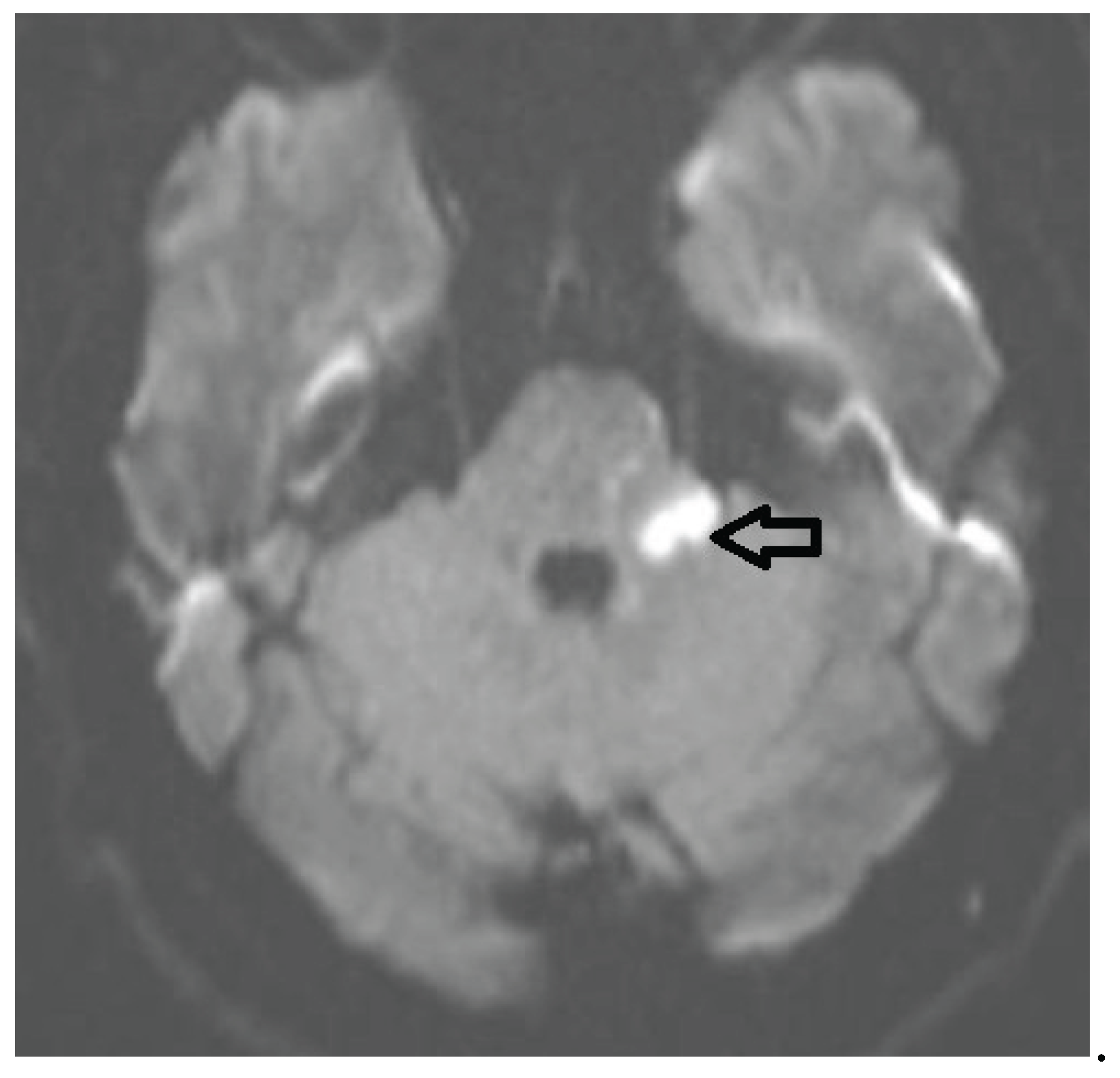
Figure 2.
Pathophysiological mechanisms linking SARS-CoV-2 infection to ischemic and hemorrhagic stroke. SARS-CoV-2 infection may promote cerebrovascular injury through multiple, partly overlapping mechanisms, including brain endothelial damage, increased tissue factor expression, elevated von Willebrand factor levels, platelet activation, thrombus formation, arterial inflammation or vasculitis, cytokine storm, COVID-19-associated coagulopathy, immunothrombosis, thrombophilia with impaired fibrinolytic imbalance, and macrophage/foam-cell infiltration contributing to vascular injury and plaque instability [192]. These pathways may converge to increase the risk of acute ischemic stroke, ischemic stroke, and intracerebral hemorrhage. Abbreviations: PAI-1, plasminogen activator inhibitor-1; TF, tissue factor; tPA, tissue plasminogen activator; vWF, von Willebrand factor.
Figure 2.
Pathophysiological mechanisms linking SARS-CoV-2 infection to ischemic and hemorrhagic stroke. SARS-CoV-2 infection may promote cerebrovascular injury through multiple, partly overlapping mechanisms, including brain endothelial damage, increased tissue factor expression, elevated von Willebrand factor levels, platelet activation, thrombus formation, arterial inflammation or vasculitis, cytokine storm, COVID-19-associated coagulopathy, immunothrombosis, thrombophilia with impaired fibrinolytic imbalance, and macrophage/foam-cell infiltration contributing to vascular injury and plaque instability [192]. These pathways may converge to increase the risk of acute ischemic stroke, ischemic stroke, and intracerebral hemorrhage. Abbreviations: PAI-1, plasminogen activator inhibitor-1; TF, tissue factor; tPA, tissue plasminogen activator; vWF, von Willebrand factor.
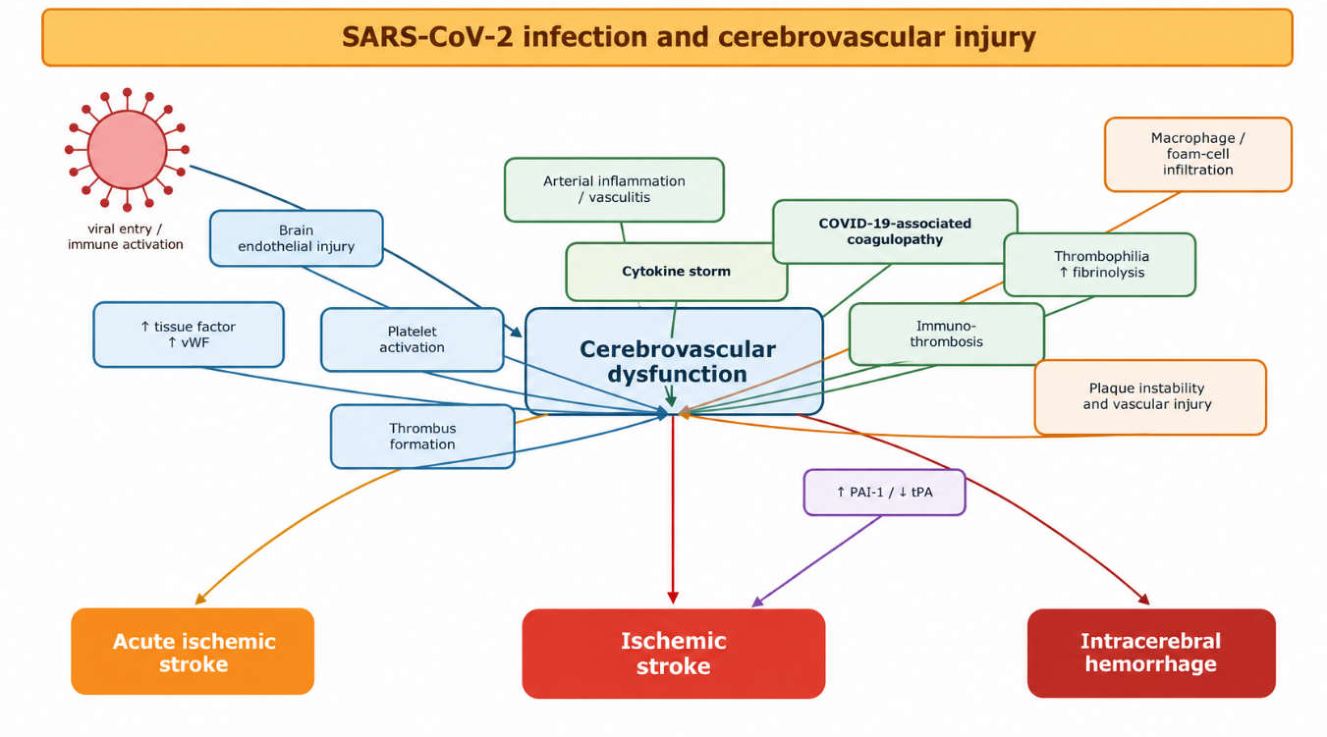
Figure 3.
Long COVID-19 neurovascular sequelae. Schematic representation of neurocognitive, neurological, cerebrovascular/vascular, and systemic/sensory manifestations described in long COVID and Neuro-COVID, including brain fog, cognitive dysfunction, dizziness, encephalopathy, insomnia or sleeping difficulties, chronic fatigue, headache, Guillain-Barré syndrome, stroke, microvascular clot formation, endothelial dysfunction, anxiety/depression, anosmia, and loss of taste.
Figure 3.
Long COVID-19 neurovascular sequelae. Schematic representation of neurocognitive, neurological, cerebrovascular/vascular, and systemic/sensory manifestations described in long COVID and Neuro-COVID, including brain fog, cognitive dysfunction, dizziness, encephalopathy, insomnia or sleeping difficulties, chronic fatigue, headache, Guillain-Barré syndrome, stroke, microvascular clot formation, endothelial dysfunction, anxiety/depression, anosmia, and loss of taste.
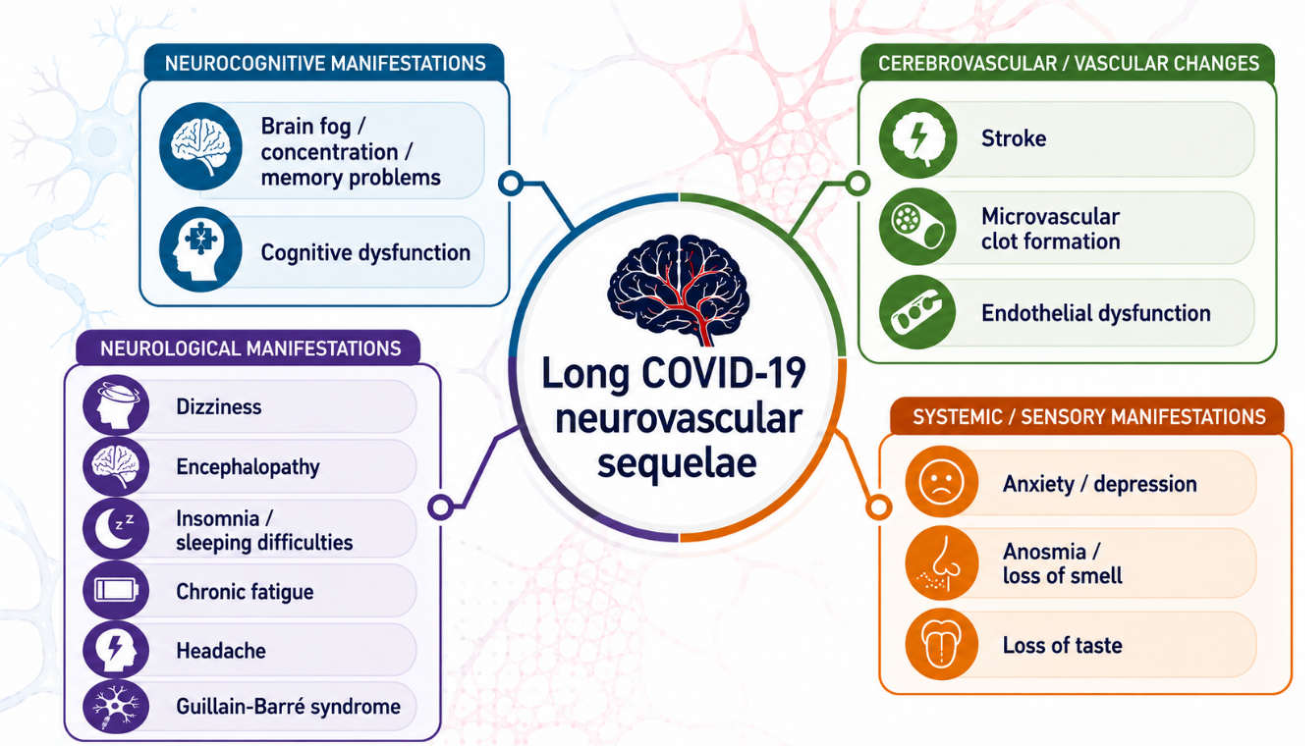
Figure 4.
SARS-CoV-2 infection, endothelial dysfunction, and multi-organ injury. Direct SARS-CoV-2 infection mediated by viral proteins, such as the spike protein, nucleocapsid protein, and main protease, and indirect mechanisms related to systemic inflammation, cytokine storm, and the senescence-associated secretory phenotype (SASP), may induce endothelial dysfunction throughout the pan-vasculature. This endothelial injury may contribute to multi-organ involvement, including stroke, lung injury, liver and kidney injury, myocardial injury/infarction, peripheral artery disease, deep vein thrombosis, reproductive system injury, and other systemic manifestations. Abbreviation: SASP, senescence-associated secretory phenotype.
Figure 4.
SARS-CoV-2 infection, endothelial dysfunction, and multi-organ injury. Direct SARS-CoV-2 infection mediated by viral proteins, such as the spike protein, nucleocapsid protein, and main protease, and indirect mechanisms related to systemic inflammation, cytokine storm, and the senescence-associated secretory phenotype (SASP), may induce endothelial dysfunction throughout the pan-vasculature. This endothelial injury may contribute to multi-organ involvement, including stroke, lung injury, liver and kidney injury, myocardial injury/infarction, peripheral artery disease, deep vein thrombosis, reproductive system injury, and other systemic manifestations. Abbreviation: SASP, senescence-associated secretory phenotype.
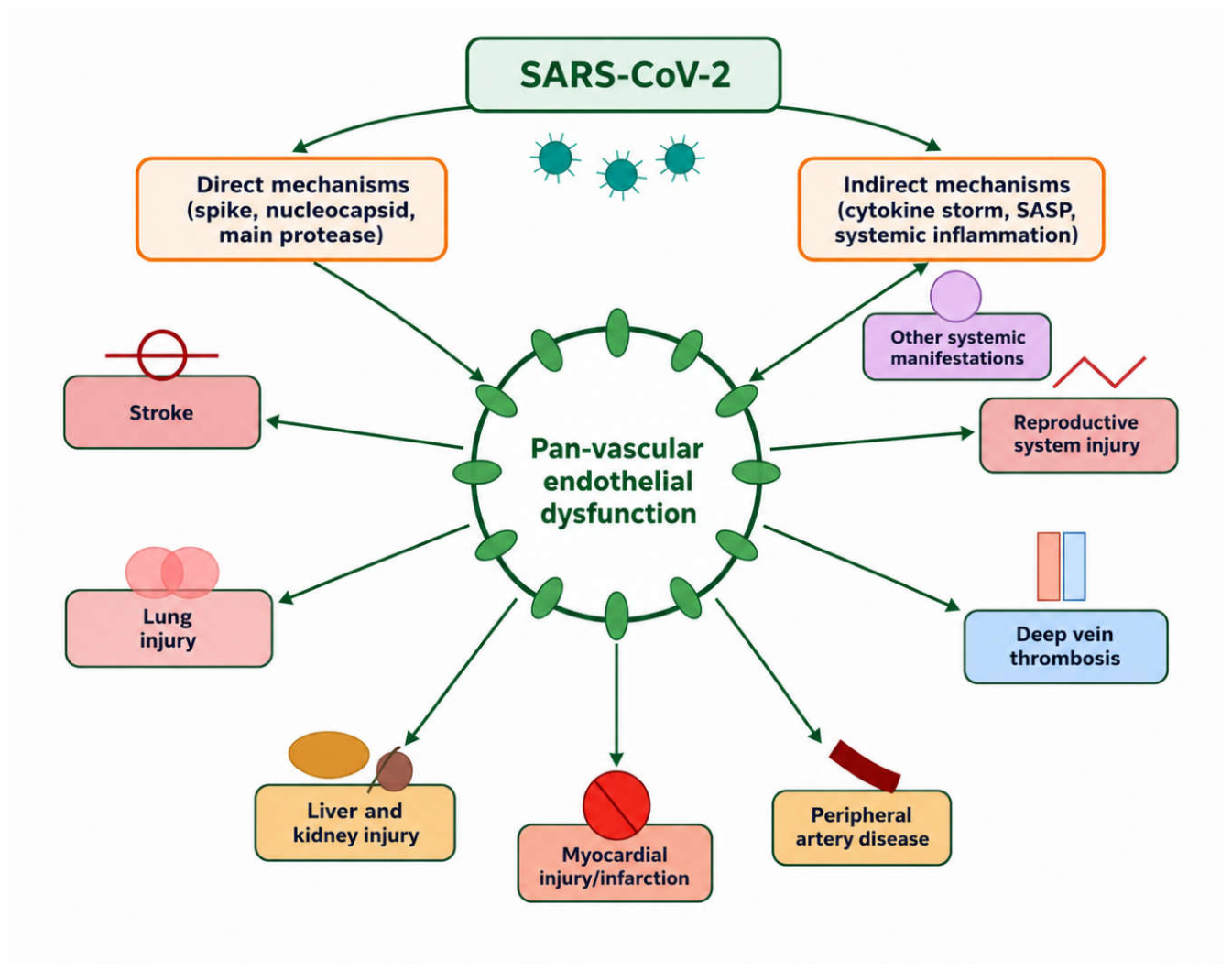
Figure 5.
Endothelial dysfunction in SARS-CoV-2 infection and tissue spike-protein immunoreactivity in a post-vaccination autopsy case. (A) Schematic summary of the principal endothelial dysfunction pathways associated with SARS-CoV-2 infection, including ACE2/TMPRSS2/ADAM17-mediated viral entry and ACE2 shedding, renin–angiotensin system imbalance with Ang II/AT1R predominance, NLRP3 inflammasome activation, reactive oxygen species generation, pyroptosis, cytokine release, glycocalyx disruption, leukocyte recruitment, extracellular-vesicle signaling, reduced nitric oxide bioavailability, vascular permeability, vasoconstriction, platelet activation, and thrombosis. Adapted from Santoro et al. [269], distributed under the terms of the Creative Commons Attribution 4.0 International License. (B) Frontal-lobe immunohistochemical staining from the autopsy case reported by Mörz showing SARS-CoV-2 spike subunit 1 immunoreactivity as brown granular deposits in capillary endothelial cells (red arrow) and in individual glial cells (blue arrow)—original magnification: 200×. Adapted from Mörz [85], distributed under the terms of the Creative Commons Attribution 4.0 International License.
Figure 5.
Endothelial dysfunction in SARS-CoV-2 infection and tissue spike-protein immunoreactivity in a post-vaccination autopsy case. (A) Schematic summary of the principal endothelial dysfunction pathways associated with SARS-CoV-2 infection, including ACE2/TMPRSS2/ADAM17-mediated viral entry and ACE2 shedding, renin–angiotensin system imbalance with Ang II/AT1R predominance, NLRP3 inflammasome activation, reactive oxygen species generation, pyroptosis, cytokine release, glycocalyx disruption, leukocyte recruitment, extracellular-vesicle signaling, reduced nitric oxide bioavailability, vascular permeability, vasoconstriction, platelet activation, and thrombosis. Adapted from Santoro et al. [269], distributed under the terms of the Creative Commons Attribution 4.0 International License. (B) Frontal-lobe immunohistochemical staining from the autopsy case reported by Mörz showing SARS-CoV-2 spike subunit 1 immunoreactivity as brown granular deposits in capillary endothelial cells (red arrow) and in individual glial cells (blue arrow)—original magnification: 200×. Adapted from Mörz [85], distributed under the terms of the Creative Commons Attribution 4.0 International License.
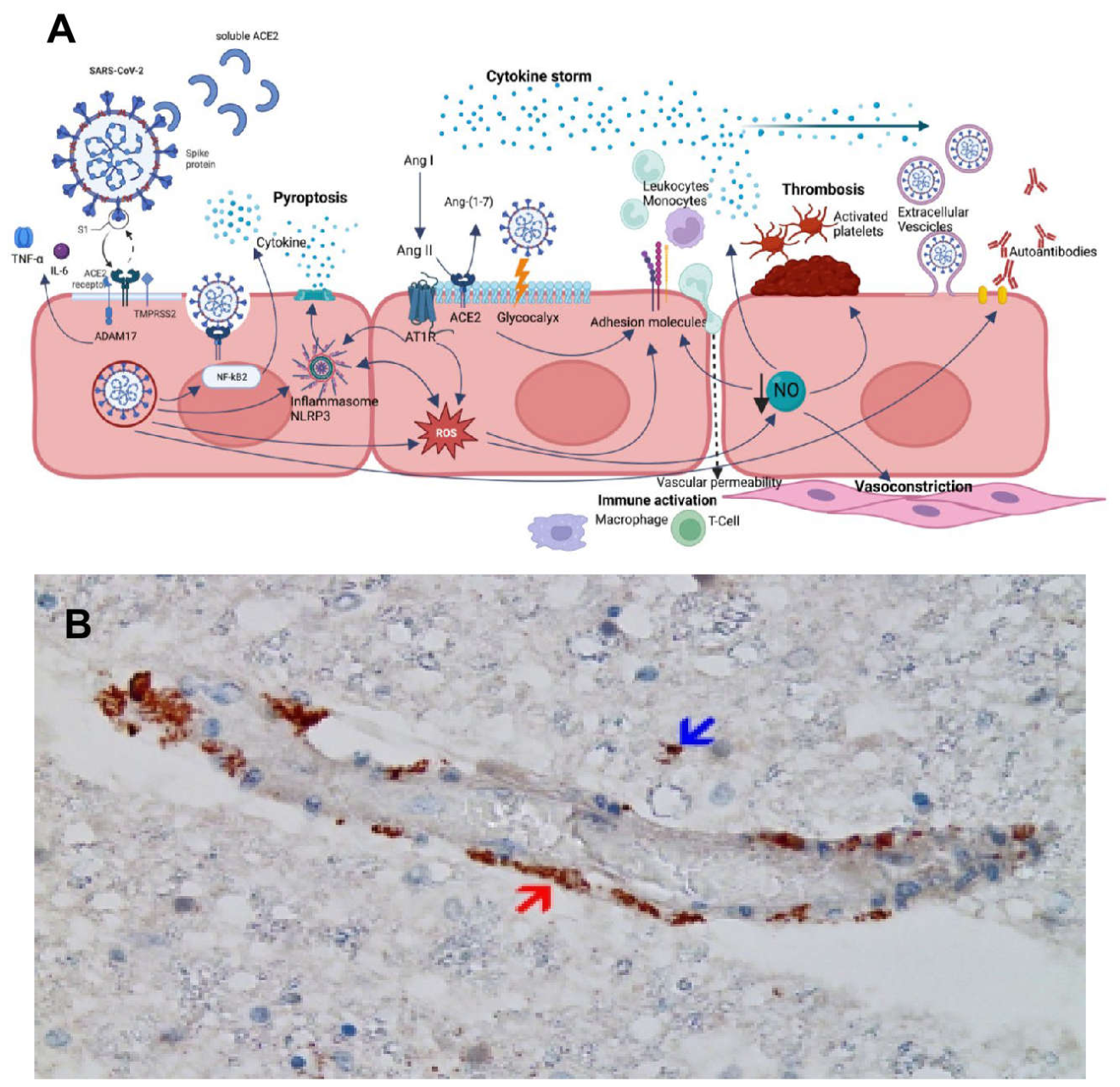

Table 1.
Clinical timeline of the presented case.
| Approximate time from vaccination | Clinical events and key findings |
| 0 h (Day 0) | First dose of ChAdOx1 nCoV-19/AZD1222 administered. |
| ~24 h | Fever, malaise, headache, marked fatigue, and nocturnal chills. |
| ~36–48 h | Severe hypertension (220/115 mmHg) followed by nausea/vomiting, vertigo, gait ataxia, dysarthria, and diplopia. |
| Emergency evaluation | NIHSS 5. CT: acute left cerebellar hypodensity; chronic lacunes and mild leukoaraiosis. CTA: ~50% intradural left vertebral artery stenosis; no large-vessel occlusion; dural venous sinuses patent. Platelets within reference range; SARS-CoV-2 PCR negative. |
| During hospitalization | Brain MRI confirmed an acute left cerebellar infarct extending into the middle cerebellar peduncle, with additional small acute supratentorial ischemic lesions. Chest radiography, ECG, and transthoracic echocardiography did not identify a clear cardioembolic source. |
| VITT work-up | Platelet counts remained within the reference range; anti-PF4 antibody testing and quantitative D-dimer levels were normal; no cerebral venous sinus thrombosis was identified. The clinical picture was not typical of VITT. |
| Discharge/rehabilitation | Thrombolysis and thrombectomy were not indicated. The patient received antihypertensive therapy and dual antiplatelet therapy and was transferred to inpatient rehabilitation after 12 days with partial improvement. |
| Following months | Persistent cognitive and affective symptoms, including impaired concentration, recent-memory difficulties, marked mental fatigue, sleep disturbance, and depressive symptoms, with substantial occupational impairment. |
| 5-year follow-up | The focal neurological deficit and post-stroke depression had largely improved, but memory difficulties, apathy/fatigue, and gait disturbance persisted. |
Abbreviations: ChAdOx1 nCoV-19/AZD1222, COVID-19 Vaccine AstraZeneca; CT, computed tomography; CTA, computed tomography angiography; ECG, electrocardiography; MRI, magnetic resonance imaging; NIHSS, National Institutes of Health Stroke Scale; PF4, platelet factor 4; SARS-CoV-2, severe acute respiratory syndrome coronavirus 2; VITT, vaccine-induced immune thrombotic thrombocytopenia.
Table 2.
Examples of vaccine-associated arterial strokes described in the literature and the present case.
Table 2.
Examples of vaccine-associated arterial strokes described in the literature and the present case.
| Vaccine/context | Author/year | Country | Age/sex | Days after vaccination | Stroke/VITT | Other thrombosis or comments |
| ChAdOx1/AZD1222 vaccine associated with VITT (first dose) | Al-Mayhani/2021 [32] | England | 35/F | 6 | Arterial stroke/Yes | Venous thrombosis/Yes |
| ChAdOx1/AZD1222 vaccine associated with VITT (first dose) | Bayas/2021 [33] | Germany | 55/F | 7 | Arterial stroke/Yes | Venous thrombosis/Yes |
| ChAdOx1/AZD1222 vaccine associated with VITT (first dose) | Kenda/2021 [34] | Slovenia | 51/F | 7 | Arterial stroke/Yes | Venous thrombosis/No |
| ChAdOx1/AZD1222 vaccine associated with VITT (first dose) | Berlot/2022 [35] | Italy | 69/F | 2 | Arterial stroke/Yes | Venous thrombosis/No |
| Ad26.COV2.S vaccine | Charidimou/2021 [36] | USA | 37/F | 10 | Arterial stroke/Yes | Venous thrombosis/Yes |
| Without VITT (first dose) | Alammar/2021 [37] | Saudi Arabia | 43/M | 3 | Arterial stroke/No | Venous thrombosis/No; severe hypertension |
| Without VITT (first dose) | Assiri/2022 [38] | India | 62/M | 4 | Arterial stroke/No | Venous thrombosis/No; severe hypertension |
| Without VITT (first dose) | Corrêa/2021 [39] | Brazil | 64/M | 2 | Arterial stroke/No | Venous thrombosis/No |
| Without VITT (first dose) | Present case | Spain | 63/M | 2 | Arterial stroke/No | Venous thrombosis/No; severe hypertension |
| BNT162b2 | Famularu/2021 [40] | Italy | 87/F | 1 | Arterial stroke/No | Second dose; atherosclerotic risk factors |
| BNT162b2 | Thomas/2023 [41] | Australia | 30/M | 1 | Arterial stroke/No | Third dose; atherosclerotic risk factors |
| CoronaVac/Sinovac (first dose) | Hidayat/2021 [42] | Indonesia | 79/M | 2 | Arterial stroke/No | Atherosclerotic risk factors |
| CoronaVac/Sinovac (first dose) | Hidayat/2021 [42] | Indonesia | 62/M | 3 | Arterial stroke/No | Atherosclerotic risk factors |
| Sinopharm | Elaidouni/2022 [43] | Morocco | 39/M | 2 | Arterial stroke/No | Good evolution |
Abbreviations: Age in years; F, female; M, male; VITT, vaccine-induced immune thrombotic thrombocytopenia.
Table 3.
SARS-CoV-2-related entities and stroke.
| Entity/syndrome | Stroke risk | Prevalence/estimate | Ischemic stroke | Hemorrhage | CVST | Microcirculatory disturbance |
| SCVI (COVID-19) | Increased | 1–5% | + | + | + | + |
| Post-COVID syndrome (PCS) | Increased | 4.40 per 1000 vs. 3.25 per 1000 controls§ | + | + | + | +† |
| Neurologic PCS/Neuro-COVID* | Not established | Unknown | + | + | + | +†† |
| PCS without neurologic syndrome | Increased mainly after severe/hospitalized infection | Variable‡ | + | + | + | + |
| Vaccination††† | Increased in rare cases | Variable§§ | + | + | + | + |
Abbreviations: COVID-19, coronavirus disease 2019; CVST, cerebral venous sinus thrombosis; PCS, post-COVID-19 syndrome; SARS-CoV-2, severe acute respiratory syndrome coronavirus 2; SCVI, SARS-CoV-2 infection. “+” indicates that the manifestation has been described. * Neurologic PCS/Neuro-COVID is used here to refer to neurological PCS presentations in which cognitive symptoms, brain vascular pathology, endothelial dysfunction, and microvascular effects have been proposed; reliable stroke-incidence data specifically within Neuro-COVID remain lacking. See [30,212,234,240]. † See [214]. ‡ Increased risk was mainly observed after severe or hospitalized SARS-CoV-2 infection; no increased long-term stroke risk was observed after community-managed infection in one national cohort study [207]. § See [209]. §§ Stroke reporting/estimates varied substantially across datasets: 12.2–65.3 reported stroke events per million administered doses in the EudraVigilance analysis [19] and 0.71 stroke cases per million administered doses in the Mexican nationwide descriptive study [21].
Table 4.
summarizes major mechanisms and supporting references. The categories are necessarily artificial because many authors consider inflammation, immune reaction, and vascular or microvascular lesions to be interdependent consequences of infection or vaccination [28,30]. Some authors have described COVID-19 as a vascular disorder [116,119,242] or as a systemic vascular hemopathy [187], with endothelial dysfunction as a central pathophysiological feature [121,122,123,240,243,244].Table 4. SARS-CoV-2-related entities and stroke: main proposed pathophysiological mechanisms.
Table 4.
summarizes major mechanisms and supporting references. The categories are necessarily artificial because many authors consider inflammation, immune reaction, and vascular or microvascular lesions to be interdependent consequences of infection or vaccination [28,30]. Some authors have described COVID-19 as a vascular disorder [116,119,242] or as a systemic vascular hemopathy [187], with endothelial dysfunction as a central pathophysiological feature [121,122,123,240,243,244].Table 4. SARS-CoV-2-related entities and stroke: main proposed pathophysiological mechanisms.
| Mechanism | Proposed link to stroke or vascular injury | Main supporting references |
| SARS-CoV-2 persistence, spike protein persistence, or vaccine-induced epitope persistence | Spike protein toxicity may promote inflammation and immune-response dysfunction; activate RhoA, affecting the endothelial cytoskeleton, blood–brain barrier (BBB) function, and thromboembolism; promote VITT in vaccine settings; be expressed in cerebral arteries; and antagonize VEGF-A signaling, potentially affecting angiogenesis. | [22,23,24,25,26,27,28,29,30,89,109,110,111,112,113,125,188,215,245,246] |
| Inflammatory mediators of ischemic stroke | Cytokine storm and inflammatory cytokine production may contribute to vascular injury and to plaque instability induced by inflammation. | [26,88,117,118,181,185,190,247,248,249,250] |
| Coagulatory dysfunction | Immune-mediated defense systems can promote thrombus formation; endothelial prothrombotic and hypercoagulable states, platelet activation, reduced physiological anticoagulants, increased coagulation factors, and antiphospholipid antibodies may contribute to arterial and venous thrombosis. | [13,14,15,16,24,32,33,34,35,36,62,71,74,75,76,78,84,122,142,145,152,166,171,176,186,187,199,246,251,252,253] |
| Endotheliopathy and microvascular injury | Endothelial activation may trigger extrinsic coagulation pathways; persistent degradation of the endothelial glycocalyx may worsen microvascular dysfunction and contribute to systemic embolism and ischemic stroke; nitric oxide deficiency may reduce vasodilation and increase platelet adhesion; VITT-related mechanisms may overlap in vaccine and PCVS settings. | [22,25,26,28,116,119,120,121,122,123,124,125,126,143,151,154,172,180,181,212,214,240,244,254,255,256,257] |
| Disruption of the renin–angiotensin–aldosterone system (RAAS) and ACE2 deficiency | ACE2 deficiency may promote procoagulant processes, organ-damaging effects of the classical RAAS pathway, sympathetic overactivity, and exacerbation of traditional stroke risk factors. | [154,258,259,260] |
| Immunological dysfunction and autoantibodies | Immune thrombocytopenia, reduced cytotoxic T lymphocytes and natural killer cells, nervous-system vasculitis, and microvascular injury may contribute to stroke mechanisms in SARS-CoV-2 infection, vaccination, and PCVS. | [13,14,32,33,34,35,36,86,113,115,185,215,234,246,249,251,255,261,262] |
| Other mechanisms | BBB breakdown in PCS; metabolic and mitochondrial dysfunction; microbiome dysbiosis with chronic inflammation; vasculitis; arterial stiffness and atherosclerosis; latent virus reactivation; organ-specific manifestations; cardiac dysfunction with cerebral embolism; blood hyperviscosity; capillary leak syndrome; and specific genetic traits. | [89,122,215,257,260,263,264,265] |
Abbreviations: ACE2, angiotensin-converting enzyme 2; BBB, blood–brain barrier; RAAS, renin–angiotensin–aldosterone system; SP, spike protein; VEGF, vascular endothelial growth factor.
Disclaimer/Publisher’s Note: The statements, opinions and data contained in all publications are solely those of the individual author(s) and contributor(s) and not of MDPI and/or the editor(s). MDPI and/or the editor(s) disclaim responsibility for any injury to people or property resulting from any ideas, methods, instructions or products referred to in the content. |
© 2026 by the authors. Licensee MDPI, Basel, Switzerland. This article is an open access article distributed under the terms and conditions of the Creative Commons Attribution (CC BY) license (http://creativecommons.org/licenses/by/4.0/).
Copyright: This open access article is published under a Creative Commons CC BY 4.0 license, which permit the free download, distribution, and reuse, provided that the author and preprint are cited in any reuse.


