
Submitted:
17 June 2026
Posted:
18 June 2026
You are already at the latest version
Abstract
Nitric oxide (NO), carbon monoxide (CO), and hydrogen sulfide (H₂S) were once regarded solely as toxic environmental gases. However, accumulating evidence over the past several decades has established them as the three principal endogenous gasotransmitters that regulate a wide spectrum of physiological and pathological processes. Unlike conventional signaling molecules, gasotransmitters diffuse freely across biological membranes and exert potent biological effects through receptor-independent mechanisms, including redox-sensitive post-translational modifications and modulation of heme-containing proteins. Although the individual functions of NO, CO, and H₂S have been extensively reviewed, emerging studies indicate that these gaseous mediators rarely operate in isolation. Instead, they form a highly integrated signaling network characterized by direct chemical interactions, reciprocal enzymatic regulation, and convergence upon common downstream pathways. In this mini-review, we propose the concept of a “Gasotransmitter Trio Network,” emphasizing the molecular crosstalk among NO, CO, and H₂S as a fundamental determinant of cellular homeostasis. We first summarize the biosynthetic pathways and major signaling mechanisms of the gasotransmitter trio, including S-nitrosylation, persulfidation, and heme-dependent regulation. We then discuss recent advances revealing how interactions among these gases generate novel bioactive intermediates and coordinate redox signaling. Particular attention is given to the emerging roles of gasotransmitters in regulating ferroptosis, autophagy, and mitophagy by modulating iron metabolism, lipid peroxidation, mitochondrial quality control, and antioxidant defense systems. These findings support a unified framework in which gasotransmitters function as master regulators of cellular fate under conditions of physiological and pathological stress. Finally, we highlight recent progress in stimuli-responsive donors, carbon monoxide-releasing molecules (CORMs), nitric oxide-releasing materials (NORMs), hydrogen sulfide donors, and advanced nanoplatforms that enable spatiotemporally controlled gas delivery. We propose that future therapeutic strategies will increasingly rely on programmable multi-gas systems that recapitulate endogenous gasotransmitter networks. Collectively, this review provides a systems-level perspective on gasotransmitter biology and outlines emerging opportunities for the development of precision gas medicine in cardiovascular, neurodegenerative, inflammatory, metabolic, and malignant diseases.
Keywords:
nitric oxide
; carbon monoxide
; hydrogen sulfide
; gasotransmitters crosstalk
; ferroptosis
; autophagy
; mitophagy
; redox signaling
; nanomedicine
; smart delivery systems
; precision gas medicine
1. Introduction
1.1. From Environmental Toxins to Endogenous Signaling Molecules: A Paradigm Shift
For much of modern scientific history, nitric oxide (NO), carbon monoxide (CO), and hydrogen sulfide (H₂S) were primarily regarded as hazardous environmental pollutants and toxic gases. NO was associated with atmospheric pollution and oxidative injury, CO was notorious for its high affinity toward hemoglobin and its potentially lethal effects on oxygen transport, whereas H₂S was historically recognized as a poisonous gas responsible for industrial and environmental intoxication [1,2,3]. Consequently, these molecules were traditionally viewed as harmful byproducts with limited physiological significance.
This perception changed dramatically during the late twentieth century through a series of landmark discoveries. The identification of NO as the endothelium-derived relaxing factor (EDRF) by Furchgott and colleagues revolutionized cardiovascular biology and established NO as a fundamental regulator of vascular homeostasis [4,5,6]. These discoveries ultimately led to the awarding of the 1998 Nobel Prize in Physiology or Medicine to Furchgott, Ignarro, and Murad for elucidating the biological role of NO [7]. Subsequently, carbon monoxide was found to be generated endogenously during heme degradation by heme oxygenase (HO) enzymes and to exert anti-inflammatory, anti-apoptotic, and cytoprotective effects through intracellular signaling mechanisms [8,9,10]. Shortly thereafter, hydrogen sulfide emerged as the third recognized gasotransmitter when mammalian tissues were shown to synthesize H₂S enzymatically and utilize it to regulate neuronal, cardiovascular, and metabolic functions [11,12,13].
These discoveries collectively transformed the conceptual framework of gaseous molecules in biology. Rather than serving solely as environmental toxins, NO, CO, and H₂S are now recognized as endogenous signaling molecules that participate in the regulation of virtually every major physiological system [14,15,16]. Similar to classical neurotransmitters and hormones, gasotransmitters transmit biological information; however, they possess several unique characteristics that distinguish them from conventional signaling mediators.
1.2. Physiological Importance of the Gasotransmitter Trio
One of the defining features of gasotransmitters is their ability to diffuse freely across biological membranes without requiring membrane-bound receptors or transport systems [14,17]. This receptor-independent mode of signaling enables rapid communication between intracellular compartments and neighboring cells, thereby facilitating immediate adaptation to environmental and metabolic perturbations. Furthermore, gasotransmitters exert potent biological effects at extremely low concentrations, often in the nanomolar to micromolar range, highlighting the exquisite sensitivity of cellular sensing mechanisms [15,18].
Accumulating evidence indicates that NO, CO, and H₂S are indispensable regulators of cellular homeostasis. NO controls vascular tone, platelet aggregation, neurotransmission, mitochondrial respiration, and innate immune responses [19,20,21]. CO functions as an important modulator of inflammation, oxidative stress, mitochondrial metabolism, and cellular adaptation to injury through interactions with heme-containing proteins [9,22,23]. Meanwhile, H₂S participates in antioxidant defense, energy metabolism, angiogenesis, autophagy, and stress adaptation, thereby contributing to tissue protection under physiological and pathological conditions [24,25,26,27]. Importantly, the biological actions of gasotransmitters are highly concentration-dependent. Physiological concentrations generally confer cytoprotective effects, whereas excessive production can contribute to pathological processes. For example, overproduction of NO may induce nitrosative stress via peroxynitrite formation, excessive CO exposure may cause tissue hypoxia via hemoglobin binding, and elevated H₂S concentrations may inhibit mitochondrial respiration by targeting cytochrome c oxidase [28,29,30]. Therefore, the physiological outcome of gasotransmitter signaling depends on a finely regulated balance involving concentration, spatial distribution, and temporal dynamics.
Recent advances in redox biology have further revealed that gasotransmitters act not merely as diffusible molecules but also as regulators of post-translational modifications (PTMs). Through mechanisms such as S-nitrosylation, persulfidation, and heme-dependent signaling, these gases reshape protein function, intracellular signaling networks, and gene expression programs, thereby exerting profound influences on cellular fate decisions [31,32,33,34]. Collectively, these findings have transformed the traditional perception of NO, CO, and H₂S from isolated gaseous mediators into components of a highly coordinated signaling system. As illustrated in Figure 1, the gasotransmitter trio forms an integrated network that links redox regulation, mitochondrial quality control, and cell fate determination, thereby influencing the development and progression of numerous human diseases.
1.3. Scope and Novel Perspective of This Review
Although numerous reviews have independently summarized the biological functions of NO, CO, or H₂S, these approaches often overlook the fact that gasotransmitters rarely function in isolation. Emerging evidence indicates that the three gases form a highly integrated signaling network characterized by direct chemical interactions, reciprocal enzymatic regulation, and convergence on shared downstream pathways [35,36,37,38]. This concept challenges the traditional reductionist view of individual gasotransmitters and instead supports the existence of a dynamic “gasotransmitter trio network” that collectively governs cellular adaptation and survival. In parallel, increasing attention has been paid to the role of gasotransmitters in regulating emerging forms of programmed cell death and quality-control mechanisms. Ferroptosis and autophagy have recently been recognized as critical determinants of tissue injury, aging, neurodegeneration, cardiovascular diseases, metabolic disorders, and cancer progression [39,40,41,42]. Accumulating studies suggest that NO, CO, and H₂S exert profound influences on iron metabolism, lipid peroxidation, mitochondrial quality control, and autophagic flux, thereby positioning these gases as key regulators of cellular fate [43,44,45,46].
Finally, despite their remarkable therapeutic potential, the clinical translation of gasotransmitter-based interventions remains challenging due to short biological half-lives, narrow therapeutic windows, and systemic toxicities [10,47,48]. Recent developments in stimuli-responsive donors, nanotechnology, and smart biomaterials have created unprecedented opportunities for achieving precise spatiotemporal control of gas delivery [48,49,50]. Therefore, this review focuses on three emerging themes: (i) molecular crosstalk among NO, CO, and H₂S; (ii) regulation of ferroptosis and autophagy by the gasotransmitter trio; and (iii) next-generation smart delivery systems designed to translate gasotransmitter biology into clinical therapeutics. By integrating these perspectives, we propose a systems-level framework in which the gasotransmitter trio functions as a coordinated regulatory network that determines cellular survival, adaptation, and disease progression.
2. Biosynthetic Pathways and Post-Translational Modifications
2.1. Enzymatic Production Machinery of the Gasotransmitter Trio
The biological activities of nitric oxide (NO), carbon monoxide (CO), and hydrogen sulfide (H₂S) are critically dependent upon tightly regulated enzymatic systems that govern their synthesis, degradation, and spatial distribution. Unlike classical hormones that are stored in vesicles and released upon stimulation, gasotransmitters are synthesized on demand and rapidly diffuse across cellular membranes to exert local and systemic effects [14].
NO is generated from L-arginine through the action of nitric oxide synthase (NOS) enzymes, including endothelial NOS (eNOS), neuronal NOS (nNOS), and inducible NOS (iNOS) [19]. These isoforms exhibit distinct patterns of expression and regulation. eNOS-derived NO plays a pivotal role in vascular homeostasis by promoting vasodilation, inhibiting platelet aggregation, and suppressing leukocyte adhesion. In contrast, nNOS primarily regulates neurotransmission and synaptic plasticity, whereas iNOS is induced during inflammation and produces substantially larger quantities of NO as part of the host defense response [21,51]. The activity of NOS enzymes is tightly controlled by intracellular calcium, phosphorylation events, protein-protein interactions, and cofactor availability, particularly tetrahydrobiopterin (BH₄). Disruption of these regulatory mechanisms may result in NOS uncoupling, leading to superoxide generation rather than NO production, thereby contributing to oxidative stress and vascular dysfunction [52].
CO is primarily generated during heme catabolism catalyzed by heme oxygenase (HO) enzymes [53]. HO-1 is an inducible stress-responsive isoform that is upregulated by oxidative stress, hypoxia, inflammation, and electrophilic stimuli, whereas HO-2 is constitutively expressed in various tissues, including the brain and vasculature [54]. During heme degradation, HO enzymes generate equimolar amounts of biliverdin, ferrous iron (Fe²⁺), and CO. Although historically considered merely a metabolic byproduct, endogenous CO is now recognized as an important signaling molecule that regulates inflammation, mitochondrial metabolism, apoptosis, and vascular function [10].
H₂S is synthesized predominantly through three enzymatic pathways involving cystathionine β-synthase (CBS), cystathionine γ-lyase (CSE), and 3-mercaptopyruvate sulfurtransferase (3-MST) [55]. CBS is highly expressed in the central nervous system, whereas CSE predominates in the cardiovascular system and liver. In contrast, 3-MST is localized primarily within mitochondria and contributes significantly to intracellular sulfur metabolism [56]. Emerging evidence indicates that H₂S production is dynamically regulated by nutrient availability, redox status, and cellular stress responses, linking sulfur metabolism to energy homeostasis and adaptive signaling [25].
Importantly, increasing evidence suggests that the biological effects of gasotransmitters cannot be explained solely by their concentrations. Rather, their signaling specificity arises largely from their ability to induce selective post-translational modifications (PTMs) of target proteins, thereby influencing cellular signaling networks at multiple levels [57]. Collectively, these observations support the concept that gasotransmitter signaling is organized as a hierarchical system encompassing enzymatic biosynthesis, molecular target modification, and downstream signal integration. Figure 2 provides an overview of the biosynthetic pathways, major post-translational modifications, and shared signaling mechanisms through which NO, CO, and H₂S coordinate cellular responses to physiological and pathological stress.
Collectively, NO, CO, and H₂S exhibit distinct biosynthetic origins and molecular signaling mechanisms, yet ultimately converge on overlapping pathways that regulate redox homeostasis, mitochondrial function, and cellular adaptation. While NO primarily signals via S-nitrosylation, CO acts via heme-dependent interactions, and H₂S predominantly mediates protein persulfidation. Despite these differences, the three gasotransmitters share numerous downstream targets and biological functions. To facilitate comparison of their biosynthetic pathways, signaling mechanisms, and physiological actions, the major characteristics of the gasotransmitter trio are summarized in Table 1.
As summarized in Table 1, the unique chemical properties of each gasotransmitter provide signaling specificity, whereas their overlapping biological activities establish the foundation for coordinated cellular regulation. This functional convergence underlies the extensive molecular interactions discussed in the following section.
2.2. Beyond Classical Receptors: Gasotransmitter-Dependent Post-Translational Modifications
Unlike conventional signaling molecules that typically activate membrane-bound receptors, gasotransmitters often act through direct chemical modification of proteins. These PTMs serve as molecular switches that rapidly alter protein structure, enzymatic activity, intracellular localization, and protein-protein interactions [31].
2.2.1. S-Nitrosylation: The Signature Modification of Nitric Oxide
Among NO-mediated PTMs, S-nitrosylation is the best characterized and involves the covalent attachment of a nitric oxide moiety to reactive cysteine thiols, forming S-nitrosothiols (SNOs) [58]. This reversible modification functions analogously to phosphorylation and has emerged as a fundamental mechanism of redox signaling.
S-nitrosylation regulates a wide spectrum of proteins involved in mitochondrial function, apoptosis, inflammation, and metabolism. One notable example is dynamin-related protein 1 (Drp1), a master regulator of mitochondrial fission. Excessive S-nitrosylation of Drp1 enhances mitochondrial fragmentation and has been implicated in neurodegenerative disorders such as Alzheimer’s disease and Parkinson’s disease [59]. Similarly, S-nitrosylation influences the activity of caspases, NF-κB signaling components, and mitochondrial respiratory complexes, thereby integrating NO signaling with cellular survival pathways [60].
Under physiological conditions, S-nitrosylation contributes to adaptive stress responses and tissue protection. However, excessive nitrosative stress may result in aberrant protein modification and cellular dysfunction, highlighting the dual nature of NO-dependent signaling [61].
2.2.2. Persulfidation: A Protective Redox Mechanism of Hydrogen Sulfide
Persulfidation, also known as sulfhydration, is the principal signaling mechanism of H₂S [33]. In this process, a cysteine thiol (-SH) is converted into a persulfide group (-SSH), thereby altering the biochemical properties of target proteins. Recent proteomic analyses suggest that persulfidation is one of the most widespread redox-dependent PTMs in mammalian cells and may affect thousands of proteins [62].
Unlike many oxidative modifications that impair protein function, persulfidation frequently exerts protective effects by shielding reactive cysteine residues from irreversible oxidation [63]. This mechanism is particularly important under conditions of oxidative stress. One of the best-characterized examples involves Kelch-like ECH-associated protein 1 (Keap1), a cytoplasmic inhibitor of nuclear factor erythroid 2-related factor 2 (Nrf2). Persulfidation of Keap1 promotes dissociation of the Keap1–Nrf2 complex, enabling Nrf2 nuclear translocation and activation of antioxidant gene expression programs [64]. Through this mechanism, H₂S enhances cellular resistance to oxidative injury, inflammation, and ferroptosis. Beyond redox regulation, persulfidation also influences mitochondrial bioenergetics, autophagy, endoplasmic reticulum stress responses, and metabolic adaptation, highlighting the broad physiological importance of sulfur-based signaling [65].
2.2.3. Heme Coordination: Carbon Monoxide as a Metabolic Regulator
In contrast to NO and H₂S, the primary signaling mechanism of CO relies on its ability to bind transition metal centers, particularly heme-containing proteins [18]. CO exhibits high affinity for ferrous heme iron, thereby modulating the activity of numerous cellular sensors and enzymes. One major target of CO is cytochrome c oxidase (Complex IV) within the mitochondrial electron transport chain. At low concentrations, transient inhibition of cytochrome c oxidase induces mild mitochondrial stress, activating adaptive signaling pathways, including mitochondrial biogenesis, antioxidant responses, and metabolic reprogramming [66]. This phenomenon resembles mitohormesis, whereby low-level stress enhances cellular resilience.
CO can also interact with soluble guanylate cyclase (sGC), the canonical receptor for NO. Although CO activates sGC less efficiently than NO, it contributes to cGMP-dependent signaling under specific physiological contexts [67]. Moreover, CO-mediated modulation of heme-containing transcription factors and redox-sensitive proteins influences inflammatory responses, angiogenesis, and cell survival [68].
Recent studies suggest that CO functions as a fine-tuner of cellular metabolism rather than a simple signaling molecule. Through selective interactions with mitochondrial and heme-associated proteins, CO coordinates energy production, redox homeostasis, and stress adaptation, thereby contributing to tissue protection during pathological conditions such as ischemia-reperfusion injury and chronic inflammation [69].
Collectively, S-nitrosylation, persulfidation, and heme coordination constitute three major molecular languages through which NO, H₂S, and CO exert biological effects. These PTMs provide the mechanistic foundation for the extensive crosstalk among the gasotransmitter trio discussed in the following section.
3. The Molecular Crosstalk Network Among the Gasotransmitter Trio
Although nitric oxide (NO), carbon monoxide (CO), and hydrogen sulfide (H₂S) were initially investigated as independent signaling molecules, accumulating evidence suggests that their biological activities are extensively interconnected. Rather than functioning as isolated mediators, these gasotransmitters form a highly integrated signaling network characterized by direct chemical interactions, reciprocal enzymatic regulation, and convergence upon common downstream signaling pathways [14,16,35,36,37,38]. This dynamic “gasotransmitter trio network” enables cells to coordinate redox homeostasis, mitochondrial adaptation, metabolic flexibility, and stress responses with remarkable precision. Importantly, the biological effects of each gasotransmitter are often influenced by the local abundance of the other two molecules. Consequently, understanding gasotransmitter biology requires a systems-level perspective rather than a reductionist examination of individual signaling pathways. Collectively, current evidence indicates that gasotransmitter signaling is organized as a multilayered regulatory network encompassing chemical interactions, reciprocal enzyme regulation, redox integration, and convergence on common downstream signaling pathways. Rather than acting as isolated mediators, NO, CO, and H₂S continuously influence each other’s production, bioavailability, and biological activity. The major components of this gasotransmitter crosstalk network are summarized in Figure 3.
The major forms of gasotransmitter crosstalk are summarized in Table 2.
Taken together, these observations support a systems-level model in which NO, CO, and H₂S function as an integrated signaling network. The biological consequences of this network become particularly evident in the regulation of cellular fate programs, including ferroptosis and autophagy.
3.1. Direct Chemical Interactions: Formation of Novel Signaling Intermediates
Among the three gasotransmitters, the interaction between NO and H₂S has received the greatest attention due to its ability to generate entirely new bioactive signaling species [36,37,70]. Unlike classical signaling cascades that rely on receptor activation, the chemistry of NO and H₂S allows spontaneous reactions under physiological conditions, producing hybrid sulfur-nitrogen intermediates with distinct biological activities. One of the most extensively studied reaction products is nitrosopersulfide (SSNO⁻), which is formed through interactions between H₂S-derived persulfides and NO-derived species [36]. SSNO⁻ exhibits significantly greater chemical stability than NO itself and functions as a sustained reservoir of bioactive nitrogen species. Importantly, SSNO⁻ can activate soluble guanylate cyclase (sGC) and promote prolonged vasorelaxation, suggesting that some cardiovascular effects previously attributed solely to NO may actually involve NO/H₂S hybrid signaling [36,70].
Another important intermediate is nitroxyl (HNO), the one-electron reduced and protonated congener of NO [71]. HNO possesses unique pharmacological properties distinct from those of NO, including resistance to scavenging by superoxide and potent positive inotropic effects in the heart. Experimental studies have demonstrated that HNO improves cardiac contractility while avoiding some of the tolerance mechanisms associated with conventional NO donors [72]. Consequently, HNO has emerged as a promising therapeutic candidate for heart failure and ischemic heart disease.
Beyond SSNO⁻ and HNO, reactions between NO and H₂S can generate polysulfides and other reactive sulfur-nitrogen species that modulate redox-sensitive proteins and influence cellular signaling networks [33,62]. These findings suggest that the physiological significance of gasotransmitter signaling extends beyond individual molecules and encompasses a broader family of chemically interconnected reactive species.
Compared with NO-H₂S interactions, direct chemical reactions involving CO are less prominent because CO is relatively inert under physiological conditions. Nevertheless, CO can indirectly influence NO and H₂S signaling by competing for metal-binding sites and altering the redox environment in which sulfur- and nitrogen-based signaling species are generated [18].
3.2. Reciprocal Enzymatic Regulation: A Multi-Layered Feedback Network
In addition to direct chemical interactions, gasotransmitters regulate each other’s biosynthetic enzymes, thereby creating a complex network of positive and negative feedback loops. A substantial body of evidence indicates that H₂S modulates NO production by regulating eNOS activity [35,38,73]. At physiological concentrations, H₂S promotes eNOS phosphorylation at Ser1177, enhances eNOS dimerization, and increases NO bioavailability [74]. Furthermore, H₂S protects tetrahydrobiopterin (BH₄) from oxidative degradation, thereby preventing eNOS uncoupling and maintaining efficient NO synthesis [75]. These mechanisms contribute to the well-documented synergistic effects of NO and H₂S on endothelial function and vascular relaxation.
Interestingly, the relationship between H₂S and NOS is highly concentration-dependent. While low concentrations generally enhance NO production, excessive H₂S may suppress NOS activity by interacting with catalytic cofactors or altering intracellular redox status [76]. Such biphasic regulation highlights the importance of maintaining gasotransmitter homeostasis within a narrow physiological range.
CO also participates in the reciprocal regulation of the NO pathway. Several studies have demonstrated that low concentrations of CO activate eNOS and enhance endothelial NO production through PI3K/Akt-dependent mechanisms [77]. Conversely, NO can induce HO-1 expression through multiple transcriptional pathways, including activation of Nrf2 and stabilization of hypoxia-inducible factor-1α (HIF-1α), thereby increasing endogenous CO production [78,79]. This bidirectional interaction creates a positive feedback system that amplifies cytoprotective signaling during oxidative and inflammatory stress.
Interactions between H₂S and HO-1 have also been reported. H₂S induces HO-1 expression through activation of Nrf2-dependent transcriptional programs, whereas HO-1-derived CO may influence sulfur metabolism through modulation of CBS and CSE activity [80]. These observations support the notion that the gasotransmitter trio operates as an integrated regulatory circuit rather than three independent pathways.
3.3. Convergence on Common Downstream Signaling Pathways
Despite differences in chemical structure and biosynthetic origin, NO, CO, and H₂S ultimately converge upon several common signaling pathways that govern vascular function, mitochondrial adaptation, and cellular survival.
One major point of convergence is the soluble guanylate cyclase (sGC)-cyclic guanosine monophosphate (cGMP) pathway [67]. NO is the most potent endogenous activator of sGC and promotes cGMP generation through direct binding to the heme moiety of the enzyme [19]. CO also activates sGC, although with lower potency than NO [67]. Meanwhile, H₂S indirectly enhances cGMP signaling by inhibiting phosphodiesterase activity and preserving intracellular cGMP levels [81]. Through these complementary mechanisms, all three gasotransmitters contribute to vascular relaxation, antiplatelet activity, and cardioprotection.
Another important target is the ATP-sensitive potassium (KATP) channel. Activation of KATP channels is a recognized mechanism underlying vasodilation and ischemic preconditioning [82]. H₂S is a potent activator of KATP channels, whereas NO and CO can modulate channel activity through cGMP-dependent signaling pathways [83]. The coordinated regulation of KATP channels represents an important mechanism through which gasotransmitters enhance tissue resistance to ischemic injury.
Beyond ion channel regulation, the three gasotransmitters converge on multiple redox-sensitive pathways involved in cellular adaptation. Activation of Nrf2 signaling, suppression of NF-κB-mediated inflammation, preservation of mitochondrial membrane potential, and enhancement of antioxidant defenses have all been reported for NO, CO, and H₂S [22,64,68,80]. Through these mechanisms, gasotransmitters collectively maintain intracellular redox balance and limit oxidative injury. Particularly in endothelial cells and cardiomyocytes, coordinated gasotransmitter signaling contributes to mitochondrial quality control and bioenergetic stability [69,84]. Low concentrations of NO, CO, and H₂S induce adaptive mitochondrial responses, including enhanced antioxidant capacity, improved respiratory efficiency, and increased stress tolerance. These effects resemble hormetic signaling and may explain the broad cytoprotective actions of gasotransmitters observed in cardiovascular and metabolic diseases.
Collectively, the molecular crosstalk among NO, CO, and H₂S extends far beyond simple additive effects. Through chemical interactions, reciprocal enzyme regulation, and convergence on shared signaling pathways, these molecules form a dynamic, self-regulating network that governs cellular adaptation to physiological and pathological stress. Understanding this integrated gasotransmitter circuitry provides the conceptual foundation for deciphering how the trio orchestrates ferroptosis, autophagy, and other cell fate decisions discussed in the following section.
4. Dictating Cardiovascular Cell Fate: Roles of Gasotransmitters in Ferroptosis, Autophagy, and Mitophagy
The traditional view of gasotransmitters has largely focused on their roles in vascular regulation, neurotransmission, and inflammatory signaling. However, emerging evidence suggests that nitric oxide (NO), carbon monoxide (CO), and hydrogen sulfide (H₂S) exert much broader biological functions by governing fundamental cellular fate decisions. Among these, ferroptosis and autophagy have recently emerged as two highly interconnected processes that determine whether cells adapt to stress or undergo irreversible damage [39,40,41].
Ferroptosis is an iron-dependent form of regulated cell death characterized by uncontrolled lipid peroxidation and membrane destruction, whereas autophagy functions primarily as a cytoprotective quality-control mechanism that degrades damaged proteins and organelles [39,44,45]. Increasing evidence indicates that gasotransmitters influence both pathways through redox-sensitive post-translational modifications, regulation of mitochondrial homeostasis, and modulation of iron metabolism. Consequently, the gasotransmitter trio may be viewed as a master regulatory network that integrates oxidative stress signals and determines cellular survival under pathological conditions. To better illustrate the multifaceted roles of NO, CO, and H₂S in ferroptotic regulation, Figure 4 summarizes the major ferroptotic machinery and highlights how the gasotransmitter trio cooperatively modulates iron metabolism, lipid peroxidation, antioxidant defense systems, and mitochondrial integrity. These integrated mechanisms collectively determine ferroptotic susceptibility and influence disease progression across multiple organ systems.
Recent studies have identified ferroptosis and autophagy/mitophagy as two major cellular fate pathways influenced by gasotransmitter signaling. Although the three gases employ distinct molecular mechanisms, they collectively regulate oxidative stress, mitochondrial quality control, and iron metabolism. Their coordinated effects on these pathways are summarized in Table 3.
The integrated regulation of ferroptosis and autophagy highlights a unifying theme in gasotransmitter biology: preservation of mitochondrial integrity and cellular homeostasis. These mechanistic insights also provide a strong rationale for the development of gasotransmitter-based therapeutics and delivery technologies.
4.1. Breaking the Code of Ferroptosis: Gasotransmitters as Modulators of Iron-Dependent Cell Death
Ferroptosis is initiated by excessive accumulation of lipid peroxides in cellular membranes and is critically dependent upon intracellular iron availability, glutathione (GSH) depletion, and inactivation of glutathione peroxidase 4 (GPX4) [39,40,41]. Because these processes are tightly linked to cellular redox homeostasis, gasotransmitters are uniquely positioned to influence ferroptotic susceptibility.
Nitric Oxide as a Ferroptosis Suppressor
Among the gasotransmitters, NO exhibits complex and context-dependent effects on ferroptosis. Under physiological conditions, NO can directly terminate lipid peroxidation chain reactions by reacting with lipid peroxyl radicals (LOO•), thereby preventing propagation of oxidative membrane damage [94]. This radical-trapping activity resembles that of classical lipophilic antioxidants and provides an important mechanism by which NO suppresses ferroptotic cell death.
In addition, NO-mediated S-nitrosylation regulates multiple proteins involved in iron metabolism and antioxidant defense [31,58]. Several studies have demonstrated that moderate NO production preserves GPX4 activity, maintains glutathione availability, and suppresses ferroptosis in endothelial cells, neurons, and cardiomyocytes exposed to oxidative stress [86]. Furthermore, NO may modulate iron homeostasis by regulating ferritin expression and iron-responsive signaling pathways, thereby limiting the accumulation of the labile iron pool that drives ferroptotic injury [87].
Nevertheless, excessive NO production may also contribute to ferroptosis under certain pathological conditions. High concentrations of NO can react with superoxide to generate peroxynitrite, thereby causing mitochondrial dysfunction and increased oxidative damage [28]. Thus, the effects of NO on ferroptosis appear to follow a concentration-dependent hormetic pattern.
Hydrogen Sulfide as a Guardian of the GPX4-GSH Axis
H₂S is increasingly recognized as one of the most potent endogenous inhibitors of ferroptosis [33,43]. A major mechanism involves preservation of intracellular glutathione homeostasis. Through stimulation of cystine uptake and activation of System Xc⁻, H₂S enhances cellular cysteine availability and promotes glutathione biosynthesis [88].
Moreover, H₂S-mediated persulfidation directly protects antioxidant proteins from irreversible oxidation [33,63]. Recent studies suggest that H₂S enhances GPX4 stability and activity, thereby preventing the accumulation of toxic lipid hydroperoxides that trigger ferroptosis [43,89]. Activation of the Keap1-Nrf2 signaling pathway further amplifies this protective response by inducing the expression of antioxidant enzymes, glutathione-synthesis genes, and iron-detoxifying proteins [64].
Another emerging mechanism involves mitochondrial sulfur metabolism. H₂S supports mitochondrial bioenergetics through electron donation to the respiratory chain and maintains mitochondrial integrity during oxidative stress [90]. By preserving mitochondrial function and reducing reactive oxygen species (ROS) production, H₂S indirectly suppresses the oxidative environment that promotes ferroptotic execution.
Carbon Monoxide: A Double-Edged Regulator of Ferroptosis
Compared with NO and H₂S, the role of CO in ferroptosis is considerably more complex. The biological effects of CO are closely linked to the activity of heme oxygenase-1 (HO-1), which simultaneously generates CO, biliverdin, and free iron during heme degradation [56,57]. At moderate levels, HO-1 activation exerts cytoprotective effects through antioxidant signaling, Nrf2 activation, and suppression of inflammation [9,22]. These mechanisms indirectly reduce ferroptotic susceptibility and contribute to tissue protection in models of cardiovascular and neurological injury [91]. However, excessive HO-1 activation may produce the opposite outcome. Because heme degradation releases ferrous iron, prolonged or excessive HO-1 activity can increase the intracellular labile iron pool and accelerate Fenton chemistry, thereby promoting lipid peroxidation and ferroptosis [92]. This dual role has led to the concept that the HO-1/CO system functions as a ferroptotic rheostat, capable of either suppressing or promoting ferroptosis depending on the cellular context and iron-handling capacity.
Collectively, NO, CO, and H₂S regulate ferroptosis through complementary mechanisms that involve antioxidant defense, iron metabolism, control of lipid peroxidation, and mitochondrial preservation. Their coordinated actions suggest that ferroptotic sensitivity may ultimately depend on the balance of gasotransmitter signaling within individual tissues.
4.2. Tuning Autophagy and Mitophagy Flux: The Mitochondrial Quality Control Axis
While ferroptosis determines whether cells succumb to oxidative damage, autophagy represents a critical adaptive mechanism that enables survival under stressful conditions. Autophagy facilitates degradation of damaged proteins, dysfunctional organelles, and toxic macromolecular aggregates, thereby maintaining intracellular homeostasis [44,45].
Among the various forms of autophagy, mitophagy, the selective removal of damaged mitochondria, has emerged as a key determinant of cellular fate because mitochondria represent major sources of ROS and regulators of apoptosis, ferroptosis, and metabolic adaptation [93]. In contrast to ferroptosis, which culminates in irreversible cellular damage, autophagy and mitophagy function primarily as adaptive quality-control mechanisms that preserve cellular integrity under stress conditions. Emerging evidence indicates that NO, CO, and H₂S regulate multiple stages of autophagic and mitophagic flux through coordinated modulation of nutrient-sensing pathways, mitochondrial signaling, and redox-sensitive post-translational modifications. The major molecular mechanisms through which the gasotransmitter trio orchestrates autophagy and mitophagy are summarized in Figure 5.
Gasotransmitters Activate Cytoprotective Autophagy
A growing body of evidence indicates that all three gasotransmitters activate autophagic pathways through overlapping signaling mechanisms involving AMP-activated protein kinase (AMPK), mammalian target of rapamycin (mTOR), and transcription factor EB (TFEB) [46,94]. NO can induce autophagy by activating AMPK and modulating redox-sensitive signaling pathways [95]. Physiological NO signaling promotes the removal of damaged cellular components and improves resistance to ischemic and inflammatory stress. Similarly, low-dose CO stimulates autophagic flux through transient mitochondrial stress and activation of adaptive metabolic programs [96]. H₂S has emerged as a particularly potent regulator of autophagy. Through persulfidation-dependent activation of AMPK and SIRT1 signaling, H₂S promotes autophagic degradation and enhances cellular stress tolerance [97]. Furthermore, H₂S-mediated activation of Nrf2 creates a coordinated antioxidant-autophagy response that facilitates recovery from oxidative injury [64].
Regulation of Mitophagy and Mitochondrial Fitness
Increasing evidence suggests that the cytoprotective effects of gasotransmitters are strongly linked to their ability to preserve mitochondrial quality control [98]. NO regulates mitochondrial dynamics through reversible S-nitrosylation of proteins involved in mitochondrial fusion and fission, including Drp1 [59]. Under physiological conditions, these modifications facilitate the selective elimination of dysfunctional mitochondria and the maintenance of mitochondrial network integrity. H₂S promotes mitophagy through activation of the PINK1-Parkin pathway and enhancement of mitochondrial biogenesis [99]. Simultaneously, H₂S improves mitochondrial respiration efficiency and reduces ROS generation, thereby decreasing the burden of damaged mitochondria that require removal [90]. CO contributes to mitochondrial quality control by inducing mild mitochondrial stress, a process often described as mitohormesis [66,69]. Low concentrations of CO activate adaptive transcriptional programs that enhance mitochondrial biogenesis, antioxidant capacity, and stress resistance. These effects ultimately support mitochondrial turnover and improve cellular resilience.
Gasotransmitter Control of the Ferroptosis-Mitophagy Balance
Recent studies increasingly suggest that ferroptosis and mitophagy are not independent processes but are interconnected components of mitochondrial quality control [100]. Excessive mitochondrial dysfunction may trigger ferroptosis through ROS accumulation and iron dysregulation, whereas efficient mitophagy removes damaged mitochondria and prevents progression toward irreversible cell death.
Within this framework, NO, CO, and H₂S collectively function as upstream regulators of the ferroptosis-mitophagy axis. By suppressing lipid peroxidation, preserving mitochondrial integrity, and promoting adaptive autophagic responses, gasotransmitters shift cellular fate toward survival rather than death. This integrated mechanism appears particularly important in ischemia-reperfusion injury, neurodegenerative disorders, cardiovascular diseases, and metabolic syndromes, where oxidative stress and mitochondrial dysfunction represent central pathogenic events [46,47,101].
Taken together, the gasotransmitter trio acts as a sophisticated mitochondrial quality-control network that coordinates ferroptosis, autophagy, and mitophagy. Rather than serving solely as signaling molecules, NO, CO, and H₂S function as master regulators of cellular adaptation, with the ultimate role of preserving mitochondrial fitness and determining cellular fate under physiological and pathological stress.
5. Next-Generation Smart Delivery Systems
The remarkable therapeutic potential of nitric oxide (NO), carbon monoxide (CO), and hydrogen sulfide (H₂S) has stimulated intense interest in developing gasotransmitter-based therapeutics. Nevertheless, despite decades of experimental research, clinical translation remains challenging because these gaseous molecules possess physicochemical characteristics that differ fundamentally from those of conventional small-molecule drugs [10]. Their rapid diffusion, short biological half-lives, narrow therapeutic windows, and potential systemic toxicities significantly complicate therapeutic administration. Consequently, the development of next-generation smart delivery systems has emerged as a critical prerequisite for realizing the promise of gasotransmitter medicine.
Recent advances in nanotechnology, biomaterials engineering, and stimuli-responsive chemistry have enabled unprecedented control over gas release kinetics, tissue targeting, and spatiotemporal precision. These innovations are transforming gasotransmitter therapy from a simple replacement strategy into a sophisticated platform for precision medicine. The growing recognition that NO, CO, and H₂S function as coordinated regulators of ferroptosis, autophagy, and mitochondrial quality control has stimulated considerable interest in translating gasotransmitter biology into therapeutic interventions. However, the successful clinical application of gasotransmitters requires delivery systems that overcome the inherent limitations of free gaseous molecules, including rapid diffusion, short half-life, and systemic toxicity. As summarized in Figure 6, recent advances in smart biomaterials and nanotechnology have enabled the development of precision delivery platforms that provide controlled, targeted, and stimulus-responsive release of the gasotransmitter trio.
Despite their remarkable therapeutic potential, clinical translation of gasotransmitter-based interventions remains challenging because of rapid diffusion, short biological half-lives, limited tissue specificity, and narrow therapeutic windows. To overcome these limitations, numerous donor systems and advanced delivery platforms have been developed. The major categories of gasotransmitter donors and smart delivery technologies are summarized in Table 4.
These technological advances are transforming gasotransmitter biology from a largely mechanistic field into a translational therapeutic platform. Future progress will likely involve programmable multi-gas delivery systems capable of reproducing endogenous gasotransmitter networks with high spatial and temporal precision.
5.1. Clinical Barriers of Free Gas Administration
The therapeutic use of free gaseous molecules is limited by several intrinsic challenges. First, all three gasotransmitters exhibit extremely short biological half-lives. NO is rapidly scavenged by hemoglobin, superoxide, and reactive thiols, resulting in a biological lifetime measured in seconds [19,31]. Similarly, endogenous H₂S is rapidly oxidized within mitochondria and metabolized via sulfur detoxification pathways, whereas CO is rapidly redistributed via hemoglobin and other heme-containing proteins [10,24]. Second, systemic administration often produces dose-limiting adverse effects. Excessive NO exposure may induce profound hypotension, nitrosative stress, and mitochondrial dysfunction [28]. Elevated CO concentrations can impair oxygen transport via carboxyhemoglobin formation, resulting in tissue hypoxia [1,10]. Likewise, excessive H₂S may inhibit cytochrome c oxidase and compromise mitochondrial respiration [29]. Third, free gases lack intrinsic tissue specificity. Because they diffuse freely across biological membranes, therapeutic concentrations achieved within diseased tissues are often accompanied by unintended exposure of healthy organs. This poor targeting efficiency substantially narrows the therapeutic window and limits clinical applicability [102]. Collectively, these limitations highlight the need for delivery systems that selectively release gasotransmitters within pathological microenvironments while minimizing systemic toxicity.
5.2. Stimuli-Responsive Gasotransmitter Donors
To overcome the limitations of free gas administration, considerable effort has focused on developing gas-releasing donor molecules that generate bioactive gases under specific physiological or pathological conditions [103].
Nitric Oxide-Releasing Platforms
NO-releasing molecules (NORMs) have evolved considerably from traditional organic nitrates toward sophisticated stimuli-responsive systems [104]. Modern NO donors can be activated by light, enzymatic activity, pH changes, glutathione levels, or reactive oxygen species (ROS), enabling highly localized NO generation [105]. Photoresponsive NO donors represent one particularly attractive strategy because light exposure provides precise temporal and spatial control of release. Such systems have demonstrated promising applications in wound healing, antimicrobial therapy, vascular regeneration, and cancer treatment [106].
Carbon Monoxide-Releasing Molecules
Carbon monoxide-releasing molecules (CORMs) have emerged as the most widely investigated platform for controlled CO delivery [107]. Unlike inhaled CO therapy, CORMs allow administration of defined CO doses while avoiding systemic toxicity associated with gaseous exposure. Several generations of CORMs have been developed, including transition metal carbonyl complexes, organic CORMs, enzyme-activated CORMs, and photoactivated CORMs [108]. Among these, photo-CORMs enable on-demand CO release at specific anatomical locations, thereby enhancing therapeutic precision [109]. More recently, enzyme-responsive CORMs have been engineered to exploit disease-associated enzymatic signatures. Elevated esterase activity, matrix metalloproteinases, or tumor-associated enzymes can selectively trigger CO release within diseased tissues, providing a novel level of pathological targeting [110].
Hydrogen Sulfide-Releasing Donors
Compared with NO and CO, H₂S donor development has progressed rapidly during the past decade [111]. Traditional sulfide salts such as NaHS and Na₂S release H₂S instantaneously and often fail to mimic physiological sulfur signaling. To address these limitations, slow-releasing donors such as GYY4137 and AP39 have been developed to provide sustained H₂S delivery [112]. More advanced platforms respond selectively to intracellular triggers including ROS, acidic pH, thiols, and enzymatic activity [113]. Because oxidative stress is a common hallmark of cardiovascular disease, neurodegeneration, and cancer, ROS-responsive H₂S donors are particularly attractive. These systems selectively generate H₂S in diseased tissues while remaining largely inactive under normal physiological conditions, thereby improving safety and therapeutic efficacy [114]. Collectively, stimuli-responsive donor systems represent an important transition from passive gas administration toward precision-controlled gasotransmitter therapy.
5.3. Advanced Nano-Platforms for Precision Gas Medicine
While donor molecules improve release control, nanotechnology provides an additional level of sophistication by enabling targeted delivery, prolonged circulation, and programmable release profiles [1115].
Metal-Organic Frameworks (MOFs)
Metal-organic frameworks (MOFs) have emerged as highly versatile gas delivery platforms because of their exceptionally high porosity and tunable chemical structures [1116]. MOFs can encapsulate NO, CO, or H₂S donors and release them in response to pH, redox signals, enzymatic activity, or external stimuli. Importantly, MOFs enable simultaneous loading of multiple therapeutic agents, creating opportunities for combination therapies involving gasotransmitters and conventional drugs [117].
Polymeric Micelles and Hydrogels
Polymeric micelles provide excellent platforms for encapsulating hydrophobic gas donors while protecting them from premature degradation [118]. Their nanoscale dimensions facilitate accumulation within pathological tissues through enhanced permeability and retention effects. Similarly, injectable hydrogels have attracted substantial attention for localized gas delivery in regenerative medicine. Hydrogels can maintain sustained release of NO, CO, or H₂S over prolonged periods, making them particularly suitable for wound healing, tissue engineering, and cardiovascular repair applications [119].
Liposomal and Biomimetic Systems
Liposomes remain among the most clinically advanced nanocarriers because of their favorable biocompatibility and established translational track record [120]. Encapsulation of gas donors within liposomes improves pharmacokinetics and protects reactive molecules from premature degradation. More recently, biomimetic nanoparticles coated with cell membranes derived from erythrocytes, platelets, or immune cells have demonstrated enhanced immune evasion and tissue targeting capabilities [121]. Such systems may represent the next generation of precision gas delivery platforms.
Toward Multi-Gas Co-Delivery Strategies
An emerging frontier in gasotransmitter therapeutics involves simultaneous delivery of multiple gases. Because NO, CO, and H₂S naturally function as an integrated signaling network (Section 3 and Section 4), co-delivery strategies may more accurately recapitulate physiological gasotransmitter biology than administration of individual gases [35,73,80]. Recent studies have demonstrated that co-administration of NO and H₂S can generate hybrid signaling species such as SSNO⁻ and HNO, thereby amplifying vasodilatory and cytoprotective responses [36,71]. Likewise, integration of CO-mediated mitohormesis with H₂S-induced antioxidant signaling may synergistically improve mitochondrial quality control [69,90].
Particularly intriguing is the application of multi-gas nanomedicine in oncology. Tumor-targeted nanoplatforms capable of releasing high local concentrations of NO and CO may promote ferroptosis, oxidative collapse, and mitochondrial dysfunction within cancer cells while minimizing systemic toxicity [122]. Simultaneous incorporation of H₂S donors may further modulate tumor redox homeostasis and improve therapeutic selectivity. These observations support a paradigm shift from single-gas therapy toward programmable multi-gas systems capable of dynamically regulating cellular fate. Taken together, advances in stimuli-responsive donors, nanotechnology, and biomaterials are transforming gasotransmitter research into a rapidly evolving field of precision medicine. Future delivery systems will likely integrate disease-responsive sensing, programmable release kinetics, and multi-gas co-delivery capabilities, enabling precise manipulation of the gasotransmitter trio network for therapeutic benefit.
6. Conclusions and Future Perspectives
As discussed throughout this review, the biological functions of nitric oxide (NO), carbon monoxide (CO), and hydrogen sulfide (H₂S) extend far beyond their traditional roles as individual gaseous mediators. Emerging evidence indicates that these gasotransmitters operate as an integrated signaling network that coordinates redox homeostasis, mitochondrial quality control, cellular fate determination, and tissue adaptation. At the same time, rapid advances in biomaterials engineering, smart delivery technologies, and precision medicine are creating new opportunities to translate gasotransmitter biology into clinically actionable therapeutic strategies. To integrate these concepts into a unified framework, Figure 7 summarizes the emerging paradigm of precision gas medicine, highlighting the interconnected relationships among gasotransmitter crosstalk, ferroptosis, autophagy, smart delivery systems, and future personalized therapeutics.
6.1. From Individual Gasotransmitters to an Integrated Trio Network
Over the past four decades, nitric oxide (NO), carbon monoxide (CO), and hydrogen sulfide (H₂S) have undergone a remarkable conceptual transformation from toxic environmental gases to indispensable endogenous signaling molecules [3,8,12,14]. Extensive research has established their fundamental roles in regulating vascular homeostasis, inflammation, metabolism, mitochondrial function, and tissue repair. Nevertheless, much of the existing literature has traditionally examined these gasotransmitters as independent signaling entities.
The evidence summarized in this review supports a different perspective. Rather than functioning in isolation, NO, CO, and H₂S form a highly interconnected signaling network characterized by direct chemical interactions, reciprocal enzymatic regulation, and convergence on common downstream pathways [35,36,37,38,82]. Through mechanisms such as S-nitrosylation, persulfidation, and heme-dependent signaling, the gasotransmitter trio continuously exchanges biochemical information and collectively orchestrates cellular adaptation to environmental and metabolic stress. This integrated framework may be conceptualized as a “Gasotransmitter Trio Network,” in which biological outcomes are determined not by the activity of a single gasotransmitter but by the dynamic balance among all three signaling systems. Such a network perspective provides a more comprehensive explanation for the diverse and sometimes paradoxical biological effects observed in cardiovascular disease, neurodegeneration, cancer, inflammation, and metabolic disorders.
6.2. Gasotransmitters as Master Regulators of Cellular Fate
One of the most important advances in contemporary gasotransmitter biology is the recognition that these molecules influence fundamental cell fate decisions. Emerging evidence demonstrates that NO, CO, and H₂S regulate ferroptosis, autophagy, and mitophagy through coordinated modulation of redox signaling, iron metabolism, mitochondrial dynamics, and antioxidant defense systems [33,39,40,41,43,92].
In particular, the gasotransmitter trio appears to function as a mitochondrial quality-control network. NO-mediated S-nitrosylation, H₂S-mediated persulfidation, and CO-induced mitohormetic signaling converge upon pathways that preserve mitochondrial integrity and maintain bioenergetic homeostasis [59,64,66,90]. By balancing ferroptotic susceptibility and mitophagic clearance, these gases collectively determine whether cells adapt, survive, or undergo regulated death under pathological conditions.
This emerging paradigm shifts the focus of gasotransmitter research beyond classical vasodilation and neurotransmission toward a broader role in cellular quality control. Such a perspective may help explain why gasotransmitter dysregulation contributes to diverse diseases that share common pathological features, including oxidative stress, mitochondrial dysfunction, chronic inflammation, and metabolic reprogramming.
6.3. Current Challenges and Unresolved Questions
Despite substantial progress, several major challenges continue to impede the clinical translation of gasotransmitter biology.
First, accurate quantification of endogenous gasotransmitter concentrations remains technically difficult. Because NO, CO, and H₂S are highly reactive, diffusible, and rapidly metabolized, precise measurement of their tissue-specific concentrations remains challenging [123]. Current analytical approaches often lack sufficient spatial and temporal resolution to capture dynamic signaling events occurring within subcellular compartments. Second, the therapeutic window of gasotransmitters remains incompletely defined. Physiological concentrations generally confer cytoprotective effects, whereas excessive accumulation may induce toxicity [10,28,29]. The transition point between beneficial and harmful signaling likely varies across tissues, disease states, and patient populations. Future studies must establish quantitative dose-response relationships and identify biomarkers that predict therapeutic efficacy and toxicity. Third, the complexity of gasotransmitter crosstalk remains incompletely understood. Although substantial progress has been made in characterizing NO-H₂S interactions, the broader signaling network involving CO, reactive sulfur species, reactive nitrogen species, and mitochondrial metabolites remains poorly defined [33,36,70]. Systems biology approaches integrating redox proteomics, metabolomics, spatial transcriptomics, and computational modeling will likely be required to decipher these multilayered interactions. Finally, translation from experimental models to human disease remains challenging. Many mechanistic insights have been derived from in vitro systems or animal models, whereas clinical evidence remains comparatively limited. Bridging this translational gap will require carefully designed clinical studies supported by advanced biomarker platforms and precision-delivery technologies.
6.4. Future Outlook: Toward Precision Gas Medicine 2.0
Looking forward, the future of gasotransmitter therapeutics will likely be shaped by the convergence of molecular medicine, nanotechnology, artificial intelligence, and biomaterials engineering [115,121]. Collectively, the advances discussed throughout this review support a transition from traditional single-gas pharmacology toward a systems-level framework of precision gas medicine. In this emerging paradigm, endogenous gasotransmitter biology, cellular fate regulation, and smart delivery technologies are integrated to achieve personalized therapeutic modulation of disease-associated signaling networks. Future implementation of this framework will require the convergence of biomarker-guided diagnosis, precision delivery systems, and quantitative monitoring of gasotransmitter dynamics across diverse pathological conditions. Despite remarkable progress, several critical challenges remain before gasotransmitter-based therapies can achieve widespread clinical implementation. These include accurate quantification of endogenous gasotransmitter levels, optimization of therapeutic dosing, development of tissue-specific delivery systems, identification of predictive biomarkers, and validation of long-term safety profiles. The major translational challenges and future opportunities are summarized in Table 5.
As summarized in Table 5, the future of gasotransmitter research is expected to move beyond the administration of individual gaseous mediators toward integrated therapeutic platforms that reproduce endogenous gasotransmitter networks. Advances in nanotechnology, biomaterials engineering, molecular diagnostics, and multi-omics approaches will likely facilitate the development of personalized gasotransmitter-based interventions for diverse human diseases.
Importantly, the convergence of gasotransmitter biology with precision medicine may enable a paradigm shift from reactive disease management toward proactive modulation of cellular fate. By integrating biomarker-guided diagnosis, targeted delivery systems, and dynamic monitoring of redox homeostasis, future gasotransmitter therapeutics may achieve unprecedented levels of efficacy and safety.
A critical prerequisite for realizing this vision is the development of technologies capable of delivering gasotransmitters with high spatial and temporal precision. The development of stimuli-responsive donors and programmable nanocarriers has already demonstrated the feasibility of achieving spatiotemporally controlled gas release [102,103,104,105,106,107,108,109,110,111,112,113,114,115,116,117,118,119,120,121,122]. Future delivery systems may incorporate real-time biosensing capabilities, enabling autonomous regulation of gasotransmitter release in response to local pathological signals such as oxidative stress, hypoxia, acidosis, or inflammation. Equally exciting is the emergence of multi-gas therapeutic platforms. Because endogenous gasotransmitters function as an integrated signaling network, the simultaneous and coordinated delivery of NO, CO, and H₂S may more accurately recapitulate physiological signaling than the administration of individual gases [35,73,80]. Such programmable multi-gas systems could enable dynamic modulation of ferroptosis, autophagy, mitochondrial quality control, and immune responses according to disease-specific requirements.
Beyond advances in delivery technologies, emerging redox proteomics, spatial multi-omics, and single-cell profiling approaches may further facilitate personalized gas medicine by identifying patient-specific gasotransmitter signatures, signaling vulnerabilities, and therapeutic response patterns [124]. In this scenario, gasotransmitter therapies would no longer rely on empirical dosing but instead become guided by molecular profiling and precision biomarker monitoring. Ultimately, the integration of systems biology, advanced biomaterials, and precision diagnostics may transform gasotransmitter therapeutics from broadly acting interventions into highly personalized strategies tailored to individual disease contexts.
In conclusion, NO, CO, and H₂S should no longer be viewed merely as independent gaseous mediators. Rather, they constitute a dynamic and highly coordinated signaling network that governs cellular adaptation, mitochondrial fitness, and cell fate decisions. Continued integration of gasotransmitter biology with advanced delivery technologies will likely usher in a new era of precision gas medicine, offering transformative therapeutic opportunities for cardiovascular, neurodegenerative, inflammatory, metabolic, and malignant diseases.
Authorship contribution statement: Tzong-Shyuan Lee: Conceptualization, Writing–original draft, Writing–review & editing, Funding acquisition.
Consent for publication: All authors have agreed to publish this manuscript.
Acknowledgments (Funding): This study was supported by grants from the National Science and Technology Council, Taiwan (114-2320-B-005-010) and Tradshine Company LTD., Taiwan (115M101).
Declaration of Generative AI and AI-assisted Technologies in the Writing Process: During the preparation of this manuscript, the authors used AI-assisted tools to improve readability, sentence organization, and overall structure. All scientific interpretation, critical analysis, figure concepts, and final content were independently reviewed, verified, and approved by the authors. The authors take full responsibility for the accuracy, integrity, and originality of the manuscript.
Declaration of competing interest: The authors declare that they have no known competing financial interests or personal relationships that could have influenced the work reported in this paper.
Abbreviations
3-MST, 3-Mercaptopyruvate Sulfurtransferase
ACSL4, Acyl-CoA Synthetase Long-Chain Family Member 4
AI, Artificial Intelligence
Akt, Protein Kinase B
AMPK, AMP-Activated Protein Kinase
ARE, Antioxidant Response Element
ATG, Autophagy-Related Protein
ATP, Adenosine Triphosphate
BH4, Tetrahydrobiopterin
CBS, Cystathionine β-Synthase
CORM, Carbon Monoxide-Releasing Molecule
CO, Carbon Monoxide
COX IV, Cytochrome c Oxidase Subunit IV
CSE, Cystathionine γ-Lyase
DAMPs, Damage-Associated Molecular Patterns
DMT1, Divalent Metal Transporter 1
eNOS, Endothelial Nitric Oxide Synthase
EPR, Enhanced Permeability and Retention
ER, Endoplasmic Reticulum
FAD, Flavin Adenine Dinucleotide
FMN, Flavin Mononucleotide
Fe²⁺, Ferrous Iron
GMP, Good Manufacturing Practice
GPX4, Glutathione Peroxidase 4
GSH, Glutathione
H₂S, Hydrogen Sulfide
HIF-1α, Hypoxia-Inducible Factor-1 Alpha
HNO, Nitroxyl
HO, Heme Oxygenase
HO-1, Heme Oxygenase-1
HO-2, Heme Oxygenase-2
IRI, Ischemia–Reperfusion Injury
KATP, ATP-Sensitive Potassium Channel
Keap1, Kelch-Like ECH-Associated Protein 1
LC3, Microtubule-Associated Protein 1 Light Chain 3
LPCAT3, Lysophosphatidylcholine Acyltransferase 3
MAPK, Mitogen-Activated Protein Kinase
MOF, Metal–Organic Framework
mTOR, Mechanistic Target of Rapamycin
mTORC1, Mechanistic Target of Rapamycin Complex 1
NF-κB, Nuclear Factor Kappa B
NO, Nitric Oxide
NOS, Nitric Oxide Synthase
nNOS, Neuronal Nitric Oxide Synthase
NORM, Nitric Oxide-Releasing Molecule
Nrf2, Nuclear Factor Erythroid 2-Related Factor 2
Parkin, E3 Ubiquitin Ligase Parkin
Persulfidation, Protein Persulfidation (Sulfhydration)
PI3K, Phosphoinositide 3-Kinase
PINK1, PTEN-Induced Kinase 1
PKG, Protein Kinase G
PTM, Post-Translational Modification
PUFA, Polyunsaturated Fatty Acid
ROS, Reactive Oxygen Species
RNS, Reactive Nitrogen Species
S-Nitrosylation, Protein S-Nitrosylation
sGC, Soluble Guanylate Cyclase
SSNO⁻, Nitrosopersulfide
System Xc⁻, Cystine/Glutamate Antiporter
TfR1, Transferrin Receptor 1
TPP⁺, Triphenylphosphonium
ULK1, Unc-51-Like Kinase 1
VSMC, Vascular Smooth Muscle Cell
References
- Penney, D.G.; Benignus, V.A.; Kephalopoulos, S.; Kotzias, D.; Kleinman, M.T.; Verrier, A. Carbon monoxide. Toxicological aspects and health implications. Crit. Rev. Toxicol. 2010, 40, 1–44. [Google Scholar] [CrossRef]
- Guidotti, T.L. Hydrogen sulfide. Occup. Med. 1996, 46, 367–371. [Google Scholar] [CrossRef] [PubMed]
- Moncada, S.; Palmer, R.M.J.; Higgs, E.A. Nitric oxide: physiology, pathophysiology, and pharmacology. Pharmacol. Rev. 1991, 43, 109–142. [Google Scholar] [CrossRef]
- Furchgott, R.F.; Zawadzki, J.V. The obligatory role of endothelial cells in the relaxation of arterial smooth muscle by acetylcholine. Nature 1980, 288, 373–376. [Google Scholar] [CrossRef] [PubMed]
- Ignarro, L.J.; Buga, G.M.; Wood, K.S.; Byrns, R.E.; Chaudhuri, G. Endothelium-derived relaxing factor produced and released from artery and vein is nitric oxide. Proc. Natl. Acad. Sci. U S A 1987, 84, 9265–9269. [Google Scholar] [CrossRef] [PubMed]
- Palmer, R.M.J.; Ferrige, A.G.; Moncada, S. Nitric oxide release accounts for biological activity of endothelium-derived relaxing factor. Nature 1987, 327, 524–526. [Google Scholar] [CrossRef] [PubMed]
- Ignarro, L.J. Nitric oxide: a unique endogenous signaling molecule in vascular biology. Biosci. Rep. 1999, 19, 51–71. [Google Scholar] [CrossRef] [PubMed]
- Maines, M.D. The heme oxygenase system: a regulator of second messenger gases. Annu Rev. Pharmacol. Toxicol. 1997, 37, 517–554. [Google Scholar] [CrossRef] [PubMed]
- Ryter, S.W.; Alam, J.; Choi, A.M.K. Heme oxygenase-1/carbon monoxide: from basic science to therapeutic applications. Physiol. Rev. 2006, 86, 583–650. [Google Scholar] [CrossRef] [PubMed]
- Motterlini, R.; Otterbein, L.E. The therapeutic potential of carbon monoxide. Nat. Rev. Drug Discov. 2010, 9, 728–743. [Google Scholar] [CrossRef] [PubMed]
- Abe, K.; Kimura, H. The possible role of hydrogen sulfide as an endogenous neuromodulator. J. Neurosci. 1996, 16, 1066–1071. [Google Scholar] [CrossRef] [PubMed]
- Wang, R. Two’s company, three’s a crowd: can H₂S be the third endogenous gaseous transmitter? FASEB J. 2002, 16, 1792–1798. [Google Scholar] [CrossRef] [PubMed]
- Kimura, H. Hydrogen sulfide: its production, release and functions. Amino Acids 2011, 41, 113–121. [Google Scholar] [CrossRef] [PubMed]
- Wang, R. Gasotransmitters: growing pains and joys. Trends Biochem Sci. 2014, 39, 227–232. [Google Scholar] [CrossRef] [PubMed]
- Szabo, C. Gasotransmitters in cancer: from pathophysiology to experimental therapy. Nat. Rev. Drug Discov. 2016, 15, 185–203. [Google Scholar] [CrossRef] [PubMed]
- Mustafa, A.K.; Gadalla, M.M.; Snyder, S.H. Signaling by gasotransmitters. Sci. Signal 2009, 2, re2. [Google Scholar] [CrossRef] [PubMed]
- Olson, K.R. Gasotransmitters: NO, CO and H₂S in biology and medicine. J. Exp. Biol. 2020, 223, jeb222638. [Google Scholar] [CrossRef]
- Wu, L.; Wang, R. Carbon monoxide: endogenous production, physiological functions and pharmacological applications. Pharmacol. Rev. 2005, 57, 585–630. [Google Scholar] [CrossRef] [PubMed]
- Förstermann, U.; Sessa, W.C. Nitric oxide synthases: regulation and function. Eur. Heart J. 2012, 33, 829–837. [Google Scholar] [CrossRef] [PubMed]
- Lundberg, J.O.; Weitzberg, E. NO signaling in health and disease. Cell. 2022, 185, 2853–2878. [Google Scholar] [CrossRef] [PubMed]
- Moncada, S.; Higgs, E.A. The L-arginine–nitric oxide pathway. N Engl. J. Med. 1993, 329, 2002–2012. [Google Scholar] [CrossRef] [PubMed]
- Otterbein, L.E. Carbon monoxide: innovative anti-inflammatory properties of an age-old gas molecule. Antioxid. Redox Signal. 2002, 4, 309–319. [Google Scholar] [CrossRef] [PubMed]
- Wegiel, B.; Otterbein, L.E. Go green: the anti-inflammatory effects of biliverdin reductase. Front Pharmacol. 2012, 3, 47. [Google Scholar] [CrossRef] [PubMed]
- Kimura, H. Signaling molecules: hydrogen sulfide and polysulfide. Antioxid. Redox Signal. 2015, 22, 362–376. [Google Scholar] [CrossRef] [PubMed]
- Wallace, J.L.; Wang, R. Hydrogen sulfide-based therapeutics. Nat. Rev. Drug Discov. 2015, 14, 329–345. [Google Scholar] [CrossRef] [PubMed]
- Szabo, C. Hydrogen sulfide, an enhancer of vascular nitric oxide signaling. Br. J. Pharmacol. 2017, 174, 2011–2022. [Google Scholar] [CrossRef]
- Meng, G.; Ma, Y.; Xie, L.; Ferro, A.; Ji, Y. Emerging role of hydrogen sulfide in hypertension and related cardiovascular diseases. Br. J. Pharmacol. 2015, 172, 5501–5511. [Google Scholar] [CrossRef] [PubMed]
- Radi, R. Nitric oxide, oxidants, and protein tyrosine nitration. Proc. Natl. Acad. Sci. U S A 2004, 101, 4003–4008. [Google Scholar] [CrossRef] [PubMed]
- Cooper, C.E.; Brown, G.C. The inhibition of mitochondrial cytochrome oxidase by NO and H₂S. Biochim Biophys. Acta 2008, 1777, 867–876. [Google Scholar] [CrossRef] [PubMed]
- Queiroga, C.S.F.; Almeida, A.S.; Martel, C.; Brenner, C.; Alves, P.M.; Vieira, H.L.A. Glutathionylation of adenine nucleotide translocase induced by carbon monoxide prevents mitochondrial membrane permeabilization and apoptosis. J. Biol. Chem. 2010, 285, 17077–17088. [Google Scholar] [CrossRef] [PubMed]
- Hess, D.T.; Stamler, J.S. Regulation by S-nitrosylation of protein post-translational modification. J. Biol. Chem. 2012, 287, 4411–4418. [Google Scholar] [CrossRef] [PubMed]
- Stamler, J.S.; Toone, E.J.; Lipton, S.A.; Sucher, N.J. S-nitrosylation of proteins with nitric oxide. Neuron 1997, 18, 691–696. [Google Scholar] [CrossRef] [PubMed]
- Filipovic, M.R.; Zivanovic, J.; Alvarez, B.; Banerjee, R. Chemical biology of H₂S signaling through persulfidation. Chem. Rev. 2018, 118, 1253–1337. [Google Scholar] [CrossRef] [PubMed]
- Aroca, Á.; Gotor, C.; Romero, L.C. Hydrogen sulfide signaling in plants and mammals. Antioxid. Redox Signal. 2018, 27, 622–636. [Google Scholar] [CrossRef]
- Coletta, C.; Papapetropoulos, A.; Erdelyi, K.; Olah, G.; Modis, K.; Panopoulos, P.; Asimakopoulou, A.; Gero, D.; Sharina, I.; Martin, E.; Szabo, C. Hydrogen sulfide and nitric oxide are mutually dependent in the regulation of angiogenesis and endothelium-dependent vasorelaxation. Proc. Natl. Acad. Sci. U S A 2012, 109(23), 9161–9166. [Google Scholar] [CrossRef] [PubMed]
- Cortese-Krott, M.M.; Kuhnle, G.G.C.; Dyson, A.; Fernandez, B.O.; Grman, M.; DuMond, J.F.; Barrow, M.P.; McLeod, G.; Nakagawa, H.; Ondrias, K.; Nagy, P.; King, S.B.; Saavedra, J.E.; Keefer, L.K.; Singer, M.; Kelm, M.; Butler, A.R.; Feelisch, M. Key bioactive reaction products of the NO/H₂S interaction are S/N-hybrid species, polysulfides, and nitroxyl. Proc. Natl. Acad. Sci. U S A 2015, 112(34), E4651–E4660. [Google Scholar] [CrossRef] [PubMed]
- Filipovic, M.R.; Miljkovic, J.L.; Nauser, T.; Royzen, M.; Klos, K.; Shubina, T.; Koppenol, W.H.; Lippard, S.J.; Ivanović-Burmazović, I. Chemical characterization of the smallest S-nitrosothiol, HSNO; cellular cross-talk of H₂S and S-nitrosothiols. J. Am. Chem. Soc. 2012, 134(29), 12016–12027. [Google Scholar] [CrossRef] [PubMed]
- Szabo, C. Hydrogen sulfide, an enhancer of vascular nitric oxide signaling: mechanisms and implications. Br. J. Pharmacol. 2017, 174(13), 2011–2022. [Google Scholar] [CrossRef]
- Dixon, S.J.; Lemberg, K.M.; Lamprecht, M.R.; Skouta, R.; Zaitsev, E.M.; Gleason, C.E.; Patel, D.N.; Bauer, A.J.; Cantley, A.M.; Yang, W.S.; Morrison, B.; Stockwell, B.R. Ferroptosis: an iron-dependent form of nonapoptotic cell death. Cell. 2012, 149(5), 1060–1072. [Google Scholar] [CrossRef] [PubMed]
- Stockwell, B.R.; Friedmann Angeli, J.P.; Bayir, H.; Bush, A.I.; Conrad, M.; Dixon, S.J.; Fulda, S.; Gascon, S.; Hatzios, S.K.; Kagan, V.E.; Noel, K.; Jiang, X.; Linkermann, A.; Murphy, M.E.; Overholtzer, M.; Oyagi, A.; Pagnussat, G.C.; Park, J.; Ran, Q.; Rosenfeld, C.S.; Salnikow, K.; Tang, D.; Torti, F.M.; Torti, S.V.; Toyokuni, S.; Woerpel, K.A.; Zhang, D.D. Ferroptosis: a regulated cell death nexus linking metabolism, redox biology and disease. Cell. 2017, 171(2), 273–285. [Google Scholar] [CrossRef] [PubMed]
- Jiang, X.; Stockwell, B.R.; Conrad, M. Ferroptosis: mechanisms, biology and role in disease. Nat. Rev. Mol. Cell Biol. 2021, 22(4), 266–282. [Google Scholar] [CrossRef] [PubMed]
- Dodson, M.; Castro-Portuguez, R.; Zhang, D.D. NRF2 plays a critical role in mitigating lipid peroxidation and ferroptosis. Redox Biol. 2019, 23, 101107. [Google Scholar] [CrossRef] [PubMed]
- Li, J.; Li, M.; Li, L.; Ma, J.; Yao, C.; Yao, S. Hydrogen sulfide attenuates ferroptosis and stimulates autophagy by blocking mTOR signaling in sepsis-induced acute lung injury. Mol. Immunol. 2022, 141, 318–327. [Google Scholar] [CrossRef] [PubMed]
- Galluzzi, L.; Green, D.R. Autophagy-independent functions of the autophagy machinery. Cell. 2019, 177(7), 1682–1699. [Google Scholar] [CrossRef] [PubMed]
- Dikic, I.; Elazar, Z. Mechanism and medical implications of mammalian autophagy. Nat. Rev. Mol. Cell Biol. 2018, 19(6), 349–364. [Google Scholar] [CrossRef] [PubMed]
- Krylatov, A.; Maslov, L.; Tsibulnikov, S.Y.; Voronkov, N.; Boshchenko, A.; Downey, J.; Mentzer, R. The role of reactive oxygen species, kinases, hydrogen sulfide and nitric oxide in regulation of autophagy during ischemia-reperfusion injury. Curr. Cardiol. Rev. 2021, 17(4), e230421186874. [Google Scholar] [CrossRef] [PubMed]
- Sun, X.; Wu, S.; Mao, C.; Qu, Y.; Xu, Z.; Xie, Y.; Jiang, D.; Song, Y. Therapeutic potential of hydrogen sulfide in ischemia-reperfusion injury. Biomolecules 2024, 14(7), 740. [Google Scholar] [CrossRef] [PubMed]
- Chai, J.; Zhu, J.; Tian, Y.; Yang, K.; Luan, J.; Wang, Y. Carbon monoxide therapy: a promising strategy for cancer treatment. J. Mater. Chem. B 2023, 11(9), 1849–1865. [Google Scholar] [CrossRef] [PubMed]
- Yang, N.; Cai, Y.; Sun, S.; Nie, J.; Gong, F.; Pei, Z.; Cheng, L. Hydrogen sulfide in cancer therapy: intelligent delivery platforms and synergistic therapeutic paradigms. Adv. Drug Deliv. Rev. 2025, 227, 115717. [Google Scholar] [CrossRef] [PubMed]
- Choi, H.; Tsurumaki, M.; Sawa, T.; Akaike, T. Chemical and biological foundations of gasotransmitter donor systems and nanomedicine-based delivery strategies. Chem. Soc. Rev. 2024, 53, 2150–2191. [Google Scholar] [CrossRef]
- Alderton, W.K.; Cooper, C.E.; Knowles, R.G. Nitric oxide synthases: structure, function and inhibition. Biochem J. 2001, 357, 593–615. [Google Scholar] [CrossRef]
- Förstermann, U.; Münzel, T. Endothelial nitric oxide synthase in vascular disease. Circulation 2006, 113, 1708–1714. [Google Scholar] [CrossRef] [PubMed]
- Maines, M.D. The heme oxygenase system and its functions. Annu Rev. Pharmacol. Toxicol. 1997, 37, 517–554. [Google Scholar] [CrossRef] [PubMed]
- Ryter, S.W.; Choi, A.M.K. Heme oxygenase-1/carbon monoxide: from metabolism to molecular therapy. Am. J. Respir. Cell Mol. Biol. 2009, 41, 251–260. [Google Scholar] [CrossRef] [PubMed]
- Kimura, H. Hydrogen sulfide: its production and functions. Exp. Physiol. 2011, 96, 833–835. [Google Scholar] [CrossRef] [PubMed]
- Kimura, H. Physiological role of hydrogen sulfide and polysulfide in the central nervous system. Neurochem Int. 2013, 63, 492–497. [Google Scholar] [CrossRef] [PubMed]
- Mustafa, A.K.; Gadalla, M.M.; Snyder, S.H. Signaling by gasotransmitters. Sci. Signal 2009, 2, re2. [Google Scholar] [CrossRef] [PubMed]
- Stamler, J.S.; Lamas, S.; Fang, F.C. Nitrosylation: the prototypic redox-based signaling mechanism. Cell. 2001, 106, 675–683. [Google Scholar] [CrossRef] [PubMed]
- Cho, D.H.; Nakamura, T.; Fang, J.; Cieplak, P.; Godzik, A.; Gu, Z.; Lipton, S.A. S-nitrosylation of Drp1 mediates β-amyloid-related mitochondrial fission and neuronal injury. Science 2009, 324, 102–105. [Google Scholar] [CrossRef] [PubMed]
- Nakamura, T.; Lipton, S.A. Emerging roles of protein–protein transnitrosylation in cell signaling pathways. Antioxid. Redox Signal. 2013, 18, 239–249. [Google Scholar] [CrossRef] [PubMed]
- Foster, M.W.; Hess, D.T.; Stamler, J.S. Protein S-nitrosylation in health and disease. Trends Mol. Med. 2009, 15, 391–404. [Google Scholar] [CrossRef] [PubMed]
- Aroca, Á.; Gotor, C.; Romero, L.C. Hydrogen sulfide signaling in plants and mammals through persulfidation. Antioxid. Redox Signal. 2018, 27, 622–633. [Google Scholar] [CrossRef]
- Ono, K.; Akaike, T.; Sawa, T.; Kumagai, Y.; Wink, D.A.; Tantillo, D.J.; Hobbs, A.J.; Nagy, P.; Xian, M.; Lin, J.; Fukuto, J.M. Redox chemistry and chemical biology of H₂S, hydropersulfides and derived species. Free Radic. Biol. Med. 2014, 77, 82–94. [Google Scholar] [CrossRef] [PubMed]
- Yang, G.; Zhao, K.; Ju, Y.; Mani, S.; Cao, Q.; Puukila, S.; Khaper, N.; Wu, L.; Wang, R. Hydrogen sulfide protects against cellular senescence via S-sulfhydration of Keap1 and activation of Nrf2. Antioxid. Redox Signal. 2013, 18(15), 1906–1919. [Google Scholar] [CrossRef] [PubMed]
- Paul, B.D.; Snyder, S.H. H₂S signaling through protein sulfhydration and beyond. Nat. Rev. Mol. Cell Biol. 2012, 13, 499–507. [Google Scholar] [CrossRef] [PubMed]
- Queiroga, C.S.F.; Almeida, A.S.; Martel, C.; Brenner, C.; Alves, P.M.; Vieira, H.L.A. Glutathionylation of adenine nucleotide translocase induced by carbon monoxide prevents apoptosis. J. Biol. Chem. 2010, 285, 17077–17088. [Google Scholar] [CrossRef] [PubMed]
- Friebe, A.; Koesling, D. Regulation of nitric oxide-sensitive guanylyl cyclase. Circ. Res. 2003, 93, 96–105. [Google Scholar] [CrossRef] [PubMed]
- Wegiel, B.; Hanto, D.W.; Otterbein, L.E. The social network of carbon monoxide in medicine. Trends Mol. Med. 2013, 19, 3–11. [Google Scholar] [CrossRef] [PubMed]
- Motterlini, R.; Foresti, R. Biological signaling by carbon monoxide and carbon monoxide-releasing molecules. Am. J. Physiol. Cell Physiol. 2017, 312, C302–C313. [Google Scholar] [CrossRef] [PubMed]
- Cortese-Krott, M.M.; Fernandez, B.O.; Kelm, M.; Butler, A.R.; Feelisch, M. On the chemical biology of the nitrite/sulfide interaction. Nitric Oxide 2015, 46, 14–24. [Google Scholar] [CrossRef] [PubMed]
- Irvine, J.C.; Ritchie, R.H.; Favaloro, J.L.; Andrews, K.L.; Widdop, R.E.; Kemp-Harper, B.K. Nitroxyl (HNO): the Cinderella of the nitric oxide story. Trends Pharmacol. Sci. 2008, 29, 601–608. [Google Scholar] [CrossRef] [PubMed]
- Kemp-Harper, B.K. Nitroxyl: a novel player in the cardiovascular system. Pharmacol. Ther. 2011, 130, 54–64. [Google Scholar] [CrossRef]
- Altaany, Z.; Ju, Y.; Yang, G.; Wang, R. The coordination of hydrogen sulfide and nitric oxide signaling. Br. J. Pharmacol. 2014, 171, 1346–1360. [Google Scholar] [CrossRef]
- King, A.L.; Polhemus, D.J.; Bhushan, S.; Otsuka, H.; Kondo, K.; Nicholson, C.K.; Bradley, J.M.; Islam, K.N.; Calvert, J.W.; Tao, Y.X.; Dugas, T.R.; Kelley, E.E.; Elrod, J.W.; Huang, P.L.; Wang, R.; Lefer, D.J. Hydrogen sulfide cytoprotective signaling is endothelial nitric oxide synthase-dependent. Proc. Natl. Acad. Sci. U S A 2014, 111, 3182–3187. [Google Scholar] [CrossRef] [PubMed]
- Predmore, B.L.; Lefer, D.J. Development of hydrogen sulfide-based therapeutics for cardiovascular disease. J. Cardiovasc Transl. Res. 2010, 3, 487–498. [Google Scholar] [CrossRef] [PubMed]
- Kondo, K.; Bhushan, S.; King, A.L.; Prabhu, S.D.; Hamid, T.; Koenig, S.; Murohara, T.; Predmore, B.L.; Gojon, G., Sr.; Gojon, G., Jr.; Wang, R.; Karusula, N.; Nicholson, C.K.; Calvert, J.W.; Lefer, D.J. H₂S protects against pressure overload-induced heart failure via upregulation of endothelial nitric oxide synthase. Circulation 2013, 127, 1116–1127. [Google Scholar] [CrossRef] [PubMed]
- Thorup, C.; Jones, C.L.; Gross, S.S.; Moore, L.C.; Goligorsky, M.S. Carbon monoxide induces vasodilation and nitric oxide release. Am. J. Physiol. 1999, 277(6), F882–889. [Google Scholar] [CrossRef] [PubMed]
- Zuckerbraun, B.S.; Billiar, T.R.; Otterbein, S.L.; Kim, P.K.M.; Liu, F.; Choi, A.M.K.; Bach, F.H.; Otterbein, L.E. Carbon monoxide protects against liver failure through nitric oxide-induced heme oxygenase-1. J. Exp. Med. 2003, 198, 1707–1716. [Google Scholar] [CrossRef] [PubMed]
- Kim, H.P.; Ryter, S.W.; Choi, A.M.K. CO as a cellular signaling molecule. Annu Rev. Pharmacol. Toxicol. 2006, 46, 411–449. [Google Scholar] [CrossRef] [PubMed]
- Peake, B.F.; Nicholson, C.K.; Lambert, J.P.; Hood, R.L.; Amin, H.; Amin, S.; Calvert, J.W. Hydrogen sulfide preconditions the db/db diabetic mouse heart against ischemia-reperfusion injury by activating Nrf2 signaling in an Erk-dependent manner. Am. J. Physiol. Heart Circ. Physiol. 2013, 304, H1215–H1224. [Google Scholar] [CrossRef] [PubMed]
- Bucci, M.; Papapetropoulos, A.; Vellecco, V.; Zhou, Z.; Zaid, A.; Giannogonas, P.; Cantalupo, A.; Dhayade, S.; Karalis, K.P.; Wang, R.; Feil, R.; Cirino, G. cGMP-dependent protein kinase contributes to hydrogen sulfide-stimulated vasorelaxation. PLoS ONE 2012, 7, e53319. [Google Scholar] [CrossRef] [PubMed]
- Gross, G.J.; Peart, J.N. KATP channels and myocardial preconditioning. Cardiovasc Res. 2003, 55, 429–437. [Google Scholar] [CrossRef]
- Mustafa, A.K.; Sikka, G.; Gazi, S.K.; Steppan, J.; Jung, S.M.; Bhunia, A.K.; Barodka, V.M.; Gazi, F.K.; Barrow, R.K.; Wang, R.; Amzel, L.M.; Berkowitz, D.E.; Snyder, S.H. Hydrogen sulfide as endothelium-derived hyperpolarizing factor. Proc. Natl. Acad. Sci. U S A 2011, 108, 6008–6013. [Google Scholar] [CrossRef]
- Calvert, J.W.; Coetzee, W.A.; Lefer, D.J. Novel insights into hydrogen sulfide-mediated cytoprotection. Antioxid. Redox Signal. 2010, 12, 1203–1217. [Google Scholar] [CrossRef] [PubMed]
- Kagan, V.E.; Mao, G.; Qu, F.; Angeli, J.P.F.; Doll, S.; St Croix, C.; Dar, H.H.; Liu, B.; Tyurin, V.A.; Ritov, V.B.; Kapralov, A.A.; Amoscato, A.A.; Jiang, J.; Anthonymuthu, T.S.; Mohammadyani, D.; Yang, Q.; Proneth, B.; Klein-Seetharaman, J.; Watkins, S.; Bahar, I.; Greenberger, J.; Mallampalli, R.K.; Stockwell, B.R.; Tyurina, Y.Y.; Conrad, M.; Bayir, H. Oxidized arachidonic and adrenic phosphatidylethanolamines navigate cells to ferroptosis. Nat. Chem. Biol. 2017, 13, 81–90. [Google Scholar] [CrossRef] [PubMed]
- Homma, T.; Kobayashi, S.; Conrad, M.; Konno, H.; Yokoyama, C.; Fujii, J. Nitric oxide protects against ferroptosis by aborting the lipid peroxidation chain reaction. Nat. Cell Biol. 2021, 23(6), 652–663. [Google Scholar] [CrossRef]
- Cairo, G.; Recalcati, S.; Mantovani, A.; Locati, M. Iron trafficking and metabolism in macrophages. Nat. Rev. Immunol. 2011, 11, 464–475. [Google Scholar] [CrossRef]
- Zhang, H.; Pan, J.; Huang, S.; Chen, X.; Chang, A.C.Y.; Wang, C.; Zhang, J.; Zhang, H. Hydrogen sulfide protects cardiomyocytes from doxorubicin-induced ferroptosis through the SLC7A11/GSH/GPX4 pathway by Keap1 S-sulfhydration and Nrf2 activation. Redox Biol. 2024, 70, 103066. [Google Scholar] [CrossRef] [PubMed]
- Zhu, Y.W.; Liu, Z.T.; Tang, A.Q.; Liang, X.Y.; Wang, Y.; Liu, Y.F.; Jin, Y.Q.; Gao, W.; Yuan, H.; Wang, D.Y.; Ji, X.Y.; Wu, D.D. The emerging roles of hydrogen sulfide in ferroptosis. Antioxid. Redox Signal. 2024, 41(16–18), 1150–1172. [Google Scholar] [CrossRef] [PubMed]
- Paul, B.D.; Snyder, S.H.; Kashfi, K. Effects of hydrogen sulfide on mitochondrial function and cellular bioenergetics. Redox Biol. 2021, 38, 101772. [Google Scholar] [CrossRef] [PubMed]
- Chiang, S.K.; Chen, S.E.; Chang, L.C. A dual role of heme oxygenase-1 in cancer cells. Int. J. Mol. Sci. 2019, 20, 39. [Google Scholar] [CrossRef] [PubMed]
- Kwon, M.Y.; Park, E.; Lee, S.J.; Chung, S.W. Heme oxygenase-1 accelerates ferroptotic cell death. Cell Death Dis. 2015, 6, e1776. [Google Scholar] [CrossRef] [PubMed]
- Pickles, S.; Vigié, P.; Youle, R.J. Mitophagy and quality control mechanisms in mitochondrial maintenance. Curr. Biol. 2018, 28, R170–R185. [Google Scholar] [CrossRef] [PubMed]
- Herzig, S.; Shaw, R.J. AMPK: guardian of metabolism and mitochondrial homeostasis. Nat. Rev. Mol. Cell Biol. 2018, 19, 121–135. [Google Scholar] [CrossRef] [PubMed]
- Sarkar, S. Regulation of autophagy by nitric oxide and redox signaling. Autophagy 2013, 9, 1421–1423. [Google Scholar] [CrossRef]
- Lee, S.J.; Ryter, S.W.; Xu, J.F.; Nakahira, K.; Kim, H.P.; Choi, A.M.K. Carbon monoxide activates autophagy via mitochondrial ROS generation. Cell Death Differ. 2011, 18, 1475–1485. [Google Scholar] [CrossRef]
- Wu, D.; Hu, Q.; Zhu, D.X. An update on hydrogen sulfide and autophagy. Biomolecules 2021, 11, 596. [Google Scholar] [CrossRef] [PubMed]
- Palikaras, K.; Lionaki, E.; Tavernarakis, N. Mechanisms of mitophagy in cellular homeostasis and disease. Nat. Cell Biol. 2018, 20, 1013–1022. [Google Scholar] [CrossRef] [PubMed]
- Zhou, H.; Wang, S.; Hu, S.; Chen, Y.; Ren, J. ER-mitochondria microdomains in cardiac ischemia-reperfusion injury. Trends Cardiovasc Med. 2018, 28, 277–286. [Google Scholar] [CrossRef]
- Hou, W.; Xie, Y.; Song, X.; Sun, X.; Lotze, M.T.; Zeh, H.J.; Kang, R.; Tang, D. Autophagy promotes ferroptosis by degradation of ferritin. Autophagy 2016, 12(8), 1425–1428. [Google Scholar] [CrossRef] [PubMed]
- Galluzzi, L.; Vitale, I.; Aaronson, S.A.; Abrams, J.M.; Adam, D.; Agostinis, P.; et al. Molecular mechanisms of cell death: recommendations of the Nomenclature Committee on Cell Death 2018. Cell Death Differ. 2018, 25, 486–541. [Google Scholar] [CrossRef] [PubMed]
- Pereira, J.C.; Iretskii, A.V.; Han, R.M.; Ford, P.C. Dinitrosyl iron complexes with cysteine. Kinetics studies of the formation and reactions of DNICs in aqueous solution. J. Am. Chem. Soc. 2015, 137, 328–336. [Google Scholar] [CrossRef] [PubMed]
- He, H.; Liu, L.; Morin, E.E.; Liu, M.; Schwendeman, A. Survey of nitric oxide donor and delivery systems. Cardiovasc Res. 2015, 108, 32–50. [Google Scholar] [CrossRef]
- Feelisch, M. The use of nitric oxide donors in pharmacological studies. Naunyn Schmiedebergs Arch. Pharmacol. 1998, 358, 113–122. [Google Scholar] [CrossRef] [PubMed]
- Sortino, S. Light-controlled nitric oxide delivering molecular assemblies. Chem. Soc. Rev. 2010, 39, 2903–2913. [Google Scholar] [CrossRef] [PubMed]
- Gelmi, A.; Schutt, C.E. Stimuli-responsive biomaterials: Scaffolds for stem cell control. Adv. Healthc. Mater. 2021, 10, e2001125. [Google Scholar] [CrossRef] [PubMed]
- Motterlini, R.; Mann, B.E.; Foresti, R. Therapeutic applications of carbon monoxide-releasing molecules. Expert Opin. Investig. Drugs 2005, 14, 1305–1318. [Google Scholar] [CrossRef] [PubMed]
- Romão, C.C.; Blättler, W.A.; Seixas, J.D.; Bernardes, G.J.L. Developing drug molecules for therapy with carbon monoxide. Chem. Soc. Rev. 2012, 41, 3571–3583. [Google Scholar] [CrossRef] [PubMed]
- Schatzschneider, U. PhotoCORMs: light-triggered release of carbon monoxide. Br. J. Pharmacol. 2015, 172, 1638–1650. [Google Scholar] [CrossRef] [PubMed]
- Chaves-Ferreira, M.; Albuquerque, I.S.; Matak-Vinkovic, D.; Coelho, A.C.; Carvalho, S.M.; Saraiva, L.M.; Romão, C.C.; Bernardes, G.J.L. Enzyme-triggered carbon monoxide-releasing molecules. Angew. Chem. Int. Ed. 2015, 54, 1172–1175. [Google Scholar] [CrossRef]
- Martelli, A.; Testai, L.; Breschi, M.C.; Calderone, V. Hydrogen sulfide: novel opportunity for drug discovery. Med. Res. Rev. 2012, 32, 1093–1130. [Google Scholar] [CrossRef] [PubMed]
- Li, L.; Rose, P.; Moore, P.K. Hydrogen sulfide and cell signaling. Annu Rev. Pharmacol. Toxicol. 2011, 51, 169–187. [Google Scholar] [CrossRef] [PubMed]
- Zhao, Y.; Biggs, T.D.; Xian, M. Hydrogen sulfide donors: chemistry and biological applications. Chem. Commun. 2014, 50, 11788–11805. [Google Scholar] [CrossRef] [PubMed]
- Kang, J.; Li, Z.; Organ, C.L.; Park, C.M.; Yang, C.T.; Pacheco, A.; Wang, D.; Lefer, D.J.; Xian, M. pH- and ROS-responsive H₂S donors for disease-targeted therapy. ACS Cent. Sci. 2016, 2, 620–630. [Google Scholar] [CrossRef]
- Chen, M.; Xu, T.; Song, L.; Sun, T.; Xu, Z.; Zhao, Y.; Du, P.; Xiong, L.; Yang, Z.; Jing, J.; Shi, H. Nanotechnology based gas delivery system: a “green” strategy for cancer diagnosis and treatment. Theranostics 2024, 14(14), 5461–5491. [Google Scholar] [CrossRef] [PubMed]
- Horcajada, P.; Chalati, T.; Serre, C.; Gillet, B.; Sebrie, C.; Baati, T.; Eubank, J.F.; Heurtaux, D.; Clayette, P.; Kreuz, C.; Chang, J.S.; Hwang, Y.K.; Marsaud, V.; Bories, P.N.; Cynober, L.; Gil, S.; Ferey, G.; Couvreur, P.; Gref, R. Porous metal-organic-framework nanoscale carriers as a potential platform for drug delivery. Nat. Mater. 2010, 9, 172–178. [Google Scholar] [CrossRef] [PubMed]
- Simon-Yarza, T.; Mielcarek, A.; Couvreur, P.; Serre, C. Nanoparticles of metal-organic frameworks for biomedical applications. Adv. Mater. 2018, 30, e1707365. [Google Scholar] [CrossRef] [PubMed]
- Cabral, H.; Kataoka, K. Progress of drug-loaded polymeric micelles into clinical studies. J. Control Release 2014, 190, 465–476. [Google Scholar] [CrossRef] [PubMed]
- Wu, J.; Zheng, Y.; Song, W.; Luan, J.; Wen, X.; Wu, Z.; Chen, X.; Wang, Q.; Guo, S. Localized gas delivery using injectable hydrogels. Bioact. Mater. 2021, 6, 2473–2485. [Google Scholar] [CrossRef]
- Sercombe, L.; Veerati, T.; Moheimani, F.; Wu, S.Y.; Sood, A.K.; Hua, S. Advances and challenges of liposome-assisted drug delivery. Front Pharmacol. 2015, 6, 286. [Google Scholar] [CrossRef] [PubMed]
- Fang, R.H.; Kroll, A.V.; Gao, W.; Zhang, L. Cell membrane-coated nanoparticles. Adv. Mater. 2018, 30, e1706759. [Google Scholar] [CrossRef] [PubMed]
- Chai, J.; Zhu, J.; Tian, Y.; Yang, K.; Luan, J.; Wang, Y. Carbon monoxide therapy: a promising strategy for cancer treatment. J. Mater. Chem. B 2023, 11, 1849–1865. [Google Scholar] [CrossRef] [PubMed]
- Cortese-Krott, M.M.; Fernandez, B.O.; Santos, J.L.T.; Mergia, E.; Grman, M.; Nagy, P.; Kelm, M.; Butler, A.R.; Feelisch, M. Nitric oxide, hydrogen sulfide, and carbon monoxide in biology and medicine: analytical challenges and opportunities. Antioxid. Redox Signal. 2020, 33(16), 1200–1226. [Google Scholar] [CrossRef] [PubMed]
- Li, W.; Chen, C.; Zhu, X.; Zhang, C. Single-cell and spatial multiomics: Applications for diseases. MedComm (2020) 2025, 6, e70553. [Google Scholar] [CrossRef] [PubMed]
Figure 1.
Evolution of the Gasotransmitter Trio From Toxic Gases to Master Regulators of Cellular Fate. Nitric oxide (NO), carbon monoxide (CO), and hydrogen sulfide (H₂S) were historically regarded as toxic environmental gases. Subsequent discoveries demonstrated that these molecules are enzymatically synthesized in mammalian tissues through nitric oxide synthases (NOS), heme oxygenases (HO-1/HO-2), and sulfur-metabolizing enzymes, including cystathionine β-synthase (CBS), cystathionine γ-lyase (CSE), and 3-mercaptopyruvate sulfurtransferase (3-MST). Increasing evidence indicates that NO, CO, and H₂S form an integrated gasotransmitter network through direct chemical interactions, reciprocal enzymatic regulation, and shared redox signaling pathways. Their biological effects are mediated primarily through post-translational modifications, including S-nitrosylation, heme-dependent coordination, and persulfidation, which collectively regulate mitochondrial quality control, ferroptosis, autophagy, and mitophagy. Dysregulation of these pathways contributes to the pathogenesis of cardiovascular, neurodegenerative, metabolic, inflammatory, and malignant diseases.
Figure 1.
Evolution of the Gasotransmitter Trio From Toxic Gases to Master Regulators of Cellular Fate. Nitric oxide (NO), carbon monoxide (CO), and hydrogen sulfide (H₂S) were historically regarded as toxic environmental gases. Subsequent discoveries demonstrated that these molecules are enzymatically synthesized in mammalian tissues through nitric oxide synthases (NOS), heme oxygenases (HO-1/HO-2), and sulfur-metabolizing enzymes, including cystathionine β-synthase (CBS), cystathionine γ-lyase (CSE), and 3-mercaptopyruvate sulfurtransferase (3-MST). Increasing evidence indicates that NO, CO, and H₂S form an integrated gasotransmitter network through direct chemical interactions, reciprocal enzymatic regulation, and shared redox signaling pathways. Their biological effects are mediated primarily through post-translational modifications, including S-nitrosylation, heme-dependent coordination, and persulfidation, which collectively regulate mitochondrial quality control, ferroptosis, autophagy, and mitophagy. Dysregulation of these pathways contributes to the pathogenesis of cardiovascular, neurodegenerative, metabolic, inflammatory, and malignant diseases.
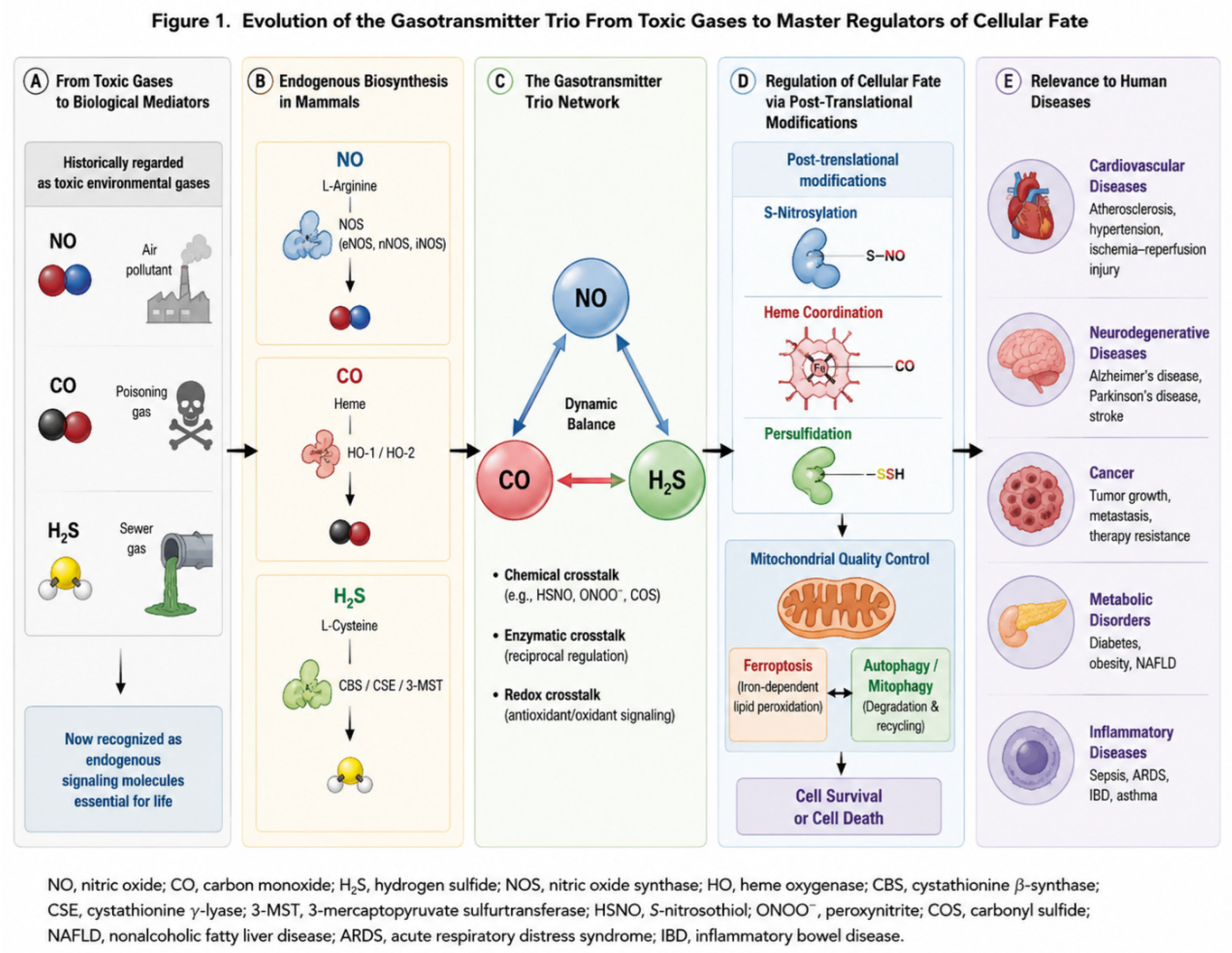
Figure 2.
Biosynthetic pathways, post-translational modifications, and major signaling mechanisms of the gasotransmitter trio. Nitric oxide (NO), carbon monoxide (CO), and hydrogen sulfide (H₂S) are synthesized through distinct enzymatic pathways but ultimately converge on shared signaling networks that regulate cellular homeostasis. (A) Biosynthetic pathways. NO is generated from L-arginine by nitric oxide synthase (NOS) isoforms, including endothelial NOS (eNOS), neuronal NOS (nNOS), and inducible NOS (iNOS), in the presence of cofactors such as tetrahydrobiopterin (BH₄), flavin adenine dinucleotide (FAD), flavin mononucleotide (FMN), and NADPH. CO is produced during heme degradation by heme oxygenase-1 (HO-1) and heme oxygenase-2 (HO-2), generating CO, biliverdin, and ferrous iron (Fe²⁺). H₂S is synthesized primarily from sulfur-containing amino acids by cystathionine β-synthase (CBS), cystathionine γ-lyase (CSE), and 3-mercaptopyruvate sulfurtransferase (3-MST), with tissue-specific expression patterns. (B) Gasotransmitter-mediated post-translational modifications (PTMs). NO regulates protein function through reversible S-nitrosylation of reactive cysteine residues, thereby influencing enzymatic activity, protein stability, intracellular trafficking, and signal transduction. CO exerts its biological effects primarily through heme coordination, in which binding to ferrous heme centers modulates the activity of heme-containing proteins, including soluble guanylate cyclase (sGC), cytochrome c oxidase, cytochrome P450 enzymes, and globins. H₂S mediates protein persulfidation (sulfhydration), converting cysteine thiols (-SH) into persulfides (-SSH), thereby protecting proteins from irreversible oxidation and regulating diverse cellular signaling pathways. (C) Major signaling mechanisms and downstream targets. Despite their distinct chemical properties, the three gasotransmitters converge on several shared signaling pathways. Direct targets include soluble guanylate cyclase (sGC), ATP-sensitive potassium (KATP) channels, calcium-sensitive ion channels, and multiple heme-containing proteins. These interactions modulate cyclic guanosine monophosphate (cGMP) signaling, membrane excitability, mitochondrial respiration, and cellular metabolism. Furthermore, NO, CO, and H₂S regulate redox-sensitive pathways including Nrf2/ARE, NF-κB, and HIF-1α signaling, thereby influencing antioxidant defense, inflammatory responses, hypoxic adaptation, and mitochondrial quality control. Through coordinated regulation of mitochondrial biogenesis, electron transport chain activity, and reactive oxygen/nitrogen species (ROS/RNS) homeostasis, the gasotransmitter trio serves as a central regulator of cellular adaptation and survival under physiological and pathological conditions. ARE, antioxidant response element; BH₄, tetrahydrobiopterin; CBS, cystathionine β-synthase; CSE, cystathionine γ-lyase; FMN, flavin mononucleotide; FAD, flavin adenine dinucleotide; HIF-1α, hypoxia-inducible factor-1α; HO, heme oxygenase; KATP, ATP-sensitive potassium channel; NF-κB, nuclear factor kappa B; Nrf2, nuclear factor erythroid 2-related factor 2; NOS, nitric oxide synthase; ROS, reactive oxygen species; RNS, reactive nitrogen species; sGC, soluble guanylate cyclase; 3-MST, 3-mercaptopyruvate sulfurtransferase.
Figure 2.
Biosynthetic pathways, post-translational modifications, and major signaling mechanisms of the gasotransmitter trio. Nitric oxide (NO), carbon monoxide (CO), and hydrogen sulfide (H₂S) are synthesized through distinct enzymatic pathways but ultimately converge on shared signaling networks that regulate cellular homeostasis. (A) Biosynthetic pathways. NO is generated from L-arginine by nitric oxide synthase (NOS) isoforms, including endothelial NOS (eNOS), neuronal NOS (nNOS), and inducible NOS (iNOS), in the presence of cofactors such as tetrahydrobiopterin (BH₄), flavin adenine dinucleotide (FAD), flavin mononucleotide (FMN), and NADPH. CO is produced during heme degradation by heme oxygenase-1 (HO-1) and heme oxygenase-2 (HO-2), generating CO, biliverdin, and ferrous iron (Fe²⁺). H₂S is synthesized primarily from sulfur-containing amino acids by cystathionine β-synthase (CBS), cystathionine γ-lyase (CSE), and 3-mercaptopyruvate sulfurtransferase (3-MST), with tissue-specific expression patterns. (B) Gasotransmitter-mediated post-translational modifications (PTMs). NO regulates protein function through reversible S-nitrosylation of reactive cysteine residues, thereby influencing enzymatic activity, protein stability, intracellular trafficking, and signal transduction. CO exerts its biological effects primarily through heme coordination, in which binding to ferrous heme centers modulates the activity of heme-containing proteins, including soluble guanylate cyclase (sGC), cytochrome c oxidase, cytochrome P450 enzymes, and globins. H₂S mediates protein persulfidation (sulfhydration), converting cysteine thiols (-SH) into persulfides (-SSH), thereby protecting proteins from irreversible oxidation and regulating diverse cellular signaling pathways. (C) Major signaling mechanisms and downstream targets. Despite their distinct chemical properties, the three gasotransmitters converge on several shared signaling pathways. Direct targets include soluble guanylate cyclase (sGC), ATP-sensitive potassium (KATP) channels, calcium-sensitive ion channels, and multiple heme-containing proteins. These interactions modulate cyclic guanosine monophosphate (cGMP) signaling, membrane excitability, mitochondrial respiration, and cellular metabolism. Furthermore, NO, CO, and H₂S regulate redox-sensitive pathways including Nrf2/ARE, NF-κB, and HIF-1α signaling, thereby influencing antioxidant defense, inflammatory responses, hypoxic adaptation, and mitochondrial quality control. Through coordinated regulation of mitochondrial biogenesis, electron transport chain activity, and reactive oxygen/nitrogen species (ROS/RNS) homeostasis, the gasotransmitter trio serves as a central regulator of cellular adaptation and survival under physiological and pathological conditions. ARE, antioxidant response element; BH₄, tetrahydrobiopterin; CBS, cystathionine β-synthase; CSE, cystathionine γ-lyase; FMN, flavin mononucleotide; FAD, flavin adenine dinucleotide; HIF-1α, hypoxia-inducible factor-1α; HO, heme oxygenase; KATP, ATP-sensitive potassium channel; NF-κB, nuclear factor kappa B; Nrf2, nuclear factor erythroid 2-related factor 2; NOS, nitric oxide synthase; ROS, reactive oxygen species; RNS, reactive nitrogen species; sGC, soluble guanylate cyclase; 3-MST, 3-mercaptopyruvate sulfurtransferase.
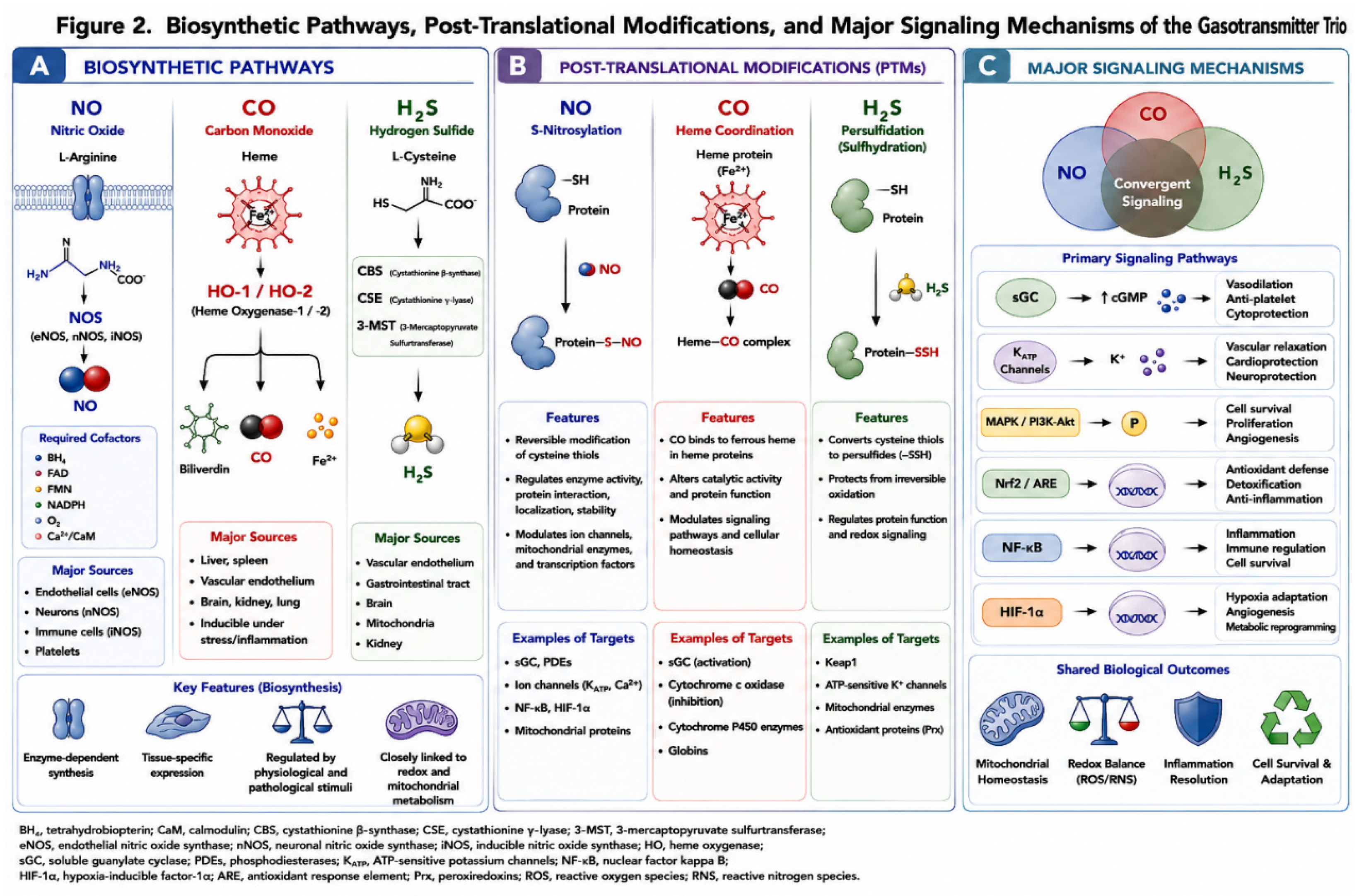
Figure 3.
Molecular crosstalk network among nitric oxide (NO), carbon monoxide (CO), and hydrogen sulfide (H₂S). The biological activities of NO, CO, and H₂S are coordinated through multiple layers of molecular crosstalk, including direct chemical reactions, reciprocal enzymatic regulation, integration of redox signaling, and convergence on shared downstream pathways. (A) Chemical crosstalk. NO and H₂S interact chemically to generate a variety of reactive sulfur–nitrogen intermediates, including nitrosopersulfide (SSNO⁻), nitroxyl (HNO), and other sulfur–nitrogen hybrid species. These intermediates exhibit distinct biological activities compared with their parent molecules and may serve as prolonged reservoirs of signaling capacity. Interactions among NO, CO, and H₂S further influence gasotransmitter bioavailability, redox balance, and reactive species formation. (B) Enzymatic crosstalk. The biosynthetic enzymes responsible for gasotransmitter generation are reciprocally regulated. H₂S enhances endothelial nitric oxide synthase (eNOS) activity through sulfhydration-dependent mechanisms and preservation of tetrahydrobiopterin (BH₄), thereby increasing NO production. NO induces heme oxygenase-1 (HO-1) expression through Nrf2- and HIF-1α-dependent pathways, thereby increasing endogenous CO generation. Conversely, CO and H₂S can modulate the activity and expression of nitric oxide synthases (NOS), CBS, CSE, and HO enzymes, creating an interconnected feedback network. (C) Redox crosstalk. All three gasotransmitters participate in the regulation of cellular redox homeostasis. NO activates soluble guanylate cyclase (sGC) and cGMP signaling, CO modulates mitochondrial respiration through interactions with cytochrome c oxidase (Complex IV), and H₂S promotes activation of the Nrf2/ARE antioxidant pathway through persulfidation of Keap1. Together, these mechanisms coordinate antioxidant defense, mitochondrial adaptation, and cellular stress responses. (D) Convergence on common signaling pathways. Despite their distinct biosynthetic origins, NO, CO, and H₂S converge on several shared signaling nodes, including the sGC–cGMP–PKG axis, ATP-sensitive potassium (KATP) channels, PI3K/Akt signaling, MAPK pathways, Nrf2-mediated antioxidant responses, NF-κB-dependent inflammatory signaling, HIF-1α-mediated hypoxic adaptation, mitochondrial quality control pathways, and calcium signaling networks. Through these shared pathways, gasotransmitters collectively regulate cell survival, metabolism, angiogenesis, inflammation, and stress adaptation. (E) Physiological and pathophysiological outcomes. Balanced gasotransmitter crosstalk supports vascular homeostasis, neuroprotection, mitochondrial fitness, antioxidant defense, and immune regulation. In contrast, dysregulation of the gasotransmitter network contributes to the development of cardiovascular disease, neurodegeneration, metabolic disorders, chronic inflammation, fibrosis, and cancer progression. Thus, cellular adaptation and disease susceptibility are determined not only by the abundance of individual gasotransmitters but also by the integrity of the overall gasotransmitter trio network. ARE, antioxidant response element; BH₄, tetrahydrobiopterin; CBS, cystathionine β-synthase; CSE, cystathionine γ-lyase; eNOS, endothelial nitric oxide synthase; HIF-1α, hypoxia-inducible factor-1α; HO, heme oxygenase; KATP, ATP-sensitive potassium channel; MAPK, mitogen-activated protein kinase; NF-κB, nuclear factor kappa B; Nrf2, nuclear factor erythroid 2-related factor 2; NOS, nitric oxide synthase; PI3K, phosphoinositide 3-kinase; PKG, protein kinase G; ROS, reactive oxygen species; sGC, soluble guanylate cyclase; SSNO⁻, nitrosopersulfide; HNO, nitroxyl; 3-MST, 3-mercaptopyruvate sulfurtransferase.
Figure 3.
Molecular crosstalk network among nitric oxide (NO), carbon monoxide (CO), and hydrogen sulfide (H₂S). The biological activities of NO, CO, and H₂S are coordinated through multiple layers of molecular crosstalk, including direct chemical reactions, reciprocal enzymatic regulation, integration of redox signaling, and convergence on shared downstream pathways. (A) Chemical crosstalk. NO and H₂S interact chemically to generate a variety of reactive sulfur–nitrogen intermediates, including nitrosopersulfide (SSNO⁻), nitroxyl (HNO), and other sulfur–nitrogen hybrid species. These intermediates exhibit distinct biological activities compared with their parent molecules and may serve as prolonged reservoirs of signaling capacity. Interactions among NO, CO, and H₂S further influence gasotransmitter bioavailability, redox balance, and reactive species formation. (B) Enzymatic crosstalk. The biosynthetic enzymes responsible for gasotransmitter generation are reciprocally regulated. H₂S enhances endothelial nitric oxide synthase (eNOS) activity through sulfhydration-dependent mechanisms and preservation of tetrahydrobiopterin (BH₄), thereby increasing NO production. NO induces heme oxygenase-1 (HO-1) expression through Nrf2- and HIF-1α-dependent pathways, thereby increasing endogenous CO generation. Conversely, CO and H₂S can modulate the activity and expression of nitric oxide synthases (NOS), CBS, CSE, and HO enzymes, creating an interconnected feedback network. (C) Redox crosstalk. All three gasotransmitters participate in the regulation of cellular redox homeostasis. NO activates soluble guanylate cyclase (sGC) and cGMP signaling, CO modulates mitochondrial respiration through interactions with cytochrome c oxidase (Complex IV), and H₂S promotes activation of the Nrf2/ARE antioxidant pathway through persulfidation of Keap1. Together, these mechanisms coordinate antioxidant defense, mitochondrial adaptation, and cellular stress responses. (D) Convergence on common signaling pathways. Despite their distinct biosynthetic origins, NO, CO, and H₂S converge on several shared signaling nodes, including the sGC–cGMP–PKG axis, ATP-sensitive potassium (KATP) channels, PI3K/Akt signaling, MAPK pathways, Nrf2-mediated antioxidant responses, NF-κB-dependent inflammatory signaling, HIF-1α-mediated hypoxic adaptation, mitochondrial quality control pathways, and calcium signaling networks. Through these shared pathways, gasotransmitters collectively regulate cell survival, metabolism, angiogenesis, inflammation, and stress adaptation. (E) Physiological and pathophysiological outcomes. Balanced gasotransmitter crosstalk supports vascular homeostasis, neuroprotection, mitochondrial fitness, antioxidant defense, and immune regulation. In contrast, dysregulation of the gasotransmitter network contributes to the development of cardiovascular disease, neurodegeneration, metabolic disorders, chronic inflammation, fibrosis, and cancer progression. Thus, cellular adaptation and disease susceptibility are determined not only by the abundance of individual gasotransmitters but also by the integrity of the overall gasotransmitter trio network. ARE, antioxidant response element; BH₄, tetrahydrobiopterin; CBS, cystathionine β-synthase; CSE, cystathionine γ-lyase; eNOS, endothelial nitric oxide synthase; HIF-1α, hypoxia-inducible factor-1α; HO, heme oxygenase; KATP, ATP-sensitive potassium channel; MAPK, mitogen-activated protein kinase; NF-κB, nuclear factor kappa B; Nrf2, nuclear factor erythroid 2-related factor 2; NOS, nitric oxide synthase; PI3K, phosphoinositide 3-kinase; PKG, protein kinase G; ROS, reactive oxygen species; sGC, soluble guanylate cyclase; SSNO⁻, nitrosopersulfide; HNO, nitroxyl; 3-MST, 3-mercaptopyruvate sulfurtransferase.
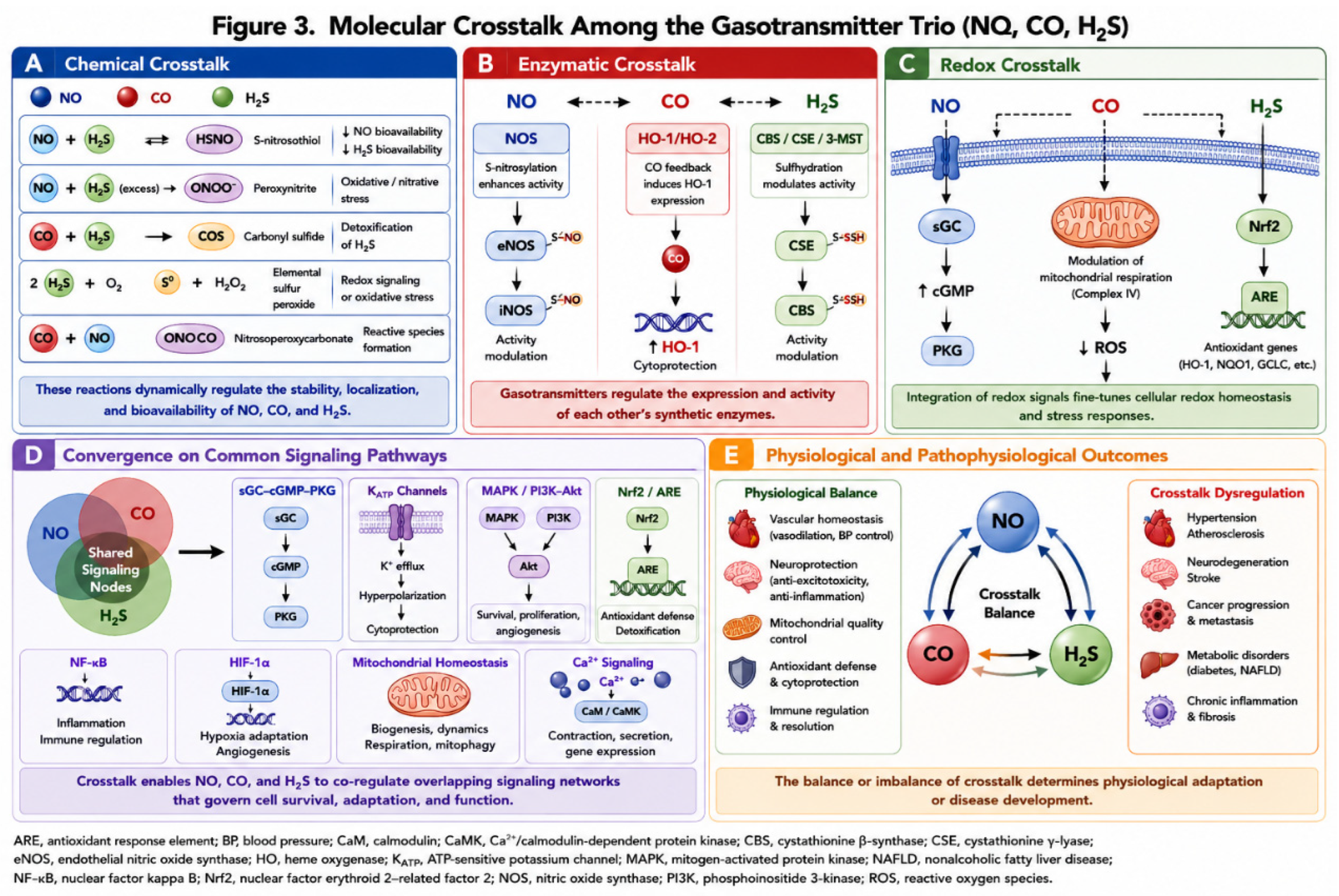
Figure 4.
Regulation of ferroptosis by the gasotransmitter trio (NO, CO, and H₂S). This figure illustrates how the gasotransmitter trio, nitric oxide (NO), carbon monoxide (CO), and hydrogen sulfide (H₂S), suppresses ferroptosis and protects against major cardiovascular diseases. (A) Overview of ferroptosis. Ferroptosis is an iron-dependent, regulated form of cell death driven by excessive lipid peroxidation. Increased intracellular Fe²⁺ (via TfR1/DMT1 uptake and ferritin turnover) generates ROS through the Fenton reaction. ACSL4- and LPCAT3-mediated synthesis of polyunsaturated phospholipids (PUFA-PL) promotes lipid peroxide accumulation, while the GSH-GPX4 axis counteracts this process. (B) Inhibition of ferroptosis by the gasotransmitter trio. NO suppresses ferroptosis via S-nitrosylation of Keap1 and ACSL4, Nrf2 activation, inhibition of ferritinophagy, and reduced PUFA-PL synthesis. CO induces HO-1, generates biliverdin/bilirubin, suppresses pro-ferroptotic enzymes (ACSL4, LPCAT3, 5-LOX, NOX), and preserves mitochondrial function. H₂S inhibits ferroptosis through Keap1 persulfidation, Nrf2 activation, GPX4 preservation, enhanced GSH utilization, and free iron sequestration. (C) Modulation of core ferroptotic pathways. The gasotransmitter trio coordinately regulates iron homeostasis, lipid peroxidation, antioxidant defense, and mitochondrial function, thereby reducing iron-driven oxidative stress, membrane lipid oxidation, and mitochondrial dysfunction. (D) Crosstalk and synergistic regulation. NO, CO, and H₂S exhibit extensive bidirectional interactions: NO induces HO-1/CO production; CO enhances eNOS activity and H₂S biosynthesis; H₂S promotes eNOS activation and HO-1 expression. This network amplifies antioxidant defenses and resistance to ferroptosis. (E) Physiological and pathological implications. Balanced gasotransmitter signaling suppresses ferroptosis and confers cardioprotection, neuroprotection, and healthy aging. Dysregulated signaling promotes ferroptosis-associated diseases, including atherosclerosis, hypertension, stroke, neurodegeneration, fibrosis, and cancer. (F) Roles in major cardiovascular diseases. In atherosclerosis, the trio improves endothelial function, reduces foam-cell formation and oxidative stress, and inhibits plaque progression. In heart failure, it enhances cardiac performance, preserves mitochondrial energetics, and promotes cardiomyocyte survival. During ischemia–reperfusion injury, it limits oxidative damage, mPTP opening, and infarct size. In vascular calcification, it suppresses VSMC osteogenic differentiation and calcium deposition, preserving vascular compliance. ACSL4, acyl-CoA synthetase long-chain family member 4; DMT1, divalent metal transporter 1; GSH, glutathione; GPX4, glutathione peroxidase 4; HO-1, heme oxygenase-1; LPCAT3, lysophosphatidylcholine acyltransferase 3; Nrf2, nuclear factor erythroid 2-related factor 2; NOX, NADPH oxidase; PUFA-PL, polyunsaturated fatty acid-containing phospholipid; ROS, reactive oxygen species; TfR1, transferrin receptor 1.
Figure 4.
Regulation of ferroptosis by the gasotransmitter trio (NO, CO, and H₂S). This figure illustrates how the gasotransmitter trio, nitric oxide (NO), carbon monoxide (CO), and hydrogen sulfide (H₂S), suppresses ferroptosis and protects against major cardiovascular diseases. (A) Overview of ferroptosis. Ferroptosis is an iron-dependent, regulated form of cell death driven by excessive lipid peroxidation. Increased intracellular Fe²⁺ (via TfR1/DMT1 uptake and ferritin turnover) generates ROS through the Fenton reaction. ACSL4- and LPCAT3-mediated synthesis of polyunsaturated phospholipids (PUFA-PL) promotes lipid peroxide accumulation, while the GSH-GPX4 axis counteracts this process. (B) Inhibition of ferroptosis by the gasotransmitter trio. NO suppresses ferroptosis via S-nitrosylation of Keap1 and ACSL4, Nrf2 activation, inhibition of ferritinophagy, and reduced PUFA-PL synthesis. CO induces HO-1, generates biliverdin/bilirubin, suppresses pro-ferroptotic enzymes (ACSL4, LPCAT3, 5-LOX, NOX), and preserves mitochondrial function. H₂S inhibits ferroptosis through Keap1 persulfidation, Nrf2 activation, GPX4 preservation, enhanced GSH utilization, and free iron sequestration. (C) Modulation of core ferroptotic pathways. The gasotransmitter trio coordinately regulates iron homeostasis, lipid peroxidation, antioxidant defense, and mitochondrial function, thereby reducing iron-driven oxidative stress, membrane lipid oxidation, and mitochondrial dysfunction. (D) Crosstalk and synergistic regulation. NO, CO, and H₂S exhibit extensive bidirectional interactions: NO induces HO-1/CO production; CO enhances eNOS activity and H₂S biosynthesis; H₂S promotes eNOS activation and HO-1 expression. This network amplifies antioxidant defenses and resistance to ferroptosis. (E) Physiological and pathological implications. Balanced gasotransmitter signaling suppresses ferroptosis and confers cardioprotection, neuroprotection, and healthy aging. Dysregulated signaling promotes ferroptosis-associated diseases, including atherosclerosis, hypertension, stroke, neurodegeneration, fibrosis, and cancer. (F) Roles in major cardiovascular diseases. In atherosclerosis, the trio improves endothelial function, reduces foam-cell formation and oxidative stress, and inhibits plaque progression. In heart failure, it enhances cardiac performance, preserves mitochondrial energetics, and promotes cardiomyocyte survival. During ischemia–reperfusion injury, it limits oxidative damage, mPTP opening, and infarct size. In vascular calcification, it suppresses VSMC osteogenic differentiation and calcium deposition, preserving vascular compliance. ACSL4, acyl-CoA synthetase long-chain family member 4; DMT1, divalent metal transporter 1; GSH, glutathione; GPX4, glutathione peroxidase 4; HO-1, heme oxygenase-1; LPCAT3, lysophosphatidylcholine acyltransferase 3; Nrf2, nuclear factor erythroid 2-related factor 2; NOX, NADPH oxidase; PUFA-PL, polyunsaturated fatty acid-containing phospholipid; ROS, reactive oxygen species; TfR1, transferrin receptor 1.
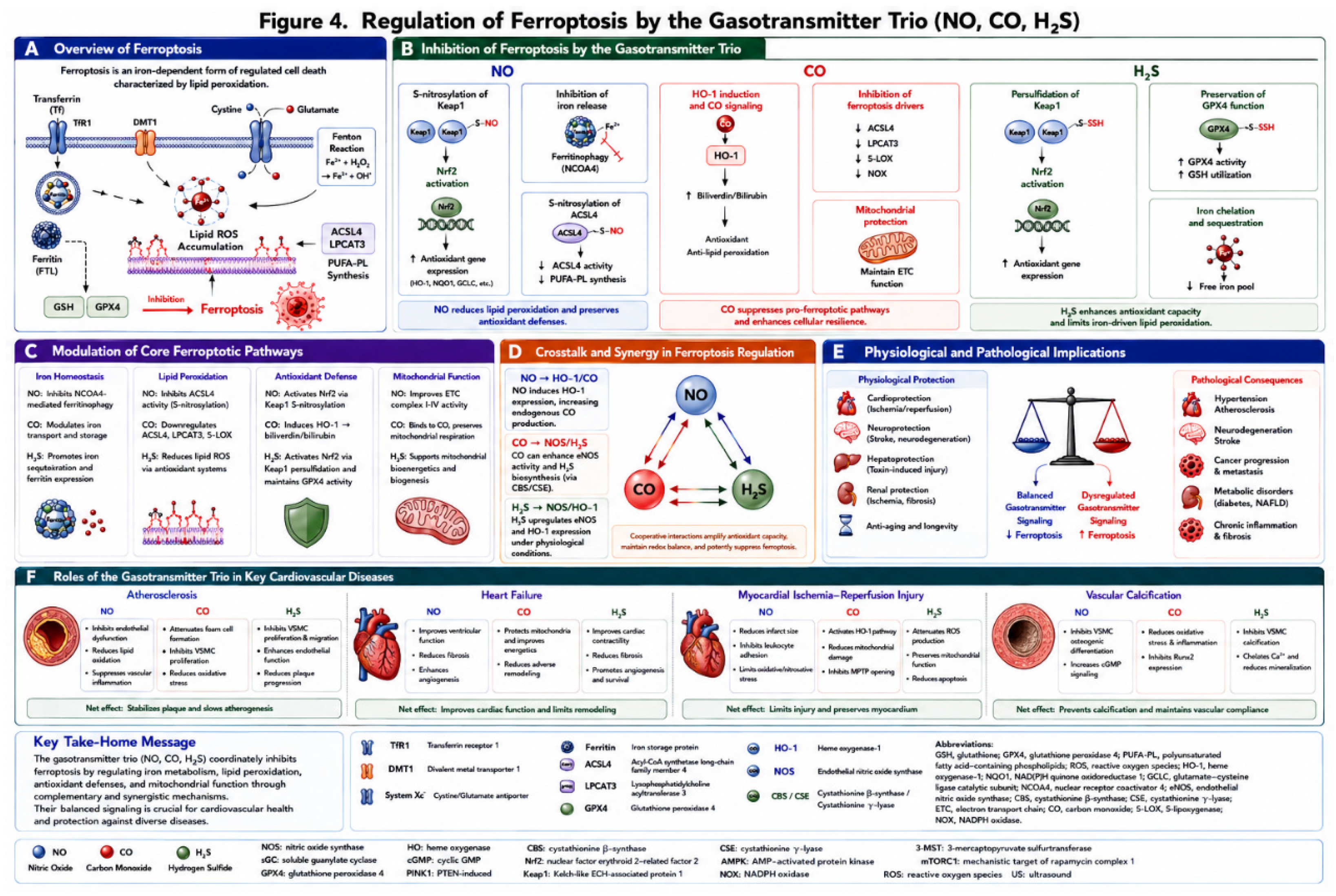
Figure 5.
Regulation of autophagy and mitophagy by the gasotransmitter trio (NO, CO, and H₂S). This figure illustrates the mechanisms by which nitric oxide (NO), carbon monoxide (CO), and hydrogen sulfide (H₂S) regulate autophagy and mitophagy and their implications in cardiovascular and metabolic diseases. (A) Overview of canonical autophagy and mitophagy. Autophagy involves initiation, nucleation, elongation, autophagosome formation, fusion with lysosomes, and cargo degradation. Mitophagy selectively clears damaged mitochondria via the PINK1/Parkin pathway. Key activators include AMPK, ULK1, Beclin-1, ATG proteins, and LC3-II, while mTORC1, AKT, and Bcl-2 act as major inhibitors. (B) Activation by individual gasotransmitters. NO promotes autophagy via S-nitrosylation of AMPK/ULK1 pathways and mTORC1 suppression. CO, generated by HO-1, activates cGMP/PKG and AMPK signaling, reduces oxidative stress, and improves mitochondrial quality control. H₂S induces protein persulfidation, activates AMPK/Beclin-1, inhibits mTORC1, and enhances autophagic flux and mitophagy. Together, they promote clearance of damaged proteins and dysfunctional mitochondria. (C) Modulation of core signaling networks. The gasotransmitter trio converges on key nodes (mTORC1, AMPK, ULK1, Beclin-1, PINK1/Parkin, and lysosomes) to enhance autophagosome formation, mitochondrial turnover, and cargo degradation. (D) Molecular crosstalk and synergy. Bidirectional interactions amplify responses: NO induces HO-1 and CO production; CO enhances eNOS and H₂S biosynthesis; H₂S activates eNOS/AMPK to increase NO bioavailability. This synergy strengthens cytoprotective autophagy under stress. (E) Physiological and pathological implications. Balanced gasotransmitter signaling supports cardioprotection, neuroprotection, metabolic homeostasis, endothelial function, and healthy aging by maintaining autophagic flux and mitochondrial quality control. Dysregulation impairs autophagy/mitophagy, leading to protein aggregation, mitochondrial dysfunction, fibrosis, and disease progression. (F) Therapeutic potential. Strategies include NO donors/eNOS activators, CO-releasing molecules (CORMs)/HO-1 inducers, H₂S donors/CSE activators, and combination therapies. These enhance autophagy, mitophagy, and mitochondrial function, and may slow the progression of cardiovascular and metabolic disease. (G) Roles in cardiovascular cell types. In endothelial cells, the trio maintains vascular homeostasis, reduces oxidative stress, and promotes angiogenesis. In vascular smooth muscle cells, it inhibits proliferation, phenotypic switching, and calcification via autophagy. In macrophages, it drives M2 polarization, efferocytosis, and resolution of inflammation. In cardiomyocytes, it enhances mitophagy, preserves mitochondrial integrity, and protects against ischemia–reperfusion injury and heart failure.
Figure 5.
Regulation of autophagy and mitophagy by the gasotransmitter trio (NO, CO, and H₂S). This figure illustrates the mechanisms by which nitric oxide (NO), carbon monoxide (CO), and hydrogen sulfide (H₂S) regulate autophagy and mitophagy and their implications in cardiovascular and metabolic diseases. (A) Overview of canonical autophagy and mitophagy. Autophagy involves initiation, nucleation, elongation, autophagosome formation, fusion with lysosomes, and cargo degradation. Mitophagy selectively clears damaged mitochondria via the PINK1/Parkin pathway. Key activators include AMPK, ULK1, Beclin-1, ATG proteins, and LC3-II, while mTORC1, AKT, and Bcl-2 act as major inhibitors. (B) Activation by individual gasotransmitters. NO promotes autophagy via S-nitrosylation of AMPK/ULK1 pathways and mTORC1 suppression. CO, generated by HO-1, activates cGMP/PKG and AMPK signaling, reduces oxidative stress, and improves mitochondrial quality control. H₂S induces protein persulfidation, activates AMPK/Beclin-1, inhibits mTORC1, and enhances autophagic flux and mitophagy. Together, they promote clearance of damaged proteins and dysfunctional mitochondria. (C) Modulation of core signaling networks. The gasotransmitter trio converges on key nodes (mTORC1, AMPK, ULK1, Beclin-1, PINK1/Parkin, and lysosomes) to enhance autophagosome formation, mitochondrial turnover, and cargo degradation. (D) Molecular crosstalk and synergy. Bidirectional interactions amplify responses: NO induces HO-1 and CO production; CO enhances eNOS and H₂S biosynthesis; H₂S activates eNOS/AMPK to increase NO bioavailability. This synergy strengthens cytoprotective autophagy under stress. (E) Physiological and pathological implications. Balanced gasotransmitter signaling supports cardioprotection, neuroprotection, metabolic homeostasis, endothelial function, and healthy aging by maintaining autophagic flux and mitochondrial quality control. Dysregulation impairs autophagy/mitophagy, leading to protein aggregation, mitochondrial dysfunction, fibrosis, and disease progression. (F) Therapeutic potential. Strategies include NO donors/eNOS activators, CO-releasing molecules (CORMs)/HO-1 inducers, H₂S donors/CSE activators, and combination therapies. These enhance autophagy, mitophagy, and mitochondrial function, and may slow the progression of cardiovascular and metabolic disease. (G) Roles in cardiovascular cell types. In endothelial cells, the trio maintains vascular homeostasis, reduces oxidative stress, and promotes angiogenesis. In vascular smooth muscle cells, it inhibits proliferation, phenotypic switching, and calcification via autophagy. In macrophages, it drives M2 polarization, efferocytosis, and resolution of inflammation. In cardiomyocytes, it enhances mitophagy, preserves mitochondrial integrity, and protects against ischemia–reperfusion injury and heart failure.
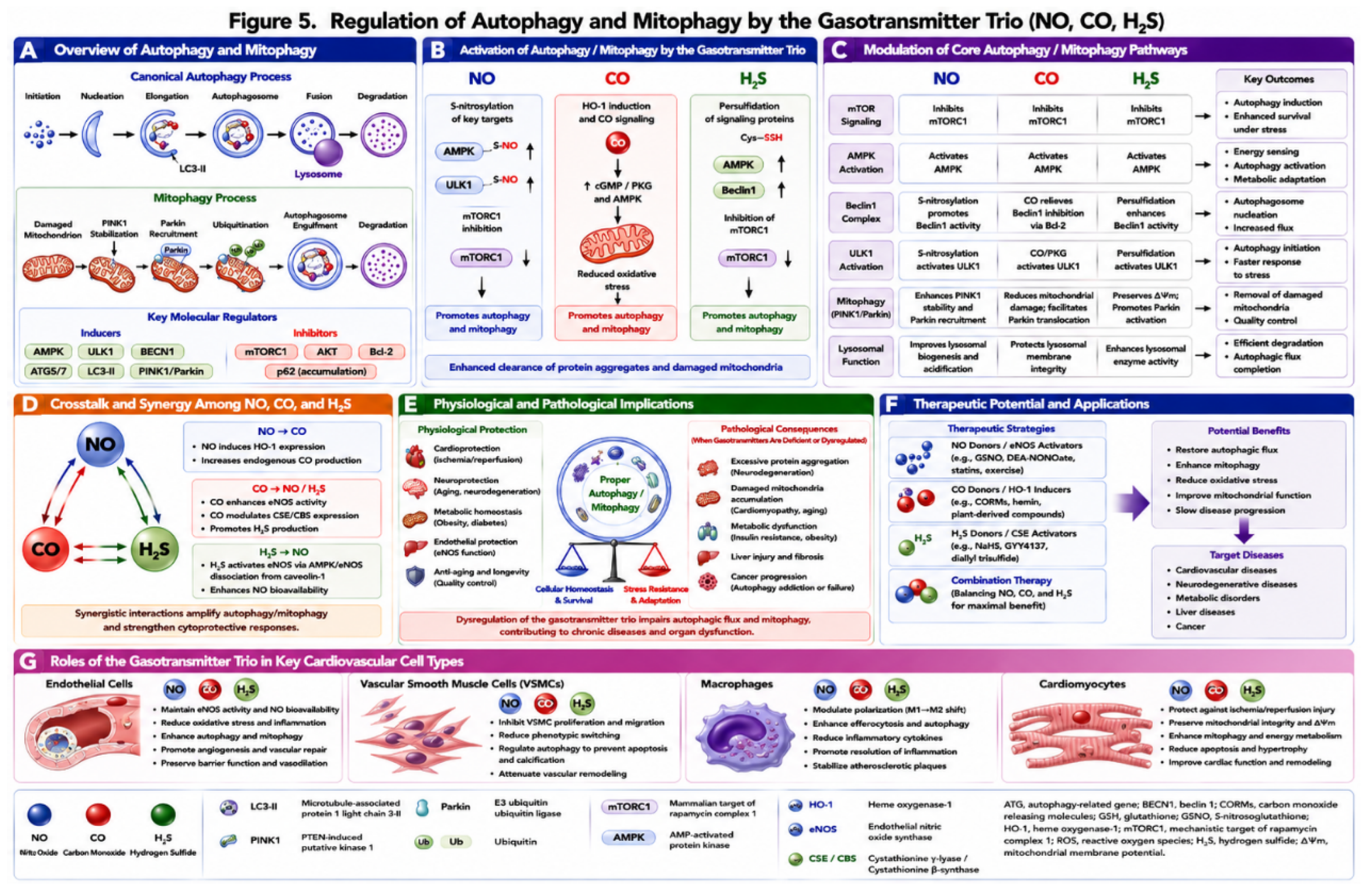
Figure 6.
Smart delivery systems for precision spatiotemporal administration of the gasotransmitter trio (NO, CO, and H₂S). The therapeutic translation of nitric oxide (NO), carbon monoxide (CO), and hydrogen sulfide (H₂S) is constrained by their rapid diffusion, short biological half-lives, limited tissue specificity, and potential systemic toxicity. Recent advances in nanotechnology, biomaterials engineering, and stimuli-responsive chemistry have enabled the development of smart delivery platforms capable of achieving controlled, targeted, and programmable gasotransmitter release. (A) Challenges in gasotransmitter delivery. Free NO, CO, and H₂S exhibit narrow therapeutic windows owing to rapid metabolism, poor localization, and dose-dependent toxicity. NO is rapidly scavenged by hemoglobin and reactive oxygen species, CO binds strongly to hemoglobin and heme-containing proteins, whereas H₂S undergoes rapid mitochondrial oxidation. These characteristics necessitate advanced delivery systems capable of improving bioavailability and therapeutic precision. (B) Smart delivery platforms. Multiple carrier systems have been developed to facilitate controlled gasotransmitter release. Nanoparticles, polymeric micelles, liposomes, metal–organic frameworks (MOFs), gasotransmitter prodrugs, stimuli-responsive nanocarriers, and exosome-based systems enable the protection of gas donors during circulation and enhance their accumulation in target tissues. These platforms can encapsulate nitric oxide-releasing molecules (NORMs), carbon monoxide-releasing molecules (CORMs), and H₂S donors to achieve sustained and programmable release profiles. (C) Targeting strategies. Gasotransmitter nanomedicines can be directed to diseased tissues through passive targeting mechanisms such as enhanced permeability and retention (EPR), active targeting via antibodies, peptides, aptamers, or receptor ligands, mitochondrial targeting using triphenylphosphonium (TPP⁺)-based moieties, and organelle-specific delivery systems. These approaches increase local gas concentrations while minimizing off-target toxicity. (D) Controlled release mechanisms. Modern gasotransmitter carriers can be activated by pathological microenvironmental cues, including acidic pH, elevated reactive oxygen species (ROS), glutathione-rich environments, disease-associated enzymes, hypoxia, or external stimuli such as light, ultrasound, and thermal energy. Such stimulus-responsive systems provide precise spatial and temporal control over gas release and improve therapeutic selectivity. (E) Therapeutic applications and translational potential. Smart gasotransmitter delivery systems have shown promise in cardiovascular disease, neurodegenerative disorders, metabolic diseases, inflammatory conditions, tissue regeneration, and cancer therapy. Controlled delivery of NO, CO, and H₂S can reduce oxidative stress, suppress inflammation, enhance mitochondrial quality control, promote angiogenesis, attenuate fibrosis, and improve tissue repair. Moreover, programmable delivery systems may facilitate combination therapies that exploit synergistic interactions among the gasotransmitter trio. Collectively, advanced delivery platforms are transforming gasotransmitter research from basic signaling biology into a clinically translatable field of precision medicine. Future smart nanomedicines capable of disease-responsive and multi-gas release may enable personalized modulation of the gasotransmitter network in complex human diseases. CORM, carbon monoxide-releasing molecule; EPR, enhanced permeability and retention; GSH, glutathione; MOF, metal–organic framework; NORM, nitric oxide-releasing molecule; PLGA, poly(lactic-co-glycolic acid); ROS, reactive oxygen species; TPP⁺, triphenylphosphonium.
Figure 6.
Smart delivery systems for precision spatiotemporal administration of the gasotransmitter trio (NO, CO, and H₂S). The therapeutic translation of nitric oxide (NO), carbon monoxide (CO), and hydrogen sulfide (H₂S) is constrained by their rapid diffusion, short biological half-lives, limited tissue specificity, and potential systemic toxicity. Recent advances in nanotechnology, biomaterials engineering, and stimuli-responsive chemistry have enabled the development of smart delivery platforms capable of achieving controlled, targeted, and programmable gasotransmitter release. (A) Challenges in gasotransmitter delivery. Free NO, CO, and H₂S exhibit narrow therapeutic windows owing to rapid metabolism, poor localization, and dose-dependent toxicity. NO is rapidly scavenged by hemoglobin and reactive oxygen species, CO binds strongly to hemoglobin and heme-containing proteins, whereas H₂S undergoes rapid mitochondrial oxidation. These characteristics necessitate advanced delivery systems capable of improving bioavailability and therapeutic precision. (B) Smart delivery platforms. Multiple carrier systems have been developed to facilitate controlled gasotransmitter release. Nanoparticles, polymeric micelles, liposomes, metal–organic frameworks (MOFs), gasotransmitter prodrugs, stimuli-responsive nanocarriers, and exosome-based systems enable the protection of gas donors during circulation and enhance their accumulation in target tissues. These platforms can encapsulate nitric oxide-releasing molecules (NORMs), carbon monoxide-releasing molecules (CORMs), and H₂S donors to achieve sustained and programmable release profiles. (C) Targeting strategies. Gasotransmitter nanomedicines can be directed to diseased tissues through passive targeting mechanisms such as enhanced permeability and retention (EPR), active targeting via antibodies, peptides, aptamers, or receptor ligands, mitochondrial targeting using triphenylphosphonium (TPP⁺)-based moieties, and organelle-specific delivery systems. These approaches increase local gas concentrations while minimizing off-target toxicity. (D) Controlled release mechanisms. Modern gasotransmitter carriers can be activated by pathological microenvironmental cues, including acidic pH, elevated reactive oxygen species (ROS), glutathione-rich environments, disease-associated enzymes, hypoxia, or external stimuli such as light, ultrasound, and thermal energy. Such stimulus-responsive systems provide precise spatial and temporal control over gas release and improve therapeutic selectivity. (E) Therapeutic applications and translational potential. Smart gasotransmitter delivery systems have shown promise in cardiovascular disease, neurodegenerative disorders, metabolic diseases, inflammatory conditions, tissue regeneration, and cancer therapy. Controlled delivery of NO, CO, and H₂S can reduce oxidative stress, suppress inflammation, enhance mitochondrial quality control, promote angiogenesis, attenuate fibrosis, and improve tissue repair. Moreover, programmable delivery systems may facilitate combination therapies that exploit synergistic interactions among the gasotransmitter trio. Collectively, advanced delivery platforms are transforming gasotransmitter research from basic signaling biology into a clinically translatable field of precision medicine. Future smart nanomedicines capable of disease-responsive and multi-gas release may enable personalized modulation of the gasotransmitter network in complex human diseases. CORM, carbon monoxide-releasing molecule; EPR, enhanced permeability and retention; GSH, glutathione; MOF, metal–organic framework; NORM, nitric oxide-releasing molecule; PLGA, poly(lactic-co-glycolic acid); ROS, reactive oxygen species; TPP⁺, triphenylphosphonium.
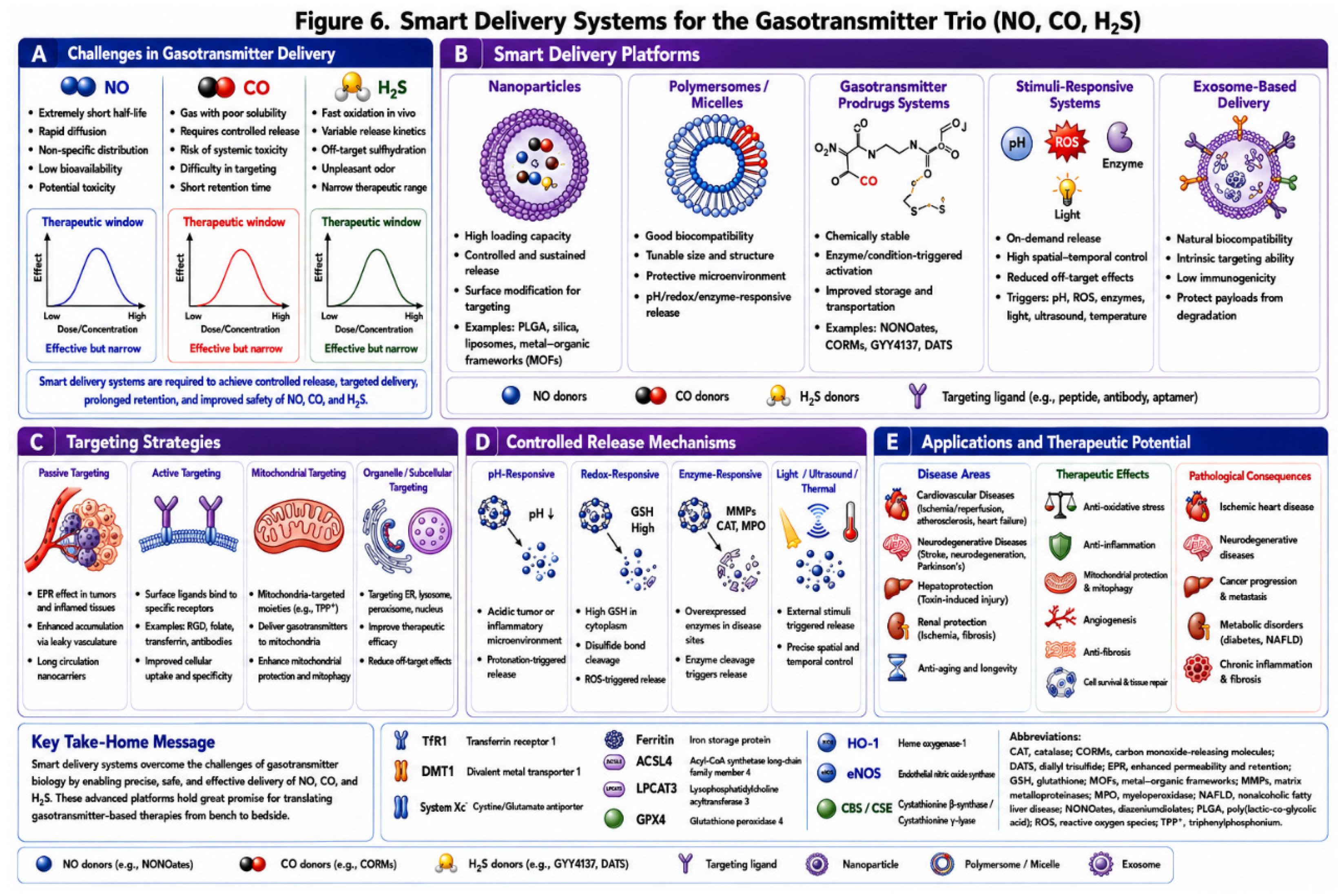
Figure 7.
Toward precision cardiovascular gas medicine: integrating molecular crosstalk, cellular fate regulation, and smart delivery technologies for the gasotransmitter trio (NO, CO, and H₂S). This figure illustrates a future framework for precision gas medicine in which nitric oxide (NO), carbon monoxide (CO), and hydrogen sulfide (H₂S) are viewed as components of an integrated signaling network rather than individual therapeutic agents. (1) Biosynthesis and post-translational modifications (PTMs). Endogenous production of NO, CO, and H₂S is mediated by nitric oxide synthases (NOS), heme oxygenases (HO-1/HO-2), and sulfur-metabolizing enzymes including cystathionine β-synthase (CBS), cystathionine γ-lyase (CSE), and 3-mercaptopyruvate sulfurtransferase (3-MST), respectively. These gasotransmitters exert their biological actions through S-nitrosylation, heme-dependent coordination, and persulfidation, thereby modulating protein function and signaling specificity. (2) Molecular crosstalk network. NO, CO, and H₂S engage in direct chemical interactions, reciprocal enzymatic regulation, and shared redox signaling pathways. These interactions generate hybrid signaling intermediates and coordinate key pathways involving sGC–cGMP signaling, Nrf2 activation, mitochondrial adaptation, inflammatory regulation, and cellular stress responses. (3) Regulation of ferroptosis. The gasotransmitter trio collectively suppresses excessive ferroptosis by modulating iron metabolism, inhibiting lipid peroxidation, activating antioxidant defense systems, and preserving GPX4 activity. Balanced gasotransmitter signaling protects tissues from oxidative injury and ferroptotic cell death. (4) Regulation of autophagy and mitophagy. NO, CO, and H₂S promote mitochondrial quality control through activation of AMPK–ULK1 signaling, inhibition of mTORC1, enhancement of PINK1–Parkin-dependent mitophagy, and maintenance of lysosomal function. These adaptive mechanisms facilitate removal of damaged mitochondria and support cellular survival. (5) Physiological and pathological outcomes. Homeostatic gasotransmitter signaling contributes to cardiovascular protection, neuroprotection, metabolic balance, anti-inflammatory responses, and healthy aging. In contrast, disruption of the gasotransmitter network promotes oxidative stress, mitochondrial dysfunction, inflammation, fibrosis, neurodegeneration, metabolic disorders, and cancer progression. (6) Smart delivery systems. Emerging nanotechnologies, including nanoparticles, liposomes, polymeric micelles, metal–organic frameworks (MOFs), stimuli-responsive carriers, and exosome-based systems, enable controlled, targeted, and programmable delivery of gasotransmitters. These platforms improve therapeutic efficacy while minimizing systemic toxicity. (7) Future precision gas medicine. Integration of gasotransmitter biology with redox proteomics, spatial multi-omics, artificial intelligence-assisted biomarker discovery, and programmable multi-gas delivery systems may enable personalized gasotherapeutics. Future therapeutic strategies are expected to combine real-time disease sensing with spatiotemporally controlled release of NO, CO, and H₂S, thereby optimizing treatment outcomes in cardiovascular, neurodegenerative, inflammatory, metabolic, and malignant diseases. The central concept highlighted in this figure is that cellular fate is determined by coordinated regulation of redox homeostasis and mitochondrial quality control. Future precision gas medicine will therefore depend on the ability to quantitatively monitor and therapeutically modulate the gasotransmitter trio network in a disease-specific and patient-specific manner. AI, artificial intelligence; AMPK, AMP-activated protein kinase; CBS, cystathionine β-synthase; CSE, cystathionine γ-lyase; GPX4, glutathione peroxidase 4; HO, heme oxygenase; MOF, metal–organic framework; mTORC1, mechanistic target of rapamycin complex 1; Nrf2, nuclear factor erythroid 2-related factor 2; NOS, nitric oxide synthase; PINK1, PTEN-induced kinase 1; PTM, post-translational modification; sGC, soluble guanylate cyclase; ULK1, unc-51-like kinase 1; 3-MST, 3-mercaptopyruvate sulfurtransferase.
Figure 7.
Toward precision cardiovascular gas medicine: integrating molecular crosstalk, cellular fate regulation, and smart delivery technologies for the gasotransmitter trio (NO, CO, and H₂S). This figure illustrates a future framework for precision gas medicine in which nitric oxide (NO), carbon monoxide (CO), and hydrogen sulfide (H₂S) are viewed as components of an integrated signaling network rather than individual therapeutic agents. (1) Biosynthesis and post-translational modifications (PTMs). Endogenous production of NO, CO, and H₂S is mediated by nitric oxide synthases (NOS), heme oxygenases (HO-1/HO-2), and sulfur-metabolizing enzymes including cystathionine β-synthase (CBS), cystathionine γ-lyase (CSE), and 3-mercaptopyruvate sulfurtransferase (3-MST), respectively. These gasotransmitters exert their biological actions through S-nitrosylation, heme-dependent coordination, and persulfidation, thereby modulating protein function and signaling specificity. (2) Molecular crosstalk network. NO, CO, and H₂S engage in direct chemical interactions, reciprocal enzymatic regulation, and shared redox signaling pathways. These interactions generate hybrid signaling intermediates and coordinate key pathways involving sGC–cGMP signaling, Nrf2 activation, mitochondrial adaptation, inflammatory regulation, and cellular stress responses. (3) Regulation of ferroptosis. The gasotransmitter trio collectively suppresses excessive ferroptosis by modulating iron metabolism, inhibiting lipid peroxidation, activating antioxidant defense systems, and preserving GPX4 activity. Balanced gasotransmitter signaling protects tissues from oxidative injury and ferroptotic cell death. (4) Regulation of autophagy and mitophagy. NO, CO, and H₂S promote mitochondrial quality control through activation of AMPK–ULK1 signaling, inhibition of mTORC1, enhancement of PINK1–Parkin-dependent mitophagy, and maintenance of lysosomal function. These adaptive mechanisms facilitate removal of damaged mitochondria and support cellular survival. (5) Physiological and pathological outcomes. Homeostatic gasotransmitter signaling contributes to cardiovascular protection, neuroprotection, metabolic balance, anti-inflammatory responses, and healthy aging. In contrast, disruption of the gasotransmitter network promotes oxidative stress, mitochondrial dysfunction, inflammation, fibrosis, neurodegeneration, metabolic disorders, and cancer progression. (6) Smart delivery systems. Emerging nanotechnologies, including nanoparticles, liposomes, polymeric micelles, metal–organic frameworks (MOFs), stimuli-responsive carriers, and exosome-based systems, enable controlled, targeted, and programmable delivery of gasotransmitters. These platforms improve therapeutic efficacy while minimizing systemic toxicity. (7) Future precision gas medicine. Integration of gasotransmitter biology with redox proteomics, spatial multi-omics, artificial intelligence-assisted biomarker discovery, and programmable multi-gas delivery systems may enable personalized gasotherapeutics. Future therapeutic strategies are expected to combine real-time disease sensing with spatiotemporally controlled release of NO, CO, and H₂S, thereby optimizing treatment outcomes in cardiovascular, neurodegenerative, inflammatory, metabolic, and malignant diseases. The central concept highlighted in this figure is that cellular fate is determined by coordinated regulation of redox homeostasis and mitochondrial quality control. Future precision gas medicine will therefore depend on the ability to quantitatively monitor and therapeutically modulate the gasotransmitter trio network in a disease-specific and patient-specific manner. AI, artificial intelligence; AMPK, AMP-activated protein kinase; CBS, cystathionine β-synthase; CSE, cystathionine γ-lyase; GPX4, glutathione peroxidase 4; HO, heme oxygenase; MOF, metal–organic framework; mTORC1, mechanistic target of rapamycin complex 1; Nrf2, nuclear factor erythroid 2-related factor 2; NOS, nitric oxide synthase; PINK1, PTEN-induced kinase 1; PTM, post-translational modification; sGC, soluble guanylate cyclase; ULK1, unc-51-like kinase 1; 3-MST, 3-mercaptopyruvate sulfurtransferase.
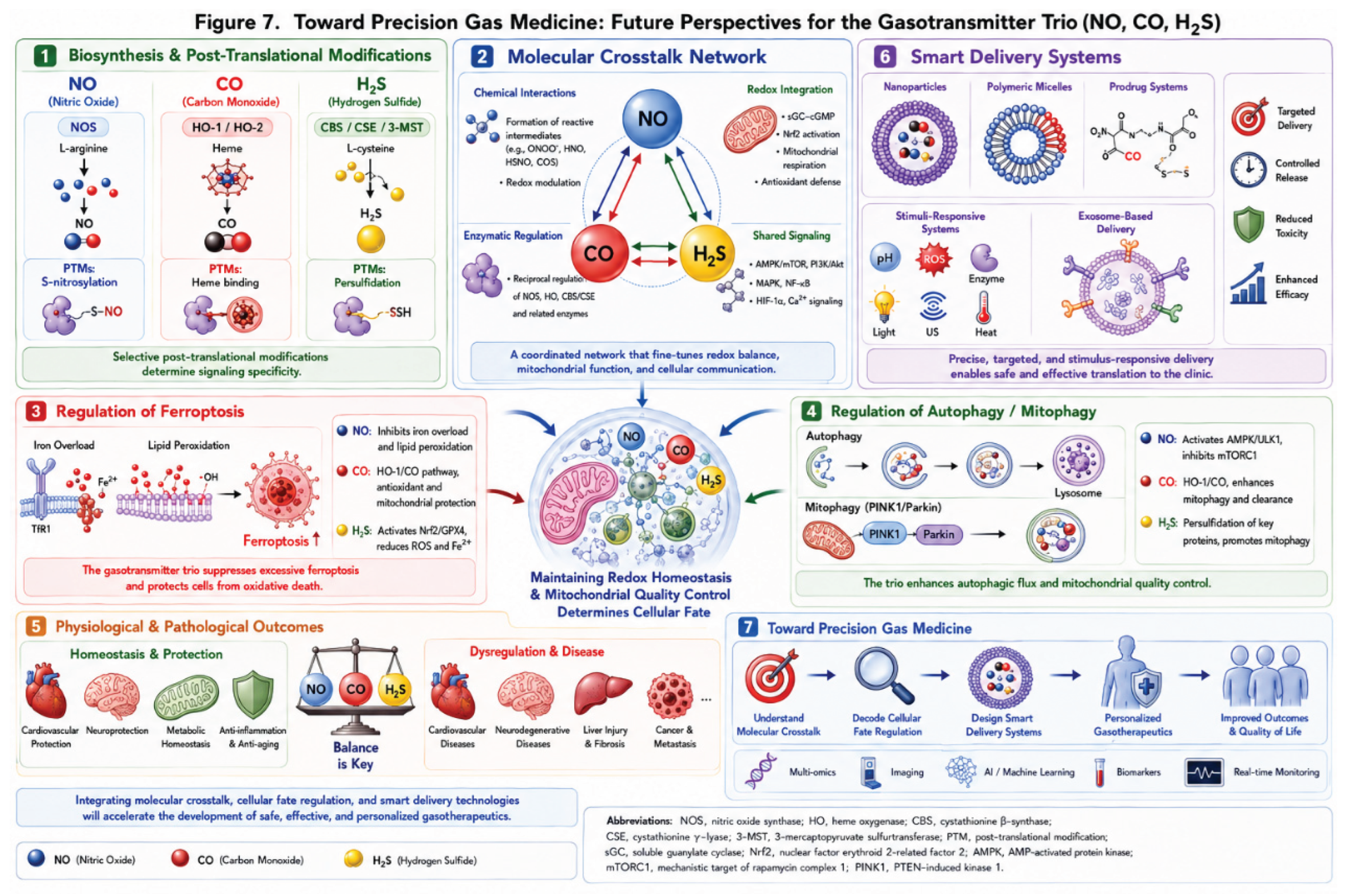

Table 1.
Comparative Overview of Biosynthesis, Molecular Targets, and Signaling Mechanisms of NO, CO, and H₂S.
Table 1.
Comparative Overview of Biosynthesis, Molecular Targets, and Signaling Mechanisms of NO, CO, and H₂S.
| Feature | NO | CO | H₂S |
| Major biosynthetic enzymes | eNOS, nNOS, iNOS | HO-1, HO-2 | CBS, CSE, 3-MST |
| Principal substrate | L-arginine | Heme | L-cysteine and sulfur-containing amino acids |
| Major signaling mechanism | S-nitrosylation; sGC–cGMP activation | Heme coordination; modulation of heme proteins | Persulfidation/sulfhydration |
| Representative molecular targets | sGC, Drp1, NF-κB, mitochondrial proteins | sGC, cytochrome c oxidase, cytochrome P450 enzymes, globins | Keap1, KATP channels, mitochondrial enzymes, antioxidant proteins |
| Major biological effects | Vasodilation, antiplatelet activity, neurotransmission, immune regulation | Anti-inflammation, mitochondrial adaptation, cytoprotection | Antioxidant defense, vasorelaxation, mitochondrial bioenergetics, stress adaptation |
| Pathological risk when excessive | Nitrosative stress, peroxynitrite formation, mitochondrial dysfunction | Hypoxia, mitochondrial inhibition, potential iron dysregulation | Inhibition of cytochrome c oxidase, mitochondrial toxicity |
| Key references | [19,20,21,31,58,59,60,61] | [8,9,10,18,53,54,66,67,68,69] | [25,33,55,56,62,63,64,65] |
Table 2.
Table 2. Molecular crosstalk mechanisms among NO, CO, and H₂S.
| Interaction | Major mechanism | Representative outcome | Key references |
| NO–H₂S | Formation of sulfur–nitrogen hybrid species, including SSNO⁻ | Sustained NO-like signaling and prolonged vasorelaxation | [36,37,70] |
| NO–H₂S | Generation of nitroxyl (HNO) | Cardioprotection and positive inotropic effects | [71,72] |
| H₂S → NO | Enhancement of eNOS phosphorylation, dimerization, and NO bioavailability | Improved endothelial function and vasorelaxation | [35,38,73,74,75] |
| NO → CO | Induction of HO-1 expression through redox- and stress-responsive transcriptional pathways | Increased endogenous CO generation and cytoprotection | [78,79] |
| CO → NO | Modulation of endothelial NO release and eNOS-related signaling | Vasodilation and vascular adaptation | [77] |
| H₂S → CO | Nrf2-dependent HO-1 induction | Antioxidant defense and stress adaptation | [64,80] |
| NO/CO/H₂S convergence | Shared regulation of sGC–cGMP–PKG signaling | Vascular relaxation, antiplatelet activity, cardioprotection | [19,67,81] |
| NO/CO/H₂S convergence | Regulation of KATP channels, Nrf2, NF-κB, HIF-1α, and mitochondrial pathways | Cytoprotection, redox balance, inflammation control | [22,64,68,80,82,83,84] |
Table 3.
Regulatory roles of NO, CO, and H₂S in ferroptosis, autophagy, and mitophagy.
| Gasotransmitter | Effects on ferroptosis | Effects on autophagy/mitophagy | Major pathways or targets | Disease relevance | Key references |
| NO | Suppresses lipid peroxidation by terminating lipid radical chain reactions; preserves GPX4 activity under physiological conditions | Regulates autophagy through redox signaling and S-nitrosylation-dependent mechanisms | Lipid peroxyl radicals, GPX4, ferritin, Drp1, AMPK-related pathways | Cardiovascular injury, neurodegeneration, oxidative stress | [31,58,86,87,95] |
| CO | Context-dependent; moderate HO-1/CO signaling is protective, whereas excessive HO-1 activity may increase labile iron and promote ferroptosis | Activates autophagy through mitochondrial ROS and adaptive stress signaling | HO-1, biliverdin/bilirubin, Fe²⁺, cytochrome c oxidase, mitochondrial ROS | Ischemia–reperfusion injury, cancer, inflammation | [9,22,66,91,92,96] |
| H₂S | Strongly inhibits ferroptosis by preserving GSH homeostasis, activating Nrf2, and maintaining GPX4 activity | Promotes autophagy and mitophagy through persulfidation, AMPK activation, and mitochondrial protection | Keap1–Nrf2, System Xc⁻, GSH, GPX4, mitochondrial enzymes | Cardiomyocyte injury, sepsis-associated injury, metabolic disease | [33,43,64,88,89,90,97] |
| Integrated trio network | Coordinately limits iron-driven lipid peroxidation and maintains redox balance | Supports mitochondrial quality control and cellular adaptation | Nrf2, GPX4, AMPK–mTOR, PINK1–Parkin, mitochondrial homeostasis | Cardiovascular, neurodegenerative, hepatic, renal, inflammatory, and malignant diseases | [39,40,41,42,43,44,45,93,94,98,99,100,101] |
Table 4.
Representative gasotransmitter donors and smart delivery platforms for therapeutic applications.
Table 4.
Representative gasotransmitter donors and smart delivery platforms for therapeutic applications.
| Platform or donor type | Gas delivered | Trigger or release mechanism | Major advantages | Representative applications | Key references |
| Organic NO donors, including NONOates and related donors | NO | Spontaneous, pH-dependent, or chemical decomposition | Rapid NO release; useful experimental tools | Vascular regulation, wound healing, antimicrobial therapy | [102,103,104,105] |
| Light-responsive NO-releasing materials | NO | Photoactivation | Spatial and temporal control of NO release | Local vascular modulation, cancer therapy, biomaterials | [105,106] |
| CORMs | CO | Chemical or ligand-exchange release | Controlled CO administration without inhaled CO exposure | Anti-inflammatory therapy, cytoprotection, cancer therapy | [10,107,108] |
| PhotoCORMs | CO | Light-triggered CO release | On-demand and localized CO delivery | Cancer therapy, inflammatory diseases, mechanistic studies | [109] |
| Enzyme-triggered CORMs | CO | Disease- or enzyme-responsive activation | Improved selectivity and reduced systemic exposure | Targeted CO therapy | [110] |
| Slow-releasing H₂S donors, including GYY4137-type donors | H₂S | Hydrolysis or slow chemical release | Sustained H₂S exposure and reduced toxicity | Cardioprotection, anti-inflammatory therapy, metabolic disease | [111,112,113,114] |
| pH- and ROS-responsive H₂S donors | H₂S | Acidic pH or oxidative microenvironment | Disease-responsive H₂S release | Inflammation, cancer, oxidative injury | [114] |
| Nanoparticles and MOFs | NO, CO, H₂S, or multi-gas systems | Encapsulation, adsorption, or stimulus-responsive release | High loading capacity, tunable release, improved targeting | Cancer, inflammation, cardiovascular disease | [115,116,117] |
| Polymeric micelles, liposomes, and hydrogels | NO, CO, H₂S | Sustained, local, or injectable delivery | Improved stability, local retention, biocompatibility | Regenerative medicine, wound healing, local inflammation | [118,119,120] |
| Cell membrane-coated or exosome-based systems | NO, CO, H |
Table 5.
Future Perspectives and Clinical Translation of Precision Gas Medicine.
| Challenge | Current Limitation | Emerging Technology/Strategy | Potential Clinical Application | Future Direction | Key References |
| Biomarker Identification | Lack of reliable biomarkers reflecting local gasotransmitter activity and signaling status | Multi-omics profiling, spatial transcriptomics, metabolomics, redox proteomics, liquid biopsy | Early disease detection, patient stratification, therapeutic monitoring | Personalized biomarker-guided gasotherapy | [121,122,123,124] |
| Quantification of Endogenous Gases | Difficulty measuring NO, CO, and H₂S concentrations in specific tissues in real time | Fluorescent probes, electrochemical biosensors, molecular imaging, wearable sensing devices | Dynamic monitoring of disease progression and treatment response | Real-time precision gas monitoring systems | [102,103,104,105,106,107,108,109,110,111,112,113,114,115,116,117,118,119,120,121,122,123,124] |
| Dose Optimization | Narrow therapeutic window and concentration-dependent toxicity | Programmable release systems, AI-assisted dose prediction, pharmacokinetic modeling | Individualized dosing regimens | Adaptive precision gas medicine | [102,103,104,105,106,107,108,109,110,111,112,113,114,115,116,117,118,119,120] |
| Tissue-Specific Delivery | Rapid diffusion and lack of target specificity | MOFs, liposomes, polymeric micelles, exosomes, cell membrane-coated nanoparticles | Organ-specific delivery to heart, brain, liver, kidney, and tumors | Precision tissue-targeted therapy | [115,116,117,118,119,120,121,122,123] |
| Multi-Gas Integration | Most current approaches focus on a single gasotransmitter | Multi-gas co-delivery platforms and stimuli-responsive nanomaterials | Reconstitution of physiological gasotransmitter networks | Programmable gasotransmitter network therapy | [115,116,117,118,119,120,121,122,123] |
| Disease Heterogeneity | Variable responses among patients and disease stages | Molecular classification, machine learning, systems biology approaches | Patient stratification and treatment selection | Precision medicine-based intervention | [121,122,123,124] |
| Monitoring Cellular Fate | Lack of biomarkers reflecting ferroptosis, autophagy, and mitophagy status | Ferroptosis-associated lipidomics, circulating miRNAs, mitochondrial biomarkers | Monitoring therapeutic efficacy and disease progression | Cell-fate-guided therapy optimization | [93,94,95,96,97,98,99,100,101] |
| Clinical Translation | Limited clinical trials and regulatory frameworks | GMP-compliant gas donors, scalable nanomedicine manufacturing, regulatory harmonization | Translation into cardiovascular, neurodegenerative, inflammatory, metabolic, and cancer therapies | Evidence-based gasotransmitter therapeutics | [118,119,120,121,122,123,124] |
| Artificial Intelligence Integration | Massive and complex gasotransmitter-related datasets | AI-assisted multi-omics integration, digital twin modeling, predictive analytics | Predictive diagnosis and therapeutic planning | Digital twin-guided precision gasotherapy | [121,122,123,124] |
| Long-Term Safety | Incomplete understanding of chronic exposure effects | Longitudinal cohort studies and real-world evidence platforms | Improved safety assessment and risk prediction | Personalized long-term treatment management | [118,119,120,121,122,123,124] |
Disclaimer/Publisher’s Note: The statements, opinions and data contained in all publications are solely those of the individual author(s) and contributor(s) and not of MDPI and/or the editor(s). MDPI and/or the editor(s) disclaim responsibility for any injury to people or property resulting from any ideas, methods, instructions or products referred to in the content. |
© 2026 by the authors. Licensee MDPI, Basel, Switzerland. This article is an open access article distributed under the terms and conditions of the Creative Commons Attribution (CC BY) license (http://creativecommons.org/licenses/by/4.0/).
Copyright: This open access article is published under a Creative Commons CC BY 4.0 license, which permit the free download, distribution, and reuse, provided that the author and preprint are cited in any reuse.


