

Submitted:
16 June 2026
Posted:
22 June 2026
You are already at the latest version
Abstract
UpstreamBench v0.1 is an expert-style multiple-choice benchmark for evaluating LLMs on upstream petroleum engineering, geoscience, geophysics, petrophysics, drilling, completions, production, geomechanics, and adjacent subsurface workflows. The benchmark contains exactly 7,440 source-linked questions: 20 mechanically validated accepted items from each of 372 technical reference books. UpstreamBench scales the earlier FormationEval benchmark and complements PetroBench with broader book-level coverage, per-source answer balancing, line-level evidence traceability, and an exact nine-model locally hosted evaluation. Its design follows the Citius, Altius, Fortius principle of a faster reproducible pipeline, higher full-corpus coverage, and stronger validation and failure accounting.
Keywords:
large language models
; LLM benchmark
; multiple-choice question answering
; petroleum engineering
; geoscience
; subsurface reasoning
; domain-specific evaluation
1. Introduction
Large language models are now deployed as engineering assistants in petroleum and subsurface work, but most public benchmarks are either broad academic exams or small domain-specific datasets. Upstream petroleum work is unusually sensitive to mechanism reasoning: a plausible answer can be wrong because it violates a pressure-regime assumption, ignores a measurement limitation, confuses seismic acquisition geometry with processing geometry, or applies a rule of thumb outside its operating envelope.
UpstreamBench v0.1 is built to stress those distinctions. It contains 7,440 four-choice questions generated from 372 technical reference books. Every source file contributes exactly 20 accepted questions, and every complete source has a 5/5/5/5 A/B/C/D answer-key distribution. Each item includes source identifiers, SHA-256 hashes, logical source URIs, line spans, evidence hashes, rationale text, domain labels, question-type labels, difficulty labels, and contamination-risk metadata.
The paper’s organizing frame is Citius, Altius, Fortius. Faster means a reproducible, cache-backed build and evaluation pipeline that can run on locally hosted models without paid external API calls. Higher means full coverage of a broad upstream and subsurface corpus rather than a small handpicked subset. Stronger means explicit validation gates, model-roster enforcement, red/green/blue audit checks, duplicate-content disclosure, and reporting of service errors, parse failures, and macro-by-book accuracy rather than only a single micro-average.
The contributions are:
- A 7,440-item upstream petroleum and subsurface MCQ benchmark generated from 372 technical reference books, with exactly 20 mechanically validated accepted questions per source.
- A deterministic validation pipeline for schema, source coverage, answer balance, evidence references, standalone wording, domain labels, question types, rejected-item fingerprints, and manifest consistency.
- A locked nine-model locally hosted evaluation protocol with per-item response caching, strict answer extraction, macro-by-book metrics, latency reporting, and failure diagnostics.
- A transparent release posture for private or copyrighted sources: source chunks and source paths are not redistributed, while source ids, hashes, line references, question metadata, and aggregate results remain auditable by the author.
2. Related Work
General benchmarks such as MMLU [3], MMLU-Pro [4], GPQA [5], ARC [6], and SciBench [7] measure broad academic or scientific competence, but they do not isolate upstream petroleum tasks. Domain-specific benchmarks such as MedQA [8] in medicine and LegalBench [9] in law established field-specific evaluation where correctness depends on professional context.
In geoscience and petroleum, FormationEval [1] introduced a 505-question petroleum geoscience MCQ benchmark with source metadata and contamination-risk labels. PetroBench [2] separately targets petroleum engineering with 1,200 questions across production, reservoir, and drilling engineering. UpstreamBench differs in scale and coverage: it is built from 372 source books, covers upstream and adjacent subsurface disciplines, and uses per-book balancing so that every source contributes equally to macro-by-book accuracy.
Geoscience language modeling and evaluation work such as K2 [10], GeoGalactica [11], and surveys of generative AI in geoscience [12] motivate domain-aware evaluation beyond generic STEM performance. Automatic multiple-choice question generation has a long history [13], and recent work studies distractor generation and iterative refinement [14,15]. UpstreamBench uses LLM-assisted generation, but the accepted artifact is governed by deterministic validators, source evidence pointers, manual rejection fingerprints, and a fixed evaluation allowlist.
3. Benchmark Design
3.1. Scope
UpstreamBench v0.1 covers upstream and adjacent subsurface domains: geophysics and seismology, reservoir engineering, petrophysics, geomechanics, petroleum geology and stratigraphy, drilling and completions, production and facilities, geochemistry and mineralogy, economics and safety, near-surface and marine methods, and machine-learning/data workflows.
3.2. Task Format
The primary task is four-choice multiple choice with exactly one best answer. MCQ is chosen for local, auditable scoring, cheap evaluation across many models, and reliable single-letter answer extraction. Each complete source book contributes exactly 20 accepted questions, with five correct answers in each of A, B, C, and D.
Items are designed to be harder than direct definitions. The generator is instructed to prefer mechanism reasoning, diagnosis, workflow design, failure modes, comparative reasoning, calculations, assumption checks, edge cases, and counterfactual judgments. Trivial source copying is disallowed; questions must be standalone and concept-based.
3.3. Schema
Each item includes:
- id, version, question_format, and language
- domains, topics, difficulty, and question_type
- question, four choices, answer_index, and answer_key
- rationale, requires_calculation, trap_type, and contamination_risk
- source_book with source id, title, logical source URI, rights status, corpus category, and SHA-256
- evidence_refs with evidence id, line span, heading, page hint when available, and excerpt hash
4. Corpus and Construction Pipeline
4.1. Corpus
The source corpus snapshot contains 372 technical reference books totaling 389 MB in the benchmark build (Table 1). Source paths are intentionally not published; public artifacts use source ids, logical source:// URIs, source hashes, and evidence hashes. The 372 source books are not added as 372 bibliography entries because many are restricted or rights-uncleared references; the manifest is the appropriate hash-based inventory. The manifest documents four exact duplicate-content groups. Duplicates are kept because the benchmark requirement is per source file, but duplicate groups are disclosed so that downstream analyses can choose file-level or content-deduplicated views.
4.2. Generation
The builder scans every technical source, removes low-value sections such as tables of contents, references, glossaries, deliverables, exercise-answer blocks, biographies, navigation fragments, and approximate trend statements that cannot support precise calculation questions. It then extracts paragraph-level evidence packets across the full line range of each book. Packets store line spans, headings, page hints when available, compact excerpts, and excerpt hashes.
Question generation uses the approved local generator qwen-3-coder [16]. Raw model output is cached by source. A normalizer converts generated JSON into the benchmark schema, checks the four-choice structure, rejects self-correction artifacts, normalizes labels, assigns source evidence references, and deterministically moves the correct answer into the target answer slot for that item index. This yields per-book answer balance without changing which answer text is correct.
4.3. Validation
The strict validator checks unique ids, benchmark version, MCQ format, English language, standalone wording, four distinct choices, answer-index/key consistency, valid domains, valid difficulty labels, valid question types, rationale length, self-correction artifacts, normalized trap types, contamination-risk labels, calculation flags, logical source metadata, source SHA-256 fields, non-empty evidence references, low-value evidence headings, generator roster membership, source coverage, per-source item counts, per-source answer balance, unknown sources, rejected-item fingerprints, and manifest consistency.
The frozen dataset passes strict validation with no missing, underfilled, overfilled, imbalanced, malformed, or rejected rows. The final validation statistics report 7,440 items, 372 covered sources, zero missing sources, zero underfilled sources, zero overfilled sources, zero imbalanced sources, and zero validation issues. Table 2 and Figure 1 summarize the difficulty, question-type, and domain composition of the frozen dataset.
5. Evaluation Protocol
5.1. Model Allowlist
Evaluation is reported for the exact nine locally hosted model IDs in Table 3. The reported set is intentionally narrow: it is the author’s local no-paid-API run, not a broad public model leaderboard. The qwen-3.6-27b candidate had pilot and partial full-run artifacts, but it did not reach validated full-cache completeness after the scope narrowed; no full-suite score is reported for it.
5.2. Prompting and Metrics
Models receive a zero-shot MCQ prompt and must answer in the format ANSWER: <letter>. The system message identifies the task as a difficult multiple-choice exam in petroleum geoscience, upstream engineering, and subsurface science. The user message includes domain labels, difficulty, the question, choices A–D, and the required output format.
Answer extraction first removes visible <think> or <thinking> blocks and then searches for explicit answer patterns such as ANSWER: A, ANSWER IS A, FINAL ANSWER: A, bare letters, leading letters, and trailing letters. Failed extraction, timeout, null visible content, or service error counts as incorrect. Reports include micro accuracy, macro-by-book accuracy, domain and difficulty breakdowns, parse failures, visible-empty counts, completion-budget exhaustion counts, service-error counts, finish reasons, extraction patterns, and mean latency.
The final run uses temperature 0, maximum 2,048 completion tokens, a 75-second client timeout, no OpenAI SDK retries, and a per-model concurrency of 8. Per-item responses are cached and final result files are reconstructed from cache only after every model has a valid cache record for every frozen benchmark row.
6. Results
Within this exact nine-model locally hosted run, the evaluation covers 7,440 questions with temperature 0.0, 2,048 maximum completion tokens, a 75-second timeout, no SDK retries, and per-model concurrency 8. Scores are reconstructed from validated per-question cache records.
Within this run, qwen-3-vl-235b-fp8 leads at 84.70%, with gemma-4-31b close behind at 84.13%. The first-to-last spread is 59.07%. The largest service-error count is for qwen-3.6-35b (4,876 errors), while the largest visible-empty count is for minimax-m2.7 (2,060 empty responses).
Because each source contributes exactly 20 items, macro-by-book accuracy is close to micro accuracy by construction; this does not remove duplicate-content or domain-composition effects. Operational failures are nevertheless material for slower reasoning-heavy models: visible-empty responses, length finishes, and service errors lower their practical benchmark scores even when some returned answers are correct.
fig:model-accuracy plots the micro-accuracy ranking; Table 5 gives the per-difficulty breakdown.

Table 4.
UpstreamBench exact local evaluation results. Parse failures, empty responses, length finishes, and service errors are counted as incorrect.
Table 4.
UpstreamBench exact local evaluation results. Parse failures, empty responses, length finishes, and service errors are counted as incorrect.
| Rank | Model | Micro | Macro | Correct | Parse | Empty | Length | Errors | Mean (s) |
|---|---|---|---|---|---|---|---|---|---|
| 1 | qwen-3-vl-235b-fp8 | 84.70% | 84.70% | 6,302/7,440 | 31 | 0 | 0 | 31 | 0.95 |
| 2 | gemma-4-31b | 84.13% | 84.13% | 6,259/7,440 | 26 | 0 | 0 | 26 | 6.74 |
| 3 | qwen-3-coder | 83.36% | 83.36% | 6,202/7,440 | 86 | 0 | 87 | 0 | 0.76 |
| 4 | qwen-3-vl-30b | 81.83% | 81.83% | 6,088/7,440 | 94 | 0 | 96 | 0 | 1.30 |
| 5 | gpt-oss-120b | 81.67% | 81.67% | 6,076/7,440 | 50 | 50 | 50 | 0 | 4.69 |
| 6 | qwen-3-vl-8b | 80.03% | 80.03% | 5,954/7,440 | 45 | 0 | 16 | 30 | 1.05 |
| 7 | qwen-3-vl-4b | 76.65% | 76.65% | 5,703/7,440 | 44 | 0 | 45 | 0 | 0.79 |
| 8 | minimax-m2.7 | 64.13% | 64.13% | 4,771/7,440 | 2,144 | 2,060 | 2,066 | 77 | 22.49 |
| 9 | qwen-3.6-35b | 25.63% | 25.63% | 1,907/7,440 | 5,322 | 429 | 446 | 4,876 | 45.76 |
Table 5.
Accuracy by difficulty. Difficulty labels are assigned during benchmark generation and checked by the validator.
Table 5.
Accuracy by difficulty. Difficulty labels are assigned during benchmark generation and checked by the validator.
| Model | Medium | Hard | Expert |
|---|---|---|---|
| qwen-3-vl-235b-fp8 | 86.71% | 84.19% | 85.14% |
| gemma-4-31b | 85.93% | 84.31% | 83.47% |
| qwen-3-coder | 83.43% | 83.12% | 83.73% |
| qwen-3-vl-30b | 80.92% | 81.63% | 82.32% |
| gpt-oss-120b | 82.85% | 81.40% | 81.87% |
| qwen-3-vl-8b | 80.54% | 79.31% | 81.10% |
| qwen-3-vl-4b | 76.11% | 76.56% | 76.91% |
| minimax-m2.7 | 74.37% | 64.46% | 61.56% |
| qwen-3.6-35b | 47.01% | 23.35% | 25.14% |
7. Audit and Reproducibility
The main public release artifacts are:
- data/benchmark/upstreambenchv0.1.jsonl: frozen 7,440-row benchmark.
- data/benchmark/upstreambenchv0.1manifest.json: source coverage, duplicate groups, local model roster, and generation metadata.
- data/working/upstreambench/validationstats.json: strict validation output.
- data/working/upstreambench/modelrosterverification.json: sanitized local model-roster snapshot.
- eval/results/upstreambenchruns.json: canonical exact nine-model result summary rebuilt from validated private local cache records.
- eval/results/upstreambenchleaderboard.md: generated local evaluation table.
Private raw-response caches are retained locally for author-side reconstruction only; they are not redistributed in public artifacts.
For final paper quality control, the build is checked by three audit perspectives. The red check looks for overclaims, outdated draft language, missing caveats, non-reproducible claims, and leakage of private source text. The green check verifies positive claims against frozen artifacts: row counts, source counts, answer balance, model membership, cache completeness, and compile success. The blue check stresses interpretation: whether results distinguish model knowledge from serving availability, whether generator/evaluator overlap is disclosed, whether duplicates are handled honestly, and whether latency/failure metrics are reported alongside accuracy.
8. Limitations
The source corpus includes private or uncleared copyrighted material. UpstreamBench does not redistribute source chunks, long excerpts, source files, or source paths. Public rows use logical source identifiers, source hashes, and evidence hashes; broader redistribution decisions should remain subject to rights review. Evidence references use hashes and line spans for author-side audit.
The questions are LLM-assisted generations from qwen-3-coder. Although strict validators and manual rejection fingerprints remove many mechanical defects, they do not replace expert human review of every item. Since qwen-3-coder is also one evaluated model, its score must be interpreted with generator/evaluator overlap in mind.
The model set is intentionally narrow: exactly nine locally hosted no-paid-API models. This makes the study cost-controlled and reproducible for the author. Counting service timeouts, null content, and completion-budget exhaustion as incorrect reflects practical usability, but it also means some score gaps mix model ability with serving reliability under the fixed protocol.
The manifest contains four exact duplicate-content groups. They are retained to satisfy the per-file coverage requirement, but content-deduplicated analyses should account for them. Finally, contamination cannot be proven absent for modern models; UpstreamBench reports contamination-risk labels rather than claiming zero overlap with pretraining data.
9. Conclusion
UpstreamBench is a 7,440-item, 372-source benchmark for upstream petroleum and subsurface reasoning. It scales FormationEval from a compact public MCQ benchmark into a broader full-corpus benchmark with per-source balancing, line-level evidence metadata, strict validation, and an exact nine-model local evaluation snapshot.
Appendix A. Representative Items and Capability Splits
Appendix A.1. Complete Example Items
- Calculation: gas-processing heat duty. Question: A gas-processing heat duty is 2.5 MJ/s. Using 1 kW = 1.341 hp, what horsepower is equivalent to that duty? Choices: A. About 2,500 hp; B. About 1,860 hp; C. About 3,100 hp; D. About 3,350 hp. Ground truth: D. Rationale: 2.5 MJ/s is 2,500 kW, and 2,500 3,350 hp. Provenance: source id prefix handbook-of-natural-gas-...-afb3b220, evidence hash prefix c2bc3ed34326, lines 14972–14977.
- Assumption check: P&ID documentation. Question: Which item must be excluded from a P&ID per documentation criteria? Choices: A. Relief valve set pressure; B. Controller action, for example direct or reverse acting; C. Analyzer tubing size and specification; D. Local hand switch tags on control panels. Ground truth: B. Rationale: Controller actions, set points, and configuration details are excluded, while operational parameters such as set pressure and tubing specifications must be shown. Provenance: source id prefix pid-doc-...-aa1ccb02, evidence hash prefix b3f4ea868c4f, lines 874–879.
- Failure mode: sulfide stress cracking. Question: Which failure mode is characteristic of sulfide stress cracking in sour environments? Choices: A. Ductile deformation with necking and elongation before fracture; B. Intergranular cracking occurring only at elevated temperatures above ; C. Brittle fracture with minimal plastic deformation, high crack propagation velocity, and transcrystalline cracking; D. Fatigue failure initiated by cyclic pressure fluctuations in the tubing string. Ground truth: C. Rationale: Sulfide stress cracking manifests as brittle fracture with high crack velocity and little visible warning under tensile stress in S environments. Provenance: source id prefix advanced-well-completion-...-c4f8e8a1, evidence hash prefix 8847f8abf732, lines 14302–14313.
- Geophysics: thin-bed seismic resolution. Question: In seismic attribute analysis for channel detection, why might a 20-Hz time-frequency slice derived from CWT processing be insufficient to fully resolve the vertical extent and internal architecture of a thin-bedded channel system? Choices: A. Fixed-frequency slices cannot distinguish lateral facies changes from vertical stratigraphy; B. CWT suppresses high-frequency components needed for thin-bed tuning; C. Phase distortion obscures bed boundaries; D. 20 Hz is below the tuning frequency for typical thin beds, causing constructive interference that masks vertical resolution. Ground truth: D. Rationale: The dominant wavelength at 20 Hz can exceed thin-bed thickness, so reflections from top and base interfere and prevent vertical resolution of the channel architecture. Provenance: source id prefix seismic-attributes-...-dca26ca5, evidence hash prefix 8eee3fcfb4ec, line 2963.
- Reservoir engineering: mobility anisotropy. Question: During a formation test, a near probe records horizontal mobility of 490 md/cp and vertical mobility of 13 md/cp, with a skin factor of 3.0. What does this mobility contrast most strongly suggest? Choices: A. Severe near-wellbore damage affecting vertical flow more than horizontal; B. Conductive horizontal fractures enhancing lateral flow; C. Significant vertical compartmentalization with limited interlayer connectivity; D. Anisotropic permeability with , consistent with laminated sandstone. Ground truth: C. Rationale: The large horizontal-to-vertical mobility contrast indicates strong vertical flow resistance and limited vertical communication between layers despite lateral connectivity. Choice D cites the correct ratio but attributes it to grain-scale lamination, whereas the suppressed vertical mobility most directly indicates interlayer flow barriers, hence C. Provenance: source id prefix formation-testing-fluid-analysis-...-3c578615, evidence hash prefix f3cf68a68dce, line 477.
- Structural geology: fault-bounded trap spillpoint. Question: In structural interpretation across faults, what does the spillpoint of a fault-bounded trap represent? Choices: A. The shallowest depth at which hydrocarbons can migrate across the fault plane via juxtaposition of permeable layers; B. The deepest point of structural closure on the downthrown side; C. The point of maximum fault seal capacity; D. The elevation where the fault plane intersects the top reservoir horizon on the upthrown side. Ground truth: A. Rationale: The spillpoint is the shallowest level at which hydrocarbons can leak or migrate across the fault, controlled by reservoir juxtaposition across the fault plane. Provenance: source id prefix 3-d-seismic-interpretation-...-aedee953, evidence hash prefix 5dd9458c2bc3, line 1177.
Appendix A.2. Valid-Output Capability Splits
The following examples compare models that both returned valid ANSWER: outputs; the split therefore reflects answer choice rather than parse failure or empty content.
- Coiled tubing RIH precaution in high-pressure zones. Ground truth: D. VL-235B answered D correctly, while Coder answered C. The split distinguishes surge-pressure formation-fracture risk from swab-kick control.
- Layered-earth integral-equation geometry limit. Ground truth: B. VL-30B answered B correctly, while Coder answered A. The split distinguishes lateral homogeneity assumptions from the lack of Green’s functions for non-parallel interfaces.
References
- Ermilov, A. FormationEval, an open multiple-choice benchmark for petroleum geoscience. arXiv 2026, arXiv:2601.02158. [Google Scholar] [CrossRef]
- Wang, X.; Zhang, T.; Wang, S.; Wu, Y.; Meng, H.; Zhou, P.; Li, P. PetroBench: A Benchmark for Large Language Models in Petroleum Engineering. arXiv 2026, arXiv:2605.28032. [Google Scholar] [CrossRef]
- Hendrycks, D.; Burns, C.; Basart, S.; Zou, A.; Mazeika, M.; Song, D.; Steinhardt, J. Measuring Massive Multitask Language Understanding. In Proceedings of the International Conference on Learning Representations (ICLR), 2021. [Google Scholar] [CrossRef]
- Wang, Y.; Ma, X.; Zhang, G.; Ni, Y.; Chandra, A.; Guo, S.; Ren, W.; Arulraj, A.; He, X.; Jiang, Z.; et al. MMLU-Pro: A More Robust and Challenging Multi-Task Language Understanding Benchmark. In Proceedings of the Advances in Neural Information Processing Systems (NeurIPS), Datasets and Benchmarks Track, 2024. [Google Scholar] [CrossRef]
- Rein, D.; Hou, B.L.; Stickland, A.C.; Petty, J.; Pang, R.Y.; Dirani, J.; Michael, J.; Bowman, S.R. GPQA: A Graduate-Level Google-Proof Q&A Benchmark. In Proceedings of the Conference on Language Modeling (COLM), 2024. [Google Scholar] [CrossRef]
- Clark, P.; Cowhey, I.; Etzioni, O.; Khot, T.; Sabharwal, A.; Schoenick, C.; Tafjord, O. Think You Have Solved Question Answering? Try ARC, the AI2 Reasoning Challenge. arXiv 2018, arXiv:1803.05457. [Google Scholar] [CrossRef]
- Wang, X.; Hu, Z.; Lu, P.; Zhu, Y.; Zhang, J.; Subramaniam, S.; Loomba, A.R.; Zhang, S.; Sun, Y.; Wang, W. SciBench: Evaluating College-Level Scientific Problem-Solving Abilities of Large Language Models. In Proceedings of the International Conference on Machine Learning (ICML), 2024. [Google Scholar] [CrossRef]
- Jin, D.; Pan, E.; Oufattole, N.; Weng, W.H.; Fang, H.; Szolovits, P. What Disease Does This Patient Have? A Large-Scale Open Domain Question Answering Dataset from Medical Exams. Appl. Sci. 2021, 11, 6421. [Google Scholar] [CrossRef]
- Guha, N.; Nyarko, J.; Ho, D.E.; Ré, C.; Chilton, A.; et al. LegalBench: A Collaboratively Built Benchmark for Measuring Legal Reasoning in Large Language Models. In Proceedings of the Advances in Neural Information Processing Systems (NeurIPS), Datasets and Benchmarks Track, 2023. [Google Scholar] [CrossRef]
- Deng, C.; Zhang, T.; He, Z.; Xu, Y.; Chen, Q.; Shi, Y.; Fu, L.; Zhang, W.; Wang, X.; Zhou, C.; et al. K2: A Foundation Language Model for Geoscience Knowledge Understanding and Utilization. In Proceedings of the Proceedings of the 17th ACM International Conference on Web Search and Data Mining (WSDM), 2024; pp. 161–170. [Google Scholar] [CrossRef]
- Lin, Z.; Deng, C.; Zhou, L.; Zhang, T.; Xu, Y.; Xu, Y.; He, Z.; Shi, Y.; Dai, B.; Song, Y.; et al. GeoGalactica: A Scientific Large Language Model in Geoscience. arXiv 2024, arXiv:2401.00434. [Google Scholar] [CrossRef]
- Hadid, A.; Chakraborty, T.; Busby, D. When Geoscience Meets Generative AI and Large Language Models: Foundations, Trends, and Future Challenges. Expert Syst. 2024, 41, e13654. [Google Scholar] [CrossRef]
- Ch, D.R.; Saha, S.K. Automatic Multiple Choice Question Generation from Text: A Survey. IEEE Trans. Learn. Technol. 2020, 13, 14–25. [Google Scholar] [CrossRef]
- Alhazmi, E.; Sheng, Q.Z.; Zhang, W.E.; Zaib, M.; Alhazmi, A. Distractor Generation in Multiple-Choice Tasks: A Survey of Methods, Datasets, and Evaluation. In Proceedings of the 2024 Conference on Empirical Methods in Natural Language Processing (EMNLP), 2024; Association for Computational Linguistics; pp. 14437–14458. [Google Scholar] [CrossRef]
- Yao, Z.; Parashar, A.; Zhou, H.; Jang, W.S.; Ouyang, F.; Yang, Z.; Yu, H. MCQG-SRefine: Multiple Choice Question Generation and Evaluation with Iterative Self-Critique, Correction, and Comparison Feedback. In Proceedings of the 2025 Conference of the Nations of the Americas Chapter of the Association for Computational Linguistics: Human Language Technologies (NAACL-HLT) Assoc. Comput. Linguist. 2025; pp. 10728–10777. [Google Scholar] [CrossRef]
- Cao, R.; et al. Qwen3-Coder-Next Technical Report. arXiv 2026, arXiv:2603.00729. [Google Scholar] [CrossRef]
Figure 1.
Difficulty distribution for the frozen 7,440-item dataset. The benchmark is dominated by hard and expert items rather than direct-definition questions.
Figure 1.
Difficulty distribution for the frozen 7,440-item dataset. The benchmark is dominated by hard and expert items rather than direct-definition questions.
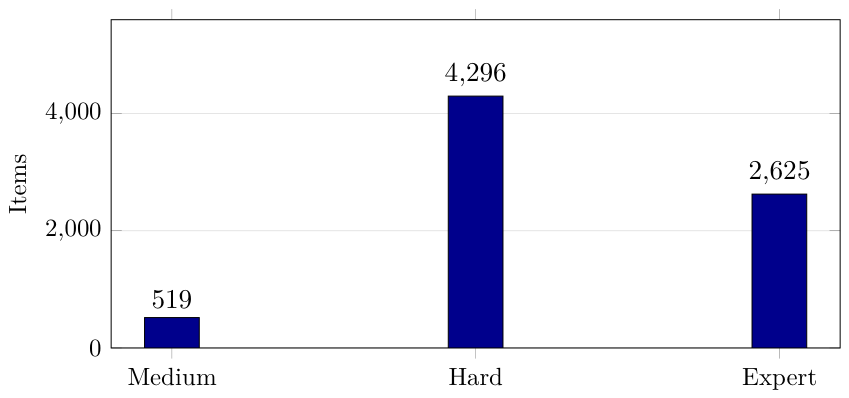
Figure 2.
Micro accuracy in the exact local nine-model run. Exact model ids and failure counts are in Table 4.
Figure 2.
Micro accuracy in the exact local nine-model run. Exact model ids and failure counts are in Table 4.
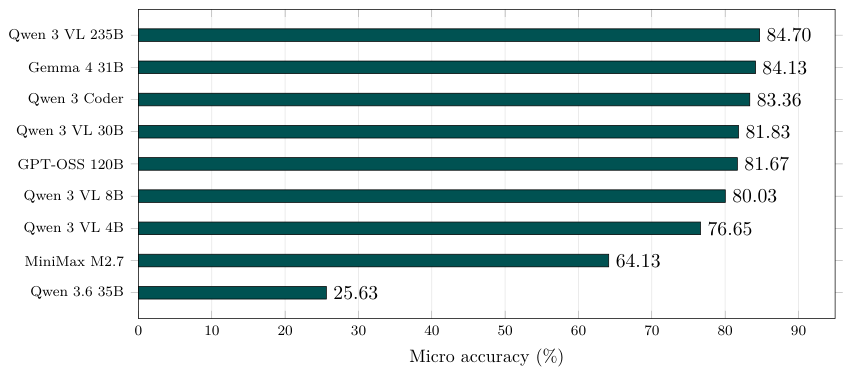
Table 1.
Frozen corpus and dataset status.
| Metric | Value |
|---|---|
| Technical source books | 372 |
| Source corpus size | 389 MB |
| Accepted MCQ items | 7,440 |
| Questions per source file | 20 |
| Source files with accepted items | 372 |
| Answer-key count per letter | 1,860 |
| Exact duplicate-content groups | 4 |
Table 2.
Dataset composition. Domain counts are non-exclusive because an item may carry two domain labels.
Table 2.
Dataset composition. Domain counts are non-exclusive because an item may carry two domain labels.
| Difficulty | Count | Question type | Count | Domain | Count |
|---|---|---|---|---|---|
| Medium | 519 | Mechanism | 3,976 | Geophysics and seismology | 3,915 |
| Hard | 4,296 | Diagnosis | 1,371 | Reservoir engineering | 1,582 |
| Expert | 2,625 | Interpretation | 819 | Petrophysics | 1,158 |
| Workflow design | 321 | Geomechanics | 969 | ||
| Comparative reasoning | 259 | Drilling and completions | 839 | ||
| Calculation | 242 | Petroleum geology and stratigraphy | 834 | ||
| Assumption check | 202 | Geochemistry and mineralogy | 596 | ||
| Failure mode | 128 | Production and facilities | 530 | ||
| Edge case | 63 | Economics, management, and safety | 238 | ||
| Counterfactual | 59 | Near-surface, environmental, and marine | 202 | ||
| Machine learning and data methods | 153 |
Table 3.
Frozen UpstreamBench local model set reported in the paper. No other model is used in the final nine-model evaluation.
Table 3.
Frozen UpstreamBench local model set reported in the paper. No other model is used in the final nine-model evaluation.
| Model id | Hosted family |
|---|---|
| qwen-3-coder | Qwen/Qwen3-Coder-Next |
| qwen-3-vl-235b-fp8 | Qwen/Qwen3-VL-235B-A22B-Instruct-FP8 |
| qwen-3-vl-30b | Qwen/Qwen3-VL-30B-A3B-Instruct |
| qwen-3-vl-8b | Qwen/Qwen3-VL-8B-Instruct |
| qwen-3-vl-4b | Qwen/Qwen3-VL-4B-Instruct |
| qwen-3.6-35b | Qwen/Qwen3.6-35B-A3B |
| gpt-oss-120b | openai/gpt-oss-120b |
| gemma-4-31b | google/gemma-4-31B-it |
| minimax-m2.7 | MiniMaxAI/MiniMax-M2.7 |
Disclaimer/Publisher’s Note: The statements, opinions and data contained in all publications are solely those of the individual author(s) and contributor(s) and not of MDPI and/or the editor(s). MDPI and/or the editor(s) disclaim responsibility for any injury to people or property resulting from any ideas, methods, instructions or products referred to in the content. |
© 2026 by the authors. Licensee MDPI, Basel, Switzerland. This article is an open access article distributed under the terms and conditions of the Creative Commons Attribution (CC BY) license (http://creativecommons.org/licenses/by/4.0/).
Copyright: This open access article is published under a Creative Commons CC BY 4.0 license, which permit the free download, distribution, and reuse, provided that the author and preprint are cited in any reuse.


