

Submitted:
17 June 2026
Posted:
18 June 2026
You are already at the latest version
Abstract
Agriculture is one of the most hazardous occupational sectors, while conventional safety training often suffers from limited realism, low engagement, and reduced opportunities to reproduce hazardous scenarios safely. This article provides a structured analysis of digital and technology-enhanced approaches for safety education and training in agriculture. A literature-based framework was developed by crossing five groups of digital tools—immersive technologies, simulators and digital twins, serious games and gamification, e-learning systems, and AI-based educational tools—with five learning contexts: formal education, vocational education and training, apprenticeships and traineeships, lifelong and on-the-job learning, and peer or community-based learning. In addition, a heuristic Application Priority Score (APS) was proposed to assess each technology–context combination according to evidence availability, cost-benefit feasibility, technology–learner fit, and inclusivity/accessibility. The results show that evidence is unevenly distributed, with stronger attention to immersive technologies, simulation-based approaches, and game-based learning in formal education, whereas lifelong, on-the-job, and peer/community learning remain less explored. The scoring framework also indicates that no single digital tool is universally suitable: the most promising solutions depend on the training context, learner experience, implementation costs, and accessibility barriers. The study provides a context-sensitive framework to support future research and the design of more inclusive and effective digital safety training solutions in agriculture.
Keywords:
agriculture
; training
; safety
1. Introduction
Agriculture is often identified as one of the most hazardous occupational sectors, where fatal risks are three times higher than other sectors [1] and non-fatal injuries and harmful exposures related to machinery, pesticides, animals, awkward postures, noise, dust, and extreme environmental conditions remain constantly present. Agricultural work, in fact, combines physical demands, environmental variability [2], and frequent interaction with potentially dangerous equipment. Given these conditions, safety will strongly rely on effective education and training: however, conventional approaches are often constrained by low realism, reduced engagement, and limited opportunities to reproduce hazardous scenarios safely and repeatedly [3,4]. These limitations are particularly relevant in agriculture, where many risks are context-specific and strongly linked to practical experience. At the same time, agricultural education is undergoing a broader digital transition. In a scoping review of educational technology in agricultural education [5], it has been found that online and distance education technologies were the most widely represented category, followed by simulation and digital games, highlighting the growing role of technology-enhanced learning in agricultural training environments. Their review also pointed out that the literature remains methodologically heterogeneous and that important research gaps persist regarding the educational impact of these tools in agriculture. Within this technological evolution, immersive and interactive tools have attracted increasing attention in safety training research. In a systematic review of virtual reality for safety-relevant training [6], it has also been shown that the use of this approach has grown rapidly and that most studies report positive effects, especially in terms of learner reaction and learning outcomes. Similarly, Scorgie [7] concluded that virtual reality-based safety training generally performs better than traditional training for knowledge acquisition and retention, supporting the educational value of immersive learning environments in hazardous domains. On the other hand, it should be mentioned that many different digital approaches are also relevant: reviewing digital games for occupational safety training, Vigoroso [8,9] noted that serious games and gamification have been applied successfully in several sectors, but remain only marginally explored in agriculture, despite their potential to improve engagement and safety awareness. In addition, AI-supported educational systems are becoming increasingly visible in training protocols: Labadze [10] showed that chatbots can support learners through immediate feedback, explanations, and personalized assistance, helping the educators through time-saving and pedagogical support. In parallel, recent reviews on digital twins in agriculture suggest that these systems can support simulation, monitoring, and scenario analysis, opening further possibilities for training environments based on realistic and data-informed representations of agricultural systems [11].
Despite this growing body of literature, research on digital safety training in agriculture remains fragmented across technological domains and learning contexts. What is still missing is, in fact, an integrated analysis of how different technology-enhanced tools are being investigated for safety education and training in agricultural and farming settings. Therefore, this study aims to classify digital tools for agricultural safety training according to the learning contexts in which they are applied, focusing on five technology groups—immersive technologies, simulators and digital twins, serious games and gamification, e-learning systems, and AI-based educational tools—and five learning contexts: formal education, vocational education and training, apprenticeships and traineeships, lifelong and on-the-job learning, and peer or community-based learning. By doing so, the paper identifies which technology–context combinations are currently supported by evidence and where relevant research gaps remain, indicating at the same time which combinations can be considered to be more promising for safety training in agriculture.
2. Materials and Methods
The research has started by performing a structured literature investigation conducted exclusively in the Scopus database, that has been considered by authors as a fairly good basis for peer-reviewed articles on the subjects of both digital tools and training purposes taxonomies. The search strategy was designed, in fact, to identify studies addressing safety in agricultural and farming contexts in relation to the use of digital and technology-enhanced training tools. To this end, the core concept of safety was systematically combined with terms referring to the agricultural domain and with two main conceptual dimensions: digital training tools and training contexts. The first dimension included five categories of educational technologies:
- immersive technologies (Virtual Reality, Augmented Reality, Mixed Reality, and Extended Reality);
- simulators and digital twins;
- gamification and serious games;
- e-learning systems (including MOOCs and Learning Management Systems);
- AI-based educational tools such as chatbots and AI tutors.
The second dimension, instead, included the principal context in which safety training may occur, namely:
- formal education (school and university);
- vocational education and training (VET);
- apprenticeships and traineeships;
- lifelong learning and on-the-job training (or Training on The Job, ToTJ);
- peer learning or community of practice settings.
The conceptual structure underlying the search design is summarized in Table 1, where the search strings are organized according to the intersection between the different categories of digital tools and training contexts.
The search architecture was hence developed as a 5x5 matrix-based framework, in which each group of digital tools was associated with different educational and training environments relevant to safety learning in agriculture. This approach was adopted to ensure a broad coverage of scientific literature while preserving conceptual consistency with the objectives of the research. In this way, the framework aimed to capture the diversity of digital solutions currently explored for agricultural safety training, as well as the variety of learning settings in which these tools are implemented and the feedback that was received from users. After retrieval, all records were exported and subjected to a multi-stage screening process based on several eligibility criteria that are listed in the following paragraph.
2.1. Study Screening and Eligibility Criteria
After retrieval studies were screened first by title and abstract and, if considered potentially relevant, by full-text assessment. Studies were considered eligible when they focused on safety in agricultural or farming settings and examined, evaluated, or discussed at least one digital training tool within one or more educational or professional learning contexts. More specifically, studies were included when they: (i) addressed the agricultural or farming sector; (ii) focused on safety, risk prevention, hazard awareness, or occupational training; (iii) investigated one or more of the technological approaches included in the study framework; and (iv) were available as full-text documents suitable for qualitative analysis.
Studies were excluded when they: (i) addressed safety in non-agricultural sectors without a clear agricultural application; (ii) focused exclusively on technological development without training or educational dimension; (iii) dealt with agricultural activities but not with safety-related outcomes; or (iv) consisted of editorials, notes, or other publications lacking sufficient methodological or analytical content. Inclusion and exclusion criteria applied during the study selection process are in Table 2, divided by the aim of the criteria adopted for this research.
2.2. Evaluation Methodology Across the Taxonomy
In order to obtain a classification and an evaluation of all the possible safety training solutions for agricultural workers involving digital technologies, each scenario has been singularly analyzed starting from evidence from scientific literature and previous applications (evidence availability, EA). The parameters that would affect the classification the most have been identified by the authors as:
- Cost-benefit feasibility (CBF), where the specific technology has been checked against costs and dimensions of the possible audience;
- Technology-learner fit (TLF), which is meant to keep into account the impact on agricultural workers;
The parameters have hence been divided into possible scenarios, each with a specific score. The results of this classification are shown in Table 3.
Each parameter has been assessed for each scenario, with the aim of calculating an Application Priority Score (APS), which is an overall index that takes into account all the variables shown in Table 3. As a result, digital tools and learning scenarios would receive an APS score that is obtained by multiplying every single score altogether in one parameter that ranges between 0.25 and 80 according to equation 1.
APS = EA x CBF x TLF x IA
The scale of the score aims to represent a wide number of possible scenarios and it might significantly be affected by the barriers that can be faced during agricultural safety training: therefore, methodologies that work well in other working contexts might result not to be fully applicable with agricultural workers were seasonal personnel, elderly and foreign workers might easily be encountered increasing language barriers or difficulties in applying digital technologies.
To clarify the methodological workflow adopted in this study, Figure 1 summarizes the sequence followed from literature retrieval to the calculation of the Application Priority Score (APS). The process was organized into three main phases. First, the literature was retrieved and screened through the 5 × 5 search framework; second, the eligible studies were classified within the resulting technology–context matrix, distinguishing between direct agricultural evidence and transferable evidence from adjacent sectors when no agriculture-specific studies were available; lastly, each scenario was assessed through the four APS dimensions.
This workflow was used to ensure that the final assessment did not depend only on the number of studies retrieved for each query, but also on the expected applicability of each digital tool in specific agricultural safety training contexts. In this sense, the APS was not intended as a validated effectiveness measure, but rather as a heuristic indicator that supports the comparison across various technology–context combinations.
3. Results
3.1. Distribution of Scientific Evidence Within the 5×5 Framework
The following paragraphs describe the scientific evidence from the application of digital and technological solutions in agricultural safety training. This evidence started to appear in scientific literature from the 90’s [14], where educational resources developed through NIOSH-funded Agricultural Health were being reviewed Promotion System projects in universities. Resources included CD-ROM materials, computer-based training modules, slide and workbook packages, posters, videos, tractor overturn displays and full-size tractor driving simulators intended for use in educational activities. Several products were specifically designed for vocational agriculture teachers, students and health professionals. This proves the institutional efforts that have been put into place to incorporate simulation and digital tools into agricultural health and safety education, showing that computer-based and simulation-based safety resources were already considered promising educational tools by that time. From that moment, several possibilities arose [15,16,17,18], such as immersive technologies, simulators, simulators and AI-based tools such as chatbots: unfortunately, not all of them have been deeply studied for specific agricultural scenarios, but still a large variety of scientific studies are available.
3.1.1. Immersive Technologies in Agricultural Safety Training
The use of immersive technologies is often mentioned by the use of Augmented Reality (AR) to overcome the possibility that workers could lose interest in safety programs and to extend these programs also to children. Studies [19,20] concentrate on the application of this technology with children between 5-13 since schools often do not provide safety information regarding production facilities or farms in their courses. The aim of using AR is to make sure that hazardous scenarios can be shown in a realistic way if compared to what happens in farm businesses, including the possibility of examining risks through ease of use and digital tools such as zooming in the scene while walking in the farm through the app. Risk scenarios were selected by an accident database and used in a virtual farm projected on a table, like runover risks involving children, falling from vehicles or being kicked by horses, with the aim of getting useful training information by interviewing participants to understand feasibility, acceptance and implementation challenges.
Among participants to AR safety programs, the feedback is divided into who recognize the possibility of using technology to have a better impact on children education about safety but still have doubts regarding the impact on adults, and others that do not see an improvement in transferring safety information compared to other methodologies. Results showed that such tools have high implementation potential, despite the need to limit the time that children spend on apps in general.
In this context, wearable devices [21] have also been investigated for the use in greenhouse activities, where a high work intensity is present and workers are exposed to heat stress and posture-related stress. In a recent study, tests involved 30 participants and data was transmitted in real-time on a platform designed for interactive visualization of information. These wearable sensors were meant to monitor physiological conditions and to contribute to the reduction of fatigue and environmental effects on workers. The integration of wearable devices designed for safety purposes and human computer interaction (HCI) systems was identified as a research gap since these instruments were often developed separately and remained independent despite growing attention from the agricultural sector. Devices included wristbands, sensors integrated into clothing and AR glasses in order to collect both environmental and body signals, with data transmissions that relied on wireless connections such as Bluetooth or Wi-Fi. Several parameters were also considered to assess data, like data collection efficiency and ground truth information, validating pose estimation gathered from multiple devices. Safety conditions were then evaluated by monitoring stress events and unsafe postures, while worker experience was measured with System Usability Scale (SUS) and NASA-TLX ratings of workload showing a consistent improvement in usability. Study conclusions showed advantages such as the short intervention time, followed by a reduced frequency of posture stress and ease of use of the device, with an improved usability if compared with conventional approaches. Recent youth-oriented immersive safety programs also suggest that virtual reality can be implemented beyond isolated prototypes, although evaluation of long-term learning and behavioral outcomes remains necessary [22].
3.1.2. Simulators and Digital Twins
Simulators are often employed in safety training to make a first impact with agricultural machinery without having to face the hazards that derive from it [23]; in addition, these tools are also employed in education giving the possibility of illustrating agricultural risks to children and students in general. Fathallah [24] used digital ergonomic simulation to assess whether young people can safely operate tractors commonly used on farms. The study combined photogrammetry and CAD-based tractor models to evaluate whether children could effectively reach major tractor controls on 45 tractors in common use in the United States. Results showed that many controls, especially hand-operated ones, could not be reached safely by the majority of youth operators. The study therefore provides a strong ergonomic basis for reconsidering age-related guidelines for tractor work and for strengthening educational messages concerning youth tractor operation. In this case, simulation functions as a preventive assessment tool supporting safer training and policy decisions. In another study from Lleras [25], an open-source tractor driving simulator was developed to study tractor stability and rollover-related safety under controlled conditions [26,27]. The simulator combined a real tractor cab, a custom motion base, a 360-degree high-definition screen, a sound system and a multi-computer network based on open-source software. Its first application focused on tilt perception, showing that operators systematically overestimated roll and pitch, with perceptual errors that may be relevant for defining instability warning thresholds. The study is particularly important because it presents simulation not only as a training environment, but also as a research platform for testing driver perception, warning systems and preventive interfaces without exposing operators to real rollover risks. A subsequent study based on the outcomes of the simulator [28] further developed the tool by examining both tilt perception and alert interfaces for tractor instability. In the first experiment, subjects were exposed to different pitch-roll combinations and asked to reproduce them, showing that roll was generally overestimated while pitch was reproduced more accurately. In the second experiment, the simulator was used to compare visual, haptic and acoustic warning systems activated when the tractor exceeded a hazardous roll threshold. Participants had to divide their attention between maintaining awareness of vehicle stability and monitoring the surrounding environment, making the task more representative of real field operation.
Digital tools have also been tested, Park [29] used hardware-in-the-loop simulation to estimate the safety benefits of electronic stability control systems for tractor-semitrailers. Their system integrated a real pneumatic braking system with the TruckSim simulation engine, allowing actual hardware to be tested in a virtual driving environment. The platform was used to simulate critical rollover-related maneuvers and was validated against field data from the Vehicle Research Test Center. Results showed that electronic stability control increased the speed thresholds at which critical rollover-related events occurred, thereby improving vehicle stability under dangerous conditions. Although the study belongs more to transport safety than to agricultural education, it remains relevant as an example of simulation-based safety assessment applied to heavy vehicle systems involving tractor-semitrailers and automated control technologies.
3.1.3. Serious Games and Gamification
The use of videogames for safety purposes has been investigated by research [8]. A study involved 7 Italian high schools [30] created a game called “becoming safe” that was provided to students and then anonymous questionnaires were collected, after which 62.8% of training was considered useful by the students. More recent contributions have further moved from general evidence on digital games towards user-centered and co-design approaches for agricultural safety training, including the analysis of game preferences and the development of game-based solutions for specific machinery-related risks [9]. In another study, Vigoroso [31] investigated gender differences in digital game preferences with the purpose of supporting the design of more engaging safety training tools for agriculture. An online questionnaire was provided to 137 Italian students with farming experience to explore preferences related to game characteristics and mechanics, genre, and graphic style. The results showed both shared and gender-specific preferences: males and females expressed similar interest in better graphics, dramatic features, better rewards and strategy dynamics, while differences were noted for aspects such as hints and visual styles. Based on these findings, the study proposed a set of practical guidelines for the development of a gamified safety training tool that could generate interest to both genders, highlighting the importance of visual communication adopting a user-centered perspective and showing that the effectiveness of digital safety training in agriculture depends not only on the use of technology itself but also on how game features are designed.
3.1.4. E-learning Systems
Software applications for the reduction of chemical risk is also another field that has been explored regarding the use of e-learning apps [35]. A study from Doruchowski [36] developed an application to reduce the risk of contamination from pesticides, meant as an environmental tool for both experts and stakeholders. The results showed that the tool was considered to be easy for use and included a help service with illustrations and references, and that the tool can be used to raise awareness with pesticide users regarding the impact of pesticide applications.
3.1.5. AI-Based Education Tools
A program based on chatbots has been developed for grassroots farmers [37] to improve their knowledge on rice farming when chemical use was not avoidable, where the program included an interactive lesson with the help of a chatbot to substitute the human role. A pilot exploration was performed to overcome possible complications in knowledge assimilation through interviews and analyses meant to design context-based learning. The chatbot was then used to answer farmers of different ages regarding the selection of appropriate chemicals, promptly providing information or advice to farmers and instructions for mixtures. One of the challenges included the need to break habits that were considered to be safe, change routines based on knowledge and improve the skills related to understanding chemical product labels.
3.1.6. Evidence from Non-Agricultural Contexts with Potential Transferability to Agriculture
Since several intersections framework returned limited or no direct agricultural evidence, selected studies from adjacent non-agricultural safety contexts were considered as transferable examples. These studies were not treated as agricultural evidence, but as methodological references that may support the future design of digital safety training solutions in agriculture. One relevant group of studies concerns realistic simulators from automotive and construction sectors: although these approaches are mainly used transport safety contexts [38], they may support agricultural training along with digital twins and real-time safety management systems which already exist in construction [39]. Finally, non-agricultural serious games tools show how digital environments can be used to increase engagement, support experiential learning, and as already happens with simulators they are able to provide repeated exposure to dangerous scenarios without real risk. These examples suggest that, where direct agricultural evidence is still weak, transferable solutions from construction, transport, and general occupational safety may help identify technological pathways that deserve further testing in agricultural contexts.
3.2. Evaluation of the Feasibility of Digital Media for Agricultural Safety Purposes
The feasibility of digital technologies applied to different safety training contexts generated 25 scenarios in which an APS index has been evaluated. The work started from scientific evidence shown in previous result paragraphs and was further integrated by assessing if the costs derived by the application of the specific digital tool was justified by the size of the expected agricultural workers audience, then verifying if the tool was fit for the audience and lastly if the digital tool was in any way helping or hindering the approach towards different particular groups of people: since the type of audience changes according to the learning context, each scenario needed to be specifically evaluated to understand if the target groups would benefit from the medium and how it could help transfer information to particular worker categories; in fact, agricultural safety training should also keep into account the presence of workers with disabilities or other disadvantaged workers, exploiting the availability of digital and technological advances to overcome possible additional barriers that would exist in the specific context. The result of the analysis is shown in Table 4.
The assessment of each agricultural safety scenario showed that, as expected, there is no one-size-fits-for-all training technology but rather a large variety of possible outcomes that are highly influenced by the audience type, by their number and learning phase. For these reasons there are no high APS scores, which are limited in a range from 1 to 20 and drastically change as they are applied to a different agricultural safety training context despite employing the same technological medium.
A complete overview of the aforementioned evaluation is reported in Figure 2. The different colors indicate if the training tool and training phase represent a good match, from red (bad match) to green (good match).
The heatmap in Figure 2 clearly shows that digital twins have drastically different effects according to the safety training phase, where the APS score changes dramatically along rows especially for lifelong learning and peer or community learning. A similar pattern is observed also along columns, with interactive or specific training tools represent a better fit for the most experienced agricultural workers.
4. Discussion
The research provides a structured framework of how digital and technology-enhanced tools can be employed for safety education and training in agriculture by combining a literature-based taxonomy with a heuristic application priority assessment. The results showed that digital safety training in agriculture is not a homogeneous field, but rather a fragmented research area in which different technologies are unevenly distributed across the different learning contexts. Evidence of this was even more visible for immersive technologies, simulators, digital twins, and serious games especially in formal education or training-like settings. By contrast, applications connected with apprenticeships, lifelong learning, training on the job and peer or community-based learning appeared less developed, despite their practical relevance for agricultural work.
The first relevant finding is that the suitability of a digital tool mainly depends on the learning context and on the expected experience of the target users, where immersive technologies and simulators appear particularly promising in formal education and vocational training and learners may have limited direct exposure to hazardous agricultural tasks. In these contexts, digital tools can reproduce hazardous working conditions, machinery interactions, rollover scenarios for agricultural self-propelled machinery, ergonomic constraints, or environmental hazards without exposing learners to real risk. Their value is therefore linked to safe experiential learning, repeated practice, and visual understanding of complex situations. However, the same technologies become less attractive in lifelong or on-the-job contexts, where workers often need rapid, task-specific, and low-cost support rather than complex simulated environments.
The second important result concerns the role of accessibility and inclusivity since agricultural safety training is often addressed to heterogeneous groups, including seasonal workers, migrant workers, young learners, older operators, and workers with different levels of literacy and digital familiarity. For this reason, the effectiveness of digital training cannot be assessed only in terms of technological complexity and barriers related to cost, equipment availability, digital skills, language, and physical access had to be assessed as well. Conversely, some simpler tools such as e-learning modules, mobile applications, or chatbots can provide lower levels of immersion but greater flexibility and accessibility for any kind of agricultural workers; this is particularly relevant since research showed that game-based training does not become inclusive only by being digital or interactive [31,40].
The APS framework reflects this generalized trade-off, where highest scores do not automatically correspond to the most advanced technologies, but to the combinations in which evidence, feasibility, learner fit, and inclusivity are reasonably aligned. In agricultural contexts, in fact, the most suitable solution may rather be a modular and context-sensitive mix of tools: simulators and immersive systems for early-stage learning and high-risk scenarios; serious games for engagement and hazard awareness; e-learning for structured and scalable knowledge transfer or and AI-based tools or chatbots for continuous, situated, and multilingual support.
The analysis also highlights an important research gap in which several promising technologies–context combinations are still supported mainly by evidence from non-agricultural sectors. This is especially relevant for digital twins, AI-based tutoring systems, and community-based digital learning. Construction, transport, and general occupational safety provide useful transferable examples, but agricultural validation remains necessary given that farms are often characterized by small and heterogeneous enterprises, variable seasonal workforce, operations that depend on seasonality and a strong interaction between formal and informal learning. Therefore, tools developed in other sectors cannot simply be transferred without adaptation; they need to be redesigned according to agricultural tasks, worker profiles, organizational constraints, and local safety cultures.
From a practical perspective, the findings suggest that future digital safety training in agriculture should be designed around the training situation rather than around the technology itself, without following technological trends and where higher costs do not automatically correspond to better results. Formal education may benefit from immersive environments, digital games, and simulators that support first exposure to hazards, while vocational training and apprenticeships may require tools that connect theory with practical action, such as task-based simulation, guided scenarios, or interactive modules. Lifelong and on-the-job training may benefit more from short, mobile, and context-aware resources, including chatbots, visual checklists, or microlearning units, and peer-based contexts may require tools that support exchange of experience, multilingual communication, and collective learning rather than individual performance alone.
Some limitations must however be highlighted in this approach. First, the search was conducted starting exclusively from existing research outcomes, while relevant technical reports, extension materials or non-indexed training resources may not have been captured. This is particularly important in agriculture, where practical safety education is often developed by extension services, public agencies, and professional organizations rather than only through academic publications. Second, the APS is a heuristic and qualitative score and should not be interpreted as a validated measure of effectiveness; the score, in fact, was designed to support comparison and discussion across technology–context combinations but it depends on expert judgement and on the available evidence. Third, several studies included in the analysis were not designed specifically to evaluate learning outcomes or injury reduction, which limits the possibility of drawing strong conclusions on effectiveness.
Despite these limitations, the proposed framework offers a useful basis for organizing a fragmented field and identifying priorities for future research. Further studies should move from conceptual or prototype-level work toward empirical validation, including usability testing, pre-post learning assessment, behavioral indicators, and long-term effects on safety practices. Particular attention should be paid to vulnerable and hard-to-reach worker groups, multilingual design, low-literacy communication and the integration of digital tools into real agricultural safety management processes.
5. Conclusions
This study proposes a cross-classification framework to analyze digital and technology-enhanced tools for safety education and training in agriculture across five learning contexts. Despite that the field is growing, and research articles keep trying new technological solutions applied to different agricultural safety training phases, the framework remains fragmented with evidence concentrated in a limited number of contexts. Immersive technologies, simulators, digital twins, and serious games appear particularly relevant for formal education and early-stage training, where safe exposure to hazardous scenarios is essential. E-learning systems and AI-based tools, including chatbots, appear more suitable for continuous, flexible, and accessible support, especially in lifelong, on-the-job, and community-based learning contexts.
The Application Priority Score (APS) model provided a structured way to compare the potential applicability of different solutions by considering evidence availability, cost-benefit feasibility, technology–learner fit, and inclusivity or accessibility. The results confirm that no single digital tool can be considered universally suitable for agricultural safety training. Instead, the value of each technology depends on the target users, their experience level, the training setting, and the practical barriers that characterize agricultural work.
The main contribution of this paper is therefore not the identification of one best technology, but the proposal of a context-sensitive framework for selecting and prioritizing digital safety training tools in agriculture. Future developments should focus on empirical validation, worker-centered design, multilingual and accessible interfaces, and the adaptation of transferable solutions from other high-risk sectors to the specific conditions of agricultural work. Future research should also investigate hybrid training pathways in which different tools are combined according to the learner’s experience, agricultural task risk level and organizational context.
Author Contributions
Conceptualization, E.M. and D.M.; methodology, E.C.; validation, D.M.; formal analysis, E.M.; investigation, E.M.; resources, E.M.; data curation, E.C.; writing—original draft preparation, E.C.; writing—review and editing, E.M.; visualization, E.C.; supervision, D.M.; project administration, E.M. All authors have read and agreed to the published version of the manuscript.
Funding
Not applicable.
Institutional Review Board Statement
Not applicable.
Informed Consent Statement
Not applicable.
Data Availability Statement
data used for this research is available on request.
Acknowledgments
None.
Conflicts of Interest
The authors declare no conflicts of interest.
Abbreviations
| AI | Artificial Intelligence |
| AR | Augmented Reality |
| APS | Application Priority Score |
| EA | Evidence Availability |
| CAD | Computer-Aided Design |
| CBF | Cost-Benefit Feasibility |
| CD-ROM | Compact Disc Read-Only Memory |
| HCI | Human-Computer Interaction |
| IA | Inclusivity and Accessibility |
| ILO | International Labour Organization |
| LMS | Learning Management System |
| MOOC | Massive Open Online Course |
| MR | Mixed Reality |
| NASA-TLX | Nasa Task Load Index |
| NIOSH | National Institute for Occupational Safety and Health (USA) |
| SUS | System Usability Scale |
| TLF | Technology-Learner Fit |
| ToTJ | Training on The Job |
| VET | Vocational Education and Training |
| VR | Virtual Reality |
| XR | Extended Reality |
References
- International Labour Organization (ILO), C184 - Safety and Health in Agriculture Convention (No. 184). https://normlex.ilo.org/dyn/nrmlx_en/f?p=NORMLEXPUB:12100:0::NO::P12100_INSTRUMENT_ID:312329, 2001.
- P. Rossi, F. Caffaro, and M. Cecchini, “FRAM-Based Safety Culture Model for the Analysis of Socio-Technical and Environmental Variability in Mechanised Agricultural Activities,” Safety, vol. 11, no. 3, p. 80, Aug. 2025. [CrossRef]
- F. Sguaizer, L. Vigoroso, M. Micheletti Cremasco, and F. Caffaro, “Perceived Working Conditions and Intention to Adopt Digital Safety Training in High-Risk Productive Sectors: An Exploratory Study in Manufacturing and Agriculture in Northwest Italy,” Safety, vol. 11, no. 2, p. 51, Jun. 2025. [CrossRef]
- F. Caffaro, G. Bagagiolo, M. Micheletti Cremasco, L. Vigoroso, and E. Cavallo, “Tailoring Safety Training Material to Migrant Farmworkers: An Ergonomic User-Centred Approach,” Int. J. Environ. Res. Public Health, vol. 17, no. 6, p. 2104, Mar. 2020. [CrossRef]
- Z. Xu, A. E. Adeyemi, R. Landaverde, A. Kogut, and M. Baker, “A Scoping Review on the Impact of Educational Technology in Agricultural Education,” Educ. Sci. (Basel)., vol. 13, no. 9, p. 910, Sep. 2023. [CrossRef]
- H. Stefan, M. Mortimer, and B. Horan, “Evaluating the effectiveness of virtual reality for safety-relevant training: a systematic review,” Virtual Real., vol. 27, no. 4, pp. 2839–2869, Dec. 2023. [CrossRef]
- D. Scorgie, Z. Feng, D. Paes, F. Parisi, T. W. Yiu, and R. Lovreglio, “Virtual reality for safety training: A systematic literature review and meta-analysis,” Saf. Sci., vol. 171, p. 106372, Mar. 2024. [CrossRef]
- L. Vigoroso, F. Caffaro, M. Micheletti Cremasco, and E. Cavallo, “Innovating Occupational Safety Training: A Scoping Review on Digital Games and Possible Applications in Agriculture,” Int. J. Environ. Res. Public Health, vol. 18, no. 4, p. 1868, Feb. 2021. [CrossRef]
- L. Vigoroso, F. Caffaro, E. Cavallo, and N. Pampuro, “Co-designing Game Training Solutions to Improve Safety in the Agricultural Sector: Insights for the Correct Use of Foldable Roll-Over Protective Structure,” in Lecture Notes in Civil Engineering, 2024, pp. 433–443. [CrossRef]
- L. Labadze, M. Grigolia, and L. Machaidze, “Role of AI chatbots in education: systematic literature review,” International Journal of Educational Technology in Higher Education, vol. 20, no. 1, p. 56, Oct. 2023. [CrossRef]
- C. Tagarakis, L. Benos, G. Kyriakarakos, S. Pearson, C. G. Sørensen, and D. Bochtis, “Digital Twins in Agriculture and Forestry: A Review,” Sensors, vol. 24, no. 10, p. 3117, May 2024. [CrossRef]
- L. Vigoroso, F. Caffaro, and E. Cavallo, “Occupational safety and visual communication: User-centred design of safety training material for migrant farmworkers in Italy,” Saf. Sci., vol. 121, pp. 562–572, 2020. [CrossRef]
- L. Vigoroso, F. Caffaro, E. Cavallo, and M. M. Cremasco, “User-centred design to promote the effective use of rear-mountefoldable roll-over protective structures (Fropss): Prototype evaluation among novice and expert farmers,” Spanish Journal of Agricultural Research, vol. 19, no. 3, 2021. [CrossRef]
- R. H. McKnight, T. G. Prather, P. H. Jones, R. L. McLymore, and G. H. Hetzel, “Educational resources for agricultural health and safety: Products of NIOSH-funded efforts in four southeastern states,” J. Agromedicine, vol. 2, no. 2, pp. 79–95, 1995. [CrossRef]
- D. B. Reed, P. S. Kidd, S. Westneat, and M. K. Rayens, “Agricultural disability awareness and risk education (AgDARE) for high school students,” Injury Prevention, vol. 7, no. SUPPL. 1, pp. i59–i63, 2001. [CrossRef]
- D. J. Hubert, D. R. Ullrich, T. H. Murphy, and J. R. Lindner, “Texas entry-year agriculture teachers’ perceptions, practices, and preparation regarding safety and health in agricultural education,” J. Agric. Saf. Health, vol. 7, no. 3, pp. 143–153, 2001, [Online]. Available: https://www.scopus.com/inward/record.uri?eid=2-s2.0-0035413468&partnerID=40&md5=66f42edb77c06f0a48354d66db3e36e4.
- B. Bashiri and D. D. Mann, “Impact of automation on drivers’ performance in agricultural semi-autonomous vehicles,” J. Agric. Saf. Health, vol. 21, no. 2, pp. 129–139, 2015. [CrossRef]
- T. Bleazard, M. L. Pate, R. G. Lawver, C. Israelsen, and R. Hatch, “Farmers’ perceptions on the utility of auto-guidance technology to improve operator safety,” in 2016 American Society of Agricultural and Biological Engineers Annual International Meeting, ASABE 2016, 2016. [CrossRef]
- K. Namkoong et al., “Virtual reality for public health: A study on a VR intervention to enhance occupational injury prevention,” Journal of Public Health (United Kingdom), vol. 45, no. 1, pp. 136–144, 2023. [CrossRef]
- K. Namkoong, J. Leach, J. Chen, J. Zhang, and B. Weichelt, “A feasibility study of Augmented Reality Intervention for Safety Education for farm parents and children,” Front. Public Health, vol. 10, 2023. [CrossRef]
- B. Sun, “Application of Wearable Technology and Human-Computer Interaction in Smart AgricultureEnhancing Experiment Monitoring and Worker Interaction,” in Proceedings of 2025 International Conference on Artificial Intelligence, Virtual Reality and Interaction Design, AIVRID 2025, 2026, pp. 286–291. [CrossRef]
- S. Schuelke, A. Yoder, M. Kreifels, and K. Kupzyk, “Implementation of a Statewide Youth Ag Safety Immersive Virtual Reality Program,” J. Agromedicine, vol. 30, no. 3, pp. 496–505, 2025. [CrossRef]
- H. B. Manbeck, D. W. Hofstetter, D. J. Murphy, and V. M. Puri, “Online Design Aid for Evaluating Manure Pit Ventilation Systems to Reduce Entry Risk,” Front. Public Health, vol. 4, 2016. [CrossRef]
- F. A. Fathallah, J. H. Chang, W. Pickett, and B. Marlenga, “Ability of youth operators to reach farm tractor controls,” Ergonomics, vol. 52, no. 6, pp. 685–694, 2009. [CrossRef]
- N. O. Lleras, S. Brennan, D. Murphy, M. Jennifer Klena, P. M. Garvey, and H. J. Sommer, “Development of an open-source tractor driving simulator for tractor stability tests,” Journal of Agricultural Safety and Health, vol. 22, no. 4, pp. 227–246, 2016. [CrossRef]
- G. Carabin, L. Becce, A. Mandler, F. Nicolosi, and F. Mazzetto, “Experimental Validation of the Influence of Obstacles on Tractor Rollover Stability,” in Lecture Notes in Civil Engineering, 2024, pp. 153–163. [CrossRef]
- C. H.-Y., F. Khorsandi, S. G. Vougioukas, and F. A. Fathallah, “Developing and evaluating an autonomous agricultural all-terrain vehicle for field experimental rollover simulations,” Comput. Electron. Agric., vol. 194, 2022. [CrossRef]
- N. O. Lleras, S. Brennan, D. Murphy, J. M. Klena, P. M. Garvey, and I. I. I. Sommer H. J., “Assessing perceptions and alerts of tractor instability,” Chem. Eng. Trans., vol. 58, pp. 7–12, 2017. [CrossRef]
- S. Park, K. Donoughe, and H. Rakha, “Safety benefits of stability control systems for tractor-semitrailers estimated with hardware-in-the-loop simulation,” Transp. Res. Rec., no. 2281, pp. 99–108, 2012. [CrossRef]
- E. Pietrafesa, R. Bentivenga, P. Lalli, C. Capelli, G. Farina, and S. Stabile, “Becoming safe: A serious game for occupational safety and health training in a WBL Italian experience,” in Advances in Intelligent Systems and Computing, 2021, pp. 264–271. [CrossRef]
- L. Vigoroso, F. Caffaro, M. Micheletti Cremasco, and E. Cavallo, “Developing a more engaging safety training in agriculture: Gender differences in digital game preferences,” Saf. Sci., vol. 158, 2023. [CrossRef]
- A. E. Peden, F. McMillan, D. Alonzo, and R. C. Franklin, “Pilot Evaluation of a Co-Designed Gamified Farm Injury Prevention Educational Resource for Adolescents,” J. Agromedicine, vol. 29, no. 4, pp. 615–625, 2024. [CrossRef]
- E. Peden, D. Alonzo, T. P. Tran, R. Q. Ivers, and R. C. Franklin, “Farm Injury and Safety Practices Among Rural Adolescents: A Qualitative Analysis to Support the Development of a Gamified Educational Resource,” J. Agromedicine, vol. 30, no. 3, pp. 468–479, 2025. [CrossRef]
- E. Peden et al., “Co-Designing a Farm Safety Gamified Educational Resource With Secondary School Students and Their Teachers: Qualitative Study Protocol,” Int. J. Qual. Methods, vol. 22, 2023. [CrossRef]
- M. A. Rudolph, S. G. Ehlers, and G. C. Morris, “Development of Quick Response (QR) Training of Tractor Component Identification, Function, Maintenance, and Safety,” J. Agromedicine, vol. 29, no. 3, pp. 511–515, 2024. [CrossRef]
- G. Doruchowski, P. Balsari, E. Gil, P. Marucco, M. Roettele, and W. H.-J., “Environmentally Optimised Sprayer (EOS)-A software application for comprehensive assessment of environmental safety features of sprayers,” Science of the Total Environment, vol. 482–483, no. 1, pp. 201–207, 2014. [CrossRef]
- A. Nokkaew, S. Chuechote, T. Poonpaiboonpipat, and W. Poonpaiboonpipat, “Integration of Context-Based Learning with Informative Chatbot for Grassroots Farmers,” in 2023 11th International Conference on Information and Education Technology (ICIET), IEEE, Mar. 2023, pp. 136–140. [CrossRef]
- R. M. Ziernicki, W. H. Pierce, and A. G. Leiloglou, “Advanced forensic engineering analysis of a school bus/tractor-trailer crash,” Journal of the National Academy of Forensic Engineers, vol. 33, no. 1, pp. 9–24, 2016, [Online]. Available: https://www.scopus.com/inward/record.uri?eid=2-s2.0-85053433088&partnerID=40&md5=b9991dfd9787f388273652eb569888fb.
- L. Messi, A. Corneli, M. Vaccarini, and A. Carbonari, “Development of a Twin Model for Real-time Detection of Fall Hazards,” in Proceedings of the 37th International Symposium on Automation and Robotics in Construction, ISARC 2020: From Demonstration to Practical Use - To New Stage of Construction Robot, 2020, pp. 256–263. [Online]. Available: https://www.scopus.com/inward/record.uri?eid=2-s2.0-85109380514&partnerID=40&md5=2c8434c6e53e7d988f6e92e3713992d6.
- F. Caffaro, G. Bagagiolo, M. Micheletti Cremasco, L. Vigoroso, and E. Cavallo, “Tailoring safety training material to migrant farmworkers: An ergonomic user-centred approach,” Int. J. Environ. Res. Public Health, vol. 17, no. 6, p. 2104, 2020. [CrossRef]
Figure 1.
Flowchart of the methodology employed in this study.
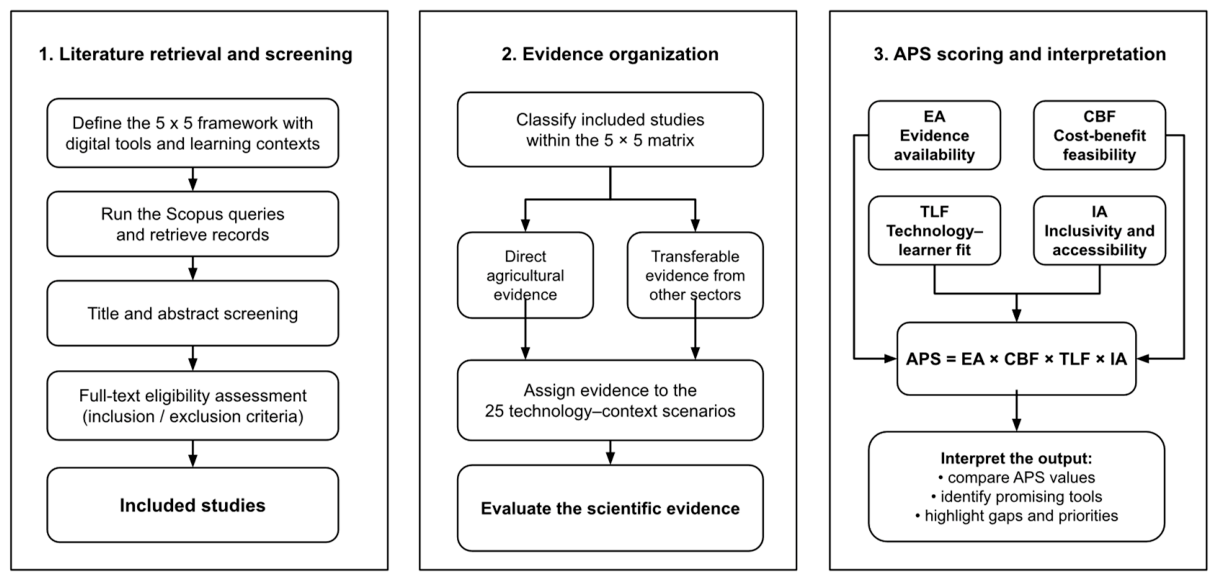
Figure 2.
Heatmap of the APS score for each training scenario.
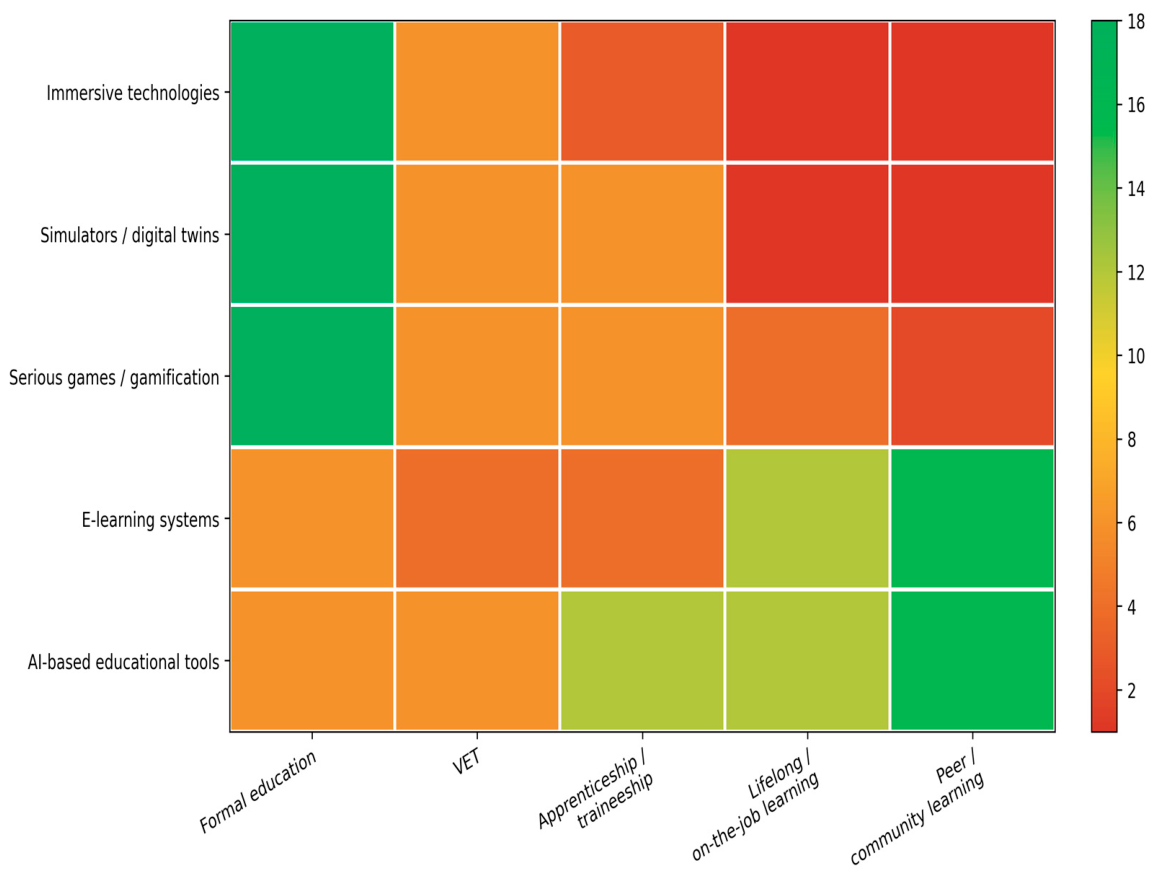

Table 1.
Conceptual structure underlying the search design adopted in Scopus.
| Search dimension | Category | Representative search terms or descriptors |
| Agricultural safety framework | Core domain | safety AND (agricultur* OR farm*) |
| Digital training tools | Immersive technologies | virtual reality, augmented reality, mixed reality, extended reality, immersive environment |
| Digital training tools | Simulation-based approaches | simulation, simulator, digital twin |
| Digital training tools | Game-based learning tools | serious game, gamification |
| Digital training tools | Digital learning platforms | e-learning, MOOC, learning management system |
| Digital training tools | AI-based educational systems | chatbot, AI tutor, intelligent tutoring system, conversational agent |
| Training contexts | Formal education | school, university, higher education |
| Training contexts | Vocational education and training | VET, vocational education and training |
| Training contexts | Apprenticeships and traineeships | apprenticeship, traineeship |
| Training contexts | Lifelong and work-based learning | lifelong learning, on-the-job training, workplace learning |
| Training contexts | Peer or community-based learning | peer learning, community of practice, community-based learning |
Table 2.
Eligibility criteria adopted for the inclusion and exclusion of studies.
| Criterion domain | Inclusion criteria | Exclusion criteria |
| Sector | Studies focused on the agricultural or farming sector. | Studies addressing safety in non-agricultural sectors without a clear application to agriculture. |
| Topic | Studies addressing safety, risk prevention, hazard awareness, occupational health, or safety training. | Studies dealing with agriculture in general without a specific focus on safety-related issues. |
| Educational dimension |
Studies examining or discussing education, training, learning, or capacity-building activities. | Studies focused exclusively on technological development without any educational or training dimension. |
| Technology scope |
Studies investigating at least one of the selected digital or technology-enhanced tools. | Studies not involving any of the technology-enabled approaches considered in the study. |
| Learning context |
Studies situated in formal education, vocational education and training (VET), apprenticeships or traineeships, lifelong learning, on-the-job training, or peer/community learning contexts. | Studies unrelated to any learning or training context. |
| Document type |
Full-text publications suitable for qualitative analysis. | Editorials, notes, short commentaries, or publications lacking sufficient methodological or analytical detail. |
| Accessibility | Studies available in full text. | Records for which the full text was unavailable. |
| Relevance to study scope | Studies consistent with exploring digital solutions for safety education and training in agriculture. | Studies outside the conceptual scope of digital safety education and training in agriculture. |
Table 3.
Model evaluation methodology for the evaluation of digital tools in agricultural safety training.
Table 3.
Model evaluation methodology for the evaluation of digital tools in agricultural safety training.
| Variable | Score | Interpretation applied to the agricultural sector |
| Evidence availability (EA) | 1 | No direct studies in agriculture, but transferable evidence from other sectors |
| 2 | 1–2 studies in agriculture | |
| 3 | 3–4 studies in agriculture | |
| 4 | 5–6 studies in agriculture | |
| 5 | 7 or more studies in agriculture | |
| Cost-benefit feasibility (CBF) | 1 | High-cost solution mainly justified for large groups |
| 2 | High-cost solution also applicable to small groups | |
| 3 | Low-cost solution mainly effective for large groups | |
| 4 | Low-cost solution applicable also to small groups | |
| Technology–learner fit (TLF) | 0.5 | Very low expected fit for agricultural target group |
| 0.75 | Low expected fit for the specific agricultural target group | |
| 1 | Neutral fit for the specific agricultural target group | |
| 1.5 | High expected fit for the specific agricultural target group | |
| 2 | Very high expected fit for agricultural target group | |
| Inclusivity and Accessibility (IA) | 0.5 | Low accessibility or inclusivity |
| 0.75 | Moderate-low accessibility or inclusivity | |
| 1 | Neutral accessibility or inclusivity | |
| 1.5 | High accessibility or inclusivity | |
| 2 | Very high accessibility or inclusivity |
Table 4.
Technology-context assessment. Scores are indicated by parenthesis.
| Digital tool family |
Learning context |
Evidence availability | Cost-benefit | Technology-Learner fit | Inclusivity and Accessibility | APS |
| Immersive technologies |
Formal education |
4 studies from VR - AR (3) | High costs but still affordable (2) | Familiarity with the medium (2) | Can overcome language barriers (1.5) | 18 |
| VET | Only in other sectors (1) | High costs but still affordable (2) | Familiarity with the medium (2) | Can overcome language barriers (1.5) | 6 | |
| Apprenticeship and traineeship | Only in other sectors (1) | High costs, limited customization (1) | Familiarity with the medium (2) | Can overcome language barriers (1.5) | 3 | |
| Lifelong learning or ToTJ | Only in other sectors (1) | High costs, limited customization (1) | No benefit by this technology (1) | Benefits would not be clear (1) | 1 | |
| Peer, community learning | Only in other sectors (1) | High costs, limited customization (1) | No benefit by this technology (1) | Benefits would not be clear (1) | 1 | |
| Simulators or digital twins | Formal education |
Several studies on digital twins (4) | High costs but still affordable (2) | Students can learn faster (1.5) | Makes basic concepts easier through visualization (1.5) | 18 |
| VET | Only in other sectors (1) | High costs but still affordable (2) | Helps to put theory in practice (2) | Makes basic concepts easier (1.5) | 6 | |
| Apprenticeship and traineeship | Only in other sectors (1) | High costs but still affordable (2) | Positive changes in behaviors (2) | Makes basic concepts easier (1.5) | 6 | |
| Lifelong learning or ToTJ | Only in other sectors (1) | Personalization is necessary (1) | No significant changes (1) | Not fully applicable (1) | 1 | |
| Peer, community learning | Only in other sectors (1) | Personalization is necessary (1) | No significant changes (1) | Not fully applicable (1) | 1 | |
| Serious games or gamification | Formal education |
Several articles on injury prevention (3) | Usable with large groups of users (2) | Higher than in other cases (2) | Ease of use and accessibility (1.5) | 18 |
| VET | Only in other sectors (1) | Usable with large groups of users (2) | Higher than in other cases (2) | Ease of use and accessibility (1.5) | 6 | |
| Apprenticeship and traineeship | Only in other sectors (1) | Usable with large groups of users (2) | Customizable (2) | Ease of use and accessibility (1.5) | 6 | |
| Lifelong learning or ToTJ | One case-study (2) | Usable with large groups of users (2) | Interest only in few scenarios (1) | Limited match with workers’ needs (1) | 4 | |
| Peer, community learning | Only in other sectors (1) | Usable with large groups of users (2) | Interest only in few scenarios (1) | Limited match with workers’ needs (1) | 2 | |
| E-learning systems |
Formal education |
Studies about safety training (2) | Affordable for any kind of groups (4) | Users could not be sufficiently engaged (0.75) | Not fully applicable (1) | 6 |
| VET | Only in other sectors (1) | Affordable for any kind of groups (4) | Interest limited by the case (1) | Not fully applicable (1) | 4 | |
| Apprenticeship and traineeship | Only in other sectors (1) | Affordable for any kind of groups (4) | Interest limited by the case (1) | Not fully applicable (1) | 4 | |
| Lifelong learning or ToTJ | Only in other sectors (1) | Affordable for any kind of groups (4) | Specific content can improve user engagement (2) | Availability in several languages and applications (1.5) | 12 | |
| Peer, community learning | Only in other sectors (1) | Affordable for any kind of groups and applications (4) | Specific content can improve user engagement (2) | Availability in several languages and applications (1.5) | 16 | |
| AI-based educational tools |
Formal education |
One study on chatbots (2) | Costs are low for many users (3) | Not fully exploited (1) | No specific beneficial effects (1) | 6 |
| VET | Only in other sectors (1) | Costs are low for many users (3) | Not fully exploited (1) | Exchange of information (2) | 6 | |
| Apprenticeship and traineeship | Only in other sectors (1) | Costs are low for many users (3) | Exploited by audience (2) | Exchange of information (2) | 12 | |
| Lifelong learning or ToTJ | Only in other sectors (1) | Costs are low for many users (3) | Exploited by audience (2) | Exchange of information (2) | 12 | |
| Peer, community learning | Only in other sectors (1) | Large, skilled audience (4) | Exploited by audience (2) | Exchange of information (2) | 16 |
Disclaimer/Publisher’s Note: The statements, opinions and data contained in all publications are solely those of the individual author(s) and contributor(s) and not of MDPI and/or the editor(s). MDPI and/or the editor(s) disclaim responsibility for any injury to people or property resulting from any ideas, methods, instructions or products referred to in the content. |
© 2026 by the authors. Licensee MDPI, Basel, Switzerland. This article is an open access article distributed under the terms and conditions of the Creative Commons Attribution (CC BY) license (http://creativecommons.org/licenses/by/4.0/).
Copyright: This open access article is published under a Creative Commons CC BY 4.0 license, which permit the free download, distribution, and reuse, provided that the author and preprint are cited in any reuse.


