

Submitted:
17 June 2026
Posted:
17 June 2026
You are already at the latest version
Abstract
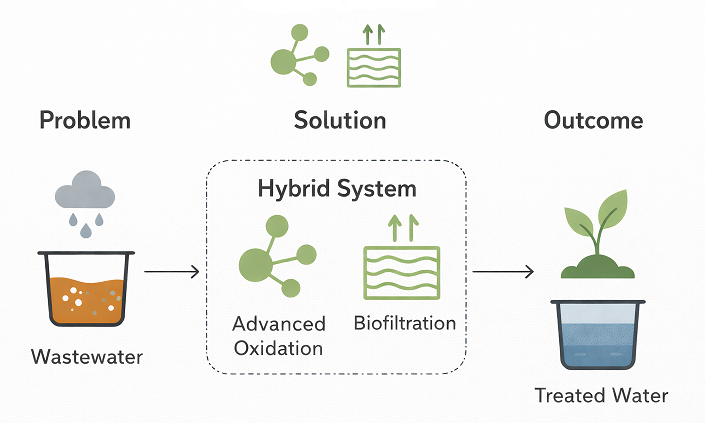
Freshwater scarcity in arid and semi-arid regions, coupled with increased population density, leads to greater demand and pressure on aquatic ecosystems and limited groundwater resources. This study, conducted using the PRISMA 2020 methodology, aims to evaluate the effectiveness and sustainability of hybrid technologies that combine advanced oxidation processes (AOPs) with biological filtration in the treatment of urban and industrial wastewater. A systematic review was conducted between 2015 and 2025 using six main databases (Scopus, Web of Science, ScienceDirect, SpringerLink, PubMed, and Google Scholar). A total of 1,248 studies were identified, but only 78 met the eligibility criteria and were therefore included in the quantitative analysis. The results showed that hybrid systems, such as ozone biofiltration, Fenton-MBR, and photocatalytic biofilm, have higher removal efficiencies for COD (>95%), microorganisms (>90%), and pathogens (>99%), with minimal residual sludge. The environmental assessment also demonstrates the strong potential of these processes when integrated into arid regions like southwestern Algeria, thanks to their contribution to conservation of biodiversity and sustainable reuse of treated wastewater. Through this study, our objective is to highlight the role of integrated approaches in circular water management, as well as the urgent need to standardize protocols to assess the magnitude of long-term environmental impacts.
Keywords:
wastewater
; PRISMA 2020
; advanced oxidation
; biofiltration
; sustainability
; arid climate
Copyright: This open access article is published under a Creative Commons CC BY 4.0 license, which permit the free download, distribution, and reuse, provided that the author and preprint are cited in any reuse.


