

Submitted:
17 June 2026
Posted:
18 June 2026
You are already at the latest version
Abstract
This paper studies the Liouville-correlation route to the Riemann Hypothesis by separating two issues that are often treated together. We show that, for all sufficiently large X, the collar-scale bound for Σn≤Y λ(n)λ(n + h) cannot follow from boundedness of the coefficients alone: an explicit bounded sequence forces the corresponding correlation energy above the required scale by a fixed power of X. We also show that a fixed-endpoint spectral large sieve bound upgrades to a maximal-endpoint bound with no power loss, so the moving endpoint is not the source of the difficulty. The remaining problem is therefore a genuinely signed Liouville estimate, stated here as a precise hypothesis and shown to imply the Riemann Hypothesis; the purpose of the paper is to isolate that arithmetic estimate and rule out the coefficient-uniform shortcut, not to present a proof of the hypothesis itself.
Keywords:
Riemann Hypothesis
; Liouville function
; large sieve
MSC: Primary 11M26; Secondary 11N37, 11N35, 11F72
1. Introduction
For a positive integer n write and set . The Liouville function is completely multiplicative, and for
Write . The following equivalence is classical; it is recorded, for instance, in the literature on the Mertens and Liouville summatory functions (see Titchmarsh [2], Chapter 14, for the closely related Mertens-function statement, and [1] for the underlying multiplicative identities).
Theorem
(Summatory Liouville criterion). If for every , then for . By the functional equation, every non-trivial zero of ζ then lies on the line .
We prove Theorem 1.1 in Section 2 because it fixes, with no ambiguity, the exact analytic target of the rest of the paper: a bound on at the square-root scale.
The standard way to attack is to square it. Writing for , one has the exact identity (Lemma 2.1 below), so a bound of the shape , uniform over dyadic , would give by Cauchy–Schwarz and a logarithmic dyadic sum. This is the Liouville collar route. Two technical features of this route are easy to confuse with each other but are logically independent, and separating them is the point of this paper.
The first feature is the moving endpoint: the supremum over inside the collar sum is not the same object as a fixed-endpoint correlation, and any spectral or sieve-theoretic estimate for the latter must be upgraded before it controls the former. We show in Section 4 that this upgrade is free: a fixed-endpoint spectral large sieve inequality of the classical Deshouillers–Iwaniec type [4] implies, via an elementary binary interval decomposition, the corresponding maximal-endpoint inequality with the same exponent, up to the admissible already present.
The second feature is the arithmetic sign of . It is tempting to try to prove the collar estimate for an arbitrary bounded coefficient sequence and then specialise to . We show in Section 5 that this cannot work: there is an explicit bounded sequence and an explicit dyadic range of shifts on which the resulting correlation energy is provably larger than the scale the collar argument needs, by a clean power of X. The Liouville (equivalently Möbius, via the classical identity ) sign structure is therefore not a convenience to be discarded; it is the entire content of the missing estimate. The same moral – that correlations of and become tractable only once their multiplicative sign is treated as data, not noise – underlies Sarnak’s randomness heuristic for the Möbius function [11] and the dynamical disjointness results of Bourgain, Sarnak, and Ziegler [12].
Section 6 states the resulting hypothesis precisely as a single inequality (Open Problem 6.1) and proves that it implies the Riemann Hypothesis (Theorem 6.2). Thus the role of the Riemann Hypothesis here is methodological rather than proclamatory: the paper identifies the exact signed Liouville estimate that this route would require and proves two facts around it, namely the maximal-endpoint large sieve upgrade of Section 4 and the coefficient-uniform failure of Section 5.
2. Notation and the Square Identity
Throughout, is a real scale, H denotes a dyadic integer ( for some ), and a dyadic block is a range . Implied constants may depend on any fixed parameter written as a subscript, and may change from line to line, always remaining fixed before any limit in X is taken.
For and set
Lemma 2.1
(Square identity). For every positive integer X,
Proof.
Expand . The diagonal contributes X since . For , write the pair with as for and ; this contributes . The pairs with contribute the same sum by the symmetric relabelling . Adding the diagonal and the two off-diagonal triangles gives the stated identity. The inequality follows since for every h. □
Definition 2.2
(Collar energy). For dyadic , thecollar energyis .
Proposition 2.3
(Collar implication). Fix . Suppose that for every , uniformly for all dyadic , and that . Then for every .
Proof.
By Cauchy–Schwarz on each dyadic block, . There are dyadic blocks with , and , so their total contribution is . Adding the assumed terminal-range bound and inserting both into Lemma 2.1 gives , hence the stated bound after renaming . □
Proposition 2.3 is the entire complex-analytic content of the route; everything from here on concerns whether its hypothesis can be established, and if so how.
3. Endpoint Duality
It is useful to record, once and for all, that a maximal correlation energy is the same thing as a dual norm over moving endpoints. This is elementary linear algebra, stated here only to fix notation for Section 4.
Lemma 3.1
(Endpoint duality). For each h in a finite index set , fix any with , and let be a unit complex number with . Then
and consequently differs from the displayed dual supremum by at most .
Proof.
The first identity is the standard duality between the norm of a finite vector , here , and the supremum of over the dual unit ball, with equality attained at . The second assertion follows because for every h, so the two vectors differ in each coordinate by at most 1, and the triangle inequality in bounds the resulting discrepancy in norm by . □
The content of Lemma 3.1 is that an endpoint field may be chosen independently for every shift, and a successful estimate must be uniform in that choice; no saving is available from restricting to a single common endpoint, since one can place a unit correlation on a different wall for every h and obtain a vector of norm where a common-wall bound would give only 1.
4. A Maximal Endpoint Spectral Large Sieve
This section proves that endpoint maximality, by itself, is never the bottleneck: it converts a classical fixed-endpoint spectral mean-value inequality into its maximal-endpoint form at no cost beyond the admissible power of already implicit in such estimates. The underlying device is an elementary dyadic decomposition of an initial segment of integers, closely related to classical maximal inequalities of Rademacher–Menshov type; we record a self-contained proof since it is used directly below.
Fix and , let be an index set carrying a finite family of non-negative measures (for instance, the discrete spectrum of Maass cusp forms together with the continuous Eisenstein spectrum at spectral height , or the holomorphic spectrum of comparable weight), and let denote the associated normalised Fourier coefficients. We take as input the classical fixed-endpoint spectral large sieve inequality:
for every interval I of length at most N and every finitely supported sequence ; see Deshouillers–Iwaniec [4], the exposition in Iwaniec–Kowalski [3, Ch. 7]], and the spectral large sieve literature surveyed in Iwaniec [5] and Friedlander–Iwaniec [6]. Recent refinements in adjacent large-sieve settings, such as Pascadi’s work on exceptional Maass forms [24], are not used below but help situate the endpoint issue within current spectral-sieve practice.
Lemma 4.1
(Dyadic initial-segment decomposition). Let and let be complex numbers. Then
where is the partition of into consecutive dyadic blocks of length .
Proof.
Fix and write Y in binary. The initial segment decomposes, by the usual greedy binary algorithm, into at most one dyadic block from each level : starting at , take the largest dyadic block of the form contained in the yet-unprocessed prefix of , remove it, decrease j by one, and repeat. This terminates after at most steps and produces pairwise disjoint blocks (some possibly empty) with and . By Cauchy–Schwarz,
the last step enlarging the sum at each level to all of , every term being non-negative. Taking the maximum over Y proves the lemma. □
Theorem 4.2
(Maximal endpoint spectral large sieve). Let be supported on . For and set . Then
with the same exponent as the fixed-endpoint inequality (2).
Proof.
Choose K with and extend by zero to . For fixed , apply Lemma 4.1 with :
Integrate against and exchange the integral with the finite sum over j and I. For each fixed and , the interval I has length , so (2) applies (with N replaced by , only changing implied constants) and gives
Summing over the at most disjoint intervals recovers exactly once at each level j, since the partition . Summing over the levels and multiplying by the outer factor from Lemma 4.1 introduces a total factor , which is absorbed into the existing by adjusting . This proves the theorem. □
Corollary 4.3
Passing from a fixed-endpoint mean-square bound to its endpoint-maximal form costs nothing beyond the admissible ε-power already present in spectral large sieve estimates. In particular, the moving endpoint in the definition of is, by itself, never the source of a power loss in any argument that reaches a genuine spectral large sieve inequality of the form (2).
Theorem 4.2 and Corollary 4.3 are the positive, unconditional content of this paper on the analytic side. They say that if a collar argument for the Liouville function ever reaches a coefficient array to which a genuine spectral large sieve inequality applies, the endpoint supremum will not be the bottleneck. Section 5 shows that the bottleneck, if there is one, must instead lie in whatever stands between the raw Liouville correlation and a coefficient array fit for (2) – and that one specific coefficient-uniform way of bridging that gap is provably unavailable.
5. Coefficient-Uniform Failure
Definition 5.1
(Coefficient-uniform collar property). Fix and . Say that thecoefficient-uniform collar propertyholds at scale if there is a constant , independent of the coefficient sequence, such that foreverysequence with , every dyadic , and ,
This is exactly the statement one would obtain by replacing every occurrence of in the collar sum of Section 2 by an arbitrary bounded sequence, i.e. by discarding the sign structure of and asking only that the coefficients be bounded. It is a natural first thing to try, since bounded coefficient arrays are the native input of a large sieve inequality such as (2).
Theorem 5.2
(Coefficient-uniform failure). Fix . The coefficient-uniform collar property fails at scale for and every sufficiently large X. Concretely, take and choose a dyadic integer H with , which satisfies once X is large. Then
while the coefficient-uniform collar property would require this quantity to be at most a constant multiple of . Since , no constant can make the property hold for all large X.
Proof.
Take for every n, and choose a dyadic integer H with . Such an H exists for every sufficiently large X, by taking the largest dyadic integer not exceeding . Then for every , an increasing function of Y, so . For we have , hence once . Therefore
where the last harmless weakening keeps constants immaterial. On the other hand, the coefficient-uniform collar property at would assert this sum is at most for all sufficiently large X. Comparing the two bounds, would force , which fails for all sufficiently large X regardless of the fixed value of . This contradiction proves the theorem. □
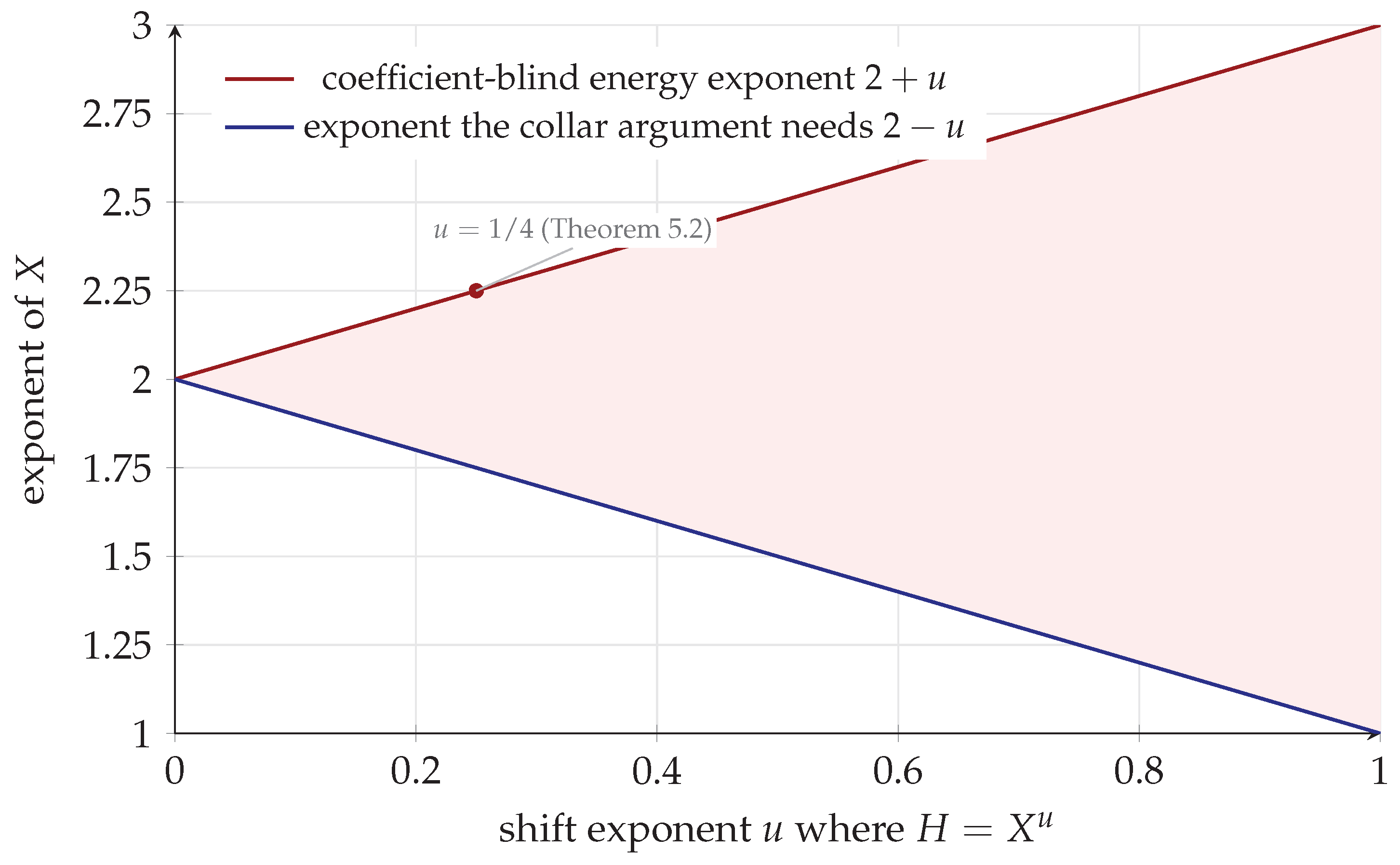
Figure 1 shows this for the full dyadic range. Writing for , the energy produced by an arbitrary bounded sequence has size (red), while the scale a successful collar argument needs is , ignoring the admissible (blue). The two lines meet only at ; for every the coefficient-blind energy exceeds the target, by a factor of . Theorem 5.2 is the marked point at .
Lemma 5.3
(Square-divisor identity). For every positive integer n, .
Proof.
Both sides are multiplicative, so it suffices to check . The right-hand side is , and vanishes unless . If e is even, the unique contributing term is , giving ; if e is odd, the unique contributing term has , giving . In either case the value matches . □
Lemma 5.3 shows that any correlation is, after extracting square factors, an honest two-variable Möbius correlation sum in disguise: the leading stratum (square factors equal to 1 on both sides) is exactly , a correlation of the same general shape as in Theorem 5.2, but with a genuinely signed, non-arbitrary sequence. Theorem 5.2 does not directly address this specific sequence – is certainly not the constant sequence used in the proof above – but it shows that the property being asked of cannot be obtained for free from boundedness alone: replacing by any bound that discards its sign and keeps only reopens exactly the gap Theorem 5.2 exhibits, since the constant sequence is itself a legitimate competitor for “any bounded sequence”. Whatever mechanism eventually controls at the collar scale, it must use the multiplicative sign of as data, not discard it as a nuisance.
6. The Remaining Hypothesis
We can now state, with no remaining ambiguity, the single inequality that remains after Section 4 and 5.
Open Problem 6.1
(Liouville collar hypothesis). For every there is such that for every and every dyadic ,
This is an inequality about the actual, signed Liouville correlations – not about an arbitrary bounded coefficient array. By Theorem 5.2, it cannot be deduced from a general-purpose coefficient-uniform large sieve estimate of the kind Theorem 4.2 upgrades; whatever proves it must use the specific multiplicative cancellation of , most likely through the square-divisor decomposition of Lemma 5.3 or an equivalent device, before any large-sieve or spectral argument is applied.
Statements of this binary-correlation type have been studied unconditionally in an averaged sense by Matomäki, Radziwiłł, and Tao [13,14,15], and the resulting structural picture has since been extended by Tao and Teräväinen [16,17], by Klurman [18], and by Teräväinen [19]. Recent work continues to sharpen this landscape in related directions, including Liouville correlations over Bohr sets and Beatty sequences [21], correlations of multiplicative functions with their summatory functions [22], and variants of Chowla-type shifted convolution problems for completely multiplicative -valued functions [23]. None of these results, however, reach the maximal, non-averaged form that Open Problem 6.1 asks for.
Theorem 6.2
(Conditional implication). If Open Problem 6.1 is true, then for every , , and therefore, by Theorem 1.1, the Riemann Hypothesis holds.
Proof.
Open Problem 6.1 supplies the hypothesis of Proposition 2.3 for every (in particular the terminal range, since the displayed bound holds for every dyadic , including ). Proposition 2.3 gives for every . Theorem 1.1 then gives the Riemann Hypothesis. □
Remark 6.3
Theorem 6.2 is an ordinary conditional implication, proved unconditionally; it does not make Open Problem 6.1 any easier, and we are not aware of any published unconditional proof of it. We record it precisely, rather than leaving it as an informal “signed analogue” of the false coefficient-uniform statement, so that any future attempt on this route has a single, checkable target: a maximal mean-square bound for , uniform in the moving endpoint Y and in the dyadic shift range H, that genuinely uses the multiplicative structure of λ and is not merely a disguised instance of the bound Theorem 5.2 refutes.
Two unconditional results elsewhere in the literature make a related point. Platt and Trudgian verified the Riemann Hypothesis numerically up to height [20], and Odlyzko and te Riele disproved the Mertens conjecture by an explicit finite construction [10]. Both show that finite-range or average-sense control of sign-sensitive sums of this kind is within reach of current methods; the square-root-scale estimate Theorem 1.1 actually needs is a different matter.
7. Concluding Remarks
We have proved two unconditional facts that do not depend on each other and do not depend on the Riemann Hypothesis. The first, Theorem 4.2, says that converting a fixed-endpoint spectral mean-value inequality into a maximal-endpoint one is free: the binary dyadic decomposition of Lemma 4.1 absorbs the endpoint supremum into the existing admissible power of , regardless of what arithmetic sequence the coefficients come from. The second, Theorem 5.2, says that the natural shortcut of discarding the Liouville sign and treating the collar problem as a generic bounded-coefficient correlation problem fails outright, by an explicit and easily checked margin.
Together these results say that the difficulty in the Liouville collar approach to the Riemann Hypothesis is neither the endpoint maximality (which costs nothing) nor a general failure of large sieve methods (which work perfectly well once a suitable coefficient array is in hand); it is specifically the construction of a signed estimate, Open Problem 6.1, that retains the cancellation in all the way through whatever transform is used to apply a spectral or sieve method. The paper therefore treats the Riemann Hypothesis as the background analytic motivation for a precise conditional implication, while its direct contribution is narrower: it isolates the needed signed estimate and eliminates one natural but unworkable coefficient-uniform shortcut.
Supplementary Materials
The following supporting information can be downloaded at the website of this paper posted on Preprints.org. A separate computational archive accompanies this manuscript. It contains verify_exponents.py, a short SymPy script that symbolically checks the exact rational exponent arithmetic used in the proof of Theorem 5.2, and make_figure.py, a short Python script (using matplotlib and numpy) that independently reproduces the comparison plot of Section 5. Neither script computes any arithmetic function value; both are included for independent verification only and are not required to compile the manuscript.
Data Availability Statement
No empirical dataset was generated or analysed. All results are unconditional theorems proved in the text. The comparison figure in Section 5 is produced natively in LATEX and needs no external file to compile. An independent computational check of the exponent arithmetic used in the proof of Theorem 5.2, together with a script that reproduces an equivalent comparison plot, is supplied separately as described under Supplementary Materials.
Conflicts of Interest
The authors declare no conflicts of interest.
Use of Artificial Intelligence
AI-assisted tools were used in preparing this manuscript, including help with organising the exposition and with constructing and checking the formulas appearing in the proofs. Computational tools, including Python and SymPy, were used to verify the exponent arithmetic in Section 5 and to produce an independent reproduction of the comparison figure. The authors reviewed the final manuscript and take full responsibility for all statements, computations, citations, and conclusions.
Ethical Approval
This manuscript is theoretical mathematics and does not involve human participants, animal subjects, clinical data, or experimental data requiring ethical approval.
References
- Apostol, T. M. Introduction to Analytic Number Theory; Undergraduate Texts in Mathematics; Springer-Verlag: New York, 1976. [Google Scholar]
- Titchmarsh, E. C. The Theory of the Riemann Zeta-Function, 2nd ed.; Heath-Brown, D. R., Ed.; Oxford University Press, 1986. [Google Scholar]
- Iwaniec, H.; Kowalski, E. Analytic Number Theory; American Mathematical Society Colloquium Publications 53; American Mathematical Society: Providence, RI, 2004. [Google Scholar]
- Deshouillers, J.-M.; Iwaniec, H. Kloosterman sums and Fourier coefficients of cusp forms. Invent. Math. 1982, 70, 219–288. [Google Scholar] [CrossRef]
- Iwaniec, H. Spectral Methods of Automorphic Forms, 2nd ed.; Graduate Studies in Mathematics 53; American Mathematical Society / Revista Matemática Iberoamericana, 2002. [Google Scholar]
- Friedlander, J. B.; Iwaniec, H. Opera de Cribro; American Mathematical Society Colloquium Publications 57; American Mathematical Society: Providence, RI, 2010. [Google Scholar]
- Bombieri, E. Le grand crible dans la théorie analytique des nombres. In Astérisque 18, 2nd ed.; Société Mathématique de France, 1987. [Google Scholar]
- Montgomery, H. L. Ten Lectures on the Interface Between Analytic Number Theory and Harmonic Analysis; CBMS Regional Conference Series in Mathematics 84; American Mathematical Society, 1994. [Google Scholar]
- Selberg, A. On the zeros of Riemann’s zeta-function. Skr. Nor. Vid. Akad. Oslo I 1942, 10, 1–59. [Google Scholar]
- Odlyzko, A. M.; te Riele, H. J. J. Disproof of the Mertens conjecture. J. Reine Angew. Math. 1985, 357, 138–160. [Google Scholar] [CrossRef]
- Sarnak, P. Three Lectures on the Möbius Function, Randomness and Dynamics, lecture notes; Institute for Advanced Study: Princeton, 2011. [Google Scholar]
- Bourgain, J.; Sarnak, P.; Ziegler, T. Disjointness of Möbius from horocycle flows, in From Fourier Analysis and Number Theory to Radon Transforms and Geometry. In Developments in Mathematics; Springer: New York, 2013; Volume 28, pp. 67–83. [Google Scholar]
- Matomäki, K.; Radziwiłł, M. Multiplicative functions in short intervals. Ann. Math. 2016, 183, 1015–1056. [Google Scholar] [CrossRef]
- Matomäki, K.; Radziwiłł, M.; Tao, T. An averaged form of Chowla’s conjecture. Algebra Number Theory 2015, 9, 2167–2196. [Google Scholar] [CrossRef]
- Matomäki, K.; Radziwiłł, M.; Tao, T. Sign patterns of the Möbius and Liouville functions. Q. J. Math. 2016, 67, 461–482. [Google Scholar]
- Tao, T. The logarithmically averaged Chowla and Elliott conjectures for two-point correlations. Forum Math. Pi 2016, 4, e8. [Google Scholar] [CrossRef]
- Tao, T.; Teräväinen, J. The structure of logarithmically averaged correlations of multiplicative functions, with applications to the Chowla and Elliott conjectures. Duke Math. J. 2019, 168, 1977–2027. [Google Scholar] [CrossRef]
- Klurman, O. Correlations of multiplicative functions and applications. Compos. Math. 2017, 153, 1622–1657. [Google Scholar] [CrossRef]
- Teräväinen, J. On binary correlations of multiplicative functions. Forum Math. Sigma 2021, 9, e16. [Google Scholar]
- Platt, D. J.; Trudgian, T. S. The Riemann hypothesis is true up to 3·1012. Bull. Lond. Math. Soc. 2021, 53, 792–797. [Google Scholar] [CrossRef]
- Teräväinen, J.; Walker, A. On a Bohr set analogue of Chowla’s conjecture. Math. Z. 2025, arXiv:2303.12574. [Google Scholar] [CrossRef]
- Chavez, G. Correlations of multiplicative functions with their partial sums. arXiv 2024, arXiv:2409.02106. [Google Scholar]
- Krishnamoorthy, K. On variants of Chowla’s conjecture. arXiv 2025, arXiv:2501.10962. [Google Scholar]
- Pascadi, A. Large sieve inequalities for exceptional Maass forms and the greatest prime factor of n2+1. Forum Math. Pi 2026, 14, e8. [Google Scholar] [CrossRef]
- Granville, A.; Soundararajan, K. Large character sums: pretentious characters and the Pólya–Vinogradov theorem. J. Amer. Math. Soc. 2007, 20, 357–384. [Google Scholar]
Figure 1.
The coefficient-blind correlation energy exponent (red) against the exponent that the Liouville collar argument needs (blue), as a function of the shift exponent u where . The shaded region is the coefficient-uniform gap of Theorem 5.2, realised explicitly at .
Figure 1.
The coefficient-blind correlation energy exponent (red) against the exponent that the Liouville collar argument needs (blue), as a function of the shift exponent u where . The shaded region is the coefficient-uniform gap of Theorem 5.2, realised explicitly at .
Disclaimer/Publisher’s Note: The statements, opinions and data contained in all publications are solely those of the individual author(s) and contributor(s) and not of MDPI and/or the editor(s). MDPI and/or the editor(s) disclaim responsibility for any injury to people or property resulting from any ideas, methods, instructions or products referred to in the content. |
© 2026 by the authors. Licensee MDPI, Basel, Switzerland. This article is an open access article distributed under the terms and conditions of the Creative Commons Attribution (CC BY) license (http://creativecommons.org/licenses/by/4.0/).
Copyright: This open access article is published under a Creative Commons CC BY 4.0 license, which permit the free download, distribution, and reuse, provided that the author and preprint are cited in any reuse.


