

Submitted:
16 June 2026
Posted:
18 June 2026
You are already at the latest version
Abstract
In mathematical chemistry, topological indices are frequently employed to link numerical descriptors related to chemical and biological aspects with molecular graph structures. The Sombor index is one of these indicators that has attracted a lot of interest lately because of its remarkable structural sensitivity and predictive power. In this study, we extend the conventional Sombor index to fuzzy graph situations by introducing a fuzzy graph-based Sombor index, represented by SO(Fη). Under basic graph operations, such as the union, join, composition, and Cartesian product of fuzzy graphs, several constraints for SO(Fη) are found. Additionally, a comparison analysis is carried out to examine the connection between the Sombor index and other well-known topological indices, emphasizing its usefulness in chemical graph theory. A modified fuzzy Sombor index is created and used to analyze cancer diagnosis data in China, where uncertainty in risk factors including nutrition, obesity, diabetes, and air pollution plays a critical role in disease progression, in order to show the practical applicability of the suggested index. The promise of the fuzzy Sombor index as a flexible tool connecting theoretical graph invariants and practical data analysis is demonstrated by this application.
Keywords:
fuzzy Sombor index
; correlation
; cancer data
; edge contribution and weight
; decision making
1. Introduction
Since its introduction by Zadeh in 1965 [1], fuzzy set theory has had a significant influence on a variety of fields, including computer science, networking, decision-making, management sciences, the chemical industry, and telecommunications. The study of fuzzy distances, fuzzy bridges, fuzzy blocks, fuzzy relations (FR), and fuzzy graphs, represented by , was made possible by Rosenfeld’s introduction of fuzzy graph theory in 1975 [2]. Since then, fuzzy graph theory has developed into a vibrant field of study with a wide range of theoretical advancements and real-world applications.
Significant contributions to fuzzy graph theory have been made by several researchers. Samanta et al. [3] investigated fuzzy coloring in , while Mahapatra et al. [4,5] introduced the concept of edge coloring in fuzzy graphs, also referred to as radio fuzzy graphs. Sunitha et al. [6] further advanced the theory by defining fuzzy cut vertices, fuzzy trees, fuzzy forests, partial fuzzy subgraphs, and complete fuzzy graphs. Rashmanlou et al. [7,8] proposed the notion of bipolar fuzzy graphs, whereas Samanta and Pal [9] studied k- and p-competition in fuzzy graphs. Moreover, Akram et al. [10] applied m-polar fuzzy graphs to decision-making problems and bipolar fuzzy soft information systems. Poulik et al. [11] explored real-world applications of interval-valued fuzzy graphs, while Ghori et al. [12] examined operations on bipolar fuzzy graphs. Muhuiddin et al. [13] investigated cubic Pythagorean fuzzy and planar graphs, whereas Jafar et al. [14,15,16] developed matrix-based interval-valued soft fuzzy spaces and similarity measures in neutrosophic hypersoft frameworks.
In mathematical chemistry, topological indices are crucial for measuring molecular structure using graph representations in which atoms are represented as vertices and bonds as edges. One of the earliest indicators used to forecast paraffin boiling points was the Wiener index (WI), which Wiener created in 1947 [17]. Gutman and Trinajstic proposed the Zagreb index (ZI) in 1972 [18], which offers a degree-based metric for assessing the overall -electron energy in conjugated systems.
In mathematical chemistry, topological indices are essential because they offer numerical descriptions of molecular graphs, in which atoms are represented by vertices and chemical relationships by edges. The degree-based Zagreb index (ZI), which Gutman and Trinajstic proposed in 1972 [18], captures the total electron energy of conjugated systems, whereas the Wiener index (WI), which Wiener introduced in 1947 [35], assesses the boiling temperatures of paraffins. The hyper-Wiener index (HWI), which extends WI and was first presented by Randic in 1993 [19], has found extensive use in chemical graph theory, spectral graph theory, and biology. Furtula and Gutman suggested the F-index as a degree-based invariant in 2015 [20]. It was later investigated for fractional and linear graphs [21], connected to extremal trees [22], and used in conjunction with neighbor Zagreb indices in quantitative structure–property relationship (QSPR) investigations [23,24].
Gutman et al. introduced the Sombor index, a noteworthy and new addition to the family of degree-based topological indices [25,26]. Because of its significant structural sensitivity and usefulness in molecular descriptors, this index has garnered a lot of interest. Since then, a lot of research has concentrated on its extreme qualities and mathematical aspects. While Deng et al. [27] examined tree and unicyclic graphs to gain a better understanding of its structural aspects among different topological indices, Milovanovic et al. [28] investigated the impact of pendant vertices on the Sombor index. The Sombor index inside tree structures was examined by Cruz et al. [29]. More recently, Some et al. [30] suggested a fuzzy graph-based generalization of the Sombor index and showed how it may be used to diagnose a particular kind of cancer in China.
The current study expands the Sombor index into the fuzzy graph domain in response to these advancements. We explore the theoretical features of fuzzy graphs under different graph operations and build new connections between them and degree-based topological indices. Additionally, the suggested fuzzy Sombor index’s suitability for chemical and biological systems is investigated, demonstrating its potential as an effective analytical tool for simulating uncertainty in actual data.
1.1. Motivation and Background
Understanding the intricate and frequently expensive physicochemical features of chemical compounds requires a thorough examination of those substances in laboratory settings. In theoretical chemistry, topological indices defined on crisp graphs have shown themselves to be very useful tools throughout time, allowing for the quantitative characterization of molecule structures. As a result, several different graph-based topological indices have been developed to solve problems in biological and chemical systems. However, standard crisp graph models are unable to fully reflect the uncertainty, vagueness, or partial information present in many real-world situations. The study of topological indices for fuzzy graphs is essential and important because fuzzy graph topologies offer a more practical framework in such circumstances.
Binu et al. [31,32] have made significant contributions to the study of the Wiener index (WI) and the connectedness index (CI) in recent years, strengthening their theoretical underpinnings and broadening their range of applications. A number of fuzzy graph-based topological indices, such as the F-index, the first Zagreb index (ZI), the hyper-Wiener index (hyper-WI), and the hyper-connectivity index (hyper-CI), were introduced by Islam and Pal [33,34]. Additionally, Poulik and his associates [12,35] enhanced the theory of fuzzy graph invariants by proposing the Wiener absolute index for bipolar fuzzy graphs and proving the usefulness of these indices in bipolar fuzzy system.
China, one of the most populous nations in the world, has made impressive strides in improving public health in recent decades. However, the country’s cancer burden is still increasing, mostly as a result of the aging population and changing environmental and lifestyle risk factors. China’s continuous cancer transition has been greatly influenced by dietary changes, rising rates of obesity and diabetes, smoking, and exposure to air pollution. Despite a downward trend, the incidence of upper gastrointestinal malignancies is still quite high. Concurrently, there has been a significant rise in the incidence of colorectal, prostate, and breast cancers. Lung cancer is now the most common cause of cancer-related deaths, with smoking continuing to be the primary cause of cancer-related mortality. The Chinese government has responded by putting in place a number of cancer prevention and control initiatives. Despite noteworthy successes, a number of obstacles still exist. Although the Healthy China 2030 initiative offers a positive outlook for cancer control, governments, public health organizations, and individuals must continue to collaborate across sectors and coordinate efforts in primary and secondary prevention in order to effectively reduce the cancer burden.
Inspired by these ideas, the current work examines the Sombor index within the context of fuzzy graphs . We examine its mathematical characteristics and consider its use in uncertain complex network modeling. This work attempts to further expand the applicability of the Sombor index to network analysis and interdisciplinary domains, including chemical and health-related systems, by building on previous findings in fuzzy graph theory and chemical graph theory.
1.2. Overview and Organization of the Paper
In several disciplines, such as fuzzy and chemical graph theory, network analysis, molecular chemistry, and spectral graph theory, topological indices are essential. The Sombor index, a unique molecular descriptor based on vertex degrees, was introduced by Gutman et al. [25] in 2021. Since then, it has garnered a lot of attention because of its theoretical depth and useful applications. The primary findings are presented in six organized sections of this paper, which explores the use of the Sombor index in the context of fuzzy graphs.
The fundamental ideas and definitions required for the formulation of the following findings are introduced in Section 2. Section 3 provides a formal definition of the Sombor index for fuzzy graphs along with an example to help understand how it is calculated and interpreted. The upper and lower bounds of the Sombor index for several fuzzy graph operations, such as union, join, composition, and Cartesian product, are examined in Section 4. The usefulness and complementarity of the Sombor index are highlighted in Section 5 by examining its interactions with other well-known topological indices. Lastly, Section 6 illustrates the fuzzy Sombor index’s practical applicability by analyzing several cancer types in China and offering insights into the disease’s most critical forms.
In earlier research, Pal et al. [30] examined the importance of the Sombor index in fuzzy graphs and calculated and set a number of boundaries. Building on these foundations, the current work expands the analysis to address practical applications, with a special emphasis on data connected to cancer in China.
2. Preliminaries
This section presents the fundamental concepts required for developing our main results.
2.1. Fuzzy Sets and Fuzzy Graphs
Let S be a fuzzy set on a universal set U, represented as an ordered pair , where is the membership function of S.
Definition 1.
A fuzzy graph over a universal set U is defined as , where:
- ℓ is the set of vertices,
- is the vertex membership function,
- is the edge membership function satisfying
The edge set is defined as
Definition 2.
For a vertex , the degree is defined as
The maximum and minimum degrees of are
and the total degree of is
2.2. Topological Indices for Fuzzy Graphs
Definition 3
(First Zagreb Index). For a fuzzy graph , the modified first Zagreb index is
Definition 4
(Second Zagreb Index). The second Zagreb index is defined as
Definition 5
(Hyper Zagreb Index). The hyper Zagreb index (HZI) is
Definition 6
(Edge F-index). The edge F-index (EFI) of is
Definition 7
(Randić Index). The Randić index (RI) of a fuzzy graph is
2.3. Operations on Fuzzy Graphs
Let and be two fuzzy graphs with vertex sets , edge sets , and maximum and minimum degrees and , respectively.
Definition 8
(Cartesian Product). Let and be fuzzy graphs. The Cartesian product is defined with and
The edge membership is
Definition 9
(Composition of Fuzzy Graphs). The composition has ,
and
Definition 10
(Union of Fuzzy Graphs). The union has with
Definition 11
(Union of Fuzzy Graphs). Let and be two fuzzy graphs. The union is a fuzzy graph with vertex set . For any vertex , the membership function is defined as
For any pair of vertices , the edge membership function is
where denotes the edge set of for .
Topological indices are related areas of network analysis, capturing structural and relational properties of complex graphs. Among these, the Sombor index, introduced by Gutman [25], is a recently proposed molecular descriptor that captures the structural properties of graphs by analyzing vertex degree distributions. This index has proven useful for characterizing graph topology in both theoretical and applied settings.
3. Sombor Index on Fuzzy Graphs
Definition 12.
Let be a simple graph. The Sombor index of is defined as
where denotes the degree of vertex in .
Definition 13.
Let be a fuzzy graph, where ℓ is the vertex set, is the vertex membership function, and is the edge membership function. The Sombor index of is defined as
where and denote the degrees of vertices and , respectively.
Definition 14.
Let be a fuzzy graph, where ℓ is the vertex set, is the vertex membership function, and is the edge membership function. The Sombor index of is defined as
where and denote the degrees of vertices and , respectively.
Example 1
(Fuzzy Graph Vertex Degrees). Consider the fuzzy graph shown in Figure 1. The vertex degrees are calculated as follows:
These values can be used to compute the fuzzy Sombor index for the graph.
4. Bounds on the Sombor Index for Fuzzy Graph Operations
This section explores bounds on the Sombor index for various fuzzy graph operations. Let the order and size of be denoted by and , respectively.
Theorem 1.
Let and be two fuzzy graphs. Then,
Proof.
Since is the Cartesian product of and , for any , the vertex membership function is defined as
For , the edge membership function is given by
□
Hence, the weighted degree of a vertex in satisfies
Let and denote the contributions corresponding to and , respectively. Using standard inequalities, we obtain
and, similarly,
Combining both bounds yields the required result. □
Corollary 1.
For any two fuzzy graphs and , the following bounds hold:
- (a)
- (b)
Theorem 2.
Let and be two fuzzy graphs. Then,
Proof.
The composition of fuzzy graphs and is denoted by , where . For any , the vertex membership function is
□
For vertices and , the edge membership function is
Hence, the weighted degree of satisfies
Let and denote the two components of the Sombor index corresponding to edges induced by and , respectively. Then
Using standard inequalities and the definitions of , , and , we obtain
and
Combining both estimates yields the stated result.
Theorem 3.
Let and be two fuzzy graphs. Then the Sombor index of their join satisfies
where (as in the previous sections) and denote the order and size of , and are the corresponding parameters.
Proof. For the join graph , the vertex membership function is
□
For the join graph , the edge membership function is
The vertex degrees satisfy
with the obvious lower bound for (and symmetrically for ).
Using these bounds, the Sombor index of can be expressed as
By splitting the sum over edges of , , and edges joining to , and applying the inequalities for vertex degrees, we obtain the upper bound stated in the theorem. The lower bound follows directly from ignoring the additional join edges. □
Theorem 4.
Let and be two fuzzy graphs. Then the Sombor index of their union satisfies
where and .
Proof. For the union graph, the vertex membership function is
The Sombor index is then
□
Splitting the sum over edges in , , and , we have
Using to bound the last term gives the stated formula. □
5. Connection Between Other Topological Indices and
This section investigates the Sombor index of fuzzy graphs and its connections with other topological indices, starting with the first Zagreb index.
Theorem 5.
Let be a fuzzy graph. Then
where denotes the first Zagreb index of η.
Proof.
For any two positive real numbers and , we have
Setting and gives
Summing over all edges , we obtain
as claimed. □
Theorem 6.
Let be a fuzzy graph. Then
where denotes the second Zagreb index of η.
Proof.
For positive real numbers and , the AM-GM (or ) inequality gives
Substituting and and summing over all edges yields
which completes the proof. □
Theorem 7.
Let be a fuzzy graph. Then
where denotes the hyper-Zagreb index of η.
Proof.
For any two positive real numbers and , we have
Taking and and summing over all edges gives
as required. □
Theorem 8.
Let be a fuzzy graph. Then
where denotes the Edge Forgotten Index of η.
Proof.
For positive real numbers and , the following inequality holds:
Setting and and summing over all edges , we obtain
as claimed. □
Theorem 9.
Let be a fuzzy graph. Then
where denotes the Reciprocal Index of η.
Proof.
For any two positive real numbers and , the following inequality holds:
Substituting and , and summing over all edges , we obtain
By the definition of the Sombor index and the Reciprocal Index, this directly implies
which completes the proof. □
6. Utilizing Determine the Most Critical Cancer Type in China
Cancer continues to be a major contributor to illness and mortality worldwide. In China, data on cancer incidence and mortality were gathered from the National Central Cancer Registry of China (NCCR), which consolidates information from national retrospective surveys and cancer registry reports. Additional statistics were derived from the 2017 Global Burden of Disease (GBD) study, conducted by the Institute for Health Metrics and Evaluation, offering country-specific disability-adjusted life years (DALYs) categorized by age and sex.
Age-standardized DALY rates were calculated using the GBD reference population in order to assess past trends in cancer burden. In order to provide a thorough understanding of cancer trends in China, survival statistics from the NCCR were also examined. Figure 2 and Figure 3 illustrate how the International Cancer Survival Standards were used to evaluate age-standardized cancer rates in various countries between 1990 and 2017. The most important cancer kinds are compiled in Table 1. This study offers a thorough examination of cancer incidence and its effects on health throughout different provinces throughout this time.
As the most populated country in the world, China has made significant progress in public health since the 1950s. Disease trends have shifted from infectious diseases to non-communicable diseases (NCDs) due to changes in lifestyle, aging populations, and environmental factors. Presently, cancer is the leading cause of mortality in China, with an estimated 2.34 million cancer-related deaths reported in 2015 by the NCCR. Moreover, forecasts suggest that the cancer burden will continue to increase in the future.
Understanding the causes of cancer has been fundamental to developing effective prevention strategies. Key milestones in cancer research, including Percivall Potts identification of occupational hazards and the ground breaking 1981 study by Doll and Peto on preventable cancer risks, have significantly contributed to modern cancer prevention and control initiatives.
Real-world decision-making in the field of health care analytics increasingly depends on sophisticated tools like the fuzzy graph-based Sombor index. This method makes it easier to analyze intricate linkages found in medical data. The fuzzy Sombor index is used in this study to determine the most important cancer kinds in China. In this case, the many forms of cancer are represented as nodes in a network, and the connections between them—which stand in for things like health issues, population patterns, and environmental hazards—are shown as fuzzy edges. By using this approach, the study offers a better knowledge of how these interconnected factors affect the prevalence of cancer, promoting better informed and efficient health care decisions. By assessing the proportional importance of each node as well as the strength of the connections, the Sombor index measures the interdependence between different cancer types. In order to reduce the cancer burden in China, this analysis helps policymakers and health care professionals identify priority areas for medical research, financial allocation, and public health activities. The left graph, Figure 4, shows the percentage difference (PD) for each form of cancer as well as the rate of DALY in 1990 and 2017. It illustrates how the burden of all cancers has evolved throughout time. The right graph, Figure 4, shows the data in a smoother, more continuous wave form that makes it simpler to see trends and smooth transitions across cancer kinds. Progression patterns and important milestones are more successfully highlighted by this fluid depiction.

Table 2.
Disability-Adjusted Life Years (DALYs) associated with cancer, some values.
| Types of Cancer | Change in all age DALYs rates Mean Percentage in (MPC (1990–2017)) |
|||
|---|---|---|---|---|
| Tracheal, bronchus, | ||||
| and lung cancer (TBC) | ||||
| Colon and rectum | ||||
| cancer (CRC) | ||||
| Breast cancer | ||||
| (BRC) | ||||
| Pancreatic cancer | ||||
| (PAC) | ||||
| Non-Hodgkin lymphoma | ||||
| (NHC) | ||||
| Prostate cancer (PRC) | ||||
| Ovarian cancer (OVC) | ||||
| Lip and oral cavity | ||||
| cancer (LOC) | ||||
| Gallbladder and biliary | ||||
| tract cancer (GBC) | ||||
| Kidney cancer (KIC) | ||||
| Non-melanoma skin | ||||
| cancer (NMC) | ||||
| Thyroid cancer (THC) | ||||
| Other pharynx | ||||
| cancer (OPC) | ||||
| Multiple myeloma cancer | ||||
| (MMC) | ||||
| Liver cancer (LIC) |
Numerous environmental, clinical, and behavioral risk factors for cancer have currently been identified by epidemiological research. The prevalence of these risk factors has changed significantly over the last 30 years, which has aided in China’s continuous transition to cancer. Westernized lifestyles have been linked to a rise in colorectal, prostate, and breast cancers as well as a decline in upper gastrointestinal cancers. The reduction of the cancer epidemic necessitates long-term primary prevention interventions that target risk factors. A comprehensive evaluation of the burden of disease is provided by DALYs, which are calculated by combining Years of Life Lost (YLLs) and Years Lived with Disability (YLDs). According to the DALY scale, 0 to 1 where 1 denotes death and 0 denotes perfect health. For example, you could estimate that if a group of 15-year-olds do not have any major illnesses like diabetes, asthma, a car accident, or cancer, they will live to be around 80 years old.
Table 3.
The degrees, edges, and vertices’ membership values in the fuzzy graph displayed in Figure 8.
Table 3.
The degrees, edges, and vertices’ membership values in the fuzzy graph displayed in Figure 8.
| Types of Cancer | Degree of an edge between cancer and center of star | MV of the vertex | Degree of cancer (vertex)=MV of edge |
|---|---|---|---|
| Tracheal, bronchus, | |||
| and lung cancer (TBC) | |||
| Colon and Rectum | |||
| Cancer (CRC) | |||
| Breast Cancer | |||
| (BRC) | |||
| Pancreatic Cancer | |||
| (PAC) | |||
| Non-Hodgkin lymphoma | |||
| (NHC) | |||
| Prostate Cancer (PRC) | |||
| Ovarian Cancer (OVC) | |||
| Lip and oral cavity | |||
| cancer(LOC) | |||
| Gallbladder and biliary | |||
| tract cancer(GBC) | |||
| Kidney cancer (KIC) | |||
| Non-melanoma skin | |||
| cancer(NMC) | |||
| Thyroid cancer (THC) | |||
| Other pharynx | |||
| cancer (OPC) | |||
| Multiple myeloma cancer | |||
| (MMC) | |||
| Liver cancer (LIC) |
Figure 5.
Radial network with probabilities.
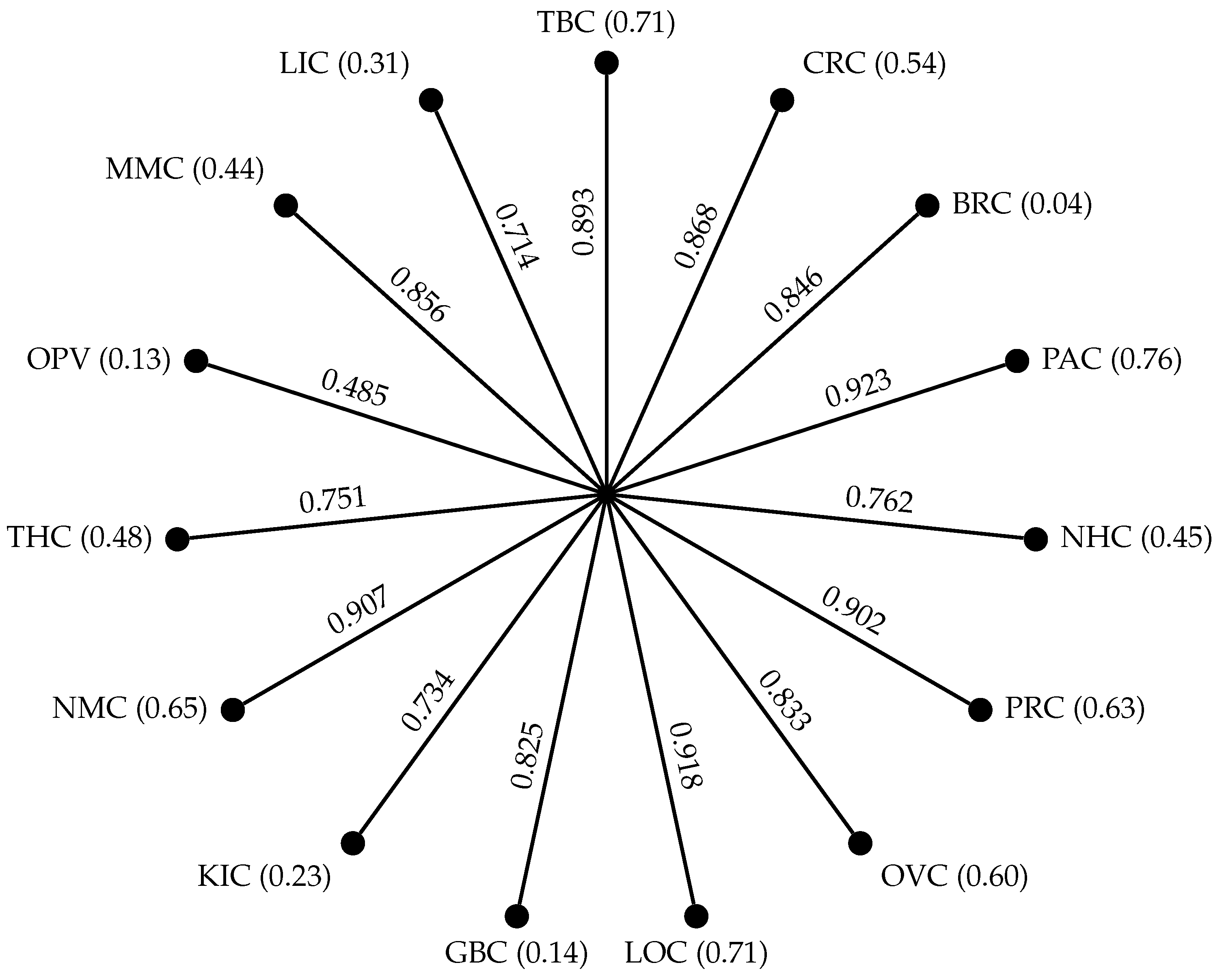
Vertex and Edge Membership Values: The membership value of a vertex is denoted by ℘ and is calculated as
The vertex membership value (MV) ℘ ranges from 0 to 1.
An edge exists between a cancer type and the central node C. The membership value of this edge (EM) is given by
where the edge membership value also ranges from 0 to 1.
This study focuses on identifying the type of cancer with the highest Disability-Adjusted Life Years (DALYs) in China. A model was developed to visualize the cancer burden across both sexes, incorporating key risk factors that contribute to disease impact. The model is structured as a star graph, with GBD-2017 at the center and different cancer types extending as connected nodes.
The Sombor index of the fuzzy graph , corresponding to different types of cancer (treated as vertices), is presented in Table 4. These values are computed using the following expression:
7. Illustrative Example: Fuzzy Graph-Based Sombor Index
Assume a fuzzy graph shown in Figure 6 expressed by the symmetric fuzzy relationship matrix below:
Summing the corresponding row values results in the fuzzy degree of every node:
The fuzzy is computed as:
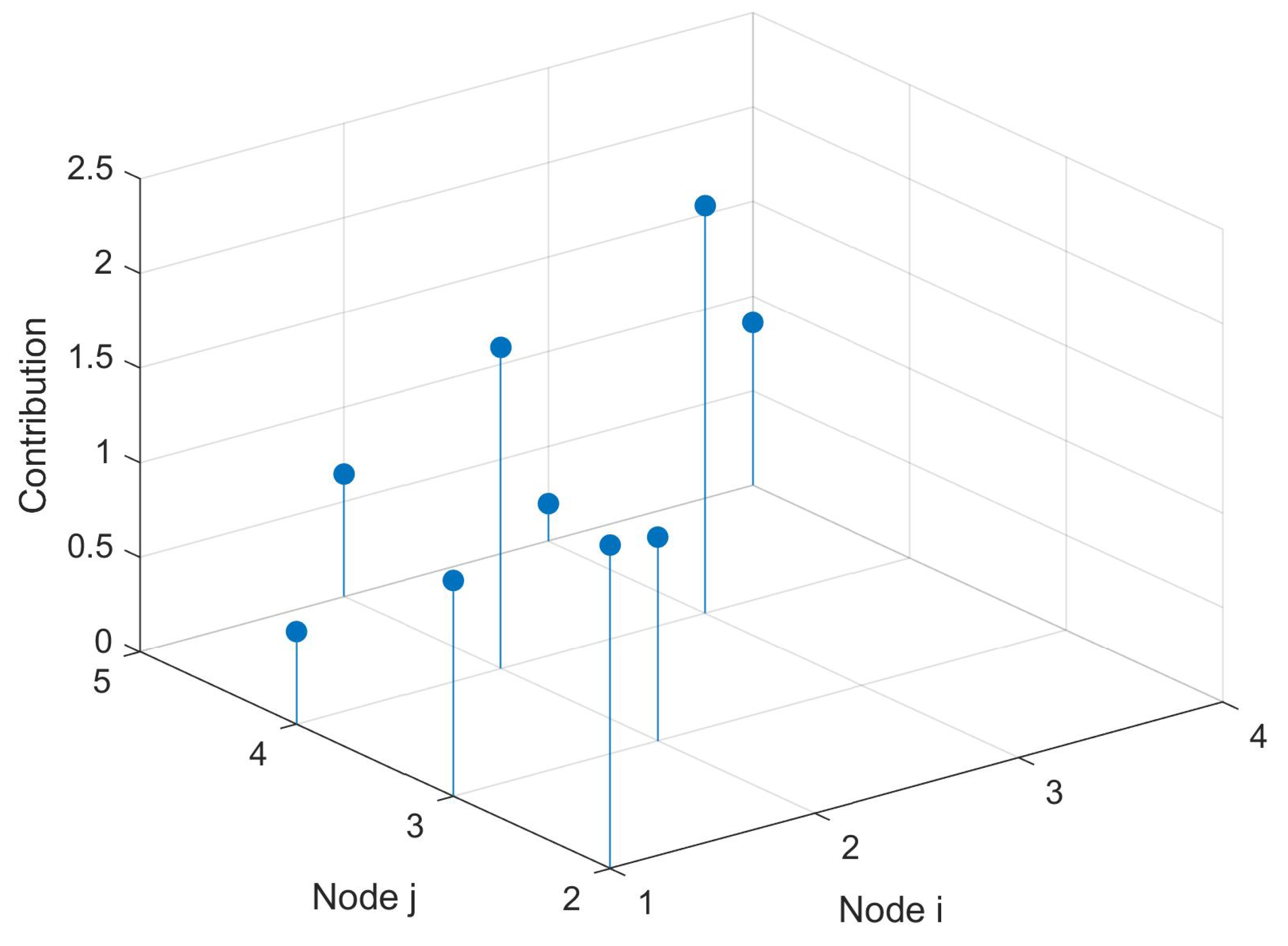
where and are the fuzzy degrees of nodes i and j. For each non-zero edge, the contribution is shown in Table 5 and Figure 7.
The total fuzzy Sombor index is the sum of these contributions:
Figure 8 of each edge and node shows the connections and relevance by means of graphical depictions of this fuzzy graph, node worth (fuzzy degrees), and edge contributions to the Sombor index.
Between 1990 and 2017, China experienced a substantial burden from several cancer types, as quantified by disability-adjusted life years (DALYs), which combine years of life lost due to premature mortality and years lived with disability. Notably, pancreatic cancer (PAC), lip and oral cavity cancer (LOC), and non-melanoma skin cancer (NMC) were among the most impactful in terms of both mortality and morbidity. Understanding these patterns is crucial for public health planning.
Large-scale cancer data sets have been analyzed using machine learning approaches more frequently in recent years. These techniques make it possible to model the course of the disease, identify high-risk groups, and find subtle trends in cancer incidence that conventional statistical techniques could miss. Public health authorities can improve patient outcomes and lessen the burden of cancer on society by incorporating these predictive insights into the creation of more effective therapies, screening programs, and early detection measures.
Figure 8.
Sombor contribution by each edge.
Decision Making
The most serious health issue in China is represented by the cancer type with the greatest value, according to the results shown in Table 4. The critical necessity for preventative measures and well-equipped medical facilities is highlighted by this study.
Due to their high percentage of cancer-related DALYs (PD) and accompanying values, these malignancies are highlighted as particularly noteworthy by the Sombor index for fuzzy values. As a result, the cancer kinds that require prompt attention are ranked as follows (see Figure 9):
Pancreatic cancer (PAC), lip and oral cavity cancer (LOC), non-melanoma skin cancer (NMC), prostate cancer (PRC), tracheal, bronchus, and lung cancer (TBC), and colon and rectum cancer (CRC) Ovarian cancer (OVC), breast cancer (BRC), gallbladder and biliary tract cancer (GBC), and multiple myeloma cancer (MMC) Non-Hodgkin lymphoma (NHC), thyroid cancer (THC), kidney cancer (KIC), liver cancer (LIC), and other pharyngeal cancer (OPC)
8. Conclusion
This article extends the Sombor index, a well-known topological metric in mathematical chemistry, to fuzzy graphs. In this context, we define it formally and obtain tight upper and lower bounds under basic graph operations such as the Cartesian product, join, union, and composition. In order to emphasize its mathematical importance, we also look at its connections with other topological indices.
The use of to determine the most important cancer kind in China is a crucial application of this research that highlights its usefulness. Fuzzy graphs provide a more complex representation than ordinary graphs, which do not include edge and vertex weights, making an effective analytical tool.
In addition to investigating applications in complicated, soft, and m-polar fuzzy graphs, future study will concentrate on expanding the Sombor index to spherical, intuitionistic, and Pythagorean fuzzy graphs. It is also anticipated that examining the energy related to the Sombor index in spherical and T-spherical fuzzy graphs will enhance its theoretical foundation and practical applicability.
Data Availability Statement
Data generated or analyzed during this study are provided in full within the published article.
Conflicts of Interest
The authors declare there are no competing interests.
References
- Zadeh, L.A.: Fuzzy Sets. Inf. Control. 8, 3383 (1965).
- Rosenfeld, A.: Fuzzy graphs. Fuzzy sets and their applications to cognitive and decision processes 8: 77 (1975).
- Pal, M., Samanta, S., Ghorai, G.: Coloring of Fuzzy Graph. Modern Trend Fuzzy Graph Theory 8, 1753 (2020).
- Mahapatra, R., Samanta, S., Allahviranloo, T., Pal, M.:Radio fuzzy graphs and assignment of frequency in radio stations. J. Comput. Appl. Math. 38, 1 (2019).
- Mahapatra, R., Samanta, S., Pal, M.: Applications of edge coloring of fuzzy graphs. Informatica 31, 3130 (2020).
- Sunitha, M.S., Vijayakumar, A.: A characterization of fuzzy trees. Inf. Sci. 113, 2930 (1999).
- Rashmanlou, H., Samanta, S., Pal, M., Borzooei, A.R.: Astudy on bipolar fuzzy graphs. J. Intell. Fuzzy Syst. 28, 5710 (2015).
- Rashmanlou, H., Samanta, S., Pal, M., Borzooei, A.R.: Intuitionistic fuzzy graphs with categorical properties. Fuzzy Inf. Eng. 7, 3174 (2015).
- Samanta, S., Pal, M.: Fuzzy k-competition graphs and p-competition fuzzy graphs. Fuzzy Inf. Eng. 5, 1914 (2013).
- Akram, M., Nawaz, S.: On fuzzy soft graphs. Ital. J. Pure Appl. Math 34, 4974 (2015).
- Poulik, S., Ghorai, G., Xin, Q.: On fuzzy soft graphs. Soft Comput. 25, 7114 (2021).
- Poulik, S., Ghorai, G.: Certain indices of graphs under bipolar fuzzy environment with applications. Soft Comput. 24, 511931 (2020).
- Muhiuddin, G., Hameed, S., Maryam, A., Ahmad, U.: Cubic Pythagorean fuzzy graphs. J. Math. 1144666 (2022).
- Jafar, M., Muhammad, N., Saeed, M., Ghani, T.: Entropy and correlation coefficients of neutrosophic and interval-valued neutrosophic hypersoft set with application of multi-attributive problems Infinite Study (2022).
- Muhammad, J.N., Muhammad, S., Muniba, K.K., Alamri, S.F., Khalifa, A.E.W.: Distance and similarity measures using max-min operators of neutrosophic hypersoft sets with application in site selection for solid waste management systems. IEEE Access 10, 11220235 (2022).
- Saqlain, M., Jafar, N., Moin, S., Saeed, M., Broumi, M.S.: Single and multi-valued neutrosophic hypersoft set and tangent similarity measure of single valued neutrosophic hypersoft sets.Neutrosophic Sets Syst. 32, 3179 (2020).
- Wiener, H.: Structural determination of paraffin boiling points. J. Am. Chem. Soc. 69, 17 (1947).
- Graovac, A., Gutman, I., Trinajsti, N.: Total pi-Electron Energy Springer 117765538 (1977).
- Randi, M.: Novelmolecular descriptor for structure property studies. Chem. Phys. Lett 211, 4783 (1993).
- Furtula, B., Gutman, I.: A forgotten topological index. J. Math. Chem. 53, 118490 (2015).
- Amin, R., Nayeem, S.M.A.: On the F-index and F-coindex of the line graphs of the subdivision graphs. Malaya J. Mat. 6, 3628 (2018).
- Abdo, H., Dimitrov, D., Gutman, I.: On extremal trees with respect to the F-index. Kuwait J. Sci. 44, 1 (2017).
- Mondal, S., De, N., Pal, A.: On neighborhood Zagreb index of product graphs. J. Mol. Struct. 1223, 129210 (2021).
- Mondal, S., Dey, A., De, N., Pal, A.: QSPR analysis of some novel neighbourhood degree-based topological descriptors. Complex Intell. Syst. 7, 9776 (2021).
- Gutman, I.: Geometric approach to degree-based topological indices: Sombor indices. MATCH Commun. Math. Comput. Chem 86, 11 (2021).
- Redzepovi, I.: Chemical applicability of Sombor indices. J. Serb. Chem. Soc. 86, 4457 (2021).
- Deng, H., Tang, Z., Wu, R.: Molecular trees with extremal values of Sombor indices. Int. J. Quantum Chem. 121, e26622 (2021).
- Milovanovic, I., Milovanovic, E., Matejic, M.: On some mathematical properties of Sombor indices. Bull. Int. Math. Virtual Inst 11, 3413 (2021).
- Cruz, R., Rada, J., Sigarreta, Juan, Jos M., Sombor, M.: Index of trees with at most three branch vertices. Appl. Math. Comput. 409, 126414 (2021).
- Some, B., Mondal, S., Pal, A.: Numerous bounds and significance of the Sombor index in fuzzy graph. J. Appl. Math. Comput. 70, 6323–C6346 (2024).
- Binu, M., Mathew, S., Mordeson, N. John.: Connectivity index of a fuzzy graph and its application to human trafficking. Fuzzy Sets Syst. 360, 1176 (2019).
- Binu, M., Mathew, S., Mordeson, N.J.: Wiener index of a fuzzy graph and application to illegal immigration networks. Fuzzy Sets Syst. 384, 1327 (2020).
- Islam, S.R., Pal, M.: An investigation of edge F-index on fuzzy graphs and application in molecular chemistry. Complex Intell. Syst. 9, 204363 (2023).
- Islam, S.R., Pal, M.: Further development of F-index for fuzzy graph and its application in Indian railway crime. Appl. Math. Comput. 69, 3213 (2023).
- Poulik, S., Ghorai, G.: Determination of journeys order based on graph?s Wiener absolute index with bipolar fuzzy information. Inf. Sci. 545, 6089 (2021).
Figure 1.
Graph with transition probabilities.
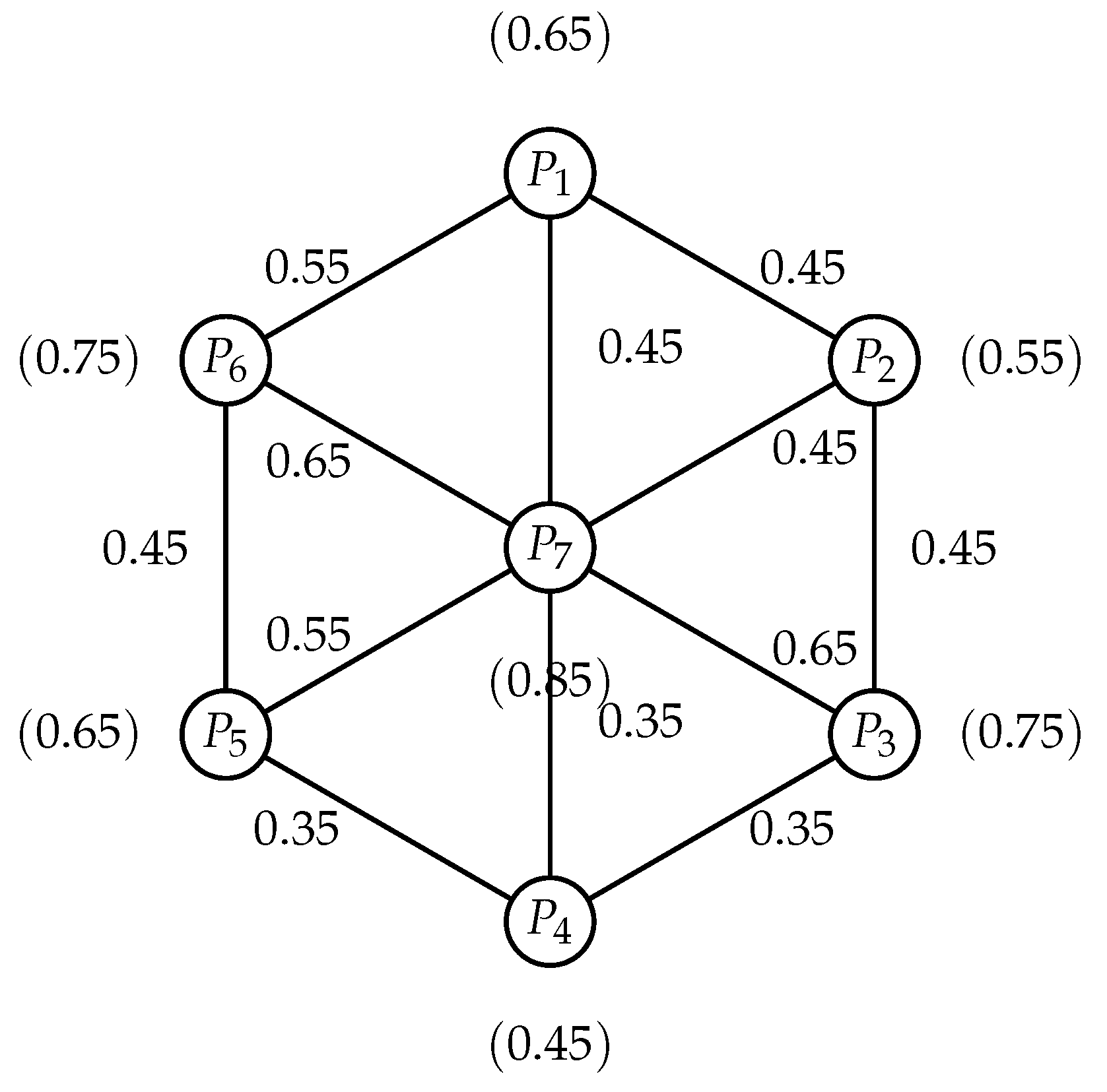
Figure 2.
DALYs (1990 & 2017) and PD of Total Cancer DALYs.
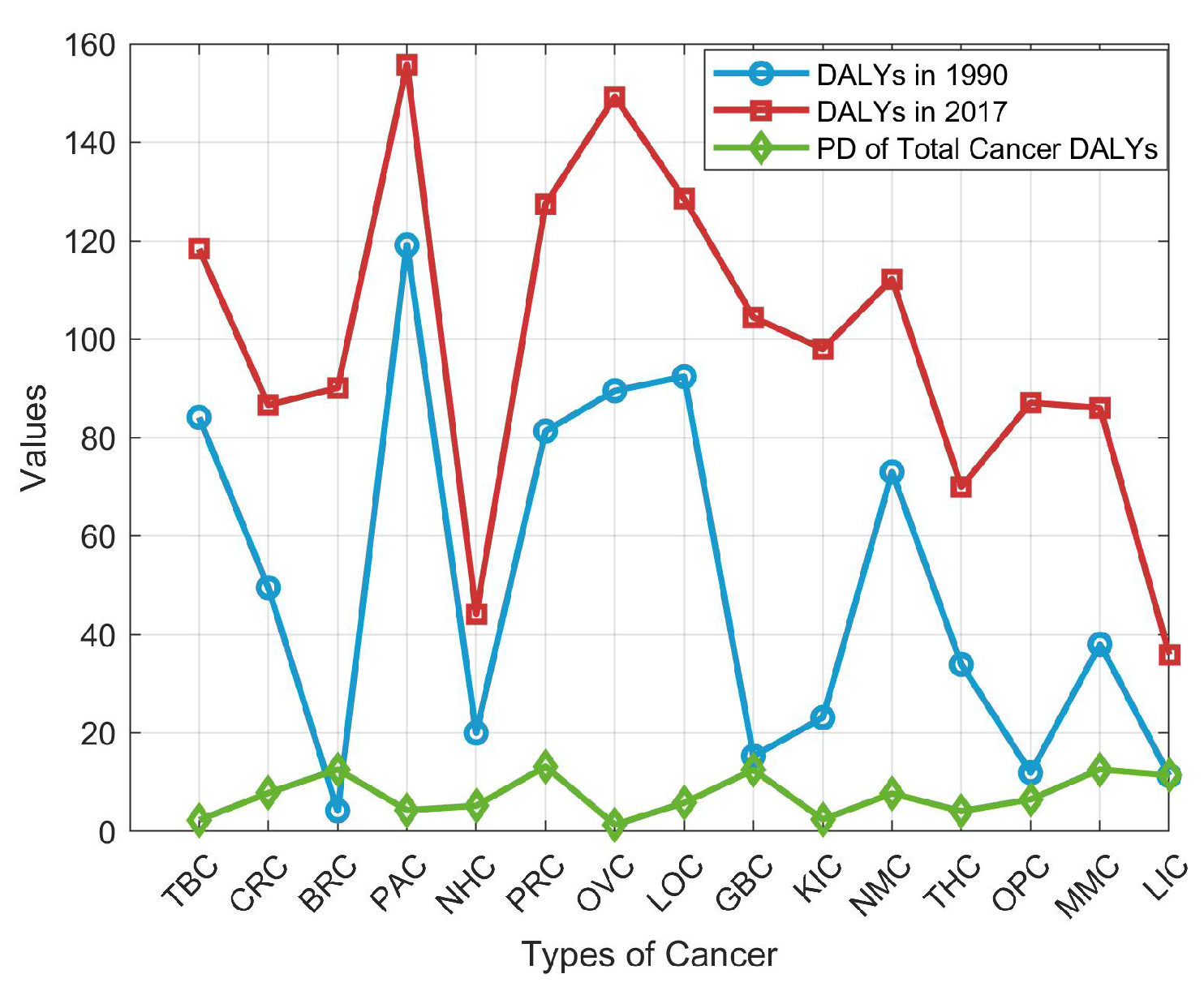
Figure 3.
Graphics of cancer data.
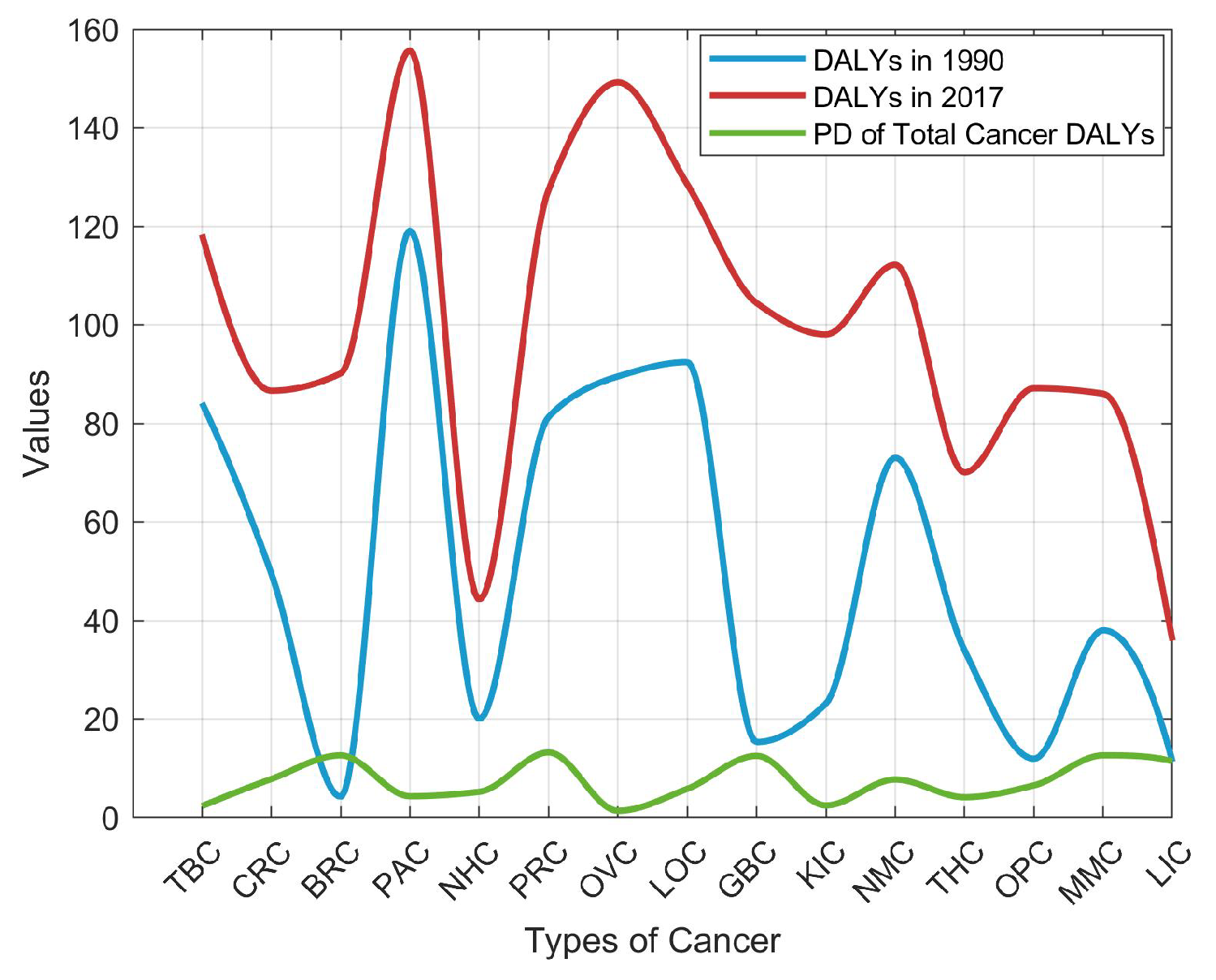
Figure 4.
DALYs and ratios of cancer types.
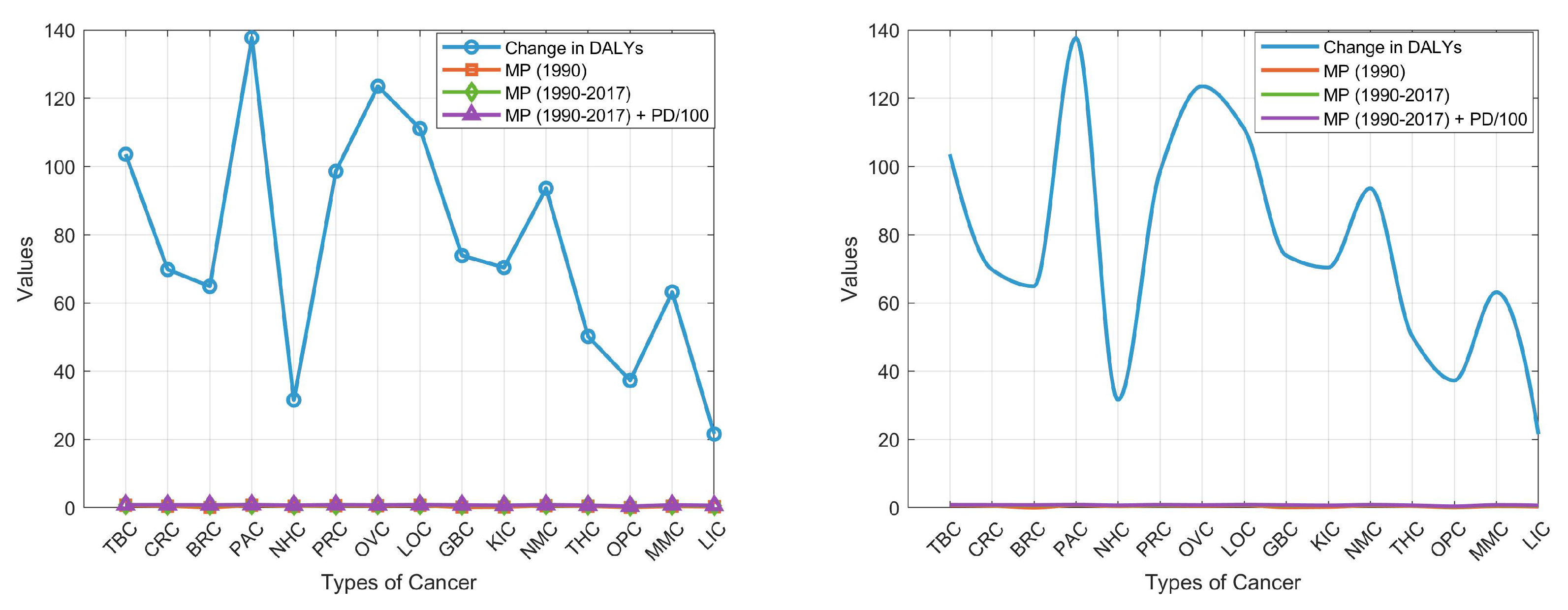
Figure 6.
Fuzzy graph showing connections and weights.
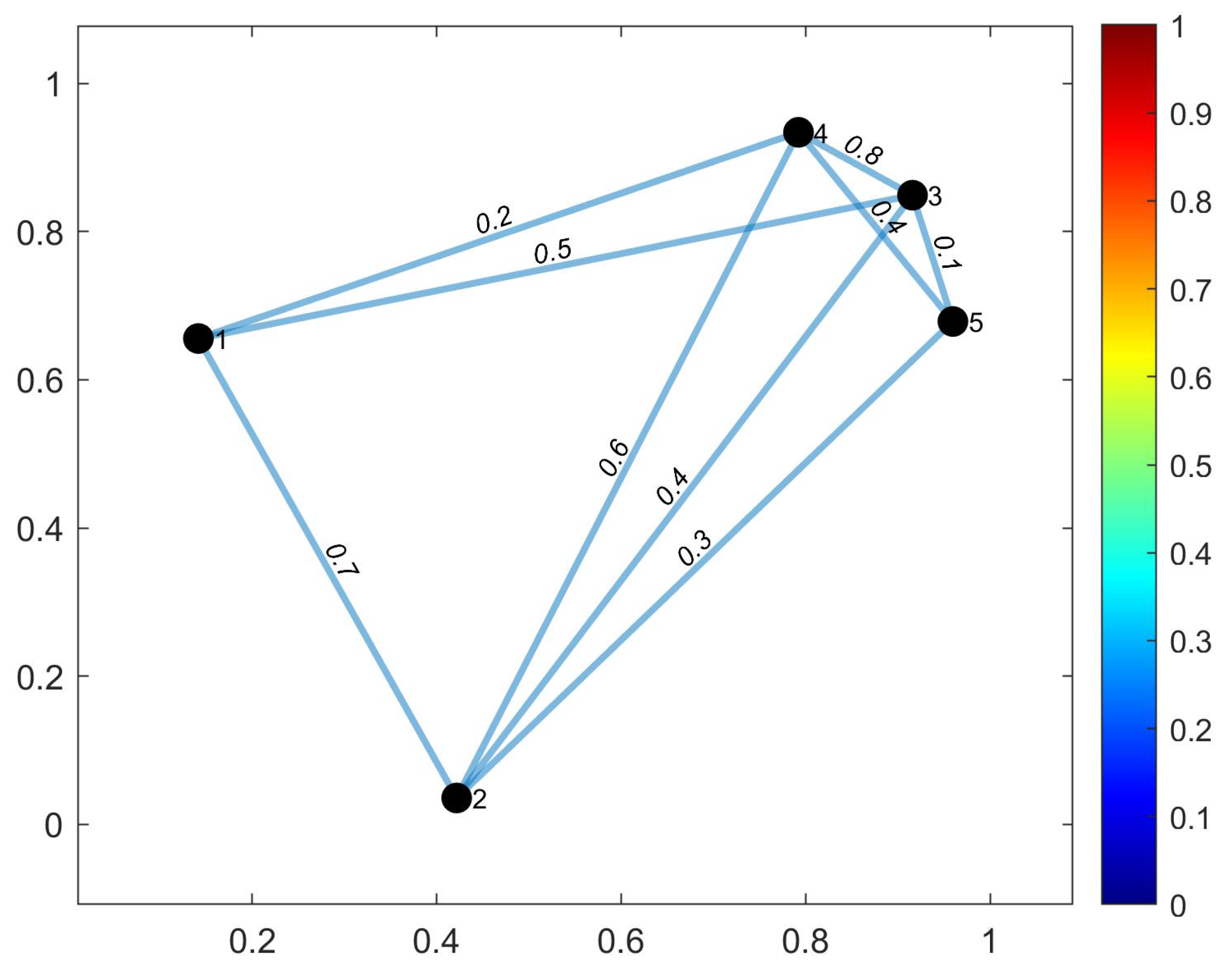
Figure 7.
Edge contributions to fuzzy Sombor index.
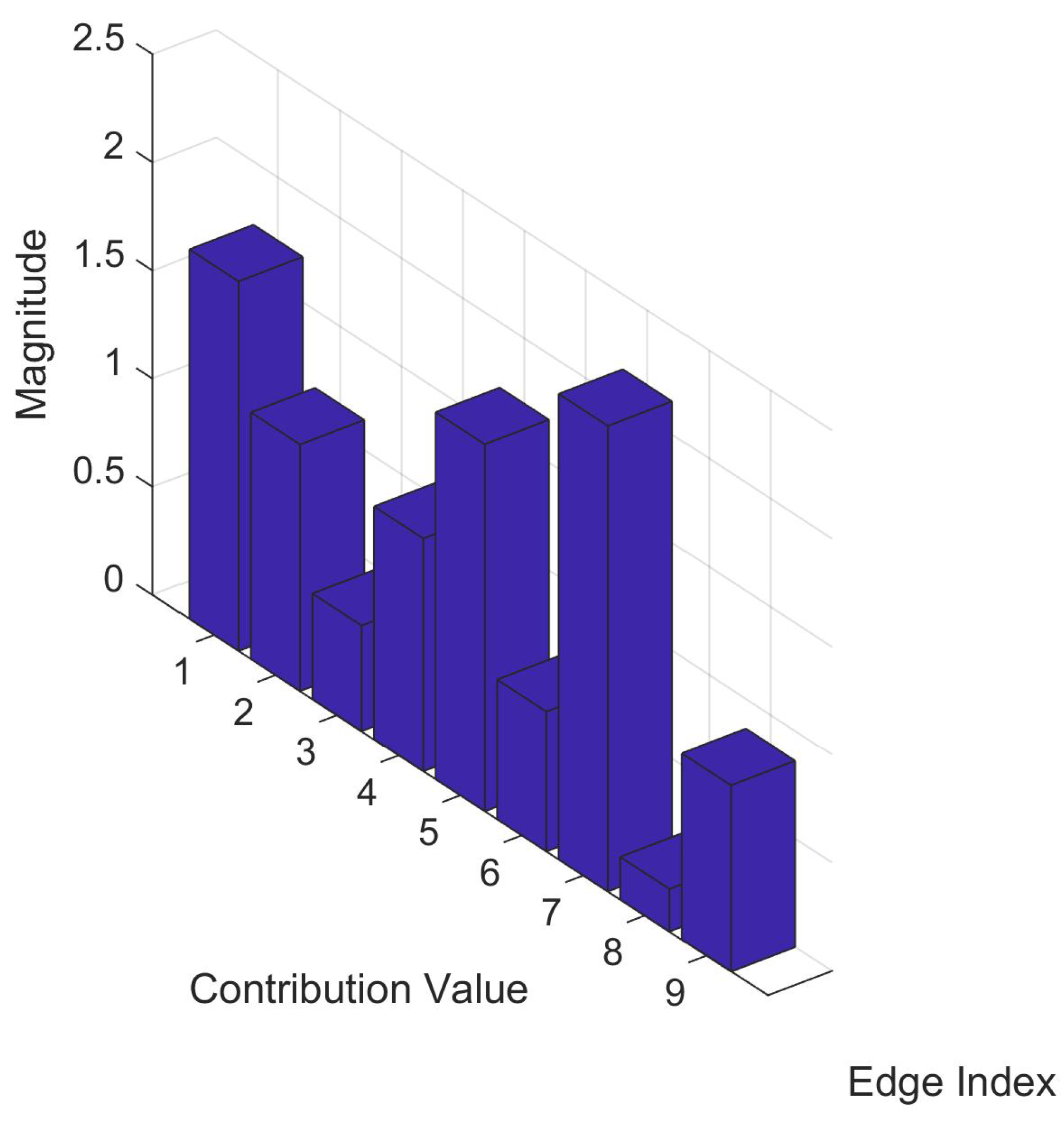
Figure 9.
Combination (bar + line) chart.
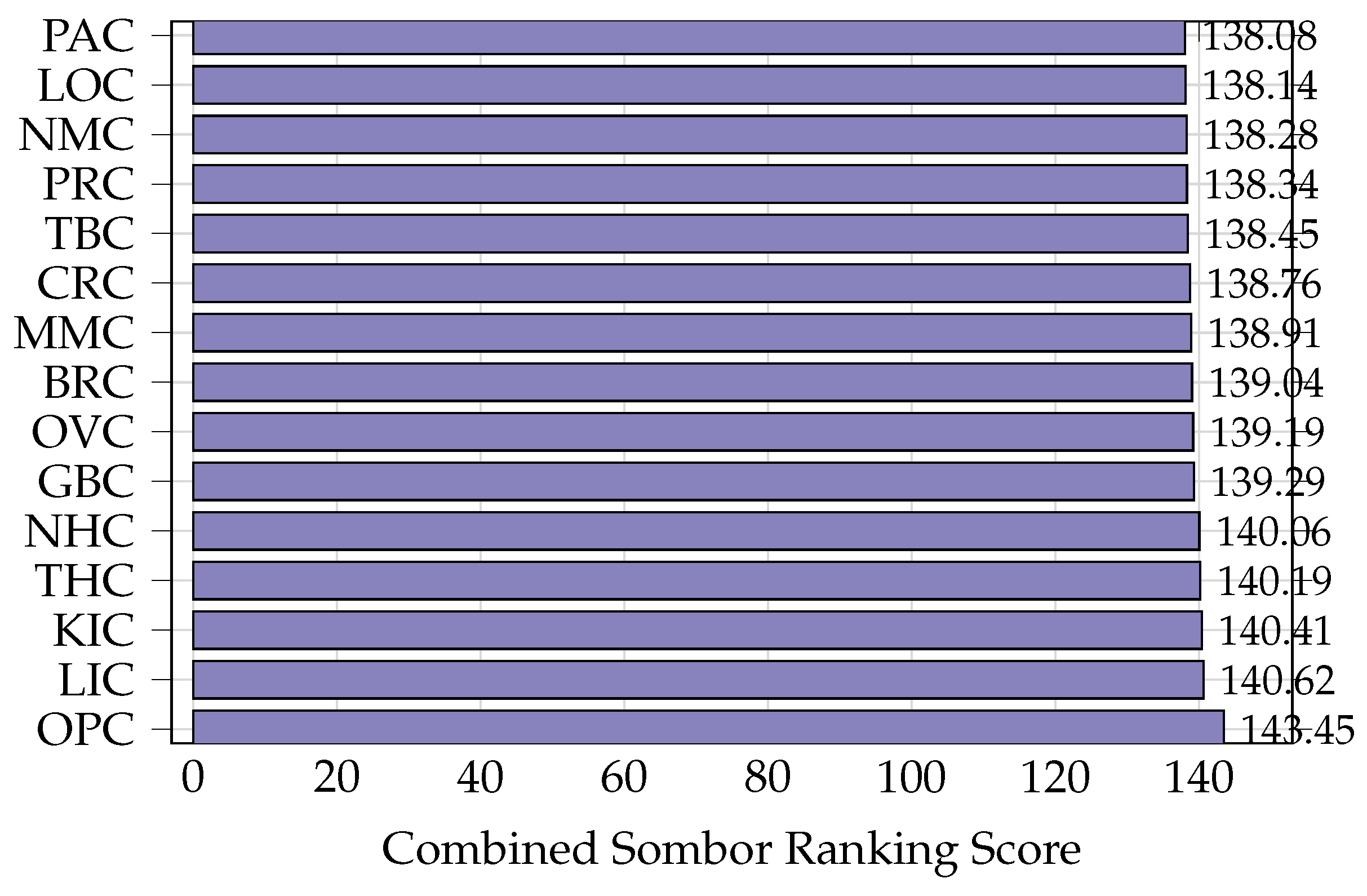
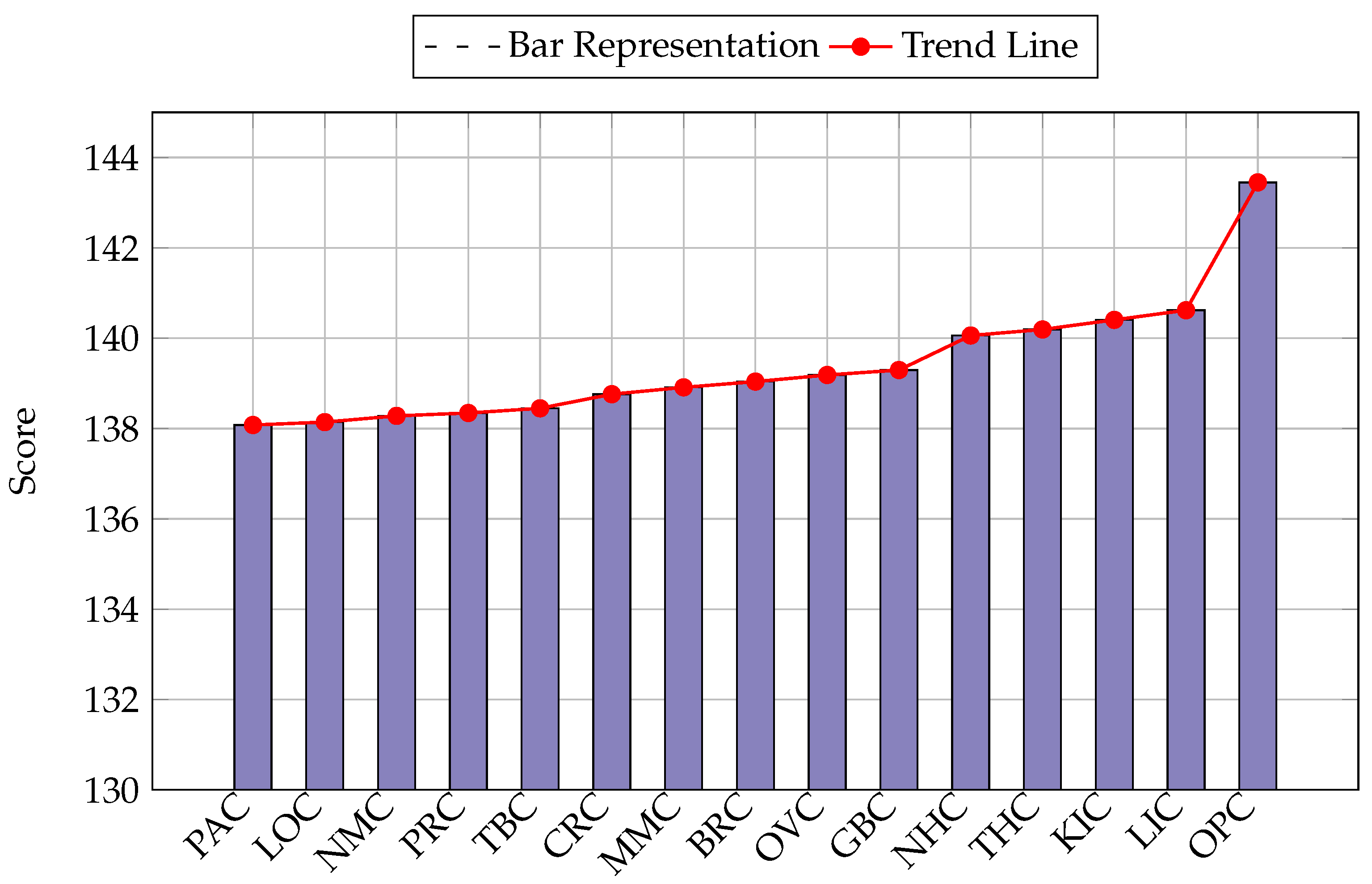
Table 1.
From 1990 to 2017, the report contains data on the most concerning types of cancer.
| Types of Cancer | Change in all age | Change in all age | PD of total cancer DALYs |
|---|---|---|---|
| DALYs rates Mean | DALYs rates Mean | ||
| in (MPI 1990) | in (MPI 2017) | ||
| Tracheal, bronchus, | |||
| and lung cancer (TBC) | |||
| Colon and rectum | |||
| cancer (CRC) | |||
| Breast cancer | |||
| (BRC) | |||
| Pancreatic cancer | |||
| (PAC) | |||
| Non-Hodgkin lymphoma | |||
| (NHC) | 20 | ||
| Prostate cancer (PRC) | |||
| Ovarian cancer (OVC) | |||
| Lip and oral cavity | |||
| cancer (LOC) | |||
| Gallbladder and biliary | |||
| tract cancer (GBC) | |||
| Kidney cancer (KIC) | 98 | ||
| Non-melanoma skin | |||
| cancer (NMC) | 73 | ||
| Thyroid cancer (THC) | 70 | ||
| Other pharynx | |||
| cancer (OPC) | |||
| Multiple myeloma cancer | |||
| (MMC) | 38 | 86 | |
| Liver cancer (LIC) |
Table 4.
The Sombor index values for every kind of cancer that poses a threat to life.
| Types of Cancer | SO(F(Cancer)) | |
|---|---|---|
| Tracheal, bronchus, and lung cancer (TBC) | ||
| Colon and Rectum Cancer (CRC) | ||
| Breast Cancer(BRC) | ||
| Pancreatic Cancer(PAC) | ||
| Non-Hodgkin lymphoma(NHC) | ||
| Prostate Cancer (PRC) | ||
| Ovarian Cancer (OVC) | ||
| Lip and oral cavity cancer(LOC) | ||
| Gallbladder and biliary tract cancer(GBC) | ||
| Kidney cancer (KIC) | ||
| Non-melanoma skin cancer(NMC) | ||
| Thyroid cancer (THC) | ||
| Other pharynx cancer (OPC) | ||
| Multiple myeloma cancer(MMC) | ||
| Liver cancer (LIC) |
Table 5.
Edge contributions to the fuzzy Sombor index.
| Node i | 1 | 1 | 1 | 2 | 2 | 2 | 3 | 3 | 4 |
|---|---|---|---|---|---|---|---|---|---|
| Node j | 2 | 3 | 4 | 3 | 4 | 5 | 4 | 5 | 5 |
| Contribution | 2.3545 | 1.7943 | 0.7483 | 1.6769 | 2.0396 | 0.5282 | 2.1984 | 0.1896 | 0.6581 |
Disclaimer/Publisher’s Note: The statements, opinions and data contained in all publications are solely those of the individual author(s) and contributor(s) and not of MDPI and/or the editor(s). MDPI and/or the editor(s) disclaim responsibility for any injury to people or property resulting from any ideas, methods, instructions or products referred to in the content. |
© 2026 by the authors. Licensee MDPI, Basel, Switzerland. This article is an open access article distributed under the terms and conditions of the Creative Commons Attribution (CC BY) license (http://creativecommons.org/licenses/by/4.0/).
Copyright: This open access article is published under a Creative Commons CC BY 4.0 license, which permit the free download, distribution, and reuse, provided that the author and preprint are cited in any reuse.